




Abstract
Social experience is often considered to be a key motivating factor for engaging with leisure activities and attendance at music concerts is no exception. Despite this, until recently, there has been limited interest in measuring the collective or social experience of live concerts in a quantitative way. Therefore, we created and validated a new measure of the social experience of a concert. In a pilot study, 103 participants were recruited across two concert settings. An extensive list of 65 items was used to measure the social experience of a concert. Based on the results, the measurement scale was reduced to 22 items.
In the main study, a further 113 participants were recruited at several concerts from a weekly series with a range of musical genres. Participants provided self-ratings of their social experience, emotional response (GEMIAC), enjoyment and demographic information in a paper survey. Based on the results of exploratory and confirmatory factor analysis we were able to reduce the number of items in the Social Experience of a Concert Scales (SECS) to 17 validated statements representing a five-factor model: Depth of Processing, Attention, Solidarity, Satisfaction, and Self-Definition. Using MANOVA, we tested the influence of these factors on the emotional response of participants to the music and found that they are not significant predictors; however, the social experience of a concert was found to be a significant predictor of enjoyment.
We have developed and validated the first quantitative measure of the social experience of a Western art music concert. Our results also suggest that the emotional response to music and the overall experience of a concert are separate and that only the latter can be influenced by the social experience of a concert.
Introduction
“The close relationship between social and musical enjoyment … is at the heart of concert attendance” (Pitts, 2005, p. 269). Across the sector, audiences of Western art music are generally decreasing (Glinkowski et al., 2004) and performers, curators, and venues are often seeking to identify what separates a live performance from other music engagement in order to develop and expand their audience. A primary function of music has been to foster group solidarity and social bonding by promoting synchronization of movement and affective states (Huron, 2001). One key aspect of live music consumption is that is typically occurs in a shared setting with others, and while this is not unique to live events, it could be an important indicator of why people enjoy engaging with music in this way. Historically, people would only be able to access music communally (Zangwill, 2012); however, today music consumption takes place in many different contexts, some of which are still social and occur in the presence of others, and others which are solitary (North & Hargreaves, 2008). This contrast, and the accessibility of music in the 21st century, highlights the selection to engage with shared music listening contexts. Social experience is often considered to be a key motivating factor for engaging with leisure activities (Beard & Ragheb, 1983) and the enjoyment of these experience and co-attendance at music concerts is no exception (Kulczynski et al., 2016; Baker, 2000; Burland & Pitts, 2014). Despite this, until recently, there has been limited interest in modelling and measuring the collective or social experience of live concerts in a quantitative way with researchers and industry experts relying on qualitative research findings to justify the claim (e.g. Dearn & Price, 2016; Dobson, 2010; O’Sullivan, 2009). In this study we have addressed this omission by creating and validating a quantitative scale to measure the social experience of a concert and considered the ways in which the presence of others influences the enjoyment and emotional experience of a live music performance. The new insights achieved in this article will not only create a psychometrically validated scale that can capture the social experience at a live Western art music concert, but also contextualizes it amongst other relevant variables such as enjoyment, demographic variables, and emotional responses to the music.
Social experience and emotional responses to music
It has been found that people often choose to engage with music because it moves them (Garrido & Davidson, 2013; Saarikallio, 2008) or induces an emotion (Garrido & Schubert, 2011; Lonsdale & North, 2011; Vuoskoski & Eerola, 2017). The ability of music to induce emotion in a listener has been widely researched and examined. An emotion is understood to be a brief episode which is characterized by the synchronization of expression, activation, feelings, and arousal in response to a specific stimulus (Scherer, 2005). Scherer and Zentner (2001) illustrate that an experienced emotion is the result of an interaction between structural, performance, listener, and contextual features. The latter can be conceived as the setting where the music is being consumed; for example, are people engaging with music at home, or in a theatre or stadium? Are people alone or with others when they are listening to the music? Is it live or recorded or music? The implication of this is that emotions can be altered by the presence of others as this will be a factor in the contextual features.
Despite these theoretical indicators, it has been found that listening in a group (compared to listening in solitude) does not necessary lead to more intense emotional responses, perhaps due to less concentration on the music. Some studies have concluded that this could be a result of co-presence distracting the listener from concentrating on the emotional content of music (Egermann et al., 2011). Other research has shown that the influence of others has been found to induce more intense emotional responses if they are known to the listener (Liljeström et al., 2013). From this research it can be seen that the presence of others influences emotional responses to music. While these studies achieved high levels of control, the listening contexts in which they were conducted display poor ecological validity. The conclusions are also largely based on supposition since these studies did not assess the social experience of participants directly, but instead inferred a connection. Egermann et al. (2011) assumed that the other members of the pseudo-audience had distracted their fellow listeners from the music, thereby reducing the emotional salience of the experience at the expense of a general increase in arousal caused by the presence of others due to mechanisms such as evaluation apprehension (Cottrell et al., 1968) or distraction conflict (Baron, 1986). However, since neither study sought to identify the mechanisms responsible for their findings it cannot be concluded that the presence of others was indeed the cause of their results.
Garrido and Macritchie (2020) made some progress in testing the effect of others on emotion contagion during music listening in a more quantitative way. To measure the level of influence the people around a participant during a music performance had exerted, they presented three statements with which participants were asked to rate their agreement: “I felt like I was in my own private bubble” (Garrido & Macritchie, 2020, p. 160), “The response of other people in the audience amplified my own reaction” (p. 163) and “I felt compelled to restrain my emotional response” (p. 163). In this study, they also measured the social bonding of audience members using one factor of a tool used to assess the intrinsic impacts of live performance, which was comprised of four items, only one of which pertained to the audience: “To what extent did you feel a sense of belonging or connectedness with the rest of the audience?” (Brown & Novak, 2007, p. 56). The data collected from these items has allowed the authors to achieve meaningful results and conclusions, including the establishment of a link between social bonding and attendance at enhancement events. However, items written by Garrido and Macritchie (2020) were not validated and the social bonding dimension from Brown and Novak (2007) might not adequately test the collective experience of a concert. Therefore, in our study we have addressed this limitation by psychometrically validating a measurement tool that captured this information.
Social experiences and enjoyment of concerts
Enjoyment can be defined as taking pleasure from something. It is similar, but not synonymous with happiness, in part due to the duration of the experience: happiness may be more abiding than enjoyment and not as tied to a specific context. Enjoyment has been found to be a motivation for attendance at, and a common response to, live musical performance, in part due to the presence of others (Baker, 2000; Dearn & Price, 2016). In their research on chamber music festival goers, Pitts (2005) discussed the positive effects of being able to see other audience members are responding to the music. One of their participants responded that “occasionally you see somebody with a slight smile . . . their involvement adds to your joy, your enjoyment” (Pitts, 2005, p. 260). To the best of our knowledge, there is no other research which specifically tests the social experience of a concert and the overall enjoyment of this type of live event.
Devising a quantitative measure of social experience
To the best of our knowledge, there has been no previous attempt to capture the social experience of a live concert using a validated measurement instrument. In order to model whether the social experience of a live Western art music concert predicts the emotional response to the music or the enjoyment of the event, we employed two key theories to derive a suitable model for the social experience: The attention paid to other members of the audience, based on parasocial interaction theory (Horton & Wohl, 1956; Rubin & McHugh, 1987; Schramm, 2015), and the extent to which an individual identifies with other members of the audience, based on in-group theory (Alport, 1958; Sherif, 2015; Tajfel et al., 1979; Tajfel, 1981). Both theories will be detailed in the following sections.
Parasocial interaction
A parasocial interaction is a term originally used to describe the interaction between a member of an audience and a television persona; either a character or a real person (Horton & Wohl, 1956). These relationships are characterized by a lack of reciprocity whereby there is a one-directional flow of information: from the media persona to the viewer. Regular viewers can feel that they know or understand a character, despite the interaction being nondialectical. We posit that the interaction between members of the audience fall under this title since there is a one-way flow of information, albeit largely non-verbal due to the convention not to interact during a Western art music concert (Wilson et al., 2014). In many ways parasocial relationships are easier and less demanding than social relationships as there is no sense of permanency or obligation of effort on the part of the viewer as they can withdraw at any moment by choosing to stop watching the character on the screen. It has been found that there are also similarities between parasocial relationships and social relationships (Turner, 1993; Giles, 2002; Jin & Park, 2009); for example, Turner (1993) introduced the term “homophily” to describe the propensity for friendships to form between individuals with commonalities which is also true for parasocial and social relationships. It is important to differentiate parasocial interactions and parasocial relationships. An interaction can be considered to momentary and based on the specific situation in which an individual is exposed to the object of their attention whereas a relationship would be considered to develop over a period of time through repeated exposure (Giles, 2002).
To our knowledge, parasocial interaction theory has not yet been applied to audiences of live classical concerts but, as stated above, the defining features of this type of relationship can be found in a conventional Western art music concert. Typically, audiences sit, facing the stage and, despite being surrounded by people, there is limited interaction (Wilson et al., 2014). This does not mean that audiences should be considered passive in this context, any live event is the culmination of active interactions between performers, audience members, and the environment (Toelle & Sloboda, 2021). An individual can observe non-verbal behaviors and characteristics exhibited by other members of the audience around them, but not provide an immediate response or feedback. This one-directional communication typifies a parasocial relationship and as such, we have decided to adapt a measure of parasocial interaction to explore the level of intra-audience attention. The PSI Process Scale, in its entirety, consists of 14 subscales, each with eight separate items, six to measure cognitive parasocial responses, such as attention allocation, and evaluation of a persona and their actions; three to measure behavioral parasocial responses, including verbal and non-verbal behaviors, and intentions; and three to measure affective parasocial responses, such as sympathy, antipathy, empathy, and emotion contagion (Schramm & Hartmann, 2019). The specific items consist of statements in which the term “persona” can be replaced with the object of focus, in this case: the audience. For example, “I formed only a fleeting impression of (Persona)” (Schramm & Hartmann, 2019, p. 2) becomes “I formed only a fleeting impression of the audience”.
Group belonging
In addition to parasocial interaction theory, it should also be considered whether people feel that other attendees at a live event enhance their experience, detract from it, or if people simply do not consider the presence of others to be important. To do this, we looked for ways to assess the degree to which an individual pays attention to others, and the extent to which they feel that being members of an audience, and sharing an experience bonds them. The theory of social identity suggests that the more an individual identifies with a group of people, the greater the attention they will pay to them and also the more influenced they will be by other members of the group (Tajfel et al., 1979). Social identity is based on how an individual's membership in a particular group influences their sense of who they are. Social groups, such as social class, sports team, celebrity fandom, race, gender, nationality, family, gang etc., of which an individual may identify with many, may be considered to be a source of pride and self-esteem which is borne from the sense of belonging an individual experiences when they are in that group. By categorizing the world into “us” (in-group) and “them” (out-group) people make sense of society and establish their own social identity. This process is thought to be based on the cognitive process of grouping things that are similar to reduce the cognitive load of retaining and recalling all stimuli that are experienced (Gobet et al., 2001).
In order to measure this phenomenon, we have employed the In-Group Identification Measure (Leach et al., 2008) which was developed using a hierarchical, multicomponent method of in-group identification. The measure has a hierarchy of segments based on two general dimensions: Self-definition, encompassing the subscales of individual self-stereotyping, in-group homogeneity, and Self-investment, including the subscales of solidarity, satisfaction, and centrality. Individual self-stereotyping refers to the degree to which a person identifies with the group and how similar to the prototypical member of a group they perceive themself to be (Tajfel et al., 1979; Turner, 1993). In-group homogeneity is based on the perceived similarity between other group members (Doosje et al., 1995). Solidarity is predicated on the assumption that those who most strongly identify with a group will also be most likely to feel bonded with other members (Lewin, 1948) and satisfaction measures the positive or negative experience of belonging to a group (Tajfel et al., 1979; Tajfel, 1981). Finally, centrality describes the subjective importance an individual places on their membership in a group in context of their own identity (Turner et al., 1994).
The conception of In-Group Identification Measure (IGIM) was theoretically informed, with each item relating to previous scales and research; subsequently, through a series of seven studies, the IGIM was reduced and validated (Leach et al., 2008). The measure was intended to halt the proliferation of new multicomponent scales by assimilating the discreet components into one general framework, thus providing greater validity and potential for inter-study comparisons. The series of validation studies show significant correlations with the Other In Self (OIS, Aron et al., 1992) and the Relationship Closeness Inventory (RCI, Berscheid et al., 2004; Berscheid et al., 1989) and for these reasons we chose to use the IGIM in this research. However, since the scale has not previously been employed in a concert context, we also validated its use in this context.
Personal and situational influences of the social experience of a live concert
While the validation of a measurement instrument which is shown to capture differences in the social experience is the focus of this article, we also consider the other factors which might influence an individual's experience. We have categorized these in two main ways: the first is personal or demographic factors that relate specifically to the individual; and the second considers situational or contextual factors, which are the features of the concert. These are discussed in more detail below.
Self-definition is an important factor in the process of forming a social bond with other members of a group and is based on an individual's ability to recognize that other members of a group are similar to each other (homogeneity) and/or themself (individual self-stereotyping). The typical criteria for making these judgements are those that are observable; notably, age (Barak et al., 2001). It follows that if an individual observes members of a group who are similar in age to each other and to themself, they may experience greater self-definition.
Of course, not all attributes are observable, but may still have an influence on the social experience; for example, musical training. It is well documented that participation in musical activity facilitates social bonding (Freeman, 2000; Kreutz, 2014; Savage et al., 2020; Tarr et al., 2014), and it has also been found that cultural familiarity and musical training elicit greater interpersonal closeness (Stupacher et al., 2020). It is not possible, in most cases, to appraise musical training in others based on appearance alone, and some prior knowledge of others would be necessary in order to determine self-definition. Prior knowledge may come from attending the concert with others or recognizing others once you arrive. Typically, individuals will attend concerts as a social function, often with family, friends, or colleagues (Boyle, 2007); however, this is not a rule and some attendees will do so alone. To the best of our knowledge, there is no previous research on the effect this can have on the social experience of a concert. However, previous research has shown that shared experiences tend to be amplified (Boothby et al., 2014; Echterhoff et al., 2009; Shteynberg & Apfelbaum, 2013). Participants’ solitary or co-attendance at the concert was captured by a single item in the questionnaire. This would be an example of a contextual factor which may influence the extent to which they experience a bond with the audience.
Other contextual factors are the event parameters, many of which have been found to have an influence on the social experience. These include the music being performed (Boer et al., 2011; Trehub et al., 2015), the staging (Dearn & Price, 2016), the arrangement of seating (Pitts et al., 2013), the level of audience interaction with each other and the performer(s) (Lee et al., 2019; Loxley, 1983; Pitts, 2005; Shin et al., 2019), the venue (Dobson, 2008), the style of presentation, and any other curatorial aspects of a live music event. Each of these parameters can influence the extent to which an individual pays attention to those around them and thus potentially be used to predict the strength of their social experience.
Aims and research questions
The aim of this research is to develop, validate, and apply a measurement tool that can be used to quantitatively measure the social experience of Western art music concerts.
Aims
Develop an efficient scale which could be utilized in an ecologically valid Western art music concert setting (Schatz et al., 2012; Sinickas, 2007) where participants usually are only willing to invest a short amount of time completing questionnaires.
Explore if there are demographic or contextual variables that can predict the intensity of the social experience of a live concert, and whether the social experience can be used to predict participants’ emotional response to, and enjoyment, of the concert.
This paper contains exploratory research on a hitherto unexplored topic and as such we do not have enough prior knowledge to formulate a-priori hypotheses. Therefore, we present the following exploratory research questions (RQ):
Pilot study
To test the questionnaires and first research question (RQ1: Can theories of parasocial interaction and in-group theory be applied to audiences of Western art music concerts?) the pilot study was conducted in two contrasting concert settings: the first in a controlled recital-experiment environment and subsequently in a more ecologically valid concert setting.
Methods
Ethics compliance
All participants who took part in this study gave informed, written consent in keeping with the ethical guidelines from the University of York Arts and Humanities Ethics Committee who formally approved this study. Each participant had the right to leave the study at any time. All data was collected and stored anonymously, and participants have given permission for their responses to be used in subsequent presentation and publication of the results. Participants received a copy of the information sheet and the University of York GDPR statement at the start of the study.
Participants
Concert 1
Participants were recruited through email and posters. 50 participants were recruited in total; however, one participant failed to complete the study and has been excluded from all analysis leaving 49 participants (female = 36, male = 12, prefer not to say = 1). The participants had an age range of 18–50 years (M = 24.63). 49% of the participants reported that English was not their first language, with 6.1% speaking Chinese, 6.1% Greek, 6.1% Spanish, 4.1% French, 4.1% Persian, and then 2% considering Bulgarian, Dutch, German, Hindi, Japanese, Latvian, Portuguese, Sesotho, Turkish, or Ukrainian to be their first language respectively. One participant declined to answer this question. No participants were excluded from the study due to linguistic incomprehension.
All participants were university students at the at the time of the study, 42.9% were undergraduates, 34.7% were taught postgraduate students, and 22.4% were postgraduate research students. 55.1% of participants reported that they had no musical training, 12.2% said they were university music students, 28.6% were self-reported amateur musicians, and 4.1% were professional musicians. Of the 49.9% who had musical training, 18.3% of the participants played piano.
Concert 2
Participants were recruited through an email sent to members of the venue's mailing list who had already purchased tickets for the concert inviting them to participate in the study. The email contained information on why they had been invited to take part, and what they would have to do. Participants were also invited to take part in the study in person, upon arrival at the venue for the evening's performance. All participants were given the option of completing an online or paper and pencil version of the questionnaire.
A total of 53 participants took part in this study, 21 completed the questionnaire online and 32 completed a paper copy (female = 25, male = 20, other = 1, did not respond = 7). The participants had an age range of 24–82 years (M = 66.14, n = 53). 7.5% of participants reported having A levels or equivalent as their highest level of education, 18.9% had an undergraduate degree, 50.9% had a postgraduate qualification (masters, teaching qualification etc.), 5.7% had vocational qualifications, 1.9% selected “other” as their highest qualification, and 15.1% declined to answer the question (n = 45). This is a highly qualified audience which is not representative of the nation but may be representative of current audiences of Western art music (Roose, 2008). 64.15% of the sample were retired (n = 53). 50.9% of the participants reported having no musical training, 28.3% were self-reported amateur musicians, 7.5% were professional musicians, and 13.2% declined to answer (n = 46).
Musical stimuli
Concert 1
The music used in the pilot test consisted of a live performance of four, short, Western art music piano pieces which were chosen to be stereotypically representative of two happy and two sad movements based on key, tempo, melodic structure and dynamics (Gabrielsson & Juslin, 1996). The pieces were Allegretto Scherzando from Arabesque No. 2 by Debussy (1888–1891), the first movement of Beethoven's Piano Sonata No.14, more commonly known as The Moonlight Sonata (1801), Nocturne No. 20 by Chopin (1870), and the first movement of Mozart's Piano Sonata No.16 (1788). The pieces are listed here in the order in which they were presented in the study. The pieces were performed live by a professional pianist.
Well known pieces were selected deliberately since the study design required participants to remember how they felt during each piece until the end of the concert, at which time they reported their subjective responses to them. Participants were given a program with the title and common names of each piece clearly stated to aid their memory at the end of the concert.
Concert 2
The musical stimuli were presented as a live orchestral performance and the concert was programmed as part of the BBC 3 Free Thinking Festival. The musical stimuli included Violin Concerto No. 3 in G major, K. 216 by Mozart in 2775, then an interval and then Symphony No.6 in A major, composed in 1881 by Bruckner. These were played, in full, by the Royal Northern Sinfonia.
Self-reports
Concert 1
At the end of the concert, once all four pieces had been performed, participants were asked to complete a questionnaire presented in Qualtrics on iPads. The questionnaire was separated into four sections for each piece with the title of the piece clearly displayed on the pages relating to each. Participants were given a program with the title and common names of each piece clearly stated to aid their memory at the end of the concert. The subjective emotional responses of the participants were measured using two sliders from negative five to positive five, measuring arousal and valence respectively.
Concert 2
Self-reports were produced by the completion of two separate questionnaires, one during the interval relating to the three movements of Mozart's Violin Concerto and the second, at the end of the concert, regarding the four movements of Bruckner's Symphony. This decision was made to alleviate the memory demands on participants as to recall how they felt in the early movements of the Mozart concerto by the end of the whole concert is unrealistic, especially if they were not familiar with the music. Participants could select whether to complete the questionnaire using a link to an online Qualtrics on their own smart device or on a printed copy of the questionnaire which we gave them at the start of the concert and asked them to hand back at the end of the evening.
The first questionnaire, to be completed during the interval, contained an instruction page and then three sections relating to the three movements of Mozart's concerto, in which participants rated their familiarity with, and preference for, the movement on a scale from negative five to positive five. Subsequently, they were asked to rate their emotion using the nine item Geneva Emotion Music Scale (GEMS9, Zentner et al., 2008).
Participants were instructed to complete the second half of the questionnaire at the end of the concert. In this section they rated familiarity, reference, and their subjective felt emotion for the four movements of Bruckner's Symphony in the same way as the first half of the questionnaire.
Measuring parasocial interaction
Concerts 1 and 2
The PSI Process Scale (Schramm & Hartmann, 2019) was used to measure the parasocial interaction within the audience. Agreement with all items was rated on a five-point Likert scale (1 = not at all, 5 = very much). Only scales perceived to be relevant to the current study were selected to ensure the questionnaire did not take participants too long to complete, thus reducing the risk of participant fatigue:
Cognitive: Persona-specific information reception (four items relating to depth of information processing and vividness of recall, e.g. “I can still remember exactly what (Persona) looked like” and four items relating to attention e.g. “(Persona) repeatedly attracted my entire attention”). Affective: Sympathy (all eight items e.g. “I found (Persona) to be likable”) and Antipathy (all eight items e.g. “I felt rather negative towards (Persona)”), and Emotion Release (four items relating to emotion induction e.g. “I occasionally reacted very emotionally towards (Persona)” and four items relating to emotion contagion e.g. “When (Persona) showed up, I forgot my own feelings and adopted his/her mood”). Behavioural: Non-verbal behaviours (four items relating to mimicry and gesture e.g. “I sometimes gestured towards (Persona)”), and Behavioural Intention (seven items, excluding “when (Persona) was visible on the screen, I was not particularly eager to turn towards him/her”) (Schramm & Hartmann, 2019, p. 8).
The total number of items presented to participants from the PSI Process Scale in this study was 51, which were presented in a random order using the randomise function in Qualtrics. When analyzing the results, the mean of each selected subscale was calculated and used in subsequent analysis, regardless of whether the subscales are cognitive, affective, or behavioural. In each subscale selected items were reverse scored.
In-Group Identification Measure
Concerts 1 and 2
We used the complete In-Group Identification Measure (IGIM, Leach et al., 2008) of 14 items, which were presented to participants in a random order using the randomise function in Qualtrics. Participants were asked to “please rate your agreement with the following statements on a scale from 1 = strongly disagree to 7 = strongly agree”. This measure allows for the collection of more detailed data relating to an individual's perception of their own group-belonging and is specifically designed to measure closeness to a group.
Co-attendance
Concert 1 and 2
Participants were asked how many members of the audience they knew on a scale ranging from zero to five and above. They were also asked “Thinking about the members of the audience you know. Did you attend the concert with them today (e.g. you planned to come together)?”
Overall enjoyment of the concert
Concert 2
There is no agreed method of measuring enjoyment and it is typical for different disciplines to devise their own tool to ensure the test matches the stimuli, which reflects the contextual emphasis of enjoyment. We chose to measure the general enjoyment of the concert using a single item: “Please rate your overall enjoyment of this concert. On the scale below where 1 = “Did not enjoy the concert at all” and 5 = “Enjoyed the concert very much”.
Background characteristics
Concert 1 and 2
Demographic questions were included at the end of the study to assess the age, gender, level of study and year, subject of study, level of musical training, and what instrument they played if their training level was novice or higher. Participants were asked if English was their first language and if not then they were asked what they consider their first language to be. Participants also completed the Short Test of Musical Preferences (STOMP, Rentfrow & Gosling, 2003) to facilitate the ability to control for musical preference.
Procedure
A flowchart depicting the procedure of the study can be seen in Figure 1.

Flowchart depicting the procedure of the pilot and main study.
Concert 1
Participants registered on arrival, signed a consent form and received an information sheet and then chose a seat. They were then given a participant number which corresponded to their iPad number. Once everyone was seated, there was a brief verbal welcome and the music was performed. Without prompting, participants elected not to clap between each piece despite sufficient silence between them, but only at the end of the concert. This could be a result of the artificial environment of the concert experiment or an in-expert audience who were unfamiliar with the conventions of a live recital of Western art music. The musical performance lasted for approximately 20 min in total.
Participants were then invited to access the questionnaire using a short link that was included on the back of their program or they were given a paper copy to complete (n = 6). Analyses showed that there were not any differences between participants filling in the paper questionnaire and those filling in the online questionnaire.
Concert 2
Participants arrived at the venue and collected their tickets for the concert. They then came and signed in, if they had pre-registered interest, or signed up if they decided that they wanted to take part on the day. At this time, they were given the option of whether to complete the questionnaire online using their personal smart device, or on a paper copy which was provided to them by the researchers. All participants received a hard copy of the information sheet and GDPR guidelines. They then took their seat and attended the first half of the concert.
During the interval, participants completed the sections of the questionnaire relating to the three movements of the Violin Concerto by Mozart which took approximately five minutes. Participants could complete this in their seats or in the foyer and bar spaces, as they chose. They then returned to Sage Hall One and watched and listened to the second half of the concert. Finally, they completed the sections of the questionnaire relating to the symphony by Bruckner, the collective experience, and all other remaining personality, demographic, and general questions before submitting the questionnaire (online) or handing it back to the sign in table (paper). The second part of the questionnaire took 15–25 min.
Analysis
Data from the online questionnaire was downloaded from Qualtrics into SPSS and the data from the paper questionnaires was manually inputted into excel and then converted and merged with the SPSS file.
Results
The two concerts attracted audiences with different characteristics. For Concert 1, participants were primarily in attendance to take part in the study and not for the performance. 36.7% of the participants in Concert 1 knew no one else in attendance and only 28% of participants planned to attend the study with someone else. Participants from the second concert were primarily concertgoers who agreed to complete our questionnaire as an auxiliary task. They booked tickets through a box office and were assigned seating in the hall. 68% of these participants had planned to attend the concert with someone else and only 1.9% of people knew no one else in attendance.
We aimed to further abbreviate the measurement tool since brevity is more likely to result in maintained levels of concentration by the participant and reduces the risk of fatigue effects (Lauer et al., 2013; Schatz et al., 2012; Sinickas, 2007). To achieve this, we aimed to be able to present the measure on one single page, which would be approximately 20 items. Our subscale inclusion criteria were as follows:
Cronbach's alpha score of > .7, which indicates that the subscale items measure the same general construct and that the subscale has a high internal consistency (Taber, 2018). That the subscale’s mean is as close to the middle scale point as possible, which indicates the range of ratings for each item in the context of a concert.
Table 1 shows that the reliability statistics for the IGIM are all above the 0.7 threshold and although the means vary, none are outlying enough for conclusive exclusion of the subscales; therefore, the entire measure was retained in the main study. As a result, there we had space for subscales with a total of approximately six items. The subscales of the PSI had a broader range of Cronbach's alpha scores, and Sympathy, Emotion induction and Mimicry and Gesture did not meet inclusion criteria described above. Of the remaining scales, Depth of Processing and Attention are the subscales that satisfy inclusion criteria and add up to a total of eight items. The remaining 22 items (14 from the IGIM and eight from the PSI) were subsequently used further in the main study.
Scale and reliability statistics for the IGIM and PSI subscales presented to participants in the pilot study.
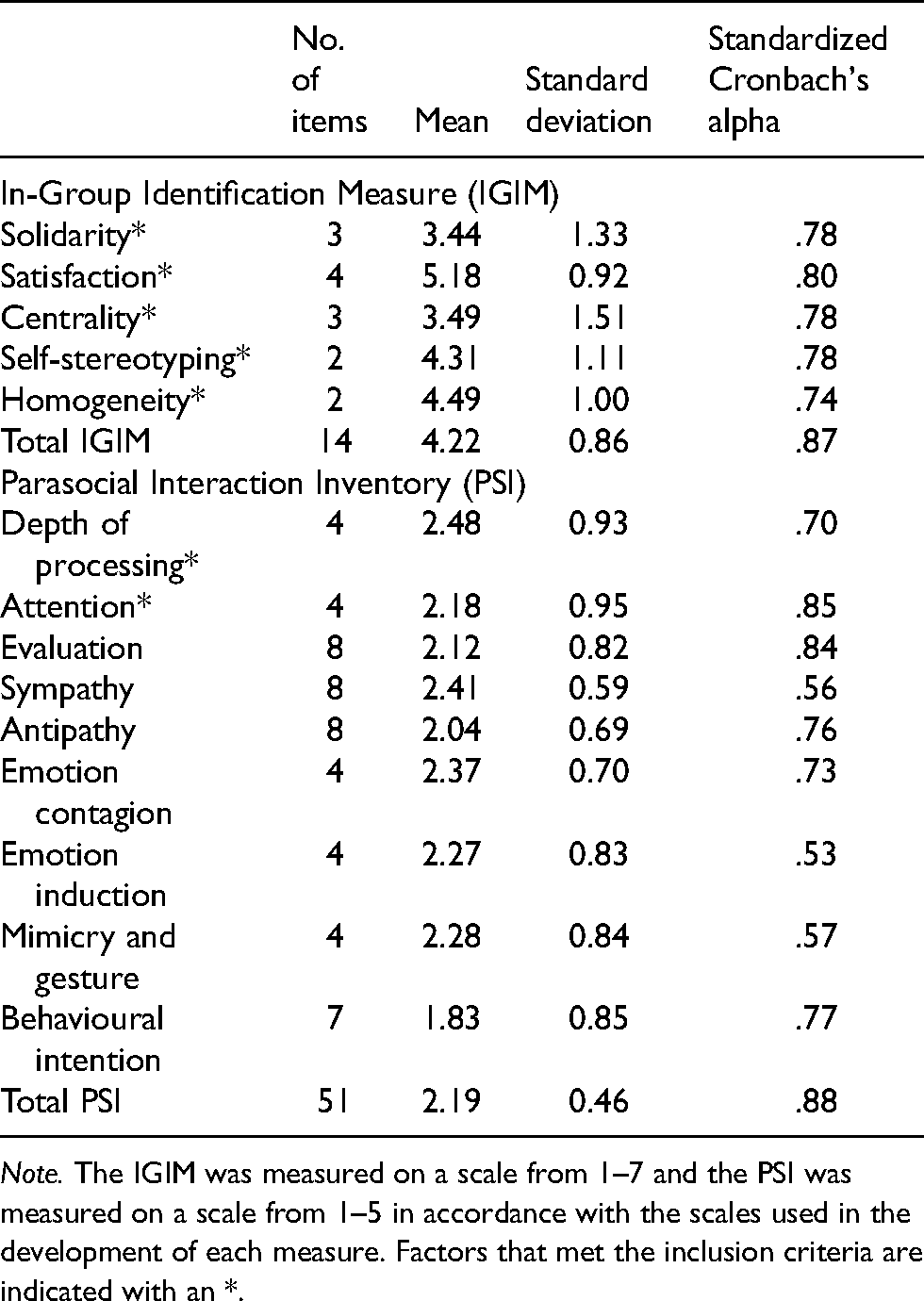
Note. The IGIM was measured on a scale from 1–7 and the PSI was measured on a scale from 1–5 in accordance with the scales used in the development of each measure. Factors that met the inclusion criteria are indicated with an *.
Discussion
The two concerts of the pilot study had many contrasting features; for example, the first concert was more controlled, and participants were invited to take part in a study whereas for Concert 2 the audience was a closer representation of a typical concert audience (Pitts, 2005). Based on the results of our analysis, we suggest that Parasocial Interaction (Horton & Wohl, 1956; Schramm & Hartmann, 2019) and In-Group theory (Alport, 1958) can be applied to social interactions within a Western art music setting (RQ1). The high internal consistency of the measures suggests that they can be used to quantify the social experience of audience members in this context and the range of results indicates the items are able to capture interindividual differences.
There are limitations in this pre-survey which should be addressed, specifically the inclusion criteria of factors in the social experience of a concert. While we have selected factors based on the criteria described above and limitations of space, there were other factors from the PSI with Cronbach's alpha scores which indicate they may also be useful when quantifying the social experience of a concert and future research should seek to test these factors further and provide evidence for inclusion in further validation analysis.
Main study
To validate the 22 items identified in the pilot study, we collected further data to apply and validate the measure in an ecologically valid setting of a Western art music concert series. Furthermore, we aimed to address the remaining research questions and model whether the social experience predicts people's response to the music performance.
Methods
For a flowchart depicting the procedure of the study see Figure 1.
Participants
Participants were recruited from attendees at the concert series. 113 participants were recruited in total (female = 59, male = 43, prefer not to say = 1, no response = 10). The participants had an age range of 16–88 years (mean = 41.9). 26% of the participants reported that English was not their first language with Chinese, Greek, French, German, Italian, Slovakian, Spanish, and Indonesian being stated as their first language. No participants were excluded from the study due to linguistic incomprehension.
Concert attendance at the York Concert Series is free or heavily subsidized for students and undergraduate music students are mandated to attend a certain number of concerts per term. 46% of the participants were students at the University of York at the time of the study, 67% of these were music students. 10% of participants reported that they had no musical training or considered themselves beginners, 47% were self-reported amateur musicians and 9% were professional musicians with the remaining 34% selecting “other”. 31% of participants reported having A levels or below as their highest level of education, 18.6% had an undergraduate degree, 39% had a postgraduate qualification (masters, teaching qualification, vocational qualification etc.) and 11.4% declined to answer the question. 61% of the participants reported coming to the concert with at least one other person.
Concerts
The data collection for the main study took place at several concerts from the York Concert Series. Table 2 provides more information on each concert.
Musical stimuli and participant numbers from the seven concerts from the main study.

Note: n = number of participants who attended each concert.
Self-reports
All responses were collected as paper and pencil surveys. Participants were asked to record which concert they were attending, rate their motivation for attending the concert, and complete demographic questions before the concert.
At the end of the concert, participants were invited to write three aspects of the concert they liked, and three they did not. They then completed the Social Experience Questionnaire, comprising the 22 items identified in the analysis of the pilot study, with agreement ratings from 1 (not at all) to 5 (very much). They also rated their overall enjoyment of the concert on the same scale. Participants were also asked to rate, on a scale from zero to five, their liking and familiarity with the repertoire performed in the concert. The subjective emotional responses of the participants were measured using the Geneva Music-Induced Affect Checklist (GEMIAC, Coutinho & Scherer, 2017). The whole questionnaire took 5–8 min before the concert and 5–15 min after the concert to complete.
Analysis
The data collected in the main study was combined with the data from the relevant items in the pilot study for validation analysis. JASP was used to conduct the factor analyses and R.studio was used to extract the factor scores. Onyx was used to create the path diagram.
Results
The process of validation follows the recommendations of best practice derived by Worthington and Whittaker (2006).
Exploring the factor structure of the Social Experience of a Concert Scale (SECS)
Since the PSI and IGIM were not previously used in a live concert setting, we ran an exploratory factor analysis (EFA) in JASP to see if the underlying structure of the factors present our social experience items matched the theoretical factors from the original scales. We used parallel analysis to identify six factors. Oblique Promax rotation was used because the factors are likely to be correlated.
The EFA model achieved a statistically significant Chi-squared result (χ2 = 289.4, p < .001) which is indicative of a poor model fit; however, since χ2 is overly sensitive with a sample of over 200 and non-normally distributed data, we ran additional fit indices. These shows that the Root Mean Square Error Approximation (RMSEA) is .07, which is in the .05–.08 range and thus indicative of a fair fit and therefore an acceptable model fit (Bentler, 1990; Bentler & Bonett, 1980; Hu & Bentler, 1999). The sampling adequacy for each variable in the model was examined using the Kaiser-Meyer-Olkin (KMO) Test. Overall, the model achieved an average but acceptable measure of sampling accuracy (MSA) of .78 (Hutcheson & Sofroniou, 1999). All individual items achieve an average MSA between .70 and .79 (See Appendix 1, items 1, 2, 3, 5, 8, 9, 15, 16), meritorious MSA between .80 and .89 (see Appendix 1, items 6, 12, 13, 14, 17), or Marvellous MSA between .90 and 1 (see Appendix 1, items 4, 7, 10, 11). This indicates that there is an acceptable degree of common variance between items and that the data is suited to dimension reduction via factor analyses, based on the conservative minimum threshold of .6
The factor loadings achieved from the EFA, are displayed in Table 3. In accordance with their original theoretical models, the resulting six factors were named: Satisfaction, Depth of Processing, Solidarity, Attention, Centrality, and Self-Stereotyping. Three items did not achieve an acceptable loading score: I often think about being in the audience (.29), The audience has a lot to be proud of (.47) and I barely noticed how the audience behaved (.35); therefore, these items were removed from further analysis. As a result, the factor of Centrality only had two remaining items which is not enough to conduct a confirmatory factor analysis (Raubenheimer, 2004) so the entire factor was removed.
Result of an EFA of the social experience items used in the main study.

Note. N = 214. Parallel analysis used to identify the number of factors. Oblique promax rotation applied. DoP = Depth of Processing. *item subsequently removed for inadequate factor score; **factor removed due to too few items loaded.
Confirming the factor structure
A confirmatory factor analysis (CFA) was run on the resulting factors and items from the EFA, with the items discussed above removed. The results can be seen in Figure 2 (see also Appendix 1). The CFA model achieved a statistically non-significant Chi-squared result (χ2 = 129.8, p = .085) which is indicative that this model is a good fit; however, since χ2 is overly sensitive with a sample of over 200 and non-normally distributed data, we ran additional fit indices again. These show that the Root Mean Square Error Approximation (RMSEA) and Standardized root mean square residual (SRMR) respectively were .032 and .075, which are under the acceptable threshold of .08 and thus indicative of an acceptable model fit (Hu & Bentler, 1999). Based on this it can be assumed that theories of parasocial interaction and social bonding can be applied to a live concert setting and be used to measure the social experience of an individual in that context. This model also shows that each of the five factors are significantly and positively correlated. The covariance of the factors can also be seen in the table in Appendix 2.
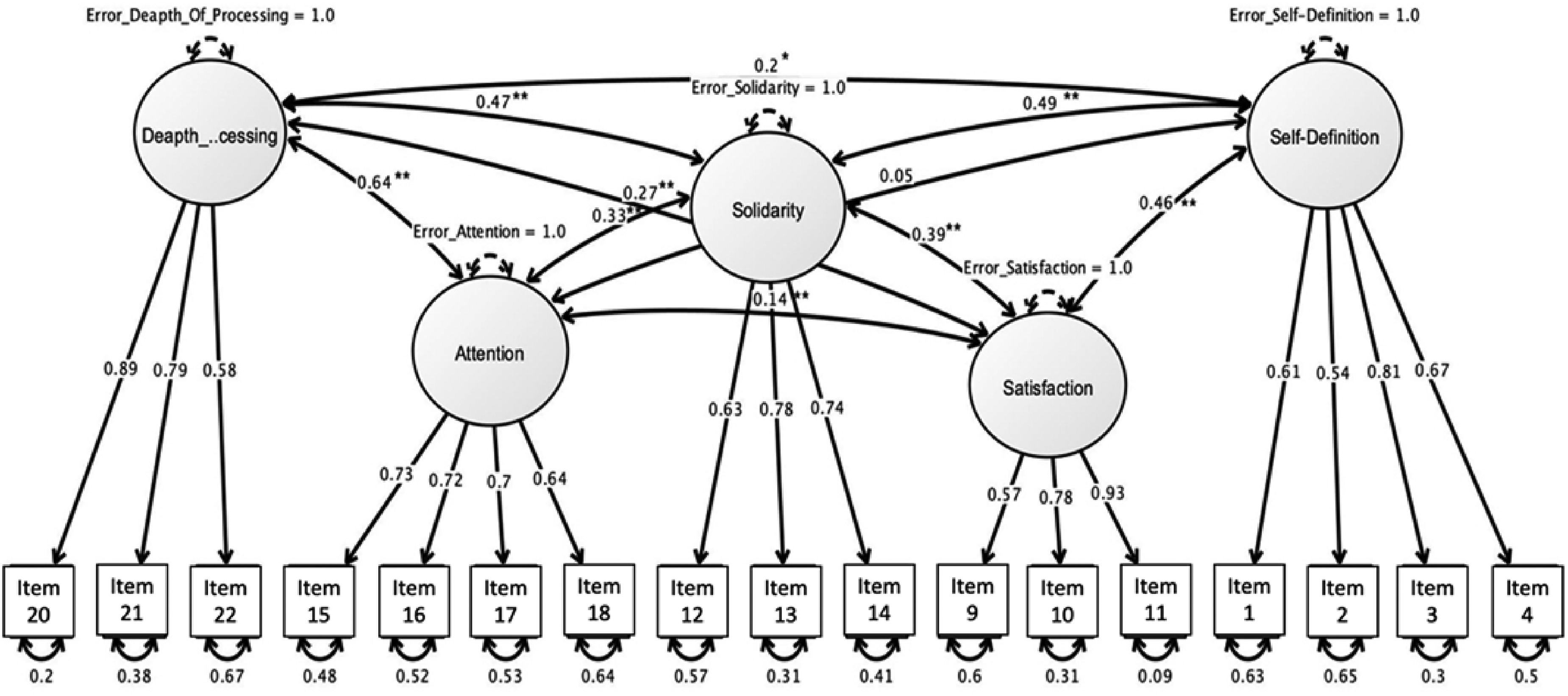
The path diagram derived from the confirmatory factor analysis with factor loading scores and factor covariance scores. The item numbers correspond with the item numbers in Table 3. Note: *p < .05, **p <.01.
Personal and situational influences on the social experience factors
Having found that many of the social factors are positively correlated, we used a multivariate analysis of variance test (MANOVA) to explore and test a range of potential predictors of a social experience (Huberty & Morris, 1989). These were the concert at which data was collected to see if the music influenced the social experience, whether participants attended the concert alone or with others, their age, highest qualification, and level of musical training. Table 4 shows the outcome of the analysis; only two-way interactions were tested to allow for meaningful interpretations to be made and any interactions that were non-significant were removed.
Between-subjects effects on the social experience factors.

Note. *p < .05, **p <.01. Only significant predictors have been included in the model.
For this analysis, age was grouped into bands which included approximately the same number of participants in each group. The categories were: 23 years old or younger (n = 62), which included the majority of the undergraduate student population who attended the concerts and took part in the studies, 23–55 (n = 53), 56–75 (n = 65), and over 75 years old (n = 12). Highest qualification was reduced to five categories: GCSE, equivalent or below (n = 43); A levels or equivalent (n = 45); Bachelor's degree (n = 31); vocational qualification or PGCE (n = 36); postgraduate qualification (n = 40).
Using Pillai's trace, as it is more robust to departures from assumptions than other multivariate tests, there was a significant effect of concert on the social experience V = .16, F(5, 93) = 3.58, p = .005, a significant effect of age on the social experience V = .21, F(5, 93), p = .001, a non-significant trend effect of co-attendance on the social experience V = .25, F(5, 93) = 3.12, p = .08 and a non-significant trend effect of musical training on the social experience V = .11, F(5, 93) = 2.21, p = .06.
F-test results for separate social experience factors are presented in in Table 4. The mean of social experience factors separated by significant independent variables can be seen in Figure 2. Satisfaction and self-definition are significantly associated by the concert variable. For example, the lecture recital, solo recital, and choral concerts elicited the highest levels of satisfaction, whereas the jazz trio, chamber vocal, and experimental electronic concerts evoked the lowest levels of satisfaction. Again, the solo recital, along with the chamber orchestral concerts resulted in the greatest self-definition and the orchestral and experimental electronic concerts achieved the lowest. Surprisingly, co-attendance was negatively associated with lower level of attention and solidarity. Furthermore, older participants reported greater depth of processing and solidarity with the audience than younger participants. Finally, the higher the level of self-reported musical training the greater the depth of processing. The variable highest qualification obtained was not a significant predictor of any of the social experience factors.
Post-hoc tests were used to explore the pairwise comparisons for the concert, age categories, and musical training and the significant differences, and those pairs that display a non-significant trend can be seen in Table 5. Consistent with the data shown in Figure 3c, the following specific pairwise comparisons between concert type are seen to be significant: the satisfaction rating compared between Solo Recital – Orchestral, Solo Recital – Experimental Electronic, Experimental Electronic – Chamber Instrumental, and the self-definition rating compared between Solo Recital – Chamber Vocal. There is non-significant trend in the satisfaction ratings in the Orchestral – Chamber Instrumental pair, and the comparison between Experimental Electronic – Choral. No pairwise comparisons in the age categories or musical training were significant.

Means of social experience factors separated by significant independent variables: A. Attention and Solidarity × co-attendance; B. Depth of processing × Musical Training; C. Satisfaction and self-definition × concert; D. Depth of processing and solidarity × age. Error bars show the 95% confidence intervals.
Significant Bonferroni post hoc pairwise comparisons.
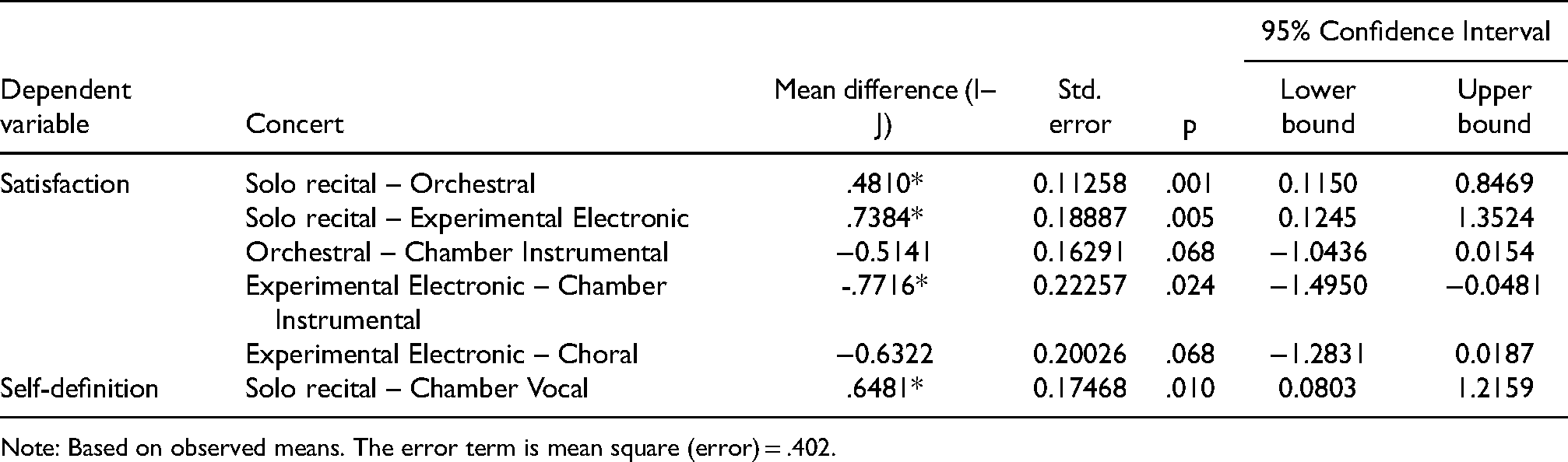
Note: Based on observed means. The error term is mean square (error) = .402.
GEMIAC dimension reduction
Since there is no theoretical subfactor model of the GEMIAC items available in the original publication (Coutinho & Scherer, 2017), we conducted a principal component analysis with Varimax rotation and Kaiser normalizations on the GEMIAC item ratings to reduce the number of emotional dimensions. Based on the Scree plot, we used the elbow criterion to identify three factors which were labelled: Positive Energy, Discomfort, and Wistful. The factor loadings can be seen in Table 6.
Loadings of the rotated component matrix for the principal component analysis of the GEMIAC.
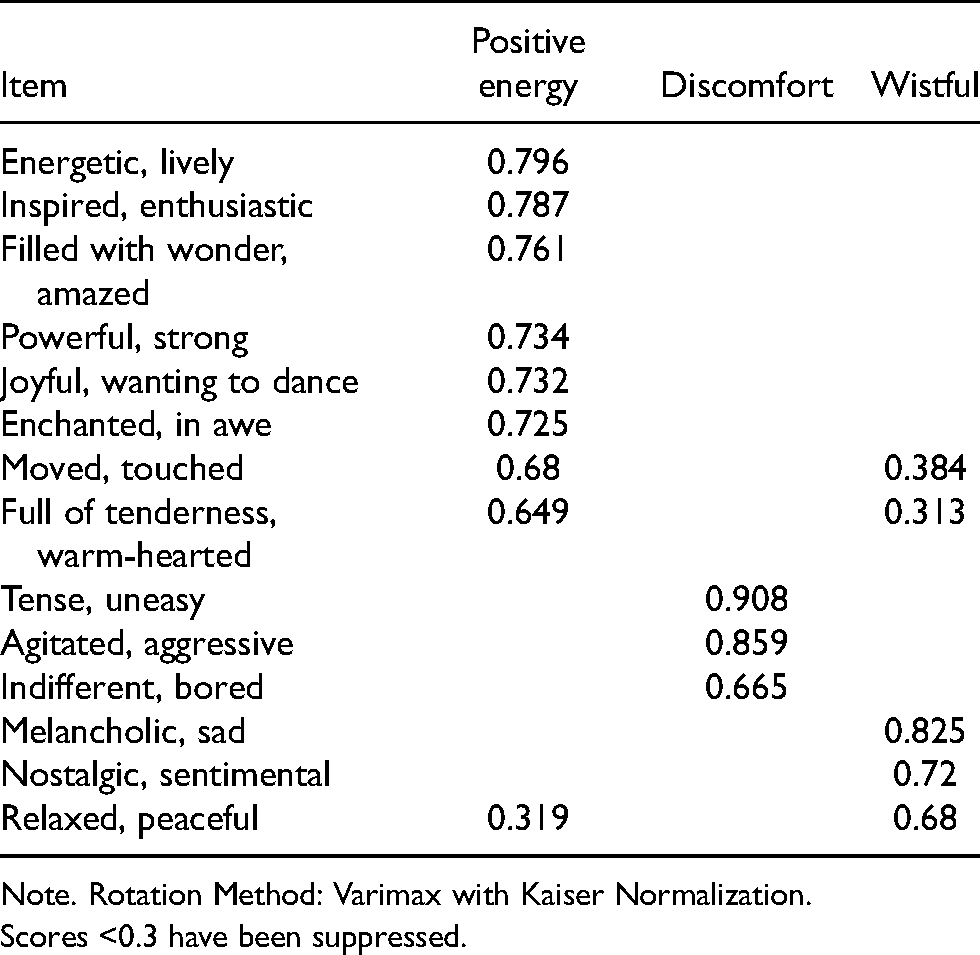
Note. Rotation Method: Varimax with Kaiser Normalization.
Scores <0.3 have been suppressed.
Social experience does not predict emotion
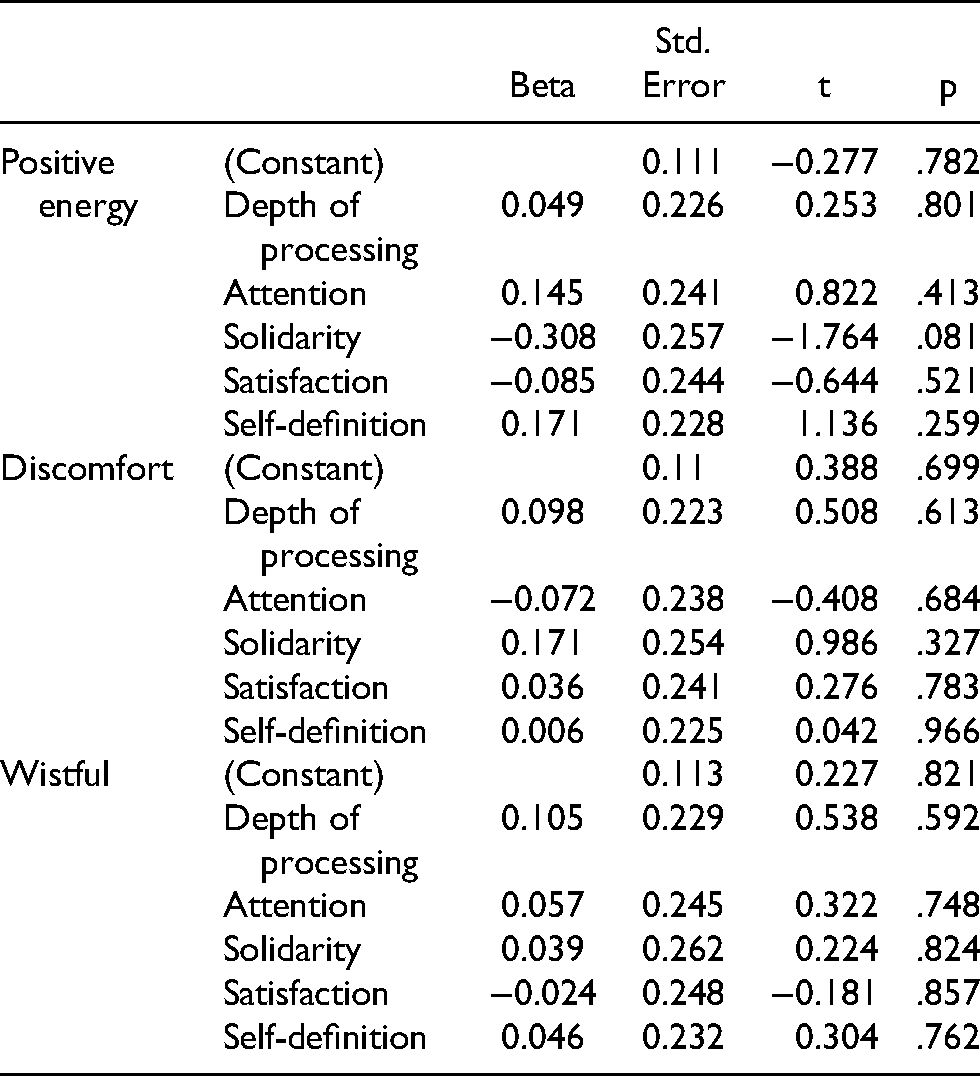
The three extracted emotion factors were used to ascertain if the social experience of a concert can be used to predict the emotional experience of the audience, in response to the music. To do so, we ran separate linear models for each of the emotion factors derived from the PCA. Overall, the social experience is not a significant predictor of Positive Energy F(5, 93) = .90, p = .49, Discomfort F(5, 93) = 1.03, p = .40, or Wistful F(5, 93) = .64, p = .67. Furthermore, no individual social experience factors are significant predictors of emotional experience of the music, as can be seen from the results of the linear modelling in Table 7.
Linear modelling of the social experience factors as predictors and the emotional experience of the music as the outcome.
Social experience predicts enjoyment
Social experience was found to be a significant predictor of enjoyment F(5, 169) = 20.15, p < .001 in a linear model. In particular, the social factors Attention and Solidarity were found to be positively associated with enjoyment in Table 8 and Figure 4.

A clustered bar graph depicting the mean enjoyment score for each of the social experience factors. Error bars depict 95% confidence intervals.
The table shows a linear model of the social experience factors as predictors and the overall enjoyment as the outcome.

Discussion
In this article, we have tested and validated a measure of the social experience of a live Western art music concert. An exploration of the literature and the high internal consistency of the factors indicate that theories of parasocial interaction (Horton & Wohl, 1956; Schramm, 2015; Schramm & Hartmann, 2019) and in-group bonding (Alport, 1958; Sherif, 2015; Tajfel et al., 1979) can be applied to a specific concert setting (RQ1). The adherence of our data to the theoretical factor models also indicate that these measurement tools can be used to quantify this experience. In our sample, co-attendance, age, musical training, and the type of concert were seen to be predictors of the intensity of a social experience (RQ2). The social experience of a concert does not seem to be a predictor of participants’ emotional response to music (RQ3) but it does predict a participant's overall enjoyment of the event (RQ4).
Our first research question was whether specific theories of parasocial interaction (Horton & Wohl, 1956) and in-group bonding (Alport, 1958) can be applied to a live, Western art music concert context (RQ1). Consequently, can we use existing measures associated with these theories to create an ecologically valid and appropriately brief (Lauer et al., 2013) yet reliable measure to quantify the social experience. We identified two commonly used questionnaire batteries corresponding to these two theories and used them to collect information on the social experience of a concert; specifically, how much attention people pay to other audience members (Schramm & Hartmann, 2019), and their experience of bonding with them to form an “in-group” (Leach et al., 2008). The results from the pilot study show that seven factors from these existing measures achieve high internal consistency scores when used in a typical live, Western art music concert setting and the factor analysis revealed that data collected in this context achieves similar factor loadings to the original scales. From this, we believe that it is possible to apply these to an ecologically valid live Western art music concert and that these tools can be used to quantify this experience. The resulting measure of the social experience of a Western art music concert has a five subfactor model and captures depth of processing, attention, solidarity, satisfaction, and self-definition. The positive covariance of these five factors indicates that an increase in any single factor will result in an increase in the other factors and that the items measure an overall social experience.
In the main study, we used the five factors from our validated measure of the social experience of a Western art music concert to explore if they are influenced by personal or situational factors (RQ2). The results indicated that age and musical training significantly influence the overall social experience. As was established in the introduction, self-definition often occurs based on observable traits, such as age, and this has been found to influence social bonding (Barak et al., 2001). Our findings suggest that this is also true in the context of a live concert since age was found to influence the social experience. Non-observable traits, such as musical training, require a degree of familiarity or prior knowledge of fellow attendees which was typically the case in our stimuli concerts. At the York Concert Series, music students are eligible for free tickets and are often seated at the extremities of the seating in the venue, whereas fee-paying public audience members are seated in the center. From this, we can infer that similar types of audience member will be seated in proximity to others who are similar to them, based on observable and latent characteristics, and we see two distinct groups of attendees: students, who are likely to be younger, and public members, who are likely to be older (Bigand & Poulin-Charronnat, 2006; Botstein, 1992; Dobson & Pitts, 2011; Thompson, 2006). It can also be inferred that music students will recognize their peers, even if they did not attend the concert together, and as a result of this recognition or prior knowledge they can evaluate the homogeneity of the musical training of other audience members, and individually self-stereotype as being similarly musically educated, and thus experience a greater degree of social bonding (Stupacher et al., 2020).
We can see from our results that the overall social experience was not significantly predicted by this co-attendance; however, this variable was found to have a significant but negative influence on the attention and solidarity factors. This means that those who attend the concert with others paid less attention to them and felt less bonded to the audience. This can be explained by the assumption that when attending a concert with others, we might pay more attention to their responses (Boothby et al., 2014) and thus have generally lower levels of awareness of the rest of the audience. In situations where concert curators or programmers want audience members to pay less attention to the general audience then they could offer discounts for sales of multiple tickets. However, if concert personnel are trying to enhance the general collective experience, then this could be achieved by encouraging audiences to be seated earlier with the house lights on to facilitate the attention and processing of other audience members. While controversial, it could also be interesting to not sell concurrent seats to those attending the concert with others, which may reduce the attention individuals pay to the responses of those with whom they have a relationship and encourage a transfer of attention to the general audience.
The type of concert was not found to be a significant predictor of the overall social experience of the concert; however, it was seen to significantly influence satisfaction and self-stereotyping. An explanation for this could be that we are similar to those who like particular types of music or ensemble, and therefore attend specific concerts, which would result in higher levels of self-definition (Boer et al., 2011; Trehub et al., 2015). The satisfaction factor captures the extent to which an individual is glad to be part of the group, in this case the audience, and it could be that there is a confluence of enjoyment of the concert and the pleasantness of the social experience. Specific concerts elicited a particularly strong social experience factor; for example, the chamber orchestral concert achieved the greatest satisfaction score. This concert involved a lot of audience participation (Lee et al., 2019; Loxley, 1983; Pitts, 2005), the staging was informal (Dearn & Price, 2016) and the seating was taken forward onto the stage (Pitts et al., 2013), all of which have previously been found to influence the social experience of a concert. Another notable result was that the self-definition ratings in the solo recital were higher than in any other concert. For this concert, participants were invited to take part in a study recital, and they came exclusively from the student population and they have responded to this homogeneity by grouping the other members of the audience to a greater extent and identifying most strongly with them. This finding may be seen to indicate that, when considering audience development, people are inclined to rate themself as more similar to people who like the same type of music as they do; therefore, marketing material should reflect the target population for each concert and depict those that are similar to them. In addition to this, since the concerts with audience participation and informal tagging achieved the highest satisfaction scores, performers could seek to include these aspects more frequently into their events, moving away from the traditional concert format towards an inclusive and engaging one.
Based on our findings, the social experience does not influence the emotional response to the concert (RQ3). Previous research in a laboratory setting has found that the presence of others reduces the intensity of emotional response to music in the presence of others (Egermann, et al., 2011; Liljeström, et al., 2013; Linnemann et al., 2016). However, the more ecologically valid research on emotion contagion and social bonding found that they are related (Garrido & Macritchie, 2020). These previous studies suggest that the presence of others does influence emotional responses to music in varying contexts. However, based on our results, for concert audiences, the social experience appears to be separate from the emotional experience of music and this is further supported by our finding that the overall enjoyment of an event is influenced by the social experience (RQ4). This contributes to the belief that the overall experience of a live, Western art music concerts and the direct influence of the music are separate (Beranek, 2012) and that they are not synonymous. Therefore, concert organizers should not feel that enhancing the social experience of a concert will detract from their engagement with, or response to, the performance. This is further supported by our finding that the overall enjoyment of an event is influenced by the social experience (RQ4). These findings should be used as encouragement to be innovative when curating and designing concerts and seasonal programs to enhance the social experience of live events. Perhaps the proscenium arch is no longer conducive to the appetite of the audience and performances in the round, on thrust or traverse stages that are conducive to a more active style of listening better reflect the modern audience.
In summary, the results suggest that the social experience of a concert can be predicted by certain demographic variables and in turn, can be used to predicted, and therefore alter, the enjoyment of a concert but not the emotional response to the music.
Limitations
By validating a new measurement tool, we sought to mitigate the limitations we identified in previous research which did not adequately quantify the social experience in our opinion (e.g. Garrido & Macritchie, 2020). We also aimed to improve the ecological validity of our data by recruiting participants from people attending concerts, rather than attending a study (e.g. Egermann et al., 2011) and validating the measure in a typical Western art music concert setting.
A limitation of this study was the need to significantly reduce the number of items from the original 126. It has been found that participant fatigue leads to a reduction on concentration and diligence when responding to questionnaires (Lauer et al., 2013; Sinickas, 2007). There is what is often considered to be a “trade-off” between the need for detailed and reliable data and the reduction in the quality of response a participant will give based on the amount of time spent completing a questionnaire (Schatz et al., 2012). As a result, the reliability of our data may have been compromised because, while we defined our exclusion criteria for discarding items from the pilot study, there were some other factors from the PSI which merit further explorations – for example, behavioral intention and antipathy, which both achieved high internal consistency scores, but had low means based on our data collection. It could be that with a larger sample or alternate context, these factors would have been included.
It should also be noted that the theories employed, specifically the parasocial interaction theory, limit the validity of this measure for typical Western art music concerts in which the audience are seated facing the stage and without interacting. In concerts of other genres of music or with different staging, there is more potential for interaction between audience members and without further testing, it is not clear if the tool would still be valid and future research could test it in alternate settings or, indeed, in digital concert settings with no audience physically co-present.
Finally, the sample sizes used in this psychometric instrument validation and analysis are small compared to other studies with similar aims. To address this, additional fit indices and conservative thresholds have been employed to conclude the acceptability of the models based on the factor analyses employed. All theoretically acceptable thresholds have been met and therefore we have concluded that the scale is a psychometrically validated measure. However, any future use of the scale should consider the internal consistency and fit of the model to each context and sample.
Conclusion
We conclude that in this study we have developed and validated the first quantitative measure of the social experience of a Western art music concert. The tool was derived from measures of parasocial interaction and in-group bonding which can be applied to a concert setting. Our results also suggest that the emotional response to music and the overall experience of a concert are separate and that only the latter can be influenced by the social experience of a concert. The implications of this are that concert curators, performers, and venue managers can increase audience members’ enjoyment of a Western art music concert by altering the social experience that audience members have, without influencing the choice of repertoire. Future research could address the efficacy of the SECS in capturing the social or collective experiences of the performers in an ensemble, both with each other and between the performer(s) and audience. It would also be interesting to explore the influences of different concert presentations and formats, including online concerts, in more controlled and hypothesis-led experiments.
Footnotes
Action Editor
Emily Payne, University of Leeds, School of Music.
Peer Review
John Sloboda, Guildhall School of Music and Drama, Research Department.
Karen Burland, University of Leeds, School of Music.
One anonymous reviewer.
Contributorship
KON and HE researched literature and conceived the study. KON and HE were involved in study design, gaining ethical approval, participant recruitment, and data analysis. KON wrote the first draft of the manuscript. All authors reviewed and edited the manuscript and approved the final version of the manuscript.
Declaration of Conflicting Interests
The author(s) declared no potential conflicts of interest with respect to the research, authorship, and/or publication of this article.
Funding
The author(s) disclosed receipt of the following financial support for the research, authorship, and/or publication of this article: This work was supported by the Volkswagen Stiftung,

Appendix 2: Table showing the factor covariances of the factors extracted from the confirmatory factor analysis.
Appendix 3: Social Experience of a Concert Scales.
[Statement regarding who is referred to by the term “the audience”.]
Please rate your agreement with the following statements where 1 = entirely disagree and 5 = agree entirely.
[Satisfaction]
I was glad to be in the audience
It was pleasant to be in the audience
Being in the audience gave me a good feeling
[Attention]
I closely watched how the audience behaved
I did not really notice the audience*
I rarely paid attention to the audience*
The audience repeatedly attracted my attention
[Self-Definition]
I had a lot in common with the average audience member
I am similar to the average person in the audience
Members of the audience had a lot in common with each other
People in the audience were similar to each other
[Solidarity]
I felt a bond with the audience
I felt solidarity with the audience
I felt committed to the audience
[Depth of Processing]
I can still remember what the audience looked like
I still have a vivid picture of the audience in my mind
I formed only a fleeting observation*
* Item to be reverse scored