



Abstract
This article introduces a hitherto undescribed pattern of audience motion during a classical music performance, wherein audience members collectively decrease their quantity of motion in coordination with shifts toward stillness in the music. This “stilling response” was observed in the audience body sway measurements from the MusicLab Copenhagen concert experiment, a research concert event in which the Danish String Quartet and over a dozen researchers collaborated to measure, analyze, and understand the experiences, physiology, and behavior of the coupled musician–music–audience system. Analysis of the performance identified over 250 “stilling points” in the music, such as rests, rubatos, and decrescendos. Most of these points were matched with measurable local decreases in movement across the majority of participating audience members. From this exploratory study, we posit that encultured classical music audiences exhibit a stilling response to suitable concert music, wherein they use their musical understanding to anticipate moments of stillness in a performance and cooperatively suppress their own movements to match. As audience stillness is recognized and valued by performers, this behavior may constitute a joint and tacit act of communication where the audience confirm their approval of and attention to the performance.
Introduction
Sometimes music propels an audience into motion, and sometimes it captivates a crowd, holding listeners still. Contemporary Western classical concert audiences are expected to be quiet and motionless while the musicians play. In fact, sectional analysis of audience members’ motion during a chamber music concert experiment found them to move less to music than during other events in the concert experiment (Upham & Rosas, accepted for publication). Yet, even within this common practice of restraint, the musicians performing in this concert experiment report noticing moments of exceptional stillness and silence across the audience. In this article we use measurements of individual audience members’ motion to look into patterns of stilling to the music performed, and find much more information than simply an absence of overt action.
Classical music audiences are more sedate than they have been in the past (Healey et al., 2022), making it reasonable to wonder what a live audience contributes to the concert experiences of those performing and attending. Encultured attendees are expected to follow and enforce a strict standard of discrete silence and stillness, regardless of how the music might affect them (Small, 1998). This restraint may be a courtesy to the audience members around them, allowing each to experience the performance without distraction from the movements of others (Upham & Rosas, accepted for publication). A lack of motion could signal that the audience feels relaxed and at ease or conversely that those attending feel tense or petrified. Surprisingly, this collective lack of motion has not received much empirical attention. Quantitative studies of audience and listener motion have mostly used music with more danceable or groovy music genres (Dotov et al., 2021; Gonzalez-Sanchez et al., 2018; Swarbrick et al., 2019), finding that both participants’ voluntary and unintentional movements correlate with culturally acceptable patterns of audience motion. However, in one exceptional experiment capturing audience motion at a contemporary dance performance, participants’ relative stillness was taken as a sign of engagement because they moved their hands less during their preferred pieces (Theodorou et al., 2019).
The background noise level in standard classical music halls is extraordinarily low, allowing for a great range of sound levels to be audible across and from the audience (Jeong et al., 2012). When the rustle of cloth and a quiet gasp can carry over rows of seats to the stage, silence is only possible through coordinated suppression of motion. In this context, stillness and silence on the part of the audience is practically interchangeable. In trying to understand how an audience behaves in this quiet setting, empirical measurements of movement can partially stand in for their audible consequences, relating both shifts toward extreme stillness (a lack of movement) and the implied silence (lack of sound).
Professional classical musicians seem to interpret audience stillness and silence positively, particularly in moments of musical quiet. As Davidson (2002) comments “many unremarkable amplitude and still moments are perceived to be expressive whilst other large amplitude moments are not detected as being expressive.” In interviews following their performance in the MusicLab Copenhagen, members of the Danish String Quartet (DSQ) reported sensitivity to audiences’ behavior in moments of intense or salient quiet: This total silence is something we really appreciate. To create a space in which people hardly dare to breathe, then something magical happens. (Frederik Øland, DSQ violinist) Pauses are the most effective means of gesticulation, in which there can be an enormous intensity in a pause. If you manage to communicate it in the right way, build it in the right way, make the curve in the right way … then silence can be incredibly dramatic. It is here that it is the most easy to get a sense of what is going on in the audience. That is, when you’re quiet yourself. Then you discover how quiet the audience is. And if you can hear a pin drop, then you’ve hit something. Then you can clearly perceive the energy in the room. (Rune Tonsgaard, DSQ violinist) I do not look. I listen. I feel that it is completely silent. You can feel this focus on being completely still. Or, it is actually not a focus on being still, but a focus on not wanting to lose the mood. And this you can also feel in the audience. (Frederik Øland) In concrete, you hear that it is quiet. You hear that people are not like back and forth on the chair or begin with candy papers or mints, or programmes. You hear whether people sit quietly. Because there is a very special silence when people sit entirely still. Just that tiny, tiny, tiny perception of moving cloth, that's enough to disrupt this silence. (Fredrik Sjölin, DSQ cellist)
These quotes mainly refer to the longer silences in music performances, when the audience is most sonically exposed and most easily attended to from the stage. However, the same relationship between engagement, exposure, and stillness could be in play throughout a performance. Irrespective of audience members’ intentions or awareness, their collective stillness is expected to change over time, with greater restraint when the performance is sufficiently engaging and relatively quiet. If, however, the audience's stillness can be heard from the stage at specific moments, it may be measurable from body sway. How sensitive might audience members be to the music and musicians slowing, quieting, or stilling?
With accelerometer recordings from the majority of the concert audience, this part of the MusicLab Copenhagen investigation allows us to address these questions. We look into the dynamics of audience's stillness with the combination of a novel music analysis and specialized audience motion treatment. Together, these analyses capture how these audience members repeatedly shifted toward stillness with the music performed and collectively reached a state of maximal stillness in the quietest moments of works. We call this phenomenon the “stilling response.” To the best of our knowledge, our analysis is the first to document and describe this effect.
Materials and Methods
Measuring Audience Movement
The body sway of participating audience members during the MusicLab Copenhagen concert experiment was captured using a custom-built app (called the MusicLab App) running on their respective mobile phones or with a small accelerometery datalogger (Axivity's AX3) given to participants without usable cellphones. With user permission, the app collected sensor values from the internal accelerometer and gyroscope and transmitted these to a protected server according to the required privacy protocol (GDPR). Before the concert, researchers and assistants helped audience members prepare and wear either measurement device in an adapted phone holder around their neck, laying the sensor high on their chest. This position was intended to capture body sway micromotion and larger actions during the concert: shifts of seating position, larger respiratory motion such as for vocalization, and major limb displacement such as clapping hands and tapping feet. Participation was voluntary, consent recorded within the MusicLab app and via a paper questionnaire. Of the approximately 120 audience members at this concert, over 90 wore measurement devices. After review for data quality and voluntary data retraction (an option in the MusicLab app), measurements from 85 participants were sufficiently complete (capturing at least half of the music performances) to be used in this analysis of motion during the live music performance. Measurements from each participant were aligned to the concert and each other via a tapping synchronization protocol, alignment measurements to on average 100 ms precision (Upham, 2023). Participants also completed questionnaires periodically during the concert experiment, with a few questions relating to their awareness of audience movement (Upham & Rosas, accepted for publication).
This analysis assesses patterns in audience members’ motion via a common reduction of their chest-mounted accelerometer sensor data. After resampling the three-dimensional measurements at a constant rate of 50 Hz, the quantity of motion (QoM) time series for each participant was calculated from the norm of the first-order difference. Subsequent analyses use non-parametric statistics to circumvent some issues of scale and noise between devices.
Conceptualizing Stilling in Music and Audience
The initial idea of a connection between the performed music and the audience becoming more still came from observing excerpts of the audience members’ median quantity of motion time series alongside an audio recording of the performance. The summary statistic of audience motion seemed to exhibit short dips alongside noticeable drops in sound amplitude. These lows in aggregate motion were not only at the quiet ends of works or music movement but also at more fleeting downshifts, such as rests and phrase endings. Examples can be seen in the top two plots of Figure 1. The dips appear to be quite rapid, sometimes falling and rising within a couple of seconds. This pattern suggested that subtle shifts in the performed music could be inducing measurable reductions in audience body sway.
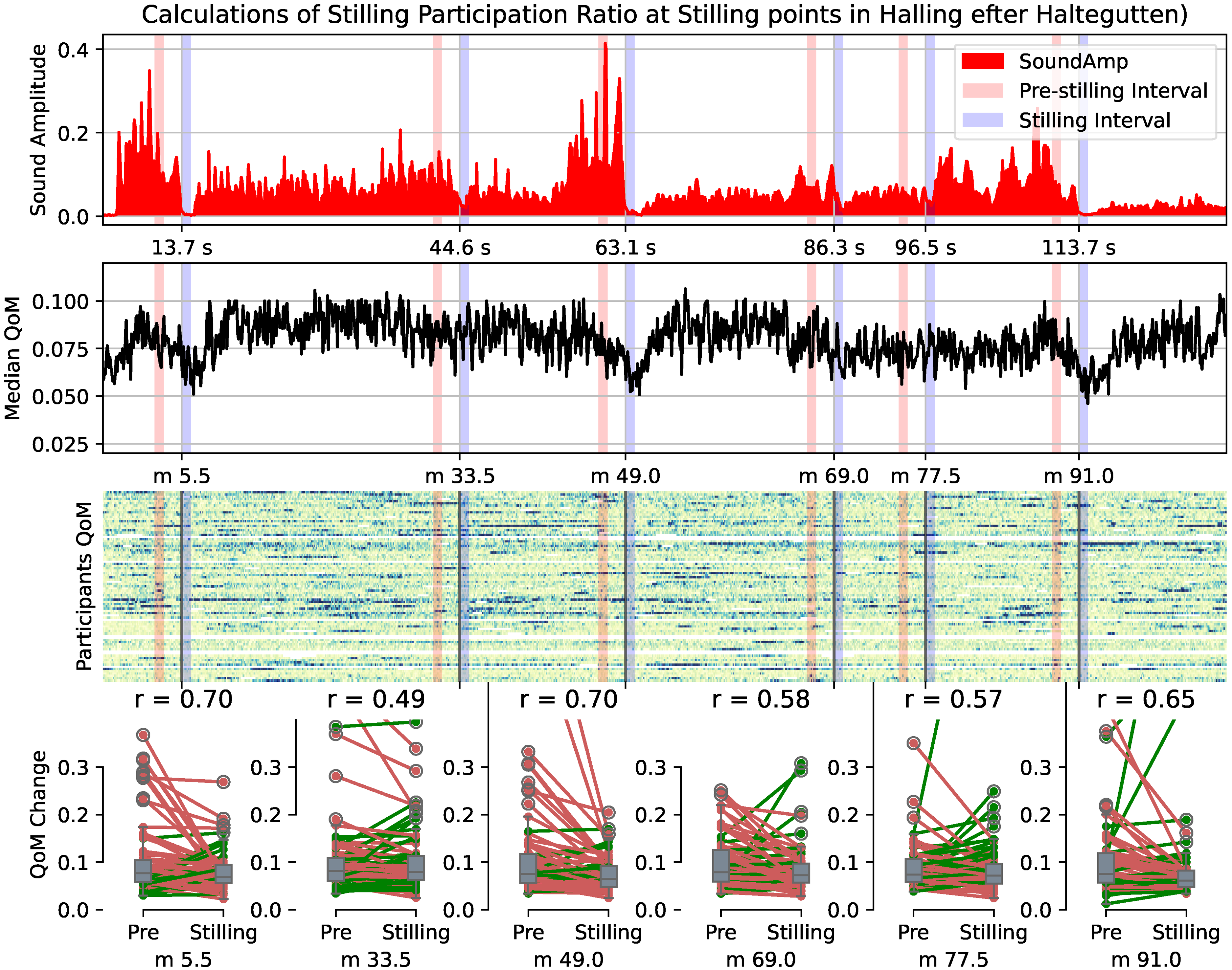
Sound amplitude of the music performance and median quantity of motion measurements from audience during 120 s excerpt of the Halling efter Haltegutten. Stilling points in this excerpt are labeled by seconds (s) from the start of the song and score measure number (e.g., m 5.5, m 49.0). Each point's stilling participation ratio (r) is illustrated in the bottom row.
Given that any such process would have to operate below audience members’ attention or awareness, mechanisms such as unconscious mimicry of the performers and noise suppression for auditory attention could explain audience members moving less when they observe or expect the music to be “stilling.” Motion is an integral part of acoustic sound production, with performers’ body sway conveying momentum and intensity, and while the mapping between quantity of motion and sound intensity or gesture rate is not strictly linear, these measures are highly correlated at the low end. Similarly to the audience, there is an inescapable conflation of silence and stillness on stage, with performances moving away from and toward this pole, moment by moment. We can explore the coincidence of stilling in the music and in the attentive audience without having to separate auditory and motor components of the performance or perception.
In order to test a hypothesis about music encouraging stillness in the audience, we had to look at either stilling in the music or in the movement and then test for stilling in the other. Given how little is known about the characteristic textures of audience motion at classical music concerts, we opted to look at the music first. In other words, the analysis strategy was to identify when one might expect the performance to influence the audience toward stillness, and then test whether the audience members’ measured behavior exhibited decreases in quantity of motion at these moments.
Note: A common challenge for data-led analyses is terminology. While it can be helpful to give illustrative names to data sets, we still need to distinguish empirical measurements from their associated concepts. In this article, capitalization indicates specific defined datasets, like the 257 Stilling points, leaving concepts such as stilling or stillness in lowercase.
Identifying Stilling Points in Music Performance
A thorough analysis of the recorded performance identified a constellation of “Stilling points”: moments when the music slowed or quieted and could potentially have a stilling effect on attentive audience members. The first author studied an audio recording of the concert alongside the scores of individual works to identify patterns in musical stillness across all pieces performed. The full concert performance—84 min of music—was reviewed three times to generate a list of Stilling points: first to develop criteria for point selection, second to determine tags and timing, and last, a review for quality and consistency.
The base criterion for identifying a stilling point was either an audible rest/gap in the played sound (notated or not), or a noticeable decrease in at least two other musical features: structure (e.g., phase endings), texture (e.g., voice number or note density), tempo (e.g., rubato, ritardando), or loudness (e.g., forte-piano, decrescendo). The Stilling points and tags were all focused on very local musical features, documenting changes relatively to the preceding few seconds of music, to match the rapid shifts noticed in the initial observation of audience stilling. This narrow lens also helped to maintain consistent assessment criteria across the different compositional styles of works in the concert program. Figure 2 shows some examples of the Stilling points selection and tagging, explained more thoroughly in the following text.

Example of Stilling points identified in short excerpts of the Beethoven String Quartet 16 in F Maj, Op. 135, Mmt. 4 mm. 247–255, and the Bach Contrapunctus 14, BWV 1080, mm. 191–196. Below the score transcriptions are the corresponding sound wave and spectrogram (via Sonic Visualizer (Cannam et al., 2010)) and tags selected for each point marked with a check. Stilling points are tagged by their position in the score, measure number with decimals.
Each Stilling point was described with a collection of 18 tags including these stilling features and possible contrary factors. If the moment occurred in a sequence, or if other features simultaneously shifted away from stillness, these were noted as potentially discouraging a stilling response. Most of the feature tags were binary markers for events or changes within specific dimensions of musical features. The full list of assigned tags are included with the Stilling point list in the supplementary materials, along with a description of what each tag represents.
For the purpose of assessing the degree of concurrency between stilling in the music performance and the audience, each identified Stilling point had to be assigned a precise onset in time. However, defining the beginning of a period of stillness (or the absence of any signal) is a nontrivial endeavor. The start of some silences and structural boundaries could be easily marked at the musically expected onset of a diminished or absent note. In cases of more gradual changes in quality, a choice had to be made as to when to measure for a potential stilling effect. The Stilling point onset for these ambiguous moments were marked at either a plausible minimum of the features’ trajectories (when the music was the most perceivably “still”), or at the first reasonable moment a note could have been expected to sound according to local tempo and texture. The binary tag Precision was added to distinguish points with a clear onset from the more ambiguous because this uncertainty could result in greater variability in the timing of audience members’ responses.
To give an example of how the selection criteria were applied, combining score information and performance choices to categorize and defining the onset of a Stilling point, Figure 2 shows a few examples. In the Beethoven excerpt, the first Stilling point, marked at m. 247.74, is a short silence (
The second Stilling point, m 249.75, is sonically similar—a short rubato phrase ending with a fermata—however, the notated Poco adagio and short crescendo–decrescendo give this Stilling point a more perceptually predictable onset on the written rest. As such, more tags were marked for this moment than the last.
The last Stilling point in the first excerpt is another short rest between phrases without loudness or tempo changes pointing the way. Rather than mark the onset of this point directly on the offset of the preceding pizzicato note, the expected moment of stillness/quiet is set on the half rest (m 253.5). This is when a note could have continued the half note pace established in the preceding phrase.
In the excerpt from the Bach Contrapunctus, second in Figure 2, this Stilling point does not fall on a rest or gap in the playing. It is instead selected as a point of relative stillness because of structural and textural features. At this moment, the four voice counterpoint closes cadentially to the solo B
The final list of 257 Stilling points was constructed to be thorough; however, this set is not exhaustive or indisputable. Another analyst may have a different interpretation of stillness in music generally or of some specific moments selected here. We encourage parallel analysis of this phenomenon on alternative definitions and stimulus analysis strategies.
Musical stilling cues such as rests, loudness changes, and tempo changes were used differently across the pieces in the concert experiment program, with some works containing more Stilling points than others (Table 1). Some movements in Beethoven's String Quartet n. 16 featured rests in the motivic material, and the structure of this work often allowed for coordinated rubato across the four parts. In contrast, the J.S. Bach fugue had very few Stilling points because the parts layered to cover moments of release in individual lines. The distribution of Stilling points over the course of the whole concert experiment is illustrated in the top plot of Figure 7.
Number of Stilling points identified per section of concert music.

Quantifying Stillness in Audience Motion
According to their questionnaire responses, the audience participants in this concert experiment were mostly experienced classical concert attendees, with the majority identifying as fans of the DSQ before the show and as music-loving nonmusicians. Despite some intrusions of measurement on participants’ experience, the audience as a whole appeared to be engaged and enthusiastic to a degree comparable with more typical concert conditions. While some audience members reported moving less than usual during the first three segments of the concert, the average quantity of motion of this subset was indistinguishable from those who felt they moved a normal amount for this kind of performance (Upham & Rosas, accepted for publication). The majority also reported being unaware of how other audience members moved during most of the concert. Hence, by our measurements of their movements and their own limited recall as reported in the questionnaires, we have reason to consider these audience members’ stilling patterns to be typical, with nothing obviously extreme or novel forcing participants into coordinated restraint.
The possibility of a systematic pattern of audience stilling came from inspecting the median time series of the audience participants’ quantity of motion. However, a shift in a median time series does not, by itself, indicate common concurrent change. Instead, we defined a statistic that explicitly captures the popularity of a shift toward stillness across the audience. Taking the average quantity of motion per participant over an interval of a second starting from one given time point and the second interval from three seconds prior (the pre-stilling interval), the stilling participation ratio is the proportion of participants whose average quantity of motion had measurably lowered. The comparison interval of 3 s was selected without optimization. It is longer than some of the drops in median quantity of motion seen in the initial joint-stilling observation while being less than the usual gap between successive Stilling points. The second-long averages of individual quantity of motion measures smooth out sensor noise while allowing small local changes to be counted.
By this definition, we expect the average stilling participation ratio to usually be around 0.5, with half of the audience independently increasing in motion from three seconds a go and half decreasing. When external influences encourage or discourage motion across the audience, that ratio will lower or rise according from this baseline.
We do not claim that the performance alone causes any specific audience member's stilling. However, if the stilling participation ratio at the selected Stilling points is higher than other points in the performance, this suggests that the Stilling point criteria are capturing something relevant to how audience members move moment by moment.
To illustrate the construction of the stilling participation ratio, Figure 1 shows six examples of the stilling participation ratio calculated at the Stilling points in an excerpt of the folk music set. The moment with the highest participation ratio (
Analyses and Results
This section describes the results of the initial hypothesis testing and subsequent exploratory evaluations on which Stilling points coincided with audience stilling and whether audience members differed in their reactions to Stilling points.
Stilling Participation Ratio at Stilling Points
The main hypothesis was that the audience would shift toward stillness when the music does. With 257 Stilling points identified across 84 min of music, we do not expect all of these moments to be accompanied by marked audience stillness. Instead, our conjecture is that, statistically, more people are shifting toward stillness at these moments relative to others’ moments throughout the performance.
To evaluate this hypothesis, we computed a two-sample Kolmogorov–Smirnov test to compare stilling participation ratios as measured at the Stilling points versus all moments when music was being played from the stage (Figure 3). Across all moments of music performance, sampled at 10 Hz for a total of

Distribution of stilling participation ratios for the identified Stilling points versus the same ratios evaluated over the full duration of the music performances.
The tendency for stilling at these moments is measurably stronger compared with all moments, but the audience's decrease in motion is not guaranteed. In some of these Stilling points, less than half of the audience members’ quantity of motion decreased. The following review of the Stilling points explores why the ratios are not stronger.
Stiller and Unstilled Points
To make it easier to identify differences in stilling response conditions, the Stilling points were split according to their participation ratio. The 174 points with ratios above the music-average (
Time Course of Stilling
To confirm this splitting of Stilling points, we can compare the audience quantity of motion within each subset. Figure 4 shows the quantity of motion across the audience at these points, focused on the median of these median time series in black.

Time course of Stilling points per subset.
The contour of each subset's median illustrates their underlying differences. The Stiller points’ median timeline shows a decrease in aggregate audience motion prior to the onset of the Stilling point (0s), followed by a plateau. The sharpness of the decrease and beginning of the plateau suggests that for many of these Stiller points, the audience members were anticipating the onset of stillness rather than reacting to its arrival. A reaction would be expressed as a decrease in motion after time zero, but across these selected moments, the audience members have already adapted to be relatively still with the arrival of the Stilling point. From the timing of these quantity of motion changes, we can infer that audience members are using musical expectations to predict and prepare themselves for cooperative stillness, even if they are unaware of doing so dozens of times per concert.
In contrast, the median across the median quantity of motion time series at Unstilled points (black in the right plot of Figure 4) is messy but essentially flat. About as many of these moments produced increases as decreases in total audience motion around time zero. There must be some substantial differences between the Unstilled and the Stiller points to producing such distinct median audience behavior.
Stiller and Unstilled Feature Tags
If some of the music features used to select the Stilling points had a stronger effect on the audience, these points should be better represented in the Stiller point subset than in the Unstilled. The music program was not chosen to compare the power of potential stilling cues, and as such the incidence of individual feature tags was quite uneven, making raw frequency of a feature tag insufficient for assessing relevance for stilling. A ratio is again the more useful statistic, 0.68 being the proportion of Stilling points that form the Stiller subset. Figure 5 shows the actual number of Unstilled and Stiller points using each tag (stacked) and marks the null split of

Stilling cue feature Tag frequency across all Stilling points by feature category, with contrary features marked with bold labels. Stiller and Unstilled points counts are stacked with their generic ratio marked by a white cross.
Surprisingly, most tags show no strong inclination for Stiller or Unstilled points. The most prominent distinction are in the time features (e.g., rubato and fermata) and rests. None of these frequency differences per tag are big enough to account for any substantial portion of either subset. In other words, Stilling point tags and the musical features they represent are not able to explain the difference in audience motion patterns at Stiller and Unstilled points.
Audience Members’ Minimum Motion
Looking back at the time courses plots shown in Figure 4, one particularity of the two median time series is their similar range of values. Across the Stiller points, the audience members’ median quantity of motion descends to a central value closer to the median starting values in the Unstilled points. A potential difference between these points might then be the amount of motion in the audience before the Stilling point occurs. This conjecture can be tested using the median quantity of motion values at the Pre-stilling and Stilling intervals, those 1 s excerpts used to assess the stilling participation ratio (Figure 1). The cumulative distributions of the audience's median quantity of motion at the Pre-stilling and Stilling intervals for the subsets and all music are reported in Figure 6.

Median audience quantity of motion cumulative distributions at Pre-stilling intervals and Stilling point onset intervals for both Stiller points and Unstilled points, with the distribution of the same statistic across all moments of the music performance times in black.
The distributions in Figure 6 suggest that an important difference between the two subsets of Stilling points is the amount of motion across the audience in the preceding seconds. The top plot shows the distributions of median audience quantity of motion 3 s before each subset of Stilling points and during all music. The pre-Stiller points look indistinguishable from a random sampling of moments during the music (two sample Kolmogrov-Smirnoff test, k = 0.062, p = 0.49). In contrast, the median audience motion before the Unstilled points (pre-Unstilled) is measurably different from the All music distribution (k = 0.213, p < 0.001). This difference is concentrated in the very lowest audience motion values: a remarkable proportion of pre-Unstiller moments have exceptionally low median audience quantity of motion, around five times the rate expected by random sample.
That difference between subsets at the Pre-stilling intervals does not carry forward to the median motion at the Stilling points 3s later. The second plot of Figure 6 shows that the Stiller and Unstilled points nearly switch values. In fact at the Stiller points, the audience seems to have reduced their motions to a degree of stillness similar to that achieved at pre-Unstilled points (k = 0.152, p = 0.13). The simplest explanation for this concentration before Unstilled and at Stiller moments is a lower bound on how still this audience can be. The distinction between these sample point distributions and that of the all music sample dissipate quickly above 0.06, suggesting a natural threshold for minimum median motion in the units of these measurements, marked by a dotted vertical line in the plots of Figure 6.
This minimum motion interpretation justifies how some Unstilled points can be similar in character to the Stiller points and also fail to induce larger stilling participation ratios: at some of these moments, the audience is already as still as they can collectively manage. Even if the music is felt to encourage further stillness, this cannot be behaviorally expressed to an extent that can be captured through chest-mounted accelerometers. Note that this aggregate minimum motion is not the same as a lower limit on individual audience members’ quantity of motion. In all of these Unstilled points, there are participants becoming more or less still than the threshold value. The minimum motion threshold is a soft lower bound on the median quantity of motion distributed across the entire audience. Such a threshold could function as a kind of target level of aggregate stillness—that is, an extremity of stillness that the audience can reliably reach when the music demands.
To gain further insight into this lower limit on audience stillness, it is instructive to observe when the audience reaches this state. Figure 7 plots the timing of the music-selected Stilling points, the audience-performed Stiller points, and when the audience's median quantity of motion time series crosses the minimum motion limit.

Timing of Stilling points, Stiller points, and Minimum audience motion below the aligned quantity of motion traces from each audience participant. The onset of music pieces, applause, and the concert interval are marked and labelled above with timestamps below in seconds. Like in Figure 1, each participants motion is reported in a row, darkening to indicate increased quantity of motion. Grey lines below these motion time series show the timing of the music-identified Stilling points, the audience-motion selected Stiller points, and the instances of median audience motion falling below the minimum median audience motion threshold (Min Motion,
A majority of the music-selected Stilling points have a majority stilling participation ratio, that is, they qualify as Stiller points. An additional 13 Stilling points occurred when the audience's aggregate motion was already below the minimum motion threshold,
Stilling Points Per Participant
A last test of these Stilling points and the audience's responses to them is to consider the behavior of individual audience members at these moments. If the stilling response is related to some form of musical engagement, and participants vary in how engaged they are with the performance, should they not also vary in how often they downshift their motion to the music?
To explore this, we can transpose the stilling participation ratio calculations to count over time instead of across the audience. Rather than reporting how many audience members exhibit decreases in their quantity of motion at stillness point onsets, we evaluate the total number of Stilling points to which each participant stilled. Figure 8 reports the number of Stilling points stilled to across the 85 participants.

Histogram of participants by count of Stilling points they stilled to. The vertical dotted black line indicates the expected central tendency if participation were random.
If the likelihood of any audience member to become more still at a stilling point were flat, if these stilling responses were not related to some kind of capacity or inclination that varied across people, then the distribution in Figure 8 should center on 123 of 257 Stilling points. Instead, the participation rates cluster substantially above this threshold (dotted black line), with
A trait-like tendency to become still with musical stilling cues might also show up between pieces. If there is a significant difference in the stilling participation between participants, this difference may also be measurable in their responses to individual works. To test this possibility, we evaluated the participation rates in each of the four sections of the concert (Beethoven, Schnittke, Bach, and folk music), and correlated audience members’ Stilling point participation rates to test whether there was any stability in who was more or less responsive at these moments. The results again were significant but mild, reported in Table 2. These correlations suggest there might be musical explanations for participants’ patterns of responsiveness, to be discovered with further study.
Pearson correlations in participants’ participation rates at Stilling points per music segment.
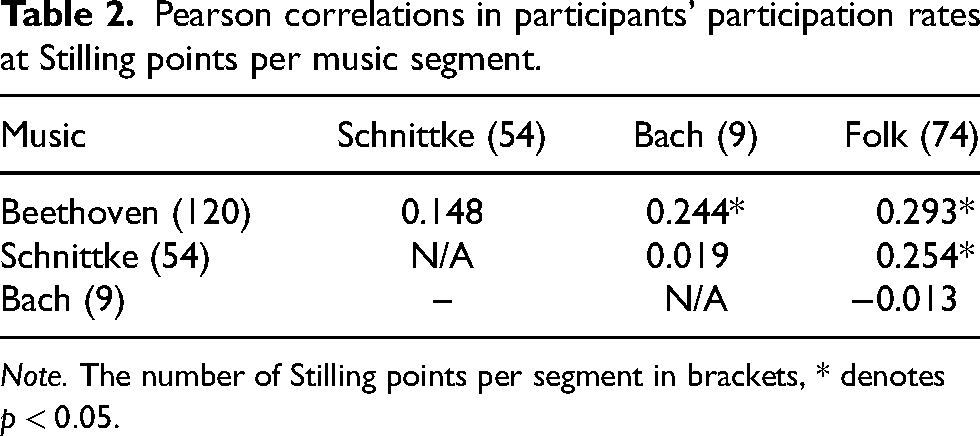
Note. The number of Stilling points per segment in brackets, * denotes
Discussion
Is there an audience stilling response to music? This investigation of the audience's motion in a concert experiment demonstrates that while the audience of a classical music concert can be habitually still, there exists a range of behavioral restraint related to the music being performed. This finding opens new doors for future investigations that may help us to significantly deepen our understanding of how people react and engage with music.
Without prior work defining musical stillness as perceptual quality, our interpretation of these shifts in audience motion is entirely based on the first author's analysis. Their approach is informed by years of experience exploring the relationship between measures of audience response to performed classical music; however, there may well be additional features and alternative strategies that better clarify the conditions for prompting audience stilling. Operationalizing musical stillness warrants a much larger discussion and we hope other researchers will join the effort to improve on the current analysis.
Eliciting the Stilling Response?
The moments of stillness and silence described in the quotes from the members of the DSQ (see Introduction), pauses prepared for the audience to perform engagement through total stillness, most clearly correspond to intervals of sustained minimum motion. The tapering off of Bach's Contrapunctus 14 (BWV 1080), the lullaby-like closing of the Unst Boat Song (Folk 4), and the quiet end of the Schnittke quartet were each carefully crafted moments that held this audience fixed in their seats for many seconds at a time. The members of this string quartet are practiced at constructing these intense moments of stillness, and can read an audience's capacity to follow their cues. Are such cues the same ones that encourage the fleeting shifts toward stillness in other moments?
Most of the Stilling points identified are not as intense or as prepared: a quick rest before a repeated motive, a thinning of voices to let a lower register solo line shine, a breath inserted before the next fanfare. These moments are not composed to hold the audience in stillness, nor are they long enough for performers to aurally check for the audience's engagement. (Though a poorly timed rustle could potentially intrude.) It is surprising to observe repeated patterns of motion restriction to such fleeting cues, and with participation from not only a few sensitive individuals but also the majority of the people measured in the audience.
The data from this concert experiment does not allow us to discern what is happening physiologically at these moments. Body sway measured from the chest is a limited descriptor of how the entire body is moving. Given that the audience members appeared to be unaware of cooperatively stilling dozens of times through the performance, the physical change must be subtle. In some moments, audience members were maybe holding their breath, and at others, holding their posture with tight constrictions down the back. It is also possible that these moments were characterized by extreme relaxation, when audience members were really settled into their seats and could refrain from moving with minimal effort. Future studies may aim to untangle the mechanisms driving the way this apparent “stilling response” operates.
An important implication of our findings is that while this stilling response may occur many times a concert, the change in audience behavior may not visible to the naked eye, and may only be measurable through the aggregate behavior across a crowd. As such, this may be a collective, emergent phenomenon that takes place in the whole but not in the parts separately (Mediano et al., 2022). Individual participants are contributing to the pattern of slight mobility and stillness, but they exhibit this responsiveness in the context of an expert performance and group spectatorship (i.e., a live face-to-face audience). If others are not around to be bothered by their motion, would they be inclined to restrain themselves at all? From this analysis alone we cannot separate social motivations for stillness from the musical or more basic acoustic influences, with each being a potential direction for future investigations.
Functional Properties of Stilling
This first assessment of Stilling points included moments of silence, valleys of loudness, phrase endings, tempo decreases, and texture decreases. While the criteria caught moments with measurable decrease in aggregate motion in this audience, none of these features seemed more or less important for producing a stilling response (within the samples of this music program). All the pieces performed had a least a few Stilling and Stiller points identified in them, but stillness and silence played different compositional roles across these works. Despite great variation in context, these moments identified by changes in local musical qualities appeared to have a reliable impact on this practiced audience.
The most still segments of music produced long intervals of immobility across the audience, reaching what looks like a minimum motion threshold across these audience members. From the analysis of the Stiller and Unstilled points, it looks like the audience often restrained themselves to this lower limit, even in moments when they had been moving substantially more. How long might an audience sustain such a degree of motionlessness? Could this kind of stilling have a purpose or be related to other musical practices, like lullabies?
Audience members varied in how often they stilled with the identified Stilling points and their participation varied with the pieces presented. With more refined criteria, this tendency for stilling might be interesting to relate to reported engagement, enjoyment, or traits such as genre familiarity. Swarbrick and Vuoskoski (2023) have already shared an initial comparison of this stilling participation rate with these participants' reported experiences of the concert. That there were any correlations between pieces on how much participants stilled to a work suggests some potential for stilling response susceptibility as a trait.
This collective stilling behavior is not simply a reaction to the occurrence of rests, decreases in tempo, or drops in loudness. These moments appear to be anticipated by these participants, with their median quantity of motion decreasing in the seconds before the arguable onset of a Stilling point. Whatever their reason for going still, the timing suggests audience members are listening for the looming obligation or opportunity for stillness, ready to cooperate as the performance demands.
A classical concert audience has very limited means of communicating to the performers. This stilling response might be an important mechanism for expression in addition to post-performance applause. Through their intense lack of audible motion, they can send a collective but tacit message of their engagement, absorption, and appreciation to the performers. Whatever the mechanism, further study into audience stillness is needed to understand this potentially common behavior.
Conclusion
Audience members can be extremely still during a classical music concert, but that stillness is not uniform, nor is it static, or independent of the performed music. The audience of our concert experiment collectively moved less when the music shifted toward stillness in a pattern that was measurable in seconds and that we call the “stilling response.” This effect is consistent with musicians’ reports of experiencing audience stillness and silence as a significant and desirable response to their performance. Across the participating audience, this response was measurable in all pieces, with differential rates of stilling between participants and works.
Measuring an audience stilling to identifiable cues is complicated by the existence of a lower limit on the aggregate quantity of motion in a crowd. Some of rests and decreases in loudness that might have caused a stilling responses had no room for further restraint when the audience was already extremely still.
This analysis is just a first look into what appears to be a dynamic component of attentive restrained spectatorship. This measurement of body sway gives only a blurry view into how audience members move, sensitive in time without qualitative distinction. Hopefully, future works employing complementary methods of tracking audience members’ subtle actions may support more specific hypothesis testing and address physiological mechanisms and social factors involved in collective stillness. Bodily stillness may turn out to be the gauge of present attention and engagement we have been waiting for.
Supplemental Material
sj-pdf-1-mns-10.1177_20592043241233422 - Supplemental material for The Stilling Response: From Musical Silence to Audience Stillness
Supplemental material, sj-pdf-1-mns-10.1177_20592043241233422 for The Stilling Response: From Musical Silence to Audience Stillness by Finn Upham, Simon Høffding and Fernando E. Rosas in Music & Science
Footnotes
Action Editor
Alexander Refsum Jensenius, University of Oslo, RITMO Centre for Interdisciplinary Studies in Rhythm, Time and Motion.
Peer Review
Lara Pearson, Max Planck Institute for Empirical Aesthetics, Department of Music.
Steven Morrison, Northwestern University, Center for the Study of Education and the Musical Experience.
Contributorship
FU identified the hypothesis, performed the music analysis, performed the data analysis, and wrote the first draft of the manuscript. SH conducted and translated the interviews with musicians. FU, SH, and FR all jointly researched the literature, discussed interpretation of the results, edited the manuscript, and approved the final version of the manuscript.
Copyright
Declaration of Conflicting Interests
The authors declared no potential conflicts of interest with respect to the research, authorship, and/or publication of this article.
Ethical Approval
This research was reviewed and approved by the Norwegian Centre for Research Data (NSD), reference numbers 915228 and 748915.
Funding
This work was supported by the Norges Forskningsråd, NordForsk (grant number 262762, 86892).
Data Availability Statement
The data from which this analysis was conducted includes audience motion measurements published in the Musiclab Copenhagen OSF repository https://osf.io/ac6yt. Additional files on the music analysis selected Stilling point annotations are available in the Supplementary materials of this paper. Stilling points, extracted features of the concert audio, and code for all the analysis and figures can be retrieved from the accompanying github repository 
Supplemental Material
Supplemental material for this article is available online.
References
Supplementary Material
Please find the following supplemental material available below.
For Open Access articles published under a Creative Commons License, all supplemental material carries the same license as the article it is associated with.
For non-Open Access articles published, all supplemental material carries a non-exclusive license, and permission requests for re-use of supplemental material or any part of supplemental material shall be sent directly to the copyright owner as specified in the copyright notice associated with the article.
