



Abstract
Recent empirical investigations suggest that music performance and perception can evoke a collective cardiac response in performers and audience members, and interpersonal cardiac coupling can be related to musical features. However, the relationship between musicians’ and audiences’ cardiac responses is poorly understood. This study investigates the interpersonal cardiac coherence of selected audience members and performers from the Stavanger Symphony Orchestra and the Norwegian Radio Orchestra during multiple performances of Harald Sæverud’s Kjempeviseslåtten. The cardiac coherence index (CCI) was computed by applying the intrinsic synchrosqueezing transform to the cardiac interbeat interval of each signal, combining noise-assisted multivariate empirical mode decomposition and short-time Fourier transforms. The results show that the CCI values among the audience members were stronger than those of the musicians. Sound pressure level measurements predicted the musicians’ CCI values, whilst musical form structure predicted the audiences’ CCI values. These results advance our understanding of how cardiac rhythms support interpersonal interactions and contribute to research on live orchestra performances.
Keywords
Introduction
Music performance and perception influence the human autonomic nervous system, modulating emotions (Gomez & Danuser, 2007) and physiological responses (Bernardi, 2005; Koelsch & Jäncke, 2015; Soliński et al., 2024). Music can affect heart activity, breathing, and blood pressure, and, in patients with heart disease, can reduce pain and anxiety (Koelsch & Jäncke, 2015). Listeners’ heart and respiratory activity tend to respond to exciting music (Koelsch & Jäncke, 2015) and to change with tempo, accentuation, and rhythmical articulation (Bernardi, 2005; Gomez & Danuser, 2007). The cardiac responses of professional musicians while playing are associated with the tempo of the music, the type of instrument (that is, especially in wind players (Czyżyk et al., 2020)), and body mass (Vellers et al., 2015), and can also be related to their interpretative and performative choices (Soliński et al., 2024). There is also some evidence that music can establish collective physiological responses in performers and audience members based on motor principles and shared musical absorption (Czepiel et al., 2024; Høffding et al., 2023). This study focuses on the cardiac activity of orchestra players and audience members during orchestra performances and how the cardiac response changes among and between audiences and musicians in relation to the musical features of the piece performed.
Cardiac Collective Responses in Musicians and Audiences
Ensemble playing and singing can induce collective cardiac responses among performers. Specifically, choir singing can lead to synchronization of cardiac phase and amplitude between choristers. A study involving a conductor and 11 experienced singers found that cardiac phase synchronization between individuals was greater during singing compared to a resting condition (Müller & Lindenberger, 2011). Similarly, pairs of non-expert singers exhibited higher levels of cardiac coupling, measured as time-frequency coherence, during singing compared to a baseline condition (Ruiz-Blais et al., 2020). Notably, this cardiac synchrony was not related to the perceived sense of togetherness among singers. Another line of research examined changes in cardiac activity among choir members during rehearsal sessions and performances. Intrinsic phase synchrony and cardiac coherence (accounting for both amplitude and phase information as a function of frequency) between choristers were quantified using noise-assisted multivariate empirical mode decomposition (NA-MEMD) (ur Rehman & Mandic, 2011). Results showed that phase synchrony and cardiac coherence were higher during a public performance than during a rehearsal session. This suggests that the more naturalistic setting and the increased level of immersion of a public performance might be reflected in the cardiac response (Hemakom et al., 2016; Hemakom et al., 2017).
Høffding et al. (2023) found that cardiac synchrony among members of both student and professional string quartets, measured using multidimensional recurrence quantification analysis (Wallot et al., 2016), was higher when performing than resting. Additionally, they found that cardiac interrelations were more pronounced in the professional string quartet than in the student quartet. However, unlike results from choir studies, there were no significant differences between concert and rehearsal conditions within the string quartets. Overall, these studies suggest that an ensemble's level of professionalism may influence musicians’ cardiac interactions. Further investigations comparing choral and instrumental ensembles could elucidate whether singing plays a unique role in achieving higher levels of physiological coupling in live concert settings compared to rehearsal conditions.
Music perception can also induce a cardiac collective response between participants. It has been found that listening to a live organ concert increased interpersonal synchronization (quantified using generalized partial directed coherence (g-PDC) (Baccalá et al., 2007)) of cardiovascular and respiratory oscillations in audience members compared to a baseline (Bernardi et al., 2017). The authors also found these results did not change based on participants’ music background (i.e., musicians and non-musicians). Piano and string quartet performances can also establish significant cardiac inter-subject correlation synchrony in audience members, compared to control (randomly shifted) cardiac data (Czepiel et al., 2024; Tschacher et al., 2023). The inter-subject synchrony was higher when audience members were exposed to audio-visual performances than audio-only performances (Czepiel et al., 2024). In addition, when the audience members felt moved emotionally and inspired by a piece, their heart-rate synchrony was higher (Tschacher et al., 2023).
In summary, recent empirical investigations analyzing musicians’ and audiences’ cardiac activity during music performances suggest that music performance and perception can evoke varying degrees of cardiac collective responses among audiences and performers, depending on the music expertise of the performers and the performance settings. Nevertheless, how audiences’ and performers’ cardiac activity collectively responds to music has not yet been fully understood. This study, therefore, investigates relationships between the cardiac coherence of musicians and audience members and how such relationships change across performances and orchestras.
Musical Features and Cardiac Coupling
Certain musical features can impact musicians’ and audiences’ physiological responses by promoting or disrupting interpersonal autonomic coupling. Singing in unison leads to higher cardiac phase synchronization among choir members compared to singing pieces with multiple voice parts (Müller & Lindenberger, 2011). Unison singing of songs with regular structures determines choristers’ heart rate variability by establishing the heart’s simultaneous acceleration and deceleration based on guided breathing principles (Vickhoff et al., 2013). These findings suggest that the cardiac coupling observed in choristers depends on music complexity and can be due to their breathing pattern. The latter, in turn, determines respiratory sinus arrhythmia (RSA), the phenomenon where heart rate increases during inhalation and decreases during exhalation, thus impacting heart rate variability (HRV) (Yasuma & Hayano, 2004). Ruiz-Blais et al. (2020) showed that some HRV synchronization among non-expert vocalists persists even after accounting for the influence of respiration. While RSA accounted for most of the observed HRV synchrony, their findings suggest that other factors beyond RSA also contribute to this synchronization. The relationship between form structure and cardiac coupling in musicians who do not rely on breath for sound production (e.g., percussionists and string players) has not yet been fully understood.
Audiences’ cardiac activity can also reflect the structure of a musical piece. Recent research in naturalistic settings has shown that the inter-subject heart rate correlation between audience members is higher during music instances centered at section boundaries than those preceding or following these boundaries (Czepiel et al., 2024). This increased correlation is linked to deceleration–acceleration patterns in heart rate trajectories at these section boundaries. These patterns, previously associated with a typical orienting response (Barry & Sokolov, 1993; Proverbio et al., 2015), suggest a collective heightened engagement with music during salient moments, such as tempo and material changes and cadential endings.
There is also some evidence that perceived loudness can affect cardiac coupling in musicians and audiences. Complex (i.e., highly varying) loudness profiles can disrupt cardiac coupling between listeners, suggesting that simpler music structures may promote higher interpersonal cardiac coupling (Bernardi et al., 2017). However, recent studies in naturalistic settings suggest that sound energy and fast tempi are not crucial for heart rate inter-subject correlation among audience members (Czepiel et al., 2021). Instead, increases or decreases in music spectral flux were found to correlate with accelerations and decelerations in audiences’ heart rates (Czepiel et al., 2024). In addition, tempo has been found to have limited value in predicting cardiac responses among members of a professional ensemble performing a Schubert trio (Soliński et al., 2024). Interestingly, researchers found loudness had a stronger effect than tempo, and playing louder tended to decrease interbeat intervals of individual musicians. This finding suggests the possibility of cardiac coupling, where the musicians’ heart rates align with each other in response to the dynamics of the music.
Overall, recent investigations on musicians’ and audiences’ physiological responses suggest that music complexity, form structure, and loudness might modulate the degree of cardiac coupling among musicians and audiences. This study investigates whether and how cardiac coupling among orchestra players and their audience members relates to certain musical features, such as form structure and sound energy.
Aim, Research Questions, and Hypotheses
This study investigates cardiac coupling changes among audiences and orchestra players. The first research question is whether we can find cardiac coupling and if it is significant (RQ1). This is based on the hypothesis that live orchestra performances evoke a collective cardiac response among orchestra players and also among listeners (H1), in line with recent empirical investigations focused on ensemble players (Høffding et al., 2023; Müller & Lindenberger, 2011; Soliński et al., 2024) and audiences (Bernardi et al., 2017; Czepiel et al., 2021, 2024; Tschacher et al., 2023). This hypothesis is based on the shared musical absorption theory, which describes the phenomenon where both musicians and audience members enter a collective state of deep engagement. This intense emotional state could explain the occurrence of cardiac coupling among participants during live performances (Høffding et al., 2023).
If a cardiac coupling is found, we ask whether the evoked cardiac coupling is stronger among musicians or audiences (RQ2). Here, we hypothesize that the interpersonal cardiac coupling is stronger among sections of orchestra players performing the same part than among audience members (H2). Since heart rate increase is the strongest contributor to the ability to perform sustained exercises (Passino & Emdin, 2018), we assumed that changes in musicians’ muscular exertions (to some extent, synchronized among performers to support ensemble playing) evoke simultaneous physiological responses in musicians.
Finally, we ask whether certain musical features of the piece performed impact the observed synchrony (RQ3). We conjectured that the cardiac coupling relates to the form structure (H3.1) and the sound energy (H3.2) of the piece performed, based on studies on physiological responses of music performances in professional musicians (Soliński et al., 2024; Vickhoff et al., 2013). This hypothesis is grounded on the entrainment theory, referring to the tendency of individual oscillators to synchronize during interaction (Jiménez et al., 2022; Patel et al., 2009). The form structure of a musical piece, with its rhythmic patterns, tempo, and dynamic changes, could lead to cardiac coupling among musicians and audience members.
Method
Orchestra Collaborations
This investigation centers on partnerships with two renowned, professional Scandinavian symphonic orchestras, the Stavanger Symphony Orchestra (SSO) and the Norwegian Radio Orchestra (KORK). So far, SSO has collaborated with us for three research concert series that took place in the main hall (Fartein Valen) of the Stavanger Concert House. Each series enclosed multiple concerts with about 600 audience members per concert. Particularly relevant to the current study are the fifth and seventh research concerts that took place on two consecutive days in March 2024. In addition to school children and general concertgoers, these two specific concerts featured 20 adult music students who participated in the study.
So far, the collaboration with KORK consisted of one research concert, which took place in June 2024 at the Store Studio concert hall at the Norwegian Broadcasting Corporation's (NRK) headquarters in Oslo and included one concert with about 200 adult audience members. The concert was part of the popular science radio show Abels Tårn, which lasted overall 2.5 hr and also included a panel answering scientific questions from on-site audience members and remote listeners. These three concerts were particularly valuable for this study as they featured selected musicians and audience members actively participating in the research.
Musical Repertoire
The SSO musical repertoire performed during the 2024 concert series remained fixed across the multiple concerts, and was about 50 min long. The musical repertoire performed by KORK during the concert research was about 36 min long. It included a wide range of excerpts from the 18th to the 21st century (see Supplemental material for the details). The order of pieces for SSO was fixed across concerts.
Both orchestras across all concerts performed Sæverud's Kjempeviseslåtten, and thus this piece was selected for the current study, because it allowed broad comparison across orchestras and concerts. SSO performed this piece one time per concert and with the conductor. Conversely, KORK performed this piece twice: the first time at the beginning of the concert with the conductor and the second time at the end without the conductor. The duration of the pieces was 4 min 11 s (SSO Concert 5), 4 min 5 s (SSO Concert 7), 7 min 30 s (KORK Take 1), and 7 min 20 s (KORK Take 2).
The piece, written in 1943 and performed for the first time in 1946, symbolizes Norwegian resistance during World War II. The semantics of resistance are expressed through a dramatic escalation: the piece starts with an introduction (bars 1–50) featuring a dark atmosphere leaning toward the central theme (T) played seven times. The first time, the theme (i.e., T1) alternates a solo viola to a solo of the concertmaster (1st violin) and two tuttis (i.e. all musicians) of viola section to a tutti of the 1st violinists. The repeated performances of the central theme lead to an intense ending played by the full orchestra (except for the harp) over the last two repetitions of the theme (i.e., T6 and T7). Table 1 presents the musical form analysis of the thematic section, showing the distinct phrases “a” “b,” and “c,” based on different melodic, harmonic, and rhythmical features. The “a” phrase features a recurrent, stable rhythm; the “b” phrase presents a more complex dotted rhythm; and the “c” phrase features a faster but constant rhythm.
Musical form analysis of Kjempeviseslåtten's thematic part.

KORK performed the whole piece, whilst SSO started with the upbeat of bar 51, presenting T1 and did not play the introduction. For consistency in the analysis across the two orchestras, the current study focused on data related to the thematic part (i.e., from the upbeat of bar 51); therefore, it did not consider the introduction (i.e., bars 1–50).
Participants
All SSO and KORK orchestra members were invited to participate in the study voluntarily; however, not everybody was willing to take part. A total of 31 SSO members participated in this research concert series. These musicians included the conductor and members of each instrumental section (i.e., six 1st violinists, four 2nd violinists, three violists, six low string players, four woodwind players, five brass players, and two percussionists). In the KORK experiment, a total of 52 musicians participated, including the conductor and several members of each instrumental section (i.e., seven 1st violinists, seven 2nd violinists, five violists, seven low string players, eleven brass players, nine woodwind players, and six percussionists).
The current study focuses on the cardiac activity of a subset of 1st violinists, viola players, and audience members during the performance of Sæverud's Kjempeviseslåtten, as shown in Table 2. Violinists and viola players were chosen for this study because of their solo roles and the alternation of solos and tuttis during T1 (see “Musical Repertoire” for more info). In addition, the current study also included a group of active audience members whose physiological activity was recorded and analyzed during the concerts. These active audience members comprised two groups of 11 and 9 advanced music students (participating in the fifth and seventh concerts of the SSO concerts in 2024) and a group of 28 adult concertgoers (participating in the study as audience members in the KORK concert in 2024). Each audience member participated in only one concert: different SSO audience members participated in Concerts 5 and 7, while the same KORK audience members participated in Take 1 and Take 2 collected during the same concert. Among the KORK active audience, only 15 were selected for the current study on cardiac activity. The remaining 13 were excluded because their cardiac activity was tracked using devices different than the rest of the group (i.e., Movesense belts rather than Equivital vests, see “Equipment” section) in line with additional research questions of the team members. Within this set of first violinists, violists, and audience members, 7.4% of the recordings were excluded from the analysis because of artifacts arising from poor quality or external interferences.
Musicians and audience members selected for the analysis of cardiac activity during the performance of Kjempeviseslåtten by Harald Sæverud. The selection was based on the quality of the collected cardiac data. The table also displays the number of pairs by group, which were used to compute and then average the cardiac coherence index (CCI) values.

Equipment
In-house audio recordings (32-bit float, 48 kHz sampling rate) were imported into Sonic Visualiser to extract piece onsets. A Python script using FFmpeg was used to export the chosen piece for each concert as 16-bit PCM audio with a 44.1 kHz sampling rate.
Equivital EQ02 Lifemonitor vests were used to track the cardiac activity of selected musicians and audience participants. These chest-worn vests provide a continuous, wireless measurement of cardiac activity, breathing rate, body position, tri-axis accelerometer data, and core body temperature. Sensor electronic modules (SEMs) placed in the vests’ pockets were used to collect and store the physiological data. The system tracks real-time 2-channel ECG at 256 Hz, interbeat intervals (IBI), and heartbeat through textile-based electrodes embedded in the vests. The signals are all time-stamped.
Audio and physiological data were synchronized using a customized system based on a shaker table and an audio recorder (Zoom H6). At the beginning and end of each concert day, synchronization cues were embedded in the accelerometer sensor data and the audio data of the audio recorder using the shaker table. The synchronization cues included 3 or 4 percussive hits and sliding the table platform to the reinforced end. The audio recorder accompanied the research activities during each research concert to allow precise timing to be retrieved for all events across the various measurement systems used, including the main audio recordings. Furthermore, the embedded synchronization cues with corresponding time stamps at the beginning and end of each recording allowed correction for clock offsets and device-wise clock drift. The latter was, on average, 0.47 s; after linear interpolation correction, the estimated drift correction was 0.18 s.
Some other sensing devices were used in line with the research interests of other research team members. During the 2024 SSO research concert series, we used two Artinis Brite fNIRS headsets to collect brain activity from two violinists. With the KORK conductor, we used a Pupil Core headset from Pupil Labs (to track eye gaze and pupil size) and a Nansense full-body suite for inertial motion capturing. We also used two infrared lamps and a Panasonic Camera HC-X2000 to capture KORK and SSO audience engagement. Additionally, in-house PTZ video cameras, a 360-degree video camera, and ambisonic audio recorders were used to document the concert. We also used Movesense sensor belts to track the cardiac activity and body sway of some KORK audience members. The details of this equipment set will be reported elsewhere since this is out of the scope of the current paper.
Procedure
Before rehearsals and concerts, musicians and audience participants were fitted with Equivital chest vests to track, among others, their cardiac activity. To do so, they were given appropriately sized chest vests to wear under their clothing in contact with their skin. The textile-based electrodes of these vests were moistened with water before making contact with the participants’ skin to increase physiological data reading. Proper vest fit and data quality were checked using a cell phone loaded with Equivital Mobile. Recordings were done on the SEMs placed in a chest pocket under the participants’ left armpit. After the concerts, SEM data were uploaded onto the Equivital Manager software, from which time-stamped physiological data were extracted and exported as CSV files.
Some SSO and KORK musicians and audience members were fitted with additional equipment and engaged in further research activities in line with the research questions of other research team members. Most of the general KORK audience wore reflective bracelets to measure active audience engagement during the concert. Audience members at the seventh 2024 SSO concert (C7) and the KORK concert were invited to answer questions about their emotional responses to each piece using a paper questionnaire. A small subset of musicians and audience members engaged in semi-structured interviews about various aspects of their concert experiences after SSO C5 and C7 and before or after the KORK concert. A subset of SSO musicians also completed a rating task after C2 and/or C4. This additional, large data set is out of the scope of this paper, and results will be reported elsewhere.
Analysis
IBI Preprocessing
The IBI values, referring to the time interval between consecutive R peaks in the electrocardiogram (ECG) signal, were first extracted using eqManager from the eq02 Life Monitor. The R peaks are the tallest points in the QRS complex, a segment of the ECG that reflects the rapid depolarization of the ventricles as they contract to pump blood. The extracted IBI data were then aligned (by correcting for pitch and device-wise clock drift) and piece-wise cropped. The IBI recordings of interest to the current study (i.e., those related to the performance of Kjempeviseslåtten for SSO's C5 and C7 and during the KORK concert) were then smoothed using a moving median average filter with a window size of five beats. This helped to reduce noise and outliers in the IBI series, due to movement or measurement errors, which can otherwise affect the accuracy of the signal decomposition. The cleaned IBI recordings were subject to a spline interpolation to sample these at 4 Hz. Re-sampling the IBI series at a uniform rate ensured that the data points were evenly spaced; this step was crucial for the NA-MEMD algorithm (for more info see “Cardiac Coherence Index Computation”) to work effectively (Hemakom et al., 2017). Computationally identified, raw, filtered, and interpolated IBI were visually screened for data quality (see “Participants” for more info). Figure 1 presents an example of the IBI of the concertmaster (panel (a)) and a first violinist (panel (b)) from the KORK orchestra during the first performance of the piece chosen for this study.

Example of the IBI trajectories of the concertmaster (a) and a first violinist (b), the CCI of the violinist’s group (c), and the sound pressure level (SPL) in decibels (dB) of the chosen piece (d). These trajectories refer to the first performance of Kjempeviseslåtten by KORK. SPL is expressed as a variation to an arbitrary reference.
Cardiac Coherence Index Computation
The above interpolated IBI data were grouped based on the four performances of Kjempeviseslåtten to form four multichannel matrices. Then the intrinsic synchrosqueezing transform (ISC) was applied to the four matrices to quantify the interpersonal cardiac coherence. ISC combined NA-MEMD and short-time Fourier transform-based univariate and multivariate synchrosqueezing transforms (Hemakom et al., 2017). The algorithm was previously tested to quantify team cooperation between choir singers and surgical teams, as manifested in their respiratory and cardiac activity.
Each matrix was decomposed with 10 adjacent white Gaussian noise (WGN) channels into intrinsic mode functions (IMFs), that is, representing physically meaningful narrow-band signal components with intra-wave amplitude and frequency modulation (as shown in Figure 2). IMFs with indices 3 and 4 produced by the NA-MEMD of each multichannel matrix were exported. These indices contained the frequency range 0.15 Hz to 0.5 Hz and were chosen as they correspond to the range from 1 to 2 bars of the piece performed. As a validity check, the extracted IMFs were correlated with the IBIs data for each participant and performance. This was done to investigate IMFs in reference to the prevailing levels of cardiac chronotropic state (i.e., mean heart rate or mean IBI) (de Geus et al., 2018), which could affect the results. Results demonstrate a weak correlation between IMFs and IBIs data (

Power spectral densities (PSDs) of IMFs of the IBI data related to SSO’s Concert 5, averaged across 30 realizations. IMFs 3 and 4 were extracted to measure the CCI in the frequency range 0.2 to 0.5 Hz, corresponding to the range from 1 to 2 bars of the piece performed.
The chosen IMFs of each signal were summed, and the short-time Fourier transform-based synchrosqueezing univariate (FSST) and multivariate (F-MSST) transforms were applied to each pair within each group. A sliding window of 4 s overlapping by one data point was used, corresponding to about two bars in length. These steps produced univariate and multivariate time-frequency (TF) representations, which were then used to generate TF representations of signal dependence, named synchrosqueezing coherence index (SCI). The latter ranges between 0 and 1, where 0 is a non-coherent index and 1 is a perfectly coherent index. To ensure consistency in signal separation and reduce mode mixing, the above steps were performed for each pair across 30 realizations, and the resulting TF representations were averaged across realizations and pairs within each group (i.e., violinists, violists, and audience). Then the SCI values of each group were summed across the frequency range to produce a continuous cardiac coherence index (CCI) sampled at 4 Hz with the corresponding time stamps. Figure 1 (c) presents the CCI computed for the KORK violin group during the first rendition of the chosen piece.
Audio Features Extraction
The sound pressure level was calculated as the root-mean-square (RMS) of the audio recordings with respect to an arbitrary reference. For this purpose, the stereo MP3 recordings of the chosen piece were first converted to WAV files, then to mono files by averaging the right and left channels. Then RMS values were extracted with a window size of 25 ms and 50% overlap and eventually downsampled by averaging at 4 Hz to match the cardiac data. The tuneR (Ligges et al., 2023) and av (Ooms, 2024) R (R Core Team, 2023) packages were used. Each audio signal's sound pressure level (SPL) variation was then computed as RMS variation with respect to an arbitrary reference set at 11000 µPa. This reference value was chosen so that SPL trajectories would be within the safe exposure limits for human ears.
The audio recordings were imported into Audacity, and the first author manually annotated music phrase onsets to identify the beginning of the musical phrases within the audio and cardiac data. Each onset in the audio file was marked with a label in an annotation track. The annotated onsets were then exported to a CSV file containing the timestamps of the labeled events. This process produced 28 onset timestamps for each recording.
Phrase-Based Computation
To investigate changes in the cardiac activity during the performance, CCI and SPL data were analyzed in relation to the form structure, and two measures were computed as follows:
Phrase boundaries average: CCI and SPL data were averaged at each phrase boundary with a window size of 4 s centered at phase boundaries. This yielded 28 observations for each performance and CCI group, reflecting changes at phrase boundaries. Average across phrases: CCI and SPL data were averaged across each phrase within each performance. This yielded 28 observations per performance and CCI group, reflecting changes across phrases.
Cardiac Coherence Significance
A surrogate analysis was implemented for each of the four matrices to assess the significance of the cardiac coherence computed. This was based on randomly shuffling the extracted IMFs data, then applying the ISC algorithm described above to the shuffled data (i.e., the surrogate data), computing the CCI based on one realization, averaged across pairs, and summed across the frequency range. The random shuffle of the data was supposed to destroy the temporal or sequential structure of the signal while preserving the amplitude distribution. This was done 250 times for each matrix. Then mean CCIs at phase boundaries were computed for each surrogate and matrix, and a grand mean surrogate CCI was computed by pooling together surrogates for each matrix and phrase boundary. This yielded 28 surrogate observations per group and performance (i.e., matrix). A Wilcoxon signed-rank test was implemented to compare the surrogate CCI data and the measured CCI data for the violist group. This test was chosen since the data were not normally distributed, as shown by the Shapiro–Wilk tests and the Quantile–Quantile plots. The data for the audience and violinist groups were normally distributed. T-tests were conducted to assess the significance of cardiac coherence.
Impact of Participants’ Group, Musical Features, and Form Structure on Cardiac Activity
To investigate the impact of participants’ group (i.e., violinists, violists, and audience members) and form structure (i.e., “a”, “b”, and “c” phrases) on CCI measures (response variables), linear mixed models were implemented using the lme4 package (Bates et al., 2015) in R; p-values for fixed effects were calculated using Satterthwaite approximation through the lmerTest package (Kuznetsova et al., 2017). Post hoc analyses were conducted using the emmeans package (Lenth, 2023).
To investigate the impact of SPL (independent variables) on CCI measures (dependent variables), linear models were implemented using the lm function of the base R package stats, including data aggregated across performances. This was done since the variance across performances was minimal, and models including performance as a random effect failed to converge.
Results
Cardiac Coherence Significance
A surrogate analysis was implemented to assess the significance of the measured CCI, comparing the measured cardiac coherence against the cardiac coherence resulting from shuffled data (i.e., surrogates). This was performed per group (i.e., audience, violinists, and violists). The Wilcoxon signed-rank test results indicated a significant and large difference in CCI observations between the measured and surrogate data for the violinist group (
T-tests comparing measured and surrogate CCI values in the audience and violinist groups. M = mean, df = degree of freedom, ***p < 0.001.

Relationship Between Musicians’ and Audience's Cardiac Coherence
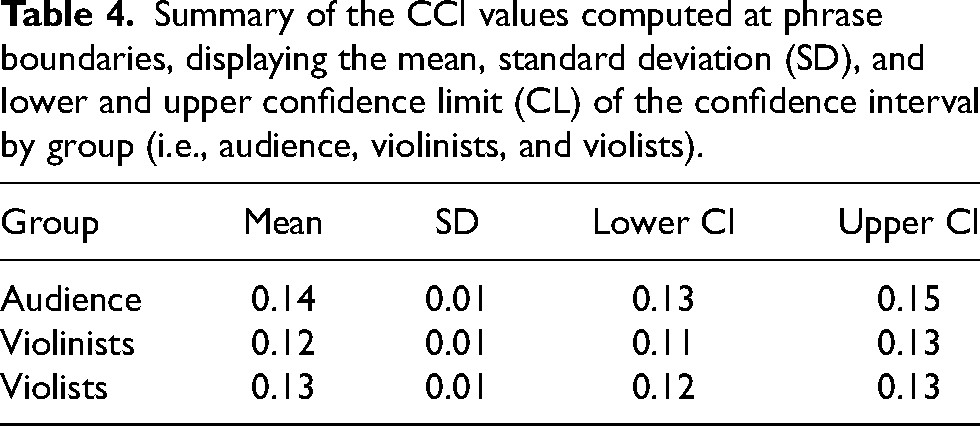
The mean CCI at phrase boundaries between audience members was significantly higher than that between violinists; it was also higher than that between violists (see Table 4, Table 5 model no 1, and Figure 3). CCI between violists was not significantly different than that between violinists. The random intercept variances for performance and phrase numbers were 1.755e-5 and 1.040e-4, respectively. This suggests that 2% and 12% of the total variance in cardiac coherence were attributable to differences between performances and phrase boundaries. These overall results were replicated with median CCI computed at phrase boundaries.

Distribution of the CCI values among three groups: violinists, violists, and audience members. The data is represented using violin plots overlaid with box plots. Each violin plot shows the kernel density estimation of CCI values, visually representing the distribution’s shape and spread. The inner box plot indicates the median, interquartile range (IQR), and potential outliers. Individual data points are also displayed as jittered dots to show the raw data distribution. CCI values are computed at phrase boundaries. ***p < 0.001.
Summary of the CCI values computed at phrase boundaries, displaying the mean, standard deviation (SD), and lower and upper confidence limit (CL) of the confidence interval by group (i.e., audience, violinists, and violists).
Results of the linear mixed models measuring the relationship between the violinists’, violists’, and audience CCI values at phrase boundaries. The table also displays the model number (n) and random effects (RE) variables (i.e., performance and phrase number, depending on the model) used in the analysis. ***p < 0.001.
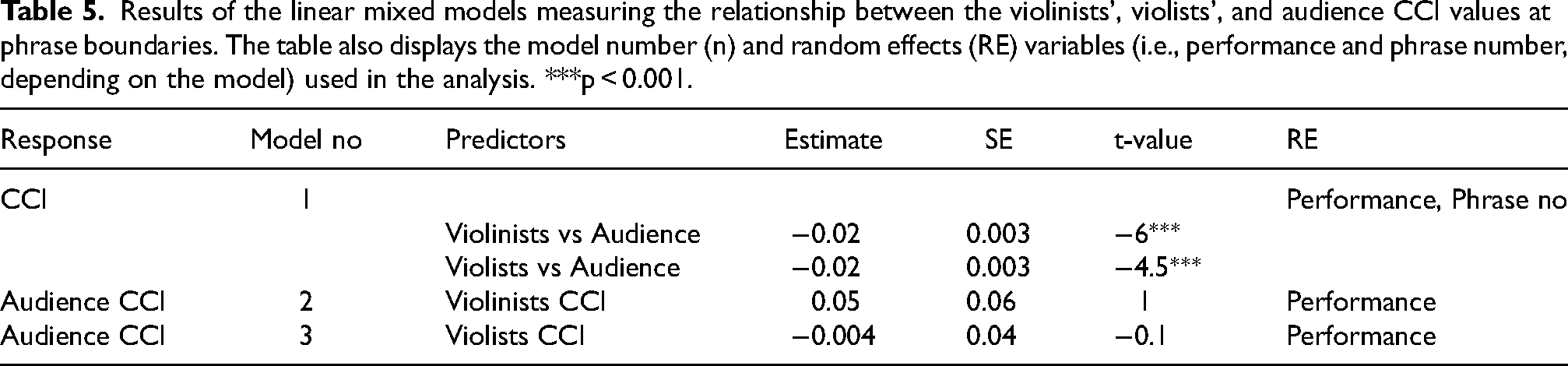
Mean CCI between violinists and between violists computed at phrase boundaries did not predict mean CCI between audience members (see Table 5 model nos. 2 and 3).
Impact of Musical Features on Musicians’ and Audience Cardiac Coherence
The form structure (i.e., “a,” “b,” “c”) did not predict mean CCI values across phrases, regardless of the participant group. This aspect was also investigated as a sanity check based on median CCI data computed across phrases, since the median is less sensitive to outliers and skewed distribution. Results demonstrate that the form structure predicted median CCI values across phrases depending on the participants’ group. Form structure did not predict median CCI values of violinists and violists (see Table 6, models 1–2), but cardiac coherence of audience members was higher in the “a” phrases than the “b” phrases (see Table 6, model 3 and see Figure 4). This points to the underlying distribution characteristics of the data, suggesting that the median might be the most representative measure of cardiac coherence in audience members during a phrase. In addition, the random intercept variances for performance and phrase numbers were 1.328e-5 and 8.315e-6, respectively. This suggests that 7.2% and 4.5% of the total variance in cardiac coherence were attributable to differences between performances and phrase boundaries.

Distribution of the CCI values by phrase (i.e., “a,” “b,” and “c”). Each violin plot shows the kernel density estimation of CCI values, visually representing the distribution’s shape and spread. The inner box plot indicates the median, IQR, and potential outliers. Individual data points are also displayed as jittered dots to show the data distribution. CCI values are median averages across phrases. *p < 0.05.
Results of the linear mixed models measuring the relationship between form structure, SPL, and rhythmical complexity (i.e., the predictors) on violinists, violists, and audience CCI values (i.e., the response variables). The table also displays the model number (n) and RE variables (i.e., performance and phrase number, depending on the model) used in the analysis. ***p < 0.001.

Figure 5 shows the relationship between SPL and CCI by participant group. SPL computed at phrase boundaries and averaged across the four performances predicted the cardiac coherence between violinists and violists. The higher the SPL, the lower the CCI between violinists and that between violists (see Table 6 models 4–5, respectively; see also Figure 5). However, SPL did not predict the cardiac coherence between audience members (see Table 6 model 6 and Figure 5). These results were replicated with mean data computed across phrases.

Scatter plots illustrating the relationship between SPL, the independent variable, and the CCI, the dependent variable, computed by participants group (i.e., violinists, violists, and audience members). Each observation is computed at phrase boundaries and averaged across performances. The blue lines indicate the best-fit linear regression line.
To further assess cardiac trends during the piece in relation to SPL, z-scores transformed of raw IBI trajectories were averaged for each group. Visual inspection of the results plotted in Figure 6 for KORK and Figure 7 for SSO demonstrates a tendency for musicians’ IBI to decrease. At the same time, SPL increases for each performance, while the audience's IBI tends to be more stable. Based on these results, an additional analysis was implemented to analyze the correlation between the mean CCI and mean raw IBI (computed at phrase boundaries and aggregated for each group) for each performance, as shown in Table 7. The median Pearson correlation for the violinist group was 0.41; for the violist group, it was 0.415; and for the audience groups, it was 0.065. These results suggest that cardiac coherence in musicians is, to some extent, positively related to increased IBI (i.e., decreased heart rate).

Z-score IBIs, (top row) plotted against SPL trajectories (bottom row) related to take 1 (left column) and take 2 (right column) performed by KORK. IBIs are averaged per group (i.e., violinists (vn), violist (vl), and audience (aud)). Vertical orange lines display theme beginnings, and purple lines piece ending.

Z-score IBIs, (top row) plotted against SPL (bottom row) related to Kjempeviseslåtten that SSO performed during concert 5 (left column) and concert 7 (right column). IBIs are averaged per group (i.e., violinists (vn), violists (vl), and audience (aud)). Vertical orange lines display theme beginnings, and purple lines piece ending.
Results of the Pearson correlation tests between mean CCI values and mean raw IBIs computed at phrase boundaries and aggregated for each group and extracted for each performance. Statistically significant results are highlighted in bold.

Discussion
This study investigates the cardiac coherence between selected violinists, viola players, and audience members from the SSO and the KORK during multiple performances of Harald Sæverud's Kjempeviseslåtten. In line with our hypothesis (H1), we observed significant cardiac coherence values among selected violists, violinists, and audience members. These results expand previous empirical investigations focused on either musicians (Hemakom et al., 2017; Høffding et al., 2023; Müller & Lindenberger, 2011; Ruiz-Blais et al., 2020) or audiences (Bernardi et al., 2017; Czepiel et al., 2021; Czepiel et al., 2024; Tschacher et al., 2023), showing how consistent the collective cardiac responses were across different orchestras (two), repeated performances (four) of the same piece, and audiences (three).
Contrary to our predictions, cardiac coherence in audience members was higher than that of musicians (H2). There may be several explanations for this. One could be diverse physiological responses to increased muscular exertions in musicians, which could have affected the degree of collective physiological response. Musicians’ body mass differences can impact their cardiac activity (Vellers et al., 2015); the increasing physical demand of the piece might have evoked diverse physiological reactions based on different fitness levels.
Age and gender/sex of the participants might have also impacted their cardiac activity. These were intentionally not collected to safeguard the privacy of the musicians. Given that the concert series and orchestras are already named, disclosing age and sex could potentially lead to the identification of individual musicians. Conducting research in real-world settings necessitates a careful balance between the amount and type of participant information that can be collected and disclosed. While this approach requires stringent measures to protect participant privacy, it also enhances the ecological validity of the findings. Developing trust between researchers and orchestras/musicians is key for the future of live concert research.
An additional explanation of the observed low musicians’ CCI values might pertain to the shift in their shared attention, in line with recent findings suggesting that concurrent changes in cardiac activity can reflect shared selective auditory attention (Stuldreher et al., 2020). In interviews after the concert, KORK violinists and violists discussed a general tendency to change their attention from specific instruments (performing leading roles during the first appearance of the theme) to their part (towards the last two performances of the theme). Musicians’ shared attention towards leading instruments (i.e., concertmaster and lead viola) during the first appearance of the theme might explain the higher CCI values in musicians. In comparison, attention toward the self during the more technically demanding renditions might explain the lower CCI values during the last two renditions of the theme.
Our hypothesis that cardiac coherence relates to musical structure (H3.1) was only partially supported. Musical structure did not predict violinists’ or violists’ CCI values or audiences’ mean CCI values, but it did predict audiences’ median CCI data. We should be cautious in interpreting structural effects on audiences’ cardiac coherence; further investigations with different musical stimuli are necessary. Nevertheless, the fact that audiences’ median cardiac coherence was higher in the more rhythmically stable phrase (“a”) than the more rhythmically complex phrase (“b” featuring a “dotted” rhythm) is in line with previous findings, indicating how simpler music structures may promote higher interpersonal cardiac coupling among concertgoers (Bernardi et al., 2017).
A decrease in musicians’ CCI whilst SPL increases (H3.2) might be explained by different physiological responses to increased muscular exertions and less coherent shared attention towards the end of the piece. A general tendency for musicians’ IBIs to decrease during music performances whilst sound pressure levels increase is in line with previous studies analyzing the physiological responses of a professional ensemble performing a Schubert trio (Soliński et al., 2024). Sound pressure levels did not predict audiences’ CCI values (RQ3 and H3.2), and these results corroborate previous investigations analyzing autonomic responses in audiences during live string quintet performances (Czepiel et al., 2021). Together, these results suggest that perceived loudness might not evoke a collective autonomic response in audience members.
The cardiac activity of the string players was of great interest because their sound production is not directly influenced by breathing patterns that could alter their cardiac activity (Ruiz-Blais et al., 2020). We might anticipate more pronounced collective cardiac responses among brass and wind players during playing than in string and percussion sections. Future studies might shed more light in this respect by mapping simultaneously the cardiac activity of the various orchestra sections.
The CCI was derived from IMFs within the frequency range 0.15–0.5 Hz. This range corresponds to 1–2 bars in the piece performed and largely overlaps with the high-frequency (HF) band (0.15–0.4 Hz). This band is associated with parasympathetic influence on the heart and RSA (Berntson, 1997). Additionally, high-frequency HRV is linked to positive emotions (McCraty et al., 1995), interpersonal connectedness (Kok BE, 2010), and an individual's affiliation with a new group (Sahdra et al., 2015). We focused on the high-frequency range to emphasize changes in cardiac activity specific to bar levels and because of its relevance in perceived affiliation among participants. Future investigations could explore trends in cardiac activity in the low-frequency (LF) band, reflecting both the sympathetic and parasympathetic activity. This aspect may be particularly relevant for musicians experiencing stress or physical exertion, as stress conditions are characterized by increased sympathetic activity and low parasympathetic activity, which can lead to elevations in the LF band (Kim et al., 2018).
Common metrics of HRV in the time domain (i.e., Standard Deviation of NN intervals, Root Mean Square of Successive Differences, percentage of pairs of successive NN intervals) or in the frequency domain (i.e., LF power, HF power, and LF/HF ratio) exhibit a positive relationship with the mean duration of the interval between two beats (de Geus et al., 2018). These metrics are often used without reference to prevailing levels of cardiac chronotropic state (i.e., mean heart rate or mean IBI). Conversely, this study analyzed the relationship between the extracted HF IMFs and IBI (see Supplemental material for details) for each participant and piece. Results show a weak relationship between IMFs and IBI, highlighting the relevance of empirical mode decomposition for the analysis of cardiac activity.
Future investigations should consider the potential impact of contextual factors on cardiac activity, such as age, physical activity, time since last meal or intake of caffeine, tobacco, and alcohol (Quigley et al., 2024). Beta-blockers’ use, effectively lowering hypertension and heart rate, should be considered in future investigations analyzing collective cardiac responses (Johri et al., 2023). To make these results generalizable, it would also be necessary to replicate this study with a broad musical repertoire.
We did not examine the differences between advanced music students participating in the SSO concerts and the general adult audience members attending the KORK concert. The varying concert settings, including differences in the musical program, concert hall, and audience size, introduced distinct contextual factors that could influence the results. These variations made it challenging to directly compare the two groups within the scope of this study. However, we recognize that investigating the impact of musicianship level on cardiac coherence is a valuable area of inquiry. Understanding how advanced musical training might affect physiological responses during concerts could provide deeper insights into the relationship between musical experience and audience engagement.
Conclusions
This study shows that orchestra performances can evoke collective cardiac responses among selected violinists, violists, and audience members, consistent across repeated performances of the same piece and with different orchestras and audiences. Decreases in musicians’ cardiac coherence were related to increased SPL, while decreases in audience cardiac coherence were related to a more complex form structure. These results suggest that cardiac coherence among orchestra players and audience members might be related to diverse physiological responses to the increased physical demand of the piece and its rhythmical complexity.
Supplemental Material
sj-pdf-1-mns-10.1177_20592043251370977 - Supplemental material for Cardiac Coherence among Musicians and Audiences During Orchestra Performances
Supplemental material, sj-pdf-1-mns-10.1177_20592043251370977 for Cardiac Coherence among Musicians and Audiences During Orchestra Performances by Sara D’Amario and Alexander Refsum Jensenius in Music & Science
Footnotes
Acknowledgments
We would like to thank the Stavanger Symphony Orchestra and the Norwegian Radio Orchestra for participating in the study. We also thank Sten Ternström for his insights in the acoustics analysis. Finally, we sincerely thank all members of the Bodies in Concert team who supported this work at RITMO.
Action Editor
Jennifer MacRitchie, University of Sheffield, School of Languages, Arts and Societies.
Peer Review
Two anonymous reviewers.
Author Contributions
All authors contributed to the conception and design of the study. SD collected, analysed and interpreted the data, and drafted and critically revised all versions of the manuscript. ARJ contributed to the data collection, analysis and interpretation, and to the article revisions. All authors approved the submitted version.
Declaration of Conflicting Interests
The authors declared no potential conflicts of interest with respect to the research, authorship, and/or publication of this article.
Ethical Approval
The Norwegian Agency for Shared Services in Education and Research (Sikt) reviewed and approved this study, with reference number 672757. Musicians and audience participants provided written informed consent to participate in the research after receiving written and spoken explanations during rehearsals and before the concert, respectively.
Funding
The authors disclosed receipt of the following financial support for the research, authorship, and/or publication of this article: This work was supported by the University of Oslo and the Research Council of Norway through its Centres of Excellence scheme, project number 262762, and from the European Union’s Horizon research and innovation program under the Marie Skłodowska-Curie grant agreement No. 101108755.
Open Research Data Sharing Policy
Research data will be made available for open access after manuscript acceptance.

Supplemental Material
Supplemental material for this article is available online.
References
Supplementary Material
Please find the following supplemental material available below.
For Open Access articles published under a Creative Commons License, all supplemental material carries the same license as the article it is associated with.
For non-Open Access articles published, all supplemental material carries a non-exclusive license, and permission requests for re-use of supplemental material or any part of supplemental material shall be sent directly to the copyright owner as specified in the copyright notice associated with the article.
