



Abstract
The pioneering “research concerts” of recent decades represent prime examples of interdisciplinary music research. MusicLab Copenhagen, a collaboration between RITMO Centre for Interdisciplinary Studies in Rhythm, Time, and Motion at the University of Oslo and the Danish String Quartet was no exception in this regard. This paper aims to document and critically evaluate key components of the project by framing it as a radically interdisciplinary research collaboration. We review the multidimensional differences and similarities between the research traditions involved and report on semi-structured interviews with five key project members. This, in turn, forms the basis for a critical discussion of organizational aspects, aims, values, and overt and covert hierarchies resulting from the meeting of divergent scientific disciplines. Ultimately, we review the practical, epistemological, and theoretical gains and challenges involved in conducting organizationally complex research at the vanguard of interdisciplinarity—both in general terms and within music research in particular. A set of recommendations is provided for conducting successful research concerts, emphasizing, among other things, the importance of providing realistic and artistically satisfying concert experiences while still collecting valid, reliable, and sufficient data; of matching expectations about what can and cannot be achieved and concluded from the collected data; of prioritizing organizational competence and infrastructure, striking a balance between top-down control and bottom-up initiatives; and of recognizing and respecting each other's expertise across the involved research disciplines.
Keywords
Introduction
The pioneering “research concerts” of recent decades represent prime examples of interdisciplinary music research due to their multifaceted intersections with psychology, sociology, mathematics, computing, acoustics, medicine, and biology (Klein & Parncutt, 2010). Often they have used a mix of methods (Seibert et al., 2020) to investigate diverse topics such as emotion and aesthetic experience (Coutinho & Scherer, 2017; Czepiel et al., 2023; McAdams et al., 2004; Merrill et al., 2023; Stevens et al., 2014; Tschacher et al., 2023; Thompson, 2006), expectation (Egermann et al., 2013), psychophysiology (Bernardi et al., 2017; Czepiel et al., 2021; Egermann et al., 2013; Sato et al., 2017), movement (Swarbrick et al., 2019), synchrony (Czepiel et al., 2021, 2023; Seibert et al., 2019; Tschacher et al., 2023), joint action (Chang et al., 2017, 2019), and social connection (Swarbrick et al., 2021) during the live concert experience. Whereas many such concert studies have been initiated and spearheaded by psychologically oriented researchers, the MusicLab Copenhagen concert, which we will discuss here, was initiated by humanities scholar and philosopher Simon Høffding (SH) with the explicit goal of obtaining a deeper understanding of joint, embodied concert absorption among both audience members and musicians. It grew dynamically out of a long-lasting phenomenological research collaboration with the world-class Danish String Quartet (DSQ) (Høffding, 2019). By virtue of Høffding's affiliation with RITMO Centre for Interdisciplinary Studies in Rhythm, Motion, and Time at the University of Oslo, a sizable interdisciplinary research conglomerate came together around this topic, comprised of around 25 experimental psychologists, musicologists, philosophers, engineers, librarians, and music technicians organized into various mutually overlapping subgroups. The collaboration culminated in a 14-hr research endeavor at Musikhuset in Copenhagen on October 26, 2021. The event featured a controlled motion-capture, cardiac synchronization, pupillometry, and eye-tracking experiment with the string quartet in the morning (Høffding et al., 2023) and a full-scale public concert in the evening, including audience surveys (Swarbrick, Martin et al., under review) and continuous recordings of physiological, pupillometry, and motion-capture data from the musicians alongside video and audio of the whole event (Upham & Rosas, submitted). MusicLab Copenhagen was the seventh installment of the MusicLab series conceived by RITMO and the University Library at the University of Oslo. This series comprises public research concerts designed to investigate music in a live setting as well as to explore new methods for conducting and communicating open research. Typically, they have featured a concert, a panel discussion on a topic related to the concert, and an edutainment element such as live data analysis.
The MusicLab Copenhagen project can be placed at the crossroads of studies investigating various aspects of interaction between musicians in music ensembles (see, e.g., Timmers et al., 2021), the motivations and experiences of audiences (see, e.g., Pitts, 2020; Sloboda & Wise, 2016; Thompson, 2006), and a line of research using quantitative approaches to measuring listeners’ experiences in concerts via, for example, continuous or retrospective self-reports or observational data (McAdams et al., 2004; Swarbrick et al., 2021) or physiological recordings (see, e.g., Czepiel et al., 2021; Egermann et al., 2013; Swarbrick et al., 2019). The primary goal of the project was to study collective and embodied aspects of being absorbed in live music in both audience members and professional musicians partaking in a realistic concert setting.
This article aims to document and critically evaluate key components of the organization and research collaboration that was MusicLab Copenhagen. We will share the lessons learned regarding how to conduct interdisciplinary research into live concerts and reflect on the gains and challenges of collaborating across disjunct academic disciplines. First, we will review the multidimensional differences and similarities between the research traditions involved. Next, we will report on semi-structured interviews with five key project members that will in turn form the basis for a critical discussion of organizational aspects, aims, values, and overt and covert hierarchies resulting from the meeting of divergent scientific disciplines. In this way, we will illuminate the practical, epistemological, and theoretical gains and challenges involved in conducting organizationally complex research at the vanguard of interdisciplinarity—both in general terms and within music research in particular.
Research Traditions and Epistemologies
MusicLab Copenhagen involved a broad variety of hard and soft scientific approaches, ranging from hypothesis-driven research and data-driven observation studies to interpretive humanistic research and philosophical reflection (see Table 1). We will refer to the last of these as “ideas driven.” Note that the distinctions between these approaches are independent of the nature of the empirical material; each of the three approaches can employ both qualitative and quantitative data, and the same data may in principle be subjected to any approach.
Key epistemological and methodological differences between the three overall research approaches forming part of the MusicLab Copenhagen project.

Traditionally, hypothesis-, data-, and ideas-driven approaches involve incompatible styles of thought and pose problems along many axes, including communication, quality criteria for research, and publication channels, to mention a few (Jacobs & Frickel, 2009). This, in turn, leads to divergent methodological commitments and goals as well as distinct practical procedures for conducting research (see Table 1). Whereas the humanities and the softer areas of the social sciences employ analysis and interpretation to achieve an understanding of a phenomenon, the natural sciences, and the hard science-inspired strands of social science (experimental psychology, quantitative sociology, etc.), pursue hypothetico-deductive paths and strive for causal explanations. This distinction goes back to (at least) Wilhelm Dilthey’s (1977/1894) essay of 1894 titled “Ideas Concerning a Descriptive and Analytical Psychology.” Here, he worked out important methodological distinctions between Geisteswissenschaften (humanities) and Naturwissenschaften (natural sciences) that still hold true today. For the sake of argument, we can take the liberty of equating Dilthey's two Wissenschaften with the ideas- and hypothesis-driven approaches in Table 1, respectively.
In the ideas-driven tradition, Geisteswissenschaften, the researcher interprets the specific phenomenon under study to obtain a fuller, and ideally a holistic, understanding of it through detailed analysis, or a “thick description,” to quote Geertz (1973). The methodological commitment is thus one of normative holism, focused on grasping the most salient aspects of the phenomenon given the stated research aims. This approach ultimately results in an interpretation that is historically and culturally situated and dependent on the interpreter's pre-understanding. In the hypothesis-driven tradition, Naturwissenschaften, there is ideally a clear separation between the research object and the researcher. A theory is formulated or adopted, and hypotheses are systematically derived from it. A certain degree of reductionism is expected and serves to prevent false positives and confounding factors. Consequently, one aspect is investigated at a time, while others are held constant. The knowledge produced will ideally accumulate into stable, causal, and generalizable explanations of the world.
Although it may most often be associated with Dilthey's Naturwissenschaften, data-driven research is inductive. It does not involve a priori hypotheses, and the study object is typically not subjected to reductionism. Instead, it commits itself to a pragmatic holism employing a multitude of methods to be able to capture as many relevant aspects of a given phenomenon as possible. Data can in principle be collected without any commitment ahead of time as to what they might represent. Research starts with data collection, which may happen opportunistically according to availability and capability rather than as the product of prior theory or hypotheses. Data are subjected to exploratory analysis that may eventually lead to new theorizing. Contrary to traditional humanistic research, data-driven research is (ideally) largely free of assumptions and “objective” in the sense that its aim is to produce replicable scientific insights.
All the three methodological orientations described above were present in the MusicLab Copenhagen science concert. The interaction between the musicians was studied using a more traditional hypothesis-driven, experimental approach. Data-driven research was conducted on many of the physiological and audio/video-based measures obtained from the musicians and the audience, whereas the qualitative survey study is an example of ideas-driven research. As disciplines are typically defined and constrained in terms of their research focus and methodology, interdisciplinary research efforts are most often intended to integrate knowledge and solve problems that individual disciplines cannot solve alone. In the case of concert experiments, the involved disciplines are in some but not all aspects united in terms of research focus. This results in a natural confluence of complementary methodological approaches that may instigate different degrees of the disciplinary integration governing various aspects of the overall project.
Forms of Interdisciplinarity
As mentioned above, the MusicLab Copenhagen science concert was, like the pioneering research concerts from the last decades (see, for example, Czepiel et al., 2021), a highly interdisciplinary research collaboration. As pointed out by Stember (1991), however, the term “interdisciplinar(it)y” can be used in both a broad and a narrow sense. Broadly, it refers to any non-monodisciplinary activity, whereas narrowly, it refers to a specific subtype of non-monodisciplinary activity that is qualitatively different from multi-, cross-, and transdisciplinary activities, for example. Inspired by LeMura (1998) and others, Jensenius (2022, pp. xvii–xviii) follows this narrower definition in describing a stepwise progression via intra-, cross-, multi-, inter-, and transdisciplinarity. While intradisciplinary approaches stay within a single discipline, crossdisciplinary approaches view one discipline from the perspective of another. In multidisciplinary approaches, several disciplines provide different—and potentially equally valid—perspectives on a single problem or issue. Interdisciplinary approaches further integrate the multiple disciplinary perspectives, and transdisciplinary approaches develop a unified intellectual framework for answering overarching questions that are often complex and transcend what a single discipline is capable of solving. If full integration is accomplished and a shared framework is solidified and proves successful, then a new discipline may eventually emerge from the transdisciplinary conglomerate. This outcome effectively restarts the potential for integration with yet other disciplines. While these five or so categories constitute a useful heuristic for describing and visually displaying different stages of disciplinary integration (e.g., Jensenius, 2022, pp. xvii–xviii), most adherents of this model (and related models) would agree that research practices instead follow a continuum from intra- to transdisciplinarity (Strathern, 2007). Thus, a given collaboration may involve aspects of multiple categories and may progress along the continuum throughout its lifetime.
Recent years have seen a steady increase in calls for interdisciplinary approaches to research from politicians, university administrators, and public and private funding agencies alike. Interdisciplinarity, it is claimed, will solve many of the foundational crises faced by societies today (Strathern, 2007). In turn, sociologists of science have noted that “interdisciplinarity is lauded as an ideal, scorned as a threat, and embraced as a practice” (Jacobs & Frickel, 2009, p. 44). Indeed, while interdisciplinary research holds great promise for large-scale problem-solving, it is also bedeviled by obstacles that monodisciplinary research does not face. These obstacles include insufficient institutional infrastructure, lack of dedicated funding sources, and an absence of established criteria for quality assessment as well as an increased workload, a higher bar to career advancement, lower employability, lack of skilled supervision and peer support, a potential gender disparity, and widespread concerns about scientific quality (Jacobs & Frickel, 2009; Kaiser et al., 2016; Lau & Pasquini, 2004). However, due to the scarcity of relevant controlled studies, there is limited tangible evidence for or against interdisciplinarity's superiority over more traditional approaches.
In addition to the successive degrees of disciplinary integration, interdisciplinary research (in the broad sense of the term) can be characterized along yet another dimension—namely, in terms of the relatedness of the composite disciplines prior to integration. Musicology, for example, is more closely related to history than to medicine or physics. At modern universities, such disciplinary relatedness is most clearly reflected in organizational divisions, such as departments and faculties. Musicology and history, for example, both belong to faculties of humanities, whereas medicine and physics typically belong to faculties for health and natural sciences, respectively. Research projects that traverse larger-scale organizational boundaries—such as those between faculties—are sometimes described as “radically interdisciplinary.” 1 This distinguishes them from interdisciplinary collaborations between neighboring disciplines like music and history or physics and chemistry. Note that radically interdisciplinary research is not the same as “radical research” (as found in “radical humanities,” for example) where the label of radicality typically highlights exceptionally high societal impact or inter-sectorial bridge-building (e.g., Schostak & Schostak, 2007).
Given its high degrees of integration between distantly related disciplines such as musicology, philosophy, psychology, mathematics, computing, acoustics, and biology, the MusicLab Copenhagen project, we will argue, held a strong potential for radical interdisciplinarity. To reiterate the concluding point of the previous paragraph, this is not to say that MusicLab Copenhagen was any more “radical” than other research concerts; rather, from the outset, its interdisciplinarity was of a particular kind due to ideas from music-philosophical research playing a prominent part in framing the research concert. As will become evident, this potential for radical interdisciplinarity came with both gains and challenges, and arguably, the potential was not always fully realized. In this article, we will use interviews with key project members to identify practical, epistemological, and theoretical aspects of the MusicLab Copenhagen project and critically assess and discuss possible gains and challenges of working across distantly related scholarly traditions and approaches.
Methods: Informants and Procedure
We interviewed five key researchers involved in MusicLab Copenhagen about their thoughts on interdisciplinary research and their specific experiences with participating in this project. The interviewees subscribe to different research traditions and possess diverging types of expertise (see Table 2). They also took on different roles in the project: Simon Høffding (SH) managed MusicLab Copenhagen; Alexander Refsum Jensenius (ARJ) was responsible on behalf of RITMO; Laura Bishop (LB) was responsible for most of the motion capture, eye-tracking, and pupillometry data collection; Nanette Nielsen (NN) was involved in the questionnaire study; and Finn Upham (FU), who joined the project quite late, was mainly concerned with the MusicLab App and the audience's micro-motion data. In addition, these researchers took on various ad hoc responsibilities closer to the concert date. The interviewed researchers were chosen to reflect and juxtapose the unusually diverse set of disciplines involved in MusicLab Copenhagen.
Overview of the five interviewees.

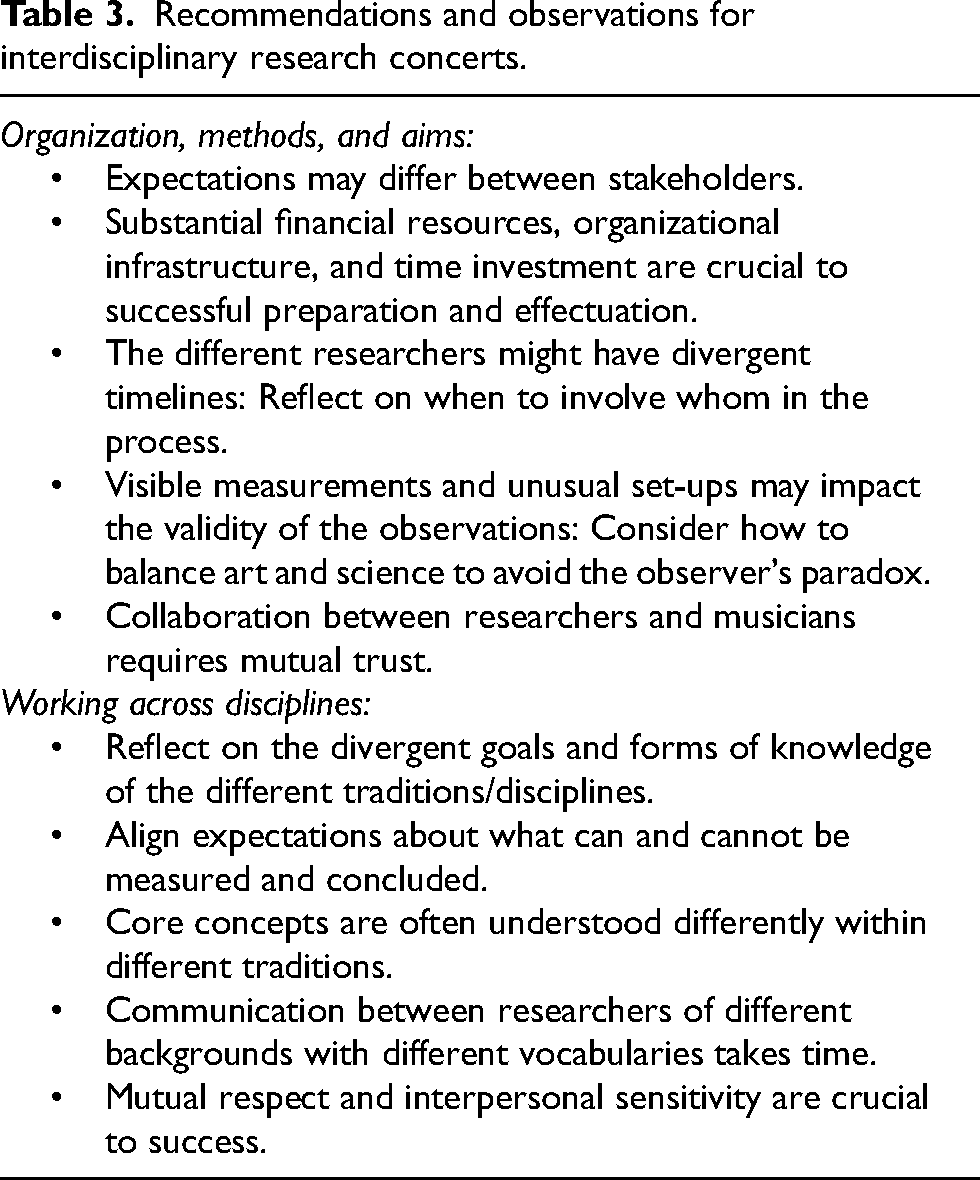
Recommendations and observations for interdisciplinary research concerts.
We designed a semi-structured interview guide specifically for this project (see Appendix A) that enabled the interviewees to highlight their own interests and allowed the interviewer to customize questions while ensuring that all relevant issues were addressed.
The interviews lasted approximately 45 min and took place in May, June, and September 2022. Three were held online through the software Zoom, due to the geographic distances involved, and the other two took place at RITMO, University of Oslo. The online interviews were recorded with the recording function of Zoom, while the physical interviews were recorded with a Zoom H4 recorder. Written informed consent was obtained, and all interviewees agreed to be identified in this paper.
The interviewer (TP) had a relationship with all the interviewees through her engagement as a part-time research assistant in a different RITMO project. She thus had some prior knowledge of the interviewees and their academic backgrounds but was not part of the MusicLab project, which allowed for an unbiased outsider's perspective.
Transcriptions were carried out by an external research assistant and statements pertaining to the themes of the interview guide (see Appendix) were subsequently identified and sorted according to those themes by the two remaining authors (AD and NCH), separately. Converging material from these two authors was then included in the different sections, which cover different parts of the interview guide. Section 3 primarily reports responses to the questions regarding project involvement and planning, and Section 4 reports responses related to questions regarding disciplinary background, interdisciplinarity, and the evaluation of the outcomes of the project. The semi-structured interview approach also resulted in some statements that we found particularly interesting given the overall aim of the study. These themes are reported in Section 5. The methodological approach to analyzing the interview material was interpretive and narrative in nature. This approach is recommended when interpreting in-depth qualitative interviews in the humanities, especially when doing a small number of semi-structured—that is, partly open—interviews as was the case in this study (see Alvesson, 2023). Quotations in the Nordic languages (from interviews with SH, ARJ, and NN) were translated into English by the authors after the first draft of the manuscript had been completed.
Organization, Aims, and Motivations
MusicLab Copenhagen was a complex event comprising multiple research groups with different interests. Alexander Refsum Jensenius (ARJ), who was in charge of the event for RITMO, recalled that the event's organization was a mix of “sign up if you like” and recruiting necessary personnel such as the engineers: “[Most] MusicLabs have been much smaller in complexity and scope; this one grew to be very big. It was at one point very big, but then we took it down again quite a bit, so that it became manageable.” Finn Upham (FU), a postdoctoral researcher at RITMO doing mostly data-driven quantitative research, described the collaboration as a self-organizing process: “I became aware of there being things that I expected to exist [that] weren't there yet. So I was kind of stepping in to try to make sure that some stuff could go more smoothly.” FU never expected to be in the sort of leadership role they ended up with: “It wasn’t a problem, and I don’t think there was any tension around that, but it was kind of a surprise to me.” Laura Bishop (LB), a music performance researcher, who according to the MusicLab leadership was vital to the more hypothesis-driven experiments, would have found overall project control too daunting a task. The management of interdisciplinary projects tends to require extra efforts (Tröndle et al., 2022), and LB noted that engineer Kayla Burnim took on an important role in planning the details and logistics of the project.
Simon Høffding (SH), the initiator of the concert, emphasized that the aim was to create an “opportunity space” rather than to answer specific research questions as such. The loose organization and absence of top-down constraints was thus, at least in part, a conscious choice: “Interdisciplinary research is often initiated from above, but I just wanted to make a room available for the different researchers that they could enter if they wanted [. . .] Instead of forcing people to work on a specific hypothesis [. . .], one should just establish a space that is valuable to them—for example, a room with some of the world's greatest musicians—and see what might happen.”
That said, SH kept specific ideas and hypotheses in mind: “First and foremost, [I wanted] to see if we could connect the experiential and the physiological and look into whether there were shared rhythms across musicians and audience.” Still, this did not work out as he had planned. After the fact, he discovered that no one had actually formulated specific hypotheses regarding his primary topic of interest: “So, in fact, we don’t have a lot of data on this.”
As mentioned above, motivations for engaging in research concerts can vary substantially. Researchers are usually most interested in producing high-quality science (Mulligan & Mabe, 2011); expert musicians want to deliver a high-quality artistic performance (Hallam et al., 2016); the audience typically seeks an exciting experience ranging from fun to existentially rewarding (Pitts, 2020); the concert venue staff and music management are subject to economic constraints (Hutter, 2020); and the press is normally concerned with certain classical news criteria such as novelty and relevance (Kepplinger, 2008). Given such a broad scope of possible interests, one might ask whether differing stakeholders’ motivations, aims, and success criteria led to concerns or tensions in the case of MusicLab Copenhagen.
SH's main goal was research communication rather than research per se: “The motivation was [. . .] to show […] people [who are not involved in research] what research looks like from the inside.” With MusicLab Copenhagen, he wanted to leave the academic ivory tower—to be honest and transparent and to put the inherent uncertainties of research on display: “[…] and I really want to show the world, together with our colleagues, the power of music, and what the experience of live art means to human beings and to our society.” The management at RITMO, on the other hand, wanted to justify the costs by ensuring that valid scientific results were achieved. According to SH, center director Anne Danielsen was concerned about the overemphasis on public communication at the expense of scientific focus during the initial project phase. The musicians likewise concentrated on the event's messaging and even sought to stage the impression of science. According to SH, in all seriousness, they requested test tubes with “bubbling” chemicals on stage, scientific graphs, and researchers wearing lab coats. Overt staging such as that requested by the musicians could have compromised the project's scientific validity in that the concert still had to feel like a real concert to the audience.
The real-time, live character of a concert also presented certain challenges. SH explained: “[I]n a concert […] one cannot just play a piece of music and say, ‘we will now play it again, because there was something [in our research set-up] that didn’t work’ [. . .] [Art and science] are very different spheres with different goals.” Overall, SH did find that the confluence of artists interested in research and researchers interested in art was very productive, but it required “a real deep human connection [. . .] a collaboration that is so confident that people can trust one another [. . .] It is very important that the quartet can say, ‘We don’t want this.’”
ARJ added, “The whole point [of MusicLab] was that we were going to build this around a real concert, because a lot of music research is often lab-based or very artificial [. . .] So we wanted to use technologies and tools to collect data during a live concert. That's a key ambition for MusicLab—we want people to not think about the fact that they are taking part in an experiment. They should be allowed to just sit there and be absorbed, literally.” Although he was skeptical about asking the audience to fill out surveys during the concerts, he arrived at a pragmatic stance: “It interrupts that flow, seriously. But we ended up doing it anyway, and there were pretty long periods with music, so in that sense I think it was fine. But [. . . it] was unfortunate, though, in relation to capturing the basic experience.”
When reflecting on possible areas of improvement for the project, SH stressed that hypotheses could have been refined in general, as well as being more directly derived from prior results. Arranging a conference with some other labs that do similar things would have been a good idea. In addition, the practical preparations could have been improved—plans to fly the quartet to Oslo, for example, to test the equipment had to be skipped due to time constraints, so everything was packed into one day in Copenhagen. FU also stressed the need for prior piloting: “We [had] sets of people practicing components of it, but when it came to the day of actually conducting [the concert experiment], we were still having to do a lot of like teaching of how to do which and figuring out who needs to be where [. . .] You can’t ask too much of the musicians, we can’t ask too much of the many people that are participating, but [. . .] if I had to state one lesson going forward, it would be [to] plan for [a rehearsal experiment]. The experimenters need dress rehearsals too.”
There was also the risk of expectancy effects and retrospective recall bias when the team collected the self-report data (e.g., Colombo et al., 2020; Klein et al., 2012). Therefore, time was dedicated in the concert program to survey completion in the hall immediately after the music had ended, and great effort was made not to reveal experimental hypotheses. In his introductory speech to the audience, for example, SH struck a reasonable balance between engaging curious audience members and sustaining their roles as relatively naïve research subjects. Because, possibly unintentionally, he formulated the research questions in broad and general terms rather than specifying hypotheses, he likely avoided any impact upon participant behavior: “Tonight we will investigate musical immersion. How is it related to our emphatic skills? Do we create a common zone of immersion, a large musical ‘we,’ when we immerse ourselves in music? How does it affect our bodies? And can we represent the inner logic of music with visual aids?” It may be that SH's grounding in ideas-driven, humanistic scholarship helped him to achieve this goal in comparison to his colleagues from the hypothesis- or even data-driven camps. In all, these concerns and challenges demonstrate the classic observer's paradox with regard to research concerts: in short, the danger of an observed phenomenon being distorted by the presence of its observer (e.g., Merrett, 2006).
Summing up, the project's organizational structure was quite complex and emerged dynamically rather than via intentional planning. Motivations varied among those who partook, and it was sometimes challenging to balance divergent concerns such as providing a real concert experience while simultaneously collecting sufficient, valid, and reliable data. Overall, neither concern had optimal conditions, but both were accomplished.
Working Across Disciplines
As mentioned in the introduction, there are epistemic barriers between research traditions and disciplines that involve incompatible styles of thought that may pose problems along many axes (Jacobs & Frickel, 2009, p. 47). How was this handled at the MusicLab Copenhagen science concert? What were the gains and challenges of working across disciplines and traditions?
LB identified three main disciplinary strands within the MusicLab team: “The people who come from philosophy, the ones who come from musicology, the ones who sit where I’m sitting with music psychology/music technology. Probably, most fit into this [third] category.” Within the third group, she further distinguished those interested in the audience from those interested in the performers, but “the expertise is the same and the literature is not that much different. So, it's really these three groups.” Hypothesis-driven researchers within the MusicLab Copenhagen project may thus have felt a closer kinship to their data-driven colleagues than to their ideas-driven ones. This kinship reproduces traditional institutional boundaries at modern universities, despite the substantial differences in epistemology, knowledge forms, and methodological commitments between the hypothesis- and data-driven approaches, as described above (see Table 1).
According to ARJ, MusicLab Copenhagen saw both a real integration of approaches and different approaches living side-by-side: “But that's also because MusicLab was not one single project but many different types of projects and experiments in parallel.” Coming from philosophy, SH noted that he was unable to understand all the analyses but still felt that it was very important that he was there, guiding the conversations and asking questions such as “What are we really trying to understand here?” Having worked with the Danish String Quartet for more than 10 years, he asserted: “What I know about their mindset and their feeling of being together is part of what we can translate into physiological measurements.” As an ideas-driven researcher, SH thus felt that he could add interpretation and relevance to quantitative measurements that others might claim to be “objective” in their own right.
Unlike SH, LB did not venture much into new disciplinary territory during MusicLab: “At least for me, there was a lot of interaction with people from the different groups. That meant that I did not need to write on philosophy myself or do a music theory analysis because other people were doing that.” For her, the confluence of perspectives was more of a happy coincidence: “Actually, the idea that I had for what I wanted to do during my postdoc was to look at experiences of togetherness in performing music ensembles, but specifically to do it in concert situations and to kind of triangulate the experiences of the audience and the performers. So, when he [SH] mentioned this, and he was preparing this idea and they didn’t know what they were going to test but the musicians wanted to do stuff, that fit very much with what I’ve listed to you already.” FU, on the other hand, readily engaged with the unfamiliar research questions concerning absorption and philosophical theories of musical experience put forward by other researchers. This points to the fact that both individual differences and contextual factors played a role in the extent to which individuals engaged with the project's interdisciplinary opportunities.
A key challenge when one is collaborating across disciplinary boundaries is to align expectations about what can and cannot be measured. FU explained: “I think one of the difficulties [. . .] is trying to figure out how to match measurements to hypotheses [. . .] There are a lot of questions we have about music that we can’t measure easily.” LB also reflected on this: “You don’t know what the quality of the data is going to be and what's actually going to happen. It's not an experiment design that I would normally have because normally, if I’m running experiments, I’m very clearly selecting things in advance [. . .] I know I want to compare the way they behave in this situation to the way they behave in another situation.” FU saw a need to lower people's expectations about how detailed [a] narrative they could get out of the collected data: “I don’t know if I succeeded in that—I mean, I think that what we got exceeded my own expectations [. . .] But that was sort of a tension [when] we were preparing all of this [. . .] to make sure that people were ready for the fact that these kinds of studies, and measurements in these kinds of conditions, are always messier than we expect [. . .] trying to measure things happening kind of in real life is so different from measuring things in [the] laboratory.”
Divergent vocabularies and a related potential for misunderstanding also arose. LB explained: “Another challenge is probably communication because you have a different vocabulary, so you have to work very hard, and you have to talk a lot and make sure you talk about the same things.” Evaluating the quality of research originating within a “foreign” discipline is difficult, LB said: “I know my research area, and I can have some idea of whether it's good quality or if it's a bit dubious, but you can’t necessarily judge the quality that well when you’re reading something or talking to somebody about research from another area [. . .] you don’t understand what contribution the other perspectives are making to the literature because you don’t know that literature that well [. . .] then you can overestimate or underestimate each other's work.” This observation reveals that the general lack of established criteria for assessing the quality of interdisciplinary research (Jacobs & Frickel, 2009) sometimes impedes collaboration across disciplines.
Ideas-driven researcher NN agreed: “You understand it like this within that tradition, [while] we understand it in a different way within this tradition [. . .] It feels like you are learning a new language when the word ‘correlation’ is used in a statistical context, where it means something specific, because we use ‘correlation’ differently within the humanities. So, one has to learn new meanings of well-known words, perhaps? I would say that it's a challenge—in a good way— to translate, but also to accept that concepts are alive. […] one should look at the ways in which concepts are used in particular constellations, practices, contexts, et cetera [. . .] I think this kind of work requires more dialogue, or I know it does.” Simultaneously, she regarded collaboration as an imperative in such situations and insisted she would not have it any other way: “One cannot come in and say that one wants exclusively to do one's own discipline.” In the end, understanding one another, including the limitations and constraints of respective methods and perspectives, and learning (and jointly developing) a new vocabulary take time and represent some of the most challenging aspects of interdisciplinary collaboration. FU summarized: “It takes a lot of patience and attention to interpret and explain things to each other [. . .] that can’t be rushed. Usually if we rush it, we go off in a different direction and then we have to circle back.” This experience is in line with previous observations that interdisciplinary projects typically require more time and resources than monodisciplinary ones (Kaiser et al., 2016).
LB thought that connecting all the different and quite specific project papers and pulling something more high-level out of them would be the hardest challenge. She described one co-authored paper in particular: “This is a larger group of people than I anticipated; it's also quite interdisciplinary, and so you have many different ideas and hypotheses coming from all these different people who have different things that they are interested in.” LB also pointed to the way in which gains and challenges of interdisciplinary research tend to overlap: “You have that [. . .] possibility of doing more [but] actually arranging it so that you do more is hard [. . .] You have to spend a lot of time talking about it and actually making deliberate choices about how you’re going to integrate your different perspectives.” FU pointed to a higher degree of uncertainty overall: “I think there's a lot of stuff that came up that took longer than expected because we didn’t know the nature of the problems that we would be dealing with until we got there […] we were still able to get back to the [. . .] big questions, but we’ve had to […]answer a bunch of others along the way.” They emphasized that these kinds of collaborations require greater innovative capacity on both parts: “We’ve got to get creative to figure out how to make sense of what we’ve got.” This inherent unpredictability calls for flexibility and adaptability on the part of the interdisciplinary researchers. Collaborating across very disparate disciplines can amplify these challenges further.
All the interviewed researchers pointed to respecting each other's expertise as key to successful interdisciplinary collaboration. FU said that even though it was hard to understand everyone entirely, it was important to work in an environment “where we trust that other people's excitement and hesitations are meaningful, even if we aren’t quite there at the same time.” LB found this to be a particularly successful aspect of the MusicLab Copenhagen collaboration: “To be honest, I think the biggest challenges were not in relation to the interdisciplinary nature. I have had other experiences outside of this project [that were] far more difficult from an interdisciplinary standpoint than this. And I think that is because everybody came to this team knowing that it was going to be an interdisciplinary collaboration, and they all wanted to collaborate in this way [. . .] Everybody is very open to each other's approaches and respectful of each other's approaches, so this kind of avoids many of the difficulties that sometimes arise.” NN, however, admits that “it feels like a risk-taking exercise, but then one has to trust each other's expertise [. . .] One cannot at all times control everything within interdisciplinary research.” SH summed up: “It was [a] madly inspiring collaboration, and it was [a] very respectful collaboration, I think. I am deeply grateful for all my colleagues in this project because they are very competent and very good at listening to things they actually know nothing about. Thus it is a very honest conversation. And it is a clear goal that all of us understand some piece of the cake that is the ecosystem of the concert hall.” The evident necessity of interpersonal sensitivity and trust suggests that radical interdisciplinarity would be difficult to force upon researchers who were not already intrinsically motivated to engage in it.
Summing up, the interviews confirm that hypothesis-, data- and ideas-driven methodological approaches were all highly present in the project. These approaches sometimes crossed disciplinary boundaries, but not always. Accordingly, MusicLab Copenhagen is described as many projects and experiments in parallel and contained both true integration and different approaches living side by side. It varied whether the researchers ventured into new disciplinary territory or stayed mainly within their own field. When crossing disciplinary borders, aligning expectations about what can and cannot be measured was a challenge. Another challenge was divergent vocabularies and potential misunderstandings, and there is a consensus that understanding each other took time. However, at the same time all our interviewees point to the project's positive, open, and respectful atmosphere and stress that this was key to its success.
Critical Reflections: Values, Hierarchies, and Potentials
In this last section, we will present some reflections that encompass differing values and views on the overt and covert hierarchies perceived to exist between the scholarly traditions involved in this project. Next, we will address identity aspects and potential alienation effects of interdisciplinary research. Finally, we will discuss the interviewees’ opinions on whether interdisciplinary work was really needed to accomplish the project goals.
(Hidden) hierarchies between scientific and humanistic approaches? Given the dominance of quantifiable scientific knowledge in society at large (e.g., Howe, 2004), one might assume that, in the context of the MusicLab Copenhagen project, the humanities scholars might have felt underprivileged and thus “threatened” by a collaboration relying so heavily upon hard-sciences approaches. In the interview material, signs of this dominance in MusicLab Copenhagen certainly emerge; for example, NN noted: “[There] is a quote that keeps resurfacing, it is often attributed to Einstein but it probably wasn’t him who said it [. . .] [switches to English]: ‘Not everything that can be counted counts, and not everything that counts can be counted.’ [switches back to Danish] So what have we learned? It's exactly that: this quote expresses it well [. . .] we work in a field where quantification sometimes predominates, but it is worth remembering that not everything is quantifiable.” Or, in SH's words: “Most of the work was experimental and quantitative.”
On the other hand, the inherently humanistic interest in the phenomenology of musical absorption was allowed to frame the project and guide its overall direction. SH observed: “In my view, the goal that we pursue with all available means is humanistic. This means that all the different experiments, being qualitative and quantitative, are located within the same humanistic frame. It is a kind of philosophical framework that drives the project, together with the artists, and if one didn’t have that, it probably would have been a quite different and much simpler set-up.” This spearheading of the project by an ideas-driven, humanistic scholar was crucial and distinguishes MusicLab Copenhagen from some of the pioneering research concerts (e.g., McAdams et al., 2004; Thompson, 2006). A similar emphasis on phenomenological approaches to music experience is seen in the project Experimental concert research (https://experimental-concert-research.org/das-projekt/?lang = en), where core concepts are drawn from sociology and aesthetics (Wald-Fuhrmann et al., 2021).
We also find statements reflecting the view that it might be easier for humanities scholars to engage in experimental work than vice versa. NN, for example, asserted: “Since I’m a humanist, I may see particular possibilities for leaping into the experimental landscape [. . .] I think it is more difficult from a natural-sciences angle to say that ‘Now I want to employ a humanistic form, a humanistic concept’ [. . .] I have interdisciplinary ambitions when I leap into the quantitative side and say that it is something I want to work with, but whether I actually succeed or whether things stay multidisciplinary, I’m not entirely sure. But I believe that the curiosity I possess and the way that I regard, for instance, [. . .] all this as opportunities to illuminate humanistic theories or perspectives [. . .] I think that this is probably a leap that is easier for humanities scholars to make.” This perspective might derive from the overarching ideas-driven framing of the project. It might also reflect the fact that humanities scholars have less training in the quantitative approaches and their merits and limitations than experimental scholars. FU's comments on the need to reality-orient those researchers less experienced in data-driven research regarding what to expect (and not expect) point in this direction as well. Conversely, there were reported difficulties with understanding humanistic perspectives and establishing a common frame of reference with them, but in general the hypothesis-driven or data-driven MusicLab partners did not refer to any asymmetric “switching costs.” This may reflect that some hypothesis- and data-driven researchers (such as LB) felt less compelled to cross disciplinary boundaries. If so, this might be yet another sign that the hard sciences tend to dominate study designs and data collection methods. Such imbalances in the emphasis on qualitative vs. quantitative methods is common in mixed-methods research (Brannen, 2017). Elsewhere, philosophers of science have proposed smaller switching costs when going from the natural sciences to the humanities than vice versa (Kaiser et al., 2016). However, both disciplinary traditions and individual and contextual factors seem to play a significant role in these costs, making it difficult to objectively evaluate them in either direction.
Interdisciplinary identity and disciplinary alienation. Both ARJ and FU, whose scholarly profiles are almost radically interdisciplinary in themselves, expressed concerns about the ability of interdisciplinary work to produce a form of disciplinary alienation. In ARJ's words: “Part of the challenge is that many who are deeper into the humanities than myself think that I am very tech-oriented, whereas if you ask any technologist, they will say that I am very much within the humanities. And that's exactly the balancing act that I am doing [. . .] I do not fit into any of the traditional labels—this has kind of become my profile and where I like to be.” FU, who tried for depth in both camps and earned degrees in music and mathematics, reflected: “I think each camp would put me on the other side.”
The disciplinary alienation of interdisciplinary researchers is a widely recognized phenomenon. Lau and Pasquini (2004), for example, provide personal accounts from two interdisciplinary scholars at the intersection of geography with biology and literature, respectively, who independently reported being automatically grouped with the “other” discipline. This challenge tends to be overlooked when interdisciplinarity is described as the “future of science” in strategy documents and research programs. As ARJ pointed out, disciplinary alienation impacts many aspects of the research process, from fitting into administrative-organizational systems at institutions to research assessment, publication, and funding channels to navigating the academic job market (cf. Jacobs & Frickel, 2009). Further consideration of these challenges goes beyond the scope of the present article, but this is clearly an area for further research, and it is very topical to research policy debates.
Was interdisciplinarity needed? As previously mentioned, interdisciplinarity has become the standard response of many strategy and policy documents tasked with drawing up a direction for future progress in research. Conversely, critics claim that interdisciplinarity tends to be simply icing on the cake, whereas actually achieving it is profoundly challenging and sometimes beside the point (Graff, 2016).
An important question to our interviewees thus concerned whether interdisciplinarity was really needed to answer the research questions they pursued. The response was surprisingly uniform: All five interviewees saw the project as dependent on its interdisciplinarity. In ARJ's words: “I simply don’t think we would have been able to produce answers to the research questions we had in another way.” SH stressed that the whole project, including its hard-sciences experimental parts, was framed by its philosophical perspective and artist collaboration. NN pointed to the project collaboration on a scientific article: “I don’t think we could have written this article without the aid of the psychologists, and vice versa—the psychologists would probably not have gotten that much out of the conceptual landscape without our [the philosophers’] involvement.” FU stated: “The questions we get, the data we get [are] completely different. If people don’t have that influence of other theories, then a lot of these questions just don’t come up. Particularly in very empirically oriented research, there is an interest in maintaining and using the same tools as before, using the same strategies. [So] it's almost like the very existence of this data is an interdisciplinary kind of question because it's not where I would have started from. That's not a criticism, it's a benefit.”
When asked about the advantages of interdisciplinarity, LB said, “You can answer bigger questions this way than you could answer using just your own work in one domain. You can come up with more complete answers to the given research question, looking at more angles [. . .] On one side, you’re kind of limited to the musicians providing you with information about what they’re aware of; on the other side, you are kind of taking the musicians’ thoughts entirely out of the question and putting them in a situation that's not playing music the way they normally do and then trying to draw conclusions about ‘what's ensemble performance?’” Neither side has the complete view, and this necessitates interdisciplinary collaboration; she continued: “You need people [who] have the expertise and the knowledge, quite extensive knowledge, in these different areas. Just reading literature from a different perspective is not really sufficient for you to do these kinds of things yourself.”
The interviewees also stressed the aspects of fun and excitement that arose from working in this way. FU said: “I think that that breadth was really exciting—particularly the breadth of expertise that came with the different measurement approaches. To be able to talk about how the many different musician-measurements were, compared to the audience; to be able to talk about the different ways of measuring the audience, the camera stuff, as well as this motion data, as well as the questionnaire [...] allows for a very rich understanding of the experience, and it is also a chance to test our different ways of looking at and capturing the musical experience. So, the scale of this one has really been quite remarkable and exciting, and I think we still have a long way to go [. . .] to bring these narratives together.”
Conclusion, Recommendations, and Future Research
The MusicLab Copenhagen event was a complex interdisciplinary research event where researchers with radically different backgrounds collaborated with musicians, engineers, and technical staff. The fact that it was a real concert represented a unique opportunity to conduct ecologically valid research but also raised methodological challenges, such as providing a realistic concert experience for the audience while facilitating the collection of valid, reliable, and sufficient data. Our interviews with five key project partners show that the organizational structure was shaped dynamically as the project progressed. This was partly a conscious choice, and SH, the initiator, emphasized that the aim was to create an opportunity space with some of the world's best musicians where researchers could pursue what most interested them. On the one hand, the research was thematically unrestricted; on the other hand, it was framed by the humanistic idea underpinning the whole event in pursuit of “shared rhythms across musicians and audience” (in SH's words).
Due to the joint affiliation of the current authors and interviewed project members, we cannot fully exclude the possibility that a desire to paint the institution and colleagues in a good light may have subtly colored the tone of the interviews. Yet, no methodological measure could have fully eliminated this risk. Even so, a number of pertinent topics relating to interdisciplinary concert research arose from the conversations and subsequent critical reflections.
All our interviewees found the interdisciplinary composition of the research team to be both crucial and inspiring. The main disciplines involved were philosophy, musicology, music psychology, and music technology. The process involved both real interdisciplinary integration and the multidisciplinary coexistence of a range of approaches. One challenge concerning the collaboration across disciplinary boundaries was to align participants’ expectations about the feasibility and costs of switching between disciplines and about what could and could not be measured and/or concluded. Another challenge involved divergent technical vocabularies and the potential misunderstandings that could result.
A particularly interesting question was whether a balance among disciplines was actually achieved. Given the dominance of quantifiable scientific knowledge in society at large, one might assume that the abiding hierarchies between scientific and humanistic approaches were sustained by this project. The interviews here point in both directions. On the one hand, it seems that much of the work ended up being experimental and quantitative, and the humanities researchers were more involved in the experimental, quantitative work than the other way around. On the other hand, the starting point of the project was clearly a humanistic interest in the phenomenology of musical absorption, as was acknowledged by even the hypothesis- and data-driven researchers. The other articles in this Music & Science Special Collection will demonstrate to what extent MusicLab Copenhagen was also a radically interdisciplinary endeavor in practice.
It is also worth noting that we found some signs of “disciplinary alienation” and frustration related to interdisciplinary research. This alienation ranged from a feeling that one was not being recognized as a true representative of any single discipline to a perceived inability to penetrate a highly discipline-oriented research assessment system and job market. The interviewees noted that recognizing and respecting each other's expertise was key to a successful interdisciplinary collaboration. Both aspects were clearly in place for MusicLab Copenhagen and contributed to the project's success.
Some points of improvement arise in the findings as well. One concerns what results to expect, and our interviewees emphasized the need to continually refine the research questions and hypotheses and take into consideration various methodological challenges. We could also have learned more from what is already known, for example, by actively reaching out to research groups that have done similar projects. Preparations should also have included a run-through of the whole event for both musicians and academics. Likewise, time and resources must be allotted to accommodate the greater interpersonal sensitivity, creativity, and flexibility demanded by the interdisciplinary undertaking. That said, the concert took place in the midst of the COVID-19 pandemic, and there were lockdowns both preceding and following the event. This clearly complicated the planning and the process.
The interviewees also indicated that, given the complexity and scope of a science concert of this format and scale, it was critical to rely upon a well-functioning and competent organization with the resources to provide adequate researcher, engineer, and administrator person-hours as well as technology and research equipment. This demonstrates the need for balancing top-down control with bottom-up initiatives and continuously adjusting this balance in accordance with the project's progress (for a summary of recommendations, see Table 3). The criteria for determining when a research concert is or is not worth the monetary investment do not currently exist and are perhaps difficult to formulate and agree upon across disciplines and funding situations.
Research concerts face an uncertain, yet potentially bright and exhilarating, future. As the field progresses, the need will increase for more topically focused and less obtrusive measurement methods. One may argue that research concerts could benefit from adopting an increasing proportion of hypothesis- over data-driven approaches as the state of the art becomes more theoretically ripe and sophisticated. However, collecting sufficiently large data sets at a reasonably affordable cost will remain a challenge given the size and complexity of such projects. In addition, the low signal-to-noise ratio of real-life data collected in naturalistic concert settings will not go away. Longitudinal research designs may alleviate some of the concerns but are likely to increase the financial costs of conducting such research. One might also wonder what will happen once research concerts become more mainstream and lose their novelty appeal: Will musicians, concert venues, and the press still enthusiastically support such public events when the spectacle is minimized to increase ecological validity? And what joint or isolated roles must the involved scientific and scholarly disciplines play in this development? Ultimately, one might ask: Can (and should) high degrees of radical interdisciplinarity be maintained as research concert teams become more specialized and detail-oriented? These and other questions loom large on the horizon for interdisciplinary concert researchers of the future.
Footnotes
Acknowledgments
The authors want to thank the interviewees and Erlend Kåsereff for assistance with transcribing the interviews.
Action Editor
Ian Cross, University of Cambridge, Faculty of Music.
Author's note
Niels Chr. Hansen is currently affiliated with Interacting Minds Centre, School of Culture and Society, Aarhus University, Aarhus, Denmark, and Centre of Excellence in Music, Mind, Body and Brain, Department of Music, Art and Culture Studies, University of Jyväskylä, Jyväskylä, Finland.
Peer Review
Lauren Fink, Max Planck Institute for Empirical Aesthetics, Music.
Katherine O'Neill, University of York, York Music Psychology Group, Department of Music.
Contributorship
AD conceived the study. AD and NCH researched the literature, decided on the interviewees, and developed the conceptual and theoretical framework. TSP and AD designed the interview guide. TSP conducted the interviews and was responsible for the transcription process. AD and NCH analyzed the interviews and wrote the first draft of the manuscript. TSP contributed to the first draft of the methods section. All authors reviewed and edited the manuscript and approved the final version of the manuscript.
Declaration of Conflicting Interests
The authors declared no potential conflicts of interest with respect to the research, authorship, and/or publication of this article.
Ethical Approval
The Norwegian Centre for Research Data (NSD) has approved this research (reference number 748915).
Funding
This work was supported by the University of Oslo and the Research Council of Norway through its Centres of Excellence scheme, project number 262762. Niels Chr. Hansen received funding from the European Union's Horizon 2020 research and innovation programme under the Marie Skłodowska-Curie grant agreement No 754513 and The Aarhus University Research Foundation.

Notes
APPENDIX A
How would you describe the research tradition you belong to? How would you describe your professional identity with just one word/term (e.g., ethnomusicologist, philosopher, music psychologist)? If you had to pick just one, what do you identify the most with/within what area do you have the greatest level of expertise:
Humanities or science? Hypothesis-driven or data-driven approaches? Qualitative or quantitative data? What was your role(s) in the project? When/what phase of the project were you engaged in? How was the work that you took part in organized? When did you become involved in the project? What was your main motivation(s) for joining the team? How would you describe/categorize the collaboration? Did you engage in research that does not belong to your “mother” discipline during MusicLab? What did you learn? What was challenging? Did something change during the project? What would you have done differently if you had had full control of the project? To what extent were the results you were aiming for in the study(ies) you took part in dependent on interdisciplinary collaboration? To what extent did you have clear prior plans for the things you wanted to investigate in Copenhagen? Did it work out according to plan? Gains and challenges of working interdisciplinarily?