




Abstract
Previous research on the links between music and posttraumatic resilience have typically relied on small sample sizes and case studies from clinical settings. To address this important gap, we conducted an online study to measure childhood trauma and adult musical engagement in everyday life in non-clinical contexts. The present study (N = 634) investigated these links by administering online questionnaires about musical engagement, personality, and demographics to adult survivors of childhood trauma. Hierarchical regression analyses showed that social music listening predicted increased well-being in males while affective music listening predicted decreased well-being in males. Gender moderated the interaction between affective engagement and well-being: affective engagement was linked to increased well-being in females and a decrease in males. Furthermore, neuroticism moderated the interaction between narrative listening and well-being: narrative listening was linked to increased well-being for participants with low neuroticism and a decrease for those with high neuroticism. These findings may reflect general gender differences in coping styles: emotional reflection for females and emotional distraction for males, and suggest gender differences in attentional biases, rumination, and capacities for disassociation. Taken together, the results show that there are individual differences in musical engagement and posttraumatic resilience based on gender and personality. These findings are useful for the development of music-based coping strategies that mental health professionals can tailor for individual clients.
Introduction
Healing qualities have been ascribed to music since antiquity (Horden, 2000) and research suggests that music can facilitate posttraumatic growth (Bensimon et al., 2008; Fisher & Gilboa, 2016; Gerber et al., 2014; Loewy & Stewart, 2004). The word “trauma” derives from the Greek word for wound and is used in psychological contexts to refer to responses to distressing events that may impair the ability to cope or function (APS, 2016). Music listening has been identified as a mechanism for coping and emotion regulation that is in part rooted in biology (Hou et al., 2017; Miranda & Claes, 2009; Saarikallio, 2010; Sakka & Juslin, 2018), and which can be particularly important for people who do not respond well to typical psychological interventions (Carr et al., 2012) including talk therapies and anti-depressants, or people who do not have access to therapy.
There is evidence from clinical psychologists, neuroscientists, and music therapists that music can be used as an effective treatment after experiencing traumatic events (Mirbagher et al., 2014; Robarts, 2006; Sacks, 2007) and that it can be used as a form of self-medication or self-therapy (Ruud, 2013; Saarikallio & Erkkilä, 2007). However, the prior research on music and posttraumatic resilience and growth, though seminal to the research topic, is largely based on either case studies, clinical populations, and small-N studies (e.g., Bensimon et al., 2008; Felsenstein, 2013; Robarts, 2003), which makes it difficult to generalize the findings to non-clinical populations and everyday music listening contexts that do not involve a more formal musical interventions. Therefore, few studies on the role of music after trauma, including the underlying mechanisms and individual differences, have been conducted using large non-clinical samples. The present study addressed this gap in the literature by investigating associations among well-being, music listening styles, and individual differences (gender and personality) in a large non-clinical sample of individuals who reported experiencing childhood trauma.
Outcomes of Trauma
Trauma can lead to psychiatric conditions including major depression, PTSD, borderline personality disorder, bipolar disorder, and psychosis (Arseneault et al., 2014; Etain et al., 2013; Ogata et al., 1990; Epstein et al. (1997); Wiersma et al., 2009). These outcomes can emerge shortly after a traumatic event or many years later (APS, 2016). Traumatic events can affect a child’s stress response by deregulating physiological mechanisms (e.g., blunting cortisol levels), which can impair emotion regulation (Cărnuţă et al., 2015; Carpenter et al., 2010; Kraft & Luecken, 2009).
Although negative outcomes of trauma are well documented, resilience following trauma has also been observed often (Bonanno, 2004). Resilience after a trauma is influenced by social support, gaining a sense of meaning or control over the traumatic event, and personality traits (Fröhlich-Gildhoff & Rönnau-Böse, 2009; Whitelock et al., 2013). Following this shift in focus from pathology to health in psychology (Ickovics & Park, 1998; Seligman & Csikszentmihayli, 2000), more attention has recently been given to non-negative (“resilient”) and positive (“growth”) long-term responses to traumatic events (Whitelock et al., 2013). This research has provided strong evidence that resilience is a common developmental feature that manifests itself in adaptive coping skills in everyday life (Masten, 2001).
Music as Self-Therapy in Everyday Life
In previous work, Greenberg et al. (2016) found that survivors of childhood trauma tended to listen to music more frequently than people without childhood trauma and they identified differences between trauma survivors and non-trauma survivors through a five-dimensional musical model (Greenberg & Rentfrow, 2015) that organized attentive music listening into five components: cognitive, affective, physical, narrative, and social engagement. Cognitive engagement referred to an analytical experience of music, focusing on acoustic and instrumental sonic aspects. Affective engagement referred to listening to music for emotional expression or alteration of mood. Physical engagement involved movement and dance. Narrative engagement referred to experiences of music listening that focus on the symbolism and narrative content in music. Social engagement referred to both interpersonal and group processes in music listening during which the listener feels connected to the musician, band or other listeners.
Results showed that individuals reporting more severe traumas had higher levels of affective musical engagement and, in particular, that experiencing the death of a loved one was positively associated with social musical engagement. Taken together, these findings suggested that trauma survivors may use music as a tool for psychological resilience. The findings converge with qualitative research on small samples which found that music in everyday life was used for “self-music therapy” (Fisher & Gilboa, 2016, p. 13) and “health musicking” (Fisher & Gilboa, 2016, p. 13; Ruud, 2013, p. 1). The present study extended this research by drawing on the five-dimensional musical engagement model to understand the role of gender and personality in resilience after trauma.
Gender and Personality Differences
Research in the music sciences has found significant gender and personality differences in the use of music for emotion regulation and coping strategies in non-clinical samples (Garrido et al., 2015). Miranda and Claes (2009) distinguished between problem-oriented coping, emotion-oriented coping, and avoidance/disengagement mechanisms. Problem-oriented coping aims to remove a stressor, emotion-oriented coping aims to reduce negative emotions associated with a stressor, and avoidance entails distraction from or denial of the stressor (Carver et al., 1989). Miranda and Claes (2009) also found in an adolescent sample that problem-oriented coping by music listening was linked to fewer depressive symptoms in girls, whereas emotion-oriented coping by music listening was linked to more depressive symptoms in boys. Avoidant coping through listening to music was linked to higher depressive symptoms in girls but not in boys. Carlson et al. (2015) found that using music to express negative emotions (a form of affective engagement) was related to increased anxiety and neuroticism, particularly in males. Further evidence suggested that listening to sad music had negative mood effects for people who scored high on neuroticism due to the activation of negative attentional biases and coping mechanisms such as rumination and venting (Garrido & Schubert, 2011). By contrast, sad music was enjoyed by people with a high capacity for absorption or self-reflection (Garrido & Schubert, 2013) which is associated with low neuroticism. These mechanisms have not yet been investigated in individuals who have experienced childhood trauma.
Overview
The gaps in the existing literature raise questions about the role of music listening as a coping mechanism for childhood trauma. The present study was designed to investigate whether dimensions of musical engagement predicted well-being in adult survivors of childhood trauma, and whether this relationship was moderated by gender and personality. We had the following hypotheses:
Does musical engagement predict well-being in adult survivors of childhood trauma?
Does gender moderate the relationship between musical engagement and well-being in trauma survivors?
Does personality moderate the relationship between musical engagement and well-being?
Method
Design
Participants from the U.S. were recruited between August and September 2014 via Amazon Mechanical Turk (M-Turk). After consent was obtained, participants were provided with a battery of measurements, including musical engagement, personality, traumatic events and demographic items. After completing the survey, participants were debriefed about the aim of the study and provided with a detailed description of their scores.
Participants
Three criteria used in previous research were employed to eliminate inattentive and repeat responders: (1) only participants who completed all items were included in the final analysis; (2) participants who completed the tests in less than five minutes were excluded from the analyses due to the probability of inattentive and false responses; and (3) those who selected 10 or more identical options consecutively within any of the provided measurements were excluded. After implementing these screening criteria, 1,070 participants were retained, 754 of whom indicated that they had experienced one or more childhood traumas. For the present analysis, the definition of trauma was refined to include only those participants whose experiences were likely to have a developmental impact, as indicated by severity ratings of four (“moderately severe”) or above, reducing the sample size to 634. Of these, 448 participants (70.7%) were female, 183 (28.9%) were male, and 3 participants (0.4%) did not specify a binary gender. The participants ranged in age from 18 to 65 years with a mean age of 35.18 (SD = 11.78). In terms of ethnicity, 503 (79.3%) were White Caucasian, 41 (6.5%) were African American or Black, 41 (6.5%) were Hispanic, and 19 (3%) were Asian. This study received ethical approval from the Psychology Research Ethics Committee at the University of Cambridge (PRE.2014.18).
Measures
Personality
Personality was assessed using measures of the Big Five or Five-Factor Model (FFM) that measures Openness, Conscientiousness, Extraversion, Agreeableness and Neuroticism. Participants were given either the IPIP-NEO-120 (Johnson, 2014), the BFI-44 (John et al., 1991), or the BFI-10 (Rammstedt & John, 2007). All items consisted of short statements describing personality characteristics (e.g., “is talkative”, “tends to find fault with others”). Participants indicated the extent to which each statement applied to them on a Likert scale from 1 (strongly disagree) to 5 (strongly agree). All scores were centered and converged to create one unitary measure for each trait.
Musical Engagement
Musical engagement was measured using the 23-item Musical Engagement Test (MET) (Greenberg & Rentfrow, 2015). The MET measures individual differences in attentive music listening. The MET items consist of short statements describing different listening experiences (e.g., “Music helps me to emotionally heal,” “Music pumps me up,” “I feel a deep connection with my favorite musicians”). Participants indicated the extent to which each statement applied to them on a Likert scale from 1 (strongly disagree) to 7 (strongly agree). Participant scores were calculated for each of the five dimensions (cognitive, affective, physical, narrative, and social engagement).
Satisfaction With Life
Life satisfaction was measured using the widely used Satisfaction With Life Scale (Diener et al., 1985): a five-item, single-factor measure. Participants indicated responses on a 7-point scale from strongly agree to strongly disagree in response to statements concerning various aspects of their lives.
Traumatic Events
The Childhood Traumatic Events Scale (Pennebaker & Susman, 1988) contains items that inquire whether participants have experienced any of five potentially traumatic events before the age of 17 years (yes, no, rather not say) and, if so, at what age (0–2, 3–5, 6–8, 9–11, 12–14, 15–17) and how traumatic these events were (1 = not at all traumatic, 4 = somewhat traumatic, 7 = extremely traumatic). The traumatic events presented to participants included: (a) experiencing the death of a very close friend or family member; (b) major upheaval between parents such as separation or divorce; (c) traumatic sexual experiences such as being molested or raped; (d) violence other than sexual abuse, such as being abused or assaulted; and (e) another experience of major upheaval with significant impact not addressed by the previous categories. To consider those who indicated more than one trauma, the total number of childhood traumas indicated was controlled for in the analyses.
Data Analysis
Preliminary analyses using analysis of variance (ANOVA) found several significant gender differences, so associations between well-being and musical engagement were examined separately for males and females. The associations between well-being and musical engagement were investigated using step-wise hierarchical regressions, with well-being as the outcome variable and the following individual predictors: person and demographic variables (age, ethnicity, total number of childhood traumas) in Step 1, personality in Step 2, and musical engagement scores in Step 3. To gain a more nuanced understanding of the musical engagement factors that made significant contributions to well-being, a regression analysis was performed which included the individual variables underlying social and affective engagement. Moderation analysis is an interaction test that investigates whether a third variable, the moderator, impacts the magnitude of the independent variable’s effect on the outcome, while other predicting factors can be controlled as covariates (Hayes, 2013). A total of 10 moderation analyses were conducted. To control for the family-wise error rate in multiple hypothesis testing, we implemented the Bonferroni correction method for the interpretation of p-values, meaning that the alpha level of .05 was divided by the number of total performed tests (10) so that the critical value for moderation effects to be significant was determined to be p < .005 (McDonald, 2014). Five moderation analyses were performed to investigate whether gender and personality moderated the association between musical engagement factors and well-being. Male and female samples were combined in analyses designed to assess gender as a moderation variable. Next, five moderation analyses designed to assess neuroticism as a moderation variable for different musical engagement factors were conducted in a joint sample of males and females and individuals who did not indicate a binary gender. The moderation analyses were performed using Hayes’ “Process tool” (Hayes, 2012) in SPSS. To probe the model, the conditional effects of the independent variable were produced at different values of the moderator, together with a standard error, t and p-value. For the interpretation of these values, an alpha level of p < .05 was employed, without the Bonferroni correction, since the model was probed for internal validity. Data for visualization were obtained through a table of model-based predicted values of the outcome for different combinations of X and the moderator. Variables that were included in the regression model but not tested as moderators were included as covariates in the moderation analyses.
Results
Preliminary Analyses
ANOVAs revealed multiple significant differences between males and females in the trauma group. There were main effects for gender on neuroticism (F(1, 629) = 11.94, p = .001); musical engagement (cognitive engagement F(1, 629) = 11.04, p < .001, physical engagement F(1, 629) = 36.54, p < .001, narrative engagement F(1, 629) = 9.08, p < .01); total number of childhood traumas F(1, 629) = 12.22, p < .01; and trauma prevalence (death of a loved one F(1, 629) = 5.53, p < .05, parental upheaval F(1, 629) = 4.53, p < .05, sexual abuse F(1, 629) = 38.61, p < .001, and other F(1, 629) = 7.21, p < .01. Females reported higher levels of neuroticism and narrative musical engagement as well as more childhood traumas, experiences of sexual abuse, parental upheaval, and “other” traumas. Males reported higher levels of cognitive musical engagement and physical musical engagement as well as more deaths of loved ones. Because of these gender differences, associations between well-being and musical engagement were examined separately for males and females.
Multiple Regression Analyses
Table 1 reports hierarchical multiple regression models for life satisfaction in males with adjusted R 2 values. Model 1 which included age, ethnicity, and the number of childhood traumas, explained 3% of the variance in well-being. In this model, age was a significant negative predictor of well-being. Model 2 accounted for 28% of the variance in well-being, indicating that personality accounted for an additional 25% of the variance. In this model, extraversion was a significant positive predictor of well-being, while neuroticism was a significant negative predictor. Model 3 predicted 33% of the variance in well-being, meaning that musical engagement accounted for an additional 5% of the variance. In this model, affective engagement was a significant negative predictor of well-being while social engagement was a significant positive predictor of well-being. A supplementary individual item-level analysis of the variables underlying affective and social engagement (see supplemental material) showed that the item “music evokes a deep surge of emotion in me,” a component of affective engagement, was a significant negative predictor of well-being (ß = −.18, p < .05), while the item “feeling a deep connection with one’s favorite musician” (ß = .26, p < .05), a component of social engagement, was a significant positive predictor of well-being.
Hierarchical multiple regression models predicting life satisfaction in males.
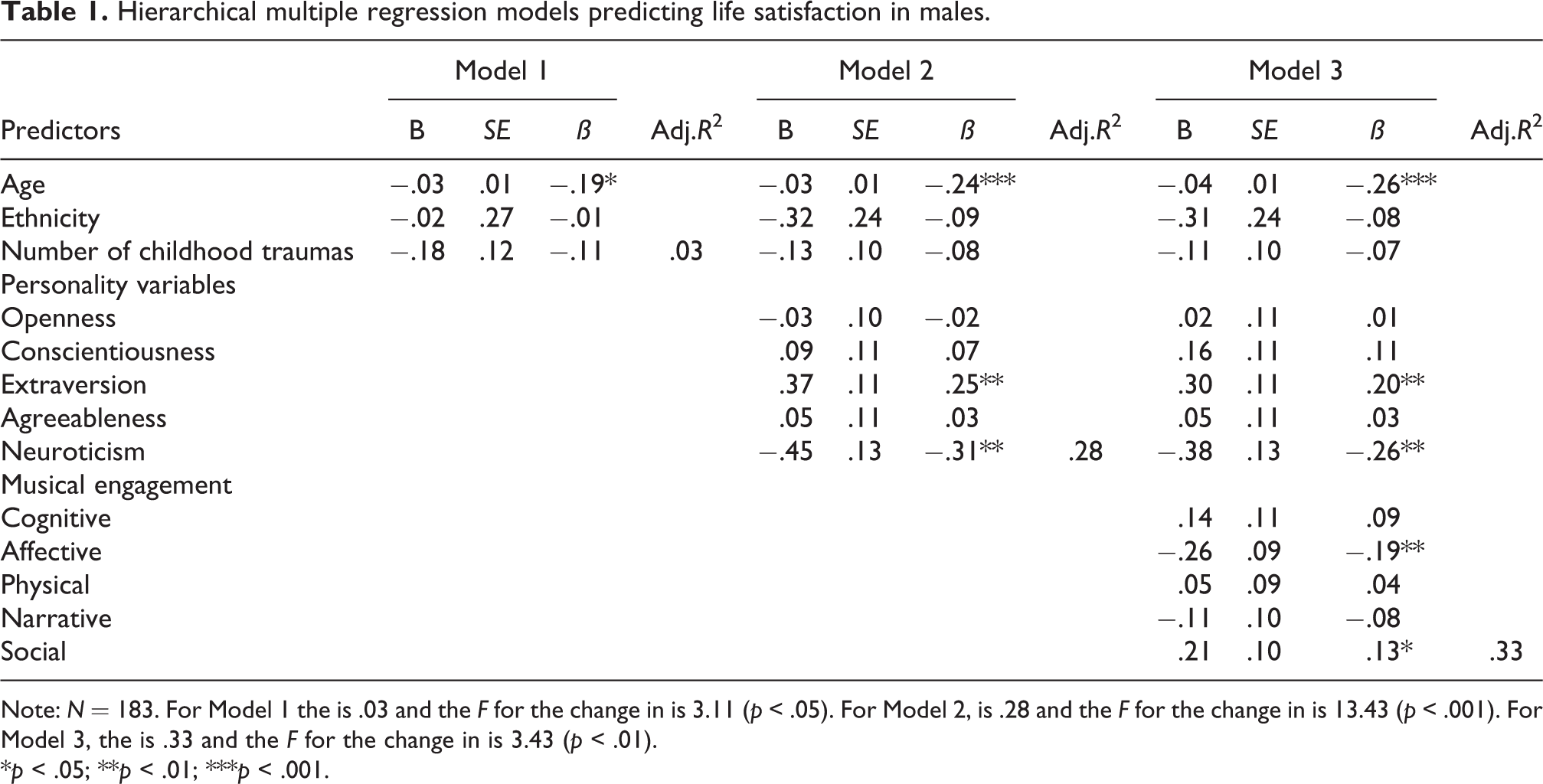
Note: N = 183. For Model 1 the is .03 and the F for the change in is 3.11 (p < .05). For Model 2, is .28 and the F for the change in is 13.43 (p < .001). For Model 3, the is .33 and the F for the change in is 3.43 (p < .01).
*p < .05; **p < .01; ***p < .001.
Table 2 reports hierarchical multiple regression models for life satisfaction in females with adjusted R 2 values. Model 1, which included age, ethnicity, and the number of childhood traumas experienced, explained 2% of the variance in well-being. In this model, the number of experienced childhood traumas was a significant negative predictor of well-being. Model 2 accounted for 18% of the variance in well-being, meaning that personality accounted for an additional 16% of the variance in well-being. In this model, extraversion and conscientiousness positively predicted well-being, while neuroticism negatively predicted well-being. Model 3 predicted 19% of the variance in well-being, meaning that musical engagement accounted for an additional 1% of the variance. In this model, all musical engagement dimensions were positively associated with well-being, but none of the associations were statistically significant. A supplementary individual item analysis of the variables underlying affective and social engagement dimensions showed that the item “music magnifies my emotions,” an item on the affective engagement dimension, was a significant positive predictor of well-being (ß = .13, p < .05).
Hierarchical multiple regression models predicting life satisfaction in females.
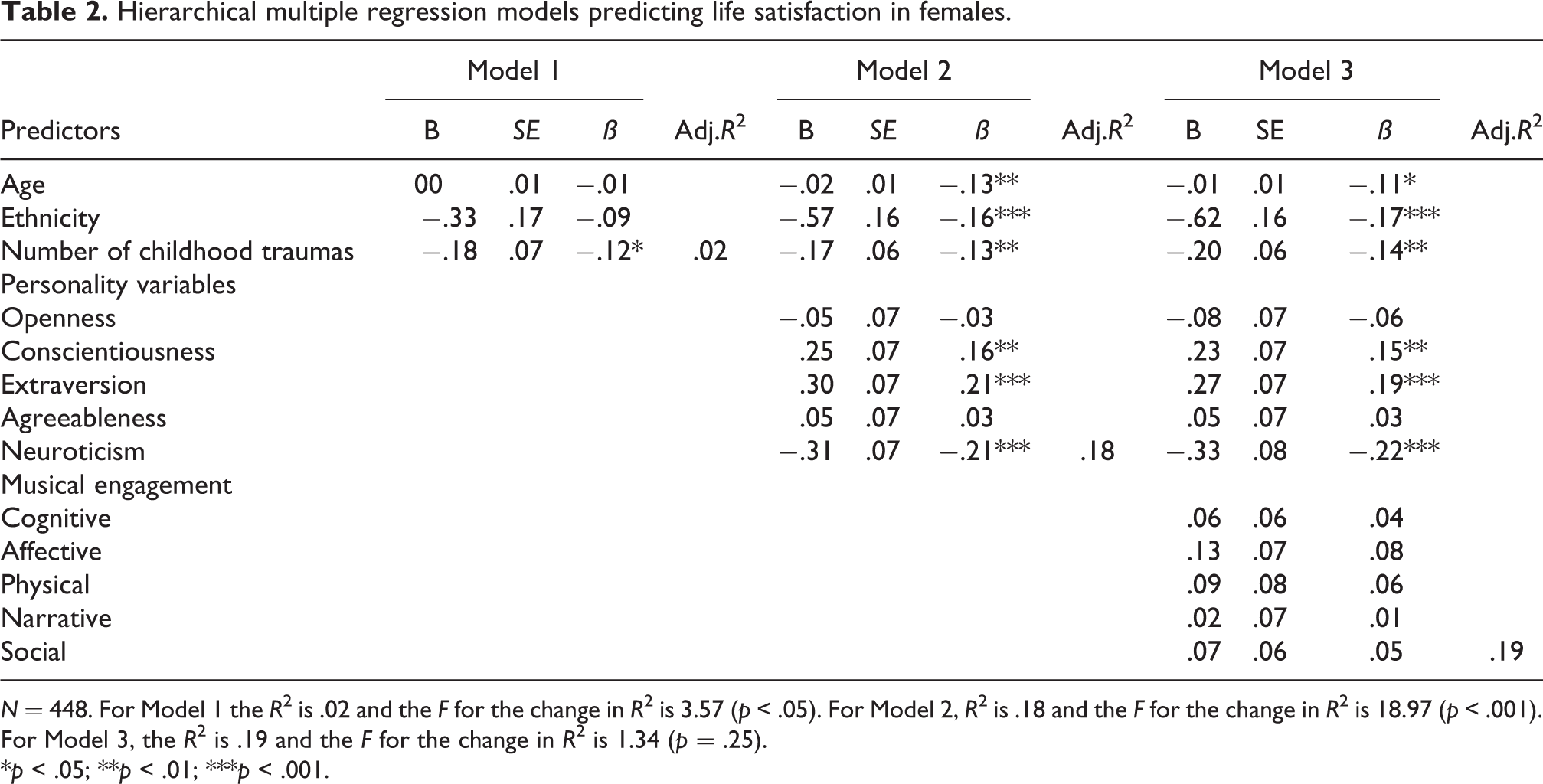
N = 448. For Model 1 the R 2 is .02 and the F for the change in R 2 is 3.57 (p < .05). For Model 2, R 2 is .18 and the F for the change in R 2 is 18.97 (p < .001). For Model 3, the R 2 is .19 and the F for the change in R 2 is 1.34 (p = .25).
*p < .05; **p < .01; ***p < .001.
Summary of Multiple Regression Analyses
In males, musical engagement was found to explain a significant proportion of the variance in well-being. Contrary to the first hypothesis, musical engagement predicted well-being both negatively (through affective engagement) and positively (through social engagement). In females, musical engagement did not explain a significant proportion of the variance in well-being.
Moderation Analyses
As seen in Figure 1, the interaction between gender and affective engagement explained some of the variance in well-being (R 2 = .01; ΔF = 9.88, p = .002). An increase in affective musical engagement was associated with an increase in well-being for females and a decrease for males. When probed for the dichotomous values of the moderator, the effect remained significant for males (p = 0.009), but did not reach statistical significance (p = 0.10) for females.

Gender moderated the relationship between affective engagement and well-being.
As seen in Figure 2, the interaction between neuroticism and narrative engagement explained some of the variance in well-being (R 2 = .01; ΔF = 8.05, p = .0047) for a joint sample of males, females and those who did not indicate a binary gender (N = 634). An increase in narrative musical engagement was associated with an increase in well-being for individuals who were low on neuroticism, and a decrease for people who were high on neuroticism. The model was probed for values at the 16th, 50th, and 84th percentile. The moderation effect was significant for values of low neuroticism (p = 0.04) and high neuroticism (p = 0.04).
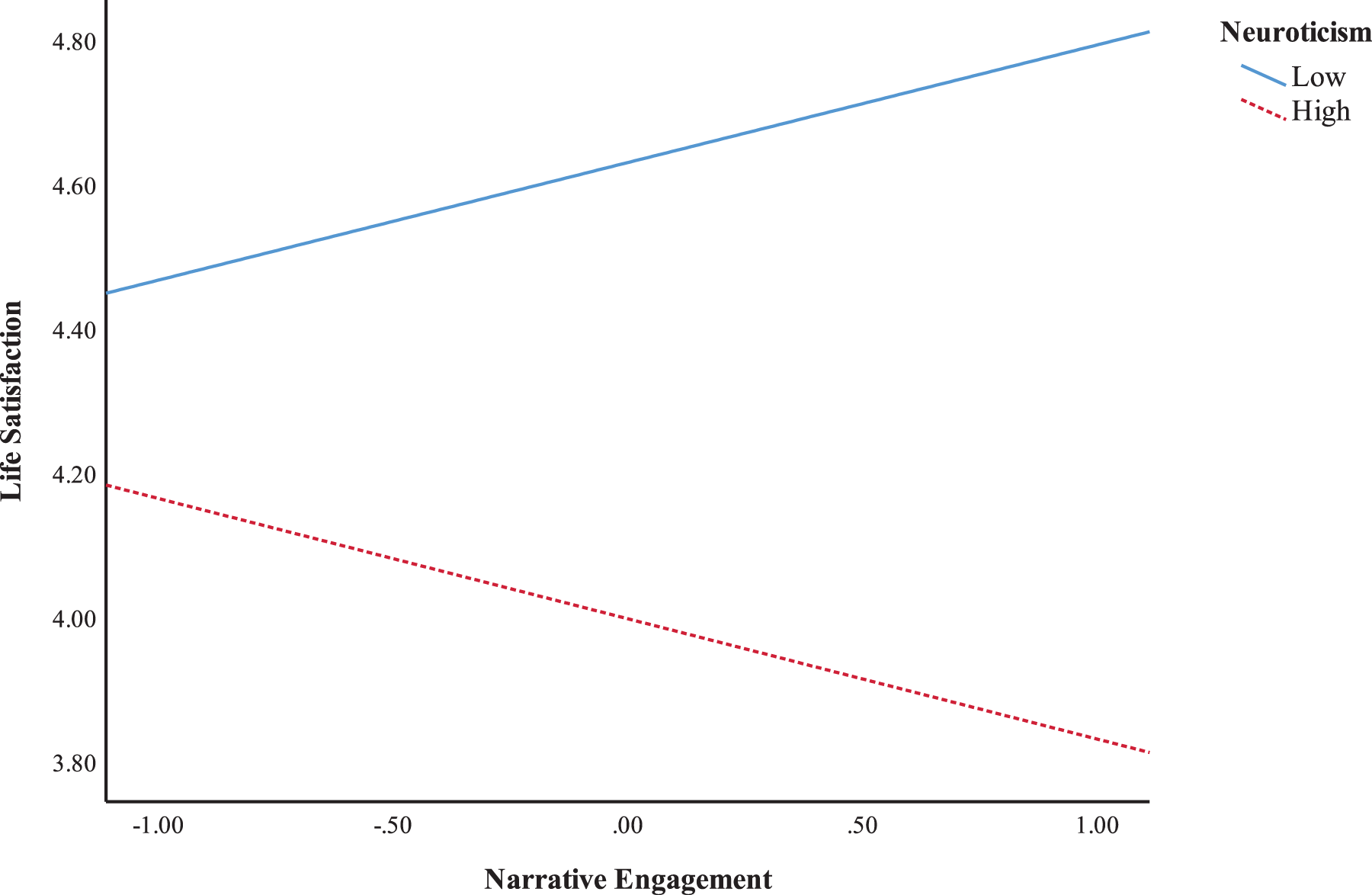
Neuroticism moderated the relationship between narrative engagement and well-being.
Summary of Moderation Analyses
Two moderation effects were found to be significant at the Bonferroni corrected significance level p < .005. First, as H2 predicted, gender moderated the effect of affective musical engagement on well-being. Second, as H3 suggested, neuroticism moderated the effect of narrative engagement on well-being. When the models were probed internally for predicted values, the moderation effect in Figure 1 was found to be statistically significant for males, but not for females. The predicted moderation effect in Figure 2 yielded significant probing results for people who were high and low in neuroticism, as defined by the 84th and 16th percentile.
Discussion
Summary of Findings
The present study indicated that individual differences in music listening play a role in posttraumatic resilience. There were three main findings that supported our initial three hypotheses. First, individual difference in musical engagement were associated with life satisfaction in adult survivors of childhood trauma. Among males, social musical engagement was associated with an increase in well-being and affective musical engagement was associated with a decrease in well-being. Second, the association between musical engagement and life satisfaction was moderated by gender differences. Specifically, gender moderated the association between affective musical engagement and well-being. And third, in females and males, neuroticism moderated the effect of narrative musical engagement on well-being so that in those who reported high levels of narrative engagement, low neuroticism was associated with high levels of well-being and high neuroticism was associated with lower levels of well-being. This showed that musical engagement is linked to well-being in adulthood after childhood trauma. Taken together, the results suggested that the link between musical engagement and well-being varies depending on the specific forms of musical engagement, on gender, on personality, and that the association can be both negative and positive.
Gender differences
Our findings shed light on prior work on gender differences. Thaut (2002) emphasized the importance of identifying shared and parallel mechanisms between musical and non-musical psychological processes to gain a better understanding of musical effects. Consistent with this view, the present findings can be linked to two tenets of the research on gender differences in coping strategies: (1) differences in emotional self-reflection/avoidance and (2) differences in emotional externalization/ internalization.
Evidence from neuroscience, anthropology, and both cognitive and clinical psychology suggests that women are more likely to cope in emotion-focused ways, while men are more likely to engage in distraction or avoidance mechanisms (Martínez-Hernáez et al., 2016; McRae et al., 2008; Nolen-Hoeksema, 2012). Male coping mechanisms have been linked to immersion in tasks or sharing activities with others (Nolen-Hoeksema, 2012). This “invisible support” allows them to maintain a sense of agency while experiencing an emotional proximity that fosters feelings of self-worth and belonging (Howland & Simpson, 2010; Nolen-Hoeksema, 2012). Qualitative data by Martínez-Hernáez et al. (2016) found that men considered self-control and “forgetting” about trouble a necessary first step towards coping, while self-reflection could follow once self-control was achieved. By contrast, women emphasized that self-reflection through analyzing a problem and talking about their emotions was a necessary step towards self-control. In our individual item analysis for females (see supplemental material), the positive significance of the variable “music magnifies my emotions” suggested that affective musical engagement facilitated self-reflection by highlighting the presence of emotions. In men, the negative association between well-being and “music evokes a deep surge of emotions in me” suggested that affective musical engagement evoked overwhelming arousal, perhaps experienced as a lack of self-control. The significant positive association with “feeling a deep connection with ones’ favorite musicians” suggested that a social connection through music allowed some individuals to feel understood, accepted and in control, thus allowing closer engagement with emotions.
The present findings were consistent with those reported by Miranda and Claes (2009), who linked gender differences to externalization and internalization. They suggested that maladaptive mechanisms in externalizing emotion, such as venting and feelings of aggression, accounted for the link between emotion-oriented coping and aggression in boys. For girls, they suggested that music listening led to a release of emotions, thereby preventing internalization, while avoidance mechanisms promoted internalization and thus predicted depressive symptoms for girls. Consistent with their hypotheses, the present study showed that, whereas the externalization (“magnification”) of emotions through music listening was associated with well-being in women and connected to analytic mental processes, affective music listening in men seemed to be associated with maladaptive externalization processes (“a surge of emotions”) and thus reduced well-being. Since our present multiple regression and moderation effects did not yield the same statistical significance for females as for males, replication would be particularly required for female samples, with measures on emotional-externalization and self-reflection. Future research could further explore the causality of the observed differences between the male and female sample, by investigating replicability and variance for biological sex assigned at birth and gender identification.
Neuroticism
In our study, neuroticism acted as a moderator of musical engagement and life satisfaction in trauma survivors. This interaction can be linked to Carlson et al.’s (2015) findings that people who were high on neuroticism tended to express negative emotions through music and were more likely to engage in venting and rumination. Furthermore, participants who were high on neuroticism were more negatively affected by sad musical stimuli because they evoked worries and anxieties in them (Garrido & Schubert, 2011). Although Garrido and Schubert established these links in relation to sad music, it is very likely that narrative engagement would activate similar negative attentional biases in neurotic individuals, since most narratives contain an interplay of sad and happy elements that could provide stimuli for the activation of negative attentional biases. Garrido and Schubert (2011) also suggested that people with lower neuroticism levels were able to derive well-being from listening to sad music through capacities of self-reflection and absorption. In the present study, it seemed that individuals low on neuroticism could derive well-being by exploring narratives because they had fewer negative attentional biases and could use music for self-reflection and absorption. To gain a better understanding of these processes, one would have to replicate them in experiments that also assess negative attentional bias and specific psychophysiological responses to music pieces.
Coping Mechanisms and Their Implications
Four related mechanisms for musical coping were elucidated by the detected differences in musical engagement in our study. These mechanisms can be called self-reflection, emotional externalization, social identification, and absorption. The associations between these mechanisms and well-being differed depending on gender and levels of neuroticism. Emotional externalization and emotional self-reflection seemed particularly adaptive for women, consistent with findings by Miranda and Claes (2009) and Nolen-Hoeksema (2012). Self-reflection through narrative engagement also seemed adaptive for people with low neuroticism levels which expanded Garrido and Schubert’s (2013) hypothesis regarding low neuroticism and sad music. Absorption seemed to be an adaptive mechanism for participants with low neuroticism who engaged with music narratively. Absorption in the content of music might allow a disassociation from immediate negative emotions as suggested by Garrido and Schubert (2011). Consistent with Nolen-Hoeksema’s non-musical coping theories (2012), social identification with others through music listening might be particularly adaptive for men because it offers social support. Emotional externalization seemed maladaptive for men and people with high neuroticism, as suggested by Carlson et al. (2015), Garrido and Schubert (2011) and Miranda and Claes (2009). Our analyses allowed us to propose how these coping mechanisms, previously described in the literature, may be employed by individuals in their everyday life. While our data suggested strong evidence for the differential ways in which gender influences emotional externalization, self-reflection and social identification through music, further research is needed to replicate these effects and to explore the role of absorption.
The present findings on individual differences in adaptive and maladaptive mechanisms may help us identify optimal musical engagement styles for people who have experienced childhood trauma. Research suggests that the effectiveness of music therapy has a strong dose–response relationship so that musical engagement outside of therapy sessions can improve and accelerate treatment outcomes (Gold et al., 2009). Therapists could draw on the present findings to find optimal listening strategies with their patients which can then be used outside therapy sessions. Furthermore, the findings can be used to enhance the coping skills of trauma survivors who do not have access to music therapy, thus promoting the use of music as self-therapy. This could be realized through interventions in schools and community organizations, or through a mobile phone application that analyses personality, musical engagement and musical preferences, and then provides recommendations.
Limitations and Future Research
First, the present study involved cross-sectional data which preclude causal inferences about the associations among childhood trauma, well-being and musical engagement. Because links among these three variables emerge across the lifespan, future research should investigate causality in longitudinal studies. Second, the data did not directly measure coping with trauma. The present study assumed that associations between musical engagement and well-being in childhood trauma survivors would provide information about their coping mechanisms. However, since most musical engagement items did not specify how they relate to coping, the interpretations regarding affective and social musical coping mechanisms are tentative. From the present data, it was not possible to tell whether people employed music to cope with everyday stress or with trauma-related memories and symptoms.
Third, the prevalence of childhood trauma in the present sample appeared to be very high, with 78% reporting one or more trauma. The high prevalence could be explained in two ways: either Pennebaker and Sussman’s definition is too broad or the sample was unrepresentative. Pennebaker and Sussman’s trauma assessment has strengths and weaknesses. A weakness of their measure is the heterogeneous range of included psychological events, which may differ in magnitude, severity and frequency. Strengths of Pennebaker and Sussman’s measure include a high degree of standardization, and evidence that the specified categories of trauma are associated with adverse psychological and physiological outcomes of child development (Anda et al., 2006; Felitti et al., 1998). Fourth, Amazon’s M-Turk is considered a reliable tool to recruit participants who are slightly more demographically diverse than typical American college samples (Buhrmester et al., 2011). Amazon’s M-Turk enabled the recruitment of a sample with considerable size and statistical power, which allowed us to demonstrate significant individual differences in musical engagement. However, the sample may be biased towards individuals who complete surveys for monetary compensation. Therefore, these results should be replicated in samples with different recruitment strategies in the future.
Fifth, the present study was exclusively based on self-report measures. While self-reporting is considered a reliable measure in studies of childhood trauma and well-being (Pennebaker & Susmann, 1988), it might be useful for future research to include informant-based clinical measures of psychological adjustment, such as scores on Beck’s depression inventory or records of physical and mental health. Sixth, there may have been a retroactive bias in participants’ self-report of their musical engagement. Future research could assess musical engagement through experience sampling methodology (ESM) or a laboratory experiment in which participants listen to music while biomarkers indicate physiological arousal. Such an experiment could test whether gender and neuroticism differences are associated with different cortisol stress levels during affective and narrative engagement.
Conclusion
The present sample size and detailed survey items made it possible to detect links among childhood trauma, adult well-being, and musical engagement, and to examine variations in these effects across individual characteristics. The study bridged theory on individual differences in coping and research on musical emotional regulation, in individuals who had experienced childhood trauma. We found that men and women benefit from different emotional regulatory processes in music and that neuroticism also affects how people respond to music as an emotional regulation tool. The findings confirmed that, in the aftermath of trauma, music can be a useful tool to develop resilience and that people appear to use it as a form of self-therapy. Since music as a treatment tool may improve the outcomes of standard psychological therapies, the present study has implications for music therapists, psychotherapists, and other clinicians. The findings can be useful when tailoring interventions to the needs of trauma survivors and to enhance resilience to prevent and treat psycho-pathological outcomes.
Supplemental material
Supplemental Material, sj-pdf-1-mns-10.1177_2059204321993731 - Musical Engagement is Linked to Posttraumatic Resilience: The Role of Gender, Personality, and Music Listening Styles After Childhood Trauma
Supplemental Material, sj-pdf-1-mns-10.1177_2059204321993731 for Musical Engagement is Linked to Posttraumatic Resilience: The Role of Gender, Personality, and Music Listening Styles After Childhood Trauma by Nora Rosenberg, David M. Greenberg and Michael E. Lamb in Music & Science
Footnotes
Action editor
Fabia Franco, Middlesex University, Department of Psychology.
Peer review
Maya Story, Eastern Michigan University, School of Music and Dance.
Christian Gold, NORCE Norwegian Research Centre AS.
Contributorship
NR, DMG, and MEL designed the research; DMG collected the data; NR performed the analysis; NR, DMG, and MEL wrote the paper.
Declaration of conflicting interests
The author(s) declared no potential conflicts of interest with respect to the research, authorship, and/or publication of this article.
Funding
The author(s) disclosed receipt of the following financial support for the research, authorship, and/or publication of this article: DMG was funded in part by the Zuckerman STEM Leadership Program and by the Cambridge Commonwealth, European and International Trust. During this period of research MEL’s research on child abuse was funded by the Jacobs and Nuffield Foundations.

Supplemental material
Supplemental material for this article is available online.
References
Supplementary Material
Please find the following supplemental material available below.
For Open Access articles published under a Creative Commons License, all supplemental material carries the same license as the article it is associated with.
For non-Open Access articles published, all supplemental material carries a non-exclusive license, and permission requests for re-use of supplemental material or any part of supplemental material shall be sent directly to the copyright owner as specified in the copyright notice associated with the article.
