



Abstract
Music conveys expressive meaning, and it elicits affective and associative responses in listeners. Historical documents from the 19th century contain reflections about the perceived expression of and affective responses to music in a wide range of works, including symphonies and operas. Therefore, we asked what verbal descriptors found in contemporary writings from the 19th century provide information about the perceived expressive qualities. Additionally, we examined whether the sources hint at situational / contextual factors. To this end, we investigated the descriptors used to describe the perception of a specific type of music, defined through a set of 16 features. We called this type of music “Glorifying Hymnic.” We searched a large amount of 19th-century symphonic music to identify as many excerpts displaying these features. Then, we investigated the description of the listening experience of the excerpts mainly using the RIPM (Retrospective Index to Music Periodicals) database. We found 47 compositions with 48 excerpts that matched our rather strict criteria and 102 textual sources that provided sufficiently concrete information regarding how several of the excerpts have been perceived. We found a very high degree of consistency in the description of the music: It has been described as glorious, powerful, triumphant and victorious, grand, joyous and happy, solemn, exciting, noble, tranquil and sometimes proud. It also elicited associations with singing, especially choral singing, and with religion. Only very few connections between music perception and situational factors were detected relating to religious associations and associations of the music with choral singing. They might refer to special circumstances in France and Germany respectively. We discuss our findings in the context of both historical perspectives and musicpsychological models.
Keywords
1. Introduction
Many research fields such as reception history, the history of music criticism, the history of listening, the history of emotion, and topic theory include investigations of the expressive qualities of music as perceived by historical subjects. Yet our knowledge of the ways in which people experienced music in the past is still limited. David Rowland has emphasized “the problematic nature of the evidence with which we work, particularly those of us whose focus is listening as evidenced in historical sources” (Rowland, 2017). Not all methodological options, however, have been sufficiently explored. Combining approaches from the digital humanities with historical and psychological methods can augment our knowledge of how musical expression was received in former times. More precisely, a mixed-methods approach can enable a rich analysis of historical records, in order to inform us about the ways in which music was experienced. Recently, Zachary Wallmark, too, has called for a more comprehensive approach to the issue, noting that “data sources that pertain to aspects of musical behaviour and reception—including written and spoken language about music—remain understudied using these methods” (Wallmark, 2019, p. 588).
In the present study, we ask how specific music excerpts from a certain time and context may have been perceived by listeners from the same period. We investigate in particular the degree to which the music in question was perceived in a similar way by different historical persons and the extent to which the experience was situational or even entirely individual. Through a combination of qualitative and quantitative methods, we expect that historical text documents will reveal aspects of how music was perceived, in ways that go beyond broader philosophical and ideological debates, which rarely discuss specific works, let alone specific excerpts of works. This approach differs from many earlier approaches in two respects: first, it focusses on particular excerpts from specific musical works, and second, it uses as many text documents as possible in order to allow comparison between sources and a quantitative evaluation of the documents (although, admittedly, historians need to be happy with rather modest quantities).
1.1 Historical Background
The combination of historical and psychological methods and approaches requires us to bridge significant disparities. Music psychology rarely focuses on individual readings of music, for methodological validity is often dependent on a collation of collective responses from socially and culturally diverse test subjects. In contrast, what a specific philosopher like Slavoj Žižek has to tell about Richard Wagner’s music is a very different matter (Žižek, 2016); such philosophical discourse about music is often removed from the average listening experience investigated by psychologists. When historical musicologists, in turn, look into the past, they often prioritize texts by outstanding individual philosophers and writers (cf. Wald-Fuhrmann, 2010). We automatically default to such texts when asking how music was perceived in the past. In Mark Evan Bonds’ Music as Thought: Listening to the Symphony in the Age of Beethoven, for example, the central witnesses of how listeners reacted to music include Immanuel Kant, Friedrich Schiller and E.T.A. Hoffmann (Bonds, 2006). David P. Schroeder writes in his review of Matthew Riley’s Musical Listening in the German Enlightenment: Attention, Wonder and Astonishment (2004): The choice of sources together with the resulting focus gives the book a very different slant than one would suspect from the title, directing it much more towards aesthetics as a branch of philosophy than actual audiences or listeners, or the way that composers engaged them. (Schroeder, 2006, pp. 961–962)
On the one hand, this focus on leading philosophers is due to the fact that audience surveys from the 19th century, for example, are impossible to complete. On the other hand, however, this is also due to different disciplinary traditions: while psychology is (in principle) more interested in human subjects in general, historiography—despite recent demands for everyday history (see, for instance, Loeser, 2019)—is often oriented towards the supposedly formative figures of their time.
There has always been and still is, of course, an overlap in the discourses of philosophers, critics, and educated audiences. Yet few concertgoers are familiar with Žižek’s ideas about Wagner and while some critics probably are, others are not. There is no reason to believe that this was significantly different in 19th-century culture. Today, as then, some of the persons reviewing and discussing music are influenced by philosophical currents; sometimes the philosophers are perhaps music critics themselves. But even in these cases, that is, when they write in their capacity as reviewers, their writings contain a great number of statements that are simply independent of their more theoretical and philosophical writings. This is especially true for statements that refer to particular passages of individual works. The tendencies of philosophical and, in a broader sense, aesthetic writings can often be read in the context of ideologies, such as those of progress and emancipation (Hentschel, 2006, pp. 158–333). Yet, the responses to specific passages are often more of an immediate reaction—a reaction that is hardly ever fully explained or absorbed into such discourse.
We therefore hypothesize that by including many everyday reviewers, by comparing their documents quantitatively, and by focussing on descriptions of specific musical excerpts, we may access a level of music perception beneath and beyond philosophical reflection. That is not to say that the various ways in which music has been perceived are entirely independent of the philosophical theories and ideologies of their times. Indeed, it would be naïve to postulate the existence, at any given time, of a single, “true” mode of music perception lying behind philosophical, cultural, and social ideologies, since those ideologies are a constituent part of music perception (see, for instance, Thompson et al., 2019). We hope, however, to identify empirically some common, that is, inter-individually shared, responses to a certain music, whether those responses arise from internalized philosophical ideas, from universal mechanisms, or from cultural and social factors. In many cases these responses will go beyond current philosophical theories since these are often far too general to account for any reaction to specific music excerpts.
In using text documents, historians might be inclined to argue that these sources are always mediated and thus that it is impossible to get down to the subjectivity or experience of historical persons. While this is true, it is not at all clear what should follow from this fact since it does not necessarily imply that they are automatically not trustworthy. Further, quantitative methods may help to correct biased—or to detect purely individual—perceptions. Indeed, psychology, too, has no direct access to psychological processes, 1 as Heinz W. Krohne observed: statements about subjective experiences, be they historical or not, are always mediated (Krohne, 1996, pp. 19–21). To be sure, though, historical research, in particular, will rarely be able to distinguish between emotions felt and emotions perceived (Gabrielsson, 2001–2002), since there seems to be no way to move beyond the written sources.
Analysing text documents that describe the perception of music quantitatively is possible with respect to the 19th century because during this century, growing musical literacy led to the publication of considerable amounts of printed texts about music and concerts (Botstein, 1992). In these texts, listeners often talked about their musical perception very subjectively in terms of affects and associations. Eduard Hanslick’s famous polemic stance against “pathological” listening (Hanslick, 1990, p. 29) underlines the prevailing tendency to privilege that kind of subjective experience. Indeed, in the entry “expression” (Ausdruck) of Sulzer’s Allgemeine Theorie der schönen Künste, we read: The correct expression of feelings and passions in all their particular shades is the most noble, if not the only, merit of a perfect piece of music. Such a work, which merely fills our imagination with a series of harmonic tones without occupying our heart, resembles a sky beautifully painted by the setting sun. (Sulzer, 1771–1774, vol. 1, p. 109)
1.2 Picking Up Some Psychological Models
Affective responses, including emotions, are a central facet of musical expression. 2 Since music psychology has a long tradition of investigating this facet, we are building directly on some of its approaches by employing textual documents from history as a distinctive feature of the study. Together, this makes our approach a kind of historical music psychology.
One traditional approach to music and affect research is to ask how music is typically described. Such investigations began with Kate Hevner’s studies (1935, 1936, 1937) and were continued using factor analysis (e.g., Schindler et al., 2017; Schubert, 2003; Zentner et al., 2008). These studies are based on listeners of their time and seek to establish semantic fields generally used to describe the affective responses to music, even if they use older (e.g., classical) music. Our approach is similar in that we evaluate how listeners described their experiences of music. Our approach differs, however, in two respects. First, it is based on listeners from history responding to music from the same era. Second, we concentrate on the description of specific excerpts of music allowing for a high degree of concretization that hopefully sharpens our idea of the breadth of the expressive spectrum of music.
Investigations of affective responses to music are frequently grounded either on a basic emotion theory assuming the existence of discrete emotions (Ekman, 1992, 1999) or on a dimension model of emotions, especially some variant of the circumplex model (Russell, 1980), focussing on the two non-discrete factors of valence and arousal, which produce different emotions. 3 In many cases, the presupposition of one of these theories or models is important for the experimental setup or the design of questionnaires. A recent article by Julian Cespedes-Guevara and Tuomas Eerola (2018) emphasized constructivist aspects of the affects elicited by music (and the listener) in its criticism of basic emotion theory. They claim that the affects elicited very much depend on the listening context. An advantage of our approach is that it is compatible with basic emotion and dimensional models as well as with constructivist approaches since our research is based on historical testimonies rather than on test procedures or questionnaires, which often imply adherence to one of these theories.
Our approach also accords with and responds to the demands articulated by Cespedes-Guevara and Eerola: Despite the knowledge that decades of research into the association between musical structures and perception of emotion have provided, we will not advance our understanding of this phenomenon by continuing to use experimental designs where stimuli have stereotyped musical configurations, and response formats consist of close-ended lists of basic emotion adjectives. (Cespedes-Guevara & Eerola, 2018, p. 15)
2. Aims and Research Questions
In a first step (Section 3.1), we will thoroughly define a specific pattern of musical features occurring in several symphonic works of the 19th century. In a second step (Section 3.2), we will collect and analyse as many contemporary textual descriptions of their expressive qualities as possible. We will then address the following research questions: ‒ What verbal descriptors found in 19th-century writings can provide information about the perceived expressive qualities of the music? ‒ How consistently were excerpts displaying a certain pattern of musical features described and perceived by 19th-century listeners? We will consider in particular the degree of differences or inter-individual similarities of these descriptions. ‒ Do these sources hint at situational and other contextual factors? Are there patterns indicating geographical, chronological, text type-related, or event-related factors?
In our discussion of the results (Section 4) we will also speculate about how these results might relate to broader historical circumstances such as revolutions, nationalism, and imperialism, thus highlighting possibilities for future historical research as well as for research into the possible interdependency of music expression and historical context.
3. Method
Since history leaves its traces by chance—uncontrolled, often irrational, and always fragmented—historians are used to living with compromises. They are not entirely free in constructing their research design but are bound to the possibilities offered by the available sources. For our purpose, namely to draw empirically based conclusions about how a particular music was perceived in a particular time, it would be ideal to use one single music excerpt and then to compare many descriptions of the ways in which this passage was experienced from different situational, regional, social, and other types of contexts. This is impossible, however, as there is no adequate quantity of sources. We attempt here to solve this problem by defining a substantial set of musical features which we then use as a measure of similarity between different excerpts. In this way, we obtain a corpus of highly similar music excerpts, increasing significantly the probability of finding sufficient text documents referring to these excerpts.
While our method is not necessarily reliant on “musical styles and genres taken out of their proper context and used in another one” (Mirka, 2014, p. 2), it does have some similarity with topic theory (for an overview, see Mirka, 2014). In an extension of this approach, we attempt to sharpen the definition of technical features (Section 3.1) and to place the perception of their expression on a more empirical basis by systematically evaluating reception testimonies (Section 3.2). At the same time, the defined pattern of musical features can be seen as a substitute for the stimulus used in music-psychological research and the evaluation of text documents as a substitute for a survey.
3.1 Musical Materials and Selection Criteria
When considering or evaluating expression, 19th-century music tended to use a vocabulary established by tradition, influences, cultural codes, psychological mechanisms, and so on. To a certain degree, this allows for a typology of music excerpts. If we look at operas, for example, there are often highly similar means by which, say, an aria of anger or a love duet are set to music. We believe that it is also possible to identify such types of expression in instrumental music.
In this article, we will focus on one such type of expression, which we call the Glorifying Hymnic. This name was ultimately chosen on the basis of historical documents. 4 While both terms (“glorifying” and “hymnic”) often occur in the sources, the terminological choice was nevertheless arbitrary to some degree, since we might have chosen other terms from our results. The Glorifying Hymnic features a triumphant and typically easily memorable melody in major harmonies and at high volumes (and many more features to be laid out later). This type of musical expression is not yet established in musicology but it has clear relations to a tradition of compositions that incorporate, possibly influenced by Beethoven, what Mark Evan Bonds has called an “implicitly vocal finale” (2013, p. 340). In our study, however, we exclusively focus on a particular type of manifestation of “implicitly vocal” excerpts asking how its expressive qualities were perceived. Therefore, just a few of our excerpts occur in the list of Bonds’ examples (2013, p. 341) (for an overview of the excerpts used, please refer to Appendix 1).
The Glorifying Hymnic has some characteristics that make it particularly suitable for our present purposes. First, it is striking and therefore allows a comparatively simple determination of its compositional characteristics. Second, it occurs regularly throughout the “long nineteenth century” (on this term, see Hobsbawm, 1989, p. 6), as evidenced by our examples. (For the sake of brevity, in what follows we will often use the term “19th century” to refer to the long 19th century.) Third, it represents a type of decidedly loud music and therefore possesses another distinctive property of that era’s music because, at that time, a new level of loudness was achieved and cultivated in certain contexts, such as opera and symphony (cf. Hentschel, 2013).
We use a defined set of technical features to define the Glorifying Hymnic. We call such a defined set of technical features a “facture type.” In English, the term “facture” is commonly associated with the execution of a painting (see, e.g., Zurier, 2009). Here, however, we are borrowing the German sense of the term “Faktur,” which can also be used with respect to the construction of a musical composition. The term stems from the Latin “facere,” meaning “to make,” and refers to how an artwork has been made. The concept of “facture,” therefore, comprises all technical means used by the composer, including texture, harmony, voice-leading, rhythm, articulation, dynamics, agogics, instrumentation, tempo, and so on, and the specific realization of these elements in any individual composition. Within any given cultural and idiomatic context, features shared by almost all composers and works—such as adherence to minor–major tonality or measured time in the 19th century—are not significant. The description of a facture focuses on those aspects that necessitate choices on the side of the composer. In short, it summarizes all compositional decisions made.
To be sure, any description of a facture will be an approximation due to the vastness of features (cf. the ontology of features describing 19th-century orchestral music sketched by Eusterbrock et al., 2017), especially as long as a computational analysis of all of these features is impossible (cf. Barzen et al., 2017). A typology of factures, of course, concentrates on shared features of many tokens displaying similar factures. A facture type differs from concepts such as syntax and grammar, however, in that it is more specific, that is, it describes a specific use of features made possible by syntax or grammar. In a similar way it differs from style, which is defined by just a few rather general features and allows a large range of compositional realizations referring to whole works or even oeuvres within a certain time or space or by a certain composer. Similarly, partimenti or schemata as defined by Robert Gjerdingen, focussing on harmony and voice-leading, allow a great range of realizations “in every possible key, meter, tempo, and style” (Gjerdingen, 2007, p. 25). In contrast, a facture type refers to a very specific pattern of compositional features, embracing all kinds of technical aspects. It also differs from a topic (in the sense this term is being used in topic theory), first, in that it does not necessarily have any connections to particular musical contexts such as military bands or dances (though it may have) and, second, in that it is again more specific. For example, a march topic may occur in high or low volume, played by different instrument groups, etc. The facture type describes much more specific constellations of compositional features.
Such facture types will often display striking features instantly catching the ear, such as the solo violin in a sentimental violin cantilena or the extremely low-volume use of muted strings, and so on, in some misterioso passages. Analysis will reveal further and more hidden features, yet there is no criterion on where to stop the analysis, that is, to decide when the collection of features suffices to describe a facture type. Further, not all features are necessarily important: the violin cantilena will unfold over a certain ambitus, but for its character, it will not be decisive whether the ambitus describes, say, an eleventh or a twelfth. It would probably be important, however, whether it describes an ambitus of only a fourth as opposed to, for instance, an ambitus of three octaves. Therefore, the features need to be selected by way of exploration and intuition. This is the case, at least, according to the hermeneutic circle, which, as Wolfgang Stegmüller (1996) has shown, is not literally a circle but rather a spiral that is used in the humanities as well as in the exact sciences.
There is, however, an indication of its plausibility as well as an option for increasing the precision of its definition through future research. The indication of the plausibility of the defined facture type comes from the text documents themselves. If the descriptions of the music are inter-individually consistent, they support the plausibility of the facture type. In future research we hope to identify other facture types that we expect will elucidate one other.
For the present study, we used analytical listening to select symphonic pieces composed between 1790 and 1914. We take the term “symphonic” music in a broad sense, embracing all music for large orchestras, including symphonies, concert overtures, and concertos. To reduce potential biases that could be generated by the lyrics of vocal works, the selection has been restricted to instrumental pieces in an orchestral setting. The only exceptions were symphonic compositions that included—in the tradition of Beethoven’s Ninth Symphony—a choir in the final movement. We also included ballets, opera overtures, entr’actes, and programme music, since the relationship with extra-musical references, relative to vocal music, is sufficiently vague in these cases. (Special caution, however, was required for the analysis of their descriptions.) A total of approximately 3,500 works by approximately 500 composers, born between 1770 and 1879, were ultimately screened using the selection criteria used to identify the excerpts. Wherever we thought we heard the facture type, we checked the criteria, that is, the technical features, with the score; we describe these criteria in the next section. Our sources were CDs, YouTube.com and Spotify.com.
3.1.1 Musical Features
3.1.1.1 Identifying features.
The musical features that we used to identify the proposed facture type comprised the following categories: surface, harmony, melody (pitch structure, rhythm, and ornamentation), and instrumentation. (Most of the features and their analyses are illustrated with Beethoven’s Eroica in Example 1a–b and 2; see below.)
Surface
(1) (2)
Harmony (see Example 1)
(3) (4) ‒ High: More than 50% of the main beats (in relation to the entire duration of the excerpt) contain minor seconds, tritones, or two simultaneous major seconds. Dominant seventh chords or subdominant chords with added sixth (D7 or s56) were not considered dissonances. Additionally, major seconds were not considered dissonances, in order to produce less ambiguous results.
5
For simplicity, intervals were evaluated independently of instrumentation and pitch distances; interval inversions were considered identical to their counterparts. ‒ Medium +: Between 40 and 49.9% of the chords meet the criteria. ‒ Medium: Between 30 and 39.9% of the chords meet the criteria. ‒ Medium –: Between 20 and 29.9% of the chords meet the criteria. ‒ Low +: Between 10 and 19.9% of the chords meet the criteria. ‒ Low: Fewer than 10% of the chords meet the criteria.
In applying these criteria, we observed a set of guiding rules. Beats were defined following practical conventions: in 3/4 and 4/4 time, the beat was a quarter note; in “alla breve” time, it was a half note; in the cases of 3/8, 6/8, 9/8, and 12/8 time, three eighth notes were considered as one beat. Dissonances that resulted casually from ornamental accompaniments (such as runs) were taken into account only if they concurred with the beat and were then counted as whole beats. Dissonances that resulted from a pedal tone (based on a pitch related to the tonal field of the excerpt) were not taken into account. Dissonances sounding shorter than a sixteenth note were ignored. Applications of rules (ii) and (iii) are marked in Table 1 by an asterisk, with a bracket indicating the instruments involved (if we had to use a piano reduction, we waived the specification).
“A rather low degree of musical dissonance” was defined as low or low +. (5) ‒ Low: 0–2, ‒ Low +: 2.01–4, ‒ Medium -: 4.01–6, ‒ Medium +: 6.01–8, ‒ Complex: 8.01 or more.
The excerpts have usually a complexity that does not exceed the “medium –” degree. (6) ‒ High: 80–100% of the melody tones coincided with a harmonic change. ‒ Medium +: 66–79% of the melody tones coincided with a harmonic change. ‒ Medium −: 51–65% of the melody tones coincided with a harmonic change. ‒ Low +: 31–50% of the melody tones coincided with a harmonic change. ‒ Low: Up to 30% of the melody tones coincided with a harmonic change.
Some additional rules were applied to properly reflect the harmonic density. Where the same harmonic change in two functions recurred several times (Pendelharmonik), as in the succession I–V–I–V…, only every second change was counted. Variants of the same harmonic function, such as V–V
7
, were not considered as harmonic changes. Harmonic changes over a functionally unambiguous pedal point were counted as only half their actual number. “Rather low harmonic density” was defined as low to medium density. (Values are rounded off to whole numbers.)
Pitch structure of the melody (see Example 2)
(7)
Rhythm of the melody
Ornamentation of the melody (see Example 1)
‒ tremolos on one pitch or with changes of pitch that do not follow the shape of the melody (a) ‒ tone repetitions that are too slow to be called tremolo (b) ‒ moderate runs or arpeggios (c) rapid passages or arpeggios (d; c and d are overlapping, of course) ‒ continuous kettle drum rolls or triangle tremolos (e) ‒ other (x)
Instrumentation

Analysis of Beethoven, Eroica, mm. 386–396

Melodic analysis of Beethoven, Eroica, mm. 386–396
3.1.1.2 Distinctive features. We considered specific features to further differentiate the facture type
Features of the Glorifying Hymnic.

#(a) Tremolos on one pitch or with changes of pitch that do not follow the shape of the melody, (b) moderate tone repetitions (c) moderate runs or arpeggios, (d) rapid passages or arpeggios (c and d are overlapping, of course), (e) continuous kettle drum rolls or triangle tremolos, (x) other.
3.1.2 Musical Excerpts.
In accordance with these features, we compiled a collection of musical excerpts. To be sure, it was impossible even to strive for completeness. Moreover, it is a characteristic of a typology that not all criteria are met by all tokens and that not all criteria are unambiguous. In our collection, we included excerpts that fulfilled at least 10 of the described criteria. The parameter “moderate tempo” could be verified only intuitively, as it is a data type that allows no unambiguous yes/no decision. Thus, a total of 12 criteria (1, 3–13) remained in which deviations could be measured. Seventeen excerpts deviated in one feature, and five deviated in two features (deviations are marked by bold type in Table 1). The deviations in harmonic and rhythmic complexity as well as dissonance degree occurring in the second half of the 19th century may be reflective of the general increase in complexity in the music of that era. Forty-eight excerpts taken from 47 compositions that met our definition of the type in the sense described were thus found (see Appendix 1 for the 48 excerpts and Table 1 for the features).
3.2 Collecting and Analysing Written Documents
In the next step, we sought evidence from the 19th century documenting how the music was experienced, that is what expressive qualities were ascribed to the music or what affective responses were reported by recipients. We sourced evidence largely from reviews of editions or performances, as well as from music theoretical or biographical books—in other words, from any source that we could find and that would contain information about music perception of the excerpts.
With the term “musical expression,” we do not subscribe to the expression theory of art in the narrow sense that implies that works of art express “the mind of the artist” (Spackman, 2014), a position famously questioned by Alan Tormey in 1971 (Tormey, 2015) and remains a matter of intense debate (see, for example, Robinson, 2009, pp. 239–244). Usually the term “expression” refers to the affects evoked or communicated by the artwork, in our case the music (see, for example, Davies, 1994). The sources we use, however, mix affective and other descriptions of musical experiences in such a way that it would be neglectful only to extract information about affects. Instead of presupposing a theory of expression, we included in the manner of grounded theory all categories that were being suggested by the empirical data—without, however, proposing a new theory in this article. We included aesthetic and moral characterizations of the music, affective descriptions, semantic associations, and so on. This is also in line with recent psychological research which includes concepts such as interest, insight, beauty, fascination, and so on, along with affects (Schindler et al., 2017).
We looked for evidence within the long 19th century. In line with this widely accepted historical concept, we assume sufficient basic cultural consistency in the time period chosen, taking the First World War as an end point. The term “cultural consistency” refers here to social structures, norms, values, education systems, ideals, behaviors, and so on, but especially to the musical grammar that was, despite its changes and developments, more congruous than after the emergence of atonality and, slightly later, the dissemination of jazz. There are no clear criteria for the choice of the terminus post quem—some authors prefer 1750, some 1776, some 1789. We arbitrarily chose 1790; by then the composers would be 20 years of age. Thus, we searched for reception documents from 1790 to 1914. We did not presuppose any commonalities of music perception in this period but we assumed that it was more plausible to find such commonalities in such a group than in more diversified groups and environments. Whether (and to what extent) this assumption is correct, however, will only be revealed by analysing the documents.
We used the Retrospective Index to Music Periodicals (RIPM) with the Online Archive and Preservation Series to find reviews. 7 We searched these sources for testimonies describing the expressive qualities of or the affective responses to the excerpts. We used search queries in four languages (English, French, German, and Italian), such as “Beethoven heroic,” “Beethoven heroique,” “Beethoven Eroica,” or “Mendelssohn Symphony A minor,” “Mendelssohn Symphonie la mineur,” “Mendelssohn op. 56,” “Mendelssohn Symphonie A-Moll,” “Mendelssohn Sinfonie A-Moll,” “Sinfonia scozzese,” “Mendelssohn Sinfonia minore.” We reviewed 49,586 search results from the Preservation Series and a few thousand results from the Online Archive as well as several 19th-century monographs. We only considered testimonies that refer to precisely traceable excerpts from musical pieces (not, for instance, just the same movement). Of course, some sources refer to the relevant excerpts only ambiguously; nonetheless, they are mentioned in our analysis of the evidence (Appendix 4). Since the Preservation Series offers material only from 1819 onwards, earlier materials are not well represented.
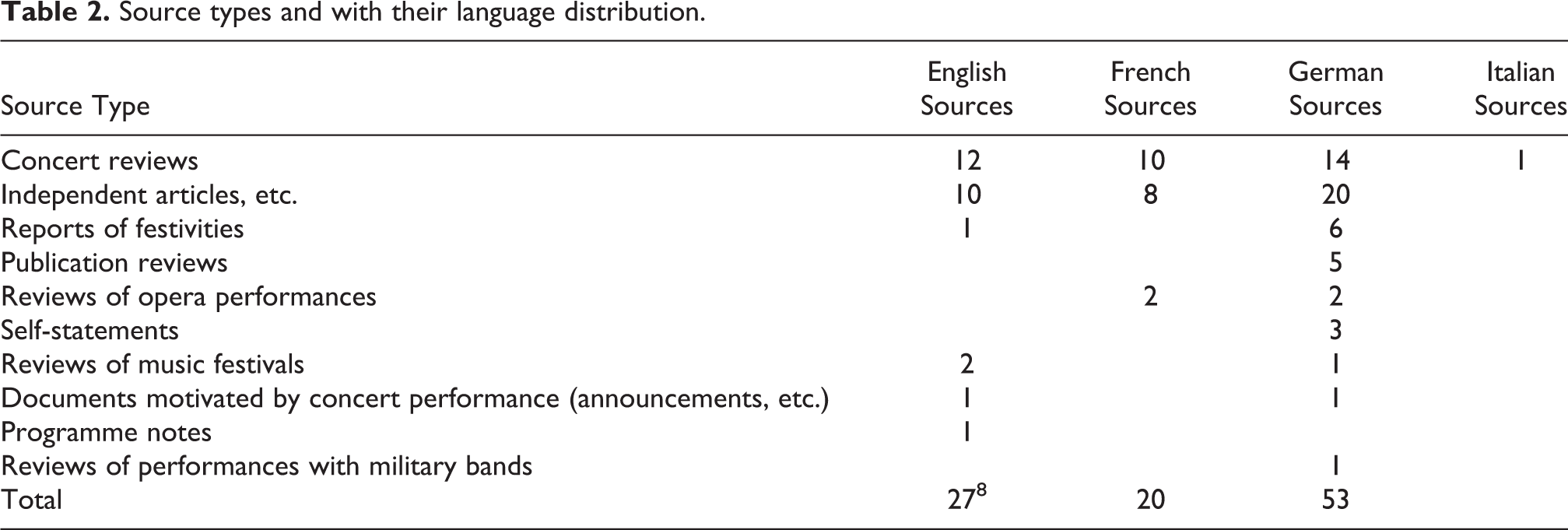
We found 102 documents referring to 24 of the 47 compositions; we present the relevant passages of these sources in Appendix 3. Depending on the popularity of the respective pieces, the quantity of documents referring to the compositions varies greatly (for example, 28 documents refer to Weber’s Jubel Overture, two to Saint-Saëns Violin Concerto No. 3, none to Bristow’s Symphony, and so on). We found 28 English documents, 20 French documents, 53 German documents, and one Italian document.
In line with our broad term of “expression,” all the terms or phrases describing the perceived expression of or the affective responses to the music were coded using QDA Miner (widely distributed software for qualitative text analysis by Provalis Reasearch, Montreal). Since one cannot always expect to find identical descriptors in characterizations of the music, that is, its perceived expression or the affective responses thereto, the descriptors were assigned to semantic fields. While studies from semantic field theory can be helpful (e.g., Johnson-Laird & Oatley, 1989), the construction of such fields is still difficult since there are no semantic field descriptions from the 19th century. Moreover, the sources were written in different languages. These terms were not translated to ensure that the categorization into fields was explicit. We used dictionaries from the 19th century to create the semantic fields. In particular, we used three dictionaries from each language (except Italian, since we found only one relevant source): Ainé & Pons, 1864; Annandale, 1892; Heyne, 1890-1895; Heyse, 1833-1849; Larousse, 1890; Poitevin, 1851; Sanders, 1876; Webster, 1886; Worcester, 1860.
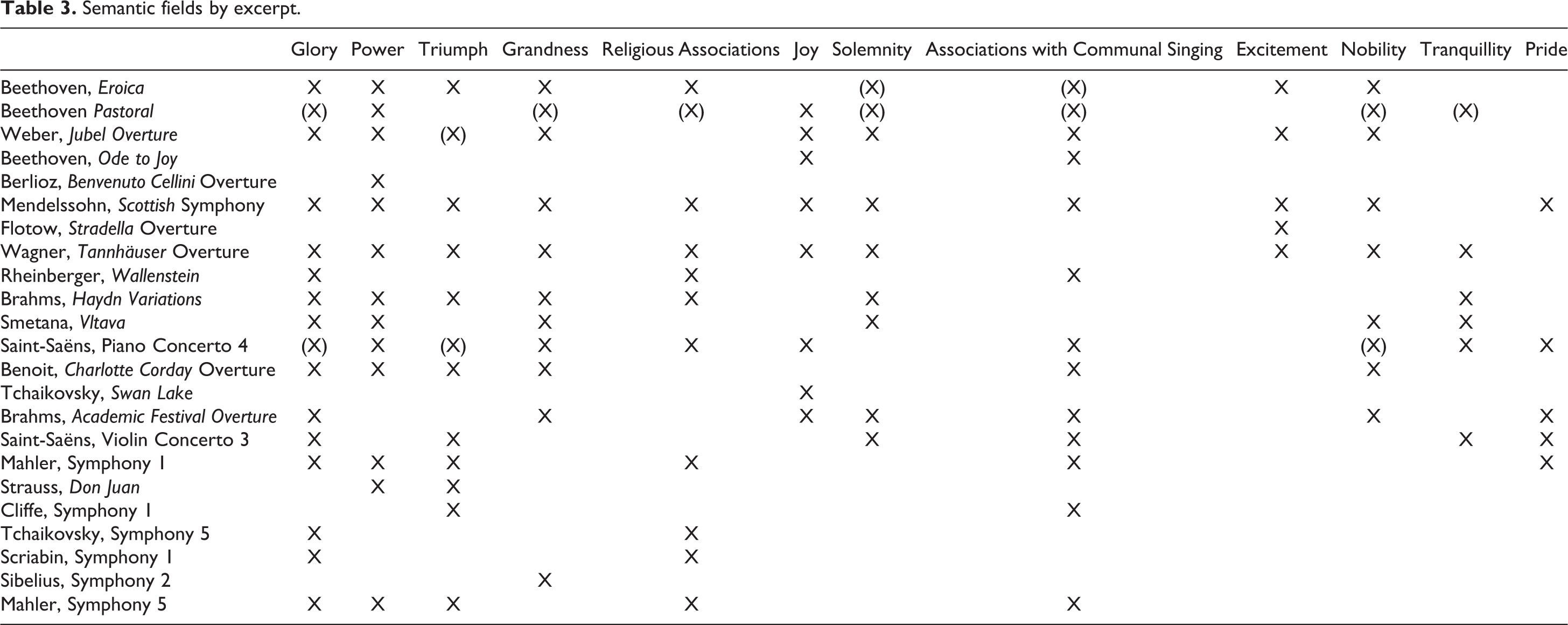
We considered evidence to be significant if the intersecting descriptions related to at least four different excerpts and were drawn from at least four different sources (this was an arbitrary decision based on historiographical expertise). The testimonies needed to be independent of each other. As such, we discarded translations, quotations, and paraphrases of earlier sources. In some cases, a reference in a testimony was ambiguous, generally because it was too vague (that is, it did not define the exact excerpt). Such references are given in round brackets in Table 3 and Appendix 4 and were not considered in determining the strength of the evidence.
Programme music, overtures, and so on deserve individual consideration, because some overtures contain elements that are directly linked to a specific moment of action in an opera (e.g., Wagner’s Tannhäuser) while others do not. Often the programme are very general, and sometimes they contain clear references to specific extra-musical content. If more than 50% of the pieces used to determine an expressive quality are programme music, overtures, or the like, then this will be noted. The same applies to quotations, as the excerpts can contain musical quotations that imply semantic associations. We also considered these potential implications when evaluating the textual documents, in that we did not count sources with quotations when estimating the strength of textual evidence.
In addition, we coded some metadata that might represent cues for context-specific descriptors, namely date, language and document type. Table 2 shows the distribution of the found documents.
Source types and with their language distribution.
4. Results
4.1 Descriptions of the Excerpts
In the following section, we summarize the descriptions of the expressive qualities attributed to the music by 19th-century listeners. The complete results are provided in Appendix 4 in the form of tables of descriptors with cross-references legitimizing our construction of semantic fields. There are also lists of the work excerpts that triggered the descriptions. We also provide there information about the number of authors, the languages of the sources, and the aforementioned metadata.
According to the semantic fields that we constructed from the found descriptions, the Glorifying Hymnic was perceived as glorious (implying the splendid appearance of something honorable, especially in a religious or political context), powerful (referring to a mixture of physical and psychological [social, political] power and domination), triumphant and victorious, grand (with an emphasis on quantity), joyous and happy, solemn, exciting, noble, sometimes as tranquil and even proud. It also elicited associations with singing, especially choral singing, and with religion. If we relate these semantic fields to Scherer’s (2005, p. 720) version of Russel’s Circumplex model, we are clearly drawn to the upper-left quadrant of the circle embracing emotions with positive valence, high arousal, and high power control. The only exception is tranquillity/calmness, which points towards the lower-left quadrant with positive, low arousal, and conducive affects.
Such a rich list of expressive qualities contains many semantic fields that do not occur in recent models that are supposed to catch the descriptors used to capture the affective responses to music (e.g., the GEMS scale: Zentner et al., 2008). Our results therefore underline the view of authors who emphasize the richness and complexity of aesthetic experience (see, for example, Cespedes-Guevara & Eerola, 2018, p. 2; Schindler et al., 2017, p. 4; Warrenburg, 2020, p. 8; Zentner et al., 2008, p. 495) and of emotional experiences in general (Kaernbach, 2015).
While the assignment of some expressive qualities to semantic fields (most of all, triumph and victory) was straightforward, that of other qualities might be subject to debate. On the one hand, the semantic field of religious associations is obvious. On the other hand, this field unites very different aspects of religiosity and contains examples of heavy metaphorical use of language and might therefore reasonably prompt an individual interpretation of each reference. Further, many semantic fields overlap, as is made plain by descriptors such as “majestic” and “grandeur,” which were assigned to more than one semantic field. Alternative orders might therefore be possible. For our purposes, however, it was much more significant that it is possible to find historically plausible, shared semantic components in the description of the expression of music, because this demonstrates that there were common elements in terms of how music was described.
The two most difficult aspects of our classification were solemnity and joy/happiness. The semantic field of solemnity contains two opposite semantic poles, one implying gravity and seriousness, and the other celebration and pomp. Since in most cases, however, it is impossible to pin down the expression to one exact meaning, and since the dictionaries also reflect this ambiguity, we decided to establish only one semantic field. We found joy and happiness to be more difficult. While English dictionaries define “joy” using the term “happiness” and vice versa, the French word use seems to vary, and German dictionaries make a strict separation between “Freude” or “Jubel” (as rather spontaneous emotions) and happiness (as a state of being). This difficulty has also been recognized in a study by Marcel Zentner and colleagues (Zentner et al., 2008, p. 506). Since the separation is not similarly present in all languages, however, and since the two aspects are closely related to each other, we again decided to keep to just one semantic field. Figure 1 gives a diagram of the semantic fields that we established on the basis of the found descriptors and the dictionaries.

Expressive qualities of the Glorifying Hymnic.
The most strongly evidenced semantic fields describing the perception of the Glorifying Hymnic are glory, power, triumph/victory and grandness. We found references to 13 or 14 works (= 54% or 58% of the compositions with testimonies) using descriptors from these semantic fields. The semantic field of glory refers to the splendid appearance of something honorable, especially in a religious or political context. It is represented by terms such as “gloire,” “strahlen,” “Glanz,” “magnificence” or “Pracht.” Next to glory comes the semantic field of power implying a mixture of physical and psychological (social, political) power and domination. The field is constituted by descriptors like “Macht,” “puissant,” “grandeur,” or “Kraft.”
Still rather strongly evidenced (with 10 references, i.e., ca. 42% of the compositions with testimonies) are the semantic fields of triumph/victory and grandness as well as the semantic field containing religious associations. The semantic field of triumph/victory consists of only these two terms and their respective translations. “Grandness”—with an emphasis on quantity—is represented by descriptors like “Größe,” “grandiose,” “plenitude,” or “fullness.” Finally, the religious references embrace descriptions like “God’s world,” “délivrance,” “das Heilige,” and so on. Although Wagner’s Tannhäuser overture contains, due to the opera’s story, a programmatic reference to religion and might thus be an example for an excerpt provoking associations through its related text rather than through the music itself, we included the evidence; otherwise, there were only nine references in this case.
Sufficiently evidenced (with 7–8 references, i.e., ca. 29–33%) are the semantic fields of joy/happiness and solemnity, the semantic field containing associations with communal singing, the semantic field describing some kind of excitement of listeners and finally the semantic field of nobility. The semantic field of joy and happiness is evidenced by terms such as “Jubel,” “exultant,” “glücklich,” or “vie beatifiée.” This last example, in particular, shows that there might be a latent relation to the religious sphere. The descriptors filling the semantic field of solemnity are much more consistent, unfolding around the terms “solemn” and its French equivalents as well as “Feier” and “Fest.” The semantic field containing associations with communal singing contains references to musical forms and practices, implying singing in larger groups like “choral,” “hymn,” “song of triumph,” and the like. We did not count works that explicitly refer to singing (for example, via quotations); otherwise, this semantic field would even have to be placed in the strongest category. The semantic field pointing to some kind of excitement consists of many different descriptors like “explosion,” “begeistert,” “carried away,” etc. Finally, the semantic field of nobility consists of terms such as “ernst,” “dignified,” and “heroic.”
It is important to note that it is likely that the semantic field of joy and happiness reflects the programmes in the background of the music excerpts since clearly more than 50% of the excerpts are programme music or belong to other genres having some extra-musical reference, or even carry terms of the semantic fields in their titles. In the case of the semantic field of excitement, the data does not allow a secure estimation. Its descriptors may or may not have been provoked by the programmatic content of the music.
Two semantic fields are still noteworthy, yet clearly less strongly supported by the evidence: tranquillity and pride. Tranquillity occurs with respect to six works (i.e., 25%), which is not an insubstantial number, however the references stem from only eight authors, whereas in the former category the evidence was based on at least 15 authors in each case. Additionally, the semantic field of pride is evidenced even more weakly: the sources refer to only five works, and the references stem from just four authors. Where the semantic field of tranquillity comprises descriptors like “Friede,” “Ruhe,” “rest,” or “calme,” the semantic field of pride contains the terms “stolz,” “fier,” and “orgueilleux.”
With the exception of pride, all the expressive qualities are supported by documents in at least three different languages (English, French, and German). Table 3 gives an overview of the occurrences of the semantic fields in texts related to the different excerpts; Appendix 5 shows all semantic fields and descriptors organized by excerpt to facilitate further analyses and verifications or falsifications.
External evidence for the main semantic fields of the Glorifying Hymnic comes from two operatic pieces which employ the expression type: Massenet’s Esclarmonde and Tanejey’s Oresteia. In both operas the facture type is used in scenes of praising the majestic and divine glory.
Semantic fields by excerpt.
We found only nine descriptors that did not fit into the semantic fields illustrated. Some of these descriptors are hapax legomena, that is, mentioned only once: – heartfelt [36: “innig,” Mendelssohn, Scottish Symphony] – dull and opaque [79: “cette couleur terne et opaque,” Benoit, Charlotte Corday Overture] – ponderous [79: “allure pesante,” Benoit, Charlotte Corday Overture] – “brilliant orchestral colouring” [95: Strauss, Don Juan] – harmless [1: “Harmlosigkeit,” Beethoven, Eroica]
Some are mentioned twice: ‒ manly [78: “males accents,” Benoit, Charlotte Corday Overture; 95: “opposed to…themes with feminine character,” Strauss, Don Juan] ‒ imple: [31/73: “einfach,” Beethoven, Ode to Joy; Wagner, Tannhäuser Overture] ‒ lovely [1: “Lieblichkeit,” Beethoven, Eroica; “lieblich,” Mendelssohn, Scottish Symphony] ‒ effervescent: [86/89b: “brausend,” “stürmisch,” Brahms, Academic Festival Overture: stürmisch”]
4.2 Distinctive Features in Relation to the Descriptions
With respect to the dramaturgical position as well as the use of brass versus strings, we did not detect any systematic relationship between the Glorifying Hymnic and any particular subset of descriptors. As might be expected, the Glorifying Hymnic mostly occurs towards the end of a piece or movement, but there are also counter-examples. The rarity of these, however, did not allow any further inference. The same was true with respect to the aspect of brass versus strings: brass seems to be preferred as melody instrument, yet brass with strings, brass and strings in exchange or even strings alone also occur.
With respect to the use of cymbals and/or drums, however, a pattern was detected: with one exception, no excerpt employing these instruments was associated with religious content or feeling. The exception was Paul Stefan’s commentary on the excerpt from Mahler’s Symphony No. 1 [93], which uses cymbals, albeit very sparingly. At the same time, again with one exception, namely, Smetana’s Vltava [70], we did not find any excerpt employing cymbals and/or drums that was associated with tranquillity. These instruments, we might presume, suggested the profane, while the semantic field of tranquillity is implicitly religious. The semantic field of tranquillity is, with two exceptions [67, 70], always directly related to religious associations, that is, the sources mention tranquillity within the context of religious descriptions. (In Figure 1, this distinction is indicated by using a different shade of grey for this element.)
5. Discussion
5.1 Consistency Versus Context-dependency of the Testimonies
5.1.1 Consistency of the Descriptions
Nineteenth-century descriptions of the expressive qualities of similarly composed excerpts of symphonic music from the same era reveal a small set of frequently evoked semantic fields. Clearly, in its broader cultural context, the facture type had a distinct expressive meaning and elicited similar affects. Hence, throughout the remainder of this article, we use the term “expression type” to refer to the totality of the particular combination of musical parameters (facture type) and their expressive content.
As expected, the descriptors of the Glorifying Hymnic are not simply a reproduction of philosophical discourses. The consistency of the testimonies cannot, therefore, be explained through these discourses. This is obvious with semantic fields such as victory or excitement that do not even occur as aesthetic concepts in 19th-century philosophical writings. Other semantic fields such as power and religious associations might, in contrast, seem to reflect philosophical debates. Thus, the religious associations might be related to the metaphysical value assigned to music in 19th-century aesthetics (see Bonds, 2006, pp. 11, 15, 21) or to the idea of art as religion (Oechsle & Sponheuer, 2015). Our analysis, however, shows exactly where and when such affects or associations were aroused, since all commentators reserve this description exactly for the excerpt; they do not use it for other passages of the compositions.
Another well-known aesthetic concept lurks under the surface of some of the semantic fields: the sublime. This concept, which seems to embrace some of the semantic fields, such as power and grandness, had become very important in philosophical discourses in the second half of the 18th century by such prominent authors as Edmund Burke in his Philosophical Inquiry into the Origin of Our Ideas of The Sublime and Beautiful (1757) and Immanuel Kant in his Kritik der Urteilskraft (1790). The category was also applied to music; for Johann Abraham Peter Schulz, the symphony was especially suited to the expression of the sublime (Schulz, 1771–1774, p. 1122). Accordingly, many scholars have sought to delineate the sublime in music (e.g., Bonds, 2012; Lütteken, 1995; Sisman, 1996). The sublime, however, is a very broad concept—it also comprises negative emotions such as horror, which is totally absent in the Glorifying Hymnic. It is a rather vague category which is why Wye Allanbrook (2010) dismissed it as a topic altogether. With our method we can, based on historical documents, give a much more specific description of the perception, which may in such a case even help to relate philosophical discourses to the actual experience of music. It is hard to say, though, what relevance the philosophical debate had for the actual listening, since the terms “sublime” and “erhaben” very rarely occur in the descriptors we found, namely, four times: with respect to Mendelssohn’s Scottish Symphony [36] and Wagner’s Tannhäuser [51a, 60a], as well as in an ambiguous formulation with respect to Weber’s Jubel Overture [(17)].
The relevance of the semantic fields that we identified is strongly supported by checking for idiosyncratic descriptors that deviate from these semantic fields. There are, in fact, very few deviations that reflect either individual experiences or specific characteristics of single excerpts. While we expected some consistency in the descriptions of the excerpts, we were surprised by the high degree of consistency. This likely cannot be explained through quotations or writing traditions, since the ways in which the expressive qualities are introduced and the specific wordings that are used are too heterogeneous. Additionally, the documents refer to very different compositions from different composers with different degrees of distribution in the 19th century, and the documents themselves were produced by very different authors from different geographical regions.
Hence, listeners demonstrated a high degree of inter-subjective agreement in terms of how they described the defined facture type and its perception respectively. This might be due to the consistency of the cultural code within the cultural, historical, and social space we investigated. It might also be due to the chosen expression type which is conspicuous and unambiguous (conducting a similar study on a more ambiguous facture type might be productive in this respect). It might, however, also be due to deeper psychological processes. Be that as it may, this result is concurrent with Koelsch’s et al. (2004) finding that the relation between music and semantic processing is not arbitrary.
5.1.2 Contextual Factors
Within this consistency, some patterns that are probably context-dependent can be observed. The first concerns the language of the documents: there is only one Italian document, and there are more German documents than English and French documents combined. It is not clear, however, what this implies. The scarcity of Italian sources might be because operatic traditions were much more important in Italy than were symphonic traditions. Further, the differences in language distribution might simply reflect the particular sources that have been digitized and that are searchable with RIPM. At the same time, they might reflect our language biases. In addition, the documents are probably influenced by the origin of the compositions: 17 compositions were by German-speaking composers (starting in 1803), six by French-speaking composers (starting in 1844), and four by English-speaking composers (starting in 1854). It is therefore not surprising that more German documents were found. It is all the more interesting that there are only minor differences in the descriptions of the music: principally, all the expressive qualities were found in English, French, and German sources (except pride, which was found only in the writings of four authors). Table 4 shows the number of descriptors used for each semantic field separated by language.
In Table 4, we can see that the total number of descriptors very roughly reflects the total number of sources, that is, the documents from all three languages use a similar average amount of descriptors. There are roughly twice as many German descriptors as there are English and French ones respectively. In other words, the descriptors (and sources) relate to each other very roughly according to the proportion 1:1:2. The distribution of the descriptors should reflect this proportion; otherwise it might be an indicator for a contextual influence. Since, however, the numbers are so small that we have to expect some fluctuations, we will only discuss deviations from that proportion where a value is doubled or halved in relation to at least one other value. In the table, these numbers are given in bold type.
Language distribution of the descriptors.

If we dismiss the semantic field of pride since the number of documents is in this case too small, there are five semantic fields that do show such a deviation: power, religious associations, joy / happiness, association with communal singing, and nobility. The semantic field of power occurs strikingly less often in English sources, as does the semantic field of nobility in German and the semantic field of joy and happiness in French sources. Importantly, the semantic fields are still clearly present in all languages. It is therefore uncertain what conclusion should be drawn from this observation.
The deviations with respect to the semantic fields referring to religious associations and to associations with communal singing are of interest. Religious associations occur strikingly less often in French sources. This fact might reflect the difficult relationship towards religion in France. Although recent studies have shown that “religious belief was a powerful and dynamic force in 19th-century politics and society, rather than a curious anachronism” (Priest, 2014, p. 261; cf. Kselman, 2006), the tendencies of dechristianization during the French revolution and the structural secularization during the 19th century (Osterhammel, 2011, p. 1249; van Kley, 2003) might very well have had an influence on how religious associations of music were perceived or articulated. To be sure, this is just a rather vague hypothesis which needs to be substantialized with much more evidence. It could, however, provide a direction for future research.
The semantic field referring to associations with communal singing notably occurs more in German sources than in English and French sources. Again, this might be related to historical developments. Due to Germany’s struggle for national identity and unity, the role of communal singing and its nationalist function—though present in all European countries (for an overview see Di Grazia, 2013)—was especially important in German-speaking cultures (see, for instance, Dueding, 1984; Langewiesche, 2002). These circumstances might have aroused corresponding associations, just as German-speaking composers might have alluded to this kind of music. Again, these remarks should be seen as no more than vague ideas for future research on the basis of richer and more adequate sources.
Often, expressive qualities seem to be articulated in English or French sources at a later point in time than in German sources. This probably reflects, however, no more than the imbalance of source findings considered. While we found German sources from the 1810s to the 1910s, we could only find English sources from the 1840s to the 1910s, and French sources from the 1850s to the 1910s. This may explain why French sources display certain expressive qualities much later than German sources.
The document type reveals no patterns that might further illuminate possible relations between context and descriptions of the expressive qualities. Any indication of a possible dependency of document type and descriptions seemed so weak that it was not worthwhile to pursue it. Table 5 shows the number of descriptors analysed by the semantic fields and the document types.
Distribution of document types.

These observations imply that specific contexts, personalities of authors, and individual performances did not have very strong influences on how the Glorifying Hymnic was perceived throughout the long 19th century. We must bear in mind, though, that the documents were written by authors from the same social sphere; they all were literate, educated, middle- or upper-class people with an affinity for music who lived in Europe or North America during the long 19th century.
5.2 Looking Ahead: Historical Significance of the Expression Type
The Glorifying Hymnic is a very striking expression type occurring quite often in 19th-century symphonic music (Figure 2). This fact opens up another possibility of getting closer to the historical experience of music. The frequency with which the Glorifying Hymnic recurred suggests that its expressive qualities were of special significance for the culture in which it was composed and enjoyed. A historical music psychology may ask what historical situations, events, and processes—rather than philosophical debates—might have shaped the state of mind of the people favoring certain affects and associations over others (cf. Hentschel, 2013, pp. 187–190). The next step in understanding music expression historically should therefore be to relate the expression type to historical circumstances.

Timeline of occurrences of the Glorifying Hymnic.
To be sure, any more precise estimation of the significance of an expression type such as the Glorifying Hymnic will remain elusive as long as corpora for comparisons are unavailable. This expression type was found in 47 instances of approximately 3,500 compositions, comprising only 1.34% of the total. Therefore, some remarks about this apparently small quantity are necessary. Fourteen additional compositions, which very likely contain the Glorifying Hymnic, could not be included, as scores were unavailable to verify our aural judgement (see the blue pieces in Figure 2). Moreover, some works that met the inclusion criteria may have simply been overlooked. The importance of a number of music works in our sample arises from their popularity (frequency of performance) during the 19th century. Some were even canonized during their 19th-century reception history. For methodological reasons, we used a very strict definition of the musical features. We omitted a large number of works, however, that violated only a few of the inclusion criteria. Further, there are many works that seem to refer to the expression type, but consciously deviate from it, for example, for dramatic reasons (such as Tomás Bretón’s Symphony No. 1 from 1872). The Glorifying Hymnic has a sensational, highly momentary attention-demanding characteristic. Composers might have been aware of the pitfalls of overusing it. In this respect, the expression type investigated here likely differs from other expression types that are not as conspicuous. There are many genres in which one would not expect the Glorifying Hymnic to occur because they are associated with different stylistic or thematic agendas. We evaluated hundreds of opera and operetta overtures and ballet compositions whose subjects did not require or could not even allow such a facture type. Equally, in flute or oboe concertos, in violin romances, and similar genres, such a facture type would never be expected.
Finally, we will discuss two historical phenomena that may have caused a tendency to use the Glorifying Hymnic, in order to illustrate how future research may proceed: praising community and the revolutionary and imperialist self-image.
5.2.1 Praising Community
The Glorifying Hymnic is notably associated with the celebration of a social or political community, by praising either a ruler or nation. In fact, in nearly all cases where the Glorifying Hymnic is based on musical quotation (the ten cases presented in Table 1), this quotation is a song with nationalist connotations. This was frequently mentioned by reviewers of Weber’s Jubel Overture, which quoted the tune of “God Save the King!” The latter was well-known throughout Europe and North America, and was used as a royal or national hymn in many places with adapted texts such as “Heil dir im Siegerkranz,” the “Sachsenhymne,” or “America” [15, 16, 18, 19, 22, 25, 24, 27, 29, 30]. Weber’s composition was used for the emperor’s birthday celebrations [26, 27] and was understood as a celebration of the German nation [20, 21, 28]. Paganini and Vieuxtemps used royal and national anthems, respectively, when touring abroad, exploiting the hosts’ loyalty and nationalist feeling for their own benefit. As a court composer at the Danish court in Copenhagen, Kuhlau used the Danish royal anthem. Henry Litolff explicitly quoted the national anthem of the Netherlands in his Concerto Symphonique No. 3, which is also known as the Concert National Hollandais.
In other works, the nationalist content is not as direct but still obvious. Smetana’s Vltava is part of the cycle Má Vlast / My Homeland, setting a nationalist frame for the piece. In the case of Stanford’s Irish Symphony, quotations of traditional Irish songs gave the piece a “patriotic touch” [92]. With respect to Brahms’s Academic Festival Overture, Max Kalbeck elucidates the nationalist connotation of the “Gaudeamus igitur”: Brahms’ “Gaudeamus” would not have sounded so stormy and enchanting if it had not been for the confusion and development of the overture, transferred from the political to the musical. ‘Freedom, honour and fatherland’, the slogan of the German Fraternity, is also the motto of the “Academic Festival Overture.” So stürmisch und hinreißend würde das “Gaudeamus” bei Brahms nicht erschallen, wenn es nicht die aus dem Politischen ins Musikalische übertragenen Verwirrungen und Entwickelungen der Ouvertüre zur Voraussetzung hätte. ‘Freiheit, Ehre und Vaterland!’, die Parole der deutschen Burschenschaft, ist auch die Devise der “Akademischen Festouvertüre.” [89b; cf. 88]
Beethoven’s Ode to Joy is not based on a quotation, nor is the text about the nation or a ruler, but it does, of course, praise community with an emphasis on equality: Thy enchantments bind together, /What did custom stern divide, / Every man becomes a brother, / Where thy gentle wings abide. (transl. William F. Wertz) Deine Zauber binden wieder / Was die Mode streng geteilt; / Alle Menschen werden Brüder, / Wo dein sanfter Flügel weilt.
We note, however, that in contrast to all the other elements of the Glorifying Hymnic’s expressive qualities—even including the religious—no source mentions aspects of the nation or the community if there is no explicit reference to it (with the exception of [34]; see below). Obviously, the music does not express the idea of the nation or nationalism, but it expresses more general feelings and associations such as grandness, solemnity, or joy, which are easily linked with nationalism and patriotism but do not explicitly arouse associations with these concepts.
The important role of community and identity construction (particularly nationalism) in 19th-century Europe is also reflected at singing festivals. In almost all European countries, singing in large groups was an important cultural practice, and one that frequently highlights nationalism (for an overview, see Di Grazia, 2013). It is highly possible that the Glorifying Hymnic articulates affects that were similar to those aroused by mass choirs, partly by alluding musically to such choirs (given the song-like character of the melodies). This would explain the explicit association of the excerpts with singing, especially by German sources as noted above.
The mass effect and popular or folkloric character are intertwined in the following commentary about the conclusion of Mendelssohn’s Scottish Symphony: which, like a great folk choir, seems to express in enormous masses its own enthusiastic feeling, on whose power and strength the whole future and hope of a people is based. The effect of this conclusion is immensely great and involuntarily stirs up as few pieces of music are able to do. der wie ein grosser Volkschor in gewaltiger Masse ein eigenes, begeistertes Gefühl auszusprechen scheint, auf dessen Macht und Kraft die ganze Zukunft und Hoffnung eines Volkes beruht. Die Wirkung dieses Schlusses ist ungemein grossartig und regt unwillkürlich auf, wie wenige Musikstücke es vermögen. [34]
These connections make it likely that some preferred expression types might be triggered by historical circumstances.
5.4.2 Revolutionary and Imperialist Self-image
While the relations between historical circumstances and expressive qualities discussed thus far ignore the aspect of historical development, we can nonetheless formulate a hypothesis about such development. Very few studies have addressed how historical developments relate to music perception. E. Glenn Schellenberg and Christian von Scheve (2012) and Katelyn Horn and David Huron (2015) have investigated changes in the supposed expressive character of music during the second halves of the 20th and 19th centuries, respectively. Neither study, however, investigates actual music perception; rather both focus on the supposed character of the music. Hal E. Hershfield and Adam L. Alter (2019) have investigated the relation between economic conditions and entertainment choice.
Our sample does not allow any conclusive observations on changes in musical expression because (i) we concentrated on one single expression type, while only comparisons with other expression types allow more far-reaching conclusions about the importance of certain musical expressions at certain times, and (ii) our sample was not collected automatically from a reliable corpus. Nevertheless, our sample may catalyse future research. If, for a moment, we accept that our sample might nevertheless be representative (which is still possible), then the timeline of the hymnic excerpts is telling (Figure 2). We can see that there are peaks in the use of the Glorifying Hymnic around the mid-1840s and roughly between 1870 and 1890. It is tempting to relate these peaks to either the revolutionary movements of 1848 or the expanding power and self-esteem of European nations during the period of imperialism.
Such hypotheses can only be developed further after we gain more knowledge of what expressive qualities were used in the compositions of the 19th century and how and where they were distributed. This information might give us a deeper understanding of the relationship between expressive qualities of music and the state of mind of its listeners in relation to historical events and circumstances. Future research should therefore extend this investigation of expression types and use digital humanities methods to obtain an overview of what expression types existed and when and where they were present.
6. Limitations
There are certainly some limitations that should be kept in mind. Working with a typology makes it necessary to consider many variables that simultaneously allow a certain range of concrete feature values to fit in. Additionally, with respect to some features, there is a certain scope for interpretation where the decision of the analyst was necessary. These aspects lead to some fuzziness that cannot be avoided. Moreover, during the first step of searching for excerpts, namely, the process of analytical listening, a certain bias is unavoidable since some features, such as high volume and melody ornamentation, are more salient than others; for that reason, there are no deviations with respect to these features. Since we do not hypothesize about the role of single features, however, this problem concerns only the completeness of our sample.
In the construction of semantic fields, there is some range of interpretation, just as there is in musical analysis. The most extreme example from our sample likely concerns the field of joy / happiness. We placed “bacchichscher Jubel” and “vie beatifiée” in this field due to their common relation to joy and happiness; it is clear, however, that they refer to opposite extremes of the same field. (On the other hand, we emphasize that using non-manipulated descriptions of music—as opposed to preselected word lists—has the advantage of obtaining a highly differentiated picture of the perception of musical expression.)
Finally, working with the typology of musical factures and with semantic fields conceals the individual aspects of the works and their reception. The hymnic excerpts occur at specific dramaturgical positions in individual compositions, and every excerpt is an individual itself. In the same vein, Michael Spitzer has pointed out that some authors treat affect in music “as a snapshot rather than a process” (Spitzer, 2020, p. 43); and our excerpts certainly are snapshots, too. Therefore, some nuances of the musical experience are probably lost in our approach. With respect to the current example, however, this is a rather theoretical point, since in our sources there were no indications of the significance of the individual work contexts—the descriptions of the excerpts were surprisingly consistent.
Finally, aspects of the contexts of the recipients could only be investigated with respect to some parameters: language and document type, while the data was insufficient for any deeper analysis of chronological developments. Moreover, we could not code personal information such as religion and political orientation since we had too little background information for too many authors; other authors were simply unknown.
7. Conclusion
Based on 16 musical features, we defined a facture type that ensured great similarity of musical excerpts from different compositions from the 19th century. Because of their similarity, we assumed that the excerpts were perceived in a similar way, allowing conclusions about the expressive qualities this type of music elicited in 19th-century listeners. Manually browsing through approximately 3,500 works by approximately 500 composers, we found 46 compositions with 47 excerpts matching our rather strict criteria. Similarly, manually browsing through digitalized documents about music from the 19th century, we found 102 sources giving sufficiently concrete information about how several of the excerpts were perceived.
Even more than we anticipated, the sources proved to be very homogeneous and consistent in describing the expressive qualities of the excerpts. According to the sources, the defined facture type was perceived as glorious (implying the splendid appearance of something honorable, especially in a religious or political context), powerful (referring to a mixture of physical and psychological [social, political] power and domination), triumphant and victorious, grand (with an emphasis on quantity), joyous and happy, solemn, exciting, noble, sometimes as tranquil and even proud. It also elicited associations with singing, especially choral singing, and with religion. Therefore, we called this expression type the Glorifying Hymnic. Notably, it is possible to divide the Glorifying Hymnic, based on the use of drums and/or cymbals, into two categories: a purely profane variant, and one that contains religious components (if the mentioned instruments are absent).
Naturally, one might have expected these descriptors. Nevertheless, they seem to be relevant for several reasons: Much is taken for granted in music studies about the association between musical factures and perceived expressive properties. Intuitive as such associations may seem, this does not make them self-evident. Our study provides empirical evidence for such associations. While the perceived character of the excerpts might have been expected, the results display much more differentiation than any intuitive characterization of the music would allow. We found no less than 12 semantic fields which are additionally distinguished by their respective frequency with which they occur. This also allows a weighting of the expressive qualities against each other and makes possible a precise comparison with the expressive qualities of possible other expression types. Some results probably go beyond intuitive expectations, for instance, the religious associations, which are not as obvious as other qualities to modern audiences. Finally, while the aesthetic discourses from the 19th century might have suggested a description of the expressive quality of the Glorifying Hymnic as “sublime,” the descriptors show that documents describing more concrete musical excerpts tend to use much more precise and differentiated descriptors. In fact, the term “sublime” hardly occurred at all.
The high degree of inter-individual consistency in the description of the expressive qualities of the music suggests that the experience of the expression type selected was less individual than might have been assumed. We found some patterns that allowed the cautious interpretation that the complicated relationship between France and religion is being reflected by the way the music was described: religious associations play a minor role in French descriptions of the music. Analogously, the problematic German identity and the struggle for national unity in German-speaking culture seems to be reflected by the descriptions of the music, since the semantic field of communal singing is much more present in German-speaking sources than in English and French sources.
Taken together, the results have another implication. In addition to the consistent responses from listeners, the results also demonstrate consistent choices of musical parameters by composers confronted with similar expressive demands. In fact, these two perspectives support each other insofar that the consistency of the testimonies also confirms the appropriateness of the defined musical features. Of course, that does not imply that these parameters had to be used to achieve such expressive qualities or affective responses (we did not check other facture types that might lead to similar results). Our results, however, reveal that this was one way to achieve them.
The results of our study support the claim that aesthetic experience is highly complex, unites apparently contrary affects, and elicits manifold affects and associations that cannot be captured by more general models and scales. It therefore makes sense to complement studies that use questionnaires and laboratory situations with studies that use testimonies from real life. In this way, historical research may enrich music psychology research.
Finally, we asked how the expressive qualities we found might relate to the historical context, hypothetically associating the Glorifying Hymnic with the revolutions of 1848 and with late 19th-century imperialism. Future research might explore the connection between preferred expression types and historical events to better understand how the expression of music is interrelated with historical processes.
Supplemental material
Supplemental Material, sj-pdf-1-mns-10.1177_20592043211012396 - The Perception of Musical Expression in the Nineteenth Century: The Case of the Glorifying Hymnic*
Supplemental Material, sj-pdf-1-mns-10.1177_20592043211012396 for The Perception of Musical Expression in the Nineteenth Century: The Case of the Glorifying Hymnic* by Frank Hentschel and Gunter Kreutz in Music & Science
Supplemental material
Supplemental Material, sj-pdf-2-mns-10.1177_20592043211012396 - The Perception of Musical Expression in the Nineteenth Century: The Case of the Glorifying Hymnic*
Supplemental Material, sj-pdf-2-mns-10.1177_20592043211012396 for The Perception of Musical Expression in the Nineteenth Century: The Case of the Glorifying Hymnic* by Frank Hentschel and Gunter Kreutz in Music & Science
Supplemental material
Supplemental Material, sj-pdf-3-mns-10.1177_20592043211012396 - The Perception of Musical Expression in the Nineteenth Century: The Case of the Glorifying Hymnic*
Supplemental Material, sj-pdf-3-mns-10.1177_20592043211012396 for The Perception of Musical Expression in the Nineteenth Century: The Case of the Glorifying Hymnic* by Frank Hentschel and Gunter Kreutz in Music & Science
Supplemental material
Supplemental Material, sj-pdf-4-mns-10.1177_20592043211012396 - The Perception of Musical Expression in the Nineteenth Century: The Case of the Glorifying Hymnic*
Supplemental Material, sj-pdf-4-mns-10.1177_20592043211012396 for The Perception of Musical Expression in the Nineteenth Century: The Case of the Glorifying Hymnic* by Frank Hentschel and Gunter Kreutz in Music & Science
Supplemental material
Supplemental Material, sj-pdf-5-mns-10.1177_20592043211012396 - The Perception of Musical Expression in the Nineteenth Century: The Case of the Glorifying Hymnic*
Supplemental Material, sj-pdf-5-mns-10.1177_20592043211012396 for The Perception of Musical Expression in the Nineteenth Century: The Case of the Glorifying Hymnic* by Frank Hentschel and Gunter Kreutz in Music & Science
Footnotes
Action editor
Tomás McAuley, University College Dublin, School of Music.
Peer review
Olga Sánchez-Kisielewska, University of Chicago, Music Department.
Ian Cross, University of Cambridge, Faculty of Music.
Three anonymous reviewers.
Acknowledgements
We are thankful for the critical commentaries and suggestions by Andreas Domann, Linus Eusterbrock and Wiebke Rademacher. We would especially like to thank Emmanuelle de Freitas and Maik Köster for their support in analysing the investigated music excerpts and to Hanjo Berressem, Torsten Hahn, Axel Rüth and Juana Christina von Stein for discussing with us the construction of the semantic fields.
Contribution
FH wrote several drafts and most of the text. GK joined the project at a later stage and took care to structure and formulate the text according to the customs of systematic musicology. The final edit of the text is the result of a collaborative endeavor.
Declaration of conflicting interests
The author(s) declared no potential conflicts of interest with respect to the research, authorship, and/or publication of this article.
Funding
The author(s) received no financial support for the research, authorship, and/or publication of this article.

Notes
Supplemental material
Supplemental material for this article is available online.
References
Supplementary Material
Please find the following supplemental material available below.
For Open Access articles published under a Creative Commons License, all supplemental material carries the same license as the article it is associated with.
For non-Open Access articles published, all supplemental material carries a non-exclusive license, and permission requests for re-use of supplemental material or any part of supplemental material shall be sent directly to the copyright owner as specified in the copyright notice associated with the article.
