



Abstract
This scoping review enlightens the current state of the relationship between music and fear by presenting findings from the last twenty years, analyzing how they frame music-related fear as a phenomenon, viewing the existing theoretical and conceptual bases critically, and finally, pointing out directions for future research. With qualitative analysis we have identified three main categories of music-related fear: 1) Expressed fear, 2) Perceived fear, and 3) Evoked and experienced fear. Each main category contains sub-categories explaining the phenomena more specifically. In the light of our findings, the relationship between music and fear is a complex, multifaceted phenomenon, ranging from neurological and embodied levels to musical features, and cultural and multimodal contexts. However, the previous scientific understanding has mainly focused on the perception of fear from music, and conceptual and terminological inconsistencies exist within the field.
Introduction
Music plays a crucial role in intentionally frightening experiences such as horror films, and scary narratives have been used as a key theme in many musical genres throughout history. Nevertheless, while psychologically oriented music research has recently given more attention to negative, unpleasant emotions such as sadness and disgust (e.g.,: Peltola, 2017; Peltola & Vuoskoski, 2022), fear has mainly been examined as a part of a set of basic emotions (e.g.,: Gabrielsson & Juslin, 2003). In some music-specific emotion models, such as GEMS (Zentner et al., 2008), fear is missing, although “tension,” along with “agitated” and “nervous,” are included in the scale. In this scoping review, therefore, we aim to map the existing research on music and fear, present the key findings of previous empirical studies, and propose directions for future research.
From an evolutionary perspective, fear can be considered an adaptive state that exists in response to stimuli that are threatening or perceived as threatening and subsequent behavioral responses (Adolphs, 2013). Rather than a cohesive state, Misslin (2003) describes fear as a behavioral defense system in animals that includes both threat detection and threat avoidance. The process of threat detection is facilitated by “anticipatory fear,” entailing increased attention to auditory and visual stimuli that may, for example, indicate the presence of a predator, as well as a stronger startle reflex. Behavioral avoidance occurs once a threat has been detected and may take several distinct forms, such as flight, defensive fight, submissive behaviors, or tonic immobilization. Immediate defense responses, particularly fight-or-flight, are facilitated by autonomic arousal, which underlies subject experiences of fear; for example, self-reported fear is correlated with measures of increased arousal and neural activation in limbic and brain-stem areas, with phobic fear drawing on a larger range of neural activation (Schaefer et al., 2014). Misslin (2003) notes that, when a threat is experienced over a longer period of time, the release of cortisol is additionally triggered.
Öhman (2009) describes fear as a crucial element of close, competitive relationships between predator and prey, with the latter experiencing greater adaptive pressure due to the possibility of immediate and complete loss of reproductive potential. Misslin (2003) further notes that, from a behaviorist perspective, predatory aggression is a positively reinforced behavior, while fight-or-flight behavior is negatively reinforced. For humans, the evolution of fear responses has been influenced not only by such classic predator–prey relationships but also by the increasingly complex relationships created as primates began living together in larger social groups. In the evolution of primate brains, the amygdala has grown along with the prefrontal cortex as a function of group size, possibly because behavioral responses to an aggressive group member often require attenuation of fight-or-flight responses in service of maintaining group membership and protection (Öhman, 2009).
In the clinical and theoretical literature, fear and anxiety are often considered to be overlapping if not interchangeable concepts, but a meta-analysis by Sylvers et al. (2011) found that fear is more associated with harm avoidance, while anxiety can be described as hypervigilance. Fear is distinguished from disgust, which also entails avoidance, by the quality of physiological responses, with disgust relating to decreases rather than increases in heart rate (Cisler et al., 2009). Self-reported fear is correlated with measures of increased arousal and neural activation in limbic and brain-stem areas, with phobic fear drawing on a larger range of neural activation (Schaefer et al., 2014). In research settings, fear-inducing stimuli have also been found to induce diverse physical reactions in participants. According to Kreibig's (2010) review of 134 studies, fear-inducing stimuli, whether they were threatening pictures, film, music or real-life manipulations, seem to cause widespread activation of the sympathetic nervous system, including increased heart rate, stronger heart contractions, narrowed blood vessels, and increased electrodermal activity.
Fear both affects and is affected by the processing of auditory stimuli. The relative speed at which auditory signals reach the human brain compared to visual signals (8–10 ms vs. 20–40 ms) underscores the importance of sound in threat detection, exemplified by the auditory startle reflex (Quevedo et al., 2010). Sounds with amplitude modulation frequencies in the range 20–200 Hz are generally perceived as rough. Maximum roughness is reached at approximately 70 Hz (Fastl & Zwicker, 2007, p. 257). Human screams typically have an amplitude modulation rate of 30–150 Hz (Arnal et al., 2015; Schwartz & Gouzoules, 2019). Acute stress has also been shown to affect neural, behavioral, and psychological responses to auditory stimuli, including decreased auditory gating, increased auditory hypersensitivity, subjective judgements of loudness, and quicker behavior responses to auditory stimuli (Jafari et al. 2017).
The intentional evocation of fear is common in aesthetic and recreational contexts; horror entertainment (e.g., films, video games) are becoming increasingly popular (Kiss et al., 2024). Choosing to engage with stimuli that cause negative emotional responses can be seen as paradoxical; in music research, this issue has been discussed during the last decade mainly in relation to sad music (e.g., Van den Tol & Edwards, 2013; Vuoskoski et al., 2012). Exploration of listeners’ motivations for choosing to listen to sad music and their emotional responses to such music has revealed a multifaceted range of experiences, often including positive emotional experiences or outcomes, which are highly dependent on context and individual differences (Eerola & Peltola, 2016; Peltola & Eerola, 2016). While similar work has not yet been done to explore why listeners might engage with music that expresses or evokes fear, Scrivner et al. (2023) found that horror fans report immediate enjoyment of the adrenaline rush evoked by the engagement with scary fiction as well as feelings of personal growth evoked by the experience of coping with their fear. Scrivner (2021) has argued that horror movies can provide psychological benefits to individuals, for instance, as a way of coping with anxiety and stress.
The complexity of fear as a physiological, psychological, and behavioral phenomenon and its bidirectional relationship with auditory processing raises questions about how fear may be expressed or evoked by music, providing motivation for the current study.
Aims and Research Questions
This scoping review aims to identify the status quo of research on music and fear. We examine the nature, extent, and range of research on scary music, music-evoked fear, and fear perception from music, summarize and report the main findings of the sample, and address research gaps in the field by asking the following research questions: RQ1: How is scary music defined within this sample of literature? RQ2: How do people perceive and experience music-related fear according to previous research?
Methods
Literature Retrieval and Selection
We followed Arksey and O’Malley's (2005) five-stage framework for conducting a literature review. First, we identified the research questions (which were clarified during the analysis). A systematic search of online databases was conducted. The first and second authors ran the searches separately. Inclusion and exclusion criteria were formed, and relevant studies were identified through screenings (Figure 1). After selecting the studies, the data was charted and the results collated, summarized and reported. A scoping review is a useful way to map a large number and variety of studies on a particular topic but it does not provide means to appraise the quality of studies in a sample or the effectiveness of the results or interventions used (Arksey & O’Malley, 2005).

Flowchart of conducting the searches and screenings.
After running pilot searches to define the keywords best suitable for the search, a systematic literature search of online databases was conducted using keywords: (Music-evoked OR “music evoked” OR Music-induced OR “music induced” OR music-expressed OR “expressed by music” OR “musically portrayed” OR “portrayed by music” OR “fearful music” OR “terrifying music” OR “scary music” OR “horror music” OR “fear-conditioned music” OR “threatening music” OR fear* OR scary* OR horror*) AND (music OR “music emotions”), with minor adaptations to specific search engines’ features made to the Boolean expression used. Included databases were ProQuest Psychology Database, APA PsycInfo, APA PsycArticles, ERIC, RILM Abstracts of Music Literature, EBSCO Music Periodicals Database, PubMed and Medline. The pieces of literature included in this review were selected through a thorough screening process, (Figure 1) and following inclusion and exclusion criteria (Table 1).
Inclusion and exclusion criteria.

Data Analysis
After the data retrieval and screenings, the first author organized articles using Excel, including publication details, methods, and key findings. The literature was divided into preliminary categories according to the focus of the study. After several rounds of reading and re-reading the literature, the final analysis was negotiated between all authors.
Findings
Descriptive Overview
The current sample of articles included 85 studies. The majority of the studies were conducted in English-speaking countries and were published in journals with the focus on music psychology, neuroscience, and psychology (see Table 2 and Figure 2).
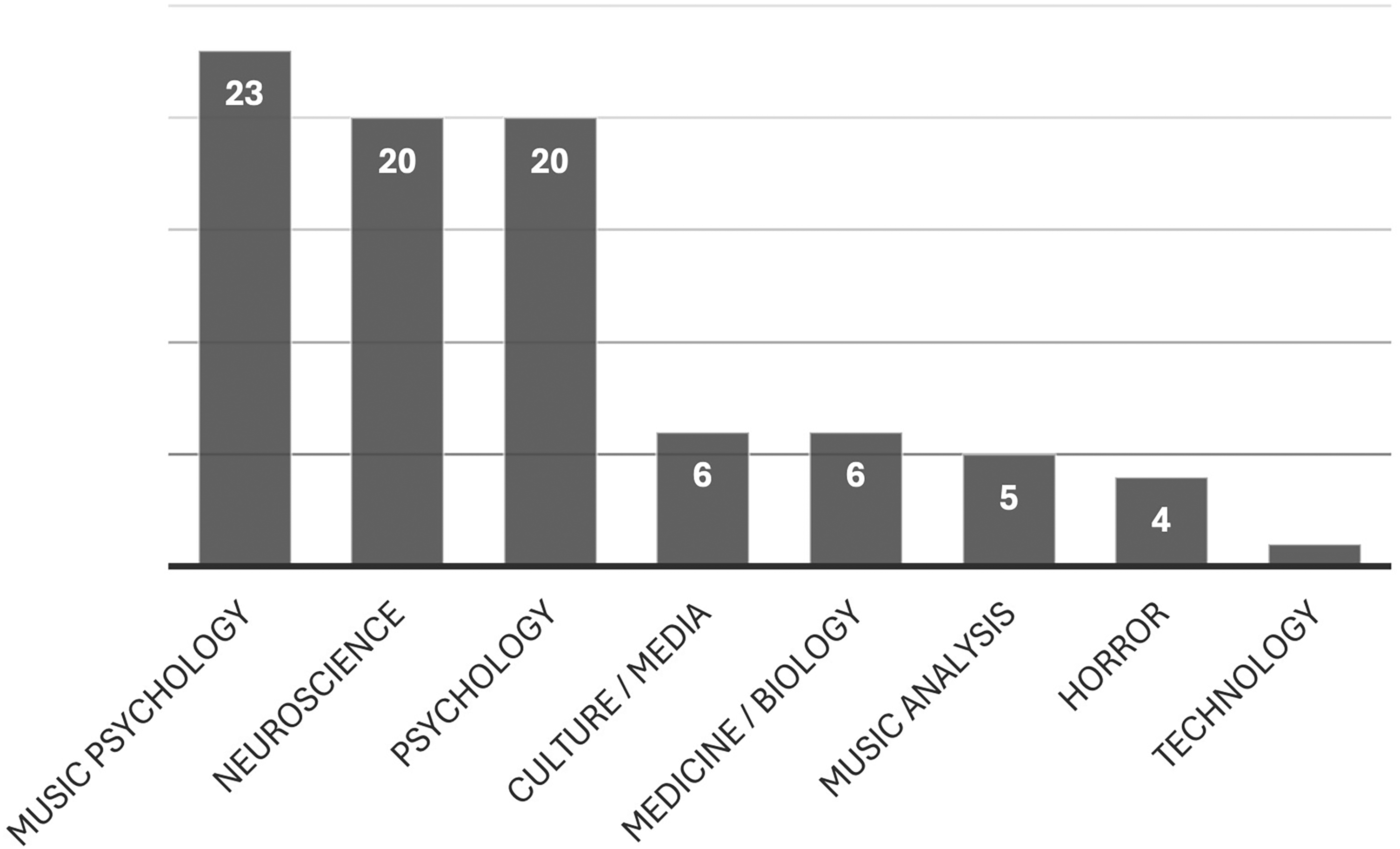
Disciplines of the journals in which studies in this sample were published.
Countries of origin and methodology of the studies in this sample.

The basic or discrete emotion theory, in which fear is considered one of several basic emotions, appeared most frequently. The dimensional model, in which emotions are characterized by their location on two or more continuous axes, was also widely used, and some articles (e.g., Eerola & Vuoskoski, 2011; Korsmit et al., 2023) compared discrete and dimensional models or used both. According to the circumplex dimensional model, fear has negative valence and relatively high or moderate arousal (Aydın & Onbaşı, 2023; Quinto & Thompson, 2013; Eerola & Vuoskoski, 2011; Korsmit et al., 2023). In the reviewed literature, fear-conveying music was variously described as “scary,” “fearful,” “terrifying,” “gothic,” “ominous,” “frightening,” or “horror music.” In the current study, we use quotation marks to indicate terms used within reviewed articles, rather than imposing our own terminology. Some articles also used synonyms for fear or used clustering, combining fear with related emotions, such as “anxiety,” “unease,” or “tension” (e.g., Tan et al., 2007). Articles representing fields such as traditional musicology, film studies or culture studies were less likely to use emotion theories from psychology.
(Figure 3).

Division of emotion theories applied in this sample.
In analyzing this literature, we distinguished three different aspects of fear in relation to music: Music can express fear, the listener can perceive the music as scary but not necessarily feel the emotion, or the listener can experience fear when listening to fear-inducing music and express it. These are in line with the basic mechanisms identified in the field of music and emotion research (see e.g., Juslin & Sloboda, 2010). Thus, we present our analysis through three main themes: 1) Expressed fear, 2) Perceived fear, and 3) Evoked and experienced fear. It should be noted that these themes are presented as distinct aspects of fear in music for the sake of analytical clarity, with the acknowledgement that in reality they often exist simultaneously.
Expressed fear
Whether it is the composer who intends to compose a piece conveying fear, or the performer who aims to perform the piece so as to evoke fear in the listener, there are musical cues through which fear can be expressed.
1.1 Fear expressed through musical characteristics and performance
Although there are common characteristics that seem to be typical for fear-expressing music, there are differences as well. This may be due to music expressing different types of fear, for instance, mimicking a “scary object” or a “scared subject.” These differences affect how fear is possibly perceived or evoked in the listener: for instance, through cognitive appraisal, or emotional contagion. Previously, for instance, contour theory has shown that the perceived expressiveness in music is due to music “contouring,” or mimicking, human behavior and emotion expression, such as gestures (see e.g., Benenti and Meini, 2018; Davies, 2010).
According to the reviewed literature, scary-sounding music is typically in minor key (Gosselin et al., 2005; Hailstone et al., 2009; Micallef Grimaud & Eerola, 2022; McClelland, 2017; Vieillard et al. 2008). Other frequently mentioned characteristics include fast tempo (Argstatter, 2016; Hailstone et al., 2009; Gosselin et al., 2005), a wide variation or high contrast in dynamics (Argstatter, 2016; Hailstone et al., 2009; McClelland, 2017), and many chromatic notes (Hailstone et al., 2009; McClelland, 2017). Irregularity in the rhythm or dissonant events (Gosselin et al., 2005), fragmented and disharmonic music (Klimmt et al., 2019; McClelland, 2017), and vibratos or tremolos may also be associated with scary music (Argstatter, 2016; Leong, 2023). Trevor et al. (2023) have recently revived the terms ombra and tempesta, previously used mostly in the analysis of 17th and 18th century Western art music (McClelland, 2017), to distinguish between different styles of expressing fear in music. Ombra is described as gloomy, tonally uncertain music in minor key, with fairly slow tempo and possibly unusual harmonies or rhythms, syncopation, and wide contrast in dynamics, whereas tempesta is described as fast, unsettling, or “stormy” music (McClelland, 2017). Trevor et al. (2023) have further proposed that music can convey at least two different subtypes of fear in relation to ombra and tempesta: ombra associated with “anxiety” or “dread” and tempesta with “terror” or “panic.” This exemplifies emotion granularity, which refers to the ability to make distinctions between similar emotions. Thus, these subtypes differ from each other in their musical properties and are suggested to convey different types of fear.
In addition to musical elements, the structure of a composition affects the expression of fear and horror. By analyzing Schubert's music, Leong (2023) points out “recurring hauntings in the O-theme,” ombra topics, such as tremolos, dissonances, and chromaticism, harmonic progression and contrast in dynamics for creating a “Gothic aesthetic” and scary atmosphere. Spitzer (2010) analyzed fear in Schubert's music holistically and found that fear is expressed both as an affect and an action in communication with other emotions; for instance, fear-expressing music can represent a “fearful” reaction to anger. Thus, the musical expression can either imitate the scary object evoking fear or the subject being afraid. Film composers have also intentionally used nonlinear sound analogies (see our theme 2.1), such as noise, shrieks, or sounds that mimic either human or animal screams, to evoke emotions of fear and terror in the audience (Blumstein et al., 2010; Trevor et al., 2020).
Performance also contributes to the overall affective expression of music. Carr et al. (2023) investigated the effect of articulation in major and minor mode, and found that legato melodies were perceived as “scarier” than staccato melodies in both modes, while staccato melodies were “amusing” and “surprising.” Quinto and Thompson (2013) found that both performance and composition had an effect on the participants’ valence and arousal ratings, but compositional cues had a stronger effect on valence, while the performance cues affected the arousal scores. Similarly, findings by Vieillard et al. (2012) highlight the vital role of the performer's expression in shaping the listener's emotional response to music. They found that music excerpts categorized as expressing happiness, sadness, or “threat” were rated higher as belonging to their category when performed expressively rather than mechanically. Physiologically, expressive excerpts increased skin conductance more than mechanical ones, slowed response times in the breath detection task, and increased target detection times for happy and “scary/ threat-expressing” excerpts, but not for sad ones. The authors suggest that expressiveness needs to be combined with a certain level of arousal to draw attention and that “scary” excerpts attract more attention because fear is considered to be evolutionarily important for our survival. However, it seems the ombra and tempesta of scary-sounding music also exists in performance: According to Vieillard et al. (2008) performers can communicate or try to induce fear in the listener using different dynamics. Music can either be played powerfully to convey a “fight-or-flight” response or softly to convey a “freezing” response. Thus, it seems composers’ and performers’ roles in affective expression are both crucial and can together create a whole.
Researchers have attempted to form validated sets of musical excerpts for expressing emotions, including fear. Vieillard et al. (2008) conducted 3 experiments using different methods to validate a set of 56 novelly composed excerpts which participants could identify as expressing happiness, sadness, fear, and peacefulness. Their “scary/threat-conveying” music excerpts were in minor keys, used chords on the 3rd and 6th degrees, had tempi between 44 to 172 beats per minute, and were rather consonant, but some conveyed rhythmical irregularity and dissonances. Eerola and Vuoskoski (2011) gathered a set of 110 unfamiliar film music excerpts and later on systematically tested and validated their set of stimuli. “Fear” excerpts were high in arousal, both tension and energy, and negative in valence, but their musical features were not explicitly described. Multiple studies, also included in the current review (e.g., Aubé et al., 2015; Fuentes-Sánchez et al., 2021; Gosselin et al., 2015; Park et al., 2013; 2014; Plate et al., 2024; Vieillard et al., 2012) have later used excerpts from these sets of stimuli by Vieillard et al. (2008) or Eerola and Vuoskoski (2011). Micallef Grimaud and Eerola (2022) created a 28-excerpt set of stimuli conveying sadness, joy, calmness, anger, fear, power, surprise, love, and longing. Their “anger,” “fear,” and “power” excerpts have a minor mode and fast tempi, dissonance, constant rhythm, step by step moving melodic lines, and repetitive notes. Recently, for fear conveying music, Trevor et al. (2023) created the FEARMUS database, concentrating specifically on music conveying “anxiety” or “terror” and consisting of 100 excerpts of horror film music.
1.2. Music as a part of scary narratives
Music can be an important element for conveying expressions of fear or scary narrative elements in fiction. In audiovisual contexts, music can create scary atmospheres and express fear in symbolic or metaphorical ways. Also, extramusical imagery or intermedial references to horror-lore in, for instance, lyrics or album artwork, can be ways to express fear associated with music.
In film, theatre, opera, and video games, music plays a crucial role in expressing threat or danger (Blumstein et al., 2010; Hong, 2019; Klimmt et al., 2019; McClelland, 2017; Trevor et al., 2023; Kattelman, 2022). Julia Kristeva's concept of “the abject” has been used in analyzing how music or sound can be used as a symbol for terrifying, possibly invisible things, such as monsters, in film or theatre settings (Halfyard, 2022; Luko, 2015). The concept of abject might help draw a line between rational real-life fear of, for instance, danger and irrational fear of, for instance, monsters or darkness. Music and noise are used as direct signifiers for a monster or its presence (Halfyard, 2022; Van Elferen, 2016; Luko, 2015), or other unseen elements supporting the horror narrative (Kattelman, 2022). Luko (2015) refers to “acousmêtre,” a musically induced “being” in a film, when the visual monster is not visible on the screen but comes alive in music, and the music can be interpreted as a metaphor for a monster; thus a musical personification. For example, in the “shark motif” from the film Jaws, the musical cues represent the dangerous shark, though not yet visible on the screen (Biancorosso, 2010). However, the abject in music is not necessarily the unknown but can be something familiar yet “uncanny” (Lentsner & de Rinaldis, 2017). Noise, both as music and as a disturbing sound, has been used in horror films and games as a sonic way to represent the abject, either replacing or accompanying more conventional horror music (Halfyard, 2022; Van Elferen, 2016). This may also refer to a specifically used sound gesture in a horror film – the “stinger”: a sudden chord or sound to scare us (e.g., Lerner, 2010). In horror film trailers, along with engaging the audience emotionally, music plays part in creating the narrative and communicating marketing information to the viewers (Redfern, 2020).
In addition to noise, other non-musical sounds and extramusical imagery have been combined with music to convey scary narratives. For example, howls of wolves and wolf imagery are used in heavy metal music and horror context to symbolically represent fear and horror (Digioia, 2016). Also, lyrical elements in songs or album cover art can have references to scary narratives, such as Metallica and Iron Maiden referring to Cthulhu and other terrifying creatures created by the horror author H.P. Lovecraft (Sederholm, 2016).
Perceived fear
Perception of fear in music does not necessarily mean that the listener will actually feel afraid, but that they can recognize the fear expressed by music or perceive the music as sounding scary. Also, the studies in this scope that focused on perception did not explicitly investigate whether the music evoked fear in the participants but only whether they were able to recognize the emotion from specific music stimuli.
2.1. Auditory basis of perception of fear in music
Timbre and tone are important elements in the expression and perception of fear in music (Hailstone et al., 2009; Bowman & Yamauchi, 2016; Ma et al., 2021). Furthermore, timbre alone can convey emotional meanings associated with fear. Tone features play an important part in defining the genre of “horror music”; for instance, drone sounds used in horror scores might have unusual or “between pitch” sound that creates intimidating atmospheres (Ma et al., 2021). Certain instruments seem to have a more suitable timbre when it comes to expressing fear, as voice or violin might be more strongly associated with “music conveying fear” compared to clarinet (Sachs et al. 2018). According to Bowman and Yamauchi (2016), acoustic properties comprising timbre differences may also predict the emotional evaluation of different timbres. In particular, certain acoustic properties are associated with certain emotions. In an experimental study, these properties, sub-bands 1 3 and 9, were associated both with timbre and emotion judgements in general, and sub-band 7, related to perceived activity in a sound, specifically predicted anger, fear, and disgust in music. Nonlinearity is a sound feature associated with fear and horror (Blumstein et al., 2010; Redfern, 2020; Trevor et al., 2020), typically referring to distortion in sound. Trevor et al. (2020) analyzed four categories of audio stimuli: “screams,” “non-screaming vocalizations,” “scream-like music,” and “non-scream-like music,” and collected valence and arousal ratings. They found that roughness, which is a typical feature in human screams as well as scream-mimicking music, can be associated with “terrifying” music.
When discussing auditory perception of fear in music, it is important to note that it is very closely connected to the neural level, and the results in these fields may overlap with each other. Since it is difficult to distinguish between perception and induction, we will further discuss the neural basis of fear in music in subsection 3.1.
2.2 Perception of fear among other emotions in music
Fear in music may be confused with other emotions, especially those typically classified as negative, such as anger, sadness, disgust, or aggression (Argstatter, 2016; Aydın & Onbaşı, 2023; Eerola & Vuoskoski, 2011; Spackman et al., 2005; Taruffi et al., 2017). It seems that fear and anger are particularly often confused with each other by both children (e.g., Spackman et al., 2005) and adults (e.g., Aydın & Onbaşı, 2023; Eerola & Vuoskoski, 2011; Fuentes-Sánchez et al., 2021; Micallef Grimaud & Eerola, 2022; Spitzer & Coutinho, 2014). Studying basic emotion recognition in music among different nationalities (German, Norwegian, South Korean, and Indonesian), Argstatter (2016) found that participants from all of the nationalities could recognize fear significantly correctly from other basic emotions, but the authors found some cultural differences in the recognition of fear. Fear was often confused with anger and disgust. Fritz et al. (2009) found that native African Mafa people, who had not been exposed to Western music before, recognized fear from “scared/fearful” stimuli above chance, along with sadness and happiness. Eerola and Vuoskoski (2011) found that music examples conveying moderate fear and anger were easily confused with each other, whereas the more extreme examples were not. Kallinen's (2005) results suggest fear, anger, and surprise are harder to recognize from Western art music than sadness or happiness. Researchers have not agreed on an explanation for why fear is often confused with anger in music perception. Proposed explanations include overlap of these two emotions in dimensional models (Aydın & Onbaşı, 2023; Eerola & Vuoskoski, 2011), or that both may reflect “fight-or-flight” responses (Aydın & Onbaşı, 2023; Vieillard et al., 2008). Kallinen (2005) has suggested that fear and anger may have more complex links with human experience due to their role in human survival, while Spitzer and Coutinho (2014) point to individual differences in interpreting emotions.
2.3 Individual differences in fear perception and recognition
Individual differences, such as age, personality traits, musical history, appraisal history, life experiences, and the context affect one's perception of fear in music (Kallinen & Ravaja, 2006). These differences can be examined on behavioral, cognitive, and neural levels. Age may affect interpretation of fear in music; Fuentes-Sánchez et al. (2023) found that fear was classified as an unpleasant musical emotion more than other studied emotions (happiness, sadness, tenderness, anger). Pearce and Halpern (2015) found that older participants rated “fearful” music in a more positive way compared to younger participants. Similarly, Vieillard et al. (2020), found that when listening to “threatening” music without any prior instructions on appraisal, older adults reported more positive feelings. The authors propose that older adults might have a naturally more positive appraisal of “threatening” music than younger ones.
Children's perception of fear from music has not been studied much, but the few existing examples show some consistency. Hunter et al. (2011) found that children reached adult-like accuracy of recognizing happy, sad, fear, or peacefulness from unfamiliar music at the age of 11, and girls’ accuracy was better compared to boys at 5 and 8 years old. In all age groups, scary music was the second most accurately identified: The participants recognized only happiness better than fear, contrary to the researchers’ expectations. Results by Vidas et al. (2018) show the accuracy of recognizing “scared” music increased with age and “scared” stimuli were mostly confused with “angry” stimuli (see also Spackman et al., 2005 for similar results). Plate et al. (2024) found 5–6-year-old children's recognition accuracy of sad, calm, or “scary” music was positively linked to their emotional verbal expressivity. This association was significantly stronger with “scary” music compared to sad or calm music. Stachó et al. (2013) showed that, for children of 3–7 years old, anger, fear, and emotional neutrality were harder to identify than happiness or sadness from emotions expressed through performance in music. Fear was often confused with sadness. Spackman et al. (2005) found that children from 5–8 years and 9–12 years with language impairment showed significant differences compared to typically developed children in identifying the basic emotions (happiness, anger, sadness and fear) expressed in music. Older children performed better than younger children. For all groups, fear and anger were confused with each other, and children with language impairment misidentified anger-expressing excerpts as fear. Overall, it seems that children recognize fear from music relatively well, and these abilities improve with age, but fear is still easily confused with other negatively classified emotions.
Although music perception research including children with disabilities is limited, researchers have tested whether autism spectrum disorder (ASD) influences children's fear recognition from music. Quintin et al. (2011) found no difference between high-functioning adolescents with ASD and typically developing (TD) adolescents in recognizing (happy, sad, “scared,” or peaceful) emotions from music. Participants in both groups rated the intensity of emotions similarly and recognized the “scared” musical stimuli most accurately. In contrast, Sivathasan et al. (2023) found that participants with ASD performed better than TD peers in identifying emotions overall, including fear, from music, but both groups performed similarly in recognizing faces. Katagiri (2009) studied the effect of background music and song lyrics on teaching emotional understanding for children with ASD and found that, after intervention, participants’ skill for decoding emotion was most improved for fear. According to all of these studies’ results, it seems autistic children and adolescents recognize fear from music well and can enhance their recognition by learning.
Personality traits have an impact on fear perception from music. Empathic concern seems to be linked to an overall tendency for better recognition of fear in music (Taruffi et al., 2017) and intensified perception of fear in music adolescents (Saarikallio et al., 2014). Sachs et al. (2018) found that empathy was associated with more distinct neural patterns related to perceiving emotions from music. Park et al. (2013) found that extraversion was negatively correlated with right amygdala activation when participants listened to music expressing fear. Juslin et al. (2008), looking at individual prevalence of experienced emotions in an ESM study, found that musical emotion category “anxiety-fear,” though an uncommon emotion in results overall, was positively correlated with conscientiousness. Musicianship, too, influences the perception and recognition of fear in music. According to Nussbaum et al. (2024), musicians outperform non-musicians in vocal emotion recognition in music, especially from the melody, but not from timbre. Park et al. (2014) found certain brain areas of musicians were more activated than non-musicians when listening to music that conveyed sadness and fear. Musicians also rated negative emotions in music as more arousing.
Studies have shown that conditions such as alexithymia, dementia, and Parkinson's disease affect the perception of fear in music. Alexithymia is associated with difficulties in recognizing emotion overall and lack of vocabulary in describing emotional experiences (Taruffi et al., 2017; Larwood et al., 2021). Larwood et al. (2021) found that higher alexithymia was linked to more neutral judgments of valence and arousal when emotion the song conveyed was “sad,” “angry,” or “fearful,” suggesting that alexithymia may be related to impaired processing of negatively valenced affect in music. Somewhat surprisingly, Gagnon et al. (2012) found that a participant diagnosed with dementia recognized fear from “scary” music excerpts better than a healthy participant. Lima et al. (2013) found that patients with Parkinson's disease had intact recognition of sadness and fear in music, whereas their recognition of happiness or peacefulness in music was impaired. In a study by Orjuela-Rojas et al. (2021) patients with behavioral variant frontotemporal dementia had compromised recognition of negative emotions from music, including fear. Gosselin et al. (2015) studied the perception of happiness, sadness, fear, and peacefulness from music in adults with congenital amusia and found that most of the amusic participants were able to recognize these emotions from music normally.
Damage to the amygdala may result in difficulties in recognizing fear from music (Gosselin et al., 2005;2007; 2011). Patients with left or right medial temporal resection, including the amygdala, had an impaired recognition of “scary” musical stimuli, while their recognition of happy and sad musical stimuli was normal (Gosselin et al., 2005). Similarly, Gosselin et al. (2007) found recognition of “scary” and sad music was impaired when the patient had bilateral damage specifically in the amygdala but not elsewhere in the temporal lobe. In a study by Gosselin et al. (2011), patients with unilateral anteromedial temporal surgery were found to be impaired in recognizing “scary” music and “fearful” faces compared to normal controls and compared to recognition of other emotions. The results suggest fear is multimodally represented in the amygdala, though recognition of “scary” music was more impaired than the recognition of scary faces in the pictures. This also suggests the networks for recognizing fearful faces and scary music may be at least partially different. We discuss the neural mechanisms of fear inducement more in subsection 3.1.
2.4 Perception of fear in audiovisual context
In the audiovisual context, such as film, TV, or video games, both auditory and visual stimuli have an effect on how the listener recognizes and perceives these emotions. The role of music in an audiovisual setting has also been studied in relation to image, both moving and still, and how music changes the perception of these visual stimuli (Ansani et al., 2023, Baumgartner et al., 2006a; 2006b; Prinz & Seidel, 2012; Tan et al., 2007).
Baumgartner et al. (2006a; 2006b) suggest that affective images alone cause a more cognitive-level perception of the emotion compared to combining images with congruent music. When shown happy, sad, and “fearful” images, participants perceived the quality of the emotions most accurately with the combination of affective images and congruent music, but accuracy was intermediate in the picture conditions and the lowest in the mere sound conditions (Baumgartner et al., 2006a). Furthermore, combining images with congruent music activated brain areas that are involved in auditory, neural, and visual-auditory integration processes, but also areas linked to emotion processing, such as the amygdala, hippocampus, and parahippocampus. The participants also reported experiencing the “happy” condition more positively and the “fear” and “sadness” conditions more negatively, when both image and music were involved (Baumgartner et al., 2006b). Tan et al. (2007) found that participants interpreted film characters’ emotions overall consistently with an emotion (happiness, sadness, fear, anger) expressed in the music, whether it was presented before and after the scene.
Evoked and experienced fear
If music is perceived as sounding scary, it should also have the potential to evoke fear in the listener. For instance, expressiveness in a composition – thus, a combination of expressing fear in music in the composition as well as in the performance – can cause stronger reactions to the music (Vieillard et al., 2012). Fear evoked by music is associated with different levels of expression, from bodily gestures and movement to verbalizing the felt emotion. Though perception and experience of fear are not the same phenomenon, they are overlapping and affected by individual differences. Negative emotions in music can be enjoyed, depending on the relationship with affect valence and emotion valence, and personal preferences of the listener (Eerola & Vuoskoski, 2011; Schubert, 2013). Thus, even though fear in music is typically considered to have negative valence and is classified as a negative emotion, it can create positive feelings and enjoyment in the listener. Nevertheless, music-induced fear can cause detectable physical reactions typical of evoked negative emotions, from activation of different brain regions (see subsection 3.1) to changes in skin conductance (e.g., Kasos et al., 2018) or heart rate (e.g., Proverbio et al., 2015).
3.1 Neural basis of music-induced fear
Multiple brain areas seem to play a part in both our perception and induction of fear in music, but when it comes to brain area activation while listening to music, fear is most typically linked to the amygdala and the auditory cortices (Aubé et al., 2015; Bogert et al., 2016; Gosselin et al., 2005;Koelsch et al. 2013; 2018; Putkinen et al., 2021), but neural activation in other parts of the brain has also been associated with music expressing fear. The most used neuroscience method in this scope was functional magnetic resonance imaging (fMRI). Aubé et al. (2015) compared neural responses to basic emotions (fear, sadness, happiness, and neutral) expressed through faces, nonlinguistic vocalizations, and musical excerpts, and found increased activity in the amygdala and anterior insula in response to “fearful” stimuli across all domains. Putkinen et al. (2021) found that happy, sad, “fearful,” and tender music all caused activity in various parts of the brain, including auditory, somatosensory, and motor cortices. Fear and liking also engaged the amygdala. Bogert et al. (2016) looked at explicit (emotion classifying) and implicit (paying attention to the number of instruments playing) processing of music-evoked emotions in the brain. The findings suggest networks of limbic and paralimbic regions are involved in the processing of sad, happy, and “fearful” emotions in music in different ways, emphasizing the role of the bilateral auditory cortices. Bravo et al. (2020) found a stronger engagement of the left medial prefrontal cortex and the left rostral anterior cingulate cortex while participants listened to dissonant music compared to consonant music. These areas are associated with detecting and resolving conflicts and processing negative emotions, such as fear. Koelsch et al. (2013) found increased activation in the right primary somatosensory cortex in response to “fear-eliciting” music along with functional connectivity between the amygdala, visual cortex, and parietal lobe. The authors suggest this may indicate increased visual alertness and automatic attention processes during auditory danger signal detection, making use of evolutionarily old brain mechanisms for threat awareness. Koelsch et al. (2018) found that fear stimuli induced higher connectivity compared to joy in the auditory association cortex. Staib et al. (2020) suggested that the primary auditory cortex is crucial in encoding fear or threat predictions in both simple and complex musical sounds. Neuroimaging studies in general have typically not concentrated on individual experience, but Kinreich et al. (2011) combined fMRI with self-reports. The participants were listening to excerpts of horror film music during the scan. Results showed activation in the right dorsal amygdala was associated with self-reported real-time emotional experience of the participants. Using positron emission tomography (PET), Zhang et al. (2012) investigated underlying neural mechanisms induced by “frightening” music. The results show that “frightening” music causes rapid changes in receptors for neurotransmitters including serotonin, dopamine and norepinephrine, with a decrease observed in the limbic and paralimbic regions, and an increase in the cerebral cortex. They also found that the right hemisphere is more dominant in defense reaction and the processing of auditory information. Using electro-encephalogram (EEG) data, Aydın and Onbaşı (2023) investigated the neural correlates of rhythms associated with anger and fear and found evidence that the neural correlates of fear and anger are distinct despite being close together in arousal-valence circumplex.
3.2 Physical reactions and bodily movement evoked by music conveying fear
“Music-elicited fear” has been associated with threat detection (Aubé et al., 2015); thus it may induce specific bodily reactions in the listener. Etzel et al. (2006) studied cardiovascular and respiratory reactions of music-evoked fear, sadness, and joy, and found that participants’ heart rate and respiration accelerated during the fear induction. Skin conductance research on music and fear is very limited, but Kasos et al. (2018) used skin conductance to identify lateralization in nervous system responses to emotionally laden musical stimuli that conveyed fear, sadness, happiness, or peacefulness, and compared the differences between left and right sides of the body. Music conveying fear, sadness, and peacefulness seems to activate the right side more dominantly, whereas the left side seems to respond to happiness. They also found that higher state anxiety levels were associated with more right-sided electrodermal responses to fear on the palms but not on the feet. Vieillard et al. (2020) found that older participants showed lower skin conductance levels than younger participants while reporting more positive feelings while listening to “threatening music” compared to younger participants (see subsection 2.3). Proverbio et al. (2015) found that atonal music caused a bodily reaction, referred to as fear bradycardia (increased blood pressure and decreased heart rate), in non-expert listeners. The participants reported the atonal music to be significantly more “agitating” than tonal pieces, which were reported as more joyful. Similarly, Fuentes-Sànchez et al. (2021) combined subjective and physiological correlates and found that music stimuli rated as more “fearful” caused a sustained slowing of the heart rate compared to other negative emotions, suggesting that participants continued to pay attention to the “fearful” stimuli, which aligns with moderate activation of the defensive motivational system.
Fear-conveying music can also influence bodily movement and motor functions, although the research on this is limited. In an experiment by Bonassi et al. (2023), 20 participants performed a motor sequence learning task with music meant to elicit “fearful,” “pleasant,” or “neutral” mood. They found that the fear condition improved participants’ declarative learning and verbal recall of the sequence, whereas the other musically induced moods did not have similar effect. However, the “fearful” music did not improve participants’ motor performance. In two studies on expressive movement by dancers, Warrenburg et al. (2020) asked participants to express melancholy, grief, or fear through their movements, with or without music. In the first study, viewers rated their perception of social connection among the dancers. Dancers expressing grief and fear without music were perceived to have more social interactions compared to those expressing melancholy. In the second study, video analysis showed that dancers expressing grief and fear showed more physical contact than those expressing melancholy.
3.3 Music as an amplifier for fear in audiovisual and extramusical contexts
Music may evoke fear in the listener in multimodal contexts, strengthening or amplifying emotions evoked by a single mode of stimuli (Baumgartner et al., 2006a; 2006b; Rosenfeld & Steffens, 2019). Since induction and perception are very closely linked, we have included some examples referring to perception in this category. Rosenfeld and Steffens (2019) propose that visual stimuli define the emotion perception or inducement in film, whereas music, when congruent with the visual, can enhance the effect or, when incongruent, decrease it. In fact, there is evidence that musically induced fear can alter our perception of visual imagery and make it feel more threatening. In a study by Prinz and Seidel (2012), participants were shown ambiguous pictures representing “alligator/squirrel,” “snake/rope,” or “cleaver/pot,” with scary or happy music and without music. The participants were more likely to interpret the pictures as something dangerous (alligator, cleaver, snake, or synonyms) when “fear-inducing music” was played, compared to happy music or no music at all. (Prinz & Seidel, 2012). According to Wormwood et al. (2022), the presence of anger or fear in music may create a biased threat detection. Their experiment showed that participants in the “emergent-anger” and “emergent-fear” conditions were more likely to identify individuals as armed regardless of what they were holding, compared to the control group.
The role of scary music in horror entertainment, such as films and games, is relying on its potential to elicit feelings of fear and terror in an audiovisual setting and enhance the intended atmosphere (Blumstein et al., 2010; Hong, 2019; Klimmt et al., 2019; McClelland, 2017; Trevor et al., 2023). However, “scary” music may induce a mood-coherent bias even in an otherwise neutral film setting, causing participants to remember the scene as scarier than it originally was (Ansani et al., 2023). Music may also affect viewers’ opinions on other neutral stimuli: viewers’ perception of sharks was more negative when the background music of a shark documentary was “ominous,” compared to uplifting background music or silence (Nosal et al., 2016). Still, film composers have developed musical ways of manipulating the audience and their emotions on purpose (see our first theme: “Expressed fear”). In addition to conventional horror scores, sound or music has been intentionally used by contrasting musical expression with what is happening on the visual screen to evoke a sensation of “discomfort” (Hong, 2019). The findings by Meinel and Bullerjahn (2022) suggest that the placement of music prior to the shock moment in a horror film may lead to the viewer's stress levels increasing earlier than in other conditions, and that music adds to the effect of strong emotional reaction evoked by the visual stimuli. Klimmt et al. (2019) compared participants’ horror gaming experience with and without the original soundtrack, which was composed with the aim of increasing the players’ experience of fear during the gameplay. The results showed that the music of the original soundtrack had a moderate effect on the participants’ experience of horror. Music has been shown to elicit visual imagery in the listener outside of an actual audiovisual context. The results of an experiment by Day et al. (2020) suggest that experiences of visual imagery are common when listening to any highly evocative music but are more likely to take place when music is low in familiarity, high in tension, and has negative emotional connotations such as sadness, anxiety, or fear.
Music can also be a way to explore and experience fear safely, at least when the music is pleasant to the individual. In a study by Thorgersen and von Wachenfeldt (2017), young “black-metal” musicians reported they can explore the darker sides of being a human through black metal and experience “unpleasantly thrilling feelings”, such as “fear,” “darkness,” “danger" and “unease.” Though the aim of a black metal performance is to evoke horror and terror in the audience, for the musicians themselves, the aim is to learn, be free, and empower themselves by experiencing and expressing fear in a safe and socially accepted manner.
Discussion
The findings of this review illuminate the current state of research on music and fear as thoroughly as possible, including different definitions for scary music, the terminology, and the findings previous studies have provided. Fear in music seems to be a more complex phenomenon than most previous research has acknowledged. Within the last two decades, the topic has been studied by using multiple approaches, but so far, the vast majority of studies have concentrated on perception or recognition of fear from music, typically among other (basic) emotions. While there is some general agreement about the elements that comprise scary-sounding music, studies on fear evoked by music are still limited and lack clear results.
Within the reviewed literature, various terms were used to describe fear in music. One reason might be that music and fear are studied in many different fields of research, from cultural studies and traditional music analysis to music cognition and neuroscience, but the use of terminology is not consistent within any specific field. For instance, studies focusing on basic emotions used the term “fear” when referring to the studied emotion but may have described music stimuli as, for instance, “fearful,” “scary,” or “scared.” In a research context, this is problematic, since different adjectives carry different emotional connotations; “fearful” can mean both being scary and being afraid, which are two different states. However, only a few studies in our corpus seemed to acknowledge, let alone draw a distinction between, music mimicking “scary” or “fearful,” or were not explicit about which one they mean. Theoretically unclear conceptualization also affects research design, possibly resulting in unclear results. Furthermore, since the musical expression seems to differ depending on whether the musical composition is aiming to imitate the source of fear (e.g., threatening situation or scary monster) or if the stimuli expresses fear through the subject experiencing fear (e.g., the main character being anxious or panicking), more nuanced and clearer definitions for “scary” or “fearful” music are needed if we wish to understand listeners’ affective reactions to such musical expressions, and the mechanisms behind them, such as perceiving fear through cognitive appraisal or feeling afraid through emotional contagion. The distinction between ombra and tempesta (e.g., McClelland, 2017) in relation to two subtypes of fear, anxiety and terror, presented by Trevor et al. (2023), is a useful conceptualization that could be further developed for empirical testing in order to gain a more granular palette of definitions for studying fear associated with music.
When it comes to emotion perception, it seems that recognition of fear from music requires learning. Research shows that, despite some individual differences, children's ability to recognize fear in music improves with age (e.g., Hunter et al., 2011; Spackman et al., 2005; Vidas et al., 2018). The role of the amygdala in brain responses to scary-sounding music suggests that the responses to music are similar to threatening non-musical stimuli, which are linked to evolutionarily evolved threat detection and threat avoidance responses, thus implying that music can indeed evoke a low-level fear-response in the listener. However, the fact that expression of fear is often confused with other negative emotions (such as anger) implies that the distinction between emotion perception and the listener's affective experience is indeed blurry and probably happens as a part of a dynamic, multi-dimensional process. For instance, if the listener is perceiving “scary music” as sounding more angry than scary, it might be that they are actually recognizing their own emotional reaction (fear or uneasiness) to a threatening soundscape (imitating aggressive “other”) rather than the “fearful” expression the musical cues convey. The ability to differentiate the locus of emotion – that is, whether it is external (perceived) or internal (felt) – develops over time and requires exposure to music of a given style. However, we propose that the frequently observed confusion between expressed and felt emotion in the case of fear is not due mainly to age and learning effects. Rather, the mismatch is more likely to be a result of lack of clarity of concepts and poor experimental design than participants’ inability to recognize the correct emotion. Clarity about how music we label “scary” or “fearful” relates to the contrasting, non-music components of fear (e.g., whether music is reflecting the predator or the prey) is imperative to developing scientific understanding of when and how music evokes fear in listeners and why listeners may choose this experience.
Furthermore, since the majority of previous studies investigating music-evoked fear have concentrated on the effects of music on multimodal experience (e.g., visual perception or movement), it is yet unclear if and how music per se could evoke a fear-response. Contextual and conceptual information regarding emotions are likely to play a crucial role in any affective experience (Barrett, 2017), but they become particularly relevant when it comes to an “artificial and not a natural stimulus” (Merrill, Omigie & Wald-Fuhrmann, 2020) such as music. The paradox of enjoyable negative emotions in the context of fiction (e.g., Smuts, 2009) cannot be ignored when investigating music associated with fear or emotions evoked by scary-sounding music. The majority of such music exists within the contexts of extreme music genres (e.g., alternative and metal music and their various sub-genres) and horror media, which aim to evoke extreme feelings but eventually to be enjoyed by the audience. It is impossible to separate contextual information from the musical material when it comes to horror entertainment, but this does not mean the emotions evoked by such entertainment are real experiences. What we expect is that the thrilling excitement induced by a score of enjoyable horror media is a different kind of experience compared to unsettling feelings evoked by a disturbing song of a disliked genre. Classifying both phenomena under the label of “scary music” or “music-induced fear” blurs our vision and prevents us from grasping the complex, dynamic nature of music-evoked emotions. The ombra and tempesta distinction and the work Trevor et al. (2023) have done in suggesting that music can convey different subtypes of fear provide the clearest step in the right direction.
While the scoping review method provided answers to our research questions within this wide sample of literature, it is not embedded in the method to appraise the quality or effects of the selected corpus, which is a limitation. Conducting a review using different methods, such as meta-analysis, to evaluate the quality and effects of existing studies, would thus be beneficial.. This could involve using a wider set of search terms, and including those closely linked to fear, but not synonymous with it, such as “uncanny.” Future research on the topic should also put more effort into developing theoretical clarity of key concepts needed in empirical studies. Finding more consecutive definitions for different forms of “scary” or “fearful” music will be needed for a more precise choice of stimuli in future studies of emotion induction research. Second, research focusing on listeners’ subjective experiences and expressions regarding scary-sounding music could provide a more nuanced view on the meanings and functions of such music but also shed light on the qualia of affective experiences music is able to evoke. Lastly, we propose that future research should combine different methodological approaches to investigate and understand the relationship between self-reported experiences and physiological responses to musically induced fear, as well as objective analysis of the musical stimuli, using, for example, Music Information Retrieval (MIR). It is also important to note that research on music and fear from a culturally diverse and cross-cultural perspective is very limited, and most of the research conducted on this topic so far has been Western-centric regarding both stimuli and participants. To deepen our understanding and make the findings more generalizable, it would be beneficial to conduct future research in more culturally diverse contexts.
Supplemental Material
sj-xlsx-1-mns-10.1177_20592043261432393 - Supplemental material for Fear in Music – Expression, Perception, and How It Actually Feels: A Scoping Review
Supplemental material, sj-xlsx-1-mns-10.1177_20592043261432393 for Fear in Music – Expression, Perception, and How It Actually Feels: A Scoping Review by Katariina Henttonen, Henna-Riikka Peltola and Emily Carlson in Music & Science
Footnotes
Action Editor
Frank Hentschel, Universität zu Köln, Musikwissenschaftliches Institut.
Peer Review
Jörg Mühlhans, University of Vienna, MediaLab.
Melanie Wald-Fuhrmann, Max-Planck-Institut für empirische Ästhetik, Music Department.
Author Contribution
The first and second author ran independent literature searches. The first author was responsible for data collection, charting, and reporting findings. Final analysis was negotiated between all three authors. The second and third authors contributed mostly to introduction and discussion.
Data Availability Statement
Data sharing is not applicable to this article as no datasets were generated or analyzed during the current study.
Declaration of Conflicting Interests
The authors declared no potential conflicts of interest with respect to the research, authorship, and/or publication of this article.
Ethical Approval
This research did not require ethics committee or IRB approval. This research did not involve the use of personal data, fieldwork or experiments involving human or animal participants, or work with children, vulnerable individuals, or clinical populations.
Funding
The authors disclosed receipt of the following financial support for the research, authorship, and/or publication of this article: This work was supported by the Research Council of Finland (grant number 346210).

Supplemental Material
Supplemental material for this article is available online.