




Abstract
After losing a close other, individuals usually confide in an empathic friend to receive comfort and they seem to have a heightened desire for mood-congruent, consoling music. Hence, it has been proposed that affect-congruent music acts as a social surrogate for an empathic friend. Thus, we hypothesized that listening to comforting music, as a response to a social loss experience, provides a sense of empathic company as indicated by reduced loneliness and heightened empathy. We further predicted that distracting music would have a stronger impact on the listeners’ mood in comparison to comforting pieces. To test these assumptions, an experiment with two factors was designed: (1) Sadness was induced by an approved guided imagery method where participants visualized either their father dying (social loss), losing their eyesight (non-social loss), or shopping for groceries (control condition). (2) After the mood induction, the listening task included either comforting or distracting music that participants selected themselves. Psychometric measures for mood and loneliness were collected before and after the mood induction and after the music listening. The data were analyzed with mixed model ANOVAs. The results showed a significant reduction of loneliness and a relevant rise in empathy and mood due to listening to self-selected music, irrespective of the listener’s mood or the applied listening strategy, which suggests that private musical engagement in general can provide mood-repair and a sense of connection. This beneficial effect of private musical engagement supports the notion that not only music production but also its perception engenders social cognition. Overall, the findings corroborate the idea of music as a social surrogate.
Background
When individuals feel distressed or lonely, they often turn to music to feel better (Taruffi & Koelsch, 2014). Some listeners say that they feel understood, emotionally supported, and less lonely when the lyrics of a song apply to their lives (Lippman & Greenwood, 2012). Others describe sad-sounding music as helping them to link their sadness to something positive and making them feel less alone in their negative experiences (Skånland, 2013). To still others, listening to mood-congruent music by themselves feels like being with a friend that offers understanding and comfort when they are sad (Van den Tol & Edwards, 2011). However, studies investigating music preferences of individuals in a sad mood have yielded inconsistent results. People experiencing sadness sometimes prefer to listen to happy or calming music (e.g., Knobloch & Zillmann, 2002; Schellenberg et al., 2008) and sometimes they seek music that reinforces their sadness (e.g., Garrido & Schubert, 2011a; Hunter et al., 2011; Skånland, 2013; Xue et al., 2018). Previous research has demonstrated that liking for sad music is influenced by personality traits among other things; openness to experience, for instance, is linked to sensitivity for art and beauty and people with that disposition seem to enjoy sad music more than others (Vuoskoski et al., 2012). The enjoyment of sad music is further associated with behavioural tendencies to ruminate (Chen et al., 2007; Garrido & Schubert, 2013b) as well as to become deeply absorbed in an experience (Garrido & Schubert, 2011a, 2013a). Additionally, listeners with a more pronounced empathic disposition appreciate sad musical excerpts more than others with a less empathic nature (Eerola et al., 2016; Garrido & Schubert, 2011a; Vuoskoski, 2012; Vuoskoski & Eerola, 2012).
Empathy results from cognitive and emotional processes that allow people to feel and understand what another person is experiencing (Davis, 1980). While trait empathy refers to the baseline level of empathic capabilities of a person, state empathy describes fluctuations around that level that can be influenced, for example, by experimental instructions (Miu & Balteş, 2012). Vuoskoski (2015) proposes that empathic individuals may be more open to engage with sad-sounding music due to their pronounced tendency to empathize with others that are experiencing negative emotions. Further, individuals with a high level of empathy seem to enjoy sad music more since it makes them feel moved (Eerola et al., 2016).
Other explanations for the inconsistent findings regarding musical preferences of people undergoing sadness capitalize on differences in the expected effects of music listening and diverging self-regulatory goals (van den Tol & Edwards, 2014) that can vary according to dispositional emotion regulation styles (Thoma et al., 2012). Some listeners that experience sadness might engage with music for mood enhancement (Stewart et al., 2019; van den Tol & Edwards, 2014) while others want to retrieve specific memories (Tahlier et al., 2012; van den Tol & Edwards, 2014), be in touch with their thoughts and feelings (van den Tol et al., 2016; van den Tol & Edwards, 2011), increase mind-wandering (Taruffi et al., 2017) or derive comfort (Saarikallio & Erkkilä, 2007; Taruffi & Koelsch, 2014) through music listening. The engagement in distraction through sad music with a high aesthetic value, for instance, has been identified as an effective self-regulatory strategy for achieving mood enhancement when feeling sad (van den Tol & Edwards, 2014). Besides sad pieces, cheerful music (Saarikallio & Erkkilä, 2007) is regularly employed for distraction from unwanted thoughts, worries and stress (Stewart et al., 2019; Thomson et al., 2014; van Goethem & Sloboda, 2011). Distraction is recognized as a self-regulatory strategy that repairs mood very effectively (Augustine & Hemenover, 2009) and as a highly important strategy for the use of music listening in general (van Goethem & Sloboda, 2011). However, the continuous use of music for distraction from negative moods may be an indicator of avoidant coping (Garrido & Schubert, 2011b; Miranda & Claes, 2009) or may even indicate psychological problems (Hutchinson et al., 2006; Salters-Pedneault et al., 2004). Even though these regulatory styles are relatively stable personal characteristics, listening preferences are influenced by situational circumstances and musical selection habits can be changed over time (Stewart et al., 2019). In sum, previous research has identified several personality traits and different styles of regulating emotions as factors that may contribute to the inconsistent findings regarding music preferences of solitary individuals in a sad mood.
Context Influences Regulatory Strategies
Besides personal dispositions or mood-regulation styles, the characteristics of the event that triggers a certain emotion may influence somebody’s music choice (Taylor & Friedman, 2014). Different regulatory strategies are employed depending on the emotion experienced prior to music listening and the desired affective state (Erber et al., 1996; Randall & Rickard, 2017; Tahlier et al., 2012). A certain emotion can in turn be caused by different events. Sadness, for instance, can be triggered by the loss of a beloved person, caused, for instance, by a relationship break-up, a terminal illness or accident of a close other (interpersonal sadness) or when failing to achieve an important personal goal, being forced to give up a cherished dream (e.g., of a dream job or profession), or losing one’s health (e.g., by losing eyesight or being diagnosed with a terminal illness; non-interpersonal sadness; DeMarco et al., 2015). Sadness elicited, for example, by career-related failure increases a desire for work-related activities (Gray et al., 2011) while sadness elicited by a social loss heightens a desire for social interaction (Gray et al., 2011; Rimé, 2009) and is associated with responses that foster social connectedness (Keller & Nesse, 2006). Thus, the situation that triggers an emotional episode supposedly influences the nature of subsequent mood-repairing behavior (situation-symptom congruence hypothesis; Keller & Nesse, 2006).
Preference for Mood-congruency
When people undergo sadness due to a broken or lost relationship, they often seek ways to continue a feeling of connection with the lost individual (Fisher et al., 2006) or they look for a surrogate to recapture the bond (Baumeister & Leary, 1995). After painful social experiences, people usually seek a mood-congruent, empathic friend with whom they can share their negative feelings and who provides emotional validation and support (Hill, 1991). In interviews, audience members sometimes have described sad music as a friend who provides understanding and comfort (Van den Tol & Edwards, 2011). Taken together, these findings suggest that sad music might act as a surrogate for an empathic friend in situations of social loss. Following the same logic, Lee et al. (2013) hypothesized that affect-congruent, sad music offers a sense of emotional sharing, akin to interacting with an empathetic friend, and thus is more appreciated when solitary individuals experience interpersonal disruption as compared to non-interpersonal distress (mood-congruency hypothesis). In an experiment where participants indicated their preference for putatively sad or cheerful pieces of music, based on contrived song titles. after writing about a personal experience of losing a significant other (social loss) or an important competition (nonsocial loss), a higher inclination towards mood-congruent music was found among participants facing interpersonal sadness compared to those experiencing non-interpersonal distress (Lee et al., 2013). Based on this result, the authors argued that interpersonal sadness is particularly likely to promote the choice of affect-congruent music. The study that established the mood-congruency hypothesis (Lee et al., 2013) included a second experiment where participants indicated their preference for an affect-incongruent or affect-congruent version of either a person (a funny or an empathic friend) or music (cheerful or sad songs) in different distressing situations. The results suggest a higher liking for mood-congruent experiences as well as a high correlation between the liking for mood-congruent music and friends across all situations. Hence, the preference for solitary engagement with sad music after a social loss strongly correlated with the liking of an empathic friend, which lent support to the mood-congruency hypothesis.
Music as a Virtual Friend
The idea that private music listening can convey the sense of the presence of another person has been proposed by several theoretical positions, in particular social cognition. Persona theory posits that listeners automatically and unconsciously conceive music as expression of a state of mind of an imagined person (Elvers, 2016; Levinson, 2006). Likewise, shared affective motion experience theory claims that music provides company by conveying a sense of the presence, actions, and emotional states of another person (Overy & Molnar-Szakacs, 2009). Furthermore, research on social music cognition suggests that solitary listening can function as a form of social encounter (Wallmark et al., 2018) and that listeners can conceive a virtual social agent while engaging with well-known musical pieces by themselves (Leman, 2007; Lippman & Greenwood, 2012).
Different underlying mechanisms for conveying a sense of connection through music listening have been proposed. Some of these suggestions are based upon music-evoked empathic processes and argue that listeners empathize with the imagined experiences of either a “virtual person” inhabiting the music (Clarke et al., 2015; Levinson, 2006) or the performer or composer itself (Scherer & Zentner, 2001). The former option relates to persona theory, which proposes that individuals experience emotionally expressive music as a narrative about a virtual companion that they imagine inhabits the musical environment (Levinson, 2006) and with whom listeners identify themselves (Elvers, 2016). Alternatively, listeners might empathize with a composer or performer by sympathizing with their lived experiences (Scherer & Zentner, 2001). It is imaginable that those music-evoked empathic processes facilitate the promotion of empathic abilities by increasing the listener’s reflective functioning and mentalizing abilities (Greenberg et al., 2015). As well as music-related empathizing, the identification with a composer or performer (Schäfer & Eerola, 2020; Scherer & Zentner, 2001) and nostalgic reminiscence (Garrido & Davidson, 2019; Schäfer & Eerola, 2020) have been proposed to convey a sense of connection during solitary musical engagement. As nostalgia is known to reconnect reminiscing individuals with people from their past (Wildschut et al., 2010; Zhou et al., 2008) and music is one of the most powerful elicitors of nostalgia (Barrett et al., 2010; Garrido & Davidson, 2019; Zentner et al., 2008), music’s ability to bring back vivid memories of loved ones and the feeling of being with them might induce a sense of connection with them (Garrido & Davidson, 2019).
Moreover, there is empirical evidence that listeners can successfully decode relational intentions from dyadic musical interactions (Aucouturier & Canonne, 2017) and that music can be perceived as having similar qualities to a real person such as age, gender, or emotions (Watt & Ash, 1998). Hence, empirical work supports the theory that both music production and perception include social cognition and empathic processes.
In sum, sadness can be caused by different situations that in turn influence the behavior that people employ to repair their mood. Sadness elicited by a social loss is associated with a greater desire for social connection and interaction than sadness triggered for instance by a career-related failure. Hence, after a painful social experience people usually seek an empathic friend to share their negative feelings and receive comfort. At the same time, a preference for mood-congruent, sad music has been observed in this kind of socially distressing situations. Due to these findings, it stands to reason that affect-congruent musical pieces may act as a surrogate for an empathic friend after experiencing a social loss.
Aim, Rationale, and Hypothesis of the Current Experiment
Aim and Rationale
This experiment was designed to test if private listening to comforting music can provide a sense of empathic company to individuals experiencing interpersonal sadness, a capacity assigned to mood-congruent, “sad music” by previous research (Lee et al., 2013). Instead of concentrating on “sad music”, we adopt a different perspective that focuses on the comforting aspect of music listening to circumvent the problem of the diversity of “sad music” and its effects; previous investigations indicate a substantial variety in the type of music that listeners consider as sad (Peltola, 2017; Van den Tol, 2012; Weth et al., 2015) and an immense variation of physical and mental reactions has been reported in response to nominally “sad music” (Eerola & Peltola, 2016). The physical responses to “sad music” range from pleasurable chills through moist eyes to crying (Peltola & Eerola, 2016; Weth et al., 2015). Likewise, emotional responses to “sad music” often include both unpleasant and pleasant emotions (Garrido & Schubert, 2013b; Kawakami et al., 2013; Miu & Balteş, 2012; Taruffi & Koelsch, 2014; Vuoskoski & Eerola, 2017). Since both the musical attributes of and the listeners’ reactions to “sad music” are so diverse, the uniformity of the concept “sad music” is questionable. Thus, we approach the topic from the angle of musical emotion regulation that examines the use of musical engagement for the purpose of emotional adjustment. More precisely, this study concentrates on a specific listening strategy named solace (Saarikallio & Erkkilä, 2007) that is often applied by sad or troubled individuals experiencing a loss in order to feel understood and comforted (Hanser et al., 2016). After a social loss experience, people also turn to empathic friends for comfort and solace (Hill, 1991). Thus, the similar situation and motivation prompts people to seek empathic friends and comforting music. Hence, it stands to reason that the highest probability to gain a sense of empathic company from solitary musical engagement is by applying the listening strategy of solace (Hanser et al., 2016; Saarikallio & Erkkilä, 2007). In sum, the theoretical reasoning and empirical evidence described above strongly suggest that solitary music listening can provide a sense of company, and that this may be especially true for comforting music since it is assumed to serve as surrogate for an empathic friend after painful social experiences.
As many of the above-mentioned empirical approaches assessed participants’ hypothetical musical preferences in different distressing situations and the implementation of real musical comforting experiences is rather scarce, it is still unclear what actually happens when sad individuals listen to either affect-congruent or -incongruent pieces. To fill this gap, a study was designed that featured a reliable sadness induction procedure and a real private listening experience with self-selected music, both of which were experimentally manipulated. After sadness was induced through the imagination of the experience of a social loss (interpersonal sadness) or a non-social loss (non-interpersonal sadness), participants were allowed to listen to music of their own choice that usually either comforts (comforting music) or distracts them (distracting music). If comforting music served as a surrogate for an empathic friend, the solitary engagement with this kind of music should reduce listeners’ feelings of loneliness. Thus, the participants’ loneliness that is conceptualized as perceived social isolation (Cacioppo et al., 2015) was measured with reliable questionnaires (DiTommaso et al., 2004; Russell, 1996). Since the conveyance of a sense of company through music listening might involve empathic processes, state empathy was repeatedly assessed through psychometric questionnaires alongside other mood states and feelings of loneliness.
Hypotheses
The induction of a sad mood (independent variable = IV 1) is expected to heighten participants’ sadness reports, while it is supposed not to influence their momentary loneliness (dependent variable = DV 1). Listening to comforting compared to distracting music is thought to lower feelings of loneliness which would show in a main effect of listening strategy (IV 2) on state loneliness (DV 1). The strongest effect of comforting music on loneliness is expected to occur in the interpersonal sadness condition. This would be seen as a significant interaction between the type of mood (IV 1) and listening strategy (IV 2) in the analysis of state loneliness (DV 1). We expect a main effect of listening strategy (IV 2) on mood as reflected in the participants’ report of more happiness (DV 2) and less nervousness (DV 3) after listening to distracting music. No directed hypothesis is formulated regarding state empathy (DV 4), since it is measured in order to explore changes that might be triggered through the mood induction or the music.
Methods
Participants
Overall, 90 individuals between 20 and 41 years of age (M = 26.0 years, SD = 4.0, 65 female) took part in the experiment (see Table 1). Half of the participants (48.9%) described themselves as music-loving non-musicians, 25% as amateur musicians, 10.2% as non-musicians, 8% as semiprofessional, 4.5% as serious amateurs, and 3.4% as professional musicians. The proportion of participants that were in a relationship (53%) – engaged, married, in an extra-marital cohabitation, or in an (open) relationship – was slightly larger than that of those who were single (38.6%). Eight percent indicated that they were neither single nor in a relationship. About half of the sample came from the country where the study run in Finland (55.2%), 17.2% from other parts of Europe, 18.4% from Asia, and 9.2% from America.
Sample characteristics.

Note. Data are displayed as number (%) or mean (SD).
Procedure
The participants were recruited via email from the University of Jyväskylä and received a movie ticket worth €10 for their effort. The musical material used in the experiment was based on self-selection and therefore the recruiting email included specific instructions for choosing pieces. The email informed participants about the sources from which they could choose music (to distract or comfort themselves) during the experiment and mentioned the possibility of bringing their own recordings. Only one participant brought a recording of their own. The recruitment message also included a link to a survey platform, where participants provided demographic information and filled out personality questionnaires.
The experiment employed a 3 (Mood induction: Interpersonal sadness, Non-interpersonal sadness, Neutral) × 2 (Listening strategy: Comfort vs. Distraction) between-subjects design. Each participant was randomly assigned to one of six conditions so that 15 individuals were allocated to each of the conditions: Interpersonal sadness and comfort, interpersonal sadness and distraction, Non-interpersonal sadness and comfort, non-interpersonal sadness and distraction, neutral and comfort, neutral and distraction. All 90 individuals were tested separately in a listening booth where studio-quality headphones were provided for the listening tasks.
Upon arrival to the lab, participants were informed about their rights and the structure of the experiment (see Figure 1) before giving their written consent. Then, participants completed a mood questionnaire in order to record their baseline mood prior to the induction of interpersonal sadness, non-interpersonal sadness, or a neutral mood. A recorded instruction for a guided visualization was presented to each participant via headphones, representing one of the three recorded narratives (interpersonal sadness, non-interpersonal sadness, neutral). After the mood induction, participants filled out the mood questionnaire for a second time and the loneliness scale for the first time. Then, participants were allowed to listen to self-selected music for approximately 20 minutes from Spotify, the internet (e.g., YouTube), or a personal record. In order to create the two listening conditions, half of the participants were allowed to choose music that consoled them (Comfort) while the other half was instructed to listen to distracting music (Distraction; see appendix for the instructions). After music listening, participants filled out the mood questionnaire for the third time and the loneliness scale for the second time. Further, participants evaluated the average familiarity, liking, happiness, and sadness of the chosen music on scales from 1 (Not at all) to 5 (Extremely).

Flowchart of the experimental design.
The experiment ended with a self-selected joyful piece to ensure that participants were released in a good mood. The experimenter left the room for each task so that participants could fully immerse themselves in visualizing or listening.
Materials
Mood Induction
The mood induction task was designed to create three conditions: interpersonal sadness, non-interpersonal sadness, and neutral. In order to induce sadness of comparable intensity in the two sadness conditions, we adopted the guided visualization technique developed by DeMarco et al. (2015). With this method, individuals are instructed to first relax and then imagine a scenario as vividly as possible in front of their mind’s eye. Interpersonal sadness was elicited through a social loss, since this type of sadness is likely to promote the choice of expressively sad media in general (Oliver, 2008) and mood-congruent music in particular (Lee et al., 2013). Thus, participants in the interpersonal sadness condition were led to imagine themselves in a hospital room witnessing the death of their own father, following DeMarco and colleagues’ study (2015). To distinguish the effect of the social loss from a general loss experience, non-interpersonal sadness was induced in a second group of participants. In order to induce non-interpersonal sadness, individuals were asked to visualize themselves awakening in a hospital bed to find that they had lost their eyesight and, with it, many of their most cherished aspirations for the future. To keep the situations as similar as possible, the presence and availability of family and friends for comfort and help was emphasized in this condition. Both texts can be found in the original study (DeMarco et al., 2015). In both of these types of situations, grief over a loved one as well as ill health of oneself, music has been found to be used for consolation (Hanser et al., 2016).
For the control condition, a new text was written by the first author since the original one described a scene with laundromats that are very seldomly used in Finland. Instead, grocery shopping in a typical supermarket was used in order to induce a neutral mood state (see Appendix). All texts were spoken and recorded by a native English speaker and presented to the participants via high-quality headphones. The recordings were between 3:16 min (interpersonal sadness) and 3:31 min (neutral) in duration.
Musical Material
The music was selected by the participants during the listening period since familiar musical pieces are more likely to act as social surrogates and usually elicit stronger mood states than pre-selected, unfamiliar ones (Kreutz et al., 2008). Sad participants in previous preference studies (DeMarco et al., 2015; Lee et al., 2013) had the choice between expressively sad and cheerful music. This narrow choice considerably limits the ecological validity of the results (DeMarco et al., 2015) and does not take into account either the complexity of mood states evoked by nominally sad music (Eerola & Peltola, 2016; Weth et al., 2015) or differences between perceived and felt emotions (Kawakami et al., 2013). Thus, the participants in the current experiment were instructed to apply one of two different listening strategies: Comfort or Distraction. Participants in the comfort condition were asked to choose music that they would listen to when they are looking for comfort while individuals in the distraction condition got to select pieces that they would turn to when they are looking for a distraction away from negative thoughts or feelings (see appendix for exact wording). The advantage of contrasting listening strategies is that they focus on the regulating function of the music rather than the valence of the music which provides a higher ecological validity and also accounts for the complexity of music-induced emotional processes.
Measures
State Measures
Standardized questionnaires were repeatedly utilized to capture the participants’ momentary feeling of loneliness (DV 1) and track their mood state in terms of happiness (DV 2), nervousness (DV 3), and empathy (DV 4). The former was measured with the UCLA Loneliness Scale (ULS; Russell, 1996) while the above-mentioned aspects of the mood state were tracked with a modified version of the Brief Mood Introspection Scale (BMIS; Mayer & Gaschke, 1988), which is explained in more detail together with the other instrument in the following paragraphs.
The first one, the ULS, is a widely used psychometric instrument for the assessment of loneliness that consists of 20 items that were rated on a Likert scale from 1 (not at all true) to 5 (extremely true). In order to measure a state, the original scale was slightly modified by starting each item with “Right now I feel…” (e.g., “…isolated from others.”). The same modification had been successfully applied in previous studies (e.g., Troisi & Gabriel, 2011). In order to estimate the reliability of the ULS, Cronbach’s α was computed (George & Mallery, 2002) and indicated an excellent reliability (Cronbach’s α = .93–.94).
The second scale, the BMIS, was utilized in a slightly modified version to capture several precise aspects of mood states rather than the bipolar positive-negative spectrum. Additionally, this procedure allowed us to calculate a separate subscale for sadness that served as tool to check if the experimental manipulation of the mood (IV 1) was successful. Since it was not relevant for this study how calm, energetic, or angry participants felt, four items (calm, energetic, fed up, grouchy) of the original BMIS, a mood adjective scale with 16 items, were left out. In order to improve reliability (Moosbrugger, 2012), two adjectives (anxious and empathic) were added. Together with the 12 original items they were rated on a scale from 1 (definitely do not feel) to 5 (definitely feel). Based on these 14 items, four subscales were calculated: sad, happy, anxious, and empathic. The ratings of four adjectives were averaged to compute a sad (drowsy, gloomy, sad, tired) and a happy subscale (happy, active, lively, content; DV 2) in analogy to previous studies (Gray et al., 2011; Niedenthal & Setterlund, 1994). On the basis of the methodology of Gray and colleagues (2011), three items were pooled for the nervous (jittery, nervous, anxious) and empathic (loving, caring, empathic) subscales (DVs 3 and 4). Correlational analyses showed that anxious correlated moderately (Cohen, 1988) with jittery (.33 < r < .45) and highly with nervous (.42 < r < .70) and empathic was highly correlated with loving (.44 < r < .63) and caring (.44 < r < .56) which corroborates the validity of the added items.
Cronbach’s Alphas for the mood subscales ranged between .52 (sadness) and .84 (empathy). Eliminating two adjectives (tired and drowsy) that were meant to measure tiredness in the original MIS (Mayer et al., 1988), led to an acceptable reliability (Cronbach’s α of .69 to .78 for the sadness subscale consisting of the two items sad and gloomy). After this trimming, internal consistencies ranged between .67 (nervousness) and .84 (empathy).
Trait Measures
Interindividual differences in empathic abilities, the experience of loneliness, and belongingness needs were assessed with standardized instruments in order to statistically control for their influence on the momentary experience of empathy and loneliness. Empathy was assessed with the Interpersonal Reactivity Index (Davis, 1980). The IRI consists of 28 items that cover the emotional as well as cognitive aspects of empathy. The items were rated on a scale from 1 (Does not describe me well) to 5 (Describes me very well). The reliability (Cronbach’s α = .82) of the IRI was good.
To take into account individuals’ predispositions of the way people experience aloneness, trait loneliness was assessed with the Social and Emotional Loneliness Scale for Adults (SELSA-S; DiTommaso et al., 2004). The short version consists of 15 items, including 5 items per subscale (romantic, family and social loneliness). Participants rated their agreement with all statements on a Likert scale from 1 (Disagree strongly) to 5 (Agree strongly). The scale reached a good reliability (Cronbach’s α = .84).
Belongingness needs were assessed, since a stronger need to belong is associated with a higher level of loneliness (Mellor et al., 2008). The Need to Belong Scale (NBS) consists of 10 items measuring the degree of respondents’ desire to seek opportunities to belong to social groups, be accepted by other people, and negative reactions to rejection or ostracism (Leary et al., 2013). Informants evaluated how characteristic each statement was for them on a scale from 1 (not at all) to 5 (extremely). The NBS’s reliability (Cronbach’s α = .84) was good (George & Mallery, 2002).
Analysis Method
Statistical analyses were performed with R statistics (R Core Team, 2017) on the data from the questionnaires and the evaluation of the self-selected musical pieces. Before investigating group differences through mixed model ANCOVAs, the data were screened for outliers and the comparability of the conditions regarding initial mood state and loneliness was investigated via one-way ANOVAs.
Results
Manipulation Checks
Mood Manipulation
To test if the mood induction was effective, the sadness subscale of the BMIS was analyzed. An ANOVA with a 3 (mood: interpersonal sadness, non-interpersonal sadness, neutral) × 2 (trial: before and after mood induction) design revealed main effects of the mood induction (F (86, 2) = 8.82, p < .001, η2 = .13) and the trial (F (86,1) = 79.6, p < .001, η2 = .21) on sadness (see Table 2). Overall, participants reported less sadness before (M = 1.70, SE = 0.09) than after the mood induction (M = 2.54, SE = 0.12). The post hoc comparison with paired t-tests with Bonferroni-corrected α-levels indicated that participants in the neutral condition reported significantly less sadness (M = 1.68, SE = 0.08) than those in the interpersonal (p = .003, M = 2.35, SE = 0.12) and non-interpersonal sadness condition (p = .002, M = 2.34, SE = 0.11; see also Table 3). Hence, in line with our first hypothesis the guided visualization method successfully induced sadness in participants in the interpersonal and non-interpersonal sadness conditions.
Overview of BMIS subscales.

Note. Data are displayed as mean (standard error of mean).
Overview of mood subscales.

Note. Data are displayed as mean (standard error of mean).
Manipulation of the Listening Strategy
To test if the current participants turned to rather sad, mood-congruent music for consolation (Lee et al., 2013) and prefer music expressing happiness for distraction (Randall & Rickard, 2017; Saarikallio & Erkkilä, 2007), the evaluations of the emotion expressed by the music (happiness and sadness ratings) were submitted to separate one-way ANOVAs with listening strategy (comfort vs. distraction) as the between-subjects variable. The analysis showed that comforting pieces were perceived as significantly less happy (M = 3.11, SE = 0.18) than distracting ones (M = 3.73, SE = 0.15; F (84, 1) = 7.37, p < 0.01). In accordance, comforting songs were considered sadder (M = 2.84, SE = 0.18) than distracting ones (M = 2.11, SE = 0.17; F (83, 1) = 8.96, p < 0.01). Taken together, both evaluations support that, as hypothesized, the music chosen for comfort was judged to be sadder and less happy than the one selected for distraction. Additionally, the self-selected music was rated as highly familiar (M = 4.84, SE = 0.04) and liked (M = 4.95, SE = 0.02) in both conditions.
Testing the Main Hypothesis: Effects of the Experimental Manipulations on State Loneliness
To test the hypothesized effects of the independent variables induced mood (IV 1) and listening strategy (IV 2) on feelings of loneliness (DV 1) we performed a mixed model ANCOVA with a 3 (mood: interpersonal sadness, non-interpersonal sadness, neutral) × 2 (listening strategy: comfort, distraction) × 2 (trial: before vs. after music listening) design with the need to belong (NBS) and trait loneliness (SELSA-S) as covariates on the measurements of state loneliness (see “State Measures” section). This analysis revealed that neither the manipulation of the mood (p = .50) nor the listening strategy (p = .53) influenced loneliness ratings significantly (see Figure 2), which is contrary to our expectations (hypotheses 3 and 4). However, a main effect of trial (F (1, 81) = 36.4, p < .001, η2 = .08) on loneliness was found, which means that music listening had a general significant impact on the loneliness reports (see Table 4). Irrespective of the experimental manipulations, participants reported more loneliness before (M = 2.22, SE = 0.08) than after music listening (M = 1.92, SE = 0.06; see Figure 3).

Aggregated loneliness measure per experimental condition. Note. n.s. = not significant.
Overview of loneliness.

Note. Data are displayed as mean (standard error of mean).
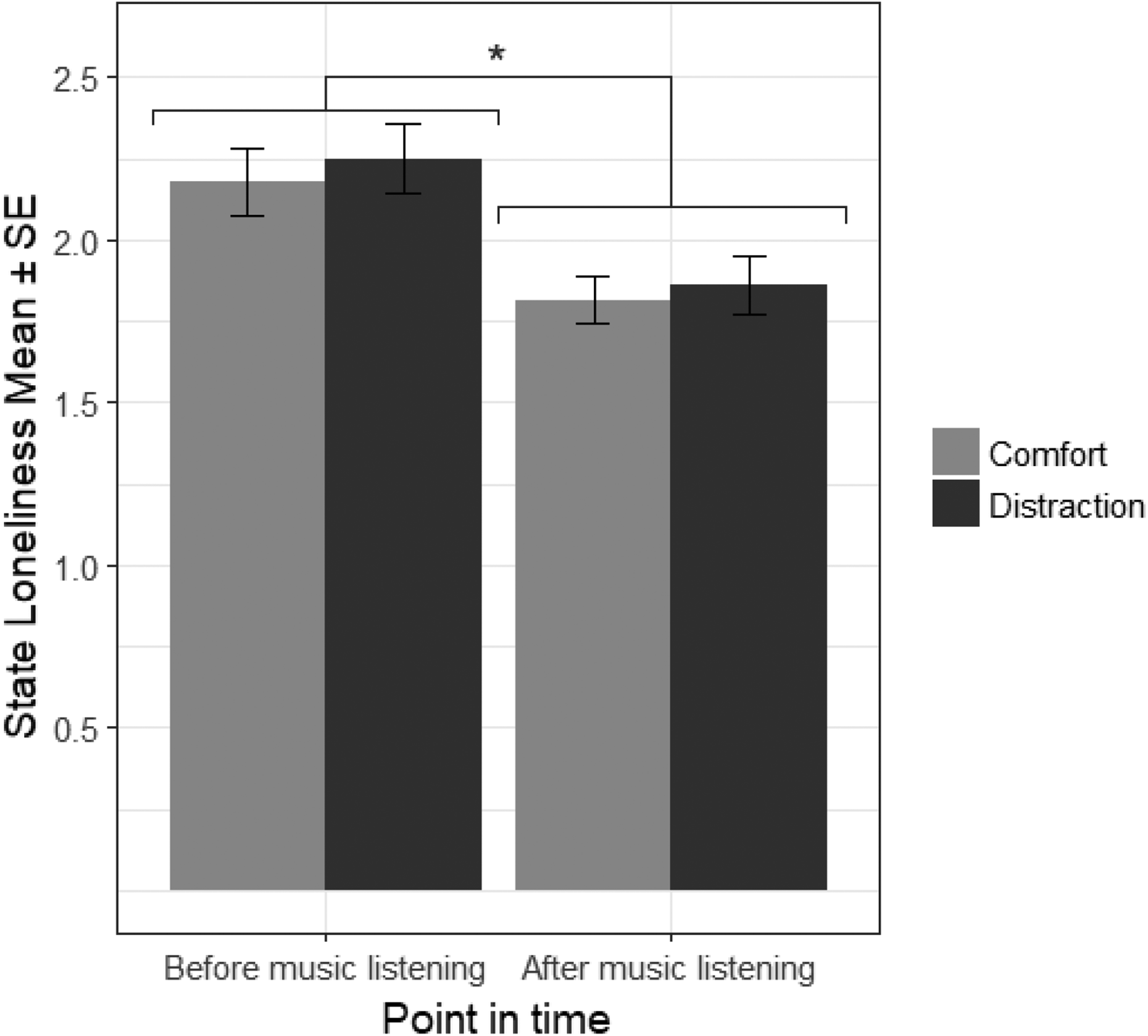
State loneliness per listening strategy (comfort, distraction) before and after music listening. Note. * p ≤ 0.05.
Effects of the Listening Strategies on Mood
To investigate the influence of the musical engagement on the listeners’ mood state (hypothesis 4), the ratings of the happiness (DV 2) and nervousness subscales (DV 3) of the BMIS were submitted to separate ANOVAs with a 2 (strategy: comfort, distraction) × 2 (trial: before music listening, after music listening) design. Contrary to our expectations, the first analysis did not result in a main effect of the listening strategy (IV 2) on happiness ratings. Thus hypothesis 4 is not supported by the evidence. However, the statistical calculations revealed a main effect of trial (F (86, 1) = 152.4, p < .001, η2 = .35) on happiness. Participants reported significantly more happiness after listening to music (M = 3.94, SE = 0.08) than before (M = 2.89, SE = 0.08; see Table 2 and Figure 4).

Mean state happiness per condition. Note. *** = p ≤ 0.001.
The analysis of the nervousness subscale (DV 3) showed a main effect of trial (F (86, 1 = 67.9, p < .001, η2 = .19), which means that participants were less anxious after music listening (M = 1.45, SE = 0.06) than before the listening experience (M = 2.19, SE = 0.10; see Table 2). Thus, participants were not only happier but also more relaxed after music listening.
Effects of the Experimental Manipulations on State Empathy
The effect of the experimental manipulations (IVs 1 and 2) on state empathy (DV 4) as measured with the respective subscale of the BMIS was analyzed with an ANCOVA with a 3 (mood: interpersonal sadness, non-interpersonal sadness, neutral) × 2 (strategy: comfort, distraction) × 3 (trial: before the mood induction, after mood induction, after music listening) design with trait empathy (IRI) entered as covariate in order to control for pre-existing interpersonal differences. The analysis revealed a main effect of trial (F (160, 2) = 19.8, p < .001, η2 = .06) on empathy. Post hoc comparisons using paired t-tests with Bonferroni-corrected α-levels showed that participants reported more empathy after engaging with personal comforting or distracting pieces than before music listening (p < .001) or before the mood induction (p < .001, see Table 2). State empathy reports before and after the mood induction procedure did not differ significantly (p = .23). More precisely, the significant interaction between trial and mood (F (160, 4) = 3.41, p < .05, η2 = .02) signifies that empathic feelings were reduced by the induction of a neutral or non-interpersonally sad affective state before reaching its maximum after music listening (see Table 3) while they raised over time in the interpersonal sadness condition. This effect suggests that imagining a personal loss may not only induce sadness but also heighten empathy, while empathic feelings seem to be lower when experiencing non-interpersonal sadness or being in a neutral mood (see Figure 5).

Mean state empathy per condition. Note. *** = p ≤ 0.001.
Discussion
The main aim of the study was to test experimentally whether private engagement with comforting music could provide interpersonally sad individuals a sense of companionship similar to an empathic friend, a capacity assigned to mood-congruent, nominally sad music by previous research. Additionally, we expected participants to be in a better mood after listening to distracting compared to comforting pieces. Therefore, individuals experienced sadness through an approved guided imagery technique prior to listening to self-selected comforting or distracting pieces. The results indicate a significant decrease in loneliness after private engagement with self-selected music irrespective of the listener’s mood (interpersonally sad, non-interpersonally sad, or neutral) or the applied listening strategy (comfort or distraction). Further, statistical analyses revealed a relevant increase in the listener’s mood state and empathy after listening to comforting or distracting musical pieces. Since the experimental manipulations did not cause measurable differences between the six experimental conditions in terms of loneliness, empathy, or mood, most of the hypotheses need to be rejected. However, music listening in general seemed to affect momentary loneliness and empathy in the predicted way; participants reported feeling less lonely and more empathic after listening to self-selected music than before regardless of their mood and the listening strategy applied. Contrary to our expectations (hypothesis 4), the two listening strategies did not influence the participants’ mood differently. However, listeners seemed happier and more relaxed after engaging with either comforting or distracting musical pieces. We interpret these findings to suggest that private music listening in general may lift the spirit and provide a sense of company, irrespective of the listener’s mood or the involvement of comfort or distraction as an affect regulation mechanism. The results are discussed in more detail below.
Music Listening Seems to Alleviate Loneliness
Overall, participants reported feeling less lonely after listening to their personal music, irrespective of their prevailing mood state (sad or neutral) or the applied mood repair strategy (distraction or comfort). That is, sad participants who attended to comforting music reported a similar level of loneliness as participants who were in a neutral mood or listened to distracting pieces. Since there was no significant interaction of induced mood and listening strategy on state loneliness, the result is not in line with most of our hypotheses. However, this result supports the idea that music listening can reduce feelings of loneliness regardless of the type of sadness that an individual experiences or even if listeners are in a neutral mood. Further, distracting music seems to be able to reduce feelings of loneliness equally well as comforting music. It is conceivable that the loneliness reports were influenced by the mood enhancement accompanying the music listening. However, it is not very likely that mood improvement accounts for the whole effect of music listening on loneliness. Therefore, other mechanisms need to be considered. A heightened sense of connection derived from private musical engagement, for instance, could have also caused lower loneliness reports.
If both musical mood-repair strategies provided listeners with a similar sense of connection, that would be at odds with Lee and colleagues’ (2013) mood-congruency hypothesis. One possible explanation for the diverging finding lies in the methodological differences between the current study and that of Lee and colleagues (2013). In experiment three of Lee et al.’s study (2013), people expressed their musical preference based on 10 contrived song titles, while participants of the current experiment had a whole library of familiar music at their disposition. The claim that interpersonal distress is especially likely to promote the choice of mood-congruent music was already questioned by a replication study where participants could freely name a song they would like to listen to and interpersonal sadness was “only” found to eliminate a baseline preference for expressively positive music instead of encouraging the choice of sad songs (DeMarco et al., 2015). Hence, the assumed promotion of mood-congruent music through interpersonal sadness is not observable any more when people have a broad choice of familiar music. Furthermore, participants in the original study (Lee et al., 2013) had only dichotomous choices; in the first experiment, they had to choose between a cheerful and a sad song and a funny and an empathic friend respectively and experiment three only provided the choice between devised sad and cheerful songs. So, people may prefer an empathic over a funny friend and sad over cheerful songs after a social loss, but they would choose something different if they had more options. To summarize, if people were given more choices and the ecological validity was improved, the mood-congruency hypothesis does not seem to hold true any more. Instead, the current results seem more in line with Zillmann’s (1988) mood management theory, according to which individuals choose media that help them reduce negative moods or heighten positive moods. It is conceivable that this theory’s hedonic principle of media choice overrides compliance to experimental instructions, and music selection was guided first and foremost by the wish to reduce the unpleasant mood. Nevertheless, the findings presented here suggest that listening to personal music either selected for comfort or distraction can alleviate loneliness, i.e. offers listeners a sense of connection. This interpretation is in line with findings demonstrating that music listening is commonly used as means to get company or cope with loneliness (Derrick et al., 2009; Groarke & Hogan, 2018; Juslin et al., 2008; Lippman & Greenwood, 2012; Mitchell et al., 2007; Saarikallio et al., 2019) and it is compatible with the recent discovery that personal music listening is used as temporary substitute for social interaction alongside other media (Schäfer & Eerola, 2020). In addition, the beneficial effect of musical engagement on loneliness supports the proposal that music listening in general can convey the sense of presence of another person (Cochrane, 2010; Elvers, 2016; Leman, 2007; Levinson, 2006; Overy & Molnar-Szakacs, 2009; Wallmark et al., 2018). Empirical support for those accounts of social music cognition often emphasizes the role of empathic abilities in the perception of agency in the musical signal (Egermann & McAdams, 2013; Miu & Balteş, 2012; Wallmark et al., 2018). Hence, connecting with an imagined person through music might be related to empathic processes.
Musical Empathy
Feelings of connectedness and intimacy with a virtual social agent have been posited to serve as the basis for emotions involved in empathizing with a performer, composer, or musical persona more generally (Clarke et al., 2015; Leman, 2007; Levinson, 2006; Scherer & Zentner, 2001). In the current experiment, participants’ empathic feelings were enhanced by self-selected music and by imagining the death of one’s parent. The latter validates the experimental manipulation; since empathic processes were engendered by visualizing an interpersonal loss compared to a non-personal loss or a neutral scene the imagination of an interpersonal loss is very likely to cause interpersonal sadness. The former finding appears to support the notion of music as a social surrogate for a close other and supports the notion that even solitary listening can engender social processes as empathy is an inherently social emotion (Aucouturier & Canonne, 2017; Wallmark et al., 2018). Alternatively, it is conceivable that empathy was evoked by memories of beloved individuals since music often triggers nostalgic reminiscence (Garrido & Davidson, 2019) that frequently revives recollections of close others (Wildschut et al., 2006). Either way, private musical engagement seems to be capable of enabling empathy systems which is in line with neuroscientific evidence (Miu & Balteş, 2012; Overy & Molnar-Szakacs, 2009; Wallmark et al., 2018). By recruiting those systems, music may train listeners’ empathic abilities (Greenberg et al., 2015), which would make it a valuable resource for individuals struggling with empathic skills (Leman, 2007). Taken together, the heightened level of empathy after the listening experience supports the notion of music as a social stimulus, it appears to corroborate that listeners perceive some sort of personal entity while attending to self-selected music, and it suggests that solitary musical engagement can induce a sense of interpersonal connection.
Mood-repair Through Comforting as Well as Distracting Music
The assessment of momentary happiness and nervousness performed before and after the mood induction as well as after the listening phase showed that participants reported higher levels of happiness and more relaxation after listening to self-selected music than before. Since the influence of the two listening strategies on mood was indistinguishable, this finding provides more support for mood management theory (Zillmann, 1988) than our predictions (hypothesis 4). The tendency to select pieces that reduced a negative or induced a positive mood might have attenuated the effect of the instructed selection strategy. However, the findings suggest that people’s mood can be improved and nervousness reduced through private engagement with both distracting as well as comforting music. This is suggestive of a more general relaxing effect of solitary music listening that is well-documented (Baltazar & Saarikallio, 2017; Saarikallio et al., 2019; Thayer et al., 1994; Yoon et al., 2020). Additionally, the result supports the idea that listening to personal comforting or distracting musical pieces constitutes an effective way to repair one’s mood. While distraction is known as one of the most effective strategies for mood repair (Augustine & Hemenover, 2009; Salovey et al., 1999), this finding may seem at odds with the choice of musical pieces with a sadder expression in the comfort condition. However, it has been shown that the engagement with sad excerpts can make listeners feel better (Eerola & Peltola, 2016; Eerola et al., 2016; Larwood & Dingle, 2018; Yoon et al., 2020) and that the mood enhancement might stem from the high aesthetic value of the selected sad music (Garrido & Schubert, 2011b; van den Tol & Edwards, 2014). Thus, choosing music with a sad expression is compatible with mood improvement, supporting the notion that listening to music can support mood repair.
Limitations
The whole study was conducted in English as the majority of local higher-educated people have a very good command of that language. However, native English speakers formed only a minority of the sample and it is possible that some answers might have been unintentionally altered due to differences in the understanding of the English language. Furthermore, the instructions for the comfort condition pose a slight risk of demand characteristics since participants were asked to self-select pieces that felt like an understanding friend. However, it is unlikely that this wording revealed the hypothesis to the majority of the participants.
Additionally, the length of the listening phase (20 minutes) might have concealed differences that possibly occurred at the beginning of the engagement with comforting or distracting music. This could be clarified by shortening the listening time or monitoring the relevant outcome measures continuously or earlier in the listening phase. We are further aware of the fact that the assumption of reducing loneliness through private engagement with self-selected music requires further empirical validation since the current study did not include a control condition without music.
Moreover, experimental manipulations always put certain limits to the external validity of a study and a listening booth is not the most naturalistic setting for engaging with comforting music. However, we did our best to maximize the ecological validity of the experiment by allowing participants to choose familiar pieces from their private music library and leaving them alone in the room during the listening phases. Since participants had the options to hear their music via a streaming service, a saved audio file, or YouTube, we cannot rule out that the results are influenced by the videos that accompany most musical pieces on YouTube. The effect of visual content on music listening is not well-known and should be respected more in future research (Wilson, 2018).
Conclusions
To summarize, private engagement with both distracting and comforting music seemed to effectively improve listeners’ mood, trigger empathic processes, and reduce feelings of loneliness, which supports the notion that both music production and perception engender social cognition. The beneficial effect of musical engagement on participants’ perceived social isolation is in line with the idea of music as a social surrogate. Hence, it is conceivable that listeners reported less loneliness due to a heightened sense of connection provided by the music which would corroborate the experience of music as a friend. Future research still needs to identify the psychological functions of this kind of “musical friend” in a more detailed fashion. However, the present results constitute a good basis for further investigations of social music cognition.
Footnotes
Acknowledgements
We thank Anna Czepiel, Emma Allingham, and Johanna Wilson for their invaluable support in the data collection, Lara Pearson for recording the texts for the mood induction and Elsa Campbell for improving the language.
Contributorship
All authors conceived of the experiment. KS was responsible for the data collection. KS and TE analysed the data. All authors contributed to the interpretation of the data. KS wrote the first draft of the article. All authors revised and edited the manuscript and approved the version that was submitted for publication.
Declaration of conflicting interests
The author(s) declared no potential conflicts of interest with respect to the research, authorship, and/or publication of this article.
Funding
The author(s) disclosed receipt of the following financial support for the research, authorship, and/or publication of this article: This research was financially supported by a personal grant for the first author from the Ella and Georg Ehrnrooth Foundation.

Action editor
Alexandra Lamont, Keele University, Department of Psychology.
Peer review
Dawn Rose, Lucerne University of Applied Sciences and Arts, School of Music.
One anonymous reviewer.