



Abstract
Mobile music listening is widely recognized as an integral part of everyday music use. It is also a rather peculiar experience, since the listeners are surrounded by strangers in public and at the same time engaged in a solitary and private activity. The current study aimed at investigating the functions and experiences of mobile listening with a quantitative online questionnaire, and collected further information about mobile listening situations and listening habits. Among respondents (n = 203), 89% reported listening to music while being on the move. We found mood-related and cognitive functions to be most prevalent (e.g., enhancing mood, relaxation, prevention of being bored), whereas least important functions relate to social dimensions (e.g., feeling less lonely, feeling less watched). Regarding experiences of mobile music, respondents most commonly adapted their mood to the music and lost touch with the current surroundings. A principal component analysis on ratings of functions and experiences resulted in an underlying structure of five dimensions, representing different levels of involvement: (1) Mood Management comprises functions to satisfy individual needs; (2) Absorption and Aestheticization encompasses deep listening experiences and altered perception of the surroundings; (3) Social Encapsulation and Self-Focus describe the distancing of oneself and changes in attention; (4) Distraction and Passing Time include the prevention of being bored and making time pass faster; and (5) Auditory Background is defined by a non-attentive and rather unaffected music listening. These results highlight the immersiveness of mobile music listening. By creating an individual soundworld, listeners distance themselves from the surroundings aurally and mentally, and modify their attention, perception, moods, and emotions, leading to an improvement of daily life experiences while moving.
Introduction
Mobile music listening has become an essential part of music use in daily life in recent decades. The small size and portability of MP3 players, iPods or smartphones, the use of headphones, and digital music selection methods (e.g., shuffling, playlist generation, skipping) in streaming all facilitate a highly individualized and solitary listening experience anywhere and anytime (Gopinath & Stanyek, 2014). Music listening is no longer location-dependent, leading to new listening situations, habits, motivations, and changes in musical engagement (Bull, 2006; Krause et al., 2014; Lamont et al., 2016). While previous research has addressed some features of mobile listening from different perspectives, no study has so far investigated this widespread musical behavior comprehensively. The current study investigated mobile music listening using a quantitative online survey, and aimed at modeling the importance of selection methods, listening situations, functions, and experiences of mobile music listening.
When referring to “mobile music listening” or “listening to music while being on the move”, the current study refers to situations in which solitary listening occurs in public through use of mobile devices and headphones. While mobile listeners are usually together with other people, they are normally not socially attached to them, and social interaction is limited. This characterization of mobile music listening pertains to activities in public settings, such as traveling, commuting, doing outdoor sports, walking, and so forth (cf. Krause et al., 2016). One of the first insights into the changes that were introduced by the Walkman is by Hosokawa (1984), who defined musica mobilis as “music whose source voluntarily or involuntarily moves from one point to another, coordinated by the corporal transportation of the source owner(s)” (p. 166). In the context of mobile music listening, the individual listens to music alone, and the music’s source and the listener become a moving unity. The portable music player was turned into a “constant companion,” carrying the personal music collection like a “digital Sherpa” (Bull, 2014, p. 107). Recently, mobile music listening was also investigated in a broader sense, where being on the move also included listening in the car (e.g., Greb et al., 2018), shared listening via headphones (Bull, 2000), and listening to music via smartphone loudspeakers or boom boxes (Lasen, 2018). Moreover, although mobile devices can also be used in private and fixed settings (e.g., Bull, 2014; Nag, 2018), mobile music listening is inherently understood as happening in public.
Little is known about how many people indeed listen to music while being on the move. A German representative online survey in 2013 found that 9 out of 10 people listen to music on the move, and a large percentage of respondents (32%) listen to music on public transport (Bundesverband Musikindustrie e.V. [BVMI], 2013). The Music Consumer Insight Report reveals that from a global perspective, 54% of respondents listen to music in everyday life most typically while commuting (International Federation of Phonographic Industry [IFPI], 2018). When people were asked to freely describe a listening situation in everyday life, being on the move was the most frequently mentioned activity (28.4%; Greb et al., 2018). Several studies investigated traveling as one possible situation in which everyday music listening takes place. Nevertheless, comparing percentages is not straightforward, since different methodologies have been used and different ways of traveling investigated (i.e., driving a car, using public transport, traveling as a passenger, walking, cycling). Studies using experience sampling methods (ESM) indicate that between 5% (Watson & Mandryk, 2012) and 22% of music listening episodes occur while traveling (Sloboda et al., 2001; see also Greasley & Lamont, 2011; Krause et al., 2016), and that participants listened to music more often in other situations. Empirical findings on the proportions of mobile listeners among travelers on public transport are also inconsistent. An in-situ questionnaire study among commuters on trains revealed that only 9% listen to music (Gripsrud & Hjorthol, 2012), while ESM studies indicate that up to 78% of traveling situations on public transport are accompanied by music (Sloboda et al., 2001; see also Greasley & Lamont, 2011; North et al., 2004). While numbers may differ across studies, it is clear that a major proportion of commuters and travelers choose to listen to music. Confirming these findings, Lamont et al. (2016) defined traveling as one out of six functional niches in which people listen to music in everyday life.
Krause et al. (2016) showed that listening to music on public transport is associated with higher levels of control over the selection of music, as well as attention and liking of the music, compared to the overall mean for different locations (e.g., at work or in a restaurant, pub, or club). Picking the right song that matches the current mood, activity, or surroundings is crucial for mobile music listeners (Bull, 2000, 2006; Nag, 2018; Skånland, 2013), and they most often choose their favorite music or at least familiar music (Heye & Lamont, 2010). A personalized listening experience is further promoted by streaming platforms such as Spotify, Apple Music, or YouTube, permitting the listeners to access millions of songs on demand and to choose a suitable song for any situation (IFPI, 2019; Krause & Brown, 2019; Nag, 2018; Watson & Drakeford-Allen, 2017). Listening to personal playlists also allows a high degree of control over music selection, since listeners may add single tracks to their personalized music compilation and are thus particularly musically engaged (Greasley & Lamont, 2011). Digital mobile devices also offer the option to not actively control the song order within the music selection by using the shuffle mode, in which songs from a whole music library or selected streaming playlists are randomly played by the system (e.g., Bull, 2005; Nag, 2018; Simun, 2009). According to Heye and Lamont (2010), the most frequently used selection method while traveling is the shuffle mode, followed by artist choice.
Mobile listening further implies a number of concurrent activities at the same time, such as waiting for the bus, jogging, walking, or shopping (Chen, 1998), that shape the purpose and functions of listening as well as potential responses (Greasley & Lamont, 2011; Hargreaves et al., 2005; Heye & Lamont, 2010; Sloboda et al., 2001). Furthermore, as a form of solitary listening in public, surrounded by strangers, mobile music listening is a peculiar experience. Chen (1998) states that this experience blurs “the taken for granted dichotomy between what is considered public and private” (p. 256), yielding uncertainties about the needs of users and how they respond to music. The act of moving implies that the situational context constantly changes, leading to perpetually altering sensual inputs and different impressions of the surroundings and of other people. How does music affect listeners in a mobile context? Insights into the reasons for why people listen to music, as well as the experience of music and their environments were predominantly found in qualitative approaches to mobile music listening. One well-known concept in previous research is the creation of an “auditory bubble” (Bull, 2005, p. 344), which empowers the listeners to achieve autonomy over space and time and “manag[e] their experience, cognitively, aesthetically, and interpersonally” (Bull, 2014, p. 115).
Mobile music is mostly listened to “from door to door” (Bull, 2005, p. 345)—for instance, while commuting to work—and is used to fill “dead time” (Gripsrud & Hjorthol, 2012). As a form of time management, listening to music makes journeys more bearable (Bull, 2000). Being in public often comes with unpleasant sounds and conversations of strangers, and an important strategy for mobile listeners is to take control over the environment by blocking out unwanted noise from external sources (Bull, 2000; Simun, 2009; Skånland, 2011), which can also enhance concentration (Chen, 1998; Williams, 2004). The music may function as a “boundary demarcator” (Bull, 2000, p. 186), and listeners create a distance to the surroundings by removing themselves from the environment, which occurs primarily for social segregation (Chen, 1998). As a consequence, they perceive the (social) environment less or not at all anymore (Prior, 2014; Simun, 2009; Skånland, 2011), which may also make them feel less insecure when surrounded by strangers (Bull, 2000; Heye & Lamont, 2010). Social segregation can be used to be intentionally “anti-social” (Chen, 1998, p. 268), or to limit social attention accidentally. Music may then be used as an “interpersonal mediator” (Bull, 2000, p. 190), showing others that one does not want to be addressed or is not paying attention (Bull, 2005; Chen, 1998; Heye & Lamont, 2010; Simun, 2009; Williams, 2004). Instead, individuals rather try to focus on themselves. Through the use of music, listeners are able to reconstruct a personal narrative based on their biography. They escape from the environment through “auditory mnemonic” (Bull, 2005, p. 349) and become absorbed by their own past, by personalizing an otherwise neutral journey with memories, so that “their actual ‘present’ is overridden by their ‘imaginary’ present” (Bull, 2000, p. 38).
However, music can also stimulate the imagination of users regardless of their own past, who then create a story embedded in the environment with themselves or unknown persons as characters, for example in the form of a daydream. In this way, music may “provid[e] the mundane with an exciting, sensual or spectacular soundtrack” (Bull, 2000, p. 24). Bull describes this as an “aesthetic experience” (p. 86), in which the perception of the external world is transformed by a projection of one’s own feelings and thoughts. Instead of ignoring visual impressions, the music connects the listener and the surroundings through a process of audiovisual aestheticization. The chosen music may then act like a personal soundtrack, leading to “an emotionally heightened expression to the image” (Bull, 2000, p. 138). This has an impact on the emotional relationship with the surroundings (Gram, 2013), building “a bridge between the external world in which they [are] physically situated and the emotional world in which they [are] active” (Chen, 1998, p. 269). On the one hand, aestheticization can be interpreted as an alienation from the surroundings, because listeners are more self-focussed in their private bubbles, so that the musical soundtrack modifies their mood and facilitates imagination. On the other hand, music may also complement or intensify the perception of the environment, leading to enhanced attention (Gram, 2013; Simun, 2009). Taken together, the functions and qualities of aestheticization among mobile users are still debated (e.g., Beer, 2007; Prior, 2014; Watson & Drakeford-Allen, 2017).
The different strategies of escaping the environment may also help listeners to focus on their own concerns, which leads to a further prevalent function of mobile listening: managing moods, blocking out unwanted thoughts, and accentuating or changing emotions (Bull, 2000; Gram, 2013; Heye & Lamont, 2010). Retreating into one’s own soundworld facilitates introspection and thus promotes focussing on one’s own feelings and thoughts in public environments (Bull, 2005; Skånland, 2013). Some listeners use music to prepare themselves emotionally for upcoming tasks—for instance, attending class or going on a date (Chen, 1998). At the same time, mobile music may function as a physical activator, and individuals report “feeling energized” (Bull, 2000, p. 190) by the rhythm of the music, leading to synchronization of motor behaviors, including walking speed (Heye & Lamont, 2010), and physical movements such as bouncing the head or tapping the feet (Chen, 1998). Listening to music relaxes, makes the listener feel better and may also reduce feelings of loneliness and isolation (Bull, 2000; Chen, 1998; Heye & Lamont, 2010; Simun, 2009; Skånland, 2013; Williams, 2004). These findings strongly mirror existing findings on emotions in general music psychology (e.g., Juslin et al., 2008; Lonsdale & North, 2011; Saarikallio & Erkkilä, 2007; van Goethem & Sloboda, 2011). Chen (1998) even considers mobile listening as an activity that explicitly aims to meet emotional needs, revealing “patterns of users’ experiences” such as emotional reflexivity, emotional energizer, social segregation, and emotional absorption (p. 257).
Some of the functions discussed above show similar characteristics of general music use (e.g., Greasley & Lamont, 2011; Randall & Rickard, 2017a; Schäfer et al., 2013), but some also seem to be characteristic to the mobile context. Information about the prevalence of functions is scarce. Heye and Lamont (2010) applied a mixed-method approach and investigated a selection of mobile functions quantitatively. They found that mobile music is predominantly used for enjoyment, suppressing boredom, making time pass faster, creating or accentuating an emotion, and blocking out noises (Heye & Lamont, 2010; cf. North et al., 2004). Other findings stem from questionnaire studies in the context of everyday music listening. Greb et al. (2018) showed that music listening on the move (including driving a car) is correlated with the function “killing time & overcoming loneliness” (p. 775).
The current state of research implies several psychological dimensions related to musical experiences. Although their importance has been widely documented, it seems to be difficult to assess whether mobile listeners can also remain unaffected by the music. The fact that listeners are surrounded by other people and have to cope with changing contexts could have an influence on the musical experience, as attention to the music is limited (e.g., Greasley & Lamont, 2011; Juslin et al., 2008; Prince, 1972). For mobile music listening, there are inconsistent findings concerning the degree of attention: Krause et al. (2016) found out that mobile listeners focus their attention on the music on public transport or while walking, comparable to Randall and Rickard (2017b), who found a negative correlation between travel and music listening for background reasons, suggesting a more attentive listening behavior. Heye and Lamont (2010), on the other hand, stated that mobile listeners may listen to music only in the background, for instance when interacting with others. Even if the mere fact that music is only perceived in the background does not rule out emotional responses (e.g., Kämpfe et al., 2011), previous findings suggest that the presence of others biases the musical impact on the listener—such as, most emotional reactions occur and are strongest when listening attentively to music while being alone (Juslin & Laukka, 2004; Juslin et al., 2008; Lamont, 2017). Attention also seems to facilitate musical experiences in the mobile context—for instance, an aestheticized experience implies that listeners are involved with the music, or at least are not indifferent to it (Gram, 2013; Schönhammer, 1989).
According to the respondents’ reports from previous studies, audiovisual interactions, imagination and absorption, fading out and disengaging from the environment are intense experiential changes. Herbert (2011, 2012) described some of these experiential qualities in her studies as absorption and dissociation. Similarly, corresponding characteristics were also determined in “strong experiences related to music” (SEM; Gabrielsson & Lindström Wik, 2003) within the categories of Cognition and Perception. SEM represent very exceptional musical experiences, which can also occur unexpectedly in unspecific everyday situations (Lamont, 2011) and show similarities to experiences of everyday music listening (Gabrielsson et al., 2016). While Herbert (2011, 2012) observed that absorption and dissociation occur frequently while traveling, only 1.9%–2.3% of SEM data Gabrielsson and his research team have collected over decades relate to traveling situations (Gabrielsson, 2011). Studies of general musical experiences are complex in their findings and cannot always be related to mobile musical experiences. The individual ability to position oneself within a private space and the public, and thus to have control over the degree of awareness, involvement, and musical responses, seems to be paramount for individual experiences of mobile music.
Taken together, mobile music listening is defined as a solitary listening experience in public situations, in which individuals use mobile devices and headphones. It represents an “autonomy-of-the-walking-self” (Hosokawa, 1984, p. 166), such that the listeners are empowered to improve their individual experiences (Simun, 2009). Mobile music may evoke music-related sensations, so that listeners are self-absorbed and “fully wrapped up in one’s own world” (Chen, 1998, p. 262). Since there is scarce research into mobile music listening that allows for generalizations of the prevalence of mobile listening situations, listening habits, motivations, and experiences, we aimed at examining mobile music listening in its multiple characteristics with a relatively large sample. We were particularly interested in the functions of why people listen to music in mobile situations, and how they experience and respond to music in mobile contexts. Depending on listeners’ concepts and decisions of deliberate music choice, functions and experiences may consciously or unconsciously be related to each other. For this reason, we also investigated the structure of functions and experiences, complementing existing knowledge and relating mobile music research to concepts in music psychology.
Method
Participants
In total, 213 individuals took part in this study. Respondents were recruited at university courses and via social media. Ten of them (4.7%) did not complete the survey and were excluded, so that data of 203 respondents were analyzed (72.4% female, 27.1% male; one respondent did not provide information), aged 18–60 years (M = 26.98, SD = 6.41; one respondent did not provide information). About two thirds (66.5%) had an active musical background, with previous instrumental or vocal lessons for M = 7.97 years (SD = 5.63). Within the sample, 181 individuals (89.2%) were “mobile listeners,” as they stated that they listened to music on the move at least occasionally. On the other hand, 22 individuals reported that they have never listened to music on the move. The following analyses are based on the subsample of mobile listeners (72.4% female; age: M = 26.34, SD = 5.38; 66.9% had an active musical background with lessons for M = 7.75 years, SD = 5.18). Respondents took part voluntarily without financial incentives, and they were informed that the data and results would not reveal any personal information.
Procedure
The questionnaire was part of a mixed-method online study and was implemented in SoSci Survey, a web-based software for online surveys (Leiner, 2019). The online survey consisted of three different studies. Before completing the questionnaire study that is analyzed and reported here, individuals took part in an audiovisual experiment that investigated the musical impact on the interpretation of visual scenarios, and an open-ended questionnaire about altered perception during mobile music listening, both of which are beyond the scope of the current article.
We specified the concept of mobile music listening for our respondents (see Appendix A for working instruction), defining it as being located in public, with a clear decision to listen to music and using headphones for a solitary listening experience (music in the car or listening via boom boxes were thus excluded). We collected data about basic demographic characteristics (age, gender), participants’ musical background (years of playing an instrument or singing), and information about mobile listening situations, listening habits, as well as functions and experience of mobile music. Data were collected in 2019; the completion of all parts of the survey took approximately 20–25 min.
Questionnaire
We developed a questionnaire based on previous findings of mobile music listening. It was divided into three sections that comprise different aspects of mobile music listening in relation to the aims of the study (see Appendix A for the questionnaire).
Section 1: Characteristics of Mobile Music Use
Individuals were asked about the frequency of mobile music listening (1 = never to 7 = several times a day) and to report their estimated mobile listening duration. Additionally, individuals responded to questions about listening habits and selection behavior (e.g., streaming, playlists, shuffle mode) in the mobile context (Heye & Lamont, 2010; Krause et al., 2014). Data about mobile listening situations (location and concurrent activity) were also collected in this section.
Section 2: Functions of Mobile Music Listening
We adapted the functions of mobile music that have been surveyed empirically before, such as interpersonal mediation, social segregation, environmental control, and boundary demarcation (Bull, 2000; Chen, 1998; Heye & Lamont, 2010; Simun, 2009; Skånland, 2013; Williams, 2004), and transferred them into questionnaire statements. We also checked studies on functions of music for items which are mentioned in the context of mobile music listening, such as prevention of boredom and mood regulation (e.g., Laukka, 2007; Lonsdale & North, 2011; North et al., 2004; Randall & Rickard, 2017a; Schäfer et al., 2013), leading to 16 distinct functional items.
Section 3: Experience of Mobile Music Listening
This section was also based on previous empirical findings on cognitive, emotional, and bodily responses while being on the move, and derived items for measuring aestheticization, absorption, and motoric consequences (Bull, 2000; Chen, 1998; Heye & Lamont, 2010; Simun, 2009; Skånland, 2013; Williams, 2004). We compared items of similar qualities in existing literature (Sandstrom & Russo, 2013; Schäfer et al., 2013), which were further adapted to fit to the current questionnaire. Two more items were added in order to evaluate the relation to the music, regarding the degree of attention and intensity of musically induced emotions. Based on this, we generated 10 statements about the experience of mobile music listening.
Data Analysis
Data were analyzed with the statistics software R 3.6.2. First, we determined the extent to which mobile listeners agreed with each item based on their own experiences. Second, we wanted to identify typical and atypical characteristics of mobile music listening. To do this, we applied multiple sample Bonferroni-corrected t-tests comparing the mean ratings of each item within each section to the scale center (test value = 4). Because the center of the scale implies neither agreement nor disagreement with the statement, this analysis offers an indication of the relevance of the items. Regarding internal consistency, Cronbach’s alpha for the items of Section 2 (functions of mobile music listening) and Section 3 (experience of mobile music listening) was at = 87, indicating high reliability.
To understand the structure of mobile music listening, we performed a principal component analysis (PCA) on the 26 items of Section 2 and Section 3 by using the Psych Package (v2.0.9; Revelle, 2020). Before performing PCA, we tested the factorability of the existing items (Field et al., 2012). The Kaiser-Meyer-Olkin (KMO) measure of sampling adequacy for the items yielded an overall MSA-coefficient of .81, and the result of Bartlett’s test of sphericity was significant, χ2(325) = 1742.63, p < .001, suggesting that data were suitable for PCA. The number of components extracted was determined by parallel analysis, which resulted in five components. We included all items in the results that showed minimum loadings of .40 (cut-off threshold). Three items could not be assigned to any component, since they were below the cut-off threshold or had similarly high loadings on more than one component (see Appendix B: Item 1, 10, 25). The remaining 23 items still had high internal reliability, Cronbach’s = .85. The goodness of fit statistics (based on the residual off diagonal elements) showed an adequate fit of .93. We observed low to moderate associations between some components; consequently, we applied oblique rotation (oblimin) and interpreted the pattern matrix (all coefficients ≥ .11 are reported as effect sizes).
Results
Characteristics of Mobile Music Use
The frequency of mobile listening differed widely across respondents (see Table 1). The majority of respondents listened to music while being on the move several times a week (27.6%) or even several times a day (27.1%). The mean mobile listening duration per week was about 5.5 hr (M = 5.54, SD = 7.77) and ranged from 1 to 60 hr.
Respondents’ frequency of mobile listening.

Figure 1 shows the mean ratings for each item of Section 1. The highest-rated activity for mobile music listening was traveling on public transport, followed by doing sports and walking. In contrast, mobile listening was not typically used while cycling (Figure 1: Panel A). The most frequent music choice was the use of personal playlists. The musical pieces used in the compilation are not selected specifically according to a special mood, but may vary (e.g., they are not consistently happy, motivating, melancholic). Furthermore, streaming music was relevant for mobile listening situations, and mobile listeners tended to listen more to familiar music. Within a compilation (e.g., playlist, music album) a specific song order did not seem to be of particular importance and listening to the radio was not typical for the context of mobile music (Figure 1: Panel B).

Mobile listening situations, listening habits and music selection methods (Means; Error bars show 95%-Confidence Intervals). Asterisks indicate Bonferroni-adjusted p-values for one-sample t-tests against scale midpoint (test-value = 4: *** p < .05, ** p < .01, *** p < .001). Panel A: Mobile listening situations. Panel B: Mobile listening habits and music selection methods.
Functions and Experiences of Mobile Music Listening
The mean ratings of items of Section 2 and Section 3 are shown in Figure 2. Items with highest mean ratings were mood-related—such as enhancing mood, relaxation—and cognitive— such as prevention from being bored, time passes faster (Figure 2: Panel A). Music was also commonly used to help to block out the environment—for example, to notice nothing or less of the surroundings, enhance self-focus, not to be addressed. The majority of selected functions (11 out of 16) seem to be particularly important for mobile listening, as the mean ratings of items were significantly above the center of the scale (t-tests). Only three of the items (concentrating on tasks, eliciting a certain memory, thinking about the music) did not show a clear tendency towards general approval or rejection in the mobile context. Items with lowest mean ratings related to social aspects such as feeling less watched or feeling less lonely, indicating that these variables were generally not typical reasons for mobile music listening.

Functions and experiences of mobile music listening (Means; Error bars show 95%-Confidence Intervals). Asterisks indicate Bonferroni-adjusted p-values for one-sample t-tests against scale midpoint (test-value = 4: ** p < .01, *** p < .001). Panel A: Functions of mobile music listening. Panel B: Experiences of mobile music listening.
Concerning mobile music experiences, respondents reported that they most commonly adapted to the mood of the music, which seemed to be the most typical experience in mobile listening, and rather disagree with listening to music only in the background (Figure 2: Panel B). Experiences of aestheticization and absorption (losing touch with the here and now, complete devotion, and moving to the music) were rated just above the scale midpoint on average, with no significant difference to scale center. Changes in the perception of the environment or oneself, on the other hand, such as forgetting about not being there by oneself and an intensified perception of the surroundings, were rated to be less common. Respondents were indifferent regarding the intensity of induced feelings while listening to music on the move compared to listening at home, and in this way, intense bodily reactions in the form of goose bumps were rated the lowest.
Underlying Structure of Functions and Experiences of Mobile Music Listening
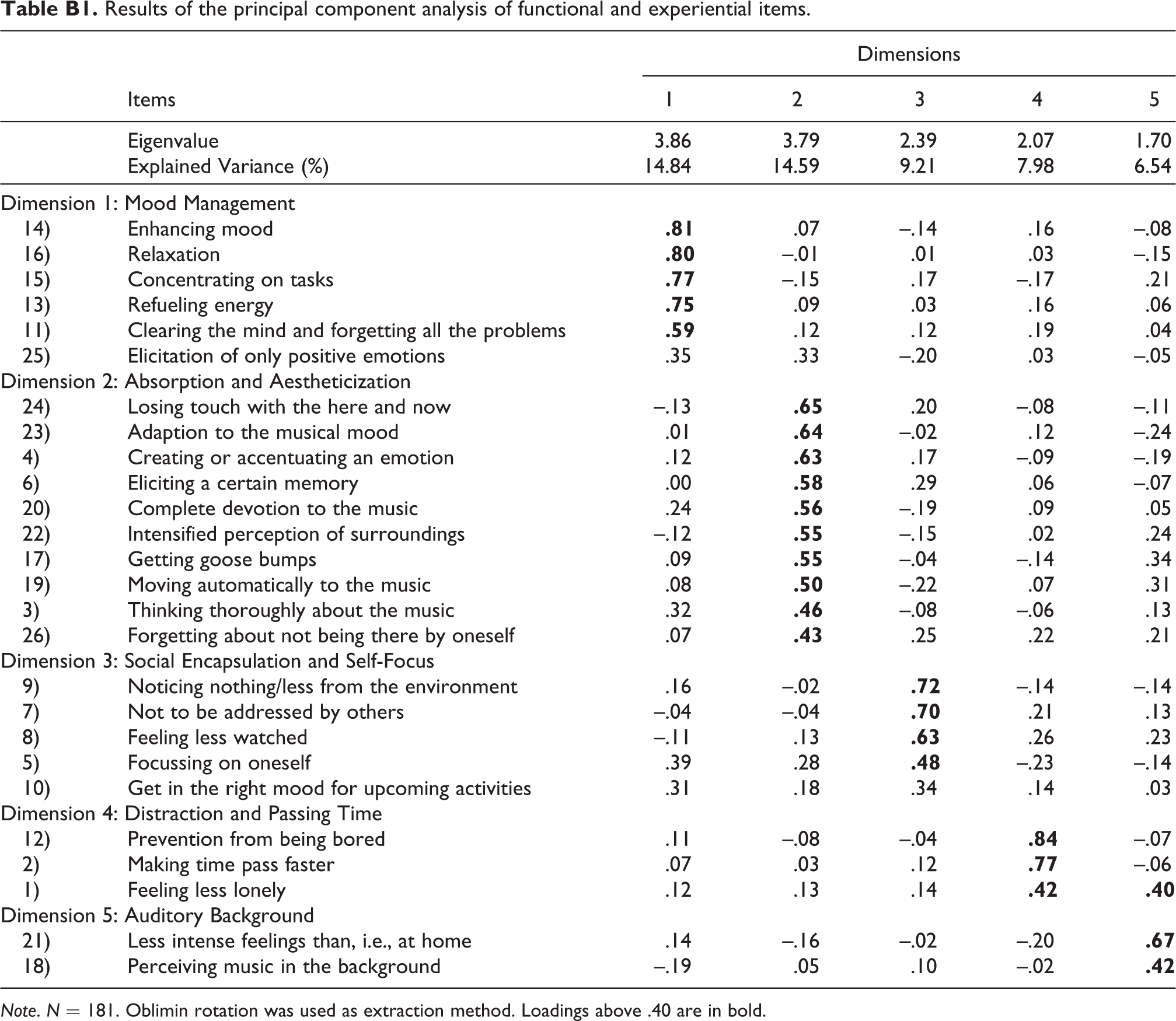
The PCA with oblimin rotation revealed five components that explain 53.16% of the variance (Figure 3, see Appendix B for full details on individual item loadings). The first dimension consists of five items (eigenvalue: 3.86, explained variance: 14.84%), and is called “Mood Management.” This dimension represents a deliberate choice of music to satisfy the listeners’ current individual needs, for instance to enhance their well-being and replenish personal resources (e.g., mood enhancement, relaxation, refueling energy), or to enhance concentration. The second dimension contains 10 items (eigenvalue: 3.79, explained variance: 14.59%), and is labeled “Absorption and Aestheticization,” because it includes items describing the total immersion in music, imagery, bodily reactions, as well as cognitive and emotional responses to the music and environment. Listeners are willing and capable of being involved with the music, which leads to an altered perception of the self and the environment. The third dimension is named “Social Encapsulation and Self-Focus,” which includes four items (eigenvalue: 2.39, explained variance: 9.21%). Respondents use music to block out the environment, to signal their wish not to be talked to, to feel less watched, and to focus on themself. The fourth dimension is defined as “Distraction and Passing Time,” which has two items (eigenvalue: 2.07, explained variance: 7.89%). This dimension encompasses reasons for music listening to reduce negative feelings, such as relieving boredom and making time pass faster. The last dimension is labeled “Auditory Background” and also consists of two items (eigenvalue: 1.7, explained variance: 6.54%), indicating that individuals are rather not affected by music on a deeper level, as music is mainly used in the background.

Principal component analysis of the functional and experiential items of mobile music listening with oblimin rotation. Note: Items 1–16 are functional, items 17–26 are experiential. Black connecting lines show factor loadings (cut-off threshold = .4), dotted connecting lines show r-coefficients as effect sizes (≥ .11 are reported).
To define the relative importance of the dimensions, the ratings of the respective items were averaged for each dimension. A repeated measures ANOVA (Greenhouse-Geisser adjusted) shows that these dimensions differ significantly, F(3.38, 607.51) = 67.24, p < .001, ηp2 = .272. Bonferroni-corrected post-hoc tests revealed significant differences between all dimensions at a p-level ≤ .03, except the two highest-rated dimensions, Distraction and Passing Time (M = 5.30, SD = 1.58) and Mood Management (M = 4.99, SD = 1.31), which do not differ significantly, p = .156. The dimension of Social Encapsulation and Self-Focus (M = 4.48, SD = 1.39) follows Mood Management and is higher-rated than the remaining dimensions Absorption and Aestheticization (M = 3.95, SD = 1.05) and Auditory Background (M = 3.49, SD = 1.33).
Since we used oblimin rotation, we also investigated the relationships between the components. All coefficients ≥ .11 are reported as effect sizes. The first dimension, Mood Management, is associated with Absorption and Aestheticization (r = .32), with Social Encapsulation and Self-Focus (r = .21), as well as with Distraction and Passing Time (r = .19). In addition, Absorption and Aestheticization shows relationships with Social Encapsulation and Self-Focus (r = .21), and Distraction and Passing Time (r = .18). The fifth dimension of Auditory Background shows no connection with any of the other dimensions.
Discussion
The aim of the current study was to investigate mobile music listening with regard to listening situations, listening habits, selection behavior, and most importantly, the prevalence and structure of functions and experiences. For this purpose, a questionnaire was developed that was mainly based on previous research on mobile music listening. In the current sample, 9 out of 10 respondents reported listening to music while being on the move for 5.5 hr per week on average. The most typical mobile listening situations included being on public transport, practicing sports, or walking, and respondents most often employed their own playlists. They also typically used streaming services and preferred listening to familiar music, confirming previous findings for a high level of control over the music selection while being on the move (e.g., Bull, 2000; Heye & Lamont, 2010; Krause et al., 2016). Functions of self-regulation (enhancing mood, relaxation, creating and accentuating emotions) and prevention of being bored were most important for mobile listeners (cf. Greb et al., 2018; Heye & Lamont, 2010; North et al., 2004). Respondents reported that they most commonly adapt to the mood of the music and lose touch with the here and now, for example through daydreaming. A PCA revealed five underlying dimensions encompassing functional and experience-related items: Mood Management, Absorption and Aestheticization, Social Encapsulation and Self-Focus, Distraction and Passing Time, and Auditory Background. The first four dimensions show low to moderate intercorrelations, indicating that mobile music acts on various levels simultaneously (e.g., mood and emotion regulation, altered perception, distraction of others, time management).
Functional items were mostly taken from previous research on mobile music listening, yet the differences of mean ratings for each item show a clear rank order concerning their prevalence among mobile listeners. Heye and Lamont (2010) already determined differences in the ratings of functions of mobile music. Although we included more items than they did, the items that were investigated in both studies are in a similar order, namely mood-related and cognitive functions are highest-rated, and social functions such as feeling less lonely are lowest-rated. We also explored the question of rather typical and atypical functions of mobile music listening. Surprisingly, thinking thoroughly about the music is no prevalent motivation among mobile listeners, suggesting that the use of music may be more purpose-driven on a psychological level. Similar to the “uses and gratification” approach, listeners seem to be well aware of the power of music, and actively choose music listening to gratify personal needs (Lonsdale & North, 2011). Our findings offer new insights into mobile listening, since we are able to differentiate between mobile listening functions with regard to their prevalence.
Regarding musical experience, results indicate that the levels of musical involvement become apparent in different ways, and concern mainly mood and altered perception. Respondents also stated that music means more to them than simply having some background sounds. They were further asked how intense musically induced emotions are, for instance whether they are less intense than at home. Ratings for this item were at the center of the scale, suggesting that respondents were somewhat undecided. The intensity of emotions may depend on the specific emotion which is induced by the music, and personal factors such as the level of involvement or the attention to the music may also have an impact (Nagy & Szabó, 2004; Vuoskoski & Eerola, 2011). The level of self-rated bodily involvement, on the other hand, was not as high as could have been expected, indicating that involvement occurs more on a psychological level than a physiological level (e.g., moving to the music, goose bumps). Items concerning aestheticized experiences show great differences: losing touch with the here and now (e.g., daydreaming) received second-highest mean ratings, whereas an intensified perception of surroundings was a low-rated musical response, suggesting that imagery does occur more often in contrast to an enhanced environmental perception, and aestheticized experiences should therefore be investigated within a differentiated approach. While we did not determine how often emotional responses and altered perception were experienced during a day, our findings suggest that intense experiences could be more prevalent in the context of mobile music listening than previously assumed (cf. Gabrielsson, 2011). Further research about the intensity and frequency of the specific experiences is needed.
The PCA examination of the underlying structure of functional and experience-related items represent a wide range of functions and psychological states of involvement with the music and the surroundings. Aggregated means of the components show that Distraction and Passing Time is most important for mobile listeners, confirming previous quantitative findings (Greb et al., 2018; Heye & Lamont, 2010; North et al., 2004), followed by Mood Management, Social Encapsulation and Self-Focus, Absorption and Aestheticization, and Auditory Background. The dimensions share characteristics with general musical strategies of affect regulation such as relaxation, distraction, active coping, and introspection (van Goethem & Sloboda, 2011; see also Saarikallio & Erkkilä, 2007).
Regarding the theoretical conceptualization of mobile functions and experiences, some other studies describe both functions and experiences with the same characteristics (e.g., Chen, 1998; Bull, 2000; Simun, 2009; Williams, 2004). We believed that music can have an impact on listeners even without conscious intentions, for instance for unexpected sound events, as was often described for strong experiences with music (Gabrielsson & Lindström-Wik, 2003; Lamont, 2011), in affect regulation (Skånland, 2013) or if the reasons for listening to music (i.e., functions) leads to another effect as intended (i.e., experience; cf. Greasley & Lamont, 2011). This seems to be especially relevant for altered states of consciousness such as dissociation or absorption (Herbert, 2011, 2012). For mobile music listening, this discourse mainly concerns the aspect of aestheticization, which is sometimes described to be a function (e.g., Bull, 2000; Williams, 2004) and sometimes to be an experience that may possibly affect the listener without intention (Gram, 2013). In our data, functional and experience-related items predominantly load separately on specific dimensions, which supports the idea that listening motivation and psychological effects should be considered as different concepts. The only exception is the dimension of Absorption and Aestheticization, which comprises both and represents an interplay of intended and unintended effects, such that focussed listening and the willingness to become involved with the music is required. The fact that absorption and aestheticization are related in this sample confirms previous insights into the transcendental character of aestheticization (e.g., Bull, 2000; see also Chen, 1998). This might explain why the experience-related items and dimensions are rated relatively low: Although listeners could try to mask external information and to create a private soundworld, focussed listening can be difficult and music is pushed back into the background from time to time, since some form of interaction with the environment is often still necessary. Heye and Lamont (2010) highlighted the permeability of the auditory bubble, which might complicate the process of gaining enhanced consciousness.
The dimensions also lead to questions about the individual meaning of music. For instance, Mood Management encompasses items of regulating emotions and moods, which requires a deliberate music choice for “the organization of the self, the shifting of mood, energy level, mode of attention and engagement with the world” (DeNora, 1999, p. 44). Similarly, for Absorption and Aestheticization listeners need to be actively involved, which is certainly influenced by the choice of music. In contrast, for the dimensions of Social Encapsulation and Self-Focus and Distraction and Passing Time, music is used to modify or block out negative impressions from the surrounding and may thus rather act as a simple source of sound, which implies a different level of involvement. For Auditory Background music might be used out of a habit (cf. North et al., 2004), and listeners are rather indifferent towards the music. Since this dimension received lowest overall mean ratings, this kind of music use is not common for mobile listeners, and could depend on the listening environment such as degree of distraction, familiarity and presence of others, as well as the current emotional state (Hallam & MacDonald, 2016).
All but one dimensions are interrelated and emphasize the impact of music to create a private space, separating oneself from the environment socially, cognitively and emotionally, which supports Chen’s (1998) idea that mobile music listening is, in essence, a form of “self-absorption” (p. 273) and mainly used for modifying the affective state (see also Skånland, 2013). On the other hand, the dimension of auditory background shows no relation to any of the other dimensions. Listening to music in the background is neither linked to other motivations nor to a deeper psychological involvement. The use of background music seems to be an autonomous listening experience, where a musical impact was not observed in contrast to previous findings (e.g., Kämpfe et al., 2011; Lamont, 2011), and also in contrast to a more engaged and attentive listening behavior represented by the other dimensions. It should be further investigated how involved mobile listeners are with the music, particularly when considering the apparent discrepancy of the solitary “private” listening situation and being in public at the same time.
This study has a number of limitations. Regarding sampling, the distributions of age (M = 27 years), gender (72% female) and nationality (German) may not be generalizable to other populations. The questionnaire possesses good internal consistency, but we believe that content validity could be improved by adding items to measure aesthetic experience which is only represented by two items (“losing touch with the here and now, e.g., daydreaming” and “intensified perception of the surroundings”). By extending this section, it is more likely that individuals find an adequate description of their personal kind of experience. Although reaching an adequate goodness of fit statistics, two out of five components consisted of only two items, while three single items were not included in the dimensions. Therefore, it would be necessary to review and extend the questionnaire especially regarding additional experience-related items (e.g., bodily responses, aesthetic experiences, background use). Furthermore, our results could be affected by response and recall biases that come along with retrospective online questionnaire approaches. Experience sampling methods (cf. Juslin et al., 2008; Randall & Rickard, 2017b; Sloboda et al., 2001) could provide more valid results of participants’ actual musical listening behaviors rather than their memories of it as for this larger cross-sectional study. Future studies could focus on possible explanations regarding the agreement to statements on functions and experiences. In addition, we suggest further considerations of the specific situations in which mobile listening happens. Various situations encompass different characteristics, such as the movement of the self (physical activity), noise level, the presence of others, and attention towards another activity. This seems to be a promising approach, since listening situations and also listening areas (e.g., rural or urban environments) seem likely to be related to the functions and music selection methods (e.g., Greb et al., 2018; Hargreaves et al., 2005; Krause et al., 2016; North et al., 2004).
It also seems promising to investigate musical experience with regard to the impact of individual and situational factors that could shape musical involvement and mobile music experience, leading to inter- and intra-individual differences. Both the comparison of mobile and non-mobile situations, and a differentiated consideration of mobile listening contexts would be beneficial in this context. Learning more about how listeners navigate within the two poles of the dichotomy (private versus public) will contribute to an understanding about circumstances in which different kinds of musical responses occur.
Conclusion
The current study investigated mobile music listening with a particular focus on functions and experiences. We were able to describe prevalent characteristics, and our findings suggest that there are differences between listening motivations and experiences, yet further research needs to scrutinize some of the reasons for listening behaviors and music choice. Mood-related and cognitive functions were most prevalent, whereas social-related functions were not of special relevance for mobile listeners. They most commonly responded to music by adapting to the musical mood but did not typically experience psychophysiological reactions (goose bumps).
The five dimensions represent distinct psychological facets of mobile music listening and show that the creation of an individual soundworld enables the listeners to modify their personal experience in different ways. Most importantly, all dimensions except Auditory Background imply a withdrawal such that listeners are able to remove themselves from the environment. This emphasizes their need to get distanced from the surroundings, which shares characteristic with Bull’s idea of an auditory bubble (2005). By withdrawing themselves into their own soundworld, mobile listeners enhance their well-being, seeking to reduce negative feelings, while reinforcing positive feelings (cf. Lamont, 2011). Accordingly, music functions as a mediator that helps to transform the relationship to the environment and to oneself (Bull, 2000; Chen, 1998; Simun, 2009). By surrounding themselves with music, mobile listeners get distracted from the outside world and are able to devote themselves to their own needs. If they cannot change the environment, they can at least change their relationship to it.
Footnotes
Contributorship
MK researched literature and conceived the study. MK and CW were involved in study design and participant recruitment. MK wrote the first draft of the manuscript. All authors reviewed and edited the manuscript and approved the final version of the manuscript.
Declaration of conflicting interests
The author(s) declared no potential conflicts of interest with respect to the research, authorship, and/or publication of this article.
Ethical Approval
This research was conducted in accordance with the guidelines of the Ethics Committee of the University of Hamburg, and participants provided informed consent prior to taking part.
Funding
The author(s) received no financial support for the research, authorship, and/or publication of this article.

Action editor
Alexandra Lamont, Keele University, Department of Psychology.
Peer review
Amanda Krause, University of Melbourne, Faculty of VCA and MCM.
Will Randall, Jyväskylän Yliopiston, Department of Music, Arts and Culture Studies.
Appendix A
Appendix B
Results of the principal component analysis of functional and experiential items.
| Dimensions | ||||||
|---|---|---|---|---|---|---|
| Items | 1 | 2 | 3 | 4 | 5 | |
| Eigenvalue | 3.86 | 3.79 | 2.39 | 2.07 | 1.70 | |
| Explained Variance (%) | 14.84 | 14.59 | 9.21 | 7.98 | 6.54 | |
| Dimension 1: Mood Management | ||||||
| 14) | Enhancing mood |
|
.07 | –.14 | .16 | –.08 |
| 16) | Relaxation |
|
–.01 | .01 | .03 | –.15 |
| 15) | Concentrating on tasks |
|
–.15 | .17 | –.17 | .21 |
| 13) | Refueling energy |
|
.09 | .03 | .16 | .06 |
| 11) | Clearing the mind and forgetting all the problems |
|
.12 | .12 | .19 | .04 |
| 25) | Elicitation of only positive emotions | .35 | .33 | –.20 | .03 | –.05 |
| Dimension 2: Absorption and Aestheticization | ||||||
| 24) | Losing touch with the here and now | –.13 |
|
.20 | –.08 | –.11 |
| 23) | Adaption to the musical mood | .01 |
|
–.02 | .12 | –.24 |
| 4) | Creating or accentuating an emotion | .12 |
|
.17 | –.09 | –.19 |
| 6) | Eliciting a certain memory | .00 |
|
.29 | .06 | –.07 |
| 20) | Complete devotion to the music | .24 |
|
–.19 | .09 | .05 |
| 22) | Intensified perception of surroundings | –.12 |
|
–.15 | .02 | .24 |
| 17) | Getting goose bumps | .09 |
|
–.04 | –.14 | .34 |
| 19) | Moving automatically to the music | .08 |
|
–.22 | .07 | .31 |
| 3) | Thinking thoroughly about the music | .32 |
|
–.08 | –.06 | .13 |
| 26) | Forgetting about not being there by oneself | .07 |
|
.25 | .22 | .21 |
| Dimension 3: Social Encapsulation and Self-Focus | ||||||
| 9) | Noticing nothing/less from the environment | .16 | –.02 |
|
–.14 | –.14 |
| 7) | Not to be addressed by others | –.04 | –.04 |
|
.21 | .13 |
| 8) | Feeling less watched | –.11 | .13 |
|
.26 | .23 |
| 5) | Focussing on oneself | .39 | .28 |
|
–.23 | –.14 |
| 10) | Get in the right mood for upcoming activities | .31 | .18 | .34 | .14 | .03 |
| Dimension 4: Distraction and Passing Time | ||||||
| 12) | Prevention from being bored | .11 | –.08 | –.04 |
|
–.07 |
| 2) | Making time pass faster | .07 | .03 | .12 |
|
–.06 |
| 1) | Feeling less lonely | .12 | .13 | .14 |
|
|
| Dimension 5: Auditory Background | ||||||
| 21) | Less intense feelings than, i.e., at home | .14 | –.16 | –.02 | –.20 |
|
| 18) | Perceiving music in the background | –.19 | .05 | .10 | –.02 |
|
Note. N = 181. Oblimin rotation was used as extraction method. Loadings above .40 are in bold.