



Abstract
Investigations of music in everyday life are dominated by a functional perspective, drawn from work using the theory of Uses and Gratifications. In so doing, we may have neglected to fully appreciate the value people place on music listening. Therefore, the present study considered if, and why, people value music listening and probed instances when they may not want to listen to music in everyday life. A sample of 319 university students residing in Australia (76.50% female, M age = 20.64) completed an online questionnaire, on which they were asked to provide short responses to open-ended questions directly addressing two research questions. Inductive thematic analysis yielded 13 themes synthesizing how participants valued listening to music, such as appreciation, emotion, time and engagement, cognitive factors, and mood regulation. Reasons for not listening to music were summarized by eight themes dominated by interference with activities that required focus or concentration, followed by environmental context, affective responses, music engagement and inversely, a preference for silence or other auditory stimuli. Fifteen percent of participants stated there was never a time they did not want to listen to music. The findings provide a novel perspective on the value of music listening beyond that considered by uses and gratifications with regard to the function of listening to music in everyday life.
Literature
Listening to music is a popular leisure activity (Lonsdale & North, 2011; Schäfer et al., 2013). Globally, the International Federation of the Phonographic Industry (IFPI, 2019) reported that people spend up to 18 hours listening to music per week (and more than 2.6 hours per day). The IFPI (2019) report also indicates that only 2.5% of participants said that music was “unimportant” to them, compared to 54% of participants who said they “love” or are “fanatical” about music. As Schäfer et al. (2013, p. 1), stated, “few behaviors match music for commandeering so much time, energy, and money.” High engagement with music listening is made possible, in part, by the digital and internet-enabled technologies of the 21st century (Nill & Geipel, 2010; North et al., 2004; Sloboda et al., 2009). People do not listen to music in a social vacuum (Lamont & Greasley, 2009; North & Hargreaves, 1997), rather listening is firmly embedded into people’s everyday routines (e.g., Krause et al., 2015; Krause et al., 2016). Moreover, music experiences can create meaningful, lasting memories (Krause et al., 2020; Lippman & Greenwood, 2012), with extensive findings detailing people’s strong experiences with music, described as “the strongest, most intense experience of music that you have ever had” (Gabrielsson & Wik, 2003, p. 163, see also Gabrielsson, 2010, 2011) and additional research highlighting how music features in people’s autobiographical memories (e.g., Baird et al., 2018; Janata, 2009).
Given the prominence of music in people’s lives, it is important to understand people’s reasons for listening to music and their perceptions of the value of music in their lives. However, while anecdotal reports and empirical studies indicate that music is highly valued and that many people spend a lot of time listening to music, do people always want to listen to music? Is there an underlying bias that listening to music is always desired? In order to better understand the value and role of music in everyday life, it is important to consider music’s worth in our everyday lives, including instances when music listening is not desired.
The Value of Music Listening
One way to expand our understanding of the value and role of music in everyday life is to ask an axiological question, namely “do you value listening?” This places value at the center of the question, and draws significance to, and leaves open to interpretation, both listening as valued as a means in and of itself and also listening as valued as a means to an end (Oxford Dictionary of English, n.d.). Posing an axiological question when considering music listening is innovative, as it allows us to draw the lens right back and view reasons for, and worth of, music listening at a macroscopic level. Value as a term suggests subjectivity, and indeed when considering music listening, embracing a subjective theory of value makes sense. In economics, the subjective theory of value posits that the value of a good (in this case music) is not determined by any inherent property of the good, nor by the amount of labor necessary to produce the good, but that value is determined by the importance an acting individual places on a good for the achievement of their desired ends (Menger, 1871, p. 120). So how does this theory help us to understand why people value music listening: an activity famously described by Steven Pinker as “auditory cheesecake” (Pinker, 1997, p. 534)? What the theory suggests is that value is determined by the choice each individual makes as to the quantity and quality of a particular good or service – again, in this case music – that they believe will satisfy their highest subjectively ranked preference (based on what that individual may want or need at any given time) or their most desired end (Callahan, 2004, p. 42). In music psychology literature, the body of research that underpins the above framework has drawn on the theory of uses and gratifications.
Uses and Gratifications
Uses and Gratifications theory (e.g., Katz et al., 1974) is a theoretical framework used when studying people’s interactions with media (Rayburn & Palmgreen, 1984; Ruggiero, 2000; Stafford et al., 2004). The theory states that people’s media use is goal-directed, and it assumes that people actively select the media they believe will gratify their needs. In other words, media use is based on the needs people aim to satisfy (Katz et al., 1973) and the perceived fulfilment of needs, or gratifications, that result from said media use (Rayburn & Palmgreen, 1984). Thus, one strength of this theory is that it helps distinguish people’s psychological motivations to elect one medium in light of other choices in particular cultural contexts (Cheung et al., 2011; Lin, 1996). In turn, the theory helps understand the functions of people’s media choices (Anderson & Meyer, 1975). Moreover, because the theory is able to consider new technologies (Lin, 1996), it has garnered much usage in research aiming to understand a variety of music behaviors.
Uses and Gratifications research has considered a wide range of media usage, including music use. This includes work focused on specific devices used to listen to music, such as mp3 players (e.g., Ferguson et al., 2007) and the radio (e.g., Albarran et al., 2007; Bentley, 2012; McClung et al., 2007), as well as considering how people select different listening formats (Brown & Krause, 2020; Krause & Brown, 2021). In addition, researchers have used the Uses and Gratifications theory to examine downloading music from the internet (Kinnally et al., 2008), using streaming services like Spotify (Mäntymäki & Islam, 2015), and using Facebook music listening applications (Krause et al., 2014). Most importantly, work has also considered the reasons people listen to music (e.g., Lonsdale & North, 2011). As such, it is relevant for use in the current study, which focuses on furthering our understanding of the value of listening to music in everyday life.
Research on the topic of listening uses and gratifications has framed investigations around reasons for listening, but also in terms of how music is used or its various functions (Schäfer et al., 2013). As Schäfer et al. (2013, p. 4) pointed out, various studies have identified different categories of functions, though the results broadly point to a small number of categories including “social functions, emotional functions, cognitive or self-related functions, and physiological or arousal-related functions (see also Hargreaves and North, 1999; Schäfer and Sedlmeier, 2009, 2010).” Often-cited reasons identified include: mood management, music as background noise/as accompaniment to other activities, to participate in musical behaviors, to reflect on the past (reminiscing), for enjoyment, for social interaction, as a distraction, for identity development or to portray a social image to others, and to improve aspects of well-being (Boer, 2009; Chamorro-Premuzic & Furnham, 2007; Groarke & Hogan, 2016; Hayes & Minichiello, 2005; Lonsdale & North, 2011). Thus, there are a number of different uses and gratifications that music listening fulfils. Recognizing that research has considered music’s functions heterogeneously, and that the lists of functions increases with each study, by creating an aggregated list of all the potential music functions identified in past research, Schäfer et al. (2013, p. 6) conducted a principal components analysis that revealed “three distinct dimensions: People listen to music to achieve self-awareness, social relatedness, and arousal and mood regulation.”
Music listening in everyday life
In everyday life, listening to music often accompanies another task. In other words, people very rarely listen to music as the primary activity, but often, people listen to music while they work, exercise, and commute (Krause et al., 2015; North et al., 2004; Sloboda et al., 2009). Thus, consideration of research on the effects of background music is pertinent to understanding how people value, and engage with, music in everyday life. Such research has been “inconclusive, and divided” (Mohan & Thomas, 2020, p. 1; see also Kämpfe et al.’s (2011) meta-analysis). Kämpfe et al.’s (2011) meta-analysis indicated a global, null effect, potentially because specific effects may have been averaged out by divided findings. For instance, research has shown both positive improvements (Črnčec et al., 2006; Hallam et al., 2002) as well as negative impacts (e.g., Cassidy & MacDonald, 2007; Furnham & Strbac, 2002; Ransdell & Gilroy, 2001). We can take the consideration of listening to music while at work as a case study.
People’s reasons for listening to music at work include “affect management, engaging in/escaping from work activities, and environment/interruption management,” “inspiration,” “to become more creative and stimulated at work” (Haake, 2011, see also Haake 2010). These reasons map onto positive consequences noted in terms of work: as music can help people concentrate on their task, preventing minds from “wandering off” (Bull, 2007), and music can positively influence mood (Lesiuk, 2005; Oldham et al., 1995) and lower people’s perceived stress levels by helping people relax (Haake, 2011, p. 110; Linnemann et al., 2015). Yet Haake’s (2011, see also Haake, 2010) investigation also pointed out people’s reasons for not listening to music at work. These included “work-performance related reasons, concern for others and image, external hindrances, and individual preferences.” “Respondents described how concentration and music listening can “contradict each other”” (Haake, 2011, p. 120) – for instance music can block out surrounding noises to help one concentrate but also distract someone from their task. This suggests that people may have reasons for not wanting to listen to music in other contexts.
While Haake’s investigation was limited to work settings, additional “studies have reported that music can evoke irritation and annoyance in certain circumstances” (Haake, 2011, p. 110; see also Gabrielsson, 2001; Sloboda & O’Neill, 2001). This type of response may be related to whether or not the listener is in control of the music they hear, as people may find music/sounds outside of their control annoying/irritating (e.g., Martí, 1997). Sound can invade private space and be perceived as unwanted/annoying (Cloonan & Johnson, 2002). Schurig (2018) adds that people using mobile devices to listen to music will stop listening when the music is “experienced as too much information,” when the environment, situation, or activity does not facilitate listening (e.g., when with other people). What these previous studies implicate is that music can be irritating and unwanted when people are in situations where they are unable to avoid unwanted musical stimulation; this study seeks to expand on these findings by investigating times or situations when people actively decide to not listen to music.
Aim and Research Questions
If we take the axiological path further, how do questions of value tie in with the Uses and Gratifications theory? The subjective theory of value, in tandem to the Uses and Gratifications theory, places music listening’s value in its ability to function as a means to an end – its ability to produce or facilitate a desired end result. As noted by Schäfer et al. (2013), research on the topic of listening has framed investigations around how music is used, or its various functions. Schäfer and colleagues (2013, p. 3) did consider the experimental aesthetics approach, “whose proposed functions can similarly be summarized as cognitive and emotional functions”; however, even aesthetics is immediately interpreted through a functional lens. We consider, however, that there is merit in reconsidering the value of aesthetics as a means in and of itself.
Methodologically, extant research has used both open and closed questioning to ask participants about the reasons for, or functions of, music listening, generating results based on both participant- and researcher-developed items (Schäfer, et al., 2013) without considering the value of music listening in and of itself. One limitation of this approach is that such work is often the result of researcher-developed items (Lonsdale & North, 2011). Furthermore, to our knowledge only one study (Schurig, 2018) has examined situations where people actively decide not to listen to music, albeit focusing on portable listening devices. Therefore, the present study used a qualitative approach with open-ended questions guided by the following two research question(s): RQ1: How do people express their value of music listening? RQ2: Are there any times or situations where people do not want to hear or listen to music?
Method
Participants
A total of 319 people responded to the questionnaire. Of the sample, 244 participants were female (76.50%), 73 were male (22.90%), and two were non-binary (0.60%). All participants identified themselves as a university student, were aged 18 to 56 (M = 20.64, Mdn = 19, SD = 4.82), and resided in Australia. On average, the sample listened to 2.99 hours of music daily (Mdn = 2, SD = 2.47) and rated music as very important (M = 6.14 on a 7-point scale, Mdn = 6, SD = 1.00). When asked about their highest level of musicianship, sample participants largely labelled themselves as “non-musicians”: 109 participants (34.20%) reported that they hardly ever play or played and 82 (25.70%) participants occasionally play or played. In contrast, 93 (29.20%) labelled themselves as amateurs, 24 (7.50%) labelled themselves as semi-professionals, and 10 (3.10%) labelled themselves as professionals.
All participation was voluntary; however, individuals who completed the questionnaire as a part of the University research participation scheme received course credit for their participation. The University of Melbourne’s human ethics committee approved this research (HREC number: 1953591.1).
Procedure and Materials
Data for this study was obtained as part of a larger online survey exploring various aspects of uses and patterns of music listening. The survey was hosted using Qualtrics. A direct weblink directed people to the Plain Language Statement; and, following explicit indication of consenting to participate, individuals accessed the questionnaire as a series of webpages. Participants were thanked and debriefed via a final webpage. Completion of the entire questionnaire took approximately 15 minutes.
Two exploratory, open-ended questions were posed with an instruction to provide a short response (defined as one to two sentences): 1. “Do you value listening? If so, how?” and 2. “Are there any times/situations where you do NOT want to hear/listen to music? Please elaborate.”
Participants were asked to state their age, gender, postcode (to ensure respondents resided in Australia), and whether or not they were a currently a university student. They were also asked to state how many hours they listen to music on average daily and to rate how important they considered music to be on a 7-point scale (1 = not at all, 7 = extremely) (Krause et al., 2019a, 2019b). Using Kreutz et al.’s (2008) item, they also were asked to indicate their highest level of musicianship (selecting from: professional, semi-professional, amateur, occasional, and hardly ever play or played).
Data Analysis
Responses to the two open-ended questions were downloaded from Qualtrics as an excel spreadsheet for the purpose of inductive thematic analysis (Braun & Clarke, 2006). We followed the steps outlined by Braun and Clarke (2006). Specifically, we first familiarized ourselves with the data by reading and re-reading participants’ responses (Rice & Ezzy, 1999). We then developed a set of initial “first-order” codes, which was done separately for each question. A recursive, reflexive approach was adopted such that the examination of the participants’ responses was flexible rather than focused on a particular theoretical background. Responses that were identified as semantically similar were noted across the dataset in order to generate initial codes to capture the data. Multiple codes were permitted for each participant’s response (Nowell et al., 2017). Thus, where appropriate in the Results section, a full quote may be cited more than once to portray the context and richness of the respondents’ experience. This clustering led to the development of first-order codes. The reliability of coding was assessed by two of the three authors blind coding 30% of the responses into the first-order codes. Percentage agreement for each domain was calculated, with overall agreement at 85%. To promote the trustworthiness of the thematic analysis, disagreements were resolved by consensus and the second and third author subsequently completed the coding for each question (as per Osborne & Kenny, 2008). After coding all responses, multiple response frequency analyses were performed in SPSS version 25 to refine the initial codes to derive higher-order themes. To best represent how the data addressed the research questions, a team consensus approach was adopted in the defining and naming of the final set of parsimonious themes (Nowell et al., 2017).
Results
Valuing Listening
We acknowledge that the presentation of the question “Do you value listening? If so, how?” was exploratory and did not specify music listening. The intention of using such an open question was to not unduly influence participant responses. Therefore, we undertook an initial round of coding to select the subset of responses that referred to music listening. All responses (N = 319) were initially classified into one of three groups: Responses that were unable to be interpreted, or that highlighted the ambiguity of the question (n = 50) Responses that implied that the participant interpreted listening as a communication skill or sense (n = 167) Responses that implied that the participant interpreted the question as “listening to music” (n = 102).
For the main thematic analysis, we focused on the 102 responses that clearly addressed value with regard to listening to music. The analysis yielded 13 themes (summarized in Table 1), which are detailed below and supported by indicative quotes (noting that a single response may have addressed multiple categories).
Thirteen themes identified in responses to being asked “Do you value listening?” in descending order of frequency.

a Percent of cases indicates what percentage of respondents provided a statement that was coded to that theme as a reason to value listening. It is possible to have over 100% because each response could pertain to more than one theme.
Theme 1: Appreciation
The most frequently cited reason for valuing music was “appreciation.” In the present study, this theme of appreciation was broadly defined to include elements of enjoyment, beauty, and the recognition that music listening is a favored activity. Thus, it was the connection with music and aesthetic considerations that were emphasized by participants: Yes, I value listening deeply. I feel a strong connection with many genres of music and feel that it constitutes a large part of what brings enjoyment to my life. I value listening to music because it can be beautiful. Yes, listening to music is one of my favourite activities.
Theme 2: Emotion
Unsurprisingly, an important theme to emerge when discussing the value of music listening was emotion. Respondents emotionally engaged with music in three different ways. Music was identified as important in inducing emotions: I value listening for the emotive response it gives me and the discovery of myself that comes with listening to new music that moves me in waves that I had never imagined before. I do value listening to music, I think it’s important for processing emotions and reflecting on my own. I highly value listening, especially listening to music as it’s a way to express my feelings and emotions.
Theme 3: Time and Engagement
One way in which respondents indicated they valued listening to music was reflected in the time they spent on the activity: Yes, I would spend most of my time on listening music. Yes, I am usually always listening to music. Yes, I often concentrate the first time I listen to a song to connect with it. Yes, when I am listening to music, I do not like any distraction from others.
Theme 4: Cognitive
The importance of listening to music from a cognitive perspective was highlighted by respondents, particularly in relation to the focused attention given to the music when listening. Wording employed such as “really listening,” “picking up on minute details,” and “break down different types of sounds” all point to the analytical nature of music listening that was valued by certain respondents: I find I’m particularly engaged and focused when I have lots of overlapping harmonies and parts coming together to create a complex whole, as it’s more interesting to me. In regards to music, I value listening to a song multiple times, as there are so many layers. I value listening to the song as a whole, but also listening to the lyrics itself, or listening to an isolated bass line, the beat in the background etc. Listening properly makes me appreciate all components of the song more. I believe listening to music is technically more professional than playing. I’d rather be an expert listener than to be a middle-class performer. I value listening to music as, even though I don’t understand much musical theory, I thoroughly enjoy learning about the context and meaning behind a particular work. I view most music as art, and I like to identify as many different elements of the music as I can.
Theme 5: Mood Regulation
Respondents described using music as a regulatory process by modulating responses triggered by emotions. Music was reported as being used as a healthy coping strategy, particularly in relation to managing stress or to promote emotional changes in affective arousal and valence, such as to motivate or relax: Yes, listening to music is an important way to relax myself and to calm my stresses. Yes (in terms of music) as it is my form of stress-relieving methods. Yes. Listening to music is important for me, as it is a way to destress and motivate myself. Yes, I love listening to music and choosing different styles of music to suit my mood or the tasks that I’m doing.
Theme 6: Escape
Respondents articulated that music can be a vehicle for transporting themselves away from reality, whether that be their thoughts, feelings, or from their physical reality. Respondents described using music to “escape,” “feel free,” and “distract,” suggesting music helped to “detach myself from reality” while “losing myself” during music listening.
Music was reported as an escape from the mundane physical labors of everyday life: Yes. Music helps cure boredom when carrying out simple, repetitive labour, such as washing the dishes or commuting to school. Yes very much so. The ability to listen, particularly to music, allows me to relax and escape my own thoughts. Listening to music provides me with a complete escape and admission into a different realm.
Theme 7: Narrative
When listening to music, some respondents indicated they gain value “through the lyrics.” Connecting with the lyrics can foster a connection between the listener and the song: Often I will have music playing in the background, but I will also often choose to give the music that I am listening to my full attention, and sometimes listen while reading the lyrics. I enjoy listening in this way because it allows me to understand and connect with the song better, and appreciate the choices of the songwriters. Yes, listening forges an important relationship between the musician and myself, which can help give meaning to my life.
Theme 8: Identity
Respondents indicated music was an important aspect of their identities by describing the “strong connection” they have with music, and by statements such as “I am a music lover.” Respondents also reflected on music’s place in their identities by underscoring their sense of loss if they didn’t have music in their lives: Without music, without listening to the world around me, I would lose a part of my self. I value listening to music very much, it is an important part of my identity and I would not be the same person without music.
Theme 9: Social
Connecting with others through music was indicated as being an important aspect of the music listening experience: Music connect me to my friends and family. Yes, listening to music is important in connecting with people and also experiencing a personality of various artists.
Theme 10: Purpose
Music and music listening was described by respondents as giving “meaning” to, and of being an “integral” and “indispensable” aspect of, life: I can’t live without music. I would describe music as an indispensable part of my life. Listening to music is an indispensable part of my life.
Theme 11: Physical
Music listening was reported as being valued for its positively perceived physical effect: Listening is very important because I physically and emotionally respond to sound, in particular music, and I believe that life would feel diminished without this ability.
Theme 12: Study
One respondent indicated music was valued as a study aid (“I really enjoy listening to music because it helps me relax and study”).
Theme 13: Money
One respondent indicated music has a monetary value (“yes, pay apple music”).
Not Wanting to Hear/Listen to Music
The second question investigated in this study concerned times and contexts where participants did not want to listen to music. Coding of the 319 responses yielded a set of eight higher-order themes after examining frequencies and removing participants who had misunderstood the question or left the answer blank (n = 20). These eight themes are presented in Table 2 and are discussed with indicative quotes included below (noting that a single response may have addressed multiple categories).
Frequency of responses given for not wanting to listen to music coded to thematic categories in descending order.
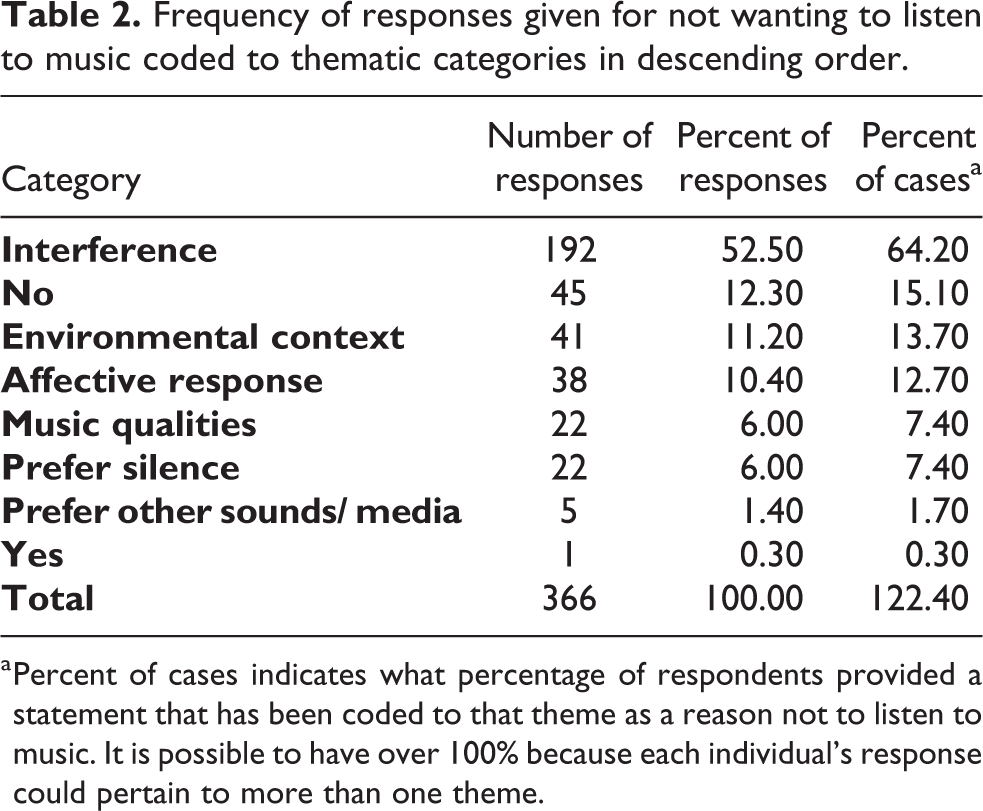
a Percent of cases indicates what percentage of respondents provided a statement that has been coded to that theme as a reason not to listen to music. It is possible to have over 100% because each individual’s response could pertain to more than one theme.
Interference
The most frequently cited reason for not listening to music was due to interference to activities that required focus or concentration. Mostly this was related to studying, problem solving or reading tasks: When I want to concentrate on something, like writing or reading, I do not want to listen to music. I struggle to take in new information with music on, even if it’s in the background. Important conversation and during the exam. When I am studying, sleeping, working or having a difficult conversation – all other times I often like to have music playing. When I’m studying. I can’t concentrate. Or if I want to relax. Quietness is more relaxing.
No
Fifteen percent of respondents indicated there was never a time that they did not want to listen to music.
Environmental Context
Contextual factors surrounding music listening were cited by just over 10 percent of the sample. Reasons were categorized as either external or internal to the listener. External environment factors included locations and contexts which inhibited the ability to listen to music in a satisfying way; such as background music during social activities in which one wishes to be focusing on the conversation instead of the music, background music that was not one’s own choice or preferred style of music; or the volume of the music being too loud. These circumstances invariably triggered negative cognitive emotional states such as distraction and irritation on the part of the listener: Often I don’t enjoy just putting on music in the background if I can’t fully engage with it. Situations, where I don’t listen to music, is when I’m unable to (such as focusing on my job or watching a movie). Probably if I’m at some sort of party or event as I find it hard to hear other people when there is loud music in the background. Also the type of music played at those type of events is almost always music that I don’t particularly like; if it was music I liked perhaps I wouldn’t mind. If I have practiced or played too much music in a week, I take days away from music to not ruin the important connection I have to music. Active listening is important to me as a musician and I try to never listen to it passively… Sometimes when I’m feeling particularly exhausted or sick, listening to music becomes painful for me because it hurts my head… When my hears hurt from playing too much loud music while wearing headphones. I don’t really want to stop listening to music but I have to because it hurts a bit.
Affective Response
Music had the power to trigger and intensify or exacerbate emotions which led to a decision not to listen to music for just over 10 percent of respondents. The majority of those responses (90 percent) were described as negative emotions such as sadness, anxiety or agitation: …when I have extreme anxiety of something I just can’t bear any sound. If the song is associated with a bad time in my life
Music Qualities
The capacity of music as being so engaging or absorbing as to capture people’s attention or creative connection drove the decision not to listen to music: I tend to listen to music in detail and so music, even background music unless it’s extremely soft or I am distracted by people talking, does not work for me. I personally find music very distracting because I enjoy listening to it and breaking it down so when I need to focus on something like talking to someone or studying then I can’t really listen to music. Only when I’m sick of the songs that I’ve been listening to. There have been times where every song I try to listen to does not feel right and doesn’t suit how I am feeling at the time. So that listening to nothing is better than feeling like something is not quite right while listening to something.
Preference for Silence
Some participants noted an explicit desire for silence and disengagement from music due to emotional, cognitive or physiological reasons: Emotional: “Yes, sometimes I don’t feel like it. For example, I may just want silence.” Yes. Sometimes in moments of immense rage, often sparked by hormones, listening or watching anything is not something I have wanted to do. Silence and stillness was all I wanted. Cognitive: “Yes. Sometimes I enjoy silence and being able to focus on my own thoughts.” Physiological: “I tend not to listen to not just music, but anything at all when I’m tired. When tired I just want silence.”
Preference for Other Sounds
This was described as a preference, on occasion (but not always) for natural environmental sounds which were judged to be appealing: If there are natural sounds around me that are nice to hear e.g. waves on a shoreline, trees rustling in the wind, then I would prefer to listen to them than to music. …when I want something more engaging than just music (audiobooks, podcasts, etc.)
Yes
Finally, one person noted a single word answer “yes,” without any further elaboration.
Discussion
By probing for reasons and instances where music is considered as both a desired (valued) and undesired activity, we have begun to flesh out a more complete picture of reasons for both engaging, and disengaging, with music. Specifically, by flipping the question of reasons for listening to music in order to ask when people do not want to listen to music, our findings support the notion that listening to music may not always be a positive experience. In contrast to research citing reasons for actively listening to music in work contexts including minimization of boredom, enhanced cognitive engagement and task concentration, and/or affect regulation (Cloonan & Johnson, 2002; Haake, 2011; Schurig, 2018), our study found that a substantial number of participants chose not to listen to music because it inhibited their ability to concentrate and focus. Additional reasons not to listen included exposure to background music which they could not control or which was of a style or taste which they disliked; and the association of a piece of music with an emotionally difficult or painful experience in their life, thus triggering a wave of unpleasant negative affect.
Value
Almost one-third of participants stated that music listening was an activity they valued and appreciated because of its beauty and/or the enjoyment they received from listening. Other responses were function-based, with respondents suggesting uses for music that were categorized as emotion, cognitive, mood regulation, escape, narrative, identity, social, purpose, physical, or study. Furthermore, over one in five respondents indicated they placed value in music by offering time (or money) to actively engage in the act of listening to music.
As the most frequently identified theme – appreciation – encompassed responses that focused on considerations of pleasure, aesthetics, and general comments regarding the enjoyment of the activity of music listening, this suggests respondents placed value in music listening as a “means in and of itself” – a phrase supported by philosophical and ethical considerations of intrinsic value (Zimmerman & Bradley, n.d.). Pivoting away from functional propositions of musical value allows us to broaden our understanding of why people choose to engage with music. Respondents clearly acknowledged music’s intrinsic value, irrespective of tandem extrinsic motivations they may have for using music to fulfill various functions. Thus, highlighting the aesthetic value of music listening does not retract from extant research that focuses on functional aspects of music in everyday life; indeed, the function-based responses given in this study fit neatly into previous research that draws on the theory of Uses and Gratifications. The extrinsic value of music was identified by respondents through different uses and gratifications that music listening fulfils, which are in many instances synonymous with several of Lonsdale and North’s (2011) dimensions of music listening (including identity, mood management, and social interaction), and could be broadly categorized under Schäfer and colleagues’ (2013) three dimensions of self-awareness, arousal and mood regulation, and social relatedness. Furthermore, the open-ended nature of the question produced responses that do not speak to either intrinsic nor extrinsic values of music listening, but rather acknowledge music listening’s worth by stipulating ways in which engagement with music is demonstrated through the currency of time: both in quantity and quality.
Not Wanting to Listen to Music
Almost two-thirds of participants explicitly stated that they did not want to listen to music due to the interference that music presented to an activity in which they wished to focus or concentrate, such as studying, echoing previous findings pointing to the contradictory nature of music listening and simultaneous engagement in tasks requiring concentration (Haake, 2011; Schurig, 2018). Less frequently cited reasons (which might also be attributed to the capacity of music to interfere with other desired cognitive or emotional states) were environmental exposure to background music, affective responses (mostly negative), musical engagement and, inversely, a preference for silence or other auditory stimuli. One participant provided a response of yes with no other contextual information.
This question acts as a counterpoint to existing uses and gratifications research as to how people select and use media to serve needs not met by music. Using a similar method, Lonsdale and North (2011) identified seven reasons why people listen to music in descending order of frequency: mood management (to create and enhance a mood, to manage arousal, to create a positive mood, to optimize emotional experiences, for emotional release or catharsis, to express confusing or difficult-to-express emotions); music as background noise (avoiding uncomfortable silence, create an atmosphere, alleviate feelings of loneliness, when working or studying to help concentrate); musical participation (to sing or dance to); to reflect on the past through memories; for enjoyment; social interaction and as a means to distract and occupy oneself (so as to allay boredom). Interestingly, the lowest-and second-lowest cited reasons are the inverse of our most frequently cited reason, that of interference to cognitively or socially demanding tasks. Their most frequently cited reason of mood management also features in our interference theme, when music is incongruent with desired moods or activities. Lonsdale and North’s (2011) second cited reason of music as background noise featured strongly in our theme of environmental context, although in this context music in the background promotes an unpleasant ambiance. Our theme concerning affective response in decisions not to listen to music was a negative one, again in contrast to Lonsdale and North’s (2011) themes of the use of music to facilitate positive memories and enjoyable, entertaining experiences.
Much of the research that has examined people’s engagement with music has highlighted the important role of emotions in defining those experiences (e.g., Gabrielsson, 2010, 2011; Krause et al., 2020; Lamont & Loveday, 2020). While Lamont and Loveday (2020) acknowledged how listeners can adapt their listening choices to the context they find themselves in (often in relation to mood regulation), the current findings expand upon this in two ways. Firstly, they speak to engaging or not engaging in listening outside of the question of music preference; and, second, they speak to the additional facet of the cognitive dimension of engagement that interplays with the emotional dimension of musical engagement (and the other dimensions such as social, for that matter). This is seen in work that has considered people’s descriptions of strong experiences with music (e.g., Gabrielsson, 2011) and favorite musical experiences (e.g., Krause et al., 2020) regarding the fact that these descriptions of a single experience frequently include multiple characteristics, highlighting the complex, multi-faceted nature of music engagement. With this in mind, it would be interesting for future research to examine the perceived value of musical engagement by drawing on a framework such as Gabrielsson’s (2010) SEM-DS (a description system using seven categories to systematically characterize musical experiences) in order to further delineate and describe what underpins people’s choices to engage or disengage from music listening.
Theoretical Implications
By taking a macroscopic approach with the present research, we posit that Uses and Gratifications theory can be interpreted as inhabiting one of two branches of an axiological theory of value, with aesthetics on the other (see Figure 1). Thus, while Uses and Gratifications is an appropriate framework to understand music listening from the perspective of “listening as valued as a means to an end,” it may be less able to interpret music listening’s worth when identified as “a means in and of itself.” While less familiar to the field of music psychology, these concepts are cemented in the philosophical branches of axiology, ethics, and aesthetics. In ethics, intrinsic value is a property of anything that is valuable in and of itself, which can be contrasted to extrinsic (or instrumental) value. We encounter philosophical considerations of aesthetics as an intrinsic value of art in autotelic art (art that is “complete in itself”): a concept – epitomized by the slogan “art for art’s sake” – that expresses the philosophy that the only “true” art is art that is divorced from any didactic, moral, political, or utilitarian function.

An axiological theory of value in music listening.
It is worth noting, however, that within the axiological theory of value the two branches are not mutually exclusive; indeed, the distinction between means and ends is a fuzzy line – many things and situations in life can be placed in the intersection between both branches, such as health, knowledge, and virtue (Dewey, 1922, 1939). We posit that forms of musical engagement, such as music listening, can fall within this intersection.
Contemplating the two research questions in conjunction also presents us with a unique opportunity to consider how people’s values may drive their listening preferences, practices, and desires. This can be done by examining the value themes alongside the reasons people stated for not wanting to listen to music. For instance, one could interpret focused attention and interference (for cognitive work) as operating in an inverse relationship. Similar inverse relationships were observed between the value of music for its affective nature and the choice to disengage from music due to the desire to avoid having it triggering strong emotions (as well as the preference for silence to process emotions). There is also evidence for the manifestation of value through one’s active time and engagement spent with music as mapping directly to the “no” theme in response to the question of times or situations where people did not want to hear or listen to music.
Lastly, when interpreting the present findings, it is also interesting to consider DeNora’s (2000) assertion that people act as “personal DJs” – that people are aware of what music they need to hear in different situations and at different times. Importantly though, what music is “right” depends, at least in part, on its “fit” for the listener’s purpose and/or situation (Krause & North, 2014). With the present data, it seems that this idea of fit suits not only the type of music but also whether people want to listen to music at all: people also have an awareness of when they don’t want to listen to, or hear, music.
Limitations and Future Directions
The present study is not without its limitations. The methodology employed relied on the assumption that participants are self-aware of their music listening practices and desires to be able to respond (Lonsdale & North, 2011). Additionally, however, as previously noted, the phrasing of the value question was broadly worded in the present investigation. This presented an issue with regard to the specificity and clarity of people’s responses. Relatedly, we acknowledge that there could be an interpretive bias to our coding of the open responses. As researchers aware of previous theory and work on uses and gratifications, our own assumptions may have unduly influenced how we read people’s responses. It will be important that researchers think carefully about how they frame and phrase questions to participants in future research.
Moreover, the two questions asked about music listening in general rather than context-specific listening. It is evident that at least some of people’s reasoning for not wanting to listen to music pertains to situational and environmental factors (as well as for how they value listening). Thus, future research needs to consider the sociocultural and particular context(s) of listening to music (e.g., Greb et al., 2018; Krause et al., 2016). More broadly, such consideration should also account for recent developments on the role of choice and agency with regard to music listening (e.g., Krause et al., 2020; Saarikallio et al., 2020). This will help provide a more comprehensive understanding of both the function, and value, of music listening.
Researchers have suggested that personality traits can influence the way people listen to, and use, music (Chamorro-Premuzic & Furnham, 2007; Haake, 2011). The present study drew on a university sample, but previous work has identified systematic differences in reasons for music listening according to age and life goals (e.g., Groarke & Hogan, 2016; North & Hird, 2020). Thus, it would be interesting to include the consideration of individual differences as well as contextual variables.
Despite these limitations, the findings of this study provide an alternative perspective on the typical focus of research into the value of music listening. While research investigating the various functions that listening to music may fulfill are well established, the alternative perspective – of when music is not desired in one’s everyday life – has received scant attention. Furthermore, while functional aspects of music listening are both relevant and essential for our understanding of the high desirability of music and the concomitant investments in time, money, and energy that people spend engaging with music, these findings suggest that our understanding of the value of music in people’s lives will remain incomplete if we do not consider music’s worth beyond its uses and functions. By considering both questions in parallel we have been able to uncover a more nuanced understanding of our relationship to music in our environment, our music listening practices, and music’s desirability and aesthetic value beyond mere function.
We argue that in addition to thinking beyond mere function, further work is needed to explicitly probe the potential adverse effects people may experience when listening to music. Just as Krause et al. (2020b) highlighted that explicitly considering people’s least favorite musical experiences would enrich our understanding of favored experiences, additional work that probes the decision not to listen to music beyond mood regulation or autobiographical memory traces might enrich our spectrum of understanding all experiences with music. Work of this nature, that does not rest on the bias or assumption that all music listening leads to positive outcomes, will broaden our understanding of the transformative, agentive property of music. A potential direction is to consider how existing theories and frameworks might be merged or refined. For instance, it would be fruitful to make use of not only Uses and Gratifications, Gabrielsson’s (2011) SEM-DS, and the axiological theory put forward here, but to also draw on additional work from other disciplines when designing future research. Such efforts will add to those of researchers working to develop strong psychological theories for explaining music experience. As Huron (2021) asserted, the future of music psychology depends on evidence-based, empirical work that uses multiple measures and inter-disciplinary knowledge. It is our hope that the axiological model put forward by the present findings fosters discussion amongst those researching and working in music disciplines.
Footnotes
Acknowledgement
The authors express sincere gratitude to all individuals who participated in this research.
Contributorship
AK, MO, and SG collaboratively developed the study, gained ethical approval, and conducted participant recruitment. AK oversaw data collection. AK, MO, and SG conducted the data analysis. AK, MO, and SG collaborated to write the initial draft, revisions, and the final version of the manuscript.
Data statement
The Ethics approval for this project did not permit the sharing of the collected data.
Declaration of conflicting interests
The author(s) declared no potential conflicts of interest with respect to the research, authorship, and/or publication of this article.
Funding
The author(s) received no financial support for the research, authorship, and/or publication of this article.

Action editors
Emily Payne and Karen Burland, University of Leeds, School of Music.
Peer review
One anonymous reviewer.
Thomas Schäfer, MSB Medical School Berlin GmbH, Department of Psychology.