




Abstract
Music is often used for regulating emotions in everyday life and could have both beneficial and harmful effects on emotional health. Depression is associated with impaired emotion-regulation skills, but few studies have examined whether such impairments apply to a musical context also. The aim of the present study was thus to compare depressed and non-depressed individuals with regard to their use of music for emotion regulation in everyday life. Seventy-seven listeners (19–65 years old) filled out a brief questionnaire, which measured emotion regulation in terms of the prevalence of various regulation goals, strategies, and mechanisms. The overall results indicated that the most frequent goal was to enhance positive emotions. Discharge was the most frequently used strategy and suppression was the least frequently used. A range of causal mechanisms were reported to occur. Contrary to our hypotheses, there were few differences between depressed and non-depressed listeners. We argue that knowledge gained from studies of emotion regulation may be used in field interventions that aim to teach depressed individuals how to use music to regulate emotions effectively.
Music has the potential to evoke profound emotions in listeners (Gabrielsson, 2011). This potential is one of the primary motives for engaging in music listening (Juslin & Laukka, 2004). It also imparts a “healing” property to music, which is harnessed, for example, in music therapy (see Edwards, 2016). However, music does not have only beneficial effects on emotional health. Music listening may also become counterproductive, contributing to harmful emotion outcomes (Marik & Stegemann, 2016).
This dual potential of music becomes relevant when considering individuals suffering from depression, a disorder of negative affect and impaired emotion-regulation skills. On the one hand, music listening may serve as a useful resource for alleviating depressive symptoms. On the other hand, music listening may contribute to depressive emotion-regulation styles, such as rumination.
The purpose of this study was thus to explore how depressed individuals use music for regulating their emotions. Such knowledge may be important for understanding how music can be applied in a therapeutic context.
Depression and emotion regulation
Depression is a highly prevalent psychiatric disorder, with rates increasing during recent years, and with major implications for the individual and society (Gotlib & Hammen, 2014). Besides the negative consequences on the patient’s mental health and quality of life, depression is associated with physical health problems, difficulties in workplace productivity, interpersonal problems, high mortality rates and large societal economic costs (Kessler et al., 2014). Thus, the disorder increasingly warrants the attention of researchers and clinicians.
At its core, depression is an affective disorder, characterized by excessive, persistent, and recurrent negative affect (Rottenberg & Bylsma, 2014). This key feature suggests that depressed individuals have difficulties regulating their emotions (e.g., Campbell-Sills, Barlow, Brown, & Hofmann, 2006). Emotion regulation refers to the process of “shaping which emotions one has, when one has them, and how one experiences or expresses these emotions” (Gross, 2014, p. 6). People may use various strategies (e.g., distraction), based on regulation goals (e.g., to reduce a negative emotion), which result in various emotional outcomes (e.g., calm). Emotion-regulation abilities are regarded as crucial for a healthy psychological life (Gross, 1998b).
Emotion-regulation skills are typically impaired in depression. Such impairments may be a determining feature of vulnerability to depression (Campbell-Sills & Barlow, 2007; Joormann & Gotlib, 2010) and contribute to the maintenance of the disorder (Campbell-Sills & Barlow, 2007; Joormann & Gotlib, 2010; Rudolph & Flynn, 2014). Impairments may be explained by a lack of motivation for successful emotion regulation, a lack of skill (i.e., knowledge on which strategies to use in which context), or information processing biases (Gotlib & Joormann, 2010; Joormann & Gotlib, 2010). In addition, there is evidence suggesting that depressed individuals tend to use maladaptive regulation strategies, such as rumination and suppression, over adaptive ones, such as acceptance and reappraisal (Aldao, Nolen-Hoeksema, & Schweizer, 2010; Campbell-Sills et al., 2006; Garnefski & Kraaij, 2007; Garnefski, Teerds, Kraaij, Legerstee, & van den Kommer, 2004; Hayes et al., 2004; Joormann & Stanton, 2016).
Emotion regulation with music
Music is commonly used to regulate emotions (Thayer, Newman, & McClain, 1994), but the effects may be both beneficial and harmful. On the one hand, listeners actively use music to enhance positive emotions and reduce negative emotions, or simply to regulate levels of arousal (e.g., Juslin, Liljeström, Laukka, Västfjäll, & Lundqvist, 2011). On the other hand, certain ways of using music for emotion regulation have negative effects on well-being (Marik & Stegemann, 2016; Miranda, Gaudreau, Debrosse, Morizot, & Kirmayer, 2012) and predict psychopathology in young people (Thomson, Reece, & Di Benedetto, 2014).
Still, there are relatively few studies on how depressed individuals use music for emotion regulation in everyday life. Garrido and Schubert (2015a) found that individuals with tendencies for depression were more likely to prefer to listen to sad music, even though this music-listening habit had a negative impact on their emotional states. Thomson et al. (2014) investigated mood regulation with music in young people with psychopathological symptoms, and concluded that venting negative emotions through music predicted higher levels of depression. A qualitative study found that depressed individuals listened to music to express their emotions more often than non-depressed individuals (Wilhelm, Gillis, Schubert, & Whittle, 2013), and an experience-sampling study obtained a positive correlation between using music for distraction and level of depression (Randall, Rickard, & Vella-Brodrick, 2014). Finally, a study of adolescents observed that certain coping styles with music, such as avoidance, were predictive of levels of depression (Miranda & Claes, 2009).
Thus, there is reason to assume that the emotion-regulation skills of depressed individuals could also be impaired in music-listening situations. The purpose of this study was to explore in more detail how depressed individuals (as compared to non-depressed individuals) use music to regulate emotions, based on recent conceptualizations of emotion regulation and a new typology for regulation strategies described below.
A conceptual framework
Despite a recent surge of interest in emotion regulation with music (e.g., Chin & Rickard, 2014; Randall et al., 2014; Saarikallio, 2010; Tahlier, Miron, & Rauscher, 2013; Thoma, Ryf, Mohiyeddini, Ehlert, & Nater, 2012; Thoma, Scholz, Ehlert, & Nater, 2014), there is still no consistent conceptual framework for investigating the field (for a review, see Baltazar & Saarikallio, 2016). For example, there are inconsistencies regarding terminology (affect, emotion, mood), choice of regulation strategies (specific to music, or generic), and levels of regulation (e.g., goal, strategy, tactic, mechanism, outcome).
In this study, we adopt the framework proposed by van Goethem and Sloboda (2011), who conceptualize emotion regulation in terms of four levels: the goal, the tactic, the strategy, and the mechanism. The goal refers to what the regulation process aims to achieve, such as to enhance a positive emotion. The tactic refers to the activity undertaken to facilitate the emotion-regulation process (e.g., music listening, exercising, and talking to friends) and used to “operationalize” the strategy. (Since the current focus is purely on emotion regulation in music listening, this activity will be regarded as a given tactic in the study.) The strategy refers to the type of mental process representing the active effort to control the cognitive or emotional response to the situation. The mechanism, finally, “mediates” the musical induction of emotions (for a review, see Juslin, 2013).
To illustrate, a person who has the goal of reducing a negative emotion, may decide to listen to music (tactic) that creates visual imagery (mechanism), which helps the listener to become distracted from negative thoughts (strategy).
Regulation strategies: A typology
Of primary importance in emotion regulation is the strategy. Several different approaches have been used to measure strategies in previous research. For instance, some studies have used Saarikallio’s (2008) Music in Mood Regulation scale, which was developed uniquely for music (e.g., Thomson et al., 2014). Others have relied on Gross and John’s (2003) Emotion Regulation Questionnaire, which measures reappraisal and suppression (e.g., Chin & Rickard, 2014). Finally, a few studies have used a customized set of strategies (e.g., van Goethem & Sloboda, 2011).
In the present study, we relied on the process model developed by Gross (1998b), to make our selection of strategies comparable to the broader literature on emotion regulation. However, the conceptual categories of this model were adapted to a musical setting based on an extensive literature review of research on emotion regulation with music. According to the process model, regulation strategies might be classified into different categories depending on which sequential time-point of the emotion-generation process they target. They may target the emotion-eliciting situation, the deployment of attention, the appraisal of the situation, or the response itself.
However, in order to study emotion regulation specifically in the context of music listening, strategies that target the emotion-eliciting situation, such as music listening or talking to a friend, were conceptualized as tactics (van Goethem & Sloboda, 2011). They were thus omitted from our categories (since music listening was a given tactic). Accordingly, the study focused on strategies from the remaining model categories (attention deployment, cognitive change, and response modulation).
We included strategies that have been studied often in the music-related emotion-regulation literature (e.g., distraction/avoidance, reflection/introspection, discharge/venting; see Miranda & Claes, 2009; Saarikallio, 2010; Saarikallio & Erkkilä, 2007; Thomson et al., 2014; van Goethem & Sloboda, 2011; and suppression, reappraisal, e.g. Chin & Rickard, 2014; Randall et al., 2014), as well as strategies from the general regulation literature, such as rumination and acceptance, which have been shown to have strong associations – positive and negative, respectively – with depression (Aldao et al., 2010).
Some strategy categories from the previous literature were excluded, because they seem to refer to the outcome of the regulation process (stress reduction, entertainment, strong sensation, happy mood maintenance; Saarikallio, 2010; Saarikallio & Erkkilä, 2007; Thomson et al., 2014; van Goethem & Sloboda, 2011), rather than a strategy as such. However, relaxation and revival were conceptualized as being governed by a common process described as physical modulation (e.g., a focus on internal bodily signals), which was included as a unique strategy here.
Table 1 presents the strategies, which fall into two categories, with two subcategories each. The first regulation category refers to cognitive processes, and was further divided in two subcategories: attention deployment and cognitive change.
Typology of emotion regulation strategies.

Attention can either be removed from or focused upon the situation. The first strategy here is thus (1) distraction (remove attention from situation). Focusing upon the situation could either take the form of (2) rumination (focusing on the situation, the feelings and the thoughts around it in a way which confirms and reinforces its negativity), or (3) reflection (focusing on the situation in a way that helps one understand it, and the thoughts and the feelings around it).
Regarding the subcategory cognitive change, the strategies included are (4) reappraisal (changing the way of thinking about the situation, the feelings and the thoughts around it) and (5) acceptance (accepting the situation, the feelings and the thoughts around it).
The second category is response modulation (i.e., emotion-targeting strategies). The first subcategory refers to the expression of emotions, and features (6) discharge (through emotion expression and release) and (7) suppression of expression. The second subcategory consists of a single strategy, namely (8) physical modulation (a focus on internal body signals and energy levels).
In sum, this study aimed to explore emotion regulation with music (goals, strategies, and mechanisms) in depressed listeners and non-depressed controls. We focused in particular on the use of regulation strategies. Based on previous studies of emotion regulation in psychopathology (Aldao et al., 2010), we predicted that depressed participants would report more frequent use of rumination, suppression and avoidance, and less frequent use of reappraisal and acceptance. The remaining regulation strategies, goals, and mechanisms were analyzed in an exploratory manner to find preliminary trends that may guide future research.
Method
Participants
The sample consisted of 77 participants (38 females and 39 males, between the ages of 19–65 years, M = 32.7, SD = 13.1). Our participants were placed in either the depressed group or the control group, based on their scores on the Beck Depression Inventory-II (BDI-II; Beck, Steer, & Brown, 1996, described further below). Participants scoring “mild”, “moderate”, or “severe” on the depression test were placed in the depressed group, whereas those scoring “minimal” were placed in the control group. 1
In order to ensure a reasonable size of both the depressed and non-depressed samples, the recruitment targeted both populations. Hence, two separate advertisements were distributed and published in newspapers, on social media, via the mailing list of the Uppsala Music Psychology Group, and on posters throughout the city of Uppsala (university campuses, library, shopping malls, health-care centers, the psychiatric department of the Uppsala university hospital). The only difference between the advertisements was that one version asked specifically for people with depression.
The final sample featured 40 participants in the control group (with an equal number of females and males) and 37 participants in the depressed group (six females and five males scoring “mild”, six females and seven males scoring “moderate”, and six females and seven males scoring “severe”).
Statistical tests (Mann–Whitney U test for age; chi-square tests for gender, musical training, and music education) showed no significant differences between depressed individuals and controls in these background variables. (However, 27% of the depressed participants reported receiving psychotherapy, and 54% reported taking psychotropic medication at the time of the study.) All participants were compensated with either two movie tickets or course credits. Participation was voluntary and anonymous.
Measures
To measure emotion regulation, we developed a brief questionnaire consisting of 20 items, which were divided across three sections, focusing on goals (four items), strategies (eight items), and mechanisms (eight items), respectively: see the Appendix (as explained above the tactic was given here: music listening). All items were rated on a five-point scale, ranging from 0 (never) to 4 (always). Regarding goals, participants were asked to indicate how often they listen to music for each of the following reasons: (1) to reduce a negative emotion, (2) to reduce a positive emotion, (3) to enhance a negative emotion, and (4) to enhance a positive emotion. In the following tables and analyses, we abbreviate these goals as R-NE, R-PE, E-NE, and E-PE. Concerning strategies, participants were asked to rate how often music helps them to regulate their emotions in each of the following ways: (1) distraction, (2) rumination, (3) reflection, (4) reappraisal, (5) acceptance, (6) discharge, (7) suppression of expression, and (8) physical modulation. Regarding mechanisms, participants were asked to rate how often their emotions are due to each of the following causes: (1) brain stem reflex, (2) rhythmic entrainment, (3) episodic memory, (4) evaluative conditioning, (5) visual imagery, (6) contagion, (7) musical expectancy, and (8) aesthetic judgment. Each item is targeting one of the mechanisms in the BRECVEMA framework (Juslin, 2013). The reasoning behind these items is that, although some of the mechanisms are implicit in nature, they may co-occur with subjective impressions that can be reported by listeners (e.g., a listener influenced by the episodic memory mechanism may recall the conscious recollection of previous events). Self-reports of this type cannot be taken as “veridical”, though experiments have shown that the items are predictive of both target-mechanism condition (Juslin, Barradas, & Eerola, 2015; Sakka & Juslin, 2017) and self-reported emotion (Juslin, Harmat, & Eerola, 2014), thus suggesting that the items have predictive validity (the most important form of validity for decision-making purposes, such as inferring whether a specific mechanism has occurred; Bergkvist & Rossiter, 2007). The items (termed MecScale) are shown in the Appendix.
Depression
Levels of depression were measured using the Beck Depression Inventory-II (BDI-II; Beck et al., 1996), which has good internal-consistency reliability and test-retest reliability (Arnau, Meagher, Norris, & Bramson, 2001). The inventory is composed of 21 multiple-choice items, relating to symptoms of depression such as hopelessness and irritability, cognitions such as guilt and feelings of being punished, and physical symptoms such as fatigue and weight loss. Cronbach’s alpha in the present sample was α = .94.
Anxiety
Due to the high comorbidity rates in depressive and anxiety disorders observed in previous research (e.g., Lamers et al., 2011) we also measured anxiety with the 21-item Beck Anxiety Inventory (BAI; e.g., Beck, Epstein, Brown, & Steer, 1988). This scale has shown high internal consistency (α = .92) and test-retest reliability (r = .75). Cronbach’s alpha in the present sample was α = .93. As might be expected, BDI-II and BAI scores were significantly correlated, r (75) = .63, p < .001.
Procedure
The emotion regulation questionnaire was administered directly after a brief listening test, which is reported separately (Sakka & Juslin, 2017). The participants also filled out the BDI-II, the BAI, and a brief questionnaire with regard to demographic variables (e.g., age, gender, music preferences, music education, musical training, use of psychotropic medication, psychotherapy, possible diagnoses). All participants provided informed consent at the beginning of the session. The questionnaires were presented on a computer monitor by means of the Media Lab software. The survey took approximately 20 minutes to complete.
Results
Regulation goals
Figures 1–3 show the mean ratings for goals, strategies, and mechanisms, respectively. In order to evaluate whether the ratings varied as a function of regulation goal and depression, we computed a mixed analysis of variance (ANOVA), with regulation goal as the within-subjects factor (four levels: R-PE, R-NE, E-PE, E-NE), and group as the between-subjects factor (two levels: depressed vs. controls). Mauchly’s test indicated that the assumption of sphericity was violated, χ2(5) = 48.76, p < .001, so we corrected degrees of freedom using Greenhouse-Geisser estimates of sphericity (∊ = .68).

Mean ratings of prevalence for emotion regulation goals.
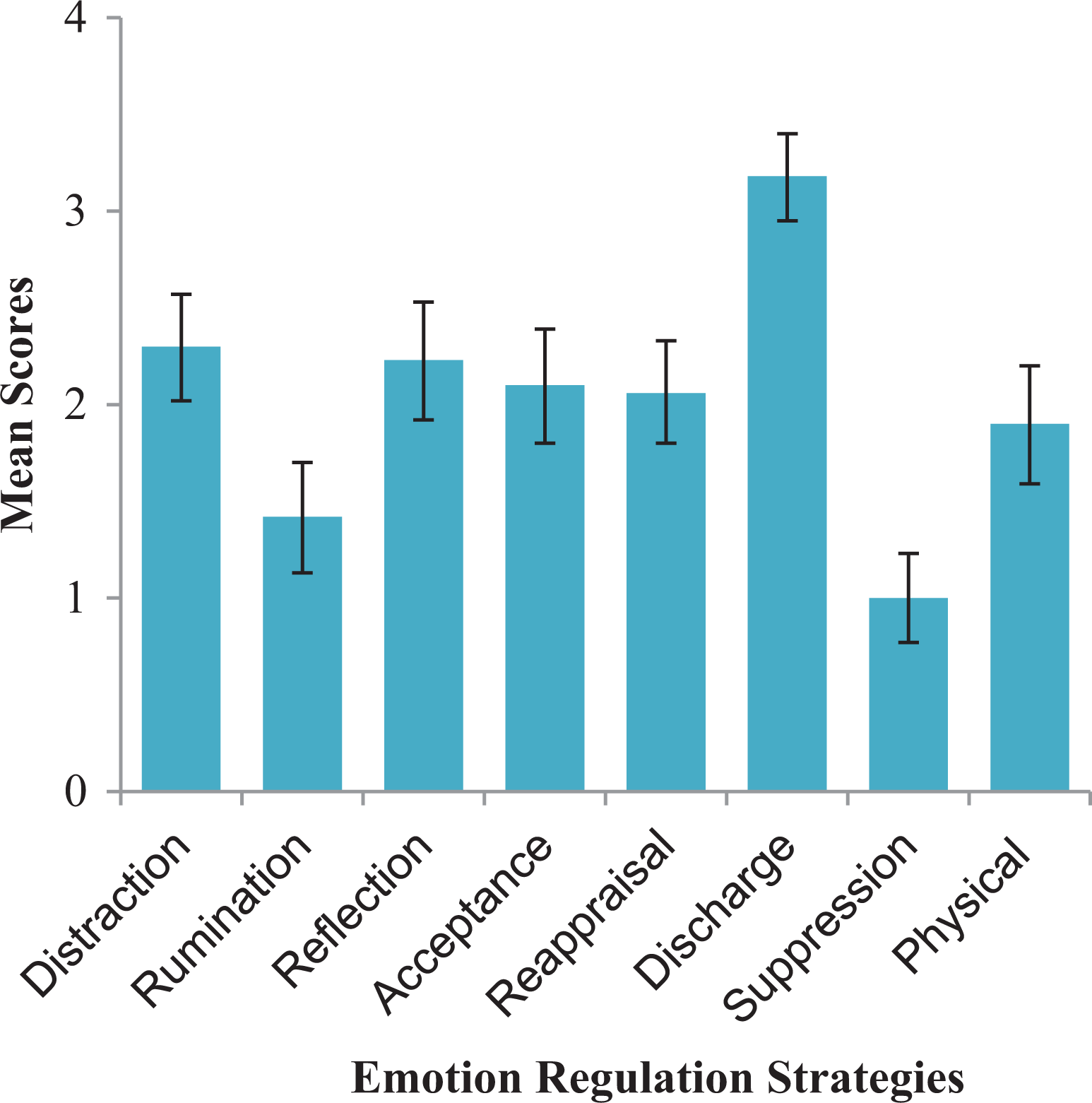
Mean ratings of prevalence for emotion regulation strategies.
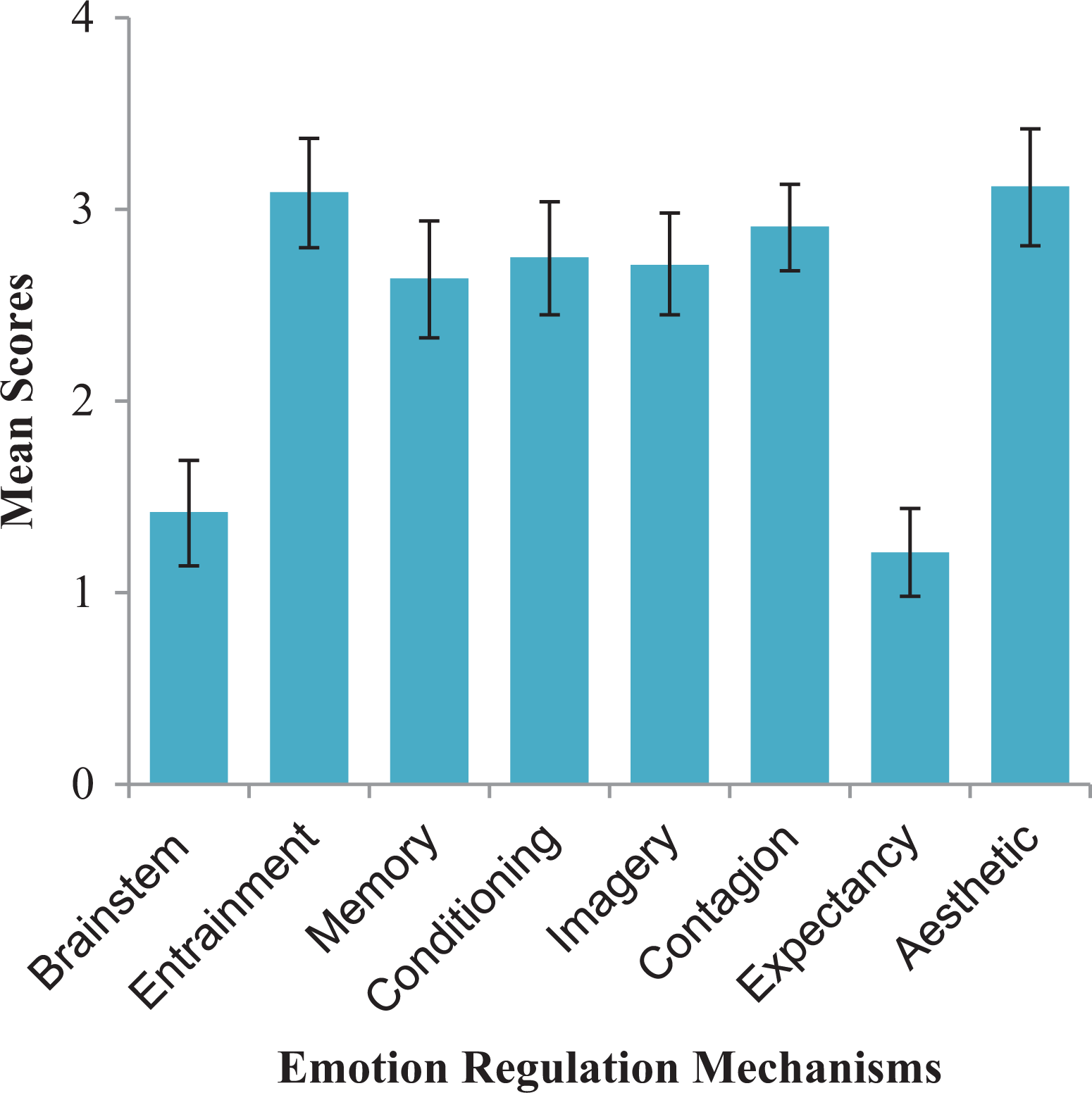
Mean ratings of prevalence for emotion regulation mechanisms.
The results indicated a significant main effect of goal, F(2.03, 152.32) = 107.40, p < .001, generalized η2 = .56, partial η2 = .59, a “moderate” effect in term of Ferguson’s (2009) guidelines. In contrast, there was no significant main effect of group, F(1, 75) = 1.48, p = .23, generalized η2 = .01, partial η2 = .02, nor was there any significant interaction between goal and group, F(2.03, 152.32) = 1.02, p = .37, generalized η2 = .01, partial η2 = .01.
As can be seen in Figure 1, the goal rated as most frequent by participants was “to enhance a positive emotion” (E-PE). Post hoc tests (Tukey LSD, Bonferroni-adjusted from α = .05 to α = .003) confirmed that E-PE was rated significantly higher than all other goals (mean differences = 1.10–2.78, ps < .001). Further, the goal “to reduce a negative emotion” (R-NE) was rated as more frequent than the goal “to enhance a negative emotion” (E-NE) (mean difference = .77, p < .001). Note, finally, the very low ratings for the goal “to reduce a positive emotion” (R-PE), which were significantly lower than all other goals (mean differences = 0.91–2.78, ps < .001).
Regulation strategies
For the regulation strategies, we computed a mixed ANOVA, with strategy as the within-subjects factor (eight levels: distraction, rumination, reflection, acceptance, reappraisal, discharge, suppression, physical modulation) and group as the between-subjects factor (two levels: depressed, control). Since Mauchly’s test showed that the assumption of sphericity had been violated, χ2(27) = 46.27, p = .01, degrees of freedom were corrected using Huynh-Feldt estimates of sphericity (∊ = .91). (Field, 2013, has recommended using the Greenhouse-Geisser correction when estimates of sphericity are less than .75, but the Huynh-Feldt correction when they are greater than .75.)
The results showed a significant main effect of strategy, F(6.36, 476.60) = 32.50, p < .001, generalized η2 = .20, partial η2 = .30, a “moderate” effect. There was no significant main effect of group, F(1, 75) = 0.58, p = .45, generalized η2 = .01, partial η2 = .01, nor any interaction between strategy and group, F(6.36, 476.60) = 1.44, p = .19, generalized η2 = .01, partial η2 = .02.
Although there was no significant main effect of group, we nonetheless conducted planned comparisons (t-tests) between groups (depressed vs. control) for each of the regulation strategies in order to test our predictions. Since the Kolmogorov-Smirnov test showed that the distribution of the outcome variables deviated from normality, we used the bootstrapping method with 1.000 bootstrap samples to report our BCa 95% CIs. The depressed participants provided higher ratings of distraction (M = 2.49, SE = .21) than controls (M = 2.13, SE = .18), t(75) = –1.31, p = .19, BCa 95% CI [–8.98, 0.24]; lower ratings of rumination (M = 1.32, SE = .19) than controls (M = 1.50, SE = .21), t(75) = 0.62, p = .54, BCa 95% CI [–0.36, 0.70]; lower ratings of acceptance (M = 1.97, SE = .22) than controls (M = 2.23, SE = .19), t(75) = 0.86, p = .39, BCa 95% CI [–0.33, 0.84]; higher ratings of reappraisal (M = 2.14, SE = .17) than controls (M = 2.00, SE = .21), t(72.38) = –0.51, p = .62, BCa 95% CI [–0.65, 0.37]; and higher ratings of suppression (M = 1.19, SE = .17) than controls (M = 0.83, SE = .15), t(75) = –1.60, p = .12, BCa 95% CI [–0.78, 0.09]. Three of these trends were in the expected direction (suppression, distraction, acceptance) and two (rumination, reappraisal) were in the opposite direction. None of the effects were significant, but we report the results nonetheless, to enable replicability of the analyses and to facilitate future meta-analyses that may include non-significant results (Gerstner et al., 2017).
At an overall level, it may be seen in Figure 2 that the most common regulation strategy in the sample as a whole was discharge. Post hoc tests (Tukey LSD, Bonferroni-adjusted from α = .05 to α = .0008) confirmed that discharge was rated significantly higher than all other strategies (mean differences = 0.88–2.18, ps < .0008). Note further that although the ratings of suppression and rumination did not differ amongst them (mean difference = 0.42, p = .02), suppression was rated significantly lower than all other strategies (mean differences = 0.90–2.18, ps < .0008) and rumination was significantly lower than all other strategies – except physical modulation (mean differences = 0.65–1.78, ps < .0008). The differences between the remaining strategies were not significant.
Regulation mechanisms
Finally, a mixed ANOVA with mechanism as the within-subjects factor (eight levels: brain stem reflex, rhythmic entrainment, episodic memory, evaluative conditioning, visual imagery, contagion, musical expectancy, aesthetic judgment), and group as the between-subjects factor was conducted. Results showed that the assumption of sphericity was violated, χ2(27) = 86.30, p < .001, thus degrees of freedom were corrected using Huynh-Feldt estimates of sphericity (∊ = .83).
The results revealed a significant main effect of mechanism, F(5.80, 434.87) = 63.61, p < .001, generalized η2 = .34, partial η2 = .46, a “moderate” effect. There was no main effect of group, F(1, 75) = 0.02, p = .88, generalized η2 = .01, partial η2 = .01, nor was there an interaction between mechanism and group, F(5.80, 434.87) = 0.66, p = .68, generalized η2 = .01, partial η2 = .01.
Inspection of Figure 3 reveals that several mechanisms were rated as common. Only brain stem reflex and musical expectancy received low ratings. Post hoc tests (Tukey LSD, Bonferroni-adjusted from α = .05 to α = .0008) confirmed that brain stem reflex and musical expectancy were rated significantly lower than all other mechanisms (mean differences = 1.22–1.91, ps < .0008), albeit that they did not differ from each other (mean difference = 0.21, p = .19). Further, the ratings for rhythmic entrainment were significantly higher than those for episodic memory (mean difference = 0.46, p < .0008). The remaining contrasts were not statistically significant.
Strategies and goals
Because the use of regulation strategies could potentially vary depending on the regulation goal, we computed Pearson correlations (r) among the four emotion-regulation goals and the eight regulation strategies (Table 2). Beginning with the two most frequently occurring regulation goals, it can be seen that using music to reduce negative emotions (left-most column) was mainly correlated with use of the strategies distraction, reflection, reappraisal, and physical modulation; that is, individuals who reported frequently using music to reduce negative emotions also tended to report using these four strategies frequently. Furthermore, individuals who reported frequently using music to enhance positive emotions tended to use the three strategies distraction, reflection, and discharge frequently. With regard to the less frequent goal of enhancing negative emotions, this was mainly correlated with the strategy rumination. In addition, note that none of the correlations were significant for the goal to reduce positive emotions, which is not surprising considering that this strategy was hardly used by participants. Finally, note that only the strategies acceptance and suppression failed to correlate significantly with any of the goals.
Pearson correlations (r) between ratings of regulation strategies and regulation goals (N = 77).

Note. Significant correlations are set in bold (Bonferroni corrected for n = 32, from α = .05 to α = .0016).
R-NE = reduce a negative emotion; R-PE = reduce a positive emotion; E-NE = enhance a negative emotion; E-PE = enhance a positive emotion.
To see whether the relationships between regulation goals and regulation strategies of the depressed listeners differed from those of the controls, we computed Pearson correlations (r) between goals and strategies separately for each group. Fisher z-tests of differences between the groups for those correlations that were significant revealed that only two of the differences were significant. More specifically, the correlation between the goal of reducing negative emotions and the strategy acceptance was smaller (z Difference = –2.14, p = .03) for the depressed listeners, r (75) = .16, than for the non-depressed controls, r (75) = .58. In addition, the correlation between the goal of enhancing negative emotions and the strategy rumination was smaller (z Difference = –2.03, p = .03) for the depressed listeners, r (75) = .30, than for the controls, r (75) = .68.
Strategies and mechanisms
To explore how the use of specific regulation strategies may be linked to specific induction mechanisms, we calculated Pearson correlations (r) between the eight regulation strategies and the eight mechanisms, as indexed by MecScale (Bonferroni corrected for n = 64, from α = .05 to α = .0008). The results revealed three significant correlations. The strategy discharge was correlated with the induction mechanisms visual imagery, r (75) = .47, p < .0008, and contagion, r (75) = .42, p < .0008. In addition, the strategy reflection correlated with the mechanism visual imagery, r (75) = .44, p < .0008. All effects may be regarded as “medium”, approaching “large” (Cohen, 1992).
Intercorrelations between items
A final set of analyses focused on the interrelationships among the various items of the new survey. We computed the mean variance accounted for (Mr 2) of the item intercorrelations of each variable, and this showed that the shared variance did not exceed an average of 13% (goals = .05, strategies = .13, mechanisms = .13). The maximum r 2 for each variable (goals = .19, strategies = .40, mechanisms = .47) showed that no item pair shared more than 47% of the variance in ratings. This indicates that the items measure relatively distinct aspects of the emotion-regulation process. The largest item correlations occurred for aspects that can be expected to correlate naturally, such as the cognitive strategies reflection and reappraisal, and the memory-based mechanisms evaluative conditioning and episodic memory.
Given our special focus on regulation strategies, we also examined the interrelationships between the strategies by means of cluster analysis (single linkage, Euclidean distances) of the listeners’ ratings (see Figure 4). As can be seen in the resulting diagram, the strategies cluster in a meaningful way. At the highest hierarchical level, one might interpret the division as one into “maladaptive” versus “adaptive” strategies. The former, which may perhaps be labeled “neurotic strategies”, include suppression and rumination. The “adaptive” strategies are at the lower level further sub-divided into what could be termed “emotional” (discharge), “cognitive” (acceptance, reappraisal, reflection; the latter two perhaps being more similar and “active” in character), and “visceral” (physical modulation, distraction) strategies.

Cluster analysis of ratings of various regulation strategies.
Discussion
Summary and interpretation of findings
The goal of this survey was to explore emotion regulation with music in depressed listeners and controls, based on the notion that depressed listeners might tend to use maladaptive regulation strategies. The most striking finding, however, was the absence of significant differences between depressed listeners and controls with regard to regulation goals, strategies, and mechanisms. This means that, contrary to our predictions, depressed people did not differ significantly from controls in their self-reported use of rumination, suppression, avoidance, reappraisal, and acceptance.
One possible interpretation of this result is that the use of maladaptive regulation strategies reported in previous research (Aldao et al., 2010) does not generalize to emotion regulation with music. It could, for instance, be that because music experiences typically lack serious real-world implications and offer a non-threatening context, this may help listeners to regulate emotions in a more adaptive manner. Another possibility is that the result reflects in part some methodological limitations that are discussed further below.
The present finding, that depressed listeners do not report using maladaptive strategies to a greater extent than do non-depressed listeners, does not necessarily imply that their use of music for emotion regulation is as efficient as that of non-depressed listeners. It should be noted that we measured various levels of the regulation process (goals, strategies, mechanisms), but that we did not measure the outcome (the extent to which regulation goals were reached). It could be the case that depressed listeners have “good intentions” and use “the right strategies”, and yet are unable to practically implement and achieve the desired emotion modulation. This could simply be because of a different emotional reactivity due to “cognitive biases” that influence underlying mechanisms (e.g., Sakka & Juslin, 2017) or it may be that the regulation strategies are implemented in a faulty manner. Thus, for example, Gross and Thompson (2007) argue that it is not so much the emotion-regulation strategies themselves that are maladaptive or adaptive as the ability to flexibly employ context-appropriate strategies. This contextual aspect of regulation is challenging to measure in a static laboratory setting.
The observed similarities in regulation between depressed and non-depressed listeners may seem to contradict previous studies, which report that individuals with tendencies for depression (indicated by high rumination scores) are attracted to listening to sad music (Garrido & Schubert, 2015a) even though this music-listening habit can result in harmful emotion-regulation outcomes (Garrido & Schubert, 2015a, 2015b). However, note that these studies measured both the goal of emotion regulation and the outcome. What they found was that, although the outcome may have been negative (suggesting maladaptive emotion regulation), the goal (indicated by the listeners’ predictions) was not. Therefore, although sad music listening may contribute to maladaptive emotion-regulation outcomes in individuals with tendencies for depression, these outcomes may not represent the regulation intentions of these individuals.
Apart from the quite unexpected findings from the between-groups comparisons, the present survey yielded some noteworthy results at an overall level. With regard to regulation goals, it was not surprising to find that listeners’ use of music for emotion regulation serves mainly to enhance positive emotions, or reduce negative emotions. What is more surprising, however, is that at least some listeners appear to use music to enhance negative emotions. This could perhaps be linked to previous findings, showing that some listeners actively choose to listen to music that makes them feel sad (cf. van Goethem & Sloboda, 2011). Previous studies have indicated that this tendency is stronger in listeners scoring high in neuroticism (Juslin et al., 2011) and rumination (Chen, Zhou, & Bryant, 2007; Garrido & Schubert, 2015a), though we did not observe any differences between depressed listeners and controls in the present study.
Concerning strategies, the results indicated that the most common regulation strategy was discharge (“it helps me express and release my emotions”); that is, a kind of “cathartic” strategy. However, music seemed to serve a number of different regulation strategies, including cognitive strategies, such as reflection and reappraisal. Rumination and suppression, which are considered maladaptive strategies, received the lowest ratings, but still seemed to be used by some listeners.
Our typology of regulation strategies (see Table 1) was based on “the process model” by Gross (1998b). However, the exploratory cluster analysis of the intercorrelations between the listeners’ ratings of the strategies in the present study suggests an alternative and empirically-derived conceptualization of the strategies: They may be divided into “neurotic”, “emotional”, “cognitive”, and “visceral” strategies, respectively. These analyses are, of course, preliminary, and need to be replicated in future research. It remains to be seen which conceptualization of regulation strategies will be most useful.
As regards mechanisms, finally, our results suggest that a wide range of mechanisms may be involved in emotion regulation with music. Five of the mechanisms featured in BRECVEMA were rated as equally frequent (rhythmic entrainment, evaluative conditioning, contagion, visual imagery, aesthetic judgment). Only two mechanisms, brain stem reflex and musical expectancy, were rated as occurring rarely in emotion regulation. In hindsight, this makes sense: Both of the mechanisms usually involve local musical events that are surprising to the listener, which render them difficult to harness for regulation purposes. The difference between the mechanisms is that musical expectancy relies on schematic expectations built up by the previous syntactic structure, whose repeated thwarting could make the music appear difficult to predict, whereas a brain stem reflex is a rapid response to some “extreme” feature of the music such as a very loud note, which cannot at all be predicted from the previous structure (Juslin, 2013).
It might be noted that only one previous study of emotion regulation with music has taken specific mechanisms explicitly into consideration (van Goethem & Sloboda, 2011). The authors concluded that brain stem reflexes did not occur in the regulation episodes. They further argued for the need for further research on the relationships between different regulation strategies and mechanisms. This was explored in the present study, but only three trends emerged: the strategy discharge was linked to both visual imagery and contagion, whereas the strategy reflection was linked to visual imagery. In Saarikallio and Erkkilä’s (2007) study, imagery and reflection were regarded as belonging to a common regulation strategy (termed mental work). We reiterate that self-reports of mechanisms – or, rather, subjective impressions linked to mechanisms – should be interpreted with the utmost caution (Juslin et al., 2015), but maintain that a focus on mechanisms is key to understanding links between music and health (Västfjäll, Juslin, & Hartig, 2012).
Limitations and future directions
In interpreting the findings, one should take into consideration a number of methodological limitations. Self-selection sampling bias threatens the generalizability of any study with volunteer participants, and this applies all the more to a depressed sample. Depression is characterized by low motivation to engage in activities (Cléry-Melin et al., 2011). This could, of course, include signing up for an experiment. Thus, it is possible that the present sample has a stronger than usual motivation, for instance due to an interest in music. In fact, anecdotal information obtained during the data collection suggested that, for some of the depressed participants, interest in taking part in the study was driven by the sense that music had helped them deal with their symptoms. It cannot be ruled out that the emotion-regulation strategies of the present sample differ somewhat from the general depressed population (though depression per se is a highly heterogeneous disorder; Webb & Pizzagalli, 2016). Further, 65% of the depressed participants reported receiving psychotherapy and/or psychotropic medication. Emotion regulation with music may show distinct characteristics in a sample of depressed listeners who are not actively dealing with their condition.
Another limitation of this study is that emotion regulation with music was measured in the laboratory and by means of self-reports, which relied on retrospective and aggregated estimates of the phenomenon. This may introduce a number of potential biases. First, although the process of emotion regulation is often deliberate and conscious, it could also operate on a subconscious, implicit level (Koole, Webb, & Sheeran, 2015). Thus, the present self-reports must be cautiously interpreted. Furthermore, emotion regulation is a dynamic process that unfolds over time (Gross, 2015). To be able to assess the outcomes of emotion regulation and to capture the complexity of the phenomenon in a real-world context, field studies involving the experience sampling method could be useful. Further recommendations include using larger samples of depressed listeners, in particular those who are severely depressed and not presently on medication. We suggest that the lack of differences between depressed listeners and controls in our sample should not discourage other researchers from further exploring how music is used for emotion regulation in depression. Last but not least, we acknowledge that the self-report items used in the regulation questionnaire (Appendix) might be subject to further refinement. This includes the MecScale items intended to capture subjective listener impressions linked with psychological mechanisms such as contagion and expectancy. A revised multi-item version of MecScale is currently under development at the Uppsala laboratory.
Concluding remarks
Our results indicate that depressed and non-depressed listeners do not differ much in their emotion regulation using music. An “optimistic” interpretation is that these findings suggest that listening can function as an important resource for dealing with symptoms of persistent negative affect in depression. As already noted, our sample of depressed individuals could be biased with regard to receiving treatment and dealing with the condition. Depressed individuals who are not dealing with their symptoms typically experience high levels of anhedonia, which may influence their motivation to engage in pleasurable activities such as music listening (Sherdell, Waugh, & Gotlib, 2012). Future treatment interventions could thus aim to teach depressed individuals how to actively use music to regulate emotions effectively in everyday life, for example by aiding in the deployment of adaptive regulation strategies, such as acceptance, reappraisal, and reflection – preferably with attention to specific mechanisms.
Footnotes
Contributorship
LSS conceived of the study (in collaboration with PNJ), and collected and analyzed the data. LSS and PNJ co-wrote, reviewed, and edited the manuscript and approved its final version.
Declaration of conflicting interests
The authors declared no potential conflicts of interest with respect to the research, authorship, and/or publication of this article.
Funding
The authors disclosed receipt of the following financial support for the research, authorship, and/or publication of this article: The present study was supported by the Swedish Research Council through a grant to Patrik N. Juslin.
Peer review
Liila Taruffi, FU Berlin, Department of Educational Sciences and Psychology.
Jonna Vuoskoski, University of Oxford, Faculty of Music.
Note
Appendix: Emotion Regulation Questionnaire
We would like to ask you some questions about music’s role in your emotional life, in particular, in how and if it helps you regulate (that is, control and manage) your emotions. For each statement please answer using a scale from 0: never to 4: always.
(Goals)
Try to estimate how often you listen to music for the following reasons:
I listen to music when I want to: reduce/ease a negative emotion reduce/ease a positive emotion enhance/strengthen a negative emotion enhance/strengthen a positive emotion
(Strategies)
The following statements are about the way in which music influences your emotions. Try to estimate how often music helps you regulate your emotions in the following ways.
Music influences the way I feel because…
(Cognitive processes)
(Attention deployment) 1. it helps me take my focus away from an unwanted situation, it distracts me from my worries (distraction) 2. it help me focus on an unwanted situation so that I ruminate and dwell over it (rumination) 3. it helps me focus on a situation so that I can better understand it and my feelings and thoughts around it (reflection)
(Cognitive change)
(Response modulation)
(Emotional expression)
(Physical modulation) 8. it helps me focus on my internal bodily signals (e.g., muscle tension, heartbeat, breathing) and decrease or increase my energy levels (physical modulation)
(Mechanisms)
The following statements are about the causes of your emotions when you listen to music. Try to estimate how often your emotions to music are due to the following causes.
Music influences the way I feel because… The music features an event (e.g., a very loud sound) that startles me (brain stem reflex) The music has a strong and captivating rhythm (rhythmic entrainment) The music evokes a memory of an event from my life (episodic memory) The music arouses emotions through associations (evaluative conditioning) The music evokes images that affect my emotions (visual imagery) I am touched by the music’s emotional expression (contagion)a
It is difficult to guess how the music (e.g., melody) will continue over time (musical expectancy) The music is aesthetically pleasing (e.g., beautiful, original, etc.) (aesthetic judgment)
Note. The Appendix shows an English translation of the Swedish version of the questionnaire that was used in the study. Text set in italics was not shown to the participants.
aThe Swedish term for “touched” was “berörd”. This is defined as “påverkad känslomässigt” (“affected emotionally”) in the predominant Swedish word dictionary published by the Swedish Academy (SAOL).