




Abstract
Objective:
To determine the prevalence of oral human papillomavirus (HPV) in the population of Córdoba, Argentina and its association with other risk factors.
Methods:
A sample of 401 volunteers over 18 years, representative of Cordoba city population, was selected. Using a questionnaire, we collected sociodemographic data including the use of tobacco, alcohol, and mate consumption. Two biological samples were taken from each individual, whole mouth saliva and a scraping of the posterior border of the tongue. HPV was determined by polymerase chain reaction using MY09/11 primers. Statistical associations were analyzed using χ2 test.
Results:
Prevalence of HPV in the population was of 3% (13/401). The mean age of HPV-positive cases was 42 years with a range of 20–85; 54% were females. Among the 13 cases whose saliva was positive for HPV, only 7 (54%) had HPV-DNA in the tongue scraping. All identified genotypes were of low risk and HPV11 was the most frequent type in 62% of positive cases. None of the positive subjects exhibited oral lesions compatible with HPV infection. Ten (77%) of the HPV-positive subjects exhibited lesions in the oral mucosa, mostly related to chronic mechanical irritation (CMI) (odds ratio 3, 95% confidence interval: 1.01–8.97, p < 0.05). Fifty-four percent of HPV-positive individuals were light smokers and consumed alcohol moderately. The combination of both habits was observed in 31%. Sixty-two percent drank mate at high water temperatures. No differences were detected in the sexual behavior or in the reported number of sexual partners between HPV-positive and -negative subjects.
Conclusion:
The overall prevalence of oral HPV in adults was 3%; only the low-risk genotypes were detected and no association with other risk factors for oral cancer was found. However, an association with CMI of the oral mucosa was noted. The saliva sample proved to be a simple, efficient, and well-tolerated method suitable for screening for HPV, and more cases were detected in saliva compared with tissue scrapings.
Introduction
Human papillomaviruses (HPVs) are a heterogeneous group of small, epitheliotropic DNA viruses that infect mucosa and cutaneous epithelia and stimulate cell proliferation. Papillomaviruses infecting humans exhibit particular characteristics in their cell cycle, variable epithelial tropism, and association with different diseases. 1,2 According to the analysis of the viral DNA sequence of the L1 gene, the most conserved gene in the genome, HPV can be divided into high- and low-risk genotypes. 3,4
The initial infection takes place in the basal layer of undifferentiated cells and involves a previously existing micro abrasion facilitating its entry. 5 Then the virus undergoes differentiation in the upper layers of the epithelium, remaining undetected by the immune system. For this reason, the HPV is a “successful microorganism” for infection. 6 Nevertheless, in most cases, HPV infection is transient and resolves spontaneously. 7
Scientific evidence of the association between high-risk HPV and cervical cancer has led to numerous research works focusing on tumors in other body sites: eg. anal, the oropharynx, oral cavity, nasal cavity, and larynx, among others. 8,9 However, our understanding of the role of this virus in the oral carcinogenesis process is still unclear. 10,11
Oral cancer is a multifactorial disease and oral squamous cell carcinoma (OSCC) was found to be the most frequent histological type. Risk factors like tobacco and alcohol use are extensively studied 12 –14 ; however, other factors have been proposed including mate drinking, a tea prepared from yerba mate Ilex paraguariensis, nutrition deficits, poor oral hygiene, chronic dental or prosthetic trauma, HPV infection, and chronic inflammation. 15,16 According to zur Hausen, 20% of all human cancers are related to a viral etiology. 17
Compared to OSCC caused by smoking and alcohol drinking, HPV-positive OSCC represents a distinct molecular and clinical pathological entity with a favorable prognosis. 18,19 Given the increasingly important role of HPV infection in OSCC, understanding its distribution in cancer-free subjects and associated risk factors is of great value for public health. 20
Studies investigating the prevalence of oral HPV infection in healthy individuals have, however, revealed a high variability in different populations, with values ranging between 0.2% and 20.7%. 21 –29 Two regional studies involving young subjects from southern Brazil and Mexico, with no oral lesions suggestive of HPV, revealed 0% and 1.2% prevalence, respectively. 30,31 The prevalence of oral HPV infection in healthy Argentinian individuals has not been studied. Therefore, the aim of the present study was to determine oral HPV prevalence, genotype distribution, and identify risk factors associated with a sample of healthy adult subjects.
Subjects and methods
Prevalence of HPV was determined as part of an ongoing study titled “Survey of oral health parameters in the adult population from Córdoba city 2014–15.” A multistage cluster sampling was conducted, with random selection of census tracts, probability proportional to size, blocks, households, and persons; the same number of individuals per tract was selected. 32 The selected subjects were asked to attend a health center in the area. Thus, a representative sample consisting of 401 adult subjects aged >18 years was obtained. This project was approved by the Institutional Ethics Committee at the CIEIS Hospital in Córdoba in September 2013.
Data collection
Written informed consent was obtained from all participants. Following completion of medical records, the patients answered a questionnaire inquiring about tobacco, alcohol, and mate consumption.
Smoking habit
Subjects were asked about the age at start of smoking, age at cessation or periods of temporary quitting, number of cigarettes/day in the different periods of life and amount of tobacco (black or blond) expressed as the equivalent in blond filter cigarettes. Then the total number of cigarettes smoked throughout the subject’s life was calculated, according to Biondi et al. 33 A subject that smoked more than 100,000 cigarettes was considered a smoker.
Alcohol consumption
Subjects were asked about the type and amount of alcoholic beverages consumed. An alcohol unit a day (one drink) was considered as regular alcohol consumption, according to Pentenero et al. 34,35
Mate consumption
We assessed mate consumption by the criteria of Sewram et al., 36 taking into account daily consumption and the water temperature, that is, hot or warm, as reported by the participants. Mate consuming individuals were considered as those who consume this drink daily. 37
Chronic mechanical irritation (CMI)
Damage caused by a low-intensity, sustained, and repeated action of an oral deleterious agent: teeth, dentures, and functional alterations. 38
Sexual behavior
Subjects were asked about oral sex practice and number of sexual partners in their lifetime.
Sample collection
Oral examination and sample collection of the selected individuals were conducted by dentists previously trained at the Dentistry College, Universidad Nacional de Córdoba, and at Municipal Dental Services of Córdoba city.
Two samples were taken from each participant to identify HPV:
Unstimulated whole mouth saliva in sterile tube and preserved at −80°C. Bilateral scraping of the posterior border of the tongue; specimens were put in a sterile tube containing 1-ml phosphate buffer solution with antibiotic and antifungal agents and preserved at 4°C.
Sample processing
DNA was extracted using the commercial AccuPrep® Genomic DNA Extraction kit (Bioneer, Bioneer Corporation, Republic of Korea), following the manufacturer’s instructions. The L1 gene analysis was performed with the specific degenerate primers MY09 and MY11, with an amplicon size of 450 bp. This set of primers allows the identification of the genotype by restriction fragment length polymorphism. All HPV-DNA-positive samples were typed by this method.
Briefly, aliquots of the polymerase chain reaction (PCR) products were mixed with seven different restriction enzymes (Bam HI, Dde I, Hae III, Hinf I, Pst I, Rsa I, and Sau III) in separate reactions. The digestion products were separated by electrophoresis in 3% agarose gel and the pattern obtained was analyzed with published data. 39
Statistical analysis
A χ2 test was applied and odds ratio (OR) was used to measure any association between HPV-positive and -negative participants, using InfoStat/professional program version 1.1 (School of Agricultural Sciences of the National University of Córdoba).
Results
A total of 401 randomly selected subjects participated in the study; their mean age was 40 years (range 18–87) and 62% were female. Approximately 50% of the population had attended only up to elementary school, 44% were married or lived with a partner, 43% smoked or had smoked, 45% reported habitual or occasional alcoholic beverage consumption, and 76% drank mate.
Our results showed that 3% (n = 13) of the subjects were HPV positive, 7 females and 6 males with a mean age of 42 years. Sixty-nine percent (9) of oral HPV-positive volunteers had low educational level (OR 3.0, CI: 0.97–9.48, p = 0.057). Table 1 describes the characteristics of the study population and the HPV-positive individuals. Of the HPV-positive cases, in 11 (85%) individuals, the virus presence was associated with other risk factors: 54% were smokers and consumed alcohol moderately, whereas 62% habitually drank mate at high temperatures. The combination of tobacco and alcohol use was detected in 31% of HPV-positive participants and in 23% combined tobacco, alcohol, and mate users (Table 1). Regarding the two samples taken from the participants, saliva was positive in 13 cases and scraping of the tongue border only in 7 (56%) of them. The detected genotypes were all of low risk; the most frequent was HPV 11 (62% of the cases), followed by 84, 6 coinfection with genotypes 11/81 and 11/84. If individual genotype 11 is grouped with others in which it appears in coinfection, it reaches 77% of the identified genotypes (Figure 1).
Characteristics of the study population.

CI: confidence interval; HPV: human papillomavirus.

Distribution of identified genotypes.
Oral examination showed that 10 of 13 HPV-positive subjects exhibited some lesion, most of them related to chronic mechanical irritation (CMI) such as leukoedema, reactive melanosis, indentations, and erythema. One subject exhibited smoker’s palate and three other participants (23%) did not exhibit any lesions at the time of inspection (Table 2). No clinical manifestation suggestive of HPV infection was found in any of the HPV-positive subjects.
Oral lesions detected in HPV+ individuals.

aCMI: chronic mechanical irritation; HPV: human papillomavirus.
Oral sex practice was reported by 50% of HPV-negative and 38% of HPV-positive subjects. Regarding the number of sexual partners, 46% of the participants had only one partner. When we classified them into five groups and compared them between HPV positive and negative, 85% of HPV positive had five or less partners, with no significant differences between the five groups (Table 3).
Number of sexual partners in the HPV-positive and -negative population.a
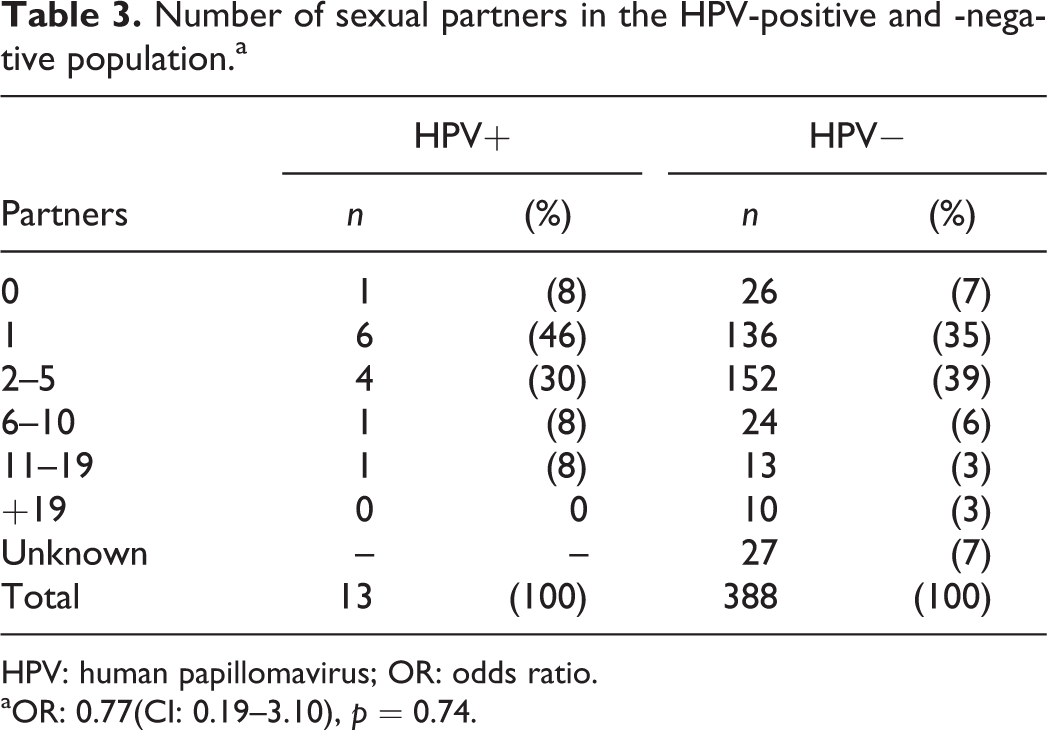
HPV: human papillomavirus; OR: odds ratio.
aOR: 0.77(CI: 0.19–3.10), p = 0.74.
Discussion
This is the first study addressing the prevalence of oral HPV in Argentina and is part of a study of oral health variables in the adult population in Córdoba city. The results indicate that 3% of individuals are HPV positive.
Previous studies conducted in Córdoba city showed a higher prevalence of HPV in subjects with oral lesions than in healthy mucosa of control subjects. Furer et al. 40 reported 95% HPV positive in patients with malignant and potentially malignant lesions and 9% in clinically healthy controls, whereas Venezuela et al. did not detect HPV positivity in healthy controls. 41 Results of both studies agree with the findings reported in other countries that did not find HPV-positive subjects in clinically healthy oral mucosa. 42 In Latin American, the prevalence of oral HPV has not been widely studied. Some studies in young subjects without oral lesions suggestive of HPV in Brazil and Mexico reported a prevalence of 0% and 1.2%, respectively. 30,31 A similar study conducted in northern Italy reported a total prevalence of 4% of HPV-positive individuals. 43 Table 4 shows oral HPV prevalence in healthy individuals in different populations (Range 0.6–18.3%).
Oral HPV prevalence in healthy people.
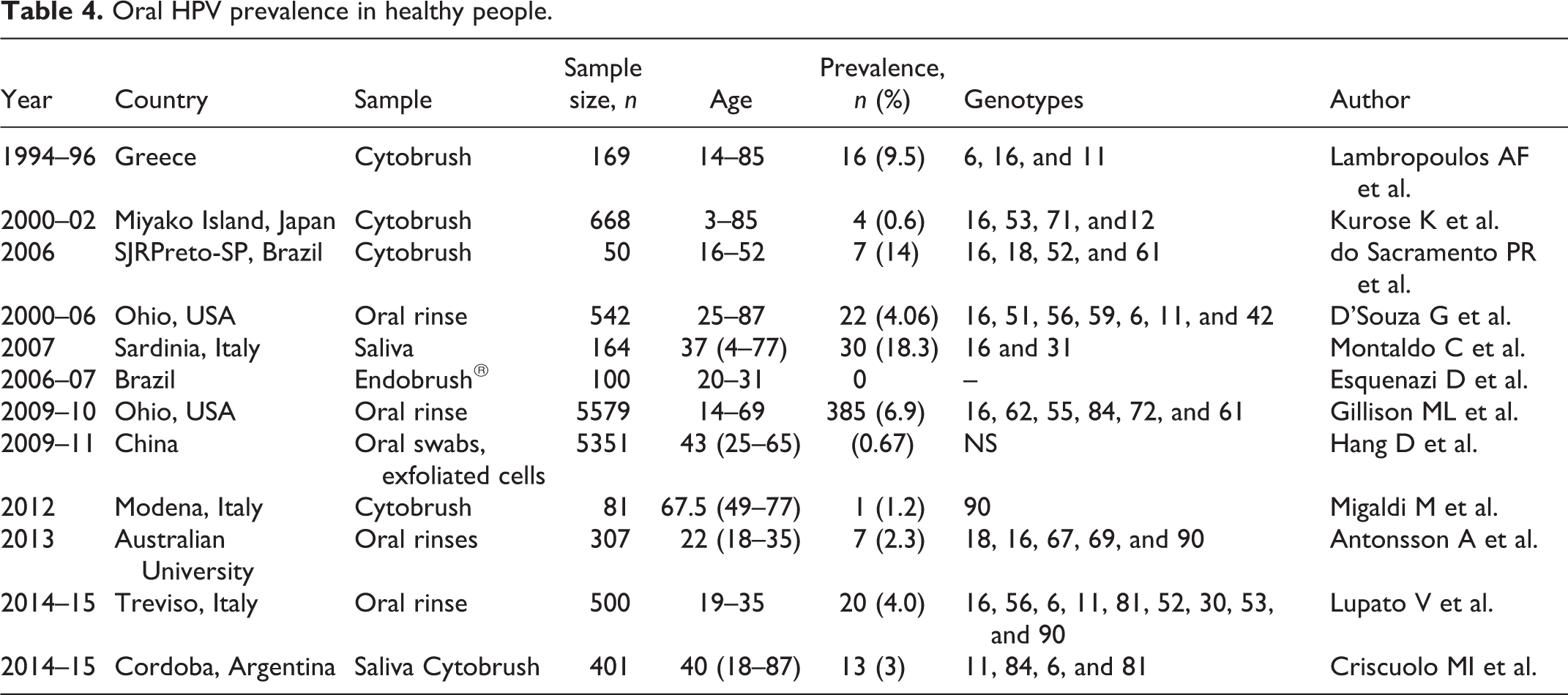
A systematic review of the literature reported a prevalence of 4.5% (95%CI: 3.9–5.1) of any HPV among health individuals. 44 All HPV genotypes detected in our study were of low risk; their order of frequency was 11, 6, 81 and we also detected the genotype 84 which has still not been described in the literature pertaining to oral heath. 5,44,45
Some authors have found an association between a higher number of sexual partners and oral sex practice in HPV-positive individuals. 46,47 In the present study, we did not observe such an association. Our observation agrees with the results reported in a study of oral HPV conducted in Italy. 43 One limitation of our work is the small sample of positives, perhaps for this reason we did not observe this relationship. In this regard, it is important to remember, however, that men usually tend to overreport sexual partnerships, whereas women tend to underreport.
In 2007, the literature reported 10% of the women with HPV cervical infection and 14% corresponded to high oncological risk genotypes. 48,49 In Argentina, the prevalence of cervical HPV infection was 16.6% in 2010 and genotypes associated with cervical cancer were HPV 16 (4%), followed by 35 (2.2%) and 18 (1.9%). 50 In a study conducted in Córdoba, 65.6% of women with cervical lesions of different degrees were found to be HPV positive, with genotype 16 being the most frequent. 51 Further studies should be conducted to analyze the prevalence of oral and cervical HPV. A study conducted in Chile involving young cervical HPV-positive women reported 71% had more than three partners. 52
Regarding the age distribution, most of the HPV-positive individuals were aged <60 years, with only one subject being 87 years old. The analysis of age ranges in HPV-positive subjects of the study population showed a high prevalence between 18 and 29 years of age and between 40 and 49 years of age. HPV-positive individuals had moderate consumption of tobacco and alcohol. A similar study conducted in India also did not find an association between HPV-positive individuals and tobacco smoking habit. 53
In relation to mate drinking, 62% habitually consumed it at high temperatures. Hot mate drinking could cause chronic irritation; however, it remains to be clarified if this fact would facilitate the entry of the virus into the oral mucosa. A significant finding among positive participants was the association with clinical manifestations of CMI, such as indentations, leukoedema, patches in the occlusion line and tongue borders, and morsicatio buccarum. These lesions would facilitate the entry of the virus into the epithelium and any contact with basal stratum cells.
When an injurious agent generates CMI, the basal keratinocytes overexpress syndecan-1 which may strongly upregulate the ability to attach and internalize HPV. 54 Although HPV was detected by PCR, positive individuals did not exhibit lesions suggesting HPV infection. The finding of low-risk genotypes in the general population could mean that HPV infects the healthy oral mucosa with a relatively low frequency. The high positivity of HPV in saliva probably should be because this sample includes exfoliated cells from different sites of the oral cavity, and much more studies are necessary to identify the biological importance of this observation.
HPV 16, a common anogenital infection, was rarely detected in oral specimens. However, it was described as a small but noteworthy proportion of healthy individuals having oral HPV infections with types known to cause oral cancer. Regarding prevention, 11 of 13 positive cases would have been prevented had they been immunized with the quadrivalent or the newly approved nonavalent HPV vaccine.
The reports of the prevalence of oral HPV in Latin America are scarce and for this reason we cannot make comparisons of our region with other regions. It is also noticeable that all the genotypes present were of low risk. It is possible that the virus is transiently present, as described in healthy individuals. Further studies are necessary especially to understand the natural history of this virus in humans.
Conclusion
This is the first study conducted on the prevalence of oral HPV in Córdoba, Argentina.
The overall prevalence of oral HPV in adults was 3%; only the low-risk genotypes were found. HPV-positive cases did not exhibit clinical manifestations of HPV infection.
Most of the participants who were HPV positive had signs of CMI. The high positivity in saliva samples shows its validity as a screening technique.
Footnotes
Acknowledgements
We are grateful to the personnel of the Departamento de Estadística y Demografía of the Facultad de Ciencias Económicas and the Programa de Estadísticas Universitarias, specially Cdor Martin Saino; and to the Secretaría de Asuntos Académicos of Universidad Nacional de Córdoba for their advice regarding the population sampling.
Declaration of Conflicting Interests
The author(s) declared no potential conflicts of interest with respect to the research, authorship, and/or publication of this article.
Funding
The author(s) disclosed receipt of the following financial support for the research, authorship, and/or publication of this article: This study was financially supported by SPU Secretaría de Políticas Universitarias and SECyT Universidad Nacional de Córdoba, Córdoba Argentina.