




Abstract
Background:
Thiazolidinediones (TZDs) are proliferator-activated receptor-γ (PPAR-γ) ligands with a variety of metabolic activities approved for the treatment of type 2 diabetes mellitus. In addition to being potent hypoglycemic agents, they are recognized through in-vitro studies as having antiproliferative activity. This study was conducted to explore the impact of TZD exposures on the development of head-and-neck cancer.
Methods:
A retrospective cohort analysis was conducted on subjects attending 10 Veterans Affairs medical centers comprising Veterans Integrated Services Network 16 (VISN-16). Data were collected from the VISN-16 database created from the electronic patient charts. Male diabetics who were eligible to be prescribed TZDs were followed for the development of head-and-neck cancer. Head-and-neck cancers were identified by International Statistical Classification of Diseases 9 (ICD 9) codes; exposures to TZDs and other antidiabetic agents were determined from pharmacy dispensing records.
Results:
A total of 130,406 subjects who met the study criteria were followed for a total of 571,237 person-years, during which time 911 head-and-neck cancers developed. There was a significant reduction in the incidence of head-and-neck cancers among subjects exposed to TZDs after adjusting for other antidiabetic agents, race, age, body mass index (BMI), and glycosylated hemoglobin [hemoglobin A1C (HbA1C)] (hazard ratio 0.43, confidence interval 0.21–0.89; p = 0.023).
Conclusion:
A statistically significant reduction was noted in the incidence of head-and-neck cancers among male diabetic veterans exposed to TZDs. These data warrant further investigation.
Introduction
Thiazolidinediones (TZDs) are proliferator-activated receptor-γ (PPAR-γ) ligands used to treat patients with type 2 diabetes mellitus. In addition to their action on lowering blood sugar levels, TZDs arrest adipogenesis, promote liposarcoma differentiation, inhibit lung cancer cell proliferation and vascular endothelial growth factor–induced angiogenesis, and induce regression of oral leukoplakia and squamous cell carcinoma in mouse models. Preclinical animal models suggested that PPAR-γ ligands are efficient in inhibiting the development of squamous cell carcinoma induced by 4-nitroquinolone 1-oxide. 1,2 PPAR-γ expression has been demonstrated in squamous cell carcinoma of the tongue but not in the surrounding normal epithelium. 3 In a large retrospective cohort study of male veterans, we previously observed a protective effect of TZDs on the incidence of lung cancer among male patients with diabetes. 4 In this study, we explored the potential preventive effect of TZD on the development of head-and-neck cancer in a male diabetic veteran population.
Methods
Patient population
A retrospective cohort study was conducted using the patient database of Veterans Integrated Services Network 16 (VISN-16), also known as the South Central VA Health Care Network, consisting of 10 Veterans Affairs hospitals. The study was approved by the research and development committee and the institutional review board of the Central Arkansas Veterans Health System. The data were obtained from the VISN-16 data warehouse, which contains data extracted from the electronic patient record systems of participating institutions. Subject identifiers were replaced with anonymized identification numbers to allow subject-level analysis. Dates of diagnoses (with ICD 9 codes), deaths, and last visits to a VISN-16 facility were available from October 1, 1996, to December 31, 2005. The date of diagnosis of diabetes mellitus or the documented date of first prescription of antidiabetic medication, whichever came first, was taken as the entry point into the study. An initial total of 180,695 subjects with a diagnosis of diabetes mellitus were identified using ICD 9 codes 250.xx. Subjects with a diagnosis of head-and-neck cancer were identified using appropriate ICD 9 codes. Patient demographics and their heights and weights were obtained from the electronic records.
Inclusion/exclusion criteria
Subjects were eligible for analysis if they met the following inclusion criteria: male and age 40 or older on their first encounter for diabetes mellitus between April 1, 1997 and March 31, 2004. Subjects were excluded from analysis if they had an ICD 9 code that was specific for head-and-neck cancer and dated on or before their documented date of diagnosis of diabetes mellitus or prescription of antidiabetic medication.
Statistical analysis
Body mass index (BMI) was calculated from the last available measurements of height and weight, while HbA1c was also the last available measurement. Age at study entry, length of follow-up, BMI, and HbA1C levels were reported as medians and interquartile ranges (IQRs), while race was reported as percentages of total number in the study. Hispanics, Native Americans, and Asian/Pacific Islanders were categorized as “other,” while those of unknown race were treated as a separate category. Length of exposure to antidiabetic medications was calculated as the first issue date to last follow-up date and were reported as person-years of exposure. Multivariate Cox regression analysis was performed to determine the time to documentation of the first head-and-neck cancer from the time of entry into the study. Time-dependent covariates were used to model the exposure to TZDs, insulin, and other hypoglycemic agents. Stratification was conducted by dividing age, BMI, and HbA1c into quintiles and using these with race as stratification factors. Missing values of BMI and HbA1c were used as legitimate values along with the quintiles for stratification purposes. The multivariate model included all main effects and two-way interactions for the three different types of antidiabetic agents, but the focus of the post hoc analysis was on the effect of TZDs alone or in combination with insulin and other oral agents. Cox regression results were judged as statistically significant if p < 0.05.
Results
A total of 130,406 subjects met the study’s inclusion criteria and were followed for a total of 571,237 person-years. The median length of follow-up was 3.99 years, with an IQR of 2.38–6.32 years and maximum follow-up of 9.25 years. Study subjects were 18.5% Black, 61.3% White, 1.8% other, and 18.3% unknown. The subject demographics are shown in Table 1. Median age, BMI, and median HbA1c for those exposed to and not exposed to TZDs were comparable (Table 2). The cumulative number of head-and-neck squamous cell carcinoma cases reached 911 by the end of the study and corresponded to a final cumulative incidence of 1.40% as computed by Kaplan–Meier methods.
Demographic characteristics of subjects enrolled in the study.

TZDs: thiazolidinediones.
aOthers: Hispanic, Asian/Pacific Islander, Native American, or Unknown.
Age, BMI, and HbA1c of the study subjects.

BMI: body mass index; TZD: thiazolidinedione.
aLast available measurement.
bA total of 38,566 subjects (37.3%) had no available measurement of BMI.
cA total of 28,198 subjects (21.6%) had no available measurement of HbA1c.
Table 3 presents the details of exposure to various antidiabetic drugs among the study population. Table 4 gives the details of the multivariate model’s predicted hazard ratios (HRs) and 95% confidence limits from exposure to TZDs alone or in combination with other antidiabetic agents on the development of head-and-neck cancer. Compared to diet only, TZD exposure alone showed a large (HR = 0.43) and statistically significant clinical benefit (p = 0.023) when adjusted for age, race, BMI, and HbA1c. The magnitude of this clinical benefit decreased appreciably but remained statistically significant when TZDs were administered with other oral antidiabetic agents (HR = 0.63, p = 0.023). However, the statistical significance of the TZD benefit was lost when TZDs were administered in conjunction with insulin.
Details of exposure to various antidiabetic drugs among the study population.
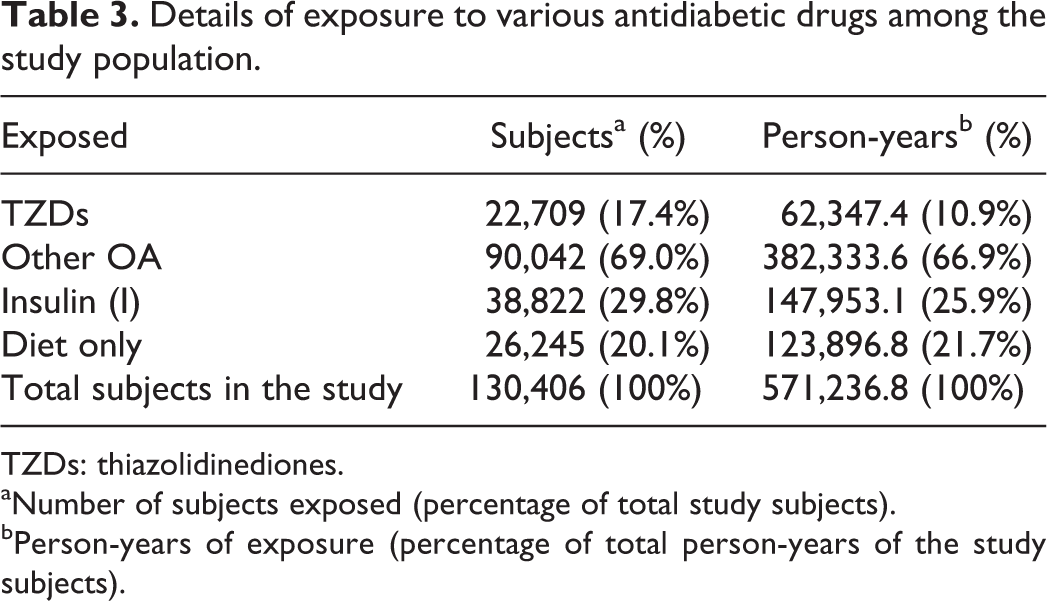
TZDs: thiazolidinediones.
aNumber of subjects exposed (percentage of total study subjects).
bPerson-years of exposure (percentage of total person-years of the study subjects).
Multivariate Cox regression results.
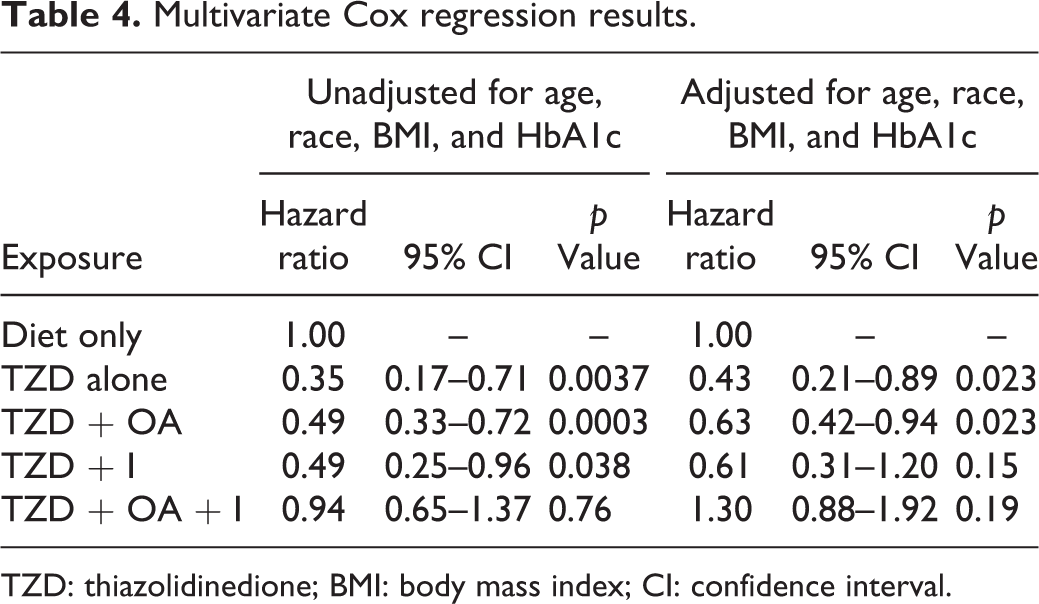
TZD: thiazolidinedione; BMI: body mass index; CI: confidence interval.
Discussion
PPAR-γ ligands have been implicated in cell differentiation, growth inhibition, cell proliferation, and carcinogenesis. 5 -7 These ligands activate PPAR-γ, a receptor that was first recognized in 1983. PPAR-γ plays the most important role in carcinogenesis. PPAR-γ is highly expressed in adipose tissue, where it modulates gene expression and induces cell cycle arrest and differentiation of adipocytes. PPAR-γ agonists induce adipocyte differentiation. 5 -7 There are many natural and synthetic PPAR ligands. 8 The synthetic ligands of clinical importance are fibrates, which are PPAR-α ligands used to treat hyperlipidemia, and PPAR-γ ligands such as TZDs, which are antidiabetic agents and nonsteroidal anti-inflammatory agents.
The TZDs are the first synthetic PPAR-γ ligands that have been studied for inducing differentiation of liposarcoma cell lines and also in preliminary clinical studies in patients with liposarcoma. 5 The proposed antineoplastic mechanisms described are proteasomal degradation of the cyclins D1 and D3, TRAIL-induced apoptosis, upregulation of Phosphatase and tensin homolog/5′ AMP-activated protein kinase pathway, downregulation of alpha serine/threonine-protein kinase (AMPK)/ mechanistic target of rapamycin (mTOR) p70S6 signaling cascades, and induction of the early growth response-1 gene. 9,10 PPAR-γ forms heterodimers with retinoid X receptor α (RXR-α) that bind to distinct DNA sequence elements called DR-1 sites, resulting in downstream signaling and activation of genes. 11 This binding releases co-repressors and triggers the binding of positive cofactors, resulting in acetylation of histones and opening up of chromatin for more efficient transcription. 12 The heterodimerization of retinoic acid receptor (RAR)/RXR-α also plays a role in the action of retinoic acids, which have been extensively investigated and targeted in prevention trials of head-and-neck and lung cancers. 13 Heterodimerization with RXR and the similarity in the action of TZD and retinoic acid suggest that both may have similar preventive effect on the development of various malignancies. The antineoplastic effects are in part mediated through their PPAR ligand activity and partly through actions independent of the PPAR pathway. 14 -17 The similarities between lung cancer and head-and-neck cancer with respect to risk factors such as smoking led to our hypothesis that a preventive effect of TZDs exists in head-and-neck cancer, just as it does in lung cancer. Our study was designed to evaluate the preventative effect of TZDs on the development of head-and-neck cancer in diabetic individuals. This is the first published study to evaluate the efficacy of TZDs in preventing the development of head-and-neck cancer in humans. There was a statistically significant decrease in the incidence of head-and-neck cancer in our patient population.
Metformin use has been associated with decreased incidence and delay in progression of head-and-neck cancer. 18 -20 The decrease in the HR with the use of TZDs was comparable to that of metformin, and the benefit was not lost when a TZD was administered in addition to other antidiabetic agents. However, the beneficial effect was lost when a TZD was administered in addition to insulin, raising the question as to whether this is a true antagonistic effect or is it due to a masking effect of one drug over another agent. There are studies suggesting the increased incidence of breast cancer in subjects exposed to insulin. 14-17 Insulin-like growth factor receptor is overexpressed in head-and-neck cancer, and a high serum level of insulin-like growth factor-1 is associated with higher incidence of second primary tumors in subjects with head-and-neck cancer. 21 In our study, the beneficial effect of TZDs was even more significant when combined with metformin. It has been observed that the incidence of breast cancer decreased with exposure to metformin, which may be due to the in vitro and in vivo antitumoral effect through a decreased cyclin D1 level. 21 Further research needs to determine whether the exaggerated efficacy of TZDs with metformin is due to an additive effect.
Although ours is an observational study of retrospective nature, there are some strengths to the methodology used. Because the database for the study is obtained from a single large uniform electronic patient record system covering veterans hospitals in the United States, all patient records including diagnosis and prescriptions are entered into the database in a real-time manner, though it has some limitations. The information obtained from patient records were not generated with the intention of conducting a clinical study. The data are dependent upon health-care staff entering the information in the database and thus is subject to individual variations. Access to pharmacy records was limited to first issue date, which did not allow us to evaluate the duration of treatment with the drug. Due to the same reason, combinations of TZDs with other agents may sometimes reflect drug-for-drug substitution rather than true combination. This would not prove the efficacy of TZDs alone and in fact would diminish rather than enhance the efficacy of TZDs in the given clinical setting. Any bias associated with the inability to evaluate treatment duration should be “bias toward the null,” leading to an underestimation of the actual TZD effect. The fact that we nonetheless observed a statistically significant reduction in cancer risk with TZD exposure is therefore encouraging. Another limitation is the data on smoking, since there is no diagnostic code for smoking and the data are in free text, which is dependent on the provider entering the relevant information, and is difficult to extract accurate data. There is no reason to believe that there is discrepancy between TZD users and nonusers.
The use of TZDs is not without associated side effects such as abnormalities in liver function test, and the recent finding of possible cardiovascular side effects of glitazones should be kept in mind while designing such studies. 22 -26 There is also a potential of the development of new cancers, since these drugs may have carcinogenic potential, as evidenced by an increased incidence of polyps in APCMin/+ mice when they are administered at low doses. 22 -26 There are published reports of increased incidence of bladder cancer in subjects exposed to TZDs, which may also be dependent on the duration of exposure. 22 -26 At the present time, there is sufficient preliminary data available to explore further the role of PPAR-γ ligands in carcinogenesis. Such studies should include prospective double-blind studies using PPAR-γ ligands in cancer prevention. These studies should be conducted in patients at high risk of developing head-and-neck cancer and lung cancer, those who are heavy smokers, and those who are screened for cancer after the development of premalignant conditions such as leukoplakia.
Footnotes
Author note
This work was presented as an oral presentation at the 43rd annual meeting of the American Society of Clinical Oncology, 2007, Chicago, IL.
Declaration of Conflicting Interests
The author(s) declared no potential conflict of interest with respect to the research, authorship, and/or publication of this article.
Funding
The author(s) received no financial support for the research, authorship, and/or publication of this article.