




Abstract
This study draws on framing theory to argue that the language used by women politicians may make them more effective in achieving their goals. Large numbers of voters around the world perceive men to be more effective political leaders than women. However, this study of the communications of women and male governors in the United States finds that the opposite is true and that women governors emphasize cooperation and compromise much more when communicating, which could be a factor in their greater efficacy. An analysis of 1,088 policy proposals made by governors in their State of the State addresses finds that women enacted their proposals into law at 1.2 times the rate of their male counterparts. An analysis also finds that, between March 2020 and February 2021, states with women governors had significantly fewer excess deaths due to the coronavirus disease 2019 (COVID-19) pandemic and significantly lower unemployment rates than states with male governors. Analyses of speeches and tweets by governors find that women governors use significantly more communal, cooperative language than their male counterparts, and these frames might catalyze more communal behavior by partners and constituents and thereby help explain their greater efficacy.
Introduction
Our society’s widespread belief that men are more effective leaders than women is one of the factors that can help explain why men are overrepresented in political office. In 2019, 47% of the people on earth believed men are better political leaders than women, according to UN Women (2020). A significant academic literature likewise confirms that voters perceive male leaders to be more effective than women leaders (Huddy & Terkildsen, 1993; Lawless, 2004; Paul & Smith, 2008).
However, these perceptions are notably at odds with an expanding academic literature which finds that when women hold office, they are more successful than their male counterparts (Anzia & Berry, 2011; Cain & Kousser, 2004; Thomsen & Sanders, 2020; Volden & Wiseman, 2011). This study is designed to contribute to answering the important question of what qualities voters should look for when selecting political candidates to support. In particular, it suggests that the way politicians frame issues by selecting the language used in their political communications such as speeches and social media posts might have a significant impact on their efficacy by affecting the responses of other politicians and partners as well as their constituents.
This study analyzes the speeches and tweets of women and men governors in the United States, documenting that women governors are more successful at achieving their legislative goals than their male counterparts, and that their greater success is correlated with a more communal and cooperative approach in their communications.
We start by applying the lens of gender to one of the largest, most comprehensive, and most reliable studies of the efficacy of American governors ever conducted. Kousser and Phillips (2012) analyzed more than 1,000 policy proposals made by 28 governors in State of the State addresses in 2001 and 2006 to determine the rates at which their proposals were implemented into law. Using these data, this study documents that women governors were more likely than their male counterparts to achieve their legislative goals.
This study also begins to explore why this might be the case, using a content analysis of 85,244 words delivered by the women governors who were included in Kousser and Phillips’ (2012) study in their State of the State addresses during this time period, along with a content analysis of 88,945 words delivered by male governors who served in the same states as the women during the time period covered by the study. We find that the women were far more likely to use communal language and to discuss cooperation.
A second study replicates these findings in a markedly different context. We find that, in a time of unusual crisis—the first year of the COVID-19 pandemic—US states that were led by women on average had both lower rates of excess deaths and lower unemployment rates than did states that were led by men.
We then analyze 3,535 tweets by governors to try to ascertain qualities that could help explain these differences. We compare the tweets of a sample of six women governors with those of six male governors whose states performed especially poorly during the pandemic to try to determine why the women were more successful. We find that the women governors were significantly more likely to use frames that women in our society are typically socialized to draw upon. They were far more likely to tweet about cooperation and compromise, the welfare and feelings of others, and avoiding risks. They were also more likely to acknowledge when an issue did not fall under their purview. By contrast, their male counterparts were far more likely to express confidence. The women’s greater focus on cooperation in their frames may have catalyzed the very collaborations needed from their audiences to achieve their goals.
While further research should explore whether there is a causal link between communal language and greater electoral success, this study suggests that voter preferences may be misguided and that electing people of all genders who display the communal behavior that women in our society are socialized to exhibit could make our political leaders more effective.
Literature review
This study explores the correlations between gender, frames used in political office, and success in political office. There are few biological differences that can explain the different social and political behaviors of men and women (Saini, 2018). However, from infancy, girls and boys are socialized to display different behaviors. Girls and women are socialized to be relational, cooperative, and communal, while boys and men are socialized to be more independent and confident (Gilligan, 1982).
This affects the ways in which we communicate. Kirtley and Weaver (1999) argue that self-perception of gender roles is the “predominant referent for how people see themselves interacting with others.” They found that females indicate that they communicate in a more “relational, socially oriented manner” than males, whose communications are more “direct and results-oriented.” However, Canary and House (1993) describe the literature on communication differences by sex as being in a “state of incoherence.” One issue, they found, was the lack of theory on the subject—a problem this study seeks to begin to remedy.
Bakan (1966) coined the terms communion and agency to describe individuals’ social behavior. Decter-Frain and Frimer (2016) define communion as “a desire to get along and be a part of a larger social or spiritual entity. It is concern for friendliness, helpfulness, sincerity, trustworthiness, togetherness, solidarity, and intimacy.” They define agency as a “desire to get ahead and differentiate oneself from others . . . It is a concern for competence, intelligence, skill, creativity, achievement, power, mastery, and assertiveness.” Research finds that communion and agency are the primary dimensions on which people judge one another (Fiske et al., 2002; Rosenberg et al., 1968).
Research in contexts outside of politics finds that women use and are described with more communal language than men, and that it serves to disadvantage them. For example, Ng et al. (2020) find that women use more communal language than men on their resumes, and that the use of such language causes women to be perceived as having less leadership ability and less “hireability” for traditionally male jobs. Madera et al. (2009) find that, in letters of recommendation for academic jobs, women are typically described as having more communal attributes, and that this makes them less likely to be hired. McClean et al. (2022) find that women are more likely to have their ideas endorsed when they use the agentic voice stereotypical of men, while men are more likely to have their ideas endorsed when they adopt the communal voice expected of women. However, there is not an established literature on how this is linked to particular political outcomes.
What is largely missing in this literature is comparisons of the rhetoric of women and male politicians. Dow and Condit’s (2005) review of feminist scholarship finds that “the study of women as public communicators is one of the most visible legacies of the emergence of feminism in the field of communication” (p. 450). However, past studies have tended to focus on how rhetoric has been used to advance feminist goals (Zaeske, 2002; Huxma, 2000; Borda, 2002; Demo, 2000; Foss & Domenici, 2001). Dow and Condit (2005, p. 466) find that “we have relatively few analyses of dominant political discourse.”
For example, Hayden’s (2003) feminist analysis of the Million Mom March describes how referring to the nation as a family—a clearly communal approach—was politically effective, yet notes that the efficacy of these types of maternal appeals is often discounted by scholars. Other research has documented differences in the appeals, use of negativity, and discussion of issues of woman and male politicians—but did not explore their use of communal language (Robertson et al., 1999).
Overall, there is a limited literature on the use of communal language by politicians. Decter-Frain and Frimer (2016) find that the use of communal language by members of Congress is not more likely than the use of agentic language to meet with public approval. However, they find that expressions of communion—which communicate both belonging and helping—by members of the US Congress are more likely to meet with public approval than the use of agentic language. They find that expressions of tentativeness by members of Congress—using words such as “perhaps” or “maybe” rather than exuding confidence—are the word category most strongly associated with increased public opinion.
Similarly, Frimer et al. (2015) find that the use of prosocial language by members of Congress is strongly associated with increased public approval ratings 6 months later. “These results suggest that both individuals and governments can gain social approval by merely talking about cooperating and about helping others,” they report. The results are so profound that they argue that reduced prosocial language by members of Congress can help explain the large decline in public opinion toward Congress over the previous decade.
Conroy and Green (2020) find that women who express interest in running for office are significantly more likely to use agentic, rather than communal, language than are women who do not express interest in running for office. This suggests that women who are interested in attaining political office adopt behaviors typically associated with men to achieve success—a phenomenon also documented in other research (Oliver & Conroy, 2018).
One reason they do so is to try to overcome what Jamieson (1995) calls the “double bind” that women face: the perception that a person cannot be both feminine and competent. On top of this, women politicians face another challenge when they speak in public. Campbell and Jerry (1988) argue that public speaking has been traditionally viewed as a masculine domain because stereotypes of speakers are that they “call attention to themselves, aggressively take stands, [and] affirm their expertise”—all of which are traits associated with men.
These gender stereotypes can help explain why voters perceive men to be better politicians than women (Huddy & Terkildsen, 1993; Lawless, 2004; Paul & Smith, 2008). Yet a significant literature suggests these perceptions are mistaken. A growing body of work finds that women perform better than men in political office.
This is partly due to the bias that women politicians face. Anzia and Berry (2011), for example, argue that women politicians are more successful because, due to widespread voter prejudice, only the most exceptionally talented women are ever elected to office in the first place. This phenomenon is known as the “Jill and Jackie Robinson effect.”
Research also suggests that the qualities that women are socialized to exhibit in our society may make them more effective politicians. Importantly, previous research finds that women legislators are more likely to try to build consensus, which can contribute to their success in some contexts. Volden et al. (2013) find that, when women serve in the minority party in the House of Representatives—a role in which it is necessary to work cooperatively and build coalitions to achieve their policy goals—women see the bills they sponsor through to later stages of the legislative process than do their male counterparts. Women in Congress also participate more than their male counterparts in legislative debates (Pearson & Dancey, 2011). Thomsen and Sanders (2020) find that women who serve as state legislators respond to requests by their constituents more than do their male counterparts.
These more cooperative and communicative approaches are associated with greater policy success. Researchers have found that women politicians are more likely to get their legislative proposals passed (Cain & Kousser, 2004; Kousser, 2005; Volden & Wiseman, 2011). Anzia and Berry (2011) found that women in Congress on average get about 9% more money earmarked by Congress for their districts than do their male counterparts. Once elected, women legislators are more likely than are their male counterparts to prioritize critical issues, such as health care, the environment, education, social services, and issues related to children (Barnes et al., 2021; Darcy, 1996; Little et al., 2001).
Their greater success can have an enormous impact on the lives of their constituents. In the first months of the COVID-19 pandemic, countries with women leaders had half as many pandemic-related deaths as did those led by men (Garikipati & Kambhampati, 2021). In diverse nations, countries with women leaders have GDPs that are on average 6.6% higher than those led by men (Perkins et al., 2013). Also, in countries that suffer from conflict, including women in the peace process significantly increases the likelihood that a peace deal will be brokered and that it will be sustained (O’Reilly et al., 2015).
Analyses such as this study of the relationship between gender, language, and political success are critical to women’s political fortunes. Robson’s (2000) feminist analysis of politician Barbara Mikulski argues that “our failure to document . . . accomplishments by women too often results in other women having to reinvent the wheel.” This study seeks to begin to remedy this lacuna.
Framing theory
The central framework of this study is framing theory. According to Entman’s (1993) seminal definition, to frame is to select some aspects of a perceived reality and make them more salient in a communicating text, in such a way as to promote a particular problem definition, causal interpretation, moral evaluation, and/or treatment recommendation for the item described. (p. 52)
Research finds that the way that topics are described can have a profound effect on the public’s views of those topics and their subsequent behavior. This is because the public does not generally have well-developed views on many issues, and people’s views are therefore heavily determined by the ways in which politicians, journalists, and other actors communicate (Iyengar, 1991; Kahneman & Tversky, 1984; Zaller, 1992). As a result, “the frame determines whether most people notice and how they understand and remember a problem, as well as how they evaluate and choose to act upon it” (Entman, 1993, p. 54).
Scheufele (1999) notes that sources that influence frames include journalists and “political actors, authorities, interest groups, and other elites” (p. 115). With respect to political actors, Entman (1993) notes that “politicians seeking support are . . . compelled to compete with each other and with journalists over news frames . . . Framing in this light plays a major role in the exertion of political power” (p. 55).
This study analyses the way the frames of male and female politicians are correlated with their efficacy. According to Entman (1993), “analysis of frames illuminates the precise way in which influence over a human consciousness is exerted by the transfer (or communication) of information from one location-such as a speech, utterance, news report, or novel- to that consciousness” (pp. 51–52).
Framing theory has the advantage of being extremely well developed and right in the center of the sphere of consensus (Hallin, 1989).
Methodology
We conducted two studies to compare the efficacy of women and men governors in different time periods and different contexts. We also assess differences in their public communications that could explain the differences in their efficacy.
Study 1: State of the State addresses
Political scientists Kousser and Phillips (2012) conducted one of the most detailed studies ever to analyze the efficacy of American governors. They examined 1,088 policy and budgetary proposals made by governors in 28 states in their State of the State addresses in 2001 and 2006 to determine how successful they were at delivering on their promises. The researchers provided their data to us for the purpose of analyzing gender differences.
Using these data, we determined that women governors had a higher success rate than male governors at getting their proposals passed. To determine why this may have been the case, we analyzed State of the State addresses delivered by governors who were included in the original study.
There were four women serving as governors of states included in the original study. In the 2001 data, there was one woman governor: New Hampshire governor Jeanne Shaheen. In the 2006 data, there were three female governors: Hawaii governor Linda Lingle, Kansas governor Kathleen Sebelius, and Michigan governor Jennifer Granholm. None of these four women were in office in both 2001 and 2006, so each of the states had both a woman and a male governor during the time period studied.
We therefore analyzed five State of the State addresses per governor that were delivered by all four women governors and the four male governors who served in the same states during the years 2001 and 2006: New Hampshire governor John Lynch (who was in office in 2006), Hawaii governor Ben Cayetano (who was in office in 2001), Kansas governor Bill Graves (who was in office in 2001), and Michigan governor John Engler (who was in office in 2001).
For each governor included in the study, we compiled the State of the State addresses delivered in the years that were closest to those analyzed in the original study (2001 and 2006). In New Hampshire, we used inaugural speeches (which served as the State of the State addresses) for the years 1999, 2001, 2005, and 2007. In Kansas, the State of the State address is sometimes alternately called the Budget Address.
In total, we coded 85,244 words delivered by women governors in their speeches and 88,945 words delivered by men in their speeches.
This study was designed to investigate whether frames emphasizing cooperation catalyzed the cooperation that the politicians needed to achieve their goals. We therefore coded the number of times that each governor used the word “we,” the number of times each governor used the word “I,” and the number of times each governor discussed cooperation.
A human coder was used to avoid possible errors of interpretation by a machine. The coder was a research assistant. To ensure the reliability of coding and mitigate potential biases of the research assistant, the principal investigator established an open dialogue to discuss any questions and make coding decisions jointly in the rare instances in which the intended meaning of content was open to interpretation.
Study 2: Tweets
We analyzed the unemployment rates for all 50 US states between March 2020 and February 2021 to compare the rates for states that had women governors with those of states that had male governors.
Unemployment rates
We calculated the percentage of the national average that the unemployment rate was in each of the 50 states in the United States for each month during this year, using data from the Bureau of Labor Statistics. We calculated this by obtaining the unemployment rate in each state for each month. The average monthly unemployment rate in each of the 50 states during this year was 7.72 (this figure was calculated by taking the sum of the unemployment rate in all 50 states in all 12 months and dividing it by 50 and then dividing it by 12). We then calculated the percentage of the national average that the unemployment rate was in each state for each month by taking the unemployment rate in each state for each month and dividing it by 7.72. We calculated the average (mean) percentage for each state for the year by adding the averages for each of the 12 months and dividing the sum by 12.
Excess deaths
We also analyzed the number of excess deaths due to COVID-19 there were in each of the 50 states during each week of the time period of March 2020–February 2021. We obtained the rate of excess deaths in each state using the Centers for Disease Control and Prevention (CDC) chart of National and State Estimates of Excess Deaths. The average weekly excess death rate in each of the 50 states during this year was 16.50 (this figure was calculated by taking the sum of the excess death rate in all 50 states in all 52 weeks and dividing it by 50 and then dividing it by 52). We then calculated the percentage of the weekly average that the excess death rate was in each state for each week by taking the excess death rate in each state for each week and dividing it by 16.50. We calculated the average (mean) weekly excess death rate for each state for the year by adding the averages for each of the 12 months and dividing the sum by 52.
As reported in the “Results” section below, we found that states with women governors had on average lower unemployment rates and lower excess death rates due to COVID-19. To explore why this might be the case, we compared the tweets of a sample of women and male governors.
Selection of governors
There were 11 women governors in office in March 2020, 9 of whom were Democrats and 3 of whom were Republicans. We excluded the women governors of Washington, DC and Guam from this analysis to compare the governors of states with one another. To compare an equal number of Republican and Democratic women, we studied tweets by all three women Republican governors (Kay Ivey of Alabama, Kim Reynolds of Iowa, and Kristi Noem of South Dakota) and tweets of a random sample of three of the women Democratic governors (Laura Kelly of Kansas, Janet Mills of Maine, and Kate Brown of Oregon).
Analyses of tweets
We compared the tweets of these six women governors with tweets of male governors whose states performed particularly poorly during the first year of the pandemic to try to identify the qualities of the women governors that may have made them more successful than the less effective male governors. The posts were made on the social media platform X, which was at the time they were posted was called Twitter.
We analyzed tweets of the three male governors with the highest unemployment rates relative to the national average during this time period. Under Nevada governor Steve Sisolak, the average monthly unemployment rate during the year analyzed was 192% of the national average. Under Hawaii governor David Ige, the average monthly unemployment rate during the year analyzed was 168% of the national average. Under California governor Gavin Newsom, the average monthly unemployment rate during the year analyzed was 143% of the national average.
We also analyzed tweets of the three male governors with the highest average percentage of excess deaths related to COVID-19 during this time period, as reported on the CDC’s chart of National and State Estimates of Excess Deaths. They were Wyoming governor Mark Gordon, whose state had an average excess death rate of 182% of the national average, Mississippi governor Tate Reeves, whose state had an average excess death rate of 173% of the national average, and Arizona governor Doug Ducey, whose state had an average excess death rate of 171% of the national average.
We analyzed a random sample of 25 tweets per month by each of the 12 governors for each of the 12 months between and including March 2020 and February 2021. In instances in which a governor did not tweet 25 times during a particular month, where possible, we added tweets from previous months to analyze 25 for each month (we added half of the tweets from the previous month and half from the subsequent month to reach 25 tweets per month, where possible). We therefore analyzed 300 tweets for each of the governors except for Janet Mills, who only tweeted 260 times during the year analyzed; Kim Reynolds, who only tweeted 286 times during the year analyzed; Mark Gordon, who only tweeted 296 times during the year analyzed; and Tate Reeves, who only tweeted 292 times during the year analyzed. In the cases of the latter four governors, all of their tweets during the year were analyzed.
Since the study was designed to investigate whether frames emphasizing cooperation and associated traits such as compromising and expressing concern for others catalyzed the cooperation that the politicians needed to achieve their goals, each of the tweets was fastidiously coded to determine the number of times the governors discussed compromising, discussed cooperating, discussed avoiding risks, expressed confidence, discussed the welfare of others, acknowledged they were trying something that was unpopular, acknowledged the feelings of others, gave credit to others, acknowledged they were learning, or appealed to a higher (governmental) authority—either asking for help or indicating that a different entity was responsible for what they were discussing.
A human coder was used to avoid possible errors of interpretation by a machine. Once again, an open dialogue was established between the principal investigator and research assistant who conducted the coding to make joint decisions about coding in the rare situations in which the meaning of words was open to interpretation.
Results
Study 1: State of the State addresses
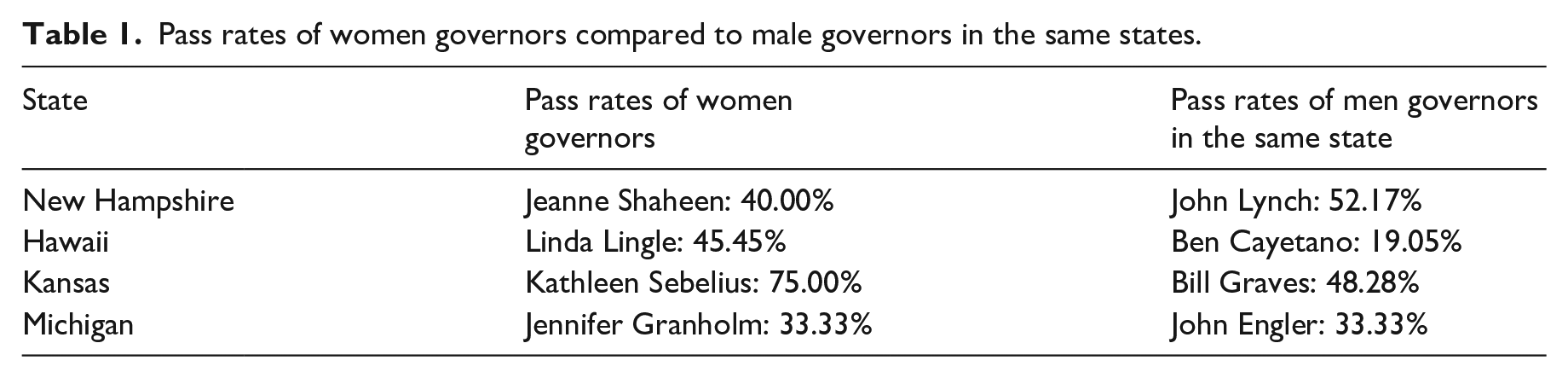
We determined that 48.45% of the proposals by woman governors in the 1,088 State of the State addresses analyzed passed, while 40.2% of proposals by all 24 male governors passed. This meant that women governors delivered on their political proposals at more than 1.2 times the rate of their male counterparts.
As recorded in Table 1, in two of the four states that had both a man and a woman governor in the years 2001 and 2006, the women governors had significantly higher rates of passing their proposals into law than did their male counterparts in the same state, while in one state, the pass rates of the man and woman governor were the same. In Hawaii, Linda Lingle’s pass rate was 45.45%, which was 2.39 times the 19.05% pass rate of her male counterpart, Ben Cayetano. In Kansas, Kathleen Sebelius’ pass rate was 75.00%, which was 1.55 times the 48.28% pass rate of her male counterpart, Bill Graves. In Michigan, Jennifer Granholm had a pass rate of 33.33%, which was the same as the pass rate of her male counterpart, John Engler. However, in New Hampshire, John Lynch had a pass rate of 52.17%, which was 1.3 times the 40% pass rate of his woman counterpart, Jeanne Shaheen.
Pass rates of women governors compared to male governors in the same states.
We also determined that women governors were more likely to use communal frames. As indicated in Table 2, women governors used the word “we” 1,532 times in the 85,244 words by women coded, for a rate of 0.018. Male governors used the word “we” 1,411 times in the 88,945 words by men coded, for a rate of 0.016. The difference is statistically significant.
Use of communal language in state of the state addresses by women and male governors.
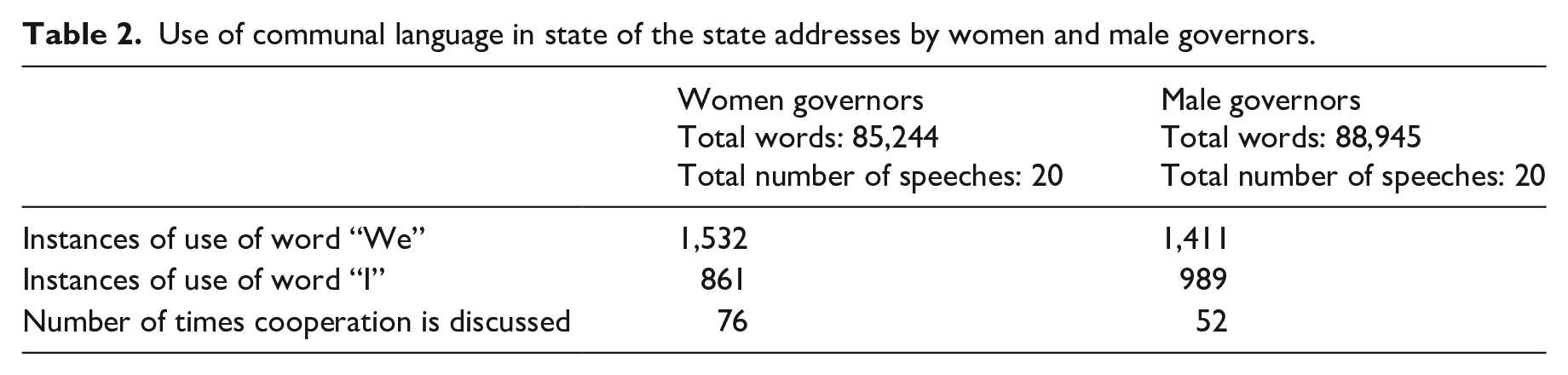
Male governors, by contrast, were somewhat more likely to use individualistic language. Male governors used the word “I” 989 times in the 88,945 words by men coded, for a rate of 0.011. Women governors used the word “I” 861 times in the 85,244 words by women coded, for a rate of 0.010. The difference is statistically significant.
Women governors were also more likely to discuss cooperation. Male governors discussed cooperation 52 times in 20 speeches, for a rate of 2.6. Women governors discussed cooperation 76 times in 20 speeches, for a rate of 3.8—nearly 1.5 times that of their male counterparts. “We have a lot of work to do,” Kansas Gov. Kathleen Sebelius said in her 2003 speech: We have hard work to do. But we can do it. We have the ability, the energy, and the expertise in this chamber, right now, to overcome our problems. But we will only overcome these problems if we act as Kansans—not Democrats or Republicans, conservatives or progressives—but Kansans, first. And we will only overcome these problems if we face them together.
Similarly, in her 2003 address, Michigan Gov. Jennifer Granholm said, “I applaud the Republican leadership of Senator Sikkema and Speaker Johnson for their willingness to work with this Democrat and Michigan’s Democrats, to move beyond partisanship, faction, friction and ego to achieve common ground.”
Study 2: Tweets
The average unemployment rate was lower in the 9 states with women governors than in the 41 states with man governors. The average unemployment rate in states with woman governors was 7.15, which was 93% of the average monthly unemployment rate in the 50 states. The average unemployment rate in states with man governors was 7.85, which was 102% of the average monthly unemployment rate in the 50 states.
The average excess death rate due to COVID was also lower in the 9 states with women governors than in the 41 states with man governors. The average excess death rate in states with women governors was 14.04, which was 85% of the national average. The average excess death rate in states with man governors was 17.04, which was 103% of the national average.
The content of the governors’ tweets reveals stark differences that could help explain the women governors’ higher levels of efficacy. Table 3 indicates the total number of instances in which the women governors and male governors discussed compromise, discussed cooperation, discussed avoiding risks, expressed confidence, discussed the welfare of others, acknowledged that they tried something unpopular, acknowledged the feelings of others, gave credit to or thanked others, acknowledged that they learned, and appealed to a different authority which they indicated had jurisdiction over the issue they were discussing.
Total number of instances in which politicians display behaviors in analyzed tweets.
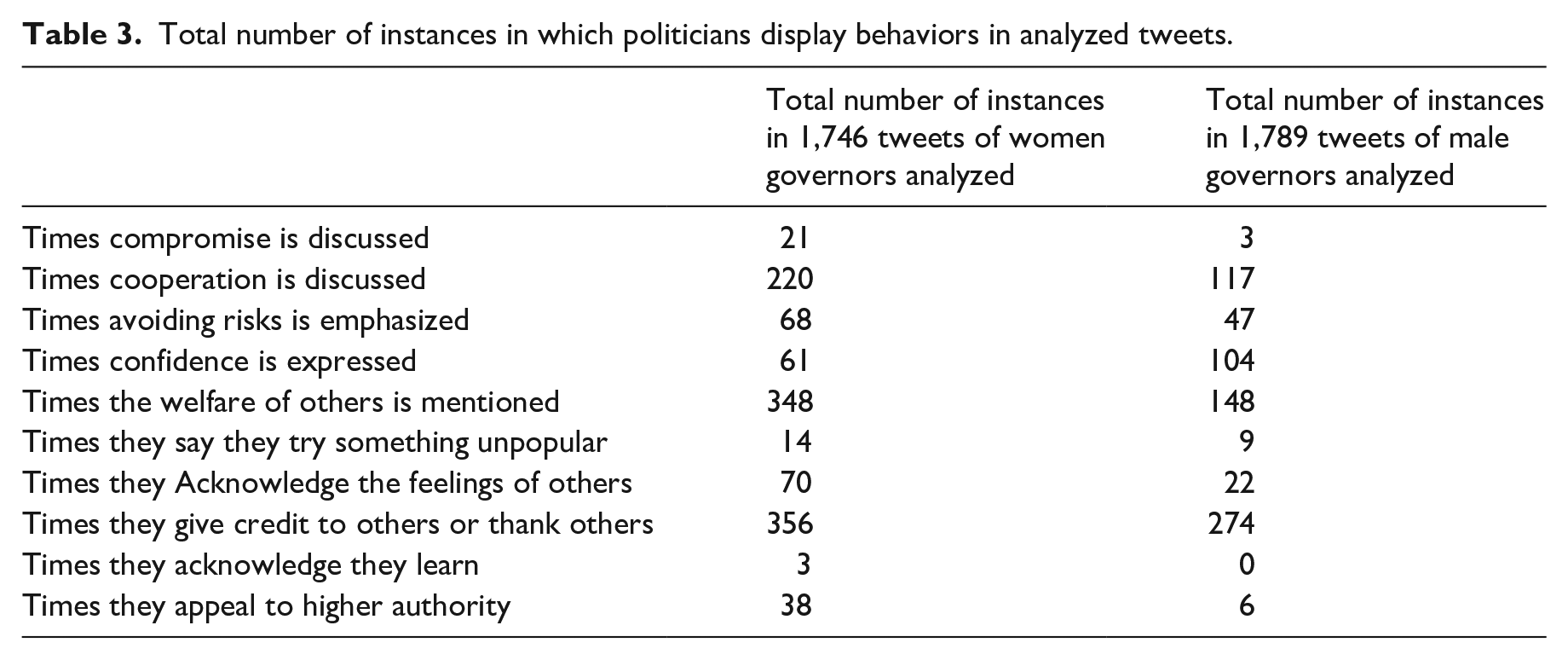
The rate at which the politicians displayed these behaviors was calculated by dividing the number of instances in which women governors displayed these behaviors by the number of tweets of women governors analyzed. The same calculation was made for the male governors. These results are displayed in Table 4.
Rate at which politicians display behaviors in analyzed tweets.
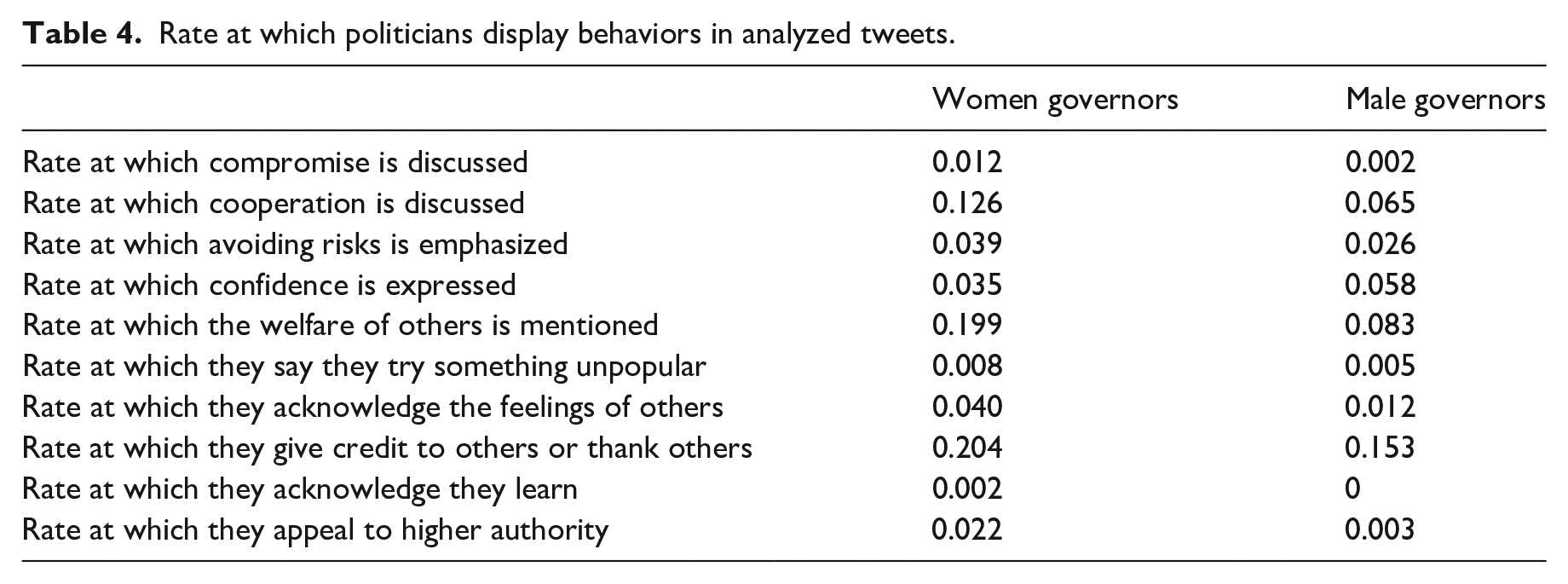
The results indicate that the women governors discussed compromise at six times the rate of the male governors. For example, Gov. Kate Brown tweeted, “We can both protect Oregon’s environment and foster economic growth for our rural communities. I’d like to thank both sides for their commitment to this historic process we began together in February.” Similarly, South Dakota Gov. Kristi Noem tweeted, Today, it’s my hope that the South Dakota legislature can set aside personal agendas and reject ideological fights. Our people are counting on us to work together, to take this finite amount of money and help as many of our citizens as we can within Treasury’s parameters.
Women governors discussed cooperation at 1.94 times—nearly double—the rate of their male counterparts. For example, Maine Governor Janet Mills tweeted, “This virus knows no state borders. I am grateful to my fellow governors for their coordination and partnership as we work together to protect the health and safety of our people.” Similarly, in a tweet chain about funding for public schools, Iowa Gov. Kim Reynolds tweeted, “Let’s work together to make sure every child receives a quality education, regardless of income, and no matter their zip code.”
Women governors discussed avoiding risks at 1.5 times the rate of their male counterparts. For example, Oregon Gov. Kate Brown tweeted, “We must continue to keep each other safe by wearing masks, avoiding gatherings, and maintaining distance.” Similarly, Maine Gov. Janet Mills tweeted, “We also believe that it is appropriate to delay the reopening of gyms and nail salons, which appear to present a greater risk of transmission of the virus based on emerging science and the experiences of other states.”
Women governors mentioned the welfare of others at 2.4 times the rate of male governors. For example, Kansas Gov. Laura Kelly tweeted, This virus has been especially difficult for families who’ve sacrificed so much to protect their elderly loved ones. We cannot let these sacrifices go to waste, which is why we must continue to wear a mask & social distance to beat this virus.
Similarly, Oregon Gov. Kate Brown tweeted, “When the next Cascadia earthquake and tsunami strike, Oregon will face one of the greatest challenges of our lifetimes. It’s never too early to start the conversation about how your family can be safe and #twoweeksready.” Women governors indicated they would try something that was unpopular at 1.6 times the rate of the male governors, but this result was not statistically significant.
Women governors acknowledged the feelings of others at 3.33 times the rate of their male counterparts. For example, Oregon Gov. Kate Brown tweeted, “It’s hard to be separated from classmates, friends, or family. You may feel lonely. Know you’re not alone. We’re all in this together, and staying connected is more important than ever.” Similarly, Maine Gov. Janet Mills acknowledged, The COVID-19 pandemic has loomed large over our state’s tourism industry. Many Maine people are fearful that more visitors will increase the spread of the virus while many small businesses are fearful that a lack of visitors will force them to permanently close their doors.
Women governors gave credit to or thanked others at 1.33 times the rate of the male governors. For example, Gov. Laura Kelly gave credit to every single person in her state, tweeting: I would like to thank all Kansans for your commitment to the health and safety of your friends, neighbors and loved ones. I know this hasn’t been easy—but without your dedication, we couldn’t move forward in our reopening efforts. We’ll continue to get through this together.
Gov. Kay Ivey of Alabama tweeted, “For #BlackHistoryMonth, we’re highlighting an Alabama leader every Friday. Today, we’re celebrating the accomplishments of Coretta Scott King, a native of Marion, & her lifelong work for racial equality & justice.”
While no male governor acknowledged that he had learned anything, women governors acknowledged learning three times—a result that was not statistically significant.
Women governors appealed to others who were in a position to act at 7.33 times the rate of their male counterparts. Kansas Gov. Laura Kelly tweeted, I just got off the phone with @POTUS & 7 other Governors to provide an update on the challenges Kansas is facing due to extreme weather. President Biden assured us his administration will do everything possible to support our state until we are through this emergency.
Similarly, Maine Gov. Janet Mills called on President Trump to issue a major disaster declaration. “I thank the President for his consideration,” she tweeted.
By contrast, male governors were more likely to express confidence. They did so at 1.66 times the rate of women governors. For example, in a tweet chain stating that the need for COVID measures would soon end, Mississippi Gov. Tate Reeves proclaimed, “We will smash every roadblock and get it done.” Similarly, California Gov. Gavin Newsom tweeted, “Even in the midst of #COVID19, California is better prepared against the threat of wildfire today than at any time in our history.”
Discussion
The results indicate that women governors were more likely to achieve their policy goals than were their male counterparts. The results also indicate that the women governors placed far greater emphasis on cooperation in their frames. In the State of the State addresses, women used more inclusive language in their public addresses and were 7.33 times more likely to acknowledge the limits of their own power by calling on others to act when they had the power or authority to do so. The analysis of tweets similarly indicates that the most successful governors, who were women, were significantly more likely to use frames that women in our society are socialized to draw upon. They talked about compromise, cooperation, avoiding risks, and the welfare and feelings of others. They gave credit to others and acknowledged when they did not have the power to do things. The results suggest that using these types of frames might help improve the efficacy of other politicians (of all genders), as well, by inducing the very cooperation and compromises politicians often require to achieve their goals. By contrast, the women governors’ less successful male counterparts were more likely to express confidence—a trait that men in our society are socialized to exhibit.
This study cannot confirm that the women governors’ more communal frames were the cause of their greater success. Scheufele (1999) notes that frames from politicians compete with frames from other sources, including journalists and pre-existing beliefs. However, it is certainly plausible that this is the case. After all, in our democratic political system, politicians typically need the cooperation of diverse constituencies to get elected. Also, in our system of divided government, politicians typically require cooperation from other parts of government to achieve their goals. In the context of this study, the governors required cooperation from state legislators to secure passage of their proposals into law. Similarly, the COVID-19 pandemic was an unusual situation in which governors needed cooperation from all of society—including other government bodies and officials, businesses, schools, and citizens—to reduce COVID-19 deaths and unemployment. It would therefore make sense that frames focusing on cooperation played a role in catalyzing the behaviors they needed from others to achieve their goals.
It is important to note that, in the study of tweets, the women governors were compared with their least successful male counterparts. We might expect the differences between the women and male governors to be smaller if they were compared with all of their male counterparts.
This study did not analyze the content of the proposals by governors that became laws. However, given the women governors’ greater focus on others, it is also plausible that the laws they passed could have been more responsive to the needs and desires of their constituents than were the laws passed by male governors.
While this study cannot confirm whether these stereotypically feminine frames caused the women politicians’ greater success, the dramatic correlations suggest that the association between exhibiting traits that women in our society are socialized to exhibit using frames emphasizing cooperation and effectiveness in political office warrants much greater investigation in future research. If more communal communications lead to greater policy success, it would be beneficial for politicians of all genders to use these frames that women in our society are typically socialized to draw upon.
While past research has found that women may try to adopt the behaviors of men to achieve political office (Conroy & Green, 2020; Oliver & Conroy, 2018), this study suggests that it is citizens—not women politicians—who should change their behaviors. Voters should rethink their assumptions that men are more competent leaders. This study is one of the several to document that the opposite may be the case. In fact, it suggests that the traits women are socialized to exhibit in their communications may contribute to their greater legislative success.
Conclusion
The results reliably document a significant difference in the efficacy of women and male governors. Women governors were more likely than their male counterparts to deliver on their legislative goals. Women governors were also far more successful than their male counterparts during the COVID-19 pandemic. States led by women had both less excess deaths and lower unemployment rates than did states led by men.
One thing that might help explain these differences in the policy success of women and male leaders is their public communications. We found that the women governors were far more likely than their least successful male counterparts to use frames containing language that women are socialized to use in our society—such as cooperation, compromise, sharing credit and responsibility, and expressing concern for the welfare and feelings of others. It is logical that political leaders who emphasize cooperation would be more successful since in the US political system of democracy and divided government, politicians need the cooperation of many other actors to achieve their goals. This need was especially pronounced during the COVID-19 pandemic.
Future research should continue to examine whether politicians who use communal frames are more successful in other contexts and to explore causal relationships between the use of communal language and success in inducing cooperation from partners and constituents. It would be particularly insightful if additional research were also conducted in a range of diverse countries outside of the United States to help elucidate whether the phenomenon is universal across cultures. If the results of this research are replicated in other studies, the implications for framing theory stand to be profound. Documenting a similar effect in other settings would make a powerful case for how the use of effective frames alone can help achieve policy goals, by catalyzing audiences including citizens and other lawmakers to take the actions needed by politicians to achieve their aims. It would suggest that lawmakers should place a much greater emphasis on strategic communications as part of their legislative and other strategies.
However, this research suggests that the bias voters display for male politicians is misplaced—and that politicians of all genders might be more successful if they adopted the frames that women in our society are socialized to use.
Footnotes
Acknowledgements
Allison Millette coded the tweets. Lincoln Anniballi calculated the unemployment and excess death rates and coded the speeches. The author thanks Thad Kousser and Justin Phillips for sharing their dataset, and Craig Burnett for helpful discussions on research design and interpretation.
Data availability
The data used in this research are available from the author on reasonable request.
Declaration of conflicting interests
The author declared no potential conflicts of interest with respect to the research, authorship, and/or publication of this article.
