




Abstract
Based on a theoretical framework of mediatization and framing, this article examines the communication behaviors of leaders from the prominent Palestinian party, Fatah, on social media, with a specific focus on the general election decree of 2021. It involves interviews with journalists and an analysis of social media content to explain how politicians’ online behavior is influenced by the formats of social media content. It shows that Palestinian politicians often use identical content on both Facebook and X (previously Twitter), with a higher frequency of written material over visual content. Politicians use their social media accounts to express their positions on internal and international political affairs. Journalists consider these accounts a source of information, thus reaffirming that political social media is newsworthy for journalists. This article contributes to the study of mediatization that is largely conducted in Western contexts, challenging the notion that mediatization only occurs in highly digitized societies.
Introduction
Mediatization is a comprehensive scientific inquiry approach to address questions related to contemporary media shaping social institutions and influencing their functions, including contemporary political life. It seeks to better understand the impact of media, not at the level of the message or content, but on the function and changing nature of social institutions (Livingstone & Lunt, 2014).
However, mediatization is yet to become a global research approach because of its concentration in the Global North. Many researchers have been influenced by the notion of a connection between highly digital-developed societies and mediatization. This has influenced the mediatization debate, which has become Western-centered. Thus, Western researchers’ conceptualization of mediatization, which connects its process with high levels of digitization, limits the study of mediatization in other parts of the world. The current trend in mediatization studies is clearly influenced by the Western-centric conceptualization of mediatization, which disregards the specificity of mediatization in less digitally developed societies. In contrast to the traditional approach of mediatization research, this article examines mediatization in non-Western contexts by applying a mediatized political analysis in relation to political communication and social media tools.
Mediatization of politics—as one area of inquiry within the mediatization approach—consists of four dimensions that interplay and interact as one: dominance of media as the source of information, degree of media’s independence of political institutions, influence of media and politics logic on media content, and the influence or governance of media and politics logic on political players (Strömbäck, 2008).
This article seeks to contribute to the scholarly debate on mediatized politics and framing of political messages on social media in light of a media logic notion (Altheide & Snow, 1979), through studying the influence of social media logic on political message framing within the Palestinian context.
While Entman’s (1993) conceptualization of framing elements within the four factors (problem definition, causal interpretation, moral evaluation, and recommendation) provided theoretical and analytical frameworks for analyzing news media framing methods, Knüpfer and Entman (2018) noted that fragmented media in contemporary media environment intensified competition over attracting audiences, leading to “selecting and re-framing information—sometimes specifically to engage or establish audiences formerly unaddressed by mainstream journalistic outlets” (p. 482). Technological affordances play an important role in content production. In this sense, Y. Zhang and Trifiro (2022) highlighted the growing relationship between media content and technology, arguing that technological affordance gradually impacts media outlet content production.
Mediatized politics have yet to be studied in the Palestinian context, particularly in relation to the effect of social media on internal political dynamics and its relation to journalists’ work. While many researchers have examined the influence and role of the media, including new media on the Palestinian political struggle for independence (Bishara, 2010; Siapera, 2014; Tawil-Souri, 2015), limited work has examined how media contribute to changing political communication via the digital public sphere in the country. Exploring online media’s influences on the dynamics of Palestinian political communication could explain how social media logic, mainly its content creation rules and formats, contributes to the ways in which politicians’ online messages are framed. These possible influences are at the core of the mediatized politics argument, which puts media logic at the heart of the forces that change political dynamics and communication. Furthermore, the geopolitical location of Palestine, its highly contested internal and external politics, including the conflict with Israel, and its attraction to global politics and media make it an important case study for mediatized politics research.
In this study, mediatized politics in Palestine are examined in relation to a political development in 2021, represented by a presidential decree to hold general elections. It examines the way Palestinian politicians framed and represented the election on their social media accounts. Although the elections were later suspended by the Palestinians because Israel refused to allow them to be held in Jerusalem, the decree by Palestinian President Mahmoud Abbas sparked a series of statements from Palestinian politicians, including leaders from the president’s ruling party, Fatah, on their social media accounts. These statements are at the center of this study, which seeks to explore the reactions of several selected Fatah leaders to the decree on social media platforms, mainly Facebook and X (previously Twitter). In addition, it examined whether local journalists perceive politicians’ accounts as sources of information for their stories. This study focuses on Fatah leaders’ statements and does not include the opposing party’s Hamas leaders’ reactions, for two reasons. First, it intends to understand why and how the ruling party, whose president issued the decree, supported the decision to hold a general election after more than 15 years of not holding general elections (the last parliamentary elections took place in 2006, and the last presidential election took place in 2005). Second, it aims to understand how traditional politicians are adjusting to the new media age, by focusing on Fatah leaders’ presence on social media, which is a relatively new phenomenon for the old guard of the party.
By conducting semi-structured interviews with journalists and applying content-framing analysis to the Facebook and X accounts of a selected number of party leaders, this study examines the extent to which social media rules of content format affect how politicians frame their messages online, and to what extent these accounts are seen as newsworthy and useful sources for journalists covering political news. Specifically, the following research questions were addressed:
Research Question 1 (RQ1). How did the Fatah party leaders frame the 2021 presidential election decree on social media?
Research Question 2 (RQ2). Does social media content format influence politicians’ methods of creating and disseminating their messages?
Research Question 3 (RQ3). Do journalists rely on politicians’ social media accounts as sources of information?
This study hypothesizes that politicians’ utilization of social media for the dissemination of political message(s) is governed by the nature and format of social media platforms, which require diversification of messages that address different audiences, usage of imagery and visual content, dense text, and short messages.
Literature review
Mediatization of politics
The main argument of the mediatization concept revolves around the media’s ability to transform society and its institutions, in which media and its logic become an integrated part of these entities and their daily functions. This transformation not only enables digital media to play a major role in the function of social components, but also forces social institutions and individuals’ communication processes to gradually adhere to the requirements of digital media in terms of form and content. A straightforward conceptualization of mediatization is found in Hjarvard’s (2008) work, where the mediatization of society is defined as the process through which society becomes more dependent on the logic of media, and media is then embedded in the function of social institutions, including politics and its associated communications.
Among the areas of inquiry within the mediatization research approach, is the mediatization of politics, which refers to an ongoing process in which the effect of the media on politics, institutions, and politicians has increased (Strömbäck, 2015). It involves an adjustment of political actions to meet mediation requirements, and refers to “changes in the decision criteria and action rationales of political institutions without turning them into media institutions” (Esser, 2013, p. 160). Furthermore, mediatized politics refers to the way in which political systems adjust to the demands of the media in their coverage of politics (Strömbäck, 2015). The importance of media within the political process is due to their role in providing information, connecting policymakers and citizens, and influencing the formation of public opinion (Strömbäck & Esser, 2014).
Mediatized politics consists of a process in which media systems and tools play a major role in changing the traditional form of political communication. However, it would be incomprehensive if the terms were discussed only in light of the influence of the traditional media. Digital media, including interactive social media platforms, plays a contemporary role in public politics. The integrative aspect of social media, which enables the audience to publicly interact with politicians’ statements, is one aspect of a changed political communication. Similar to traditional media, social media has its own logic (van Dijck & Poell, 2013) of operations as well as particular formats and requirements in terms of content format and interaction with the audience.
It has been proposed that the mediatized political process consists of four dimensions (Strömbäck, 2015; Strömbäck & Esser, 2014); the first is centered on the notion that the media is a major source of information about politics and society, while the second is concerned with media dependency from other social or political institutions. The third dimension refers to how media and political logic guide media coverage of political affairs, whereas the fourth refers to the extent to which political actors’ positions are guided by logic. Political logic consists of three elements (Esser, 2013): policy aspects, politics, and polity aspects. Polity “refers to the system of rules regulating the political process in any given country, including the institutional structure . . . policy refers to the processes of defining problems and forming and implementing policies within a certain institutional framework,” whereas “politics refers to the processes of garnering support for one’s candidacy, party, or political program” (Strömbäck & Esser, 2014, p. 15). Altheide (2015) provides a practical definition of media logic, in which the main principle of this logic is when actors and their functions are governed by the media technology communication formats, where “communication guidelines become institutionalized and taken for granted, serve as an interpretive schema, and guide routine social interaction, and thereby become integral in creating, maintaining, and changing culture” (p. 751). Altheide (2015) does not neglect internet-based media in conceptualizing the notion of media logic, arguing that online media also adapts media logic principles. The inclusion of online media provides a contemporary understanding of media’s influence on society and its institutional functions. However, this influence is governed by other factors, including media independence.
In line with the media influence process, Strömbäck et al. (2011) consider media independence a condition for the existence of the media’s ability to shape its content to meet its needs. They argue that one dimension of the process of media influences “. . . focuses on media content and, more specifically, the extent to which media content is shaped by the media’s own needs, requirements and logics rather than those of other social and political institutions and actors” (Brants & Van Praag, 2017; Mazzoleni, 1987; Patterson, 1993 cited in the work of Strömbäck et al., 2011, p. 4).
Mediatized politics research
Studies of mediatized politics have examined mediatization from different perspectives; some have examined elections and governing institutions from a mediatized politics perspective, while others have employed this approach to understand its effect on public opinion formation and international relations. While Strömbäck et al. (2011) looked at the 2009 European Parliamentary (EP) election campaigns, Kissas (2018) analyzed the 2015 general elections in Greece, where ideology and political discourse were examined in light of mediatization. Another approach provided an analysis of the extent to which the UK government is mediatized, arriving at the conclusion that media influence has become embedded and normalized in governmental bureaucracies (Garland et al., 2018), meanwhile an examination of mediatization within the Arab world, including the role of new media in the process has been conducted by Wiest and Eltantawy (2015).
A public opinion on mediatization influence research was studied by Sacco and Gorin (2017), who examined how mediatized conflict in Syria was perceived by Swiss audiences. Others looked at how the refugee crisis in Europe has been framed and politicized (Krzyżanowski et al., 2018). Similar cases provide an analysis of other countries’ perceptions of crises.
International political relations have had their share of mediatization studies, in which Li (2017) examined Africa–China relations from a mediatization perspective, focusing on how media and communication play roles in the dynamics of this relationship. In this regard, Trenz and Michailidou (2014) argued that mediatization provides a tool for understanding the transformation of international politics and its forms of operation.
An important addition to mediatization research has been found in studies that examine the effect of social media, including their role in contemporary conflicts (S. I. Zhang, 2021), as well as those that provide case studies from the Global South. Within this line of research, Nie et al., (2015) provided an online media content-centric analysis. In this exploratory study, they analyzed political reporting on YouTube in Malaysia. An analytical approach to media structure in the Global South has been examined by Khan (2009), who provides a systemic analysis of Pakistani media through the lens of mediatization.
The mediatization literature addressing the Palestinian context is understandably limited. This is in line with the research trend described earlier, which is the concentration of mediatization research in highly digitized societies, a trend that limited this line of research to Western contexts and excluded the Global South. Nevertheless, some researchers have attempted to fill this gap in mediatization research in the Palestinian context (Shreim & Dawes, 2015).
Social media factor and political communication
Most research on mediatized politics has paid much attention to questions concerning the relationship between traditional media institutions and politics, while little attention has been given to political communication dynamics on social media platforms. Political communication is defined as the “flow of messages and information that gives structure and meaning to the political process” (Pye, 1993, p. 442). Its main goal is to influence the opinions, attitudes, and behavior of the public (Feldman & Zmerli, 2019), and it exists in the everyday utilization of politicians’ social media platforms. The term is perceived negatively as a tool for achieving politicians’ interests, and positively as a vital element of the democratic process (Perloff, 2018).
In the context of changes that impact political communication in light of social media prevalence, questions have been raised regarding how the shift in the media environment, where politicians are increasingly using online communication as part of their strategies, has consequences on political communication (Vowe & Henn, 2016). Others have discussed the influence of this shift on journalism, which has not been able to reinvent itself, while “the most innovative information formats seem to be coming from outside of journalism, ranging from WikiLeaks, to Twitter.” (Bennett, 2017, p. 12).
As a result of the development of the media scene, political communication has changed both horizontally and vertically. The first is centered on media institutions and political players, while the latter is concerned with the process of disseminating political messages from journalists and politicians to ordinary citizens (Tasente, 2014). However, the utilization of social media to achieve these goals via political communication requires mastery of these tools with their own content production requirements and regulations. Altheide’s (2015) and Strömbäck et al. (2011) analysis of media logic, where media formats, needs, and requirements guide media logic, remain valid when applied to online media, including social media platforms. Strömbäck (2008) highlights four aspects of the mediatization of politics, two of which consist of degrees of media independence from political entities in the way they are governed, and two in which media content is governed by either political or media logic.
The independence of traditional media is a controversial concept, and the same applies to social media. Social media has its own logic, and many factors influence its governance and operation. van Dijck and Poell (2013) identify four elements of this logic: programmability, popularity, connectivity, and datafication. They refer to “the principles, mechanisms, and strategies underlying social media logic [which] consist of complex relations between users that use them, technologies that drive them, economic structures that scaffold them, and institutional bodies that incorporate them” (p. 5).
The notion of media’s independence from politics is a required state that enables the media to perform freely from political pressure. However, this does not mean that public or private media, including social media platforms, are ideally objective. The ownership of these media entities contributes to the utilization of media in favor of the owners’ economic or political agendas. Social media logic governed by interactive platform companies’ strategies and mechanisms of interactions (van Dijck & Poell, 2013), in addition to their forms of content regulations—which some see as a form of censorship—is an example of social media’s un-objective interference in society’s institutions, including online politics.
While the discussion of mediatized politics is largely concerned with media independence and its role in transforming political life, few have addressed the effect of media ownership on the political process within its mediatization of politics process. Social media formatting requirements have influenced and reshaped online political communication. For instance, political campaigns are influenced by infrastructural elements of platform design (Bossetta, 2018), namely, digital architecture. Bossetta (2018) argues that network structure, functionality, algorithmic filtering, and datafication are aspects of social media architecture that influence political communication, in which they “impact the decisions that political campaigns make in terms of the audience they try to reach, the form and content of messages they produce, the diffusion patterns of these messages, and how financial resources are allocated for digital campaigning” (p. 32). However, many politicians have not yet mastered the social media games. Giansante (2015) criticizes politicians’ use of the Web in a similar way to traditional media, stating that politicians lack the skills to listen to and interact with users.
Social media is important for politicians, not only because it influences the news process in the phases of production, dissemination, and consumption (Sacco, 2016), but also because of its role in political campaigns. Despite research conducted to examine politicians’ use of social media, it is still unclear how they use social media platforms in their political communication (Stier et al., 2018). While Perloff (2018) suggests that in times of election, mediatization becomes the “coin of the [political communication] realm,” a worldwide phenomenon, he points to previous work (Esser & Strömbäck, 2012; Swanson & Mancini, 1996) in which similarities in media roles were found during election campaigns. These roles are as follows: candidates’ adaptation to news and interactive media needs, journalists’ role in framing political issues, increasing the importance of opinion polling, and personalizing politics.
Although the use of social media has enabled politicians to bypass traditional media gates when interacting with the masses, journalists seek refuge from social media for political statements. The study by Metag and Rauchfleisch (2017) examined how journalists use X (previously Twitter) as a source of information and incorporating politicians’ tweets into news content, with a focus on Swiss journalists. They highlighted that, “if journalists think that Twitter is a reliable tool for journalistic research, an agenda-building influence through political tweets becomes possible” (p. 13).
Method and data collection
This case study-based design is concerned with an in-depth analysis of the phenomenon of online political communication and its associated framed political messages. A case study requires an in-depth analysis of the studied case or individuals within a particular time and setting (Creswell & Creswell, 2023). This qualitative approach employed two data-collection tools: interviews and social media content extraction. As Creswell (2013) explains, qualitative research usually relies on multiple forms of data, such as interviews, observations, and documents.
While extracting and analyzing the contents of the selected politicians’ social media accounts provided answers to RQ1 and RQ2, which address the framing of the election decree and how social media formats affect the dissemination of these messages, interviewing journalists provided answers to RQ3, which concerns journalists relying on social media for political statements.
Content-framing analysis
A content-framing analysis of four Fatah leaders’ personal accounts on Facebook and X, along with an examination of the party’s official accounts on both platforms, was selected for analysis. The selection was based on their online presence, particularly on the aforementioned social media sites, senior positions at the party, and available online comments on the election decree.
The selection included Mohammad Shtayyeh, a member of Fatah’s Central Committee (the highest council of the party) and the current Palestinian Prime Minister; Mahmoud Aloul, Deputy Head of the Central Committee; Jibril Rajoub, Secretary-General of the Committee; and Hussein Al- Al Sheik, member of the Committee, also serving as the Secretary-General of the Executive Committee of the Palestine Liberation Organization. Data analysis relied on thematic analysis, which interpreted the visual and textual data into codes and themes.
All election-related posts and tweets were collected for 26 days between January 15, 2021 (when Palestinian President Abbas issued the election decree) and February 10, 2021. While coding the content, 25 topics were identified.
Following Matthes and Kohring’s (2008) model, single-frame elements were grouped systematically, where the author combined each thematic category from the corresponding social media posts into the corresponding elements. Matthes and Kohring (2008) justified this process by arguing that “some elements group together systematically in a specific way, they form a pattern that can be identified across several texts in a sample. We call these patterns frames” (p. 263).
A second step of coding was based on Entman’s (1993) conceptualization of framing that defines the process as selecting “some aspects of a perceived reality and make them more salient in a communication text, in such a way to provide a particular problem definition, causal interpretation, moral evaluation, and/or treatment recommendation” (p. 52). The topics identified in the social media content, which were later thematically grouped, were placed in a table where they were discussed in terms of Entman’s framing elements.
The grouped themes were discussed in terms of framing elements, content distribution on both platforms, forms of content, and addressing different audiences. The collected content was coded in terms of visuals, short sentences, and interactions with users.
Interviews
Interviews were conducted with three political news editors from publicly owned media institutions: the Palestine News and Information Agency (Wafa), the Palestinian Public Broadcasting Corporation (PBC), and the Al-Hayat Al-Jadida daily newspaper, in addition to an interview with Fatah’s former social media manager.
Interviews were used as a tool for data collection to provide Palestinian journalists with the possibility to explain their experiences with political social media content. This tool helps answer RQ3, which concerns whether journalists rely on politicians’ social media accounts as a source of information. These semi-structured interviews helped determine how important and newsworthy the content of the social media accounts of these select leaders were for news editors. They helped journalists gain a better idea for incorporating this online content into their story coverage.
Moreover, conducting these interviews was related to the importance of knowing the editors’ perspectives on how the format of social media platforms affects politicians’ messages in terms of shape and idea. The interviewees were asked to provide consent based on their answers, and they all agreed. The author does not identify the names of the interviewees. Only the initials were used in the writing process.
Results and discussion
This study analyzed the reactions of four Palestinian Fatah Party Central Committee members in terms of how they framed the 2021 presidential decree announcing parliamentary and presidential elections, by examining their social media accounts. The period of analysis was 26 days, from January 15, 2021 to February 10, 2021. All election-related messages (N = 70) were collected on two main social media platforms, of which 51 were Facebook posts and 19 were tweets that were valid for analysis. The interviews were conducted with selected journalists and social media managers.
The 25 identified topics were combined into three main pattern frames: the democratic process, national unity, and conflict with Israeli occupation. These themes resulted from grouping posts and tweets from selected accounts that shared the same ideas, topics, and subjects.
Interacting with the audience
Although the data suggest that the party and four leaders are present on both platforms, they differ in terms of activity, use of language, issues discussed, and platform priorities. As Figure 1 indicates, Facebook accounts have more followers than X accounts. The distribution of these followers may affect how Facebook accounts are used to disseminate politicians’ messages. Facebook posts were mainly in Arabic, whereas the X content of the three leaders was in English, which indicates that X is—perceived by them—as a platform for addressing international audiences, whereas Facebook is used to send messages to local audiences. This result resonates with Stier et al. (2018), who concluded that politicians use Facebook and X for different purposes.
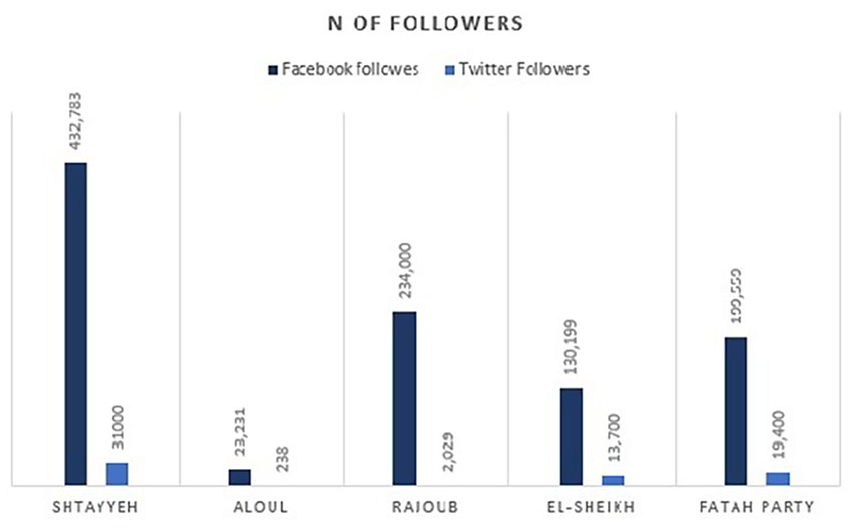
Number of followers of the analyzed accounts on Facebook and Twitter.
Furthermore, as Figure 2 shows, more than 70% of the messages related to elections were posted on Facebook, which indicates that these leaders were more interested in addressing local audiences on this matter. In light of Bossetta’s (2018) argument that social media platform design influences politicians’ decisions in terms of reaching audiences with particular messages, Fatah leaders’ strategy of using different platforms in different languages is a form of audience segmentation. This segmentation is based on language and location (internal audience and international audience).
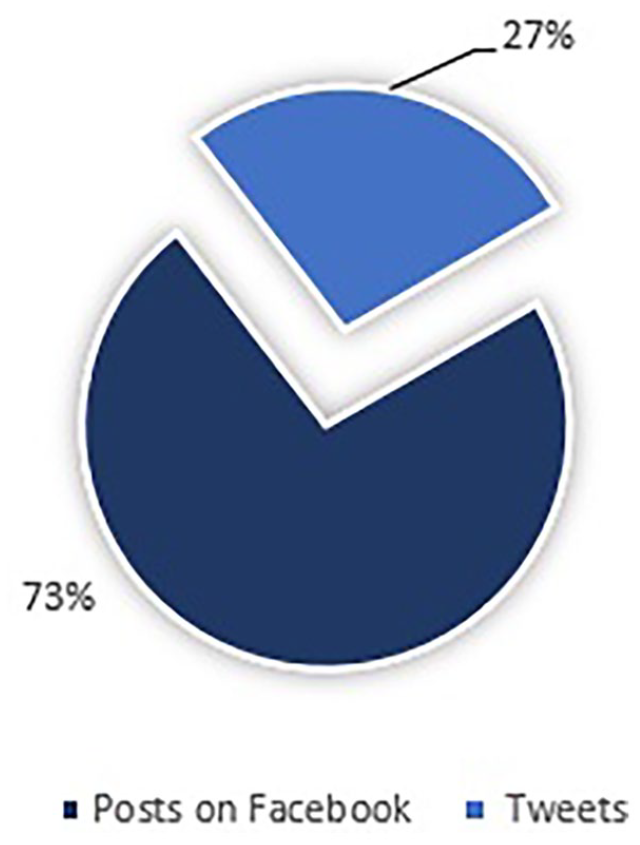
Content distribution on the two platforms.
However, politicians commonly address local audiences through one-way communication, given that none of them respond to followers’ comments or remarks.
Framing the elections
Although the period of analysis was limited to 26 days, the data show two dominant frames that politicians’ messages revolved around when addressing the election topic: the democratic process and national unity. Meanwhile, a third, less apparent frame was the conflict frame pertaining to the conflict with the Israeli occupation.
In Table 1, the author deconstructs the content into four sections, which are frame elements based on Entman’s (1993) definition of framing. The emerged frame—the democratic process—was highly dominant in the analyzed content. As Figure 3 indicates, 56% of the content on both platforms presented the election decree as part of a democratic process. Issues related to this framework varied from the concerted efforts of the party to mobilize citizens’ support for the process, and calls for widespread participation. This process was mostly defined by politicians in different phrases, in which they presented it as an essential step for the Palestinian people.
Frame elements, variables, and description.
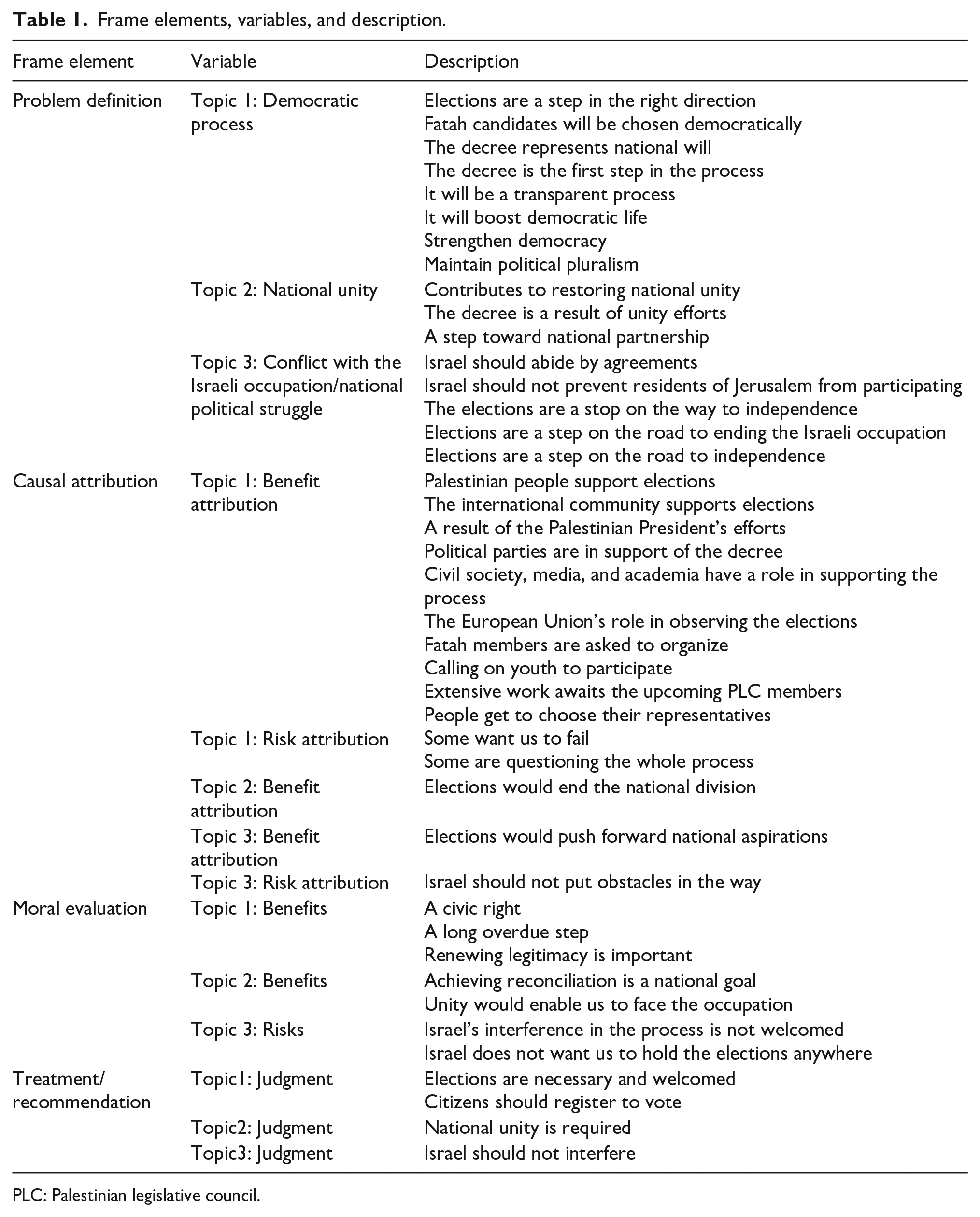
PLC: Palestinian legislative council.
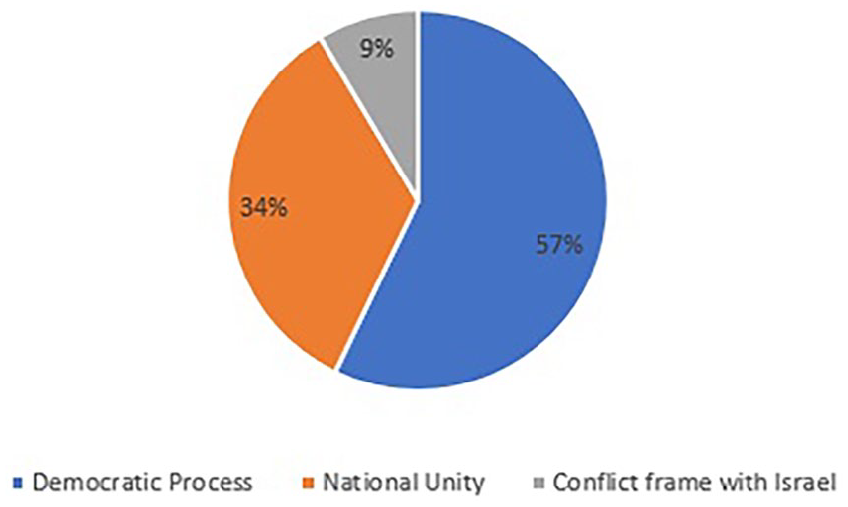
Frame distribution percentage.
The Palestinian people and the international community contributed to this element. The latter was widely incorporated as a partner in the framing process, where support for and monitoring of upcoming elections were welcomed. The Israeli occupation was presented as a risk to this process, including the possible prevention of Palestinian residents of Jerusalem, where Israel has full control, from participating in elections.
The democratic process was also described as a step in the right direction, representing the nation as a means of strengthening democracy in Palestine and maintaining political pluralism. Along this line of framing the decree as part of the democratic process, the Fatah leaders reaffirmed on several occasions during the analysis period that the party would choose its candidates democratically and transparently.
The second dominant framework is related to domestic political efforts among Palestinian parties to achieve national unity through reconciliation. The national unity framework, which accounted for 34% of the content in many units of analysis, overlapped with the democratic framework. In many cases, politicians frame elections as a democratic process and part of national unity efforts, which is noticeable in the texts.
In this framework, elections are presented as a core element in efforts to end the 16-year-old political division between the two main parties, Fatah and Hamas. Associating the success of the election with reconciliation efforts appeared in all the analyzed content as a related or mandatory step toward achieving unity. Al Sheik, member of the Fatah Central Committee, and the Secretary-General of the Executive Committee of the PLO, “Palestinian Liberation Organization,” praised the decree in a tweet in English and Arabic—see Figure 4, in which he thought of the election as a path for unity first, and a way for continuing the independence project.
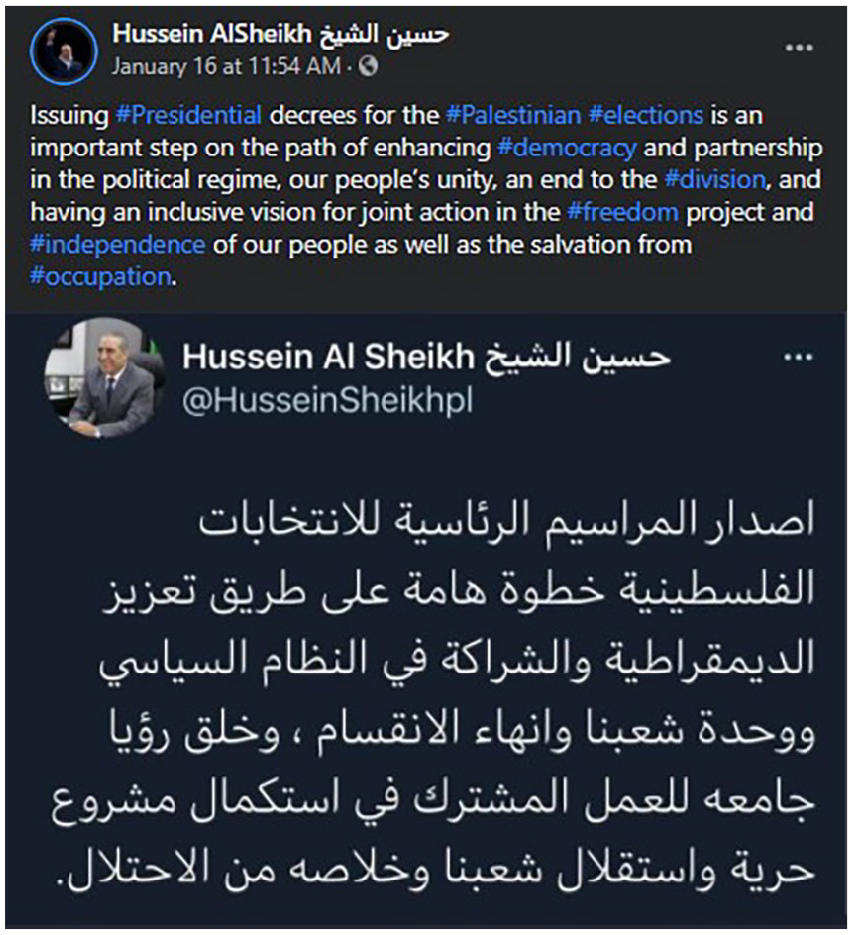
Member of Fatah Central Committee welcomes the elections decree, tweeting in Arabic and English.
The conflict frame, related to the Israeli occupation and the national aspiration for independence, was present at a modest 9%. Framing the election as a step on the road to independence was associated with fear of Israeli interference in the process, including preventing Jerusalem residents from participating in the elections.
Israel refusal of allowing Palestinians to hold the election in Jerusalem, is seen as an obstacle to the democratic process. The Palestinian Prime Minister Mohammad Shtayyeh, who is also a member of Fatah Central Committee, reminds Israel, in an English written tweet, of the signed agreements that allow Palestinian citizens of Jerusalem to participate in the elections—see Figure 5.
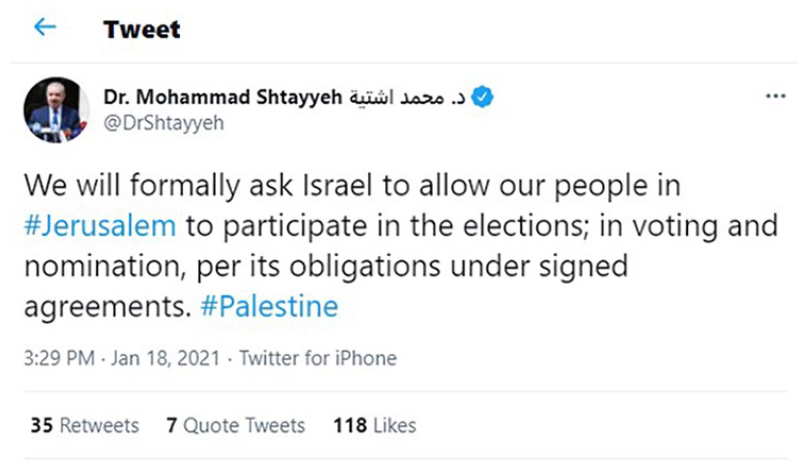
Prime Minister Shtayyeh tweeting about asking Israel to allow residents of Jerusalem to vote in the upcoming elections.
Failure to segment the audience(s)
While no specific pattern was found in the way politicians and the Fatah Party used Facebook and X to deliver different messages to different audiences (Figure 6), the data showed a tendency to post similar content on both platforms when the content was news of activities or meetings held by politicians. This implies that politicians did not invest in segmenting their audiences. Aside from positing on X mainly in English, and using Arabic mainly on Facebook, the leaders did not consider tailoring messages according to time, audience interaction, and platform. To understand this in light of social media logic, where popularity plays a role in highlighting content, politicians have not actively interacted with the audience, which could have drawn more attention from the social media masses.
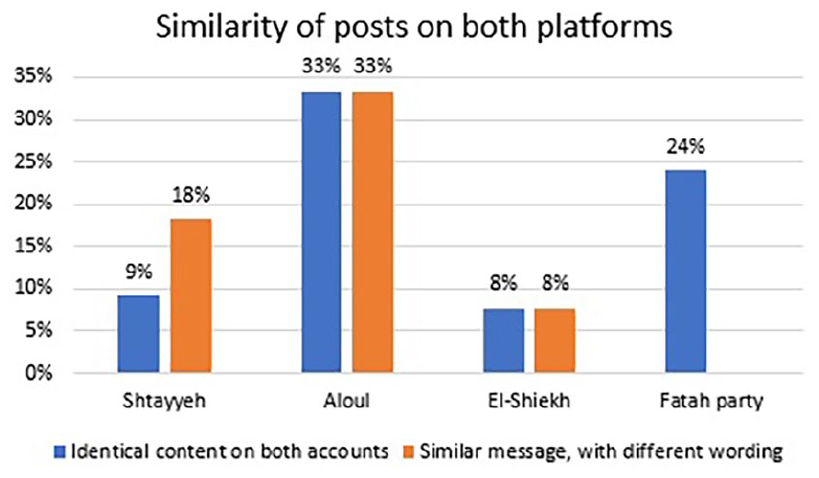
Similarity of content on social platforms.
Social media impact on message format
The lion’s share of content was granted to text posts and tweets (Figure 7). With 98% of the content being text, hashtags and images came in second and third places, respectively. Meanwhile, other social media-associated content, such as video graphs and info graphs were used modestly. Sharing of external links, including the party’s official website, was also limited. This result disproves the hypothesis that politicians adhere to social media formats and content requirements. Contrary to the hypothesis and social media logic, politicians’ contents were mainly limited to text with disregard for opportunities social media provides in terms of utilization of visuals and interaction with audiences.
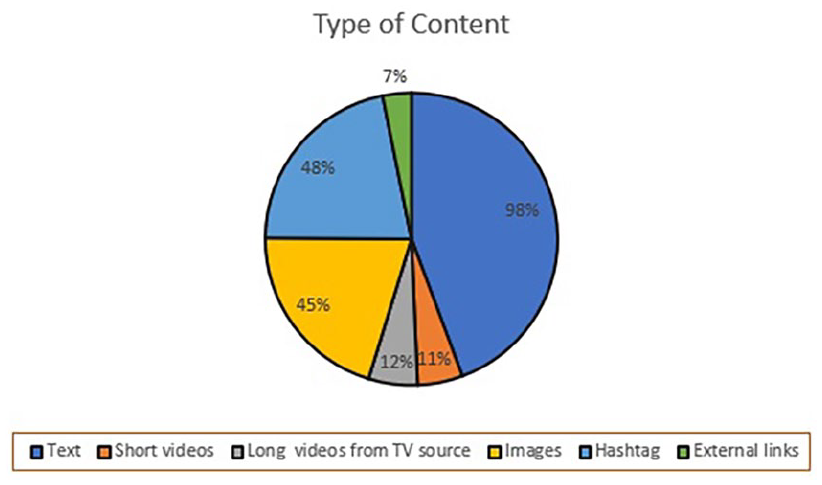
Usage of social media content features.
In his comments on Fatah’s social media editorial policy, a social media manager of the party’s stated that there was no written or editorial policy that guided the party’s strategy for disseminating media content on digital platforms. Moreover, content-posting guidelines were not fixed, since the process was directed by members of Fatah’s Central Committee, responsible for the media department at the time.
With regard to the utilization of social media content formats and features, the former social media manager indicated recent improvements, whereby the party’s media team gradually started to incorporate video graphs and info graphs to deliver messages and increase interaction with the audience. He added that these new content forms were becoming part of the party’s content production tools. He believed that the modest interaction from social media audiences was partly due to the most sensitive political issues posted on the party’s accounts. However, they mentioned that parties should invest in human resources to address the question of interaction with online followers.
Journalists’ use of online political statements
Given the data indicate an unorganized online content creation strategy and very limited interaction with followers by politicians, what they share on their social media accounts remains unnoticed. However, journalists who cover political stories rely on the politicians’ social media accounts as sources of information. A senior manager at the PBC supports the premise that politicians’ messages on social media are newsworthy, given that they are often used in the news segment of its TV station.
Similarly, an editor of the online version of a daily newspaper, Al-Hayat Al-Jadida says that, in many cases, social media accounts provide newsworthy information. However, he clarifies that the information or news he usually seeks from these accounts relates to politicians’ civil service positions and duties, and not necessarily their party’s activities.
A political news editor at the national news agency, Palestine News and Information Agency-Wafa, notes that the social media accounts of politicians are essential in many ways, as they can be considered an alternative source of information when politicians do not often appear in press conferences or are not easily reached by phone.
While it is not surprising that journalists see social media as an easy and verified source of political news coverage by quoting politicians’ social media content, the quotes used were selected based on journalists’ story needs; thus, not all political statements online receive the same attention from journalists.
Limitations and future research
Park et al. (2020) argued that the use of linguistic formality and human interaction in text messages could positively affect the perception of politics. While their study, which took place in the Korean context, does not suggest a very important role for interactivity in voters’ decisions, the use of informal language may have. It may be a good starting point for research to examine how lack of interactivity with followers and use of formal Arabic language has an effect on Palestinian voters in the upcoming elections.
Conclusion
This study provides insights into how political players in Palestine use social media for political communication during mediatized politics. It examines how the leading governing party’s senior Fatah members framed the upcoming national elections, and how social media logic and content production formats affect the political messages process on social media.
The analyzed politicians’ messages varied in terms of dissemination density and issue priority. Nonetheless, they mostly offered similar messages, in which they framed the elections as a democratic process and a method of national unity.
The main results indicate that politicians have made limited investments in the segmentation of their audiences on social media. X (previously Twitter) is seen as a platform for addressing international audiences with tweets mainly in English, and Facebook as a platform for sending internal messages to Palestinian audiences with posts mainly in Arabic.
However, this study identified very limited levels of interaction with the audience on social media by politicians. Simultaneously, most content was text-based, neglecting opportunities to engage with visuals, such as videos, images, and hashtags, which may affect the number of interactions. This indicates that politicians do not differentiate between social media usage requirements and those of other traditional media, such as vertical-based communication.
Similarly, the results showed that Palestinian politicians used similar messages on both platforms, contradicting the notion that the nature of the platform affects the structure and shape of the politician’s message. This is another indication that the existence of digital venues does not necessarily mean changes in the behaviors of political actors in using media. This can be seen as a contradiction to the thesis of mediatized politics, which argues for changes in political function in relation to media use due to the high level of mediatization that influences political communication. The results discussed earlier highlight the fact that for politicians, the core of the political message remains more important, and is the center of their attention much more than the social media format and requirements of aesthetics.
To cover political statements on social media, Palestinian journalists use politicians’ social media content and consider political statements on social media newsworthy. However, this use is based on journalists’ information needs, which helps them cover their stories.
