



Abstract
This paper investigates the structure of networked publics and their sharing practices in Persian Twitter during a period surrounding Iran’s 2017 presidential election. Building on networked gatekeeping and framing theories, we used a mixed methodological approach to analyze a dataset of 2,596,284 Persian tweets. Results revealed that Twitter provided a space for Iranians to discuss public topics. However, this space is not necessarily used by voiceless and marginalized groups; and the uses are not limited to discussing controversial issues. The growing body of conservative crowdsourced elites emerged to defend the regime’s ideology. Moreover, the dominant networked frames were shaped around normal and routine subjects in an election time. Thus, Twitter was not a platform for only seeking liberal demands. It was to some extent used to serve the regime’s political interests. Furthermore, while many ordinary users rose to prominence, mainstream media continued to act as powerful players. This study contributes to the existing literature into networked practices, digital democracy, and citizen journalism; particularly in restrictive contexts.
This paper maps and analyzes the Iranian Twittersphere (Persian Twitter) during Iran’s presidential election of 2017 to explore how Twitter provides an alternative setting in restrictive contexts for discussing political topics. It will further explore the types of Twitter crowdsourced elites and the extent to which they got engaged in politics for gatekeeping and framing the election in a co-working and connective practice. Twitter’s role as a medium for political participation and activism has been well documented in many societies (to name a few: Boczkowski and Papacharissi, 2018; González-Bailón, 2015; Jost et al., 2018; Tufekci, 2017). Several scholars (e.g., Faris and Rahimi, 2016; Khazraee, 2019) have argued that Twitter has played a considerable role in Iran’s political sphere, beginning with the 2009 Green Movement to current political events. Nonetheless, there are still some fallacies in the existing research literature that lead to misunderstandings in the interpretation of Twitter use in the political sphere of Iran.
First, most studies focus on 2009 protests, overemphasizing the role of Twitter. Having coined terms like “Twitter revolution” (Carafano, 2009), such studies portray Twitter as a crucial factor enabling Iranian users to mobilize and organize their protests without providing enough empirical data (Wojcieszak and Smith, 2013). Later studies showed that Twitter was more of a publicizing and bridging tool (between Iran-based users and expatriates) which was used heavily by (Iranian and non-Iranian) users who did not live in Iran (Khazraee, 2019). In the absence of empirical studies, judgments about the importance of Twitter for the 2009 movement developed from a Western perspective, based on the role of Western technology for Western societies (Marchant et al., 2016). Thus, there is lack of in-depth studies about how Iranians have actually used Twitter for their protests.
Such fallacies become even more problematic when we attempt to understand Twitter’s role in the post-2009 political events. Although Iranians have become more interested in Twitter in recent years (Bowen, 2017; Marchant et al., 2018), there has not been much research investigating these blurred events. It is also necessary to analyze the Iranian Twittersphere if we want to understand and decode the contemporary political sphere in Iran. Moreover, we will provide a broad overview and a better understanding of Twitter usage in authoritarian societies, whereas this field of research is usually concerned with Western democracies (Tufekci and Wilson, 2012). Social media, particularly Twitter, create opportunities to discuss sensitive topics and present opposing views in countries where freedom of expression is limited. In addition, analysis of social media data provides researchers with a more reliable and valid method in studying public opinion in those countries where traditional methods (e.g., survey or interview) are not applicable or are subject to bias, particularly on contentious topics (Khazraee, 2019).
To this end, we will analyze a dataset of 2,596,284 Persian tweets collected during the 2017 presidential election in Iran. We will employ a mixed-method approach applying both computational methods and qualitative methods to achieve a close and distant reading of tweet corpus (Moretti, 2005). Building on networked gatekeeping and framing literature, we will identify the main communities and the most influential users in disseminating information, and analyze the users’ networked practices in order to investigate the mechanisms in which Twitter intervenes with the political sphere in Iran. Our focus is on retweet (RT) network as the main network of information dissemination on social platforms (Bruns and Stieglitz, 2013). The 2017 election is a good case study since – for the first time in Iran’s modern history – moderates, reformists and conservatives galvanized around their candidates online (Marchant et al., 2018). Furthermore, this research will investigate how Twitter use for political causes has changed in Iran from a uniform space to a medium which was steadily filled by different camps of polarized citizens, even bots and the state’s cyber forces.
Literature and theory
Due to the importance of Twitter in political communication, researchers have substantially studied the ways that various types of users, from politicians to ordinary users are employing this microblogging network in formal (e.g., campaigns and elections) and informal (e.g., movements and protests) political events (Jungherr, 2017; Papacharissi, 2014; Sadler, 2018; Tufekci, 2017). Researchers asserted that by tweeting politics, as a micro-donation effort (Margetts et al., 2016), ordinary people construct networked publics that simultaneously take shape locally on streets and squares and globally on social media platforms (Poell and van Dijck, 2018).
Networked publics such as those that boyd (2010) argued are simultaneously (1) the space constructed through networked technologies and (2) the imagined collective that emerges as a result of the intersection of people, technology, and practice (p. 39). Networked publics introduce new affordances for amplifying, recording, and spreading information and social acts (boyd, 2010: p. 46). Castells (2013) argued that networked publics have a culture and structure of their own which is beyond their ordinary, instrumental, and simple use in organizing and mobilizing political campaigns and protests. He calls this type of culture as “culture of sharing” which causes the virality of messages in the network of users (Barzilai-Nahon and Hemsley, 2013). Bennett and Segerberg (2013) continued this line of thinking by asserting that culture of sharing and virality gave birth to connective action. Connective action is based on users’ self-motivated (though not necessarily self-centered) sharing of already internalized or personalized ideas, plans, images, and resources with networks of others (p. 747). In this way, networked practices are at the heart of any type of connective action. The two practices mostly referred to as networked are framing and gatekeeping. These dual concepts constitute the theoretical basis of this research.
Both ideas are based upon the traditional theories of framing and gatekeeping. While mass communication studies have approached gatekeeping as a one-way, top-down process controlled by big media organizations (Barzilai-Nahon and Hemsley, 2013; Shoemaker et al., 2017), networked gatekeeping focuses on the ways that ordinary users were empowered to play a significant role in gatekeeping process by reporting and commenting via social media (Coddington and Holton, 2014). Formerly known as passive gated, ordinary citizens now can work as gatekeepers creating measurable impact through practices that blend broadcasting with social conventions (Meraz and Papacharissi, 2013: 5). In short, the idea of networked gatekeeping concentrates on the dynamic interactions among media outlets, social media networks, algorithms, and crowds of ordinary citizens involved in filtering and curating continuous information flows (Bennett and Pfetsch, 2018: 247).
While Barzilai-Nahon (2008) argued that gatekeeping has been considered to consist not only of information selection, but also of any activities that influence media narratives; we believe that networked framing would be a better fit to analyze how crowdsourced elites form some particular digitally mediated frames around public news events. As Meraz and Papacharissi (2013) argued networked framing works in tandem with networked gatekeeping to sustain the information flows of the ongoing events (p. 22). Networked framing is the result of interaction between elites and crowds in networked publics to generate dominant frames that shape the form of news narratives. Despite the statistic and the permanent nature of frames which are produced on mass media, frames on networked publics are persistently revised, rearticulated, and redispersed by both crowds and elites (Meraz and Papacharissi, 2013). Meraz and Papacharissi (2013) understand networked framing as a process whereby actors keep the information circulating, and add their own layers of information, knowledge, beliefs, and experiences to it.
The concepts of networked gatekeeping and framing provide us with a convenient theoretical context to investigate how, by whom, to what effect, and through which mechanisms, Twitter plays with politics in contemporary societies (Tufekci and Freelon, 2013). Moreover, Bennett and Pfetsch (2018) believed that these ideas are central to rethinking political communication in a time of disrupted public spheres. Following such rationale, researchers employ these concepts to analyze Twitter activism and structure in different contexts and events. In particular, researchers pay attention to Twitter communication during political and social unrests arguing that algorithmic and technical architecture of Twitter empowered former gated citizens in a way that they can collaborate in selecting, altering, amplifying and shaping events in spite of mainstream and formal narratives (Jackson and Foucault Welles, 2015; Meraz and Papacharissi, 2013). The existing literature also showed a shift from traditional mass media to ordinary people as gatekeeps; insisting that the norms of gatekeeping and framing in a networked environment have been transformed to become more relational, reflexive, permissive, and expansive (Coddington and Holton, 2014; Hopke, 2015; Lev-On, 2018). Other researchers (Galarza Molina, 2019; Pöyhtäri et al., 2019) also investigated how networked practices help people sustain the protests as well as humanize them. Studies on Twitter-like platforms in other contexts (e.g., Weibo in China) revealed that the dominant frames of political discourses are not produced by elites alone, but are also coproduced by nonelites who help spread the popularity of certain content aggregated via platform’s algorithms (Jiang et al., 2016; Nip and Fu, 2016).
However, potentials of these theories in studying Persian Twitter have been relatively neglected. On the other hand, the special case of Persian Twitter could contribute to the existing body of knowledge into networked framing and gatekeeping.
Twitter and politics in Iran
Several facts make Persian Twitter a unique context for this study. First, while Iran’s 2009 Green Movement was one of the beginning incidents that shows how dissident citizens discovered social media, particularly Twitter and Facebook, potentials for political protests and challenging the closed systems, Persian Twitter has not received much scholarly attention to date. Social media provides Iranians with a tool to raise their voice challenging the monopolistic control of public communication by the state. That is probably why Iranians have been staying on Twitter despite the fact that this social medium was blocked at the beginning of 2009 presidential campaigns. Moreover, despite the fact that we have no exact data about the number of Twitter users in Iran and their demographic information, mostly because of its blockage and lack of official statistics, this microblogging network becomes part of Iranians’ everyday practices. Therefore, we should do more research to fully understand its role, potentials and meaning for Iranians beyond its usage in protests and upheavals.
Twitter has also become a significant variable in Iran’s political sphere. The domestic political system is comprised of two major competing forces: reformists and conservatives. While Iran’s presidency is passed among these camps, there are many non-electoral positions which are filled by conservatives appointed by the leader. As a result, conservatives are relatively the most powerful political force in Iran. In addition to these main camps, there is a body of Iranians who have migrated from Iran mainly in years following the 1979 revolution. This diaspora community has almost no direct and official role in Iran’s politics, but they have a clear and notable presence in public sphere particularly with powerful media operated outside of Iran. Defined itself outside of formal and official boundaries, Iranian diaspora is mainly against the regime policies and tries to subvert the political system.
Twitter has a critical role in the power struggle among these forces. Dissident citizens and reformists use Twitter to seek their liberal and democratic rights, and to amplify their voices in an authoritarian society (Koo, 2017). Conservatives, radicals and other Iranian authorities have also joined this microblogging network in large scale (Marchant et al., 2018). Besides the offices of the Iranian leader and the president, who have Twitter accounts in Farsi, Arabic and English, most of the ministers and the parliament members have their own accounts, too. They mainly use Twitter both to engage in public conversations, and to communicate with their political fellows.
Now, the presence of all Iranian political forces on Twitter makes this space a convenient context to explore how different political camps, even those which support the suppression and blockage of social media, use this platform for their political targets. It could also give us a more accurate understanding of Iran’s political climate. Moreover, in Iran’s restricted media environment, Twitter is a place where researchers can have access to citizens’ unsolicited and uncensored ideas and thoughts on sensitive topics, even on non-controversial happenings. In other words, analyzing networked gatekeeping and framing in Iran gives us a better understanding of Twitter use where it has a paradoxical meaning inherently.
Networked publics in Persian Twitter
Despite the importance of Twitter in Iran, there are still much we do not know about networked publics and sharing mechanisms in Persian Twitter. In one of the few researches, Khazraee (2019) showed that Persian Twitter was dominated by micro-celebrities, whereas English Twitter was dominated by institutional elites. He concluded that Persian Twitter in 2013 presidential election was predominantly in favor of reformists. Moreover, in the two successive reports, Small Media Foundation tried to map the Persian Twittersphere during the 2016 parliamentary and Assembly of Experts, and 2017 presidential elections. In the first report, 46 clusters of users ranging from human rights activists to reformist and conservative political commentators, technology advocates, and literature enthusiasts were identified in 2016 elections (Marchant et al., 2016). This report also showed that the network is home to extensive networks of everyday users, who share jokes, idle chatter, and flirtatious messages. Authors concluded that Persian Twitter is mainly political and effectively unipolar, being populated largely by reformist-leaning journalists, activists, and media consumers. This landscape changed in 2017 election.
The second report (Marchant et al., 2018) showed that there were five main clusters in 2017 presidential election, including reformists, conservatives, Mujahedin-e Khalq, 1 Critical Activists, and mixed users. Their results showed that while the largest user groups were still reformist-leaning, there was a small and increasingly more active conservative presence. Moreover, they noted that MEK is rather isolated and consists of bots. This result was confirmed by other researches (Parsi et al., 2018). While Marchant et al. (2018) worked on a similar case, we try to update and extend their findings by using a larger sample collected with more hashtags (94 hashtags vs. 10 hashtags), during a longer period (25 days vs. 15 days). Furthermore, we go deeper to unfold the more convoluted layers of networked meaning-making on Persian Twitter, while the Small Media foundation’s report provided a merely descriptive overview.
Building on networked practices literature and the studies of networked publics in Iran, the following questions guide this investigation:
RQ1: How were the networked publics in Persian Twitter structured in RT network during 2017 presidential election?
RQ1a: Who were the most influential networked gatekeepers in RT network?
RQ1b: How were these crowdsourced elites gatekeeping the 2017 election?
RQ2: What were the popular networked frames in RT network during 2017 presidential election?
RQ2a: How and by which mechanisms did the different communities of users in RT network frame the event?
As mentioned in the above questions, we will focus on RT network as the network of information dissemination. Retweets can both be used to trace information propagation among users (Bruns and Stieglitz, 2013) and as a sign of virality (Hemsley, 2016). Thus, investigating RT network is a convenient way to answer research questions.
Method
Data collection and preparation
We used DMI-TCAT 2 (Borra and Rieder, 2014) for collecting data from Twitter API. 3 During a time period from 1 May 2017 to 25 May 2017 (19 days before to 6 days after the Election Day), we gathered 2,596,284 tweets. Collecting data from Twitter API comes up with several issues as selection bias, black boxing and API restrictions (Stieglitz et al., 2018). Selection bias refers to the influence of the selection of the available data. Black boxing, refers to the practice of utilizing tools and methods without being able to observe how they work, check the results, and verify the algorithms (Rieder and Röhle, 2012). Twitter also only provides access to approximately 1% of all the data sent on Twitter at that moment. Moreover, tweets older than 7 days cannot be retrieved by Search API (Hino and Fahey, 2019). To address such limitations as much as possible, we tried to collect live data in a longer time period (25 days) with more hashtags and keywords (n = 94) using REST API.
Previous experiences also showed that most of the electoral debates in Iran had begun a few days after the beginning of official presidential campaigns. Therefore, we chose the 3rd day after the beginning of the campaigns to work as our starting point. We also continued collecting data till we concluded that the number of related tweets declined meaningfully. Six days after the Election day, most of the users were almost done with electoral discussions.
Besides technical and platform restrictions, we had no significant restriction in data collection. Of course, Twitter is blocked in Iran but collecting datasets and doing Twitter research are not prohibited. Moreover, social media data are more reliable sources to gauge Iranian public opinions as we discussed it earlier. Finally, we removed non-Farsi tweets and duplications in order to prepare the dataset for further analysis. Then, we extracted the RT network which consisted of 1,208,723 tweets (with 62,633 nodes and 713,696 edges) as the main network of content sharing for further analysis.
Social network analysis
We employed a social network analytical approach to identify networked publics and explore their structures in Persian Twitter. Conducting a cluster analysis on RT network (Louvain method) (Blondel et al., 2008), we used PageRank centrality (Easley and Kleinberg, 2010: 407) to identify the top 50 influential users in each cluster as crowdsourced elites. Previous researches (e.g., Jackson and Foucault Welles, 2015; Meraz and Papacharissi, 2013) employed degree to identify networked gatekeepers. However, degree is not a powerful index as it only considers the number of edges in the network (Kadushin, 2012). On the contrary, PageRank considers both number and quality of links.
Our SNA approach resulted in five main clusters: (1) Reformists, (2) Conservatives, (3) Iranian diaspora, 4 (4) MEK, and (5) Botnet. Previous researches have argued that MEK community was a bot network since it was an isolated community with low connections to other clusters (Khazraee, 2019; Marchant et al., 2018). Our primary analysis confirmed this finding, as MEK community was an inward-looking one with a significant distance from other communities. Considering that we had intended to analyze networked publics including real accounts, we removed clusters 4 and 5 from our investigations. Then, we identified the top 50 users in each community and of course, none of them was a bot.
For the purpose of textual analyses, we extracted all of the influential users’ tweets in the whole network. The total number of tweets were 31,098. Then, we chose a sample of these tweets to conduct textual analyses. Using Cochran’s formula for calculating the sample size of a finite population showed that a sample with 10,416 5 units would be representative. Based on cluster sampling, we chose the final sample randomly. Therefore, the portion of each cluster unit in the research sample was the same as the main population. We used this sample to discover the structure of networked publics as well as their sharing practices.
Qualitative and textual analyses
We combined Social Media Critical Discourse Studies (SM-CDS) and Ethnographic Content Analysis (ECA) to build an interpretive model to discursively and qualitatively analyze networked practices of the selected elites. The fluid, changeable, and non-static nature, location, and dynamic of the discursive power in social media needs a special and appropriate approach. Furthermore, users-provided information is mostly incomplete, particularly on Persian Twitter. For instance, Iranian users usually choose nicknames or just use some parts of their real names. Our mixed method approach enables us to capture changing and episodic discursive meaning of users’ practices on Twitter.
The SM-CDS understanding of practice, based on Jones et al. (2015), is “more as a matter of the concrete, situated actions people perform with particular mediational means (such as written texts, computers, mobile phones) in order to enact membership in particular social groups”. An SM-CDS model, then, includes horizontal context substantiation, which deals with the intertextuality among textual practices, and vertical context substantiation, which links both the micro-features of textual analysis and horizontal context to socio-political context of users in society. We connected SM-CDS horizontal axis with ECA to enhance the model capability. ECA, as Altheide and Scheneider (2013) describe it, is a mixed-methods approach used for documenting and explaining the communication of meaning, as well as for verifying theoretical relationships. All its steps are reflexive and circular, and it considers the data not only as numbers but also as narratives. This method combines quantitative content analysis with participant observation to offer a qualitative approach to document analysis (Barnard, 2016).
Based on this interpretive model, researchers and two other coders (four coders in total), coded the sample iteratively following Saldaña (2015)’s two-step coding method. At first, an initial list of codes, as Saldaña asserted (p. 144), was prepared based on research questions, researchers’ expectations and experiences; and previous studies. This list was used to code 500 tweets by each coder randomly in the provisional phase. As a result, a primary code sheet was developed in the first step. Then, the coders coded the whole sample in pattern-coding step to identify and categorize the emerging and grounding frames. The coders discussed the process continuously to reach a better understanding of tweets’ meaning and context. They revised the primary code sheet over and over while sifting through the content and reading tweets closely. The result of these steps was the final code sheet which they used to code the whole corpus for the last time. It should be noted that coders could not change the code sheet after finalizing it and prior to calculating the intercoders’ reliability. We used the Krippendorff’s alpha to measure intercoders’ reliability (Lombard et al., 2002). All scores were significantly satisfying with the minimum of .91. Since levels above .8 are generally considered sufficient, the codes are reliable.
The combination of SM-CDS and ECA allowed some innovations in the coding process to discover the deeper layers of meaning as well as achieve more reliable, stronger results. For instance, the coding process was not confined to tweet texts as it may not provide a full understanding of user’s information and discursive practices. The coders also referred to a user’s profile/timeline/followship network and accounts in other social media to elicit the most reliable information. Such information was then systematically analyzed to give a better understanding of networked gatekeepers and their networked practices. For instance, users’ gender, location, career, and identity were classified. Since Twitter is blocked in Iran, some API-provided data such as users’ location are not reliable. Due to the fact that Iranians have to use VPNs and proxies to access Twitter, their location probably changes to other countries. There were also users who did not point to their gender or identity explicitly. In such cases, coders tried to identify these variables based on extra meta-data. For instance, they read a user’s timeline closely to reach a tweet that s/he might mention her/his location or identity clearly.
There were also a few suspended or deleted accounts in the data. However, since they were less than 5 accounts in total, and we had collected their data automatically during the research period, it did not cause any problem in our investigation.
Findings
Networked publics
Our SNA analyses showed that Reformist users formed the biggest community in Persian Twitter. The reformist cluster’s size was 52.93% (33,157 nodes and 451,499) while the size of conservative and diaspora clusters edges were 12.5 (7827 nodes with 111,248 edges) and 7.4 percent (3665 nodes and 17,582 edges) respectively. The reformist cluster was also denser with a modularity of .21. The modularity of conservative and diaspora clusters were .24 and .42 respectively. These results not only confirm the previous findings on the structure of Persian Twitter (Khazraee, 2019; Marchant et al., 2018), they also represent the political landscape of Iran. Whilst Persian Twitter is obviously not an accurate representation of Iranian society, Twitter affordances allow more voices, and various types of citizens emerge as active users. Thus, it now consists of all main political forces in Iran. It even becomes clearer if we notice the fact that a growing body of conservative users are joining Twitter. While conservatives’ presence was rare previously, they tried to take a more active role in this space in the years leading to the 2017 election. Our results also emphasize that Persian Twitter is not a unipolar space anymore. In addition to conservatives and diaspora users who joined this network, other types of accounts like bots supported by the state and other political groups have emerged. Of course, we removed such accounts from our sample in this study, but their presence showed that Persian Twitter is more diverse and complicated now.
Overall, our results indicate that different communities of Iranian citizens are increasingly going on Twitter to discuss political and other issues. It is for now true that reformists are the main force, but Twitter use is not restricted to them anymore. New forces are trying to take the power in this space out of reformists’ hands. Twitter is not just a tool for protesting or seeking liberal wills anymore (González-Bailón, 2015; Moghanizadeh, 2013; Tufekci and Freelon, 2013). It could even be used by conservatives, who are generally against “western” social media, to serve their political needs and fight back against dissident people. This result highlights the importance of rethinking digital democracy and social media affordances, particularly in non-democratic societies. Figure 1 illustrates how Persian Twitter was structured in 2017 election.

Persian Twitter structure in 2017 election.
Networked gatekeeping and crowdsourced elites
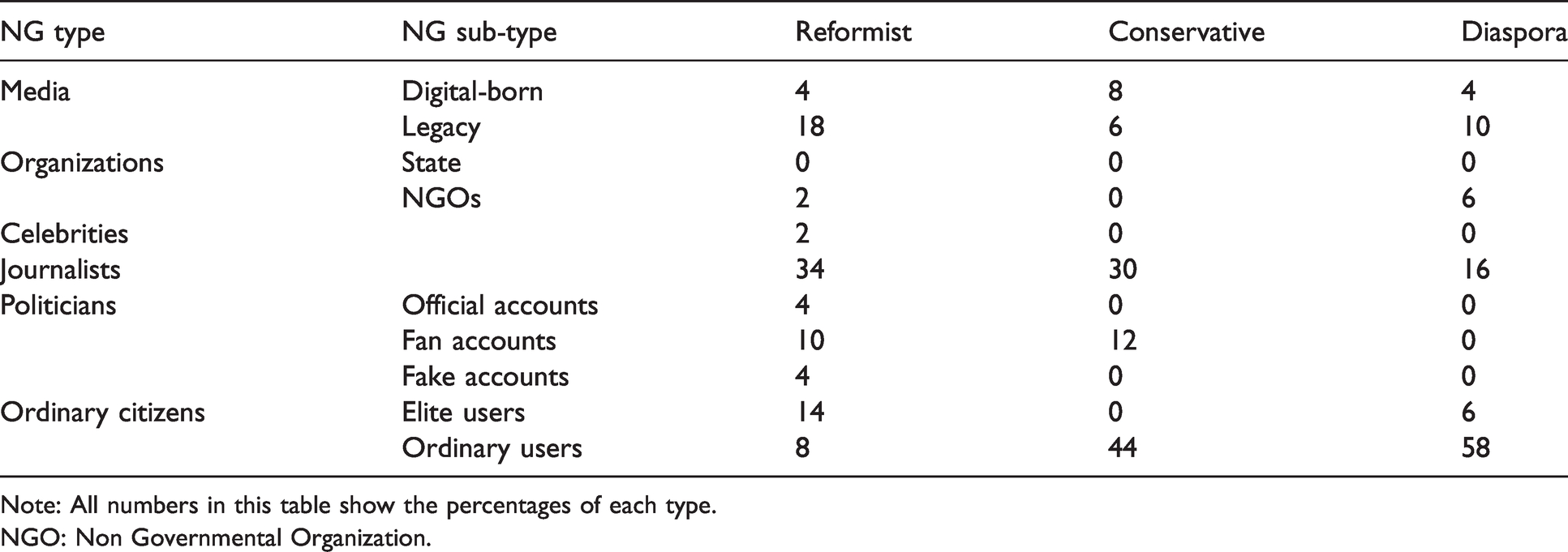
Even though previous studies provided some sporadic insights into the types of crowdsourced elites in different contexts (Hopke, 2015; Jackson and Foucault Welles, 2015; Meraz and Papacharissi, 2013), and even in Persian context (Khazraee, 2019), they failed to present a comprehensive and inclusive understanding of such matter. We try to present a more systematic and a clearer typology of crowdsourced elites on Twitter. Moreover, while those studies mainly tried to identify networked gatekeepers on the whole network (RT or mention network), we investigated how these elites were positioned in different publics. Thus, we are able to analyze how different gatekeepers performed across various political communities. Table 1 shows the different types of networked gatekeepers (also their sub-types) and the percentage of each type in its networked public. The operationalized definitions of emerging crowdsourced elites are presented in Appendix 1.
Networked gatekeepers (NGs) in networked publics.
Note: All numbers in this table show the percentages of each type.
NGO: Non Governmental Organization.
As Table 1 reveals, ordinary users, journalists and to a lesser extent media are the most important influential gatekeepers in the whole network. Journalists and media had the majority in reformist community while they were ordinary citizens who attained the higher positions in conservative and diaspora publics. Interestingly, other types of elites (incl. politicians, celebrities and organizations) failed to attain prominence in this space. This result highlights the importance of individual actors and journalists over more organizational and institutional forces on Twitter (Castells, 2013; Papacharissi, 2014). However, it does not completely support the previous studies which asserted this new trend would inevitably lead to more democratic online sphere (Meraz and Papacharissi, 2013; Newman, 2009). The journalists who attained prominence through their crowdsourced practices were not among citizen or independent journalists. They were mainly affiliated with big media organizations, inside or outside of Iran. There were journalists in the conservative community who were working for radical and hardliner press. For instance, @Ali_Rajabi and @tdejakam were two prominent actors working for radical media such as Rajanew.com and Keyhan newspaper. They even promoted their ideas about suppressing dissidents through their Twitter accounts.
This result is also true for conservative media. @AfsaranIr and @FarsNews_Agency are two of the most radical media in Iran which rose to prominence in election time. Regarding media outlets, it is interesting that the number of legacy media were higher in reformist and diaspora clusters and almost equal to digital-born media in conservative community. It shows that legacy media still plays an important role in Iran. While some new media were emerging, they could not attain prominence as legacy outlets. Moreover, some of the digital-born media were explicitly or implicitly affiliated with the big legacy media. For instance, @Fars_Plus was a child of @FarsNews_Agency presenting its content and news in softer forms. This also confirms the fact that conservative forces are seeking new ways to communicate with public and disseminate their ideas.
Further analyses also showed a significant gender gap among networked gatekeepers. In fact, the number of men was significantly higher in all publics. The conservative community had the biggest number of male elites. While this can be understood in terms of their religious and conservative attitudes, such a rationale is not applicable to other communities. Therefore, it probably reflects the systematic and institutional gender inequality in Iran. Such a gap still exists when it comes to Iranian expatriates who do not face the same legal and cultural restrictions as the people in Iran.
Although most of the crowdsourced elites on Persian Twitter used their real names, the number of fake names was notable. The use of fake names by the people in diaspora is almost normal since their political positions were severely against the state and they probably wanted to prevent upcoming risks particularly in returning to Iran. Conservative users ranked second in choosing fake and unreal names. This is interesting since they have more freedom in expressing their ideas than reformists and expatriates. Our further investigations showed that while reformist and people in the diaspora preferred using fake names because of security concerns, conservatives mainly did so according to their experience with previous social media like weblogs. They did choose religious or literal names as part of their traditional practice. Names such as @AadamEbneHavva 6 refers to conservative users’ religious interests.
Finally, regarding the reformists’ long history of using social media, we anticipated that the frequency of ordinary users would be higher in their community. However, other communities had higher number of ordinary individuals. In this election, journalists were the main force in the reformist community. We explored the rationale behind this finding by identifying and analyzing their crowdsourced practices. In particular, we investigated the type and tone of tweets produced by networked gatekeepers.
Table 2 shows that tweets appeared in 15 different forms in Persian Twitter. It also presents the percentage of each type in its public. The operationalized definitions are also presented in Appendix 2.
Tweet types.

Note: All numbers in this table show the percentages of each type.
Table 2 improves our understanding of the forms that a tweet can take on Twitter. While this result is obtained from analyzing Persian tweets, it is not limited to this specific context. Overall, commentary, news and quotation are the most popular types. Reformist gatekeepers preferred publishing news and quotations, whilst on the contrary, conservative and diaspora elite users mainly tweeted commentaries. News and quotations are straightforward massages aimed for informing. These types also have an ambient characteristic. Textual analyses showed that reformists tried to propagate the actions and achievements of Rouhani’s government by disseminating news. They also used public figures’ statements in support of Rouhani to encourage others to vote for him. It can explain the high frequency of journalists and media accounts in the reformist cluster as well. News is a journalist/media profession. Considering that most of the messages in the reformist cluster had an informative nature, the main types of crowdsourced elites in this community were journalists and media. On the other side, conservative and diaspora users focused on commentaries. Commentary has a broader nature yielding more complexity and variation. By using commentaries users not only send their comments about ongoing events, they also mix news and other contents with their opinions. Commentary gives more freedom to the sender to explain and disseminate what s/he thinks. Therefore, conservative and expatriates’ activists chose this more interpretive type in performing their crowdsourcing practices.
Since Rouhani was in power at the time of election, and due to the fact that he was supported by reformists, reformist journalists/media focused on highlighting his actions and successful background by disseminating news. They found it as a way to support their favored government. On the other hand, conservative and users in the diaspora who were out of the power structure tried to criticize news published by the reformists. Analyzing the tweet tones also confirms this finding. News and quotations generally had a serious or neutral tone while commentaries were almost sarcastic. It means conservative/diaspora users tried to challenge and sneer reformists’ informing messages. We will provide some examples in the following parts. In sum, reformist elites tried to achieve prominence by sharing serious messages, mainly news/quotations, while gatekeeping actions by conservatives and the diaspora revolved around sending sarcastic commentaries. This process had also affected the influential actors’ framing practices.
Networked framing
Twenty-four networked frames emerged on Persian Twitter as a result of crowdsourced practices during 2017 election. Table 3 lists the top 10 frames across networked publics and their percentage in each community.
Networked frames.

Note: All numbers in this table show the percentages of each frame.
aJoint Comprehensive Plan of Action, is an agreement on the Iranian nuclear program reached in Vienna on 14 July 2015.
In the remaining parts of this section, we will discuss some of these top frames with some examples to shed more lights on the ways that networked publics framed the 2017 election.
Discussing election campaigns
Discussing election campaigns (DEC) was the most dominant frame in both reformist and conservative communities. While different types of users participated in framing the election in these publics, their favored prominent frame was the same. However, further analysis revealed that those users discursively elaborated DEC in different ways. It is true that users in different communities were discussing election-related subjects, but they were trying to criticize and challenge their opponents by both gatekeeping news and framing the events. In other words, crowdsourced elites used DEC as a grounding framework to develop their election struggles. They tried to challenge each other by using topics like election meetings, trips, and live TV debates. Therefore, most tweets in this frame were sent during such events and had an ambient nature.
During one of the election debates which was aired live on IRIB 7 first channel, @Proximah_, a conservative ordinary user tweeted: Rouhani is beating around the bush. Which she sarcastically meant that Rouhani avoided answering the criticism of conservative candidates. In this way, she mixed sharing news about the debate with interpreting Rouhani’s performance. In another example, @faridebrahimi62, another ordinary conservative user tweeted: Rouhani’s greatest effort for victory was [his presence] in Mashhad, but even Aghili’s concert and the army of artists were not enough to save him from losing to Raisi in the second biggest city in Iran.
Mashhad is a holy city in Iran, ruled by some of the most radical clergies. It became the center of attention particularly because of the severe and strict religious restrictions that hardliners impose on citizens. For instance, music concerts are not allowed in Mashhad. Rouhani wanted to show his disagreement with such hard policies. Thus, he invited Salar Aghili, a singer of Iranian classical music, to sing in his election meeting. Conservatives also accused Rouhani of using artists to support him by providing them with some merits and special points. Thus, @faridebrahimi62’s tweet was an attempt to criticize Rouhani and sneer his effort in using artists by commenting on his trip to Mashhad.
While, lots of other ambient news, and at the same time sarcastic commentaries, were sent by gatekeepers in both camps, such tweets chiefly discussed routine and normal election-related topics. Reformist and conservative crowdsourced elites did not discuss more critical and deliberative issues. The target of their criticism were individual politicians, not the regime’s identity or its powerful figures such as Ali Khamenei. Networked gatekeepers in all publics showed a similar manner even in more specific frames.
Corruption, and ethical matters of candidates and their supporters
While DEC has a general attitude, some frames like Corruption, and Ethical matters of candidates and their supporters (EMCS) are more issue-centric. The aforementioned frames were particularly of significant interest in conservative community. However, they used these frames to attack Rouhani and Jahangiri (reformist candidates) in new directions. They did not mean to say the regime was corrupted. They even believed that reformist candidates’ corruption and disobeying ethical values harm the regime’s public picture. Therefore, corruption and EMCS were not frames for challenging the regime, they were intended to support the regime to some extent. Nevertheless, most of the conservative’s sarcastic messages occurred in these frames. For instance, @Ali_Rajabi struck Rouhani by sharing this photo (Figure 2) of his election posters under a bridge in Tehran and writing: The association of PhD supporters also announced that they would vote for Rouhani.

Sharing creative photos to criticize Rouhani by conservative users.
Rouhani’s PhD certification was one of the nodal points of conservative’s attacks. Here, this conservative journalist mixed this creative photo with his sarcastic words to suggest that Rouhani did not have any PhD certificate.
Public support for candidates, freedom and political activism, and minorities rights and problems
Reformist elite users neither criticized the regime, nor attacked the opponent politicians like conservatives did by co-producing these two frames. Instead of concentrating their tweets on attacking conservative rivals, they put a lot of effort in promoting their favored candidate: Rouhani. As a result, Public support for candidates (PSC) ranked 2nd in the reformist public. The popularity of this frame also explains the high frequency of news/quotation in the reformist community. By this frame, reformists simply shared public figures’ sayings, particularly those of politicians and celebrities, in support of Rouhani. However, not only they used serious news/quotations, but they also shared many encouraging and motivating messages to dominate this frame. Reformist crowdsourced elites mostly used images of young girls wearing colorful clothes while chanting in Rouhani’s meetings with some writings in their hands. Due to the hard legal and religious restrictions against women in Iran, the selection and dissemination of such photos had a discursive interpretation. This gatekeeping practice aimed to implicitly convey that Rouhani did not agree with such strict limitations, and he particularly supported women’s freedom and rights. This finding was also confirmed by the higher frequency of Freedom and political activism (FPA) and Minorities rights and problems (MRP). In particular, the latter has a sub-frame which focused on women’s rights. Most of the tweets in MRP belongs to this sub-frame. The photo in Figure 3 is an example of such efforts.
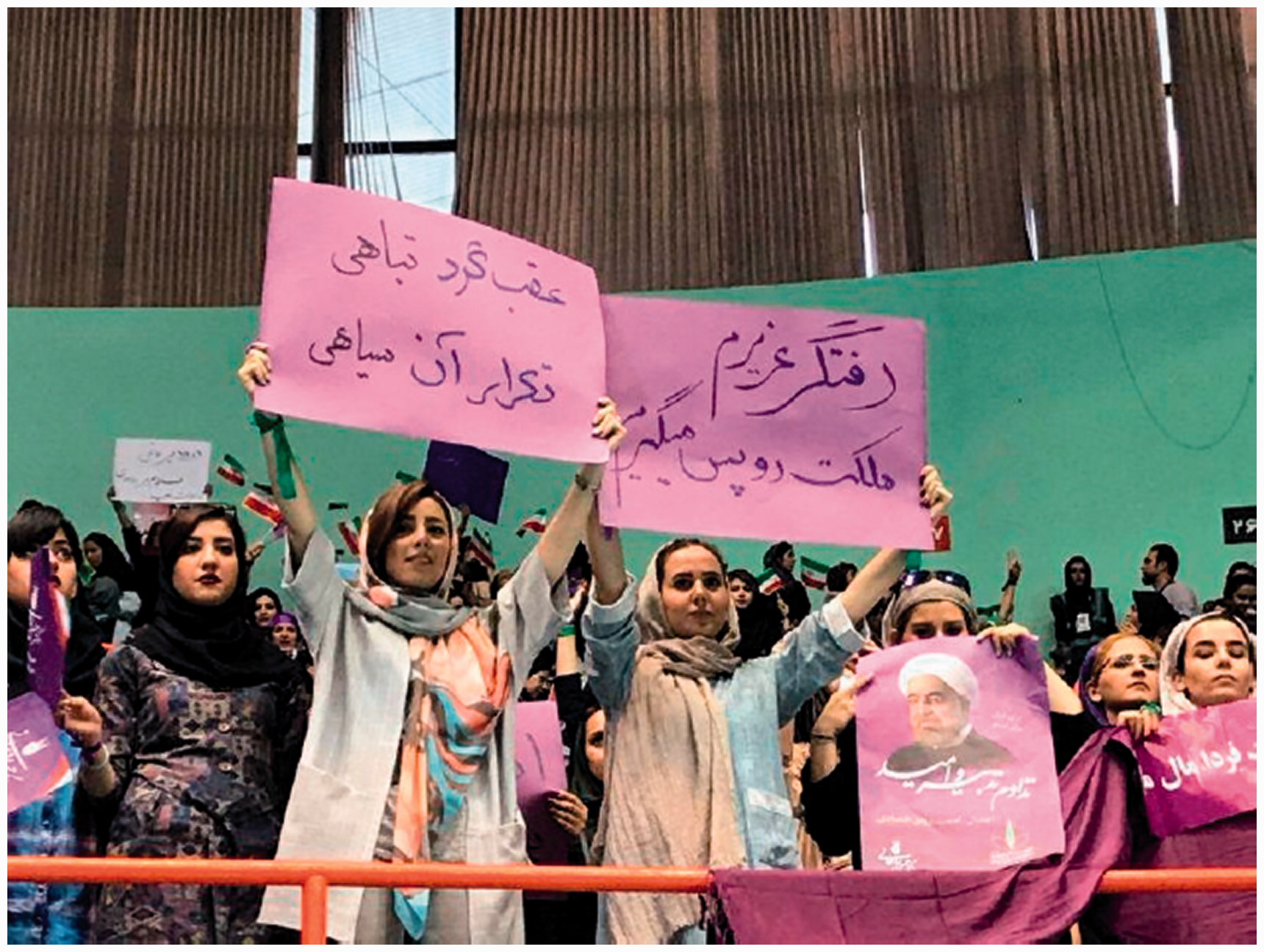
Iranian girls in a Rouhani's election meeting.
While these tweets show a more critical attitude to a non-democratic system, they do not criticize and destabilize the regime in clear and explicit ways. In fact, they generally remained at a superficial level, failing to delve into the deeper layers of the state’s discourse.
The dominance of these frames highlights the role of Twitter in both informing and meaning-making practices. However, while crowdsourced elites employed Twitter for shaping more complex frames of meaning, such frames also focused on non-critical issues like normal election battles. So far, we have analyzed reformists and conservatives’ practices as political camps which are defined in the boundaries of Iran’s political system. But what about the expatriate users? How were they positioned in this tussle?
Regime related-matters
Traditionally, the Iranian diaspora are known as people with strong disagreement with the regime. Our results also confirm this notion at first glance. Unlike other communities, Regime related-matters (RRM) was the most prominent frame in diaspora public. Expat elites particularly criticized the totality of the regime by producing this frame (65% of tweets in this frame aimed to challenge the identity of the regime as a totalitarian political system). This frame was also comprised of many commentaries which had been sent by ordinary users. Serious comments on the political situation in Iran, the violation of human rights by the regime, and criticizing reformists as the regime’s puppet outnumbered the sarcastic messages. @PesarNoah, 8 an ordinary expat, used a sentence by Mehdi Karoubi, one of the leaders of the 2009 Green Movement, to question the legitimacy of the regime in general. First, he mentioned Karoubi’s sentence: Voting to Rouhani is voting to the real Islamic Republic. He then interpreted this excerpt: Voting to Khomeini’s 9 Islamic Republic, voting to the state of execution, madness and dumbness. In such tweets which were frequent in RRM, users explicitly attacked the regime and its hegemonic discourse. However, crowdsourced users in the diaspora were not successful in affecting the mainstream flow in the network. Two reasons can be mentioned for this failure.
First, diaspora public was the smallest community on Persian Twitter. Thus, the tweets of RRM consisted less than 3 percent of the whole corpus. In comparison with DEC in reformist community which included 15 percent of all tweets, the number of RRM tweets were really low and negligible. More importantly, diaspora crowdsourcing practices in other top frames in their community, such as EMCS and DEC mainly repeated the behavior of other communities. They did not continue to challenge the regime by tweeting about ethical issues, election campaigns, and corruption. Their criticisms and attacks were aimed for individuals, mostly reformist politicians. Further analyses showed that expatriate elites had just sent 19 tweets challenging Khamenei, while the number of their critical tweets against Rouhani was much higher: 448. In this sense, they significantly stayed with conservatives in attacking reformist figures. Therefore, it can be concluded that even antagonistic expats could not change the reformist and conservative crowdsourcing practices in discussing non-critical issues mainly in the context of election campaigns and debates.
Discussion
This paper extends and updates the existing literature on networked practices and Twitter, particularly in the context of the Iranian Twittersphere. Our investigations shed more light on the ways that users with different political interests used Twitter for fulfilling their political demands. Our empirical analyses echo those researches which had shown that Persian Twitter was mainly comprised of three communities: reformists, conservatives, and Iranian diaspora (Khazraee, 2019; Marchant et al., 2016, 2018) representing the political landscape of Iran. It also confirmed that Iranian Twittersphere is notably reformist-leaning, despite the fact that users with different political relations have been joining this platform. On the one hand, the results confirm studies asserting that Twitter provides a space for voiceless and marginalized groups (Hamdy and Gomaa, 2012; Howard and Hussain, 2013); as we saw reformists used Twitter more effectively in 2017 election. On the other hand, our findings push forward those researches showing that people who have access to and even control mainstream media in Iran (conservatives) have also joined Twitter. Their presence is obviously not because they lack media outlets, but it is due to the importance of Twitter even for radical and hardliners in authoritarian contexts. As a matter of fact, conservatives tried to fight against reformists and opposition groups to poach this new space from reformists’ hands and even more, display their power on the international stage (“Briefing: Tracking Twitter’s Growing Popularity in Iran”, 2017). This finding challenges the idea of digital democracy and we will discuss it further with more evidence.
This paper explained the extent to which networked framing was effective in shaping public conversations during an election in a non-democratic context. Whilst previous researches remained in a relatively descriptive level, and lacked clear and enough explanations on their operationalization and coding strategies (Khazraee, 2019; Marchant et al., 2016, 2018), we tried to provide a better qualitative and discursive understanding of this understudied space by investigating Iranian crowdsourced elites and their networked practices. Our findings explained how a growing body of conservative users, with the help of expatriates, joined Twitter to compete with reformists who were traditionally the dominant force on Iranian Twittersphere and even other social media (e.g., weblogs). While previous studies focused on the gatekeepers in the whole network (Hopke, 2015; Jackson and Foucault Welles, 2015; Khazraee, 2019; Meraz and Papacharissi, 2013), our approach to investigate elite users in different networked publics helped us reach a more detailed and nuanced understanding of the ways in which crowdsourced gatekeepers were seeking to become the prominent actors in the network. It also showed how networked framing was effective to create a polarized space during official political happenings by crowdsourced elites. Moreover, we presented a more systematic and comprehensive framework to identify and analyze crowdsourced elites and the type of tweets they mostly share on Twitter. Previous investigations were partly sporadic and not inclusive/exclusive (Hopke, 2015; Meraz and Papacharissi, 2013). Thus, our suggested typologies of both networked gatekeepers and their tweets could provide a convenient basis for further studies, even in other contexts.
Our investigations not only advance our understanding of political communication on Persian Twitter, they also contribute to the existing literature of networked and citizen journalism, digital democracy and political activism on social media. For instance, our results indicated that DEC was the most prominent frame in the whole network as well as reformist/conservative communities. It revealed that networked gatekeepers used Twitter particularly for informing and discussing normal topics in the election time. This result was asserted by the high frequency of news/quotation tweets. These findings highlight the importance of Twitter for ambient news sharing and seeking (Hermida, 2010; Marchant et al., 2016). The results also support the arguments that users mixed their opinions and feelings with their, even informing, tweets as they participated in a connective action (Jackson and Foucault Welles, 2016; Papacharissi and De Fatima Oliveira, 2012).
Unlike previous researches which showed that Twitter in non-democratic societies is mainly used for discussing and challenging sensitive topics (Hamdy and Gomaa, 2012; Lev-On, 2018; Meraz and Papacharissi, 2013), our interpretations showed that Iranian users mainly talked about routines and normal topics during the 2017 election. This was also confirmed by the high frequency of news/quotations and also the dominance of DEC. Even when elite users’ informing practices were combined with meaning-making strategies in producing frames such as EMCS, corruption, and PSC, such practices did not aim to challenge the foundations of the regime’s discourse. For instance, frames which challenged the idea of Velayat-e-Faghih as the backbone of the regime’s ideology, or attacked Khamenei as a dictator were of least interest in the network. Therefore, our investigations contrasted the existing literature that emphasized the potentials of social media for democracy and challenging political systems in non-democratic contexts (Castells, 2013; González-Bailón, 2015; Howard and Hussain, 2013).
In particular, Meraz and Papacharissi (2013) see networked framing as a citizen activity resulting in democratizing or pluralizing the public sphere. Our empirical investigations, on the contrary, showed that Twitter is not only a political tool for protesting, and even deliberative conversations encouraged by marginalized and voiceless groups. It could simply be a communicating and news-sharing platform dealing with routine topics. In this way, this research highlights other studies that challenged the ideas of digital democracy and networked framing as processes that necessarily resulted in democratizing authoritarian societies (Pöyhtäri et al., 2019; Tufekci, 2014).
The above-mentioned interpretations were also emphasized if we notice how a growing body of conservative-leaning users emerged on Twitter to frame the election in favor of Iranian regime. While the prominence of some frames like FPA and RRM showed that other communities tried to use Twitter for destabilizing the regime, those efforts had minor impacts on the network. Reformists, in particular, did not explicitly challenge the regime. Their crowdsourcing practices aimed to question cultural norms of the regime in more soft and implicit ways. Expatriates’ sharper tweets in framing RRM were also unsuccessful to attain prominence in the network. Moreover, they stayed with conservatives in attacking their mutual enemy: reformists; rather than continuing their efforts in challenging the regime. Thus, the network was dominated by reformists’ serious news/quotations on non-critical issues, and conservative tweets which commented sarcastically and critically on reformists’ messages to underpin the regime. Overall, this research shows that Twitter was not only against the regime during 2017 election, it was more or less in support of the Iranian political system.
Our primary focus was on investigating how different networked publics (ika. analytical units) were positioned in discursive frames. However, our findings revealed more noteworthy conclusions about the networked gatekeepers across various communities. This research confirmed and explained the ways ordinary citizens are empowered by Twitter to get engaged in public discussions around ongoing events more directly and effectively. However, while other researches argued this process led to bypassing mainstream media and official narratives (Lev-On, 2018; Poell and van Dijck, 2018), our findings showed that media and their journalists still remained as powerful networked crowdsourced elites. It also challenges the body of citizen journalism literature which undermines the role of traditional news players. Furthermore, legacy media had more success in attaining prominence than digital-born outlets. Besides ordinary citizens and media, other types of elite users like politicians and celebrities had significantly failed in reaching higher positions in the network. Despite this fact that many ordinary Iranians joined Twitter in recent years, it is an interesting result that politicians cannot use this platform effectively in line with their political interests. It contrasts previous studies which argued that politicians employ Twitter significantly and effectively to reach their voters and fans as well as participate in public conversations (Hemsley et al., 2018; Jungherr, 2017). However, it seems that this situation has changed since 2017, particularly since some Iranian political figures like @azarijahromi, Mohammad Javad Azari Jahromi, the minister of Information and Communications Technology, have emerged as active gatekeepers. This could also be investigated in relation with the state’s policy toward social media and particularly Twitter. The scarcity of organizational and celebrity gatekeepers could also be studied in terms of such policies.
Moreover, our analytical focus was on analyzing “real” users. Therefore, we removed bots from our sample. However, it seems that bots which are operated by the state, opposition groups such as MEK, and other political forces play a more important role in Persian Twitter. Analyzing the mechanisms by which bots and “cyber armies” are trying to affect the information flow and networked practices could enhance our knowledge about the state, Twitter and political activism in authoritarian societies even more. In addition to analyzing the ways that government figures emerged as crowdsourced elites, such investigations could also reveal how the state uses Twitter for suppressing people and derailing Twitter conversations. Finally, we identified the most prominent frames in each tweet. There were some tweets that included more than one frame. Investigating how, why, and to what effect, users mixed frames in their tweets can be a significant direction for the next studies.
Footnotes
Acknowledgements
I would like to thank Dr. Emad Khazraee (Indeed: San Francisco, US), whose guidance and support in collecting and analyzing Twitter data played a crucial role in fulfilling this research. I also like to thank Maxime Walder and other participants in the IPZ pre-publication seminar (Universty of Zurich, October 2018) who provided insightful comments on this project. Lara Kobilke (Universty of Zurich) also raised thoughtful comments on the very early drafts of this work. Finally, I am grateful to the Editor (Dr. Mattew Zook), the Co-Editor (Dr. Dhiraj Murthy), and the three anonymous reviewers for critically reading the manuscript and suggesting substantial improvements on earlier drafts of the manuscript.
Declaration of conflicting interests
The author(s) declared no potential conflicts of interest with respect to the research, authorship, and/or publication of this article.
Funding
The author(s) received no financial support for the research, authorship, and/or publication of this article.

Notes
Appendix 1
The operationalized definitions of networked gatekeepers: We identified six main types of Iranian users. Some of these types also have some sub-types. The networked publics in Persian Twitter are chiefly populated by these types of users: Media, Organizations, Celebrities, Journalists, Politicians and Ordinary citizens. Media type has two sub-types: Digital born and Legacy. Based on the conceptualization of Majó-vázquez et al. (2017), legacy media are those outlets that preceded the advent of the web, and digital-born media are those outlets that do not have an offline edition (p. 1). We divided organization into two categories: State organizations and NGOs. 10 Celebrities also are the public figures whose reputations are independent of social media communication. Cinema actors, sport players and so on are classified in this category. Journalists and politicians are identified based on their career. Politicians category was divided to Official accounts, Fan accounts and Fake accounts. Finally, users who are not part of the aforementioned categories are classified as ordinary citizens. These citizens are of two types: Elite users and ordinary users. We defined elite users as users whose followers were at least 10k more than their followings at the time of research. Other users were coded as ordinary users.
Appendix 2
The operationalized definitions of tweet types: Bombastic tweets are inflated texts which contain exaggerated language that sounds important but has little meaning. A commentary is an interpretation or opinion of/about a subject. An evidence is a tweet which provides facts about something. There is a related type to this one. Users demand some facts in requesting evidence tweets. Then, in response to those requests, evidence may be posted or not. Fun tweets provoke laughter, or entertain users. Like fun, there is a general understanding of infographic too. Infographic tweets contain some visual representation of information, data, or knowledge intended to present information quickly and clearly.
Following the rich literature in communication studies, news is defined as a piece of information which is new, interesting, and true 11 (Rudin and Ibbotson, 2002). On the contrary, personal expressions are users’ instant reactions to ongoing events. For instance, a user tweeted: Damn you! Mir Salim, 12 in reaction to Mir Salim’s speech in one of the election debates. Point is a general fact in a particular field like health, economy, etc. By poll we mean a Twitter feature which enables users to run a poll. Question is a straightforward type which refers to a tweet asking something. The next type, quotation is a group of words of other peoples which is exactly repeated. Rhetorical question is a question which asks something but it means exactly the opposite. Using this type, users wanted to assert that their opinions were right. The penultimate type, slogan, is a short phrase aiming to promote a politician or an idea. The last type, feature, is a journalistic story which is usually hyperlinked in a tweet.