




Abstract
Nonprofit organizations rely on social media to build relationships with their stakeholders and solicit the resources they need to provide their programs and services. This online activity takes place in an increasingly competitive environment. We draw on the situational theory of publics, stakeholder theory, giving motivation, and gamification to examine this question: When organizations engage in competitive philanthropy, what framing is more effective at generating donations on an online platform? We confirm the relationship between tweeting and donation solicitation and shed light on some specific types of messaging associated with increased donations.
Introduction
Nonprofits build relationships and expand audiences one retweet and one like at a time. M+R Benchmarks
Nonprofit organizations can help individuals acquire needed goods and services and navigate public space. These organizations connect individuals to larger societal institutions, representing what Berger and Neuhaus (1977) call mediating structures. Many nonprofits rely on donated income to deliver on their missions. When it comes to securing donations, we see three trends growing in prominence: online giving (Saxton & Wang, 2014), social media use (Suh et al., 2021), and gamification (Curley et al., 2021; Walk et al., 2022). Mechanisms for giving are evolving, with an ever-growing reliance on web-based platforms. For example, MacLaughlin’s (2016) study of 5210 nonprofit organizations finds that online giving now accounts for 7.2% of total fundraising, resulting in US$2.6 billion raised annually. Some online giving mechanisms are relatively straightforward, such as donation buttons on organization websites. At a minimum, organizations using this type of mechanism rely on donors to seek them out. Organizations can boost the likelihood of online fundraising success by using social media. Doing this may broaden the reach of an organization’s message, as research into effective engagement demonstrates (Amtzis, 2014; Carboni & Maxwell, 2015; Lovejoy & Saxton, 2012; Paulin et al., 2014), but may result in engagement (i.e. likes on Facebook, or retweets on Twitter 1 ) rather than monetary donations (Lacetera et al., 2015).
Social media practices that successfully generate revenue reflect a combination of factors: nonprofit social media use, donor social media use, and strategies motivating both in-app and out-of-app behavior. We know something about how nonprofits like to use social media, often through case studies (Abeza & O’Reilly, 2014; Briones et al., 2010; Campbell et al., 2014). We know a bit about (potential) donor social media use and giving patterns. For example, M + R Benchmarks found that 38% of donors making an online gift in 2016 repeat the gift to the organization a year later. We know something about the strategies for motivating in-app behavior such as likes and retweets (Guo & Saxton, 2014). We also know a little bit about the connection between an organization’s online activity and financial performance (Lee, 2021) and what (if anything) motivates out-of-app behavior (e.g. donations), including social media activity and audience engagement/familiarity with the organization (Bhati & Mcdonnell, 2020). According to the 2018 M + R Benchmarks Study, online revenue showed a 23% growth, with revenue from Facebook, Twitter, and Instagram up by 13%, 15%, and 44%, respectively—nonprofits who have an online presence can generate revenue. However, we do not know as much about the efficacy of specific messaging strategies as they relate to creating two-way interactions (Mato-Santiso et al., 2021) and increasing donations.
This interplay between social media use and online giving takes place in an increasingly competitive landscape. Nonprofits compete over limited resources in the grant process (Ashley & Faulk, 2010), over fee-based services (Chetkovich & Frumkin, 2003), and even for clients (Ritchie & Weinberg, 2000). Social media makes those competitive tendencies more visible as organizational actions, especially on platforms like Twitter or Facebook, are public.
Thus, we aim to examine the efficacy of specific messaging strategies to address this question: What framing is more effective at generating donations during direct competition? We draw on the situational theory of publics, stakeholder theory, giving motivation, and gamification to examine this question. We answer this question by linking communication timelines and donation timelines based on data collected during a fundraising competition in which nonprofits vied for donations. Specifically, we look at framing to see whether philanthropic framing (appeals to help advance mission), gamification framing (appeals to fan identity to “get off the bench/score points”), or crowdfunding framing (we are in this together, team spirit) are more effective at generating donations when nonprofits directly compete. We find that the message matters: altruistic messaging is positively related with donations; competitive messaging is negatively related with donations (even when nonprofits were participating in a fundraising competition).
Theory
As Knutsen (2016) notes, no single definition of nonprofits or the nonprofit sector exists. For this study, we rely on a structural/operational definition that describes nonprofit organizations as non-coercive, non-distributive, voluntary, and self-governed (Frumkin, 2005; Salamon & Anheier, 1997). These organizations are often formed to fill a void between the market and the state (Weisbrod, 1986), and represent mediating structures that help people navigate between public and private life (Berger & Neuhaus, 1977).
One hallmark of these organizations is their reliance on contributory philanthropy, also known as donations. Philanthropists use traditional contributory philanthropy to work with, around, and sometimes in direct competition with government to meet public needs (Horvath & Powell, 2019). They often channel their giving through nonprofit organizations. These organizations have many stakeholders, essentially defined as “those groups and individuals who can affect you and whom you can affect” (Freeman, 1994, p. 411). These include but are not limited to service recipients, donors, community members, public officials, employees, and volunteers. These stakeholders have varied attitudes, responses, and behaviors based on their perceptions of a given organization.
Nonprofit organizations that rely heavily on donations have to balance the varied preferences of stakeholders they deem salient based on power, legitimacy, and urgency (Mitchell et al., 1997). Grunig (1989, 1997) uses the concept of publics to demonstrate how people can have different levels of interest in and engagement with organizations: latent, aware, and active. Grunig developed this theory while observing the Sierra Club, noting that members of active publics were most likely to join and participate in activist groups. We extend his theory to a fundraising context and link it to the existing literature about nonprofit social media use and online relationship building (e.g. Lovejoy & Saxton, 2012). When it comes to soliciting contributions from potential donors (i.e. move donors from latent or aware to active publics), we argue that organizations have to demonstrate salience of their own to the stakeholders to stand out from a crowded field and successfully acquire donations.
Offline versus online donations
In a typical offline, contributory donation setting, donors tend to care about some combination of quality, price, and fundraising (Weisbrod & Dominguez, 1986). However, online donations are driven by different factors (Walk et al., 2022), including social network effects and quality of online communication (Saxton & Wang, 2014). Nonprofit organizations can foster better online connections with their stakeholders through the strategic use of social networking sites (Hu & Shi, 2017). Social media offers organizations outlets for “multi-dimensional information flows” (Bernhardt et al., 2012, p. 135), and a way to dialogue especially with multiple audiences, including community members (Briones et al., 2010).
Lovejoy and Saxton (2012) identified three common information strategies nonprofits typically use online: information-sharing, relationship-building, and call to action. Information-sharing is a one-way dialogic, with the organization pushing out information to what Grunig (1997) would consider a latent public without expectation of response or feedback. They may hope to move the latent public to an aware public. By contrast, the Lovejoy and Saxton’s (2012) relationship building and calls to action strategies imply at least some level of interplay between the information giver and receiver. They tend to generate more engagement (e.g. retweets and replies) than simple information-sharing (Guidry et al., 2014), and provide opportunities for supporters to perform tasks like attending events or participate in programs run by the organization (Campbell & Lambright, 2020), thus moving publics from aware to active (Grunig, 1997).
Donation solicitation is one example of a two-way dialogic in the form of a call to action (Del Mar Gálvez-Rodríguez et al., 2016). Successful donation solicitation rests on appealing to donor giving motivations. People generally donate out of a mix of pure (Warr, 1982) and impure altruism (Andreoni, 1990). They give to organizations they deem trustworthy as recipients of funding (Sargeant & Lee, 2002). In addition to these long-established motivations, Fielding et al. (2022) identified competitive giving as a motivation, in which donors make their giving decisions based on the giving patterns and actions of others. Successful solicitation online rests on creating dialogic loops, appealing to a donor’s empathy and perception of credibility as an organization (Liu et al., 2017)—and, possibly, their competitive drive—thus motivating them to, in turn, give back to the organization. By integrating these information strategies with Grunig’s publics, we can consider information-sharing to move latent publics to aware publics, relationship building as a means to move aware publics to active publics, and calls to action as a means to utilize active publics (e.g. for resource provision). As Figure 1 demonstrates, both relationship building and calls to action create dialogic loops.
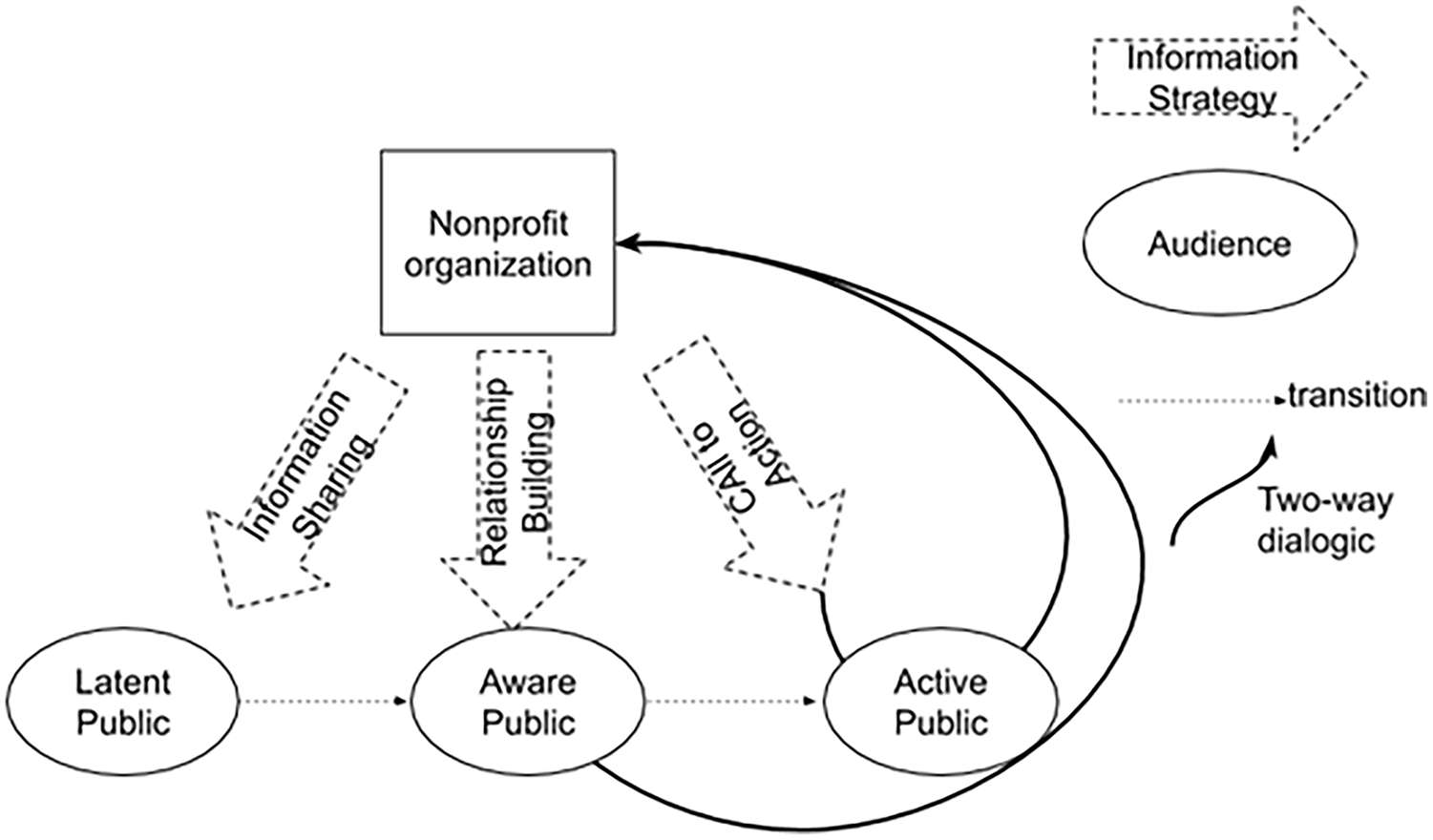
Nonprofit messaging, dialogic loops, and the public.
Defining competitive philanthropy
Nonprofits vie for resources in an increasingly competitive environment (Joseph & Lee, 2012). In addition, fundraising efforts have increasingly occurred in formats that pit individuals against each other on behalf of charities (e.g. the PGA Tour Charities’ Birdies for Charity), as well as competitions between nonprofits, where raising the most money or getting more resources is the goal. These types of competitions often occur online, when the organization with the most likes, votes, or other engagement with social media posts are deemed as “winners” and receive a prize. For example, on 2019’s Giving Tuesday, the Philadelphia Federal Credit Union initiated a giving campaign to allocate US$5000 among three local nonprofits based on crowd voting.
What happens when organizations engage in competitive philanthropy? We define competitive philanthropy as monetary gifts made by individuals to nonprofit organizations or private foundations where the giving experience is enhanced through game-like/gamified aspects and where the nonprofit organizations or private foundations raise funds while being benchmarked against each other. Thus, competitive philanthropy combines elements of traditional contributory philanthropy with elements of both crowdfunding and gamification.
Belleflamme et al. (2014) define crowdfunding as “an open call, mostly through the internet, for the provision of financial resources either in the form of donation or in exchange for the future product or some form of reward to support initiatives for specific purposes” (p. 558). DonorsChose.org is an example of crowdfunded philanthropy where teachers list their needs and donors get to pick the campaigns they fund. Gamification is the application of game-like design principles to both game and non-game contexts (Huotari & Hamari, 2017). Gamified giving is “the use of game design elements” (Deterding et al., 2011, p. 9) in giving to nonprofit organizations or private foundations and has been studied through the lens of learning about and solving social problems (Nguyen et al., 2012). Examples include Omaha Gives!, which is an example of a 1-day tournament that incentivizes giving with donor matches and timed mini-fundraising goals. The goals and time limits gamify the act of giving but do not pit organizations against each other. Gamified or competitive philanthropy may be considered market-driven and individualistic. However, according to Yu (2017, p. 46), this type of philanthropy “. . . also has the potential to transcend the dichotomies of altruism versus self-interest or state versus society” (Hu & Shi, 2017). Figure 2 demonstrates the relationships between contributory philanthropy, crowdfunding, and gamification.
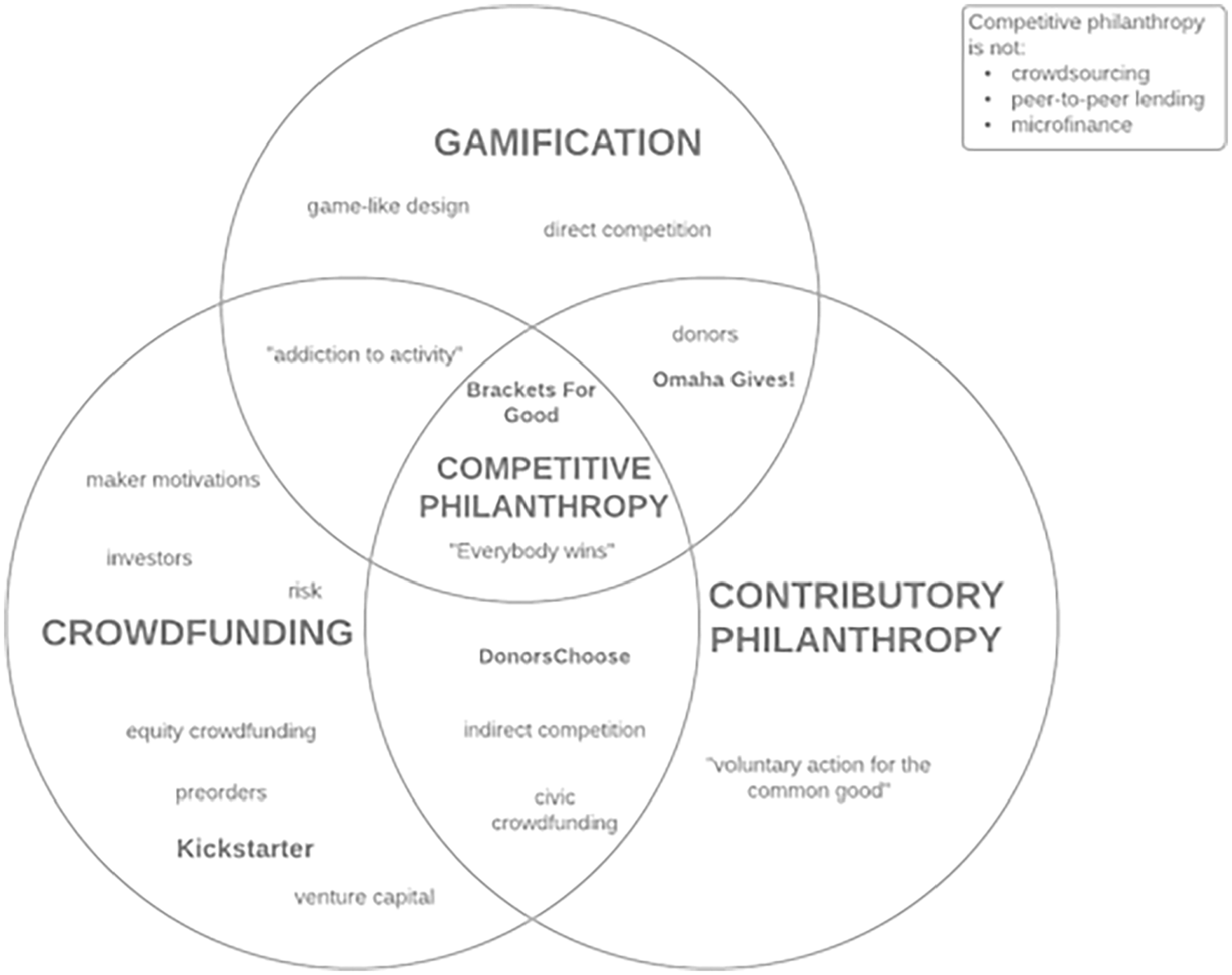
Competitive philanthropy at the intersection of contributory philanthropy, crowdfunding, and gamification.
Using framing to generate calls to action
Individuals use a two-step process to make decisions: (1) a preliminary analysis in which they frame the problem, choice, and outcomes and (2) an evaluation of the previously framed options to settle on a choice (Kahneman & Tversky, 1979). Framing theory rests on the idea that one issue or concept can be perceived in different ways, and the way in which one views said issue affects one’s consideration of the issue (Chong & Druckman, 2007). Framing is the choice of presentation of a given issue and be used to change or reorient someone’s thinking by “activating information already at the recipients’ disposal, stored in long- term memory” (Nelson et al., 1997, p. 225). For example, donors often have a preconceived (negative) notion of overhead but react more positively when overhead is framed as organizational capacity (Qu & Levine Daniel, 2021). Nonprofits use many different frames when sending out donation appeals—some focus on impact, others use narratives from beneficiaries, and some highlight the benefits donors will personally realize through the effect of donating. A competitive fundraiser that combines elements of contributory philanthropy, crowdfunding, and gamification offers nonprofits the opportunity to use additional, competition-relevant framing along with their traditional mission-based framing to yield active publics, as represented by donations.
At its core, competitive philanthropy is still philanthropy. Therefore, we expect messages that focus on the organization’s mission and the act of doing good to resonate with potential donors, motivating them as active publics to donate to the organization outside of a social media platform.
H1: Philanthropic framing will be positively associated with active publics.
Individuals who back campaigns on crowdfunding platforms tend to do so to help others, support causes, and be part of a community (Gerber & Hui, 2013). Using a collective crowdfunding frame to appeal to donors is reflective of traditional contributory philanthropy’s history of philanthropists entreating their networks to give. Saxton and Wang (2014) use the language of “fans” and note the importance of organizational fans expanding exposure within their own social networks, netting increased charitable contributions. Philanthropy and crowdfunding share some characteristics, including a wide range of funder motivations and behaviors. In addition, nonprofits have had some success using crowdfunding campaigns, especially in specific, one-off designs (Alexiou et al., 2020). Therefore, we expect messages referencing crowdfunding will serve as calls to action that will generate donor engagement.
H2: Crowdfunding framing will be positively associated with active publics.
Competitive philanthropy reframes the philanthropic giving through a lens of competition. The competitive giving hypothesis argues that public competition can trigger giving because individuals have the urge to win in situations where their reputation is publicly displayed, and altruistic behavior improves the status and reputation of the giver (Hardy & Vugt, 2006). In addition, Solomon et al. (2015) emphasize the importance of early donations, Xiao et al. (2022) find an indirect effect of loss-framed messaging highlighting the negative consequences for not donating on willingness to donate, and Cao (2016) demonstrates a direct link between loss-framing and donor giving intentions. Gamifying philanthropy in the form of direct competition can inform problem recognition (here is a situation you can do something about: help us move forward) and lower constraints (help us by donating), two of the factors that determine a stakeholder’s position as a latent, active, or aware public (Grunig, 1989). Given this competitive element (have to outperform head-to-head, impact of early donations), we expect gamification framing will serve as calls to action that will generate engagement.
H3: Gamification framing will be positively associated with active publics.
Method
We draw on data from a competitive, online fundraising tournament run by Brackets for Good (BFG; bfg.org, n.d.), a Midwest-based 501(c)(3) nonprofit organization that focused on activating new donors and increasing awareness for other nonprofits. From 2012 to 2020 BFG ran fundraising tournaments that put nonprofits in direct competition with each other. The tournament was set up as a bracket, similar to the National Collegiate Athletic Association’s March Madness basketball tournament or the International Federation of Association Football’s World Cup. Organizations filled out an entry form that asked, among others, for organizational-level information such as human resources, fundraising strategies, and social media use to determine selection into the competition. For a nonprofit to be part of the online fundraising tournament, they must go through an application process to be appropriately paired with a similarly sized competitor. These matchups were made based on organizational capacity, motivation, and effort (Levine Daniel, 2017). In total, 64 organizations were selected to compete in head-to-head matchups in the bracket-style tournament we studied. Figure 3 provides a visual of how different nonprofit organizations are matched up in a bracket, thus facilitating direct competition. All entrants keep the money they raise, and the organization that out-fundraises its competition through four rounds wins an additional monetary prize. BFG was selected for this exploration as they were considered a leader in innovative fundraising platforms, even being labeled a “fundraising tool to watch” (Nonprofit Tech for Good, 2017).
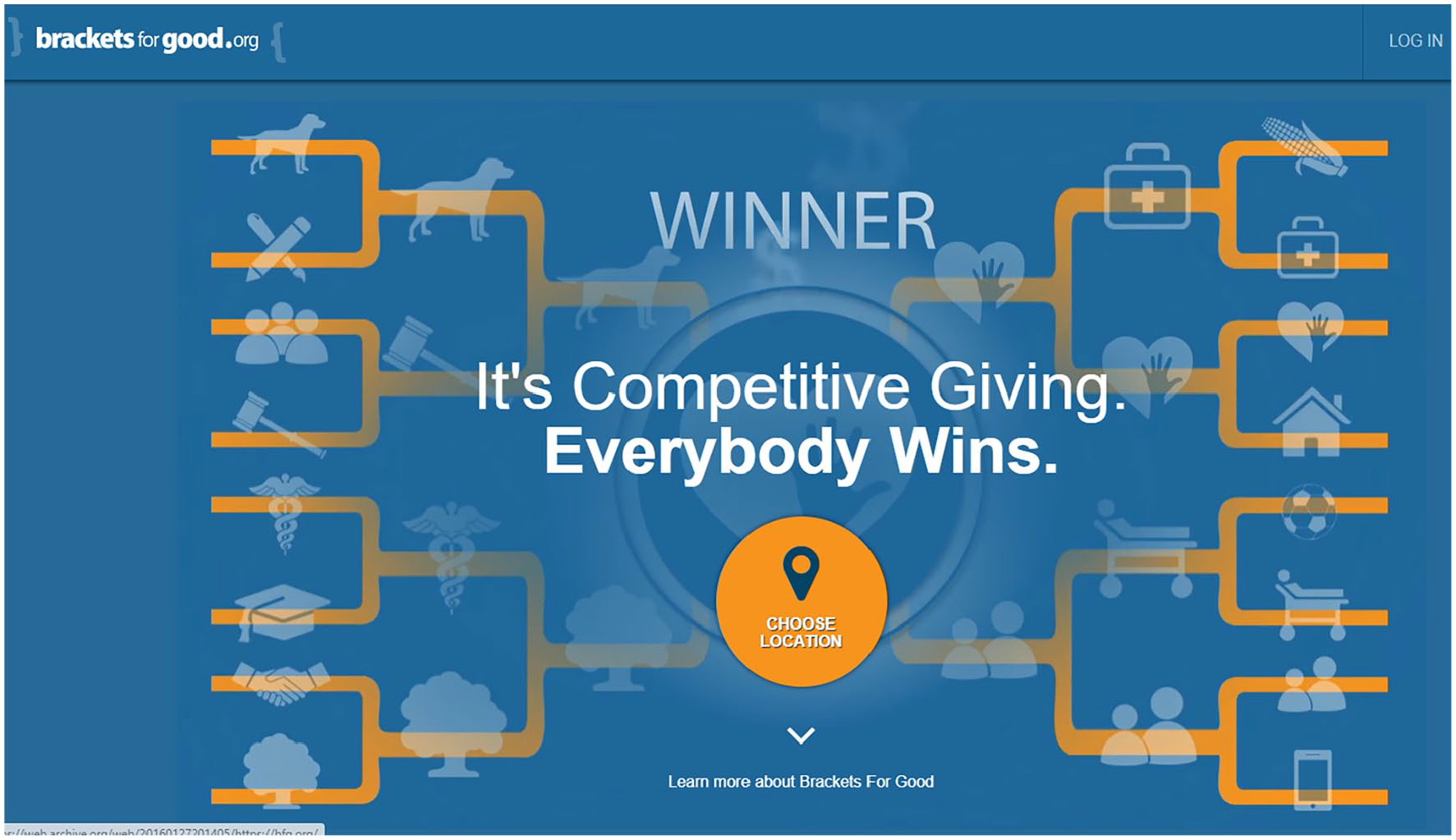
Visualization of a BFG tournament bracket.
To link social media messaging with donations, we first identified Twitter activity from the March 2017 tournament (3057 original tweets using BFG-related hashtags along with their timestamps). We then matched data from the donation timeline (31,922 data points) to see what type of framing engages followers to act (i.e. donate). Each data point on the donation timeline showed how much someone donated to a specific organization, and the time the donation was made. The tournament included multiple rounds of competition, but here we focus only on the first round, since subsequent rounds would unfairly balance the tweeting and fundraising opportunities for organizations still in the competition.
Tweet sampling strategy
To collect our sample of tweets we utilized the hashtags promoted by BFG as search terms through birdIQ. BFG released a suggested marketing strategy that included the use of specific #BFG terms that would connect the audience and nonprofits who were actively using social media to promote the tournament and drive donations. These hashtags were also used on other platforms like Instagram and Facebook. However, Twitter had the most traffic and use across the nonprofits and those on Instagram and Facebook were also active on Twitter. Therefore, as the most widely used platform, we opted to focus our analysis on Twitter.
Tweet coding strategy
Twitter is an ideal platform to study in this competitive philanthropy because of its constant stream of communications, including real-time updates and the ability to respond to stakeholder reactions (Golbeck et al., 2010). This platform is more conversational in nature with an interface that is simpler for the user (than, e.g. Facebook) and designed for use across desktop and mobile devices (Kwon et al., 2014). In addition, organizations often use Twitter to reach multiple audiences, including both their own members and the general public (Halpin et al., 2021). During the BFG tournament the tweets fell into categories of calls for donation, performance updates, shoutouts or thank yous to donors, and direct calls to competition.
Two independent coders read and identified the contents of each tweet. They initially coded them into categories such as “game references,” “specific basketball reference,” “competitive spirit,” “mission specific tug,” “call for general do goodness,” “reference to the big prize,” “proposes fundraising scheme/suggested donation,” and “encourages donation broadly “thanks for donation.” We then aggregated these categories into frames. For example, “mission- specific tug” and “call for general do-goodness” are considered as philanthropy framing, while “specific basketball reference” is gamification framing. Table 1 provides additional examples of coding categories and frames.
Examples of coding categories, frames, and examples.
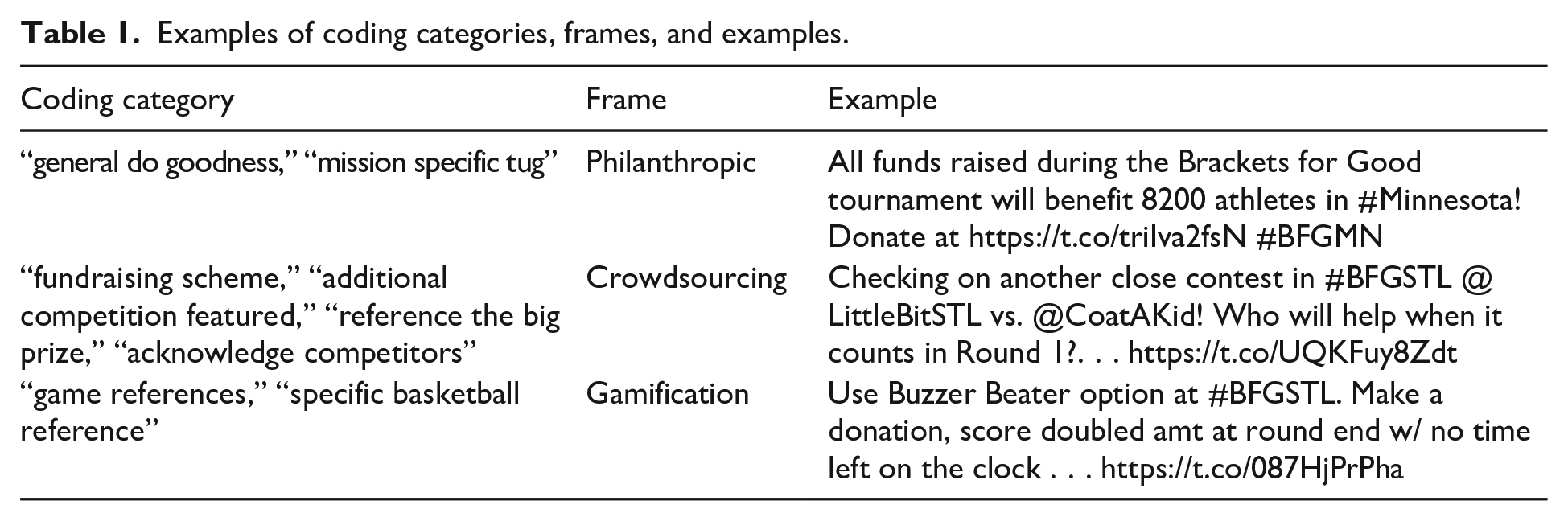
Each tweet was allowed to have multiple coded categories based on the content. We allow for each statement to receive codes across the content so each tweet could be coded under multiple frames. For example, if a tweet has a mission-specific tug, the tweet was coded as philanthropy framing. If that same tweet also makes a basketball reference, then they also are coded as gamification framing. We recognize that some statements have sentiments of more than one coded category. Our models include variables that account for these more dynamic tweet strategies.
Dependent variable
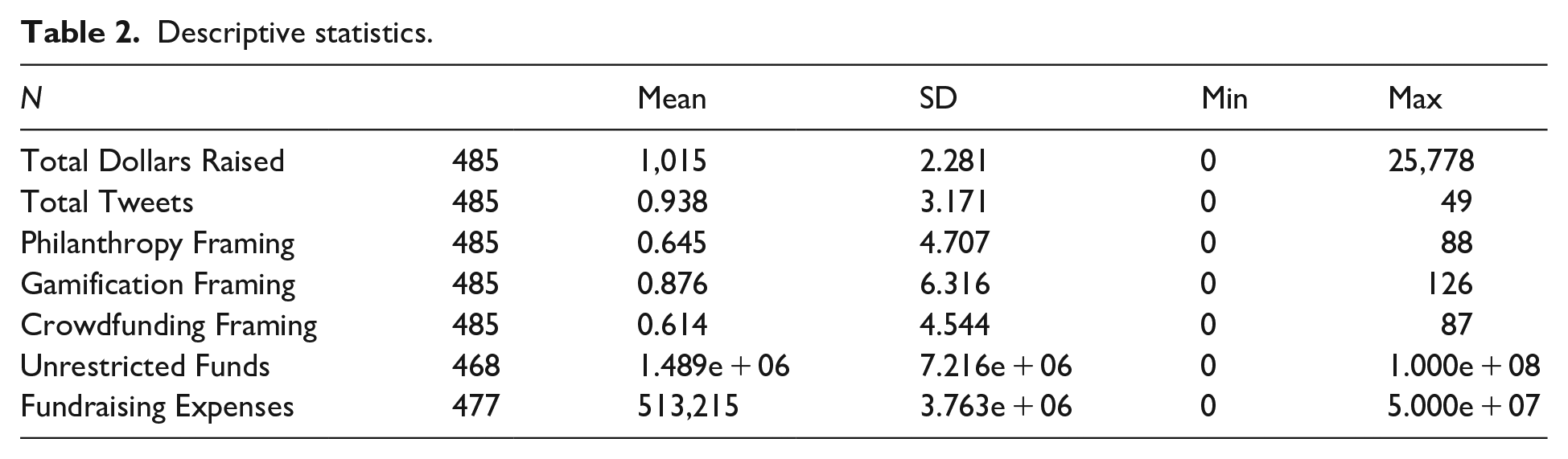
Our focus is on active publics, that is evidence of people shifting to take actions on behalf of the organization. We measure this as total dollars raised. Total Dollars Raised can be considered a measure of magnitude regarding an active public and has a mean of US$1015; see Table 2 for descriptive statistics of all variables.
Descriptive statistics.
Independent variables: framing
Our independent variables focused on messaging related to the characteristics of competitive philanthropy. We sorted each tweet into one of three frames: philanthropy, gamification, and crowdfunding.
Philanthropy Framing represents tweets focused primarily on the organization’s core mission and/or spoke about generally doing good, appealing to the altruistic aspects of philanthropy. An example would be an animal shelter encouraging its followers to “save some kitties.” In our data 11.8% of organizations utilize philanthropy in at least one social media message.
Gamification Framing tweets played up the competitive aspects of the game or included basketball-related references. “The final buzzer is about to sound! Push us over the edge and score points” is an example of a gamification message. Approximately 17% of the participants in our data utilize competition in some form to market their organization.
Crowdfunding Framing tweets directly referenced money and/or egoistic benefits for donors. “We’re looking for this round’s MVD (Most Valuable Donor)! Will it be you?” is an example of this type of messaging that focuses more on the donor than on the organization. Over 87% of organizations utilized a monetary-oriented approach to their social media strategy.
Control variables
We controlled for Total Tweets to help isolate the messaging effect, rather than the effect of tweeting itself. The mean was approximately 1; however, several organizations actively engaged in tweeting, sending as many as 49 tweets in the first round alone.
We used Unrestricted Funds as a proxy for organizational financial capacity. Unrestricted funds represent an internal funding source (Calabrese, 2012). The mean reported was US$1.4 million.
We also control for Fundraising Expenses since this expenditure may affect the resources an organization has to devote to a funding campaign such as BFG. The mean reported was US$513, 215.
Data analysis
We used ordinary least squares (OLS) to estimate a relationship between an organization’s tweets and its active publics for the 485 organizations in our sample. We used Total Dollars Raised as the dependent variable: We iterated the model 4 times: Model 1 established a relationship between tweeting generally and total dollars raised, Model 2 established a baseline with the independent framing variables, Model 3 incorporated and controlled for organizational characteristics, and the full specification in Model 4 included interactions between the framing variables.
Findings
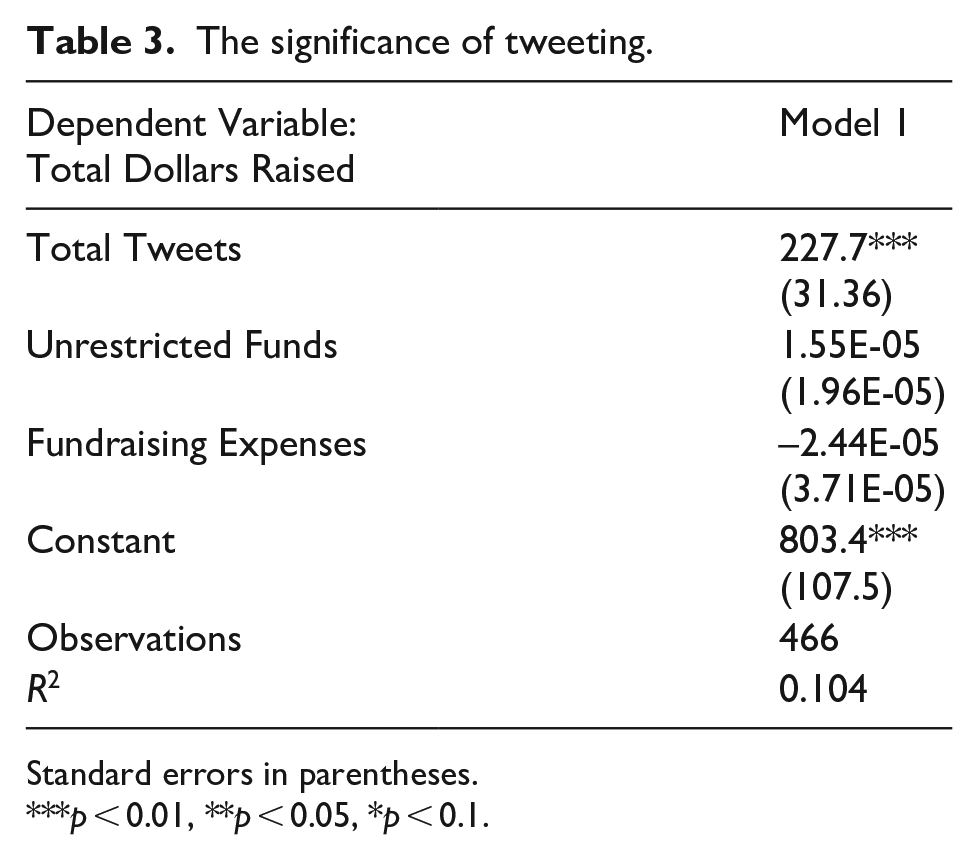
As Model 1 shows, an increase in Total Tweets is associated with an increase in total donations of US$277.7. This confirms a relationship between tweeting and donations. However, this model only explains approximately 10% of the variability in donations. Table 3 shows additional details for Model 1.
The significance of tweeting.
Standard errors in parentheses.
p < 0.01, **p < 0.05, *p < 0.1.
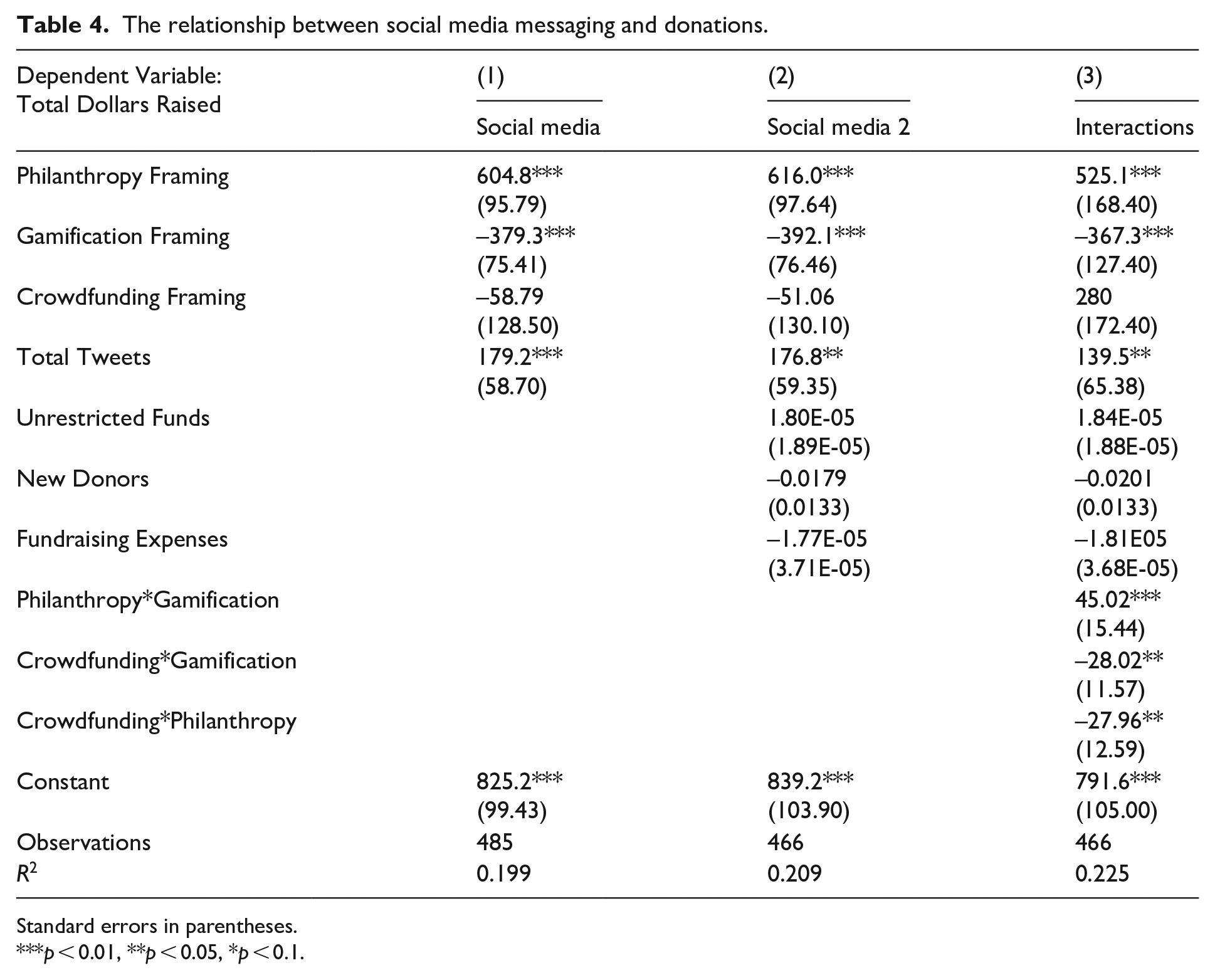
Tweeting itself was related to increased donations, but accounting for messaging increased the explanatory power of the models. Although the Brackets for Good tournament was competitive, this was, at heart, a fundraising drive. Philanthropy Framing (i.e. the organization’s mission) was positively and significantly associated with total donations, supporting H1. A one unit increase in philanthropy-framed tweets was associated with an increase in donations ranging from US$505 to US$614 (Table 4, all models).
The relationship between social media messaging and donations.
Standard errors in parentheses.
p < 0.01, **p < 0.05, *p < 0.1.
We initially hypothesized that messages related to crowdfunding and gamification would both be associated with active publics. As Table 4 shows, Crowdfunding Framing was not significant when it comes to total funds. Thus, H2 is not supported.
The format of the Brackets for Good tournament makes the competitive nature of this gamified fundraising initiative explicit, which is, in part, why we expected messaging relating to the gamification to be associated with active publics. However, Gamification Framing was negatively related to Total Dollars Raised. A one unit increase in gamification-focused tweets was associated with a decrease in donations ranging from US$343 to US$382, disproving H3.
Although Philanthropy Framing was positively related to Total Dollars Raised and Crowdfunding was not significant, the Philanthropy*Crowdfunding interaction demonstrated a negative and significant relationship to Total Dollars Raised. The Crowdfunding*Gamification interaction was also negatively related to Total Dollars Raised. Interestingly, despite the negative relationship Gamification Framing had with Total Dollars Raised, Philanthropy Framing appears to drive the positive, significant relationship between the Philanthropy*Gamification interaction and Total Dollars Raised.
Neither of the control variables were significant. This null finding for fundraising capacity is notable because it reflects what Bhati and McDonnell (2020) found: an organization’s budget is not correlated with online fundraising success. This democratizes the opportunity for smaller nonprofits to reach larger audiences/potential fundraising pools.
Discussion
Previous research has suggested that social media engagement via actions like tweeting are important and relevant for driving donations. Halpin et al. (2021) identify intention to reach multiple audiences but not being able to know if successful—we offer a way to show if loops are truly dialogic. This study makes connections between tweeting and fundraising that demonstrate the importance of framing. This research also suggests that despite the common scholarly acknowledgment that social media promotes donation and engagement with a donor and volunteer base, organizations are not utilizing this technique.
We demonstrate that by simply tweeting once during the competitive fundraising tournament organizations were likely able to increase their donations. We then demonstrate that the tweets utilized fell into one of three categories that undergird competitive philanthropy: philanthropy, gamification, and crowdfunding. Donors most positively responded to the philanthropic or altruistic attempts to raise funds. The use of competitive narratives and monetization appear to decrease donor interests in giving to an organization.
This finding may seem conflicting with existing research. For example, Levine Daniel and Eckerd (2019) have shown that donors do not necessarily care about the mission and symbolic communication, but in that study donation behavior was presumed (e.g. donors going to Guidestar to figure out where to donate, but had already made the decision to donate). Here, where competition is already presumed, we find that mission communication via tweets is relevant for creating the dialogic loops that move people to active publics. Given the platform, familiarity with Brackets for Good or exposure to marketing of the tournament appears to create unique and varied needs for social media communication.
The salience of mission may also reflect the very nature and perception of competition among nonprofits. As Sharp (2018, p. 783) observes, “First, the nonprofit exhibits an apparent disconnect between material practices, which are characterized by engagement in competitive funding and marketplace scenarios, while presenting, at the symbolic level, claims that competition does not exist.” Negatively framed messages tend to decrease donations (Jang & Chu, 2022). Nonprofit stakeholders tend to view competition in a negative light (Curley et al., 2021), and this dissonance appears to hold even while engaged in direct competition. We see this reflected in the fact that gamification framing was negatively related, but the interaction of philanthropy and gamification messaging ends up attracting new dollars. Nonprofits will have to continue grappling with this dissonance as they continue competing—implicitly and explicitly—with each other for donations.
Our finding that organizational variables were not significant may show how social media can serve as an equalizer for resource acquisition. Bhati and McDonnell (2020) find similar results, demonstrating a similar return on social media across budget size. These findings are in line with Amtzis (2014), who found that social media, crowd voting, and crowdfunding increase opportunities for public participation and influence.
These findings allude to the situational effects impacting social media success at the organizational level. Simply having an account is enough to increase donations. However, to be more successful organizations need to cultivate an intentional and strategic approach to social media usage that responds to the dynamics of their fundraising platform and accounts for the effect of the context in which funds are being raised. For example, donors appear to dislike messages related to gamification and competition even when they are supporting an organization engaged in a fundraising competition. Nonprofits engaged in competitive philanthropy will need to frame their messages to overcome this cognitive dissonance.
Limitations
In this particular study, one of our primary limitations is that we cannot direct link exposure of a donor to a tweet. This means that our analysis here is correlative and not causal. In other words, we could not ascertain for certain if a given tweet led directly to a donation. However, it is reasonably assumed that donations within a given time frame are likely to have been motivated by social media messaging and timing.
Another limitation is the measure of active publics. First time donors represent a shift to an active public because they had not previously engaged with the organization with monetary support. We know from a separate donor survey that 39% of approximately 4200 Brackets for Good donors were first-time donors. However, since that survey was done at the individual level and not linked to organizations, we cannot associate these donors directly with specific organizations and therefore we are unable to use this measure as a dependent variable in our models.
While we were able to identify tweet information for our organizations based on key hashtags and demonstrated usage of Brackets for Good language, it is possible that we have missed some of the organization’s Twitter or other social media usage. However, the goal of this study is to explore how engagement with the social media platform and the Brackets for Good tournament may have led to increasing donations. This means that if we were unable to find social media usage through our robust approach it is likely that the engagement did not reach new audiences or the Brackets for Good following. In addition, we only focus on total dollars raised. Tweeting may have yielded other benefits, such as media attention, increased social media activity from donors to others in their own circles, and other outcomes that may indirectly lead to increased fundraising. In this case, our analysis likely underrepresents the importance of intentional and appropriate social media strategies for the fundraising platform.
Conclusion
Previous research has shown that social media matters for online fundraising. Our study identifies a mechanism for this by demonstrating how organizations can use social media to create two-way dialogic loops and motivate active publics. In a competitive environment, where donors should be primed to help an organization compete but also do not like competition, placing an emphasis on philanthropic or altruistic intentions appears to have the most success at procuring donations. Organizations that doubled down on the competitive and monetary nature of the tournament were able to successfully raise funds but at a lesser rate than those that found ways to promote their mission in fun and innovative ways. This means that while we may understand the roles and benefits of social media in philanthropy, we have to be willing to modify and adapt it under different fundraising circumstances.
Footnotes
Acknowledgements
This study was conducted while the authors were employed at the Paul H. O’Neill School of Public and Environmental Affairs at IUPUI. The authors are thankful for the collaboration with Brackets for Good. They are also thankful for support from the research assistants Emily Peterson and DeeAndria Hampton.
Funding
The author(s) disclosed receipt of the following financial support for the research, authorship, and/or publication of this article: This study was partly funded by grants from IUPUI’s Sports Innovation Institute and Indiana University’s Lilly Family School of Philanthropy.
