




Abstract
Crisis communication is not a linear communication occurrence as users seek out information from multiple sources and contribute their own opinions or frames to the discussion. This study focuses on a user-centered and public-oriented perspective of crisis communication on social media. The study investigated how users received and reacted to crisis communication messages from the media, organizations, and other users. A survey analyzed framed crisis communication consumption and examined source preferences for content and credibility during a crisis. Participants responded to crisis posts, determined overall source credibility, and indicated how they viewed crisis communication from other users. The results of this study indicate a needed shift in the role of media effects and an emphasis on credibility and reliance on organizational messages.
In our highly connected digital society, social media allows instant updates and a steady flow of news information, especially on sites like X (formerly Twitter). X’s short-form posting style allows for sharing quick updates, especially during breaking news and crisis situations (Rainear et al., 2018). Social media users can create the experience they desire through platform choice, frequency of use, accounts followed, and level of engagement. Although news networks contribute to the abundance of information on social media, the flow of communication is redirected by algorithm preferences and user preferences of content. This rationale is in conjunction with Ban and Lovari’s (2021) dynamic public-oriented perspective (DPOP) and is a guide for the structure of this study that focuses on the user/publics’ responses to crisis messages on social media instead of the corporate construction of messages.
The corporate construction of messages or framing is part of media effects theory and has been well researched, but the judgment that users make while consuming information on social media and the way users frame messages has only recently begun to be studied (Pond & Lewis, 2019; Shurafa et al., 2020). This denotes the level of influence users can have as we shift focus from the traditional news agencies gatekeeping news dissemination to citizen journalism and social media influencers (Scheffauer et al., 2024). The scope of this study focuses on crisis information dissemination on social media and the type of content framing users prefer and trust or see as credible. This can vary based on how frequently users are on X, the source of information, the level of credibility, and the type of content users seek while on social media.
Previous crisis research calls for additional study into the role of technology in the crisis communication process (Macnamara, 2021; Rainear et al., 2019). The concept of media credibility is not new, and additionally, the importance of credibility as part of the media and message resonance (Chakraborty, 2021; Chauhan & Hughes, 2020; Endsley et al., 2014; Singh et al., 2020; van Zoonen & van der Meer, 2015; Vergeer, 2018).
Other research articles in this area have used crisis communication and emergency management professionals as their sample demographic (Chauhan & Hughes, 2020; Singh et al., 2020; van Zoonen & van der Meer, 2015), while this study seeks to expand the sample with a survey of those, not in the communication, crisis or risk fields. Focusing on the average user instead of industry experts provides additional information on how the general public views the frames and the credibility of messages communicated during a natural disaster. Furthermore, this study updates previous research that has found that traditional information outlets, like television, are more reliable than social media during a crisis (Endsley et al., 2014).
This study uses the first of Lerbinger’s (1997) crisis types, the natural disaster, as the initial investigation into a public or user-oriented perspective on crisis communication on social media (Ban & Lovari, 2021; I. Kim & Dutta, 2009; Lerbinger, 1997). The 2017 natural disaster of Hurricane Harvey was selected as it was a complex challenge for the Texas and Gulf Coast regions as the storm hit the coast and then circled back and hit land an additional time, adding significant flooding to the already dire situation. In addition, Hurricane Harvey was the most significant storm and the first large storm in the era of social media crisis communication (Dolce & Donegan, 2018). Topics addressed include the role of media credibility on social media during a crisis and investigating how users’ perceived credibility of sources and framing impact their own crisis communication framing. The goal of this study is to use Entman’s (2004) Media Effects model to explore the crisis information dissemination on social media and the frames users prefer and see as credible.
Literature review
Social media and the news
As natural disasters and global events transpire, media coverage goes beyond traditional journalism tactics as information dissemination has become increasingly more digital. Younger audiences are also consumers of information, and the news must progress in the format viewers expect of digital messages (Francis & Hoefel, 2018). In 2023, the Pew Research Center (2023) reported that 58% of US adults prefer to get their news on digital devices. This usage results from the digital convergence or social mediatization of information dissemination, as audiences depend on the media, other users, and the algorithms to provide information on current events (Kraft et al., 2020; Mukerjee et al., 2023; Olsson & Eriksson, 2016).
In addition, algorithms must be factored into news dissemination as users will see content that aligns with previous clicks and acts of interest. How a message is framed can impact the algorithm’s handling of the post and message content (Bandy & Diakopoulos, 2021; Mukerjee et al., 2023; Scheffauer et al., 2024). However, previous studies have indicated that although tailored information is present on news feeds, it does not mean that the user gives cognitive attention to assess the content and may not learn about the issue or event (Lachlan et al., 2010; Mukerjee et al., 2023; C. S. Park & Kaye, 2019; Toff & Kalogeropoulos, 2020). Gaining audience attention becomes essential during a crisis as the public consumes large amounts of information to determine the severity of the crisis while news and organizations push out crucial information (Olsson & Eriksson, 2016). The attention economy on social media indicates a need to develop trusted relationships with creators/users so that when crises arise, users know which messages to seek out (H. Lee & Jahng, 2020; Myllylahti, 2018; Scheffauer et al., 2024). Thus, this study focuses on the messages’ origin, credibility, framing, and how users react to them to provide insight into attention-grabbing content during a crisis.
An additional component of social mediatization is the idea that news agencies must move from the gatekeeper view of news to a gate watcher as users also provide relevant information (Scheffauer et al., 2024; Waddell, 2018). The framing of news and crisis content is constantly evaluated by users online (Bandy & Diakopoulos, 2021). Media companies and users are both subject to the algorithm and content evaluation as the messages are viewed in the same space. Users can post their own firsthand experiences or find sources with new information that the news accounts have yet to post on social media. Indicating how the posts are constructed or framed emphasizes specific viewpoints of the event. The flow of communication is more dispersed than in traditional media formats, and as a result, media companies have become more concerned about framing, tone, branding, credibility, and the value or connection users have with the posts (Olsson & Eriksson, 2016; Scheffauer et al., 2024).
Framing and Entman’s media effects model
In Entman’s (2004) media effects model, framing details how the media selects and shapes the messages disseminated to the public (Entman, 2004; Scheufele & Tewksbury, 2000). There are two main approaches to the concept of framing. The first is sociological; it incorporates culturally constructed reality into framing messages. The second is psychological, and it looks at the construction and effects of the frames. Both approaches are rooted in theory, with Heider’s (1930) attribution theory and Goffman’s (1974) frames of reference that are the basis of the sociological viewpoint. Kahneman and Tversky’s (1979) psychological basis of framing is grounded in the elaboration of the prospect theory. Prospect theory explains how people analyze the alternatives of an issue in terms of gains and losses versus the results of the outcome (Kahneman & Tversky, 1979). This study looks at the sociological as it guides event narrative construction, which is the rationale for including the source as the first element of framing on social media as the ideological basis of a media agency or source impacts the psychological framing. This also looks at the terminology and message construction as seen in the content and word choice in the social media post.
The usage of X during a crisis speaks to the flow of communication from emergency managers to the public, which relates to the message’s value, as seen in Entman’s (2004) media effects model. Entman’s (2004) cascade model details how the messages filter down from the elites and the government to the public, each level of the model adding a frame to the view of the situation. The conceptual definition of framing guiding this study is the construction of a message where some elements of the issue or event receive more attention and emphasis to raise the level of the salience of that specific interpretation of the issue in the public’s mind (Entman, 1993). Applying this definition indicates that the news source can be as important as the message, which places the source’s credibility as one of the factors of framing as it is an element of the message that gains attention. Frequently, the messages created by organizations and the media are framed in a way that benefits the organization or media (Entman, 2004; Price & Tewksbury, 1997; Scheufele & Tewksbury, 2007; Valenzuela et al., 2017; Weaver, 2007). In a media landscape familiar with the accusations of “fake news,” how an organization or media network frames its message can signal credibility.
In addition to the organizational and media framing, Entman (2004) notes that some groups have more power than others, and in the visual model, a minor reciprocal relationship is depicted through the dotted lines, indicating that information does move back up the cascade. The cascade highlights a hierarchy as an elite, or influencer propels the dominant frame or understanding out to the public with some but little feedback from the public (Entman, 2004). This hierarchy is still seen in the media; however, social media have changed the flow of communication from a cascade to a multidimensional relationship contingent on factors like preferences, motivation for use, past engagement, and algorithm results. In the current digital media environment, the public has increased their role in developing the predominant narrative as they communicate on social media and engage with content viewed as significant (Ash et al., 2019; Ban & Lovari, 2021; Nee et al., 2017). Users’ messages are present in the same space as traditional media messages and, depending on their followers, can influence other users and, increasingly, the posts made by traditional media and organizations (Kraft et al., 2020; Nee et al., 2017).
Despite the emphasis on framing in this study to decipher user preference, there is no implication that users also engage in the entire media effect theory elements of priming and agenda setting. Priming is related to salience and is a judgment as message construction underscores the importance of the sentiment of an issue or element (Scheufele & Tewksbury, 2007). Agenda setting pulls on the priming effect to emphasize an issue because it has gained attention and, therefore, importance (Scheufele & Tewksbury, 2007). Media are actively curating content in digital spaces that fit within the ideological values of the organization and priming audiences or users to more readily accept their view of current events (Price & Tewksbury, 1997). While users curate content, this study focuses primarily on the framing social media users prefer as they digest crisis communication content from media, government, and other users.
Crisis and social media
Looking at crisis news situations directly, there are several ways to define a crisis, and most public relations research focuses on the crisis from the organization’s perspective (Ban & Lovari, 2021; I. Kim & Dutta, 2009; Macnamara, 2021). This view only addresses part of the framing, and the dominant narrative users digest on social media (Ash et al., 2019; Nee et al., 2017). Crisis research does contain schemas to provide boundaries around the type of crisis and the actors involved, including the public, as seen in the social-mediated crisis communication model by Austin et al. (2012) (Liu et al., 2011).
In addition, Lerbinger (2012) classifies crises into three main categories: physical crises, human climate, and management failure, to differentiate between what communication is warranted. Coombs (2007) views crises from the lens of public relations communication responses and looks at crises in three ways: victims, accidental, and intentional. These models aim to provide communication that matches the severity and type of situation (Coombs, 2007; Lerbinger, 2012). Looking at this study, it focuses on a high-level natural disaster with a broad group of impacts and victims. The communication is not organization or media-centered as victims who are also social media users can share their firsthand point of view of the situation, adding new information to the developing crisis and potentially shifting the framed understanding of the event (Rainear et al., 2018). In addition, the needs of victims become a central focus of organizational crisis communication as the information posted during the emergency can be life-saving. These insights lead to a need for the user-centered or DPOP of social media crisis communication, as organizations must already have a following before a crisis strikes (Ban & Lovari, 2021; Olsson & Eriksson, 2016).
The social mediatization of news has led to social media being an effective way for organizations and traditional media to reach target audiences and stakeholders with crisis communication (Cho et al., 2013; Leykin et al., 2016; Liu et al., 2011). As seen with recent events like the COVID-19 closures, traditional media and organizations rely on social media platforms to communicate with users. Local and federal governments frequently used live video online to make real-time crisis updates accessible to the public (Gruber et al., 2015). During crises, updates are highlighted on X through Trending Topics and current news that suggests those issues that have received significant attention from other users. Social media platforms have responded to social media use during crises and developed pages and tabs highlighting the most current information. As a result, social media have become a hub for disseminating crisis information (Rainear et al., 2018). Users who frequent social media understand how to find the most recent news and may be more savvy consumers of information, and can more efficiently wade through the surplus of news information by tapping into selective exposure skills (S. K. Lee et al., 2017). Frequent users might also be more comfortable posting their content and joining in crisis communication discussions to create an algorithm boost for specific topics. Acknowledging how experience on social media can shape the way users view the framed crisis messages leads to the following hypotheses:
H1. Publics that use X (formerly Twitter) to learn about the news use it more frequently than those who use it for other reasons.
H2. There is a positive relationship between the frequency of X (formerly Twitter) usage and the perception that posting about a crisis is helpful.
Credibility
As users seek out their preferred sources on social media, the reputation of news agencies can be a sign of ideological bias that causes the public to question the information’s legitimacy (Du et al., 2019). Transparency and a sense of trustworthiness are needed to determine perceived credibility. Journalists experience a multimedia environment that includes producing social media content that is no longer restricted to the length of a printed page (Sivek, 2010; Waddell, 2018). The credibility of the information can be disseminated more easily online as additional links and sources can be integrated into the digital news format (Du et al., 2019). Social mediatization leads to a fluctuating sense of credibility based on topic, timing, user engagement with the story topic, and comfort with the social media platform.
Perceived credibility is a conceptual construct for this study as it allows for the variance in credibility that occurs on social media, and it accounts for a user’s preferences, experiences, and ideology in determining trustworthiness. This concept accurately reflects what occurs on social media as it combines the concept of trustworthiness and transparency, along with the need for expert-level sources (DiStaso & Bortree, 2012; Flanagin & Metzger, 2007; Porumbescu, 2017). The concept of perceived credibility encompasses the concepts of trust seen in three ways: trust in the medium (social media platform), trust in the messenger (post author), and trust in the message (content) (Hayes et al., 2007; C. Kim & Brown, 2015; Li & Suh, 2015; Utz et al., 2013). The public must see the media agency, organization, or account as credible before the message can resonate (Fico et al., 2004; Hovland & Weiss, 1951; Toff & Kalogeropoulos, 2020; Yang et al., 2010). Perceived credibility, trustworthiness, and authenticity go together when assessing message and framing effectiveness and dominate frame development (Flanagin & Metzger, 2007; Hayes et al., 2007; C. Kim & Brown, 2015; Koch & Peter, 2017; Li & Suh, 2015; Utz et al., 2013). Messages from media and organizations are displayed alongside user-generated messages on social media; thus, perceived credibility extends to other users. The framing done by users is not always viewed the same way as organizational framing (Li & Suh, 2015). There is an aspect of authenticity that the user is granted during a crisis because they appear free from the perceived news agency bias (Li & Suh, 2015; Peterson-Salahuddin, 2023). This discussion leads to the following hypotheses that explore the relationships between framing credibility, message content, and sourcing:
H3. The level of content credibility has a positive relationship with the level of (content) preference.
H4. There is a difference between the source types (traditional media, users, organizations) in the level of perceived credibility and preference.
H5. Public views the level of source expertise differently depending on the originating source.
Method
This study used a survey to gather participant opinions and attitudes regarding crisis communication sources and preferences on social media. The survey design included insight into how the public reacts to various framing ideologies from media and/or organizations versus those from other users without the source influencing the participants’ opinions. The survey design allowed content to be viewed and ranked without the source, and additional questions sought out sourcing opinions without the post content.
Participants
The recruitment for the survey utilized Amazon Mechanical Turk (MTurk) to provide a population free from researcher bias, with participants not connected to the researcher. The Institutional Review Board approved the survey content and recruitment protocols. The participants were over the age of 18, X (formerly Twitter) users, and not professional crisis communicators, as the goal of this survey was to get user opinions, not practitioners or industry experts. Initial survey questions were asked about the frequency of the participants’ platform usage. Any participants who stated they did not use X or were in the crisis/risk or media were directed to the end of the survey and were not part of the following results.
After removing the non-users, incomplete responses, and missing data, the results are based on N = 229 survey responses. Of the N = 229 responses, N = 140 were male (61.1%), N = 88 were female (38.4%), and N = 1 did not respond (0.04%). For the age demographic, N = 112 were ages 25–34 (48.9%), N = 55 were ages 35–44 (24%), and N = 35 were ages 18–24 (15.3%). In addition, N = 133 identified themselves as White or Caucasian (58.1%), N = 46 identified themselves as Asian (20.1%), and N = 22 identified themselves as Black or African American (9.6%). Although a high percentage of respondents were male and not generalizable to the general public, it is related to users’ demographic information on X (formerly Twitter), with 56.4% of global users being male (Dixon, 2022).
Procedure
The participant responses from MTurk had to meet the following criteria: 18 years old, indicate they use X (formerly Twitter), complete the survey, and pass the attention checks. The attention check for this survey included two questions about bias with the scale values swapped. The survey included 29 questions and used 6 real posts to provide context for the questions. The posts used for this study were actual tweets/posts made during the 2017 Hurricane Harvey crisis communication response. The posts selected were randomly generated from those made by the representative agencies during the hurricane response time frame.
Account selection
The three media networks used are ABC, Fox News, and CNN to span the range of ideologies, as seen in the Ad Fontes Media Bias Chart (2022). As noted on the chart, ABC is in the middle with slight bias and provides a mixture of fact reporting and analysis. Fox News is located in the chart’s political right or conservative part, and CNN is found in the skews left or progressive section. In addition, organizations close to the crisis were included to provide additional framing themes and allowed for a review of the level of government credibility during a natural disaster post-Hurricane Katrina (Boin et al., 2019; Farazmand, 2017). Reviewing the organizations that were heavily involved with the hurricane responses led to FEMA, Houston Government, and the Red Cross being selected as representatives for the federal government, local government, and nonprofit accounts.
Additional posts regarding the hurricane from users were randomly selected each day of the hurricane time frame. All posts came from Twitter’s Advance API Search, and were from 22 to 31 August 2017, and had to contain the keywords hurricane and Harvey or include hurricane-related hashtags like #Harvey and #HurricaneHarvey.
Tweet/post (X) preference matrix
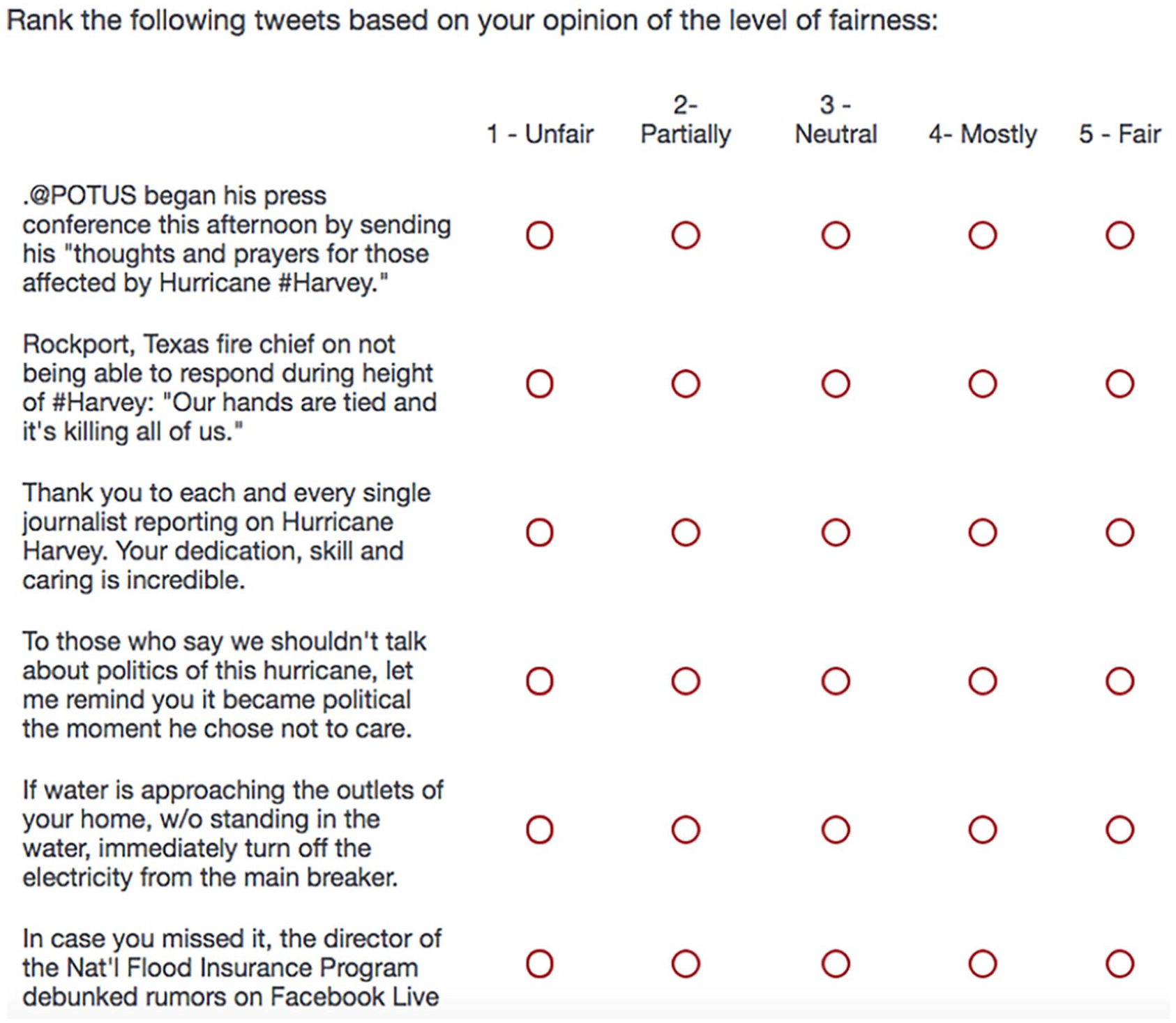
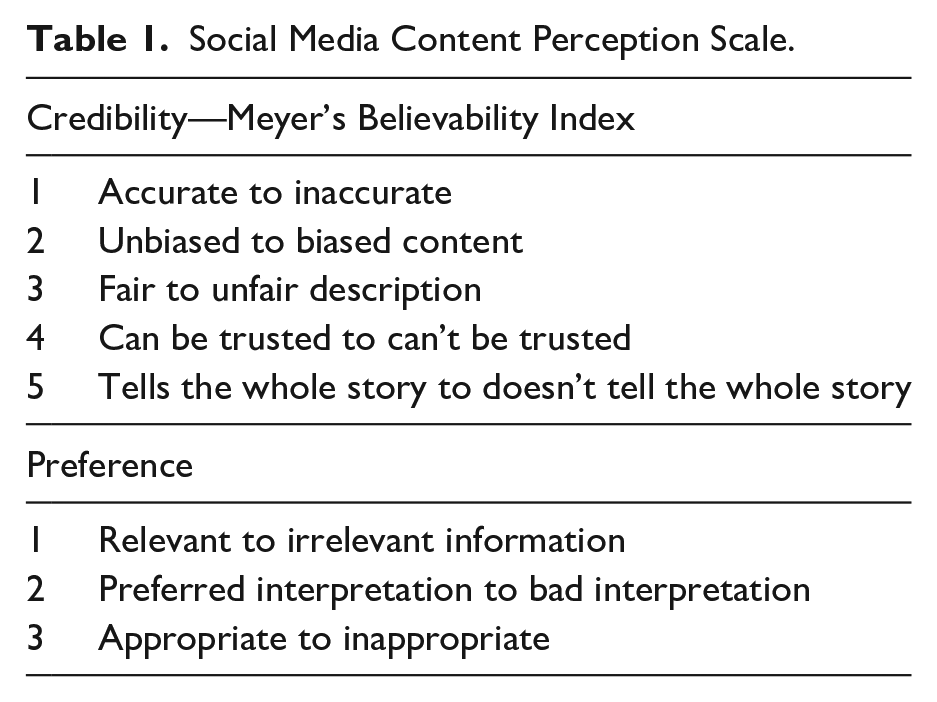
After selecting the posts, a matrix-designed survey question measured user preference for the posts (Figure 1). The matrix design allowed posts to be viewed together, similar to the display on the platform’s newsfeed. To help participants focus on the content only, the posts had the identifying information removed. The questions asked participants to compare a set of posts and grade each one according to the prompt, and the matrix allowed participants to view and compare the posts’ content when answering the questions. The prompts were based on Meyer’s (1988) Believability Index and addressed popular frames seen in the news: accurate, informational, descriptive, trustworthy, relevant, biased, and the level of agreement the participant had with the content (Meyer, 1988) (Table 1). This question design is intended to investigate the participants’ reactions to the content and framing before assessing their view on the source of the posts.
Tweet matrix.
Social Media Content Perception Scale.
Additional crisis questions
Additional questions asked participants about their overall platform usage during the crisis. Questions asked about the effectiveness of crisis communication on social media including: During a crisis, what action do you take? And In your opinion, which of the following attributes make up a crisis? These questions are designed to determine user attitudes toward crisis communication on social media.
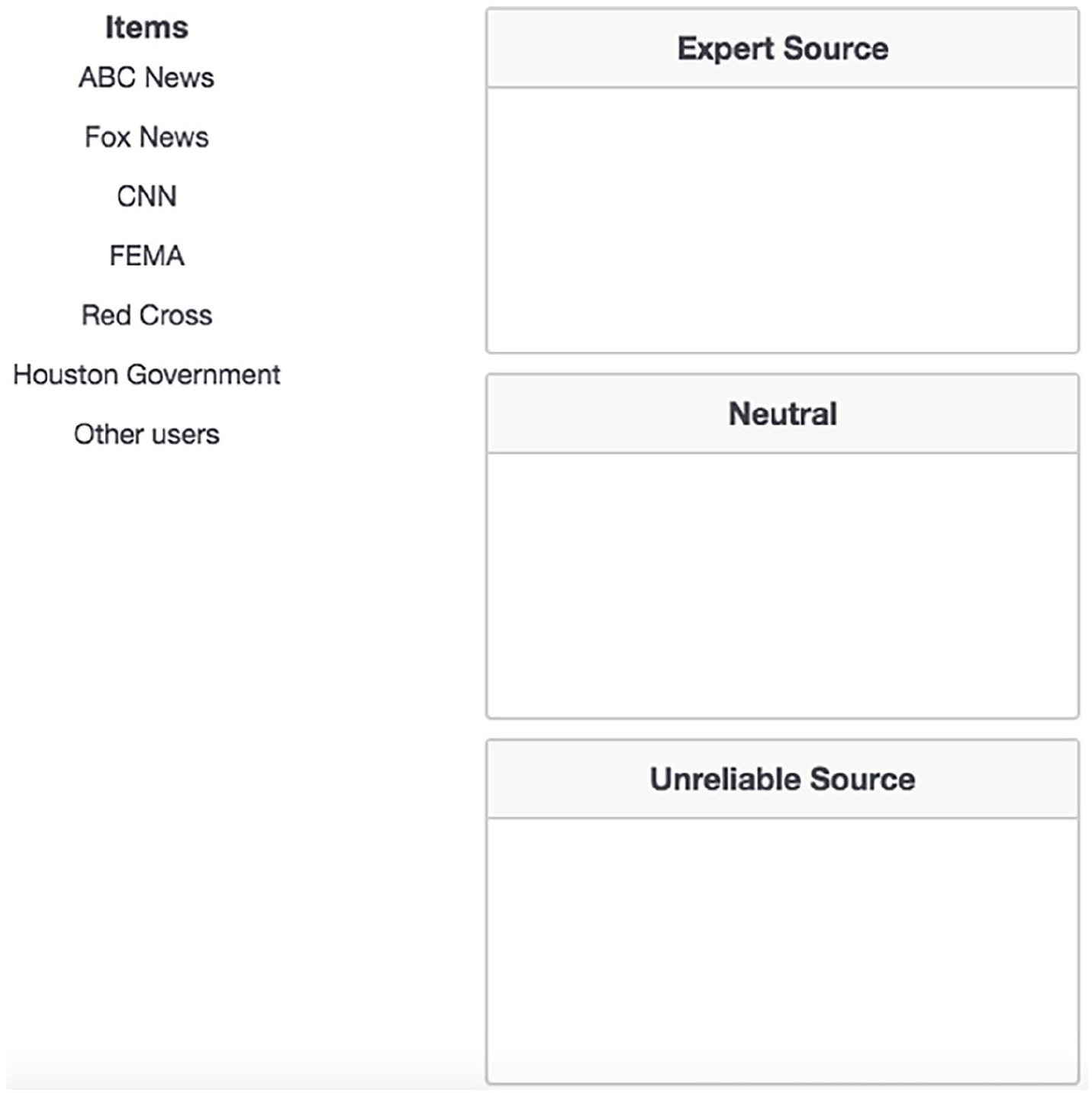
Finally, a pick-and-drop question was created to determine how participants viewed different sources (Figure 2) without the post content. This question asked participants whether ABC, Fox News, CNN, FEMA, Red Cross, Houston Government, and other users are considered expert, neutral, or unreliable sources.
Source evaluation question.
Measurement
Social Media Content Perception Scale
Source credibility
Source credibility was measured using Meyer’s (1988) Believability Index plus additional items to measure content preference. Meyer (1988) originally developed the index to study the credibility of newspapers. In the 1970s, there was a shift in how the public viewed newspapers and the topics they covered. It was observed that newspapers could be viewed as credible and trustworthy even if the public did not agree with the stories’ conclusions, separating ideology from credibility (C. Kim & Brown, 2015; Meyer, 1988; C. Y. Park, 2005).
Although not termed framing in the research, Meyer states that there are differences in interpreting news stories due to the processes involved in making the news (Meyer, 1988). This scale is an appropriate measure for assessing the differences in interpretation or framing and the concept of credibility and is an appropriate measure to use in this study (Table 1). The five-item measure has an overall reliability of α = 0.83 (Meyer, 1988). Since Meyer’s (1988) Believability Index was used for the credibility variable, Cronbach’s alpha was re-run in the study and had the reliability of α = 0.82.
Source preference
Content and source preference was measured using three variables: interpretation, relevance, and appropriateness. Cronbach’s alpha was run on the preference scale with a reliability of α = 0.80. Cronbach’s alpha was used to analyze reliability on all items (Meyer’s Believability Scale and Content Perception Scale) to determine the overall higher reliability of α = 0.87.
X usage
The frequency of use of X variable was measured with an ordinal scale that ranged from never to every day. Those who reported they never used the platform were removed from the results. Also, there was a question about why participants use the platform. The options for this variable included the following: to stay up with professional/industry news, to learn about the news, to participate in discussions, to stay up-to-date during a crisis, to post about my day, or to network.
Crisis usage
To measure crisis usage, a question asked what action users take and included the following options: turn on the news, check Twitter/X, check other social media sites, share information, dialogue with others about the situation, and monitor social media opinions and others.
The final crisis measure determined the user’s opinion about posting on X during a crisis. This variable was asked two ways: Do you think others posting on social media during a crisis is helpful? And Do you think posting about a crisis will help the situation? This measure completed the questions needed to determine usage, motivations, crisis actions, and the opinion of crisis communication on social media.
Sourcing
Finally, to complete the analysis of sourcing and credibility, a pick-and-drop question was used to allow participants to classify different sources like ABC, FEMA, and other users by the level of reliability. The question had three options: expert, neutral, and unreliable (Figure 2). This question was the inverse of the tweet/post matrix as that question removed the source and kept the content, and this question removed the content and kept the source.
Results
Social media usage
To analyze how social media usage impacts framing, H1 assessed how frequently participants use X. The highest proportion of participants reported using the platform every day (42.7%, N = 122), and the second largest group reported using it multiple times a week (25.2%, N = 72) (Table 2).
Frequency and reason for using X (formerly Twitter).
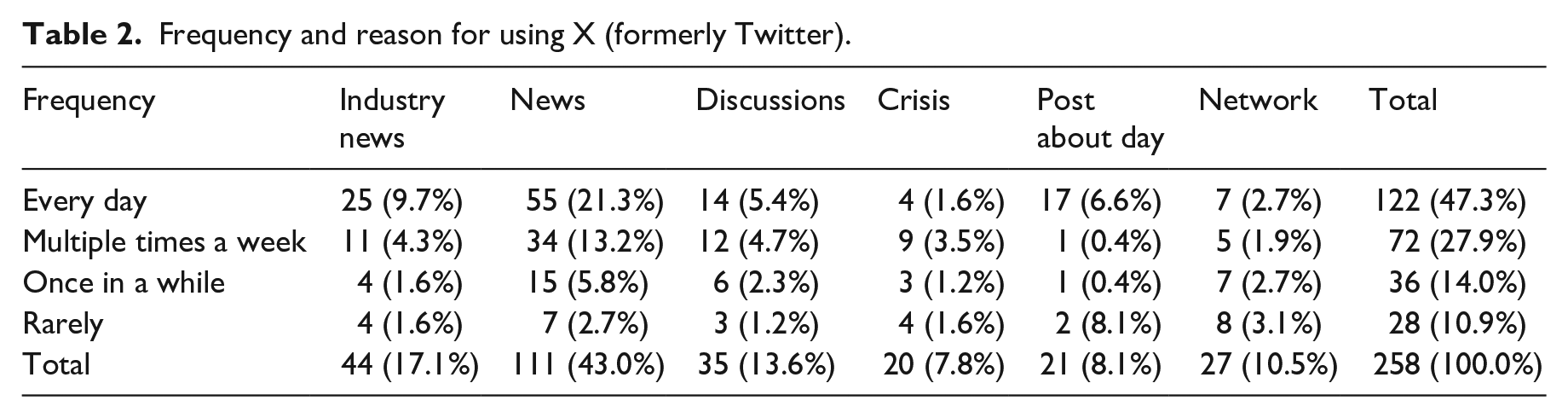
To determine the motivation for platform usage, a survey question asked about the reasons users logged on to the platform. Of the participants, 43% (N = 111) stated they log on to learn about the news, 17.1% (N = 44) to learn about professional news, 13.6% (N = 35) to participate in discussions, 10.5% (N = 27) to participate in network, 8.1% (N = 21) to post about their day, and 7.8% (N = 20) to stay up-to-date during a crisis (Table 2).
A chi-square was run on the usage and frequency of use to determine whether there was a relationship between the motivation for using the platform and how often participants use it with χ2(15, N = 258) = 37.90, p < 0.001. There was a noticeable difference between the motivation and frequency of participants who used it daily for news (N = 55) and those who used it multiple times daily to participate in discussions (N = 12), supporting H1 (Table 2).
Helpfulness of posts about crisis
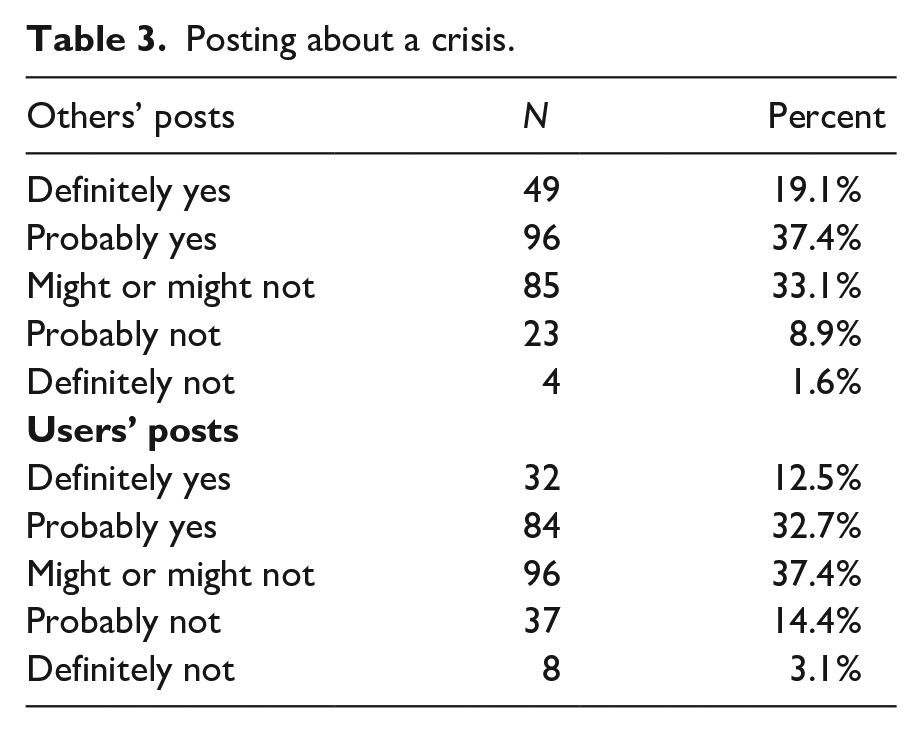
The next area examined how participants’ opinions influenced their view of users’ framed crisis messages (H2). Two questions sought out user opinions, and both were on a 5-item Likert-type scale ranging from definitely yes to definitely not. The results indicated that others posting on social media (37.4%, N = 96) is probably helpful during a crisis. Only 1.6% (N = 4) thought that posting would not be helpful during a crisis. For individual posts, 32.7% (N = 84) thought that posting about the crisis would probably help. Participants were slightly more skeptical about their posts, with 3.1% (N = 8) indicating that posting would definitely not help the situation (Table 3).
Posting about a crisis.
To determine the second hypothesis, a correlation was run to see whether there was a relationship between how frequently users post on social media and thinking users posting during a crisis is helpful. A significant positive correlation was found between the variables, r = 0.23, p < 0.001. Frequency of use accounted for approximately 5% of the variance in whether or not a user perceives others posting about a crisis on X to be helpful.
A correlation was also run to determine whether there is a relationship between posting frequency and users’ opinion of the post’s helpfulness. A significant positive correlation was found between the variables, r = 0.25, p < 0.001, supporting H2. Frequency of use accounted for approximately 6% of the variance of a user perceiving posting about a crisis on X to be helpful. However, the direction of the relationship could also be that posting on the platform during a crisis is seen as helpful because the user is on it more frequently.
Source credibility and content preference
The scales used to determine credibility and preference were Meyer’s Believability Index and Content Perception Scale. The variables included Meyer’s Believability Index items like trust, bias, and accuracy plus interpretation, relevance, and appropriateness. The scale contained eight items and analyzed the content from six tweets in the tweet/post matrix (Figure 1). The data were reconfigured for these scales by focusing on the source type, source name, and the variables listed in Meyer’s Believability Index and the Content Perception scale. Together, these items produced a sample size of N = 1380.
A correlation was run between credibility and preference variables to determine whether there is a positive relationship between the two. A significant positive correlation was found between the variables, r = 0.77, p < 0.001. Credibility accounts for approximately 60% of the variance in post preference. These results support H3 since credibility positively correlates to the preference for content.
A multivariate analysis of variance (MANOVA) was conducted with one independent variable, source type (traditional media, users, organizations), and two dependent variables, credibility and preference. Box’s M test for equality of covariance matrices was significant, F(6, 47257368.92) = 2.82, p < 0.001, so Hotelling’s Trace values were used. Multivariate tests showed significant main effects for the source type (F (4, 2750) = 19.78, p < 0.001, ηp2 = 0.03, power = 1.00).
Tests of between-subjects indicated that there was a significant main effect for source type on credibility (F (2, 1377) = 35.78, p < 0.001, ηp2 = 0.05, power = 1.00). In addition, there was a significant main effect for source on preference (F (2, 1377) = 26.65, p < 0.001, ηp2 = 0.04, power = 1.00). Pairwise comparisons indicate that organizations (M = 3.60, SE = 0.04) have higher levels of credibility than traditional media (M = 3.29, SE = 0.04) or users (M = 3.11, SE = 0.04). Organizations (M = 3.71, SE = 0.05) also have higher levels of preference than traditional media (M = 3.32, SE = 0.05) or users (M = 3.25, SE = 0.05). These results support H4 that source does change the level of credibility and preference of content.
Sourcing
The final variable tested sourcing and was guided by H5 and utilized a unique pick and group question where participants could select a source and drag and drop it into a category. This question included seven options: ABC, FoxNews, CNN, FEMA, RedCross, Houston Government, and other users. There were three options to rank the sources: expert, neutral, and unreliable.
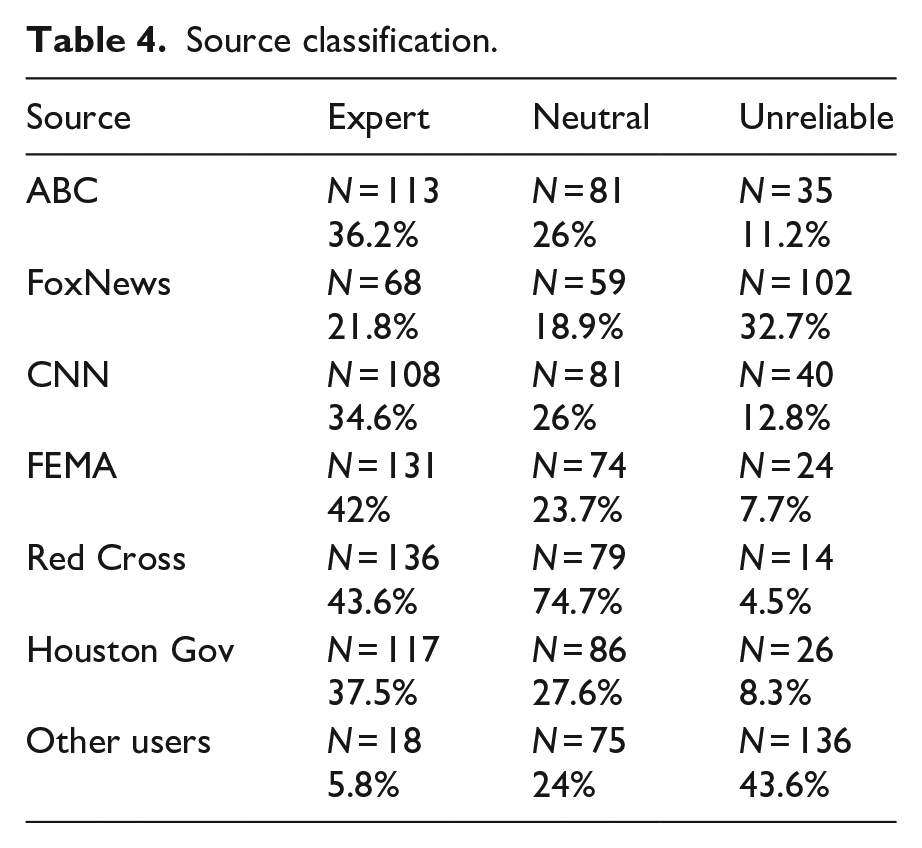
For the expert category, N = 113 chose ABC as the most expert source; users received the lowest number of expert selections (N = 18). In the neutral ranking, the Houston Government was viewed as the most neutral (N = 86), and FoxNews was determined as the least neutral (N = 59). In the unreliable category, users were indicated as the most unreliable (N = 136), with the Red Cross (N = 74) having the fewest in this category (Table 4). Estimated marginal means relate to the overall average of credibility or preference. The scale ranges from 0 to 5.00, with a higher number indicating higher credibility or preference. The resulting differences in source ranking and participant selections support H5.
Source classification.
Discussion
Social media usage and crisis postings
This study, along with recent studies, reflects the interconnected nature of the news on social media as the sites have become a primary source of current events for users (Gil de Zúñiga et al., 2012; Kumpel et al., 2015; Kwak et al., 2010; Shearer & Mitchell, 2021; Pew Research Center, 2023; Scheffauer et al., 2024; Van der Meer & Verhoeven, 2013). The results of this study confirm previous literature regarding social media and digital sources being increasingly used for news consumption. The findings emphasize how people get their news, which has changed as it is more interactive and participation increases on digital sources. Understanding the habits of social media users is step one in defining what users are looking for when they log on and begin to consume information. Users who frequently log on to social media have a strong ability for selective exposure in determining what to spend time reading and responding to online. Users are shown and seek out messages that are framed according to their views and are from credible sources. This insight also aligns with the uses and gratifications theory framework that encapsulates the concept that people use technology for specific beneficial reasons and, in this case, to be informed.
Attention economy
The reality of the attention economy online indicates that attention is a commodity that must be acquired before a message can resonate with a user (Myllylahti, 2018). In the midst of a crisis situation, the information immediately shown will still align with the algorithmic preferences of the users, underscoring the need to build strong connections with users prior to the emergency situation unfolding. In the case of Hurricane Harvey, people created their experience through searches, posts, and clicks that inform the algorithm of their content preferences, even during a crisis. Capturing attention with preferred framing and content is a critical task as crisis communicators share vital information, as seen in the example used for this study and during natural disasters since.
The next area of investigation looked specifically at how users viewed crisis conversations online. The results indicate that the usage level impacts how users see the posts and their influence during a crisis. As noted above, the more users are on social media, the more they learn the norms and posting habits and refine their algorithm preferences, shaping what and how they view information. The familiarity with the social media sites’ layout, posting styles, and user base creates a comfortable environment for users to seek out and contribute their own opinions or frames on current events. Users can easily find the information and interpretation of the news they prefer. The predominant frame of the event can come from any user, not just the media. The attention economy does not cease during a crisis, and many times, the global context of the platform presents multiple ongoing situations at a time. Quick responses must be made to crises as users seek credible information and post their own framing insights of the event.
Sourcing and credibility
Beyond capturing users’ attention, a user must also view the source of the message as credible before the message can resonate and have any impact. The concept of message credibility has been a factor since the 2016 Presidential Election, and ‘“fake news” became part of the US vernacular. For this study, perceived credibility was used to accurately reflect the variance in the perception of social media content. The approval of messages and accounts can ebb and flow as social endorsement changes the perception of an account. The account and creator that was reliable and trusted yesterday may not be trusted amid a crisis. Perceived credibility underscores the changing nature of credibility on social media and the need for accounts that attempt to participate in the news and crisis dialogue to constantly reaffirm the view and frame of the account and information.
Perceived credibility
The tweet/post preference matrix survey design allowed for perceived credibility assessment by allowing participants to grade the posts and show which content is preferable to them. Although insightful, online content is always viewed with the source; therefore, the user always receives the message with the framing of who the source is and how they might align politically. The source is the first level of framing, as media companies have ideological bias built into their brand and identity. Users may judge the content based on the source before reading the content, making the source’s reputation the first mental evaluation the user has when deciding if the post has validity. Even beyond the account, the platform may often tailor content to specific audiences or viewpoints, creating an impression in the mind of the user before they view the content published by an account. Accounts or media that users follow will gain an element of initial credibility as users decide to participate on the platform, providing the first layer of framing even if the information is not as thorough or accurate (Du et al., 2019). As news accounts embody political ideologies, if the source is trusted, it paves the way for the framing of the content to be accepted more readily by a user. The resonating content can help build a desirable dominate narrative of the event.
The idea of sourcing and preference were addressed in the tweet/post matrix questions that indicate that the variables of credibility and preference are connected, and as one increases, the other increases. This finding relates to the prevalence of echo chambers on social media as users seek out accounts that post information they like and, therefore, see as credible (Diaz Ruiz & Nilsson, 2023). This behavior was observed during the COVID-19 pandemic as users sought out news from specific sources despite the personal risk users took by engaging with some messages over others (Levy, 2023).
Organizations as reliable sources
The source of news information was also explored in the final hypothesis, as the question asked participants to sort the sources based on the level of expert, neutral, and unreliable sources. Organizations were designated as experts, and users fared the worst, having the fewest expert designations. ABC had the most expert rankings among the traditional media accounts, and FoxNews had the least. These results mirror the Ad Fontes Media bias ratings depicted on their Media Bias Chart, which uses a different methodology to arrive at their determinations (Media Bias Chart, 2022).
For the most part, organizations are seen as the most credible and preferred during a natural disaster crisis. In a post-Katrina crisis environment, this is a positive finding that organizations have rebounded and are seen as trustworthy. For crisis managers, this provides an avenue for capturing user attention during a crisis. Users look to organizations for expert-level information, emphasizing the need for organizations to have integrated crisis communication plans with robust social media strategies that are structured around social mediatization as information no longer flows down to the public but is a dialogic give-and-take (Ban & Lovari, 2021; Botan, 2018; Kosmidis & Theocharis, 2020; Olsson & Eriksson, 2016). As users interact with specific messages, the algorithms produce more of that type of information to the user. Groundwork must be laid in daily posting to build high credibility with users and provide a vital conduit of information that can be utilized during a crisis.
User-to-user communication
Although users can contribute messages to the crisis dialogue, participants view traditional media and organizations as more credible than the average user (Fredriksson, 2014). Together, these results show that although users participate the same way as other sources on social media, there is a difference in how each group’s framing and content are perceived and deemed credible. The idea of social media being a level playing field for communication is not an accurate picture during a crisis. Users are looking at certain accounts for credible information and analysis of a situation. Although users may indicate citizen journalists have higher transparency levels, organizations are more important sources for crisis information.
Modified media effects
This study has looked at the reactions and engagement of users to framed crisis messages on social media. Combining mass communication theory with crisis communication theory and a converged media industry has resulted in a need to adjust Entman’s (2004) media effects model to incorporate perceived credibility and social media concepts (Figure 3). This study conceptualizes a new visual graphic in Figure 3 to reflect the accuracy of Entman’s concepts while integrating the social media landscape and how it multiplies the aspects that influence users’ actions and perceptions on social media. The way information is disseminated is more than just a downward push out to the public; it can be a messy back-and-forth discussion (Botan, 2018; Kosmidis & Theocharis, 2020). The flow of communication disperses among multiple accounts beyond the news media. Algorithms shape what is seen as previous content, and framing indicates the level of credibility and preferred ideology of the user. Users often go beyond information adoption as they post and interact with other users, the media, and organizations, shaping the information they will see when they log on later. For a crisis, this can shape what messages the users see first and create the foundation for the dominant framing of the event to be adopted or disputed. The new model proposed in this study is an area for future research to test and determine whether it is an accurate visual representation of the complex media effects observed on social media.
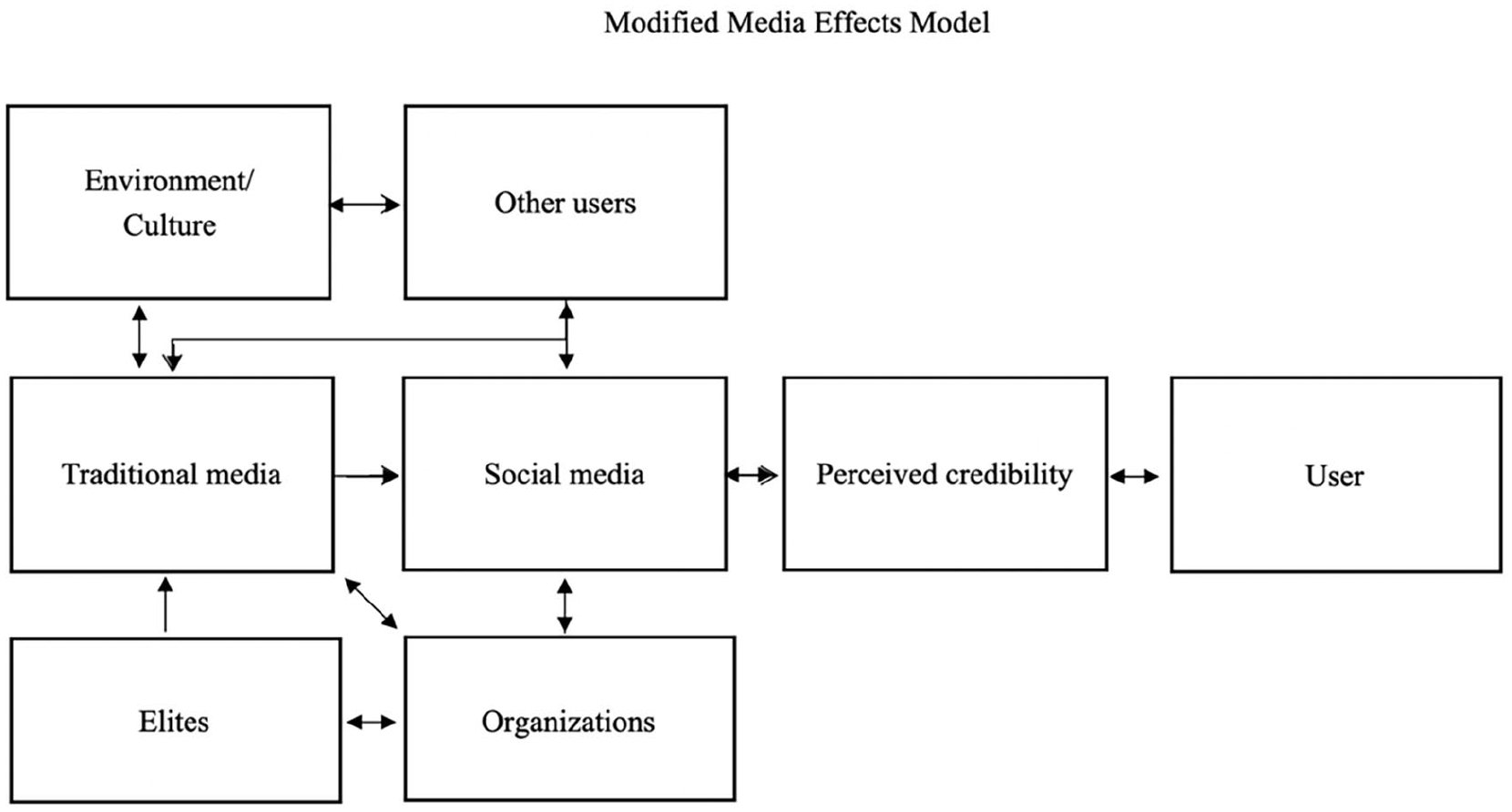
Proposed modified media effects model.
In addition, an adjusted view of media effects would incorporate other users’ rising influence on the public. Although not addressed in this study, influencers provide frames that leverage online relationships or parasocial relationships with users, creating their own frames and interpretations of events. Users connect with others, and the dialogue can be studied to better understand the influence users have on developing collective understanding. Although this modification is suggested as a result of analyzing crisis communication data only, adjusting the media effects model to a user-centered approach more effectively addresses the changes the digital convergence has made on information dissemination in digital spaces.
Limitations and future research
The limitation of the survey is the use of MTurk to recruit participants. A concern with MTurk is the lack of ecological control because MTurk respondents are self-selected and paid. These attributes could contribute to unknown biases, and there could be a tendency for the respondent’s attention to wander or rush through the survey to get the incentive. However, the two survey bias questions served as attention checks as the scales were reversed from the first question to the second. An additional limitation is the oversight of collecting information on political ideology from the participants, which might factor into the discussion of source preference. Future research could be conducted on how political ideology influences users’ content preferences and how influencers shape the dominant crisis narrative.
In addition, future research should be conducted on how social media impacts media effects models and the individual concepts of agenda setting and priming. As social media sites shift and change with ownership changes and new features, future research should continue to assess how users gather data and the cognitive process involved with designating an account or influence as credible.
Conclusion
The role of traditional media has changed as digital convergence and social mediatization push more news to social media platforms that were initially intended to be entertainment (Olsson & Eriksson, 2016). As the public seeks crisis communication information, this study shows that X (formerly Twitter) users are looking for credible content in a world of fake news and alternative facts. Users go online for instant updates and seek out sources they perceive as credible to provide those updates. Looking at what this means for traditional media, perceived credibility becomes crucial as users who may not trust the media, will not trust the message. The source is the first mental evaluation the users look for to see how the message might be framed. The study’s findings indicate that the variables of credibility and preference are connected and highlight the relationship between the accounts/sources and others as they seek message resonance.
For organizations and crisis communication managers, message effectiveness can be achieved by enhanced listening to popular frames and directly incorporating those concepts into timely crisis communication responses (Coombs, 2007; Lachlan et al., 2014). As seen in this research, users value the crisis communication messages posted on social media from organizations, and they will continue to look for clear, responsive messages if organizations continue to be a strong force of trustworthy information during a crisis.
