




Abstract
This article asks: How can we best conceptualise and analyse media systems and media organisations today?
A discussion of approaches to media systems and organisation analysis shows that many of them seem to assume the correctness of Francis Fukuyama’s claim that liberal democracy has after the breakdown of the Soviet system been universalised. This article argues that the contemporary world situation shows that Fukuyama’s concept of the end of history is wrong and that we, therefore, need to rethink approaches to media systems and organisation analysis. This article introduces one such approach that is based on a concept of society that argues that all social systems and organisations have economic, political and cultural dimensions and that there is an antagonism between self-management and alienation. The article builds on and extends a typology of media organisations introduced by Colin Sparks. It introduces a systematic model of 12 different types of media organisation and six types of media systems. It stresses the importance of discerning between and analysing the interactions of capitalist media, public service media, civil society media, state media, authoritarian media and democratic media.
Keywords
Introduction
We live in highly polarised times where society and humanity are at risk and face multiple crises (see Morton & Bieler, 2018; Robinson, 2015; Walby, 2015; Žižek, 2018, 2023). It is uncertain what their future will look like. Not only is there a global environmental and climate crisis that might have very severe consequences if humanity does not take adequate counter-measures, but also the nuclear annihilation of life on Earth and a new World War have again become more likely. There are competing imperialisms, new nationalisms, new authoritarianisms and new fascisms. In the past decades, the world has become more socially unequal and politically polarised. The logics of separation, violence, enmity and death have become globally dominant. If the war in Ukraine and the conflict over Taiwan escalate into wars between NATO on the one hand and Russia and China on the other hand, then a new world war is the consequence. Such a war may very well terminate life on earth.
Media organisations and media systems are important parts of society and the public sphere. They play a role in communicating the state of the world and assessments of it in public. Therefore, situations of crisis also affect the media world in manifold ways. In the light of the concerning situation of the world, media and communication studies scholars need to ask what kind of media systems and media organisations we find in the world today. For assessing the transformations of the media, in the light of crises, we need an understanding of how media are organised. This article is a contribution to the analysis of media systems and media organisations. It asks: How can we best conceptualise and analyse media systems and media organisations today?
To provide one possible answer, I will first discuss some approaches in the analysis of media systems and media organisation (section 2) and will then introduce a new approach (section 3). Finally, some conclusions are drawn (section 4).
This article introduces one typology of media systems and media organisations. It is based on a concept of society that argues that all social systems and organisations have economic, political and cultural dimensions and that there is an antagonism between self-management and alienation. The article builds on and extends a typology of media organisations introduced by Colin Sparks. It introduces a systematic model of 12 different types of media organisation and six types of media systems. It stresses the importance of discerning between and analysing the interactions of capitalist media, public service media, civil society media, state media, authoritarian media and democratic media.
Analysing media systems and media organisations: established approaches
There have been some well-known attempts in the media and communication studies literature to classify media systems and media organisations. The most widely discussed one is the typology of four different press systems by Siebert et al. (1956). They distinguish between the authoritarian press, the libertarian press, the social responsibility model of the press and the Soviet-totalitarian model of the press. This approach was an expression of the Cold War (McQuail, 2010, Chapter 7; Nerone, 1995; Nordenstreng, 1997). It basically contrasted liberal-capitalist media with Soviet-style authoritarian state media.
But even then, the world was more complex. There were not just US media and Soviet media but, among others, also European media models where public service broadcasting played an important role. Siebert et al. (1956, p. 73) argue that the 20th century in the West saw ‘a gradual shift away from pure libertarianism’ towards the social responsibility model. For Siebert, Peterson and Schramm, the US media system was the epitome of the social responsibility model. They seemed to have assumed that market and capital are guarantees of a free, high-quality, democratic press. But the market system has also given rise to the tabloid press that often violates basic principles of objective reporting, scapegoats and spreads ideologies. Siebert, Peterson and Schramm’s analysis was so much focused on the US media system that they overlooked the differences between the USA – where capitalist media have been almost absolutely dominant, public service media was only founded in 1969 (PBS) and 1970 (NPR) and has remained very weak – and Europe, where in many countries there have been strong public service media organisations that are non-capitalist in character and are also news media. After the demise of the Soviet system in the 1990s, the theory of the four press systems needed revision, which has resulted in newer approaches.
The most well-known newer approach to media systems analysis is Hallin and Mancini’s (2004) book Comparing Media Systems. They distinguish between the North Atlantic liberal model, the Northern European democratic corporatist model and the Mediterranean polarised pluralistic model of the media. The two authors limited their analysis to 18 countries in Northern America and Western Europe. There have been discussions of further developing Hallin and Mancini’s approach so that one also analyses media systems beyond the Western world that did, however, not result in extended typologies (see the contributions in Hallin & Mancini, 2012). Christians (2009) distinguish between four models (see also Jakubowicz, 2010): the libertarian model, the social responsibility model, the corporatist model and the citizen participation model. They limit this classification to Western democratic societies. Murdock (2011) identifies three moral economies of the media: capitalist media that are based on commodities, state media or public service media that are based on public goods and civil society media that are based on gifts.
All of these newer models have their merits that we cannot further discuss here. But it is also evident that in all of them, authoritarian (media) systems and organisations do not play an important role. It seems like many media scholars have after the demise of the Soviet Union assumed that authoritarianism would no longer play a major role in the world. Implicitly they seem to have taken for granted Francis Fukuyama’s (1989, p. 5) claim that the end of history has arrived and that the ‘state that emerges at the end of history is liberal insofar as it recognizes and protects through a system of law man’s universal right to freedom, and democratic insofar as it exists only with the consent of the governed’. Society’s history only comes to an end when humanity is destroyed. The actual course of history depends on the development of society’s dynamics, contradictions, conflicts and struggles. It is therefore open and dependent on collective human practices. The global rise of liberalism has not simply meant the universalisation of liberal democracy. More than the spread of democracy it has meant the globalisation of neoliberal capitalism. Neoliberalism has not been accompanied by the universalisation of liberal democracy. There is no capitalist economic base that determines and automatically brings forth a democratic political model. The world’s competing systems have capitalist economic systems but with different characteristics such as state capitalism and private monopoly capitalism, oligarchic capitalism, or welfare state capitalism.
Following multiple crises of capitalism, new forms of authoritarianism, right-wing extremism and fascism have arisen in many parts of the world. Fukuyama was too optimistic. While capitalism has been globalised, democracy as a political system, other than Fukuyama expected, has not been. Capitalism is compatible with a variety of political models. Today, even Fukuyama himself acknowledges implicitly that his end of history-thesis is mistaken. In the book Liberalism and its Discontents, he argues that neoliberalism as the dominant economic form of liberalism has created massive inequalities and helped to advance the crisis of political liberalism (Fukuyama, 2022).
The globalisation of neoliberalism has brought about a new negative dialectic of liberalism where increasing socio-economic inequalities between the rich and the poor as well as between the privileged and the precariat, increasing cultural fragmentation between influencers and the ignored and the forgotten, political disparities between the powerful and the powerless have backfired and created new authoritarian and fascist potentials (Traverso, 2019). These potentials have polarised societies and the world to the point where a new World War, a new dominant fascist world order, or the nuclear annihilation of humanity have become realities. The combination of escalating global problems, rising national and international inequalities, an increase of nationalism and the use of friend/enemy logic, the competing search for global political influence and hegemony, and economic opportunities for capital export, access to cheap labour, cheap resources and international commodity markets have put various imperialisms, including Chinese imperialism, US imperialism and Russian imperialism, on a collision course that has resulted in an increasing polarisation of world politics.
Rosa Luxemburg argues that ‘severe competition’ between capitalist countries can become very violent and ruthless (Luxemburg, 1913/2003, p. 426). For Luxemburg, a world war is ‘the product of the imperialistic rivalries between the capitalist classes of the different countries for world hegemony and for the monopoly in [. . .] exploitation and oppression’ (Luxemburg, 1970, p. 329). The contemporary situation of world politics is not completely dissimilar from the one before the First World War when Luxemburg (1913/2003) was writing her book The Accumulation of Capital. We again find competing imperialisms that seem to be willing to not just compete economically but to also use the means of military violence. The danger of a new world war and along with it the danger of the nuclear annihilation of humanity and life on Earth has increased in recent years.
Neoliberal capitalism’s negative dialectic has resulted in a crossroads between humanism and authoritarianism, democracy and fascism, political life and political death, survival and barbarism. As a consequence, typologies of media systems can and should today not ignore authoritarianism and fascism. Although limited to political aspects of democracy such as the electoral process, political pluralism, participation, the rule of law and individual liberties and not taking into account the (un)democratic character of the economy, the Freedom House Index gives us an idea of changes in world politics. According to this indicator, in 2005, 46.0% of the world population lived in free political systems, and in 2022, it was only 20.3% (Freedom House, 2022). The share of those living in semi-free or unfree political systems increased from a total of 54.0% in 2005 to 79.7% in 2022 (Freedom House, 2022).
Curran and Park (2000, p. 2) argue that much Western media theory and research is dominated by Western theories and approaches originating in the West that analyse the Western media and then universalise their findings as if Western media ‘are a stand-in for the rest of the world’, an approach that they characterise as ‘self-absorption and parochialism’ and as ignoring ‘the emergence of alternative centers of media production’. Based on this argument, Curran and Parks (2000), as well as others, have called for de-westernising media and communication studies (see, for example, Dutta, 2020; Fuchs & Qiu, 2018; Kraidy, 2018; Kumar & Parameswaran, 2018; Makoni & Masters, 2021; Shome, 2016; Sparks, 2018a, 2018b; Thussu, 2009; Waisbord & Mellado, 2014; Wang, 2011; Willems, 2014; Willems & Mano, 2016). The question that arises from this debate for media systems and organisation analysis is whether or not it is possible and feasible to establish general typologies of media systems. Unity without diversity is one mistake in the construction of such typologies. One kind of media system and type of society, such as the liberal-capitalist one, is taken as a normative standard that defines the theoretical categories and standards of analysis. Similarly mistaken is, however, the position of diversity without unity that argues that media systems and societies are so different that no comparison is possible and that all attempts at comparisons are forms of cultural imperialism. Such arguments are often attempts to shield certain systems against criticism. The liberal model of democracy is focused on the political system and elections in a multi-party parliamentary system. The present author considers a third position, the one of unity in diversity, as the most feasible one. It argues that there are certain general features of all societies that allow us to work out basic typologies of societal phenomena, including media systems. The utilised categories have to be general enough so that they apply to all societies and at the same time have to allow for variety. Societies and media systems are neither fully identical nor fully different, they have common and different aspects.
Curran and Park (2000, pp. 10–11) suggest a typology of societies that has two axes, a political one (with authoritarianism on the one end of the spectrum and democracy on the other) and an economic one (that ranges between neoliberalism on one end and regulation on the other end). This typology results in four types of societies, to which the authors add a fifth one, ‘transitional or mixed societies’ (Curran and Park, 10). Curran and Park’s suggestion is theoretically interesting, but it is not specific to media systems. It rather is a classification of societies. Jain (2021) stresses that Curran and Park’s as well as other approaches to media systems analysis leave out the dimension of culture.
Sparks (2017) sketches a model of media systems that like the one by Curran and Park has two dimensions, an economic and a political one. The difference to Curran and Park is that Sparks’ typology is related to the media system, whereas Curran and Park distinguish different models of society. In Sparks’ approach, the economic axis ranges from non-marketised media on the one end to fully marketized media on the other end. The political axis ranges from media that are fully embedded in the state structure on the one end to media that are disembedded from the state structure on the other end.
There have been some recent attempts at establishing universal typologies of media systems. Inspired by Confucianism, Yin (2008) suggests a universal typology that has two axes: the (ir)responsibility of the media and the (un)freedom of the media. The combination of the two axes results in four types of media: responsible free media, irresponsible free media, responsible unfree media and irresponsible unfree media. The problem with this approach is not the category of responsibility but that Yin suggests defining it purely by surveying a country’s population about how responsible it sees the national media. Responsibility is not merely a subjective category.
Blum (2005, 2014) tried to develop a universal classification of media systems that identifies based on and as a way of extending Hallin and Mancini’s (2004) approach six models: the Atlantic-Pacific liberal model, the South-European clientelist model, the Northern European public service model, the Eastern European shock model, the Arabic-Asiatic patriotic model and the Asian-Caribbean command model.
One of the problems of this model is that it associates and essentializes certain features, especially the distinction between democratic and authoritarian/totalitarian political systems, with certain regions of the world. One needs to take care to avoid Orientalist and Occidentalist typologies, labels and concepts of media systems.
‘Orientalism is a style of thought based upon an ontological and epistemological distinction made between “the Orient” and (most of the time) ‘the Occident’’ (Said, 2003, p. 2). The ‘essence of Orientalism is the ineradicable distinction between Western superiority and Oriental inferiority’ (p. 42) and ‘Oriental backwardness’ (p. 7) Orientalism presents African, Asians, Africa, or Asia as ‘absolutely different [. . .] from the West’ (p. 96) and promotes ‘the difference between the familiar (Europe, the West, ‘us’) and the strange (the Orient, the East, ‘them’)’ (p. 43). Orientalism is an ideology that reifies the assumed character of Africa(ns) and Asia(ns) by claiming such characteristics are natural and eternal. Orientalism shares ‘with magic and with mythology the self-containing, self-reinforcing character of a closed system, in which objects are what they are because they are what they are, for once, for all time, for ontological reasons that no empirical material can either dislodge or alter’ (p. 70).
Occidentalism is reverse-Orientalism that postulates that the West is necessarily different and other than the non-West (Carrier, 1992). It reifies the West. Occidentalism either characterises the West as necessarily good or necessarily evil. One should, however, also avoid Occidentalist media systems analysis.
An example of Occidentalism is the claim that modernity or Western societies are essentially and necessarily ‘commodity systems’ (Carrier, 1992, p. 201). Such claims overlook that there are non-commodified realms in Western societies and that there are also non-Western forms of commodification and capitalism. Edward Said concluded his book Orientalism by saying that the proper ‘answer to Orientalism is not Occidentalism. [. . .] If the knowledge of Orientalism has any meaning, it is in being a reminder of the seductive degradation of knowledge, of any knowledge, anywhere, at any time’ (Said, 2003, p. 328).
Table 1 provides a typology of versions of Orientalism and Occidentalism. The geographical point of reference (Western or non-Western parts of the world) forms one dimension and the kind of moral assessment made of the system in question forms the second dimension. A combination of these two dimensions results in two versions of Occidentalism and two versions of Orientalism. All four versions have in common that they essentialize and de-historicise social phenomena, make moral assessments based on geographical location and oppose the West and the non-West as radically different and incompatible. What differs in the various versions is whether there is a positive or a negative moral assessment. Occidentalist and Orientalist arguments are frequently made in connection with each other. Where there is Orientalism, we often also find Occidentalism and vice versa.
A typology of orientalism and occidentalism.
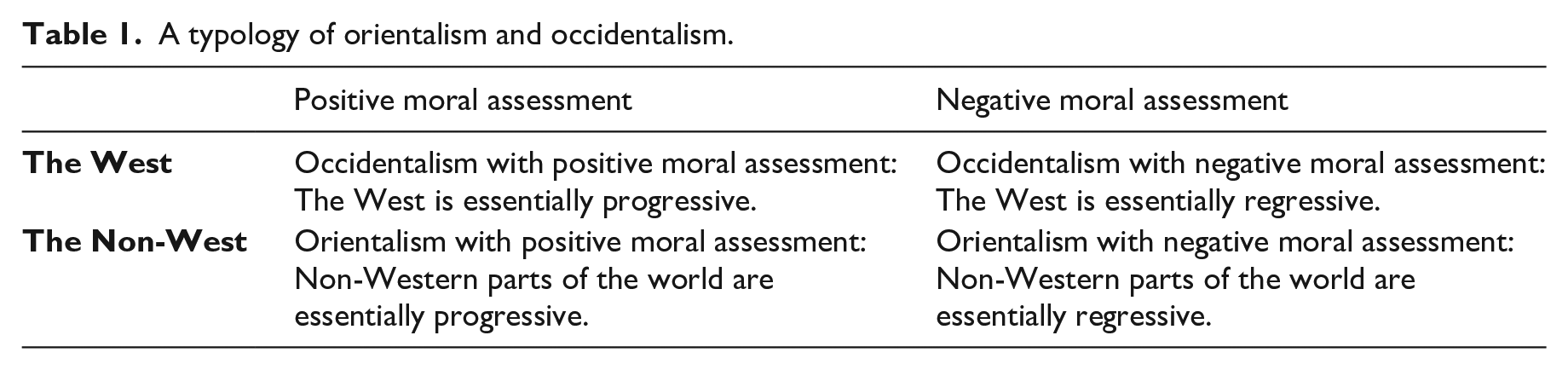
Orientalist media systems analysis characterises non-Western media systems as essentially and necessarily autocratic and backward (media Orientalism with negative moral assessment) or as essentially and necessarily progressive (media Orientalism with positive moral assessment). Occidentalist media systems analysis characterises Western media systems as necessarily and essentially progressive and democratic (media Occidentalism with positive moral assessment) or as necessarily and essentialist regressive, imperialist, (neo-)colonial, capitalist, etc. (media Occidentalism with negative moral assessment). Both Orientalism and Occidentalism overlook that societies and media systems are the result of social struggles and therefore are not fixed, unchanging and static but rather open, historical and dynamic.
Blum’s (2005, 2014) analysis contains both Orientalist and Occidentalist aspects. It is Occidentalist to characterise the public service model as ‘Northern European’ (Blum, 2005). Public service media certainly have the potential to advance the democratic public sphere. But they are not bound to only exist in Northern Europe. It is Orientalist to speak of the ‘Arabic-Asiatic patriotic model’ and the ‘Asian-Caribbean command model’, ‘the South-European clientelist model’ because such labels imply that the geographic location of countries in the South and the East make them patriotic, clientelist and authoritarian, as if geographic location would by nature imply specific characteristics of the media system.
It certainly makes sense to distinguish between democratic and authoritarian systems and media systems, but societies are dynamic and therefore based on social and political practices can change their character. Democracy is therefore not inherently Western but is a potential model for all of humanity. Names of countries and regions should better be left out of the labelling of media models.
There are also approaches that combine negative Occidentalism and positive Orientalism. Typically, they characterise Western society and media as imperialist and neo-colonial and idealise non-Western media as anti-colonial, anti-imperialist and progressive.
Opposition to the US-led international order that results in the assumption that everything that presents itself as an alternative to the US and the West, everything that is anti-US and non-Western, is good, is a form of negative Occidentalism combined with positive Orientalism. Such positions are based on the logic that ‘the enemy of my enemy is my friend’. In such thought, there also seems to be the assumption that only Western countries are by definition imperialist and that there can be no non-Western imperialism.
Daya K. Thussu and Kaarle Nordenstreng (2021, p. 8) write that ‘BRICS countries have the potential to pluralize and democratize global information and communication agendas and thus set the stage for a new global communication order – a NWICO 2.0 for the digital age’. In respect to the internet, Thussu (2015, p. 259) argues that there is ‘little doubt’ that ‘the BRICS should contribute to a more pluralistic and multi-perspectival media globe and that a BRICS internet would be a crucial node within this networked world’. Thussu (2021) discusses how capitalist internet platforms such as Yandex, VK, Baidu, Alibaba, QQ and WeChat in China play important roles in the internet use of Russia and China, that Russia and China want to advance ‘cyber-sovereignty’ to better control the internet in their countries as well as reports that Russia and China weaponise the internet and digital technologies for disinformation campaigns, hacking and cyber-espionage. These are certainly not democratic practices aimed at advancing democracy, so it is surprising that Thussu concludes that the BRICS countries are remaking the internet into ‘a more pluralistic and democratic cyberspace’ and a ‘de-centred internet’ (Thussu, 2021, p. 296). It is hard to see how the quest for fragmented, highly censored and monitored national Internets is ‘democratic’.
Table 2 gives an overview of the world’s most accessed internet platforms. 9 out of them are for-profit companies. Wikipedia is the exception. It is a not-for-profit foundation dedicated to the common good. Among the world’s 10 most accessed internet platforms, there are two platforms operated by companies with headquarters in BRICS countries: Baidu and Yandex.
The world’s most accessed internet platforms in July 2022, data source: https://www.similarweb.com/top-websites/, accessed on August 11, 2022.
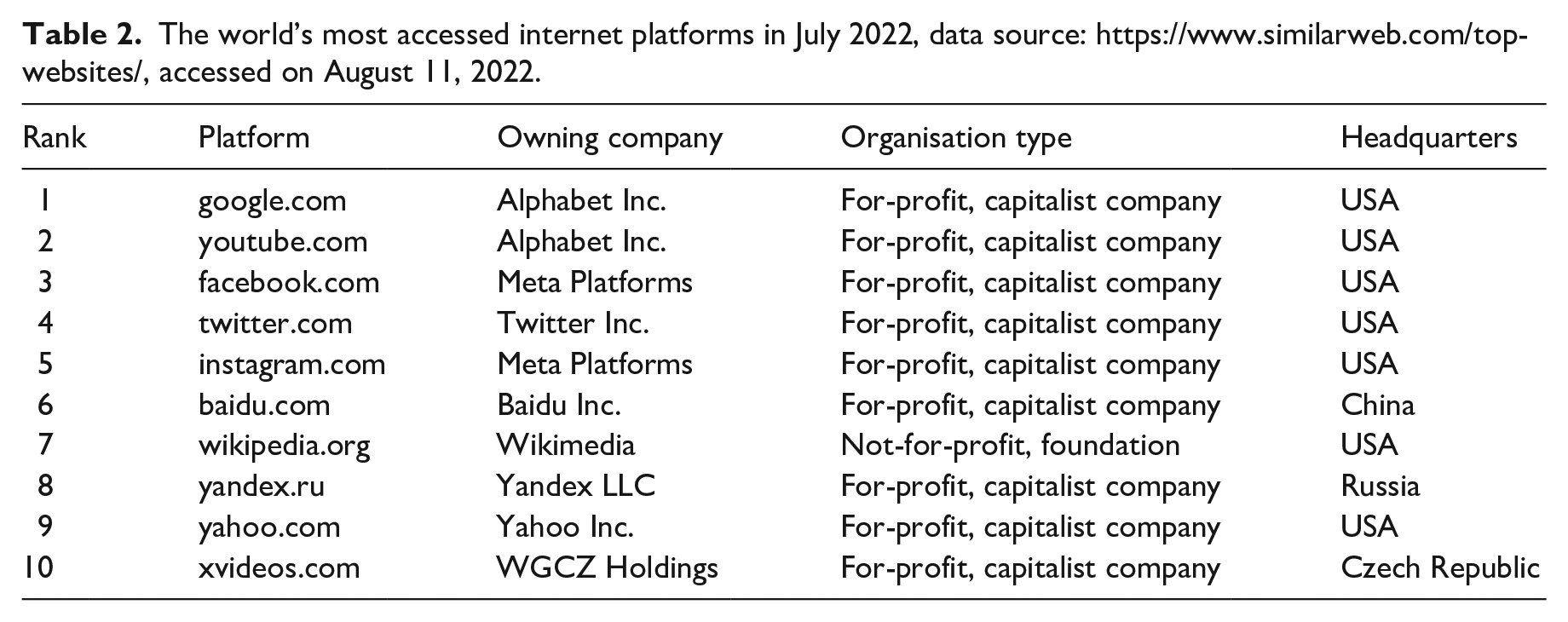
Baidu is a Chinese for-profit company that operates China’s primary search engine. Its major source of revenue is advertising. Other sources are memberships (access to content) and cloud services. 1 Yandex’s main source of revenue is advertising. Other sources of revenue include the taxi and delivery app Yandex Go, the e-commerce platform Yandex Market and online subscription services (movies, music, podcasts, etc.). 2
As for-profit corporations, Chinese and Russian internet platforms do not pose alternatives to but rather copy the capitalist models of US companies such as Google, Netflix, Amazon, Uber, etc. In the past 10 years, state control of the internet has increased both in Russia (Budnitsky, 2022; Kiriya, 2021) and China (Economy, 2018, Chapter 3; Yang, 2019). Since the start of the 2022 war in Ukraine, Russia has started charging social media users based on the law introduced in March 2022 that introduced prison sentences of up to 15 years for ‘discrediting’ the Russian army (Jackson, 2022). Consequently, Yandex warns in its 2021 Annual Report that it might in the context of the ‘geopolitical crisis’ be affected by Russian political authorities’ ‘political considerations’ (Yandex, 2022). Baidu writes in its Annual Report that the Chinese government requires Baidu ‘to monitor’ its platform for prohibited content, which includes content that ‘compromises national security’, ‘damages national unity’, ‘harms the dignity or interests of the state’, ‘disseminates rumors, disturbs social order or disrupts social stability’ (Baidu, 2022). China’s and Russia’s calls for ‘cyber-sovereignty’ are attempts to create contained, monitored, repressive internet spaces. It is hard to see how they contribute to ‘a more pluralistic and democratic’ internet landscape. As most of the dominant internet platforms are capitalist in character and are privately owned, there is no democratic ownership by internet users and platform workers. The internet is therefore also in an economic respect today not democratic, neither in the West nor in other parts of the world.
One can now argue that also in the West there is government surveillance of the internet and that internet surveillance is therefore not special to China. Edward Snowden revealed in 2014 the existence of internet surveillance systems operated by the US intelligence agency NSA. These systems included PRISM, by which agents can access data and meta-data of US and non-US users stored by AOL, Apple, Facebook, Google, Microsoft, Paltalk, Skype, Yahoo! and YouTube (Greenwald & MacAskill, 2013). Another system is XKeyScore that according to Snowden allows agents to read e-mails, track web browsing and users’ browsing histories, monitor social media activity, online searches, online chat, phone calls and online contact networks and follow the screens of individual computers (Greenwald, 2013).
Mass surveillance is a problem no matter where it occurs. One should be critical of the surveillance and privacy violations of users in the USA, China and all other places where it takes place. One of the problems of mass surveillance is that it helps create a society of suspicion where authorities see everyone as potential terrorists and criminals. Such surveillance can also be used for political purposes so that not just terrorists but also civil society organisations and social movements are monitored.
Capitalist media create certain problems such as the dominance of profit logic, commercially-driven media concentration, the advancement of individualistic consumer logic, the influence of tabloid logic, etc. The universalisation and globalisation of this model are certainly not desirable. That this media model originated in the West does not mean that non-Western media and culture are automatically progressive and viable alternatives. On the one hand, there are non-capitalist media such as public service media that pose an alternative model. On the other hand, as authoritarian state media show, also non-capitalist models are not automatically progressive. What we then need is a variety of media and cultural models throughout the world that advance independence, critique, information, unbiased news, entertainment, etc. Advancing democratic media requires the reduction of both capitalist and statist control of the media.
Occidentalist and Orientalist media systems analyses overlook that contemporary non-Western media are not entirely different from Western media. Neither Western nor non-Western media are automatically progressive, regressive, democratic, authoritarian, capitalist, public service, etc. All humans and groups have the potential to struggle against domination and for solidary, empowering and democratic forms of organisation. Alienation is not appropriate for humans, it dehumanises them. Humans have a desire, need and right to together determine and control their conditions of economic, political and cultural conditions of existence. They deserve to be treated like and live under conditions that allow their and humanity’s full development. The problem is that there are groups and classes that want to advance alienated forms of organisation, systems and society. Occidentalist media systems analysis as a reaction to Orientalist media systems ignores Edward Said’s warning that the proper ‘answer to Orientalism is not Occidentalism’ (Said, 2003, p. 328). Rather, Said argued that ‘humanism is the only, and, I would go as far as saying, the final, resistance we have against the inhuman practices and injustices that disfigure human history. [. . .] The human, and humanistic, desire for enlightenment and emancipation is not easily deferred, despite the incredible strength of the opposition to it’ (Said, 2003, pp. xxii–xxiii).
Imperialism, media imperialism, digital imperialism and cultural imperialism are not strictly domains of Western capitalism. Colin Sparks (2020) argues that China’s export of capital channelled into projects such as the Belt and Road Initiative (BRI), its integration of state control and big capital, its dominant role in the BRICS association (Brazil, Russia, India, China, South Africa), and its military expansion are evidence that ‘China is evolving into an imperialist power’ (p. 278) and an ‘emerging cultural imperialist’ (p. 275). He situates China’s international media and cultural activities that are often termed ‘soft power’ in the context of this imperialist power, which means that for Sparks, China is also a cultural imperialist power. Graham Murdock (2020, p. 301) argues that China’s Digital Silk Road initiative as part of the Belt and Road Initiative is an expression of its ‘networked imperialism’. Thussu and Nordenstreng (2021, p. 5) write that the BRI has been seen ‘as the infrastructure for a new Chinese global empire’.
The discussion indicates that there is a variety of limits in media systems and organisation analysis. The next section will introduce a new approach.
A new framework for the analysis of media systems and media organisations
Table 3 illustrates the difference between four political economies of the media. These are four different models of media organisations. In capitalist media, there is private ownership. The primary economic goal is capital accumulation. Given private ownership, such media are prone to the influence of partial interests by the owning families, individuals, shareholders, etc. as the examples of Rupert Murdoch, Axel Springer and Silvio Berlusconi have shown (see Knoche, 2023 for the analysis of private family ownership of the media). In citizen media, workers and/or citizens own the organisation, and the primary goal is the advancement of participation. In authoritarian media, an authoritarian state or a politically or ideologically motivated group owns a media organisation and the primary goal is propaganda for particularistic political interests. Propaganda means ‘conscious and systematic efforts to use the means of public communication to advance an ideological cause or material interest of the sender or source, often by cover means (for instance by omission, distortion or misinformation) and without regard for anyone else’s truth or the true interests of the recipient’ (McQuail, 2013, 60). Public service media are owned by the public and have a public service remit to advance democratic understanding, information, news, education, entertainment, culture and debate.
Four political economies of the media.
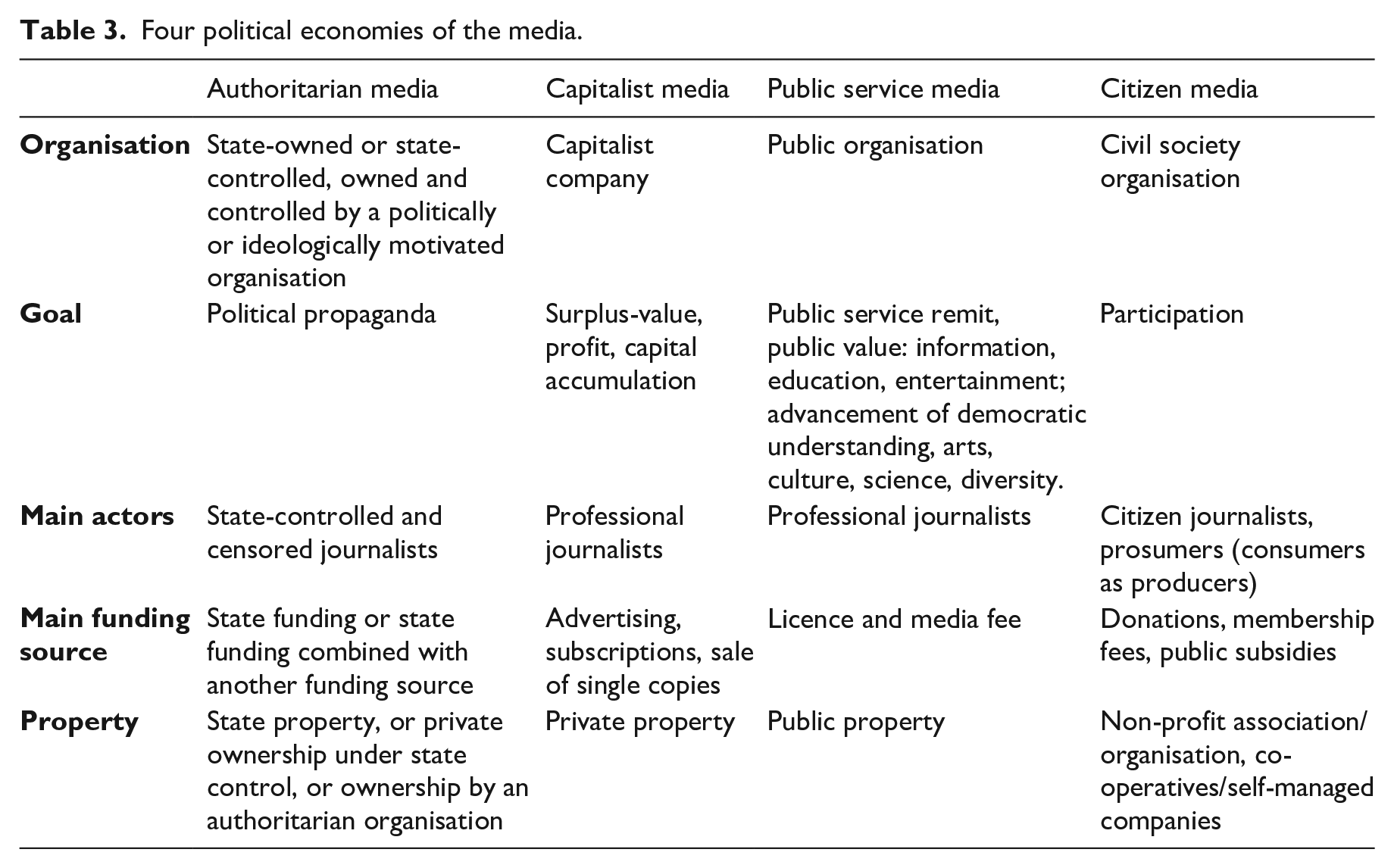
The four types of media organisations shown in Table 3 are ones we can frequently encounter in contemporary societies. There can, however, be more than just these four types. Although Table 3 gives an overview of media types we frequently encounter today, we will next try to construct a typology that presents all types of media organisations that can exist based on certain theoretical assumptions.
For humans to survive, they need to engage in three types of practices: they produce and consume goods (economic practices), they make decisions (political practices) and they interpret the world (cultural practices). We can find these three dimensions of practices in all human situations, organisations, institutions and systems. They are part of everyday life. There are economic, political and cultural aspects of all human life, which implies that these three dimensions exist in all types of societies.
An organisation is a group of people who in a routinised manner, that is, repeatedly and regularly in a certain space at certain times, engage in specific practices to try to achieve a defined goal. All organisations have economic, political and cultural aspects. Their economy deals with how and what they produce, their politics involves governance mechanisms that define how decisions are made in the organisation, and their culture deals with the organisation’s self-understanding and self-definition in the light of certain interpretations of the world. Organisations are dynamic, which means there is not always agreement on how their goals, strategies, governance structures, decisions and identity should look like. As a consequence, there can be contradictions and conflicts in organisations as well as struggles over these matters.
The present author suggests that a typology of media systems and media organisations that is at the same time universal and diverse (unity in diversity) can be built based on two assumptions (see also Fuchs, 2008, 2020)
There are economic, political and cultural dimensions of all societies, which is why we require a focus on at least three dimensions in typologies of societal phenomena.
Humans have an inherent need and quest for living a good life in a good society, which is why struggles and quests for self-management and against alienation are driving forces of societies and humanity.
Alienated social relations are social systems where humans who live in and create certain social systems and social relations are not in control of these systems. A subgroup dominates ownership (economic alienation) and/or decision-making (political alienation) and/or meaning-making (cultural alienation). In contrast, self-management means that humans who live in specific social systems together in a democratic manner shape the systems they live in and that affect their lives.
Media organisations are organisations where humans produce information that is made publicly available to society so that members can make interpretations of these contents. They are part of what has been termed the public sphere (Calhoun, 1992; Habermas, 1989). Media organisations have specific structures of ownership and production (economy), decision-making and governance (politics) and understandings of the world (culture).
According to Hallin (2021), a media system is ‘a set of media institutions and practices understood as interacting with and shaping one another’. McQuail (2013, Chap. 6) points out what factors, institutions and practices are relevant in this context. Based on McQuail, we can define a media system as the total of media organisations within a certain societal setting that features a common context consisting of common media laws and media regulations, a common economic system, a common cultural context, common standards and experiences of media work and common audiences relating to different media organisations.
It is a contested question whether or not media systems are necessarily organised at the level of the nation-state (see Flew & Waisbord, 2015; Hepp & Couldry, 2009). My position is that there are national media systems just like we can find regional, transnational, international and global media phenomena that are partly indicative of the existence of international and global media systems. I, therefore, do not want to restrict the definition of a media system to either the national or the transnational realm.
A critical theory of society distinguishes between instrumental reason and critical reason as two logics of society (Fuchs, 2020). Practices shaped by instrumental reason aim at exploiting or dominating humans so that a few individuals or groups benefit at the expense of the many. Practices shaped by critical reason question asymmetrical distributions of power and aim at creating structures from which all humans benefit. Democracy in a narrower, liberal sense is often understood as a political system that is based on elections of parliamentary representatives who pass laws and form a government. There are, however, also broader understandings of democracy such as participatory democracy and deliberative democracy (Held, 2006). Participatory democracy stresses the extension of consensus or majority decisions to realms of society beyond the political system or deliberative democracy. Deliberative democracy emphasises broad political debates on key areas of decision-making that inform actual collective decisions (Held, 2006).
Concepts of democracy share the conception of democracy as human beings’ self-government. Democracy is different from monarchical rule by an emperor, oligopolistic and aristocratic rule by the few and dictatorial and tyrannical rule by terror and violence. Democracy reduces domination in comparison to other forms of rule as well as rule by violence. The present author follows a broader understanding of democracy and argues that the democratic organisation of the economy, politics and culture is desirable (Fuchs, 2023a). The social systems, groups and organisations we humans are part of have specific overall characteristics. Their organisational character varies on a continuum from member-controlled (collective self-management) on the one end and alienated on the other end. Many social struggles are struggles against or for collective self-management. The contradiction between self-management and alienation allows us to discern between three dimensions of organisations and social systems that are organised on the continuum between self-management and alienation. Figure 1 visualises this model of the organisational dimensions of media organisations.
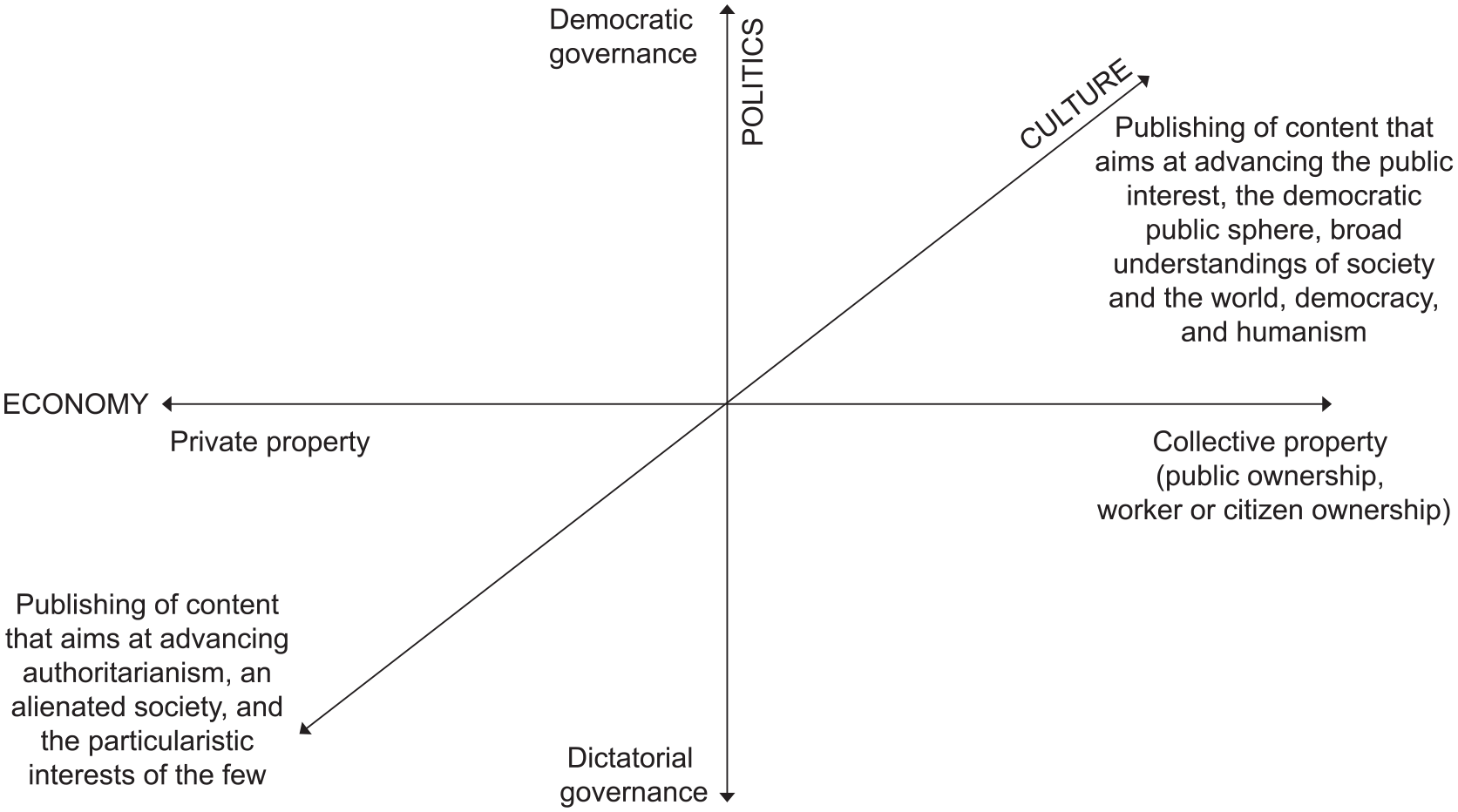
The organisational dimensions of media organisations.
The model builds on the model that Colin Sparks (2017) defines. It adds a cultural dimension to it so that it is a three-dimensional model of media organisations. The resulting three-dimensional model outlined in Figure 1 is based on a model of society that sees the economy, politics and culture as the three key dimensions of society, The distinction into three realms has been used and introduced by various social theorists (see, for example, Bell, 1974; Bourdieu, 1986; Giddens, 1984, pp. 28–34; Habermas, 1987). My own approach builds on this distinction of society into three dimensions and adds that production is of particular importance in constituting the cohesion and unity of society. It constitutes the specific importance of the economy in society so that all societal phenomena have an economic dimension because they need to be produced but at the same time have emergent, non-economic aspects (see Fuchs, 2020). Notwithstanding this special role of the economy (see also Fuchs, 2023b), the distinction into the three realms of society is in principle of basic importance: ‘The economy is a system in which humans in particular relations of production create use-values that satisfy human needs. [. . .] In the political system, humans take collective decisions that govern and regulate society. [. . .] Culture is the system whereby the human being is reproduced, which entails the reproduction of mind and body. [. . .] In the cultural system, humans make meaning of the world and develop their minds, bodies, and identities. Therefore, culture includes, for example, the educational system, medicine, psychology, science, the media system, sports activities, exhibitions, cycling, playing chess, eating, cooking, restaurants, playing an instrument, painting a picture, attending a concert or football game, the architecture of a church and the practices of praying conducted in it; love, friendship and family as affectual practices and relations, morals, norms and ethics, etc. Culture is not just focused on the mind, thoughts, and ideas. It is at the same time about the engagement of the body and the mind’ (Fuchs, 2020, pp. 55–56).
The Marxist cultural theorist Terry Eagleton stresses the role of subjectivity in culture: ‘Culture means the domain of social subjectivity – a domain which is wider than ideology but narrower than society, less palpable than the economy but more tangible than Theory’ (Eagleton, 2000, p. 39). From the works of the media, social and cultural theorist Raymond Williams we can learn that culture is material (Fuchs, 2017) and that there is a dialectic of culture and communication. Williams writes that there is the ‘centrality of language and communication as formative social forces’ (Williams, 1980/2005, p. 243). For him, culture is a ‘whole way of life’ (Williams, 1958, pp. xviii, 325; Williams, 1989, p. 4; 2022, p. 39). The way of life is a fairly broad concept that indicates that culture is not simply and only high art and artworks but grounded in the everyday practices of individuals and how they make meaning of the world. Culture is popular culture (Williams, 2022, Chapter 5), culture ‘is ordinary, in every society and in every mind’ (Williams, 1989, p. 4). In a way, Williams like Eagleton stresses the importance of subjectivity in culture. He distinguishes between lived culture, recorded culture and traditional culture (Williams, 1961/2011, p. 70). All forms of culture enable human subjects’ practices that enable that ‘a social order is communicated, reproduced, experienced and explored’ (Williams, 1981, p. 13). There is a dialectic of culture and communication. Whenever we communicate, we create culture. For culture to take place, cultural forms need to be communicated and there needs to be communication about culture. Culture implies communication. Communication implies culture.
Media organisations and media systems play a particularly important role in the context of the reproduction of the mind. Humans produce and consume media content to inform themselves about the world, be entertained, educate themselves, communicate with others about such content, etc. The media system and its organisations produce, distribute and provide content that allows humans to create content. This cultural dimension is what makes media organisations special and different from other organisations such as financial organisations, industrial organisations, agricultural organisations, etc. In the realm of Media Economics, the implication is that the Political Economy of Communication and the Media is not a subdomain of Business and Management Studies that simply applies the logic of these fields to media organisations. Rather, Media Economics requires an analysis that takes the specific cultural logics of the media that interact and are part of the political-economic logics of the media into account (Fuchs, 2024). As a consequence, Media Economics and the Political Economy of Communication and the Media are part of the field of Media and Communication Studies (Fuchs, 2024). In capitalism, the cultural logic of the media often comes into conflict with the political-economic logic of accumulation (Fuchs, 2024).
Just like other organisations, media organisations are owned and governed/managed in particular ways. The approach taken by the author suggests that private property is exclusive and collective property where organisations are owned by their members (workers and/or citizens) or by the public is more inclusive. In respect to governance and management – an organisation’s political dimensions – media organisations just like other organisations are either governed and managed in more democratic forms so that there is deliberation on key decisions that are taken together by the organisation’s members or in more dictatorial forms where a small group of managers and owners takes the key decisions. Culture is about how humans make meaning of, define and interpret the world. The main difference between media organisations and other organisations is of a cultural nature. Whereas there are meaning-making processes in all organisations and organisations develop a certain self-understanding that guides how the organisation is presented to society, media organisations are peculiar organisations: In media organisations, humans produce content that is made publicly available. Media organisations are meta-cultural and meta-communicative organisations because they publish and communicate content that humans interpret and about which they communicate. They organise second-order information, cultural and communication processes, namely the production of content that allows humans to inform themselves and form interpretations by engaging with information, creating and shaping culture by engaging with culture and communicating about communicated content. From an organisational point of view, it is therefore decisive what character a media organisation’s information has and what its goals, form and content look like. On the alienated end of the continuum, we find content produced by media organisations that aim at advancing the particularistic interests of certain groups, communicate partial worldviews and aim at advancing an authoritarian, alienated society where the key processes are controlled by a small elite. On the self-managed end of the continuum, we find content produced by media organisations that aim at advancing the public interest, the democratic public sphere, humanism (understood as a worldview that aims at the creation of a society that benefits all humans, see Fuchs, 2022), and broad understandings of society and the world.
Table 4 provides a summary of the dimensions visualised in Figure 1.
The three dimensions of media organisations.
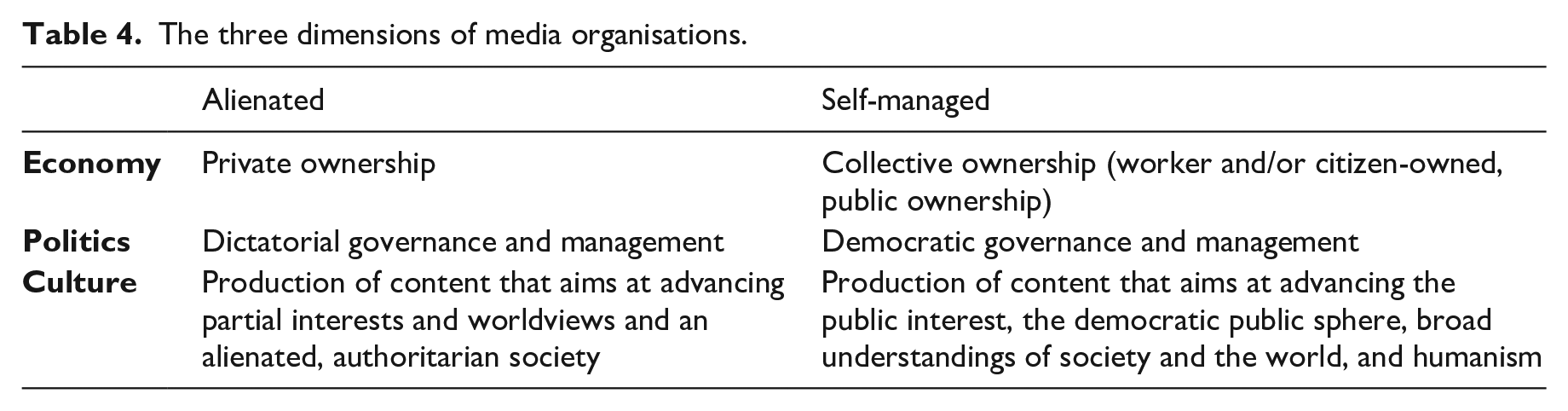
Based on the model set out in Figure 1, it follows that there are 12 logical ideal types of media organisations. These types are presented in Table 5.
Twelve types of media organisations.
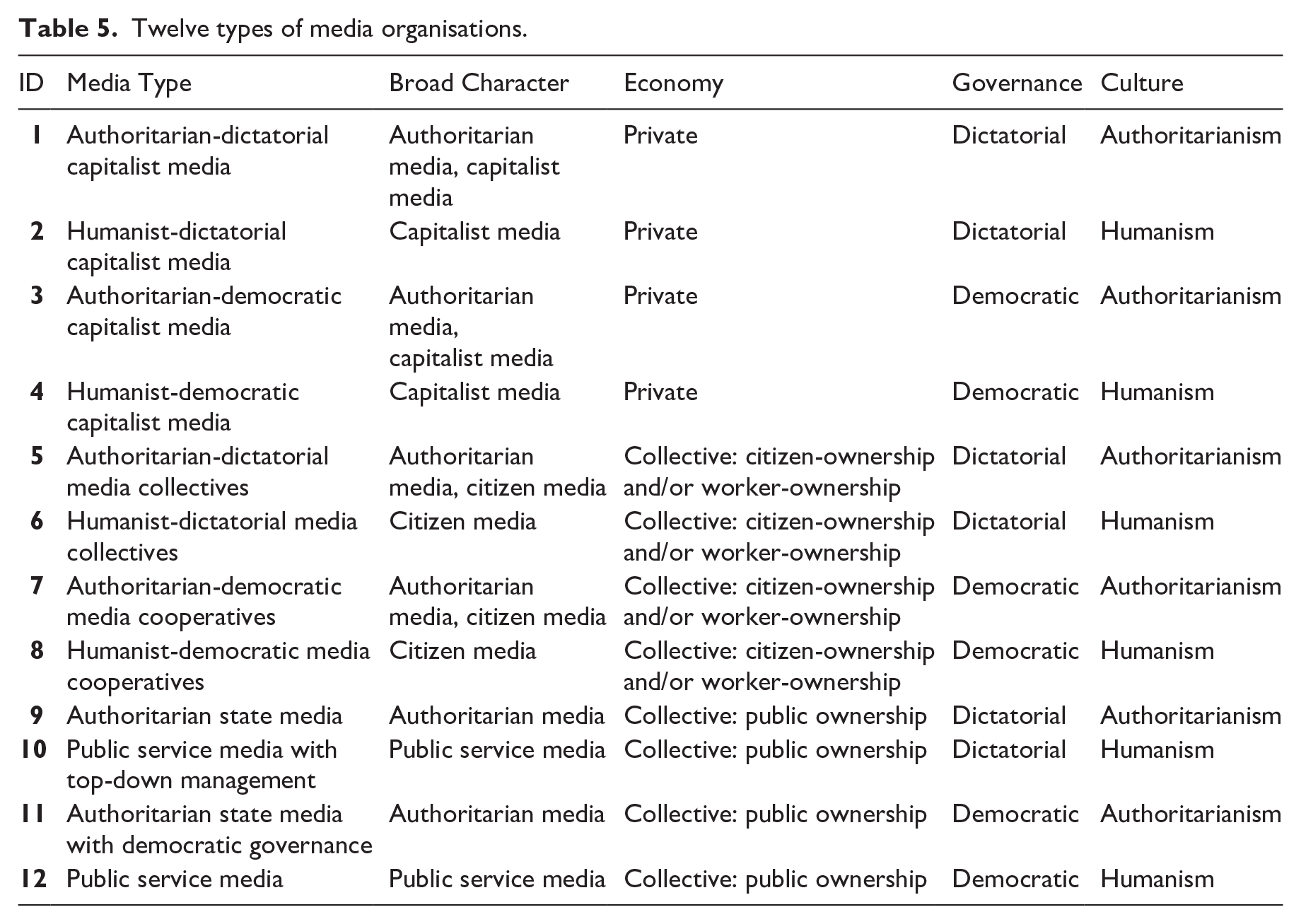
Ideally, all three organisational dimensions of the media are self-managed. Such media are public service media or cooperatives (owned by citizens and/or whose basic aim is to advance Humanism. Such media are ideal-type democratic media. Ownership alone does not determine the democratic or undemocratic character of the media. The least democratic, most alienated media are those that are owned by privately or the state and have the aim to advance an authoritarian society.
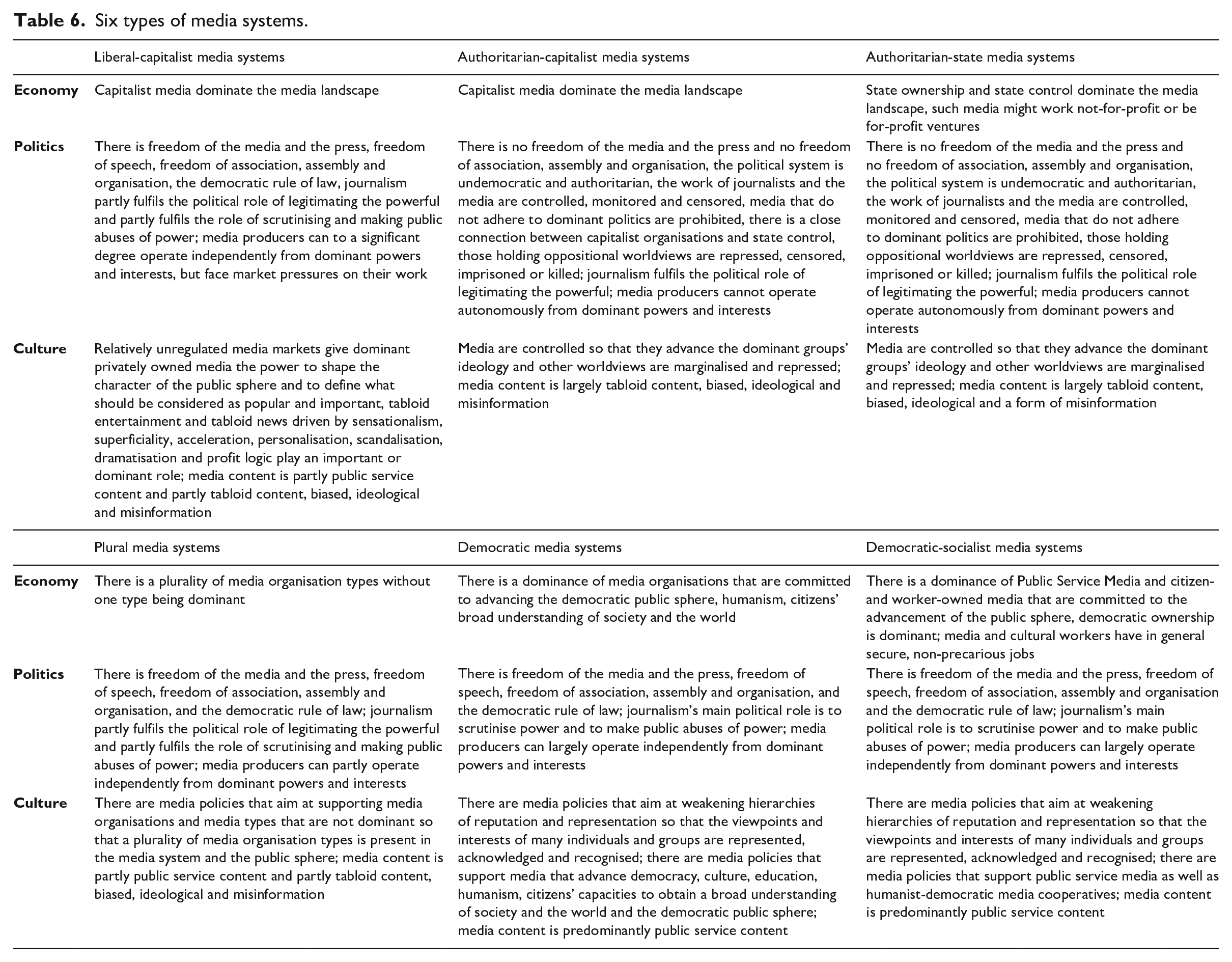
Analysing a concrete media system requires that the distribution of organisations in different media and communication spheres (such as television, radio, daily newspapers, social media platforms, etc.) are analysed. For such realms, one can analyse what share of organisations, workers, audiences, funding, revenues, etc. belong to what media type and to what kind of the four basic media organisations. Furthermore, there are some basic economic, political and cultural features of media systems that allow us to distinguish between six ideal types of media systems (see Table 6).
Six types of media systems.
Conclusion
This article asked: How can we best conceptualise and analyse media systems and media organisations today?
Many of the typologies and approaches to the analysis of media systems and media organisations established after the breakdown of the Soviet system have left out authoritarian media systems. It seems like they have implicitly and maybe unconsciously taken for granted Francis Fukuyama’s claim that after the collapse of the Soviet empire, democracy would be globalised and universalised.
It has been argued that there are economic, political and cultural dimensions of all organisations and all media organisations and that there is a basic contradiction between self-management and alienation that shapes human practices, organisations and social systems. Based on these theoretical assumptions, a systematic typology of 12 types of media organisations was introduced. Based on these distinctions, a second typology of six ideal type media systems was presented.
Society is at a crossroads today where the world has become more polarised between authoritarianism and democracy. In the world of the media, we find a complex variety of media organisations and media systems where capitalist media, civil society media, public service media, democratic media and authoritarian media interact. Just like the future of society is uncertain, also the future of media systems and media organisations is uncertain. For a better understanding of media in the contemporary world situation, we require new approaches to the analysis of media systems and media organisations.
The work presented in this article wants to contribute to the establishment of typologies that allows us to comprehensively classify concrete media organisations and media systems. The approach taken in this article is based on the argument that the quality of media systems and media organisations is shaped by political economy and not by geography. It therefore rejects speaking of, for example, the South-European clientelist model, the Arabic-Asiatic patriotic model, the Mediterranean polarised pluralistic model, etc. Political economy and society are dynamic, which means that humans ‘make their own history, but they do not make it as they please; they do not make it under circumstances chosen by themselves, but under circumstances directly encountered, given and transmitted from the past’ (Marx, 1852, p. 103). As a result, societies change historically. Being part of society and political economy, also media systems and media organisations do not have essential features derived from geography, but change historically. One question that arises is how typologies can best be used for empirical research. The suggested typology is certainly suited for such analytical work, which means that can very well underpin empirical research of media systems and media organisation in future research.
