



Abstract
Web-based groups can be observed as social systems emerging from computer-mediated communication underpinned by the technological infrastructures of Web 2.0. The usage of social network platforms has been investigated from a wide array of sociological perspectives. Among many others, prominent fields of research concern the practices of presentation of the self, the emergence of social formations, the construction of knowledge, the relationships between technology and business models underpinning social networking platforms and social participation of the users. This article proposes a complementary approach advancing innovative theoretical reflections, in a commitment to answer Fuchs’ plea for new approaches to media systems and media organisation analysis. In particular, this articles discusses web-based groups as the catalyst for theoretical reflections concerning the co-evolution between the digital medium of communication and the societal capacity to handle complexity in the material dimension, temporal dimension, and social dimension.
The article builds the foundation of its theoretical innovations in the first part, through an interdisciplinary combination of the theory of forms, second-order cybernetics, and autopoietic system theory. The second part of the article presents the main body of theoretical innovation by introducing web-based systems as a specific type of social group, emerging from the digital medium of communication. The ambition of the article is to offer an opportunity to contextualise sociological research on communication processes supported by social networking platforms within an ontology of web-based groups as social systems that emerge from digital media of communication.
Keywords
Introduction
This article conceptualises web-based groups,as social systems emerging from computer-mediated communication underpinned by the technological infrastructures of Web 2.0 (Salte, 2022). Web-based groups become the catalyst for theoretical reflections concerning the co-evolution of the digital medium of communication and the societal capacity to handle complexity in the material dimension, in the temporal dimension and in the social dimension. The use of social network platforms has been investigated from a wide array of sociological perspectives. An interest in a pragmatic use of social networks platforms as a resource to present the self to online audiences (Hogan, 2010), inspired by Goffman’s sociology, was an early focus of research, perhaps inspired by research on the social uses of mass media (Lull, 1980). Granovetter’s sociology of networks (Granovetter, 1983) has inspired research at the intersection between computer-mediated interaction and emergent fluid social formations (Goyanes et al., 2021). Social networking platforms as contexts of communication that affect the use of rhetoric and the criteria to validate knowledge is another field of research (see, for instance, Velasquez & Rojas, 2017). A critical approach to the techno-economic nature of social networking platforms and how their revenue-motivated technological design influences communication is another robust field of research (Abu-Ayyash, 2024; van Dijck et al., 2018).
After consideration of the main fields of research on the interaction between social networking platforms and social processes, this article proposes an alternative approach that aims to complement current research. This article proposes theoretical reflections to help contextualising social research within an ontology of web-based groups as social systems emerging from the digital medium of communication. Web-based groups are considered an interest example of how the high complexity generated by the digital medium of communication (Mattelart et al., 2024) is reduced with the emergence of autopoietic social systems as recursive connection of communicative events, generating boundaries of meaning. The theoretical innovations proposed by this article stem from an interdisciplinary combination of theory of forms, second order cybernetics, and the theory of autopoietic systems, in a commitment to answer Fuchs’ plea for innovative approaches to media systems and media organisation analysis (Fuchs, 2024).
Following this introduction, the second section of the article introduces a classic sociological problem: the coordination between individuals (2.1) approached from a systemic perspective (2.2). Systemic theories recognise that the coordination between individuals depends on the recursive interlacement of communication that stabilise meanings and orient further communication. This is the emergence of social systems, including social groups and web-based groups. Section 4 explores the relationship between meaning and communication, in relation to the evolution of the digital medium of communication. As a whole, sections 2, 3 and 4 aim to build the foundation for the main body of theoretical innovation advanced by the article. Section 5 introduces a sociological perspective on the technological infrastructure that underpins social networking platforms, re-contextualising them in a systemic perspective focused on the coordination between individual consciousnesses. Building on this, section 6 re-conceptualises individual consciousness within social networks, as digital personhood. Section 7 approaches the problem of the coordination between individual consciousnesses as a problem of coordination between digital persons, or profiles, introducing aninnovative conceptualisation of web-based groups as autopoietic social groups. This conceptualisation is articulated in three dimensions: the coupling between web-based groups and the technological infrastructures of social networking platforms (7.1), the specificity of web-based groups as a type of social group (7.2) and their ego-centred ontology (7.3). Section 8 discusses web-based groups as social and temporalised systems. Like all autopoietic social systems, web-based groups reproduce themselves through the network of recursive communication that they make possible and that, at the same time, made them possible. Section 9 invites reflection on a risk for web-based groups which is intrinsic to their mode of autopoiesis: the viability of reflectivity as the intelligence of the system substantiating its reproduction is introduced as concluding consideration and invitation to further research.
Structural coupling between consciousness and communication
Setting the scene: the coordination between individuals as a sociological question
The relationship between consciousness and society has never ceased to attract the interest of sociological research. The process of socialisation lends itself as an example. Over the last the last century, theories of socialisation that are acknowledged as a staple of the discipline have described socialisation as the internalisation of social expectations. Notwithstanding widely discussed difference among their theories, Durkheim (1922/1956), Parsons and colleagues (1955), Bourdieu and Passeron (1996) converge in describing a relationship between consciousness and society as a process whereby society (via socialisation), influences the operations of consciousness.
However, the idea of internalisation has been challenged by constructivist epistemologies that understand knowledge of reality as a construction performed by an observer. For constructivism, the question should not be how the individual receives knowledge? Rather, the question should be: what is the individual who creates knowledge? Or, in more stringent theoretical terms: what is the consciousness that creates its reality? From this latter question, another one descends: how is coordination between individual constructions of knowledge possible? Radical constructivist theories (Maturana, 1988; Maturana & Varela, 1987; von Foerster, 1981, 2002; von Glasersfeld, 1989) suggest that individuals create knowledge by themselves instead of assuming it from communication. Not only internalisation should be ruled out, but the same idea of ‘shared’ knowledge. Differently, social constructivist theories include the relationship between social and individual dimensions (Amadasi & Iervese, 2018; Gergen, 1991; Harré, 2012). For social constructionism, cogito-centred theories cannot explain the construction of a shared knowledge; the construction of knowledge, to be viable socially, can only be social (Baraldi, 1993).
The coordinated management of meaning theory is particularly interesting in this perspective because it describes the construction of meanings ascoordination among individuals. According to the coordinated management of meaning theory, construction of meaning develops as interlacing narratives (Bamberg, 2011; Norrick, 2019), coupled with simultaneous individual constructions of meaning (Baraldi, 1993; Farini, 2019a; Jaatinen & Lavikka, 2008; Pearce, 1989; Pearce & Cronen, 1980; Scollan & Farini, 2021). The construction of coordination happens simultaneously in individuals and in communication, psychologically and socially. The coordinated management of meaning theory invites to abandon the question about the relationship between individual construction of meaning and social construction of coordination, because they are not considered as distinct but simultaneous: each one the presupposition of the other.
For the coordinated management of meaning theory, it is necessary to take a systemic approach to the construction of meaning. Individual consciousnesses are meaning-making systems, coordinated with other meaning-making systems via interlaced narratives, which can be also conceptualised as recursive communication processes. A succinct discussion regarding the concept of system that underpins this work becomes necessary.
A systemic approach to the coordination between individuals
In the most comprehensive terms, a system ‘happens’ when operations that reproduceits elements create a lasting difference in the world between themselves and ‘everything else’. That space that remains outisse of the operation of the system becomes the environment of the system. Autopoietic systems (Maturana & Varela, 1979) are a form of system that reproduce their elements within the network of their elements. The environment does not enters the reproduction of the system directly; rather it enters via the operations of the system. While it is true that the success of any system’s operations depends on their viability vis-à-vis the environment, it is also true that environmental conditions exist for the system only when the operations happen: the autopoietic system and its environment arise together. Consciousness is an example of autopoietic system; its mode of operating, that is, how it reproduces itself by reproducing the difference between itself and the environment, aligns with the mode of operating of all autopoietic systems. Consciousness reproduces the difference between itself and the environment as the reproduction of thoughts through the network of thinking-forming consciousness. In disagreement with post-Cartesian philosophy, consciousness is not ‘mental substance’ but an autopoietic system with an operational ontology: a consciousness emerges, and reproduces itself, as the recursive connection of thought toprevious thoughts.
The coordination between different autopoietic consciousnesses can be described as the coupling of two constructions: Alter’s construction of action and Ego’s construction of understanding. It is the coordination of action and understanding that creates information as something that makes a difference in Ego’s world: information. Coordination is the construction of a common reality between Ego and Alter, which is social because it cannot be constructed by individual consciousness but is based on communication (see, with regard to computer-mediated interactions, Bi et al., 2024). The coordination between Ego and Alter is an emerging social system (Luhmann, 1995), emerging as self-referential network of communication. With psychich systems, social systems represent the second type of meaning-making systems recognised by the coordinated management of meaning theory. According to Luhmann’s influential theory (Luhmann, 1995), social systems are autopoietic systems, but their autopoiesis is based on a different type of operation: they reproduce themselves as networks of communicative events. The recursivity of communication events creates the the difference between the social system and its environment. Communication is an ideal social operation because of its attributes of recursive confirmation and self-validation, interlacing past, present and future communications, stabilising meanings and the systems that rely on them.
For instance, the education social system is orientated towards the development of the child. While the development of the child happens in its environment, that is, outside of education, it becomes part of the education system as the reference of specialised recursive communication, reconstructed as education of the pupil (Baraldi & Corsi, 2017; Farini, 2019b).
Social groups as autopoietic systems
Systemic theories approach social groups as autopoietic social systems of communication that reproduce themselves through recursive communication constructing the difference between the system (the group) and the environment (what is outside of the group). This view implies that social groups involve people who are in contact with each other as persons (Kühl, 2020), whether psychical or digital persons, which makes them different from organisations where communication is centred on roles (Schirmer & Michailakis, 2018). In the communication that operates the autopoiesis of groups there is primarily a ‘personal orientation’ between the members, which marks a difference from role-orientation of communication in organisations or goal-orientation of communication in movements (Luhmann, 2018). Personal communication, that is, communication that thematises the person, is not only permissible but it is expected, if not demanded, in social groups. This means that communication in the group, the communication that makes the group, relies on personal knowledge or, at least, in viable expectations, constructed over time through communication, about behaviour of each person within the socail group.
Although a group does not automatically disintegrate when persons leave or join the group, groups have a limited ability to compensate for loss of people or to incorporate new people. New entrants are observed to ascertain whether t their arrival can disrupt the group cohesion based on the shared culturerepresenting an identarian anchor for the members of the group (Tyrell, 2008).
As suggested by the coordinated management of meaning theory (Pearce, 1989; Pearce & Cronen, 1980) and by social systems theory (Luhmann, 1992), individual construction of meaning is coordinated with the social construction of meaning. The impossibility for individual consciousness to control communication, and the impossibility for communication to control individual thinking, do not mean indifference between consciousness and communication. Communication is a condition for the autopoiesis of consciousness, and the individual networks of thoughts are a condition of the autopoiesis of the social group.Although the individual construction of meaning cannot be controlled socially, yet it is negotiated (coordinated) in the social dimension when interlacing narratives are constructed. The social construction of interlacing narratives is the construction of a memory, of themes for communication, of expectations. It is the construction of a temporal horizon (memory), a social horizon (expectations) and a material horizon (themes for communication) that constitutes the borders of meaning ofemerging social systems. Meaning is therefore an important concept to explore when the coordination between individuals and social groups becomes an object for sociological research.
Meaning and communication, meaning in communication
Spencer Brown’s theory of form (Spencer Brown, 1969) defines a form as the distinction between indication and distinction. Construction of a form means to draw a distinction; only when a distinction is drawn, it is possible to indicate something. Luhmann applies Spencer Brown’s logic to conceptualise the social construction of meaning as the construction of forms that differentiate actual meaning, the indicated side of the distinction, from potential meaning, the non-indicated side that remains (at least temporily) in the background of the distinction. Forms, which are social because they are constructed through communication, facilitate the coordination of action and understanding. For instance, the understanding of the utterance ‘How much is it?’ in a high street shop is facilitated by social forms that concern the meaning of information (the price, the ability to pay for it). The understanding of the utterance is also facilitated by social forms that concern the meaning of contributions; in the crudest terms conern who is communicating. In an ordinary commercial interaction, the speaker is a customer (a role). It could be also be Paul, John, a relative, a friend, or any other person, but those identity remain in the background, when the social form of customer is indicated. Roles and persons are social forms that, combined with social forms such as prices, offer orientation for communication. Communication can be connected to previous communication trough social forms distinguishing the meaning of information (what is relevant, the indicated side of the distinction, such as prices) and the meaning of contribution (who is communicating and the motives for it). In the terms of the coordinated management of meaning theory, social forms allow the coordination of individual construction of meaning and social construction of meaning. Although the meaning of social forms in individually constructed at the level of consciousness, it is negotiated and adapted when interlaced narratives are compared and constructed. The interlacement of narratives can be concaptuqlised as an emerging social system.
Luhmann (1995: 158) notices that it is improbable that ego understands what alter means, given that their bodies and minds are separate and individual; he then continues: it is improbable for a communication to reach more persons than are present; he concludes: even if communication is understood, this does not guarantee that it is also accepted and followed. The coordination between individual consciousnesses presents three problematic aspects: understanding, accessibility and acceptance. These three problems cannot be tackled at the level of individual consciousness, because individual construction of meaning is intrinsic to the very autopoiesis of consciousness. They can be tackled socially, with the evolution of media of communication.
The first problem, understanding, is tackled with the evolution of language: using signs, Alter and Ego can be reinforced in the apprehension that they mean the same thing. Language is meaningless per se, and because it is meaningless, it can fulfil the function to generalise meaning with the help of symbols (Luhmann, 1995: 94). With language, both communication and consciousness become more complex: communication learns to communicate about communication and consciousness learns to form episodes, stories of thoughts connected to thoughts, using linguistically formed thoughts.
The evolution of language generates the second problem: reaching individuals outside the immediate surroundings. The problem of accessibility is tackled with the evolution of a range of media of dissemination: writing, printing, electronic broadcasting, digital media. Already with the optical medium of writing, it became possible to differentiate between interaction and society or, better, to imagine interactions as specific social system within society, because the physical co-presence of participants was not a presupposition of understanding. With the medium of language, humans began emancipation from biologically determined social behaviour and started to structure co-operation dependent on meaning. However, in a completely oral culture knowledge must be constantly thematised as object of communication, or it will be lost. The optical medium of writing allows differentiating between interaction and society, and the preservation of knowledge becomes autonomous from interaction, therefore to a degree independent from the limits that socially bounded interactions impose to themes and modes of communication.
As disseminating media evolved, they strengthened the potential of communication to reach further afield. Following writing, the printing press, radio, television, and the internet have become familiar media of dissemination.
When technological advances offered to communication the electronic media (such as radio, or television) the need to learn a written code, which for millannia had been essential to disseminate communication, disappeared: electronic media of dissemination does not require any secondary code such as writing, except from the code of language itself.It is sufficient to listen, or to watch, the meaning disseminated by the electronic media. The first electronic media built a peculiar form of communication, mediated by language, but without interaction. In the era of radio and television, being in media space is rather passive in terms of agency; it is possible to switch from one channel to another, but there is no chance of contribute to the differentiation of meaning, except from the liminal position of ‘audience’.
The evolution from electronic media of dissemination to digital media of dissemination made it possible for any participant in communication to create, to store and to share meaning in and through the digital media. Figure 1 illustrates the possibility for digital media to absorb and reconstitute other communication media (language, writing, images), creating more complex forms of meaning.
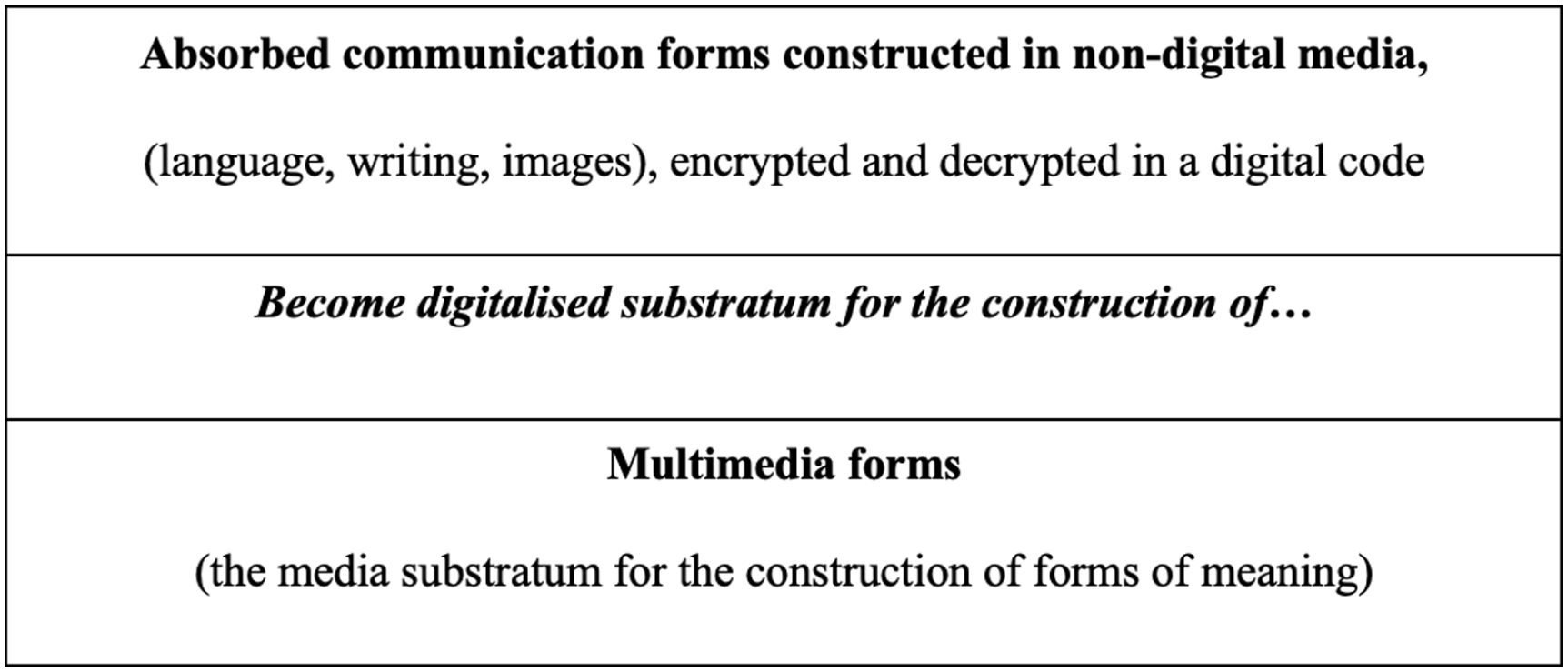
Digitalised media as substratum for the creation of forms of meaning.
Some sociological notes on the technological infrastructure of web-based groups
Digital media of dissemination rely on technological infrastructures allowing coordination between computers through programmes. Programmes are the functional equivalent to the alphabet for the medium of writing. The coordination between computers generates information systems that collect, store, process data and distribute information; an example of information system is the World Wide Web. Since the beginning of the new century, the diffusion of technological infrastructures labelled and marketed under the umbrella term Web 2.0, hasinvolved servers software, content syndication, messaging protocols, navigation standards and client applications. The elements of the technological infrastructures publicised as Web 2.0 interact to creation platforms such as social networks. Social networking platforms are programmed to facilitate coordinated construction of meaning between individuals who can influence each other’s thinking as they construct computer-mediated narratives interlacing past, present and future communications. In addition to the general connotation of Web 2.0, consisting in the possibility for users to contribute to both the content and structure of the pages, facilitating their interaction, social networking platforms facilitate recursive communication between users. As previosuly discussed, recursive communication represents the condition for the emergence of social groups.
Social networking software instructs new participants to create a profile, writing themselves into being (boyd, 2007), for exampleassociating his or her person with cultural icons, celebrities, places and popular media resources (Zhang, 2024). The profiles may list their names, ages, geographic locations, interests, relationship status, and other details that can easily be inserted into a form or template. Profiles represent individuals that are the output of the social networks and the elements of the same social networks. The ontological distinction is between networked profiles and non-users. The individual consciousnesses underpinning profiles remain in the environment of the social networks. Individual consciousnesses remain outside of the social network, as much as they remain outside of any mundane social interactions. For this reason, the connectiveness of the social network is not hindered by the possibility for each consciousness to generate more than one profile, and it is not limited by profiles that participate in the social network independently from any consciousnesssuch as, for instance, profiles that have abandoned the platform are still thematised as objects of communication in the social network. The same is true for profiles generated by specialised software, also know as “bots”:.. Consciousnesses underpinning profiles remain in the environment of the social networks. Individual consciousnesses that do not underpin profiles, for instance the consciousness of non-users, are meaningless for the social network, unless non-users are thematised, irrespective of their volition, as objects of communication. The dissemination medium of writing contributed to the development of autopoietic systems such as international learned societies that reproduced themselves using that medium of dissemination as substrate of meaning produced through communication. In a similar fashion, social networking platforms contribute to the development of social networks as autopoietic systems that reproduced themselves using the digital medium of dissemination as substrate of meaning produced through computer-mediated communication.
Digital personhood in the social network
Information systems are capable of organising information that is available within the digital medium of dissemination (Piccoli et al., 2022), which is constantly expanding through the technological infrastructures that allow users to produce digital content interchangeably with other users. Social networking platforms combine the information systems capacity to organise information with the technological infrastructures known as Web 2.0. Organisation of information allows specialised software or the users as agents, or a synergy between the two, to relate profiles to other profiles, based on selected characteristics. The technological infrastructures of Web 2.0 facilitate recursive communication between profiles, creating the social condition for the evolution of temporary and contingent assemblies, such as circles of friends or cohorts of followers. Users utilise software to establish and manage connections, selectively generating friends from the substratum of profiles.
Luhmann suggests that a person is a social construction, the outcome of communication processes that reduces complexity, because expectations are constructed concerning the person’s behaviour (Luhmann, 1995). Although Luhmann did not have the possibility to observe the diffusion of Web 2.0, it is believed that his concept of person, as communicative construct that supports connectivity of communication by reducing complexity, can be applied to profiles operating within groups emerging from social networking platforms. Both persons and profiles can be colourfully described as collages of expectations. The use of organised information by profiles to locate and contact one another presupposes that communication has already raised reciprocal expectations of personhood. Profiles learn to expect that different spaces within the social network include different digital persons that are willing to participate in specific communicative situations (Wu, 2023). The most successful social network sites over the last 20 years are comparable in this respect: they all support selective online interactions between matched profiles that represent the online personhood of the network users.
Making use of the capacity of the digital medium of dissemination to absorb and reconstitute other communication media, a profile may attach collections of photos, music and videos to claim symbolic and cultural capital (Zararsiz & Ayaşlioğlu, 2024). The work of assembling artefacts builds up the complexity of a profile page but also reduces the complexity of the digital person, as it increases the selectivity of expectations that may be attributed to the online profile by others.
As she or he creates a profile on the social network, a person becomes a profile. A profile may instigate digitally mediated friendship. Within the social network users not only claim personhood by participating in communication; they also validate the digital personhoods of profiles they connected with. Thus, we may describe the position of friends in systemic terms, as the difference between friend and digital person, and we may say that the meaning of friendship is produced by processing this difference. As suggested by boyd and colleagues in the one of the early works on digital friendship, a click produces friendship by bringing a specific digital person to the surface, up from the digital depths of available profiles (boyd et al., 2010).
Web-based groups as autopoietic social systems
Social networking platforms as technological infrastructure of web-based groups
The digital media of dissemination both increases and reduces the complexity of communication. An efficient utilisation of the information system’s capacity to organise information, enables a social networking platform to preserve the memory of past communication as social semantics, which can be also defined as “culture”, reducing complexity therefore facilitating interactions between profiles.
It has been observed that during the two decades that separate this article from the introduction of the technological infrastructures of Web 2.0, social media platforms have mostly been developed for economic purposes, making the facilitation of connections between individual and groups a selling-point rather than a mission (Gillespie, 2018). For-profit social media platform are driven by the pursuing of revenues adapting their design to attract advertising and facilitating data collection (Flensburg & Lai, 2022), to the point that a number of observers (see, for instance, Hwang, 2020) have raised concerns about the colonisation of social life by the commercial rationale of social media platforms. Nevertheless, recent research indicated that it would be limiting to classify social media platforms exclusively as commercially incentivised technologies, because they support the emergence of a varied range of communication systems (González-González et al., 2022; Salte, 2022), often integrating ‘offline’ social networks (Kalogeropoulos, 2021).
Social networking platforms support the emergence of a wide array of groups based on recursive events of communication (posts, likes, sharing of elements, comments) that maintain a boundary of meaning eproducing the difference between system and environment, which includes individual consciousnesses and other social systems. The reproduction of the difference between the social system and its environment simultaneously reproduces the ontology of the system. Although, the reproduction of general functional systems such as, among others, the social system of education (Baraldi & Corsi, 2017), the social systems of the economy (Pahl, 2017), the social system of mass media (Bechmann & Stehr, 2011), does not depend on social networks, all function systems are now structurally coupled with social networks, continuously producing irritation for each other (Boccia Artieri & Gemini, 2019). In addition, moving from the level of general function systems to the level of social groups, the social systems that emerge from social networking platforms would not exist without the technological infrastructure underpinning the platforms, because they depend on user-generated content and recursive communication.
Web-based group as a distinct type of social group
According to the characteristic of social groups, it is possible to conceptualise the social systems emerging from social networking platforms as a type of social group, web-based groups. Like all social groups, web-based groups are systems of communication that reproduce themselves through recursive communication. Recursive communication constructs the difference between the system (the group) and the environment (what is outside of the group) as boundaries of meaning. Web-based groups involve profiles who are in contact with each other as digital personhoods (Do et al., 2024) which makes them different from organisations where communication is centred or role, or social movement where communication is centred on goals. Communication is oriented to the digital personhood of profile as they enter a group should not disrupt thecohesion based on the social semantics, the culture of the group, constructed over time trough recursive communication.
The dynamics of access and exit of profiles from web-based groups can be typified utilising three theoretical principles, originally developed to describe the dynamics of access and exit of members from social groups (Forsyth, 2009): the proximity principle (the access to the group is related to the closeness, not necessarily physical, of members); the similarity principle (the access to the group is related to shared attitudes, values, demographic characteristics); and the elaboration principle (the access to group is related to the incorporation of new members based on their off-group relationships with current group members).
Notwithstanding the viability of principles developed for offline social groups as theoretical tools to describe the dynamics of access and exit of profiles from web-based groups, it is also possible to observe a unique characteristic of web-based groups. The digital medium of communication, combined with the technological infrastructures of social networking platforms, extends the possibility of synchronous and asynchronous communication.Additionally, the possibility to produce contents including images, sounds, videos facilitates the construction of a rich social semantics within the boundaries of the web-groups (Marino et al., 2022). Finally, information systems allow the instantaneous construction of a memory of past communication within the web-based group.
These characteristics, specific of web-based groups, conjure to offer more scope for the construction and interlacement of narratives that invite the engagement of new profiles, offering web-based groups a more pronounced ability to incorporate new profiles, if compared to other types of social groups. Nonetheless, the digital medium of communication and the technological infrastructures of social networking platforms, by facilitating synchronous and asynchronous communication exacerbate a limit of all social groups: the difficulty in conditioning the behaviour of profiles in the group, consequence of the the (digital) person-centred orientation of communication in social groups, emphasising expectations of individual contributions to communication (Malik, 2022).
Web-groups’ capacity to integrate profiles and the concurrent difficult control of profiles’ behaviour generate high complexity which is often reduced through relying on the architecture of the social networking platform. The most popular social media networking platforms provide for one, or more, profile to take the role of group administrators, who are responsible to guard the access of other profile in the group. Although the interpretation of the administrator role varies across group, with some positioning themselves as uncompromising guardian of the group’s culture and other opting for a laxer approach, the administrator of the group is an access point with specific responsibility for accepting (or not) group membership requests (De Salve et al., 2023).
Web-based groups share the fundamental characteristics of social groups, discouraging the idea of considering them a separate type of social system. However, the coupling between web-based groups’ autopoiesis and the technological infrastructure underpinning social networking platforms, combined with the dynamics of access to the groups, invite to conceptualise web-based group as a distinct type of social groups.
Web-based groups as ego-centred group
From an ontological and operational perspective, web-based groups emerging from the use of technological infrastructures that underpin social networking platforms are ego-centred. Web-based groups are ego-centred because they are necessarily observed from the perspective of a member of the group (Ego) that observes the group reproducing its unity as the difference between itself and the environment, connecting communication with communication according to the group’s semantics. Joining or leaving the group, launching new topics of discussion, criticising or praising the contributions of other members: these are all autopoietic operations of web-based group that rely on the understanding of an Ego. Communication happens socially only when Ego understands the behaviour of Alter as communicative action (an utterance), attributing motives for it and creating the meaning of information (Baraldi, 1993).
Web-based groups can be characterised as ego-centred and content-centred, because profiles gather in a group attracted by a theme, a cultural reference, a popular person, a stream of discussion. It has been acknowledged that web-based groups represent an important type of social system; for instance, the use of web-based groups can be structurally coupled with participation in social movements (Segerberg & Bennet, 2011) and pro-social behaviours (Raza et al., 2022). Developing Mark Granovetter’s concept of weak ties networks (Granovetter, 1983), scholars researching the relationship between web-based groups and social capital argue that while web-based groups are likely to lack strong networking ties (Goyanes et al., 2021), they can be channels for the exchange and accumulation of social capital, by facilitating active social participation (Salte, 2022). A non-exhaustive list of examples include Facebook-based groups assisting the recruitment, organisation and dissemination of information to protesters during ‘tent protests’ in Israel (Lev-On, 2019); coordinating and documenting the #EndSARS protests in Nigeria (Uwalaka & Nwala, 2023); discussing and critically reviewing political communication in the run-up to general elections in Norway (Skogerbø & Karlsen, 2021); functioning as nodes in networks of peer-education and support during the Covid19 pandemic in Vietnam (Do et al., 2024); facilitating adaptation to new social contexts for Chinese students in the USA (Li & Chen, 2014); publicising healthier life style choices for young adults in China (Lau et al., 2022).
Web-based groups as social and temporalised autopoietic system
The communication processes that reproduce a web-based group doing so by selectively interlacing narratives; in this way, the material dimension of the web-based group is condensed validating relevant communication, and rejecting non-relevant communication. Acceptance, or rejection, of communication creates a memory of what communication is relvant for the system. Thus, in the temporal dimension it is the past, the memory of the group, that indicates the horizon of possibilities for future communications. Nevertheless, it is important to highlight that, as for all communication systems, any event of communication in a web-based group can introduce a possible variation from the group’s semantics, triggering evolutionary potential.
For web-based groups, the difference between the system and the environment is a source of self-irritation: the environment is always produced by the operation of the system that observes and makes sense of the difference between the system and ‘everything else’. The environment becomes meaningful for the system if the system makes it an object for its observation: this is theoretically described as the re-entry of the distinction between system and the environment into the system (Blatterer, 2024; Luhmann, 1995). When a web-based group communicates about its culture, its structures, its patterns of distinction, about its identity, these are all operations of re-entry. Thus, alongside material differentiation (themes of communication) and temporal differentiation (the memory of the group), a distinction is produced in the social dimension. It is a distinction between an environment that consists of what does not communicate, for instance psychic systems, or laptops, or information systems, and what communicates, that is, the web-based group as a social system. With operations of re-entry, when communication thematises the identity of the group, the distinction is brought into the system, as a distinction between self-reference and other-reference (Baraldi et al., 2021).
Figure 2 illustrates the process of self-referential autopoiesis of a web-based group within the Facebook social network platform. Figure 2 also describes how the re-entry of the distinction between the web-based group and the environment into the web-based group generates social semantics.
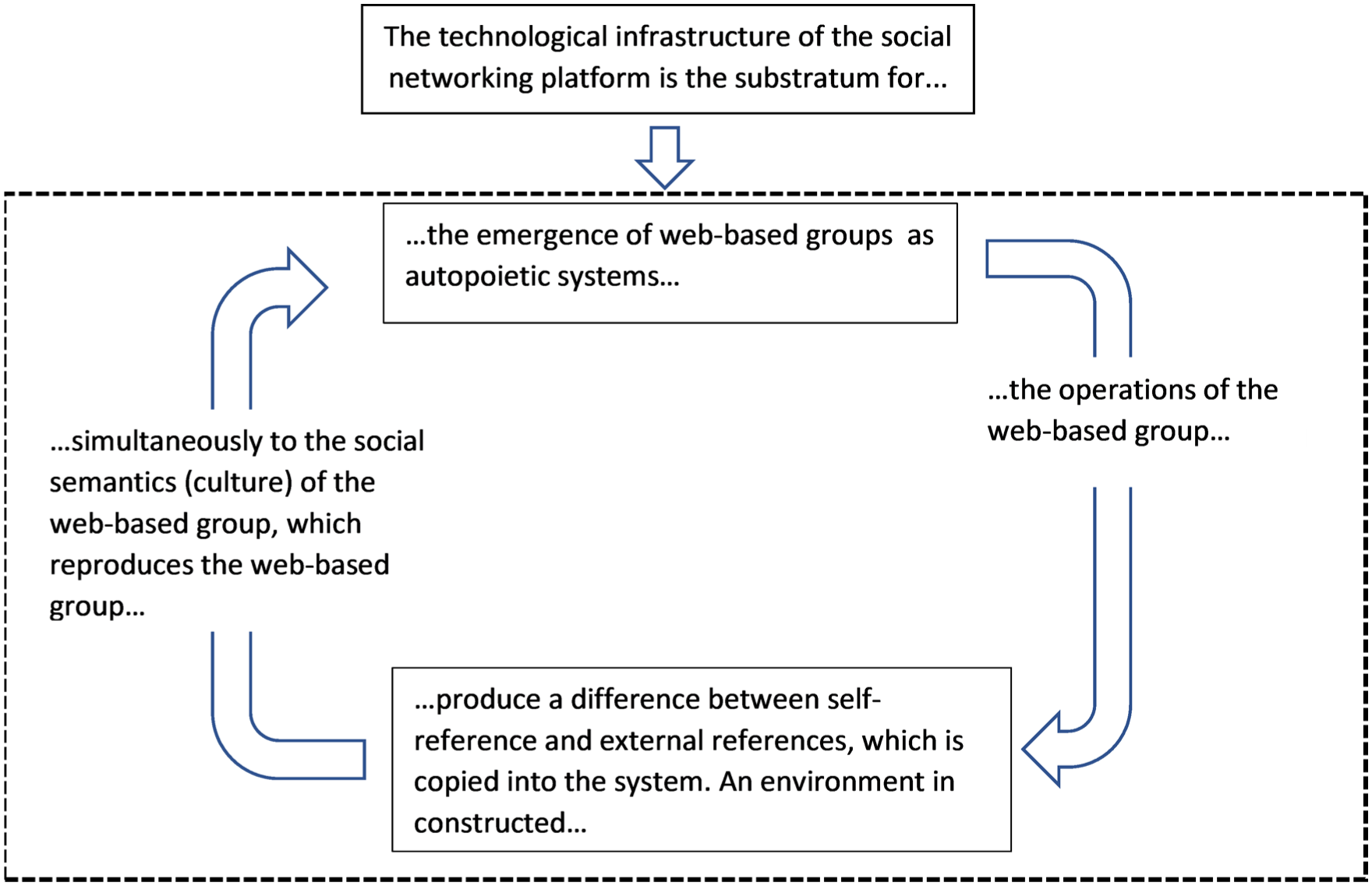
Web-based groups as social and temporalised systems.
Society constitues theenvironment of a web-based group. Society includes the members of the group; indeed, the most important source of irritation for a web-based group is the observation of its members. While the group and its members are structurally coupled, they represent two different forms of autopoietic systems; the group is a social system of communication, each member is a psychic system of consciousness.
In the very moment when the group penetrates in the consciousness of its members via communication, the conditions for the irritation of the group are created. Consciousness produces meaning out of communication, drawing the distinction between what has been done by Alter and what else could have been done but was not. This is a self-referential process where, after the initial coupling with the event of communication that immediately vanishes, thought follows thought inside the individual consciousness, beyond the group’s control. The group cannot control the difference it makes for consciousnesses of its members. When, following the penetration of the group in a consciousness, this consciousness produces the meaning of this irritation and communicates about it, consciousness penetrates the group: a contribution is uttered, understood, and reacted to. All these events represent irritations, and the group must produce new semantics to cope with irritation, frequently a rather confrontational process. While in the ordinary activities of the system its semantics remains implicit and quietly works in the background, if an event of communication challenges it, this border will be defended strongly, making it explicit. It is of the greatest importance to notice that web-based groups can reach (and indeed they must reach, otherwise they would perish) a level of internal complexity that allows them to produce self-irritation, as a strategy to revitalise to actualise their semantics. The most evident example of self-irritation in web-based groups is the presence of unpopular members who are not thrown out permanently because byreacting to them others digital personas reinstate and revitalise the group’s semantics. When an unpopular member offers a proposal of meaning in opposition with the semantics of the group, the group irritate itself, and such irritation is the condition for the re-entry of the distinction betweenthe group (the system)and f society and individuals (the environment), into the system (Spencer Brown, 1969).
When the distinction between self-reference and other-referenceintersects the distinction between before and after, the social system becomes temporalised. A temporalised system operates historically, considering the memory of its past operations as foundation for its operations in the present (Figure 3).

The operation of re-entry generating social semantics.
Intelligence as an autopoietic imperative for web-based groups
Web-based groups, like all autopoietic systems may forego their complexity; evolution is not necessarily a one way process from low complexity to high complexity; indeed the other way round is possible when a system: (1) sticks to its unity without paying attention to the other side of the distinction, the environment (social stasis) and (2) does not observe the difference between the before and the after of any operation, assuning semantic continuity (temporal stasis). .
As all social groups, web-based groups tend to condense their borders of meaning, which is a presupposition of their self-reproduction as a unity in the environment. While this operation preserves the autonomy of the system, it also exposes the system to the risk of a drive which could lead the system away from (self) reflection towards generalisation, abstraction and a-historical self-description (socail stasis and temporal stasis), with consequences that cannot be underestimated. For an autopoietic system, such as a web-based group, the distinction between itself and the environment is essential for the re-entry of the system in itself. Without re-entry, without self-observation, without reflectivity, the system becomes static therefore less capable to adapt to change. Generalisation, abstraction and absence of historical depth imply that the system loses the capacity to look at itself through the mirror of its environment. This is an existential threat for any web-based groups, because intelligence starts when an entity can take its own lack of knowledge into account as first step in the search for knolwedge from other entities which are in a better position to bring it forth. This position describes self-reflectivity and presupposes the distinction between the system and the environment, with the latter that becomes the space of the quest to find the sought knowledge.
A conclusion that this article is proposes (of course among many possible other conclusions) concerns the differentiation of autopoietic web-based groups. Even within a hyper-complex society with millions of social possibilities, even within the space of digital media, there is always a chain of communication events that determines the border between what can be said and what cannot be said as the condition for social inclusion. Nevertheless, the construction, and the reproduction, of borders of meaning are processes that are necessary but also dangerous at the same time: they bring about the possibility that the reproduction of the system becomes a pathology of the system itself. Web-based groups offer an instance of the paradoxical relationship between differentiation, complexity, and time.
Footnotes

Funding
The authors received no financial support for the research, authorship, and/or publication of this article.
Declaration of conflicting interests
The authors declared no potential conflicts of interest with respect to the research, authorship, and/or publication of this article.