



Abstract
This study examines the role of individuals’ media diets in contributing to the growing support for right-wing populist parties. Drawing on social identity theory and the notion of populism as political communication, this study argues that socio-economic status and tabloid news use explain support for right-wing candidates through heightened out-group hostility. Using survey data from the Austrian National Election Study (N = 1161), we present a process model in the structural equation modeling framework, and we compare the direct and indirect effects of attention to tabloid versus broadsheet news on the probability to vote for the Freiheitliche Partei Österreichs. Results show that the link between social status and support for right-wing populism is mediated by attention to tabloid news and anti-immigration attitudes. Implications for democratic norms are discussed in light of the overlap between news media and politicians in their use of populist narratives.
Between 2013 and 2017, millions of asylum-seeking refugees and economic migrants fled from North Africa and the Middle East to Europe. Right-wing populist politicians across Europe leveraged negative news coverage and public concern about this event in their political rhetoric. In doing so, they achieved a level of electoral success unprecedented in post-war Europe (Griessler, 2017; Mudde, 2016; Wodak, 2015), prompting a new wave of scholarship on right-wing populist parties (RWPPs) and their candidates (Aslanidis, 2016; Bracciale & Martella, 2017). One strand of this literature has examined news consumption habits and anti-immigration attitudes (e.g. Jacobs, Meeusen, & d’Haenens, 2016), while another has looked at news selection and support for populist attitudes and actors (Bos, van der Brug, & de Vreese, 2011; Hameleers, Bos, & De Vreese, 2017; Schemer, 2014). Emerging thinking in this area suggests that these phenomena should be examined as acts of political communication, where politicians, citizens, and the media operate to elevate populist movements (De Vreese, Esser, Aalberg, Reinemann, & Stanyer, 2018).
At least one group of scholars suggests that a preference for tabloid media might play a key role in support for anti-immigrant parties. As contemporary media markets become increasingly competitive, there is a general tendency toward tabloid news; lurid, negative news with little context has flooded the information environment (Krämer, 2014). Radical-right and populist leaders have been particularly successful at leveraging tabloid-style news narratives to stoke issues of social identity, often through anti-immigration rhetoric (Ernst, Engesser, Büchel, Blassnig, & Esser, 2017). Scholars have examined the political economy that connects right-wing populist actors to tabloid news (Eberl, Wagner, & Boomgaarden, 2016), and others have found that people with populist attitudes have media diets rich in tabloid news (Hameleers et al., 2017; Schulz, 2019). Yet, defining the underlying communication processes for media selection and effects in the context of right-wing populist movements represents a conceptual blind spot (Reinemann, Matthes, & Sheafer, 2017). The current study aims to fill this gap in the literature.
The following literature review addresses this challenge by first connecting social identity theory (Jenkins, 2014; Riek, Mania, & Gaertner, 2006; Tajfel, 1982) with support for right-wing populist attitudes and actors. Next, it discusses tabloidization of the press and the implications for priming effects on attitudes toward social outsiders. The study presents a theoretical process model of communication effects that takes into account social predispositions and media selection in one’s support for anti-immigrant parties. Employing survey data from two waves of the Austrian National Election Study (AUTNES) (N = 1161), the study then tests the relationships between social demographics, news selection, anti-immigration attitudes, and support for the Austrian RWPP, the Freiheitliche Partei Österreichs (FPÖ, or the Freedom Party of Austria) in the ordinary least squares (OLSs) and structural equation path-modeling (SEM) frameworks.
Austria is an ideal context for studying these relationships because (a) it is home to a competitive news market demarcated by clear distinctions in narrative style, (b) it was on the front lines of the European migration wave that peaked just before the 2016 Austrian presidential election, and (c) the FPÖ—which took an anti-immigration stance during the campaign—has been one of the more successful RWPPs in Europe. 1 The study finds that social identity in the form of socio-economic status (SES) and out-group evaluations (anti-immigration attitudes) are directly related to electoral support for the FPÖ. Those of lower social status prefer tabloid media, and in turn, tabloid media is also directly related to both anti-immigration attitudes and intention to vote for the FPÖ.
Populism and the radical right in Austria
Populism is a rhetorical style that refers to the Manichean conflict between the corrupt governing elite and the “pure people,” whose plight represents an appeal to majoritarian rule (Akkerman, Mudde, & Zaslove, 2014; Canovan, 1999). Though there is some debate over its definition and measurement, populism is often articulated in the strategic framing of issues by political candidates and leaders (Aslanidis, 2016; Bracciale & Martella, 2017). Building on this definition, scholars have recently embraced the notion of populism as a political communication style (De Vreese et al., 2018). Analyzing populism as communication distinguishes narrative themes from political ideology, and therefore, populism may “host” ideologies from across the political spectrum (Mudde, 2011). Defining populism as political communication also allows researchers to look at how various political actors—including news organizations, news audiences, and citizens more broadly—might define or articulate exactly who are the “pure” people, which institutions are corrupt, and what remedies should be pursued.
Radical right-wing populist communication styles take a decidedly exclusionary and nativist stance. These groups are considered “radical” because their talking points and policy proposals concerning social outsiders often challenge long-standing liberal norms of inclusion and diversity (Mudde, 2007, 2016). In contrast to so-called “empty populisms” (which invoke a simple dichotomy between elites and the people), right-wing incarnations attack both the governing elite and immigrants, especially those who belong to an ethnic minority. Austria is home to the prototypical RWPP in Europe, the FPÖ. The radical right in Austria regularly employs populist rhetoric alongside themes of nativism and authoritarianism. Content analyses of party platforms, speeches, and social media posts reveal consistent patterns: portraying elites as corrupt, ostracizing “others,” invoking the homeland as a rallying point, and contrasting liberal institutions with direct democracy (Ernst et al., 2017; Wirth et al., 2016).
During a political re-alignment in the 1980s, the FPÖ emerged as a political force under the leadership of Jörg Haider, a charismatic politician who successfully garnered media attention by breaking political taboos and challenging incumbent political elites (Wodak & Pelinka, 2002). The party’s rhetoric emphasized identity politics and “traditional values” (Betz, 1994), and it promised to put “Austria first” by focusing on issues of immigration, crime, and European Union (EU)-skepticism. 2 In 2016 and 2017, the FPÖ tallied its most successful election results to date—FPÖ candidate Norbert Hofer garnered 46% of the popular vote in the run-off election, narrowly losing to the Green Party candidate. After the 2017 parliamentary elections, the party gained 28% of the votes and became the junior coalition partner in government (Bundesministerium für Inneres, 2017).
Populism and social identity
Social identity is the core principle of all forms of populism. How actors define who are the corrupt elite, who belongs among the people, and in exclusionary forms, who are the social outsiders, is a matter of individual and group identity formation. Simply stated, “identity is the human capacity—rooted in language—to know ‘who’s who’” (Jenkins, 2014, p.6). Social identity theory posits that human behavior can be described, at least in part, by how people categorize themselves relative to in-groups and out-groups. There are two basic components to the theory: identification (or classification) and cognitive evaluations (Jenkins, 2014; Tajfel, 1982). Identity is not categorical, and since evaluations are based on social relationships, the hierarchies that emerge between individuals and groups are complex, and include competition, hostility, co-operation, affinity, ambivalence, and so on (Jenkins, 2014, p.7). There is considerable nuance to social identity theory, and the rather complex history of scholarly debate is beyond the scope of this discussion (see Hornsey, 2008 for an overview). For the purposes of the current study, there are two components of social identity that help explain affinity to the radical right: out-group evaluations of immigrants and SES.
Right-wing parties and anti-immigration
Immigration is perhaps the most important issue for RWPPs (Mudde, 2011; Wodak, 2015; Wodak & Pelinka, 2002), and social identity theory helps explain how populist rhetoric about this issue fosters negative attitudes toward social outsiders. Xenophobic and exclusionary rhetoric is a defining feature of right-wing populism, and the perceived risks associated with immigration are regular talking points for these candidates (Mudde, 2011, 2016). Right-wing populist leaders problematize cultural outsiders, including immigrants, which contributes to in-group identification by promoting cognitive awareness of the defining features of the in-group (in this case, the “native Austrians”) and an evaluative component that determines the values and attributes that demarcate out-groups. In-group identification leads to depersonalization and stereotypical perception of out-group members in times of stress or competition (Tajfel 1982), which can manifest as negative attitudes about immigration, especially if in-group members perceive an out-group to be a threat to in-group power or access to resources (Riek et al., 2006).
The recent immigration wave into Europe provided the basis for such a perceived threat to “cultural insiders” (Green, 2009; Meuleman, Davidov, & Billiet, 2009) because—as the FPÖ narrative goes—its popularity as a destination for displaced people arguably strains its social welfare system during a time of relatively high unemployment. The FPÖ made social spending on refugees a centerpiece of their recent campaigns, contributing to a process of social identification with “native Austrians” that results in anti-immigration attitudes, which research shows, tends to be positively related to support for RWPPs (Rydgren, 2008). Thus, by emphasizing the issue of immigration, the FPÖ played on individuals’ affinity to a perceived in-group to bolster support for their candidates. Based on these considerations, we propose the following hypothesis:
H1: Anti-immigration attitudes will be positively related to support for the FPÖ.
Right-wing parties and SES
According to meta-analyses, in-group identification is not synonymous with negative evaluations of an out-group (Pettigrew & Tropp, 2006), and not all citizens hold populist attitudes in terms of “us” versus “them” thinking. Empirical studies show that populist attitudes, and subsequent support for RWPPs, are directly related to social demographics. For example, populism in Europe appeals to a group of people disproportionately affected by globalization. Young men, blue-collar workers, and those without advanced degrees are particularly vulnerable to the social and economic uncertainty typical of modern industrial society (Spruyt, Keppens, & Van Droogenbroeck, 2016).
SES is therefore a key driver of the demand for populist messaging. As Spruyt et al. note, “due to increased economic competition, innovation, and changing types of work, certain groups are simply ill-suited to function well in a contemporary globalized world characterized by a widening gap between the rulers and the ruled” (p. 3). These groups look to populism to affirm political vulnerability and address grievances through a majoritarian take-over of the current ruling elite. While social demographics are not identification per se, socio-economic class is no doubt a sub-component of identity (Destin, Rheinschmidt-Same, & Richeson, 2017) and several studies have explored the relationships between social class (education and income) and support for RWPPs (Inglehart & Norris, 2016; Lucassen & Lubbers, 2012; Spruyt et al., 2016).
Right-wing populists regularly employ social status as an identity cue in the construction of their discourses. Two strategies are commonly used: (a) populists can paint the ruling class as a cosmopolitan, educated “elite” out of touch with working class needs (Spruyt et al., 2016) and (b) anti-immigration rhetoric appeals to the supposed economic threat that immigrants pose to groups without advanced education (Lucassen & Lubbers, 2012). Thus, those of lower SES may be more willing to consider, based on a politically informed rationale, populist narratives that seek to oust the ruling elite and ostracize immigrants. Based on this reasoning, as well as the empirical findings cited above, we posit the following hypotheses:
H2: Socio-economic status (SES) is inversely related to support for the FPÖ.
H3: Socio-economic status (SES) is inversely related to anti-immigration attitudes.
Tabloids and media populism
News narratives also mirror aspects of populist discourse, what some scholars call “media populism” (Akkerman, 2011; Krämer, 2014). Media populism uses the same stylistic traits of its political counterpart, including speaking directly to “the people,” challenging elites in its role as the fourth estate, and adopting the language, norms, and schemata of the intended audience (Krämer, 2014, p. 49). Tabloid news is particularly emblematic of media populism.
Tabloid news organizations position themselves as an alternative to the elite press, thus creating a space for counter-publics to form (Wasserman, 2010). Historically, the tabloid press has operated alongside, and sometimes in opposition to, mainstream newspapers (referred to as broadsheets in the United Kingdom). Tabloid newspapers employ language and representation styles that reflect the culture of local working class and less educated audiences (for a full treatment, see Conboy, 2006; Örnebring & Jönsson, 2004).
In direct contrast to broadsheet newspapers, tabloid news tends to publish shorter, multi-media news stories that focus on celebrity and scandal (Arbaoui, De Swert, & van der Brug, 2016; Magin, 2017; Vonbun, Königslöw, & Schoenbach, 2016), use larger captions with lurid headlines, more pictures, and simple language. European tabloids prioritize attention-grabbing headlines and entertainment-driven content, often over journalistic substance (Esser, 1999). In general, the move toward tabloidization in the wider media market challenges long-standing professional and organizational influences of the “elite” press (Hamilton, 2004).
Tabloids and right-wing populism
In parallel with political populism, news has a long history of evoking a sense of local and national identity (Anderson, 2006). The early popular press in Victorian Britain (Conboy, 2006), as with the penny press and yellow journalism in the United States, spoke directly to the working class and challenged the emerging industrial-elite institutions of the time (Örnebring & Jönsson, 2004). Modern tabloids maintain this tradition; editors and journalists see themselves as participating in the gossip of the day, and they directly attempt to create a sense of audience identity (Deuze, 2005). In addition, tabloids favor candidates whose rhetoric champions the public and employs elite-conflict frames (Bos et al., 2011; Wodak, 2015).
The emphasis on popular language, identity, and conflict with elite institutions give populist leaders an advantage in garnering coverage from tabloid news outlets. Thus, these newspapers tend to favor populist candidates over candidates from mainstream political parties, and, as a result, there is considerable potential for overlap in the characters, themes, and implied values between tabloids and populist candidates. Consuming tabloids has also been empirically linked to support for RWPPs. Several Austrian tabloids, such as the Kronen Zeitung, have openly endorsed right-wing candidates (Plasser & Ulram, 2003). The FPÖ also focuses their advertising strategy on tabloids (Eberl et al., 2016), and therefore, maintain a working economic relationship with tabloid press. Finally, those who support RWPP candidates also prefer more entertainment-driven media (Eberl, Boomgaarden, & Wagner, 2015). The tendency toward media populism on the one hand, and providing a space for populist political actors on the other, makes tabloids the ideal platform for influencing those predisposed to populist messaging. Therefore, we predict that
H4: Tabloid news use will be positively associated with support for the FPÖ.
Attention to tabloid media may also stoke anti-immigration attitudes. Negative coverage of immigration was prevalent in tabloids during the recent migration wave (Greussing & Boomgaarden, 2017), and negative coverage of immigration can stimulate inter-group anxiety, particularly for heavy news consumers (Schemer, 2014). Social identity theory implies that negative coverage of the migrant crisis could elevate in-group identification, because negative coverage provides evaluative criteria for assessing out-groups. If identification processes are successfully activated, the negative news coverage can result in the identification of displaced people as members of the out-group. For example, research shows that mediated depictions of ethnic outsiders activate stereotypes and result in negative evaluations of out-groups (Dixon, 2008; Domke, McCoy, & Torres, 1999). And while these cognitive processes are temporary, ongoing negative press coverage makes evaluations of out-groups readily available in individuals’ cognitive schemata (Schemer, 2014).
The narrative style of tabloids, in contrast to broadsheets, could also affect anti-immigration attitudes because professional standards of content production may differ in terms of tone, story framing, and attribution. For example, Jacobs et al. (2016) show convincing evidence that preference for public broadcasting in Belgium leads to more positive evaluations of minorities and immigrants. Similar trends have been identified in Berlin, London, Paris, and Zurich metropolitan news markets (Müller et al., 2017). In contrast, tabloid-driven media diets are linked to exclusionary forms of populism in Europe (Hameleers et al., 2017; Schulz, 2019). Because coverage of immigration was decidedly more negative in the Austrian tabloids relative to broadsheets (Greussing & Boomgaarden, 2017), and negative coverage can stimulate in-group biases, we propose the following hypotheses:
H5: Tabloid news use will be positively associated to anti-immigration attitudes.
H6: Broadsheet news use will be inversely related to anti-immigration attitudes.
Process model of news selection and support for RWPPs
Recent theoretical work urges scholars to consider the success of RWPPs as an outcome of political communication processes (De Vreese et al., 2018). This thinking has led at least one group of scholars to propose the use of communication mediation models (CMMs) (Reinemann et al., 2017) to explore the antecedents and effects of populist communication styles. In CMM, individual-level predispositions drive media selection. Media effects are indirect, and mediated through discussion and information processing (see Shah et al., 2017). In the context of Austrian political culture, and based on the literature review, we propose an exploratory process model of tabloid media influence that treats support for the FPÖ and anti-immigration attitudes as outcome variables, and SES as the antecedent factor (Figure 1).
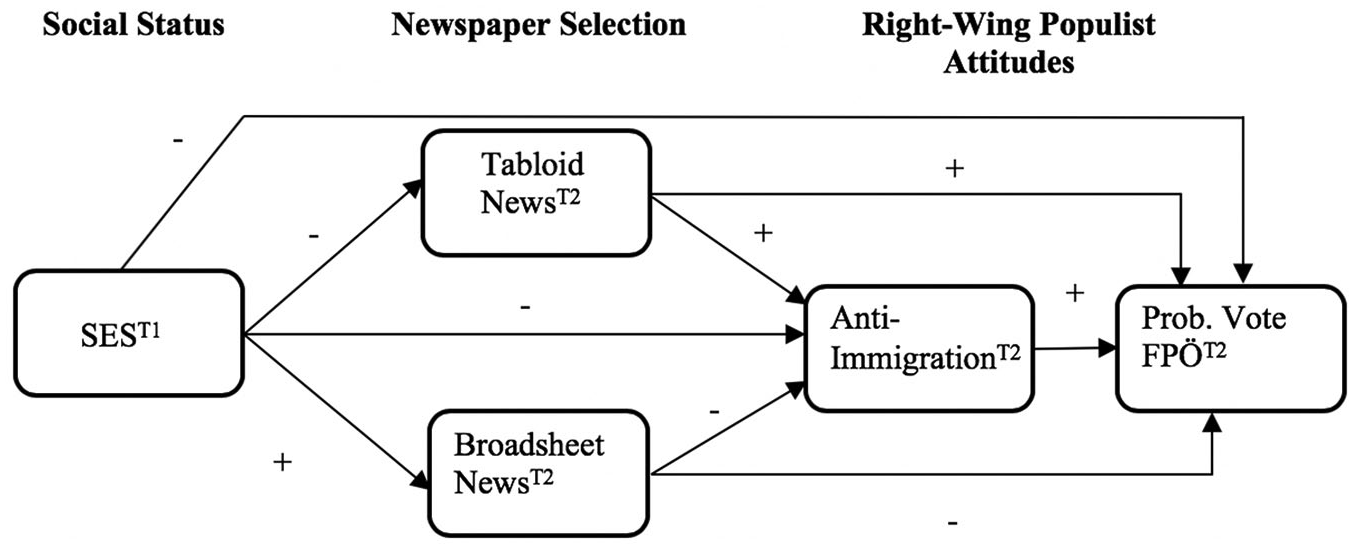
Tabloid influence model: theoretical path model showing the effects of social status on probability to vote for the right-wing populist party (FPÖ) mediated by news selection and anti-immigration attitudes.
SES operates as a pre-condition to news selection in the model. Popular tabloids by definition target the working class (Arbaoui et al., 2016; Magin, 2017), and therefore, they play an important role in creating social identity and a sense of community for these groups (Anderson, 2006; Örnebring & Jönsson, 2004). In contrast, broadsheets appeal to groups with higher levels of SES. Next, news use acts as both a predictor of anti-immigration attitudes (H5 and H6), and a mediator of SES on support for the FPÖ (e.g. H2). Given the direct relationship between tabloid news use and anti-immigration attitudes (H5), and the potential role of tabloid news stoking in support for the FPÖ (H4), anti-immigration attitudes may also mediate the relationship between tabloid news use and support for the FPÖ (Figure 1).
Social identity theory suggests that perceived threats in the environment can reinforce in-group identification (Jenkins, 2014; Tajfel, 1982). If different news outlets employ different narrative styles in covering immigration, individuals’ support for anti-immigration parties will be partially explained by media attention. This will particularly be the case for those in the lower social strata, who may see ethnic outsiders as a direct threat to their economic security (H3) (Inglehart & Norris, 2016; Lucassen & Lubbers, 2012). Simply stated, the model proposes that media selection also mediates the relationship between SES and anti-immigration attitudes.
Figure 1 presents the conceptual model that outlines the proposed direction and order of tabloid media influence. It is important to note that CMMs are not always empirically causal, but instead represent an assumed flow of influence that is primarily theoretical. One could, for example, argue that the direction of influence may be reversed (anti-immigration driving news selection). While CMM conceptually situates attitudes as “outcomes”, attitudes are both inseparable from, and influenced by, media use (Reinemann et al., 2017; Shah et al., 2017). Since some of the proposed direct and mediating relationships are not well understood in the literature, the following research question is proposed:
RQ1: How might SES, news use, and anti-immigration attitudes be interrelated as a structural model of communication influences on support for the FPÖ?
Methods
Sample
This study relies on secondary data analysis of a multi-wave online panel survey conducted between 2013 and 2015 (Kritzinger et al., 2016). The survey was a part of the AUTNES (available for download: https://www.autnes.at). The sample was drawn randomly from an opt-in online access panel based on key demographics. As with similar online panel surveys, response rates are not typically calculated. A total of 3084 respondents completed the first panel wave in August 2013 (pre-election survey), and 1162 respondents completed the sixth survey (post-election survey) between 14 October and 3 November, and 13 and 25 November, 2015, yielding a retention rate of 38%. The survey is closely representative of the Austrian electoral population, though the sample skews slightly male, is younger, and has a higher degree of formal education (Kritzinger et al., 2016).
Only a handful of survey questions were asked across all waves, and therefore, all data come from the more extensive Wave 6 of the survey, with the exception of the dependent variable (measured Wave 1 and Wave 6). Due to the limited availability of variables of interest to Wave 6, the study should be considered mostly cross-sectional in nature. However, the availability of a measure of support for the FPÖ in Wave 1 offers important empirical advantages. This item allows for all statistical models to take into account one’s preference for the FPÖ in 2013—no doubt a strong predictor of the dependent variables of interest measured in 2015. The inclusion of this term significantly increases the stringency of the models and reduces the tendency for spurious relationships. Finally, it allows for modeling support for the FPÖ in Time 2 (Wave 6) with an auto-regressive term.
Dependent and independent variables
Support for the FPÖ
Support for the FPÖ was measured with two questions at two points in time. A probability score was created tapping the likelihood one will vote for the FPÖ across waves. First, respondents were asked to rate the FPÖ along with other mainstream parties with the following prompt (Q1): “Using the scale of 0 to 10, how likely is it that you would ever vote for each of the following parties” (Wave 1: M = 3.01, standard deviation (SD) = 3.68; Wave 6: M = 3.98, SD = 4.11). The second question (Q2) asked respondents to pick one party: “Which party do you think you will vote for (dichotomous variable)?” (Wave 1: 13%, Wave 6: 30%). These measures alone introduce bias, because voters often choose a party relative to other parties (Q1), and single-item vote preference measures are prone to error (Q2) (Achen & Blais, 2015; Blais & Nadeau, 1996). Therefore, the dichotomous measure (Q2) of intention to vote for the FPÖ was regressed on the continuous favorability items (Q1) in a logistical regression for all political parties. The result yields a percentage probability score (the probability to vote for the FPÖ), which is the main dependent variable in the study, and it accounts for people’s preferences for other parties (Wave 1: range = .91, M = .13, SD = .27; Wave 6: range = .99, M = .32, SD = .40).
Anti-immigration attitudes
The survey contained nine questions related to attitudes toward asylum-seeking refugees and immigration in general. The survey did not contain extended measures of sub-dimensions of attitudes toward out-groups (Lucassen & Lubbers, 2012). All nine items were analyzed for reliability based on exploratory confirmatory factor analysis (CFA, oblimin rotation). Based on this approach, five items were observed to reliably load onto a single factor without the need to fix co-variance parameters. 3 The final construct reflects support for government action to prevent immigration into the country and deny immigrants social benefits (Davidov, Meuleman, Billiet, & Schmidt, 2008; Green, 2009). Five items, five-point agree/disagree scale: (a) “Migration into Austria must be stopped,” (b) “Migrants who come to Austria should be supported” (reversed coded), (c) “The Austrian government should not financially support refugees,” (d) “Asylum seekers should receive work permits” (reversed coded), and (e) “Asylum seekers, whose applications have been approved, should be entitled to bring their families” (reversed coded) (range = 4.00, Cronbach’s α = .88, M = 2.99, SD = 1.03).
Tabloid news use
The key predictor variable of interest, tabloid news use, is based on categorizations of the Austrian media landscape studied in previous work (Magin, 2017). The construct was measured as the average frequency of reading the newspapers Heute, Österreich, and Kronen Zeitung during a regular week (three-item averaged index: range = 7.00, Cronbach’s α = .65, M = 1.7, SD = 1.63).
Broadsheet news use
Broadsheet newspapers are the primary foils to tabloid newspapers in most European media markets, and they are often studied for their influence on public opinion and political attitudes (Akkerman, 2011; Conboy, 2006). Respondents received the following prompt: “On average, how many days in a regular week do you read the print version of these papers” (Der Standard and Die Presse) (two-item average: range = 7.00, Spearmen–Brown coefficient = .66, M = 1.02, SD = 1.48).
SES
SES was measured as the scaled (z-score) average of income (median monthly net income: 1800–2100) and education (highest level of formal education achieved folded into seven categories (1 = primary school or less, 7 = masters degree or more) (mode = vocational school (29%), range = 6, M = 4.50, SD = 1.48)).
Demographics
The survey also asked about age (M = 49 in Wave 6), gender (49.3% female in Wave 6), and religion (Christian = 1, 58%).
Control variables
Political ideology
Political ideology is thought to influence news selection, and is implicitly related to the dependent variable. It was measured using self-placement on a left–right scale, where 0 = “left” and 10 = “right” (range = 10, M = 4.98, SD = 2.01).
Television news use
Consuming political news (both in broadcast and online contexts) is often associated with participation in elections. Television news use was measured with four items, based on the number of days one watches various national news broadcasts. The questions asked: “How often do you use the following media to inform yourself about political events in Austria: a) television, b) Zeit im Bild in the evening, b) ZIB 2 later in the evening, and c) Puls 4 News in the evening” (Averaged scale: range = 6.25, Cronbach’s α = .64, M = 2.40, SD = 1.36).
Social media news use
Social media news use was measured with two items: (a) “How often do you read about political issues on social media,” and (b) “How often do you read posts on social networks such as Facebook or Twitter” (two-item averaged scale: range = 4.00, Spearman–Brown coefficient = .89, M = 2.58, SD = 1.51).
Government satisfaction
Support for populist candidates in Europe is often correlated with negative attitudes toward the current government (Waldron-Moore, 1999). Satisfaction with current government was measured with three items measuring overall satisfaction and trust in Austrian politics: (a) “On the whole, how satisfied are you with the way democracy works in Austria,” (b) “How satisfied are you with the performance of the current federal government” (SPÖ–ÖVP coalition), and (c) “One can trust the Austrian parties” (three-item averaged scale: range = 3.00, Cronbach’s α = .74, M = 2.06, SD = .62).
Media skepticism
Previous scholarship finds that attitudes toward the media at the system level influence the media selection, and are a common feature in populist movements (Tsfati & Peri, 2006). Media skepticism was measured with three items. Respondents were asked to rate on an agree/disagree scale: (a) “The Austrian media works diligently” (reversed coded), (b) “Austrian media are partial,” and (c) “One can trust Austrian media” (reversed coded) (three-item averaged scale: range = 3.00, Cronbach’s α = .71, M = 2.68, SD = .57).
Political discussion
Political discussion has been studied as a precursor to, and mediator of political behavior in several studies (Eveland & Hively, 2009). To avoid potential spurious correlations in the statistical models, political discussion is included as a control variable. The survey asked respondents three questions: “Please think about the first person [and the next two people], who you talk to about politics. How often do you talk to this person about politics” (averaged scale: 1 = never, 4 = often, range = 3.08, M = 3.38, SD = .51).
Political interest
Interest in politics and strength of partisanship are key predictors of intention to vote (Blais & St. Vincent, 2011). Political interest was measured with the question: “In general, how interested are you in politics” (range = 3, M = 1.94, SD = .82).
Analytic approach
To test the relationships between the independent and dependent variables, OLSs regression and path analysis in the SEM framework was used. The modeling strategy accounts for potential spurious relationships by controlling for several individual demographic and political antecedents to voting as identified by previous literature. The SEM model was estimated using residualized manifest (observed) variables that account for the influence of the control variables. This approach greatly reduces model complexity. Support for FPÖ at Time 1 (Wave 1) was included as a control variable in all estimated models. The theoretical model (Figure 1) was tested with the lavaan package in R (Rosseel, 2012), and the indirect (mediation) effects were estimated with robust standard errors and the delta method in lavaan. The partial correlation matrix is reported in Table 2.
Results
Before turning to the research question and hypotheses, some preliminary relationships were examined between social demographics, media use, anti-immigration attitudes, and support for the FPÖT2 in Time 2 using Pearson correlations. Those that have a higher probability to vote for the FPÖ are men (r = −.08, p < .05) of lower SES (r = −.23, p < .001), that do not identify as Christian (r = −.07, p < .05), and identify as politically right leaning (r = .56, p < .001). They also tend to be skeptical of the media (r = .39, p < .001), consume tabloids (r = .19, p < .001), avoid broadsheets (r = −.15, p < .001), and hold anti-immigration attitudes (r = .63, p < .001).
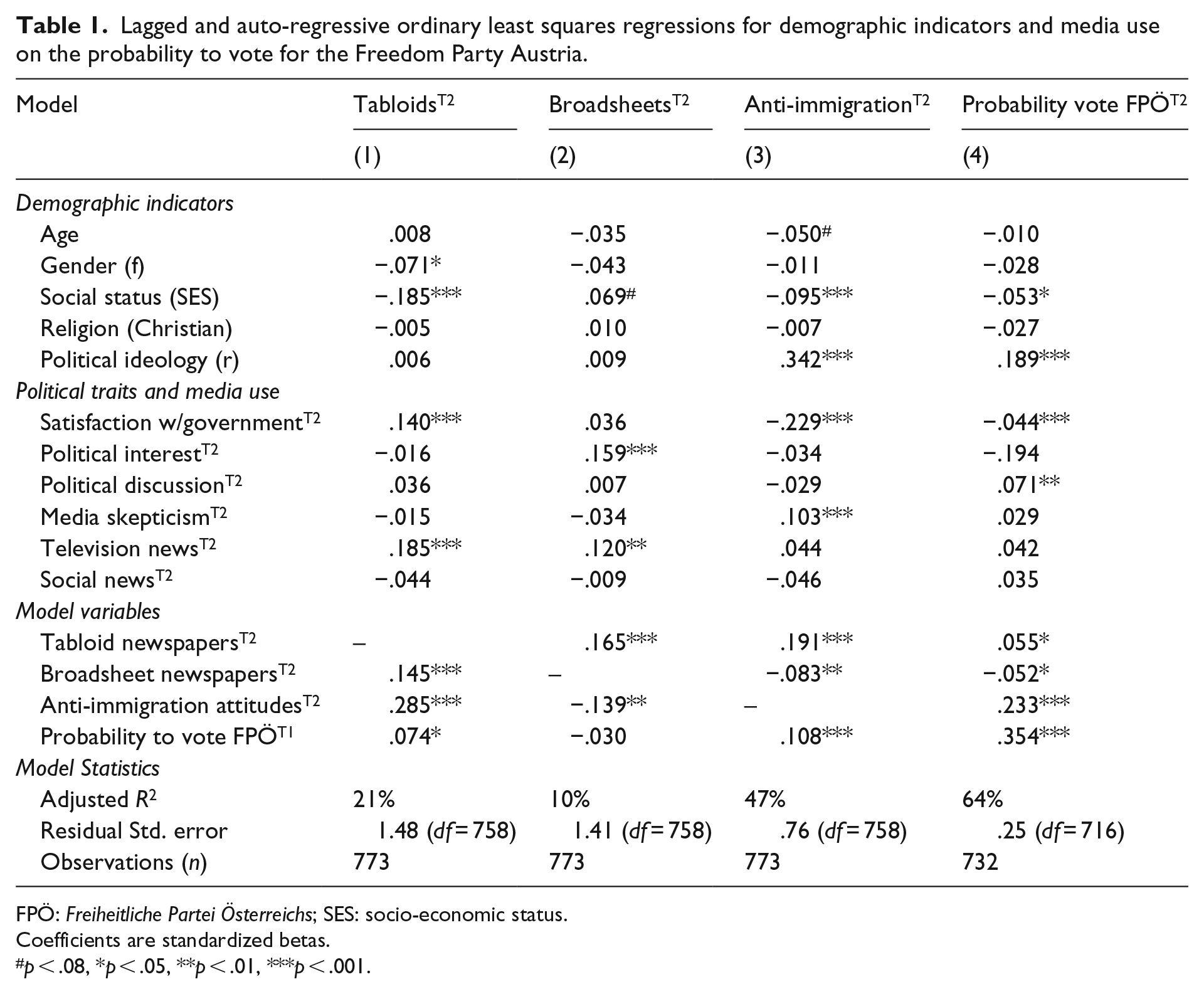
Results from the OLS models, including fit statistics for each model of interest, are reported in Table 1. H1 predicted that anti-immigration attitudes would be positively related to support for the FPÖT2. Results from the OLS (Table 1, Model 4) support this hypothesis with a statistically significant and positive, standardized coefficient (β = .23, p < .001). After accounting for support for the FPÖT1 in Time 1, as well as social demographics, political traits, and media habits, anti-immigration is a strong predictor one will vote for the FPÖT2. H2 predicted that higher SES is inversely related to support for the FPÖT2, and Model 4 affirms this assumption (β = −.05, p < .05). H3 proposed that higher SES is inversely related to anti-immigration attitudes. Model 3 (Table 1) confirms this prediction as well (β = −.10, p < .001).
Lagged and auto-regressive ordinary least squares regressions for demographic indicators and media use on the probability to vote for the Freedom Party Austria.
FPÖ: Freiheitliche Partei Österreichs; SES: socio-economic status.
Coefficients are standardized betas.
p < .08, *p < .05, **p < .01, ***p < .001.
H4 proposed that tabloid news use will be positively associated with support for the FPÖ. This relationship (Model 4) is positive, and statistically significant (β = .06, p < .05). Those that read tabloids (Table 1, Model 1) are more likely to be male, from lower SES backgrounds, hold anti-immigrant attitudes, and are heavy news consumers. H5 and H6 predicted that attention to tabloids and broadsheets would have opposite effects on holding anti-immigration attitudes. Model 3 shows a positive, statistically significant relationship between tabloids and anti-immigration attitudes (β = .19, p < .001), while attention to broadsheets and anti-immigration is inversely related (β = −.08, p < .01).
Figure 2 presents results from the path analysis (RQ1). The model fits the observed data according to widely used standards in the field (χ2 = 1.9, df = 1, p = .16, comparative fit index (CFI) = .99, Tucker–Lewis index (TLI) = .96, root mean square error of approximation (RMSEA) = .028, standardized root mean square residual (SRMR) = .012), and the model explains 12% of the variance in support for the FPÖT2 (R2 = .12). Note that the model includes all the same controls and predictors as Model 4 (Table 1) and is based on the co-variance matrix reported in Table 2. The path between SES and broadsheets was not statistically significant, and in order to avoid presenting a saturated model, that path was omitted. This particular finding is counter to our expectations. The relationship was marginally statistically significant in the OLS models (β = .07, p < .08, Table 1). It may be that those of higher SES have more complex media diets than others in the sample, and they do not selectively expose themselves to broadsheets in lieu of tabloids.
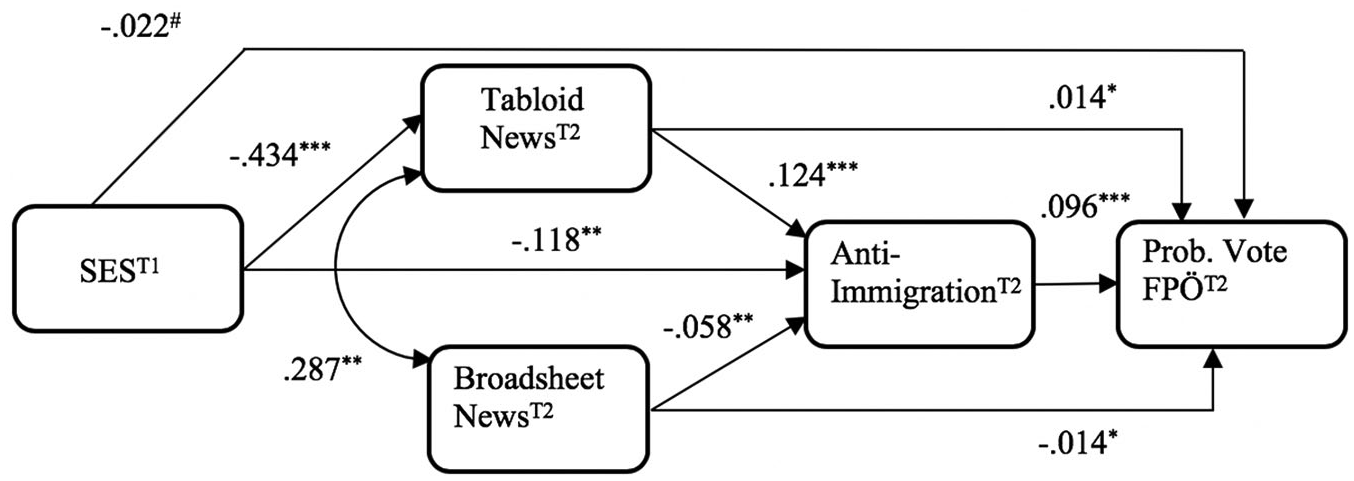
Final estimated path model.
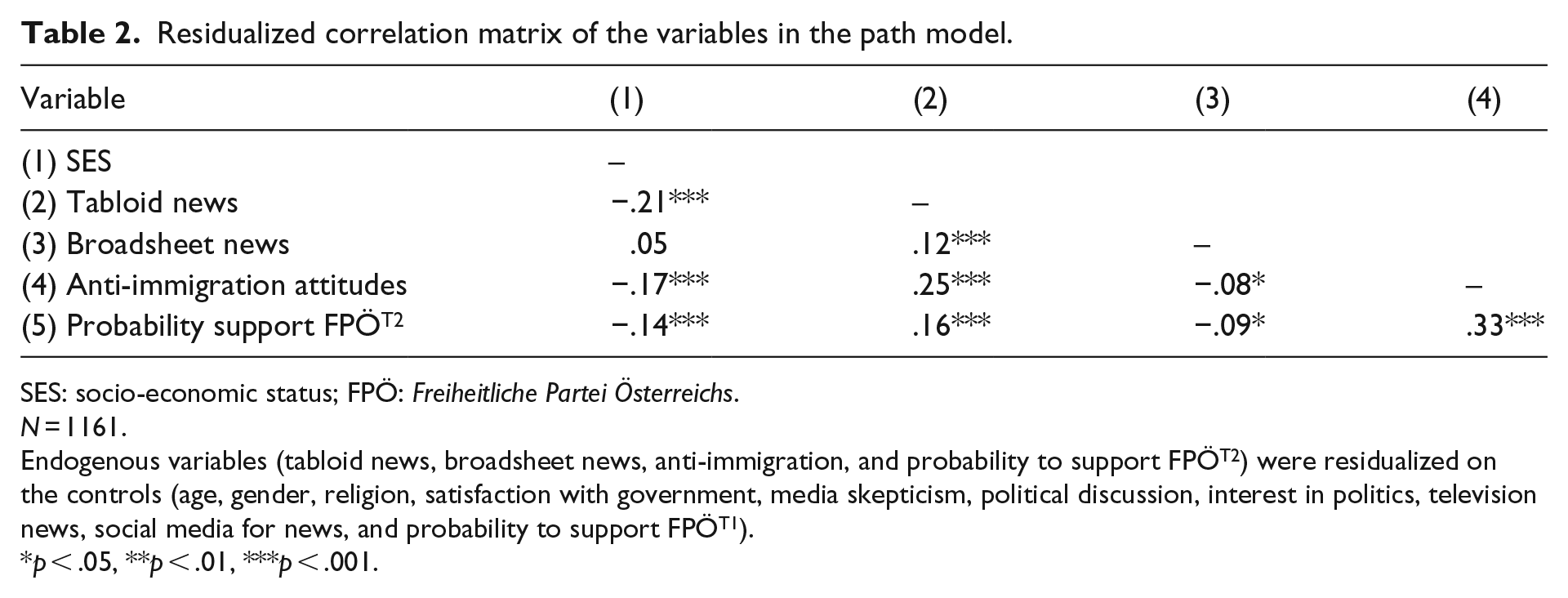
Residualized correlation matrix of the variables in the path model.
SES: socio-economic status; FPÖ: Freiheitliche Partei Österreichs.
N = 1161.
Endogenous variables (tabloid news, broadsheet news, anti-immigration, and probability to support FPÖT2) were residualized on the controls (age, gender, religion, satisfaction with government, media skepticism, political discussion, interest in politics, television news, social media for news, and probability to support FPÖT1).
p < .05, **p < .01, ***p < .001.
We can now turn to the model (Figure 2) from antecedent factors to outcomes variables. As suspected, SES is directly and inversely related to tabloid media use (γ = −.22, p < .001) and anti-immigration attitudes (γ = −.12, p < .001). In the path model, SES is not directly related to support for the FPÖT2; however, the effect is within the 90% confidence interval (γ = −.06, p = .07). Thus, the influence of SES on the outcomes appears to be mediated by news selection.
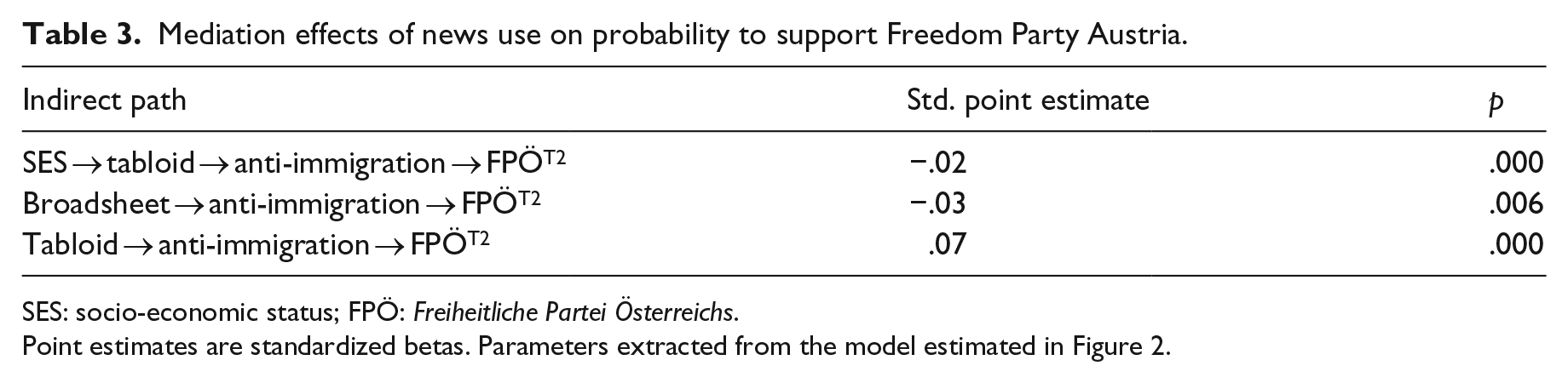
The mediation tests are presented in Table 3, and they show the indirect relationships between SES and support for the FPÖT2 through tabloids and anti-immigration attitudes (β = −.02, p < .001). The indirect relationship accounts for about 18% of the total effect of SES on party support (indirect effect/total effect: −.015/−.081 = .18). Anti-immigration attitudes mediate the effect of tabloids on party support (β = .07, p < .001), and account for about 46% of the total effect of tabloids on support for the FPÖT2. The mediation influence is reversed for broadsheets, suggesting opposite mediating influences (β = −.03, p < .001, about 30% mediated). Thus, the model confirms the hypotheses tested above, and shows that both tabloid news use and anti-immigration attitudes play a significant role in facilitating the influence of SES on support for the FPÖ.
Mediation effects of news use on probability to support Freedom Party Austria.
SES: socio-economic status; FPÖ: Freiheitliche Partei Österreichs.
Point estimates are standardized betas. Parameters extracted from the model estimated in Figure 2.
Discussion
This study tested a theoretical rationale for the role of news selection in the prevalence of support for RWPPs in Austria. Results indicate that after controlling for demographics, political orientations, and prior support for the FPÖT1, tabloid news use is positively related to an increase in the probability that one will vote for the FPÖT2. This relationship is both direct and indirect, positively mediated through anti-immigration attitudes. By contrast, broadsheet news use is inversely related to support for the FPÖT2, and the indirect relationship is negatively mediated through anti-immigration attitudes. Moreover, the model shows that social class (SES) is a strong predictor of tabloid use and support for right-wing populism. Finally, SES is indirectly related to support for the FPÖT2, and the relationship is mediated by both tabloid news use and anti-immigration attitudes.
We based these tests on the assumption that support for RWPPs is contingent upon social identification processes that take place, in part, through news selection. People of lower SES are more likely to choose media that emphasize the interests of their in-group, defined in opposition to immigrants and refugees. These individuals may come to see their group status in society threatened by immigration through perceived cultural or economic threats (Inglehart & Norris, 2016), and therefore, they may develop anti-immigration attitudes and support the party that emphasizes anti-immigration. In the context of the current study, anti-immigration attitudes explain a considerable portion of the indirect effect of news use on support for the FPÖ. Tabloids in Austria covered the migrant crisis negatively (Greussing & Boomgaarden, 2017), and this coverage should have made the issue of immigration more salient to readers. However, SES seems to be an important factor for this effect to take place, suggesting that social status is an important precursor to news selection, and consequently, in-group identification (Destin et al., 2017).
Populism studies have recently undergone a conceptual shift (Aslanidis, 2016; Bracciale & Martella, 2017), and treating populism as a form of political communication has led to the development of testable frameworks for identifying the interactions between political actors and institutions, such as news media (Akkerman et al., 2014; Hameleers et al., 2017), as well as their implications for public opinion and electoral choice. As Reinemann et al. (2017) note, we know very little about how these interactions might work, and even less is understood about the potential antecedent and mediating factors that account for the effects of tabloid news on the growing support for radical right-wing parties. This study helps fill that gap in the literature by highlighting the role of social identity in a broad sense: social status and out-group hostility are strong predictors of populist support. The study also takes into account the role of newspapers in defining national and local identities. In contrast to the arguments that tabloids lack “quality,” popular papers should be taken seriously for their potential to communicate populist ideals.
During the time period the data for this study were collected, the news was dominated by stories related to an ongoing, Europe-wide immigration event. Not coincidentally, support for RWPPs also grew during this period. Therefore, it is reasonable to conclude that the FPÖ successfully leveraged coverage of the migrant crisis, especially in the tabloids, to stimulate implicit (or explicit) bias toward migrants among those in the lower socio-economic strata. This finding demonstrates the fact that populists have been successful at translating acute social crises into electoral support.
There are notable limitations to the study. First, we do not have a direct measure of social identity. However, social demographics and out-group attitudes are commonly studied as sub-dimensions of identity. Second, both before and immediately after the data were collected, there were multiple election cycles in Austria. It is not possible with the current dataset to isolate coverage of the migrant crisis from election coverage, and therefore, it is difficult to make causal inferences related to specific coverage in tabloid news. In other words, it may not be newspaper style alone that increased support for the FPÖ during this time, but instead, election coverage kept anti-immigration discourses in the news over time. Future studies might look at past election cycles, and compare news selection effects to periods of immigration where no election was taking place. In a related concern, this study examined support for RWPPs during a major migration event, and the relationships uncovered here may not generalize to political or historical contexts in which such an event has not occurred. Finally, only a small fraction of variables are available across waves, thus limiting the auto-regressive (time-based) tests available. These limitations are common to survey studies, and the SEM (which accounted for prior support for the FPÖT2) offers some meaningful inference compared to studies that employ simple cross-sectional designs.
A final consideration is determining the role of causation in path models. For example, perhaps those who already hold anti-immigration attitudes prefer media outlets where that issue is dramatized. To test this assumption, we conducted a post-hoc competing mediation test (based on Table 1, Model 4), in which anti-immigration attitudes predict tabloid news use (anti-immigration → tabloid → FPÖT2). Results suggest that tabloid news only mediates a small portion of the direct effect (6%). In contrast, as reported in Table 3, the reverse order shows that anti-immigration attitudes explain much of the influence of tabloid media (43%). Interested readers should also turn to Table 1, which highlights the overlapping relationships across the sample. Many of the relationships examined in the current study are most certainly inter-related, and empirically, we cannot determine the real nature of causation. The current model performed well in our empirical tests, and it conforms to basic assumptions about the flow of communication influence (Reinemann et al., 2017; Shah et al., 2017). Future studies may employ more robust across-time measurements, or tie news use to observational studies.
Despite these limitations, this study presents relatively strong evidence of the relationships between socio-economic factors, news selection, and the probability to vote for the RWPP in Austria. The structural features of the information society that lead to tabloidization of the news (particularly media populism) dovetail rather well with the basic strategies employed by populist leaders. Thus, these cultural and market pressures—which ostensibly lead to the rising popularity of entertainment-style formats online and offline—are an important area for scholars interested in the rise of contentious and identity-based politics. These findings have implications beyond Austria; narrative styles that emphasize audience identity and attention over journalistic substance may be a key factor in stimulating other anti-social political attitudes, like xenophobia, anti-globalization, and distrust of liberal institutions.
