




Abstract
This study scrutinizes the nature of online citizen-driven collective actions aimed at countering terrorism following bombing attacks in Indonesia. In particular, this study illuminates the framing processes, public sentiments, and actors involved in the movement. An analysis of 10,000 tweets bearing the hashtag #KamiTidakTakut (we are not afraid) showed that the participants predominantly employed motivational frames to encourage others to engage in anti-terrorism efforts and defy terror by bolstering collective identity. Moreover, while the tweets were mainly conveyed in a positive tone, a considerable number of tweets voiced negative sentiments, including criticism of the movement. In addition, most tweets came from citizens, and some were from media outlets, civil society organizations, government agencies, and public figures. The study enriches the literature on online collective actions in the context of terrorism and offers practical insights into the design of public anti-terrorism campaigns.
As the threat of terrorism continues to expand globally, authorities worldwide have undertaken significant measures to enhance public safety. In recent years, numerous countries have recognized the pivotal role of citizens’ engagement in anti-terrorism efforts. For example, in the United Kingdom, the police launched the “Action Counters Terrorism” campaign, urging the public to report suspicious behavior to prevent terrorism (“Police Call for ‘Counter-Terrorism Citizens’,” 2018). However, the citizens’ role is not only important before and during attacks but also in the aftermath of such events. With the emergence of social media, the public has gained a greater capacity to participate in post-crisis events. Digital platforms have facilitated rapid responses and the formation of online collective actions, as seen in the #KamiTidakTakut movement (#WeAreNotAfraid) following the 2017 Jakarta bombings in Indonesia (Yulianto & Thenarianto, 2018) and the #PrayForBoston campaign following the 2013 Boston bombings (Lin & Margolin, 2014).
These digital movements offer numerous advantages. Online collective actions enable governments to disseminate information and enhance public awareness by collectively creating and sharing related information (Reuter et al., 2018). In addition, such movements contribute to the mobilization of resources to cope with catastrophic events (Palen & Liu, 2007). In the context of terrorism, existing literature indicates that digital movements following a terrorist attack facilitate the collective sense-making process, which is crucial in times of uncertainty and ambiguity (Fischer-Preßler et al., 2019). Given these benefits, understanding the development of citizen-driven counter-terrorism movements is essential.
Interestingly, despite the growing body of research on counter-terrorism efforts, the existing literature primarily focuses on the strategies and policies adopted by authorities, largely overlooking the role of the public in combating terrorism (Keohane, 2008; Lum et al., 2006). Similarly, while there is an abundance of literature exploring collective actions driven by perceived threats from the state or government, such as the 2011 Egyptian revolution (Kharroub & Bas, 2016) and the #Ferguson campaign (Blevins et al., 2019; LeFebvre & Armstrong, 2018), there is a dearth of studies examining citizen movements to defend the government or the country from outsider threats (e.g., Yulianto & Thenarianto, 2018).
To address these research gaps, this study investigates the nature of online citizen-driven collective action to counter-terrorism. Guided by the collective action framing theory (Snow & Benford, 1988), this research scrutinizes how citizens utilize digital platforms to establish and mobilize collective actions in the aftermath of terrorist attacks. In addition, this study identifies the public sentiment and actors involved in the campaign. This research conducts a Twitter content analysis, focusing on the 2018 citizen-driven collective action in Indonesia called “Kami Tidak Takut” (We Are Not Afraid), which has been viewed as a movement that can build public resilience post bombing attacks and has consistently emerged after terrorist incidents since 2016 (Brajawidagda et al., 2016). By examining the landscape of citizen counter-terrorism efforts, this study not only fills the gap in online collective action literature but also informs the government and other institutions regarding public concerns in the aftermath of terrorist attacks and provides insights for crisis management and anti-terrorism campaigns.
Online collective actions and counter-terrorism movements
An extensive body of research on social media has underscored the pivotal role of digital communication platforms in facilitating collective actions. These platforms provide a unique avenue for individuals to participate in movements (Kruikemeier et al., 2014), connecting users with shared goals and purposes within an online environment and enabling the organization of actions that address pertinent issues through personal and community networks (Bennett, 2008; Goh & Pang, 2016). Notably, online channels, especially Twitter, enable users to engage in horizontal conversations and form thematic categories by embedding hashtags (#) in their tweets, which facilitate coordination and the formation of hashtag movements to push social and political change (Meraz & Papacharissi, 2013; Theocharis et al., 2015).
Numerous examples illustrate how citizens have leveraged specific hashtags to mobilize collective actions. For instance, the hashtags #Ferguson and #BlackLivesMatter gained prominence on Twitter as a means of protesting the court’s decision not to indict a white police officer who shot an unarmed black teenager in Ferguson, Missouri (Ince et al., 2017; LeFebvre & Armstrong, 2018). The #MeToo movement, which gained traction in 2006, went viral in support of sexual harassment victims (Xiong et al., 2019). Moreover, various hashtags have emerged on Twitter and other online platforms in response to catastrophic events, including terrorist attacks, such as #JeSuisCharlie following the 2015 Charlie Hebdo shooting, #PrayForParis in the aftermath of the 2015 Paris bombings, and #PrayForBrussels following the 2016 attacks in Brussels (Krutrök & Lindgren, 2018).
The presence of collective actions, especially in the wake of terrorism, is crucial. Through these movements, the public can rally around collective emotions and solidarity, enhancing the community’s social resilience (Garcia & Rimé, 2019). Individuals can share information pertaining to the attacks, make sense of the situation, and manage the inherent uncertainty. Most importantly, citizens can cultivate public awareness and collectively develop resistance against acts of terrorism (Fischer-Preßler et al., 2019). Therefore, understanding the communication practices throughout counter-terrorism movements is vital.
Indonesia and the #KamiTidakTakut movement for counter-terrorism
Indonesia has experienced numerous bombing attacks. From 1997 and 2002 alone, Indonesia endured over 90 bombing incidents, resulting in the tragic loss of 224 lives and injuring 340 people (Pusponegoro, 2003). Since then, acts of terrorism persisted, including the 2018 bombings in Surabaya and Sidoarjo, targeting three churches and a police headquarters (Boediwardhana, 2018; Febrica, 2010).
Historically, the Indonesian government primarily relied on its armed forces to protect the nation from terrorism (“Hunting Terrorists in the Woods is a Breeze for us: TNI,” 2017). However, in recent years, the government has gradually shifted its strategy to include citizen participation in counter-terrorism measures. For example, social media users have been recruited to spread positive and peaceful messages as a means to prevent radical ideas and terrorist propaganda (Pinardi, 2017). Given Indonesia’s status as a leading social media nation, with over 167 million users, including 24 million Twitter users as of early 2023 (Kemp, 2023), social media is viewed as an effective channel for reaching the public.
Interestingly, online anti-terrorism campaigns are initiated not only by the government but also voluntarily by citizens. One such movement is the #KamiTidakTakut movement. The movement went viral on social media, particularly Twitter, in 2016 as the citizens responded to the blasts and shootouts in the center of Jakarta (Brajawidagda et al., 2016). Since then, the hashtag has consistently emerged after terrorist attacks, such as the 2017 Kampung Melayu bombings and the 2018 Surabaya bombings (Yulianto & Thenarianto, 2018). The movement has also garnered significant public support, consistently trending on Twitter following terrorist incidents, both nationally and globally, indicating a high level of public engagement (Lubis, 2017). Moreover, the movement has received extensive coverage from both national and international news agencies (Utomo, 2018).
The #KamiTidakTakut movement plays a vital role in bolstering public resilience in the aftermath of bombing attacks, fostering community support exchange, and stimulating collective resistance and solidarity (Brajawidagda et al., 2016; Yulianto & Thenarianto, 2018). Furthermore, this online collective action has mobilized offline participation, with hundreds of people taking to the streets to pray for the victims and offer flowers as part of the “Kami Tidak Takut” campaign (Wardah, 2016).
Despite the positive impacts, the campaign is not without criticism. Previous studies have highlighted that the hashtag movement may inadvertently contribute to the spread of sensitive information and misinformation due to a lack of control. In addition, the influx of messages from citizens may potentially overshadow credible messages from important and responsible entities such as the Indonesian police (Yulianto & Thenarianto, 2018). Nevertheless, the benefits derived from collective action outweigh these drawbacks.
Given the significance of the #KamiTidakTakut movement, this study aims to understand the nature of the online counter-terrorism campaign by focusing on the latest instance of collective action in 2018. The movement took place after a series of bombing attacks involving a family of five, consisting of a married couple with their children, who detonated suicide bombs in three churches in Surabaya, Indonesia, during Sunday Mass on the morning of 13 May 2018. The following day, another attack occurred at the Surabaya police headquarters, resulting in at least 11 fatalities and more than 40 injuries (“Surabaya Attacks: 11 Killed in Indonesia Church Bombings,” 2018). These events marked the deadliest attacks in Indonesia since the 2005 Bali bombings, which claimed 20 lives, and the second-largest attacks following the bombings targeting 12 churches in 2000. Notably, the Surabaya bombings are the first known instance of a female bomber and an entire family engaging in terrorist attacks in Indonesia (Soeriaatmadja, 2018; “Surabaya Attacks: 11 Killed in Indonesia Church Bombings,” 2018).
Framing online collective actions
Framing plays a pivotal role in determining the success of collective actions (Pu & Scanlan, 2012). Snow and Benford (1992) define message framing as “an interpretive schemata that simplifies and condenses the ‘world out there’ by selectively punctuating and encoding objects, situations, events, experiences, and sequences of actions within one’s present or past environments” (p. 137). The framing process brings attention to specific topics in the public’s mind, influencing their perceptions and contributing to the success of collective action (Harlow, 2012). Framing also facilitates shared understandings among individuals, enabling collective problem-solving (Goh & Pang, 2016). Moreover, effective framing can mobilize people to participate in collective actions and attract media attention, thus amplifying the movement’s influence (Goh & Pang, 2016; Ward & Ostrom, 2006).
The framing theory for collective actions has identified three types of message frames in social movements: diagnostic, prognostic, and motivational frames (Snow & Benford, 1988, 1992). Diagnostic frames explain the problems that trigger a social movement and who should be blamed. It also identifies the subjects and the reasons for an injustice that sparks moral outrage and action (Ward & Ostrom, 2006). Prognostic frames emphasize alternative solutions to the issue and strategies for implementation (Goh & Pang, 2016). Finally, motivational frames describe why people should participate in collective actions (Harlow, 2012). It attempts to legitimize the movement, decrease the costs and risks, and highlight the positive aspects of the actions (Goh & Pang, 2016).
Several studies have delved into framing strategies employed by online collective actions. For instance, a study on an online movement in Guatemala, which emerged after a postmortem video of a well-known lawyer appeared and accused the president of assassinating him, revealed that the messages on the movement’s Facebook pages predominantly employed motivational frames as a call to arms (Harlow, 2012). Another research on a protest against the Singaporean government on Facebook found that the organizers and the protestors commonly used motivational frames to evoke change and mobilization in the movement (Goh & Pang, 2016). An investigation in Indonesia also analyzed tweets of a protest against a company supporting the LGBT community and found that two competing groups of the public utilized different framing strategies (Oktavianus et al., 2023). The protesters mainly used motivational frames to spur participation, while the counter-protesters predominantly posted messages with diagnostic frames. Hence, different groups of participants in online collective actions may adopt different framing strategies to achieve their goals.
However, the #KamiTidakTakut movement is different from the movements in previous studies, as this collective action focuses on defending the country or the government against outsider threats and building public resilience post terrorist attacks. Understanding the collective action frames used during the #KamiTidakTakut movement is crucial as it provides insights into the process of building shared concerns and solutions to the problems, as well as mobilizations of the participants, which are essential for establishing a successful movement (Oktavianus et al., 2023). Accordingly, building on the framework of collective action framing, this study aims to investigate how the participants utilized different frames and poses the following research question:
Message sentiment of online collective actions
Individuals have diverse opinions or attitudes toward events, and their reactions are often reflected implicitly and explicitly in their message responses. The implicit meaning of a message that echoes people’s attitudes or thoughts is referred to as message sentiment (Liu et al., 2012). It can be categorized into positive (supportive), negative (critical), and neutral (LeFebvre & Armstrong, 2018). Positive messages induce desirable emotions, such as discussing unity and justice, while negative messages convey unfavorable emotions, such as expressing pain and suffering (Boyraz et al., 2015). Objective messages that do not contain any positive or negative emotions are classified as neutral sentiments (Liu et al., 2012).
Social movements often arise from intense emotional states, such as anger, which commonly leads to the prevalence of negative sentiment during such events (Paltoglou, 2014). For instance, a study examining the #Ferguson movement in the United States found that more than half of the tweets were negative sentiments (LeFebvre & Armstrong, 2018). However, collective action as a coping mechanism post terrorist attacks may elicit different sentiments, as the public engages in the movement to demonstrate their solidarity (Wardah, 2016). Therefore, this study seeks to answer the following research question:
Message sources in online collective actions
Messages in online collective actions may originate from various sources, including citizens, public figures, news outlets, civil society organizations, and the government (Boyraz et al., 2015; LeFebvre & Armstrong, 2018). Citizens have been the central focus of numerous social movement studies, given their role as key actors in various collective actions and their dissemination of messages to achieve shared goals within their social groups (Klandermans, 2004). Another source is public figures who also hold considerable influence by promoting messages and drawing public attention to social movements. News organizations also contribute by raising awareness and disseminating specific messages (LeFebvre & Armstrong, 2018). Civil society organizations, on the other hand, are non-political groups of members who bond over common visions, values, or principles that they wish to advocate. These organizations can mobilize resources and elicit public commitment (Hasenfeld & Gidron, 2005). Finally, during crises such as terrorist attacks, the government assumes a crucial role in providing information to the public (Simon et al., 2014). Given the diverse sources of messages that can arise during collective action, this study addresses the following research question:
Method
This study conducted a Twitter content analysis to address the proposed research questions. Twitter content analysis is a suitable method for this study as it enables researchers to analyze information or texts, including electronic content, such as tweets (Small, 2011). This technique has been widely applied to examine communication patterns (Oktavianus et al., 2023) and to observe public reactions during political and social events (Smith et al., 2018).
Sample
Using the GetOldTweets Python program (Henrique, 2018), this study retrieved 21,280 tweets bearing the hashtag #KamiTidakTakut during the 2018 Surabaya bombings from 13 to 25 May 2018. Before examining the whole data set, manual data cleaning was conducted to identify irrelevant posts. Around 1485 tweets were marked as unrelated, such as advertisements and discussions about other topics and were subsequently removed, resulting in 19,795 tweets. However, manually coding the data set was challenging as it was labor-intensive and required a long time. Therefore, this study randomly selected 10,000 tweets for further analysis using systematic sampling. This sampling method has been widely utilized by previous content analysis studies (e.g., Choi & McKeever, 2020; Oktavianus et al., 2023) and is known to yield a relatively accurate representation of the sample (Song & Chang, 2012).
Instrument
This study examined three main components: message frames (RQ1), sentiments (RQ2), and sources (RQ3). To construct the coding scheme, a hybrid approach combining deductive and inductive approaches was employed (Fereday & Muir-Cochrane, 2006). Initially, a deductive approach was used to establish the coding scheme based on existing literature. Codes for message frames (i.e., diagnostic, prognostic, and motivational frames), sentiments (i.e., negative, positive, and neutral), and message sources were adopted from prior studies (Goh & Pang, 2016; LeFebvre & Armstrong, 2018; Oktavianus et al., 2023). Subsequently, the lead author selected 500 tweets for preliminary analysis and employed an inductive approach to openly code the tweets. The codes generated from this process were compared to the existing codes derived from the literature and discussed with the second author, resulting in the inclusion of sub-codes for message frames and sentiments in the final coding scheme. This approach ensured a comprehensive and balanced coding scheme for data analysis.
The codes for message frames were adapted from Goh and Pang (2016) and based on the framework of collective action framing (Snow & Benford, 1992). They encompassed diagnostic, prognostic, and motivational frames. Sub-codes for these three main codes were derived from the inductive analysis. For diagnostic frames, sub-codes included defending religion, discussing problems and causes, defining the victim, and assigning causal agents, including terrorists, radical groups, and politicians. Prognostic frames were categorized into law enforcement, education, and security enhancement, while motivational frames comprised four sub-codes: framing reasons to participate, individual agency, collective agency, and encouraging to perform other counter-terrorism activities, such as reporting suspicious activities in their neighborhood.
In addition to message frames, the tweet sentiment was coded into positive, negative, and neutral (LeFebvre & Armstrong, 2018). The inductive analysis identified sub-codes for positive sentiments associated with anti-terrorism campaigns, anti-terrorism law, police officers, victims, government, and religion. Negative sentiments were coded for terrorists, government and police, victims, the #KamiTidakTakut movement, religious leaders or organizations, and mass media.
Finally, message sources were coded into five categories: citizens, public figures, news organizations, civil society organizations, and the government (Oktavianus et al., 2023). The results section provides examples of tweets for each code. To ensure confidentiality, the tweets were anonymized and translated from Indonesian to English by the lead author.
Coding process
The tweets were coded manually by human coders. The lead author and a graduate assistant independently labeled the tweets according to the coding scheme. Before coding the entire data set, both coders analyzed a preliminary data set of 50 tweets. Any disagreements were discussed and solved until both coders were comfortable with the coding scheme. Subsequently, a sample of 500 tweets was selected from the pool using systematic sampling to test the intercoder reliability formally. The Cohen Kappa coefficients were at least .82, suggesting acceptable intercoder reliability.
Results
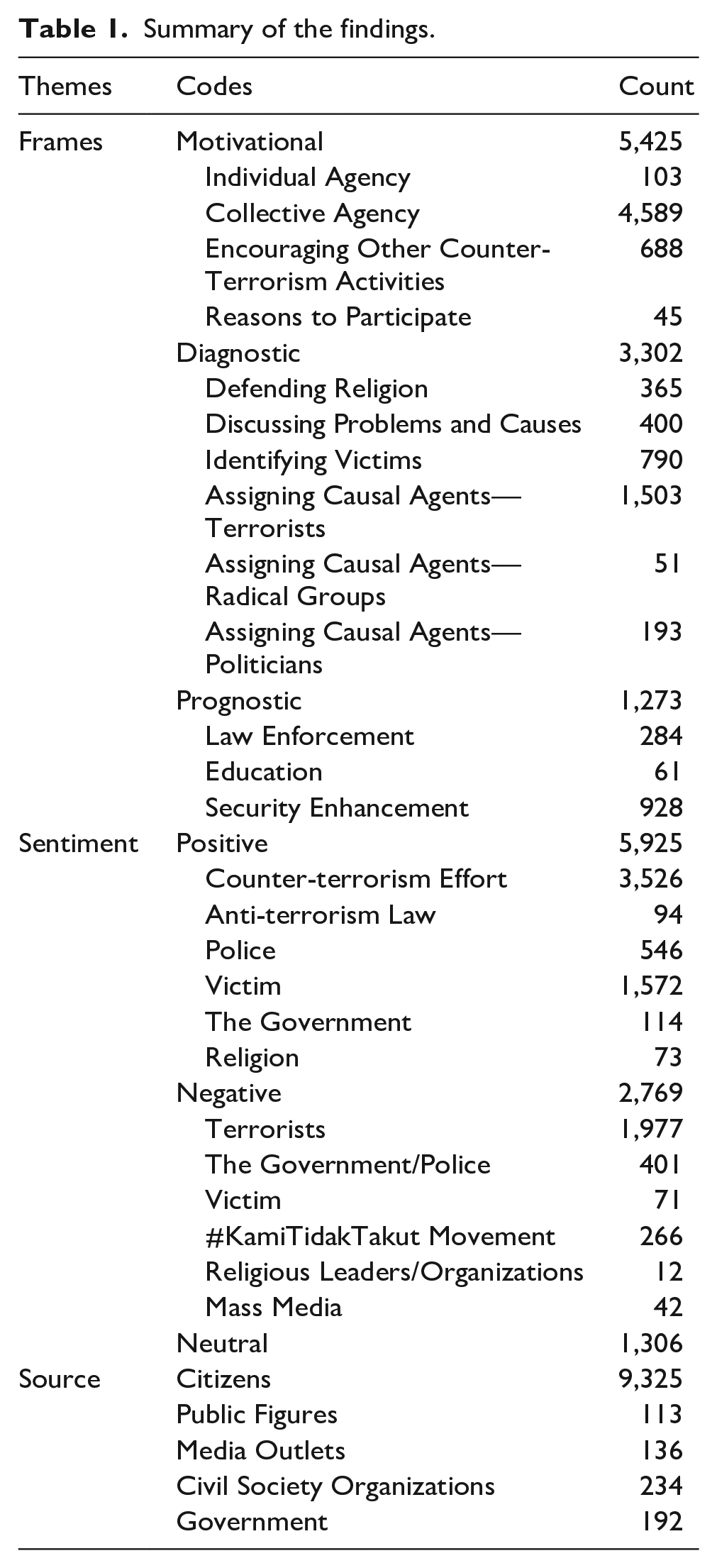
The findings of the content analysis of 10,000 tweets bearing the hashtag #KamiTidakTakut highlighted message frames, sentiments, and sources of the messages in the online collective action. Table 1 summarizes the findings.
Summary of the findings.
Framing strategies
RQ1 seeks to understand the message frames in the #KamiTidakTakut campaign. The results indicated that 5,425 out of 10,000 messages employed motivational frames. These frames were intended to encourage online collective actions and persuade others to join the effort to combat terrorism. Participants used various strategies, such as promoting collective agency and individual agency, articulating reasons to participate, and encouraging others to take other actions to counter-terrorism.
One prominent sub-category of motivational frames was collective agency (n = 4,589). Many Twitter users tweeted using the hashtag #KamiTidakTakut in the aftermath of the 2018 Surabaya Bombings to incite public engagement in combating terrorism. They highlighted the importance of unity, as they believed that it was essential for Indonesians to stick together and fight terrorism collectively. Examples included “Let’s combat terrorism together!!” and “We all agree that terrorism must be eradicated.” In addition, many tweets that emphasized collective agency attempted to provoke change and unity by bolstering their identity as Indonesians. For instance, some tweets exhorted, “We need to protect our country from the threat of terrorism that is rampant in many cities,” or “A million terrors will not make us afraid because we are Indonesia.”
Besides emphasizing collective agency, participants also indicated individual agency by displaying their personal identity and actions (n = 103). These tweets showed someone’s commitment and capability to make a difference and exercise their power. Examples of tweets included “I join the fight against terrorism” and “I am a Muslim. I am taught to respect people from other religions. I condemn the act of terrorism.”
Around 45 tweets also articulated the reasons to join the effort to combat terrorism. These tweets mainly asserted that terrorist groups used violence to produce terror and induce fear in society, and participation in the movement was vital to show the public was not afraid of the threat and that the terrorist groups had failed their mission. One tweet stated, “The goal of terrorists is to spread fear among us, to divide, to raise suspicion among different religions. However, their goal will never be achieved if we unite to fight against terrorism.”
Tweets with motivational frames also called the public to perform other measures to cope with the terrorist attack (n = 688). For instance, many requested others to stop posting and sharing pictures or videos displaying the victims’ bodies. The public believed that spreading this multimedia content would help terrorists spread fear and was disrespectful to the victims and their bereaved family members. One tweet said, “The goal of terrorism is to spread fear and create an unstable condition. Don’t circulate the photo and video of the victims.” Moreover, Twitter users asked the public to stay safe and be cautious of their surroundings. They also sent reminders of hoaxes as unverified news widely circulated on digital platforms, given misinformation commonly ran rampant on social media in times of uncertainty like bombing incidents. Finally, they posted messages encouraging others to report suspicious activities or hoaxes that could cause more panic.
Furthermore, messages employing diagnostic frames were also prevalent in the movement (n = 3,302) and were crucial in raising public awareness about the issue and the campaign. These tweets included attribution of blame, defending religions, and identifications of victims, problems, and causes of terrorism. Diagnostic frames predominantly focused on identifying who was responsible for the incidents. As expected, most tweets assigned blame to terrorist groups (n = 1,503), the main perpetrators of the attacks. These tweets often condemned the terrorists and insulted the perpetrators, as exemplified by the following tweet: “The bomber in Surabaya was an example of someone who didn’t have a brain.” In addition, some tweets identified radical ideologies and organizations as well as those who spread radicalism (n = 51) as the roots of terrorism.
Apart from the terrorist groups, some tweets also assigned blame to the government, politicians, and security forces (n = 193). The government was especially under criticism as the participants believed that some political parties used the issue for their own political agenda. The participants were also disappointed that the House of Representatives postponed the anti-terrorism law. The delay exacerbated the police’s power to combat terrorism, and thus, the public considered this one of the reasons why bombing incidents still occurred in the country. One tweet said, “I’m sick of hearing sympathy from those respectful House of Representatives in Senayan (the House of Representative’s office). The anti-terrorism law is kept being put off. This (the terrorist attack) is also because of your mistake.” Moreover, the participants criticized politicians for undermining the incidents after some of them came to the press and commented that the event was only an issue diversion to drive public attention away from other important issues. The participants perceived these statements as unethical and ignorant. One tweet stated, “Those who said this [bombing attack] was only an issue diversion, you are a jerk. Where is your sense of humanity when others are still grieving!” Moreover, the participants criticized the State Intelligence Agency and security forces for failing to detect and prevent terrorist attacks and protect the public from outsider threats.
Many tweets also discussed the victims, primarily victim identification, death toll updates, and expression of condolences for the victims (n = 790). One example of such tweets was, “9 people died, and 40 people were injured because of the explosions at three churches in Surabaya.” A considerable number of tweets also identified the problems and causes of terrorism as well as the #KamiTidakTakut campaign (n = 400). Some participants were skeptical about the effectiveness of the movement, as reflected in the following tweet: “What is the meaning of #KamiTidakTakut? Are you sure that there will not be another bombing? If there is another bomb, are you really not afraid?”
A total of 365 tweets with diagnostic frames were found to defend religions. Terrorism was frequently associated with a particular faith, and the participants used social media to express that terrorism had no religion. These tweets aimed to protect their religion and counter the prevailing idea that terrorism was linked to a particular faith. Examples of such tweets included “There is no religion which teaches violence,” and “Terrorism has no religion.” Many tweets also explicitly mentioned the name of the religion, such as “Islam never teaches anyone to kill and commit suicide,” and “Islam is NOT terrorists. Terrorists are NOT Islam.” These tweets demonstrated Twitter users’ attempts to dissociate their religion from terrorism.
Finally, around 1,273 tweets used prognostic frames containing solutions to end terrorism. The public mainly made three recommendations. First, Twitter users demanded that the government increase security and strengthen police operations (n = 928). They believed that the government should revive the special military force, whose mission was to protect national security and combat terrorism. For instance, one tweet shared, “The situation was already urgent because of the recent terrorist cases. It’s the right move to bring back the Special Operations Command (Kopassus).” The public also urged the government to pass anti-terrorism legislation (n = 284), which would expand the authority of the police and the military to fight against terrorism. For example, one tweet suggested, “Please pass the anti-terrorism law soon. It will help the police and military to combat terrorism.” Finally, some recommended education as an essential tool to prevent radicalism and terrorism (n = 61). For instance, a Twitter user said, “With weapons, we can kill terrorists. With education, we can kill terrorism.”
Tweet sentiments
RQ2 concerns the message sentiment of the tweets. Out of 10,000 tweets analyzed in the sample, the majority (59.2%, n = 5,925) expressed positive or supportive sentiments. These positive tweets were primarily directed toward the anti-terrorism campaigns, as the participants expressed their support for the movement (n = 3,526), such as “Muara Bungo people support the counter-terrorism effort.” Moreover, the positive tweets talked about victims (n = 1,572). These tweets came in the form of sending prayers or support for the victims and their families. Furthermore, many tweets expressed admiration for the fallen police officers and victims who sacrificed themselves to prevent the terrorists from entering the churches and saving other visitors. One tweet stated, “The victims are the real superheroes.” Tweets that appreciated the police’s efforts in handling the crisis were also abundant (n = 546). Positive messages conveying support for the government (n = 114), the anti-terrorism law (n = 94), and the notion that religion taught kindness (n = 73) were also present.
In contrast, negative or critical tweets accounted for 27.7% of the total sample (n = 2,769). This sentiment was mainly projected toward the terrorist groups as users condemned the bombing attacks (n = 1,977), with one tweet stating, “Damn all you terrorists who don’t have hearts.” Apart from this, participants developed negative attitudes toward the government and the police, who failed to prevent terrorism (n = 401). One tweet stated, “Surabaya is grieving because the government is careless. They’re busy with their own political affairs.” In addition, 266 tweets criticized the #KamiTidakTakut campaign for being ineffective in combating terrorism and reducing the adverse impacts of the attacks, as exemplified by the following tweet: “The hashtag #KamiTidakTakut seems like challenging the terrorists to make bigger attacks instead.” Around 71 messages expressed negative emotions, such as sadness, about the victims and events. Some tweets also talked about how mass media (n = 42) and religious leaders or organizations (n = 12) spread negative and provocative news or speech. Finally, neutral tweets that did not exhibit any sentiment accounted for 13.1% of the total tweets (n = 1,306).
Sources of tweets
RQ3 inquires about the sources of the tweets embedding the hashtag #KamiTidakTakut. The majority of the tweets analyzed in this study (n = 9,325) were posted by ordinary citizens. Other actors involved in the movement included civil society organizations (n = 234), government agencies (n = 192), and news outlets (n = 136). Public figures took the least portion with 113 tweets.
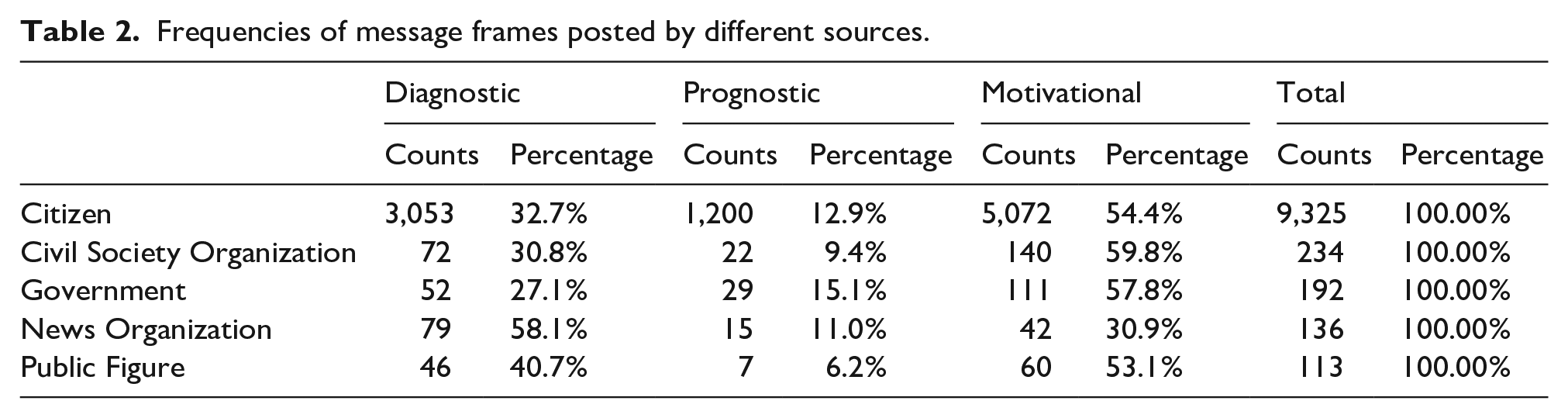
Additional analyses were conducted to examine the dominant frames and sentiments of each source. The results indicated that citizens, civil society organizations, government agencies, and public figures predominantly used motivational frames in their tweets. On the contrary, news organizations tweeted content with diagnostic frames more frequently (χ2 = 53.2, df = 8, p < 0.001, Cramér’s V = 0.05, see Table 2).
Frequencies of message frames posted by different sources.
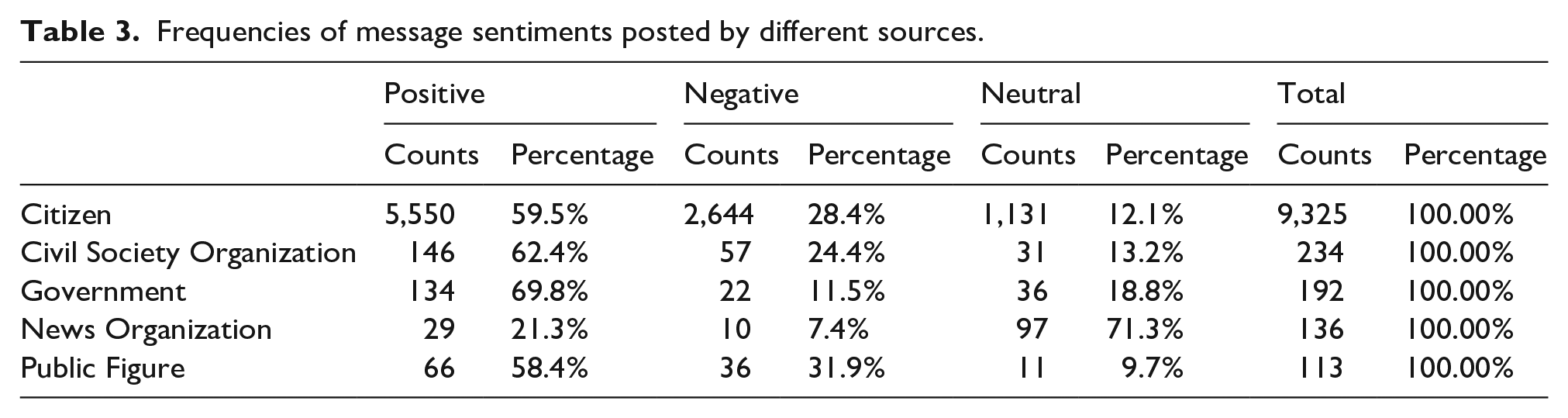
Regarding the message sentiment shown by different sources, the analysis found that the citizens, civil society organizations, government agencies, and public figures mostly delivered their messages in a positive or supportive tone. In contrast, news organizations tweeted in neutral sentiment (χ2 = 444.26, df = 8, p < 0.001, Cramér’s V = 0.15, see Table 3).
Frequencies of message sentiments posted by different sources.
Discussion
This analysis of the “Kami Tidak Takut” movement in Indonesia provides valuable insights into the role of citizen participation in online collective action to counter-terrorism. Through a content analysis of 10,000 tweets from the 2018 movement, this study uncovers the multifaceted nature of the campaign. Participants employed different collective action framing strategies, including diagnostic, prognostic, and motivational frames, to advance their cause, ultimately contributing to the success of the movement. Moreover, the messages conveyed both supportive and critical tones directed toward various actors, highlighting the diverse range of stakeholders involved in the movement, including the government, public figures, civil society organizations, and media outlets.
Regarding the framing of the messages, this study finds that the tweets predominantly utilized motivational frames, consistent with prior literature on online collective actions (Goh & Pang, 2016; Harlow, 2012). This suggests that participants commonly deliver their messages on social media to encourage others to join the movement. It also underscores social media’s role in facilitating the mobilization of social movements through messages that provoke citizens’ engagement (LeFebvre & Armstrong, 2018). Digital platforms enable convenient and low-cost connections within networks, making collective actions more accessible for individuals (Goh & Pang, 2016).
The findings reveal that ordinary citizens played a prominent role in disseminating motivational messages, reflecting their awareness of the importance of their participation in countering terrorism. They recognize that their involvement is crucial to the fight against terrorism, and therefore, voluntarily and actively engage in social media and campaign activities. More importantly, the messages shared by citizens urging others to join the movement are crucial, as peer recommendations have been shown to induce attitude and behavioral change (Lilleker & Koc-Michalska, 2017). Hence, the significant number of motivational frames, especially from ordinary Twitter users, has the potential to increase support and involvement in the counter-terrorism effort.
Interestingly, this study also identifies a substantial number of tweets employing diagnostic frames (approximately 33%), in contrast to previous research that often found a weak presence of such frames (Goh & Pang, 2016; Harlow, 2012). The prominence of diagnostic frames demonstrates participants’ efforts to identify the victims, problems, and causes of the attacks, as well as attribute blame to terrorists, radical groups, and politicians. In addition, many Twitter users participated in the movement to defend their faith and clarify that there was no association between religion and terrorism. This finding aligns with the work of Lim (2013), asserting that issues surrounding religiosity can fuel people’s involvement in digital activism, especially in Indonesia. The social identity perspective also suggests that individuals commonly identify with a particular social identity, including religion. Individuals who develop strong identification with the group are more likely to participate in a movement to protect the group and their identity when threatened (van Stekelenburg & Klandermans, 2013). In Indonesia, people exhibit a strong commitment to faith, and the country is known for its predominantly Muslim population and religious devotion (Iswara, 2020). As terrorism is often associated with religions, Indonesians may engage in online collective action to defend their faith. This finding sheds light on the complex relationship between religiosity and collective action in the context of countering terrorism in Indonesia.
This study also discovers the presence of prognostic frames, although they only accounted for 13% of the analyzed tweets. Interestingly, there was a significant number of tweets advocating for the revival of special military forces. This result suggests that some citizens still place trust in the Indonesian military, as exemplified by one of the tweets: “The Special Operations Command (Kopassus) for sure can calm Indonesia down, and arrest or even defeat terrorists in Indonesia.” This trust is further supported by a recent public survey in Indonesia, indicating that the Indonesian military enjoys the highest level of public trust at 90%, surpassing other agencies such as the president (82.2%) and the House of Representatives (63.3%) (Purnamasari, 2021).
However, the limited use of prognostic frames in the movement raises concerns that the citizens may not fully comprehend the complexity of the issue and may rely on military actions. Yet, the involvement of the military in counter-terrorism efforts may contain some potential pitfalls. For instance, Mengko (2017) has suggested that terrorism occurs due to the spread of ideology, which may not be effectively solved through a military approach. Apart from that, military involvement will reinforce the thoughts or stereotypes that political, economic, and social issues, which are the root problems of terrorism, can be eradicated through military instruments or violence. Such a thought can potentially result in the abuse of the military should their actions go unchecked by those in power. For instance, reinstating the Special Operations Command, or the Kopassus, for handling counter-terrorism concerns has been criticized heavily by activists as the unit was responsible for extensive human rights abuses during the Suharto era (Chadijah, 2019). Although the Indonesian government claims that the Kopassus are being held accountable for their previous actions, several members who were implicated in the abductions of student activists from 1997 to 1998 were allowed to remain in the military (Harsono, 2018).
Another noteworthy finding is the high proportion of positive messages, which contradicts previous research on collective actions or citizens’ responses to other crises, such as natural disasters, where negative sentiments tend to prevail (Caragea et al., 2014). This disparity may arise because citizens perceive a common enemy in the attackers and choose to express solidarity and unity through the #KamiTidakTakut campaign, as evidenced by the significant number of motivational frames emphasizing collective identity and the importance of unity in combating terrorism, thereby fostering a positive mindset. Moreover, Twitter users believe that the terrorists intended to spread fear throughout the country. Therefore, a way to counter this was by displaying positivity. In contrast, in the aftermath of a natural disaster, where there may not be a clearly identifiable enemy, people may feel more helpless. Consequently, individuals turn to social media to share their experiences and intense emotions, particularly those who are in close proximity to the affected areas (Caragea et al., 2014).
The dissemination of positive messages in the aftermath of bombing attacks can have beneficial effects on the public. It helps individuals shift their focus away from negative emotions and aids in their coping efforts during stressful situations (Tugade & Fredrickson, 2004). Furthermore, expressing positive emotions can contribute to building resilience in people, even in challenging times such as terrorist incidents (El-Masri et al., 2021).
While the “Kami Tidak Takut” movement predominantly conveys positive messages, a notable percentage (28%) comprises negative tweets. The negative content centers around the condemnation of terrorist groups and their activities, aligning with diagnostic frames that attribute blame to terrorist groups for the incidents. However, it is worth noting that messages criticizing the government or the police and the campaign also feature prominently. This situation may occur due to the lack of viable solutions in combating terrorism, as indicated by the dearth of prognostic frames. Although the movement has gained support from various stakeholders, including politicians and religious leaders, serving as a platform for the public to demonstrate solidarity and express disapproval of terrorism (Wardah, 2016), its effectiveness in addressing terrorism-related problems remains limited. Over time, people may become weary of this recurring movement, which has followed both the 2016 and 2017 bombing attacks but nothing substantial has come from this movement beyond solidarity and awareness. Thus, it is imperative to complement digital activism with real-life actions to engender public optimism.
Furthermore, this study identifies citizens as the primary contributors of tweets for the campaign, which is unsurprising given that they initiated this “Kami Tidak Takut” movement and constitute a larger proportion of Twitter users than public figures, news organizations, civil society organizations, and the government. Moreover, the minimal participation of government agencies is noteworthy, with their tweets mainly consisting of motivational messages in support of the movement. It differs from the existing literature suggesting that the government mainly utilized Twitter to distribute diagnostic messages following terrorist attacks (Simon et al., 2014). One possible explanation for this discrepancy is that informational messages were posted without embedding the hashtag, as spreading crisis information might not be the campaign’s primary objective.
Despite the insights this study provides, several limitations warrant consideration. This study focuses exclusively on Twitter, which became the primary platform of the “Kami Tidak Takut” campaign. However, other social media platforms were also utilized for the campaign. Therefore, future studies can include content from other channels. Moreover, Twitter users in Indonesia possess unique characteristics that may not fully represent the entire population of the country. For instance, Indonesian Twitter users are predominantly young (between 18 and 24 years old), open-minded, and curious (Nisriyna, 2022). These characteristics can potentially influence the nature of collective actions observed on Twitter and may impact the generalizability of the findings beyond the platform. Furthermore, the sample of tweets may have been potentially contaminated by fake accounts, spam, promotional messages, robots, and many others, although manual data cleaning has been performed to address and minimize this problem. Finally, the program used for harvesting the data was not able to capture the whole tweets during the studied period. Moreover, the data collection was performed on November 2018, several months after the attacks, which may have resulted in the removal of tweets that violated Twitter’s policy. Hence, subsequent research may consider collecting the data in real time.
Despite the limitations, exploring citizen-driven online counter-terrorism movements holds both theoretical and practical implications. This research enriches the existing scholarship on online collective actions by shedding light on the role of Twitter in facilitating public response during and after crisis situations. Moreover, this study extends the application of collective action framing by unveiling the framing strategies employed in the online movement after terrorist attacks. In particular, this study found that the participants predominantly used motivational frames to mobilize supporters on Twitter. In addition, this research illuminates not only the framing process that affects the mobilization of the movement but also the interaction between public sentiments and message frames, which may provide a more comprehensive understanding of the mobilization process. The context of this study also offers additional insights regarding citizens’ responses to terrorist attacks and their involvement in counter-terrorism efforts, which are currently underexplored in the literature.
Furthermore, great scholarly attention has been devoted to examining collective actions in the context of politics against the government (Goh & Pang, 2016; Harlow, 2012; LeFebvre & Armstrong, 2018) or natural disasters (Takahashi et al., 2015), and literature on terrorism commonly focuses on the government’s efforts to counter-terrorism (Lum et al., 2006; Mengko, 2017). This study deviates from these mainstream perspectives in the literature and provides further insight into the nature of citizen-driven movements to defend the country from outsider threats. This study highlights the understudied area of public involvement in counter-terrorism efforts and therefore contributes to the scholarship on terrorism and collective actions.
The findings of this study also revealed minimal involvement of opinion leaders, such as public figures, media outlets, and the government. While it is understandable, given that the #KamiTidakTakut campaign is a citizen-driven movement, these stakeholders have a relatively powerful influence in mobilizing the masses (LeFebvre & Armstrong, 2018). Hence, future campaigns may benefit from involving these stakeholders to encourage greater public participation in counter-terrorism efforts. Moreover, the movement can help the public cope with terrorist attacks by spreading powerful messages to defy terror and motivating the public to unite to counter-terrorism. However, this study also points out that digital activism alone is not sufficient to eradicate terrorism, as shown by a growing amount voices criticizing the campaign for various reasons, including its inability to stop terrorist attacks. Therefore, real actions to fight against terrorism should be taken in addition to digital activism.
