




Abstract
Social media platforms continue to flourish as practices encompassing them become deeply embedded in many cultures. As more people embrace social media platforms, their affordances and opportunities are leading to improved communication, and helping hold authorities to account. To further scrutinize the importance of these platforms, this study interrogates the role of digital media in socio-political contestations in Nigeria by examining the media used to mobilize, coordinate, and document the 2020 #EndSARS protests in Nigeria. Analyses of survey data collected in 2020 during the protests in Lagos and Port Harcourt, Nigeria (N = 391) show that demonstrators who were 30 years and older and used WhatsApp and Facebook to learn about the protests as well as coordinate their participation in the protests are more likely to report participating on the first day of the protests than protesters who are younger than 30 and used other media platforms. Findings further illustrate that digital enthusiasm facilitated by hedonic-experiential and epicurean communication on WhatsApp and Facebook eventuated a process of emotional contagion through connective repertoires that created propitious emotional conditions for mass collective protest actions. Finally, the article discusses how the use of WhatsApp and Facebook gave protesters strategic communicative power during the protests.
Keywords
Introduction
Digital media and protest movements literature have offered different ways digital media influences the organization of collective action. Some of the ways include helping protesters to join political causes, providing channels and data that help in the coordination of protest actions and creating deliberative space for the people (Bennett et al., 2014; Segerberg & Bennett, 2011), as well as spreading excitement which facilitates emotional contagion (Gerbaudo, 2016). It has been argued that online protest movements are conceived, planned, and organized via digital networks. Majority of such cases entails countering the mainstream posture and preventing the hegemonic and bourgeois cultures that the protesters believe to be oppressive (Castells, 2012). Such was the case for the 2020 #EndSARS protests in Nigeria.
Many socio-political protests’ studies have uncovered that social media platforms such as Facebook and Twitter, when used, facilitate the organization of protests. The puzzle that research studies have started to attempt concerns the platform effects of both social media platforms and mobile social networking applications: the over-reliance on “frontstage” digital media platforms and the underappreciation and relevance of “backstage” activist practices and the ubiquity and integration of mobile social networking applications such as WhatsApp, Telegram, Badoo, 2go in protest movements (Baulch et al., 2020; Treré, 2020). It has been argued that Eskimi (a mobile social networking application) was used by the protesters to learn about and plan their participation during the 2012 #Occupy Nigeria protests. It was further uncovered that a protester reporting to use Eskimi to learn about the protests or plan his or her participation in the protests also increased the likelihood that the protester will report joining on the first day of the 2012 Occupy Nigeria protest (Uwalaka, Rickard, & Watkins, 2018). Similar result was reported for Facebook in Egypt during the 2011 revolution in Tahrir Square (Tufekci & Wilson, 2012). Furthermore, Treré (2020) has also illustrated how activists in Spain and Mexico have integrated WhatsApp into their media ecologies to reinforce their collective identity, cement internal solidarity, and lower the pressure of protests. He further demonstrated that WhatsApp has been used as a robust organizational device and is firmly integrated into mechanisms of organizations and movements (Treré, 2015, 2020). It has been noted that WhatsApp is used by activists and organizational networks for mobilizing and coordinating protest actions (Johns & Cheong, 2021; Pang & Woo, 2020).
From the forgoing, while mainstream social media platforms are increasingly studied, only a few scholars are interrogating the banality and mundanity of mobile social networking applications’ roles within the media ecologies of socio-political protests such as the 2020 #EndSARS protests. Besides Tufekci and Wilson (2012), many social movement studies rely on protesters’ recallability to test what the protesters did and their perception at the time of the protest. However, this study reports on data that were collected during the 2020 #EndSARS protests. Understanding the media platforms that the protesters used at the time that they were using such platforms will enable researchers to test whether there are differences in protesters’ recallability. The data collected were used to examine the role of social media and mobile social networking applications in organizing, coordinating, and documenting the 2020 #EndSARS protests in Nigeria.
Overall, these studies emphasized and examined the role of digital media use in protest organization and planning. This was also the case in many other protest movement studies. However, there is dearth of study and lag in digital activism and social movement literature in Nigeria. For example, the 2020 #EndSARS protests in Nigeria are yet to be adequately studied. Some studies (Aniche & Iwuoha, 2022; Dambo, Ersoy, Auwal, Olorunsola, Olonode, et al., 2022; Dambo, Ersoy, Auwal, Olorunsola, & Saydam, 2022; Nwabunnia, 2021; Uwalaka, 2021) have evaluated the hypothesis about the salience of online media during the 2020 #EndSARS protests. Although these studies are vital to understanding some aspects of the hypothesis, they, however, either looked at the spreadability of protest messages on twitter or used content analysis to ascertain meaning from tweets and Facebook posts or safety of journalists during the protests (Adeniyi, 2022; Chinweobo-Onuoha et al., 2022; Talabi, Nwokolo, et al., 2021). These studies also studied one particularly social media platform (Twitter or Facebook). However, these studies failed to interface with the protesters on the streets and did not study an array of social media platforms and mobile social networking applications to ascertain the leading platform that protesters in Nigeria used the most during the protest. This study is designed to provide further insights into digital activism literature regarding the peculiarities of the 2020 #EndSARS protests in Nigeria, particularly, how the protests were organized and coordinated as well as documented. Understanding the influence or lack thereof of digital media platforms to the organization and coordination of the protests helps extend knowledge in the digital activism scholarship while doing so with data collected at the protests’ venues when protesters’ recall and understanding were still fresh. This paper also included mobile social networking applications in the study and helps provide insights into platform effects and differences or lack thereof of both mainstream social media platforms and social networking applications.
Therefore, the aim of this study is to situate the influence of social media in contentious politics by evaluating the role of social media and mobile social networking applications in socio-political contestations in Nigeria. Thus, the study interrogates how the 2020 #EndSARS protesters mobilized, coordinated, and documented their participation in the protests.
This study attempts to answer the following research questions:
What are the media platforms used by protesters to document their participation during the 2020 #EndSARS protests in Nigeria?
To what extent did social media and mobile social networking applications use influence the organization and mobilization of the 2020 #EndSARS protests in Nigeria?
What are the effects of specific media platforms in planning and coordinating the 2020 #EndSARS protests in Nigeria?
The 2020 #EndSARS protests in Nigeria
The politico-social contestations referred to as the #EndSARS protests are sequence of global mass movements that started on 7 October 2020, against police brutality in Nigeria. Nigerians called for the dissolution of the Special Anti-Robbery Squad (SARS). SARS is a special unit of the Nigerian Police Force that achieved notoriety with a long record of abuses (BBC, 2020; Orjinmo, 2020). Long before 2020, Nigerians have complained about the crudity with which SARS handles cases. SARS is an anti-crime unit of the Nigerian police which was founded by former Commissioner of Police, Simeon Danladi in 1992. Mr Danladi added the word “special” to Anti-Robbery Squad that was already in existence. This tweak in their name brought about the SARS and that introduced SARS into the vocabularies of the Nigerian police and the Nigerian public (Ogbette et al., 2018).
However, due to the abrasive and high-handed nature of SARS, people started to see them as bullies and oppressors (Ogbette et al., 2018). It has been alleged that SARS tortures people mercilessly, extorts, beats, kills, and jails those who are not forthcoming with their demands (Ogbette et al., 2018). SARS’ modus operandi can be argued to be predatory policing. In fact, the Nigerian Police in general are perceived negatively in Nigeria. For example, a study found that Nigerians have lost confidence in the police force as a result of several antecedents of bribery and corruption (Okpo et al., 2012). With all these, Nigerian youths did not pursue the disbanding of SARS. This posture changed when a video emerged on 3 October 2020, revealing some SARS officers fleeing a scene in a white vehicle that allegedly belonged to an unnamed man they had shot in front of the Wetland hotel in Ughelli, Delta State (Dambo, Ersoy, Auwal, Olorunsola, & Saydam, 2022). The reaction that followed the circulation of the video was substantial as many Nigerians took to the streets of Nigeria and many other cities around the world, protesting and asking for the disbandment of the police unit (Uwalaka, 2023).
The video revealed the high-handedness of SARS officers as it showed a lifeless body of their victim and a paucity of empathy shown to the dying man by the fleeing SARS officers (Uwalaka, 2021). Youths in Nigeria were enraged, protested in the streets of Nigeria and other countries such as the United States, Canada, Germany, United Kingdom, Hungary, Ireland, South Africa, and Australia (Lawal & Olanrewaju, 2020). In majority of the states in Nigeria, the protests were fierce, with enormous attendance and enthusiasm unseen in previous protests. The protests were both momentous and joyous. After a sustained protest for 4 days, the Nigerian Police Force declared that they have disband the SARS unit (Al Jazeera, 2020). The announcement was received widely with joy (Al Jazeera, 2020). It was then reported that instead of ending SARS that President Buhari is rebranding them SWAT—Special Weapons and Tactics (Uwalaka & Nwala, 2022). The protesters’ delight turned to disenchantment and the protests returned with more vigor and anger.
On 20 October 2020, following violent escalations and attacks by thugs against the police and protesters, the Governor of Lagos State, Babajide Sanwo-Olu proclaimed a state-wide curfew (Orjinmo, 2020). The protesters declined to stop the protest arguing that Lagos State Government wants to silence their voices and that the curfew was a ploy to disperse the protest. Few hours later, armed men from the Nigerian Army arrived at one of the protests’ venues in Lekki Toll Gate, Lagos State. It was then reported that the Nigerian Army Officers opened fire on the protesters with live ammunitions, thereby killing several protesters in Lekki in Lagos State.
The protests arguably attained its goal of disbanding the police unit SARS through digital media platforms, and social media platforms were used to mobilize, communicate, and provide instantaneous updates to protesters (Dambo, Ersoy, Auwal, Olorunsola, & Saydam, 2022). This is not unique as foundational enquiries into the impact of digital media and mobile social networking applications in the organization of social movements in Nigeria revealed that digital media boosted the coordination and planning of the 2012 Occupy Nigeria protests (Uwalaka, 2020). Researchers have also interrogated the issues around the safety of the journalists who were reporting on the protests (Chinweobo-Onuoha et al., 2022; Talabi, Ugbor, et al., 2021). Despite that, there are little to no research that empirically test the assumptions that the 2020 protests were organized and mobilized on social media other than hypothetical musings from the media. These researchers are also unaware of studies in Nigeria that collected their data at the scenes of the protests. This study extends social movement literature by not only adding findings from these data that were collected at the height of the protests but also contributing a voice as to whether social media and mobile social networking applications played a role in the organization, planning, and documentation of the protests by protesters in Nigeria.
Digital media and socio-political protests
Digital media platforms continue to flourish as practices encompassing them become deeply embedded in many cultures. As many people embrace digital media platforms, their affordances and opportunities are leading to improved communication among the citizenry and between the led and the leaders. This improved communicability is helping hold those in authority accountable to their actions. Even with digital media becoming normative, its effects on political participation and engagement, particularly during contentious politics, are still under debate. The increasing number of protest movements around the world as innovations in digital media technologies increase is raising questions about the influence of digital media platforms as catalyst for dissent, protests, and other forms of contentious politics.
Only a handful of studies are skeptical and dismissive of digital media platforms as a vehicle for political change (Fenton & Barassi, 2011; Gladwell, 2010, 2011; Morozov, 2009a, 2009b, 2012, 2014). These studies argue that digital media platforms breed lazy and ineffective activism. The studies contend that the absence of ideological frame in activism mobilized through digital networks are usually weak and unable to achieve their goals. However, other studies are optimistic as they see digital media platforms as essential for modern political activism (Bosch, 2019; Castells, 2012; Tufekci & Wilson, 2012). For example, the diffusion of digital media corresponded with protests around the world. Some of these protests include the indignados, the Arab Spring, the Occupy Wall Street, and pockets of other protests such as the Occupy Nigeria protests. The planning and organization of these protest movements were unconventional. This compelled researchers to conduct studies that assessed the role that digital media platforms played in influencing these protest movements and many of the results are positive (Castells, 2012; Tufekci & Wilson, 2012). Findings of some of these studies demonstrate that protest networks used digital media to engage with protesters during the 2009 G-20 protests in London (Bennett et al., 2014; Bennett & Segerberg, 2011; Walgrave et al., 2011).
Scholars assert that digital media platforms and other media outlets such as satellite television contributed to the success of the social movements during the 2011 protests in Egypt (Alexander & Aouragh, 2014; Aouragh & Alexander, 2011; Eltantawy & Wiest, 2011). It has also been noted that digital media platforms such as Twitter played a key role in amplifying and spreading timely information across the globe during the Tunisian and Egyptian revolutions (Lotan et al., 2011).
Results from some recent studies have maintained the status quo as they show that digital media platforms used for political purposes correlate with protest participation. Findings reveal that political use of digital media platforms related to how young people evaluated the Umbrella Movement in Hong Kong (Lee et al., 2020). The researchers illustrated that digital media platforms helped maintain protest potential even at a time when social mobilization is generally frail (Lee et al., 2020). Findings from other parts of Asia have affirmed that digital networks contributed to the mobilization of protest movements. For example, it has been established that the #FreeYouth protests in Thailand were loosely connected clusters of weak ties on Twitter and that Twitter and other social media platforms helped enliven and revitalize the protest (Sinpeng, 2021). Intriguingly, scholars have also demonstrated that participating in protests increase citizen’s political use of digital media platforms (Chang & Park, 2021). This indicates that the more people join and participate in protests, the more they use digital media platforms for political purposes. This is magnified during dueling protests such as the 2016–2017 presidential corruption scandal in South Korea (Chang & Park, 2021).
Studies have examined the significance of digital media platforms to social movements. Findings affirm a significant positive relationship between digital media platform use and protest movements such as the Black Lives Matter, #MeToo, and the protests in Venezuela (Alaggia & Wang, 2020; Freelon et al., 2018; Mendes et al., 2018; Morselli et al., 2021). Although many studies confirm that digital media platforms gain offset its risks, they, however, are starting to caution digital activists on the need to critically manage their online groups to mitigate concrete and physical risks that digital media platforms can create for activists (Mundt et al., 2018).
The trajectory is maintained in sub-Saharan Africa’s digital activism and social movement literature. Results have consistently shown that social media platforms help social and digital activists in the coordination and even documentation of the protest. Bosch, Mutsvairo, and colleagues (Bosch, 2017, 2019; Bosch et al., 2018; Bosch & Mutsvairo, 2017; Kperogi, 2019; Mutsvairo & Rønning, 2020; Wasserman et al., 2018) have authoritatively tested many questions regarding the impact and usefulness of social media in protest participation. Their results show considerably a positive relationship between digital networks and protest movements. Findings have demonstrated how activists in South Africa use nanomedia and digital media as communicative platforms and as a way of combating their asymmetrical and tenuous relationship with the mainstream media (Bosch et al., 2018).
Findings demonstrate that digital communities’ real-world change steered the agenda and pushed the Nigerian government to engage with the Chibok girls crisis in Northern Nigeria (Carter-Olson, 2016). These digital communities were led by international celebrities who championed the release of the Chibok girls by making people around them to participate and join the protest movement (Akpojivi, 2019; Endong, 2019; Olaniyan & Akpojivi, 2021).
Theoretical framework
This study adopts aspects of the logic of collective and connective action. The logic of collective action was propounded by Olson (1965). In this theory, he raised a concern around collective action. He stated that individuals in all groups who try to act collectively have motives to become free passengers at the expense of others (Olson, 1965). He believed that there needs to be a coercive influence or control for a group of people to act in their common interest. McCarthy and Zald (1977) came up with the resource mobilization theory as a way to further comprehend the logic of collective action. Resource mobilization interrogates the variety of resources that must be mobilized, the linkages of social movements to other groups, the dependence of movements upon external support for success, and tactics used by authorities to control or incorporate social movements (Gjerald & Eslen-Ziya, 2022; McCarthy & Zald, 1977; Uwalaka, 2022).
However, the researchers adopted the logics of collective and connective action as espoused by Bennett and Segerberg (2011, 2013). They assert that the growth of personalized digitally networked politics has given rise to a new logic to engage in socio-political movements. They joined the debate about the logic that necessitates collective action. Bennett and Segerberg (Bennett et al., 2014; Segerberg & Bennett, 2011) maintain that communication, and the means of communication, can facilitate the development of organizational structures. According to them, communication organizes, and in this way facilitates, the development of connective action frames. Digitalized technology results in loosely interconnected, interpersonal networks that help create outcomes that “resemble collective action, yet without the same role played by formal organizations or the need for exclusive, collective action framings” (Bennett & Segerberg, 2013, p. 35). This idea is essential, as it underscores how online forms of engagement can reflect the function of their conventional equivalents.
Methods
A survey of media use by Nigerian protesters was taken over a 3-day period beginning on Friday, 9 October 2020, one day after the 2020 #EndSARS protests started in Nigeria. The survey was collected from Port Harcourt, Rivers State, and Lagos, Lagos State of Nigeria protests’ venues. Since this study was conducted at the beginning of the protests, these two cities were chosen as the street protests began in the two cities. Also, Lagos and Port Harcourt witnessed good turnout at the beginning of the protests, and the two cities are two of the most ethnic diverse cities in Nigeria. To manage the raucousness and disorderliness as well as the sensitive situation informing the protests, the research team used snowball sampling approach in which protesters were recruited through referrals (Tufekci & Wilson, 2012). The surveys were conducted in diners, by the side of the road, inside a hall in Mile 1, Port Harcourt, and inside a van prepared for the data collection.
A questionnaire was administered to protesters in the streets of Lagos and Port Harcourt. A total of 450 questionnaires were returned. Of the 450 returned questionnaires, 230 were from Lagos, while 220 were from Port Harcourt. The researchers stopped at the third day of data collection as they adjudged the protest of becoming risky and violence reported in Lagos. The questionnaires not completed due to security concerns, yelling that detracted the participants, and unintelligible responses were dropped, yielding 391 valid surveys. Of the 59 void responses, 27 were from Port Harcourt, while 32 were from Lagos.
However, it was impossible to access the representativeness of the sample because of the conditions at these protests’ venues. Perhaps, the best that can be said is that the research team believes that the sample was similar in demographic terms to those they witnessed protesting in both Lekki Tollgate in Lagos and at Mile 1, as well as in the front of the Government House in Port Harcourt. Eight research assistants and eight logistics personnel were used during the questionnaire administration. The eight research assistants had previous survey and research experience. The lead researcher was also on the phone and on Zoom explaining the research essence and clarifying issues regarding the study to some participants who wanted further information.
The survey was conducted using a questionnaire in English and on paper instruments. It required 25 minutes to complete and consisted of 35 mandatory questions. The survey consisted of six sections, including general information, media use, documentation, media comparison, engagement for the protest group, and leadership-based questions.
Outside descriptive statistics, a binary logistic regression model was conducted to predict respondents’ media use for protest purposes and the likelihood of participating on the first day of the protests. Although respondents’ overall degree of participation in the protests was not assessed, the researchers are confident that participating on the first day is a crucial indicator. Conventional wisdom suggests that the riskiest kind of dissent is that which fails, and the most dangerous protest is one that is small. Thus, smaller protests have a higher likelihood of being effectively censored, isolated, or repressed by those in power (Tufekci & Wilson, 2012; Uwalaka, 2017). Therefore, high participation on the first day is often essential to initiate the larger cascade that eventually results in the protest’s success. The nerve and resolve required to attend the first day of the protests displays bravery and a commitment to change. This is the reason this study attempts to understand the impact of the media choice on the likelihood that respondents would report participating on the first day of the protest and it was measured as a dichotomous variable (joined the protest on the first day = 1; joined on subsequent days = 0).
Use of media to communicate about the protests and reliable source of news of the protests (Facebook, Twitter, WhatsApp, SMS, TV and Radio, print, etc.) was measured using a Likert-type scale where 1 = not at all reliable and infrequent to 5 = very much reliable and frequent; gender was measured dichotomously as 1 = male and 0 = female. Previous protest experience was measured categorically. The media use part of the instrument was adopted and adapted from previous studies that investigated similar phenomenon (Tufekci & Wilson, 2012). The instrument has been used by multiple studies to test similar phenomena. Also, the researchers are conversant and experienced in conducting this type of studies. Thus, this lends credence to the validity and reliability of the instrument.
Results
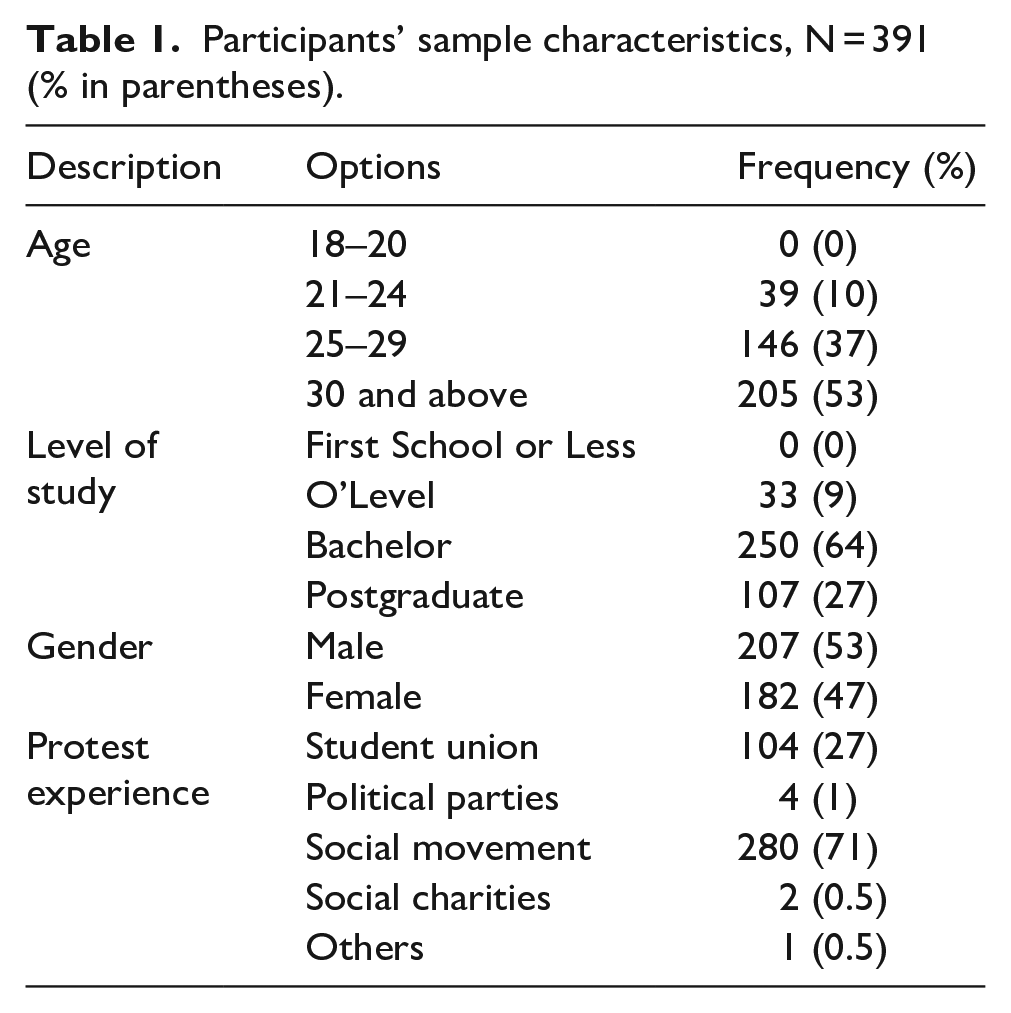
As shown in Table 1, participants in this study were mainly between the ages of 25 and above as they account for 90% (351) of the respondents of the study, while 18- to 24-year-olds made up of 10% (39) of demonstrators who were interviewed. Male participants were slightly in the majority as about 53% (207) of the participants in the study were male, while 47% (183) were female. Participants with bachelor’s degree had a higher representation in the study as 64% (250) of the participants in the study reportedly completed a bachelor’s degree as their highest qualification, while 9% (33) reported Senior School Certificate as their highest qualification and the remaining 27% (107) participants reported completing a postgraduate degree as their highest education. In this sample, zero protester reported to having First School Leaving Certificate or less, revealing that this cohort of demonstrators were very educated. It is also clear from the data that majority of the demonstrators has previous social movement experience.
Participants’ sample characteristics, N = 391 (% in parentheses).
Demonstrators frequently used Facebook to communicate about the protests among other media platforms. Respondents indicated that Facebook (97%), WhatsApp (92%), SMS (87%), Face-to-Face (82%), and Twitter (37%) were media platforms they used frequently before, and during the 2020 #EndSARS protests. All other communication options barely registered as a means of communication during the protest.
Protesters were asked to rank the media that (a) were most important to their protest activity, (b) were most informative regarding the protest, (c) were most used to coordinate the protest, and (d) most motivated them to participate in the protests. Specifically, they were asked to rank the top media for each of the four categories, from their personal experience. As shown in Figure 1, WhatsApp (150) is the most important means of communication among the protesters. Facebook (90) is the second most used means of communication about the protests. WhatsApp (131) and SMS (128) are reportedly the two most used media platforms by the protesters during the 2020 #EndSARS protests in Nigeria. WhatsApp (165) and Facebook (100) are the two platforms that had the two most motivative contents during the protests. Finally, WhatsApp (114) and Twitter (80) are the two top media platforms that were the most informative during the 2020 #EndSARS protests.
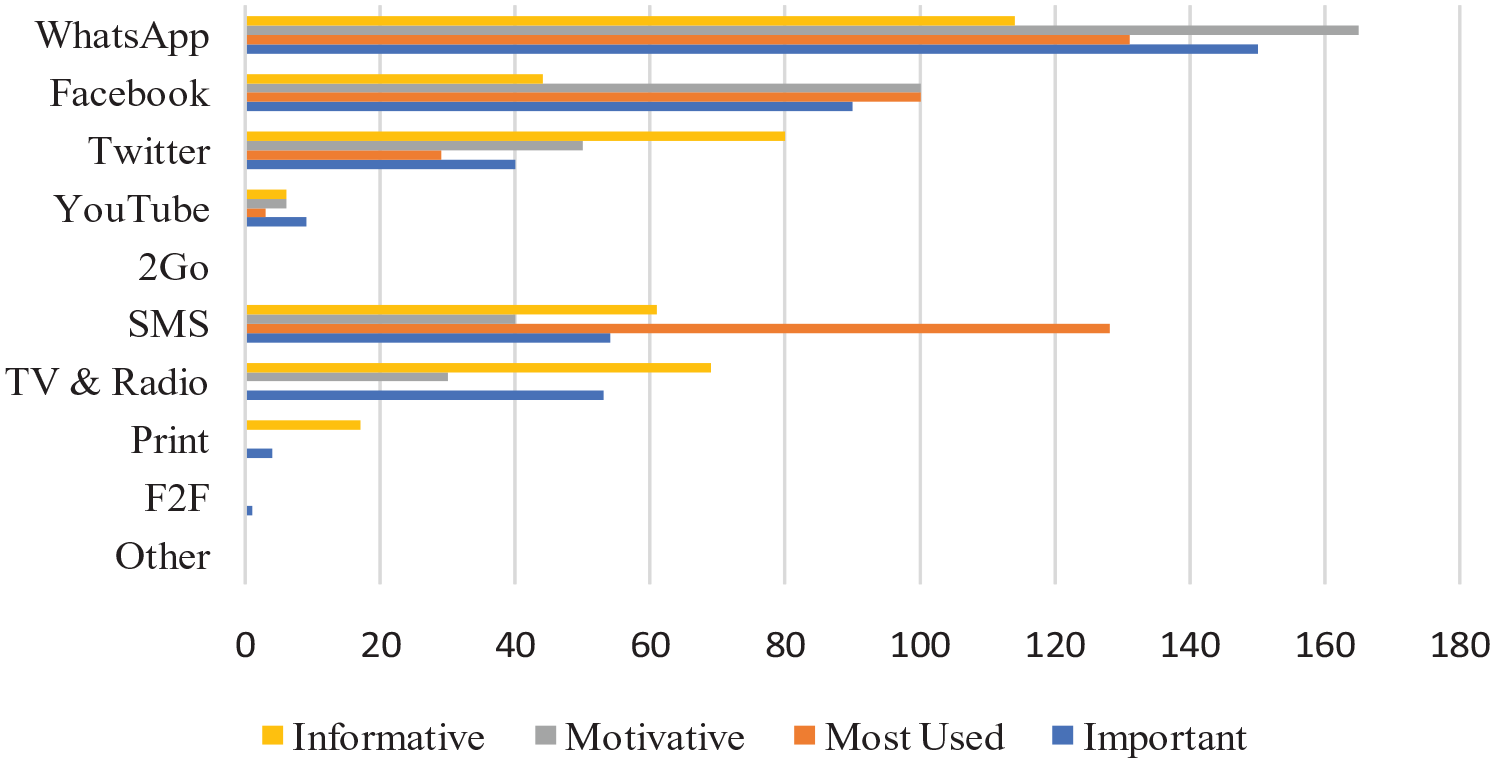
Respondents’ media ranking (N = 391).
Social media platforms were the foremost platforms for producing and disseminating as well as receiving visuals during the protest. As shown in Figure 2, WhatsApp was the most used media platform for documentation (producing and disseminating) as about 40% of the sample (148) reported using WhatsApp for documentation. Facebook (34%) was the second most used media to document, that is, to produce, disseminate, and receive videos and pictures about the protest. Outside Twitter that showed equal strength in both producing and disseminating videos and pictures during the protest, other media platforms such as TV and radio, newspaper and magazine, Face-to-Face communication, and SMS were mainly used to receive videos and pictures and not for production.
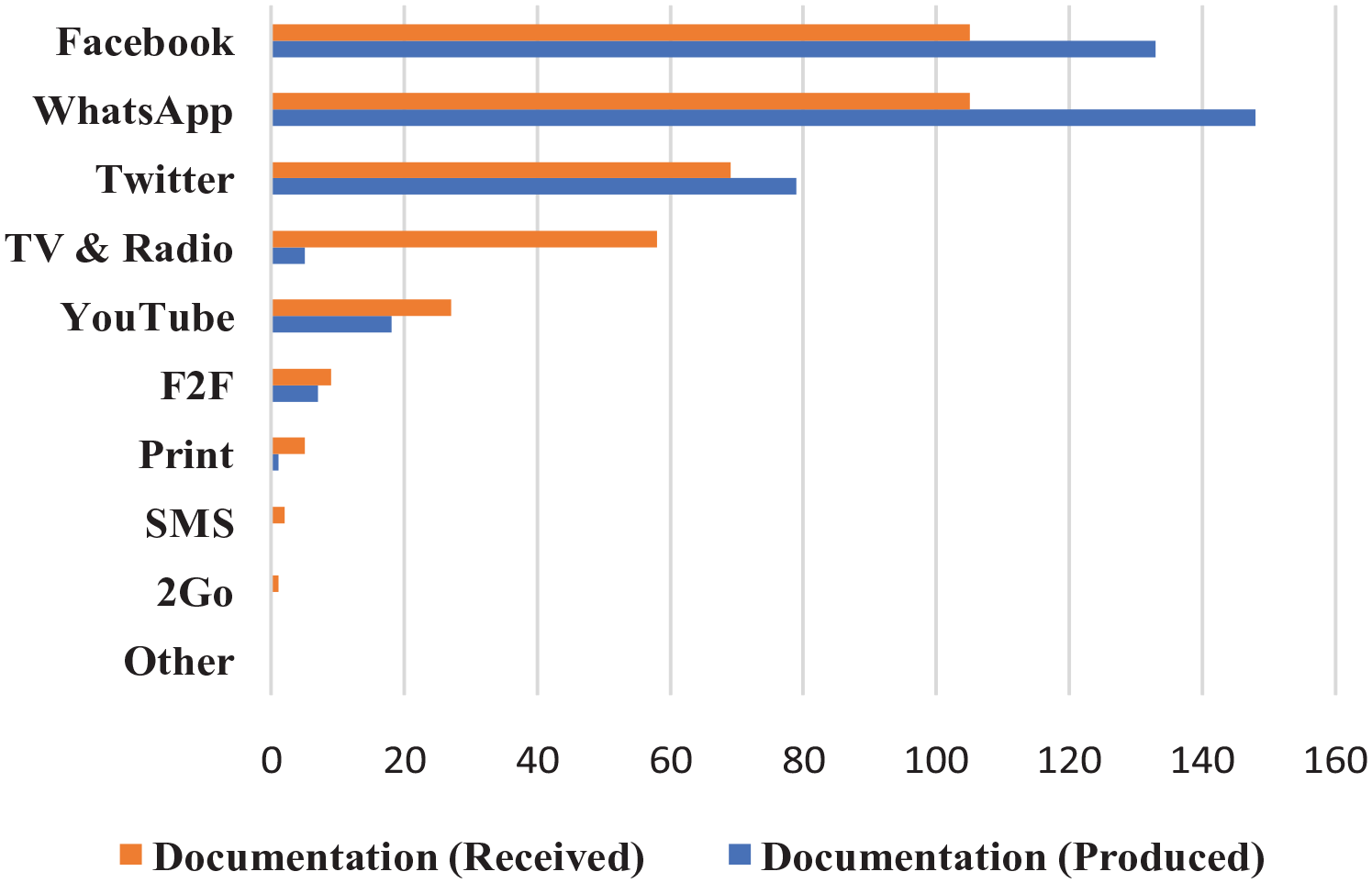
Media used by protesters for documentation (N = 391).
Using SPSS, a binary logistic regression was performed to assess the impact of specific media used on the likelihood that protesters would report participating on the first day of the protests. The model of the binary direct logistic regression contained 14 independent variables (media used for protest news and coordination: SMS, Newspaper, TV and radio, Face-to-Face, Facebook, YouTube, WhatsApp, 2go, Twitter, and Instagram, as well as age, gender, education qualification, and protest experience). The full model containing all the predictors was statistically significant (X2(19, N = 391) = 378.433, p < 0.001), indicating that the model was able to distinguish between respondents who reported participating on the first day of the protests and those who joined on subsequent days. The model has a considerable predictive power (Nagelkerke R2 > 0.227) of the variance of the day respondents joined the protest and correctly classified 59.5% of cases.
As shown in Table 2, four of the independent variables made a unique statistically significant contribution to the model (media used for protest news and coordination: SMS, Facebook, WhatsApp, and Age). The strongest predictor of reporting protest participation on the first day was age, recording an odds ratio of 3.135. This indicates that those who are 30 and older are 3.135 times more likely to report participating on the first day of the protest. The odds ratio of 1.248 for the use of WhatsApp for protest news and coordination indicates that respondents who used WhatsApp for protest news and coordination were 1.248 more likely to report participating on the first day of the protest, controlling for all other factors in the model. Furthermore, using Facebook for protest news and coordination is the third strongest predictor of reporting participating on the first day of the protest with an odd ratio of 0.707. This reveals that protesters who used Facebook for protest news and coordination are over 0.707 more likely to report joining the protest on the first day. Finally, using SMS for protest news and coordination reduces the protesters likelihood of reporting joining on the first day of the protest. The odd ratio of 0.259 signifies that those protesters who used SMS for protest news and coordination are over 0.259 times less likely to report participating on the first day of the protest, controlling for all other factors in the model.
Media used for protest news and coordination and joining on the first day of the protest.
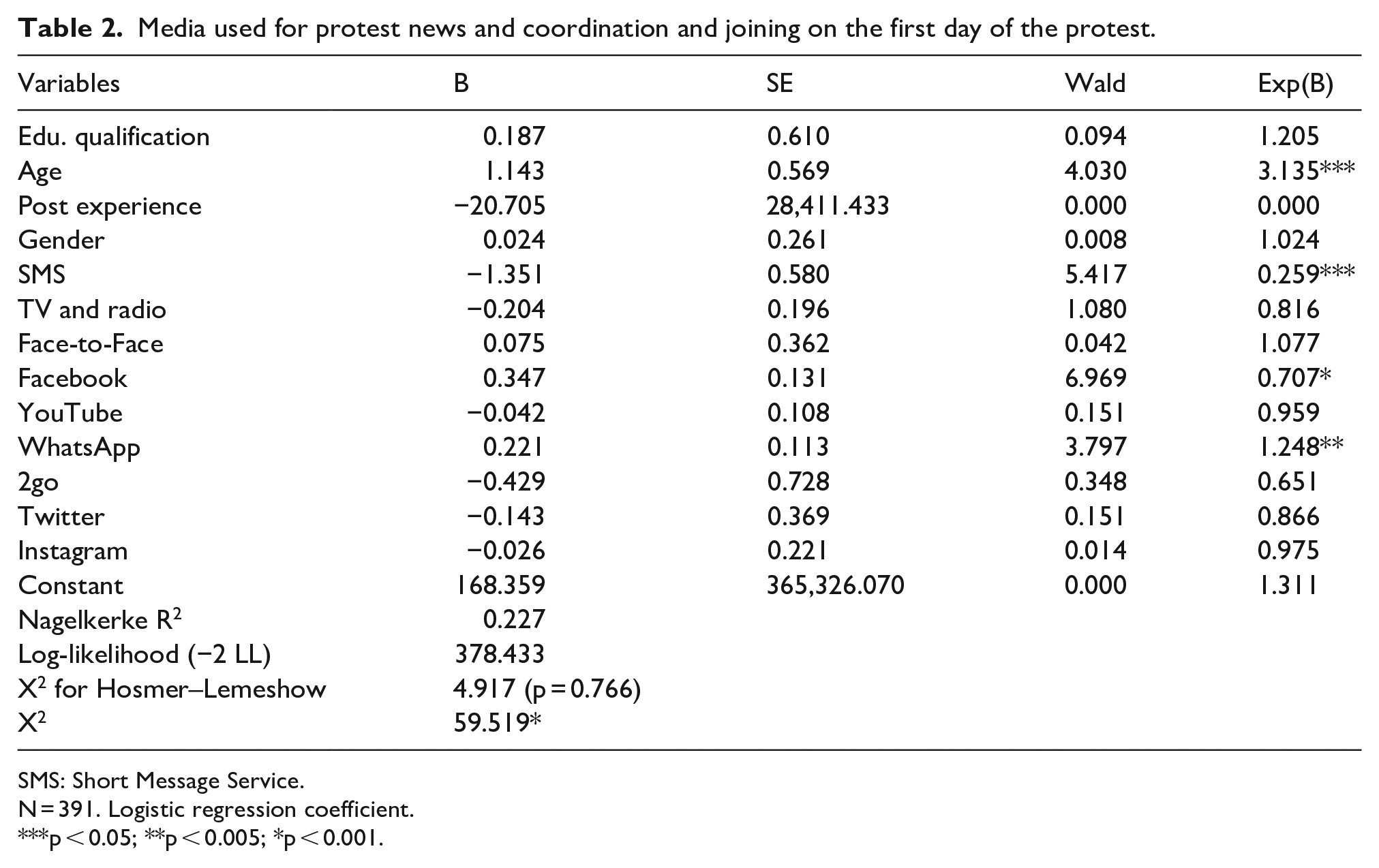
SMS: Short Message Service.
N = 391. Logistic regression coefficient.
p < 0.05; **p < 0.005; *p < 0.001.
Discussion
Results indicate that social media and mobile social networking applications were the most used platforms to document protesters’ participation. The production and sharing of videos and pictures of the protests entices those who may not have wanted to join the protests but will be convinced to participate. This is because the more videos and images that show progress of the protest and common concern that the protesters are espousing, the more neutral people will be tempted to join the protests. Such images show the success of the protests, thereby giving cover to prospective protesters who may be afraid to join the protests. Documentation also helps to stamp out violence against protesters from the government and expose the government when they attempt to muzzle the protesters as was the case during the 2020 #EndSARS protests in Nigeria (BBC, 2020). Findings from this study demonstrate and solidify the importance of social media and mobile social networking applications in protest mobilization and coordination as well as documentation of their participation.
This study uncovers that demonstrators who are 30 and older, who used WhatsApp and Facebook for news about the protests and coordination, are more likely to report joining on the first day of the protests. This result shows that gender and previous protest experience are not statistically significant predictors of media used for protest purposes and the day that protesters joined the protests. It also shows that SMS use for learning and coordination reduces the chance that a protester will report joining on the first day of the protests. This finding elucidates the importance of social media platforms in the organization of contentious politics and espouses foundational tenets of the logic of collective and connective actions (Bennett & Segerberg, 2013). Digital enthusiasm facilitated by hedonic-experiential and epicurean communication on protest social media platforms eventuated a process of emotional contagion through connective repertoires that created propitious psychological conditions (Gerbaudo, 2016) for a mass collective protest action. These media platforms helped Nigerians to soro soke, that is, to speak out and ask for a change. Clearly, joining the protest in the street is a stamp of boldness but those who innovatively used social media platforms to bring about digital enthusiasm that roused people’s emotion to join the protest are to be commended too.
This study uncovers that WhatsApp and Facebook played cardinal roles in the organization, planning, information, and motivation for mass protest actions in Nigeria. The impact of this is that protesters deploy social media platforms to identify, publicize targets, solicit and encourage support, recruit and raise funds as a means of promoting their protests (Adeniyi, 2022; Della Porta & Diani, 2006). This finding contrasts with anecdotal claims by some scholars and commentators (Adeniyi, 2022; Ojedokun, Ogunleye & Adeyinka, 2021) that Twitter is the foremost platform for protest organization in Nigeria. For example, some studies have justified their use of tweets from Twitter for their data collection by claiming that Twitter “served as the core resource through which #EndSARS protesters organized themselves and coordinated their mass action with over 28 million tweets bearing the hashtag” (Adeniyi, 2022; Ojedokun et al., 2021, p.5). Findings from empirical studies that interfaced with protesters in Nigeria have not corroborated this assertion. For example, since the 2012 Occupy Nigeria protests, like the findings from this study, results from other studies (Hari, 2014; Ibrahim, 2013; Kombol, 2014; Uwalaka et al., 2018; Uwalaka & Watkins, 2018) that interfaced with protesters in Nigeria whether quantitative or qualitative interviews have uncovered that Facebook and mobile social networking applications such as WhatsApp, Badoo, and Eskimi play greater role in the organization of the protests than Twitter. This does not mean that Twitter is not a veritable platform for protest coordination. Twitter is important, but protesters in Nigeria do not highlight it as their engine room for protest organization. Results like the above serve as a caution to scholars not to generalize patterns of social media use as individuals and countries use digital platforms differently. These patterns of use may be because of affordability, digital literacy, and cultural alliance.
The study finds that social media platforms such as Facebook and WhatsApp in Nigeria mediated many kinds of ties and brought together individuals, news, information, and social support that are needed to spur socio-political contestations. Online activists’ capability to inspire camaraderie via dispersed and loose networks while allowing for solidarity building during the protest demonstrates the personalization of politics, the appropriation of issues once reserved for ideological groups, drawn together through a shared understanding of the mutual apprehension of police brutality in Nigeria. This resonates and demonstrates the key theoretical underpinnings of connective action.
Given the prodigious use of social media platforms by protesters in Nigeria, this study argues that participants’ actions should not be seen as an inert ingestion of information, but rather as the active consumption, accumulation, and distribution of information as a step toward socio-political contestations that online activism personifies. The 2020 #EndSARS protesters acted as mediators within the socio-political community as they engaged on an individual basis during the protests and yet contributed to the broader protest goals. Although these protesters acted on an individual basis, the common concern of SARS brutalization and their resolve in dissolving SARS brought them together. The togetherness was built neither through ideological ties nor via strong or thick networks. However, it was through anger, fear, project acknowledgment, and common concern. Socio-political camaraderie was forged via common action. Through this, a sense of mateship was derived from personal action frames. Data from the study demonstrate that the protests became a form of protest movement without a thick and shared ideology but with an understanding of a common concern.
Specifically, data demonstrate that WhatsApp was the most informative media platform for protest news and coordination, most motivative, the most used media for the protest, and the most important means of communication during the protests. Findings further uncover that WhatsApp was the most used media platform to document protesters’ participation in the 2020 #EndSARS protests in Nigeria. Data show that while WhatsApp was used to document protesters’ participation in the protests, Facebook was the platform where protesters received photos, videos, and other protest-related multimedia contents—the most about protests’ activities. Results also illustrate that besides age, WhatsApp used for protest news and coordination is the strongest predictor of joining on the first day of the protests. These findings show the importance and centrality of WhatsApp and other mobile social networking applications in the planning and documentation of protesters’ participation in the protests.
This study shows that social media and mobile social networking applications such as WhatsApp’s utilitarian potential endear the application to protesters. The study illustrates that the intimacy inherent in WhatsApp discussion threads enhances trust building and eliminates protest apathy and suspicion from the users. This increased trust and camaraderie improves protesters’ perception and reactions to protests’ news and messages. This reflects the argument about how connections increase when users are active on the same social media page (Mercea, 2020).
Findings from this study explicate the findings of Omanga (2019) who found that Nakuru County, a WhatsApp application group, was used to mobilize grassroot politics and that this online discourse shifts to offline collective action. Like the above finding, this study reveals that protesters planned and mobilized the 2020 #EndSARS protests on WhatsApp. However, the protesters not only engaged on WhatsApp application but also joined the street protests.
This study also shows the salience of mobile social networking applications such as WhatsApp’s “backstage practices” (Treré, 2015, p. 902, 2020). These backstage practices stress the internal communicative dynamics of collective and connective actions. This shows how internal cohesion on mobile social networking applications such as WhatsApp shapes and reinforces the digital comfort zones where “ludic activism” not only unfolds but spills to the streets of Nigeria. Here, social media platforms, such as Facebook and Twitter, and mobile social networking applications, such as WhatsApp, represent not only the organizational backbone of the 2020 #EndSARS protests but also an arena where new protests’ “communicative grammar” emerged. This study reflects part of the findings of Pang and Woo (2020) where their results showed that WhatsApp is used by activists and organizational networks to mobilize and coordinate protest actions. The results of this study also bolster the argument that mobile-based applications are associated with higher likelihood for both online and offline political participation (Aubyn & Frimpong, 2022; Hopke et al., 2016; Michael et al., 2021). This study argues that the communicative affordances of mobile social networking applications such as WhatsApp attract protesters to them. The ease of access, speed, reliability, mobility, reach, and multimediality attract protesters to social networking applications such as WhatsApp. This is some of the reasons that mobile social networking applications are increasingly becoming popular.
Data from this study partially reflect that of Dambo, Ersoy, Auwal, Olorunsola, and Saydam (2022). In their study, they evaluated the role of influencers on Twitter within the protest movement. Their key finding was that Twitter users relied more on foreign media than local media coverage of the protests. This is similar to the findings of this study as mainstream media outlets in Nigeria were used sparingly during the protests. Social media and mobile social networking applications such as WhatsApp were used to plan and coordinate the protests thereby gaining strategic communicative power during the protests.
Limitations and recommendations
This study has some limitations. The sample of this study are protesters who were at protest venues. The rowdiness of the research site has the potential to impact the accuracy of protesters’ recall and focus during the survey. This is because the data were collected at the protest venues. The raucousness and disruptiveness of the situation could adversely impact participants’ state of mind and recallability. This could impact the accuracy of the findings. Furthermore, the researchers cannot lay claim as to the representativeness of the sample. This is also a drawback. Having pointed out these limitations to the study, the researchers tried their best to mitigate any of these shortcomings. First, given the conditions of the research site, the researchers provided a safe and quiet environment for the interviews. The researchers used safe diners and hired buses that are parked in safe locations around the protest venues. These conducive environments alleviated any issues that the disruptive environment and situation may have posed. Second, the researchers ensured that the sample reflected protesters in age, gender, and ethnicity. Clearly, the data for this study are salient as it is one of the few times that data sets of a protest were collected during the protest itself. This improves the validity of the instruments as respondents were still enmeshed in the protest at the time of data collection.
Another limitation of this study relates to the importance of different social media platforms in the organization of protest movements in Nigeria. Some studies and commentators (Adeniyi, 2022; Dambo, Ersoy, Auwal, Olorunsola, & Saydam, 2022; Ojedokun et al., 2021) that interrogated the 2020 #EndSARS protests on Twitter often claim with anecdotal evidence that Twitter is the leading engine room in the organization of protest movements in Nigeria. However, few studies (Hari, 2014; Kombol, 2014; Uwalaka, 2017, 2022), this study included, which have surveyed or interviewed protesters in Nigeria since 2012 often report that Facebook and mobile social networking application such as WhatsApp and Eskimi play much greater roles than Twitter. Result from this study corroborates the latter argument. Since there are few studies evaluating the impact of media types in the organization of protests, there is a need to conduct further studies in this area. Thus, it is recommended that further study be conducted to vigorously examine the impact of individual media platforms (mainstream and social media, as well as mobile social networking applications) on the organization of protest movements in Nigeria.
Conclusion
This study presents the findings of how the 2020 #EndSARS protests were mobilized, coordinated, and documented. This study demonstrates that protests are now personalized and solitary and that they do not only occur from developing strong and thick ideologies, but rather through loose ties, shared experience, and rage. This leads to the spirit of comradeship and communal devotedness that provokes outrage against their common foe or situation. Thus, the study accepts that protests do not eventuate by developing strong ideologies, but rather through loose ties from networks of social media and mobile social networking applications.
The study reveals that digital media platforms such as WhatsApp, Facebook, and Twitter were drivers of protests with the insignificant use of newspapers and television channels illuminating the eroded trust in the mainstream media platforms. The study demonstrates that WhatsApp, Facebook, and Twitter are eliminating the cost of initiating and coordinating connective and collective actions in Nigeria and bring about interaction and socialization that ignite protest movements in Nigeria.
Finally, this study found elements of both collective and connective actions. Although this study, for the most part, confirms the increasing role that social media and mobile social networking applications play in protest mobilization and coordination, it also provides evidence that protests conducted on WhatsApp frequently spill over into offline spaces. The study not only explicates and extends the theorization of the logic of collective and connective actions, but it also unpacks how self-organizing and personalization of protests help metastasize collective and connective actions.
