




Abstract
In recent years, political instability in South American countries has led to an increase in violent collective actions. While extensive research has examined normative collective action, fewer studies have investigated its non-normative forms, particularly regarding the comparison of the predictive role of participative and group efficacy in non-normative collective behavior. By analyzing the dynamics between social media, efficacy, and non-normative collective behavior, this study aims to provide insights into the indirect effect of group and participative efficacy in the relationship between political social media use and non-normative collective action. Structural Equation Modeling analysis was done using a sample of 1979 participants from Chile, Colombia, and Peru. Participative efficacy was found to mediate the relationship between political social media use and non-normative collective action in all three countries, while only in Peru group efficacy mediated this relationship, with a negative effect. The authors concluded that non-normative collective action is better predicted by individual perceptions such as participative efficacy.
Introduction
Currently, the massification of social media has reached a large part of the population, generating numerous studies on its political use (Holmes & McNeal, 2018; Skoric et al., 2016; Valenzuela, 2013). This phenomenon is characterized by three main behaviors: obtaining information, using the platforms as sources of political news; expressing opinions on political issues through these media; and interacting, participating in political debates and discussions in various digital environments. These aspects design a new paradigm of citizen participation in the political arena, mediated by technology and social media (Skoric et al., 2016; Valenzuela, 2013).
Numerous empirical studies have demonstrated a significant correlation between the political utilization of social media platforms and collective action (Gerbaudo, 2017; Hoffmann & Lutz, 2021; Milesi & Alberici, 2018; Wamuyu, 2018). Studies indicate that political activity on social platforms can catalyze various forms of collective mobilization (Holmes & McNeal, 2018). Of particular note, some studies point out that informational uses of social media can lead to collective action both online and offline, with political expression on these platforms being a mediating factor (Gil de Zúñiga et al., 2014).
In the Latin American context, particularly in Chile, researchers have examined how indigenous movements achieve empowerment through the strategic utilization of digital media (Lupien, 2020). In Colombia, the use of these platforms has been linked to the student movement (Archila et al., 2020), and in Peru, studies examined the link between social media and collective action in the women’s rights movement (Caballero, 2019) and youth protagonism in politics (Villanueva-Mansilla, 2015, 2021).
There have been several efforts to differentiate the types of collective action. Among others, there is the proposal by Wright et al. (1990) that differentiates between normative behavior (e.g. marches, protests) and non-normative behavior (e.g. highway takeovers, damage to private property), from Sabucedo and Arce (1991) that proposes a distinction between collective action within and outside the system; meanwhile Moskalenko and McCauley (2009) differentiate between non-violent activism and illegal and violent radicalism, as well as the division made by Knoll et al. (2018) between high- and low-effort actions. All these categories illustrate the difference between normative behaviors, oriented toward practices that operate within the status quo, and, their counterparts, actions that take place outside the established order and often use violence.
Research examining the motivations behind participation in non-normative collective action demonstrates that the variables driving this type of behavior differ from or include additional factors beyond those underlying normative collective action. For example, Tausch et al. (2011) suggest that normative actions are driven by heightened feelings of anger and perceived group efficacy, whereas non-normative actions are associated with increased feelings of contempt and low perceived group efficacy (Shuman et al., 2016). Other studies observed that the violation of moral norms can trigger non-normative collective efforts (Pauls et al., 2022).
Besides, research has indicated that the perception of efficacy plays a distinct role in the propensity to engage in aggressive collective action tactics. Saab et al. (2016) demonstrated that perceived efficacy has a more pronounced relationship with violent collective action compared to normative group initiatives. However, there is research that analyzes low group efficacy as a good predictor of non-normative collective action (Becker & Tausch, 2015; Tausch et al., 2011).
Studies examining the relationship between political use of social media and non-normative collective action have yielded significant findings. Research indicates that the dissemination of false information (Pérez-Curiel & Velasco Molpeceres, 2020) and the echo chambers formed within these platforms can promote polarization and non-normative collective action (Sanchez, 2018). In addition, evidence suggests that frequent exposure to politically extreme messages on social media can normalize violence, desensitize users, and consequently encourage non-normative collective action (Giordano, 2020). However, after a thorough search of different data sources, the authors have not found literature in which perceived efficacy (individual and group) is used as a mediator to explain the relationship between political social media use and non-normative collective action. Therefore, the present study seeks to establish what type of efficacy (participative and/or group) mediates the relationship between political social media use and non-normative collective action. This research is pertinent as it contributes to a more comprehensive understanding of social media’s impact on non-normative collective action in countries where violent practices have become increasingly prevalent. Our study examines this phenomenon in three Latin American countries—Chile, Colombia, and Peru—where non-normative collective action is a notable presence.
Theoretical framework
Social media, efficacy, and collective action
The political use of social media refers to the employment of these platforms to get information about political news, express one’s opinions, and participate in and promote social movements (Dimitrova et al., 2014; Greijdanus et al., 2020 Valenzuela et al., 2018). Social media are a favorable environment for online collective action, such as signing a petition or expressing a position related to a political issue (Chan, 2017; Oeldorf-Hirsch, 2018). In this context, online activism has three characteristics: the ability to express one’s opinion; the support generated by echo chambers, where the person finds like-minded individuals; and the possibility to involve others outside one’s community in a collective initiative (Greijdanus et al., 2020).
Some studies have found efficacy to be a mediating variable between social media and collective action. For example, using a Chilean sample, Halpern et al. (2017) reported that information shared across different social media platforms had an impact on different types of political efficacy: the relationship between the use of Facebook to publicize political information and participation was positively mediated by collective political efficacy, while internal efficacy acted as a positive mediator between Twitter use and political action. In research using a German sample, Hoffmann and Lutz (2021) found that political internet use was a good positive predictor of in-person and virtual political participation; furthermore, social media efficacy was found to exert an indirect effect on in-person and online political participation through internet use. One main factor in the relationship of social media and collective action is participative and group efficacy (Chan, 2017; Ruiz-Dodobara et al., 2024). According to van Zomeren et al. (2013), participative efficacy is the personal belief that one’s own individual participation helps the group to achieve its goals. Whereas group efficacy is the belief that the group has the power to achieve its goals. Ruiz-Dodobara et al. (2023) reported that group efficacy positively mediated the relationship between social media use to combat climate change and habits to protect the environment and, on the other hand, virtual environmental collective action (e.g. signing petitions to support environmental laws). Therefore, it will be proposed within the model that group efficacy and participative efficacy are positively predicted by political social media use in Chile, Colombia, and Peru.
Relevant to the present study, van Zomeren et al. (2019) found that participative efficacy, together with anger, moral convictions, and identification with a particular group, was related to participation in environmental collective action. Similarly, Adra et al. (2020) examined the motivation for collective action in a repressive context among a group of migrant domestic workers. The results showed that participative efficacy and fear were good predictors of collective action and that both mediated the relationship between identity and collective behavior.
Efficacy and non-normative collective action
In recent years, the literature addressing the psychological motivations of collective action has placed significant emphasis on normative collective action; however, there has been a notable gap in research focusing on non-normative collective action (Ayanian & Tausch, 2016). Recent research on the motivation to participate in collective action indicates that different types of protest (normative vs non-normative) exhibit distinct features (Shuman et al., 2016; Tausch et al., 2011). Regarding non-normative collective action, a study based on U.S. citizens by Gee and Johnson (2023) found that low levels of collective efficacy were related to non-normative actions such as boycotting a brand of clothing in opposition to the way it was produced and voting for anti-establishment political candidates. Corcoran et al. (2015) noted that internal efficacy was related to participation in collective actions with low to moderate personal cost, while in contrast, political efficacy (one’s perceived ability to contribute to group political goals) was linked to engagement in actions with low and high cost. Moreover, they found that people with a high level of internal efficacy were more likely to engage in high-cost collective action when they perceived social injustice than when they assumed people were not working hard enough to meet their needs (Corcoran et al, 2015; Shi et al., 2015). The same was true for political efficacy, where a similar interaction was found (Carvacho et al., 2023).
It has also been suggested that the risk of government sanction may increase the perceived group efficacy of the movement. Also, some authors propose that oppression may lead to a heightened sense of efficacy due to perceptions of alienation from the political system (Thomas & Louis, 2013). This has been theorized to be due to expectations that the authority’s oppressive actions signal their weakening power, which in turn may attract the attention of international figures, which would provide additional pressure for ceding to protesters’ demands (Sharp, 2005). Therefore, it will be proposed within the model that group and participative efficacy will positively predict non-normative collective action in the three studied countries.
Non-normative collective action in Chile, Colombia, and Peru
In recent years, there has been a large amount of collective action in countries such as Chile, Colombia, and Peru. An important part of these mass mobilizations has been linked to violent behavior, or so to speak non-normative collective action.
Social mobilization in Peru has varied over time. The presence of non-normative collective action has recently increased due to changes in the type of actors, the object of protest, as well as the political environment (Arce, 2015). Mobilizations in the 1980s were primarily made up of trade unions, linked to political movements, with a protest repertoire that prioritized strikes, and whose claims were oriented on economic issues (Arce, 2015). However, from the year 2000 onward, due to changes in the predominant economic model and the re-establishment of democracy, union mobilizations diminished. The regional movements become present, where the actors are rather settlers from the interior with ties to rural Peru, who come into conflict with the mining and oil sectors. Socio-environmental conflicts are becoming more and more prevalent, where clashes with the forces of law and order are constant and often lead to violent confrontations (Neyra, 2023). These groups are not as strongly related to political organizations and their actions are, comparatively speaking, more radical, such as the occupation and blocking of roads or buildings (Arce, 2015; Neyra, 2023).
From 2010 to date, in addition to these protests, there are others linked to specific issues in which young people have a high level of protagonism, and where violence is also present in different forms but almost always linked to confrontation with law enforcement (Chávez, 2020; Villanueva-Mansilla, 2021). An important moment concerning the non-normative behavior of collective action has been the recent mobilizations carried out in Southern Peru against the Dina Boluarte government. This crisis is linked to the gradual lack of legitimization of the party system in Peru (Levitsky & Zavaleta, 2019), which came to a breaking point in 2019 with the dissolution of the Congress (Paredes & Encinas, 2020). Further highlighting this climate of political instability is the fact that there have been six presidents in the past 5 years (Huamaní, 2020), due to resignations in the wake of political scandals, censorship from Congress, and pressure from massive street protests (BBC, 2018, 2020; Fowks, 2020 November 9th; CNN Español, 2022).
Regarding the Chilean case, starting in the year 2000 there have been a series of political mobilizations with the presence of both normative and non-normative collective actions involving young people (Donoso, 2014; Hatibovic et al., 2023). These processes reached a critical point with the mobilizations that began in October 2019, which were linked to the request for a radical change in the economic and political model, leading to a call for a constituent assembly (Torres et al., 2023). These mobilizations incorporated collective actions of all kinds; however, a group of mainly young people engaged in violent collective action aimed toward various symbols of economic and political power (Rivera-Aguilera et al., 2021). Another example of non-normative collective action was the 2023 march commemorating the coup d’état against Salvador Allende. This event became violent when specific groups of people, seeking to disrupt the march, used Molotov cocktails and desecrated tombs in the cemetery (Salgado, 2023). The relationship between non-normative collective action and youth has also been described in other studies in Chile. For example, Orellana Águila (2020) analyzed different forms of popular collective action among Chilean students and workers between 2000 and 2011 and observed that while for workers there was a predominance of normative actions (negotiations, marches) oriented toward specific common interests, in contrast, students have greater participation in non-normative actions (e.g. takeovers of departments, universities) oriented toward issues of greater national scope. In addition to age, another related variable is the perceived legitimacy of authorities. Gerber et al. (2018, 2021), using representative survey samples, found that the perception of injustice is linked to lower levels of belief in the legitimacy of the authorities (procedural justice), which is subsequently related to a greater justification of non-normative collective actions.
In Colombia, according to the database developed by the Center for Research and Popular Education (CINEP), there have been a total of 10,975 strikes, sit-ins, road blockades, and confrontations with public forces between 1975 and 2000 (Archila, 2002), due in part to a lack of perceived legitimacy of the authorities on the part of the population. Several violent protests have occurred as part of the population’s reaction to perceived unjust events. For example, following the death of an activist in September 2020, there were several days of demonstrations against the forces of law and order (Betin, 2022). In addition, there was an escalation of violence in 2021 due to the rejection of a fiscal bill promoted by Duque’s administration. However, even when the president withdrew the bill, protesters continued blocking roads and destroying public and private property (BBC, 2021). The protest escalated when several protesters were shot and one of them was killed in the La Luna sector by a civilian (BBC, 2021). In addition, this event was accompanied by road blockades in which the Colombian nation lost between 13 and 14 billion pesos (about US$3.5 million), due to the lack of distribution of food and necessities (BBC, 2021).
Barrera and Hoyos (2020) analyzed protest movements in Colombia between 1976 and 2016 to evaluate to what extent they were conventional, disruptive, or violent (Tarrow, 2012) and to understand the variables associated with them. They conclude that violent reactions (behaviors that are intentionally aimed at physically harming people or objects) are marginal and that they are usually directed at law enforcement or public enterprises. Furthermore, they observe that over time, violent actions tend to be replaced by so-called disruptive actions (road blockades, invasions, takeovers of entities). The latter increases when collective action is led by certain specific social sectors (ethnic or racial groups, students, and farm and informal workers), and where their motivation is linked to unsatisfied material or welfare demands.
Hypothesis
As mentioned above, according to the literature, the following hypotheses are presented:
Hypothesis 1: The political social media use, group efficacy, and participative efficacy are positively significant predictors of non-normative collective action in Chile, Colombia, and Peru.
Hypothesis 2: Participative efficacy positively mediates the relationship between political social media use and non-normative collective action in Chile, Colombia, and Peru.
Hypothesis 3: Group efficacy positively mediates the relationship between political social media use and non-normative collective action in Chile, Colombia, and Peru.
Methodology
Design
The present research uses a multivariate cross-sectional design. The model structure is based on the use of Structural Equation Modeling (SEM, Preacher et al., 2007). As the variables are latent and observed, the model is multivariate, and it uses a cross-sectional sample, as measurements were made at only one time point. This research is a comparative study, as it aims to compare the mediating effect of participative efficacy and group efficacy in the relationship between the political social media use and non-normative collective action in three countries of the Latin American region: Chile, Colombia, and Peru. Regarding the theoretical model, the predictive variable is the political use of social media. The outcome variable is non-normative collective action, with the relationship between the two postulated to be mediated by participative and group efficacy.
Participants and procedures
The sample was obtained using the Offerwise panel service and was intentional. The research was part of a larger project that sought to examine the relationship between political social media use and collective action. Data collection took place from October to November 2022.
The final sample consisted of 1979 participants aged 18 to 39 years from urban areas. There were 660 Chileans (50% men, M = 28.02, SD = 6.54), 660 Colombians (50.2% men, M = 28.08, SD = 6.68), and 659 Peruvians (49.92% men, M = 27.56, SD = 6.37). Fifty percent of the sample resided in the capital city (Santiago, Bogota, or Lima) and the other half came from other regions of Chile, Colombia, or Peru. The study was approved by Ethics Committee of the Faculty of Psychology of the Universidad de Lima.
Instruments
All the instruments were designed by the authors, and the reliability and validity of the instruments were analyzed for the study.
Political social media use: (α = .913 in the Chilean population, α = .927 in the Colombian population, and α = .924 in the Peruvian population). An eight-item scale was used to measure the use of social media to obtain information (e.g. “I follow the social media of politicians and/or political groups to read their opinions”), to express political orientations (e.g. “I participate in discussions and debates on political topics in social media such as Twitter, Facebook, WhatsApp, TikTok, and/or Instagram”), and to encourage people to participate in collective action (e.g. “I use social media, such as Twitter, WhatsApp, TikTok, and/or Instagram to help organize actions related to politics”).
Participative efficacy: (α = .761 in the Chilean population, α = .738 in the Colombian population, and α = .781 in the Peruvian population). A three-item scale was used to measure the belief that individual contribution has a significant impact on groups meeting their desired objectives (e.g. “Together with others, I believe that I can contribute in an important way so that the authorities adopt adequate political measures”).
Group efficacy: (α = .738 in Chile, α = .706 in Colombia, and α = .704 in Peru). With the purpose of examining the belief that group actions can have an impact on political measures, a three-item scale was designed (e.g. “If we citizens act as a group, we can ensure that the authorities take adequate measures in the face of political issues”).
Non-normative collective action: (α = .778 in Chile, α = .772 in Colombia, and α = .744 in Peru). A two-item scale was used to analyze the intention to carry out collective behaviors outside social norms within the context of a potential political protest (e.g. “I would take over a public or private place (park, building, square, church, etc.) as part of a protest related to political issues”).
Analysis plan
An initial Pearson correlation matrix was done using the different variables in this study. We then established multiple linear regression models to analyze the role of the predictor variables (political social media use, participative efficacy, and group efficacy) on the intention of participating in non-normative collective action. Subsequently, and to analyze multiple mediation, three SEM models were established in which the predictive variable was the political use of social media, the mediating variables were participative efficacy and group efficacy, and the outcome variable was the intention of participating in non-normative collective action. Sex and age were used as control variables in the analysis, as previous literature has reported differences between groups regarding these variables (Chávez, 2020; Kraft, 2023; Rivera-Aguilera et al., 2021; Villanueva-Mansilla, 2021). The SPSS AMOS program was used to analyze the data.
Results
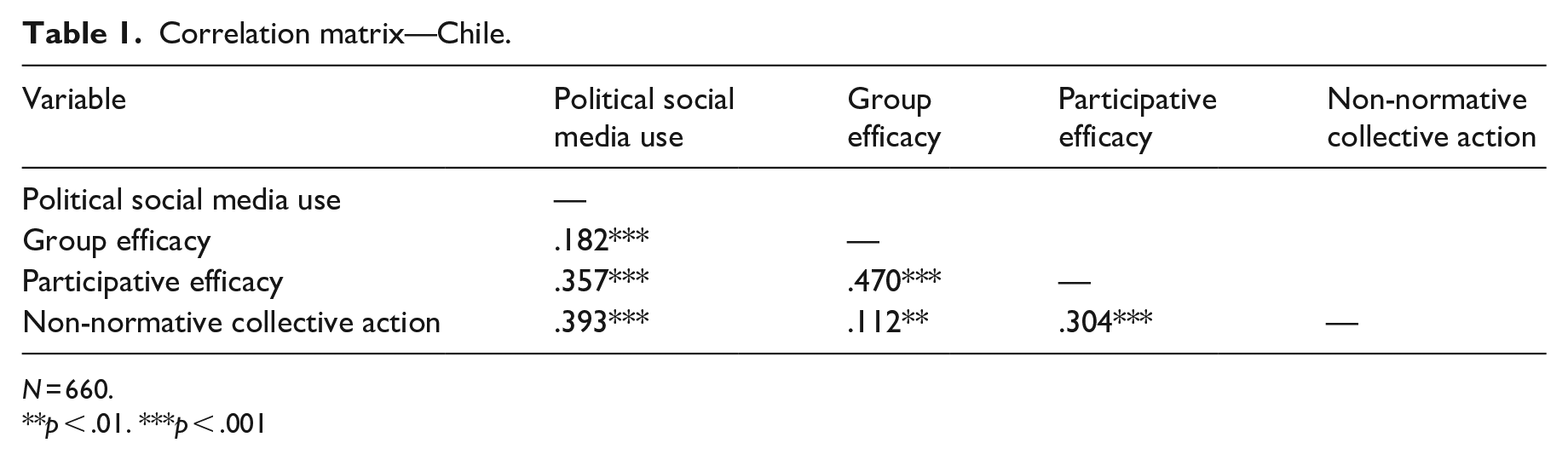
In the Chilean sample (Table 1), it can be observed that all variables were positively correlated in a statistically significant manner.
Correlation matrix—Chile.
N = 660.
p < .01. ***p < .001
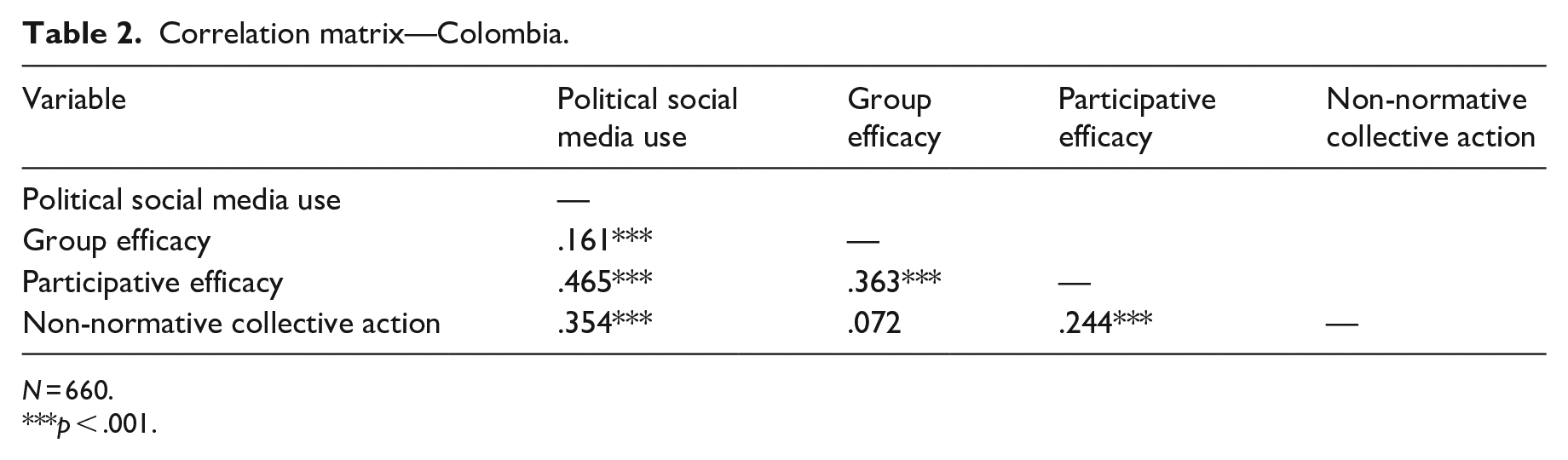
This is similar in the Colombian sample (Table 2); however, the relationship between the intention of participating in non-normative collective action and group efficacy was not statistically significant (r = .072, p = .063).
Correlation matrix—Colombia.
N = 660.
p < .001.
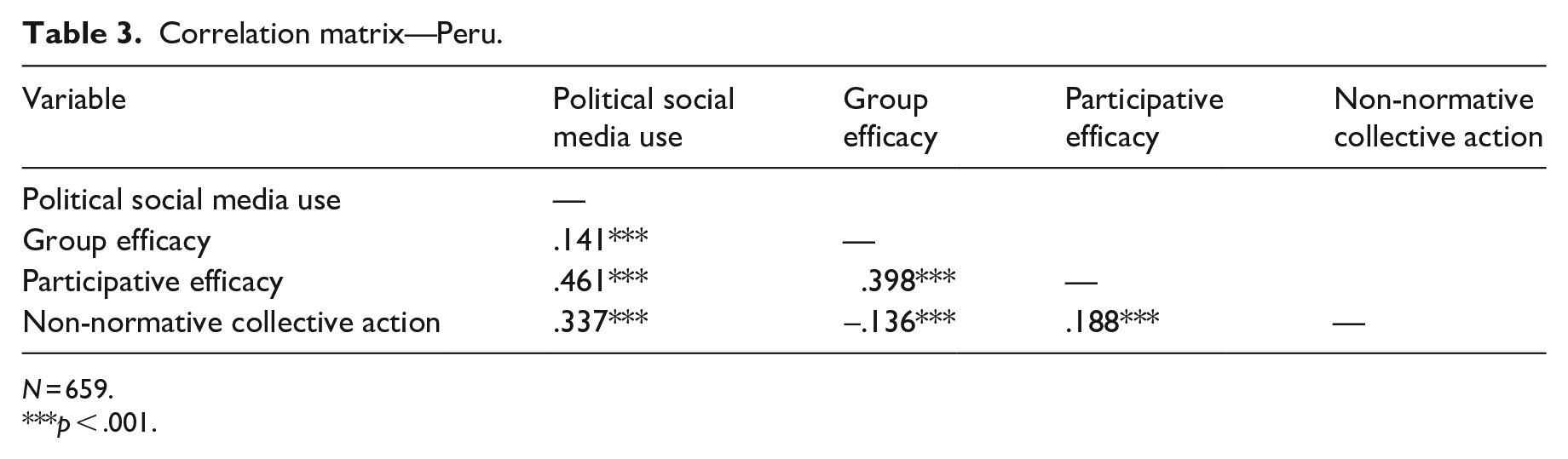
Similarly, in the case of Peru, it can be observed that all variables (Table 3), with the exception of the relationship between the intention of participating in non-normative collective action and group efficacy (r = –.136, p < .001), correlate in a statistically significant positive manner.
Correlation matrix—Peru.
N = 659.
p < .001.
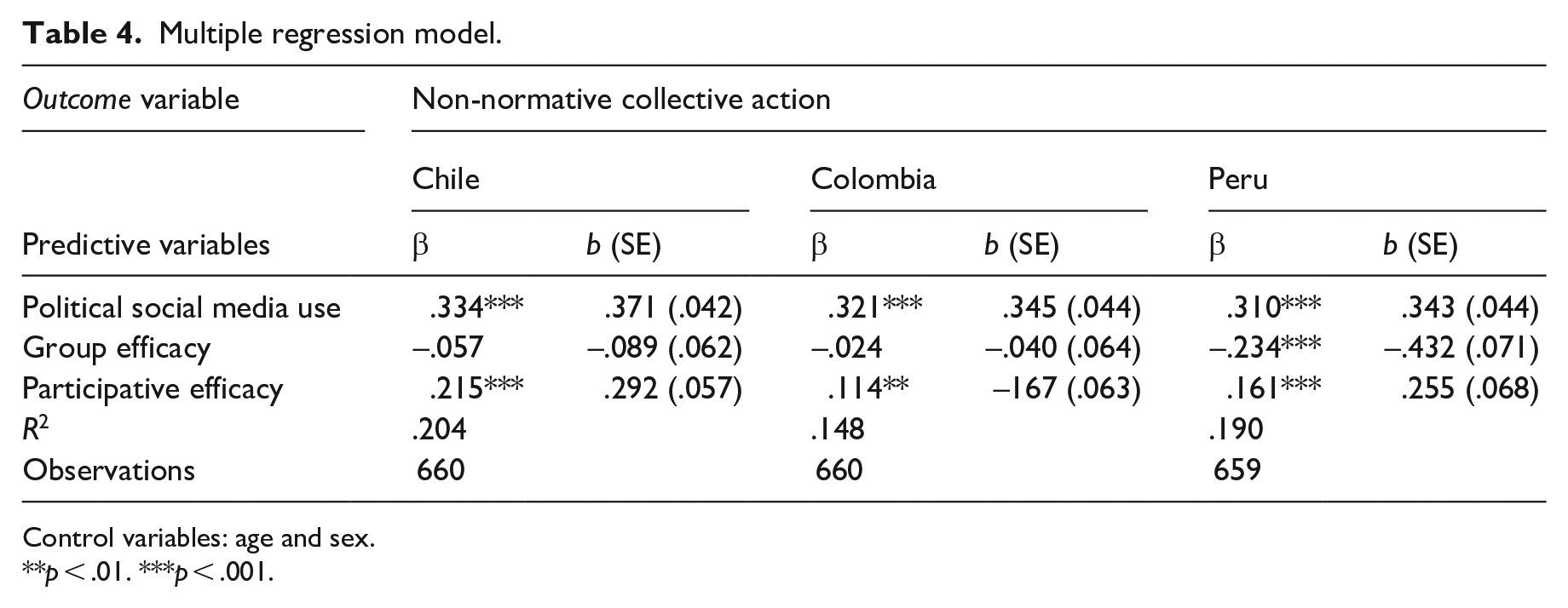
Regarding the multiple regression models, in both Chile and Colombia it can be observed that participative efficacy was a significant positive predictor of the intent to participate in non-normative collective actions. On the contrary, group efficacy failed to predict the intent to participate in non-normative collective actions for both the Colombian (β = –.024, SE = .064, p = .534) and Chilean (β = –.057, SE = .062, p = .148) samples.
In the case of Peru, all the variables of interest (political social media use, participative efficacy, and group efficacy) were significant predictors of the intent to participate in non-normative collective actions (Table 4).
Multiple regression model.
Control variables: age and sex.
p < .01. ***p < .001.
In all three countries, social media use was the strongest predictor of the intent to participate in non-normative collective actions (Peru: β = .310, SE = .044, p < .001; Colombia: β = .321, SE = .044, p < .001; Chile: β = .334, SE = .042, p < .001). By interpreting the R2 coefficient, it was observed that the predictive variables explained the variation of the outcome variable by 20.4% in Chile, 14.8% in Colombia, and 19% in Peru.
With respect to the SEM analysis, marginal fit indexes were obtained for the theoretical models (Chile: x2/df = 6.990, Comparative Fit Index (CFI) = .870, Root Mean Square Error of Approximation (RMSEA) = .095, Standardized Root Mean Square Residual (SRMR) = .087; Colombia: x2/df = 6.682, CFI = .887, RMSEA = .093, SRMR = .073, and Peru: x2/df = 7.753, CFI = .865, RMSEA = .101, SRMR = .087). When evaluating model fit, it is crucial to consider various fit indices. For the RMSEA, values below .05 indicate good fit, values between .05 and .08 are acceptable, and values between .08 and .1 are marginal (Mulaik et al., 1989). For the CFI, values above .90 are considered good, while values between 0.90 and 0.80 are marginal (Khari et al., 2021). CFI values close to these cut-off criteria suggest a relatively good fit. However, model fit indices are sensitive to sample size (Bentler, 1990). The importance of a small sample size is that it may lead to imprecise estimates of the standard error and the adjustment rate (Kline, 2011). To avoid these issues, increasing the sample size can be a solution (Kline, 2011). This would help to obtain more precise estimates and improve the overall fit of the model (Cea, 2002).
Regarding the Chilean sample (Figure 1), participative efficacy was a statistically significant mediator (β = .117, b = .183, SE = .051, 95% confidence interval, CI [.091, .295], p = .004), while group efficacy did not reach statistical significance (β = .025, b = –.039, SE = .035, 95% CI [–.103, .026], p = .291). Political social media use had a direct effect of β (SE) = .37 (.049), p < .05 on the intent to participate in non-normative collective action, while the model had total effect (β = .466, SE = .041, 95% CI [.383, .547], p = .004).
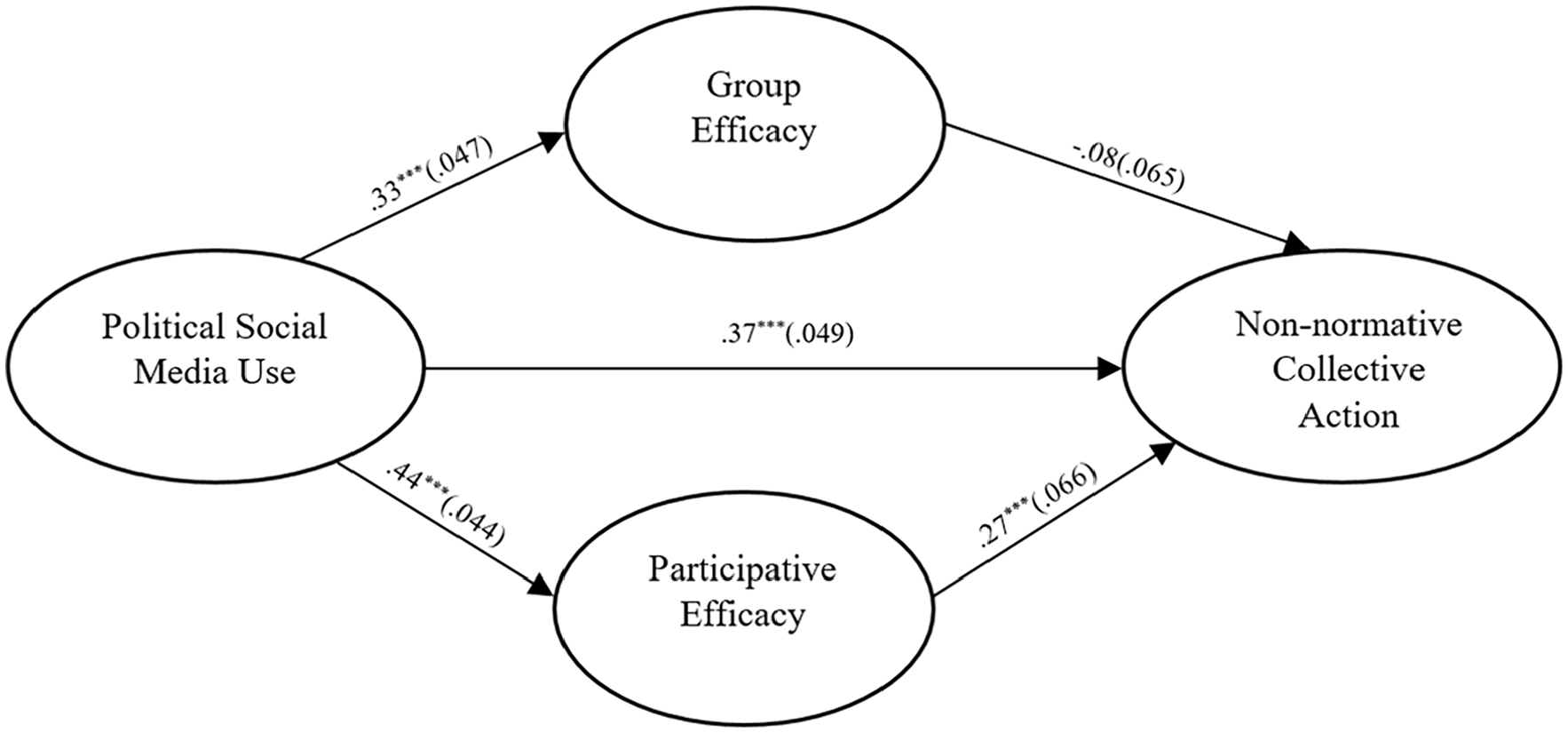
SEM model: non-normative collective action—Chile.
Similarly to the Chilean sample, in the Colombian model (Figure 2) participative efficacy was found to be the only effective mediating variable (β = .097, b = .170, SE = .075, 95% CI [.015, .308], p = .027). Political social media use had a total effect of β = .378 (SE = .042, 95% CI [.296, .459], p = .004) on the intent to participate in non-normative collective actions. Political social media use had a direct effect of β (SE) = .31 (.058), p < .05 on the intent to participate in non-normative collective actions, while the model had a total effect of β (SE) = .378 (.044) (95% CI [.296, .459], p = .004).
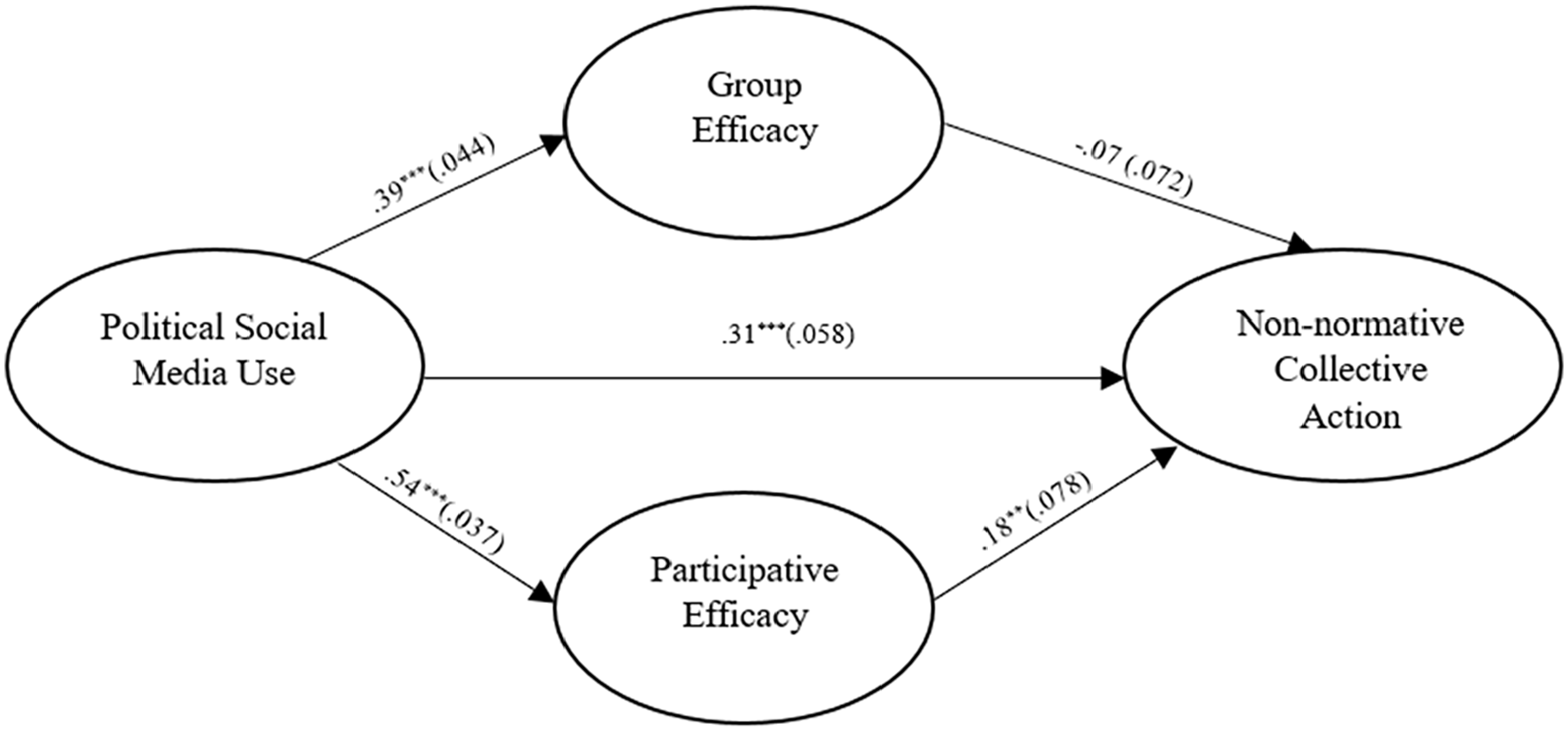
SEM model: non-normative collective action—Colombia.
In contrast, in the Peruvian sample (Figure 3), participative efficacy (β = .110, b = .233, SE = .097, 95% CI [.048, .425], p = .028) and group efficacy (β = –.098, b = –.197, SE = .065, 95% CI [–.346, –.084], p = .006) were significant mediators in the relationship between political social media use and the intent to participate in non-normative collective action. Political social media use had direct effect of β (SE) = .33 (.056), p < .05 on the intent to participate in non-normative collective action, while the model had a total effect of β (SE) = .349 (047), p = .004.
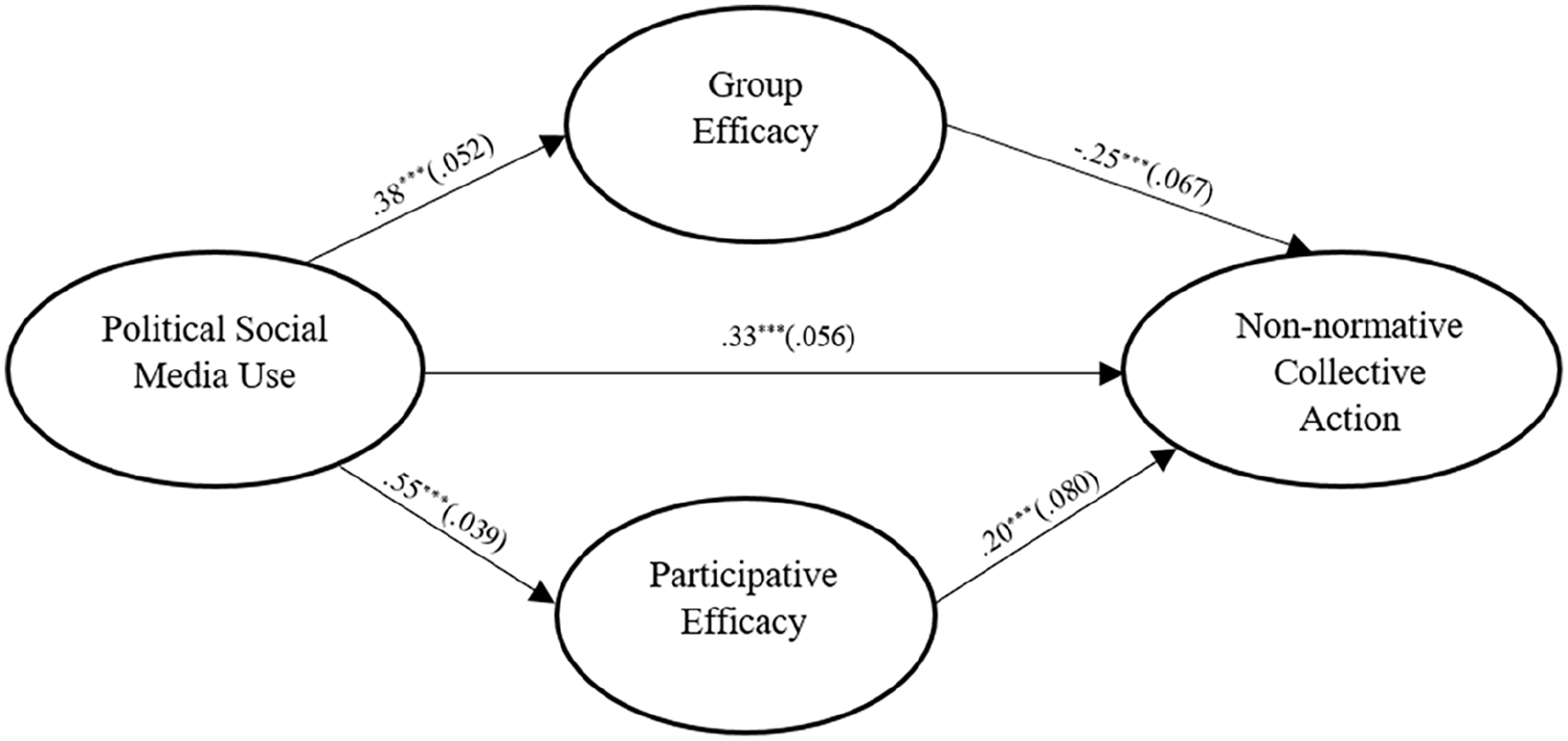
SEM model: non-normative collective action—Peru.
Discussion
The main objective of the present study was to analyze the indirect effect of participative and group efficacy in the relationship between political use of social media and the intent to participate in non-normative collective actions.
Regarding our first hypothesis, we found that all variables, except for group efficacy (which we will discuss in the following section), were significant predictors of the intent to participate in non-normative collective action in all three countries. That is both social media use (Peru: β = .310, SE = .044, p < .001; Colombia: β = .321, SE = .044, p < .001; Chile: β = .334, SE = .042, p < .001) and participative efficacy (Peru: β = .161, SE = .068, p < .001; Colombia: β = .114, SE = .063, p < .01; Chile: β = .215, SE = .057, p < .001) enhance the likelihood that individuals will take violent action against the establishment (Drury & Reicher, 2005). These results confirmed the predictive ability of participative efficacy related to the intent to participate in collective action (van Zomeren et al., 2012). This may be exacerbated through social media, since in a situation in which the governments of these three countries are undergoing processes of delegitimization, social media may be enhancing this sense of illegitimacy, which may lead to greater intent of non-normative collective actions (Thomas & Louis, 2014). The authors will explain the interaction of these variables in more detail in the following section.
Concerning the second and third hypothesis, while we found that social media would increase participative and group efficacy, empowering individuals (Greijdanus et al., 2020; Wilkins et al., 2019), only participative efficacy positively mediated the relationship between social media use and the intent to participate in non-normative collective action in all three countries (Chile: β = .117, b = .183, SE = .051, 95% CI [.091, .295], p = .004; Colombia: β = .097, b = .170, SE = .075, 95% CI [.015, .308], p = .027; Peru: β = .110, b = .233, SE = .097, 95% CI [.048, .425], p = .028). Since participative efficacy is focused on the importance of individual contributions to a group objective (Drury & Reicher, 2005; van Zomeren et al., 2012), these results illustrate that a greater amount of this efficacy could empower individuals to believe that they can achieve collective goals through the use of violence. Social media could be acting as an echo chamber where users receive personalized information, connected to their interests and goals, which could boost people’s perception of their individual importance in achieving a collective objective (Gardner & Davis, 2014; Medaglia & Zhu, 2017; Yarchi et al., 2021). Also, the use of emotional language (Matsumoto et al., 2013) and participation in online discussions on social media could polarize people’s opinions, leading them to become more aggressive and radicalized (H.-W. Chan, 2020; Everton, 2016; Levendusky, 2013; Levendusky & Malhotra, 2016; Lynch et al., 1997; Wells et al., 2017). Hence, this radicalization on social media could be empowering individuals to confront authorities using non-normative actions (Gerber et al., 2021).
Nevertheless, in Peru, contrary to our hypothesis, it was found that group efficacy (β = –.093, b = –.197, SE = .065, 95% CI [–.346, –.084], p = .006), the power attributed to the group itself, reduced the effect of social media on the propensity to participate in violent collective action. This is likely because social media users, who see their groups as capable of changing things through normative means, would not see the need to risk the possibility of being sanctioned by engaging in high-cost non-normative collective action (Corcoran et al., 2015). This contradicts the findings of Thomas and Louis (2013), who argue that the risk of sanction could cause a rise in the perception of the group’s efficacy, because it would be taken as a sign of weakening of the government in power. Therefore, in Peru, we find that people are mainly driven to act violently in pursuit of a common goal when they believe that their individual actions are useful in achieving this objective (Saab et al., 2016). The reason for this may be that in Peru, some social groups are marginalized by the existing political system (Veri & Sass, 2023), as they do not have access to normative channels of political influence (Becker & Tausch, 2015). Hence social media could be promoting non-normative collective action through a sense of lack of group efficacy and a boost of participative efficacy.
On the other hand, group efficacy did not have an indirect effect on the relationship between political social media use and non-normative collective action in Colombia and Chile. It would seem that in these two countries group efficacy is only related to normative collective action (Pozzi et al., 2022, [Author removed], 2023). Since, in comparison to Peru, Colombia and Chile demonstrate a higher level of political participation (Cabalín-Quijada, 2014; Školník, 2020), a possible explanation for the lack of this mediating effect could be that in these two countries, people’s participation in violent manifestation does not depend on their group political influence, but they adhere to collective action based on national topics, such as education, with the student movement in Chile (Palacios-Valladares, 2020; Pavlic, 2022) and increases in taxes in Colombia (BBC, 2021). Another possible explanation for the absence of an indirect effect of group efficacy would be due to the tendency of this kind of collective action (non-normative) to be more related to individual processes than to political groups (Neyra, 2023). Therefore, we would expect participative efficacy to have a greater effect on this issue. These findings could also be related to the progressive lack of identification with political parties in Latin America (Meléndez, 2022).
In conclusion, this study found that the relationship between political social media use and non-normative collective action was mediated only by participative efficacy in the three countries included in this study. The authors propose that this could be due to the possible effect of exposure to selective information on social media that boosts perceptions of the effectiveness of individual contributions to reach a common goal (participative efficacy) through high-cost actions. However, group efficacy did not mediate the relationship between political social media use and non-normative collective action in Colombia and Chile. In these two countries, we suggest that people are more aware of the importance of their individual contributions toward a common goal, whether their group has power or not. In contrast in Peru, people tend to act violently for a common goal only if their group lacks power and when they think their individual contribution is relevant.
Regarding the limitations of this study, the cross-sectional design, use of a convenience sample, and limited geographic scope prevent us from establishing causal relationships or generalizing the results to broader populations. Regarding future research, the authors believe it is necessary to identify the groups that promote non-normative collective action in Colombia and Chile, to better understand how the public identifies with these groups. This would give greater clarity to the lack of a relationship between the variables of group efficacy and non-normative collective action found in this study. Furthermore, it is crucial to investigate the specific components of group efficacy that shape an individual’s perception of their own group’s power; therefore, groups such as political parties could enhance their perception of efficacy for people to participate through them, avoiding violent actions. Besides, since group efficacy negatively mediates the relationship between political social media use and non-normative collective action then this variable could help to explain the burst of violent collective action.
Supplemental Material
sj-docx-1-ctp-10.1177_20570473251323755 – Supplemental material for Social media, efficacy, and non-normative collective action in Chile, Colombia, and Peru
Supplemental material, sj-docx-1-ctp-10.1177_20570473251323755 for Social media, efficacy, and non-normative collective action in Chile, Colombia, and Peru by Fernando Ruiz-Dodobara, Karla A. Uribe-Bravo and Hernán Chaparro in Communication and the Public
Footnotes
Declaration of conflicting interests
The author(s) declared no potential conflicts of interest with respect to the research, authorship, and/or publication of this article.
Funding
The author(s) disclosed receipt of the following financial support for the research, authorship, and/or publication of this article: This work was supported by the Universidad de Lima (Project code: PI.55.003.2022).

Supplemental material
Supplemental material for this article is available online.
Author biographies
References
Supplementary Material
Please find the following supplemental material available below.
For Open Access articles published under a Creative Commons License, all supplemental material carries the same license as the article it is associated with.
For non-Open Access articles published, all supplemental material carries a non-exclusive license, and permission requests for re-use of supplemental material or any part of supplemental material shall be sent directly to the copyright owner as specified in the copyright notice associated with the article.
