



Abstract
This study examined the moderating and mediating variables in parental mediation practices in Nigerian families in the digital age. This study applied a multi-stage sampling technique to achieve an adequate representation of the population in six educational districts in Lagos, Nigeria. The study included 1,270 adult sample. Data were obtained through questionnaire from parents of children in the selected schools. Findings of the study showed that a strong and positive relationship exists between parent’s age and educational level and parent’s gender and educational level. These relationships were evident as strong moderating variables for the four mediation strategies measured in this study. It was found that, relating to the digital literacy of parents, the hierarchical regression analyses showed that only 7% of variance in parental mediation practice, in the case of participatory learning, was explained. By implication, the constructs of digital literacy are more relevant to participatory learning mediation practice compared to other parental mediation practices in the context of Nigerian families.
Keywords
Introduction
Parental mediation is oriented toward guiding, monitoring, and regulating young children’s digital media use. Parenting is a dynamic process impacted by technology. Technological advancement in terms of digital media has presented a wide range of new challenges and altered the landscape of parenting. One can even imagine that such advancement of technology would have enhanced the daunting task of parenting, but the use of digital media in the home has further complicated the already difficult tasks for parents (Billington, 2016; Livingstone et al., 2017).
More than ever before, today’s children now have access to a wide range of digital media technologies both at home and in the learning environment. In particular, the use of tablets and touch screen devices is rapidly increasing in homes (Billington, 2016), and, according to Valcke et al. (2010), today’s children represent the first generations to grow up with this new technology. In effect, digital media appear to have saturated their lives, thereby occupying many hours of each day and shaping their cognitive and social behavior (Livingstone et al., 2017). In fact, Prensky (2001) sees children between the age group 5 and 16 years as “digital natives” because they seem to be among the most avid users of digital media and also early adopters of digital media technology.
As every generation of new technology ushers in new approaches to parenting, parental mediation research suggests that digital literacy of parents can enhance the parental role to effectively cope with the challenging task of parenting and to guide children’s digital media choices and usage (Livingstone et al., 2017). Although the present-day children are experts in the use of digital media, they are still susceptible to new risks as a result of the use of digital media (Livingstone et al., 2017).
Children’s online media activities may lack guidance: their parents may not even know what their children are doing online (Billington, 2016). This is one of the major challenges of parenting in the digital age. This challenge comes with a great responsibility on parents to manage the nature of the risks their children may encounter and to ensure that they have the tools they need to prevent or cope with the risks (Valcke et al., 2010). It is important for parents to understand the intricacies of how digital media continue to shape the world in which young children are developing and learning.
To date, research about parental mediation has been unevenly distributed and skewed (Manohar, 2011) toward Europe and the United States, with most research done in Germany, the United Kingdom, and Denmark (Gitte & Leslie, 2008). However, it is unclear to what extent the findings from these countries are applicable to developing countries like Nigeria.
Parenting in Nigeria has been perceived as a gendered responsibility solely meant for female parents. Literally, a child who is well-behaved with good home training is to be identified with the father, and a child with delinquent behavior is to be identified with the mother. It is presumed that male parents have a higher tendency to be more digitally literate compared to female parents. For instance, in Nigeria, males have a higher literacy level compared to females (Ifijeh et al., 2016). This raises the concern of whether parents (most especially mothers) are equipped to face the daunting task of parenting in the digital age. This approach to parenting in Nigeria is culturally motivated and dispersed by different ethnic groups in the country.
Barriers to effective parenting seemed to be precipitated on different cultural values, norms, and beliefs, and low literacy level of parents may also impede effective parental mediation (Adigwe & van der Walt, 2020). For instance, the National Literacy Survey by the National Bureau of Statistics (2010), cited in Ifijeh et al. (2016), indicated that the adult literacy rate in Nigeria stands at only 56%. This is problematic because digital literacy skills of parents could be an essential media skill enabling them (parents) to adequately regulate, monitor, and guide their children’s media use.
The assumption that the sociodemographic characteristics of parents may impact their digital literacy skills, which, in turn, may influence their mediation strategies, remained unexplored. This study provides the avenue to ascertain the sociodemographic characteristics of parents that can enhance mediation practices regarding children’s online behavior. As a result of this, examining the relationship that may exist between the mediator variable and the moderating variables will provide the basis for ascertaining the variables that may enhance effective parenting in Nigerian families in this digital age.
This study focuses on children aged 11–18 years. There is lack of policy interventions addressing the negative outcomes of digital media use of children that might inform policy and address parental concern in this regard (Livingstone et al., 2017).
Literature Review
An Overview of Literature on Parental Mediation
The term “parental mediation” has been widely used to capture a range of parental strategies (Nikken, 2017). Livingstone et al. (2017) indicate four types of parental mediation practices (restrictive, active, participatory learning, and technical mediation). Table 1 describes these mediation types.
Types and Forms of Parent Mediation Practices in This Digital Age.
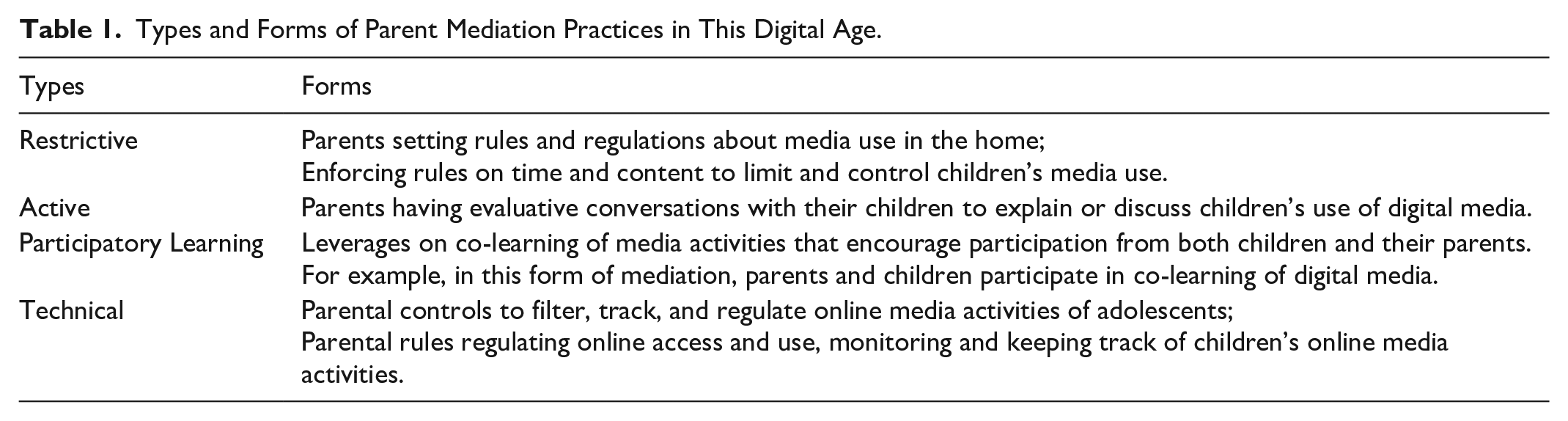
Irrespective of the media platform, parents are presumed to regulate and mediate children’s digital media use. Ideally, parental mediation should be continuously adaptive and dynamic to keep pace with the changing trends of children’s media activities in the home environment. Regardless of the time and location, parental mediation of children’s digital media use is generally aimed at establishing effective familial communication to enable them to effectively navigate their children’s experiences in the virtual world (López-de-Ayala-López & Haddon, 2018).
With the growing convergence of digital media technologies, including the emergence of various hybrids of digital media platforms, conventional mediation practices (rooted in traditional media like television and video games) appear to be insufficient in mediating children’s digital media use. Parental mediation of traditional media does not seem to factor in the complexity and interactivity of digital media tools. This indicates a need for parents to develop technical skills and competencies for them to adequately oversee their children’s online media activities (Nikken, 2017).
Research has shown that younger children generally receive more parental mediation than older children. This brings Livingstone et al. (2015) to state that parental mediation declines for older children, that is, those aged between 11 and 18 years. As such, they become more independent of their parents. Future research is warranted to explore which factors stimulate parental mediation during adolescence (Nikken, 2017).
Both younger and older children engage in various forms of online media activities to connect with friends and other people in cyberspace. Examples of online media activities may include online gaming, social networking, online chatting, online dating, online gambling, sexting, and surfing pornographic sites (Soh et al., 2018). While online media activities of children may vary depending on the social and cultural context of use, studies (Nikken, 2017; Youn & Shin, 2020) on online media activities, digital media literacy, and parental mediation have evolved separately, but with considerable commonalities and relevance (Nikken, 2017).
Research that aims to study parenting in this digital age, with a particular focus on online media activities of children, should explore the direct connection between digital media literacy of parents and parental mediation practice in the digital age. This will create an avenue where parents can define the contexts of digital media use of children in the new media environment. The next section discusses the potential moderator and mediator variables.
Potential Moderator and Mediator Variables
MacKinnon (2011) described a moderating variable as a variable for which the intervention has a different effect on the outcome or dependent variable, and a mediator variable can be described as a variable that intervenes between an independent variable and a dependent variable or the outcome variable. In this study, the potential moderator variables include demographic characteristics of parents and children—in this case, parent’s age, gender, and level of education and the child’s age and gender. Next is household characteristics—in this case, number of children, number of family members, and number of digital media in the home, followed by family factors—in this case, annual income, marital status, and ethnicity.
The mediator variable deals with parents’ usage and perception of digital technology—in this case, time spent with child on digital media device and digital literacy skills of parents.
The next section provides an empirical review of the potential moderator variables.
Age and Gender
There has been considerable debate regarding the extent to which parenting practices equally affect males and females and children of different ages. Gaspar and de Matos (2017) establish that parenting is a gendered activity with more responsibility on mothers than fathers, and mothers are likely to be the ones who mediate online media activities of children. This is because mothers are more likely than fathers to be at home taking care of the children, so the responsibility of taking care of children rests on them (Sasson & Mesch, 2016). However, one study notes that fathers spend more time and are more involved with their sons than their daughters regarding online gaming activity (Gaspar & de Matos, 2017). In fact, the literature indicates that there could be a significant difference with regard to parent’s gender as it concerns parenting in the digital age (Livingstone et al., 2017).
Examining the differences in parental mediation practice with regard to parents’ gender and differences in children’s media online activities requires more research, particularly because today’s children are early adopters and knowledgeable about digital media. Research indicates the widespread nature of the gendered patterns of mediating online media activities of children (Söderström, 2013). The lack of studies using these methodological approaches in Africa highlights an important direction for future research (Söderström, 2013).
Education and Income Level
Parents’ educational level and income are other important sociodemographic variables that can predict the choice of mediation practice a parent may employ while mediating the digital media use of children (Sasson & Mesch, 2016). The extent to which a parent’s income influences mediation practice is yet to be ascertained in communication research. Although the income level of parents can be a determining factor toward the acquisition of digital media tools in the home, the full range of mediation practices, including different strategies, for managing restrictions for digital devices needs to be ascertained.
Broadly seen, socioeconomic variations, especially in terms of household income and parental education, exist. Livingstone et al. (2015) stress the need to investigate whether the income and educational levels of parents influence parental mediation.
Research acknowledges the inconsistencies in the findings of previous studies. Livingstone et al. (2015) classified parents in Europe into three groups: lower income/more educated parents; lower income/less educated parents; more income/more educated parents. Findings of the study are mixed and indeed controversial in relation to the extent to which income and educational level of parents can enhance parental mediation practice.
It could be inferred from the study that both income and education can influence parental mediation. However, the study did not provide empirical evidence on how the educational level of parents, or perhaps income level, may directly influence mediation practice. According to the authors, education level is more likely to influence parental mediation, considering the fact that the tendency for one to say that the level of education one acquires may significantly determine the income level.
Family Structure, Marital Status, Ethnicity, and Household Composition
Parental mediation is not exclusively explained by parents’ gender, age, education, and income level. It is worth examining how family structure, marital status, and household composition can also influence parental mediation. The need to consider other family structures cannot be overemphasized (Sasson & Mesch, 2016). For instance, current studies report that problems and conflicts may arise when a child’s parents separate and share the care of the child, as the challenges of setting restrictions may increase when divorced parents have to negotiate their child’s media use across different household locations (Livingstone et al., 2017).
Consistent with this, one study indicates a conflict between parents and grandparents for guidance regarding children’s digital media use (Livingstone et al., 2015). It is obvious that parents may be stricter with young children when mediating their media use compared to older children or even relatives, who may grant children freedom to explore online media activities without any form of restrictions.
Household characteristics, such as the number of digital media devices available at home and in the child’s room, and the number of children in a family, may also indirectly impact parental mediation (Livingstone et al., 2015). Ultimately, parents may have less control over children in larger families, and as a result, this can impede parental mediation of children’s media activities. The ethnicity of parents was imperative and included in this study because it forms part of the sociodemographic variables as a moderating variable in predicting the form of mediation strategy parents may employ. This was necessary because the literacy level of parents differ from one ethnic group to another in Nigerian families. Together, the contribution of ethnicity and other variables was imperative for the four mediation strategies. The next section deals with parents’ digital literacy as a mediator variable.
Parents’ Digital Literacy as a Mediator Variable
Digital literacy of parents is one such extension of research that seeks to identify whether the moderating variables impact parental mediation practices. In relation to the influence of parents’ digital literacy on children’s digital media use, the question can be asked to what extent digital literacy of parents can enhance effective parental mediation practice in mediating online media activities of children. Research has shown that children acquire digital media skills in terms of technology use, but that they do not apply such skills in the safe use of technology. While digital media use by children clearly raises new questions and requires new methods of investigation, Shin and Kang (2016) and Youn and Shin (2020) note that the need for parents to work out strategies to mediate their children’s digital media use cannot be undermined in this era considering the fact that digital skills of parents can enhance their media literacy. This is worth examining in the light of this study because the mediating role of digital literacy and its effect on parenting in this era remained unmeasured taking Nigeria into focus.
This study tends to provide answers to the following research questions. The two research questions that guided the study were the following:
RQ1. What are the moderating variables influencing parent mediation practices in Nigerian families?
RQ2. In what ways can digital literacy skills of parents as a mediator variable impede or enhance parent mediation practices in Nigerian families?
Hypotheses formulated were as follows:
HO1A. There is no significant difference between the moderating variables (parent’s age and gender, education and income level, family structure, marital status, ethnicity, and household composition) and the mediator variable (digital literacy) on restrictive mediation practice in Nigerian families.
HO1B. There is no significant difference between the moderating variables (parent’s age and gender, education and income level, family structure, marital status, ethnicity, and household composition) and the mediator variable (digital literacy) on active mediation practice in Nigerian families.
HO1C. There is no significant difference between the moderating variables (parent’s age and gender, education and income level, family structure, marital status, ethnicity, and household composition) and the mediator variable (digital literacy) on participatory learning mediation in Nigerian families.
HO1D. There is no significant difference between the moderating variables (parent’s age and gender, education and income level, family structure, marital status, ethnicity, and household composition) and the mediator variable (digital literacy) on technical mediation in Nigerian families.
Method
Sampling Technique Employed in Selecting the Participants
The study applied multi-stage sampling technique to achieve an adequate representation of the population. The scope of this study deals primarily with public senior secondary schools in Lagos State, Nigeria. Lagos is a mega city and it has the largest population in Nigeria. In the state, virtually all ethnic groups and nationals of diverse economic status reside and live in Lagos. The sample included 1,270 parents aged 25–65 years, with children aged 13–18 years living with their parents and they account for their whereabouts. The participants for this study were parents of children in the targeted schools in Lagos. A stratified random sampling technique was employed to obtain equal representation of schools from the six educational districts in Lagos. From each strata (district), a systematic approach has then been applied where school was selected using a sampling interval from the random number table. A total of 12 schools were selected for the study.
Procedure
The data collection process lasted for 5 weeks. The exercise began on 26 April 2019 and ended on 31 May 2019. The sampled children were given a copy of the parents’ questionnaire to take home. One of the parents was asked to complete the questionnaire, keeping in mind the child who brought the questionnaire home. It took on average about 20 min to complete all questions in the questionnaire.
On the questionnaire, the confidentiality of the participant was assured and participation was voluntarily. A class teacher was assigned by the principal to assist the researcher in the data collection process. It was required that participating students returned the parents’ questionnaire 4 days after the administration of the questionnaire to their class teachers. In all, a total of 1,200 questionnaires were returned. The response rate was 94.00%. A total of 1,050 questionnaires were included in the analyses. One hundred fifty (12.00%) questionnaires were discarded due to the large number of questions left unanswered.
Measures
Besides the demographic characteristics, other measures were rated on a 4-point scale (1 = never, 2 = sometimes, 3 = often and 4 = always).
Demographic Characteristics
Data on parents and the characteristics of their children have been collected asking parents for the focal child’s age and gender, number of siblings, and number of digital media available in the home and those owned by their children. Sociodemographic characteristics collected also include parent’s gender and age, marital status, annual income, and educational qualification. Table 2 presents the demographics characteristics of the respondents.
Demographic Characteristics of Research Participants.

Parental Mediation
The study construct of parental mediation practices which include restrictive, active, participatory learning, and technical mediation coupled with digital literacy is presented in Table 3.
Mean, Standard Deviation, and Cronbach’s Alpha of the Study Constructs.
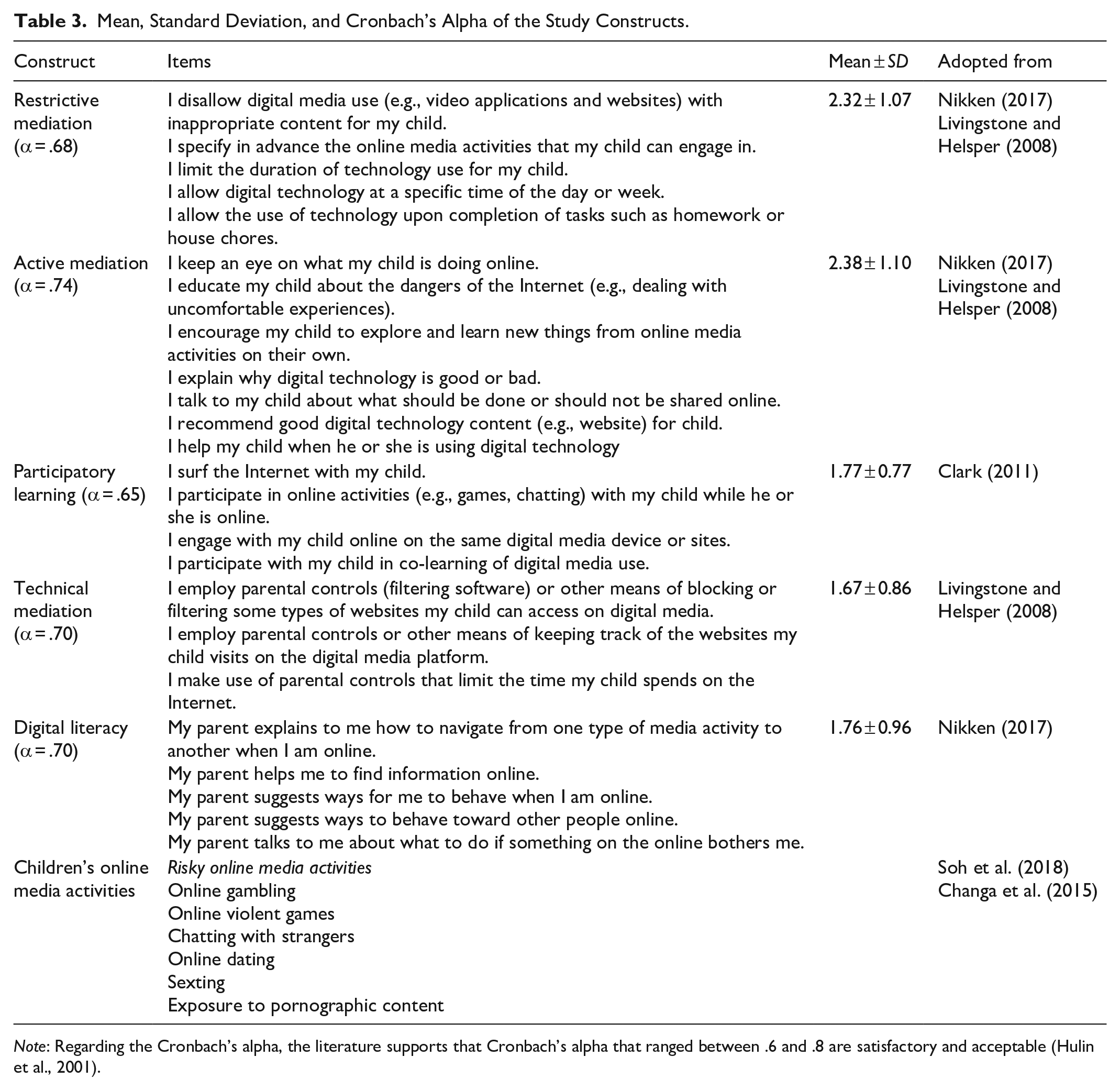
Note: Regarding the Cronbach’s alpha, the literature supports that Cronbach’s alpha that ranged between .6 and .8 are satisfactory and acceptable (Hulin et al., 2001).
Data Analysis
Hierarchical multiple regression was employed to test how different sets of factors are associated with different mediation strategies after controlling for parent–child characteristics. Hierarchical multiple regression is a form of multiple regression in which the variables are entered into regression on the basis of a predetermined theoretical framework (Lu, 2019). The authors employed the hierarchical multiple regression in an effort to account for unwanted effects with the control variables in previous studies (Aiken & West, 1991; Baron & Kenny, 1986) that used the model. Hierarchical multiple regression was suitable and appropriate over other regression models and structural equation modeling (SEM) because its shows how much of variance in the dependent model is accounted for by certain variables at different blocks of the model (Aiken & West, 1991; Baron & Kenny, 1986).
Indeed, some of the independent (i.e., sociodemographic characteristics) variables or set of variables are better at predicting the dependent variables (parental mediation practices) than others. The predicting power of different independent variables varies, and it contributes differently to the model. However, some independent variables may contribute nothing toward the choice of parental mediation practice. The aim is for all the independent variables to be correlated with the dependent variable but not with each other. With this in mind, the authors run a bivariate correlation (Pearson’s r) for all the study variables (Table 4).
Bivariate Correlations (Pearson’s r) for All Study Variables.
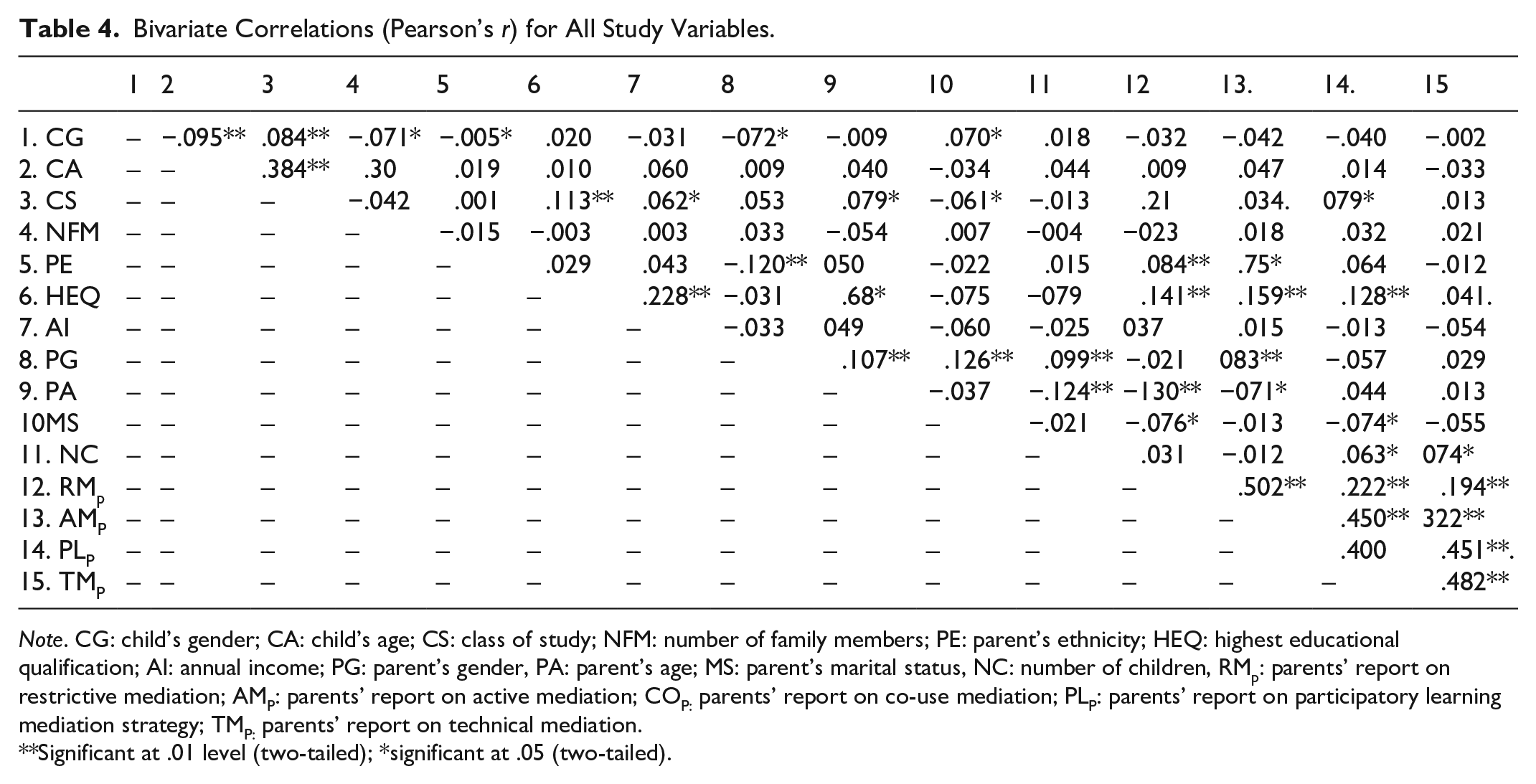
Note. CG: child’s gender; CA: child’s age; CS: class of study; NFM: number of family members; PE: parent’s ethnicity; HEQ: highest educational qualification; AI: annual income; PG: parent’s gender, PA: parent’s age; MS: parent’s marital status, NC: number of children, RMp: parents’ report on restrictive mediation; AMP: parents’ report on active mediation; COP: parents’ report on co-use mediation; PLP: parents’ report on participatory learning mediation strategy; TMP: parents’ report on technical mediation.
Significant at .01 level (two-tailed); *significant at .05 (two-tailed).
Table 4 indicates that there were many significant but weak bivariate correlations among the continuous study variables. There is no correlation between variables that were greater than .8 (Pallant, 2011). The issue of multicollinearity where two or more moderators in the model are correlated and provide redundant information about the response was taken into consideration before further analysis was performed. Only variables with significant correlations with the respective dependent variable were included in the hierarchical regression model. As most of the study variables are categorical variables, dummy variables were created to ascertain the interactions between different levels of the categorical variable and continuous variable in the model that is affecting the dependent variable from different levels or categories. In each case, the dummy variable is interpreted relative to the reference group in the regression.
Results
Table 5 shows that four separate hierarchical regression analyses were conducted, with the four parental mediation strategies as dependent variables. For each analysis, control variables were entered into the first model, followed by parents’ usage and perception of digital technology (Model 2), household characteristics (Model 3), and family factors (Model 4). Model 1 includes five potential moderators: child’s age and gender, parent’s age and gender, and parent’s educational level. The variables in Model 1 are the control variables in the model. These variables were used to test the predictive power in relation to other variables in Model 2 (time spent on digital media with child and digital literacy of parents), Model 3 (number of children, number of family members, and number of digital media in the home), and Model 4 (annual income, marital status, and ethnicity).
Hierarchical Regression Analysis for Predicting Parent Mediation Practice (β).

Note. Beta weights (β) are from the final regression equations with all blocks of variable in the model.
p < .05; **p < .01;, ***p < .001. ** and *** for R2 indicate significance of ΔR2 increments.
RQ1 aimed at identifying the moderating variables influencing parental mediation practices in Nigerian families. Different moderating variables may influence the choice of parental mediation practices; findings of the study reveal that not all the demographic variables are moderating variables regarding the different mediation strategies. For instance, the hierarchical multiple regression shown in Model 1—parent’s age (β = .122, p < .05) and education (tertiary) (β = .175, p < .05) (in the case of restrictive mediation), F(10, 1039) = .51, p < .05; parent’s gender (β = .85, p < .01) and education (tertiary) (β = .190, p < .01) (in the case of active mediation), F(10, 1039) = 6.41, p < .05; child’s gender (β = −.012, p < .01), parent’s age (β = .138, p < .01), and education (tertiary) (β = .046, p < .01) (in the case of participatory learning), F(10, 1039) = 7.49, p < .01; and parent’s age (β = −.095, p < .01) and education (tertiary) (β = .199, p < .01) (in the case of technical mediation, F(10, 1039) = 4.11, p < .01—contributed significantly to the variance in the model. In Model 2, holding all variables in Model 1 constant, time spent on digital media with the child was not significant in the four mediation types, and digital literacy of parents was only significant for participatory learning (β = −.029, p < .01), F(12, 1037) = 6.32, p < .01. In Model 3, none of the household variables significantly contributed to the model except the number of family members (4–6) (β = .582, p < .05), F(18, 1031)= 4.35, p < .05) (in the case of technical mediation). In Model 4, family variables contributed significantly to different mediation types. For instance, ethnicity (Igbo) (β = .109, p < .05) contributed significantly in the case of restrictive mediation; income (₦250,000–₦500,000) (β = −.079, p < .05; β = .100, p < .001) contributed significantly in the case of participatory learning; income (₦250,000–₦500,000) (β = −.111, p < .001), marital status (separated) (β = −.111, p < .001), and ethnicity (Igbo) (β = −.111, p < .001).
Addressing HO1A to HO1D, the hierarchical multiple regression showed that the moderating variables for demographic characteristics were child’s gender, parent’s age, parent’s gender, and parent’s educational level; the moderating variables for household characteristics were number of family members and number of children in the home; the moderating variables for family factors were annual income, marital status, and ethnicity.
Table 5 showed that there were relationships between the independent variables at different levels of the model (RQ2), indicating the effects of these variables in relation to the outcome variables (in this case the dependent variable). Findings of the study showed that a strong and positive relationship exists between parent’s age and educational level and parent’s gender and educational level. These relationships were evident as strong moderating variables for the four mediation strategy types indicated earlier in the previous paragraph. In fact, among these variables, parent’s education (tertiary) was the strongest moderating variable in the demographic characteristics of parents (Table 5). This implies that parents who are educated to tertiary level were more likely to effectively mediate children’s digital media use compared to parents with lower educational qualification. There were no relationships observed in the household characteristics. Annual income, marital status, and ethnicity were significant, indicating strong and positive relationships in family factors. Annual income was the strongest moderating variable, whereas marital status was the least moderating variable in the family factors category.
Discussion
Parental mediation has received much more attention in the United States and Europe than any other region or country in recent years. Because cultural difference plays a major role in parenting in the digital age, we cannot ascertain whether findings from these regions (the United States or Europe) may be applicable to Nigerian context. This study examines the antecedent of parental mediation, with the aim to broaden our understanding of how the combined effects of the moderator and mediator variables influencing parental mediation in Nigeria give the overall contribution of this study.
Previous studies (Livingstone & Helsper, 2008; Nikken & Opree, 2018) on parental mediation largely examined the effects of the moderator variables (in this case the sociodemographic variables). Livingstone et al. (2017) have emphasized the importance of digital literacy of parents in enhancing parenting in the digital age. Considering the fact that digital media devices now saturate the lives of the present-day children, it is presumed that the digital literacy construct will enhance parenting skills in this digital era. By taking a national perspective, this study was able to investigate the prevalent variables impacting parental mediation practices in Nigeria. The key findings of this study are presented in the subsequent paragraphs.
Findings of the study showed that a strong and positive relationship exists between parent’s age and educational level and parent’s gender and educational level. These relationships were evident as strong moderating variables for the four mediation strategies measured in this study. The contributions of these variables cannot be overemphasized in the model. The obtained standardized regression coefficients showed that for sociodemographic characteristics educational qualification (in this case tertiary level) was the strongest moderator variable; number of family members was the strongest moderator variable for household characteristics; and annual income was the strongest moderator variable for family factors. It was found that, relating to the digital literacy of parents, the hierarchical regression analyses showed that only 7% of variance in parental mediation practice was explained, indicating the relevance of the digital literacy constructs in relation to parental mediation practices in the context of Nigerian families.
This implies that much work is needed to improve our understanding regarding the mediator variable and parental mediation practices in Nigeria. Contrary to our expectations, our findings showed that digital literacy was only negative and weak but significant for participatory learning. Findings of this study show that the current model is plausible. This study was only the first in exploring these relations. Multiple and diverse samples relating to digital literacy of parents and mediation strategies are needed to improve and ensure validity of construct (Livingstone et al., 2017).
It is interesting that, with reference to fathers, mother’s educational qualification is important when considering the moderator variable that enhances the mediation of children’s digital media use. These findings corroborate previous findings (Livingstone et al., 2017; Nikken, 2017) regarding the sociodemographic variables predicting parental mediation.
Again, similar studies (Livingstone et al., 2015; Nikken & Opree, 2018) showed that household characteristics and family factors were statistically significantly related to the current moderators of parental mediation in this study.
The study applied hierarchical regression analysis to investigate the influence of the moderator and mediator variables on parental mediation. This statistical tool was appropriate because it explains the variance of the contributions made by certain variables relating to the outcome variable in the model. A comparative finding relating to the study constructs should be performed in the future with other statistical technique such as SEM. However, the variance explaining the effect of the independent variables may not be accounted for in SEM.
Theoretical and Practical Implications of the Study
Theoretically, this study made several contributions to parental mediation literature, and its implications to theory and practice are discussed. With respect to parental mediation practices in Nigerian families in the digital age, it was mentioned earlier that, relating to digital literacy of parents, the hierarchical regression analyses showed that only 7% of variance in parental mediation practice, in the case of participatory learning, was explained. By implication, the constructs of digital literacy are more relevant to participatory learning mediation practice compared to other parental mediation practices in the context of Nigerian families.
To inform policy and address parental concern in children’s media use, participatory learning is said to be the most effective form of parental mediation. Parents need to exhibit some level of digital literacy skills to effectively apply participatory learning mediation approach in mediating children’s online media activities. Having said that, digital literacy construct is an enabler in aiding parental mediation strategies in the digital age. In other words, digital literacy of parents can enhance their mediation practices in the digital age in the context of Nigeria, where the influx of digital media devices and Internet population is the highest in Africa and eighth in the world (Internet World Stats, 2021). The main concern here is how to improve digital literacy skills of parents. This concern is germane because findings of this study showed that only 30% of the respondents had tertiary education (Table 2). This raises the issue about how digital literacy skills of parents can be measured. In fact, Helsper (2012) emphasizes that digital literacy of parents may be ascertained relating to their online activities and occupational status. It may be problematic to gauge parents’ digital literacy skills in relation to digital media use. Central to this is the recognition that digital media literacy is not universal and does not automatically evolve with technological changes. Terras and Ramsay (2016) indicate that there is no standardized tool to gauge digital media literacy skills. As such, digital media literacy varies in scope and may require different strategies to establish and evaluate. Although the construct of digital literacy in this study had a satisfactory reliability coefficient of .7, Hulin et al. (2001) proposed that a reliability coefficient closer to 1 is excellent and preferred. Future studies should endeavor to continually improve the reliability coefficient of the construct in this study.
Practically, one may say that increase in educational qualification may also precipitate or perhaps enhance digital literacy of parents. Livingstone et al. (2017) buttress that parental education makes little difference when it comes to acquiring digital skills. In fact, the assumption that parents with more education are likely to be more digitally literate and skilled compared with parents of little or no education is yet to be empirically investigated. These results should be interpreted with caution regarding educational qualification and digital literacy of parents in Nigeria. Future studies should employ a more diverse population relating to educational qualification.
Fostering parental digital literacy may require a combination of interventions directed at parents and children should be conceptualized. There is need for collaborative efforts that promote and support measures of enhancing digital literacy of parents. This can be done by educating parents on the latest developments regarding online safety as new technology evolves. Parents can be enlightened through parents’ meetings organized quarterly by school authorities; policy makers such as the Ministry of Education are not left out. Regarding children’s online safety, efforts should begin at primary school level, teaching children about the opportunities and risks of online media. This is important because young children are less likely to be equipped to cope with the risks of digital media. In lieu of this, interventions should focus not only on enhancing parents’ digital skills toward mediating children’s online digital media use regarding risk of harm, but also on providing children with the necessary skills to navigate the online environment and take ownership of their online safety.
Limitations and Conclusion
There are several limitations of the study that require urgent attention and should be taken into consideration. First, making inferences regarding the causality of the study variables was difficult because of the cross-sectional design employed in the study. Longitudinal studies should be applied in future studies to remedy this limitation. Second, we cannot rule out the bias inherent in self-administered questionnaires. Social desirability bias may not necessarily be avoided. Future studies should complement the questionnaire with other data collection instruments in validating the responses obtained. Third, we cannot rule out the cultural diversity of Nigeria. Our study only sampled respondents based on the three major ethnic groups in Nigeria. Future studies should incorporate other ethnic diversity and extend the research to other part of Nigeria and Africa at large.
It is important to note that results of this study showed that digital literacy is more related to parental mediation (participatory learning). Also, a possible direction for future study may be using different constructs of digital literacy to investigate its relationship with parental mediation practices.
In conclusion, this study shows the relevance of moderator and mediator variables on parental mediation practices in Nigeria. This study demonstrates the relevance of the sociodemographic characteristics, household characteristics, and family factors and its effect on parental mediation in Nigeria. Findings of this study serve as a basis for similar investigations in other communities and countries in Africa. Findings of this study suggest that we cannot neglect the contribution of every variable as explained in the hierarchical model; it is therefore imperative that joint consideration regarding the effect of moderator and mediator variables on parental mediation gives a better explanation and enhances our understanding regarding parental mediation practices in Nigerian families.
Footnotes
Declaration of Conflicting Interests
The author(s) declared no potential conflicts of interest with respect to the research, authorship, and/or publication of this article.
Ethical Approval
Ethical approval was obtained from the College of Human Science (CHS), University of South Africa (UNISA), Pretoria. Prior to data collection, permission was granted by the Lagos State Government, Office of the Head of Service to obtain information from parents whose children were students in public senior secondary schools in the selected educational districts.
Funding
The author(s) received no financial support for the research, authorship, and/or publication of this article.
