



Abstract
While the Internet is part of everyday life for many children, inequalities exist in their digital skills, with little known about the influence of perceived discrimination on these inequalities. Building on survey data collected from nationally representative samples of 10,820 children aged 12–16 in 14 European countries, we seek to understand whether and how disadvantaged children may fall behind their more advantaged peers across Europe with respect to digital skills, as well as the role played by perceived individual and social discrimination in acquiring these skills. The findings show that perceived individual and social discrimination affect the relationships of socio-cultural resources (age, gender, preference for online social interaction) and personal resources (self-efficacy) with digital skills. Therefore, even in countries where Internet use is an integral part of children’s lives, interventions should be made to prevent perceived offline discrimination translating into digital inequalities.
Introduction
Public and policy debates around children’s use of digital media have long been shaped by the myth of ‘digital natives’ who, growing up in media-rich environments, are ‘naturally’ positioned on the right side of the digital divide (Helsper and Eynon, 2010). Contrary to this idealised, yet erroneous, representation, prior research has shown that, while the Internet forms the general background of everyday life for many children (Livingstone et al., 2018), digital inequalities exist, and as they depend on the same complex factors that explain digital inequalities among adults, they are also linked to digital exclusion in adulthood (Helsper, 2017; Livingstone and Helsper, 2007; Robinson et al., 2020).
Questions about the digital divides that exist among children have been addressed by a number of empirical studies that examined the relationship between social and digital inequalities (for an overview, see Haddon et al., 2020). However, little research to date has examined social-psychological resources as drivers for digital inequalities among children in a cross-cultural comparative study. This is in contrast to recent theorisations in both children and media research and digital inclusion research, all of which invite researchers to move beyond essentialist notions of social differences and to account for the complex intersection of overlapping individual and social differentiation (Alper et al., 2016; Helsper, 2017).
To fill this gap, we analysed the EU Kids Online data collected from 2017 to 2019 from nationally representative samples of children aged 12–16 in 14 European countries (Smahel et al., 2020). We compared children who reported having been discriminated against on the basis of their social identity (i.e. religion, colour of skin or ethnic origin) and/or their individual identity (i.e. cognitive or physical impairments, sexual orientation) with children who did not perceive any experience of discrimination, in order to identify the influence of perceived social and individual discrimination on digital skills and, therefore, on digital inclusion.
We further analysed the antecedents of digital skills among discriminated children from a cross-cultural perspective. Our aim was to uncover the similarities and differences for associations between antecedents and digital skills across 14 countries, to help us understand whether and how perceived individual and social discrimination influences the acquisition of digital skills in different countries.
This article contributes to the fields of both children and media research and digital inclusion research for two reasons. First, we conceive of digital inclusion and exclusion beyond binary conceptualisations; second, we aim to account for the diverse social and cultural conditions by which children are differentiated.
Background literature
Digital inequalities among children
Research focused on the differences in children’s access to and use of the Internet has followed the evolution of the digital divide debate, thus moving beyond binary accounts (Tsatsou, 2011). The shift from the digital divide to digital inclusion resulted in a different focus for the analysis, from access to skills and to outcomes, with each corresponding to a subsequent phase of research – namely, the first-, second- and third-level digital divide. This shift in focus does not mean that the first-level digital divide (i.e. inequalities in Internet access) has been bridged and ceases to be a source of disparity. Inequalities in material access to the Internet persist, even in affluent and technologically advanced countries (van Deursen and van Dijk, 2019), but, access being equal or similar, these are complemented by or supplemented with inequalities in usage and skills (i.e. the second-level digital divide; see van Deursen and van Dijk, 2011, 2014).
The theorisation of digital inclusion emphasises the non-linear intersections between access, skills and usage in shaping the tangible outcomes of Internet use (Ragnedda, 2017; van Deursen and Helsper, 2015; van Deursen et al., 2017). It also expands the scope of research beyond socioeconomic status and demographics as the main source of digital inclusion or exclusion (Helsper, 2017; Tsatsou, 2011). In connecting social inclusion with digital inclusion, and then back to social inclusion, the third-level digital divide ‘re-integrates digital inequalities into social structure, rejecting the strict opposition between online and offline spheres of activity’ (Calderon Gomez, 2020: 3).
The metaphor of a ‘digital inequality stack’ (Robinson et al., 2020) suggests that all of the layers in the stack – access, skills, use – are interdependent. Furthermore, it foregrounds the recursive loop of social and digital inequalities: digital disparities end up amplifying and reinforcing social inequalities.
The trajectory from the digital divide to digital inclusion can also be observed in research that examines digital inequalities among children. The first move forward – from the digital divide to digital divides – is represented by Livingstone and Helsper’s (2007) notion of gradations in digital inclusion, through which one can interpret the interactions between conventional social stratification variables and Internet access and use that shape children’s progressions from basic to advanced uses of the Internet. More specifically, children with similar socioeconomic conditions were shown to use the Internet for different activities and achieved different levels of digital skills, depending on the quality of Internet access – namely, the number of devices to which the child has access and the variety of places where they can go online. At the same time, children who benefitted from similar conditions of Internet access and use reached the same steps on this ‘ladder of opportunities’ (Livingstone and Helsper, 2007) irrespective of their socioeconomic background. This notion of a gradual and staged progression of Internet use brings to the fore the complex interplay of material and symbolic resources, practices (including parental mediation), motivations and dispositions (e.g. lack of interest in certain online activities) that lead to digital inclusion among children. Rejecting the idea of a binary opposition between digitally included and excluded children, this supports the idea of digital inclusion as a continuum along which children are positioned according to how different vectors of social identities operate together.
The existence of different pathways towards children’s digital inclusion is further elaborated in Livingstone and Helsper (2010) and Helsper and Eynon (2013). Both studies highlight the role of digital skills, which can positively mediate between structural social exclusion factors (including age, gender, economic, cultural and social capital, and personal resources) and digital engagement. Simultaneously, these works pave the way for research into the third-level digital divides that examines the different online and offline outcomes of Internet use and investigates how digital inequalities, when beginning early in life, impact educational and occupational opportunities. Based on these works (see Haddon et al., 2020), research on the digital inclusion of children has adopted a new conceptualisation of digital skills as ‘the ability to use ICTs in ways that help individuals to achieve beneficial, high-quality outcomes in everyday life for themselves and others’ comprising of ‘the extent to which one is able to increase the benefits of ICT use and reduce potential harm associated with more negative aspects of digital engagement’ (International Telecommunication Union [ITU], 2018: 23).
Nonetheless, despite theoretical alignment with the digital inclusion framework, children and media research lags behind, both for its limited ability to expand the range of the social inequality factors taken into account (Helsper, 2017) and for its predominant focus on Western, middle-class children (Alper et al., 2016). As Helsper (2017) notes, research on the digital inclusion of disadvantaged youth is still sparse and mainly consists of qualitative and single-country studies. In fact, research on disadvantaged children has focused on children with low-income and/or minority ethnic backgrounds on one hand and children with disabilities on the other hand (Andreasen and Kanstrup, 2019; Drotner and Kobbernagel, 2014; Paus-Hasebrink, 2018).
Research on low-income families and those from a minority ethnic background has emphasised the need to reframe digital divides not as individual experiences, but as embedded in the context of family and/or community relationships, and, at the broader societal level, mediatized cultural, economic and political contexts. Katz’s (2017) research on underconnected families, Clark’s (2013) study of parents from different socioeconomic backgrounds and Paus-Hasebrink et al.’s (2019) longitudinal research with socially disadvantaged children in Austria all show how families creatively navigate the synergies or tensions among interwoven forms of social stratification. Upper- and middle-class parents favour children’s individual attainment of tangible outcomes of Internet use, which is in line with their ‘ethic of expressive empowerment’ (Clark, 2013: 16). Conversely, low-income parents regulate their children’s media use through an ‘ethic of respectful connectedness’ (Clark, 2013: 16), which prioritises the strengthening of family ties and culture over individual achievements. Accordingly, joint media engagement of parents and children is more common among families from lower socioeconomic groups (Katz, 2017).
There has also been research on the opportunities and challenges for children with physical impairments (including hearing, speech, visual and mobility impairments) and cognitive or psychosocial disabilities. Findings are mixed, showing that digital media can be a tool for both empowerment and exclusion, thus compensating for, or exacerbating, offline inequalities (Alper, 2014). For example, while digital technologies can reduce barriers to learning for disabled children, assistive technology ‘does not easily solve these problems in education and, in fact, begets new challenges for literacy, collaboration, and cognition’ (Alper and Goggin, 2017: 734). Similarly, while the Internet can compensate for a lack of etiquette or writing and reading difficulties that limit offline participation in society, physical and cognitive barriers to Internet access still exist among children with disabilities, the main barrier being their limited personal skills (Sorbring et al., 2017). Furthermore, when it comes to social interactions, the Internet fulfils the need to develop and maintain social relationships (Andreasen and Kanstrup, 2019) and even provides a digital playground where children with disabilities can learn fundamental social skills, have fun and interact with their peers (Ringland, 2019). At the same time, however, research shows that children with disabilities report higher levels of both cyber-victimisation (Didden et al., 2009) and excessive Internet use (Urbanova et al., 2020).
Taken together, these studies show how different degrees of digital, social and individual marginality configure disadvantaged children’s life contexts and their digital media use (Alper et al., 2016).
Helsper’s research with NEETs (those not in education, employment, or training) has shown that inequalities in the achievement of tangible outcomes of digital engagement cannot be fully explained by differences in Internet access, use and competences, or by conventional social stratification measures. Rather, the positive attitudes of NEETs towards digital media contrasted with the (low) personal motivations and social pressures to use ICTs. Helsper (2017) writes, ‘That individuals with similar socio-demographic backgrounds and similar skill levels engage in different ways with ICTs poses problems for the standard explanations of digital inequalities’ (p. 256). This invites researchers to look at other dimensions of inequality in children’s lives, namely at social-psychological resources.
Individual, social, and digital discrimination among children
The notion of children’s discrimination encompasses all those circumstances where a child is treated badly or differently because of his or her personal and social characteristics. Discrimination can be implicit or explicit, it concerns different realms of one’s life, and individuals can perceive it or not; in other words, people can be more or less aware of being discriminated against (Swim et al., 1998). As such, studying children’s discrimination implies detecting those areas where a child feels they are being discriminated against. Discrimination can be perceived at an individual or social level: examples of the former are when a child is treated badly because of his or her appearance, opinions, sexual orientation and the like; the latter occurs when a child is discriminated because of his or her socioeconomic status, ethnicity, religious beliefs and so on. Studies suggest that children are, in fact, aware of several forms of discrimination they themselves or their peers may have experienced, with many reporting experiences of discriminatory behaviour (Fisher et al., 2000; Theimer et al., 2001).
Discrimination can have negative impacts on several domains of children’s lives. In their review of the developmental implications of discrimination, Marks et al. (2015) show how being discriminated against negatively impacts children’s and adolescents’ development in terms of life satisfaction, self-esteem, self-worth and academic achievements, showing that perceived discrimination negatively affects academic outcomes, motivation, goals and efficacy. This is particularly relevant for children from discriminated groups in terms of race, physical impairments, sexuality and the like. Garcìa Coll et al.’s (1996) ecological model equally shows how discrimination acts as an important factor influencing children’s development and achievements in life, potentially compromising their overall well-being and developmental competencies.
Discrimination concerns children’s digital lives as well, and being discriminated against on the Internet is an important concern for children, since offline discrimination often tends to lead to online discrimination through forms of digital discriminatory behaviour (Keeley and Little, 2017; Umaña-Taylor et al., 2015). It can be argued that as discrimination is an important variable affecting several domains of young people’s lives, and as the Internet is an important environment where their lives are unfolding, lacking digital skills may hinder an array of social and individual opportunities for children who are discriminated against, ranging from more economic-oriented and utilitarian opportunities – such as developing skills that may foster upwards social mobility (ITU, 2018) – to personal and interpersonal ones – for example, knowing how to build social support to help fight social stigma and various forms of discrimination (Dobransky and Hargittai, 2006; Drotner and Kobbernagel, 2014; Hatchel et al., 2017).
It follows that it is important for children who are discriminated against to be able to competently turn to digital technologies in order to cope with their daily challenges while also being able to avoid, or at least cope with, individual and social discrimination online. Analysing data from 25 European countries, Bosman et al. (2015) researched children who were perceived as being discriminated against according to their parents on the basis of different cognitive, emotional and physical vulnerabilities. Although the focus was mostly on explaining the influence of the perceived discrimination on children’s exposure to risks rather than on their digital inclusion as measured by digital skills, findings show the ambiguity of digital technologies, which play a compensatory role for children seeking to remedy perceived discrimination while exposing them to more risks. Children who were discriminated against were seemingly more vulnerable to sexting and cyberbullying, both because they engaged in the riskier social uses of ICTs (i.e. making friends online) and because they were generally less skilled (Bosman et al., 2015). In fact, in line with the social compensation theory (Valkenburg et al., 2006), children turn online to compensate for inhibitions and difficulties encountered in face-to-face communication. They also tended to report lower levels of digital skills, which were related to their parents’ mediation practices: as they were more worried about their children, those parents tended to set more restrictions on their children’s Internet use.
Research questions
Against this background, this article seeks to understand the relationship between children’s perceived individual and social discrimination and their digital skills, because – in line with the concept of a recursive loop of social stratification, social-psychological resources and digital inequalities – offline inequalities may lead to online inequalities, and, at the same time, be exacerbated by digital inequalities (Helsper, 2021; Robinson et al., 2020). In other words, different sources of inequality are interrelated in ways that compound disadvantage. In order to better understand whether and to what extent children who report being discriminated against may fall behind their more advantaged peers with respect to digital skills, we seek to address the following research question:
RQ1. How does the association between a set of antecedents and digital skills vary between children who are discriminated against and those who are not?
Individual and social discrimination, as highlighted in the recursive loop hypothesis, may add up to other sources of inequality. We therefore need to investigate the role of perceived social and individual discrimination as predictors of digital skills in relation to other antecedents. Moreover, the influence of individual and social perceived discrimination over digital inclusion is likely to differ across countries, similar to the effect of discrimination on other antecedents of digital skills, such as parental mediation (Bosman et al., 2015). As such, we pose this second research question:
RQ2. Among children who perceived being discriminated against, what are the associations between digital skills and perceived social or individual discrimination? And how do these associations vary across countries?
Methods
Sample
Data from the broader project (Smahel et al., 2020), of which this article is part, was collected through surveys administered to a representative sample of 25,101 children and young people aged 9–17 from 19 European countries between autumn 2017 and summer 2019. Cognitive testing was conducted in all countries so as to ensure the cross-cultural validity of the survey. Nationally representative samples, balanced in terms of children’s age, gender, region and urban/rural residency, were either surveyed at home or at schools. Household sampling took place through quota sampling, random walk sampling and random recruitment from appropriate registers; school sampling took place by including students aged 9–17 who were at school the day the survey was administered. All countries followed relevant ethical guidelines, obtaining written informed consent from the legal representative of the child and written or oral consent from the children themselves.
For the purpose of comparability, this article focuses on a representative subsample of participants aged 12–16 from the following 14 European countries: the Czech Republic (CZ, n = 1794), Estonia (EE, n = 501), Germany (DE, n = 581), Italy (IT, n = 508), Lithuania (LT, n = 539), Malta (MT, n = 686), Norway (NO, n = 564), Poland (PL, n = 572), Portugal (PT, n = 1149), Romania (RO, n = 446), Serbia (RS, n = 659), Slovakia (SK, n = 499), Spain (ES, n = 1,775) and Switzerland (CH, n = 547). Participants were 51% female, with an average age of 13.85 (SD = 1.37) years, and 51% of the sample spent 1–3 hours online on weekdays. Three-quarters of the sample considered themselves to be of average or above average socioeconomic status (SES; 5–8 on an 11-point scale that ranges from ‘worst off’ as ‘1’ to ‘best off’ as ‘11’). Descriptive statistics of the sample demographic variables can be found in Table 1.
Descriptive statistics of variables used in the analysis.
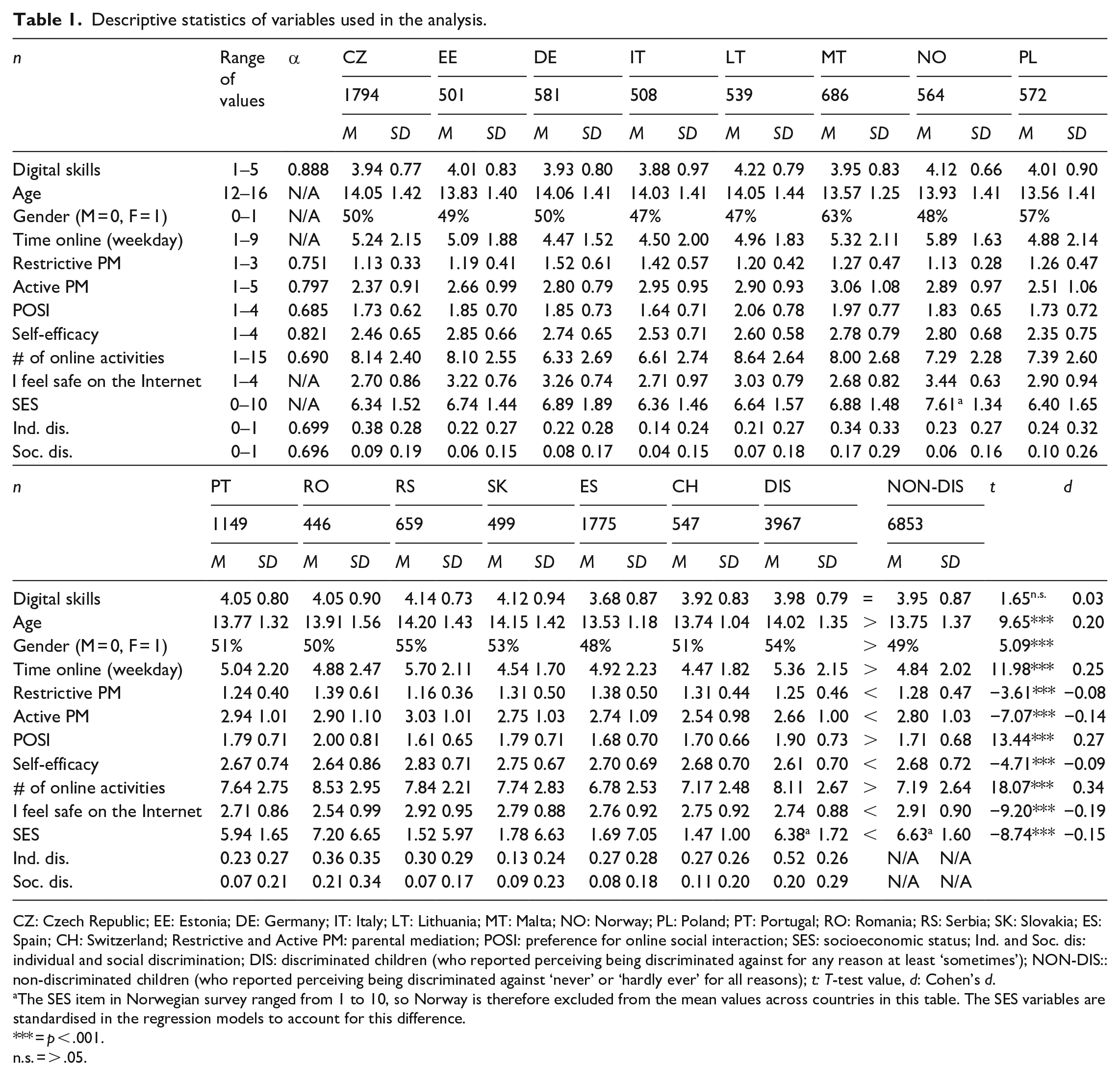
CZ: Czech Republic; EE: Estonia; DE: Germany; IT: Italy; LT: Lithuania; MT: Malta; NO: Norway; PL: Poland; PT: Portugal; RO: Romania; RS: Serbia; SK: Slovakia; ES: Spain; CH: Switzerland; Restrictive and Active PM: parental mediation; POSI: preference for online social interaction; SES: socioeconomic status; Ind. and Soc. dis: individual and social discrimination; DIS: discriminated children (who reported perceiving being discriminated against for any reason at least ‘sometimes’); NON-DIS:: non-discriminated children (who reported perceiving being discriminated against ‘never’ or ‘hardly ever’ for all reasons); t: T-test value, d: Cohen’s d.
The SES item in Norwegian survey ranged from 1 to 10, so Norway is therefore excluded from the mean values across countries in this table. The SES variables are standardised in the regression models to account for this difference.
= p < .001.
n.s. = > .05.
Measures
Unless indicated otherwise, the scale scores presented in Table 1 were computed as mean values of their corresponding items and coded in a way that higher values represent higher levels of the variable (e.g. more restrictive mediation or better self-efficacy). All Cronbach’s αs can likewise be found in Table 1, with coefficients ranging from 0.68 to 0.88 which are mostly indicated as sufficient in the literature (Cortina, 1993; Taber, 2018).
Demographics (i.e. age and gender, perceived SES): participants were asked the month and year of their birth and ‘What would you say is your sex/gender?’ SES was measured by a graphic of a ladder with 11 steps that ranged from ‘0’ ‘Worst off’ to ‘10’ ‘Best off’, with the following instructions: ‘Here is a picture of a ladder. Think of this ladder as representing where people stand in your country. Please tick the box where you think you and your family are’. For analytical purposes, SES values were standardised and entered into the model as Z-scores.
Digital skills: measured by 10 items from van Deursen et al. (2016). Two items measured each of the five subscales: operational, informational (or critical), social, creative and mobile. Sample items included ‘I know how to remove people from my contact lists’ or ‘I find it easy to check if the information I find online is true’, and the response options ranged from ‘1’ ‘Not true of me’ to ‘5’ ‘Very true of me’.
Internet use: measured with one item: ‘About how long do you spend on the Internet during a regular weekday (school day)’ with response options that ranged from ‘1’ ‘Little or no time’ to ‘9’ ‘About 7 hours or more’.
Restrictive parental mediation: adapted from EU Kids Online (Livingstone et al., 2010), with the following instructions: ‘Does your parent/carer allow you to do the following things on the Internet, and if so, do you need their permission to do them?’ with the following three choices: ‘Use a web or phone camera (e.g. for Skype or video chat); Download music or films; Use a social networking site (e.g. Facebook, Snapchat, Instagram, Twitter)’. The response scale ranged from ‘1’ ‘I am allowed to do this anytime’ to ‘3’ ‘I am not allowed to do this’.
Active parental mediation: adapted from EU Kids Online (Livingstone et al., 2010), with the following instructions: ‘When you use the Internet, how often does your parent/carer do any of these things?’ with the following four choices: ‘Encourages me to explore and learn things on the Internet’, ‘Suggests ways to use the Internet safely’, ‘Talks to me about what I do on the Internet’ and ‘Helps me when something bothers me on the Internet [when you use the Internet]’. The response scale ranged from ‘1’ ‘Never’ to ‘5’ ‘Very often’.
Preference for online social interaction (POSI): measured by three items (Smahel et al., 2012): ‘I find it easier to be myself online than when I am with people face-to-face’, ‘I talk about different things online than I do when speaking to people face-to-face’ and ‘I talk about personal things online which I do not talk about with people face-to-face’, with a 4-point response scale ranging from ‘1’ ‘Never’ to ‘4’ ‘Always’.
Self-efficacy: measured by four items from Schwarzer and Jerusalem (1995): ‘It’s easy for me to stick to my aims and achieve my goals’, ‘I am confident that I can deal with unexpected problems’, ‘I can generally work out how to handle new situations’ and ‘If I am in trouble I can usually think of something to do’. The response scale ranged from ‘1’ ‘Not true’ to ‘4’ ‘Very true’.
Online activities: an index of 15 items was used to measure the breadth of children’s online activities. These were adapted from EU Kids Online (Livingstone et al., 2010) and van Deursen et al. (2016). The items asked about the frequency of engagement in various online activities, including using the Internet for schoolwork, looking up news, communicating with family or friends, playing games, watching video clips, participating in groups with shared interests, looking up health-related information, and getting involved in campaigns, protests or petitions. The items were dichotomised into ‘0’ ‘Never or hardly ever’ and ‘1’ ‘At least every week or more frequently’. They summed together into an index measure to indicate the number of online activities children engage in weekly or more often.
Perceived individual and social discrimination: an index that comprised of five items and four items, respectively, represented the extent to which participants perceived having experienced various forms of discrimination. Participants were asked ‘Do you sometimes feel that you are treated badly because of the following?’ and responded on a scale ‘1’ ‘Never’ to ‘5’ ‘Very often’ to a list of possible reasons for perceived discrimination. The individual discrimination index comprised of items about height, weight, disability, the type of people participants fall in love with, physical appearance, behaviour, opinions and beliefs. The social discrimination index comprised of items about where the participant’s family was from, skin colour, religion and not having enough money. The items were adapted from Williams et al. (2008). They were dichotomised into ‘Never’ versus the rest.
Personal attitude towards the Internet: measured by the item ‘I feel safe on the Internet’ with a response scale that ranged from ‘1’ ‘Never’ to ‘4’ ‘Always’.
Plan of analysis
In the first step of the study, in order to answer RQ1 we tested the discussed variables as predictors of digital skills in the broader context of European youth with the focus on comparing the effects of predictors between those youth who felt discriminated against and those who didn’t. Participants who responded ‘sometimes’ or more frequently to any of the nine items that measured perceived discrimination were considered discriminated against. Participants who perceived themselves as being discriminated against ‘hardly ever’ across all nine items were considered ‘non-discriminated’. This yielded a subsample of 3967 participants who experienced some individual or social discrimination and 6853 participants who experienced a negligible amount of discrimination. Due to the small sample sizes in country-specific analyses and the resulting low statistical power of those analyses, such comparisons were made only across countries on full samples. Due to the nature of grouping based on discrimination, the non-discriminated group included only participants who responded with at most a ‘2’ on all items of the 5-point response scale; the variance of individual and social discrimination variables was severely reduced, so these variables were omitted from the analyses. A Z-test procedure outlined in Paternoster et al. (1998) was used to compare the coefficients between the two groups.
Subsequently, in order to address RQ2, we investigated the predictors of digital skills with a focus on individual and social discrimination among European children in specific countries. For that purpose, we conducted a series of hierarchical multiple linear regressions with digital skills as an outcome. To test the strength of the relationships of individual and social discrimination and digital skills, we entered the predictor variables into the regression in three steps: first, the demographics or control variables (i.e. age, gender, time spent online); second, restrictive and active parental mediation, preference for online social interaction, self-efficacy, online activities and personal attitude towards the Internet; and third, SES, individual discrimination and social discrimination were included. The change in the proportion of explained variance was compared after each step.
Results
Aside from sample descriptive statistics, Table 1 shows that there was no difference in mean-level digital skills between young people who felt discriminated against and those who did not, even when a large sample size. In simple t-test comparisons, these two groups of discrimination self-perception seem to have differed in all other variables of interest; however, the magnitudes of the differences were relatively small (average absolute value of Cohen’s d = 0.18).
To answer the first research question, Table 2 shows statistically significant differences among the effects of age (p = .015), gender (p = .020), preference for online social interaction (p = .022) and self-efficacy (p = .029) on digital skills when these effects are compared between young people who feel discriminated against and those who do not. All of these effects, except for female gender, were stronger among the non-discriminated youth compared to their discriminated peers (age: β = .088 vs β = .047; gender: β = −.052 vs β = −.102; POSI: β = .073 vs β = .041; self-efficacy: β = .201 vs β = .175). This means that being older or male, preferring online social interaction or believing more in one’s self, has a lower positive impact on digital skills among those children who feel discriminated against.
Predictors of digital skills: comparison of model coefficients between children who feel they are discriminated against and those who do not.
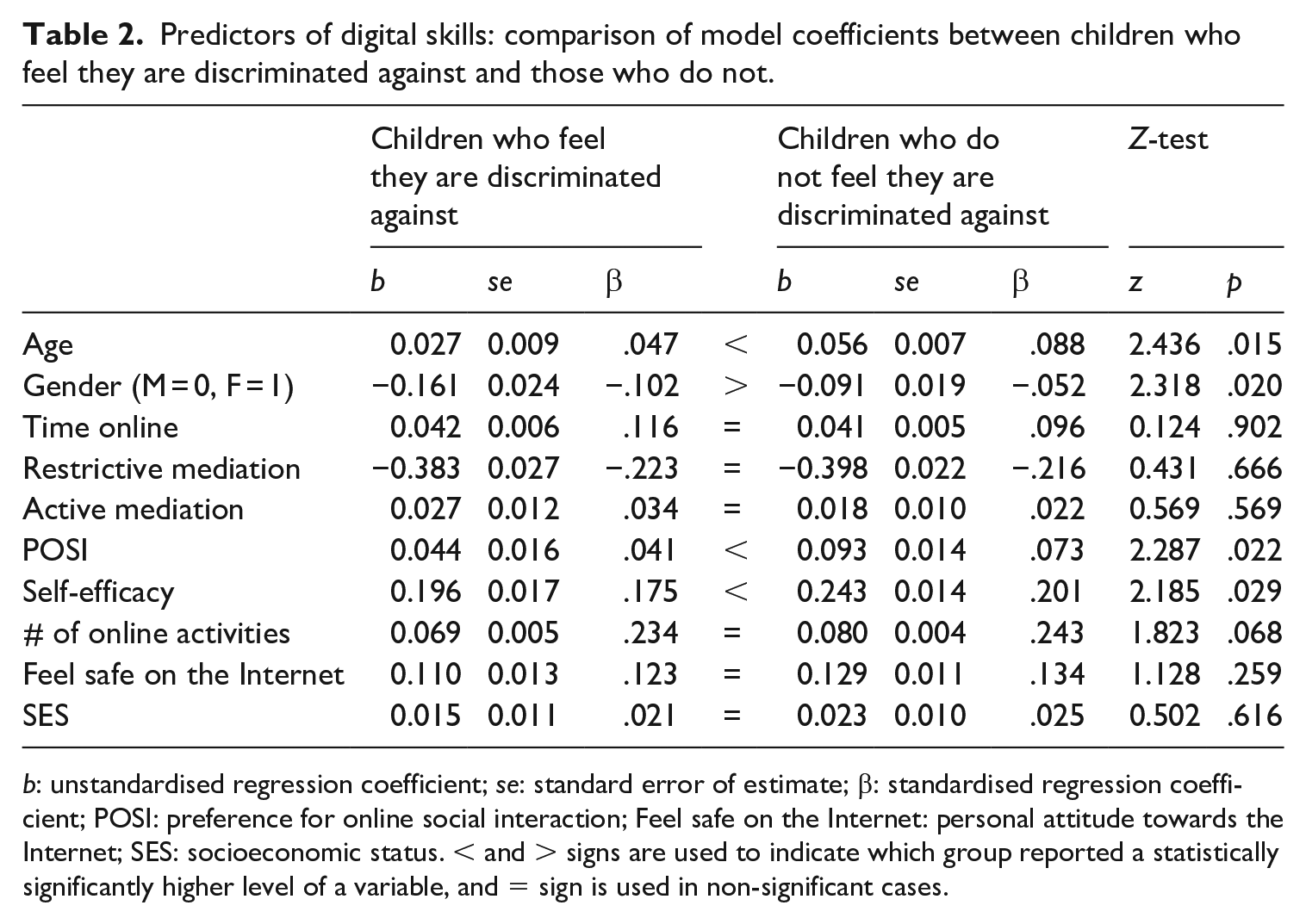
b: unstandardised regression coefficient; se: standard error of estimate; β: standardised regression coefficient; POSI: preference for online social interaction; Feel safe on the Internet: personal attitude towards the Internet; SES: socioeconomic status. < and > signs are used to indicate which group reported a statistically significantly higher level of a variable, and = sign is used in non-significant cases.
Table 3 contains the results of the three-step hierarchical multiple regressions and addresses the second research question. In the first step, age, gender and time spent online during weekdays were added to the model, accounting on average for 11.4% of the variance in digital skills. This increased by 20.6% to a total of 32.1% in the second step, with the addition of restrictive and active parental mediation, preference for online social interaction, self-efficacy, online activities, and personal attitude towards the Internet. Adding SES in the third step, along with the individual and social discrimination variables, increased this proportion only by 0.5% to a total of 32.5%. This suggests that SES and the discrimination variables are not substantively associated with digital skills above and beyond the remaining predictors, and they do not offer much more explanation for the variance in digital skills among European youth who experienced discrimination.
Standardised estimates of the final step of hierarchical linear regressions predicting digital skills across 14 countries.
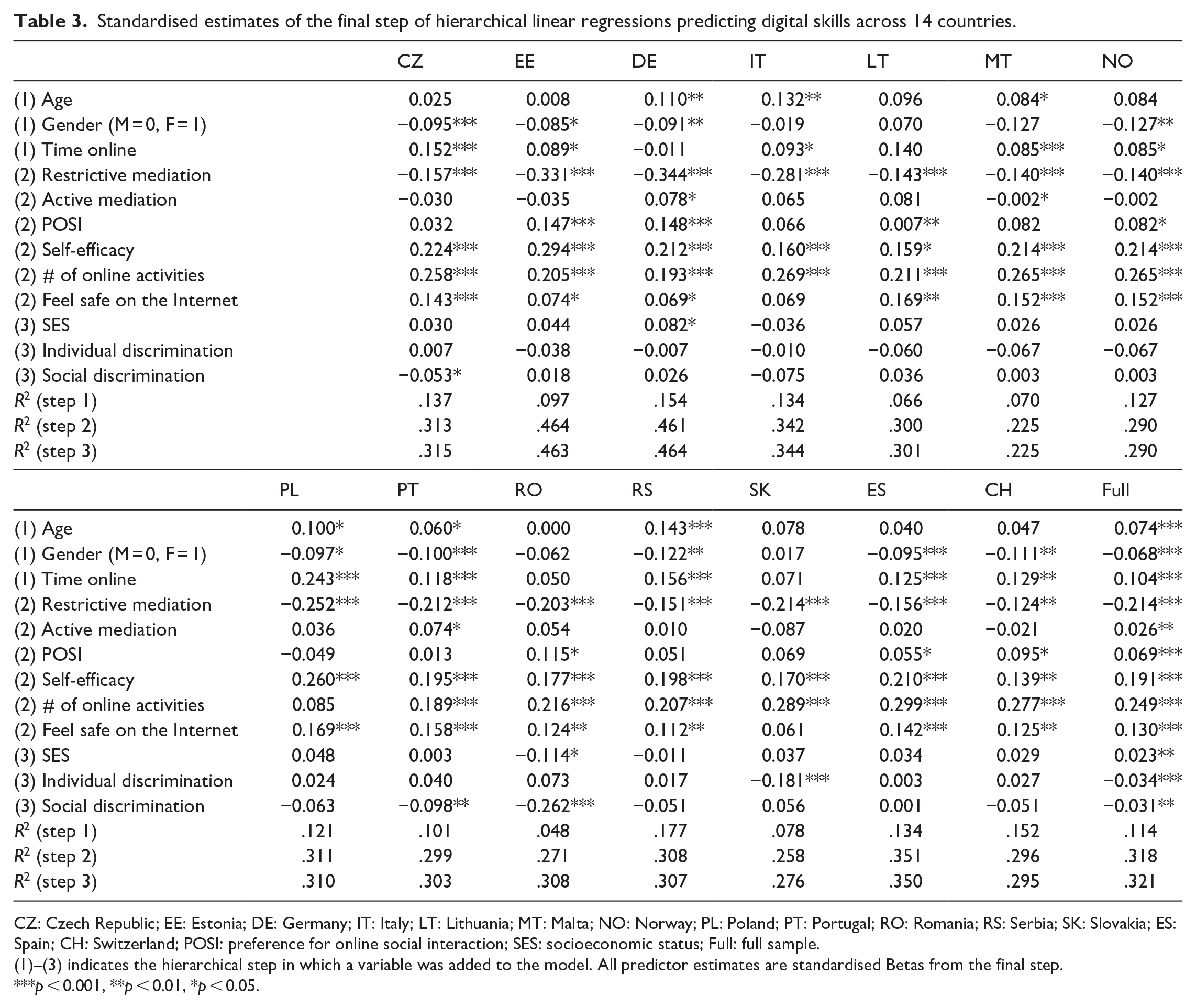
CZ: Czech Republic; EE: Estonia; DE: Germany; IT: Italy; LT: Lithuania; MT: Malta; NO: Norway; PL: Poland; PT: Portugal; RO: Romania; RS: Serbia; SK: Slovakia; ES: Spain; CH: Switzerland; POSI: preference for online social interaction; SES: socioeconomic status; Full: full sample.
(1)–(3) indicates the hierarchical step in which a variable was added to the model. All predictor estimates are standardised Betas from the final step.
p < 0.001, **p < 0.01, *p < 0.05.
This is further supported by the size of the standardised coefficients of the predictors in the model. The strongest and most consistently significant predictors (across countries) were restrictive parental mediation (βs ranged from −.124 in the Czech Republic to −.344 in Germany, with an average value of −0.203 and a full sample value of −0.214); self-efficacy (βs ranged from .139 in the Czech Republic to .294 in Estonia, average = 0.202, full sample = 0.191); number of online activities (βs ranged from .189 in Portugal to .299 in Spain, with a significant effect in 13 countries, average = 0.242, full sample = 0.249); feeling safe on the Internet (βs ranged from .069 in Germany to .169 in Lithuania, with a significant effect in 12 countries, average = 0.132, full sample = 0.130); and time spent online (βs ranged from .085 in Malta to .243 in Poland, with a significant effect in 10 countries, average = 0.128, full sample = 0.104). While more restrictive parental mediation strategies were negatively associated with digital skills (i.e. lower digital skills among youth with more restrictive parents), the other predictors (i.e. self-efficacy, number of online activities, feeling safe on the Internet and time spent online) were positively associated. On the contrary, SES was only statistically significant in Romania (β = −.157) and Germany (β = .082), and its effects were not consistent in direction. While individual discrimination was only significant in Slovakia (β = −.181), social discrimination was significant in Romania (β = −.262), the Czech Republic (β = −.053) and Portugal (β = −.098). However, the effect size was relatively small in the Czech Republic and Portugal.
Discussion and conclusion
The literature on digital skills has long investigated the role of social stratification, socio-cultural differences (age and gender) and ICT environment variables that affect their acquisition by children, but little has been said with respect to how individual and social discrimination influence this relationship. Our research addresses this gap by expanding the range of antecedents of digital skills to include social-psychological resources such as perceived discrimination – we asked whether and how perceived discrimination affects the relationships between the usual antecedents and digital skills, as well as whether perceived discrimination affects these relationships similarly among children in different European countries. The results of our analyses provide supporting evidence for the idea of a recursive loop between diverse social and personal inequalities and digital inequalities. In other words, while perceived individual and social discrimination do not contribute a great deal in predicting the different levels of digital skills achieved by children, they do affect the relationships of socio-cultural resources (age, gender, preference for online social interaction) and personal resources (self-efficacy) with digital skills. Except for gender, these variables are more strongly associated with digital skills among non-discriminated children, suggesting that perceived discrimination weakens the positive impact of age, preference for online social interaction and self-efficacy on digital skills acquisition.
The effect of age on digital skills has been extensively investigated, showing a positive relationship between being older and acquiring more skills (Livingstone and Helsper, 2010). Our results, however, indicate that the progression of children along the scale of digital skills according to age is slower among those who perceived being discriminated against.
In line with previous studies that suggest that boys and girls develop different skills in different areas (van Deursen et al., 2016), boys have been found to report higher levels of digital skills, and this gender difference was larger among those children who felt discriminated against. While the reason for this difference may be a matter of variation in overall self-efficacy and perceived Internet self-confidence rather than of different competences (Haddon et al., 2020), it is important to note that a gender gap in digital skills may be further exacerbated in the case of individual and social discrimination.
As for preference for online social interaction, it may be speculated that children who prefer to spend a more time cultivating social relationships online than offline may also develop more skills (Smahel et al., 2012). However, children who felt discriminated against benefit less from social uses of ICTs – at least as indicated by the lower influence of preference for online social interactions on digital skills acquisition.
Drawing on the social compensation theory, we may argue that children who perceive themselves as being discriminated against may turn online to establish beneficial relationships (Valkenburg et al., 2006). However, against the social compensation hypothesis, Helsper (2017) found that NEETs with less Internet access tend to prefer face-to-face interactions. Therefore, they may not benefit from informal learning opportunities in terms of skills acquisition associated with more intense social uses of ICTs.
Another finding worth further investigation concerns the role of self-efficacy: while believing in yourself has stronger positive impacts for those children who did not feel discriminated against – which is consistent with previous studies (Livingstone et al., 2018) – those who did feel discriminated against do not seem to benefit equally from this psychological resource. Taken together, these findings offer support for the recursive loop hypothesis (Helsper, 2021; Robinson et al., 2020), on which basis several structural social and psychological resources interact to produce digital disadvantage.
However, these results partly contradict previous research that has shown how children who feel disadvantaged against would develop more skills than their non-disadvantaged peers because of an increase of risky experiences online that would push them to learn how to cope with stressful situations by improving their technical abilities (Livingstone et al., 2010). Such a contrast is probably due to the kind of analysis we run and our investigation of the role of other intervening variables at the intersection of such a relationship (Alper et al., 2016). This suggests that, even when we consider a plethora of factors that are positively related to digital skills, these are less effective in the case of children who perceive they have been discriminated against.
Interestingly, the results of the hierarchical multiple regressions (Table 3) identified few significant effects for the individual and social discrimination variables when compared to other predictors. Consistent with the literature on the antecedents of digital skills (Haddon et al., 2020), the most significant variables that account for higher levels of digital skills were parental mediation, age, gender, time spent online, preference for online social interaction, self-efficacy and personal attitudes towards the Internet. This suggests that SES and the variables of individual and social discrimination are not substantively associated with digital skills and do not offer much more information in the attempt to explain the variance in digital skills among European children who experience discrimination due to personal or social characteristics. The strong negative effect of restrictive parental mediation is not surprising (Livingstone et al., 2017) and points to the important role played by parents in enabling, or, as is the case here, hindering their children’s acquisition of digital skills despite the personal or social characteristics that may interfere with this relationship. Regardless of previous evidence that has shown how parents of children who feel discriminated against tend to adopt both active and restrictive mediation more often in order for them to safeguard their children online against the backdrop of potential risks (Bosman et al., 2015), the impact of these strategies on the levels of digital skills does not differ between those children who feel discriminated against and those who do not (Table 2). Other variables, such as the number of online activities and self-efficacy, are stronger predictors of digital skills than discrimination variables; this is a positive finding, suggesting that those children who feel discriminated against could compensate for the vulnerability associated with their perceived discrimination if they develop digital skills. However, a lack of intervention designed to minimise restrictive mediation practices in the household could impact on the range of online activities that children engage in and prevent them from building a more confident attitude – which is among the stronger predictors of digital skills. Thus, it may exacerbate the inequalities based on their perceived discrimination.
Our findings also point to the relevance of social and cultural contexts. The linear regressions (Table 3) have shown that the most important predictors of digital skills tend to be stable across countries, although differences exist in their overall impact. By contrast, we can observe differences in relation to individual and social discrimination: perceived discrimination based on individual characteristics is significant in Slovakia, whereas perceived social discrimination is highest in Romania and significant in Portugal and the Czech Republic. Future research could provide further evidence to explain the differential significance of perceived individual and social discrimination across countries.
In terms of the next steps, a limitation of this study was that it did not consider the effect of perceived individual and social discrimination on specific sets of skills, which could have yielded different results. Future inquiry can build on our findings to make a step in that direction.
Overall, this article expands the literature on digital skills and digital divides among children by taking into account the combined role of a range of social and personal inequalities in shaping this relationship. Our findings can be informative for policy-makers, offering further evidence that online and offline vulnerability go hand-in-hand. In terms of practical implications, this study suggests that adopting linear responses to foster digital skills – where more access and use is associated with more opportunities, more skills and more resilience – may not be enough if interventions do not also empower children and help them gain confidence in their ability to use the Internet and handle digital challenges.
Footnotes
Funding
The author(s) disclosed receipt of the following financial support for the research, authorship and/or publication of this article: The research reported here is part of the project Youth Skills (ySKILLS) and received funding from the European Union’s Horizon 2020 Research & Innovation Programme under Grant Agreement no. 870612.
Author biographies
 ).
).