



Abstract
This article advances the understanding of parental mediation of children’s online activities by examining the roles of parental perceptions of risk and parent and child digital skills. Analysis of a survey of European parents distinguishes parental perceptions of the likelihood of risk and the severity of harm before testing the linearity of their relation to digital skills. Results show that parents with higher perceived control over online risk management and those with a broader set of digital skills are more involved in mediating their children’s online activities. The analysis also shows a non-linear, n-shaped relationship between parental skills and parental perception of the severity of harm. The results suggest that future research on parental mediation should distinguish parental knowledge of the digital world based on direct experience from their general perceptions of the likelihood of risk and severity of harm.
Although there has been research on parental anxieties about online risks, research has not examined whether risk perceptions influence parents’ mediation of their children’s Internet use. In this article, we draw on the well-established literature on the social psychology of risk, according to which people adjust their risk management behaviors based on their perceptions of the likelihood of risk and the severity of harm. We also examine whether any relationship between risk perception and parental mediation might be influenced by parents’ or children’s digital skills. Previous research on parental mediation has established that more digitally skilled parents, and those with more skilled children, more actively mediate their child’s Internet use (Livingstone and Helsper, 2010; Livingstone et al., 2017; Kirwil et al., 2009). This may be because skilled parents understand the risks better, but such a role for risk perception has not been explicitly examined, except through qualitative research suggesting that parental mediation is influenced by parental perceptions of the digital world in which their children are growing up (Livingstone and Blum-Ross, 2020). In this article, we aim to deepen current understanding of how parents mediate their children’s online activities by examining the role-played by parental perceptions of risk and children’s prior experience of risk online and how these link to parent and child skill levels, by analyzing nationally representative surveys of parents of 6- to 14-year olds in eight European countries. While the data were collected almost a decade ago, the recent surge in concern around digital media and mobile phones in particular, makes this a very timely and relevant study due to its demonstration of the importance of different aspects of risk perception in understanding parental mediation of Internet use.
Parental mediation
Early conceptualizations of parental mediation strategies derived from research on children’s television viewing (Clark, 2011). In the digital age, passive approaches such as co-viewing are blending with active mediation, given the interactive nature of Internet use (Garmendia et al., 2012; Valkenburg et al., 2013). Research has recently identified five parental mediation strategies: active mediation of Internet use (actively discussing and/or sharing an online activity); active mediation of Internet safety (explaining online risks or helping with a problem); restrictive mediation (such as limiting time spent or activities online); technical controls (using filters or monitoring software); and monitoring (checking the child’s online activities after use) (Livingstone et al., 2011; Chang et al., 2015; Nikken and Schols, 2015). Research also recognizes child-initiated activities; children sharing experiences or offering support to parents (Clark, 2011; Shin, 2013). Two overarching strategies exist: enabling mediation, which encompasses active mediation of Internet use, safety mediation, parental monitoring and use of technical controls, can be distinguished from restrictive mediation (Livingstone et al., 2017). The advantage of the former is that children are more able to explore the opportunities that the Internet offers, while encountering risks within a supportive environment. By contrast, restrictive forms of mediation have been shown to reduce risky encounters but at the cost of online opportunities (Livingstone et al., 2017; Kirwil et al., 2009).
Several factors differentiate parents in their choice of mediation strategy. Less educated (and less digitally skilled) parents are less likely to mediate their children’s Internet use, and when they do, they are less consistent and tend toward more-restrictive and less-enabling mediation, also preferring to use tools provided by external parties (Garmendia et al., 2012; Nikken and Schols, 2015). Enabling mediation is more prevalent among mothers compared with fathers, parents in households with higher education and socio-economic status or those with better digital skills (Livingstone et al., 2011; Livingstone et al., 2017; Kirwil et al., 2009; Valcke et al., 2010); however, we found no research that links restrictive mediation to either social status or skill.
Risk perception
The study of risk perception has long sought to understand preventive and risk management behavior in the face of natural or health risks (Clarke, 2006; Wuthnow, 2012). Parental mediation of children’s Internet use is a behavior that aims to mitigate potential harms associated with this use and could be illuminated by the application of risk perception theories. Within this literature, we focus on parents’ everyday perceptions of the likelihood of risks and severity of associated harm, the importance of a child’s prior risk experiences, and parents’ ability to manage risk situations to limit potential harms (Slovic, 2010). These appear relevant to parental mediation yet have not, to our knowledge, been researched in the literature on parental mediation.
Perceived likelihood and severity of risk and parental mediation
Risk perception research is grounded in theories of reasoned action (Ajzen, 1991; Ajzen and Fishbein, 2004). It hypothesizes that people who perceive the likelihood of risks to be high, or the associated harm to be severe, are more likely to act to prevent such risks (Slovic, 2016). Research should assess both the likelihood of risk and the severity of harm, analyzing them separately, because when risks are perceived to be likely but not severe in their consequences, or when they are perceived to be unlikely but severe, responses vary (Slovic et al., 1986). This risk perception framework has been successfully applied in family contexts. For example, Napper et al. (2015) showed that parents’ perceptions of the likelihood and consequences of alcohol use influenced their willingness to communicate with their child about alcohol. Indeed, a few studies have examined parents’ perceptions of the Internet in general but without linking these to mediation (Lee, 2012; Nikken and Jansz, 2014). Others have examined parental attitudes toward online risks and linked these to parental mediation but without distinguishing the different elements of risk perception (Symons et al., 2019). Or, they have examined how children’s (but not parents’) risk perceptions and risk taking relate to parental mediation practices (Chang et al., 2018; Dedkova and Mýlek, 2022; Ramos-Soler et al., 2018).
The little available research linking risk perception to parental mediation shows that parental risk perception is more strongly related to enabling than restrictive mediation, although they are positively related to both (Symons et al., 2019). Livingstone et al. (2017) show that as parental perceptions of online risks increase, initially only enabling mediation increases, but when the risk perception becomes high, restrictive mediation also increases. This suggests feedback loops between risk perception, mediation and observed experiences of harm; possibly, parents who favor enabling mediation to allow their child more freedom to explore see that their child does well online, confirming their perception that risks are either unlikely or that any harms are not severe. It is also possible that parents who perceive their child’s online activities as likely to be harmful might favor restrictive mediation and, since this will likely result in fewer online risks, it could reinforce them in their view of a risky online world and the value of restrictive mediation.
Risk experience and parental mediation
Theories of reasoned action have been criticized for underplaying the role of actual experiences of risk, such as those described above as part of a potential risk-mediation-risk feedback loop. Unsurprisingly, research does show that past experiences of risk influence people’s perceptions of the nature, likelihood, and severity of future risks (Albarracin and Wyer, 2000; Pachur et al., 2012). This is often explained through the availability heuristic (Maley et al., 2000): once someone has experienced a risk, they are likely to overestimate its future likelihood because they remember its occurrence. More simply, if someone has experienced a risk, they know that it can happen and so may estimate its future likelihood to be higher (Alhakami and Slovic, 1994; Barnett and Breakwell, 2001). Also important is the effect associated with past risk experiences (Keller et al., 2006). For example, Rosen and Kostjukovsky (2015) found that parental risk perception of the likelihood of negative effects of exposure to tobacco smoke on their children depended on the parent’s own experiences with smoking and its consequences. Note, however, that research on media panics suggests that the lack of a risk experience may not necessarily lead to low estimations of risk likelihood or severity, insofar as sensational or newsworthy reporting increase parental risk anxiety, leading them to overestimate both likelihood and severity (Critcher, 2003; Staksrud, 2013). Mediated experiences of risk might explain why parents overestimate their children’s exposure to cyberbullying while not overestimating their exposure to less-newsworthy risks such as unwanted advertising (Livingstone et al., 2011). An added complication to the risk perception literature is that it is the prior online risk experiences of the child more than the parent that are likely to influence parental perceptions and mediation strategies.
Online risk management and digital skills
Responding effectively to online risks is far from straightforward. Usefully, the risk perception literature conceptualizes risk management as perceived behavioral control, encompassing the perceived ease of performing certain behaviors and one’s control in managing risks (Fishbein, 2007; Fishbein and Ajzen, 1975). Consequently, we conceptualize online risk management as parents’ perceived ease of managing, and perceived control over, the online risks their child may be exposed to, and we distinguish this from parents’ general digital skills, though it is plausible that these, too, make online risks more manageable and mediation more feasible.
How does such risk management relate to digital skills? Until now, research has looked at parents’ digital skills in general rather than specifically in relation to managing online risks faced by their children. Yet we know that more digitally skilled parents are more likely to mediate their children’s Internet use (Clark, 2011; Lee, 2012; Nikken and Schols, 2015), presumably because they have a better understanding of the risks their child might encounter online and more experience themselves in navigating these risks. We also have evidence that more digitally skilled parents prefer enabling mediation so that their children can take advantage of online opportunities while avoiding potential harm from risky activities, while parents lacking such skills tend to rely on restrictive mediation and so reduce risks but at the cost of their children’s opportunities (Livingstone et al., 2017; Kirwil et al., 2009). The perception the parent has of their child’s digital skills is also important for parental mediation. For example, parents take a more restrictive approach if they perceive their child to have lower levels of digital skills, while enabling mediation is preferred by parents who perceive their child to be more digitally skilled, presumably because they estimate that their child will be better able to cope with risks they encounter online (Livingstone et al., 2017).
At present, it remains unclear how parents’ digital skills are related to their perceptions of online risk as regards likelihood or severity. It is plausible that those with little knowledge of the Internet know less of its risks while those with more experience of the Internet will perceive the likelihood or severity of online risks to be greater, leading to more parental mediation. It is also unknown whether it is the parents’ skill in navigating the digital world generally or specifically in online risk management that matters to their parental mediation strategies. It is possible that a parent is highly digitally skilled yet does not perceive that they can manage or control their child’s experience and so take no action. Conversely, there might be parents who are confident they can manage online risks for their child but who underestimate the likelihood or severity of those risks and so do not take action.
In this context, we frame a nonlinear hypothesis. Less digitally skilled parents will perceive the likelihood of risk to be lower, because of their lack of experience (or because they see their child to be more skilled than they are in coping with risk). Highly skilled parents may also perceive online risks to be less likely or less severe because they know from their own engagement with digital technologies that risks are less frequent than media reports would lead one to believe, and because they have gained confidence in their and their children’s skills to prevent online risks resulting in actual harm. Parents with average skills, however, may have just enough experience to know of the risks but worry that they or their children will not be able to cope with them, especially in a climate of media panics about children’s risky Internet use (Livingstone and Blum-Ross, 2020).
Framework and hypotheses
Research is still to consider the full quad that we have argued to be of importance in explaining parental mediation, that is risk perception, risk experience, digital skills, and online risk management. Our main research question is whether the explanation of parental mediation is improved by including variables from the literature on risk perception as shown in Figure 1.
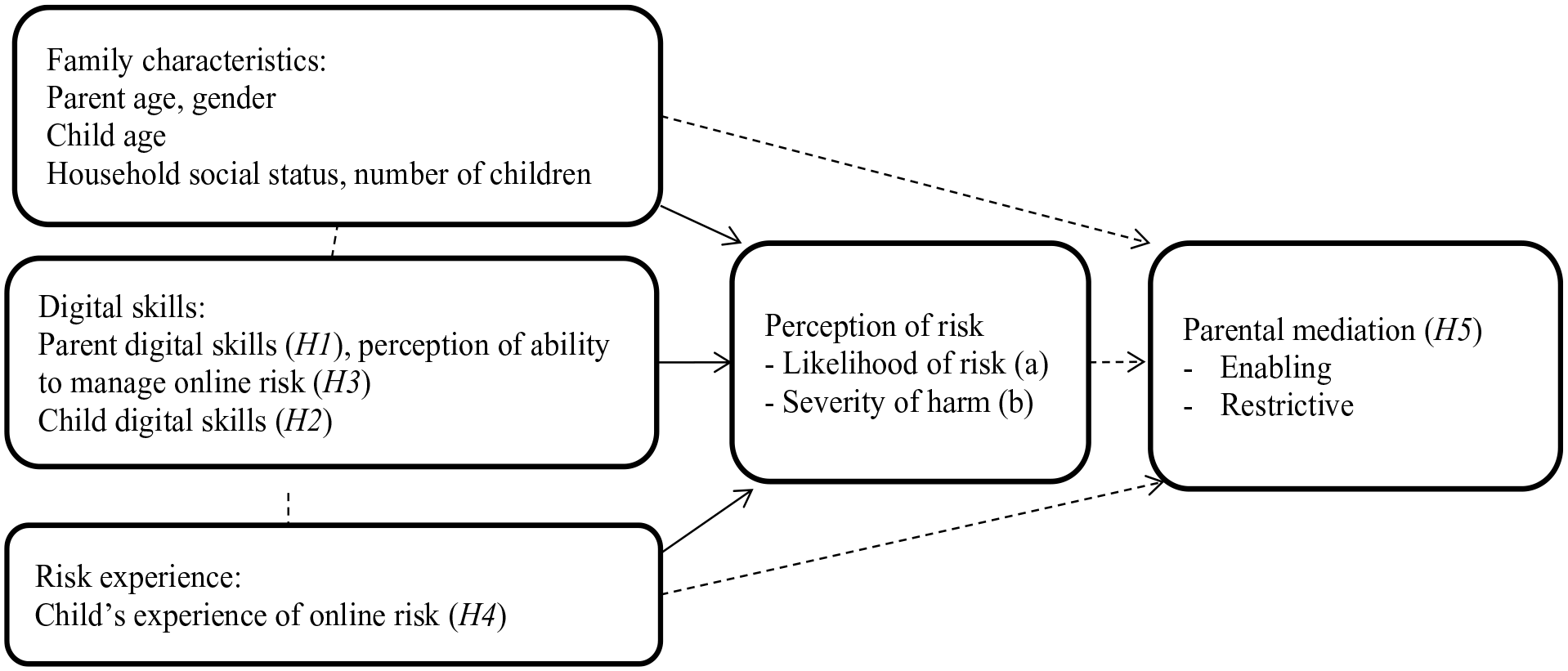
Framework for explaining parental mediation.
Based on the foregoing discussion, specific hypotheses are as follows:
We hypothesize a curvilinear relationship between digital skills and risk perception (H1), with the least and most skilled parents perceiving online risks to be less likely (H1a) and the harms associated with them to be less severe (H1b).
Taking an exploratory approach, we expect no relationship between the child’s digital skills and the parent’s perception of the likelihood of online risks, since the latter are intrinsic to the digital world. However, we do propose that parents will be more likely to expect their child to avoid online risks escalating into a harmful (i.e. severe) situation the more skilled they believe their child to be; we expect this to be the case even if children are more likely to encounter risks due to their greater involvement. Thus, our second hypothesis (H2) is that there will be a linear negative relationship between the child’s digital skills and parental perceptions of the severity of harm (H2b). However, we do not expect to find support for a hypothesized relationship between the child’s digital skills and parental perceptions of the likelihood of online risks (H2a).
Our third hypothesis (H3), based on the social psychology of risk literature, is that independent of a parent’s digital skills, if their perceived ease of and control over online risk management is lower, they will estimate the likelihood of risk (H3a) and the severity of harm (H3b) to be higher (e.g. an informed but helpless parent).
Bearing in mind that previous research finds the incidence of online risks to be moderate and the chances of severe harm to be low (Livingstone et al., 2011; Smahel et al., 2020), we hypothesize (H4) that if a child has experienced more risk, the parent will estimate the likelihood of (future) risk to be higher (H4a) but the severity of (future) harm to be lower (H4b).
Finally, and most importantly, in the absence of prior research distinguishing the perception of risk likelihood from risk severity, we can only frame a simple hypothesis (H5): when the perception of the likelihood and severity of harm from online risks is higher, we expect enabling and restrictive mediation to be more often practiced by parents.
Methods
Sampling
The target population was people aged 25 to 65 with children aged 6 to 14 living in their household and under their responsibility or care. The survey was administered by computer-assisted web interviewing (CAWI) using online panels in France, Germany, Italy, the Netherlands, Poland, Spain, Sweden, and the United Kingdom, with 800 interviews per country (total N = 6,400). These countries were selected because they varied in parental mediation strategies, digital skills, and online risks and opportunities (Lupiáñez-Villanueva et al., 2016). Quota sampling was used with random sampling within age quotas (25–34, 35–49, and 50–64) to ensure a representative sample in each country (see Table 1).
Sample characteristics for each country.
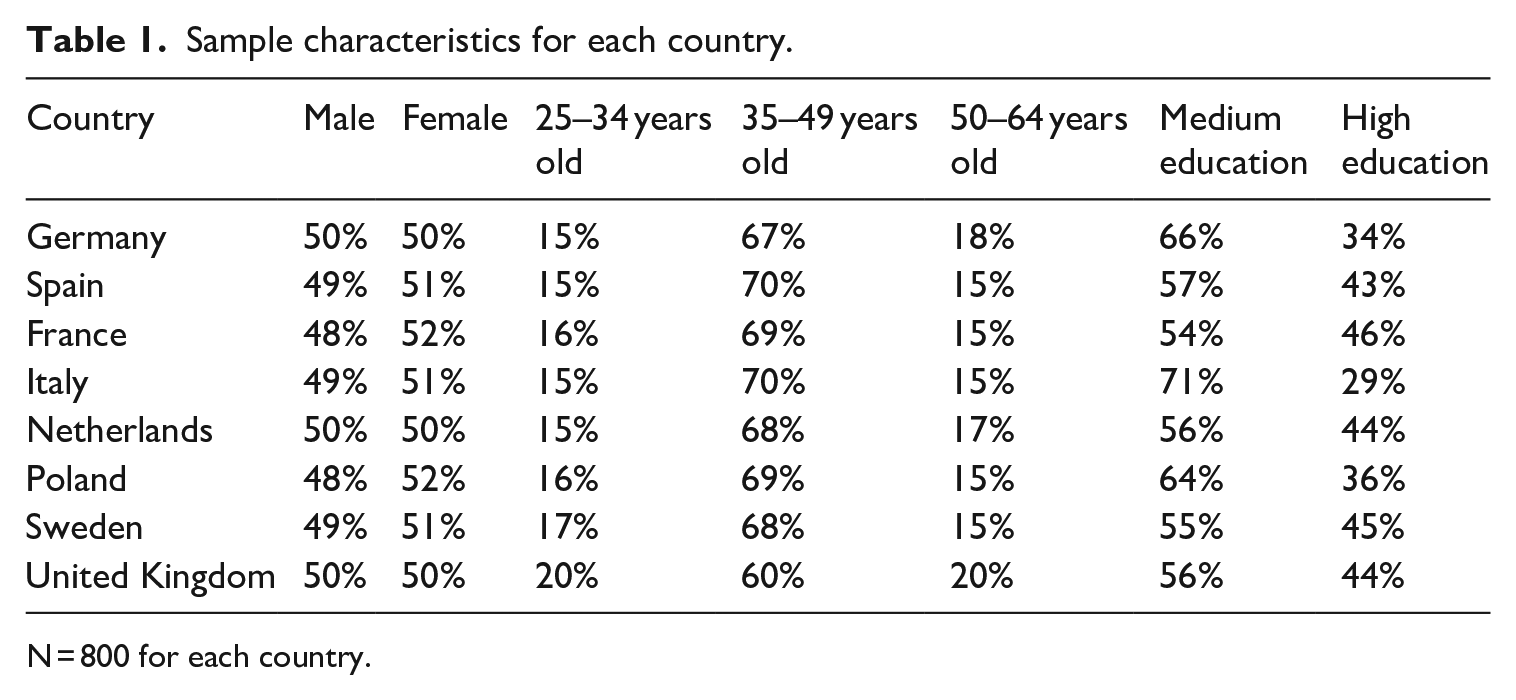
N = 800 for each country.
Participants were paid after completing a number of surveys, with incentives in the form of gift cards, lotteries, or bank transfer. The survey followed European Society for Opinion and Market Research (ESOMAR) and International Chamber of Commerce (ICC) (2016) ethical guidelines, with ethical authorization provided by [the lead author’s university] Research Ethics Committee for the research in all eight countries.
The data were collected in February and March 2015. This was a time at which there was increasing media attention and public concern around online safety, when parents themselves were gaining digital skills and a broader understanding of the risks and opportunities afforded by Internet use, making it therefore a key moment to study the theorized relationships between risk perception, experience, skills, and parental mediation. At the time of writing there is again an upsurge in concern among parents, this time around wellbeing, mobile phones, and social media. While a slightly different set of risks were prominent at the time, the pattern of heightened concern about risks and calls for parental mediation show similarities. Therefore, the presented study examining the general principles linking specific aspects of risk perception to parental mediation is of much relevance.
Measures
The survey was primarily intended to explore parental beliefs, concerns, and actions in relation to the commercial environment online, as part of a larger multimethod study (Lupiáñez-Villanueva et al., 2016). Here, we report an analysis of findings from a subset of measures.
Parental and household characteristics
Parent measures included age (M = 42.2 years, SD = 7.44) and gender (51% mothers). Household measures included subjective socio-economic status, based on the MacArthur single-item self-report scale asking individuals to place themselves on a 10-step ladder in terms of where they stand compared to other people in their country (M = 5.57, SD = 1.78) (Adler et al., 2000). We also measured the number of children in the household (M = 1.38, SD = 0.58) and age of the child (M = 10.69, SD = 2.68).
Parental risk perceptions and child experiences
For each of 10 online risks, parents were asked how likely it was that the child would encounter the particular risk (perceived likelihood of risk [PLR]: 1 = not likely at all to 7 = very likely) and how severe the harm would be if the child would encounter the risk (perceived severity of harm [PSH]: 1 = not harmful at all to 7 = very harmful) (see Slovic, 2010). The risks were: To see images on the Internet that contain explicit violence against others; Being exposed to personalized/targeted advertisements (in social media, Google searches, etc.); To be treated in a hurtful or nasty way on the Internet by another child or teenager; Spending too much money on online games or in-app purchases; Being exposed to incentives to make in-app purchases while playing an online game; Being exposed to hidden advertisements on online platforms, such as branded games or product placement; That his or her personal data are being tracked, stored, and used by third parties that use it for a purpose other than that for which they were collected; Being exposed to advertising about unhealthy lifestyle products such as tobacco or alcohol; Being exposed to advertisements of unhealthy food; and Digital identity theft or identity fraud in which someone wrongfully obtains and uses your child’s personal data (Livingstone et al., 2011). The broader study of which this article is a part focused on advertising and gaming and therefore the risks considered were overwhelmingly commercial (or “contract”) risks, and only single items on contact and content risks (Livingstone and Stoilova, 2021) were included.
Parents were then asked whether, as far as they were aware, their child had encountered each of the 10 online risks in the past year (yes = 1, no = 0).
Single scales were calculated for each of these three measures by averaging the contributing items – likelihood (M = 4.40, SD = 1.61, α = 0.96), severity (M = 5.59, SD = 1.17, α = 0.93) and past risk experience (M = 0.26, SD = 0.25, α = 0.82).
Perceived online risk management
Parents were asked two questions concerning ease of and control over online protection: “Do you find protecting your child from online threats is . . .” with a scale from 1 (very difficult) to 7 (very easy) (M = 3.69, SD = 1.60) and “How much control do you believe you have over protecting your child from online threats?” with a scale from 1 (no control) to 7 (complete control) (M = 4.76, SD = 1.31).
Digital skills of parent (DSP) and digital skills of child (DSC)
The operationalization of digital skills developed by the project “From Digital Skills to Tangible Outcomes” (DiSTO) was used for this article (Van Deursen et al., 2016). This framework has been tested and validated to counter social desirability issues in digital skills measurement (Van Deursen et al., 2017). Digital skills were measured for operational skills (five items), information/browsing skills (five items), social skills (five items), creative skills (five items), and mobile skills (three items). These were assessed using a 5-point Likert-type scale that focuses on truth claims from “Not at all true of me” to “Very true of me” to avoid social desirability bias (Helsper et al., 2021; Spitzberg, 2006; Van Deursen et al., 2016). These are not hypothesized to have different relationships with parental mediation, so single scale was calculated for digital skills by summing the contributing items (M = 4.14; SD = 0.75, α = 0.87). We created non-linear versions of this scale (M = 17.76; SD = 6.46, α = 0.90) by squaring the variable (i.e. multiplying it by itself = DSP2). Parents were asked to assess their child’s skill using the same measures (5 = very true of my child to 1 = not at all true of my child). For parental perceptions of the child’s digital skills only a normal, linear variable was created (M = 7.46; SD = 12.95, α = 0.95).
Parental mediation
The survey included five items for active mediation of Internet use (scale from 4 = always to 0 = never), eight items for active mediation of Internet safety (5 = always to 1 = never), 17 items for parental restrictions (0 = can do this anytime, 1 = can only do this with my permission or supervision, 2 = can never do this), nine items for parental technical controls (yes = 1, no = 0), and six items for parental monitoring (4 = always to 0 = never) (from Livingstone et al., 2011). A factor analysis using principal components analysis and varimax rotation had previously revealed a two-factor solution—“enabling” and “restrictive” mediation (Livingstone et al., 2017). Child-initiated support loaded positively on the “enabling mediation” and negatively on the “restrictive mediation” factor and was included in the enabling mediation scale. Composite enabling (M = 3.00, SD = 0.96, α = 0.86) and restrictive 2.47 (M = 2.47, SD = 1.35, α = 0.94) mediation scales were constructed by summing the scores for the items on the component scales.
Country
Country dummies were created to control for differences between the countries in the dependent variables of risk perception and parental mediation.
Results
The hypotheses were tested by analyzing the additional variance explained by non-linear conceptualizations of parents’ digital skills (H1) through analysis of variance (ANOVA) and through linear regressions of the likelihood and severity of harm associated with online risks (H2, H3, H4) and how these relate to parental mediation (H5).
Non-linear relationships between digital skills and risk perception
First, we examine the relationships between parental perceptions of the likelihood and severity of online risks and their digital skill, to test the hypothesis (H1) of a curvilinear relationship between digital skills and the two dimensions of perceived risk.
To test whether curvilinear relationship between risk perception and parents’ digital skills is a significant improvement on a linear relationship, ANOVA analyses were conducted. Table 2 shows that the model with a quadratic form of digital skills to explain perceived severity of risk is an improvement on the model that uses a linear form (F = 10.59, p < 0.001), though for the likelihood of risk, there is no improvement when incorporating the curvilinear relationship (F = 0.55, p = 0.46). Greater parental digital skills (H1a) are related to parents perceiving it less likely their child will encounter online risk. Although we expected a non-linear relation between parents’ digital skill and risk perception, we found a linear relationship for perceived likelihood of online risk, consistent with prior research (Livingstone et al., 2017, Van Deursen et al., 2017), but hypothesis (H1b) was supported for perceived severity of harm, for this was higher for parents with average digital skills compared with both less and more skilled parents.
Comparison of linear and curvilinear (quadratic) relationships between parents’ digital skills and the perception of risk likelihood (i) and the severity of harm (ii).
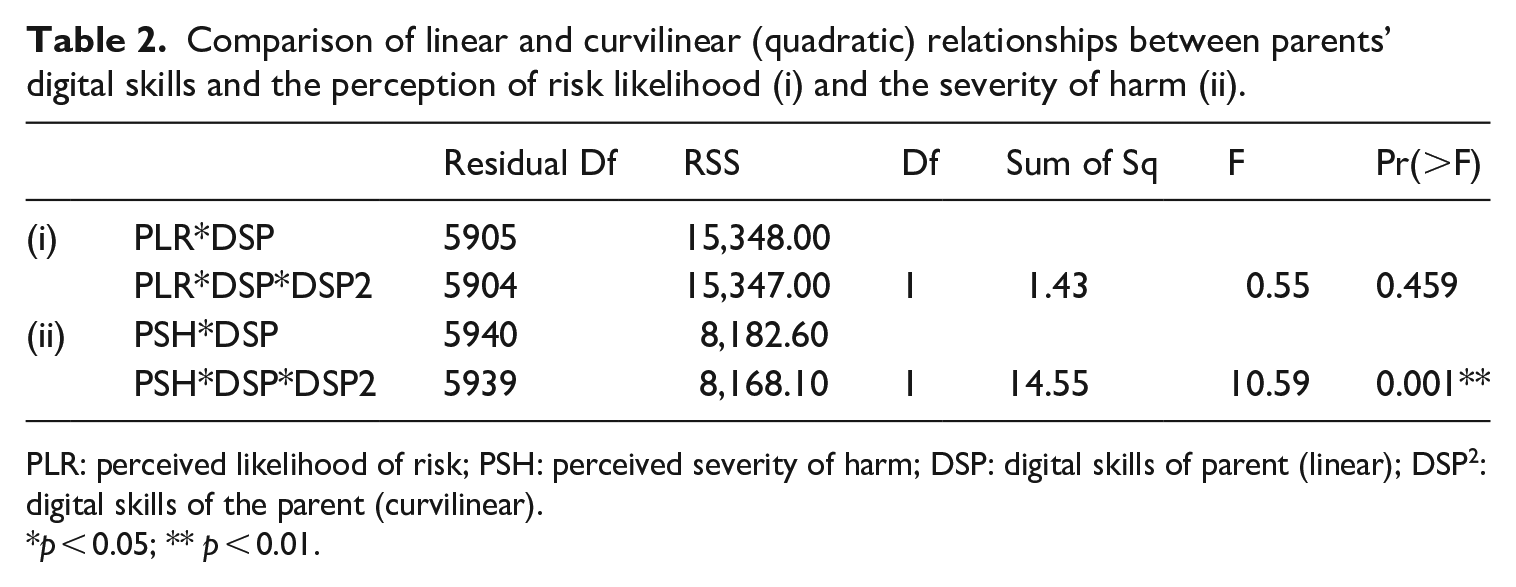
PLR: perceived likelihood of risk; PSH: perceived severity of harm; DSP: digital skills of parent (linear); DSP2: digital skills of the parent (curvilinear).
p < 0.05; ** p < 0.01.
Explaining parental risk perception
Table 3 shows the regression models for the perceived likelihood of a child encountering risks online and the perceived severity of harm if the child were to encounter a risk. The models include as predictors the characteristics of the parent and the household, parent and child digital skills, parental perceived online risk management (ease and control), and child’s risk experience, controlling for country effects.
Linear regression predicting parental perceptions of the likelihood of risk (PLR) and severity of harm (PSH).
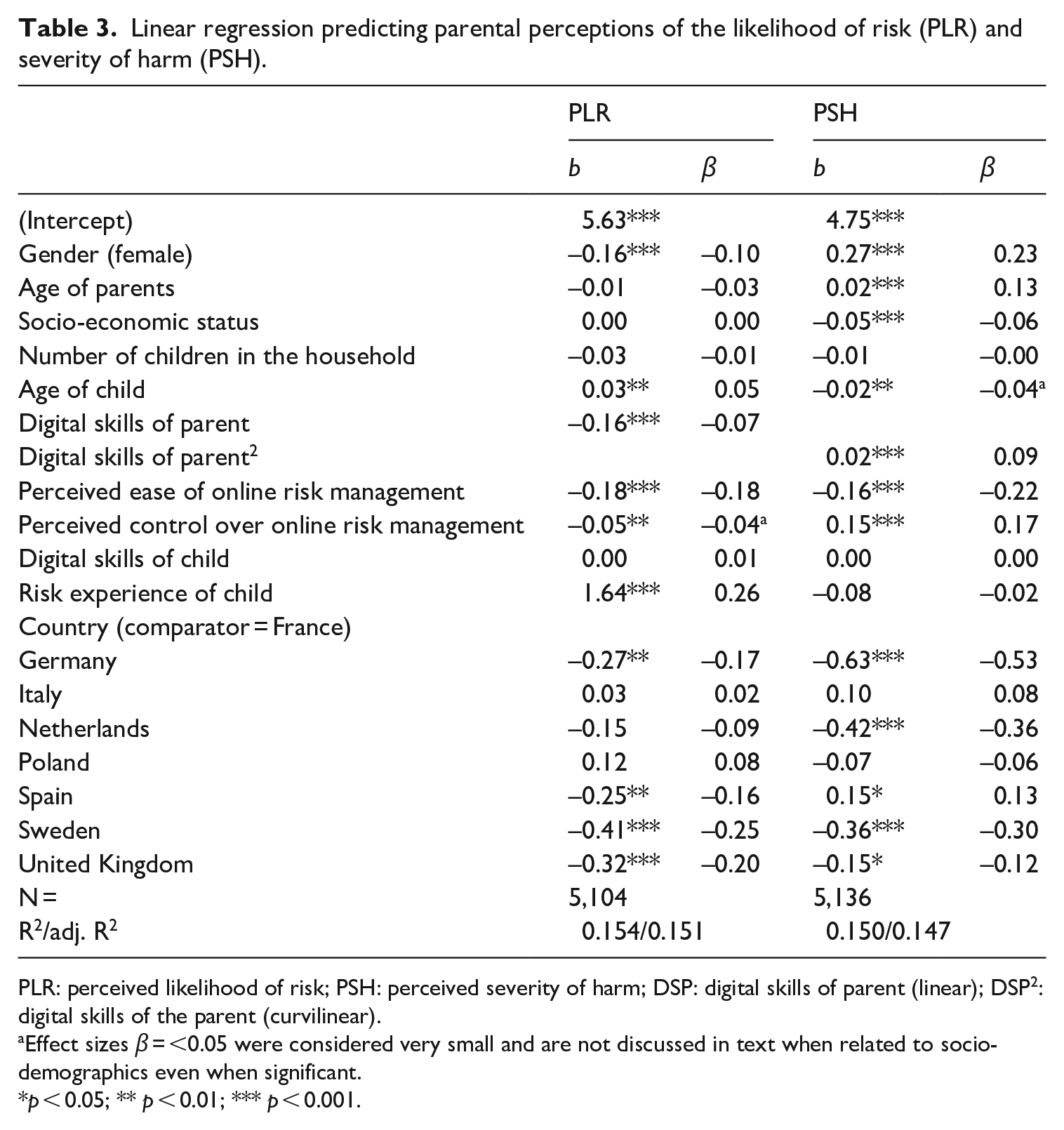
PLR: perceived likelihood of risk; PSH: perceived severity of harm; DSP: digital skills of parent (linear); DSP2: digital skills of the parent (curvilinear).
Effect sizes β = <0.05 were considered very small and are not discussed in text when related to socio-demographics even when significant.
p < 0.05; ** p < 0.01; *** p < 0.001.
Parental and household characteristics
Mothers (β = –0.10, p < 0.001) perceive a lower likelihood of their child encountering a risk online than fathers, while those with older children perceive a slightly higher likelihood. In contrast, mothers (β = 0.23, p < 0.001) and older parents (β = 0.13, p < 0.001) are more likely to perceive the severity of harm to be high, while parents of lower socio-economic status (β = –0.06, p < 0.001) perceive a lower severity of harm.
Digital skills, parent’s perceived online risk management, and child’s prior experience of online risk
Parental digital skills are negatively related to the perceived likelihood of risk (β = –0.07, p < 0.001), with more skilled parents perceiving online risks to be less likely. There is also a non-linear relation between a parent’s digital skills and perceived severity of harm, supporting H1b (β = 0.09, p < 0.001). The child’s digital skills are unrelated to the parent’s perceived likelihood of risk (β = 0.01, p = 0.59) or severity of harm (β = 0.00, p = 0.82), supporting H2a but not H2b.
Parents who perceive online risk management to be easier also perceive the likelihood of risk (β = –0.17, p < 0.001) and severity of harm to be lower (β = –0.04, p < 0.01). Parents who feel they have control in managing their child’s online risks also perceive the likelihood of risks to be lower. This provides support for H3a but only partial support for H3b, since parents who feel they can control risks perceive a higher severity of harm. Perceptions of online risk management (H3a) are related to parents perceiving it less likely that their child will encounter online risks. Furthermore, parents who are more confident that online risk management is easy tend to perceive any associated harm to be less severe (H3b). Perceived control was more strongly related to perceived severity of harm than to perceived likelihood of risk (the latter had a very small effect), but the direction of the association is not that hypothesized (H3b). Specifically, we found that parents who are more confident that they can control online risks for their children perceive the severity of harm to be greater.
If the child previously experienced online risks, the parent’s perception of the likelihood of risk increases (β = 0.26, p < 0.001), supporting H4a. Experience of risks was not related to perceived severity of harm (β = –0.02, p = 0.23), contradicting our hypothesis of a negative relationship between a child’s experience of risk and parental perceptions of severity (H4b).
Cross country variation
To fully explore the nature of the differences across countries would require a separate and additional analysis beyond the scope of this article. Having statistically controlled for variation explained by country characteristics, we note that adding the country dummy variables increases by only 0.01 percent the variance (and adjusted variance) explained of the perceived likelihood of risk, while the increase for severity of harm was 0.02%.
Explaining parental mediation
The multivariate analysis in Table 4 examined the relationships among parental mediation, parents’ digital skills, their perception of online risk management, and their perceptions of risk likelihood and the severity of harm associated with these (H5).
Multiple regressions predicting parental enabling and restrictive mediation.
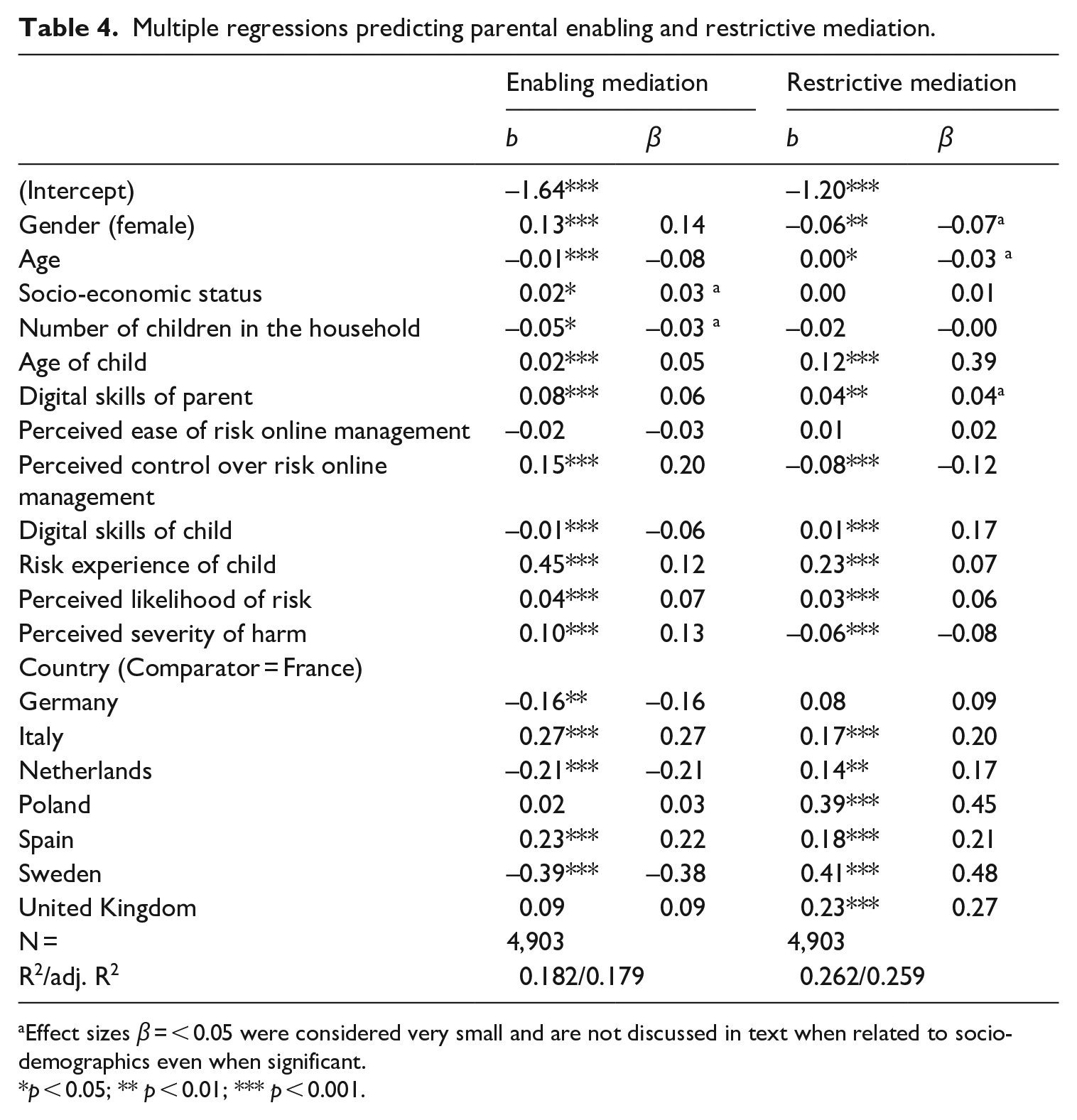
Effect sizes β = < 0.05 were considered very small and are not discussed in text when related to socio-demographics even when significant.
p < 0.05; ** p < 0.01; *** p < 0.001.
Digital skills, parents’ perceived online risk management, and child’s prior experience of online risk
Parental skills relate positively to both enabling (β = 0.06, p < 0.001) and restrictive (β = 0.04, p < 0.01) mediation. The two measures of parental online risk management behaved differently in relation to parental mediation: while perceived control of online risk management is positively related to enabling mediation (β = 0.20, p < 0.001), it is negatively related to restrictive mediation (β = –0.12, p < 0.001). Perceived ease of risk management relates to neither enabling (β = –0.03, p = 0.05) nor restrictive mediation (β = 0.02, p = 0.15). Parents who perceived their children to have higher digital skills practiced less enabling (β = –0.06, p < 0.001) and more restrictive (β = 0.17, p < 0.001) mediation. Parents whose children had experienced risks practiced more of both types of mediation (enabling β = 0.12, p < 0.001; restrictive β = 0.07, p < 0.001).
Perceptions of risk
The perceived likelihood of a risk was positively related to both enabling (β = 0.07, p < 0.001) and restrictive (β = 0.06, p < 0.001) parental mediation styles. The perceived severity of harm was positively related to enabling mediation (β = 0.13, p < 0.001) but negatively related to restrictive mediation (β = –0.08, p < 0.001). This offers only qualified support for H5: enabling mediation is positively related to higher perceptions of risk likelihood and higher perceptions of severity of harm. But while restrictive mediation is positively related to higher perceived likelihood, it is lower when perceived severity of harm is higher.
Parental and household characteristics
The findings confirm previous research that shows that mothers, parents who are younger or with older children in the household practice more enabling mediation. Fathers and parents of older children practice more restrictive mediation.
Cross country variation
Having entered country dummies to control for country-level effects, we note that the country differences are persistent and stronger for parental mediation than for risk perceptions.
Discussion
This article’s contribution consists of two parts: the first examined explanations of parental risk perception based on their own and their child’s skills and experiences. The second explored how these factors alongside risk perceptions explained different forms of mediation. Risk perception included measures of the estimation of likelihood as well as severity of risks, and digital skills included the skills of the parent and of the child (as perceived by the parent), as well as the parents’ perceptions of their ease and control in managing online risks for their children.
In hypothesizing a non-linear relationship between parental digital skills and risk perception, we assumed that parents with average skills have enough knowledge to understand that risks exist and simultaneously are aware of their own skill limitations in facing these risks, thus estimating that encountering risks might lead to more severe harm. Higher and lower skilled parents, albeit for different reasons, were presumed to perceive the likelihood and severity of harm as lower. As hypothesized, parental skills were non-linearly related to the severity of harm. However, they were linearly and negatively related to likelihood (i.e. more skill relates to perceptions of lower likelihood). The reasons for this need to be further explored.
We also found differential relationships between the experience of risk and the perception of the likelihood and severity of risk. The availability heuristic might explain that experiences of risk relate to a higher perceived risk likelihood. Similarly, that children encountering online risks is not associated with parents perceiving harm to be severe, suggests that these experiences are generally not severe in nature.
The findings regarding parental management of online risks for their child and their perceptions of the likelihood and severity of these risks add complexity to explanations of risk perception. While parental perceptions of both ease and control were negatively related to the perceived likelihood of risks, there was a reverse relationship between perceived control and the estimation of risk severity. An explanation might be that the direction of the relationship is reversed, pointing to an anxiety-driven approach where parents anticipate high levels of harm to justify their controlling behavior. Another explanation might be that we were measuring “desire for risk reduction” rather than actual ability to control risks, and that the higher the perceived harm, the more a parent wants to control. Or, to put it the other way round, if you perceive less possible harm, you feel less need to control (Motet and Bieder, 2017).
Since parental perceptions of severity of harm may reflect media reports of online risk (Mascheroni et al., 2010), future research could examine how exposure to media reporting of risk relates to children’s risk experiences, and parental perceptions and mediation. A more precise measurement of online risk management than the one available could have been useful. Extended developments of the theory of planned behavior that have come to see perceived behavioral control as a multidimensional construct encompassing self-efficacy, internal, and external control factors (Ajzen, 2011; Trafimow et al., 2002).
Regarding digital skills, it seems that parents’ perceptions of their own skill and of managing risks matter more to parental risk perception than the child’s digital skills. Since the study did not measure the child’s actual skill, the parent’s perception of the child’s skill should perhaps be considered another aspect of risk perception. That perceived severity of harm does not differ according to parents’ perceptions of their child’s digital skills seems counter-intuitive and requires further research. While the ego-centric aspects of parental risk perception focusing on their own skills are countered through the “reality” check received when a child actually experiences a risk (this being one of the strongest predictors of perceptions of the likelihood of online risks), it would have been interesting to measure parents’ own experiences of online risks, another point for future research.
The main aim of this article was to explore whether parental risk perception and its correlates explain enabling and restrictive mediation of children’s Internet use (Livingstone et al., 2017). The findings suggest a complex picture. While parents who perceived the likelihood of risk to be greater did show higher levels of both enabling and restrictive mediation, those who perceived the severity of harm to be higher did more enabling but reduced restrictive mediation. It makes sense for parents to engage in more parental mediation when they believe risks are more likely, though it seems surprising that the more severe they perceive the consequences of risk to be, the more they focus on enabling and not restrictive practices. Enabling mediation, we suggest, involves a more direct engagement with the child’s Internet use than imposing restrictions or bans, so this may explain the results obtained. It is possible that the more parents regard online risks as likely to have severe consequences, the keener they are not to undermine their child’s trust or resilience, and the more they want to get directly involved in their children’s Internet use rather than parenting at a distance through restrictive mediation practices.
Note that the effect sizes for the relation between risk perception and parental mediation are relatively small, except for the relation between perceived severity of risks and enabling mediation. Other factors, such as perceived control over online risk management, the digital skills of the child and the child’s experience of risk, play a greater role in parental mediation. Thus, in contrast with what drives perceptions of online risk, when it comes to parental mediation, what matters is parents’ perceptions of the ease and control they have in managing their child’s online environment and their confidence in their child’s ability to manage this for themselves. Parents with higher perceived ease and control over online risk management get more involved, and if they have confidence in their children, they take a step back by reducing their mediation practices.
Over recent years, Internet safety experts have urged parents to move away from restrictive mediation on the grounds that simply limiting or banning certain online activities has negative consequences: reducing children’s opportunities online, including their opportunity to gain resilience, and undermining the child’s trust in the parents, leading them to evade parental scrutiny and not to turn to them when they do encounter a problem (Rimini et al., 2016; Staksrud, 2013). Instead, the advice is that parents should increase enabling activities that combine active engagement with the child’s Internet use with parental monitoring and use of technical control tools. The present findings would suggest also advising parents that, in addition to encouraging their children’s digital skills, increasing their own digital skills is likely to be beneficial, to gain a better grasp of the risks their children may encounter and to feel better able to manage them. It could also be helpful to reduce overly anxious or inflated parental perceptions of online risk, possibly by encouraging a critical approach to media reports of online risk to children. The importance of the child’s experience of risk is interesting, as advice to parents is usually generic, but it could be helpful to discuss specific past experiences of risks with parents (and children) so as to reduce subsequent anxieties and encourage enabling mediation.
Conclusion
Considering the continued widespread concern about the risks and potential harm children encounter in digital environments, and what parents can do about mitigating these risks, it is surprising that the risk perception and prevention literature has not been incorporated into the study of parental mediation of children’s online behaviors.
This article shows that the theoretical frameworks used to study risk perception and prevention in other contexts have significant explanatory power. Particularly useful was the distinction between perceptions of the likelihood of online risks and the potential severity of harm associated with these and a parent’s capacity to manage or mitigate harm from the online risks for their child. These general principles should hold even if public anxieties have shifted slightly and mobile phones now dominate over other types of connectivity; this should be explored in future research.
Future efforts to distinguish knowledge about the digital world (risk perception) based on direct experience from that based on indirect experiences through media and public discourse around online risks and from different types of digital skills may prove insightful. This study showed that perceptions related to controlling online risks, and having a broad set of digital skills, are important in predicting the type and extent of parental mediation. Since this article focused on commercial risks, relevant at the time of study, future research should test whether these principles hold for other risks, such as contact risks, content, and conduct risks, that cause much of the current anxiety around mobile phones. The incorporation of a non-linear relationship between digital skills and perceptions of risk and parental mediation was fruitful in explaining contradictory results regarding the relationship between skills and risks in previous research. More research is needed to understand how (optimal) levels of skills are related to managing online risks, not only for children but also for parents. Accounting for the heterogeneity of risks and effects are necessary future steps.
Given that the purpose of parental mediation is surely not only to reduce or manage risk but also to enhance children’s online opportunities, attention should be paid to the benefits of Internet use in future research as these, too, may influence parents’ perceptions of the online world and decision-making in relation to parental mediation.
In short, we are proposing that parents engage in a complex cost–benefit analysis when they determine their approach to parental mediation and that they take into account a range of relevant factors in so doing, as conceived in theories of risk perception, planned behavior, and reasoned action.
Footnotes
Funding
The author(s) disclosed receipt of the following financial support for the research, authorship, and/or publication of this article: The study used data collected by LSE and Partners for the “Study on the impact of marketing through social media, online games and mobile applications on children’s behaviour” project. Awarding body: European Commission, Framework Contract n° EACH/FWC/2013 85 08 funded by Directorate-General for Justice and Consumers Directorate E — Consumers Unit E.1 (Consumer Markets).
