




Abstract
This study investigates the gender perspectives of adolescents’ online risk-taking and parental mediation in Nigerian families. Because the “the-one size fits all” relating to effective mediation of adolescents’ digital media may not apply to adolescent boys and girls in the same way. Accounting for gender differences in digital media use that lead to risky behavioral outcomes will enhance parents’ efforts in interceding their online media activities. The population for this study includes parents and students in public secondary schools in Lagos, Nigeria. The sample size for this study was 1,050 parents and their children. The questionnaire was the data collection instrument to obtain information about adolescent online media activities and parental mediation practices. The study’s findings show that girls engage in chatting with strangers and social networking more than boys, and boys engage in online gambling, online gaming and pornographic content more than girls. The findings also show that the risky online behavior of adolescent girls correlates with increased time spent on online media activities. Interventions targeted at female adolescents relating to digital media use, online media activities and risky online behavior will enhance parental efforts in interceding in their risky behaviors.
Introduction
The present-day children and adolescents’ lives are surrounded by digital media technologies, affecting how they live, play, and interact with one another in cyberspace (Adigwe, 2021). Digital media devices such as smartphones, iPhones, iPad and screen media significantly impact adolescents’ social behavior because their lives are immersed in these media technologies. There is limited evidence suggesting the risk-taking tendencies between boys and girls as it concerns their exploration of online media activities (Adigwe, 2021; Nikken & Opree, 2018). Research is lacking on how adolescents’ online media activities influence how parents should exercise parenting responsibilities in this era of increased use of digital media by adolescents (Nikken & Opree, 2018).
Parental mediation entails ensuring children’s safety as they explore digital media. Intensifying the benefits of digital media use by children gives the notion of why parental mediation is crucial in children’s cognitive and social development.
Adolescents are active Internet users, and recent data shows that boys are more active Internet users than girls in Nigeria. However, how this translates to online risk tendencies remains unknown (Adigwe & van der Walt, 2020; Livingstone et al., 2017; Nikken & Opree, 2018).
The effect of digital media use on one may differ from another, making it more difficult for parents to mediate online media activities regarding the child’s gender. Again, not all children encounter risks of harm online to the same degree. Examining gender differences in adolescents’ online media activities and delinquent behavior is rarely studied in parental mediation research, especially in the global south (Livingstone et al., 2017).
Limited evidence suggests who is more vulnerable online – boys or girls—for instance, the D.Q. Institute (2018) findings show that “54% of Nigerian adolescents aged 13–18 years confront the risks of harm online: cyberbullying, exposure to sexual content, chatting with strangers, sexting, and grooming.” The findings did not report and aggregate by gender the risk-taking tendencies of girls and boys. Studies have shown that boys and girls engage in different online media activities leading to risky behavioral outcomes (Livingstone & Helsper, 2008; Nikken, 2017; Nikken & Opree, 2018). Livingstone et al. (2011) classified online risk as content (e.g., pornographic content), conduct (grooming or sexual abuse), and contact (sexual harassment) risks. Some studies reported significant differences between boys’ and girls’ online media activities (Nikken & Opree, 2018; Symons et al., 2017). Others reported no significant differences (Livingstone & Helsper, 2008; Notten & Nikken, 2016; Tokunaga, 2010) regarding adolescents’ online risk engagements. It is perplexing to ascertain how online media activities’ behavioral outcomes differ in boys and girls. Since parents’ perceptions of risks may not differ in boys or girls, it is challenging for them to mediate adolescents’ online media activities relating to gender.
Previous studies reported that boys are more likely to watch sexual and violent material online. At the same time, the girls were more likely to chat with strangers (Symons et al., 2017). Research has shown that boys’ and girls’ online risks differ. For instance, famous authors such as Adigwe and van der Walt (2020) and Nikken and Opree (2018) showed that adolescent boys subscribe to pornographic content online more than girls. This increased the odds of why they experience content risks more than girls. These studies further buttressed that girls participate in online social engagements more than boys, which increased the tendency for adolescent girls to experience conduct or contact risks.
Some studies have shown a significant association between fathers’ and mothers’ mediation practices (Adigwe & van der Walt, 2020; Nikken & Opree, 2018). At the same time, studies like Livingstone and Helsper (2008) and Tokunaga (2010) reported no significant difference. It appears that “the-one size fits all” relating to effective mediation of adolescents’ digital media may not apply to adolescents’ gender (Notten & Nikken, 2016; Zaman et al., 2016). Accounting for gender differences in digital media use leading to risky behavioral outcomes will provide a comprehensive understanding and a balanced approach to ascertaining which online media engagements lead to risks of harm peculiar to Nigerian adolescents.
Parental mediation practices have become a gendered activity solely meant for mothers (Adigwe, 2021; Livingstone et al., 2017). In Nigeria, the responsibility of parenting rests on mothers because they are readily available at home to provide care and nurture the child. Mothers are usually strict with girls compared to boys, and research shows that boys are more at risk of harm concerning digital media use. It is a cultural norm for mothers to be less strict with boys, influencing how parents can exercise their authority and transcend the online environment.
Different socio-cultural contexts shape parenting practices and online risk-taking of adolescents. For instance, Nigeria is the eighth country globally and the number one country in Africa with the highest Internet penetration and massive diffusion of digital media. With over 60% of Internet users being young people. Little is known about how the sociocultural environment shapes online media activities and the risk-taking tendencies of adolescents (Adigwe, 2021; Adigwe & van der Walt, 2020). This study is imperative because the findings of previous studies in the U.S., U.K., and Europe may not apply to the global south. There is the possibility that adolescents in Nigeria may have a higher risk-taking propensity than their contemporaries in developed countries with the same level of Internet penetration as Nigeria. Therefore, this study investigates the gender perspectives of adolescents’ online risk-taking and parental mediation in Nigerian families.
Parental Mediation
Parental mediation explains the measures parents can apply to safeguard children’s digital media use to minimize online risk and maximize online opportunities (Adigwe, 2021; Livingstone et al., 2017; Nikken & Opree, 2018; Zaman et al., 2016). Parents may employ any mediation strategy or combination to safeguard adolescents’ digital media use. Parents enforce rules to limit time spent on media content or activity online in restrictive mediation. Also, in active mediation, parents have evaluative conversations to explain, discuss and comment on adolescents’ online media activities. Participatory learning is based on shared interests regarding children’s media activity, and this shared interest must be aligned with that of parents and children. Technical mediation allows parents to use software to filter and track online media activities of children (Adigwe, 2021; Livingstone et al., 2017; Nikken & Opree, 2018; Zaman et al., 2016).
Parents differ in how they exercise parental mediation. There is little evidence suggesting that fathers and mothers exercise and mediate online media activities of children differently. Previous findings lack gender balance; most importantly, fathers are not represented in previous studies. This may be because the responsibility of parenting rests on mothers than fathers (Gaspar & de Matos, 2017). In contrast, one study reveals that fathers spend more time and are more involved with their sons than their daughters regarding online gaming activity (Gaspar & de Matos, 2017). To buttress further, Wang et al. (2005) opine that fathers employ technical mediation in parental Internet monitoring. Valcke et al. (2010) opine that mothers apply restrictive mediation but exert more warmth than fathers. These studies reveal that parental mediation practices are complementary efforts exercised by parents in safeguarding children from the risk of harm online.
Since adolescents’ digital media use changes over time, it is more demanding for parents to supervise and mediate their online media activities based on gender because of their online media preferences. It is argued that increased online media consumption could expose adolescents to a greater risk of harm, irrespective of gender (Livingstone et al., 2017; Nikken, 2017). Research suggests that since boys spend more time online than girls, their risk-taking tendencies may be much higher (Livingstone & Smith, 2014; Notten & Nikken, 2016). Nigeria presents an opportunity to uncover cultural nuances relating to adolescents’ digital media use and its implications on parental mediation practices. A focus on adolescents’ and parents’ gender is a priority in this study.
Adolescents’ Online Media Activities
Evidence in the literature raises questions about whether boys and girls use digital media differently and are exposed to different forms of parental mediation. This requires further investigation. Gender differences in the online activities children engage in still persist. Empirical evidence is inconsistent and controversial regarding who receives more mediation—the boys (Eastin et al., 2006) or the girls (Valcke et al., 2010). Other studies show no significant difference regarding the child’s gender (Adigwe & van der Walt, 2020; Livingstone & Helsper, 2008; Nikken & Opree, 2018). Research is required to investigate whether online risks vary between girls and boys. Also, it is yet to be ascertained if the ways girls respond to parental mediation differ from boys. For instance, one study from Portugal found that parents are stricter with boys than girls regarding gaming activities (Gaspar & de Matos, 2017). Another study found a significant difference between girls’ and boys’ social networking habits (Sasson & Mesch, 2016). The study’s findings suggest that social networking activities are more popular with adolescent girls than adolescent boys.
Central to this, adolescents’ gender should be considered when studying the online media activities adolescents engage in and how this determines their behavioral outcomes (Bradley & Inglis, 2012; Sasson & Mesch, 2016). For instance, sexting and online gaming are widespread online media activities among adolescents but may differ between boys and girls. One quantitative study in the U.S. indicates that online gaming is often perceived as an online media activity for adolescent boys. The study’s findings suggest that adolescents who game daily are predominately boys (Lenhart et al., 2015).
Since sexting is becoming more prevalent among adolescents, Spencer et al. (2015) suggest that parents must keep abreast with the patterns and trends of sexting on digital media platforms. The authors reported that sexting is prevalent among boys and girls. The study found that 49% of adolescent girls and 64% of adolescent boys in the U.S. had sent a sext and that 83% of adolescent boys had received a sext, compared with 70% of adolescent girls (Spencer et al., 2015). Together, these studies point out that the child’s gender, age, and the type of online media activities adolescents engage in are predicated on parental mediation strategies. Although there is evidence that a parent’s gender can influence parenting in a digital age, it remains unclear how much of a parent’s gender can enhance effective mediation of adolescents’ digital media use. In this study students, children and adolescents were used interchangeably.
The two research questions guiding this study are presented here:
To what extent do parental mediation types predict adolescents’ online media activities?
What is the influence of gender on adolescents’ online risk and its impact on parental mediation practices?
Two hypotheses were formulated in this study:
HO1: There is no significant difference between parental mediation types predicting adolescents’ online media activities.
HO2: There is no significant difference between the influence of gender on adolescents’ online risk and its impact on parental mediation practices.
Method
Participants
Students and their parents were the participants of the study in public senior secondary schools in Lagos. The age range of the student participants was 13 to 18 years. The gender distribution of the participants appears to be even (55% were mothers), and fathers accounted for 45%. Girls made up 53.6% of the sample, and boys 46.4%. The mean age was 14.33 (SD = 1.68). With parental education, 65% of fathers and 60% of mothers reported having secondary education or higher, and >80% of the participants (parents) are married and are living together with their children. The mean and standard deviation for parents’ ages were mothers (30.66 ± 4.63) and fathers (39.92 ± 4.98). The age range is between 25 and 55 years. Of the 1,050 respondents, 65.00% were Yoruba, 15.30% were Igbo, 10.20% were Hausa, and 9.50% were from other ethnic groups in Nigeria.
Procedure
A random sampling technique was applied to select two schools from the six Educational Districts in Lagos. A table of random numbers was used to select the schools. Before applying the table of random numbers, all the schools were arranged in alphabetical order and two schools were chosen at random. The total number of schools selected for this study was 12. None of these schools declined participation. Ethics Clearances were sought from Lagos State and the researcher’s institution. A sample of 1,270 children (students) and their parents took part in the survey. The questionnaire for the students and their parents were numbered to align every student and their parent’s response for analysis.
Before administering the copies of the questionnaire to adolescents in schools, parental consent was obtained from one of the parents. Only adolescents who were willing to participate in the study obtained consent from their parents through the consent letter. After the consent letter was signed by parents and returned to school, adolescents completed the questionnaire during lunch break to avoid disrupting learning activities. Research assistants and school teachers facilitated the process of administering copies of the questionnaire to the students. The researcher and the head teacher supervised the exercise. For parents, it was a take-home survey sealed in an envelope, where one of the parents filled out the questionnaire. The completed questionnaire was returned in 3 days in a sealed envelope to the head teacher through the address provided on the envelope. The confidentiality of the participants was guaranteed, and they could discontinue by will. Out of 1,050 questionnaires of both children and parents’ copies of the questionnaire were used and included in the data analysis.
Measures
The students’ and parents’ questionnaires were similar in structure. Both questionnaires obtained information on their demographic features and the views of the participants regarding parenting approaches were also obtained. Demographic variables are represented using two different measures in the analyses. Gender is coded as zero (0) for girls and one (1) for boys.
The students’ questionnaire obtained information that focused on their media activities engaged online and the frequency and time spent online.
Frequency of Use
Information regarding how frequent students used digital media on either weekdays or weekends was provided here. Smartphones, tablets, and iPhones were the digital media devices used by the participants. To obtain a standardized measure for adolescents’ digital media use, the responses to their digital media use were summed up. The frequency of digital media use on weekends/weekend were measured with a 6-point scale (1 = 30 minutes, 2 = 1 hours, 3 = 1 hours and 30 minutes, 4 = 2 hours 5 = 2 hours and 30 minutes, 5 = 3 hours, 6 = over 3 hours). The scores for weekdays were multiplied by 5 and the score for weekends were multiplied by 2. Both scores were added up and divided by 7. This represents the students’ amount of frequency of digital media use. (M = 5.56, SD = 2.46). By gender this translates to (MBoys = 5.31, SDBoys = 2.71; MGirls = 5.81, SDGirls = 2.21).
Parental Mediation
Parental mediation practices were adopted from previous studies. Four parental mediation strategies were investigated in this study. For each of the mediation practices, the following scales were adopted and measured on a 5-point scale. Table 1 provides a compressive list of the items used to measure parental mediation practices in this study.
Measures of the Study Construct.

Online Media Activities
In this study, online media activities include online gambling, online gaming, chat room interactions with strangers, and their negative impact on children’s online behavior may consist of -sexting, exposure to pornographic content, cyberbullying and grooming (Chang et al., 2015; Soh et al., 2018). Online media activities were measured on a two-point scale, and participants marked all that apply to them. For instance, I engage in chatting with strangers (1 = yes, No = 0).
Results
The independent sample t-test was applied to determine the mean differences in the child’s gender regarding their online media activities. Table 2 shows a significant difference between online activities for girls and boys. For instance, girls engage in chatting with strangers (M = 2.12, SD = 0.85), and social networking (M = 2.78, SD = 0.34) more than boys. Boys engage in online gambling (M = 2.78, SD = 0.34), online gaming (M = 2.62, SD = 0.70) and pornographic content (M = 2.61, SD = 0.46) more than girls. There is no significant difference between boys and girls regarding sexting.
Means and Standard Deviations of Boys’ and Girls’ Online Media Activities.
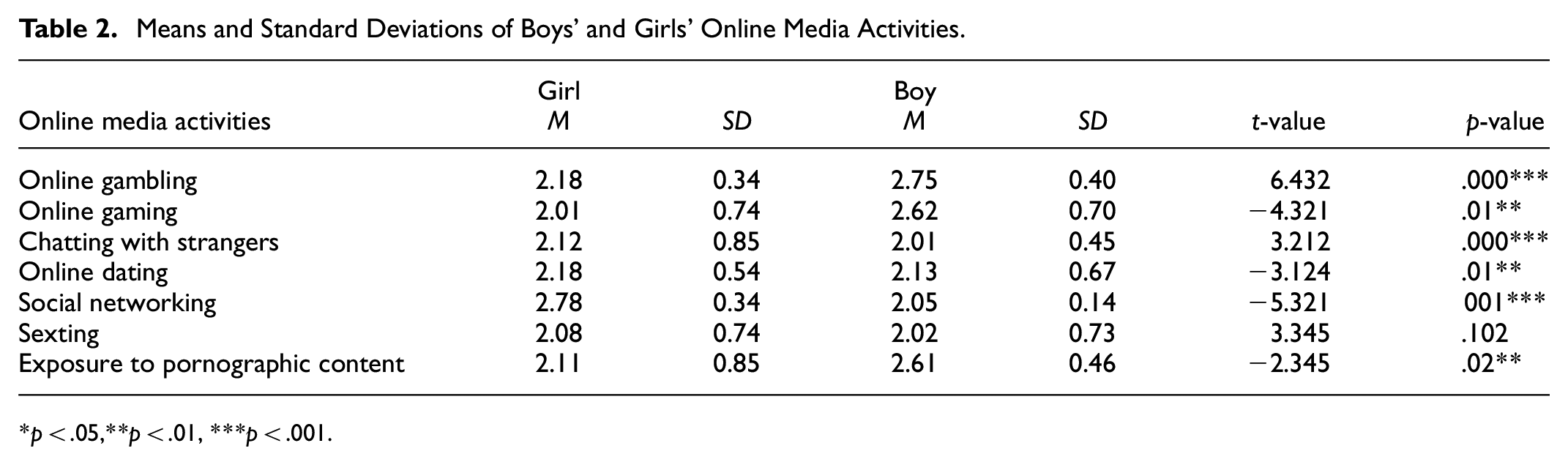
p < .05,**p < .01, ***p < .001.
Parental Mediation Practices Predicting Adolescents’ Online Media Activities
In Table 3 regression analysis was performed to predict the frequency of adolescent online media activities, taking into consideration the gender and age of adolescents, time spent on digital media, and parental mediation practices.
Regression Model Predicting Adolescents’ Online Media Activities Based on the Child’s Age and Gender and Parental Mediation Practices.

p < .05 **p < .01 ***p < .001.
The model predicting the frequency of adolescents’ social networking is significant explaining 15% of the variance in the regression model (F = 6.10, p < .001, R 2 = 0.15). Significant predictors include gender (β = −.26, p < .001). It implies adolescent girls engage less in social networking, time spent on digital media (β = .20, p < .01), and parental active mediation (β = .23, p < .001) shows that more mediation is linked to more social networking. Participatory learning (β = −.28, p < .001) also shows that less mediation is linked to more social networking but negatively correlated with adolescent girls’ social networking activities. The model suggests that adolescent girls increased participation in social networking is linked to time spent on digital media and parental active mediation, and participatory learning mediation practices.
The model predicting the occurrence of adolescents’ online engagements with strangers is presented here. The model shows that 19% of the variance (F = 7.69, p < .001, R 2 = 0.19) explaining adolescents’ engagements with strangers include gender, indicating that adolescent girls engage more with strangers online (β = .21, p < .001), parental restrictive mediation (β = −.31, p < .001), which is linked to adolescents fewer engagements with strangers and parental active mediation (β = .38, p < .001) which is linked to adolescents more engagements with strangers and the time spent (β = .34, p < .001) on social networking is also a significant predictor. The model suggests that adolescent girls become vulnerable online to engaging with strangers as they spend more time on social networking.
The model predicting adolescents’ online behavior in the case of sexting is explained by 29% of the variance in the regression model (F = 9.69, p < .001, R 2 = 0.29). Significant predictors include gender (β = .24, p < .001) adolescent girls engage in sexting more than their counterparts, restrictive mediation (β = −.15, p < .001) more restrictions linked to less sexting and active mediation (β = .24, p < .001) more active mediation linked to more sexting.
The model predicting the frequency of adolescent exposure to pornographic content is presented here. Comparing adolescent girls to boys in the case of exposure to pornographic content, the model shows that 29% of the variance (F = 7.69, p < .001, R 2 = 0.29) explaining adolescents’ exposure to pornographic content was a result of parental active mediation practice and the time spent on digital media devices. Adolescent boys are being exposed to more pornographic content.
The model predicting the frequency of online gambling in the adolescent sample is significant and predicts 31% of the variance (F = 10.13, p < .001, R 2 = 0.31). Comparing adolescent girls to boys in the case of online gambling significant predictor in the model are gender (boys play more), time spent on digital media devices, active mediation (more mediation linked to more gambling), and restrictive mediation (more restrictions linked to less online gambling).
The model predicting the frequency of online gaming in the adolescent sample is significant and predicts 42% of the variance (F = 12.30, p < .001, R 2 = 0.42). Comparing adolescent girls to boys in the case of online gambling significant predictor in the model are gender (boys play more), time spent on digital media devices, active mediation (more mediation linked to more gaming), and restrictive mediation (more restrictions linked to less online gaming).
The model shows that all the online media activities, adolescents engage in, irrespective of gender, are negatively correlated to restrictive mediation. These media activities also positively correlated to active mediation strategies. Also, adolescents engaging in social networking activities predict other online media activities. Restrictive mediation decreases adolescents’ online media activities that may impact their risky behavior, and active parental mediation increases their online media activities.
Parental Mediation Concerning the Parents and the Child’s Gender
Table 4 shows the correlations of parental mediation concerning parents’ and child’s gender. It can be seen from the results that there was a significant difference in the mediation practices exercised by mothers and fathers relating to the child’s gender. With restrictive mediation, the patterns—father-daughter (r = –0.42, p < .05) and mother-son (r = –0.55, p < .05) were significant with negative correlation, while the mother-daughter (r = .44, p < .05) and father-son (r = –0.43, p < .05) were also significant but with positive correlation. In the case of active mediation, only the father-son (r = –0.31, p < .05) and the mother-daughter (r = –0.33, p < .05) were significant with a negative correlation. No significant difference was found for participatory learning about fathers’ and mothers’ mediation practices. Fathers differ from mothers in technical mediation but showed negative correlations and a significant influence on children’s online media activities. Father-daughter (r = –0.34, p < .05) and father-son (r = –0.43, p < .05).
Correlations Between Parenting Dimension Concerning Parents, and the Child’s Gender.
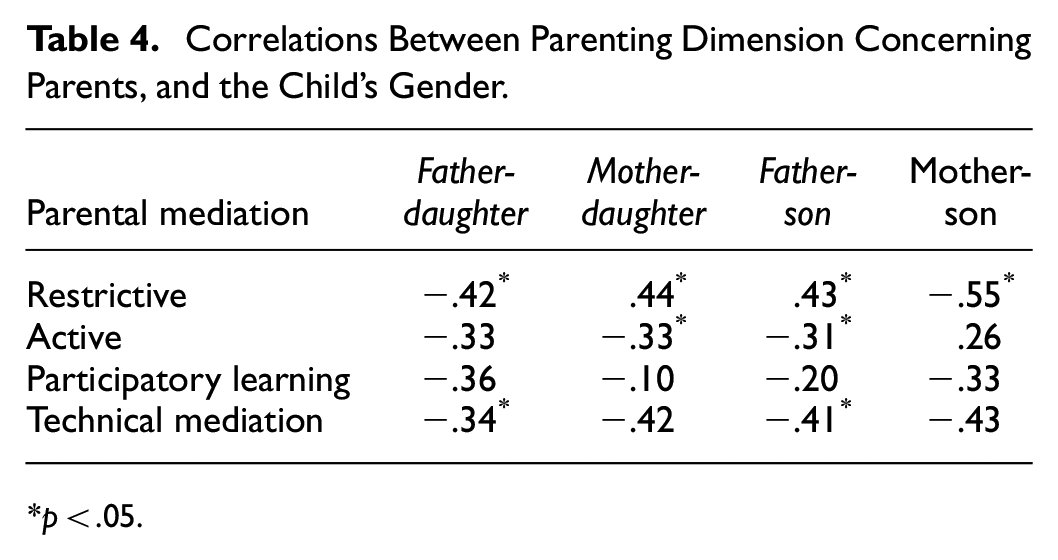
p < .05.
Discussions
This study examined the relations between online media activities, media use, and parental mediation strategies. Two main research questions are advanced, one concerning parental mediation strategies and their relations with children’s media activities and the other focusing on gender differences. The key findings emanating from this study are presented here. Answers to the questions asked in the study are presented in the subsequent paragraphs.
Responding to research question one, the findings of this study showed the extent to which parental mediation predicts adolescents’ online media activities depend on gender, age and the time spent online with digital media devices. Adolescents’ age was not a significant predictor in this study because the age bracket of adolescents that took part in this study was almost the same. This implies that adolescents’ digital media use and online media activities may not differ in age.
The results of the study made clear why gender differences may occur in some but not other types of online activities. This clarifies why it was important to look at different types of online activities. The findings of this study have shown that, overall, female adolescents in Nigeria spent more time online with their digital media devices chatting with strangers, sexting and social networking compared to male adolescents who spent more time online on gaming and gambling and pornographic content. The online media activities adolescents engage in precipitate the kind of risks they encounter. This supports the claim asserted by previous studies (Livingstone et al., 2017; Nikken & Opree, 2018) that female adolescents encounter more contact and conduct risks compared to male adolescents in international studies in the global north. Also, the consumption of pornographic content is more prevalent among male adolescents. They are more likely to encounter content risks (Livingstone et al., 2017; Nikken & Opree, 2018).
Regardless of adolescents’ gender, all online media activities, adolescents engage in, are negatively correlated to restrictive mediation. The time spent on digital media platforms is also considered a significant predictor, and these media activities are also positively linked to active mediation strategies. The findings further show that adolescents’ engagement in social networking activities predicts other online media activities. With this in mind, the study findings reveal that restrictive mediation decreases adolescents’ online media activities that may harm their behavior compared to other mediation strategies like active mediation, participatory learning or even technical mediation. Active mediation, increase the tendency for adolescents to engage more in online media activities, which may also yield more risk of harm.
The study’s findings reveal that adolescents’ vulnerability increases with increased time online. Results show that girls spent more time online than boys. This suggests that girls are more likely to encounter online risks compared to boys. That is, contact and conduct risks. Because online, adolescents’ vulnerability increases with the amount of time spent on the Internet, ensuring the safety of female adolescents in their quest for cyber exploration cannot be undermined and it has great implications for parental mediation practices in Nigeria.
Because male adolescents and female adolescents’ consumption of online media activities varies, this may diminish the notion that employing the same mediation approach for adolescents based on gender may not necessarily yield different outcomes. Irrespective of the child’s gender, it stands to reason that children from the same family background may have online experiences that may vary from one child to another. Parental mediation practices should focus more on the vulnerable child at risk of digital media use. This may seem problematic to ascertain the vulnerability of a child based on digital media use and online media activities the child engages in. Because adolescents engage in one or more online media activities simultaneously, it is problematic to say whether one online media activity is more detrimental to adolescents’ online behavior because they engage in a chain of media activities. Linking online media activities such as social networking, chatting with strangers online, gambling, sexting, and surfing pornography to deviant behavior require more research to extrapolate the extent to which risky online behavior of boys differs from girls.
Online risks adolescents encounter due to digital media use are universal, but the effect of these risks of harm may vary from country to country. The socio-demographic characteristics of adolescents may play a role in the variations or differences that may exist in the country. Among the risks of harm reported in this study was that chatting with strangers was more popular and evident for girls than boys. This corroborates previous studies such as Livingstone and Helsper (2008) and Staksrud et al. (2013). The causality between online media activities and the risks of harm encountered has raised more concerns than recommendations regarding the emerging challenges of digital media use in adolescents’ lives (Adigwe & van der Walt, 2020; Livingstone et al., 2017). Besides, not every online media activity equally exposes children to risks of harm or opportunities, and different online media activities might bring various opportunities or threats. With the increased time spent online by young people and the potential dangers that this may pose, the amount of time spent engaging in online activities cannot be undermined and overestimated. To support parents in meeting the growing challenge of adolescent girls’ online media activities, parents and educators should take measures to target girls at risk of becoming involved in risky online behavior and intercede in their online media activities. Such measures would assist them (parents and teachers) in providing specific guidance on safer online practices.
Responding to research question two in examining the influence of gender on adolescents’ online risk, and its impact on parental mediation practices in Nigerian families is provided here.
Generally, parenting practices are not a one-way approach. It often requires the input of both parents. Some studies showed that parents may employ different parenting strategies for sons and daughters for different online media activities. Some studies have shown that often girls are often more restricted than boys. This is because female adolescents are often at the receiving end of the divide and the effects of online risks are enormous. Though, some studies have shown that parenting may appear more effective with a same-gender child because of role identification and parental own experiences, how these nuances influence parental mediation practices in Nigerian families requires urgent attention. It is not clear whether parenting differs for mothers and fathers concerning male adolescents and female adolescents. Responding to research question two in this study, no significant differences were found between the ways mothers and fathers exercise and intercede mediation of adolescents’ online media activities. However, mothers engage in restrictive mediation and active mediation more than fathers for adolescent girls compared to boys. Fathers exercise technical mediation more than mothers for adolescent boys and girls. Gender effects on parenting in the digital age may vary across cultures and contexts. For instance, the results of this study provide the associations between the child’s and parent’s gender regarding parental mediation. Given the limited scope of research in the global south, this study established the relevance of father and mother parenting as it relates to the child’s gender concurrently. These findings corroborate previous studies (Ferreira et al., 2017; Valcke et al., 2010; Wang et al., 2005). This indicates that fathers are perceived to be performing technical mediation more than mothers. The reason for this was that the responsibility of technical know-how rests on them more than on mothers. In the study sample, there were more educated fathers than mothers with higher education at the tertiary level. Since increased education ignites one’s technical capacities, future studies should explore these differences with evenly distributed samples of fathers and mothers with a similar level of education to unravel the differences and similarities that may exist regarding parental education.
Limitations of the Study
When interpreting the findings of this study, the following should be put into mind. First, this study only incorporated the self-assessment survey in collecting data, and it may suffer bias from the participants in the study who may over-report their mediation practices or even under-report them. Second, the generalizability of this study is limited by the characteristics of the study participants. The findings of this study may not be generalized and applicable to a non-student population. This is because online media activities of children who do not attend secondary school may differ coupled with the parenting dimensions of parents in this category. Comparative studies are needed to be conducted on students who participate in secondary school and those who do not attend. Further research can examine Nigeria’s two groups’ similarities and differences in parental mediation practices.
Implications of the Study, Future Directions and Conclusions
This study provided the opportunity to examine the gender differences concerning parental mediation of male adolescents and female adolescents. Since previous studies (Cabello-Hutt et al., 2018; Li et al., 2022; Warren, 2017) on mediation mostly presented the mothers’ perspectives on mediation practices, this study also presents an opportunity to compare mothers’ and fathers’ mediation practices. Limited research examines fathers’ mediation practices because it may not be culturally relevant for fathers to nurture their children. Still, in the case where fathers have shown to be more digitally literate than mothers in exercising technical medication, it is timely to see how fathers’ and mothers’ parenting practices complement each other to ensure the child’s online safety. Since the digital environment drives adolescents’ online choice of media activities and is dependent upon technological advancement, future studies should employ longitudinal studies to investigate the specific effect of these media activities on gender over a given period. The parenting behavior of both parents may differ, and some of these differences may be due to different socio-demographic characteristics.
Also, the directionality of the variables measured cannot be assured. The cause and effect of the dimensions of online media activities and parental mediation practices in Nigeria cannot be ascertained. This is because the study design was correlational. It only allows us to assess the associations between variables. Longitudinal and experimental designs can aid the directionality of the variables measured in this study coupled with the way and manner adolescents’ online media activities change. This creates an avenue for future studies to explore further. Furthermore, future studies should employ cross-national variations in exploring the experiences of adolescents’ online risks in Africa. This may include South Africa and Egypt, and these two countries are next to Nigeria regarding internet penetration and digital media use.
In conclusion, this study addresses adolescents’ online activities and the parental role in monitoring these activities. The substantial increase in screen time among children and adolescents and increased exposure to potentially harmful content and risky behaviors within the context of Nigerian adolescents and their parents were investigated. Our results suggest that policymakers, parents, teachers and stakeholders should be abreast with the practical significance of the gender-specific dimensions of adolescents’ online media activities. For instance, it was revealed from this study that female adolescents in Nigeria encounter more online risks than boys because of the increased time spent online. In other words, female adolescents encounter contact and conduct risks more than male adolescents in Nigeria and content risks are more prevalent for male adolescents compared to female adolescents. This contradicts the studies by Sasson and Mesch (2016) and Warren (2017). The findings of these studies indicated that boys tend to encounter more risks than girls. Yet, the kind of risks was not categorically differentiated. The methodological design applied in these studies may be responsible for the disparity in the findings of these studies. The uneven distribution of the participants employed in the study may also be responsible for the differences in findings. Also, the findings of this study corroborate previous studies that male adolescents tend to be exposed to content risks more than female adolescents (Livingstone et al., 2014). The implication of gender-specific dimensions of online media activities and risks female adolescents encounter suggests that female adolescents should receive more mediation because they are more prone to online risk.
Footnotes
Declaration of Conflicting Interests
The author declared no potential conflicts of interest with respect to the research, authorship, and/or publication of this article.
Funding
The author received no financial support for the research, authorship, and/or publication of this article.

Data Availability Statement
Data will be made available on request.