




Abstract
This article examines the relative importance of personal, descriptive, and injunctive norms for adolescents’ self-presentation on Instagram and analyzes the role of proximal and distal reference groups in norm negotiation. Based on 27 semi-structured interviews with German Instagram users between 14 and 19 years old, we identified four types of adolescents’ self-presentation that differ in terms of norms and referent others: authentic, self-confident, self-staged, and audience-oriented self-presentation. In addition, our study demonstrates that adolescents engage in reflective norm breaches when coping with conflicting self-presentation norms. These results highlight the crucial role of both adolescents themselves and their proximal and distal reference groups for norm negotiation.
Today, adolescents have more opportunities to use self-determined media in different places and at different times than any generation before them (Paus-Hasebrink, 2019). The use of social media platforms is continually integrated into adolescents’ daily lives and has become increasingly important to their identity performance (boyd, 2014; Metcalfe & Llewellyn, 2020; Papacharissi, 2013). Among these social media platforms, Instagram offers adolescents a wide range of practices to present themselves by posting aesthetical or edited photos, following other accounts, and liking posts (Anderson & Jiang, 2019; Dumas et al., 2017; Lee et al., 2015).
Previous studies have shown that adolescents’ self-presentation on Instagram is based on social norms, which are negotiated with referent others (Chua & Chang, 2016; Yau & Reich, 2018). Social norms are “socially negotiated and contextually dependent modes of conduct” (Rimal & Lapinski, 2015, p. 394). When studying the normative influence on adolescents’ self-presentation on social media platforms, these studies have neglected the interplay of adolescents’ personal and social norms of their reference groups. Personal norms refer to “an individual’s conviction that acting in a certain way is right or wrong” (Bamberg et al., 2007, p. 191). Although personal and social norms can be congruent, they can also conflict (Cialdini & Trost, 1998) and have an independent influence on adolescents’ behavior. In addition, previous studies have mainly focused on friends when examining the negotiation of self-presentation norms (Chua & Chang, 2016; Yau & Reich, 2018). Research on multiple reference groups has primarily examined the role of parents and teachers in mediating social norms for adolescents’ general social media use (Livingstone & Helsper, 2008). However, on Instagram, both proximal (e.g., close friends, family members) and distal reference groups (e.g., bloggers, influencers, celebrities; Geber & Hefner, 2019) intermingle within adolescents’ networks, and both may serve to orient adolescents’ self-presentation. Therefore, the present study examines the relative importance of personal and social norms for adolescents’ self-presentation on Instagram and analyzes the role of proximal and distal reference groups in their norm negotiation.
Identity Performance via Self-Presentation
A key developmental task of adolescence is to develop a stable sense of one’s identity (Erikson, 1968; Havighurst, 1972), that is, “a sense of who I am and how my biology, psychology and society interact to produce that subjective sense of the person who is ‘genuinely me’” (Kroger, 2007, p. 6). In exploring their identities, adolescents try out different roles in different social contexts (Metcalfe & Llewellyn, 2020), accepting the feedback of others concerning their identity performances. During middle adolescence—between 14 and 16 years old—adolescents begin to detach themselves from their parents. Their peers gain importance as referent others (Harter, 2012). Middle adolescents tend to perceive their peer group as a homogeneous community with definite social norms; conformity to these social norms is valued and regarded as a sign of acceptance or rejection within the group (Selman, 1980; Yau & Reich, 2018). Due to their increased perspective-taking skills (Selman, 1980), middle adolescents assume that their peers are constantly evaluating and scrutinizing them, making them believe that they are the focus of attention (Elkind, 1976). In addition, different role-related selves, such as with parents, teachers, or close friends, emerge during adolescence (Harter et al., 1997). When middle adolescents perceive themselves differently across various interpersonal contexts, an intrapsychic conflict over the opposing attributes of the different selves may arise (Harter et al., 1997). During late adolescence—between 17 and 19 years old—adolescents gain the ability to resolve the contradictory attributes of their self. Thus, they further internalize their personal norms and find more opportunities to behave in line with these norms (Harter, 2012). Taken together, the psychosocial and cognitive changes that occur in adolescence increase adolescents’ introspection, their sensitivity to the opinions of others, and their desire for acceptance (Harter, 2012; Yau & Reich, 2018). To resolve the conflicting attributes of their different selves and stabilize their sense of identity, adolescents may engage in self-presentation (Siibak, 2009).
Self-presentation refers to “the process by which individuals attempt to control the impressions others form of them” (Leary & Kowalski, 1990, p. 34). Because the impressions others form of an individual influence how they perceive, evaluate, and treat that individual, people want to convey an impression that is in their interest (Goffman, 1956). Their primary aim is not always to create a positive impression but to create one in line with their objective (Schlenker, 2012). When people interact with others, they project a situation definition and foster the understanding of what others should perceive (Goffman, 1956). The existence and reactions of both a real and imagined audience influence individuals’ self-presentation (Schlenker, 2012). Thus, self-presentation occurs in a specific social context and against the background of referent others’ normative expectations.
Instagram is a social media platform that follows the rule “image first, text second” (Lee et al., 2015, p. 552) and is particularly suited for self-presentation. It offers adolescents a distinct platform for thoroughly creating self-descriptive profiles and sharing crafted content within their network, exploring different role-related selves, and constructing and performing their identities (Chua & Chang, 2016; Jackson & Luchner, 2018; Metcalfe & Llewellyn, 2020). Since adolescents have to manage the conflict between their personal needs and their social obligations (Hoffman, 1977), it is likely that their self-presentation on Instagram is founded on their personal norms and the social norms of referent others.
Social and Personal Norms of Self-Presentation on Instagram
Social norms influence adolescents’ self-presentation on social media platforms (Chua & Chang, 2016; Siibak, 2009; Uski & Lampinen, 2016; Yau & Reich, 2018). Social norms are standards that are negotiated by referent others and that guide or constrain behavior in a given situation (Cialdini & Trost, 1998; Rimal & Lapinski, 2015). They can either refer to what most people do (descriptive norms) or to what most people approve or disapprove of (injunctive norms; Cialdini et al., 1991). Descriptive norms provide information about how widespread a particular behavior is, whereas injunctive norms refer to the pressure of engaging in a specific behavior (Cialdini et al., 1991; Rimal & Real, 2003). This pressure arises from the expectation of whether a behavior is right or wrong. A violation of this expectation usually implies sanctions (Interis, 2011). Thus, noncompliance with injunctive norms typically entails social sanctions (Cialdini & Trost, 1998; Interis, 2011; Lapinski & Rimal, 2005). Empirical studies have demonstrated that both descriptive (Cialdini, 2007; Mollen et al., 2013) and injunctive norms (Rimal & Real, 2005) independently influence an individual’s behavior. The present study conceptualizes descriptive and injunctive norms as perceived norms (Rimal & Real, 2003). Perceived descriptive norms refer to individuals’ perceptions about the prevalence of a specific behavior, whereas perceived injunctive norms refer to the perceived social approval of the behavior (Lapinski & Rimal, 2005).
Previous studies on self-presentation norms on social media platforms have shown that users internalize social norms of their reference group by observing the self-presentation of referent others and receiving advice or criticism from them, especially shortly after having registered on the platform (Chua & Chang, 2016; Uski & Lampinen, 2016; Zillich & Müller, 2019). Additional studies have indicated that adolescents strive to present themselves favorably and positively to others but not to overdo it (Siibak, 2009). Yau and Reich (2018) identified three social norms of adolescents’ self-presentation on Instagram: (a) appear interesting, (b) appear likable, and (c) appear attractive. To fulfill these social norms, the adolescents asked their friends to like their photos, posted photos during Instagram’s evening peak hours, or created second accounts to distance themselves from others’ approval (Yau and Reich, 2018). Similarly, Siibak (2009) showed that adolescents mainly selected profile photos in which they look good; that were taken in beautiful surroundings; or in which family, friends, or acquaintances as referent others were pictured together with them.
Personal norms are also associated with adolescents’ self-presentation on social media; they are feelings of moral or personal obligation to perform a certain behavior (Ajzen, 1991; Schwartz, 1973). They are the individual conviction “that acting in a certain way is right or wrong” (Bamberg et al., 2007, p. 191). Personal norms are not based on external rewards or sanctions but are self-based standards that arise from internalized values (Cialdini et al., 1991). Although personal norms originate in social interactions, they are enforced through the self. The violation of personal norms may result in regret or reduced self-esteem; conformity to personal norms may result in pride or a sense of security (Bamberg et al., 2007; Schwartz, 1973). 1
Researchers have argued that personal norms are essentially internalized social norms (Bamberg et al., 2007; Doran & Larsen, 2016). In the process of moral internalization, social norms that are initially external to the individual become part of an individual’s internal motive system and guide their behavior even in the absence of external agencies (Hoffman, 1977). One key developmental task in middle childhood is to develop a beginning morality. When children become adolescents, they acquire a scale of values and have to apply it in complex situations, taking account of the moral consequences of their actions (Havighurst, 1972). In the course of this development, personal norms are internalized through identification, dialogues, and interactions with referent others, such as parents, peers, siblings, or teachers (Erikson, 1968; Havighurst, 1972). When adolescents are “successfully socialized” (Vanden Abeele, 2016, p. 88), they have acquired their personal norms and internalized their referent others’ social norms.
When studying the influence of personal norms on behavior, researchers have mainly relied on the Norm-Activation Model (NAM, Schwartz, 1977; e.g., Ho et al., 2016; Lai et al., 2020), the Theory of Planned Behavior (TPB, Ajzen, 1991, e.g., Schaffner et al., 2017), or a combination of both (e.g., Bamberg et al., 2007; Chen, 2020). The NAM conceptualizes personal norms as a direct predictor of behavior. Originally developed to explain helping people in need, the model has been extended to the self (Stern et al., 1999), and has been successfully tested in studies on pro-environmental (Bamberg et al., 2007; Lai et al., 2020; Schaffner et al., 2017) or health behavior (Ho et al., 2016).
Self-presentation can also be regarded as a behavior with a moral dimension, since “any definition of the situation [ . . . ] has a moral character” (Goffman, 1956, p. 6). When individuals project a situation definition, they make a claim of who they are and exert a moral demand upon others concerning how to treat them. Consequently, when presenting themselves on social media platforms, individuals “have the moral obligation to be who they claim to be” (Yang & Brown, 2016, p. 404). For example, a study by Chen (2020) showed that users’ motivation for self-presentation on social media platforms is positively correlated with their personal norms to share environment-related information. Moreover, a study by Chua and Chang (2016) on self-presentation on Instagram illustrated that adolescents perceive a gap between their personal beliefs and the perceived social norms of their friends. They struggled with the tension between their personal understanding of beauty and their perception of socially approved conceptions of beauty. After a time of resistance, they conformed to their friends’ social beauty norms when presenting themselves on Instagram by editing their selfies and planning photos before taking them. Thus, previous findings indicate the complex interplay of personal and social norms in adolescents’ self-presentation on social media platforms. However, to our knowledge, studies examining the influence of personal norms on adolescents’ self-presentation on Instagram are missing.
Agents of Norm Negotiation: Individuals and Their Multiple Reference Groups
Both personal and social norms are negotiated with referent others. These are comprised of individuals themselves and their reference groups (Hurrelmann & Bauer, 2018). Individuals serve as agents of their self-socialization (Arnett, 1995; Riesmeyer, 2020), who reflect upon their experiences, needs, and aspirations (Deci & Ryan, 2000), use social media platforms in line with their personal norms according to their developmental task, and develop an idea of how to present themselves there (Paus-Hasebrink, 2019).
Furthermore, social norms are negotiated with reference groups (Geber & Hefner, 2019), which comprise people whose expectations matter to an individual in a specific situation and provide that individual orientation (Kemper, 1968). Through social interaction and communication, the members of a reference group negotiate normative expectations, normative misconduct, and social sanctions (Rimal & Lapinski, 2015). Reference groups can vary in their social proximity or distance (Geber & Hefner, 2019; Rimal & Lapinski, 2015), which encompasses the emotional closeness and identification with referent others (Neighbors et al., 2010; Paek, 2009). Research has shown that proximal reference groups have a stronger normative influence on individuals than distal ones (Neighbors et al., 2010; Woolf et al., 2014). Applying the concept of group proximity to adolescents’ self-presentation on Instagram, we argue that proximal reference groups include close friends and family members with whom adolescents regularly virtually and non-virtually interact. In the present study, distal reference groups consist of bloggers, influencers, and celebrities with whom adolescents mostly only virtually interact, whom they follow on Instagram, and whose photos may serve as an orientation for their self-presentation. Both proximal and distal reference groups blend into users’ imagined audience, which refers to “the mental conceptualization of the people with whom we are communicating” (Litt, 2012, p. 331). Thus, on Instagram, adolescents present themselves to an imagined audience composed of not only proximal, known referent others who may also give offline feedback but also distal, unknown referent others with whom they mainly interact in their imagination (Litt, 2012).
However, when studying the negotiation of self-presentation norms on social media platforms, previous research has not considered the normative influence of proximal and distal reference groups. These studies have instead focused on one specific proximal reference group, mainly friends (Chua & Chang, 2016; Yau & Reich, 2018), or analyzed parents’ general mediation strategies for their adolescents’ social media use (Livingstone & Helsper, 2008). Against this background, we examine the relative importance of personal, descriptive, and injunctive norms for adolescents’ self-presentation on Instagram as well as the self, proximal, and distal reference groups in norm negotiation. Therefore, our first research question asks,
RQ1. How do adolescents negotiate personal and social norms of self-presentation on Instagram with referent others?
Although personal and social norms may often be congruent, they can also conflict with each other (Cialdini & Trost, 1998; Doran & Larsen, 2016). The transition from adolescence into adulthood is characterized by tensions that may arise out of the socialization process (Vanden Abeele, 2016). In this process, personal norms are internalized as social norms (Havighurst, 1972; Hoffman, 1977). However, adolescents do not simply imitate the adult world. They interpret, transform, and creatively appropriate elements from the adult world to meet the expectations of their peers and their own obligations (Corsaro & Eder, 1990; Vanden Abeele, 2016). As a result, both adolescents’ personal and social norms are “interpretive reproductions” (Corsaro & Eder, 1990, p. 200) of their social systems. Both constructs are importantly generative of their self-presentation on Instagram. Which one has the greater impact on adolescents’ actual self-presentation on Instagram may depend on whether the adolescents are focused on internal standards and sanctions (personal norms) or on social standards and sanctions (social norms) for their self-presentation (Cialdini et al., 1991; Schlenker, 2012). Thus, our second research question asks,
RQ2. Which norm conflicts do adolescents perceive when using Instagram?
Method
We conducted 27 semi-structured interviews with German Instagram users between May and June 2019. Although the concepts of personal and social norms are well defined in the literature and in various scales (e.g., Chen, 2020; Doran & Larsen, 2016; Geber et al., 2021; Lai et al., 2020; Rimal & Real, 2005), a qualitative research approach was deliberately chosen. This approach is well-suited for examining mind-sets, opinions, and behaviors (Flick, 2018) because it is often difficult for adolescents to express themselves about complex and subconscious perceptions or to scale approval or rejection.
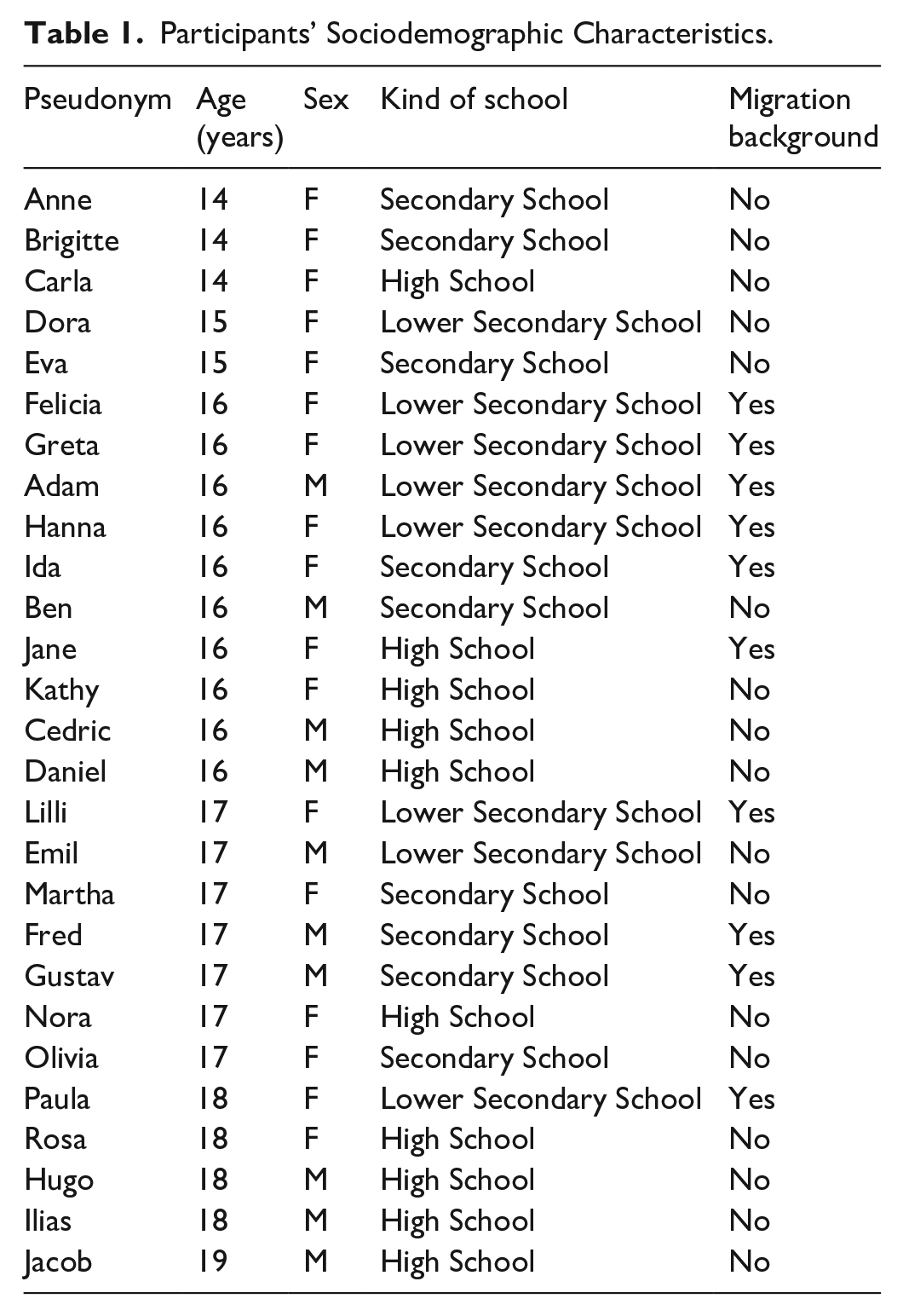
The sample was stratified by age, migration background, and kind of school to access a diverse range of users (see Table 1). Of the 27 participants, 17 were female. The participants had an average age of 16 years, with an age range of 14 and 19 years. Of the participants, 15 approximated middle adolescence (14–16 years old) and 12 approximated late adolescence (17–19 years old). Ten participants had a migration background. Eight attended lower secondary school, 9 attended secondary school, and 10 attended high school. The participants were recruited via convenience and snowball sampling in the area of Munich. The adolescents were contacted by students and asked if they had friends who might be interested in participating, too (e.g., the students asked peers of their younger siblings and contacted adolescents at places where they often spend their leisure time, for example, in sports classes, youth centers, or music schools). When conducting the interviews, care was taken to ensure that the interviewer did not know the interviewee personally. Therefore, interview contacts were exchanged among interviewers when necessary. The participants did not receive compensation for participating in the study.
Participants’ Sociodemographic Characteristics.
An interview guideline addressed 15 main issues regarding the adolescents’ everyday lives, their perceived social norms of proximal and distal referent others, and their personal self-presentation norms on Instagram (Supplementary Material A1). We concentrated on self-presentation through public communication via the users’ profiles and feed photos, as they are most likely to be visible to different followers and, therefore, most likely to correspond to social and personal norms. The participants were asked to describe their Instagram use on an ordinary day, the intentions of their Instagram practices, and how they perceive proximal and distal referent others on Instagram. In addition, they were asked to compare their own use to that of these referent others and to describe what uses these others deemed appropriate. Furthermore, the participants were asked to show their last posted photo on Instagram and to reflect on the conditions of taking this photo. This procedure was chosen to capture both a denser description of the interviewees’ practices, as well as their ability to reflect on their self-presentation practices, and to detect possible discrepancies between their recalled self-perception of their own practices and their actual practices. Thus, the knowledge gained contributed to the validation of our results. The interviews were conducted in locations convenient and familiar to the participants (e.g., their homes or coffee shops), although adults known to the participants were not present. Each interview lasted on average 27 min (range 16–44 min) and was conducted in German. Before the interviews, the adolescents and their parents gave their written consent for participation.
The interviews were audio-recorded, transcribed, and analyzed through the qualitative coding of texts (Gläser & Laudel, 2013). All names were pseudonymized to protect the participants’ privacy. To stepwise and systematically reduce the data’s complexity, we developed a category system derived from theoretical considerations (Gläser & Laudel, 2013). The conceptual framework, theoretical concepts, and research questions underlying the study served as an important source for creating the category system (Miles & Huberman, 1994). The system comprised the following three main categories: adolescents’ everyday life (typical Instagram use, self-presentation via Instagram, cultural background), self-presentation norms (personal, descriptive, and injunctive), and proximal as well as distal reference groups. Based on these main categories, a line-by-line coding of each transcript was conducted to identify common topics between the participants. During the coding process, specific subcategories that arose directly from the analysis of the transcripts were assigned to the main categories (Miles & Huberman, 1994). These subcategories reflect the central meaning of the interviewed adolescents and aided in identifying not only the central personal and social norms but also specific self-presentation practices on Instagram (Supplementary Material A2). Thus, the main categories were changed or supplemented according to empirical information in the transcripts, applying a combined theory-driven and data-driven analysis strategy (Gläser & Laudel, 2013). The two authors of this study conducted the coding and then actively discussed their respective coding results to achieve agreement. Afterward, we selectively retrieved and organized the coded transcripts to systematically compare them and recognized repeating patterns (Miles & Huberman, 1994). Based on these results, we constructed a typology and grouped the participants into types that can be described by a combination of norms, reference groups, and self-presentation practices that are as similar as possible and differ as much as possible from the other types (Kluge, 2000).
Results
Common Norms and Practices of Adolescents’ Self-Presentation on Instagram
Before characterizing the identified types of adolescents’ self-presentation on Instagram (RQ1) and potential norm conflicts (RQ2), we highlight common norms and practices for nearly all participants. First, all adolescents perceived the injunctive norm of “become part of our network” as peer pressure to join Instagram. They reported that their friends’ expectations were decisive in their registering on Instagram: “Because many had it. Because friends had it and then I was always asked, ‘Do you have Instagram? What’s your name on Instagram?’ And then I just downloaded it” (Dora, 15).
Second, the adolescents stated that their privacy protection and profile characteristics had changed over time (see also McLaughlin & Vitak, 2011; Zillich & Müller, 2019). As Felicia (16) said, an Instagram account should go through a “development phase.” Hence, it needs to be updated until it is (provisionally) complete: “Otherwise everyone will think that I still look so young. That I am still 12” (Gustav, 17). To resolve the contradiction of conflicting past and present information, the interviewed adolescents removed information (e.g., place of residence, school), deleted accounts, and used hashtags and likes more consciously.
Third, we found the common personal norm “I respect others,” which relates to respecting others’ divergent Instagram uses. The adolescents advocated that all individuals should design their profiles as they please. Ben (16) summarized this personal norm: “It is up to each individual to decide whether or not it is absolutely necessary to use 100,000 filters or not.”
Fourth, the 10 adolescents who had a migration background perceived the injunctive norm “adhere to your culture.” They stated that it is expected of them to show their cultural background on Instagram as part of their identity. They therefore posted captions and hashtags in their native language or displayed the national flag of their home country in their profile so that their followers know “who I am, where I come from” (Greta, 16).
Finally, distal reference groups, such as food bloggers, athletes, celebrities, or influencers, were central for all interviewed adolescents and served as both information and inspiration. Although these groups often use Instagram for earning money and have “another life” (Emil, 17), one could still “learn something from them” (Felicia, 16). For example, Hugo (18) stated, If it’s a competitive athlete, then you look at: Okay, what do they do during the day when they train as much as we do? What do they do between training sessions, how do they deal with it all? You also try to see if you can learn something from them.
And Rosa (18) explained that she tries out creative ideas from do-it-yourself sites, which she then posts on Instagram and follows food bloggers since “they explain what hacks you should make and tell you what recipes you should try out.”
Typology of Adolescents’ Self-Presentation
Regarding RQ1, we identified four types of adolescents’ self-presentation, which differ in school type and age as well as in the relevance of various distal and proximal reference groups. To answer RQ2, we analyzed the perceived conflicts of personal and social norms in the adolescents’ self-presentation on Instagram and the strategies they applied when dealing with these.
Type 1: Authentic Self-Presentation
This type consisted of 10 adolescents (6 girls, 4 boys) between 14 and 17 years old. With an average age of 15.5 years, these adolescents are comparatively young. Five attended lower secondary school, four attended secondary school, and one attended high school. Characteristic for this type was the dominance of the personal norm “I am me.” The adolescents often referred to their personal values that guide their authentic and simultaneously attractive self-presentation through a coherent image of themselves: notably, colors, captions, and photos should be in harmony. When asked how she would describe her profile, Anne (14) responded, “just natural.” The participants were concerned with showing themselves from their best side as far as possible. Hence, they believed that authentic self-presentation involved a certain amount of staging, which was accepted as long as it is done appropriately and inconspicuously (see also Uski & Lampinen, 2016).
Closely related to this obligation is the personal conviction concerning which information adolescents should disclose about themselves. They presented little personal information on their profiles and consciously decided who could follow them—representing the personal norm “I protect myself.” As Felicia (16) stated, “earlier, I gave my age and then deleted it. I did not like the idea that everyone knows how old I am.” This personal norm also included omitting hashtags so that posts could not be found by accounts outside of the adolescents’ own network. In addition, the adolescents refused to present themselves revealingly or within an intimate setting. Photos of a naked body or of the adolescents drinking alcohol were not posted on Instagram (see also Zillich & Müller, 2019). Moreover, this obligation is closely related to the personal norm of not wanting to hurt anyone with one’s own self-presentation (“I hurt no one”), which shows respect for personal rights. The adolescents opposed the publication of racist or sexist content on Instagram. Instead, before publishing a post, they reflected on the possible consequences for others.
These personal norms sometimes conflicted with the common practice of referent others to stage themselves as much as possible. To resolve this contradiction, the adolescents relied on their personal values. For example, Ben (16) stated, “My advice to everyone is to decide for yourself what you upload, not what others want you to upload, and to upload only your personal stuff that you want to share and is not too private for you.” In addition, the peer group specifies the evening as the ideal time to post. However, the adolescents consciously resisted this peer pressure and posted their photos when they had time to do so. Although not adhering to this norm was typically not sanctioned, the adolescents were aware that their feeds will pass unnoticed and will therefore receive less likes and comments. Nevertheless, adolescents valued close friends as a proximal reference group. However, they did not function as a source of inspiration but of criticism because “my friends know me like I am” (Gustav, 17).
Type 2: Self-Confident Self-Presentation
This type consisted of four girls and three boys between 16 and 18 years old (17 years on average). Two of them attended secondary school and five high school. Adolescents with a self-confident self-presentation focused particularly on a positive body image. They acknowledged and accepted that individuals are imperfect, which was reflected in their personal as well as perceived social norms. It was important to them that first and foremost they like their own posts. Hence, they did not stage their photos (although they perceived this as a common practice among their distal referent others), but often posted spontaneous shots, such as selfies. Martha (17), for example, did not consider herself photogenic but nevertheless presented herself naturally and renounced photo editing. Rosa (18) stated, “Instagram is the perfect life. Only the perfect moments are actually shown, so it’s actually cool if you cry or show your scars.”
At the same time, adolescents stated that proximal referent others expected a self-conscious and imperfect self-presentation from them, too. When they do not follow this injunctive norm, they might not get likes and positive feedback, but this would not result in deleting or editing the posted photos afterward. This self-confident self-presentation is also reflected in adolescents’ perception of descriptive norms. They perceived that posting photos showing ones’ body (e.g., in swimwear) was legitimate among their referent others as long as certain body regions (e.g., the buttocks) were not in the focus. Furthermore, they perceived the descriptive norm “self-disclosure counts” (i.e., open handling of personal information on Instagram). Within their circle of followers, age, telephone number, or place of residence were typically shown in their profiles.
Their media use in general, but their Instagram use in particular, is strongly monitored by their parents. The adolescents reported that their parents have clear expectations of how they should present themselves on social media platforms, indicating the injunctive norm “adhere to adult norms.” Their parents and other referent adults in their social environment (e.g., sport coaches) expect socially appropriate behavior. They do not want them to share photos of misconduct, such as alcohol or tobacco use. If this norm is violated, sanctions may follow. These ranged from parental disapproval to exclusion from a training group. However, not only do these proximal reference groups provide the normative framework for their self-presentation, but they are also actively asked for advice when adolescents select photos because “every mom has a good eye for what’s okay” (Jane, 16).
Type 3: Self-Staged Self-Presentation
Contrary to the first two types, all six adolescents of type three were girls. They were on average 16.2 years old (with a range between 15 and 17 years). Two attended lower secondary school, three attended secondary school, and one attended high school. These girls had two Instagram accounts to deal with arising conflicts between their personal norms and the perceived social norms (see also Yau & Reich, 2018). The first was a private account that only their closest friends could follow—which Kathy (16) called the “private-private” account. Adolescents’ self-presentation on this account follows their personal norm of authentic self-presentation (see also Uski & Lampinen, 2016), which often occurred spontaneously and has a diary function to save personal moments. The second account, also called a “spam account” (Kathy, 16), followed a self-staged self-presentation. For example, Ida (16) does not pay attention to the composition of the posts on her private profile: “I don’t care at all. So, I really post all kinds of things there.” However, the composition on her public profile is very important to her: “I was so unsure whether I should post [the photo] or not. Since it fitted my feed, I posted it then.” Olivia (17) also strictly distinguished between the content that she posts on each account: The public one, where I show a good side of me, where only beautiful pictures without flaws are, and a second, where really only my friends and family can have a look, where I also sometimes post fun pictures and show what just happens spontaneously.
Adolescents stated that staging and attractiveness are integral parts of Instagram in general. They perceived that their referent others follow a “production process” (Ida, 16) when posting photos—indicating the descriptive norm “staging counts”—and knew that their referent others expected a staged self-presentation from them, too. For example, Kathy (16) explained that it is personally important to put herself in the perfect light when taking a photo for her public account. She reported on holidays with friends, their search for the best place at the beach for taking a photo and the right pose. After the shooting, they selected the best photo, added an appropriate caption and hashtags, edited the photo, and then posted it on Instagram.
The fact that staging was so important for adolescents of this type also became clear regarding their reference groups. Achieving a high number of followers and gaining likes counted for these adolescents. Their feedback was perceived as such strong pressure that Hanna (16) sometimes felt desperate because she did not know what to post or write. Hence, she asked her friends for advice and involved them in photo creation and selection.
Type 4: Audience-Oriented Self-Presentation
This type consisted of one girl and three boys between 16 and 19 years old (17.8 years on average). The girl attended lower secondary school, and the boys attended high school. Similar to Type 3, these adolescents also stage their self-presentation on Instagram. However, they were oriented more strongly toward the expectations of referent others, such as close friends and other followers. Thus, adolescents of this type are especially sensible toward injunctive norms and have less pronounced personal norms. By anticipating the expectations of their followers, they avoid mistakes in their self-presentation and reduce likely sanctions, such as failing to receive positive comments and likes. “Likes are nice, if no one liked my post, it’s crap,” said Cedric (16). In addition, to adhere to the perceived injunctive norm of showing oneself “as a complete artwork” (Jacob, 19), these adolescents changed their account over time and deleted posts that no longer corresponded to their personal conviction or to the social norms of their changing circle of friends.
Adolescents of this type also perceived the descriptive norm “approval counts.” They knew that referent others strive to obtain as many followers as possible and for positive reactions from them. To receive as much positive feedback as possible, they present themselves according to the expectations of their audience: “I have specifically chosen this outfit, because of these brands, then I have made my hair, so that everything fits. All elements were planned” (Paula, 18). For such staged photos, Paula gained between 600 and 700 likes. In addition, many referent others posted their photos during the peak Instagram traffic hours to achieve as much approval as possible (see also Yau & Reich, 2018). In some cases, they surveyed their friends before posting a photo to select the one that best fit the expectations of their peers. For example, Paula (18) set her profile public so that as many people as possible could follow her. She perceived it as important to post photos that not only she likes but also that meet her followers’ expectations and resemble the typical photos of her referent others: “I actually look at photos of others and see what kind of photos they have made, how does it look, the pose looks cool, and that’s what I actually orientate myself on.”
Discussion
Self-presentation on social media platforms is a process through which adolescents present, compare, adjust, or defend their identity (Papacharissi, 2013). Our results confirm Instagram as a central platform for identity performance (Chua & Chang, 2016; Jackson & Luchner, 2018; Metcalfe & Lleweylln, 2020). By changing their accounts, deleting dated posts, planning, selecting, and editing photos, and disclosing varying degrees of personal information to differing reference groups, adolescents experiment with different role-related selves and construct their identities. These self-presentation practices are founded upon norms. While previous studies on self-presentation norms on Instagram have focused on the social norms of adolescents’ referent others (Siibak, 2009; Yau & Reich, 2018), our results show that adolescents’ self-presentation on Instagram is guided by a complex interplay of both social and personal norms. Personal norms served as important anchor points for adolescents’ self-presentation on Instagram, especially for those adolescents who value an authentic or self-confident self-presentation. These adolescents stand by themselves, reflect on the benefits and risks of their Instagram use, acknowledge the imperfect, and implement this imperfection in their self-presentation. The importance of personal norms becomes also apparent regarding adolescents’ strategies for managing conflicting norms. Our results demonstrate that adolescents engage in reflective breaches of norms. They reflect their personal convictions for successful self-presentation on Instagram, compare it to the common practices of referent others, are sensible to their normative expectations, and often decide to follow their personal norm. This mature handling of conflicting personal and social norms is independent of their age. However, our findings also suggest that the articulated personal norms were often internalized social norms. Thus, differing from previous research, our results illustrate the benefit of differentiating the influence of personal and social norms on adolescents’ self-presentation.
While previous studies have focused on selected reference groups (Chua & Chang, 2016; Yau & Reich, 2018), the present study assessed both proximal and distal reference groups and related them to each other. Our results show that varying reference groups fulfill specific functions for adolescents’ self-presentation. Proximal reference groups provide both guidance and meaningful interactions that help adolescents to develop a stable sense of their identity and to satisfy their desire for acceptance (Erikson, 1968; Harter, 2012; Yau & Reich, 2018). Moreover, distal reference groups serve as an additional source of information and inspiration for successful self-presentation and sometimes even for emulating their lifestyle. Drawing on these results, future studies can analyze the normative influence these and other reference groups have over the development of adolescents to specify the relative importance of multiple reference groups.
A limitation of our study is that interviewing adolescents about the intentions of their Instagram practices and those of referent others might trigger them to mainly articulate norms that are easily remembered, easily verbalized, and socially appreciated. Tracking adolescents’ self-presentation on Instagram and subsequently analyzing them in a content analysis would allow further measurement of the normative influence of unconscious social norms. Furthermore, the findings are based on the adolescents’ ability to reflect on multiple proximal and distal reference groups and how they relate to themselves in the moment of the interview. Therefore, long-term studies are needed to assess more adequately the dynamic process of norm negotiation and norm adaptation.
Besides these limitations, our results highlight the crucial role of adolescents as agents in the negotiation of self-presentation norms on Instagram. To continue to stand by their personal norms and implement them in their self-presentation, it is important to strengthen adolescents’ personal perceptions and distinctions of referent others’ perceived obligations. Only then can adolescents make a conscious, reflected decision for or against specific self-presentation practices and live up to the claim “be yourself,” even when using social media.
Supplemental Material
sj-docx-1-sms-10.1177_20563051211033810 – Supplemental material for Be Yourself: The Relative Importance of Personal and Social Norms for Adolescents’ Self-Presentation on Instagram
Supplemental material, sj-docx-1-sms-10.1177_20563051211033810 for Be Yourself: The Relative Importance of Personal and Social Norms for Adolescents’ Self-Presentation on Instagram by Arne Freya Zillich and Claudia Riesmeyer in Social Media + Society
Footnotes
Data Availability Statement
The data that support this study’s findings are available from the corresponding author upon reasonable request.
Declaration of Conflicting Interests
The author(s) declared no potential conflicts of interest with respect to the research, authorship, and/or publication of this article.
Funding
The author(s) received no financial support for the research, authorship, and/or publication of this article.

Supplemental Material
Supplemental material for this article is available online.
Notes
Author Biographies
References
Supplementary Material
Please find the following supplemental material available below.
For Open Access articles published under a Creative Commons License, all supplemental material carries the same license as the article it is associated with.
For non-Open Access articles published, all supplemental material carries a non-exclusive license, and permission requests for re-use of supplemental material or any part of supplemental material shall be sent directly to the copyright owner as specified in the copyright notice associated with the article.
