



Abstract
This study explores the image sharing site Instagram to reveal how affordances, or uses of the platform, occur within a nexus of technological architecture, sociocultural contexts, and globalized commercial practices. It suggests social actors draw upon Instagram’s affordances at material, conceptual, and imaginary levels while using social media. This triadic model for theorizing affordances of Instagram responds to the need for mapping ontologies and typologies of social media within increasingly visual, intercultural, and non-Western contexts. The lenses of critical multimodality and a participant-centered method consider how female Gulf-Arab social media influencers operate through an interplay of shifting affordances in ways that challenge current conceptions of authenticity surrounding social media influencers. It is suggested that the triadic affordances of Instagram, occurring at material, conceptual, and imaginary levels, provide both influencers and followers with strategies of “fantastical authenticity” for navigating conflicting modes of representation and self-presentation within local and globalized economies.
Introduction
Social media, as a technological as well as a social phenomenon, remains a conflated term requiring sharper definitions of what is meant by “social” and “media,” and how and why they come together to exercise degrees of control in ways that are often highly gendered and increasingly commercialized (Bouvier, 2015). The author of this study locates a lack of precision in theorizing social media that partly results from the confusion surrounding “affordances.” Yet, before clearer articulations of the affordances of social media can occur, clarifications of the term “affordance” are required since it is inconsistently defined within communications theory and other disciplines including psychology, human computer interaction, design, and sociocultural theory. This is an issue to the extent that these variations subsequently shape (mis)understandings of social media. Originally coined by Gibson (1966), “affordances” are “properties of an environment relative to an animal” (p. 285). However, this definition was not conceived to include collective, sociocultural affordances, or the ways users’ perceptions, or appropriations of affordances that can change over time. Furthermore, Eynon (2018) argues designs, assumptions, and realizations of technologies are never gender neutral and this study reiterates that neither are affordances. These issues are addressed through developing a framework for theorizing the tacit gendering and triadic layering of multimodal affordances. It builds on understandings of multimodality as occurring through hybrid social configurations, human activity, and agency rather than as fixed and embedded in material properties and technology (Bouvier, 2016; Machin, 2016). The participant-centered study involved a focus group of 25 female students at a university in the United Arab Emirates (UAE). These respondents helped select the case study samples of five highly popular female social media influencers from Gulf-Arab countries including the Kingdom of Saudi Arabia, Kuwait and the UAE. The author of the article worked with respondents carrying out multimodal analysis of the influencers’ posts on Instagram to consider ways the platform’s architecture converges with influencers and followers to form specific affordances or uses occurring across a triad of material, conceptual, and imaginary levels.
Machin’s (2016) critical multimodal affordance-based approach is one driven by the social and not by the need to model exclusively on the basis of language and linguistics. A multimodal artifact consists of a combination of “modes,” which is a term used within systemic functional linguistics (Halliday, 1994) and social semiotics (Hodge & Kress, 1998) to refer to resources for meaning making. Examples of modes include speech, images, writing, illustrations, clothing, digital screens, or any material property communicating meaning (Lackovic, 2018). Each of these modes is organized according to the principles of semiotic resources that are recognized within a social context. The social media application Instagram consists of the multimodal semiotic resources of videos, images, sounds, speech, text, captions, and hashtags. These technological semiotic resources come together to create social meanings that occur in combinations and change over time to constitute and reflect boundaries of sociality (Graham, Laurier, O’Brien, & Rouncefield, 2011). Social media’s semiotic resources not only facilitate but shape and limit the communications that lead social practices as software fosters certain kinds of social interactions and suppresses others (Unger, Wodak, & KhosraviNik, 2016). This study’s understanding of multimodal affordances as semiotic resources goes beyond Oliver’s (2005) proposal to use literary techniques to understand affordances which emphasizes material features but limits visual and symbolic aspects. It also goes beyond Nagy and Neff’s (2015, p. 2) efforts to reconstruct the concept of affordances within communication studies, which although conceptualizing affordances as simultaneously “material and conceptual,” does not address the ways technologies and their affordances are highly gendered (Wajcman, 2004, 2009).
This study’s theorizing of gendered, multimodal affordances of social media is therefore developed through a radical re-grounding of Gibson’s (1979) conception of affordances (Albrechtsen, Andersen, & Pejtersen, 2001; Kaptelinin & Nardi, 2012). Affordances are defined as involving: (1) material properties linked directly to specific functions or actions (e.g., sending a text or liking a friend’s post); (2) conceptual and/or symbolic uses, through linguistic and visual signaling of identities, lifestyles, and allegiances to national and international communities (i.e., communicating in a particular language, sharing images of hobbies and lifestyle choices, participating in national customs and rituals); and (3) also at imaginary levels through aesthetic and digital manipulation of image, identity, self-presentation, image consumption, and activities symbolizing and expressing aspirational desires that may be tacit, (e.g., Anderson, 2006 considers a nation to be a socially constructed community imagined by the people who perceive themselves as part of that group). The prolific sharing of images via image based social media like Instagram contributes to imaginary affordances not only of nationhood but also contestations, challenges, thinking beyond, or even reconfiguring current versions of socially gendered and national identities.
This study explores how this critical multimodal re-grounding of the concept of affordances provides clearer articulations of the architecture of social media like Instagram as well as participant led reflections of the affordances for users. This is important because it contributes to understandings of the ways social media affordances are not homogeneous or static but vary across triadic levels as well as in terms of gender and sociocultural contexts, routinely embedded, and taken for granted in technological and social configurations. Furthermore, this study provides insights into the under researched fields of female Gulf-Arab social media influencers and perspectives of Instagram followers in the Gulf-Arab region.
Social Media in the Gulf-Arab Context
Traditionally conservative government media institutions have struggled to compete with the less formal and booming social media influencer market in the Gulf-Arab region (Azaiz, 2017). A survey by Denis, Martin, and Wood (2017) indicates Instagram is preferred by 55% of 18- to 24-year-olds and is the primary vehicle for this age group in the region. The popularity of Instagram here, like elsewhere, can be explained in terms of its multimodal affordances of photographs, filters, hashtags, captions, and videos that enable postings of pre-prepared content as well as immediate postings of live content. Instagram’s launch of Stories in 2016, is viewed as derivative of Snapchat’s feature of video posts that last 24 hr, and a direct attempt to capitalize on their popularity. Ahmed (2016) says the ephemerality of disappearing content is appealing to young people, giving a sense of authenticity. Although Instagram’s Stories, since 2017, can now be saved permanently, they still retain this sense of immediacy and apparent authenticity. Although these indicators of Instagram’s popularity are generalizable elsewhere, for example, in Anglo-American and South East Asian contexts (Abidin, 2018), this study’s surveying of social media literature and methods of participant centered multimodal exploration, indicates how affordances vary across sociocultural contexts in ways that are also highly gendered.
While the Gulf-Arab region is vast, rapidly changing, and heterogenous, its oil and gas-based economies underwent rapid economic modernization while retaining conservative sociocultural traditions (Malachova, 2012). Gulf-Arab women are sometimes portrayed as oppressed, but their lives are highly varied, and they do not necessarily view themselves in this way. Furthermore, they are considered potential agents of social and economic change, driving developments as a result of investments in education (Romano, 2017). Many of these changes are played out through visual modes of dress, style, and identity presented via social media, offering Gulf-Arab women a range of multimodal affordances to explore and perform their identities in different ways (Bouvier, 2016). Social media has also played a crucial yet controversial role in enabling women to participate in the public sphere and drawn attention to issues they deem important, for example, the social media campaigns of activists petitioning for the rights of women to drive in Saudi Arabia (Agarwal, Lim, & Wigan, 2012) or the right to wear the hijab (veil) as postcolonial resistance (Golnaraghi & Dye, 2016). A crucial aspect of this has been the power of visual representation by women who have traditionally been denied these opportunities. Homi Bhabha (1994) in the Location of Culture develops intercultural understandings, questions about cultural crossovers, and third spaces. Similarly, visual culture is also understood as both “globalizing and localizing—quite often simultaneously” and contexts are not easily bounded or static and they change over time (Gruber & Haugbolle, 2013, p. 106). What it means to be “social” in one context differs to another and what is social about social media therefore also needs to be precisely defined (Jensen, 2010). Indeed, Papacharissi (2015b) points out all media by definition have been social. To address these complexities, the author views social media as occurring in a reciprocal relationship with its social context, as these both define and constitute one another. To understand social media, like Instagram, as cultural activity necessitates a focus on its material, conceptual, and imaginary affordances. Importantly, this focus needs to occur in relation to social actors and situated contexts to avoid universalizing and ethnocentric perspectives.
Social Media Influencers
Literature surrounding female social media influencers provides an overview of strategies for maintaining and extending celebrity and microcelebrity, imported and adapted within the visually orientated architecture of Instagram. A number of authors have established the ways that social media entertainment, often consumed on mobile devices, offers distinct modes of address to traditional media. It features both established celebrities and amateur creators across a series of platforms, including Twitter, YouTube, Snapchat, and Instagram as well as reality television. Cunningham and Craig (2017) suggest that the social media platforms offer distinct “technological affordance” without fully defining this concept (p. 72). As mentioned, this article advocates the importance of defining this key term to understand the intersection of social media architecture, social actors, and sociocultural contexts. Furthermore, defining affordances offers insights into strategies of social media influencers as well as how affordances define their practices and relationship to authenticity.
Microcelebrity is distinguished from traditional celebrity to the extent that celebrities are famous for who they are and a result of their talents and/or roles in films, sporting and music events, and so on. Microcelebrities, a term coined by Senft (2013), are famous for what they do involving online self-presentation practices to strategically attract followers, through sharing personal information for marketing purposes, mobilizing online identity as a brand in itself (Marwick, 2015; Senft, 2013). Marwick (2015) says Instagram users’ approaches to microcelebrity differs to users’ approaches on preceding platforms including blogs, webcams, Twitter, and YouTube previously written about (Marwick & boyd, 2011; Senft, 2008) specifically due to the visual orientation of the platform and emerging visual self-presentation strategies. Abidin (2018) discusses the wide uptake of Internet celebrity by an economically elite group who have managed to transform digital fame into a self-brand. This differs to a business scholars’ definition and has an anthropological focus on the cultural role of influencers in society. This study adapts this socially orientated definition of “influencer” as a vocational practice, occurring on Instagram and centering around self-presentations and identity performances as a means to self-brand, communicate lifestyles, and advertise products. While this type of Instagram influencing is commercially orientated, it converges within a framework of social and cultural phenomena. The cultural meanings formulating across these practices are therefore not limited to consumerism but operate simultaneously within a visual economy of social meanings. Some of these social meanings function at imaginary levels or the “yet to be” dimension. A number of scholars have theorized about imagined audiences as mental conceptions of communication (Litt & Hargittai, 2016; Marwick & boyd, 2011). This study is aligned with this idea of imaginary audiences, occurring in relation to other imaginary affordances, and builds on it to consider some of the gendered and sociocultural implications of imaginary affordances of social media in the Gulf-Arab context. It is argued further on in the study that the female Gulf-Arab social media influencers’ posts on Instagram dispense with the modes of realism and documentary style images used previously by microcelebrities on YouTube and earlier Instagram practices as a strategy to convey authenticity (Marwick, 2015). Although Instagram affords instant, on the go, as they happen posts, there is nothing instant about female Gulf-Arab social media influencers’ posts on Instagram, occurring through highly scripted, choreographed, staged, digitally manipulated processes, involving extensive architectures of digital labor. This suggests that whereas celebrities garnered attention for who they are, microcelebrities for what they do, female Gulf-Arab social media influencers appeal for their performances of what they and their followers could potentially or imaginatively be as they incorporate a range of luridly colorful and fantasy style visual props, costumes, and locations. Building on Banet-Weiser’s (2012) analytic framework, Cunningham and Craig (2017) discard with the binaries of commercial versus authentic culture which offers support for the claim that potential ways of being, presented on Instagram, are not necessarily realist or authentic in terms of traditional conceptions.
The role of influencers, socialites, celebrities, and “It” girls, has a long tradition in advertising, pre-dating microcelebrities on the Internet, going back to the late 19th century. Influencers in the Middle East region were also featured in advertising from the 1960s (Otterman, 2007) as consumers demonstrated a fascination for famous people doing every day or authentic things. Abidin (2017, p. 1) says influencers have responded to this fascination with authenticity, building upon the practices of celebrities and microcelebrities, through contriving a “calibrated amateurism,” that crafts an amateur aesthetic of comedy or spontaneity, reinforced by the affordances of social media tools and platforms. Although it has been extensively argued that the blurring between personalities and commodities has risen (Evans, Phua, Lim, & Jun, 2017), in this article, the author believes that the blurred lines do not just refer to consumers’ alleged needs for more authentic online marketing campaigns, they also problematize traditional notions of “authenticity” as a mediation of identity performance.
This is relevant to concerns surrounding the naivety of younger consumers which may be unfounded as teenagers online could be more discerning and critical than commonly assumed (boyd, 2007, 2014). Furthermore, it is relevant to issues surrounding the “authenticity” of visual representations of Gulf-Arab women that could be stereotypically construed in the West as images of either oppression, from feminist second wave perspectives (Holt & Jawad, 2013), or terror and all that is “other” about the Arab world, understood as orientalism (Said, 1998). Interestingly, the images exchanged via female Arab social media influencers’ accounts on Instagram in the Gulf-Arab region bear limited resemblance to the stereotypical images of Gulf-Arab women circulating in Western media (Machin, 2016; Machin & Mayr, 2012). This reminds us of the importance of thinking about the circulation of images across national boundaries and how important it is to ask questions about how images circulate in the global, visual economy, why and with what effects (Rose, 2016). Moreover, despite the range of visual data relating to Gulf-Arab women on the Internet, Piela (2010) says it is sometimes difficult to identify what is representation (as they are seen by others) and what is self-presentation (as Gulf-Arab women see and present themselves). Conversely, social media like Instagram are also framed through commercial practices as the lifestyles, customs, and activities of Gulf-Arab women are packaged, commodified, and consumed as idealized in ways that blur the dichotomy of self/other (re)presentations. Therefore, just as there is nothing really instant about female Gulf-Arab social media influencers’ Instagram posts, ways of being social and/or an authentic social actor are rarely instantaneous and instead highly mediated and engineered through a range of technologies, social, and historical practices. Subsequently, greater awareness of these mediations of authenticity result in significant contestations of the term.
Representations of Authenticity
A number of social media scholars have emphasized the crucial role that representations of authenticity play in social media entertainment. For example, Banet-Weiser (2012) first problematizes the term and Papacharissi (2015a) explains how authenticity operates dialogically and in ways that are continuously tested through affective interactions. Nevertheless, the author of this article intends to problematize conceptions of authenticity, and its role in visual social media like Instagram, even further through outlining a broad etymology of the concept and its intersections with triadic affordances of Instagram. Philosophically, concepts of authenticity can be dated to the 17th-century Cartesian sense of the self and beliefs that the mind is separate to the body and we can consciously think our way through life (Simmons, 2012). However, this view of authenticity has been undermined since it is accepted that we are a lot less in control of ourselves than we like to admit due to psychological, physiological, and material causes. Existentialists like Sartre (1906-1980) were concerned with how modern people could live authentically and existentialism is a treatise for being authentic. Yet, from an existentialist perspective, being authentic is not necessarily something we can just decide, or marketers can replicate in advertising campaigns. As Sartre said, “If you seek authenticity for authenticity’s sake you are no longer authentic,” (Sartre & Pellauer, 1992). Conversely, this existential perspective seems to function from a position of privilege since only those members of society who have enough capital are free to try and live life as they choose (if this is possible), which brings us to an important point in this article about the need to conceptualize authenticity as an ideal. Authenticity understood from this perspective is that it is an idealization rather than something tangible or concrete.
Goffman’s (1956) dramaturgical understandings of the self as a theatrical identity performance also offer useful insights into the concept of authenticity as idealized performance. For Goffman, identity is not a natural or genetic state but a series of idealized performances that people present which are unconscious and conscious but can also be contrived to achieve, obtain, or even deceive. Social media provides a digital platform for idealized identity performance and experiment, for example, on Instagram users can make use of various filters and avatars to alter, enhance, and transform their appearance. These aesthetic representations of authenticity can also be drawn upon as a successful marketing strategy (Gaden & Dumitrica, 2015) to attract followers. Abidin (2017, p. 6) suggests the concept of “calibrated amateurism” is an adaptation of Goffman’s (1956, pp. 28-68) theories of strategic interaction, and in particular, the notion of “front region” and “backstage” identity performances. However, Goffman’s dramaturgical approach, in relation to authenticity and social media influencers, has limitations since it implies a deliberate authorship or performance of the self that operates in terms of conscious binaries or divisions. Alternatively, post-structuralists (Butler, 1990; Foucault, 1979) discuss performative identities, dispensing with unified or authentic notions of the self entirely, and from this perspective the self is far more fragmented and multifaceted, undermining the sense that identity can be “authentic” because identity is never singular or coherent. We all have a number of identities which we call upon at different times, but the multimodal affordances of Instagram enable users to draw upon social semiotic resources of identity, shifting representations as ideational, idealized, and imaginative affordances. In other words, filters, emojis, audio, video, and captions mediate social media influencers’ constructions of rich multimodal depictions of themselves, conjuring, creating, and capturing self-presentations of idealized authenticity that are not easily realized or necessarily desirable in the offline world. A social media influencer can offer a series of differing versions of idealized authenticity, yet retain some sense of an identity thread across them due to Instagram’s multimodal affordances. The mosaic structure of Instagram, offering serialized visual posts, enables a display of varied identity representations or fragments. Furthermore, Instagram can also help us view identity (re)presentations as a process of bricolage (Lévi-Strauss, 1962). Individuals and social media influencers draw on the range of multimodal affordances available via Instagram and make do with them the best they can as digital bricoleurs, using the identity constructs at hand and recombining them to create something new.
However, although the uses of semiotic resources can reformulate satirical, contested, and idealized or aspirational identity representations, it is important to remember the extent to which many of these identity representations are formulaic, reproducing dominant discourses and ideological sociocultural scripts. These increasingly marketized or branded identities can also be understood in terms of the logic of neoliberalism. Although generally perceived as an economic and political process, Shamir (2008) suggests neoliberal practices are disseminated through, “a certain imagination of the ‘market’ as a basis for the universalization of market based social relations” (p. 3). This neoliberal imaginary extends then not only to the ways we currently interact and work in a globalized economy but to the ways we imagine ourselves. Social media influencers are also operating within this neoliberal imaginary and the blurring of lines intensifies further.
Duffy and Hund’s (2015) discussion of ways social media influencers’ digital labor is routinely obscured indicates one of several roles social media plays in perpetuating neoliberalism. Neoliberalism takes many shapes and forms and does not have a linear history so whereas some women benefit others are oppressed as the gap between the rich and poor increases (Brown, 2015; Harvey, 2005). Although some female social media influencers are earning substantial amounts of income other women, in Nigeria, for example, are running social media micro-businesses and earning less than a dollar a day (Dorcas, 2013). Brown (2015) argues that within neoliberalism, all conduct is economic as all spheres of existence are framed and measured in economic terms and metrics. This affects women in specific ways as government services, maternity pay, kindergartens, child support are all removed. Economic pressures on women intensify, yet their ability to articulate them decreases within dehumanizing neoliberal rationales. Social media influencing involves women in commodifying their personal and family lives as marketable performances, and as seemingly “having it all,” although the efforts of the digital labor that go into the production of their posts are hidden or backgrounded (Kress & Van Leeuwen, 1996). This female digital labor, therefore, becomes a 21st century version of feminine mystique (Friedan, 1963). Followers trust in social media influencers because they provide imagined affordances of thriving in a harsh and alienated neoliberal economy (Giroux, 2014). Female Gulf-Arab social media influencing can also be thought of as digital versions of 18th-century European female conduct manuals, 19th-century romantic fiction, or 20th-century women’s magazines, communicating feminized, marketable scripts.
Multimodal Affordances of Instagram
Analyzing social media in terms of multimodal affordances therefore enables considerations of social media influencers’ posts on platforms like Instagram, not only in terms of what is novel or new but in ways they draw on a wider historical semiotic and multimodal heritage. Kress and Van Leeuwen (1996) point out that texts have always been multimodal, consisting of color, image, lettering modalities. To illustrate this is the following social semiotic reading (Barthes, 1977; Machin, 2007) of the Czech painter Mucha’s (1897)—Bieres de la Meuse—Beer from the River Meuse in Belgium (Figure 1). The art nouveau style advert denotes a woman adorned in a crown of flowers and ribbons. Leaning on an overflowing mug of beer, exposing one naked shoulder, eyes avoiding a direct gaze, an eyebrow slightly raised, and her finger coyly resting on painted red lips.

Bieres de la Meuse by Mucha 1887 (Mucha Foundation, 2018), screengrabbed June 2018.
Images connote values and ideas, and Machin (2007) says we can “ask what the cultural associations of elements in the image are” (p. 25). To answer these questions, a critical multimodal reading of the image occurred in terms of the staging of the image, the social actor’s gaze, and positioning; use of visual props, clothing, and decorations; color and modality; location and text as well as how these modes come together to communicate meaning. As the author of this article, my individual and 21st century reading of the advert, based on these categories, is of an enigmatic woman possessing a feminine mystic or charm due to her calm yet slightly suggestive pose and gaze. It is what Kress and Van Leeuwen (1996) refer to as an “offer” image where the model is an object of contemplation drawing the viewer into her mental world. As a painting, rather than a photograph with realist associations, the advertisement can be understood as a symbolic image, allowing visual props to operate in non-realist ways. There is a fantastical or fairy-tale quality, framing beer drinking as escapism. The caption is written in an ornamental calligraphic font, displayed in a banner embracing the woman sitting at the entrance to a garden. The word, “Meuse” meaning river, is in larger font and connotes river as flow, working as a repetition of the flowing beer. In this semiotic frame, beer drinking and flow connote rest, an escape from reality and occur with a mythical realm which the model offers to her viewers.
Curiously, the multimodal affordances of this advertisement share parallels with the semiotic constructions of the female Arab social media influencers’ posts discussed further on in this article. This is surprising considering the vastly different socio-historical contexts of 19th-century Europe and 21st century Arabian-Gulf context and raises the difficulty of bounded interpretations of visual representations across historical and geographical modes (Rose, 2015). Instagram’s filters, captions, and emojis, often imported across platforms like Snapchat, also provide social media influencers with multimodal affordances to decorate themselves in flower-crowns and fairy-tale decorations, similar to the ones decorating the woman in the painting. These fantastical filters, function not simply at aesthetic levels but enhance social semiotic and multimodal performances of identity, operating as “imagined affordances” in terms of being not fully realized in conscious, rational ways (Nagy & Neff, 2015, p. 1). Van Leeuwen and Wodak (1999) discuss the ways semiotic resources create social “scripts,” (Machin, 2007, p. 14) which convey and encourage ways of operating in the world. The modes of escapism described in the Mucha advertisement incorporate scripts of feminized escapism. This article proposes that these semiotic resources offer imagined affordances, which although tacit are interesting cross fertilizations of intercultural semiotic representations, drawing on conventions that have been built up over time, and circulating across cultures (Machin, 2007). Female Gulf-Arab social media influencers’ uses of these decorative, imagined affordances often run contrary to stereotypical images depicting Arab women (Morey & Yaqin, 2011). However, to find out more about what female Gulf-Arab Instagram followers’ think about the affordances of Instagram required a respondent centered method for conducting the critical multimodal analysis.
Methods
This study was part of a wider research project into social media influencers taking place at a university in the UAE which ran from September 2017-June 2018. This section of the project involved a focus group of 25 female Gulf-Arab university students, aged 18-24 years, who were recruited due to their interest in social media. These media and communications undergraduates were active and articulate followers of female Gulf-Arab social media influencers on Instagram and fluent in both English and Arabic. Their bilingualism was an important feature as the female Gulf-Arab influencers’ code-switch between English and Arabic. The study took place over a series of 24 focus group sessions during which the participants selected the five highly popular influencers who have a substantial number of followers in the Arabian-Gulf (Azaiz, 2017). In terms of ethics, the chosen Instagram accounts occur within the public domain and fully informed ethical consent was obtained from the participants and informed all stages of the research.
The participant led analysis built on the critical multimodal methods piloted by the author in the above description of the Mucha beer advertisement, based on Machin’s (2007) critical multimodal approach, to reveal the tacit social meanings embedded. In total, 105 images across the influencers’ accounts were analyzed by the respondents and researcher. As mentioned in the pilot, analytical criteria included the staging of the images; the social actors’ gaze and positioning; use of visual props, clothing, and decorations; color and modality; location and text and the ways these modes combine to create social meanings.
First, participants were asked to discuss the influencers’ posts and the ways they connote values, ideas, and cultural associations (Machin, 2007). Second, themes of the focus group scripts were based around the triad of material, conceptual, and imaginary affordances theorized in the study. Affordances were separated into discussions about the affordances that influencers capitalized upon and, in particular, the theme of authenticity. Next, the ways these affordances are actually mobilized by their followers were discussed by the participants, providing understandings of the interactions and convergences of Instagram’s architecture. As mentioned previously, this offers a conception of both the architecture of social media like Instagram, as well as its affordances, as non-static, fluid, and contestable but also operating within the constraints of current cultural-historical and economic contexts.
To analyze the findings of the focus group discussions and critical multimodal analysis, the author transcribed the recorded conversations and images on the qualitative software analysis tool NVivo. This enabled systematic as well as simultaneous scrutiny of the main themes, including values, ideas, and cultural associations generated by the posts as well as discussions of the triadic affordances and notions of authenticity. Coding and analyzing these transcriptions enabled emic findings emerging from within the focus group discussions to be explicated at an etic level from the perspective of the author and connections to the literature. New understandings were also allowed to emerge through the re-grounding of the concept of triadic material, conceptual, imaginary affordances, and understandings of authenticity.
Findings and Discussion
The five female Arab social media influencers, selected by the focus group, came from Gulf-Arab countries, including Saudi Arabia, Kuwait, and the UAE. The influencers’ number of followers ranged from 2.4 to 23.5 million indicating not only their popularity but also the significant revenues involved. The female Arab influencers’ ages went from mid-20s to early 30s, and in terms of appearance they could all be described as conventionally slim and attractive. Out of the five influencers included in the sample, two wore Muslim head scarves, known as shaylas in the region although only one of them wore a shayla in every post. Table 1 summarizes these key variables.
Female Arab Influencer Variables.

In terms of traits, they all depicted glamorous lifestyles, fashionable clothing, and were heavily made up or in the process of having make-up applied. Once again, these characteristics are typical of female social media influencers elsewhere capitalizing on strategies of glamor, personal intimacy, and showcasing economically privileged lifestyles. Like the South East Asian influencers, described by Abidin (2014, p. 125), the Arab influencers presented hegemonic ideals of beauty and a blurring of “lifestyle and work,” occurring as a form of feminine mystic. Abidin (2014, p. 124) suggests influencers go to extreme lengths to capture attention in a competitive “war of eyeballs,” from followers who live vicariously through them. These vicarious pleasures that influencers provide to their followers, are aspects of the material, conceptual, and imaginary affordances theorized in this article. Working with the focus group in this study helped to reveal the extent to which these vicarious pleasures are socially situated, gendered, and operating as contextually specific affordances. Furthermore, the case study discussions raised interesting questions about conceptions of authenticity.
Case Study
@hudabeauty
@hudabeauty (Figure 2) is the influencer based in the UAE, with a staggering 23.5 million followers at the time of the focus group study (which increased to 26.9 million at the time of writing). Huda Kattan is a brand in her own right, founder and CEO of a commercially successful make-up line. In terms of visual analysis of her Instagram icon image, @hudabeauty’s direct gaze provides what in multimodality is called a “demand” image (Kress & Van Leeuwen, 1996). This is a visual form of direct address that asserts the agency of the participant who “demands the viewer enter into some kind of imaginary relation” with her (Kress & Van Leeuwen, 1999, p. 381).

@hudabeauty, screengrabbed, June 2018.
In terms of positioning, @hudabeauty’s icon image shows her bare shoulder, underlined by a white top, emphasizing her tanned, glowing skin, and confident demand gaze. Interestingly, her exposed shoulder and the way she rests her fingers on her chin are similar to the model’s pose in the Mucha advertisement and @hudabeauty also has the look of a woman possessing feminine mystique. However, this shifting mode of address, from an offer image in the Mucha advertisement to a demand pose in @hudabeauty’s Instagram advertisement, emphasizes @hudabeauty’s agency in directing the gaze of her viewers.
In terms of the values, ideas, and cultural associations conveyed, respondents viewed her as “modest but modern; humble and kind.” Despite, being the CEO and majority owner of Huda Beauty, with an estimated worth of US$550 million (Sorvino, 2018), respondents suggested she was on Instagram to “share her tips and knowledge” about make-up due to her “generosity” and wish “to help” fellow girls from the region. Respondents articulated a strong aspect of her appeal was her physical similarity to themselves and their belief she was an icon they could realistically emulate. One participant said, “Huda shows us any girl can be beautiful with the right make-up and application techniques.” In one of the images, Huda puts forward an exposed shoulder and presses against a gigantic bunch of pink roses. This floral motive of femininity is also present in the Mucha advertisement, yet @hudabeauty’s demand gaze accentuates feminine power rather than passivity. Nevertheless, this assertiveness was not considered as threatening by the respondents and occurred within accepted or normative parameters of feminine beauty. For example, when asked about the video of the dog receiving a spa treatment and massage, in one of @hudabeauty’s posts, respondents explained that @hudabeauty’s posts are always “fun, entertaining, help us forget about our problems and just be pretty.”
Overall, analysis of @hudabeauty’s account, occurring through the discussions suggested she displays traits typical of popular female influencers in other regions, such as hegemonic beauty. The posts operate in terms of specific advertorial modes, including dissemination, instigation, and aggregation as @hudabeauty encourages followers to respond, circulate, share, and emulate content (Abidin, 2016a, 2016b). She also communicates with followers through building what Abidin (2016b) terms parasocial relations (PSR) via varying modes of intimacy, commercialism, interaction, and disclosure. PSR refer to followers’ relationships with influencers and media being consumed and can be considered as an illusionary experience of a connected and intimate relationship. These feelings or PSR are carefully nurtured through influencing mechanisms, including the visual interaction cues of framing, gaze, stance, props, comments, hashtags, and so on, and operate as conceptual affordances, in terms of signaling allegiance to particular lifestyles and cultural norms, as well as imaginary affordances, as followers imagine partaking in these activities as acts of desire and wish fulfillment.
Abidin’s (2016b) perspective that followers also engage in a form of tacit labor through PSR, sharing, and emulating of content, further correlates with the triadic affordance framework of this study. The respondent discussions and author analysis indicated that the @hudabeauty’s Instagram offers affordances at a material level, as participants view and engage with posts; at conceptual levels, as they learn about beauty rituals, labor toward hegemonic beauty ideals to increase their feminine worth, and participate in a community of followers; at imaginary levels, aspiring to membership of a successful or imaginary community of hegemonic beauties, with significant material and social success, participating in the public sphere in ways unprecedented by most women in Arabian-Gulf. Conversely, these affordances are presented as an effortless mastery of feminine mystique and reproduction of feminized scripts. Nevertheless, @hudabeauty simultaneously provides comic relief and escape from the serious realities of women having to achieve ideals of attractiveness and agency, for example, the dog video interjects an element of satire and humor.
@nohastyleicon
Values, ideas, and cultural associations connotated by the Kuwaiti influencer Noha Nabil, or @nohastyleicon (Figure 3), also operate through PSR mechanisms typical of influencers elsewhere symbolizing feminine mystic and “having it all” (Duffy & Hund, 2015, p. 1). @nohastyleicon lists her occupations as “Engineer, Media Influencer, Forbes ME top 2017, Lifestyle, Proud MaMa” and the images above reference this range of activities. In the video, she is promoting a German kitchen company but despite being a trained engineer her struggle to open a kitchen drawer, as a source of humor, is juxtaposed with the effortless ease of opening it by her male counterparts. Respondents in the focus group suggested that this was testament to her “ordinariness,” “everyday charm,” being “just like us,” rather than a reduction of her range of abilities or a common stereotypical representation of feminine impracticality.

@nohastyleicon, screengrabbed, June 2018.
The sequence of posts included in Figure 3, as well as other images on @nohastyleicon’s Instagram, promote a number of brands and locations which are framed via parasocial modes of intimacy, commercialism, interaction, and disclosure. In the focus group discussions, the effects of these PSR mechanisms were notable. Participants spoke about who they considered to be “fake.” For the focus group being non-fake or genuine seemed to mean being reliable in a neoliberal sense. Someone who was reliable was a person who could brand, market, and perform every aspect of their identity for their influencer campaign and do this while being strategically authentic. @nohastyleicon is submerged in conspicuous consumption of expensive designer bags, fur coat, sunglasses, and European locations. She is clearly working, but this work or digital labor is conveyed as fun, effortless, and empowering as indicated by either her smiles or confident head on gaze. She is another example of what Senft (2013, p. 350) calls the branded-self, succeeding in the “attention economy.” In this sphere, everything is for sale, on show and everyone is a commodity even @nohastyleicon’s own son who can be visually consumed via her Instagram as he consumes toys. His role here is what Abidin (2017, p. 2) calls “filler” content, providing authenticity to the shared snippets of “everyday life.” For the focus group respondents, these contrived acts of authenticity were interpreted as “friendly and innocent.” @nohastyleicon’s gaze and degree of social distance were interpreted as “close and intimate.” Her attitude was considered benevolent and “able,” and this was enhanced through the visual modality, warm colors, and non-threatening mixture of warm browns, pinks, and yellows. The multimodal affordances were audio–visual, captured through images and video, helped the focus group also feel “connected” enough to like, comment, interact, and share her posts and advice.
@model_roz
The focus group also discussed how Saudi Arabian @model_roz (Figure 4), promoting plastic surgery, lip-implants, and blue hair was to be considered “authentic” and “not fake.” Their invested confidence in this influencer was also revealed through the semiotic analysis and discussion of her “non-threatening, gentle, feminine” gaze; “close and intimate” social distance; benevolent attitude; and “friendly, cool” blues, pinks, and cream modalities.

@model_roz, screengrabbed, June 2018.
The focus group discussions indicated influencers, like @model_roz—the Saudi Arabian living in Los Angeles (LA) marketing products to Middle Eastern followers, successfully navigate being a neoliberal branded-self through gaining attention in the visual “war of eyeballs” (Abidin, 2014, p. 119). Interestingly, @model_roz’s striking appearance offers a stark alternative to traditional images of Arab women, covered in black robes and veils, typically circulating in Western media. Her direct gaze in a number of the posts operates in a demand mode yet her parted lips, long eyelashes, and sideways glance are coy and sultry in ways that are reminiscent of the Mucha model. Her hair is dyed an array of blues and blonds and when the focus group were asked about her striking appearance and the ways this differs to the modest dress code traditionally favored by women in Saudi Arabia, they explained that it was “totally appropriate” as she was in LA. In other words, she is a bricoleur making the most of the social semiotic resources available. In one image, she wears a blue netted veil, but this is not the kind of face covering typical in the Gulf-Arab region. Nevertheless, @model_roz’s “authenticity” can be thought of as a veil or a mask, not of black cloth, but of a mediated and multimodal identity performance and PSR mechanisms. This mediated, multimodal “sharing” of herself, and promotion of products were seen as “sharing” by the focus group. They expressed deep feelings of admiration and trust in her while acknowledging that she is selling something in every post. According to the focus group, it is acceptable that “everything is for sale” within the world of social media influencers. It was assumed that everything and everyone participating in the social media landscape is doing so for commercial gain. Projecting a fantasy or giving a performance of “authentic” life is the important thing as authenticity itself becomes commodified.
While Gaden and Dumitrica (2015) discuss the strategized modes of authenticity that influencers use, the author of this article believes this account remains within a neoliberal logic and is too similar to marketing language. Abidin’s (2016a) notion of “subversive frivolity,” goes further in explaining the identity experiment and performance of female Arab social media influencers. Subversive frivolity refers to the satirical and playful self-portraits or selfies in the Singaporean context. She suggests that selfies enable female social media users to grapple with the conflicting demands of identity construction and performance on their own terms. This correlates with the ways social media is understood, within this study, as providing material and conceptual architecture for constructing semiotic self-presentations. However, it does not reach as far as the concept of fantasy or idealized authenticity emerging from this research. “Fantastical authenticity” is therefore the term coined in this study for referring to versions of authenticity occurring at imaginary levels. It is an admission of the struggles surrounding authenticity as well as evidence of the imaginary affordances provided by social media to imagine, play, and perform. For example, @model_roz (in Figure 5) provides a spectacle of fantastical authenticity in the images below: bathing in marshmallows, dancing in a white bridal gown in a field of flowers, walking down the street in a red ball gown, or juggling purple stars.
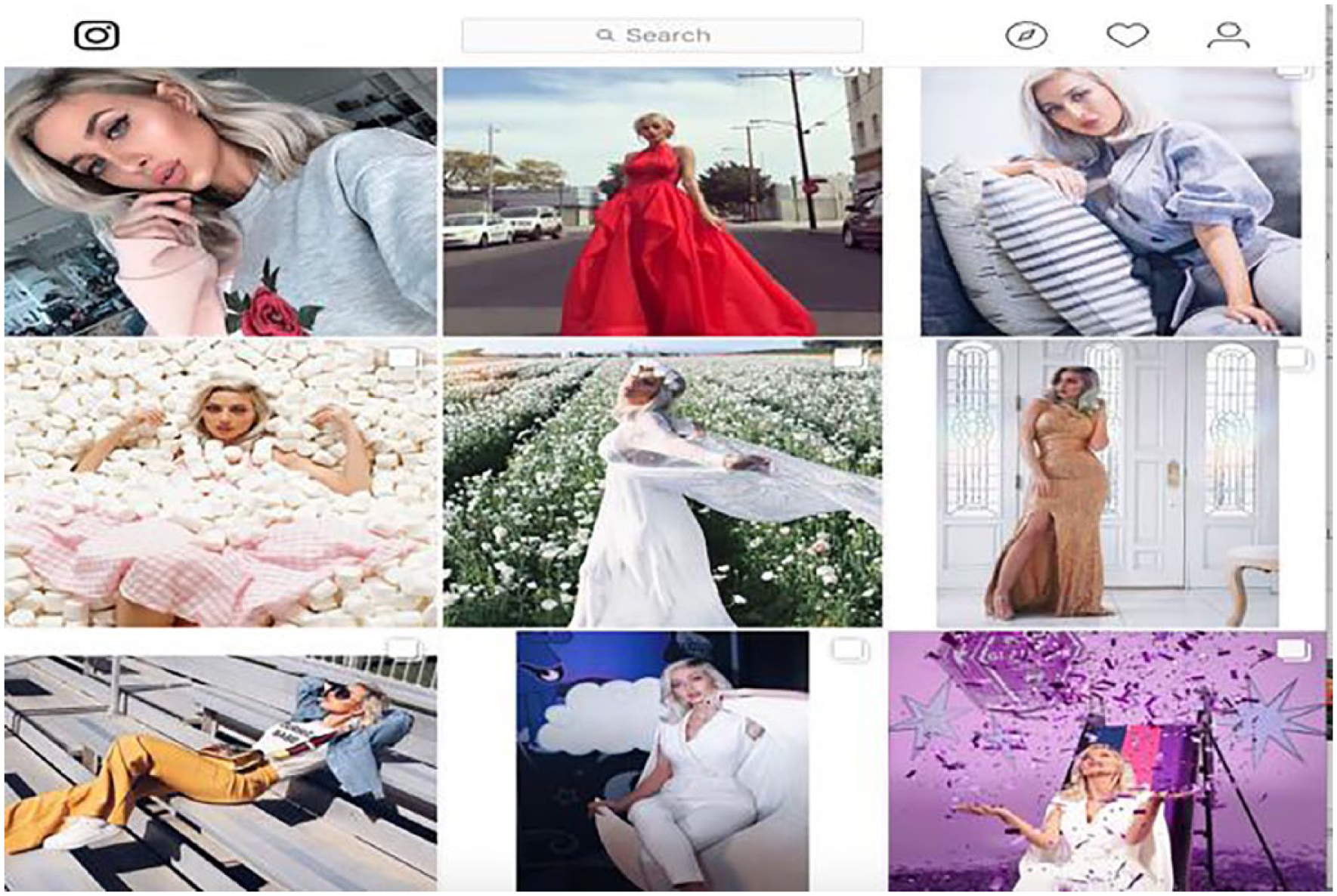
@model_roz, screengrabbed, June 2018.
These PSR mechanisms, operating through modes of fantastical authenticity, were discussed with the focus group respondents who viewed @model_roz’s self-presentations as acts of performance that nevertheless resonated deeply with how they feel. One respondent explained that although she would not dress, or act like @model_roz, she enjoyed the posts because: “they make me feel happy and free. She (@model_roz) loves being a woman, wearing beautiful clothes, doing things that girls love.” When asked whether these representations were “real,” the respondents explained that this was not the purpose of the posts and they do not signify actually doing the things that were shown, rather they depicted a state of mind, imagination, and fantasy. In other words, they offer a range of imaginary affordances similar to a child’s fancy-dress-box of clothing and props utilized for play acting. It is interesting that the respondent refers to @model_roz as both a “woman” doing things “girls love” and this juxtaposition of feminine maturity and innocence indicates the role that fantasy, fairy tales, and myths have played in sexual and identity development. These are contradictory realms of self-presentation and are echoed in other feminized genres including the romance novel (Radway, 2006). Interestingly @model_roz, like Mucha’s model, is depicted as the lone protagonist in her identity performance of fantastical authenticity.
@lojain_omran
The respondents’ interpretations of the Saudi Arabian influencer—@lojain_omran (Figure 6), also indicated strong elements of fantastical authenticity.

@lojain_omran, screengrabbed, June 2018.
Fantastical authenticity in these posts, according to the respondents, depicts a “lovely and varied life” as @lojain_omran’s world of blossoms and balloons is “like a fairy-tale” or romance, full of exciting possibilities, shifts in multimodal affordances, and colorful modes. Analysis of these posts reveals a range of identity self-presentations, including wearing a Muslim headscarf/shayla in one post or showing off cascading hair in another. Cultural, national, and religious identity signals are therefore depicted as something optional or as easy as putting on a new outfit or applying a digital filter. It is theorized that these are representations of fantastical authenticity, offering narratives of freedom where Gulf-Arab women can be their fantastical–authentic selves if only within a social media realm.
@taimalfalasi
These elements of fantastical authenticity are also present in the UAE social media influencer @taimalfalasi’s Instagram (Figure 7). While submerged in commercial activity, such as the Dubai Shopping Festival, there is the similar fairy-tale or fantasy aesthetic occurring throughout the social media influencers’ posts, for example, the images of galloping horses and sparkling backdrops. Interestingly, @taimalfalasi was the least popular influencer for the focus group. The focus group said although they like the way she supports local businesses in the UAE, they found her “irrelevant.” Coincidently, she is the most traditionally dressed and so least fantastically authentic in terms of appearance.

@taimalfalasi, screengrabbed, June 2018.
Conclusion
Overall, female Gulf-Arab influencers, like social media influencers in other contexts, blur the lines between offline and online, fact and fiction, trust and deception, authenticity and fantasy. It is argued that the multimodal affordances of social media, at material, conceptual, and imaginary levels, offer bricolage identities for individuals and communities navigating contradictions of a neoliberal imaginary. Contestations of authenticity and identity performances came through in the findings and support the literature suggesting social media influencers’ authenticity is staged, crafted, and calibrated. This occurred to such extents in the female Gulf-Arab influencers’ posts that the modes of authenticity occurring were viewed as fantastical identity performances. However, these modes of fantastical authenticity are not entirely new and occurred in earlier forms of media as varying configurations of feminine mystique, via advertising, feminized culture, and representations of female ontologies. This study is important in theorizing how understandings of social media practices can be expanded through critical multimodal analysis and the ways social meanings occur across cultures and are built up over time (Bouvier, 2015; Machin, 2016). Just as Kriady (2016) discusses the politicized character of reality television in the Arab world, this author argues that social media plays a highly politicized potential in the lives of Gulf-Arab women.
This participant-centered study indicated that social media influencers in the Arabian-Gulf rely on techniques of microcelebrity and the tacit labor of their followers that are mirrored elsewhere and discussed previously in social media literature (Abidin, 2018; Marwick, 2015; S. Senft, 2013; T. M. Senft, 2008). However, female Gulf-Arab social media influencers also mobilize other key strategies and, in particular, fantastical authenticity. This focus on Gulf-Arab female visual culture expands the scope of social and political actors contributing and constructing definitions of reality and simultaneously provides insights into the ways visual representations on social media define real and imagined ways of being that are highly gendered yet differ according to sociocultural context. Future research should explore emerging trends in computer-generated digital influencers, for example, @shudu.gram with 141,000 followers or @limiquela with 1.4 million, to explore how the crafting, digitalization, and simulation of female authenticity on Instagram are intensifying. These fantastical modes of authenticity are problematic in being unobtainable yet simultaneously offer potential for imagining beyond current gendered ways of being.
Footnotes
Declaration of Conflicting Interests
The author(s) declared no potential conflicts of interest with respect to the research, authorship, and/or publication of this article.
Funding
The author(s) received no financial support for the research, authorship, and/or publication of this article.
