



Abstract
This study explores emerging adults’ reflections about how their secondary Instagram account (“Finsta” or Fake Instagram) self-presentation evolved over time, from account creation to their present use. Drawing on interview data collected from female emerging adults (N = 17) who had at least one Finsta and one Rinsta (i.e., Real Instagram), we use Emerging Adulthood as a frame for understanding how their content-sharing practices changed, reflecting their own development from adolescence to adulthood. Our participants described how their Instagram content-sharing behaviors evolved, reflecting their desire to be seen as more mature, especially in regard to managing negative self-presentational content. Furthermore, some participants described the difficulties introduced by context collapse associated with presenting to two distinct networks, both high school and college followers. Finally, and reflecting contemporary developments, we document how the “Making Rinsta Casual Again” trend and the COVID-19 pandemic influence users’ self-presentational behaviors on image-based social media platforms like Instagram.
Introduction
Finstas, or “fake Instagrams,” are typically created by individuals as a secondary Instagram account to express an authentic (Darr & Doss, 2022; Taber & Whittaker, 2020) and true (Kang & Wei, 2020) self apart from their “real Instagram” or Rinsta, where people typically present a more curated self (Taber & Whittaker, 2020). Finstas are seen as a safe place to present “unfiltered, silly and sometimes NSFW” (Not Safe for Work) content (Xiao et al., 2020, p. 6) and where users can “reflect and share difficult emotions” (Xiao et al., 2020, p.7). Previous research exploring self-presentation on Finsta has used different lenses, such as through “intimate reconfiguration” (Xiao et al., 2020), user motivations and self-presentation behavior measurements (Kang & Wei, 2020), and personality theory (Taber & Whittaker, 2020). This study identifies and analyzes emerging adults’ Finsta self-presentation changes over time, from their early use of the platform, typically started in high school, through their college experiences, including during the coronavirus (COVID-19) pandemic.
To understand these changes, we analyze data collected via semi-structured interviews conducted with U.S. female undergraduate students aged 18 to 22 years (N = 17). Our protocol included questions about participants’ self-presentational strategies, content consumption and posting behaviors, audience, and goals for their Finsta, from their account creation to current use. Our findings uncover how participants describe their use of Finsta evolving over time, mirroring their own developmental changes, especially around sharing practices and negative self-presentational content. Context collapse emerged as a key issue: some participants found that engaging on Finsta was more difficult when they had to simultaneously present to both high school and college contacts. Finally, we consider the implications of the “Making Rinsta Casual Again” trend and the COVID-19 pandemic. This trend, popularized on TikTok through the hashtag #casualposting (Crossley, 2020), encouraged participants to post to Rinsta the uncurated content usually only shared on Finsta. This study contributes to the literature on social media and self-presentation by exploring how and why self-presentation on secondary accounts change, reflecting emerging adults’ development and, for many, their transition from high school to college. Specifically, we contribute to scholarship that explores how emerging adults use secondary accounts as an experimental space not only to explore various possible identities but also to refine strategies for managing life challenges in a networked social system. This includes decisions about what to share and with whom, and how to do so in ways that reflect their new maturity and enable them to communicate meaningful moments to close friends during a period of fluidity and change.
Literature Review
Emerging Adults on Social Network Sites
Working in the field of developmental psychology, Arnett (2000) described the period between the ages of 18 to 25 as “Emerging Adulthood.” Emerging adults go through identity explorations (Arnett, 2000) and have distinct perspectives on whether they have reached adulthood (Arnett, 1998). Given that social media platforms enable users to engage in consciously-curated self-presentation and provide multiple opportunities for peer feedback, surveillance, and reinforcement, these platforms serve an important role in the kinds of identity explorations that mark this period.
During emerging adulthood, changes in self-presentation on social media platforms reflect the identify exploration that is a hallmark of this period. Examining one of the earliest social network sites (SNSs), Manago et al. (2008) conducted focus groups with undergraduate students to discover how emerging adults used MySpace to explore and present different aspects of themselves: They found that students utilized the online space to explore identities they aspired to become or to present ideal images obtained from social comparison with peers. Similar issues associated with emerging adults’ attempts to curate self-presentation to reflect various identities are highlighted in Brandtzaeg and Chaparro-Domínguez (2019) research; participants who had gone through a life transition, from youthful experimentation to professional identity, described curating both their current and previous self-presentations. As journalists who may be part of the public eye, their participants were mindful of their self-presentations, especially with regard to their previous self-presentation. Participants were concerned about whether their past content would be seen as representative of their current self, resulting in some participants’ decision to filter past content.
Changes in self-presentation also often came from wanting to demonstrate maturity as self-identified by emerging adults. Drawing from interviews with college students about their Facebook use from adolescence to young adulthood, Schoenebeck et al. (2016) found that participants’ self-presentation on Facebook evolved over time as they transitioned from teens to adults. Participants in this study overall reported being more careful in showcasing their self-presentation compared with when they were younger and less mature. For instance, one of their participants no longer participated in “inflammatory discussions” because there was no positive outcome from it. Huang et al. (2020) also found similar findings to Schoenebeck et al. (2016). In interviews, their college participants described self-presentational changes in how they used WeChat Moments, a popular social media platform in China, and reported shifting from more open to more self-censored as a reflection of their (self-identified) maturity. Both Schoenebeck et al. (2016) and Huang et al. (2020) highlight maturity as a key contributor to participants’ reason for shifts in self-presentation and focus on changes of self-presentation in a primary account usually consisting of a large social network, where self-presentation shifts from broader to more selective as participants gain maturity.
Self-Presentation on Social Network Sites
Goffman’s (1959) work on self-presentation explores the strategic activities an individual may engage in “to convey an impression to others which it is in his interests to convey” (p. 4). Hogan (2010) forwards the exhibitable approach, understanding social media platforms as places “where people submit reproducible artifacts” (p. 381). In other words, the data produced by submitters can be viewed synchronously or asynchronously by the audience. Expanding on Hogan’s (2010) research, Zhao et al. (2013) categorized people’s self-presentation on Facebook into three regions: the performance region, the exhibition region, and the personal region. The performance region is reserved for presenting the self to others. The exhibition region includes performances of the user over time, such as previous posts. Finally, the personal region captures how the user’s data can be saved to self-reflect or reminisce for the individual. These three regions explain how people manage their content online, and how the tension between balancing the public regions (the performance and exhibition regions) and the personal region remains a challenge in that people are more selective in the content they share in the prior than the later. From Hogan (2010) and Zhao et al.’s (2013) research, we understand how social media platforms are utilized by users not only to present content to audiences at any time but also for personal archival purposes.
Self-presentation strategies are intimately related to one’s audience and goals. People tend to “imagine” who the audience might be when presenting themselves online (Litt, 2012), and adjust their presentation accordingly. When conducting interviews with emerging adults, Stephenson-Abetz and Holman (2012) discovered how participants who were first-year or sophomore students experienced three sets of distinct desires they struggled to balance in content-sharing as they navigated old (those met before college) and new (those met in college) relationships on Facebook: “preservation and (re)invention” (connecting with existing and new people), “uniqueness and conformity” (expressing unique interests yet meeting peoples’ expectations) and “openness and closedness” (revealing various degrees of information to different audiences). As this research suggests, emerging adults’ self-presentation is influenced by their audience on social media platforms, where they try to achieve self-presentational goals for two different audiences during the college transition. Drawing from survey data, Yang and Brown (2015) also highlight change in first year students’ self-presentation on Facebook from when they started college to the end of the first semester. The authors compared the two and found that participants’ self-presentation became broader, deeper, and less positive over time, while the authenticity and intentionality of their self-presentation did not differ. The authors speculated that this may have been because at first students were trying to make new friends in college and were thus more cautious about how they presented themselves, but after developing connections they felt less obligated to present a likable self. While these studies show how college students think about self-presentation when facing a new audience (e.g., new college friends and peers), when faced with different imagined audiences, such as family, friends, and colleagues, users may apply different strategies to deal with context collapse (Marwick & boyd, 2011): a term that refers to the flattening of multiple audiences into one single context, as often happens on social media environments. For instance, even though users are aware of multiple audiences, some users target one certain group of the imagined audience when they tweet as a way to navigate context collapse (Marwick & boyd, 2011). Hogan’s (2010) lowest common denominator concept describes the process through which social media users decide what to share, using their most “problematic” audience member as guidance—the logic being that if content is acceptable to this audience member, it’s acceptable to the entire network (and thus to share). Instagram, despite existing research suggesting that Finstas might be a strategy for dealing with context collapse, as they separate out one’s close audience and thus become a space for negative or less performative self-presentation (Darr & Doss, 2022; Dewar et al., 2019; Huang & Vitak, 2022; Taber & Whittaker, 2020), we explore whether context collapse still occurs on Finsta and the mechanisms behind how emerging adults manage their self-presentation within this secondary account.
Practice of Multiple Accounts
Scholarship on other social media platforms highlights how multiple accounts on the same platform, or across more than one platform, are used to maintain different facets of one’s identity, which are often associated with different subnetworks (Devito et al., 2018; Haimson, 2018; Pearce & Vitak, 2016; Tandoc et al., 2018; van der Nagel, 2018; Zhao et al., 2016). Zhao et al. (2016) explored how participants utilized multiple communication channels within the communication ecosystem to share and manage content across multiple social media platforms. Depending on the social media audience and norms, participants shared various content on each platform to achieve specific goals. When new social media platforms emerged, their participants would evaluate their current use of existing social media platforms to decide whether or not a new platform was needed. Similarly, Devito et al. (2018) examined how their participants considered the audiences, affordances, and norms of multiple social media platforms in a holistic manner to achieve self-presentational goals, viewing this combination of platforms as their personal social media ecosystem. Other scholars such as Tandoc et al. (2018) used focus group data to explore how people manage multiple platforms to control the disclosure of information to audiences, finding that people used various social media platforms based on self-presentation and relationship maintenance gratifications such as availability and acceptability. Multiple platforms used simultaneously can also serve as “social transition machinery” in which “multiple social media sites and networks often remain separate, yet work together to facilitate life transitions” (Haimson, 2018, p. 1).
Although the above work focused on instances in which participants used different platforms to manage identity change over time, different accounts on the same platform may also function in this manner. Drawing from survey data, van der Nagel (2018) described alternative accounts (alts) as a “disconnective practice of selective presencing” (p. 3), where people present a facet of identity distinct from the primary account, varying across intimate perspectives or targeted topics such as weight loss journeys or fandoms. Stutzman and Hartzog (2012) found that people created multiple profiles within one or across social media platforms to achieve various goals related to multiple audiences, such as privacy or utility. To avoid surveillance from specific audiences and the potential repercussions of revealing their identities online, in Pearce and Vitak (2016)’s research, young Azerbaijanis used different sites or multiple accounts on one site to manage separate audiences, self-presentation, and interactions. Haimson et al. (2016) also described how people going through gender transition would manage multiple accounts as one way to separate their old and new identity. From these examples, we see that the practice of multiple accounts is associated with the motivation to present different facets of identity and information to multiple audiences. Considering that emerging adults are also going through various transitions—adolescents to adults, high schoolers to college students—we would like to explore how these transitions may or may not be reflected in their usage of multiple accounts. When studying emerging adults’ self-presentation, we focus specifically on Instagram due to the popularity of its use among emerging adults and the rise of multiple accounts on the platform.
Self-Presentation on Instagram: Rinsta and Finsta
Some platforms encourage multiple account use more than others. Instagram introduced the ability for users to switch between accounts in 2016 (Monckton, 2016). When users create multiple accounts, the primary account is often called the “Rinsta” (for “real Instagram”) and the secondary account is coined “Finsta” (for “fake Instagram”).
Recent scholarship on Rinstas and Finstas highlights differences (and some similarities) in self-presentational patterns. Drawing from the Big Five Inventory, Taber and Whittaker (2020) surveyed students who had one Rinsta and one Finsta and found that their Finsta personalities were “more extraverted, less conscientious, less agreeable than Rinstas” (p. 1). From survey data, Huang and Vitak (2022) discovered that Finsta posters tended to have less intention to edit their posts or share visually appealing photos, and were more likely to share negative emotions compared with their Rinsta posts. The literature highlights the ways in which Finsta allows users to be expressive, humorous, and negative in their self-presentation (Huang and Vitak, 2022; Kang & Wei, 2020; Taber and Whittaker, 2020; Xiao et al., 2020).
When comparing Rinsta and Finsta, some scholars have applied Goffman’s (1959) dramaturgical approach to theorizing self-presentation by describing Rinsta as the front stage and Finsta as the backstage. Kang and Wei (2020) suggested that Finsta may be the backstage where performers, who are Finsta users, invite a small group of other performers who they trust to their backstage where they can see the Finsta users’ funny self. In other words, the authors implied that instead of a true backstage, the backstage may be another performance stage. Huang and Vitak (2022) also described Rinsta as the front stage and Finsta as the backstage. In the front stage, Rinsta, people were expected to follow certain norms, whereas in the backstage people were able to focus more on themselves and present a vulnerable self to their friends. The audience and norms of Rinsta and Finsta shape their respective self-presentational patterns.
Typically, the audience on Finsta is a smaller network of the users’ close friends, usually less than a hundred people (Abrashi, 2018). Besides close friends, the audience could also include connections who users aspire to build relationships with or a looser collection of followers (Xiao et al., 2020). Drawing from interviews conducted with emerging adults, Duffy and Chan (2018) argued that Finsta accounts were a result of “imagined surveillance” on Rinsta: users imagined potential scrutiny from social institutions on Rinsta that might hinder future opportunities and utilized Finsta as a pseudonymous space for sharing more quotidian selves (e.g., the funny, sarcastic, and vulgar self). Having a close and intimate audience gives users more control on Finsta than Rinsta: through trust and closeness with the audience, Finsta users are able to manage who has access to their private feelings and engage with a relatively more homogeneous network than Rinsta (Taber & Whittaker, 2020). While Xiao et al. (2020) reported that, compared with generic interactions on Rinsta, Finsta interactions between the user and their followers can be more “meaningful and genuine” (p. 8), Huang and Vitak (2022) found from survey data that users’ perception of Finsta responses in terms of satisfaction, usefulness, supportiveness, and pleasantness were lower than Rinsta responses due to the small number of followers, which meant fewer responses to users’ negative posts (Huang and Vitak, 2022). In summary, the smaller and more selective audience plays an important factor in users’ decisions about what content they share and how they feel about the interactions on Finsta.
The self-presentational norms on Rinsta and Finsta differ. While users follow social and self-presentation norms on Rinsta and offline, Taber and Whittaker (2020) noted that on Finsta, users have more latitude to violate those norms by presenting sensitive information and negative perspectives. The authors suggest that expressing negativity through venting or going against social norms of self-expression are two ways that demonstrate the social context of Finsta: An emotional outlet where users feel comfortable complaining and posting illicit behaviors. Aside from negative content, Finsta may have its own social norms, such as an expectation to be “open, funny or even imperfect” (Xiao et al., 2020, p. 10) or include content on drugs and alcohol (Xiao et al., 2020). Presenting authenticity may also be another social norm on Finsta, as Darr and Doss (2022) found that teen participants’ self-presentational behaviors for being authentic evolved from “spilling T” (expressing honest opinions, often strong, about others) to “shit-posting” (sharing less important content than Rinsta) as an indication of their self-identified maturity. In summary, the existing literature highlights how Finsta self-presentational norms diverge from more generic social media norms. While negative content and authenticity have been found to be unique to Finsta, we hope to further investigate any other change of self-presentational norms for emerging adults in addition to Darr and Doss’s (2022) work, which focused on a younger (aged 13–17) set of participants who have not yet reached emerging adulthood.
Overall, prior research has explored emerging adults’ self-presentational changes on social media platforms, such as Myspace, WeChat and Facebook, where those changes are discovered on one primary account that is more public with a larger audience. As research on secondary accounts is emerging, we know less about users’ self-presentation strategies and envisioned audience on secondary accounts, such as on Instagram’s Finsta. In particular, less is known about how these performances for emerging adults change over time in response to audience, changes in the account holder over time, and external pressures. Thus, we ask:
Research Question 1 (RQ1). How and why do emerging adults’ self-presentation on secondary accounts (i.e., Finsta) change from account creation to current use?
Method
Data Collection
Participants
According to recent reports from Pew Research (Auxier & Anderson, 2021), in 2021 71% of United States 18 to 29 year olds were likely to use Instagram. As undergraduate students typically fall within this age range, we recruited undergraduate students at a large university in the Midwestern U.S. through department email listservs and newsletters from several colleges (engineering, education, public policy, and design). Students were invited to complete a screener survey included in the email or announcement. In the screener survey, we collected the emails of students who met our screening criteria (have at least one primary and one Finsta account) and were interested in participating in a 45 to 60-min interview for a US$12 Amazon gift card. In total, we contacted the first 28 students who met our screening criteria via email and scheduled interviews, beginning with those who responded first. Saunders et al. (2017) highlight data saturation as the point at which researchers no longer receive new information that differs from information they have gathered from previous interviews. When we started to hear redundant information, we ceased recruiting. Our final sample consisted of 17 participants.
Similar to prior work (Dewar et al., 2019; Kang & Wei, 2020; Xiao et al., 2020)—and appropriate given that online self-presentation differs across gender (Herring & Kapidzic, 2015)—all of our Finsta-using participants identified as female and were between the ages of 18 and 22. Participant age, gender, school year, ethnicity, and the number of followers on Finsta and Rinsta are shown in Table 1.
Participants Demographics.
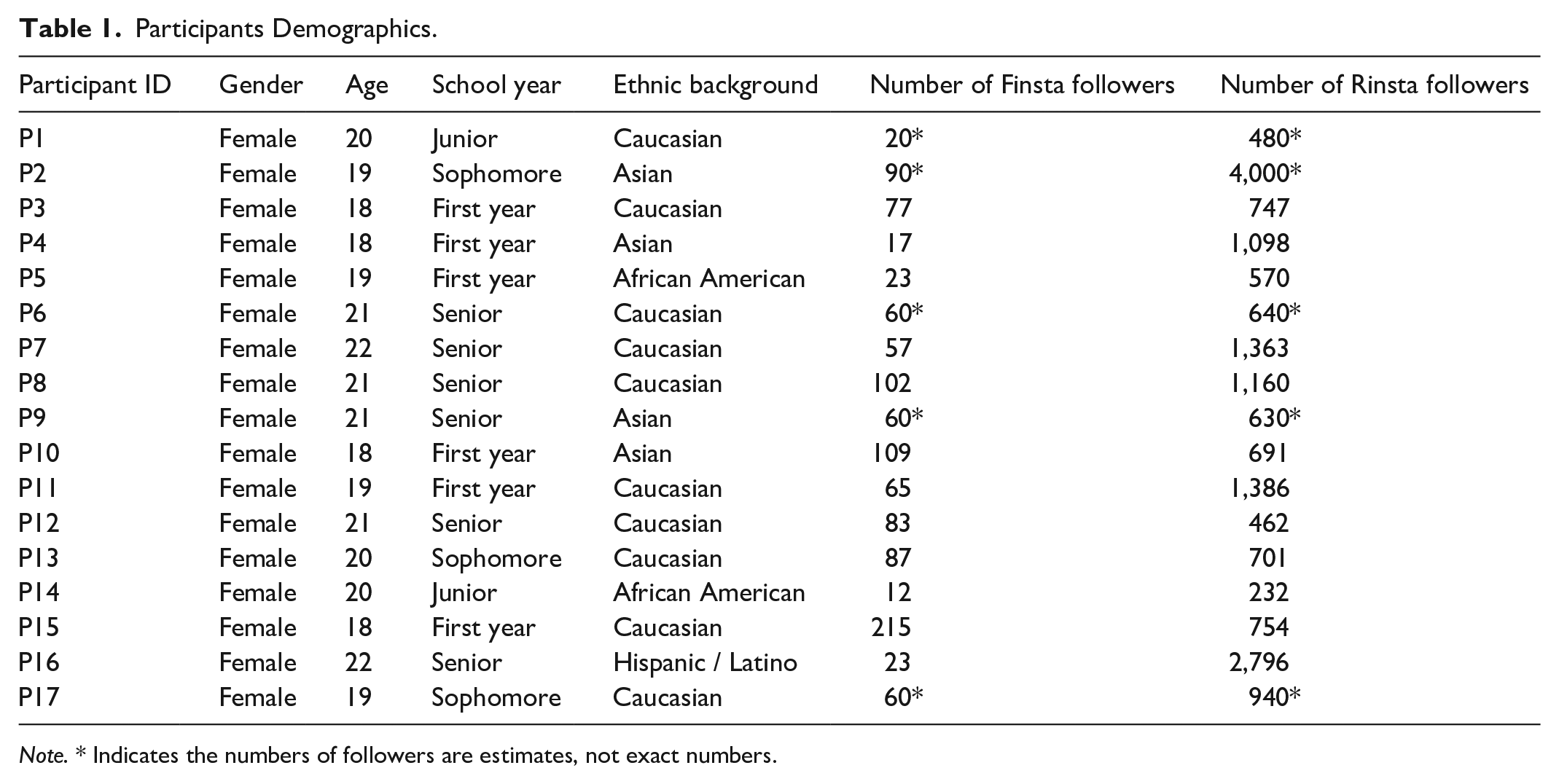
Note. * Indicates the numbers of followers are estimates, not exact numbers.
Procedure
This study was considered exempt from oversight from our university’s Institutional Review Board. We conducted semi-structured interviews with individual participants remotely. The interviews were conducted between December 2020 and February 2021 by the first author. Participants signed a consent form to be audio recorded prior to participating in the interview. After completing the interview, participants were sent a US$12 Amazon gift card.
Drawing on previous Finsta research (Kang & Wei, 2020; Taber & Whittaker, 2020; Xiao et al., 2020), our interview protocol addressed how Finsta self-presentation strategies were different or similar to Rinsta. Our semi-structured interview protocol included questions including: What were the reasons you signed up for your Finsta? Have these reasons changed throughout your use of Finsta? What do you hope to get out of your Finsta right now? Thinking about 1 year ago versus today, how (if at all) has COVID changed your use of Finsta? The full interview protocol is available from the first author upon request.
Analyzing Data
Interview files were transcribed using Otter.ai, checked for accuracy by the first author, and slightly edited for readability. Data analysis was conducted in a “cycling act,” where coding was not only limited to one cycle, but multiple cycles of recoding; this process “further manages, filters, highlights, and focuses the salient features of the qualitative data record for generating categories, themes, and concepts, grasping meaning, and/or building theory” (Saldaña, 2011, p. 8). After importing data into Dedoose (qualitative analysis software), we applied codes using a combination of inductively-generated codes (e.g., Making Rinsta Casual Again, COVID-19, Change of Finsta Use) as well as codes that reflected salient themes that emerged from our review of scholarship on online self-presentation, use of secondary accounts, emerging adulthood, and other relevant themes (e.g., Peer Influence, Comparing Finsta to Rinsta). After the two passes of coding, the entire corpus was recoded using the final codebook. Next, we conducted axial coding; this step of analysis eventually resulted in our main themes: change of self-presentation on Finsta, change of audience on Finsta, the “Making Rinsta Casual Again” trend, and the COVID-19 influence on Finsta. To compare data and synthesize observations across participants, we then constructed a meta-matrix with participants as rows and our themes as columns (Miles et al., 2020).
Findings
Changes of Self-Presentation on Finsta
Our research question asked what kinds of changes, if any, participants noticed in their self-presentational Finsta practices over time and their understanding of the origin of these changes. Our analysis suggests self-presentational changes associated with several factors described by our participants: the audience, participants’ self-described maturity level, social contexts, and the availability of alternative communication channels to Finsta.
Exploring Identities and Social Coordination
Most participants joined Finsta in high school or their first year of college. We observed how in the early years of using Finsta, the criteria for accepting followers into participants’ Finsta network appeared to be less selective than later years, with many participants mentioning how they would accept almost anyone they knew in offline contexts to their Finsta at the time they signed up for Finsta. P2 described her process of accepting anyone who followed her in high school when she first got a Finsta, but later only keeping her close friends as her Finsta network: People in my high school would follow it. And I’d just accept [them]. And when I went to college, I was like, I don’t want all these people following [me] anymore. So I just removed all of them. Besides from my close friends.
With a less selective network, some participants described how their self-presentation was influenced by the self-presentation norms observed on Finsta, specifically the desire to present “cool” or “dramatic” images to one’s audience. Drinking alcohol was one of the self-presentational strategies utilized by participants as a “cool” image. For P7, her profile picture used to be an image of herself drinking to show that she was “cool”: My profile photo for the last four years that I had—It was me drinking svedka . . . It was the alcohol one because that kind of like symbolized I think what Finsta was like, where you talked about alcohol and stuff, especially when I first made it when I was first going to college. It was like, I don’t know, I guess it was probably bragging about like, “Oh, I drink. I’m cool.”
Some participants suggested how presenting a “dramatic” image on Finsta would be an exaggerated version of their life, as this was also what everyone else was sharing on Finsta in the early years of use. P16 explained how presenting her social life on Finsta as “dramatic” was a norm, where she would constantly compare her Finsta with other peer Finstas: I guess again, with the whole comparing yourself thing, I feel like, especially with the content, people always had something, like their lives are so interesting. . . . And so, I felt like a pressure to post to make people think oh, like, “My life is interesting.” Like, I have things that I want to share with the world that are super dramatic going on in my life. And so I feel like yeah, the pressure to post was more of like, the pressure to make my life seem like a movie almost.
The Finsta network was less selective in the beginning of using a Finsta, thus also was utilized as a hub to manage social coordination (e.g., finding parties) and hierarchies (e.g., “shading” other people) within the social circle. One participant described engaging in this kind of social regulation as “shade,” or being disrespectful toward someone (Urban Dictionary; Shade, 2003), as described by P10: “It was another thing when I was in high school, so bad of me, but I would like shade people and stuff. [I would kind of] make the post directed towards them. Even though I wouldn’t say their name.” Another participant P15 talked about following people who “went out a lot” to try to search for information and discern where the next party would be: And so I would follow all the accounts of people I knew in high school. I would try to get beyond the end and find parties and figure out what was going on the weekend. And so, I followed the people from that kind of scene who I [knew] went out a lot.
The lack of selectivity when accepting Finsta followers in the early stages of participants’ use, as well as newly starting a secondary account, may have encouraged participants to mimic self-presentational norms (e.g., being cool and dramatic) and utilize the account for social goals.
Presenting Negativity and Intimacy
Our participants discussed another common self-presentational norm they witnessed and also emulated: presenting negativity (e.g., sadness, depression). As P11 explained, she shared “stupid things” because other Finstas were also doing so: “I would only want people who were also sharing similar stupid things, to also be able to see it.” Despite “sharing similar stupid things” being a perceived self-presentational norm on Finsta, at least among some, participants and their networks had varying perspectives on how much negative self-expression was acceptable. For example, for P3, even though she shared negative content, noted the amount of “emotional things” others shared and calibrated her own content accordingly: [Other Finstas also post] a similar amount of like, emotional things. I’m not posting every day, like, “Oh, this is what made me mad today.” But like, a couple times a month, or when it’s a really bad day or something, I’ll post about it. And I think there are people who do post that same amount as in, a couple times a month. They’re also people who post weekly, or almost everyday things that are getting them down. And I feel like that can become negative if you’re always posting about negative things. So I like to have a balance.
Participants observed how their peers presented negativity on Finsta, adopting a similar style when presenting their own life challenges. P7 talked about imbuing negativity with humor to make it more consistent with her friend group expectations: And [my friend’s Finsta] was like lighthearted, like comedy jokes. So we all kind of copied that. And obviously [she] is a very depressed person. So it’s like lighthearted, but actually really depressing, but you know, hide the pain away. . . . So we do post things about being depressed, being sad, whatever, not getting into something we wanted, we post that stuff but in a lighthearted manner.
Despite negativity being accepted as self-presentational norm, the perceived acceptability of sharing negative experiences and emotions shifted throughout participants’ use of Finsta. As an audience of other Finstas, some participants expressed gradual uneasiness when peers shared too many details of their lives or overwhelming negativity. P17 explained, “Sometimes I was like, I don’t really know these people as well as I used to. It feels almost weird to know how intimate the things that are going on in their life are.” P11 described how intense negativity on peer Finstas seemed like an “attention grab” to her: I know that it can be really cathartic for people to just scream out into the world that they’re sad, but I never quite understood. . . . This is probably bad, but posting about your sadness on Finsta always seemed like a bit of an attention grab to me.
Participants expressed annoyance at the amount of complaining and overly disclosive “intimate” content on Finsta they witnessed as audience members, which lead them to adopt specific strategies to avoid being exposed to content they didn’t want to witness. P6 noted she stopped using Finsta due to the negative content on Finsta during the COVID-19 pandemic: I find [Finsta] a little bit annoying now, because it’s kind of everybody else just ranting about how terrible quarantining is or how terrible life is. And to me, that’s just not the headspace or the area that I want to be surrounding myself. And so I kind of stay away from [Finsta] a little bit more now.
Another strategy a few participants applied to avoid receiving complaints or intimate content was to ultimately remove followers who were not participants’ close network and posted large amounts of negative content. P15 explained, I like unfollowed a lot of people because I was like, not to sound mean—but I was like, “I don’t care about you,” like talking about these problems that happen over and over again, just like, petty drama.
Although Finsta provided a space for negativity (Huang & Vitak, 2022; Taber & Whittaker, 2020; Xiao et al., 2020) and personal secrets (Kang & Wei, 2020), some participants described gradually feeling more uncomfortable about exposing themselves to a large network over time. This discomfort may have been introduced by the early, indiscriminately added followers in their network: in the early years of maintaining a Finsta, participants were generally following and accepting a wider circle of connections, beyond their close friends’ circle. Putting herself in her Finsta peers’ position, P12 mused about the possibility of creating another Finsta consisting of strangers instead of acquaintances to alleviate the concern of appearing too “weird” or “cathartic” to her audience: For some reason, even though Finstas should be a place for venting and sharing everything, you just don’t want to spill all of it. Because sometimes it can feel like a lot. But I did propose this idea . . . If you had a Finsta, and you let a bunch of other people’s Finstas follow it that you didn’t know at all, like they were from like Utah, or something. None of you knew each other personally. So you could all just spill everything on your personal life. And it would have no consequences or repercussions. Because they don’t know you—they just get to see what you post and maybe give you advice if you’re going through something kind of rough.
This suggestion highlights what our participants saw as a benefit of disclosure—“advice if you’re going through something kind of rough”—but in a more anonymized context where people didn’t “know each other personally,” akin to how Reddit “throwaway accounts” are used to get advice without disclosures associated with one’s primary Reddit account (Leavitt, 2015) or how anonymous platforms like ask.fm were used for information-seeking about stigmatized issues (Ellison et al., 2016).
Intermingling Between High School and College Content
Most participants started using Finstas as high schoolers and continued to use the account after starting college. This transition from high school to college marked a developmental shift in participants’ Finsta content, as it shifted from sharing high school experiences to college life. P13 explained how the college content she shared later became difficult for her high school friends to understand, explaining, I feel like [posts on Finsta] wouldn’t really get a reaction because people would just be like, “I don’t really know what she’s talking about.” I kind of think, like an example would be . . . posting about a class. Or specific [college] friends here? It wouldn’t really make any sense because I don’t think those people [high school friends] [would] want to know them [college friends]—they wouldn’t really know what I was talking about.
Since participants were generally more selective about their network of followers on Finsta compared with Rinsta or other social media sites, some participants described initially not adding college followers, since they had not become close friends with people from college. As P13 explained, I think that I was going through a weird time in college where I wasn’t super close with anyone enough where I trusted anyone to follow the account. So I wasn’t really adding any new followers. So at that point, like the number [of followers] just kind of stayed the same.
As college followers joined participants’ Finsta, some participants described facing two audiences on Finsta: high school (existing) friends, and college (new) friends. The two audience subnetworks represented self-presentational challenges—as existing and new friends were joining participants’ Finstas, this resulted in the “weird intermingling” associated with context collapse. As P12 explained, It was definitely different when I had college people start following me because when I would post in high school, it was all about stuff that was going on in high school. And all people started to follow me I’m like, “Oh, I have this new audience. What do I have to say?” It was weird intermingling the two groups of high school versus college people. “I’m experiencing all this new stuff in college freshman year. Let me share it with you.” But people from my high school who weren’t with me in college, they weren’t directly there to see what was going on. It was weird intermingling the two.
Even for participants’ college friends, various sub-networks of followers emerged. As one way of managing context collapse within the college network—namely, the struggle to find content that appealed to a more diverse set of followers—P9 explained how she would share memes that she knew would be funny to all of her audiences: So it’s like, one friend I have from frisbee, another friend I have from housing, another friend I have from work. So they really don’t overlap. . . . [But] I have a general sense of what they find funny. When I’m posting these memes, I’m not thinking, “Oh, this is the most efficient way to send this to all of them without sending it to all of them.” But it’s just like, a general, I find this funny, I relate to it now, I’m sure to other people when this comes up on their timeline, they’ll also find it entertaining.
The challenge of managing multiple audiences in one context led to participants selecting one platform for each audience. For instance, even as P1 had a small Finsta network, she explained how she decided to share content in a group chat that only consisted of her high school friends: It’s an inside joke of something with my high school friends, and I would just send it directly and, like, [through] the group chat that we have. I think that’s just a more convenient way and kind of an easier way to connect with them, by posting something similar to the content I would post on Finsta. And it’s only meant for a specific group of people.
The transition of going from high school to college impacted the organization of one’s Finsta network: Participants struggled to invite a close college network that was still in the process of being solidified to join their Finsta. In addition, when a college network was formed on participants’ Finsta, context collapse occurred due to the different social networks present (e.g., high school and college, various college groups). Despite Finsta being a smaller network for close friends, our participants still experienced context collapse challenges as they added people throughout their use of Finsta from high school to and through college.
Maturity Encouraging a Lighthearted Finsta
When we asked participants whether their Finsta use changed over time, many participants claimed that as they got older and more mature, their Finsta content-posting practices changed. For some participants, they realized in the later years of Finsta use that negativity and dramatizing events on Finsta may not be the best method to deal with issues in life: Seeking professional help through a therapist was mentioned as an alternative coping mechanism. They noted their interactions on Finsta became more easygoing as they discovered other strategies to manage their emotions and personal problems. For instance, P16 shared how the biggest difference between her Finsta in the beginning and at the time of the interview was that “what I write about [now] is that I feel like I’m just way more mature and I know how to handle my emotions and events better.”
Many participants disliked the drama or negativity presented in the previous years of using Finsta and aimed to share “lighthearted” content on Finsta. This can be understood through some participants reflecting on their past self-presentation and explaining their current self-presentational goals, for example, as P17 explained, I feel like in high school definitely used to be dramatic, sometimes, people would post things that were scandalous about someone’s drama. But it’s definitely stopped being like that. So I think the interactions are a lot more easygoing. [Interviewer: Why do you think it has stopped?] I think people realize once we got into college that you don’t have to project everything that you’re doing and all of your problems to this small following. It’s just kind of like you deal with it in other ways. I think it . . . still sometimes feels like a very high school thing to do to be posting on your Finsta.
Similarly, P8 explained that instead of complaining or sharing dramatic events, she now wanted her Finsta to be more “authentic” by sharing her life without exaggeration, stating, [Before,] I would probably complain about my roommate, I’d probably complain about not being able to party on a Friday or something like that. It would just be like a bunch of shallow like, “Oh, I ended up getting the number of this one random frat guy” or something like that. And [now] I want people to be able to understand me a bit more. And I mean, if they’re friends with me, they do understand me and they really enjoy my life and stuff. Like they’ve told me that [my Finsta is] more authentic than some other Finstas might be.
Some participants also referenced the concept of “relatability” as a self-presentational strategy for posting negativity on Finsta in a mature manner. That is, even if participants expressed negativity on Finsta, they mentioned the negativity being “relatable” to the audience as a consideration for sharing, with P15 explaining, And, whatever I’m posting about, I think it at least relates to someone else that follows me. And so it’s kind of like, I feel like my feed on a spam account is just like teenagers, getting through life. And we’re all just like, I feel what that person posted [about], or [I understand] this person is letting out their feelings, because we’re all stressed right now.
Participants attributed their shift from being “dramatic” and negative to sharing lightweight content to their developing sense of maturity. In order for Finsta to become “lightweight,” as described by a participant, participants applied self-presentational strategies such as sharing more authentic selves, without exaggeration, or emphasizing relatable factors when sharing negative content.
Sharing Positive but Personal Updates
Compared with the Rinsta network, many participants felt that their Finsta network was more aware of their personal lives and thus able to understand the content participants share as compared with the Rinsta or Facebook audience. The limited audience on Finsta encouraged participants to share content that could be misinterpreted by a larger audience without knowing the context. For instance, P11 explained that her audience knew she was in a relationship with another person and would not mistake her “one month anniversary” post with her roommate as a new relationship: I think I chose it [posting on Finsta] because I didn’t want people [on Rinsta] to think that we were dating if I were to post a one-month anniversary to my roommate, but I figured that the people on my Finsta would get that it was a joke.
In the case of P7, she associated the ability to share accomplishments on Finsta as “authentic” because she could share good news about herself to her limited audience without the fear of delivering the wrong message, noting, When I got into [University], I posted on my Finsta, I wasn’t gonna post that on my real Instagram [Rinsta] because it’s like, everyone’s trying to get into colleges, some people probably didn’t get into [University] and you don’t want to make people feel bad. So it’s [Finsta] just like a place you can be more authentic like post things that you wouldn’t want to post on your regular [Rinsta].
Participants sometimes also utilized Finsta to test the waters—to predict how their Rinsta or Facebook audience might react by sharing the information first on Finsta. P6 explained how the Finsta audience was her “middle circle” to share information if she was not ready to share to her “biggest circle” on Rinsta or Facebook: I mean, I’ll use when I posted about my ex [as an example] when I kind of came out and I was like, “Oh, I’m in a relationship.” I wanted to let not just my inner circle, but kind of like that one ring outside of the inner circle [know]. That’s not like your big circle with all the acquaintances that you know, from high school and stuff like that. But let that middle circle kind of know that, “Oh, this is a big part of my life.” And because I wasn’t quite ready to tell that biggest circle what was happening. I think it’s just to kind of share a little bit more about my life. When I don’t want to post it on Facebook or when I don’t want to really publicly post about it.
In the case for P9, the limited audience on Finsta also provided the platform for her to share news about the death of her mother instantly with the hope of receiving attention and care from her close network before announcing the news “to the world”: Because on my Finsta it first happened. And I just I didn’t know what to say. And I didn’t really want to be saying exactly how it happened to my Finsta. And I didn’t really have the words to articulate my emotions. So it [the post] was either [a black screen] or having absolutely no caption at all. And then I want to say like half a day later, I posted the “In Memoriam of My Mother” [on Rinsta and Facebook] and I was able to kind of gather my thoughts a little bit and be able to [through] that post, let the world, let all friends and family know what happened.
Because of its limited network, Finsta was utilized by many participants as the platform where they would share personal news, both positive and negative, especially news where knowing additional context was critical for deciphering or understanding the relevance of the information. Participants would post about experiences such as starting a romantic relationship or sharing their achievements on Finsta to a smaller, more intimate network who had more context about their lives before considering sharing with a larger audience.
Being Casual on Rinsta, Not Personal
Participants observed the “Making Rinsta Casual Again” trend on Rinsta that encouraged users to present a casual, less curated self one would usually see on Finsta. Just as how P11 described, I actually feel like there seems to be kind of a “Make Instagram Casual Again,” type of trend that’s been going on, which I think has helped move people from posting those types of things like more casual photos on their Finsta posting on their Rinsta. I think it’s just like any sort of trend. It’s more trendy to be more transparent with your followers now than it was back when Finsta kind of originated, at least that’s what it seems like.
Another reason why more “casual” content became more acceptable on Rinsta was due to the COVID-19 pandemic, with P7 hinting that since people had fewer events to post about (e.g., traveling or outdoorsy activities), the pandemic encouraged people like herself to post more content about their daily, everyday lives: Especially during COVID people are posting less, and I’d be posting more everyday things versus just going to Bahamas and things like that. So I think that’s good.
Participants also hinted how Finsta may have been a trend that eventually lost its attractiveness over time: communication channels other the Rinsta such as direct messages, group chats, and Snapchat emerged and offered alternative channels for meeting their self-presentational goals. P1 explained, I think we’ve kind of moved from posting on Finsta when we want to reach out to everyone to just posting in our group chats. I feel like our group chats have become more active, and then Finsta less often. So I think it’s just also growing out of it as well.
While “Making Rinsta Casual Again” and the pandemic may have encouraged participants to present a casual self on Rinsta and overlap with the self-presentation on Finsta, some participants still expressed how the limited audience of Finsta allowed participants to share personal feelings, as mentioned by P12, “Even when people are posting those casual photo dumps on Rinsta, they’re not adding like a personal caption.”
“It’s your Finsta at the end of the day . . . kind of,” shared P10 at the end of her interview. This quote captures participants’ perception that presentational concerns were salient, even on a Finsta. As these emerging adults explore different identities and self-present based on peer Finstas and trends, their self-presentational strategies on Finsta changed as well, mirroring their own development as well as social norms and external events, such as the COVID-19 Pandemic.
Discussion
This study explores emerging adults’ understanding of how and why their self-presentation evolves on secondary social media platform accounts, taking Finsta (i.e., Fake Instagram) as an exemplar. Our findings contribute to understanding specifically how secondary accounts are utilized in addition to the primary account to manage multiple facets of one’s identity and self-presentation, especially by serving as a space for identity exploration for emerging adults (Arnett, 2000). Here, we summarize our main findings and explicate their implications for our understanding of these dynamics.
First, we find that participants described a range of evolving factors they considered when presenting on Finsta. Prior research has found that Finsta provided a space for negative self-presentation (Huang & Vitak, 2022; Taber & Whittaker, 2020; Xiao et al., 2020). Echoing these findings, our participants also described sharing negative content on Finsta (as opposed to Rinsta, the primary account). However, our participants closely followed self-presentational norms observed on peer Finstas and adjusted their frequency and way of presenting. Changes in how our emerging adult participants presented negativity on Finsta can be understood as mirroring the developmental process of how emerging adults learn to manage negative emotions: starting with venting, as one participant said, “I can just make a make a post on my Finsta and like, post it. And then it could be like . . . ‘Oh my gosh, I don’t know what to do.’ Or if I just want to rant like ‘Oh my gosh, yada, yada, yada,’” to filtering what is shareable, and eventually considering other methods (such as professional counseling) to manage emotions. These changes in self-presentational practices may reflect what drew them to Finsta in the first place—an outlet where initially they shared unfiltered feelings and thoughts, but which later became less appealing for this kind of content due to their desire to signal maturity and the new social norms such as being “lighthearted” and “relatable” associated with emerging adulthood. Our work builds on research that highlights participants’ self-described maturity over time as a key factor animating change in self-presentation (Brandtzaeg & Chaparro-Domínguez, 2019; Huang et al., 2020; Schoenebeck et al., 2016), but extending it to explore how these changes manifest on secondary accounts. As participants reflected on their evolving Finsta practices, they also noted how their online behaviors mirrored their own development as they moved from unfiltered venting in high school to more calibrated content-sharing and audience composition in college.
Second, audience played an important role in self-presentation on Finsta. Finstas typically have a smaller network than Rinstas, consisting of close and intimate friends (Taber & Whittaker, 2020; Xiao et al., 2020). Our data similarly illustrate instances in which Finsta includes close friends, as opposed to the larger social network on Rinsta, and thus represented a space where participants were able to share a less curated, quotidian self. Yet, in our study, we discovered how the shifts in the Finsta audience size and network throughout participants’ use have directly impacted which content participants choose to share. The less selective but more uniform network of high school followers in the early years of using a Finsta allowed participants to explore different identities such as a “dramatic” or “cool” self, which were both desired self-presentational behaviors at that time. Though Finsta has been framed, by both researchers and end users, as a remedy to context collapse tensions (Huang & Vitak, 2022; Kang & Wei, 2020; Taber & Whittaker, 2020), some of our participants nonetheless described experiences of context collapse associated with their Finsta, when tensions about content-sharing occurred as the Finsta network became more diverse and spanned both high school (old) and college (new) audiences. Participants struggled to present their college self when these preexisting audiences did not have access to the full context of what was happening in their college lives. Even for the new audience, the separate groups within the new audience of college contacts also led participants to engage in self-presentational strategies. These included a kind of “lowest common denominator” (Hogan, 2010) approach, as we saw with one participant who limited herself to sharing memes and other humorous content suitable for and legible to a diverse network. On another version of this concept, Finsta was utilized as an experimental space to see how the limited audience on Finsta would react to certain posts before sharing to a larger audience. We also found that participants reported using Finsta to share news in scenarios where they were not ready to disclose to the larger audience, and shared first on Finsta where the network was smaller. This echoes Huang and Vitak’s (2022) work, where participants shared experiences of cross-posting by posting the same events on Rinsta and Finsta, including asking for feedback of a certain post on their Finsta before sharing to their Rinsta. In our findings our participants choose Finsta over Rinsta to share personal news, not only to test the waters of the audience response, but also to spread the news to close friends who cared for them.
Third, our findings highlight the way in which external forces such as the “Making Rinsta Casual Again” trend and the COVID-19 pandemic encouraged participants to be “casual” on Rinsta, which overlapped with the self-presentation strategies traditionally associated with Finsta. The pandemic also encouraged participants to share more quotidian selves on Rinsta since there were fewer social, exotic, or outdoorsy activities to feature to present a more curated self. Similar to how Zhao et al. (2016) discovered that their participants evaluated their uses of social media platforms due to new platforms and changing norms, our findings extend to instances in which users evaluated multiple accounts across and within a platform. When it became an option to share a version of self on Rinsta that was normally shared on Finsta, participants evaluated the need to maintain a Finsta. In addition, though Finsta is a secondary account for sharing more personal content to a limited audience, our participants sought to manage content not just within Instagram (Rinsta and Finsta), but within a wider media ecosystem including channels such as direct messages, group chats, or other social media platforms (e.g., Snapchat). The study of secondary accounts is particularly useful for exploring self-presentation, as they offer the exact same features and affordances as the primary account, but with a different audience. Future work could explore instances of secondary or temporary “throwaway” accounts (Leavitt, 2015) on the same platform as a methodological strategy for exploring user choices about what to share where, holding platform constant and thus offering the ability to discern which other factors might be especially salient in these decisions.
Limitations
This study is limited to data collected from undergraduate students in one university. While we gather insight on how self-presentation changed during their use of Finsta, our findings and insights may not generalize to other age groups, geographical and cultural contexts, or time periods. Further research could compare self-presentation on Finsta between the United States and other countries, as cultural differences may influence self-presentation and Finsta behaviors. In the same vein, how self-presentation on Finsta evolves after users reach adulthood, specifically the potential for new audiences beyond those of their high school and college contacts, could also be further explored. Considering that this study was conducted in the context of COVID-19, these practices may differ in the future.
Conclusion
As a secondary account with the same features but a different network and norms, Finsta continues to be a unique space for emerging adults to experiment with different and evolving self-presentations. While Finsta has been described as the “backstage” in Goffman’s (1959) dramaturgical approach in prior Finsta research (Huang & Vitak, 2022; Kang & Wei, 2020), in our study, our participants were very intentional about their self-presentational strategies and goals on Finsta, disrupting this dichotomous framing and thus perhaps more productively conceived of as a liminal space between the two. Similar to how Haimson (2018) found that people used Tumblr while going through gender transitions, in this study, we explored how our participants, adolescents transitioning to adults, also used Finsta as a space to explore different self-presentational messages with fluid and diverse audiences, reflecting changes in their own development but also in the world around them.
Footnotes
Acknowledgements
The authors thank the participants in this study for sharing their experiences with us.
Declaration of Conflicting Interests
The author(s) declared no potential conflicts of interest with respect to the research, authorship, and/or publication of this article.
Funding
The author(s) disclosed receipt of the following financial support for the research, authorship, and/or publication of this article: This work was supported by an internal grant from the University of Michigan School of Information.
