



Abstract
Social media platforms such as Instagram and Snapchat offer adolescents many opportunities to control how other users see and perceive them. By observing their peers’ self-presentations and receiving feedback on their own self-presentations from them, adolescents learn what is typical (descriptive norms) and appropriate (injunctive norms) on different social media platforms. Based on computer-assisted face-to-face surveys with German Instagram and/or Snapchat users aged between 14 and 16 years (N = 1,002), we examined the impact of descriptive and injunctive norms on adolescents’ self-presentation practices on social media. Drawing on the theory of normative social behavior and the affordances approach, we also considered the norm-moderating factors of outcome expectations, group identity, platform differences, and perceived content persistence. We provide evidence that both descriptive and injunctive peer norms influence adolescents’ staged self-presentations, authentic self-presentations, and presentations of everyday life, although none of the moderating factors reached practical significance.
Extensive research has shown that self-presentation is an integral part of social media use (Chua & Chang, 2016; Gorea, 2021; Hollenbaugh, 2021). Self-presentation is a goal-oriented behavior designed to shape an audience’s impressions (Schlenker, 2012). Consequently, individuals consider both the intended reactions of their audiences and the effectiveness of their self-presentation practices (Schlenker & Leary, 1982). Social media platforms such as Instagram and Snapchat offer adolescents many opportunities to control how other users see and perceive them (Hollenbaugh, 2021; Stsiampkouskaya et al., 2021). While numerous studies have demonstrated that adolescents tend to present themselves in a staged manner on social media by showing the most favorable images of themselves possible (Bareket-Bojmel et al., 2016; Chae, 2017; Chua & Chang, 2016), more recent studies have shown that social media is also used for authentic self-presentation (Huang & Vitak, 2022; Kreling et al., 2022).
During adolescence, social approval is one of the main goals of self-presentation on social media and often serves as an indicator of social belonging (Hernández-Serrano et al., 2022). During middle adolescence—between 14 and 16 years of age—individuals increasingly focus on nonfamily relationships, and the influence of peers increases (Harter, 2012). For example, through in-depth interviews with Singapore teenage girls, Chua and Chang (2016) showed that peers played multiple roles in adolescents’ self-presentations on social media, acting as imagined audiences, judges, sources of learning, and targets of comparison. Hence, adolescents are receptive to the social norms of their peers’ self-presentations on social media (Yau & Reich, 2019; Zillich & Riesmeyer, 2021). Social norms can be understood as “socially negotiated and contextually dependent modes of conduct” (Rimal & Lapinski, 2015, p. 394). By observing their peers’ self-presentations and receiving feedback on their own self-presentations from them, adolescents learn what is typical (descriptive norms) and appropriate (injunctive norms) on different social media platforms (Chung & Rimal, 2016; Geber & Hefner, 2019).
Previous studies have identified relevant social norms for various self-presentation practices on different social media platforms, mainly using qualitative approaches (Chua & Chang, 2016; Vaterlaus et al., 2016; Xu et al., 2016; Yau & Reich, 2019; Zillich & Riesmeyer, 2021). Although these studies refer to social norms in their empirical results, they are often not based on a theoretical concept of social norms (Chua & Chang, 2016; Vaterlaus et al., 2016; Xu et al., 2016; Yau & Reich, 2019). Nevertheless, the results of these studies demonstrate that adolescents tend to adjust their self-presentations on social media according to their peers’ social norms. However, several research gaps remain. First, the impact of social norms on self-presentation practices has rarely been studied based on a consistent theoretical framework, such as the theory of normative social behavior (TNSB; Real & Rimal, 2007; Rimal & Real, 2005). The TNSB explicates the conditions under which descriptive and injunctive norms influence behavior while acknowledging that they do not always or exclusively affect behavior (Chung & Rimal, 2016). Hence, the impact of social norms on behavior is considered in the context of meaningful moderators (Rimal & Real, 2005). However, most previous studies have not distinguished between types of norms (for an exception see Zillich & Riesmeyer, 2021) or considered norm-moderating factors, such as outcome expectations and group identity. Second, despite numerous theoretical conceptions of self-presentation, previous quantitative studies have often operationalized self-presentation as an endeavor to make a good or favorable impression: They have tended to focus on positive and ideal content carefully selected and edited with tools to enhance physical appearance (Dumas et al., 2017; Schreurs & Vandenbosch, 2021; Zimmer-Gembeck et al., 2021), ignoring that users also engage in a more authentic self-presentation, which includes emotional and spontaneous content (Huang & Vitak, 2022; Kreling et al., 2022). Thus, more holistic studies of adolescents’ self-presentation practices on social media are lacking. The present quantitative study extends our understanding of the variegated self-presentation practices on social media by systematically examining granular differences between normative perceptions and behavioral outcomes. Third, little research has been conducted to examine normative differences between platforms in terms of self-presentation. Although it has been acknowledged that social media affordances both facilitate the perception of social norms and make certain self-presentation practices likelier (Choi & Sung, 2018; Hollenbaugh, 2021; Masur et al., 2023), previous studies have rarely measured specific affordances. Therefore, this study aimed to examine the impact of both descriptive and injunctive norms on German adolescents’ self-presentation practices on Instagram and Snapchat while accounting for norm-moderating factors (outcome expectations, group identity, platform differences, and content persistence). Furthermore, instead of relying on a convenience sample, this study was based on a quota sample representative of 14- to 16-year-old Instagram and Snapchat users in Germany.
Adolescents’ Self-Presentations on Social Media
Self-presentation can be defined as the “process by which people control the impression others form of them” (Leary & Kowalski, 1990, p. 34). Through self-presentation, individuals inform others “as to what is and as to what they ought to see as the ‘is’” (Goffman, 1990, p. 24). However, self-presentation is rarely superficial, deceptive, or manipulative (Schlenker, 2012). When presenting themselves to others, individuals aim to convey an impression that supports their goals and can be credibly presented and defended to their audiences (Schlenker, 2012; Schlenker & Leary, 1982). Therefore, they accentuate certain aspects of themselves and suppress others (Goffman, 1990). While self-disclosure is understood as revealing personal information to others, self-presentation aims at controlling this information to influence the impressions formed by others (Schlosser, 2020). Consequently, self-presentation reflects individuals’ characteristics and goals, social roles, and audience perceptions in a particular social context (Leary & Kowalski, 1990; Schlenker, 2012).
Social media offers adolescents a wide scope for presenting themselves and the opportunity to tailor their self-presentations carefully and selectively (Stsiampkouskaya et al., 2021). As Instagram and Snapchat prioritize the visual (Hernández-Serrano et al., 2022), they have become instrumental venues for visual self-presentation (Choi & Sung, 2018). Both offer filters for optimizing and controlling one’s self-presentation, allow feedback on it, and provide features for targeting specific audiences. A popular form of adolescents’ self-presentation is the “selfie” (Chae, 2017; Gorea, 2021; Utz et al., 2015), “a visual representation of the photographer’s face, or other body parts used as a means of visual communication and self-representation” (Gorea, 2021, p. 2). For example, through in-depth interviews with U.S. Snapchat users, McRoberts et al. (2017) showed that selfies often served an important communication function by conveying the intended impression to the audience more accurately than text. Regarding Instagram, Chua and Chang (2016) found that adolescent girls in Singapore carefully planned their selfie shots, edited them using filters before posting them, and observed others’ feedback on them. Similarly, based on scenario-based semi-structured interviews with Instagram users in the United Kingdom, Stsiampkouskaya et al. (2021) showed that selecting and sharing photos on Instagram was largely driven by users’ desire to present the best aspects of their lives. To reach this goal, the participants chose photos that would attract their audiences’ interest and elicit positive emotions, such as excitement. Thus, these studies suggest that adolescents tend to create staged self-presentations on Instagram and Snapchat that include the best or ideal images of themselves (Hollenbaugh, 2021).
Besides offering numerous opportunities for staged self-presentation, Instagram and Snapchat can also be used to express oneself more authentic—for example, by spontaneously and informally sharing daily activities, thoughts, and emotions (Kreling et al., 2022). For example, by combining a survey of U.S. college students with semi-structured interviews, Taber and Whittaker (2018) found that users on Snapchat were both more extroverted and more open since Snapchat’s ephemerality gives them more freedom in self-presentation. In addition, using a mixed-methods approach, Huang and Vitak (2022) found that some Instagram users managed the challenge of balancing self-presentation practices by maintaining two accounts: one for a more idealized version of themselves (“real” Instagram account, or Rinsta) and one for a more authentic self-presentation (“fake” Instagram account, or Finsta). On Rinsta, the study participants selectively presented desirable aspects of their lives with carefully edited positive photographs and photographs in which they looked attractive or professional. On Finsta, they shared a rawer side of their lives that included emotional content and content with a negative valence. Hence, presenting oneself on social media does not always mean to create a positive impression, but also to convey an accurate impression of oneself (Schlenker, 2012). However, authenticity on social media remains a “constructed, commodified authenticity” (Gorea, 2021, p. 8). Being authentic on Instagram or Snapchat means appearing genuine in photographs and not trying too hard to convey a particular impression (Hollenbaugh, 2021).
In sum, research has provided evidence that adolescents engage in various self-presentation practices on Instagram and Snapchat. These practices include editing the photographs and videos that they post using filters, adding visual elements to them, and contextualizing and commenting on them (Chae, 2017; Chua & Chang, 2016; Gorea, 2021; Huang & Vitak, 2022; Piwek & Joinson, 2016). Therefore, this study conceptualizes self-presentation as quite broad and holistic (see also Leary & Kowalski, 1990). While many studies have focused on apparent forms of self-presentation (such as editing and posting attractive selfies), we explored German adolescents’ variegated self-presentation practices on Instagram and Snapchat, which are influenced by their peers’ social norms (Xu et al., 2016; Yau & Reich, 2019; Zillich & Riesmeyer, 2021).
Social Norms and Self-Presentation on Social Media
Social norms are rules and standards that guide or constrain behavior by eliciting conformity (Cialdini & Trost, 1998) and are negotiated through social interactions with relevant others (Cialdini & Trost, 1998; Rimal & Lapinski, 2015). For adolescents, peers—most often defined as friends in social norms research (Shulman et al., 2017)—are the most important reference group (Geber et al., 2019). They constitute a key source of social information because they share social identities and have common interests, activities, and preferences (Fikkers et al., 2016; Geber et al., 2019). Hence, they exert a particularly strong normative influence on adolescents’ behaviors (Chung & Rimal, 2016). Peer norms differ depending on the level to which they apply. While collective norms operate at the social group level and signify a group’s code of conduct, perceived norms operate at the psychological level and represent how individuals interpret collective norms (Chung & Rimal, 2016; Lapinski & Rimal, 2005). Individuals may or may not interpret the collective norm correctly. Since perceived norms are the result of individual interpretation processes, questions about normative influences in communication processes therefore relate to perceived norms (Lapinski & Rimal, 2005). In this study, we focused on perceived peer norms—that is, adolescents’ perceptions of their friends’ self-presentation norms.
Two types of perceived peer norms have been identified in the literature: descriptive and injunctive (Chung & Rimal, 2016; Cialdini et al., 1991; Lapinski & Rimal, 2005). Descriptive norms refer to what most people do, whereas injunctive norms refer to what most people approve or disapprove of (Cialdini et al., 1991). The former describes the prevalence of behavior, thus providing information about the strength of a social norm (Rimal & Real, 2003). The latter specify what should be done in a specific situation and reflect the pressure to behave in a certain way (Cialdini & Trost, 1998; Rimal & Real, 2003).
Building on the distinction between descriptive and injunctive norms, the TNSB postulates that descriptive norms affect individuals’ behaviors. This influence is moderated by injunctive norms, outcome expectations, and group identity, which can strengthen or weaken the influence of descriptive norms on behavior (Real & Rimal, 2007; Rimal & Real, 2005). Since the theory’s original conceptualization, its premises have been refined (see, for example, Geber & Hefner, 2019), and moderators have been added (for an overview, see Chung & Rimal, 2016). For example, empirical studies have shown that both descriptive and injunctive norms independently influence behavior (Cialdini, 2007; Rimal & Real, 2005); thus, both types of norms can be considered direct predictors of behavior (Rimal & Lapinski, 2015).
Previous research on social norms related to self-presentation on social media is mainly based on qualitative studies that provide insights into the social norms that users perceive when they present themselves on Instagram or Snapchat and the common practices by which users enact these norms (Chua & Chang, 2016; Vaterlaus et al., 2016; Xu et al., 2016; Yau & Reich, 2019; Zillich & Riesmeyer, 2021). For example, in a study based on focus groups with adolescents in the United States, Yau and Reich (2019) identified the norms of “appear interesting,” “appear likable,” and “appear attractive” for self-presentation on Instagram. The participants attempted to make a positive impression to gain peer approval by posting positive content, posting and tagging photographs taken together with friends, posting photographs in which they looked good, and avoiding sharing negative emotions. Based on semi-structured interviews with German Instagram users, Zillich and Riesmeyer (2021) identified four types of self-presentation among adolescents that differed in terms of underlying personal, descriptive, and injunctive norms: authentic, self-confident, self-staged, and audience-oriented self-presentation. To manage the complex interplay between personal norms (an individual’s conviction that “that acting in a certain way is right or wrong” (Bamberg et al., 2007, p. 191)) and social norms, the participants changed their Instagram accounts, deleted outdated posts, and planned, selected, and edited photographs before posting them. On the contrary, adolescents who valued authentic or self-confident self-presentations were more likely to show their imperfections on Instagram. Based on interviews with U.S. college students, Xu et al. (2016) found that Snapchat’s ephemerality supported less self-censored, more authentic self-presentation. Because content is deleted shortly after being viewed, self-presentation on Snapchat more often follows the social norm of “be yourself.”
In sum, research suggests that adolescents’ self-presentations on Instagram and Snapchat are founded on social norms. Our study extends these findings by revealing the distinct effects of descriptive and injunctive norms on various self-presentation practices on social media. Accordingly, we formulated the following hypothesis:
H1: (H1a) Descriptive and (H1b) injunctive norms are positively related to self-presentation practices on social media.
According to the TNSB, outcome expectations moderate the influence of social norms on behavior (Rimal & Real, 2005). Outcome expectations refer to the degree to which individuals believe that a particular behavior will result in obtaining the benefits sought (Real & Rimal, 2007). Research on emerging adults has shown that these benefits are primarily related to two sets of expectations: benefits for oneself and anticipatory socialization—that is, the belief that a particular behavior in a social group is beneficial (Real & Rimal, 2007; Rimal & Real, 2005). When the high prevalence of a behavior and the perception that peers approve this behavior are accompanied by the belief that it is beneficial, individuals are more likely to adopt it (Lapinski & Rimal, 2005). Hence, when adolescents believe that presenting themselves on social media is beneficial to themselves and their socialization with peers, the influence of descriptive and injunctive norms on their self-presentation practices increases. Thus, we put forward the following hypothesis:
H2: The magnitude of the relationships between (H2a) descriptive and (H2b) injunctive norms and self-presentation practices on social media increases as outcome expectations become stronger.
Group identity is another key moderator of the norm-behavior relationship in the TNSB. Group identity can be defined as an individual’s aspiration to become like relevant others and the extent of their perceived similarity to relevant others (Real & Rimal, 2007; Rimal & Real, 2005). According to previous research, group identity affects behavior for two main reasons. First, individuals experience positive affect when they conform to the group’s behavior. Second, there is an implicit understanding that conformity to the group’s behavior will be known to and regarded as an expression of group solidarity by other group members (Lapinski & Rimal, 2005; Rimal & Real, 2003). When individuals perceive a certain behavior as both widespread and approved in a social group with which they strongly identify, they are more likely to engage in this behavior (Lapinski & Rimal, 2005). Thus, the influence of descriptive and injunctive norms on self-presentation increases when adolescents emulate their peers’ self-presentation practices and perceive a high degree of similarity between themselves and their peers. Accordingly, we formulated the following hypothesis:
H3: The magnitude of the relationships between (H3a) descriptive and (H3b) injunctive norms and self-presentation practices on social media increases as group identity becomes stronger.
Normative Differences Between Platforms
Although Instagram and Snapchat share certain similarities, such as prioritizing images over text, each platform has distinct features that encourage or discourage different self-presentation practices (Choi & Sung, 2018). Previous research has shown that Snapchat is mainly used for engaging in mundane talk, discussing topics of limited depth, and sharing funny or creative content. The small and intimate networks prevalent on Snapchat encourage more private communication within existing relationships (Choi & Sung, 2018; Piwek & Joinson, 2016; Vaterlaus et al., 2016; Xu et al., 2016). In contrast, young Instagram users are particularly preoccupied with drawing attention and gaining validation from other users, especially via “likes” (Dumas et al., 2017; Lee et al., 2015; Sheldon & Bryant, 2016; Stsiampkouskaya et al., 2021). Moreover, self-presentations on Instagram are visible to wider, more public, and often persistent networks of followers (Choi & Sung, 2018).
The extent to which self-presentation on social media is enacted in a public or private setting may also moderate normative influences. According to the concept of behavioral privacy, greater privacy lessens normative influences (Chung & Rimal, 2016). When a behavior is enacted in private, neither its prevalence nor its consequences are likely to be known to others. Therefore, the influence of social norms is assumed to be greater in public or when people believe that others have access to information about their behaviors (Lapinski & Rimal, 2005). Consequently, the influence of descriptive and injunctive norms on self-presentation should be stronger in more public interactions within larger networks and weaker in more private interactions within more intimate networks. Accordingly, considering the distinct features of Instagram and Snapchat, we put forward the following hypothesis:
H4: The magnitude of the relationships between (H4a) descriptive and (H4b) injunctive norms and self-presentation practices is greater on Instagram than on Snapchat.
Social norms are learned and negotiated by observing the self-presentation practices of other social media users, interacting with them, and receiving feedback from them (Chung & Rimal, 2016; Geber & Hefner, 2019). These processes are influenced by the technological architecture of each social media platform (boyd, 2010). Differences in platforms’ features can be addressed through the conceptual framework of affordances (Evans et al., 2017; Treem & Leonardi, 2012). Originally, the concept of affordances referred to the possibility of an action being available in one’s environment (Gibson, 1979). Adapted to computer-mediated communication, affordances can be described as the relational structure “between an object/technology and the user that enables or constrains potential behavioral outcomes in a particular context” (Evans et al., 2017, p. 36). Affordances arise from the technological features and properties of social media platforms and frame users’ actions on these platforms (Treem & Leonardi, 2012). Since social media platforms’ technological features are designed, perceived, and used differently, they encourage adolescents to present themselves in different ways (Huang & Vitak, 2022). Moreover, affordances facilitate conclusions about both descriptive and injunctive norms on social media. Scrolling through Instagram feeds or receiving Snaps allows adolescents to view and evaluate photographs or videos, thereby prompting descriptive norms. On the contrary, seeing which types of photographs or videos attract the most attention, likes, positive comments, and resharing activates injunctive norms (Masur et al., 2023).
Treem and Leonardi (2012) identified four affordances characteristic of social media: persistence, visibility, editability, and association. In this study, we focused on persistence. Persistence means that content remains accessible in its original form (Treem and Leonardi, 2012), functioning as a digital archive of one’s past self-presentation that does not disappear or expire (Huang & Vitak, 2022; Kreling et al., 2022). Its opposite, ephemerality, is part of Snapchat’s appeal (Xu et al., 2016). On Snapchat, content automatically disappears after a few seconds or 24 hours. Moreover, Snapchat does not allow access to users’ photo albums. Although Instagram has also adopted ephemerality by introducing Instagram Stories, content persistence is thought to be greater on Instagram than on Snapchat (Choi & Sung, 2018). The influence of descriptive and injunctive norms on self-presentation should be stronger with greater content persistence, as adolescents are more aware that their photographs and videos can be viewed repeatedly, thus striving to meet their peers’ normative expectations. Accordingly, we formulated the following hypothesis:
H5: The magnitude of the relationships between (H5a) descriptive and (H5b) injunctive norms and self-presentation practices on social media increases with greater perceived content persistence.
We integrated all hypotheses into a research model, which is depicted in Figure 1.
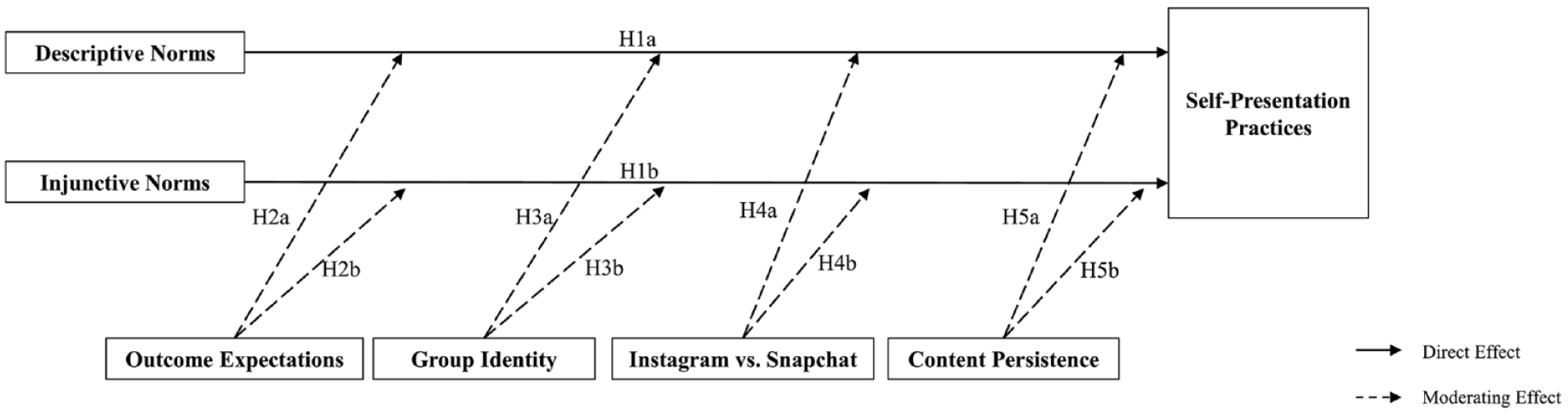
Research model.
Method
Procedure and Sample
To test our hypotheses, we conducted computer-assisted face-to-face surveys in the summer of 2022. The study was approved by the institutional review board of the authors’ university. We drew a quota sample representative of 14- to 16-year-old Instagram and Snapchat users in Germany in terms of age, gender, immigration background, kind of school, state, and community size. A total of 1,035 Instagram and/or Snapchat users aged between 14 and 16 years were surveyed by iconkids & youth, a German market research institute specializing in young target groups. The questionnaire, data, and analysis scripts can be accessed via https://osf.io/563rh/. To participate in the study, individuals had to actively use Instagram, Snapchat, or both several times a week for at least one year and had to post content several times per month. The survey was conducted at the participants’ homes and lasted approximately 25 minutes on average. Before the survey, both the participant and one parent provided written consent. Half of the participants were surveyed about Instagram, and the other half were surveyed about Snapchat. We excluded 33 participants because they either answered less than 75% of the items related to self-presentation practices (n = 17) or were outliers in terms of platform use (n = 16). Based on box plot inspection, we excluded participants who reported receiving on average less than five or more than 1.000 likes/views for their photos or videos on Instagram/Snapchat (n = 9), having ever received no more than seven or more than 1.500 likes on Instagram (n = 6) or no more than four or more than 1.500 views on Snapchat, having more than 2.345 Followers on Instagram (n = 1) or more than 1.054 Friends on Snapchat (n = 2), and following more than 2.047 accounts on Instagram (n = 2). Some participants met several of these criteria. Thus, the final sample consisted of 1,002 participants (nInstagram = 496; nSnapchat = 506). Among them, 87.4% held German citizenship, and 49.2% were female. The average age was 15.02 years (SD = 0.82).
At the beginning of the survey, the participants were asked several questions about their social media use. Among the Instagram users, 16.9% reported that they used the platform three or more hours on a weekday. The corresponding percentage among the Snapchat users was 17.4%. In terms of posting frequency, 33.3% of Instagram users and 47.9% of Snapchat users reported posting photographs or videos at least once a day. Moreover, 19.6% of Instagram users and 28% of Snapchat users reported posting photographs or videos of themselves at least once a day. Among the Instagram users, 92.1% had only one account. The corresponding percentage among the Snapchat users was 95.3%. While most Snapchat users reported that their main accounts were public (79.2% public, 20.8% private), the public and private accounts were balanced among Instagram users (51.3% public, 48.7% private). Besides being active Instagram and/or Snapchat users, 86.3% of the participants also used TikTok, and 23.5% also used Facebook several times a week.
Measures
Self-Presentation Practices
Drawing on extant research and theories (Chae, 2017; Choi & Sung, 2018; Leary & Kowalski, 1990), we developed a set of 16 items for Instagram and a set of 15 items for Snapchat to explore adolescents’ variegated self-presentation practices. Participants in the Instagram subsample answered the respective items for Instagram and participants in the Snapchat subsample answered the respective items for Snapchat. The participants rated how often they had performed various activities on Instagram or Snapchat in the previous four weeks on a 5-point scale (1 = never, 5 = always). We performed a principal component analysis (PCA) with varimax rotation (Kaiser–Meyer–Olkin test = .80, df = 55, p < .001) of 13 items included in both the Instagram and Snapchat sets to determine the underlying factors. After excluding two items due to insufficient or inconsistent factor loading, we extracted three factors. A PCA of the Instagram and Snapchat user subsamples indicated the same three factors as for the overall sample. The final factor structure of the 11 items and their factor loadings are displayed in Table 1. We combined the items that had a factor loading of ⩾ .50 into three mean indices: (a) staged self-presentation, referring to the prevalence of carefully planning and editing photographs and videos (six items; M = 3.2, SD = 0.76, McDonald’s ω = .77); (b) authentic self-presentation, referring to the prevalence of spontaneously posting photographs and videos, including emotional and embarrassing content (three items; M = 3.0, SD = 0.81, ω = .64); and (c) presentation of everyday life, referring to the prevalence of presenting hobbies, interests, and special events in photographs and videos (two items; M = 4.1, SD = 0.66, rs = .35). The three indices accounted for 54.72% of the variance. Although authentic self-presentation had a lower ω value than the other two indices, we included it in the analysis because it is related to freer self-presentation practices, such as posting emotional and spontaneous content, which have been discussed in recent studies (Gorea, 2021; Huang & Vitak, 2022; Kreling et al., 2022). Moreover, the three items of this index showed satisfactory discriminatory power (i.e., the average item-total correlations of all three items were r ⩾ .33) and homogeneity (i.e., an average inter-item correlation of r = .32), thus confirming the sufficient quality of the index.
Factorial Loadings for Self-Presentation Practices.

Note. The extraction method was principal component analysis with orthogonal (varimax with Kaiser normalization) rotation. Factor loadings ⩾ .50 are in bold.
Descriptive Norms
We measured descriptive norms as adolescents’ perceptions of the prevalence of the self-presentation practices described above (following Geber et al., 2019). The participants rated how common these self-presentation practices were among most of their friends on a 5-point scale (1 = not at all applicable; 5 = completely applicable). Sample items include “Most of my friends plan every detail before they [post/share] photos or videos on [Instagram/Snapchat].”. We repeated the data analysis described above. A PCA with varimax rotation (Kaiser–Meyer–Olkin test = .75, df = 55, p < .001) revealed three corresponding factors (accounting for 53.07% of the variance), whose structure was consistent with that of the three factors identified for self-presentation practices. We combined items with a factor loading of ⩾.50 into three mean indices: (a) descriptive norm of staged self-presentation (six items; M = 3.5, SD = 0.66, ω = .70), (b) descriptive norm of authentic self-presentation (three items; M = 3.3, SD = 0.73, ω = .61), and (c) descriptive norm of presentation of everyday life (three items; M = 4.2, SD = 0.67, rs = .41).
Injunctive Norms
We measured injunctive norms as adolescents’ perceptions of their friends’ approval of the self-presentation practices described above (following Rimal & Real, 2003). The participants indicated what their friends think is important in this regard on a 5-point scale (1 = not at all applicable; 5 = completely applicable). Sample items include “Most of my friends think it is important to plan every detail before they [post/share] photos or videos on [Instagram/Snapchat].”. A PCA with varimax rotation (Kaiser–Meyer–Olkin test = .80, df = 55, p < .001) revealed three factors corresponding to the three factors of self-presentation practices and the three factors of descriptive norms (explaining 56.45% of the variance). We combined items with a factor loading of ⩾ .50 into three mean indices: (a) injunctive norm of staged self-presentation (six items; M = 3.5, SD = 0.72, ω = .78), (b) injunctive norm of authentic self-presentation (three items; M = 3.3, SD = 0.76, ω = .60), and (c) injunctive norm of presentation of everyday life (two items; M = 4.1, SD = 0.71, rs = .40).
Outcome Expectations
We operationalized outcome expectations as adolescents’ perceived benefits of self-presentation on social media. We used four items to measure the benefits for oneself and four items to measure the benefits of anticipatory socialization (Rimal & Real, 2005). The participants reported on a 5-point scale (1 = completely disagree; 5 = completely agree) the extent to which posting/sharing photographs or videos on Instagram/Snapchat (a) made them feel confident, (b) allowed them to show who they were, (c) felt good to them, (d) showed them that they belonged, (e) was something that all young people did these days, (f) was something that their friends expected from them, (g) was important for their future lives, and (h) allowed them to find friends. Based on a confirmatory factor analysis (CFA) using R package lavaan, the two-dimensional model of outcome expectations was supported by the data. After excluding one item (“Posting/Sharing photos or videos on Instagram/Snapchat do all young people these days.”) due to insufficient factor loading, the model fitted the data well, χ2(13) = 48.87, p < .001; comparative fit index (CFI) = .98; root mean square error of approximation (RMSEA) = .06; 90% confindence interval [CI] = [0.04, 0.07]; standardized root mean square residual (SRMR) = .03. We combined the responses to the remaining seven items into a mean index (M = 3.8, SD = 0.71, ω = .84).
Group Identity
We measured group identity as the extent of adolescents’ perceived similarity to their friends (four items) and aspiration to emulate them (four items) (Real & Rimal, 2007; Rimal & Real, 2005). The participants rated the following statements on a 5-point scale (1 = completely disagree; 5 = completely agree): (a) “I think similarly to my friends,” (b) My interests are similar to my friends,’” (c) “I behave similarly to my friends,” (d) “My goals are similar to my friends,’” (e) “I consider my friends inspirational,” (f) “I look up to my friends,” (g) “My friends are role models for me,” and (h) “I orient myself toward my friends.” A CFA clearly supported the two-dimensional structure of group identity, χ2(19) = 85.73, p < .001; CFI = .97; RMSEA = 0.06; 90% CI = [0.05, 0.07]; SRMR = .03. Suggested modifications didn’t improve the factor structure. Hence, we averaged the responses of the eight items into an index (M = 3.9, SD = 0.61, ω = .84).
Content Persistence
Following Fox and McEwan (2017), we measured content persistence using two items rated on a 5-point scale (1 = completely disagree; 5 = completely agree): “Instagram/Snapchat allows users to view content again after some time” and “Content on Instagram/Snapchat is permanent.” We combined the two items into a mean index (M = 3.6, SD = 1.0, rs = .40).
Data Analysis
To test our hypotheses, we performed hierarchical regression analyses. We treated each of the three forms of self-presentation (staged self-presentation, authentic self-presentation, and presentation of everyday life) as the dependent variable. We entered gender as a control variable in Block 1. Descriptive norms and injunctive norms were entered in the second block. We used the statistical significance of the increment in explained variance to determine whether descriptive norms and injunctive norms were significantly correlated with self-presentation (H1). The practical significance of these relationships was determined by using f2. Outcome expectations, the interaction between outcome expectations and descriptive norms, and the interaction between outcome expectations and injunctive norms were added in the third block. Group identity, the interaction between group identity and descriptive norms, and the interaction between group identity and injunctive norms were entered in the fourth block. We added platform, the interaction between platform and descriptive norms, and the interaction between platform and injunctive norms in the fifth block. In Block 6, we added persistence, the interaction between persistence and descriptive norms, and the interaction between persistence and injunctive norms. Variables were centered around their means. To test our hypotheses regarding the norm-moderating factors (H2–H5), we considered the interaction effects and used standardized beta coefficients in interpreting the practical significance of the results. Post hoc power analyses with G*Power showed that the power of all direct effects was high (1 − β = .89–.99). However, the power is not sufficient to detect the interaction effects.
Results
H1 postulated that descriptive (H1a) and injunctive norms (H1b) would be positively related to self-presentation practices on social media. The results revealed that adolescents who identified as female staged their self-presentations significantly more often than those who identified as male (Table 2). Moreover, both descriptive and injunctive norms were significantly related to all three forms of self-presentation on Instagram and Snapchat. Adolescents who perceived a high prevalence of a form of self-presentation and a high degree of approval of this form among their friends were more likely to present themselves accordingly. The effect sizes showed that these results had practical significance (Tables 2 to 4). Hence, the results confirmed H1a and H1b.
Hierarchical Regression Results for Staged Self-Presentation.

Note. DN = Descriptive Norm; IN = Injunctive Norm; OE = Outcome Expectations; GI = Group Identity; CI = confidence interval; LL = lower limit; UL = upper limit. The variables were centered around the means.
The equations in Blocks 4 through Blocks 6 contained all variables from the previous blocks.
p < .05. **p < .01. ***p < .001.
Based on the TNSB, we hypothesized that the magnitude of the relationships between descriptive and injunctive norms and self-presentation practices on social media would be greater with stronger outcome expectations (H2) and group identity (H3). While the main effect of outcome expectations was significant for all three forms of self-presentation on Instagram and Snapchat, we found mixed results for the interaction between outcome expectations and social norms: Contrary to our expectation, participants who perceived the descriptive norm of staged self-presentation among their friends and who believed that presenting themselves on social media was beneficial reported engaging in staged self-presentation on Instagram and Snapchat significantly less frequently than those who did not (Table 2). We also found a significant negative influence of the interaction between the descriptive norm of the presentation of everyday life and outcome expectations on the presentation of everyday life (Table 4). In line with our expectation, participants who perceived the injunctive norm of staged self-presentation among their friends and who believed that presenting themselves on social media was beneficial reported engaging in staged self-presentation on Instagram and Snapchat significantly more than those who did not (Table 2). However, the effect sizes indicated that the results had small practical significance. Regarding group identity, we found no significant interaction with descriptive norms or injunctive norms for any of the three forms of self-presentation (Tables 2 to 4), but only a significant main effect for authentic self-presentation (Table 3). Hence, we found no support for H2 and H3.
Hierarchical Regression Results for Authentic Self-Presentation.

Note. DN = Descriptive Norm; IN = Injunctive Norm; OE = Outcome Expectations; GI = Group Identity; CI = confidence interval; LL = lower limit; UL = upper limit. The variables were centered around the means.
The equations in Blocks 4 through Blocks 6 contained all variables from the previous blocks.
p < .05. **p < .01. ***p < .001.
Hierarchical Regression Results for Presentation of Everyday Life.

Note. DN = Descriptive Norm; IN = Injunctive Norm; OE = Outcome Expectations; GI = Group Identity; CI = confidence interval; LL = lower limit; UL = upper limit. The variables were centered around the means.
The equations in Blocks 4 through Blocks 6 contained all variables from the previous blocks.
p < .05. **p < .01. ***p < .001.
Based on the concept of behavioral privacy, H4 postulated that the magnitude of the relationships between descriptive and injunctive norms and self-presentation practices would be greater on Instagram than on Snapchat. We found mixed results. Adolescents who used Instagram and perceived the injunctive norm of presentation of everyday life reported presenting their everyday lives on Instagram significantly more frequently than those who used Snapchat (Table 4). We also found a significant normative difference for staged self-presentation between the two platforms. However, contrary to our expectation, adolescents who used Snapchat and perceived the descriptive norm of staged self-presentation among their friends reported engaging in staged self-presentation on Snapchat significantly more frequently than those who used Instagram (Table 2). Based on the effect sizes, we consider the practical significance of both effects to be small, thus rejecting H4.
H5 postulated that the magnitude of the relationships between descriptive and injunctive norms and self-presentation practices on social media would be greater with greater perceived content persistence. However, only the interaction between the descriptive norm of staged self-presentation and perceived content persistence was associated with significantly more frequent staged self-presentation. Contrary to our expectation, the interaction between the injunctive norm of staged self-presentation and perceived content persistence was associated with significantly less frequent staged self-presentation (Table 2). Again, the effect sizes indicated that the results had small practical significance. In addition, the main effect of content persistence was significant for authentic self-presentation. Thus, H5 was not supported.
Discussion
The results of our study suggest that the use of Instagram and Snapchat is based on social norms that guide adolescents in their self-presentations. These norms influence not only adolescents’ strategic self-presentations but also their authentic self-presentations and presentations of everyday life. Moreover, the impact of these norms is evident on both studied platforms. In addition, the results of our study demonstrate the benefit of adopting a more holistic view of self-presentation on social media and examining users’ diverse self-presentation practices, which go beyond conveying positive or ideal impressions and include posting emotional and spontaneous content (see also Huang & Vitak, 2022). Thus, extending previous qualitative research, our results substantiate the relevance of considering normative influences in research on self-presentation on social media. More generally, they first support the norm-behavior-link that has been proposed by general social norm theories, such as the TNSB (Real & Rimal, 2007; Rimal & Real, 2005). Second, they highlight the importance of distinguishing between types of social norms (Cialdini et al., 1991; Lapinski & Rimal, 2005) and examining their respective influences on social media behavior (see also Masur et al., 2023).
A major contribution of the TNSB to social norms research is that it considers the impact of social norms on behavior in the context of meaningful moderators (Chung & Rimal, 2016; Rimal & Real, 2005). It is based on the premise that social norms influence individuals’ behavior through interactions with outcome expectations and group identity (Rimal & Real, 2005). Subsequent studies have tested these norm-moderating factors in different communication contexts and have refined the TNSB by adding empirically tested moderators (for an overview see Chung & Rimal, 2016; Lapinski & Rimal, 2005; Rimal & Lapinski, 2015). Surprisingly, we found no empirical confirmation that both the established normative factors outcome expectations and group identity and the factors we added to the TNSB–platform differences and content persistence—moderate the relationships between social norms and self-presentation. This contradicts the assumptions of the TNSB and suggests that norm-moderating factors may depend on specific social contexts and social behaviors (see also Masur et al., 2023).
Presenting oneself on social media inevitably means making ones’ behavior and preferences visible to others, which often includes a public and persistent audience (Choi & Sung, 2018; Treem & Leonardi, 2012). Geber and Hefner (2019) argue that the visibility and permanence of behavior on social media leads to social norms becoming more important in users’ daily lives. On social media, adolescents constantly observe the self-presentation practices of other social media users, interact with them, and receive approval or disapproval for their own self-presentation. In addition, the anticipation that their self-presentation is observed by others can reinforce the adaptation of their behavior to the social norms of their audience (Geber and Hefner, 2019). Accordingly, the results of our study showed that both descriptive norms and injunctive norms were strongly related to all three forms of self-presentation on Instagram and Snapchat. Hence, this may be one reason, why the norm-moderating factors did not substantially strengthen this relationship. Instead, in social contexts where social norms are weak, they may nonetheless gain influence via strong norm-moderating factors (Masur et al., 2023). However, it should be noted that the power of our study is not sufficient to detect some of the interaction effects. It is therefore possible that our study did not find any norm-moderating effects, even though they exist. In the following, we discuss the implications of our results for future research on self-presentation norms on social media.
Surprisingly, we found inconsistent results for the interactions between outcome expectations and social norms. However, outcome expectations were significantly (albeit small) related to all three forms of self-presentation. Adolescents who perceived it as beneficial to present themselves on social media—both for themselves and their anticipatory socialization—more frequently engaged in this behavior. Thus, the results of our study confirm the idea that self-presentation is a goal-directed behavior from which the presenting individuals benefit (Schlenker, 2012).
Contrary to our expectations, we found no influence of group identity on the relationships between social norms and self-presentation. Social norms are tied to groups and influence an individual’s behavior because the group is relevant for the individual in the respective social context (Geber & Hefner, 2019; Hogg & Reid, 2006). Although the results showed that adolescents identified rather strongly with their friends—in terms of both perceived similarity and aspiration to emulate them—this identification did not increase normative influences on self-presentation. When reporting the strength of their group identities, the participants may have been referring to their close (offline) friends. However, on Instagram and Snapchat, adolescents observe the self-presentation practices of not only their close friends but also more distant peers and present themselves to these differing sub-audiences accordingly (Hollenbaugh, 2021; Stsiampkouskaya et al., 2021). Therefore, future research should examine the normative influences of different reference groups on adolescents’ self-presentations in relation to perceived group identity.
Although we found some moderating (albeit contradictory) influences of platforms and content persistence on the relationships between social norms and self-presentation, the results suggest that neither the platforms themselves nor content persistence are meaningful moderators. Given the frequently claimed influences of the key features and affordances of social media platforms on self-presentation (Choi & Sung, 2018; Hollenbaugh, 2021; Xu et al., 2016), we expected that platform differences would play a more influential role. However, as platforms constantly change by launching new features or adopting features from other platforms, they become increasingly indistinct in terms of affordances. Hence, affordances may increasingly differ between features (e.g., posts and stories) rather than between platforms (Kreling et al., 2022). Moreover, it should be noted that the measure of perceived content persistence comprised only two items and might thus have limited validity. Future research should develop specific and distinct measures of social media affordances.
Limitations and Future Directions
As with all empirical studies, this study has certain limitations. First, we operationalized self-presentation as the practice followed by the participating adolescents. Although we used a holistic conceptualization of self-presentation that accounted for various forms of adolescents’ self-presentations on Instagram and Snapchat, we did not consider content shared by other users, which may have implications for one’s own self-presentation. Adolescents striving to convey a particular impression of themselves must also manage the content and actions of others, such as their photographs and videos, their likes, and their comments (Hollenbaugh, 2021). Second, our holistic conceptualization of self-presentation meant that we measured adolescents’ impression management across different features that Instagram and Snapchat offer (e.g., Feed, Stories, and Reels/Spotlight). While this approach allowed a comprehensive analysis of self-presentation, it did not take into account the possible differences in self-presentation resulting from different social media features. Thus, future studies should examine how adolescents’ self-presentations differ depending on features both within a platform and between platforms. Third, building on the TNSB, we examined several norm-moderating factors that have been discussed in the literature on communication via (social) media (Chung & Rimal, 2016; Geber & Hefner, 2019; Lapinski & Rimal, 2005). However, the rapidly evolving nature of social media platforms requires further investigation of the relationships between technological architectures, social norms, and adolescents’ self-presentation practices. Therefore, we recommend that future studies consider other social media affordances (such as visibility, editability, and association; Treem & Leonardi, 2012) besides persistence. Fourth, we focused on peers, defined as friends, as the most important reference group for an adolescent (Fikkers et al., 2016; Geber et al., 2019), assuming a stronger normative influence of peers than of less proximal groups. However, on social media, close peers, acquaintances, and unreachable social media influencers mingle in ones’ network and can have simultaneous and interactive normative influences on adolescents’ self-presentations (Zillich & Riesmeyer, 2021). Finally, our study relied on cross-sectional data, which did not allow us to assess the causal relationships between social norms, norm-moderating factors, and self-presentation practices. Future studies should further investigate these relationships using experimental designs to examine the relationships of social norms, reference groups, and social media affordances in adolescents’ self-presentations on various social media.
Conclusion
This study extends previous research on self-presentation on social media by examining the influences of different types of social norms on adolescents’ self-presentation practices on Instagram and Snapchat. Drawing on the TNSB (Real & Rimal, 2007; Rimal & Real, 2005) and the affordances approach (Evans et al., 2017), we also considered the norm-moderating factors of outcome expectations, group identity, platform differences, and perceived content persistence. We provide evidence that both descriptive and injunctive peer norms influence adolescents’ staged self-presentations, authentic self-presentation, and presentations of everyday life, although none of the moderating factors reached practical significance. Our findings not only encourage further research to systematically unveil the relationships between descriptive, injunctive, and possibly other types of norms (such as personal norms) and variegated forms of self-presentation on different social media platforms but also underscore the need to refine and potentially adjust existing norm theories.
Footnotes
Acknowledgements
This study was conducted in cooperation with PD Dr. Claudia Riesmeyer (Ludwig-Maximilians University Munich, Germany) and Jessica Kühn (Ludwig-Maximilians University Munich, Germany). The authors sincerely thank them for their valuable advice and practical suggestions in planning and conducting this study.
Declaration of Conflicting Interests
The author(s) declared no potential conflicts of interest with respect to the research, authorship, and/or publication of this article.
Funding
The author(s) disclosed receipt of the following financial support for the research, authorship, and/or publication of this article: This research was supported by the German Research Foundation under grant no. ZI 1543/3-1.
