




Abstract
Following the aims of Proactive Law, which explores the relationship between contracts, contracting and better relationships, we seek to contribute to the understanding and operationalization of the contracting process. We identify four levels, which we believe technical contracting systems should facilitate: (1) Goal Hierarchies and Awareness of Values, as an overall exercise for identifying most promising synergies or deal constellations; (2) Pre-Negotiation level, as a strategic level related to a specific Negotiation; (3) Negotiation level, facilitating the process of a negotiation; and (4) Actual Contracting, as capturing an agreement in a legally binding form. After clarifying the terminology, we introduce a generic prototype of “Integrative Deal-Design” facilitating the seamless transition between the different levels of the contracting process, which can be customized according to various theoretical or practical approaches. Finally, we propose a set of characteristics for computer human interactive legal technology systems to facilitate better deal-design.
Keywords
Introduction
Current research activities within the fields of negotiation, contracting, and conflict resolution recognize that orthodox approaches to contracts may not serve optimally the interests of the parties of the contracts (Wright, 2010). Recent developments in the field of legal technology tend to focus on the actual practice of creating contracts, for example, smart contracts, editing interfaces and the abundance of template-based contracting software.
Our claim is that a particularly broad view on the context of contracting would be beneficial to such approaches; and we therefore promote what we call an Integrated Deal-Design Framework. We firstly propose to consider “high level goals” or “values” of the parties per se, in other words preferences disconnected from any specific negotiations. These high level concepts serve as regulative ideas providing guidance for the more specific steps in the negotiation.
We rely on the body of research and practice of negotiation theory to expand a narrower view on contracting. In negotiation theory a kind of “pre-negotiation” phase is often introduced, referring to preparation and strategizing as well as on the actual intentions and high level goals of each party.
In this paper we want to make a point that addressing high level goals and overall values explicitly facilitates better deal-design; and – for technological systems – we encourage user interfaces to contemplate such goals (Norman and Draper, 1986). Of course, such goals and values are highly strategic or personal activities and therefore can probably only be expressed if coupled with specific privacy options to keep them hidden from other parties or participants. We are aware that such sensitive entries may not be accepted by all user groups or be suitable for all types of deal-designs. However, we believe there is great potential to open up the narrower sense of “contracting”.
Deal-designing becomes ideally a highly creative process iterating among the different levels of abstraction of hierarchies. Users may brainstorm and articulate their own values, preferences and overall goals upfront – be it for a company or an individual – and seamlessly apply overall strategies and specific tactics, taking the degrees of aggression into account. In this sense we continue our research on the “next generation deal-design” and connect to discourses around simplifying contracting, awareness, visualization, smart contracts and patterns (Haapio et al., 2016).
We proceed to present an example of a generic integrated online contracting platform which facilitates the operationalization of the proposed integrative deal-design process. Informed by the development of this system we aim to derive a set of general characteristics relevant for the development of contracting systems.
Integrated Deal-Design Framework
We distinguish the following four levels of the contracting process within the Integrated Deal-Design. We envision that the process of integrated deal-design begins with the high level goals and then “cascades” down to the specifics of the negotiation. However, especially in creative deal-design we expect a non-linear and associative quasi-simultaneous springing between the levels.
As the first level we consider the Awareness of Goals and Goal Hierarchies. Each party to the agreement has a vision of the outcome of the contract, the reason why the party is intending to enter into the contracting process (Levine, 2002).
As the second level we introduce the Pre-Negotiation level – this is the strategic level, preparing strategies and tactics for the actual deal-design for a specific negotiation. There is a natural transition from the higher level goals to the pre-negotiation level, leaving plenty of opportunities for creative brainstorming. This approach is informed by the Lax and Sebenius (2006) approach to negotiation, emphasizing exploring synergies, creating win–win situations, etc.
As the third and most specific level we consider the actual Negotiation Level. This is where the negotiations strategies, which would be consistent with the values and goals, are executed. Examples of such strategies abound: Whether “hard” or “soft”, “cooperative”, “competitive” or “integrative” strategies, “distributive” and “integrative” or to “claim value” or “create value” (Fisher et al., 1991; Gifford, 1989; Lax and Sebenius, 2006; Raiffa, 1982).
Fisher and Ury, pioneers in the field of negotiation theory from the Harvard Business School, have been criticized for their perhaps too benevolent assumptions regarding the collaborative potential between parties. The Wharton School is considered much more pragmatic and aims to develop a basic catalog of strategies for different types of negotiations (Shell, 2006). However, they pursue a rather focused approach on the distributional conflicts of negotiations.
While a plethora 1 of work exists on negotiation and there is an abundance of literature on how to draft contracts 2 , fewer writings explore how the levels of negotiating can effectively integrate with contract drafting (Malhotra, 2012). The cause of contract conflict is often the lack of a clear agreement, whether expressed or implied (Levine, 2002). There seems to be a simplistic assumption within the negotiation literature that once the negotiating parties “get to yes” the “deal is done”, and that the process of drafting the contract is only a matter of capturing it in a contract form.
Finally, the fourth level we call Capturing the Deal in the form of a contract. This is the “actual contracting” or “contract drafting” level, and must be distinguished from the broader definition of contracting, which often includes the negotiation levels of the contracting process. We propose that the process of capturing the deal in a contract is a distinct process within the contracting process.
To clarify terminology, we observe that in much of the literature and in day-to-day practice, “contracting” is used as a synonym for “negotiating”, except that with contracting, the intended outcome of the negotiation is a “contract”. With negotiation the intended outcome is a “deal”, which may or may not be captured in a “contract”. In our view and for purposes of describing the Integrated Deal-Design Framework, “formal contracting” is the process whereby the parties capture their deal in a contract.
Formal contracting does not imply only orthodox contracting, being the familiar boilerplate contracts written in legalese. An Integrated Deal-Design Framework and technological platform should accommodate capturing the deal with various forms of knowledge representation, such as diagrams, icons, visual language and comics.
Level 1: High level values and goal hierarchies
Articulating high level aims and goals is essential to exploring the overall creativity of deal-making and supports negotiation and contracting. Perhaps surprisingly, we draw on the German sociologist and philosopher Georg Simmel to support the importance of goal-hierarchies. According to Simmel any “exchange” or deal becomes a means for all parties to reach their “teleological goals” (Simmel, 1971). Throughout our lives we are embedded in chains of transactions (“teleological sequences”) in order to pursue our goals and fulfill our desires in collaborative ways. Simmel views exchanges as the purest and most concentrated form of significant human interaction and all social interactions are considered as forms of exchanges. A characteristic of exchange is that the sum of values (of the interacting parties) is greater afterward than it was before. Exchange for Simmel is a creative process. Simmel believes that exchange is just as productive or creative of values as is ‘‘production’’ in the common sense (Simmel, 2011).
Simmel’s train of thought anticipates many contemporary discourses, such as management theory, design theory, and various psychological approaches on motivation, to name just a few. They all rely on an abstraction of a hierarchy of goals or intentions, which allow high level decision-making.
Another perspective on goals may be found in the discussions around awareness and mindfulness. These have been linked to, amongst others, innovative approaches in negotiation and conflict resolution (Reb and Narayanan, 2013; Riskin, 2002). This level of awareness is the subject of the study of mindfulness. Mindfulness may consist of actively noticing new things, or the practice of cultivating non-judgmental awareness (Langer, 1989; Riskin, 2002). The impact of improved mindfulness in negotiation and conflict resolution is well researched, with benefits extending from improved performance to improved creativity (Langer, 1989).
The cognitive demands for formal contracting are similar to negotiating deals or conflicts. The level of awareness of the process of contracting, from goals to the impact of a comma in a sentence, affects the quality of the contracting process (Barton et al., 2013).
“Mindlessness”, as the opposite of mindfulness, is associated with “standard contracts” and standardized contracting practices. “The use of standard procedures for negotiation and contracting generally diminishes parties’ attention to the substantive details of a transaction, and reduces the impact of contracting on inter-organizational performance” (Vlaar, 2006) and may threaten the achievement of a “meeting of the minds” as the foundational fact of a contract.
The idea of alignment
All of the above listed discourses rely on navigating across abstraction hierarchies, thereby aligning higher level concepts with the ones subsumed under them. Abstraction and the idea of functional hierarchies have proven to be powerful tools in terms of organizing knowledge and combining knowledge with actions. We rely on them for our proposal for a framework for integrative deal-design as well.
Similar to other forms of classifications, the actual terminology and assignments and links between the concepts may not be unambiguous. However, since we are aiming to construct a customizable tool and not an objectified theory of goal-hierarchies, we do not consider this as problematic. Apart from that, different theories have made different assumptions on how conscious these goal articulations can be. In economics, for example, the idea of the “rational agent” has been questioned for decades.
Organizing and breaking down complex activities into smaller goals is also a common metaphor guiding the management of organizations; alignment between high level directives (e.g. “vision” and “mission” statements) informing the actions on lower levels is found in management theories, such as Kaplan and Norton’s Balanced Scorecard Approach. Each “initiative” in an organization needs to be aligned with the overall “mission” as mapped upon the balanced scorecard or their visualized counterparts, the so called strategy maps (Kaplan and Norton, 2004).
Alignments also occur in creative processes: many design methodologies rely on functional hierarchies. For example Don Norman’s design-oriented approach assumes goal-oriented rationality and envisions iterations of feedback loops (Norman and Draper, 1986; Norman, 1988) However, goals cannot always be explicitly stated or explicated and it may not always be the case, that we “explore the world in order to discover our goals” (Kirsch, 1997). For this reason the Integrative Deal-Design Framework explicitly distinguishes the four levels to delineate the assumptions at each level of the contracting process.
Levels 2 and 3: Pre-negotiation and negotiation
The idea of pre-negotiation is stressed in various approaches to negotiation theory, a discourse informed by academics and practitioners alike. For our Integrated Framework we chose the Harvard Business School approach by David Lax and James Sebenius, due to its emphasis on creativity during negotiations and their overall holistic view on deal-making (Lax and Sebenius, 2006). Like many other negotiation theories, they highlight the importance of the pre-negotiation phase and preparing a negotiation.
Lax and Sebenius advise not to focus too early on the obvious subjects of a deal. They recommend to consider wider issues, such as the constellation of the parties “at the table”, the sequencing of engagement, and especially the “dovetailing of differences” to improve the overall synergies and utility of the deal to all parties. Agreements are sustainable if the “spirit of the deal” represents a way for all parties to “solve joint problems and claim value”. To detect these, creativity and unconventional thinking are required to overcome what the authors call the “barriers to agreement”, which mostly do not question the fundamental assumptions of the potential interaction between the parties (Lax and Sebenius, 2006).
The creative process of “making a deal” we call deal-design involving the various parties exploring a solution space (Plewe, 2009). Synergies may occur not only through a similarity of values or goals, but also through complementarity of the parties. To put it in Simmel’s (1971) words: very different “teleological sequences” may be intertwined through an exchange and yet increase the overall good. To discover these synergies is a highly creative process, which systems facilitating deal-design should support.
Another relevant approach in the context of goal-hierarchies and pre-negotiation is the so-called interest-based negotiation, assuming that outcomes of negotiations can be optimized when the intentions of the parties are known (Rahwan, 2005). This bears great potential for all sorts of “better deal-making”, yet is not always applicable, especially in non-trustful and aggressive negotiations. Nonetheless, potential synergies based on high level goals and and/or lower level interests should be explored.
Lax and Sebenius provide many examples where the understanding of both sides’ intentions is beneficial for reaching one’s own goals, but also for increasing the overall good (Lax and Sebenius, 2006). Standard sales techniques also highlight this aspect in a rather intuitive way, by recommending focusing on the actual decision- maker and his/her dispositions.
Level 4: Formal contracting
Formal contracting can range from filling in standard contracts, to adapting precedents, to drafting custom agreements. The negotiation that informs the contents of the contract can range from immutable “terms and conditions” to elaborate negotiations over extended periods of time.
This process typically follows the negotiators concluding that they have a deal, after which one of the negotiating parties agree that one of the parties’ lawyers would be instructed to draw up the contract as he/she understands it, which gets sent to the other party, who sends it to his/her lawyer, who reviews it and highlights structural problems and unfair clauses, and drafts changes based on instructions from his principal, which then gets sent back, and this goes back and forth (commonly known as “contract tennis”) until the negotiating parties eventually sign the agreement.
Formal contracting is left to the lawyers, who are often not directly involved in the negotiations of the deal. It often amounts to a second round of negotiations, where the lawyers have to wrestle the gaps and inconsistencies of the deal.
This contracting process, as typically practiced, is perceived as ineffective, inefficient and hazardous to the relationship between the parties. The Integrated Deal-Design Framework enables the parties to easily capture the outcome of their negotiations in a formal contract by having (visual) placeholders representing clauses.
The proposed framework could be extended to the implementation of contracts in the future. So called “smart contracts” aim to automatize the implementation of agreements. Internal and external deal design validity could also be checked through simulating contract scenarios. A formal contracting process that is aligned and efficient enhances the relationship between the parties.
Formal contracting does not imply only orthodox contracting, but includes many innovative methods and technological innovation in the legal technology space. Examples include template-based editing systems and more visual approaches, aiming to capture contractual agreements using diagrams, icons, customized visual languages and comics (Figure 1). Design patterns can also be applied within this formal contracting level as solutions to recurring problems with contract forms, templates, or clauses (Haapio and Hagan, 2016). We envision that contracts can effectively and appropriately be formalized using visualization and contract simplification techniques, to achieve the advantages which such techniques offer (Passera, 2012), Berger-Walliser, Barton and Haapio (2017), Waller et al. (2016), Passera, Smedlund and Liinasuo (2016).

Robert De Rooy – example of comic contracts.
Integrative system: Otto deal-design platform
We propose a generic conceptual sketch of an online deal-design platform named Otto 3 introduced by Daniela A. Plewe focusing on pre-negotiation, negotiation and actual contracting within one system (Plewe, 2012, 2013) (Figures 2–4). This system stimulates and facilitates the articulation of high level goals allowing the pre-negotiation considerations to be aligned to these goals. It also facilitates the pre-negotiation work informing the negotiation, and importantly, the seamless translation of the deal into a contracting through Formal Contracting. Via the platform, users may negotiate in real time or asynchronous, together within one space or remotely.
The proposed interface effectively allows the alignment of the details of the agreement with the higher level goals, thereby reducing the gaps between the mental models of the deal-makers and the contract. The interactive nature of the interface also supports creativity in deal-design as outlined above.
The prototype consists of various modules based on the visual metaphor of a marketplace, with choices arrayed for possible selection. This visualization allows for simple interactions such as drag and drop leading to a contractual document. We envision here a generic platform, which could be customized according to the context, preferred theoretical models of negotiation, strategy, etc. All four levels could be customized according to the preferred terminology and visualization approaches (e.g. pictorial visual approaches such as comics, icons or abstract visual language), but also conceptually making use of various theoretical approaches.
From goal hierarchies to negotiation and contracting
Users may represent themselves via a hierarchy of personal values and preferences. If desired, they may break down higher level goals into lower level tasks and to-do lists via a simple tool to allow specifying of hierarchical dependencies (Ackermann et al., 2004). This module is not a prerequisite, but rather an option for the deal-design functionality. Otto allows parties to represent and communicate (fully or partially) their goal hierarchies during a negotiation. This option is completely customizable according to the strategic preferences of the user: the spectrum of transparency may range from zero visibility, to negation-specific disclosure of tasks, to total visibility of a cluster of goals.
A front-end inspired by Lax and Sebenius (2006) can support brainstorming clusters addressing the constellation of the parties, the sequence of approaching them, the interests of the different parties, and a section on dovetailing differences (which is similar to interest based negotiation). The high level organically leads into the next level – the concrete strategic “layer” of the interface. All guiding questions are customizable. Here is a list of examples to be displayed in expandable editing windows:
High-Level Questions What is important in general today? What are overall issues we care about? What are general problems and trends? How do we want to position ourselves on the global landscape? How do we want to make a contribution? What is our legacy?
Pre-negotiation – inspired by 3D negotiation of Lax and Sebenius (2006)
What is important to us in this context? Which problems/issues are we trying to solve? Which parties could be involved? In which sequence can they be involved? What are their interests? How can we increase the overall outcome for each party? What is important to us and potentially to them? Who has complementary interests? How can we dovetail differences? What are our no-deal options? What are the sequences of actions and basic process choices? How can we secure lasting deals by crafting a good “spirit of the deal”? How can we shape perceptions to claim value? What are tactics to pursue our desired outcomes? How can we solve joint problems to create and claim value? Who has similar interests? Who has complementary ones? How can we dovetail differences?
In the pre-negotiation level parties may define their goals and preferences (in a hierarchical form) either in private or to be shared with supporting negotiators and other allies. The system demands explicit attention for the scope of the potential deal without prematurely limiting it on perhaps irrelevant terms and risks. It also allows articulating speculations and hypotheses about the other side’s goals, preferences, and resources and to develop adequate strategies. If desired, assumptions can be shared among team-members, but not with the other side. For example, they may enter and structure information as “negotiable”, “un-negotiable”, “hidden and visible conditions”, “target prices, “best alternatives to negotiated agreement” (BATNA) and other concepts (Nixon, 2005). This forms an important base for developing the strategies about preferences and values of the other side.
Another example of pre-negotiation themes and questions is inspired by Horacio Falcao’s approach on “Value Negotiation” (Falcao, 2012; Plewe, 2013).
Pre-negotiation – inspired by Value Negotiation of Falcao (2012)
Us: Details about the parties; Our Assets: SWOT
4
analysis in the context of this deal; Our Interests: Brainstorming on our goals and interests in continuation to our “profile”; Our Ideal Deal Design: Collection of thought experiments on ideal deals with this party; Our Options: Within this context of negotiation: possible solutions, proposals, ideas, suggestions or recommendations to satisfy interests; Our Relationship to Them: Awareness for emotions, feelings and behaviors related to this negotiation; Our Approach to this Communication: The messages we want to send or not send; Our choices of process and the means through which we communicate; Our Arguments: Our arguments to persuade the other side of the validity or benefits of their preferred option; Our Core Elements of the Deal: First collection of clauses to be included in the contract; Our Best Alternative to Negotiated Agreements: Our Best Alternative to Negotiated Agreement (BATNA); Our External Value Adders: Any external parties who could enrich this deal? Our No-Deal-Here-and-Now Options: Potential other parties, completely other deal-designs, change of interest, etc.
The pre-negotiation modules (lower and upper zones of the screens) are invisible to the other parties. If wanted, users may break down high-level goals into lower level tasks and to-do lists via a simple tool allowing specifying hierarchical dependencies and clustering content according to contexts, perhaps comparable to brainstorming tools, such as mind maps.
Through the hierarchical dependencies such as high-level values and preferences, mid-level goals and specific legal clauses can be represented emphasizing the aims behind the deal. The screenshot above (Figure 2) displays the visualization of the “hidden elements” in the pre-negotiation level at the bottom and top of the screens.
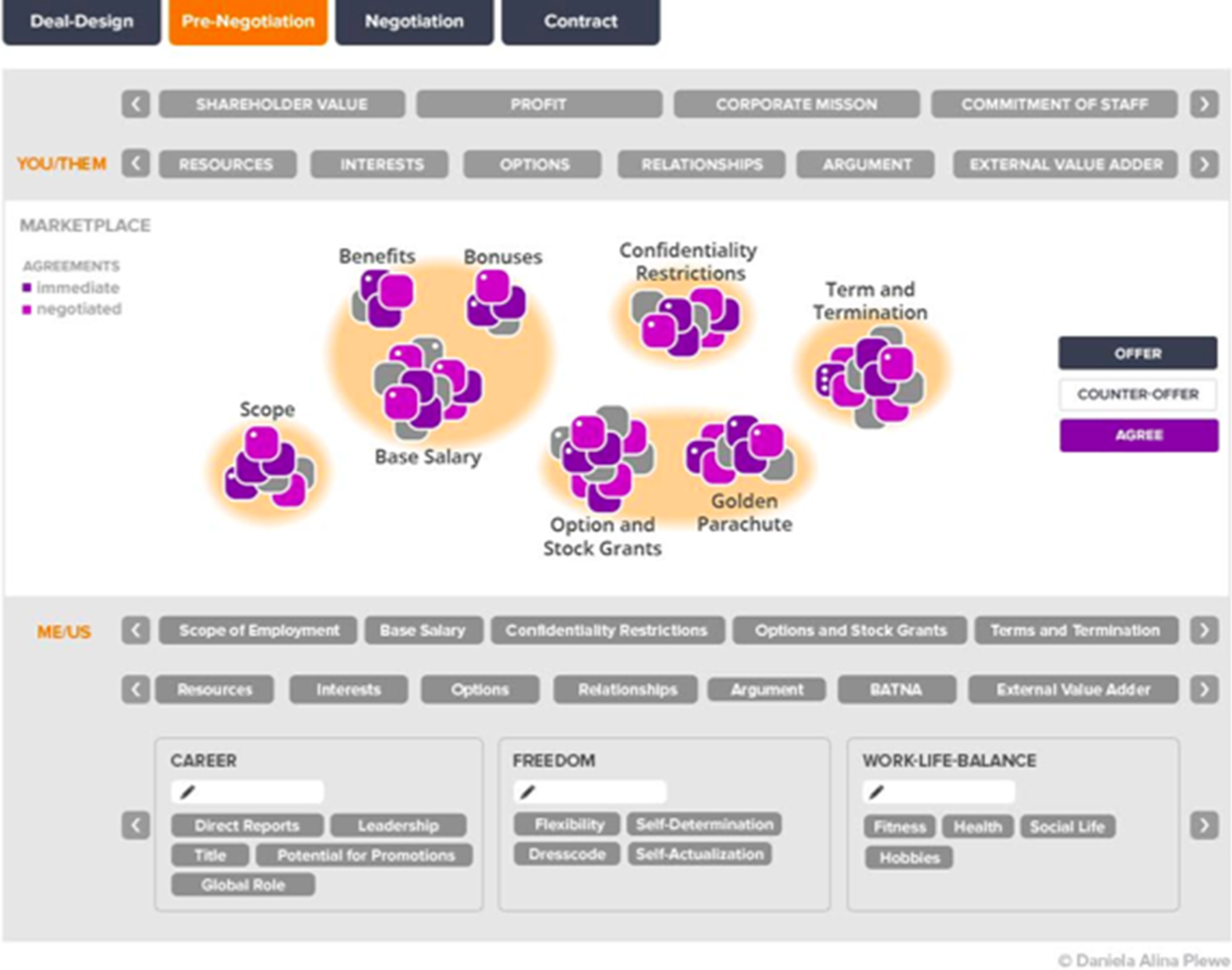
Otto deal-design platform – pre-negotiation level (by D.A. Plewe).
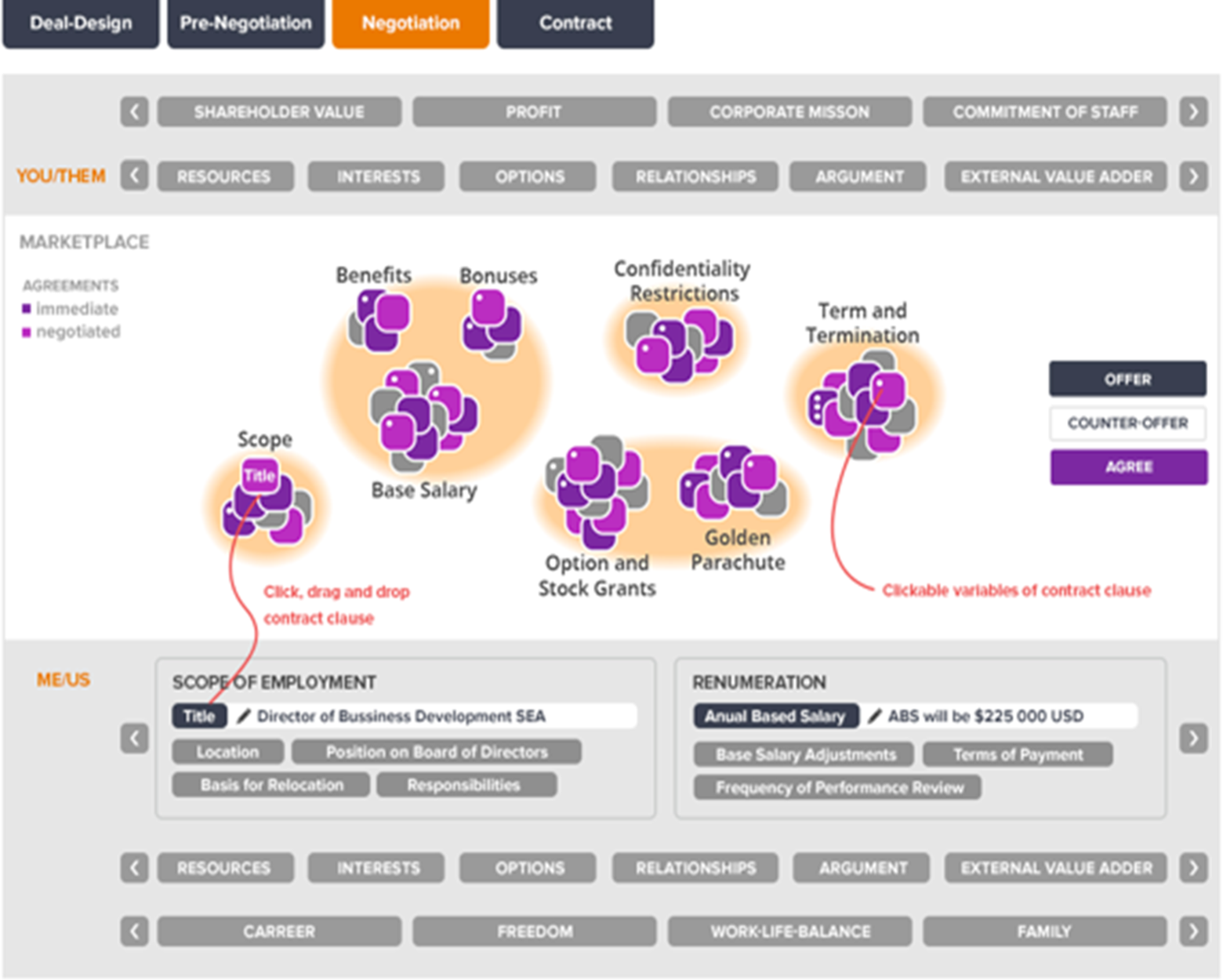
Otto deal-design platform – negotiation level (by D.A. Plewe).
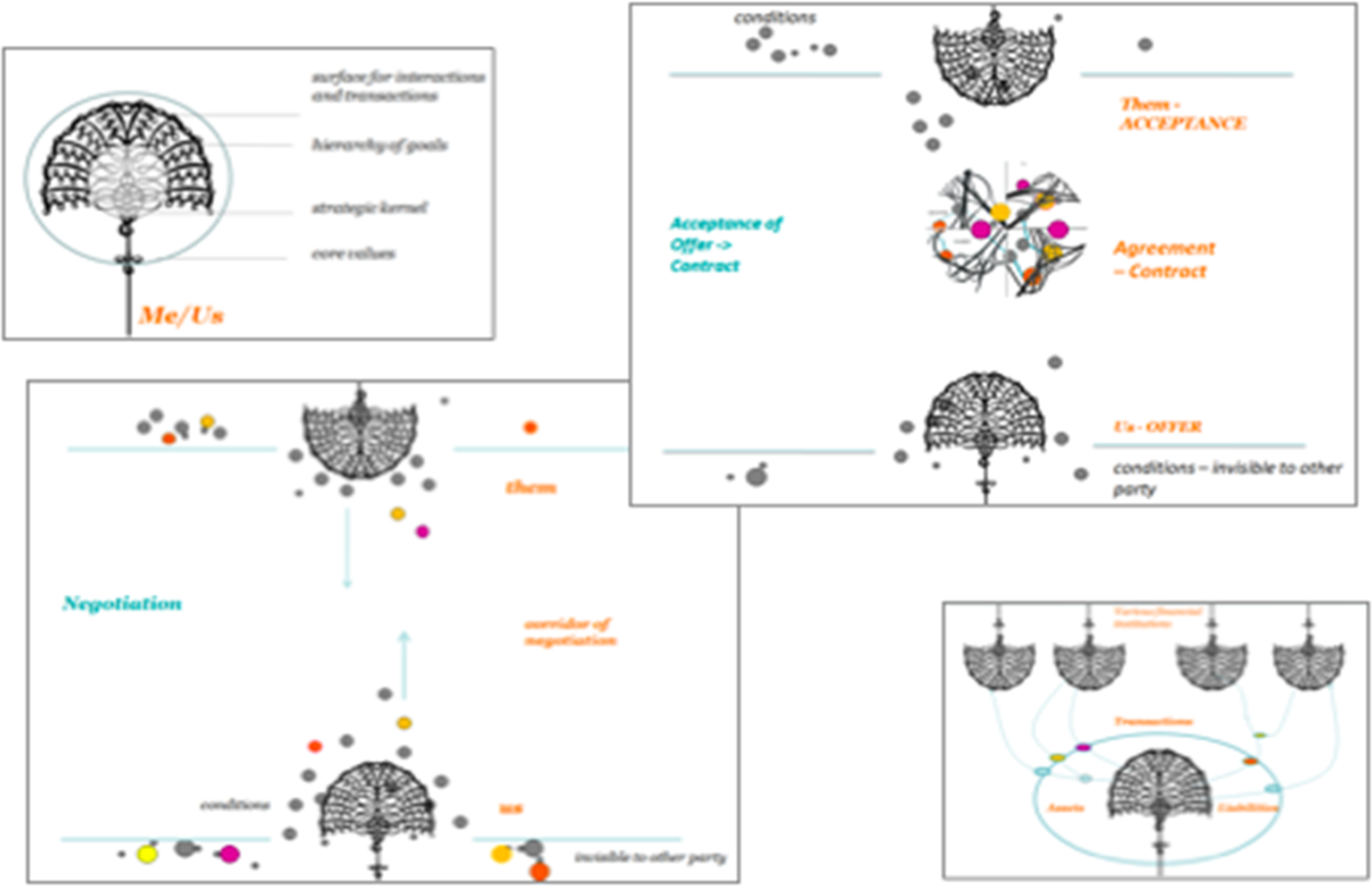
First prototype of Otto with abstract visual contracts (by D.A. Plewe).
The market-place metaphor allows parties to drag and drop clauses (square entities on the market place) in order to negotiate the various segments and clauses of the contract. Users may negotiate in real time or asynchronously, and can offer, counter-offer or agree to individual clauses or clusters of clauses in the contract. The visualization reduces complexity and highlights variables in master-agreements as small dots on the clause-icons All Items on the marketplace are clickable and can unfold as the actual contract (visualization as contract – or generate pattern-like document as contract).
The platform facilitates the alternate dynamics of offer and counteroffer through highlighted buttons on the marketplace. After a negotiation phase the users may finalize the result in a visual contract. Every visual element of a contract refers to a section of a formal contract.
The overall contract is represented in various clusters of icons and this visual interactive representation could be seen as the contract itself (Haapio et al., 2016). As a pure software instantiation this could be considered as a kind of simple smart contract or editing tool for smart contracts. One can easily envision other functionalities, such as executing clauses or messaging mechanisms informing relevant participants of updates.
Apart from text, we believe the platform should also facilitate various visual languages ranging from icons to more concrete depictions such as comics. Combining Robert de Rooy’s visual approach, the platform could offer short comic-like elements, either as illustrations or as unfolding narratives showcasing different scenarios.
Customizability and the role of visualizations
As a generic platform Otto would allow all sorts of customization and applications, including on mobile devices. Not only should different approaches to the various levels be customizable, but also the representation of the content of the deal. Below we include an earlier version with pictorial abstract contracts, including clickable variables and clauses in the forms of highlighted dots.
Below is the first prototype of Otto with specifications of the preferences at the bottom of the screen in the hidden realm for assembling clauses and a “visualization” of a contract with highlighted variables followed by the flow of transactions (Plewe, 2009).
The Otto platform itself makes use of an abstract visual language, but could be extended with more or less text, labels or even a visual narrative as envisioned by Robert de Rooy. De Rooy uses comics to make contracts more accessible to people who are contract illiterate or must sign contracts in their second or third language or suffer from some forms of dyslexia. This population is typically not “serviced” by mainstream contracting services and discourses.
In comic-based contracts, the parties are represented by characters, engaged in the interaction or dialogue of contracting. Apart from being easier to read, process and remember, this format has several advantages: it creates visual context, provides the tone or feeling of the intended relationship, and various “what if” scenarios can be “played out”, assisting the parties in fully understanding the consequences of the terms they are agreeing to, and integrating their higher level goals and values.
Application and extension of the Otto platform
We would like to see Otto emerge into a general platform supporting human–human deal-design as well as an editing device human–machine interaction like smart contracts. Otto may serve further as a platform for visual programming and editing of “smart contracts”. Projects like the Legalese Initiative may also benefit from it since it allows for visual programming interface for coding contracts (Legalese Initiative, n.d.; Szabo, 1998).
The Otto platform is conceptualized as highly customizable, not only regarding the theoretical approaches guiding the brainstorming on the various levels, but also in an aesthetic sense: various skins are possible regarding design and forms of knowledge representation, including comics.
Combining Otto with the comics approach one could convey high level goals, strategies, intentions or the internal communication of a party in “thinking bubbles.” The difference between “think” and “speech” as established in the medium comics can display the difference between actual speech and the inner monologue of the parties. Thereby mindfulness could be represented as a characterization of the parties at the beginning.
The platform could serve as a trusted third party identifying potentialities for a compromise. The parties may share their intentions and high level goals with the platform but not with each other. Otto will inform and signal, if synergies are possible and a compromise is within reach. It could also facilitate all sorts of online contracting in e-commerce and across online value chains, facilitate the design of derivatives and other financial products, and make license agreements more transparent, etc.
General characteristics of integrative frameworks
Inspired by the development of the Otto platform we propose a set of general criteria for the development of integrative contracting systems.
Seamless integration between levels of the deal-designing – allowing for easy navigation between the different stages (Plewe, 2013).
Intuitive and self-explanatory interfaces – with affordances nudging users into pre-negotiation and possibly higher level thinking.
Flexibility and associativity –supporting ideation and spontaneity at any stage – systems should facilitate spontaneous idea generation and creative thinking regarding the deal. In this sense they may support brainstorming about parties, solutions and other forms of synergies.
Expressiveness regarding degrees of cooperation or aggressiveness – any attitude towards exploration of synergies (degree of aggression or cooperation (exploration of synergies). Facilitating all approaches to transparency and level of aggressiveness or cooperative approaches: aggressive negotiation strategies as well as the exploration of synergies should be supported.
Customizability for various form of context – and allowing meta-configuration (e.g. the ways to reflect upon goal-hierarchies may differ for various user groups).
Reduction of complexity: ways to reduce complexity in order to focus on relevant parts of the deal and during contracting on the relevant variables and clauses. Visualization seems a promising means.
Congruence with the enforceable contract and all requirements for legally binding the final contract version.
Structural integrity of the deal: no gaps, ambiguities, logical loose ends or contradictions, by applying decision trees.
Reference-ability – all units of content across various forms of representation should be trackable and clearly referring to the other form of representation: a visual element has to unfold clearly to a text and vice versa. Abbreviations in the form of text, icons or even comic sequences need to be properly abstracted and subsumed in the higher order level.
The diversity of developments in the contracting space from code to comics, combined with trends like Proactive Law, present exciting opportunities for unification and standardization across international jurisdictions.
Footnotes
Declaration of Conflicting Interests
The author(s) declared no potential conflicts of interest with respect to the research, authorship, and/or publication of this article.
Funding
The author(s) received no financial support for the research, authorship, and/or publication of this article.