



Abstract
This paper reports a case study of an innovative contract simplification project. The context is an energy industry facility to be built in northwestern British Columbia, Canada, where it is important to gain social license from Aboriginal communities by sharing employment opportunities. However, the complexity of contract documentation was seen as a barrier to local small contractors. This project transformed a complex document set by using principles of clear information design, both at the structural and detailed level. The principles used are explained in the form of a pattern library that lists potential solutions to common communication problems for contract documentation.
Bringing clarity to contracts
In recent years there has been growing interest in applying the principles of clear information design to contract documents. This reflects a growing realization that, in addition to accurately recording requirements and business terms, they also need to work as communication tools. Considered as communications they are judged not only for their accuracy and legal soundness, but also by the degree to which they enable a good working relationship, cooperation and effective contract management.
As Tim Cummins (2016), CEO of the International Association for Contract and Commercial Management (IACCM), remarks: Contracts today are too complicated. The process through which they are created remains a mystery to many and the resulting content is often unintelligible. Yet effective communication lies at the heart of trading relationships and trading relationships are increasingly at the core of a technology-driven world, so we need practical instruments that gather and record commitments and obligations…In just a few years, we will look back and wonder why it took so long to make our contracts intelligible to the mass of people they affect. As contracts become more important, social and economic pressures are combining to force a rethink in how we design, structure, compile and disseminate our formal agreements.
Consumer contracts have to some degree led the way which is unsurprising given that they have to address the whole population, with obviously different ability levels. – Regulations, such as the European Consumer Rights Directive (2011/83/EC, http://ec.europa.eu/consumers/consumer_rights/rights-contracts/directive/index_en.htm), require the use of clear and comprehensible information for consumer contracts and experimental studies have demonstrated that loan documents and credit card agreements can benefit from a new, more user-friendly approach (Siegel and Etzkorn, 2013; US Consumer Financial Protection Bureau (CFPB), 2011). Further projects have aimed to simplify, for example, an online game’s terms of service, a rail network’s disclaimer, and a law firm’s standard terms of engagement (Clarity2010 Blog, n.d.; UK Office of Fair Trading (OFT), 2011). Several projects have looked into the simplification of online terms and conditions, end-user licenses, and privacy policies through the use of icons (for a summary, see Lannerö, 2013; for updates, see also CommonTerms, n.d.). For example, Creative Commons licenses use simple icons that can be clicked on to reveal a plain-language version of the license terms: the icons inform users about the possibilities and limitations of, for instance, sharing or remixing the licensed content (Creative Commons, n.d.).
Research and experiments in commercial contracting and public procurement show that the principles of clear communication design can be applied beyond consumer contracts (for commercial contracts, see, e.g., Haapio, 2013a, 2013b; Passera, 2015; Passera and Haapio, 2013; for public procurement, see Passera et al., 2013). These studies, and the present one, result from collaborations between contract experts and designers.
Information designers are experts in clear communications, applying principles of clear writing and visual design to make information easy to understand and apply. These principles are underpinned by user-testing, research studies, theoretical models and the application of concepts from neighbouring disciplines such as cognitive psychology, applied linguistics, and vision research. Information designers typically work on functional and transactional documents such as forms, user guides, signs and interfaces, and their toolbox includes simplified language, typographic structuring, icons and diagrams.
In this paper we present a project to apply information design concepts to a set of complex contract documentation used by a global energy company, Nexen Energy ULC (Nexen), a wholly-owned subsidiary of CNOOC Limited, to enhance its engagement with small contractors from local and Aboriginal communities in northwestern British Columbia (BC), Canada.
Introduction to the Nexen project
Because of the level of risk, the complexity of the work, and the scale of projects, contract documentation for the oil and gas industry inevitably appears complicated to a non-expert. In practice, this is not necessarily a problem, because in professional settings individuals become skilled in navigating and interpreting information that might be quite challenging at first view.
However, complexity is starting to present itself as a problem as Nexen embarks on a new project in a new area, with new political and social pressures. Aurora LNG is a joint venture between Nexen Energy and INPEX Gas British Columbia Ltd. They are studying the design, construction and operation of a liquefied natural gas (LNG) facility and marine terminal on the coast of BC. An important aspect of its success is obtaining social licence – the development of a trusted relationship with local and Aboriginal communities, who want to share benefits from employment and business opportunities. The Aurora LNG team seeks to accomplish this through collaboration and a commitment to developing strong, mutually respectful relationships. However, smaller companies from local and Aboriginal communities see the complexity of the current contract documents as a barrier.
Social and cultural background
In Canada, Aboriginal Peoples are the First Nations, Métis and Inuit whose rights are recognized and affirmed in Canada’s Constitution Act 1982. It would be too simplistic to group all Aboriginal communities together – there are significant differences between, for example, Treaty Indians who are from bands who signed one of eleven treaties between 1871 and 1922, and those who remain outside this process. Additionally, there are Métis communities with mixed First Nations and European ancestry, and the Inuit who are the Aboriginal people of the Arctic. Corporations need to be sensitive to these distinctions when managing community relations – for example, they cannot assume that simply employing an Aboriginal-owned contractor will be acceptable, if that contractor is from a community other than the one that controls the work site.
The Aurora project represents a change for Nexen from dealing largely with treaty communities in the oil sands area of northeastern Alberta, to ‘non-treaty’ communities in northwestern BC.
In the areas of BC where the Aurora project is being developed the kinds of services Nexen, as operator of the Aurora LNG project, is seeking from local communities may include catering, land clearance, guiding services, platform construction for drilling equipment, guides and medics, and marine and land studies. While it would be easy enough for individual project managers to bring in established firms from outside, Nexen recognizes that it needs to work with local communities to build capacity, so they match the outside competition. Aboriginal people are interested in participating and working with industry to share in the benefits of resource development taking place on their traditional territories.
The importance of earning social licence is critical, and as one commentator puts it, ‘Social licence can never be self-awarded, it requires that an activity enjoys sufficient trust and legitimacy, and has the consent of those affected’ (Morrison, 2014).
Capacity building will have to take a number of forms, which may include training and mentoring. It may also involve making allowances for any educational disadvantages suffered by remote communities, including Aboriginal communities. Dominique Collin, reporting on Aboriginal financial literacy, suggests that many small and medium-sized enterprises (SMEs) offering such services in Canada are likely to share the same kinds of challenges: ‘Aboriginal individuals, entrepreneurs and communities have been affected by financial literacy challenges in many of the same ways that lower-income people and remote populations have’ (Collin, 2011: 3).
Interviews with contractors and procurement staff
Early in the project, we conducted interviews over several days with a range of stakeholders: Representatives from 7 Aboriginal-owned contractors in the oil sands region of Northeastern Alberta; 10 Nexen staff responsible for Aboriginal and community relations; 3 members of Nexen’s legal team; 3 members of Nexen’s procurement team.
The interviews followed a structure that was shared in advance: your experience of what happens at the moment; what needs to change; what a simple and inclusive bidding/contracting process would look like; what the documentation would look like; what Nexen would gain from simpler, more inclusive contracting processes; what might be lost; any barriers you can foresee.
Although the Aurora project is in BC, the Alberta-based contractors were able to give us good insight into their experiences of bidding for work from companies such as Nexen.
In all cases, except one where permission was refused, interviews were recorded and transcripts obtained for analysis. In the account that follows, we identify the source of comments as contractors (C) and Nexen staff (N). The contractors were speaking generally, not specifically about Nexen’s contracts (in fact, most of them were not currently working with Nexen).
Both groups agreed that the documentation was a problem: Doing the bids is an overwhelming task. We’ve been doing it for 10 years and we still have to read everything in case something’s missing (C). ignoring anything they cannot understand; guessing at meaning based on a perception of what is likely to be normal practice; paying for expensive expertise such as legal advice; staying up late and working through it; giving up and not bidding.
With the exception of retaining outside counsel (which adds cost), these strategies are worrying and indicate a potentially dysfunctional relationship between buyer and bidder. The bidder’s attempts to bid for the right work and comply with the terms of business are partly guesswork; the buyer can only hope that the price has been based on a correct understanding of the scope, and that nothing will go wrong.
In practice, the success of any project will depend on human qualities of cooperation, mutual effort, communication and trust – which are actually qualities prioritized in Aboriginal culture.
Four challenges for better documentation
The interviews, together with our analysis of the documents and the bidding process, pointed to four distinct challenges for the project: the challenge of one-size-fits-all; the challenge of simplicity; the challenge of functionality; the challenge of relationship.
The challenge of one-size-fits-all
Most companies pay detailed attention to the documentation for significant projects where the risks are high. Procurement staff are assisted by their legal departments to ensure that contract wording is watertight, and that key risks are covered. This can mean that not only are the general terms and conditions written in a necessarily formal legal style, but so are other documents that define requirements and scope.
The same standards may then be applied to other projects which are smaller and less risky, and where suppliers are mostly SMEs. But there is an increasing recognition that this one-size-fits-all approach may not be appropriate in certain circumstances.
Recent research in both private and public procurement reveals that the issues raised in our interviews with Aboriginal companies are not unique to this community, but are typical of SMEs generally (Haapio, 2013a, 2013b; Patajoki, 2013). If the bidding process or documents seem too complicated or time consuming, the SMEs are unlikely to bid. Further, if the bidders do not understand the contracts they enter into, misunderstandings easily lead to a breakdown in relationships and poor or late delivery.
At Nexen, front line managers acknowledged the realities of working with First Nations contractors on small-scale, low risk projects. Often the risk profile and the consequence profile of that work is not that critical quite frankly. Primarily, I need to know that they are going to follow our safety rules, that their people are trained and are keeping their equipment in good repair and that their health insurance is up to snuff. But that is such early work, it’s not that they are going to take down a multi-billion dollar facility because there’s no facility there yet. (N)
Nexen is not the first company to consider simplifying contractual documents. There are a number of precedents to act as a point of reference. For example, the in-house legal team at Scottish & Newcastle plc, the UK brewery, developed a new contract format they call Pathclearer. They found that in many cases detailed contract terms were unnecessary because they are covered by general law, and that too much detail could actually be an obstacle to doing business (Colquhoun, 2007; Weatherley, 2005; see also Siedel and Haapio, 2011: 119–121). They moved from conventional contracts – tens of pages and exhibits full of dense text – to a brief letter agreement that drastically reduced the length and complexity of the document set.
In another case, Agilent Technologies implemented a ‘50/50/500 Plan’ for simpler contracts, with numerical goals: reduce the length of most common agreements by at least 50 per cent; reduce negotiation cycle time by 50 per cent; and provide more empowerment on contract terms for deals of $500,000 or less. One case was telling – a services division had consolidated six different exhibits describing six different services into one document. This seemed to be a simplification from their point of view since they did not need to worry about which set of terms and conditions to use, when preparing quotes and processing customer orders. However, less complexity for Agilent meant more complexity for customers: rarely did a customer require more than one of the services described in the contract. So as part of their 50 per cent simplification goal, Agilent broke the document apart and re-drafted it into six separate documents, none longer than three pages. The resulting experience was much less complex for the customer (Barton, 2008).
Perhaps the best known and earliest simplified contract was the 1993 New Engineering Contract (NEC) (Barnes et al., 1986; Broome, 2012), described on the NEC website as …a radical departure from existing building and engineering contracts, being written in At the heart of the NEC is a new creed that Project Management techniques can be successfully written into a main contract to produce more co-operation, more efficiency and fewer disputes. There is also, of course, the implicit assumption that the terms of the contract can affect the way in which the contractor performs the work.
The highlighted comment from Uff (1991) may be taken as a warning that implementing simplified contracts may not be straightforward. The new approach represents a paradigm shift – a fundamental change in the way we perceive contracts – and as such may be seen as an existential threat by practitioners of the traditional approach. McInnis (2001) analyses the debates that met the NEC in some detail – for example, between those who were concerned about new simpler wording losing the certainty of precedent, and those who believed that greater certainty would in fact result from clarity of expression. These issues may partly explain why the NEC approach, although widely used in construction, has not spread far into other sectors.
The challenge of simplicity
Earlier we discussed the need to build capacity and capability amongst small business owners. This means, in effect, building what we might term ‘contract literacy’ – a familiarity with the processes and documentation used by large corporations. General literacy may also be a problem.
Like many advanced countries, Canada reports major problems with literacy skills: The majority of jobs in Canada require at least IALS Level 3 literacy skill, yet 43% of all students leaving Canada’s high schools still do so with Level 1 and 2 skills1. Some students obtain their grade 12 diploma but don’t have the skills that the level of education implies. (Harwood, 2012: i)
These statistics help us to set a realistic readability baseline for our target audience, to ensure that the level of difficulty of the text is audience-appropriate. By “readability” we mean specifically the calculations carried out by Microsoft Word using the Flesch Reading Ease and Flesch-Kincaid grade level tests. For communicating with the general population, Microsoft guidelines recommend a Flesch Reading Ease score of between 60 and 70 (higher scores are easier) and a Flesch–Kincaid Grade Level of between 7 and 8. In the light of the statistics above, we would aim for the lower end of these recommendations. For example, the Canadian Health and Wellness Centre (www.chla-absc.ca) recommends a Grade score of 6–8 for effective health materials.
In practice, readability scores should not be interpreted too rigidly – the formulae are not designed for use with highly structured text, and it is inevitable that for any specialist purpose, such as contracting and engineering, technical terms are bound to be present. But we can mitigate the risk that something might not be understood, by providing definitions and guidance notes for example.
The factors influencing readability are well researched and summarized in any number of plain English how-to guides (for example, Cutts, 2013). The central rules for simple language include short sentences, common words, personal pronouns (‘you’ and ‘we’) and active verbs.
The clause quoted in Figure 1 has a readability level of Grade 12. The plain English rewrite in Figure 2 brings the action to the front, personalizes the language, simplifies the list of transgressions and returns a readability score of Grade 3.7.

A clause typical of many companies’ general terms and conditions.
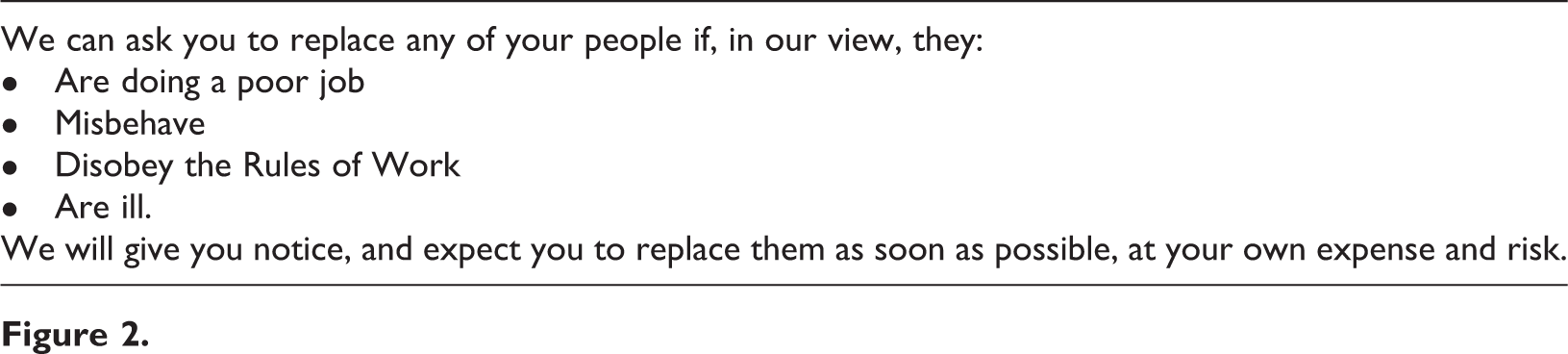
The clause from Figure 1 rewritten in plain English.
Whether or not it is legally watertight the rewrite is more likely to be read, understood, communicated on within the contractor’s team, and acted upon.
The challenge of functionality
Of course, the documentation is not just there to be read in the sense of being decoded; it has to be used effectively to guide those bidding for the work and eventually doing it. Contracts typically include information that might be considered work instructions – the scope and requirements documents are very obviously in this category, so are various sections of the general terms and conditions for many contracts. For example, they typically cover obligations to pack goods correctly, practices when working on site, reporting obligations, systems for inspecting and accepting work, and the information required on invoices. Managers need to be able to find and use this information, so what happens in practice is that it gets repeated in other documents, such as invoicing instructions that might accompany a purchase order. This can lead to version control problems when revisions are made. We should note that making sense of apparently discrepant information requires inference, one of the most complex of literacy challenges.
The ability to use documents effectively is known as ‘document literacy’ – a form of literacy that goes beyond reading the words to include strategic reading – searching documents for answers to questions, assembling information from different documents, and determining the relevance of information. Effective documents are structured around their users’ strategic needs to access different information at different times for particular purposes. A good user manual, for example, includes numerous access devices such as contents lists, index, headings, icons, section tabs and alternative layouts to suit different content structures.
The challenge of relationship
The fourth challenge was the role the documentation plays in building good relationships with stakeholders.
Nexen actually has a reputation for excellent front-line relationships: Any contact I’ve had with anyone in Nexen has been really good. I think they have a good attitude. (C) The Nexen culture is instinctively inclusive. (C) The tone of our communications can be really formal…First Nations can be really sensitive to the tone. It’s better face-to-face – the ‘no emails between strangers’ rule. (N)
The first prototype
Early in the project we developed a prototype of one simple document to respond to these four challenges, to illustrate these learnings, and to get feedback from our interviewees within Nexen and among the contractors.
The initial invitation
Figure 3 shows a Request for Proposal (RFP) document covering letter. We chose this as an initial prototype since it sits outside the formal bidding document, has limited information to convey, and can be taken as the normative voice of the organization as it talks, sometimes for the first time, to potential suppliers. In other words, this letter should represent the organization at its clearest.
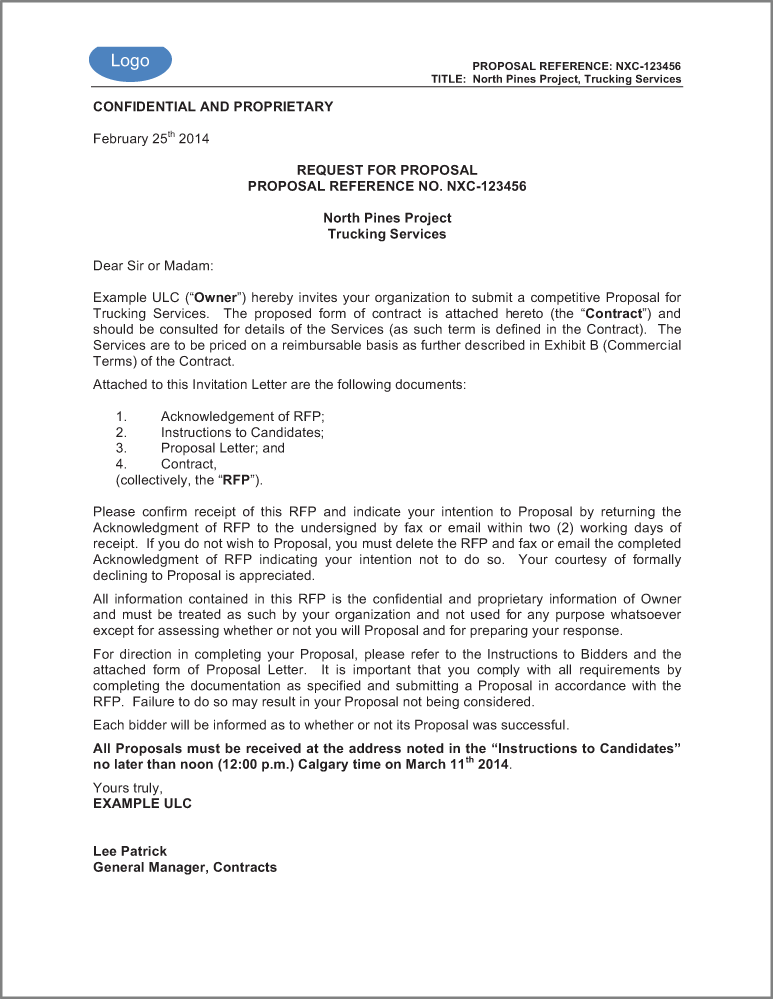
Request for Proposal document covering letter.
It is immediately apparent from the words ‘hereby’ and ‘hereto’ in the first sentence that this letter is legally framed – it is written in the same style and tone as the terms and conditions, the core legal component of the contract. The content is dominated by procedural compliance, rather than the services being requested.
Figure 4 shows a draft transformed letter which addresses our four challenges:
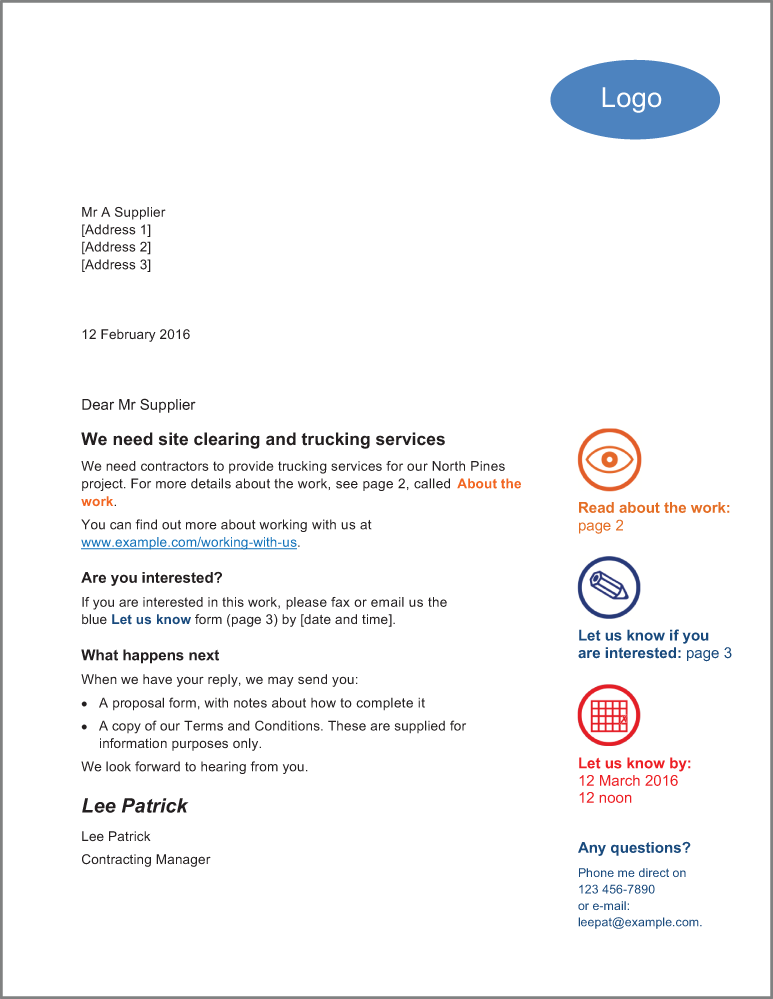
A draft of the new letter prototype, using a fictional project and location.
The challenge of one-size-fits-all: we avoid formal language, which might be appropriate for larger organizations and projects, and instead focus on describing the job and bidding process in simple terms.
The challenge of simplicity: we use plain English throughout, in a conversational style.
The challenge of functionality: information is in chunks, with clear action oriented headings that make the structure clear. Colour-coded icons link to enclosures and spell out the process.
The challenge of relationship: the letter is now personalized, and includes an invitation to phone direct with queries. The implied power relationship is more balanced (‘We need…’, ‘Are you interested?’).
The accompanying documents
The original letter is accompanied by substantial documentation, including 44 pages of general terms and conditions. Our alternative starts with a simple three page document set: the covering letter (Figure 4), a one page summary of scope, and an expression of interest form (Figures 5 and 6). The result is less intimidating, and makes it more likely that small contractors in the new area of operation would respond. Obviously, the general terms and conditions would eventually be supplied, but only after the bidder has expressed interest in the opportunity. This uses a principle known to information designers as progressive disclosure – the gradual revelation of complexity in steps, as the user demonstrates they are engaged with the topic.
The summary of scope includes a description of the overall context for the services that are sought, with a location map. There is also decision support, in the form of a simple description of the task, the people and equipment needed. The form makes it clear what action is needed and by what date, and removes the need to write a formal letter in response.
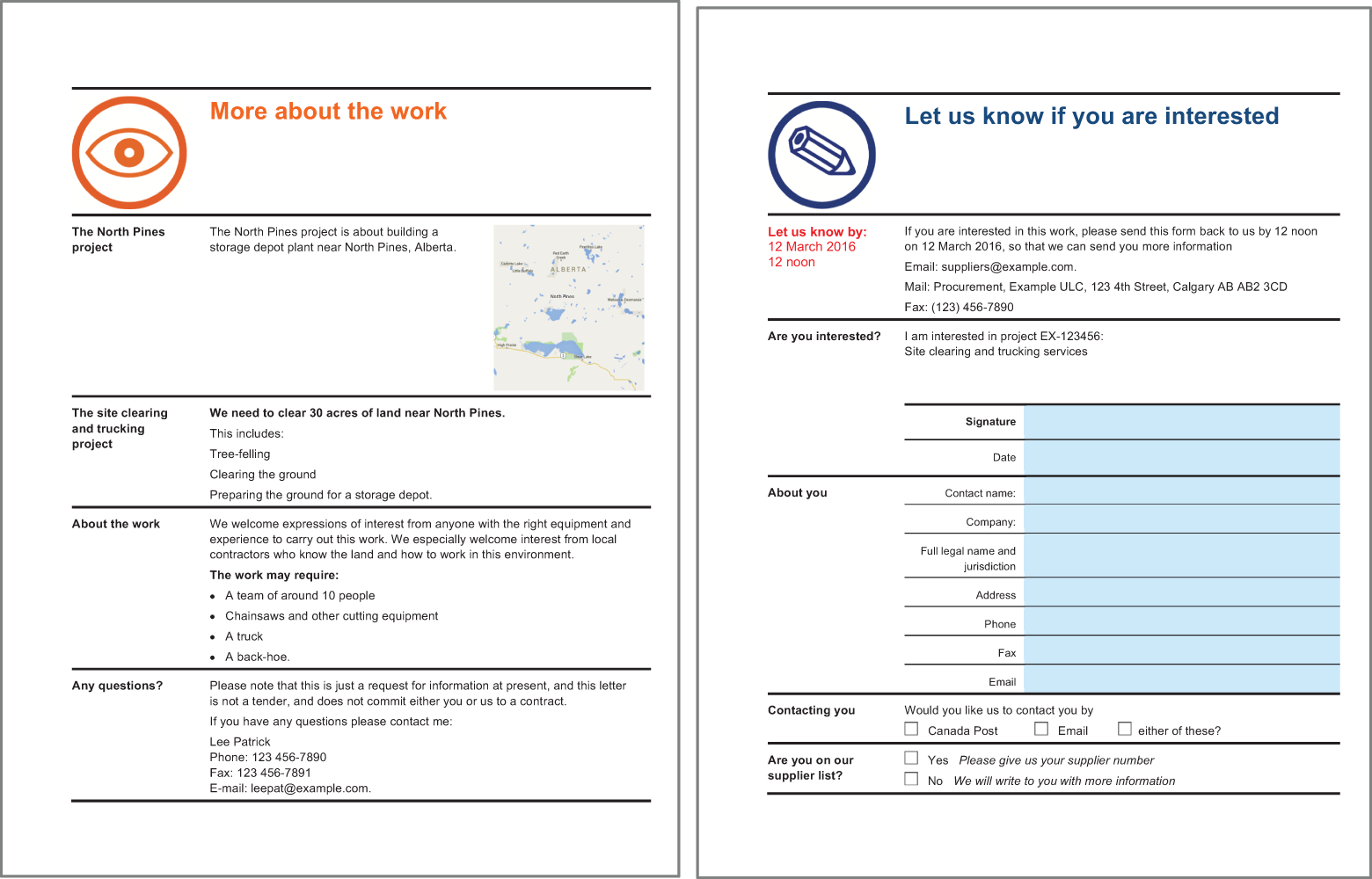
Pages 2 and 3 of the new letter prototype, using a fictional project and location.
Transforming the full Request for Proposals (RFP)
These prototypes were developed initially to demonstrate what an alternative approach might look like, before we moved on to consider how the full document set might be transformed.
The full document set for a typical contract comprised: RFP instructions; signature document; Exhibit A – general terms and conditions; Exhibit B – commercial terms (such things as rates, prices, rules for invoicing), with various attachments; Exhibit C – scope (what is required and the manner of its delivery), with various attachments; Exhibit D – equipment (what is to be provided by Nexen and by the contractor).
The function of these documents is not entirely distinctive. Many issues are dealt with in both Exhibit A and one of the others (invoicing for example). This might work if B, C and D were plain language operational documents, governed by corresponding legal clauses in A (and that is one direction the redesigned contracts could take). But the default tone of voice is technical and legal throughout the whole document set, not just the general terms and conditions. This means that contract documents are hard to write, just as they are hard to read. Assembled from component parts, the result may not cohere as well as it should, and rules of considerate writing get broken.
We have already mentioned the problem of divergent versions when information is repeated. Another common problem is what we might call false precision, where, for example firm quotations are required for services that ‘shall consist of but not be limited to the following’. Or where, although the contract is on a call-off basis and may in theory not lead to any actual work at all, all equipment is apparently required to be on site for the commencement of the contract. The bidder ‘knows’ at a common sense level that this clause should not be taken literally, but they also need to know that other clauses cannot be so ignored – those about safety or insurance, for example.
A genre perspective
The term ‘genre’ refers to common document types for which we have names – words like ‘magazine’, ‘novel’ or ‘catalogue’ call to mind a particular combination of typical format, language style and appropriate reading strategy. Genres like these have evolved over many years, as producers of particular kinds of information seek to attract users (Waller, 1991). For example, whereas a novel typically presents uninterrupted text intended for a long spell of comfortable reading, a catalogue prioritizes quick search. So a good catalogue provides structural cues such as colour-coded sections, or headings that can be easily spotted in a quick scan. A catalogue that fails to do this results in few sales.
Where documents seem not to work well, it is often because an imbalance in power relations has not encouraged document producers to take account of the needs of users in the same way. Traditional administrative forms, for example, are notoriously poor because users have little choice but to cope. They are, in effect, a poorly evolved genre, designed without a user in mind. The user is similarly absent from the traditional format of contracts and other documents with a legal status.
In the absence of training, or theoretical knowledge about document design, the genre perspective enables document producers to make use of their personal experience and cultural awareness. They can identify common document types that most closely match the needs of their own users, and use them as a starting point for their document transformation.
The example genres we listed at the start of this section are clearly inappropriate, because their content and anticipated user behaviour is very different from that of contracts. For example, a novel locks readers into an undifferentiated linear path, while a magazine is loosely structured for casual browsing. In contrast, users of contracts need a document that leads them systematically through essential content and that reliably leads to correct action. It needs to be comprehensive, accessible and easy for document producers to maintain. The document genre that has best evolved to solve this set of problems is the user guide.
Good user guides work because they are designed around the user’s experience. When we buy a product or service, we need to know how to set it up, how to integrate it into our habitual routines, and how to fix something that has gone wrong. We rarely read a user guide straight through – instead we move in and out of the guide in response to tasks and events. So the best guides have clear systems of hierarchical headings, diagrams and icons, and layouts that allow readers to skim quickly in search of answers to questions.
Contracts as user guides
In our transformed contract documents, we took inspiration from the user guide genre. We searched for information in the contract documentation that is focused on practical actions and extracted it to create three generic user guides:
Guide to pricing
The content for this guide was derived mostly from Exhibit B (commercial terms). It explains what quoted costs should cover (for example, whether the hire of equipment includes the operator, fuel and maintenance), how to deal with change requests and similar issues. Potentially this guide could be developed in several versions to suit different audiences – for example, a technical version for more complex, sophisticated projects, and a simple, didactic version to help smaller businesses learn about pricing.
Guide to project management and reporting
At various points in the document set, there are scattered references to reporting requirements. These include regular reports to be sent every month, and incident reports that need to be sent if there is an accident, spillage, labour dispute or similar event. This is largely a generic document, but it could be customized to include actual dates and reporting lines for the project in hand.
Guide to invoicing
Nexen already had an excellent guide to suppliers called ‘How to get paid’. We took the view that, since this should be completely consistent with the requirements separately specified in the contract, it should be merged into a single guide. This could then be referenced by the contract rather than repeated there.
Figures 7 –9 illustrate our application of the user guide genre to the Guide to Invoicing.
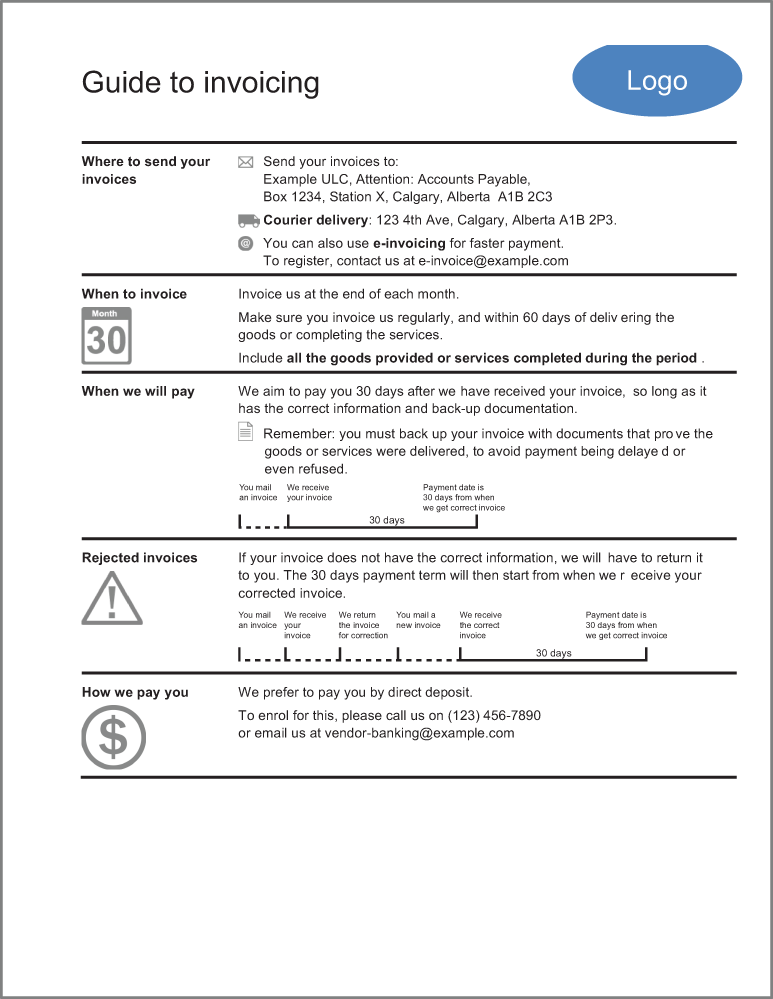
The draft of the guide to invoicing
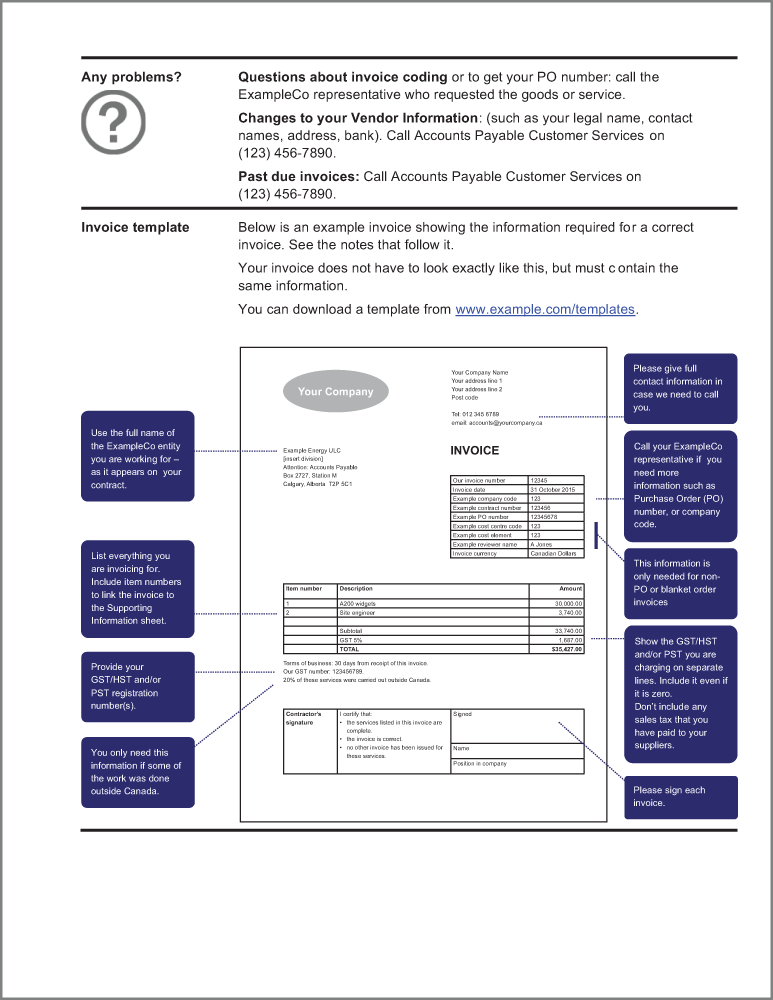
Rather than rely on a verbal description of a correct invoice we include an example invoice that would be compliant if used or copied by the supplier.
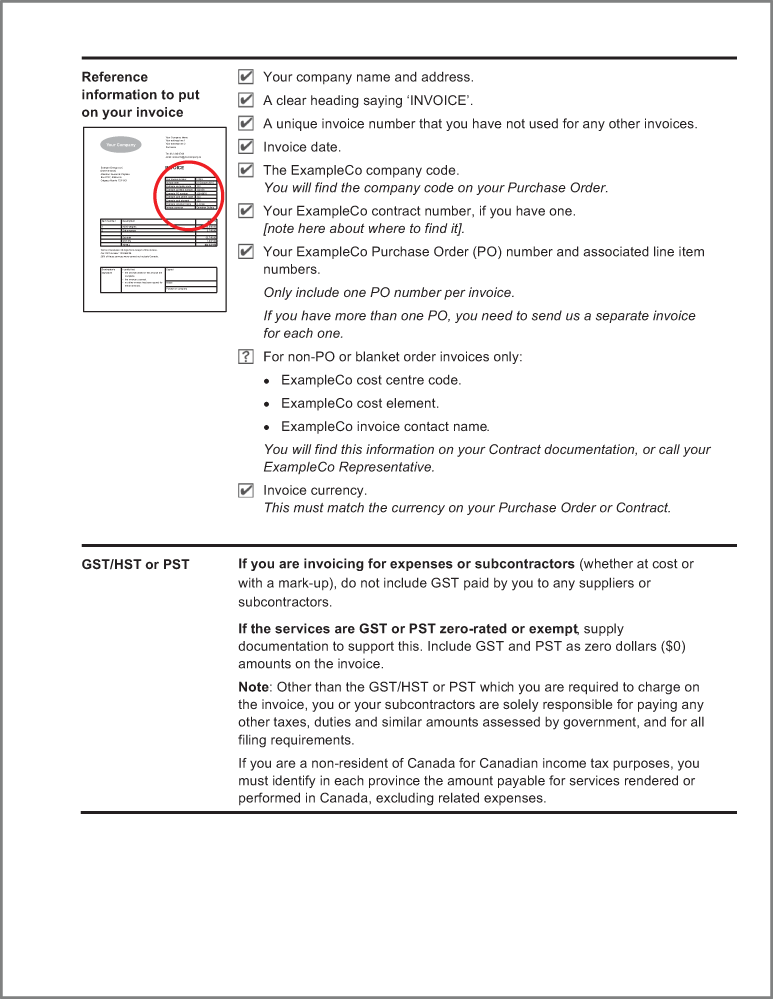
Reference information is explained in more detail using a checklist format to reinforce the fact that this is a firm requirement.
Figure 7 shows the focus on action, and the use of graphic support through icons and visualization (the timelines show the payment date, and the effect of a rejected invoice). It is designed to be clear to someone whose job is to create invoices – although this is a routine task, this person may be responsible for billing several clients, each with their own rules for correct invoicing.
To make the job even easier, an invoice template (Figure 8) is provided. Because it provides a place for all the correct information, using it helps the supplier to know they are compliant. And the required reference information is further defined in a separate illustration (Figure 9).
Icons, check boxes and colour-coding
The RFP document is designed as a form to be returned with the proposal, ensuring bids are easily comparable, and reducing the burden on bidders to produce a perfectly formatted submission.
It asks bidders to submit various proposals and reports with their bid. To make it difficult to miss these actions, we include icons to cue a document requirement, and we provide check boxes for bidders to confirm they have taken the required action (Figure 10). A concern was raised that this might seem patronizing, but our collective view is that this gives valuable reassurance to a new bidder that their bid is complete.
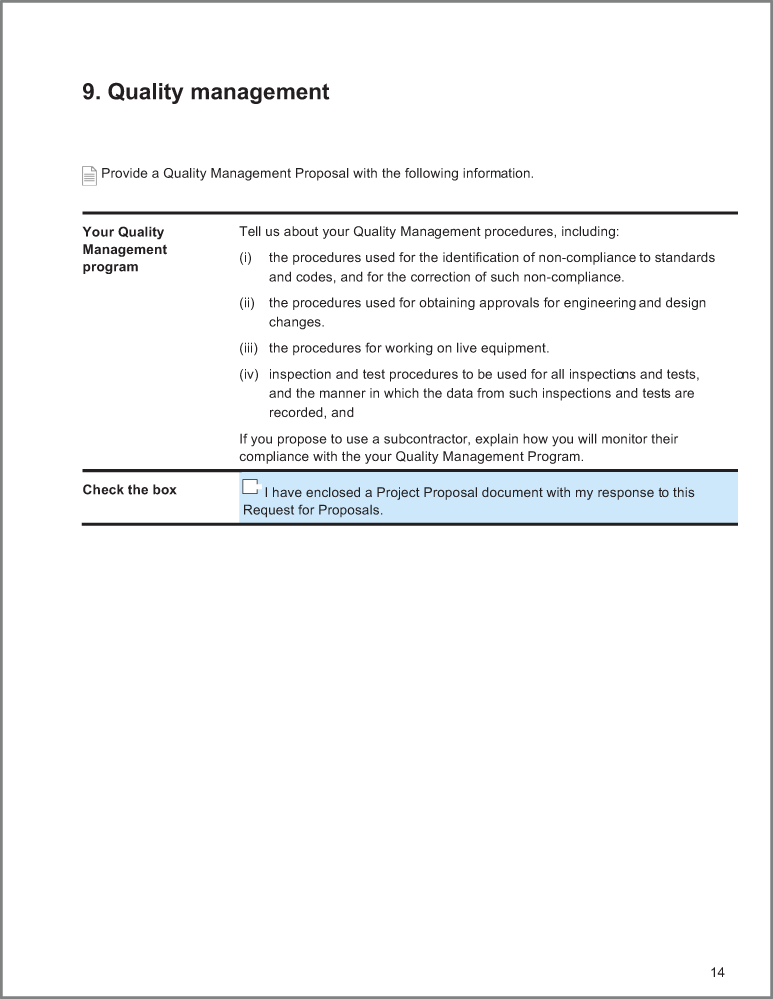
The Request for Proposal document includes icons to cue documents to attach, and checkboxes to confirm the action has been noticed and carried out.
We use light blue areas (or light grey if printed in monochrome) for places where a response is needed (Figure 11).
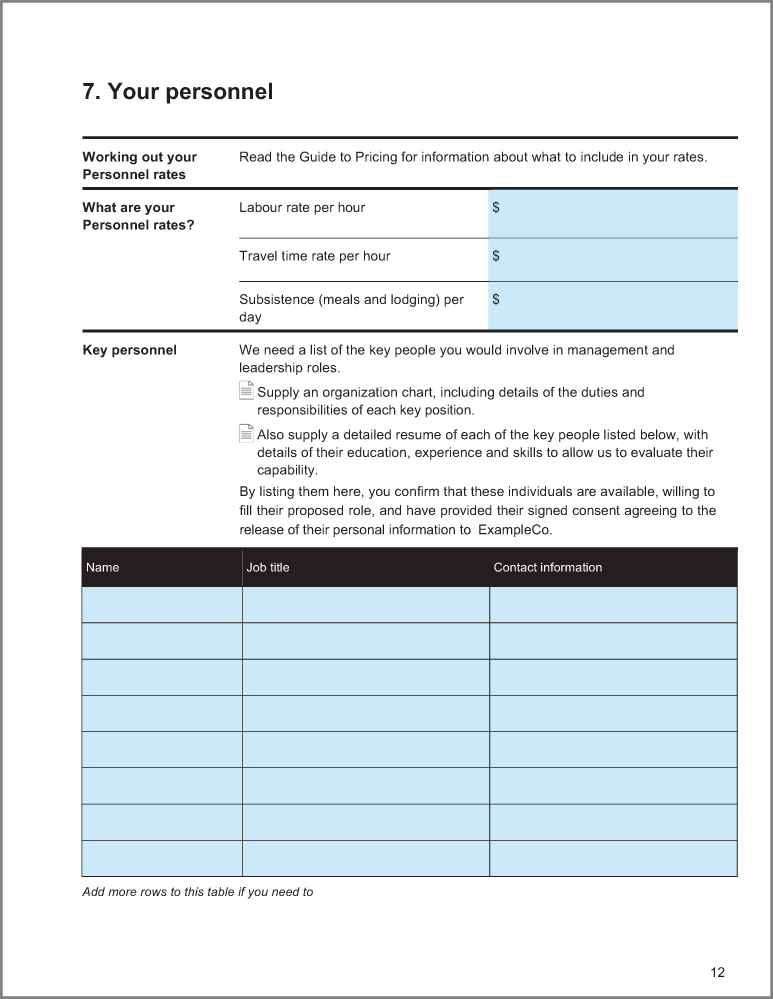
Coloured backgrounds are used to cue responses in the Request for Proposal document.
Communicating what we did: design patterns for clearer contracts
There are various possible ways to communicate information design techniques so others can use them.
Templates are one possibility, but they assume a consistent context of use within the organization they were designed for. Because they embody the organization’s particular practices and processes, someone adapting them for use elsewhere needs to discern the reasons behind the designs so that they retain or adapt only what is essential.
Earlier we introduced the concept of genre – and the user guide genre was an important inspiration. But this is not a robust enough concept for general use. There are many poor user guides, and some genres include features that are vestiges of historical technologies, with no real function today (for example, the half-title and title pages of a typical book). And some useful techniques might come as a mix of different genres or they might be an original creation.
Instead, we prefer to use design patterns to describe useful techniques in terms of the functional problem they aim to solve.
Originating in architecture (Alexander et al., 1977), design patterns have become widely used in software engineering and interface design (Tidwell, 1999), and in more recent times, among some information designers (Farkas et al., 2011; Waller et al., 2012). Gerding (2013) proposed a design pattern approach to contract content, and Haapio and Hagan (2016) have proposed a pattern library for contract design. Creating design patterns is a naming exercise (identifying a useful, repeatable solution to a common problem then giving it a name and a description so it can join a designer’s repertoire of potential solutions to similar problems).
Table 1 lists the main design patterns we have used in the transformed Nexen documents. We present them here as a way to summarize our learning from this case study, and to list techniques that might be applied to other contract documentation with similar user needs.
Some design patterns for contract design.
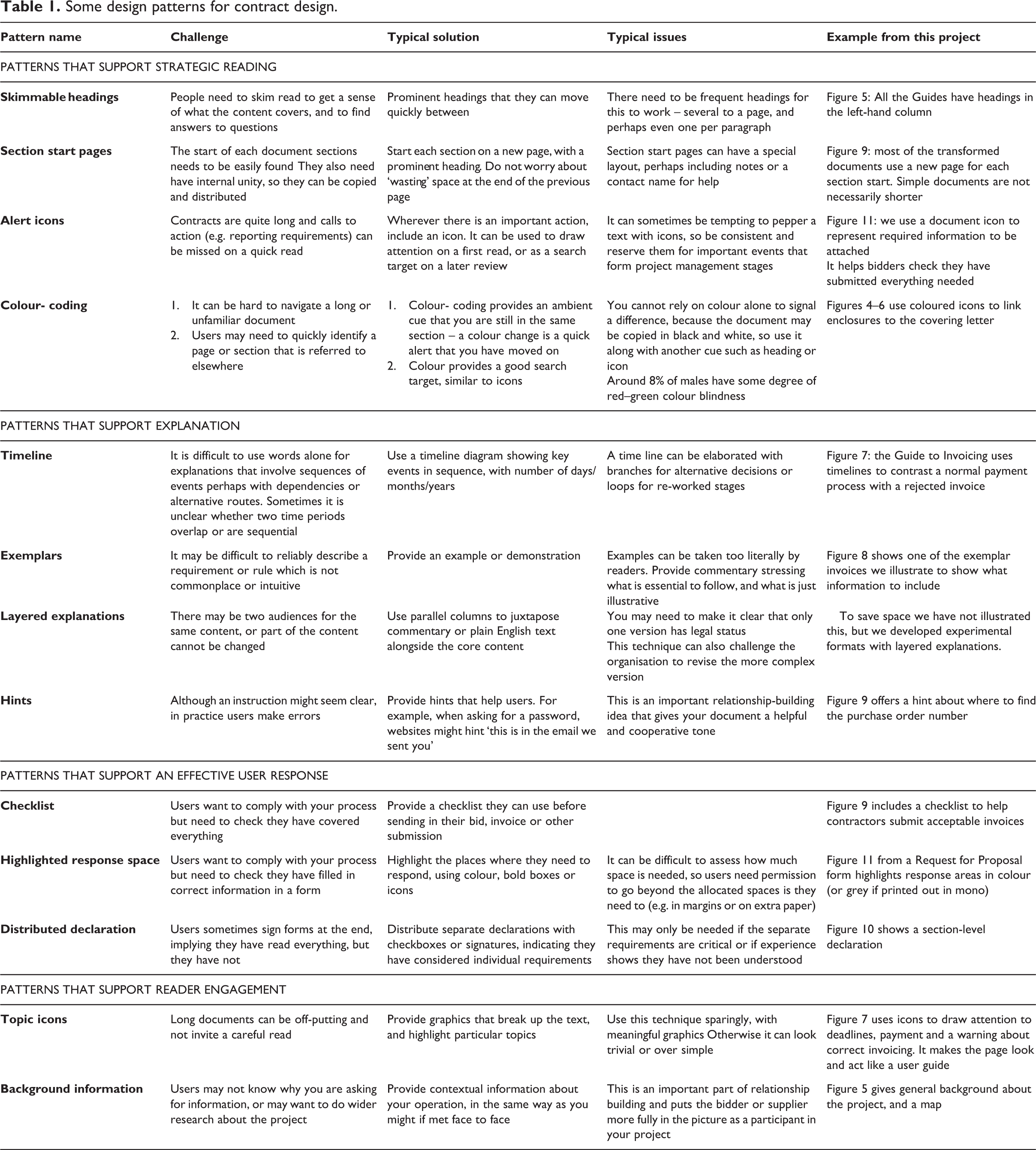
They are defined at a high level – we do not, for example, reiterate the rules of plain English, or legible typography.
Conclusion
This case study has described an innovative approach to contract simplification in response to the needs of some members of a particular audience, Aboriginal small businesses in BC, Canada. Similar needs will be felt wherever contracting parties come from different cultural and professional backgrounds. And, as the creators of the New Engineering Contract showed, simplified contracts also address a need felt in any industry where the users of contractual documents include not only procurement and sales professionals but also the managers and workers on the job.
Contract simplification and visualization is sometimes discussed in the abstract with few examples and practical cases to illustrate what is actually being discussed and proposed. The innovative document designs published here, together with the design patterns that explain them, are intended to move the debate forward and lead to further, more detailed research on the topic.
This is by no means the first instance of contract simplification, but rather it continues a growing trend towards greater clarity as a priority. The project used a multi-disciplinary approach that combined the best professional practices of specialists in procurement, legal drafting, project management, community relations, and information design. Importantly, it also consulted users, to give them a voice in the creation of the new document set.
Footnotes
Declaration of Conflicting Interests
The author(s) declared no potential conflicts of interest with respect to the research, authorship, and/or publication of this article.
Funding
The author(s) received no financial support for the research, authorship, and/or publication of this article.