




Abstract
This article explores the concept of visualisation and law in relation to the development of a contract comprised of comic strips/panels. It explores some other initiatives in law and visualisation, and some of the legal issues which visualisation in contracts may raise.
The Scandinavian pro-active law movement has always focused on re-evaluating how lawyers interact with industry. Rethinking how law can be more facilitative to the industries it supports in more original and valuable ways is a key aspect of this focus. In particular, rethinking contracts and how their format can be improved to enhance mutual understanding of terms and better meeting of minds is core to providing value. Haapio and Passera (2013) refers to this as the “paradigm shift” in contracting in her thesis “Next generation contracts: A paradigm shift”, and reminds us of the need to see contracts as communication tools as well as legal rules (Haapio and Passera, 2013).
Legal communication has always been a challenge. But then, lawyers have not always been very creative in using all communication tools. The great John Honnold wrote, in the context of the internationalisation of law and the issues of legal linguism in international commercial contexts, that: We lawyers have to work with blunt, unreliable tools – words! Why can’t we be as fortunate as our colleagues in the sciences who can write laws in formulas and numbers? Digital recordings turn the exquisitely nuanced sounds of a symphony into just two numbers – zero and one. Perhaps someday we can use this technology…Until that day we must work with words – mushy, ambiguous things even for ordinary communications…. (Honnold, 1988: 207)
Introduction: understanding visualisation
Convening meaning and having that meaning remembered in a simple form is key to subsequent understanding. A report by the Metiri Group, 2008 which reviewed current research findings on the effectiveness of multimodal learning found that retention and learning is improved by the inclusion of words and pictures rather than through words alone. This insight into understanding is not only relevant for a learning environment in education, but also in understanding contract negotiations. Yet law is communicated traditionally through only words, and the inclusion of pictures has traditionally not been well embraced.
Now, with pro-active movements and contract law rethinking all around us, lawyers are re-evaluating the role of pictures in legal contexts. Several initiatives have related to what has been dubbed the “visualisation of contract law”, spanning the use of graphics and pictures in supporting contract negotiations, to the inclusion of graphics in some contracts, to the communication of legal consequences with illustrations.
Visualisation in law, and using graphics to convey concepts of law, is still an emerging field. Collette Brunschwig seems to have pioneered it, not only by publishing one of the first studies in the field in 2001 (Brunschwig, 2001; see also, more recently, Brunschwig, 2014), but by heading a department on Legal Visualisation at the University of Zurich. Visualisation has gained a stronger foothold through the Scandinavian pro-active law movement. In 2012, Haapio et al. published the appropriately named “Time for a visual turn in contracting?” in which they argued the benefits of including visual imagery in contract to clarify meaning. Visualisation seems to have a stronger foothold in eastern and northern Europe, most likely due to the need to address cultural and language barriers. Lexpert reports that: “In the German-speaking countries, terms such as legal visualization (Rechtsvisualisierung), visual legal communication (Visuelle Rechtskommunikation), and visual law (Visuelles Recht) have been used to describe this field of growing research and practice” (http://www.lexpert.com/our-approach/visualization/visual_law/).
The benefits of visualisation would seem apparent. Using one of Brunschwig’s illustrations, we can consider the very definition of a contract to a non-lawyer (see Figure 1).

OR Article 1 Section 1 For a contract to be concluded, a manifestation of the parties' mutual assent is required.
This illustration, taken from Brunschwig’s Legal Visualisation Unit website at the University of Zurich (http://www.rwi.uzh.ch/oe/zrf/abtrv_en.html) speaks volumes. While most lawyers can spend a long time explaining the finer points of offer, acceptance, and meeting of minds with legal language, this illustration does a beautiful, swift, and even emotive job of the task. The green belt binding the parties together conjures an image of a constructive (if constrictive) positive relationship. The outstretched hands of the parties associate with collaboration and partnership, and openness to ideas and exchange. This illustration instantly portrays a contract in ways that legal linguistics cannot do (at least not swiftly). Add to that Legrand’s point that in a multinational and comparative context, lawyers cannot even agree on the correct legal semantics to describe a contract (Legrand, 1996), and words are beginning to seem very inadequate tools in comparison.
But visualisation is not only useful for non-lawyers. Lawyers themselves would benefit from visual aids which convey meaning simply and effectively – and unequivocally. Many will recall the highly publicised story of the comma which cost a million Canadian dollars: the dispute between Rogers (Canada’s largest cable television provider) and Bell Aliant (a telephone company in Atlantic Canada turned on a single comma in the 14-page contract, which rendered ambiguous whether a 5-year contract could be terminated after one year. The Canadian courts were initially persuaded by the grammatical meaning of a comma, rather than the plain meaning of the legal words, in establishing intent of the parties and the meaning of the contract clause. Luckily, this was overturned when a different French language version of the contract was produced. But think – as Haapio does in her paper – how easily this could have been avoided with a simple graphic timeline (see Haapio and Passera, 2013: 54–55). Pro-active law, and visualisation, is – amongst other things – about avoiding such potential misunderstandings and ensuring contracts which cannot be misconstrued so easily.
Some advances are reported, such as David Berman’s white paper on visualisation in Canadian government reform (Berman, 2000), and contract management firms like IIACA and LEXPERT are reporting great success in aiding legal comprehension with visual aids. Lexpert publishes a visual trajectory of visualisation in contract law, reporting innovations and contributions to three fields: Visualisation in contract law education, visualisation about contracts, and visualisation in and about contracts; however, to date, there is very little trajectory on visualisation AS contracts (see http://www.lexpert.com/our-approach/visualization/).
That is what this paper addresses; the authors wish to map their experience of forming a comic-book contract for a university initiative in innovation and development. This paper discusses how to take visualisation one step further, in the development of contracts which are almost entirely composed of comic strips which help the parties to understand their choices in collaboration, cost sharing, liability, and intellectual property (IP). While issues of misinterpretation of words may be replaced by issues of misinterpretation through images, the combination of images and words combined with the intent expressed through story makes the comic format a powerful medium worthy of consideration and debate. The authors acknowledge that there is a wealth of research on the psychology of visualisation that we have yet to draw upon, but wish to showcase the experience with the current contract so as to encourage continued experimentation and research about contracting methods and formats.
The initial idea and the legal needs
The idea arose last year, when the authors were discussing innovations at an unrelated conference, and it became clear that the School of Mechanical and Chemical Engineering at UWA needed a lawyer to form a contract to protect and regulate their work in creating solutions for others. Who better to help that someone from the Law School? This someone, with a previous intermittent past in the Scandinavian pro-active law movement, and in the midst of including contract visualisation in a forthcoming book on how to rethink contracts (Andersen and Henschel, 2016), immediately seized this opportunity to rope her engineering colleague into an experiment: a visual digital contract format. And so the journey began – a journey which is far from over, and is, so far, proving to be the most fun a researcher can have.
The project began with an interview by the lawyer, to assess the engineer’s legal needs. This resulted in the identification of two key needs: Non-Disclosure and IP protection.
Some standard verbal Non-Disclosure Agreement (NDA) clauses were developed, and some models for the allocation of IP rights, but they failed to clearly and swiftly communicate their effects to the engineer. We then turned to the issue of identifying the ground-level needs of the engineers from a non-law perspective; not just wanting to clarify legal relationships, but also wanting to find less threatening ways to drive behaviour.
Identifying the non-law needs of a contract
One of the biggest benefits of negotiating an innovative contract with an engineer is that he or she is not a lawyer. Harsh, but true. Unfettered by ideas of contract format, unrestricted by tradition or fear of the untried, we began from the simplest of beginnings: not a complex template, but the identification of the needs of the contract from the engineer’s point of view. Each are listed below – some arose as the project progressed and some are still arising.
Innovation requires removal of barriers
Innovation by definition involves new ideas, and when sharing these ideas, we are most often asked to sign NDAs. Not only do such NDAs immediately slow the collaboration process, but invariably they require the engineers on both sides to pass them to their respective lawyers, who read, amend, and/or debate, ultimately coming back and asking the engineer to sign a lengthy, jargon-filled document. The engineer understands the nature of NDAs, yet is generally unaware of the nuances that have been debated.
Understanding the importance of IP
Young engineers are often enthusiastic and full of ideas. However, the training of these engineers is critical to ensure they understand the importance of protecting their ideas and the ideas shared with them.
Training and education
We see countless NDAs; yet, are engineers or organisations ever taken to task over a violation of an NDA? How would such a violation be proven? We propose that education of the importance of closed discussions is ultimately a better tool than fear of litigation in the process of developing new ideas.
Acknowledging contributions
The sharing of ideas and development of engineering solutions can lead to significant advances, with the possibly of generating a revenue stream for the team. However, team members often make assumptions about what they will get out of the venture. Identifying the problem to solve may be the key step, but most often the solutions generate the value for the venture. Contributions towards solving that problem and their worth in the revenue sharing process need to be clearly identified early in the process. All parties must be made aware that contributions ultimately determine how wealth will be shared.
Finding a common framework
Engineers come from different disciplines (electrical, mechanical, chemical, civil) and the language used within each discipline is different. Further, engineers come with a range of experiences, from a range of cultural backgrounds and from public and private sectors. Legal contracts need to be simple and easily accessible by the whole gamut of the engineering team, to ensure all understand the framework and work to ensure its integrity.
No time
Research and development engineers want to be quick to market. The Lean Startup concept teaches us to focus on the important issues, stop wasting time, and undertake a build–measure–learn feedback loop to be the first to market. Introducing legal contracts is often perceived as impeding this process.
Examples from the contract
These more pragmatic needs mentioned above fuelled more specific discussions on the composition of the graphics. Below are some excerpts of the key “comic strips” which form the Makers Contract. 1 They were generated using the software from Pixton, to meet the need identified above in creating a swift and easy to understand format for both NDA and IP agreements.
When completed, the strips will be presented in a non-interactive website with options outlined. We are hoping that, in time, we can develop an interactive digital comic-strip contract where the Challenger outlines his preferred methods/options, which then generates a comic-strip contract for the Makers to accept.
Currently, the strips will generate different scenarios, and the Makers and Challengers can choose different alternatives with different outcomes (and, ultimately, IP allocations) based on their projected involvement and creative/work allocation. We are hoping to embed this in a digital platform that allows the advancement of choices in sequence, ultimately generating the relevant final comic-strip contract after both parties have chosen the same pathways.
Comic strip 1 (see Figure 2) is a graphic representation of an NDA, signifying the need to keep innovative work confidential. It also plants the idea of the Maker agreement being based on the Challenger giving the Makers a task.
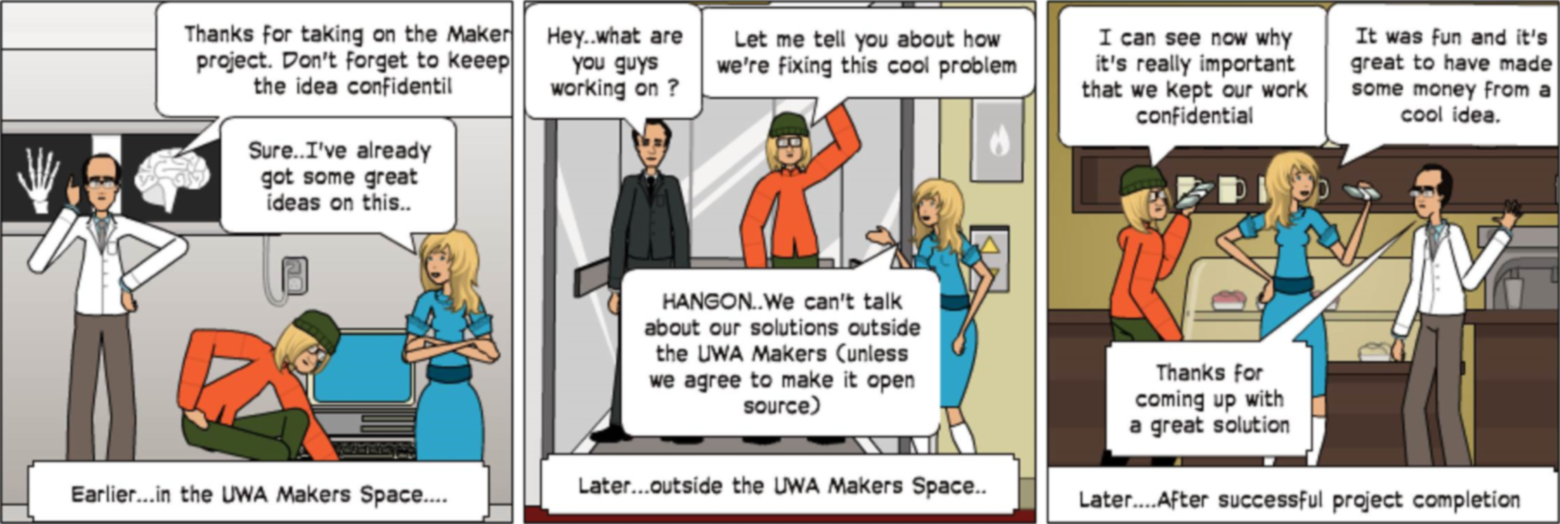
Comic Strip #1. The Non-Disclosure Agreement.
Comic strips 2–4 were developed to convey three different models of engagement/contribution between the University of Western Australia (UWA) Makers (the engineering students) and the Challenger (individual with the initial problem or idea).
Comic strip 2 (see Figure 3) depicts the (standard) situation where the Challenger identifies a problem, and the Makers work on the solution independently and with little or no creative or labour input from the Challenger, who is thus happy to forego any IP rights on the solution designed in exchange for rights to use the item/solution created.
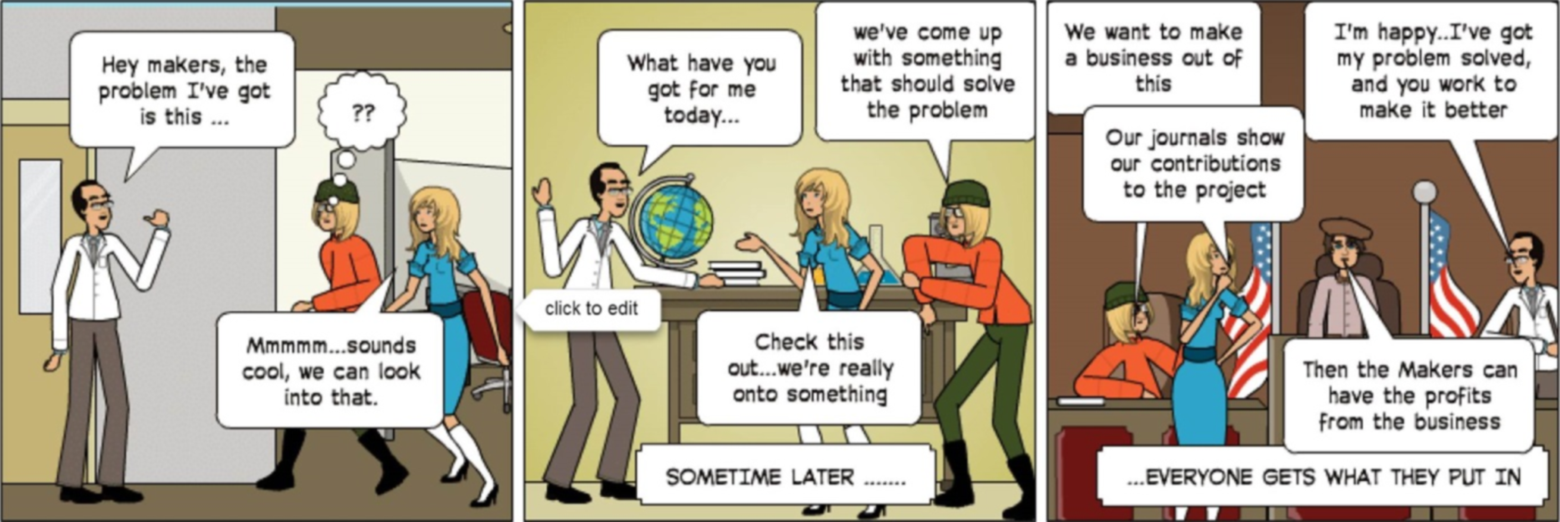
Comic Strip #2. The standard challenge.
Comic strip 3 (see Figure 4) depicts the scenario where the Challenger identifies a problem, and works with the Makers on the solution collaboratively. Equal input of creative ideas and labour will result in common ownership of the IP rights to the solution between the Makers and the Challenger. Ratios can be explored at completion of the project – careful journals must be kept.
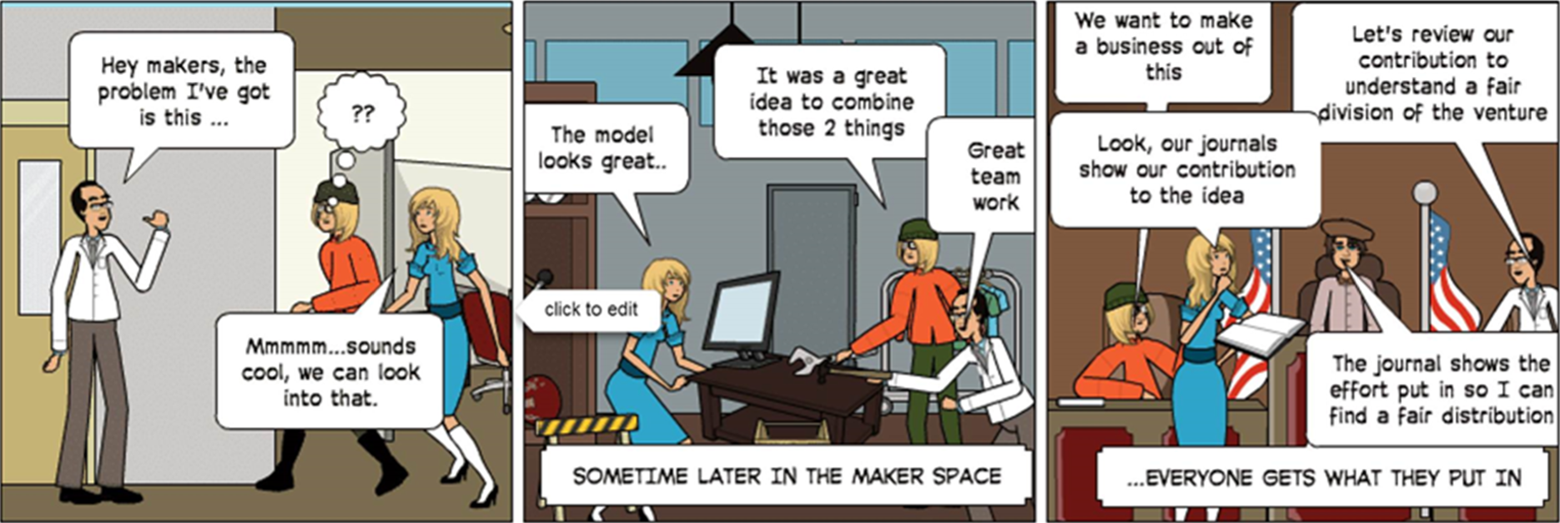
Comic Strip #3. Challenger collaboration.
Comic strip 4 (see Figure 5) depicts the scenario where the Challenger identifies a problem, and contributes with a creative idea for a solution, which forms the basis of the Makers’ final solution. The allocation of IP rights on this basis will be more difficult to calculate, and it is recommended that an agreement be made beforehand outlining the proportionate values of the work versus the value of the creative idea. Ratios can be explored at completion of the project – and, again, careful journals must be kept.
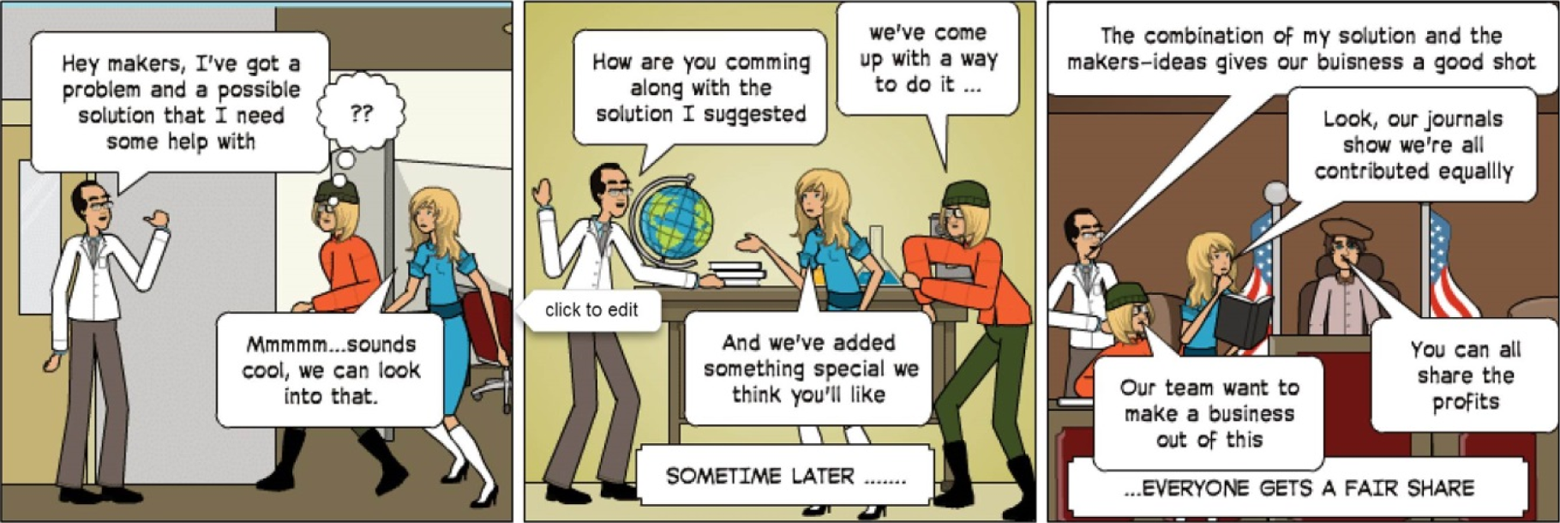
Comic Strip #4. Challenger contributes creative input.
Conclusion
It is surprising that the visualisation of contracts does not seem to be taking the world by storm, but it does not seem to be a field which is emerging with any haste – breaking new ground in what can best be labelled very conservative soil. Our focus is not on the binding nature of the contract, but on the behaviour it can drive with better communication of expectations. As any IP lawyer will tell you, at the end of the day the key to allocating IP is not what was agreed, but what actually happened.
The benefit is evident for all multi-lingual and multicultural contexts. Visualisation can avoid misunderstandings where communication and assumptions can be a known danger. We seem to have made commercial contracting too complex and difficult to navigate, and some simplification is needed.
We certainly believe that the format we have developed for the UWA Maker’s Contract has a lot of potential for simplification, clarity, and understanding: making law accessible for engineers.
There is no doubt that more research into this is needed – and, hopefully, we can be more informed about our choices and other innovations once we have carried out further research. Since starting this project, we have also learned that we are not alone: Robert de Rooy has developed “Contracts as Comics” to empower works, a visual contract which illustrates the duties of a house maid (De Rooy). And in India, cartoons are being developed to educate children about law and to help visualise concepts. 2
We need to advance this field with some collaborative sharing, research, and development. Who knows what contracts can look like in the future…?
Footnotes
Declaration of Conflicting Interests
The author(s) declared no potential conflicts of interest with respect to the research, authorship, and/or publication of this article.
Funding
The author(s) received no financial support for the research, authorship, and/or publication of this article.