




Abstract
Objective
The introduction of the “Broadband China” strategy significantly boosted internet access for older adults in China. This study examines the association between improved internet usage on the psychological well-being of older adults in China and explores the mediating role of intergenerational interactions, focusing on economic and emotional exchanges between older adults and their children.
Method
A difference-in-differences analysis was employed to evaluate the effectiveness of the “Broadband China” strategy in enhancing internet access. Additionally, fixed-effect regressions were used to examine the relationship between internet use and psychological well-being for older adults (aged 60 and above, male and female, all of Chinese ethnicity).
Results
Internet use is positively associated with psychological well-being. Mobile use and concurrent use of mobile and computers devices show particularly strong benefits. An inverted U-shaped relationship is observed between usage duration and well-being. Moderate use enhances well-being while excessive use diminishes the effect and may even lead to negative outcomes. Internet-based learning, social, and entertainment activities are beneficial, whereas the associations of internet-based work remain inconclusive. Economic interactions such as online shopping and digital transfers are positively associated with well-being, while increased reliance on virtual communication may reduce face-to-face interactions, weakening emotional connections.
Conclusion
The “Broadband China” strategy played a significant role in promoting internet use among the country's older adults. While our results suggest many positive associations between internet use and mental well-being, increased internet usage is also associated with decreased face-to-face contact frequency and lower contact quality between older adults and their children.
Policy Implication
Digital inclusion policies should not only expand access but also promote balanced internet use while encouraging meaningful offline interactions between older adults and their families.
Keywords
Introduction
For the past four decades, China has benefited from a healthy and young workforce that powered its economic transformation. However, in recent years, this demographic landscape has undergone a significant shift. Partially accelerated by the one-child policy implemented between 1980 and 2015, the country's population pyramid has rapidly tilted toward an ageing structure. By the end of 2020, more than 264 million Chinese were aged 60 or older, representing 18.7% of the country's population and nearly one-quarter of the global older adults population. 1 Meanwhile, the average of Chinese households size shrank from 4.41 individuals in 1982 to 2.62 in 2020, reducing opportunities for coresidence and daily intergenerational contact. 2 In China's traditional family model, adult children provide both practical and emotional support to their parents. Reduced intergenerational interactions have therefore contributed to the deterioration of mental health among older adults. 3
Mental health, understood as a state of psychological well-being that encompasses the absence of depression and anxiety as well as positive functioning and life satisfaction, is crucial to the quality of life in later years. The “China National Mental Health Development Report (2019–2020)” 4 highlights that nearly one-third of the older adults in Beijing experience mental health challenges. To address the consequential societal and economic ramifications, national initiatives such as the “Action Plan for Caring for the Mental Well-being of Older Adults” were created to promote mental health among ageing populations. 5 Depression is of particular concern, as it is linked to reduced life satisfaction, increased healthcare demand, and premature mortality.6,7 This study examines how the rise of an information-centric society in China relates to the psychological well-being of older adults, focusing specifically on depressive symptoms. We measure depression using the eight-item Center for Epidemiologic Studies Depression Scale (CES-D) (A detailed discussion of CES-D’s validity is provided in Supplemental Materials S1.), a widely validated tool for detecting clinically significant symptoms among older populations. 8
Digital inclusion has emerged as a potentially important determinant of mental health in later life. The rapid expansion and widespread adoption of internet technology have significantly reshaped individuals’ lifestyles, affecting various dimensions of personal, familial, and societal relationships, including emotional well-being and family communication. 9 Since the launch of the “Broadband China” strategy in 2013, the Chinese government has expanded its internet infrastructure nationwide, contributing to a large rise in internet access among older adults. According to the China Statistical Report on Internet Development (Figure 1), the population of Chinese internet users aged 60 and above exceeded 153 million as of December 2022. 10 This digital transformation has altered how older adults in China access information, maintain social ties, and interact with family members.

Number of internet users aged 60 or above (1999–2023).
Despite these developments, the mental health consequences of internet use for older adults remains mixed, raising a central question: does internet use ultimately help or harm their well-being? On the one hand, studies suggest internet use can alleviate depression and reduce isolation by enhancing social connectivity and access to resources.11,12 On the other hand, excessive use may reduce face-to-face interactions, increasing loneliness and emotional strain. 13 Much of this evidence is based on Western contexts, and comparatively few studies examine older Chinese adults. Existing work in China suggests that the internet enriches the cultural and social engagement and support successful ageing, 14 yet theoretical accounts and rigorous tests of the mechanisms remain limited. A key question, therefore, concerns the mechanisms at play: through which pathways does internet use influence well-being, and how do these competing effects manifest within the unique sociofamilial context of China's ageing population? In particular, intergenerational dynamics within China's family system remain underexplored and lack robust empirical evaluation. 15 This question is especially salient in China, where rapid digitalization coincides with a shrinking traditional family support system.
To address this puzzle, our study aims to achieve three primary objectives: Using the China Family Panel Studies (CFPS) data, we first evaluate the net effect of internet use on depressive symptoms among older Chinese adults. Second, we move beyond a simple binary measure of internet use to identify an optimal usage pattern, examining how usage duration and purposes influence psychological well-being. Third, we investigate the potential mechanisms, specifically testing whether intergenerational interactions (measured through financial exchanges and contact frequency) mediate this relationship.
We extend prior work in three ways: using a difference-in-differences (DID) approach, this is one of the first studies to analyze the impact of China's “Broadband China” strategy on the psychological well-being of the nation's older adults. Unlike previous research that often relied on binary indicators and single measures for internet use and mental health, 16 we adopt more holistic assessments of internet use (i.e. usage status, duration, and purposes) and psychological well-being (i.e. the eight-item CES-D Scale). We identify an optimal weekly internet usage duration and discuss the importance of promoting balanced internet use. Lastly, this study is among the first to evaluate the mediating effects of intergenerational interactions (i.e. financial exchange and contact frequency). By doing so, we aim to clarify whether and how internet use supports or undermines the mental health of China's ageing population.
Related literature and research hypotheses
Internet use and mental health
In August 2013, China introduced the “Broadband China” strategy to expand broadband infrastructure, aiming to improve internet access nationwide. Regional pilots began in 2014 in 39 metropolitan areas, followed by broader implementation in 2015 and 2016 (see Supplemental Figure S1 and Table S2 for details). This infrastructure expansion reduced access barriers for older adults and encouraged greater internet adoption.
As discussed in the introduction section, the relationship between internet use and the mental health of older adults remains debated. Researchers have shown that internet use by older adults alleviates loneliness, enhances emotional support, and increases life satisfaction by enabling communication with family and friends. 17 Furthermore, Oh et al. suggest that as internet usage duration increases, feelings of loneliness and depression can be reduced, and self-esteem may be boosted. 18 On the other hand, researchers have also argued that prolonged or excessive internet use may diminish these benefits. Overuse can reduce time spent in face-to-face interactions, weaken familial bonds, and increase loneliness.19,20
Taken together, these findings suggest a pattern of diminishing marginal returns, wherein moderate internet use may enhance psychological well-being, but excessive use could have adverse effects. This ambiguity raises an important research question: What is the optimal level of internet use that maximizes mental health benefits for older adults?
Dimensions of internet use
Internet use among older adults serves varied functions. The authors of the CFPS categorize four primary types: learning, work, social interaction, and entertainment. Each dimension offers distinct pathways to influence mental well-being. For example, work-related use increases flexibility regarding hours and locations, enabling older individuals to work from home or in more comfortable settings. 21 It also improves efficiency, creating opportunities for self-development, which may enhance their psychological well-being. 22 Social use can be effective in improving communication with family and friends, reducing isolation and psychological distress.23,24 Entertainment use, such as watching videos, can contribute to improved psychological well-being. 25 This positive impact of enjoying life has also been shown to be more significant in older adults than younger individuals. 26
While these diverse uses generally yield positive outcomes, their benefits vary in intensity and mechanisms. Prior studies have emphasized the need to differentiate these functions to better understand their effects on mental health. 27
The mediating role of intergenerational interaction
Older adults’ well-being is closely tied to family dynamics, especially in the Chinese context where adult children play a central role in the long-term care of their parents, providing both financial and emotional support. 28 Positive intergenerational relationships are associated with improved mental and physical health, reducing depression among older adults.29,30 As society becomes more mobile and family sizes shrink, maintaining these relationships increasingly depends on digital tools.
The internet facilitates two key dimensions of intergenerational interaction: financial and emotional. Financial interaction involves two-way economic support between older adults and their children via tools such as digital payments and online shopping platforms. 31 Emotional interaction involves digital communication through tools such as WeChat, which increases contact frequency despite physical separation. However, this may come at the cost of reduced face-to-face interaction, potentially weakening emotional closeness. 32
These dynamics align with Intergenerational Solidarity Theory, 33 which describes six dimensions of family cohesion. Among these dimensions, internet use can enhance functional solidarity (e.g. the exchange of tangible support) and associational solidarity (e.g. the frequency of intergenerational contact). Out of the two, the internet's impact on associational solidarity is more nuanced. On one hand, digital tools can enhance contact frequency and reduce feelings of isolation, thereby providing emotional support and improving well-being. On the other hand, online communication may substitute for face-to-face interactions, thereby undermining affectual solidarity. In-person interactions offer deeper emotional comfort and trust-building, which cannot be fully replicated through digital exchanges. 34 The net effect on well-being depends on the balance among these components.
In addition to Intergenerational Solidarity Theory, these observations can also be further understood through Social Capital Theory, which emphasizes the importance of social networks, trust, and reciprocity in individual well-being.35,36 Social capital is typically divided into structural (i.e. forms and frequency of interaction) and cognitive (i.e. trust, shared norms) dimensions. In the context of intergenerational interaction, structural capital manifests as economic and emotional exchanges, while cognitive capital reflects intergenerational trust and shared familial expectations. On the structural side, technologies such as mobile payments and e-commerce lower the costs of intergenerational economic transfers, enhancing resource connections. 37 Video calls and instant messaging increase the frequency of emotional contact, offering the “strength of weak ties” that reduce loneliness. 38 However, frequent but shallow interactions may crowd out deep, trust-building conversations according to Putnam's “erosion of social capital” hypothesis, especially if they replace in-person meetings. 39 On the cognitive side, high-frequency online contact may strengthen emotional security and intergenerational trust. 40 However, if communication becomes overly instrumental (e.g. simply sharing online articles without personal engagement), older adults may perceive emotional support as superficial, thereby reducing trust. Moreover, digital engagement may shift family roles. For instance, when older adults are included in online family decisions or asked for online shopping advice, they may experience enhanced self-efficacy according to Lin's resource mobilization theory. 36 Conversely, if adult children overly rely on technology for caregiving, parents may feel reduced to functional roles, weakening their sense of belonging. Such normative tensions are especially salient in cultures that emphasize traditional familial obligations.
Taken together, Intergenerational Solidarity Theory and Social Capital Theory provide a complementary lens to understand the mechanisms by which internet use affects older adults’ mental health. By transforming both the structure and quality of intergenerational interaction, the internet can promote or inhibit psychological well-being, depending on usage patterns and family dynamics.
Research hypotheses
Building on the above literature, we propose the following hypotheses, and the conceptual model illustrating these relationships is presented in Figure 2. Hypothesis 1 (H1): Implementing the “Broadband China” strategy promotes internet use among older Chinese adults and is significantly associated with their psychological well-being. Hypothesis 1a (H1a): Internet use is positively associated with the psychological well-being of older Chinese adults. Hypothesis 1b (H1b): The relationship between internet usage duration and the psychological well-being of older Chinese adults exhibits an inverted U-shaped pattern. Increasing duration is positively associated with the psychological well-being of older Chinese adults up to a critical threshold. Beyond this threshold, the effect diminishes and may even negatively impact. Hypothesis 2 (H2): Internet functions such as learning, work, social interaction, and entertainment all contribute to the psychological well-being of older adults. Hypothesis 3a (H3a): Internet usage promotes the psychological well-being of older adults through increased two-way economic support between them and their children. Hypothesis 3b (H3b): Internet usage has a “promoting effect” on the frequency of overall communication and a “substituting effect” on the frequency of in-person interactions between older adults and their children. Both effects are significantly associated with the psychological well-being of older adults.

Conceptual framework.
Data and methods
Data source and sample construction
This research used the CFPS dataset, an annual longitudinal survey conducted by the Institute of Social Science Survey at Peking University. The dataset is publicly available and contains information on individual, family, and community levels. It offers extensive insights into the well-being of the Chinese population, covering areas such as internet usage habits, self-assessed mental wellness, family dynamics, and personal economic conditions. The data is available at Peking University's official website. Statistical analyses were performed using STATA 17.0 (STATA Corp, College Station, TX).
To test H1, we constructed a panel dataset by merging three periods of CFPS data (2012, 2016, and 2018). This dataset incorporates observations from 22 provinces, five autonomous regions, and four directly controlled municipalities, effectively representing all of mainland China. The initial numbers of observations were 35,719 (2012), 36,892 (2016), and 32669 (2018). Since our analysis focuses on individuals aged 60 or older, we obtained 7269 (2012), 9358 (2016), and 7872 (2018) observations after excluding individuals under 60. The next exclusion step identified individuals with missing or invalid responses to key variables (e.g. internet use, mental health), which led to 6116 (2012), 7746 (2016), and 6742 (2018) observations. The final exclusion process involved merging the three periods of data to form a balanced panel data and then removing observations with unmatched county-level identifiers, which are necessary for identifying policy exposure. The number of missing county-level identifiers was 49 in 2012, 393 in 2016, and 391 in 2018. The higher number of missing identifiers in 2016 and 2018 is attributable to the tracking nature of the CFPS: when core household members relocated to areas not covered in the original 2012 county coding framework, their new locations could not be harmonized with the baseline geographic identifiers. After which, we obtained a final sample of 11,794 valid observations (3960 from 2012, 3916 from 2016, and 3918 from 2018).
Detailed statistics for the three-period consolidation (CFPS 2012, 2016, and 2018) are presented in Supplemental Table S3.
To test Hypotheses 2–4, we consolidated CFPS 2016 and 2018 only, as internet use questions were not available in 2012. The first two steps of data exclusion were identical to the last paragraph, which gives us 7746 (2016) and 6742 (2018) observations. Finally, we constructed a balanced panel by identifying individuals observed in both 2016 and 2018, resulting in a total of 9684 valid observations (4842 in each year).
Detailed statistics for the CFPS 2016 and 2018 consolidation are presented in Table 1.
Description of variables and summary statistics CFPS (2016 and 2018 consolidated).

Variable definitions
Dependent variables
Psychological well-being. Unlike earlier studies 15 that relied on single-question assessments to measure depression (e.g. “How often do you feel depressed?”), our composite measure captures a broader spectrum of affective and somatic symptoms. As shown in Supplemental Table S1, respondents reported the frequency of eight experiences over the past week. While the standard CES-D protocol scores negative experiences from 3 (most frequent) to 0 (least), we reversed the scoring for all items so that higher scores consistently indicate better psychological well-being. Thus, in our scoring system, more frequent positive experiences and less frequent negative experiences both contribute to a higher total score (range: 0–24).
Independent variables
Internet usage. Internet usage is measured along three distinct dimensions: usage status, duration, and purpose. Each dimension is analyzed in its dedicated regression models to isolate unique effects and mitigate multicollinearity. Usage status is derived from binary responses regarding internet access via mobile devices or computers, from which we constructed dummy variables categorizing respondents into nonusers (reference), mobile-only users, computer-only users, and concurrent users of both devices. Usage duration is quantified as the number of hours spent online during leisure time in a typical week. Usage purposes (learning, work, social interaction, and entertainment) are measured on a 1 to 7 Likert scale reflecting frequency, with each purpose analyzed individually to evaluate its specific association with psychological well-being.
Mediating variables
Financial interaction. Financial interaction contains two directions: from children to parents and from parents to children. Financial support from children is measured using the question: “In the past six months, on average, how much money did your children give you? (If your children provided goods, please convert them into a cash equivalent.)” The cumulative amount received from all children is used to represent the overall level of support. Financial support from parents is measured with the question: “In the past six months, on average, how much money did you give to your children? (If you provided goods to your children, please convert them into a cash equivalent.)” The total amount provided to all children reflects the level of parental financial support.
Emotional interaction. Emotional interaction contains contact frequency and face-to-face interactions. Contact frequency is measured with the question, “In the past six months, how often have you contacted your children through mobile phones, emails, etc.?.” Responses, ranging from 1 (never) to 7 (almost every day), were summed across all children to capture the overall level of digital or remote contact. Face-to-face interaction is measured using the question: “In the past six months, how often have you met with your children in person?.” Responses also range from 1 (never) to 7 (almost every day), and the summed score across all children reflects the overall frequency of in-person contact.
Control variables
To control for potential confounding factors, we include a range of demographic, socioeconomic, and health-related variables: age, gender, marital status, years of education, health status, pension status, household size, self-assessed economic status, and self-assessed social status. Economic and social status are measured on a five-point scale, with higher scores indicating higher perceived status within the local community.
Statistical analysis
Our empirical approach is organized into four parts, each corresponding to a specific set of hypotheses.
DID model for H1
To test H1, we use a DID design comparing older adults living in “Broadband China” pilot cities (treatment group) with those in nonpilot areas (control group), before and after policy implementation. We include individual and time fixed effects and control for observed covariates.
This equation estimates the association between the implementation of the “Broadband China” policy and psychological well-being of the country's older adults. The dependent variable,
Fixed effects model for H1a, H1b, and H2
To assess the relationship between internet use and mental health (Hypotheses 1a, 1b, and 2), we apply a two-way fixed effect model to the 2016–2018 panel data. A Hausman test (
The above model assesses how changes in an individual's internet use correlate with changes in the individual's mental health, after controlling for other relevant factors. In equation (2),
Mediation analysis for H3a and H3b
To evaluate whether intergenerational interactions mediate the impact of internet use on psychological well-being (Hypotheses 3a and 3b), we follow a three-step approach. First, we estimate the direct effect of internet use on mental health. Second, we assess the effect of internet use on intergenerational interactions (financial support and contact frequency). Finally, we examine whether these mediators significantly account for the total effect of internet use on psychological well-being. In addition to the same control variables and fixed effects stated in equation (2), we have the following model:


The above set of equations tests whether the link between internet use and psychological well-being operates through intergenerational interactions. In equations (3)–(5), X represents internet usage, Y represents the psychological well-being of older adults, and Z represents intergenerational interactions. Here, Z acts as a mediating variable, indicating that internet usage affects the psychological well-being of older adults by influencing intergenerational interactions. The coefficient c represents the total effect of X on Y. For
Addressing endogeneity and robustness checks
Endogeneity concerns (omitted variables/reverse causality) were addressed via IV estimation (county-level mobile/broadband penetration) and PSM.
To ensure robustness, we reestimated key models using a Tobit model to account for the bounded nature of the CES-D 8 scale (0–24). Furthermore, to mitigate potential measurement bias from declining cognitive ability in older adults, we excluded respondents with low cognitive scores (≤4), a common threshold for identifying low response credibility, and evaluated whether our results remained consistent.
Detailed discussions of the test designs are provided in Supplemental Materials S2 and S3.
Heterogeneity analysis
The influence of internet usage on the psychological well-being of older adults may differ across distinct demographic groups. We conduct heterogeneity analysis to explore the effects of varying family values, age brackets, and educational backgrounds.
For family values, respondents rated the importance of “family harmony” and the significance of “continuing the family line” on a scale of 1 to 5. Summing the responses to these questions created a continuous variable with values ranging from 2 to 10. Values from 2 to 6 and 7 to 10 corresponded to weak and strong family values, respectively, with the majority of older adults (91.47%) holding strong family values. For age groups, we categorized older adults into younger and older age groups using 70 years as the threshold. For educational backgrounds, older adults were divided into two groups: primary school and below, and junior high school and above.
Results
Policy impact of broadband China strategy (H1)
DID estimates in Table 2 (Columns 1–2) support H1. Both tests include control variables, individual fixed effects, and time fixed effects. Column 1 (β = 0.504, SE = 0.120, p < .01) defines 2012 and 2016 as prepolicy years and 2018 as postpolicy, incorporating pilot cities launched between 2014 and 2016 (Due to the time required for policy effects to manifest and constraints related to data availability, we considered the policy as not yet implemented in 2016.). Column 2 (β = 1.252, SE = 0.131, p < .01) restricts the treatment group to cities piloted in 2014, using 2012 as prepolicy and 2016 and 2018 as postpolicy.
Baseline regression results and placebo test of difference-in-differences.

Note: Robsut standard errors (SEs) are in parentheses.
***p < .01, **p < .05, *p < .1.
Table 2 (Columns 3–4) are placebo tests conducted on the DID model. A random sample of 8216 cases was drawn and divided into a treatment group (n = 3800) and a control group (n = 4416). Applying the same DID framework with fixed effects and covariates, neither test yielded statistically significant interaction terms (Column 3: β = 0.074, SE = 0.119; Column 4: β = 0.086, SE = 0.133). This suggests that the observed effects are unlikely to be driven by unobserved trends or confounding policies, reinforcing the robustness of the baseline results.
The geographic concentration of the pilot cities, as illustrated in Supplemental Figure S1, underscores the policy's targeted urban focus, which helps to contextualize the observed treatment effects.
Internet use and psychological well-being (H1a, H1b, and H2)
Table 3 presents results related to different dimensions of internet use.
Regression results of internet usage, duration, purposes, and their effects on older adults’ mental health.

Note: Robust standard errors are in parentheses.
***p < .01, **p < .05, *p < .1.
Internet usage status (H2.1)
Columns 1 to 4 of Table 3 examine the relationship between binary internet usage and psychological well-being. Columns 1 and 3 of Table 3 present estimates without control variables, while Columns 2 and 4 include a full set of controls. The resulting coefficients for internet usage are positive and statistically significant in both Columns 1 and 2 (β = 1.383, SE = 0.127, p < .01; β = 0.578, SE = 0.129, p < .01, respectively), supporting H1a. These results remain robust after controlling for individual characteristics.
Regarding the type of device used, older adults who use only mobile devices or both mobile and computers show significantly better mental health outcomes compared to nonusers, with the largest effect observed for combined usage (Column 4: β = 0.770, SE = 0.209, p < .01). Computer-only use, however, is not statistically significant.
Several demographic variables are also significantly associated with mental well-being. Individual characteristics such as age, gender, education, physical health, retirement pension status, family size, self-rated economic status, and self-rated social status are all significantly associated with one's psychological well-being. Regarding marital status, married and cohabiting older individuals demonstrate better psychological well-being than the baseline (unmarried).
Duration of internet use (H1b)
Columns 5 and 6 of Table 3 examine weekly hours spent online. Column 5 (β = 0.112, SE = 0.015, p < .01; quadratic term: β = −0.001, SE = 0.000, p < .01) does not include the control variables, while Column 6 (β = 0.053, SE = 0.011, p < .01; quadratic term: β = −0.001, SE = 0.000, p < .05) includes a full set of covariates. Both show a positive main effect and a negative quadratic term, indicating an inverted U-shaped relationship. In Column 6, the estimated turning point is 26.5 h per week. This supports H 1b: moderate use improves well-being, while excessive use may reduce it.
Purpose of internet use (H2)
Columns 7 to 10 of Table 3 assess internet usage purposes: learning (Column 7: β = 0.081, SE = 0.034, p < .1), work (Column 8: β = 0.022, SE = 0.063, not significant), social activities (Column 9: β = 0.080, SE = 0.026, p < .01), and entertainment (Column 10: β = 0.133, SE = 0.026, p < .01). Significant positive effects are found for learning, social, and entertainment uses. Use for work shows no significant association. These results provide partial support for H2.
Mechanism analysis: Intergenerational interactions (H3a and H3b)
In this subsection, we investigate intergenerational interaction mediating effects by studying financial and emotional interactions.
Financial interaction
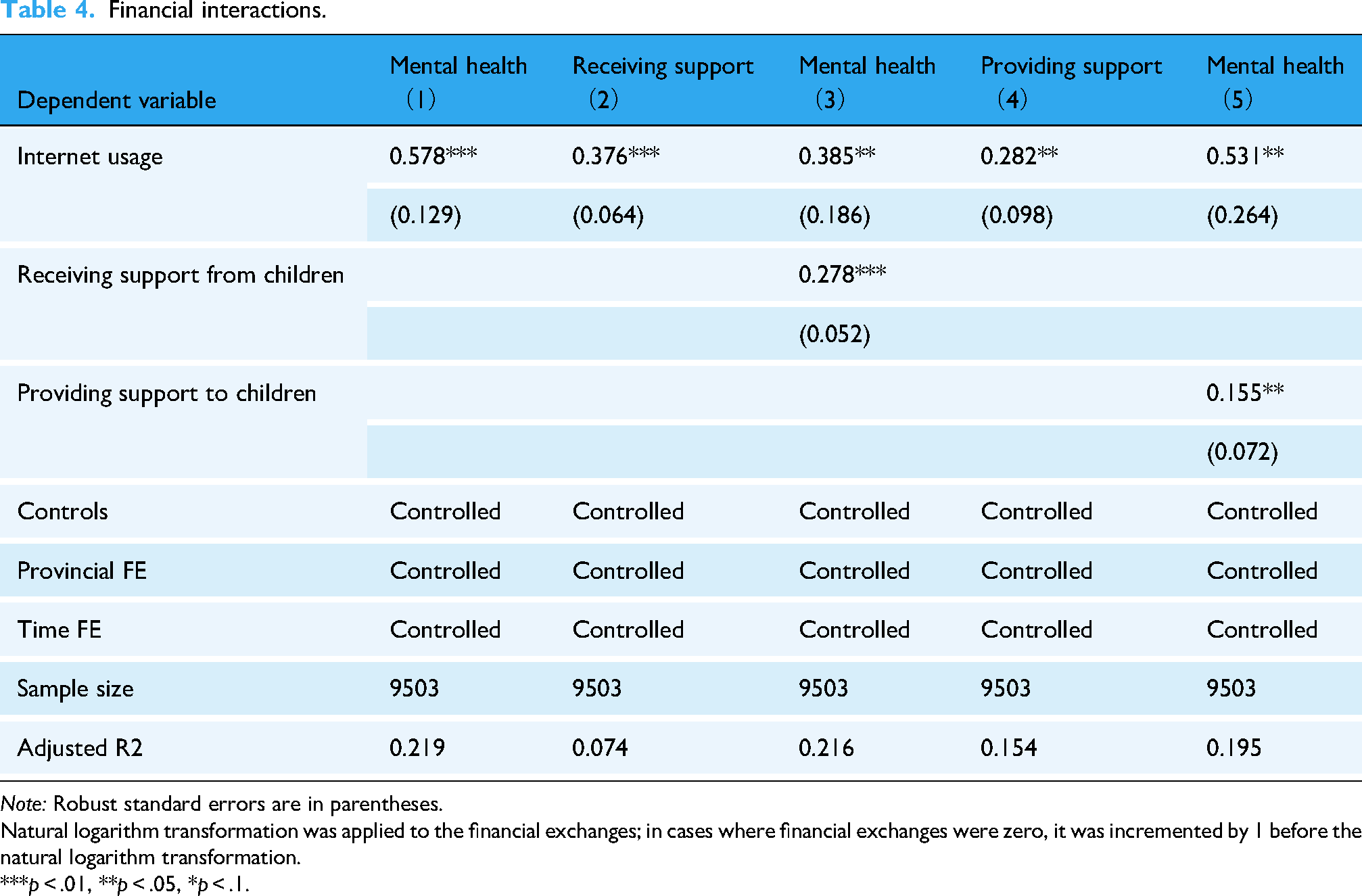
For functional interactions, the results are presented in Table 4. Column 1 of Table 4 corresponds to Equation 3, Columns 2 and 4 correspond to Equation 4, and Columns 3 and 5 correspond to Equation 5.
Financial interactions.
Note: Robust standard errors are in parentheses.
Natural logarithm transformation was applied to the financial exchanges; in cases where financial exchanges were zero, it was incremented by 1 before the natural logarithm transformation.
***p < .01, **p < .05, *p < .1.
Receiving financial support from children
Column 2 of Table 4 (β = 0.376, SE = 0.064, p < .01) shows a significant and positive correlation between older adults’ internet usage and receiving financial support from their children. In Column 3 of Table 4 (β = 0.385, SE = 0.186, p < .05), we observe a significant and positive association between internet use and psychological well-being for older adults after accounting for the effects of receiving financial support from children. It is worth noting that both the significance level and coefficient value have decreased in Column 3 of Table 4 compared to Column 1 of Table 4 (β = 0.578, SE = 0.129, p < .01). Overall, the results suggest that internet usage positively affects the receipt of financial support from children, promoting the psychological well-being of older adults.
Providing financial support to children
In Column 4 of Table 4 (β = 0.282, SE = 0.098, p < .05), internet usage is significantly and positively associated with the amount of financial support older adults provide to their children. In Column 5 of Table 4 (β = 0.531, SE = 0.264, p < .05), after accounting for the effects of providing financial support to children, a significant and positive association between internet usage and the psychological well-being of older adults is observed. Similar to the results from receiving financial support from children, both the significance level and coefficient value have decreased in Column 5 of Table 4 compared to Column 1 of Table 4. Overall, our results suggest that providing financial support to children may be one of the mechanisms through which internet usage influences the psychological well-being of older adults, providing support to H3a.
Emotional interaction
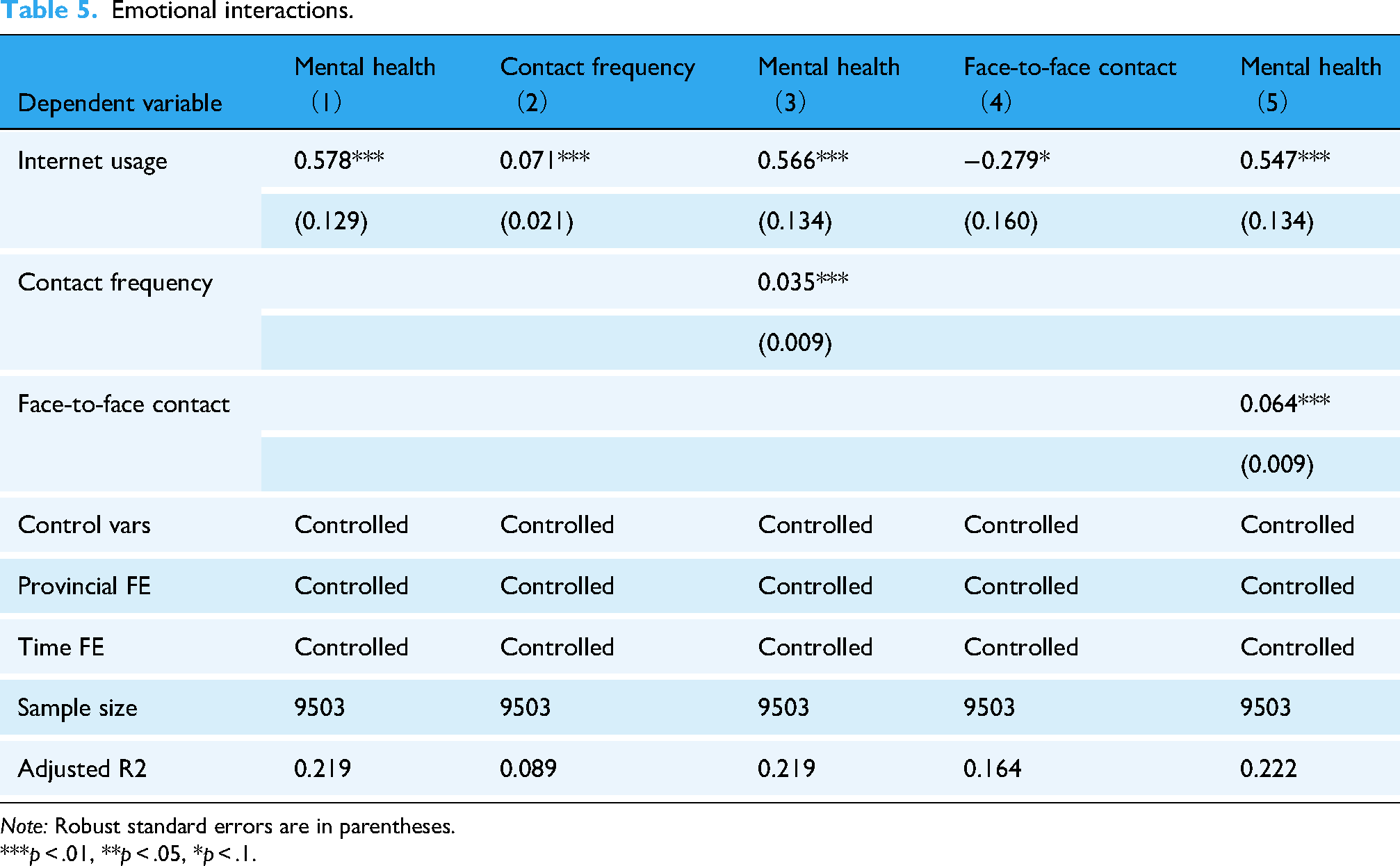
In this subsection, we look into both the internet's facilitation and substitution effect on intergenerational contact. The results are presented in Table 5. Column 1 of Table 5 corresponds to Equation 3, Columns 2 and 4 of Table 5 correspond to Equation 4, and Columns 3 and 5 correspond to Equation 5.
Emotional interactions.
Note: Robust standard errors are in parentheses.
***p < .01, **p < .05, *p < .1.
Facilitation effect on contact frequency
Columns 2 and 3 of Table 5 present the results of the internet's facilitation effect on contact frequency. Column 2 (β = 0.071, SE = 0.021, p < .01) shows a significant and positive correlation between internet usage and the frequency of contact between older adults and their children. Column 3 (β = 0.566, SE = 0.134, p < .01) of Table 5 displays a significant and positive correlation between internet usage and the psychological well-being of older adults after accounting for the effects of contact frequency. Overall, our analysis suggests that the internet provides older adults with additional means to communicate with their children. This is associated with increased contact frequency and contributes to improved psychological well-being.
Substitution effect on face-to-face contact frequency
Column 4 of Table 5 shows a marginally significant negative association between internet usage and face-to-face contact frequency (Column 4: β = −0.279, SE = 0.160, p < .1). Column 5 of Table 5 shows a significant positive correlation between internet usage and the psychological well-being of older adults after accounting for the effects of face-to-face contact frequency (β = 0.547, SE = 0.134, p < .01). The results suggest that internet usage increases opportunities for online communication, potentially creating a “substitution effect” for in-person meetings, providing support to H3b.
Addressing endogeneity
In this subsection, we address issues related to endogeneity. Comprehensive endogeneity tests (PSM/IV validity checks) are included in Supplemental Materials S4.
Robustness checks
In this subsection, we present our results for the robustness checks. The findings, shown in Columns 1 to 6 of Table 6, align closely with the baseline regression in Table 3, demonstrating the robustness of the Tobit model. Specifically, internet usage remains significantly associated with mental health (β = 0.753, SE = 0.165, p < .01), and usage duration exhibits a positive yet diminishing marginal effect (β = 0.072, SE = 0.016, p < .01; quadratic term: β = –0.001, SE = 0.000, p < .01). Among usage purposes, learning (β = 0.122, SE = 0.051, p<.1), social activities (β = 0.099, SE = 0.035, p < .01) and entertainment (β = 0.178, SE = 0.036, p < .01) show significant positive associations. Additionally, the exclusion of low-reliability responses, presented in Columns 7 to 12 of Table 6, yields consistent results with the baseline regression in Table 3, further confirming the robustness of our findings.
Robustness testing.

Note: Robust standard errors are in parentheses.
***p < .01, **p < .05, *p < .1.
Heterogeneity analysis
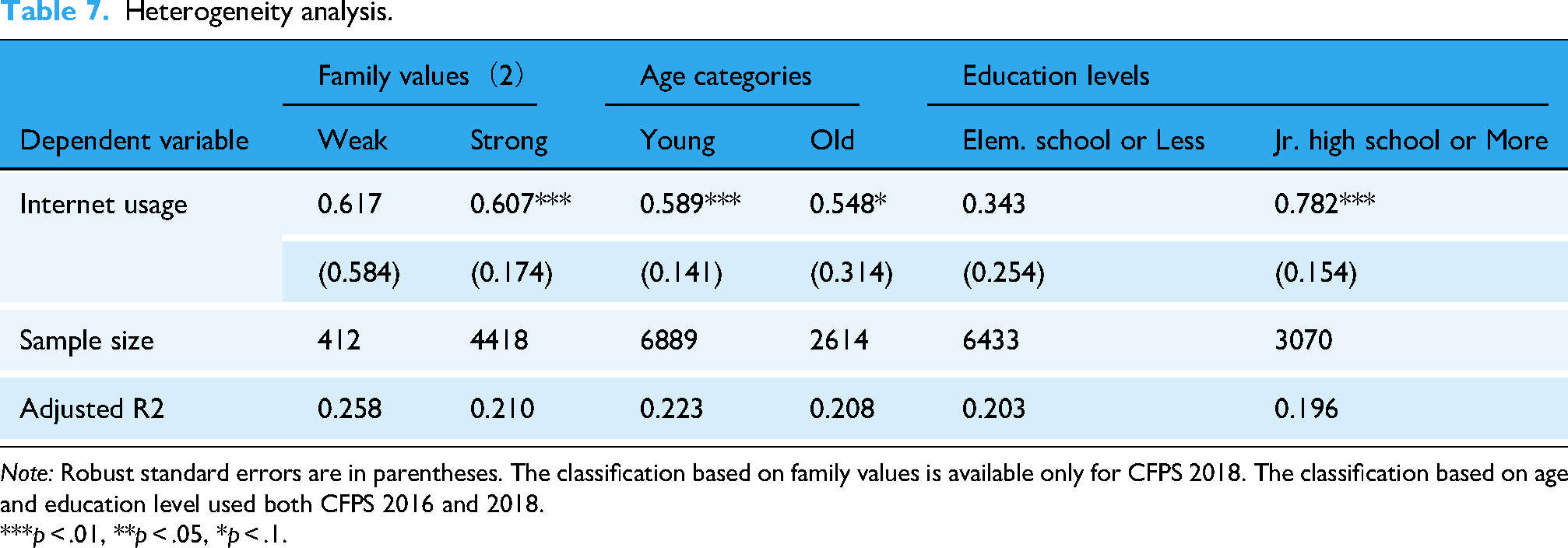
In this subsection, we present the effects of varying family values, age brackets, and educational backgrounds in Table 7. We observe a significant and positive association between internet usage and the psychological well-being of older adults with strong family values only (β = 0.607, SE = 0.174, p < .01). The association is also more pronounced among younger older adults (β = 0.589, SE = 0.141, p < .01) and those with junior high education or above (β = 0.782, SE = 0.154, p < .01), while it is not significant among those with weaker family values or lower educational attainment.
Heterogeneity analysis.
Note: Robust standard errors are in parentheses. The classification based on family values is available only for CFPS 2018. The classification based on age and education level used both CFPS 2016 and 2018.
***p < .01, **p < .05, *p < .1.
Discussion
This study provides robust empirical evidence that internet use is positively associated with the psychological well-being of older adults in China. These findings contribute to the growing literature on digital inclusion by demonstrating how digital engagement can facilitate intergenerational solidarity and enhance mental health outcomes in ageing populations. Consistent with Intergenerational Solidarity Theory, 33 we find that internet use fosters both functional solidarity and associational solidarity, and these mechanisms partially explain the observed well-being benefits. Specifically, our mediation analysis shows that increased financial support (functional solidarity: β = 0.376) and contact frequency (associational solidarity: β = 0.071) validate the internet's role in strengthening these core dimensions of intergenerational solidarity. The dominance of financial mediation aligns with Fei's “feedback model” of Chinese familial reciprocity, 27 where adult children are culturally expected to provide tangible support to their ageing parents in return for the care they received. This observation illustrates a cultural emphasis on material interdependence in China, contrasting with the greater focus on emotional autonomy often observed in Western intergenerational relationships.
In particular, internet use promotes both upward and downward financial support flows between parents and adult children. The ability to engage in digital transactions reduces logistical barriers and enhances perceptions of reciprocity. This pattern aligns with existing findings that suggest older adults derive meaning and self-worth from supporting their offspring 41 and also benefit emotionally from receiving financial support. 33 Likewise, the increase in digital contact reinforces emotional connections, which serve as protective factors against loneliness and depression. However, a possible tradeoff is noted in the marginal decline in face-to-face contact, suggesting that emotional closeness may not be uniformly enhanced. This duality reflects the complexity discussed in previous studies.13,34
Regarding usage patterns, our findings affirm that not all internet use is equally beneficial. The strongest positive associations were found for learning, entertainment, and social interaction, consistent with prior studies in both Chinese and Western contexts. 27 In contrast, work-related usage showed no significant effect, suggesting the importance of motivational context. The nonlinear relationship observed in usage duration suggests diminishing returns, echoing prior literature that cautions against excessive screen time. Moderate use, particularly via mobile devices, appears most conducive to well-being.
With respect to heterogeneity analyses, subgroups characterized by younger age, higher education, and stronger family values derived greater benefits from internet use. These differences may reflect variations in digital literacy, cognitive flexibility, and value alignment. For instance, older adults with strong familial orientations may be more motivated to maintain virtual connections, thus amplifying emotional gains. This subgroup pattern aligns with Social Capital Theory,35,36 in which trust and norms within social networks mediate individual outcomes.
The findings above have important implications for the evaluation of the Broadband China policy. While the policy's effectiveness in enhancing digital access is evident, our study suggests that access alone is insufficient. Psychological outcomes are conditional on how older adults engage with the internet, what values they prioritize, and what types of support they exchange. Policies must therefore be accompanied by programs that foster digital literacy, promote emotionally enriching content, and consider cultural norms of filial piety and reciprocity.
Our study comes with its set of limitations, opening doors for future research. First, the geographical scope is limited to pilot cities; future research may examine whether effects differ in rural areas or less digitally developed regions. Second, although we observe mediation through financial and emotional interactions, additional mechanisms—such as self-efficacy or community participation—may also play a role. Third, we do not distinguish between the platforms of digital interactions. Exploring how specific internet functions and platforms contribute to psychological outcomes in developing targeted interventions for maximizing positive effects. For example, investigation of online shopping behaviors of older adults across platforms such as Taobao and JD may lead to the identification of preferences, challenges, and the association between various shopping patterns and mental health. Finally, our findings raise the question of whether digital disparities could exacerbate mental health inequalities among older adults. Further studies can investigate the intersection of digital exclusion, socioeconomic status, and health equity.
Conclusions
This study provides empirical evidence that internet use significantly enhances the psychological well-being of older adults in China. Our findings contribute to ongoing debates about the role of technology in ageing societies and highlight the potential of inclusive digital infrastructure and training to foster mental well-being in later life. Leveraging data surrounding the Broadband China initiative, we show that expanded digital access yields significant mental health benefits when use remains moderate in intensity.
The mechanisms driving these outcomes include enhanced intergenerational financial and emotional interactions. Notably, the positive effects are most pronounced among younger older adults, those with higher education, and individuals who strongly value family connections. These insights point to the importance of context, motivation, and user capability in shaping digital benefits. Therefore, we recommend that future iterations of “Broadband China” should:
Integrate community-based digital literacy programs specifically tailored for rural older adults, who often face greater barriers to adoption. Incentivize family-centric initiatives that leverage technology to enhance, rather than replace, high-quality face-to-face interaction. Develop public guidelines that raise awareness of optimal usage patterns, encouraging benefits while mitigating the risks of excessive use beyond an appropriate weekly threshold.
For policymakers, the implications are clear: expanding infrastructure is only a first step. Targeted interventions are needed to build digital literacy, encourage meaningful online engagement, and address disparities in access and skills. By supporting older adults in navigating the digital landscape, such efforts can contribute meaningfully to healthier, more connected ageing.
Supplemental Material
sj-docx-1-dhj-10.1177_20552076251384829 - Supplemental material for Digital connections: Impact of internet usage on the psychological well-being of older Chinese adults
Supplemental material, sj-docx-1-dhj-10.1177_20552076251384829 for Digital connections: Impact of internet usage on the psychological well-being of older Chinese adults by Zhengyi Yang, Yexin Zhou, Yu Wang and Hongyao Wei in DIGITAL HEALTH
Footnotes

Ethical considerations
This study was reviewed by the Office of Sponsored Programs and Research Compliance at one of the authors’ institutions and determined that it did not meet the regulatory definition of human subjects’ research; therefore, approval was not required.
Author contributions
Zhengyi Yang: writing—review and editing, writing—original draft, visualization, validation, software, methodology, investigation, formal analysis, data curation, and conceptualization; Yexin Zhou: writing—review and editing, validation, methodology, investigation, formal analysis, data curation, and conceptualization; Yu Wang: writing—review and editing, writing—original draft, validation, software, methodology, investigation, data curation, and conceptualization; and Hongyao Wei: methodology and conceptualization.
Funding
This work was supported by the Youth Program of National Natural Science Foundation of China (Grant No. 72203240), Fundamental Research Funds for the Central Universities (Grant No. CSQ25018), and the Fund for Academic Innovation Teams of South-Central Minzu University (Grant No. XTS24023).
Declaration of conflicting interests
The authors declared no potential conflicts of interest with respect to the research, authorship, and/or publication of this article.
Data availability statement
The data necessary to reproduce the analyses presented here is publicly available from Peking University's official website.
Analytic code
The analytic code necessary to reproduce the analyses presented in this article is not publicly accessible but is available upon request for review purposes.
Declaration of generative AI in scientific writing
The authors did not use any generative AI in the preparation of this manuscript. The typing assistant software Grammarly was used to review spelling, grammar, and clarity.
Statement of prior dissemination
The ideas and data appearing in the manuscript have not been published elsewhere, nor are they being considered for publication elsewhere.
Supplemental material
Supplemental material for this article is available online.
References
Supplementary Material
Please find the following supplemental material available below.
For Open Access articles published under a Creative Commons License, all supplemental material carries the same license as the article it is associated with.
For non-Open Access articles published, all supplemental material carries a non-exclusive license, and permission requests for re-use of supplemental material or any part of supplemental material shall be sent directly to the copyright owner as specified in the copyright notice associated with the article.
