




Abstract
Objectives
Online media has become an increasingly important part of older adults’ daily lives in the digital era. This study aims to examine the effects of online media use and its frequency on the mental health of older adults in China, with a particular focus on the mediating role of life satisfaction.
Methods
Using data from the 2020 wave of the China Longitudinal Aging Social Survey (CLASS), this study analyzed a nationally representative sample of 3118 Chinese older adults. A multiple indicators multiple causes (MIMIC) model was employed to assess the impact of both online media use types and usage frequency on mental health. Further mediation analysis was conducted to investigate whether life satisfaction mediates these relationships. Sensitivity analyses were performed using different estimators (maximum likelihood (ML), asymptotic distribution free (ADF), and generalized structural equation model (GSEM)), and robustness was tested with 2016 and 2018 CLASS data.
Results
Findings show that both online media use and online media use frequency are significantly and positively associated with mental health among Chinese older adults. Specifically, informational media (e.g. News reading app), entertainment platforms (e.g. TikTok and Kwai), and utility tools (e.g. Alipay and Taobao) exhibit strong positive effects, with news reading app showing the most prominent impact. A dose–response pattern was observed: older adults who engage with online media more frequently report better mental health outcomes. Notably, life satisfaction serves as a significant mediator in these relationships, accounting for 12.8% of the total effect of media use and 5.4% of the effect of use frequency on mental health.
Conclusion
Online media use, especially frequent engagement with digital platforms, enhances older adults’ mental health, not only directly but also indirectly by improving life satisfaction. These results offer valuable empirical evidence for understanding the mechanisms through which digital participation promotes psychological wellbeing in later life and highlight the importance of fostering digital literacy and inclusive media environments for the aging population.
Introduction
Over the past decade, the aging population in China has experienced a rapid increase. The percentage of Chinese adults aged 60 years and above escalated from 14.33% in 2012 to 22.0% in 2024. 1 Projections for 2030 indicate that the elderly demographic will surpass 400 million, constituting over 30% of the total population. 2 This projection significantly exceeds the statistical standard of population aging proposed by the United Nations, underscoring China as a society deeply experiencing aging. The human capital model of health demand introduced by Grossman posits that individuals inherit an initial stock of health, subject to depreciation with age. 3 Advances in modern medicine have expanded the concept of health to encompass not only physical but also mental wellbeing, both of which are integral to holistic health. 4 With advancing age, older adults experience a decline in mental functions and a reduction in social circles, potentially leading to loneliness, anxiety, and depressive symptoms. Moreover, available reports imply that nearly half of the individuals resorting to suicide in China are grappling with mental health issues, with a notable increase in mental problems observed in the 60 to 64 age group. 5 Hence, identifying strategies to improve the mental health of China's aging population has emerged as a crucial public health priority.
The mental health of older adults in the internet era is becoming a vital issue in China. With the popularization of internet, the loneliness and mental health problems caused by the lack of communication and interaction among the elderly may be tied to online media use. In fact, online media can not only provide entertainment services for the elderly, but also supply new channels for their social interaction. Online media use encompasses individuals browsing and disseminating various types of information via the internet, including but not limited to social media, news websites, video platforms, and chat tools. With the advancement of network technology, online media has evolved into an indispensable aspect of life for older adults. According to the 55nd Statistical Report on China's Internet Development, by December 2024, online media users in China numbered 1 billion 108 million, comprising 78.6% of the population. However, merely 14.1% of adults aged 60 years and above had internet access, a figure significantly lower than the 19.0% observed in adults aged 30 to 39 years during the same period. 6 Given the digital divide among older adults and the implementation of digital skills popularization policies for this demographic in China, exploring the impact of online media use on the mental health of older adults and understanding the underlying mechanisms hold significant relevance.
The interest in the impact of online media use on the mental health of older adults is burgeoning, yielding mixed findings. 7 Although the utilization of online media by older individuals is notably lower compared to younger demographics, influenced by the “digital divide,” 8 several studies have illuminated positive correlations. Internet use has been identified as a promoter of mental health and quality of life for older adults. 9 The elderly who often use the Internet perform better in mental function, cognitive ability, daily life self-care ability, and more actively participate in health screening and sports activities.10,11 The social use of the Internet, such as connecting with family and friends, can reduce loneliness, improve social participation, and indirectly promote mental health and subjective wellbeing.12,13 In addition, some studies also show that older adults can obtain health information such as diet and exercise via the Internet to promote healthy behaviors.14,15 Moreover, existing research posits that online social media could aid older adults in establishing and maintaining diverse, heterogeneous social relationships, thereby accumulating enriched social capital. 16 Moreover, older adults engaging with online social media are often observed to have an enhanced sense of social belonging. 17 Online intelligent life media platforms such as Alipay, Ctrip, and Taobao have significantly simplified the lives of the elderly. These platforms enable older adults to engage in online shopping and electronic payments without the need to leave their homes. This development, however, has contributed to an increasing “peer digital divide” among the elderly, as noted by Nam. 18 The quality of life for those using online media is continually improving, while those not engaging with such media are finding it increasingly challenging to integrate into society. In light of this, the researchers propose two hypotheses based on the literature review: Hypothesis 1 posits that older adults who use online social media exhibit a better mental health state. Hypothesis 2 suggests that older adults engaging with online intelligent life media demonstrate improved mental health.
The dose–response theory posits that the relationship between dose and response may encompass thresholds, plateaus, and nonlinear patterns, alongside a continuous, monotonic function. 19 In the context of mental health and online media use, this theory suggests that the frequency of usage is a pivotal factor. While it is established that online media usage can enhance the mental health of older adults, an intriguing question arises: does the extent of this positive effect vary with the frequency of usage? This query seeks to determine whether the promotion of mental health strengthens or diminishes as the frequency of online media use increases. Research has shown that the frequency of Internet use is positively related to the physical and mental health of older adults. 20 The elderly who frequently use the Internet are more likely to participate in sports activities and social activities, have more extensive social networks, and have a higher frequency of Internet use, which reduces the risk of depression, visual impairment, digestive system diseases, and other diseases of the elderly.21,22 By contraries, exist research also has highlighted that excessive internet usage can precipitate internet addiction, consequently impairing the mental health of users. 23 Recent research indicates that excessive internet use, particularly the overuse of online social media, 24 correlates with increased symptoms of psychopathology, anxious rearing, and a decline in academic performance among adolescents. Another study by Wang et al. 25 on problematic smartphone use suggests that the frequency of smartphone use inversely mediates the relationship between excessive smartphone use and boredom proneness, while positively correlating with rumination. Drawing on these theoretical insights, we propose hypothesis 3a: The frequency of social media use is positively correlated with the mental health of older adults. And hypothesis 3b: The frequency of social media use is negatively correlated with the mental health of older adults.
One fundamental motivation for utilizing online media is the pursuit of entertainment. Based on the Selective Optimization with Compensation model (SOC), the engagement of older adults with online media may stem from selection, optimization, or compensation, thereby exerting a positive influence on life satisfaction. 26 Life satisfaction is deemed a crucial determinant of mental health in older adults and can be enhanced through online entertainment. 27 The internet serves as a medium to alleviate boredom for older adults, reducing feelings of emptiness. Existing research shows that Internet use can help improve the life satisfaction of the elderly, and the Internet can help the elderly to obtain information, entertainment and daily services, especially for the elderly who live alone and have poor health.28,29 According to the self-fulfilling prophecy theory, as elucidated by Pikhartova et al., 30 an individual's beliefs and perceptions can significantly influence health outcomes. This theory is particularly relevant in the context of aging, where older adults with negative perceptions of aging often experience more adverse effects, including poorer health and cognitive decline, as noted by Fawsitt et al. 31 Consequently, higher life satisfaction, a subjective experience, may foster positive psychological reinforcement, thereby enhancing mental health. Therefore, we propose hypothesis 4: Life satisfaction mediates the relationship between online media use and mental health in older adults.
From the literature review conducted, it becomes evident that improvements are needed in certain areas. (1) Although a few research has delved into the relationship between internet use and mental health among older adults, studies specifically scrutinizing the effects of online social media use and online smart lifestyle media use on the mental health of the elderly remain scarce. (2) Existing research predominantly focuses on assessing the mental health of older adults through the lens of depressive symptoms and anxiety. However, this approach does not encompass a comprehensive evaluation of their overall mental health. (3) The mediating role of life satisfaction has received limited attention in the existing literature.
The marginal contributions and innovations of this study are outlined as follows: (1) Rather than merely exploring internet usage, the study delves into specific online media platforms like WeChat, TikTok, and Kwai, thereby facilitating a more in-depth analysis of internet influence. (2) The mental health of older adults is holistically assessed using the MIMIC model. (3) Drawing on the dose–response theory and the self-fulfilling prophecy theory, this research also considers the mediating roles of life satisfaction (Figure 1).

Hypothesis model based on MIMIC. Abbreviation: F1, WeChat app; F2, TikTok video app; F3, Kwai video app; F4, Xigua video app; F5, News reading app; F6, Shopping app; F7, Travel app; F8, Video editing app; F9, Game app; F10, Media player app; F11, Payment app; MIMIC, multiple indicators multiple causes.
Method
Participants and procedure
The present study harnesses data derived from the China Longitudinal Aging Social Survey (CLASS), a comprehensive national survey designed to gather socioeconomic and health-related information from Chinese older adults aged 60 and above. This observational study adopts a multistage sampling design and draws on nationally representative cohort data collected through face-to-face interviews. 32 The inaugural wave of data was gathered in 2011, with subsequent waves and the inclusion of new participants transpiring in 2012, 2014, 2016, 2018, and 2020. Since the key variable (online media use) of this study, was only included for the first time in the 2020 survey, the main analysis relies on data from the 2020 wave (collected from August to December 2020), while robustness tests were performed using data from the 2016 and 2018 waves. The primary sampling unit encompassed both communities and villages. This extensive survey witnessed the participation of 11,511 older adults, originating from 259 urban communities and 172 rural villages across 28 provinces. The structured questionnaire was meticulously read and completed by trained interviewers, correlating with the responses provided by the interviewees. 33 All participants provided their writing consent. The study was approved by the Ethics Review Committee of the First People's Hospital of Yunnan Province (approval number 2022ZYFB001).
The analytical cohort for consideration comprised 11,398 respondents, all aged 60 and above, hailing from the most recent 2020 wave of CLASS. For the purposes of this study, a total of 8280 participants, who reported no usage of online applications, were excluded. Given the minimal missing data—pertaining to cognitive function, depression, social adjustment, life satisfaction, and the usage and frequency of online apps—which was <1%, imputation methods were employed to address these discrepancies. Consequently, the final analytical sample was consolidated to include 3118 participants aged 60 years and above. For the robustness checks using the 2016 and 2018 waves, a total of 19,462 valid cases were retained after excluding participants with missing data on key variables.
Measures
Online media use
In this study, the predictor was online media usage, encompassing both online social media and online intelligent life media use. The former was gauged through seven inquiries, including the utilization of applications such as WeChat, TikTok, Kwai, Xigua, video editing, media player, and gaming within the preceding week. Simultaneously, online intelligent life media usage was evaluated through four inquiries concerning the use of news reading, shopping, travel, and payment applications in the past week. Responses were binary, with “yes” coded as 1 and “no” as 0. The reliability of the online media use scale was determined to be 0.760, indicating a robust measure of older adults’ online media usage.
Online media use frequency
The CLASS queried respondents regarding the frequency of their online media usage/internet usage frequency, with response options being 1 “Frequent”, 2 “Moderate”, and 3 “Rare”.
Life satisfaction
Life satisfaction was gauged through the inquiry, “How satisfied are you with your life?”, with response options ranging from 0 “Completely Satisfied” to 4 “Not at All Satisfied.”
Mental health
The dependent variable, mental health, was evaluated through measures of cognitive functions, depressive symptoms, and social adaptation. Cognitive functions were assessed utilizing the Mini-Mental State Examination, as proposed by Folstein, a widely recognized scale comprising 16 topics, with a lower score denoting stronger cognitive function (Cronbach's alpha = 0.758). 34
Depressive symptoms were measured using the abbreviated Center for Epidemiological Studies-Depression Scale (CES-D), 35 a well-validated instrument, especially in studies involving Chinese older adults, with a higher score indicating a higher risk of depressive symptoms (Cronbach's alpha = 0.864).
Social adaptation was assessed by the Two-dimensional Scale for Social Development Adaptation and Spiritual and Cultural Adaptation of Elderly (SDA-SCA) (Commission 2022), incorporated into the Chinese health industry standards in March 2023. Comprising eight items, a higher score, after reversing the coding of positive items, indicated poorer social adaptation (Cronbach's alpha = 0.742). Consequently, a higher mental health score represented a deteriorated mental health state.
Covariates
In alignment with prior research, covariates incorporated in this study included age, sex, education, marital status, residence, and socioeconomic status. Age was represented as a continuous variable in years. Given that China is a developing country with the majority of older individuals possessing lower education levels, 36 education was categorized from illiterate (scored as 1) to high school and above (scored as 5) based on concurrent validity with preceding studies. 37 Marital status was categorized into a live-in partner (coded as 1) and no-live-in partner (coded as 0). Residence was differentiated between urban (coded as 1) and rural (coded as 2). Socioeconomic status, a direct reflection of the life condition of older adults through factors such as household income or financial support, was also controlled and categorized into high 1, moderate 2, and low 3.
Statistical analysis
All statistical analyses were conducted using STATA 15.0. A descriptive analysis of the study variables was performed. Both Exploratory Factor Analysis (EFA) and Confirmatory Factor Analysis (CFA) were employed to analyze the relationship between online media use and mental health. EFA tested the measurement of the unique factor variable (mental health and online media use) by the indicator variables. CFA assessed the model's goodness of fit, the significance of the load of the indicator factor, and model corrections. The MIMIC model was utilized to investigate the mediating role of online media use frequency and life satisfaction in the association between online media use and mental health. Sensitivity analyses were conducted to verify the robustness of the results. The robustness of the relationship between online app use and mental health, and the sensitivity of the mediating role of internet use frequency and life satisfaction, were tested using the maximum likelihood (ML), asymptotic distribution free (ADF), and generalized structural equation model (GSEM), respectively. In addition, robustness checks based on the 2016 and 2018 CLASS waves were conducted by substituting the variable “online media use” for “frequency of Internet use,” further validating the consistency of the associations and the mediating pathways identified in the main analysis.
Results
Preliminary analyses
Table 1 delineates the characteristics of the variables utilized in this study. The mean age of the older adults was 67.84, spanning a range from 60 to 97 years. Males constituted approximately 52.21% of the older adults, above 85% cohabited with a partner, and around 73.70% resided in urban areas. A total of 38.84% of older adults had attained middle school education. And 10.42% of participants were classified under low socioeconomic status and 70.72% were classified under moderate. The average scores for cognitive function, depressive symptoms, and social adjustment were 2.39, 5.62, and 14.89, respectively. A substantial majority, exceeding 70%, of older adults utilized the internet frequently, and the mean score for life satisfaction was 1.12, with a spectrum ranging from 0 to 4. And 73.41% of older adults frequently use online media, while 5.2% of older adults use online media rarely.
Characteristics of the study population (N = 3118).

EFA and CFA results of the influence of online media use on mental health among older adults
Table 2 presents the EFA results derived from the main factor method, principal component factor method, iterative principal component factor method, and maximum likelihood factor method. In the mental health dimension, a singular eigenvalue exceeded 1, suggesting the extraction of a unique common factor. Concurrently, factor 1 exhibited a high factor loading (above 0.5), indicating a notable correlation. Similarly, in the online media use dimension, one eigenvalue exceeded 1, denoting the extraction of a unique common factor.
EFA results of the influence of online media use on mental health among older adults.
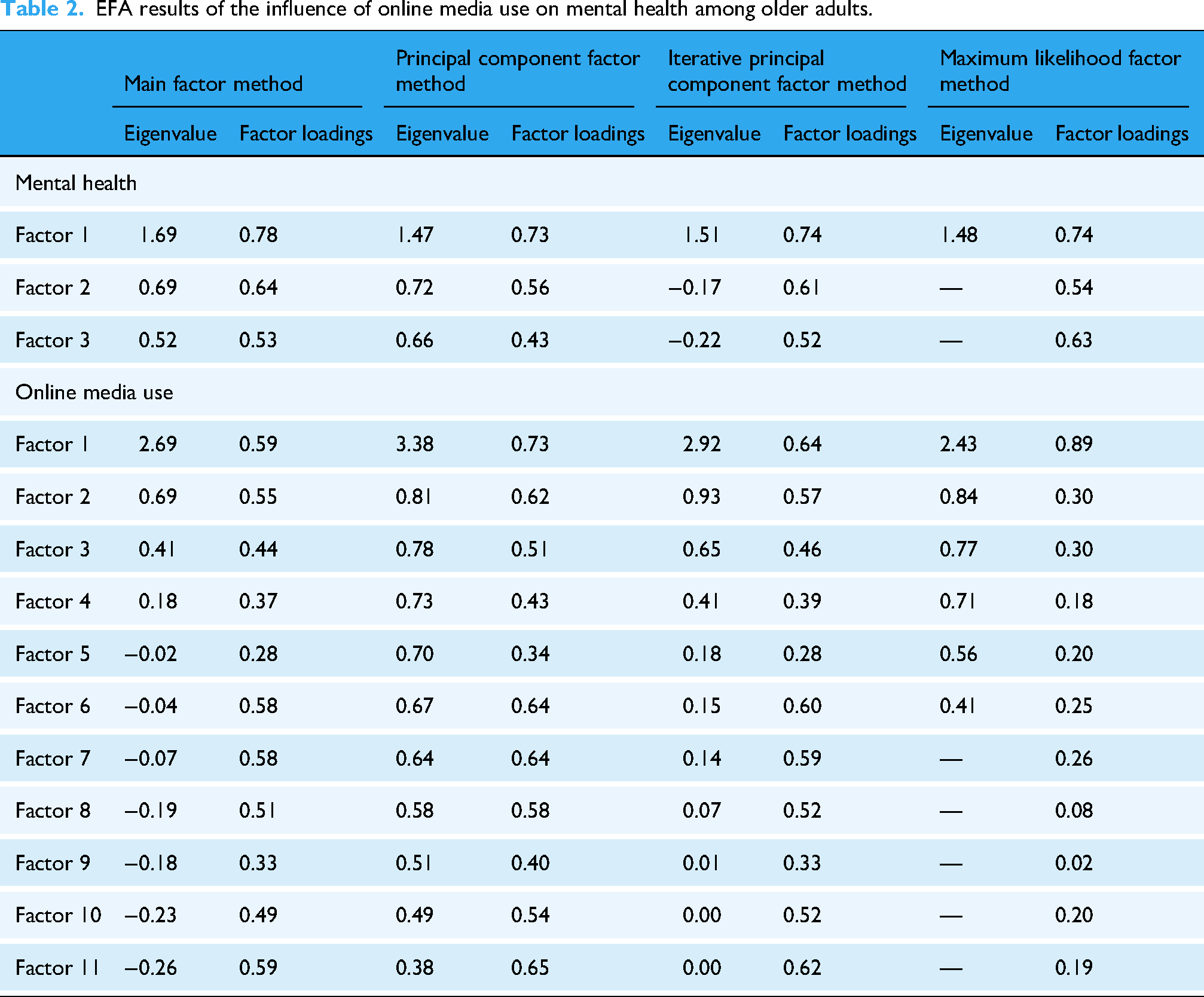
Figure 2 delineates the CFA results concerning the impact of online media use on mental health among older adults. The CFA results manifest a substantial degree of model fit, with Root mean square error of approximation (RMSEA) = 0.048 (<0.08), Standardized root mean square residual (SRMR) = 0.014 (<0.08), Comparative fit index (CFI) = 0.985 (>0.90), and Tucker–lewis index (TLI) = 0.913 (>0.90). Furthermore, all standardized factor loading coefficients were notably above 0.2 and were significant at the 0.1% level. Among the three dimensions of mental health, depressive symptoms emerged as the most explanatory variable for mental health, exhibiting a standardized path coefficient of 0.43. The corresponding coefficients for cognitive function and social adaptation were 0.32 and 0.28, respectively, each significant at the 0.1% level.
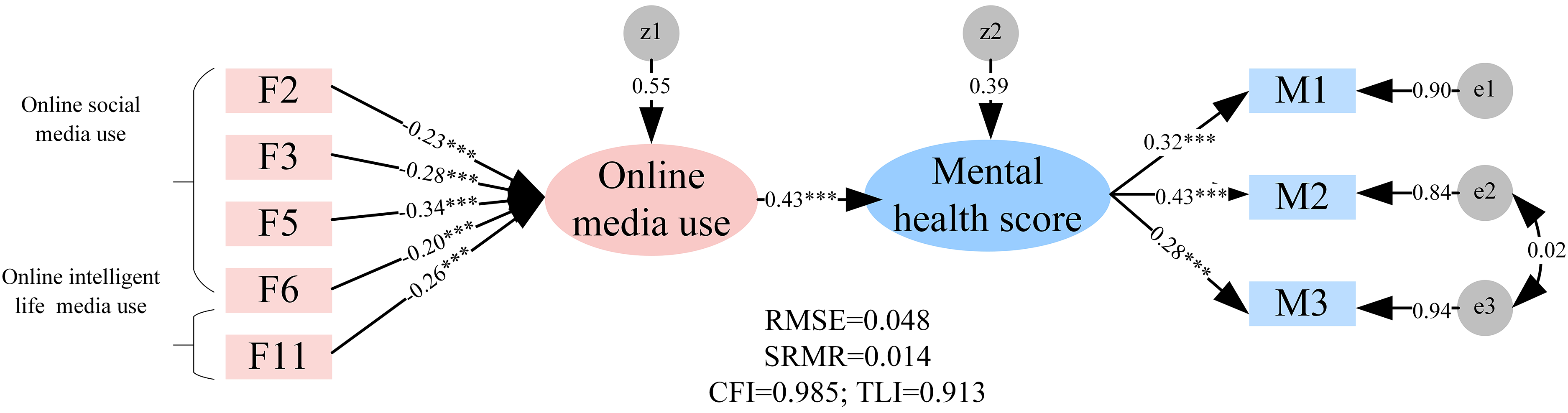
CFA results of the influence of online media use on mental health among older adults.
MIMIC structural equation model results
Figure 3 demonstrates that the mental health score for older adults engaged in online media use was lower compared to nonusers, suggesting a superior mental health status for the former group. Notably, the utilization of news reading apps exerted the most substantial impact on the mental health of older adults, followed by shopping apps and TikTok.
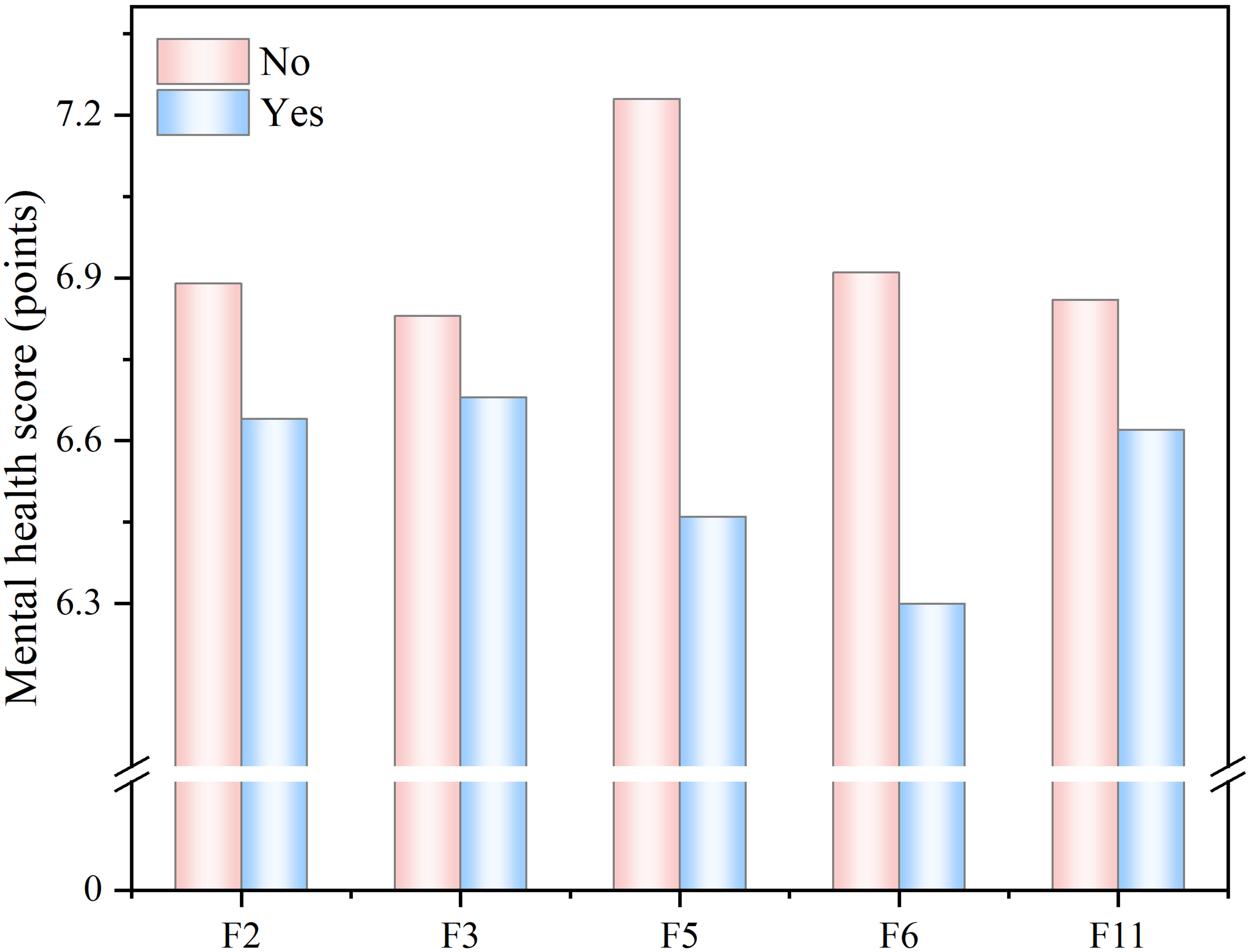
Mental health score results among participants who use and do not use media apps. Abbreviation: F2, TikTok video app; F3, Kwai video app; F5, News reading app; F6, Shopping app; F11, Payment app.
Figure 4 presents the MIMIC results, revealing a positive association between online media use and mental health (Coef. = 0.64, p < 0.001). Analyzing the standardized path coefficient, it was discerned that TikTok usage had a significant positive influence on the mental health of older adults (Coef. = −0.25, p < 0.001). Similarly, the employment of Kwai exhibited a positive correlation with the mental health status of older adults (Coef. = −0.29, p < 0.001). Specifically, the use of news reading apps showcased the most pronounced positive effect on the mental health status of older adults (Coef. = −0.36, p < 0.001). Furthermore, shopping app utilization also proved beneficial for older adults’ mental health (Coef. = −0.21, p < 0.001). Additionally, payment app usage yielded a significant positive impact on the mental health of older adults (Coef. = −0.26, p < 0.001). Furthermore, the frequency of online media usage also had a significant positive impact on the mental health of older adults (Coef. = 0.35, p < 0.001). The mediation analysis results indicated that life satisfaction has a significant mediating effect on the relationship between online media use and mental health, with a mediation effect value of 0.09, accounting for 12.8%. Concurrently, the mediating effect of life satisfaction was statistically significant between online media use frequency and mental health, with a mediation effect value of 0.02, accounting for 5.4%.
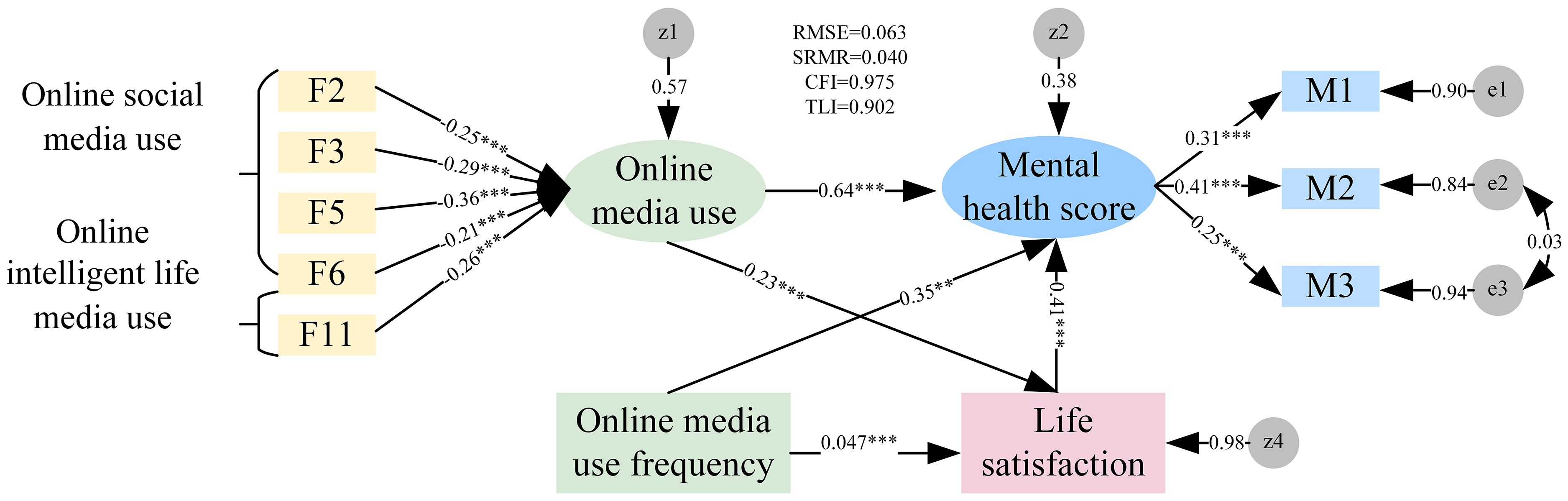
MIMIC model result of the influence of online media use on mental health among Chinese older adults.
Sensitivity analyses
To ensure the robustness of the results, this study conducted further sensitivity analyses employing ML, ADF, and GSEM estimation methods, as depicted in Table 3. The overall model exhibited good fit (RMSEA < 0.08, SRMR < 0.08, CFI > 0.90, and TLI > 0.90). While the path coefficient exhibited fluctuations among the three estimation methods, the significance and the direction of impact remained consistent, thereby affirming the relative robustness of the research findings.
Sensitivity analysis results based on ML, ADF and GSEM.

Notes: Covariates in Table 3 were controlled; *** p < 0.001, ** p < 0.01, * p < 0.05. The path coefficients were unstandardized. Abbreviation: ADF, asymptotic distribution free; F2, TikTok video app; F3, Kwai video app; F5, News reading app; F6, Shopping app; F11, Payment app; GSEM, generalized structural equation model; ML, maximum likelihood.
To further assess the robustness of the cross-sectional findings, this study incorporated data from the 2016 and 2018 waves of the CLASS. However, given the absence of specific items on online social media usage among older Chinese adults in these two waves, the variable “frequency of Internet use” was employed as a proxy indicator. As illustrated in Figure 5, a higher frequency of Internet access among older adults was significantly associated with increased life satisfaction and improved mental health outcomes (Coef. = 0.016, Coef. = 0.044, p < 0.01). Moreover, the mediating role of life satisfaction in the relationship between Internet use frequency and mental health remained statistically significant, thereby supporting the consistency of the mediating mechanism across datasets.

Robustness test results of the relationship between the internet usage frequency, life satisfaction, and mental health among Chinese older adults from 2016 to 2018 (N = 19,462). Notes: Covariates in Figure 5 were controlled; *** p < 0.001, ** p < 0.01, * p < 0.05. The path coefficient was standardized.
Discussion
This investigation into the older adult population in China elucidated the relationships between online media use and mental health by deploying the MIMIC model. Three principal conclusions emerge from this study. Firstly, the usage of online media, encompassing both online social media and online intelligent life media, manifested a positive correlation with an enhanced mental health state among older adults, with the results being interpreted through the lens of social causation theory. Secondly, the higher the frequency of online media usage among the older adults, the better their mental health condition. Lastly, life satisfaction was identified as an indirect route leading from online media utilization to improved mental health among older adults.
Online media use and mental health
The relationship between mental health and online media use among older adults in China was explored in this study. While prior research has predominantly focused on the general impact of internet and smartphone use on the mental health of older adults, 38 this study delves deeper into the effects of specific internet usage content on mental health in this population. Consistent with several preceding studies, online social media platforms such as TikTok and Kwai were found to have a substantial positive impact on the mental health of older adults,39,40 thereby supporting hypothesis 1. Several mechanisms could elucidate the benefits of online social media for mental health among older adults. Firstly, platforms like TikTok and Kwai facilitate access to external information and entertainment through short videos. Secondly, according to the social causation theory, 41 older individuals are inclined to use social media to garner social capital from robust offline relationships, thereby mitigating serious mental health issues. 42 Thirdly, these platforms enhance the social structure for older adults, enabling communication with a wider network, 43 and providing an anonymous space for safe emotional expression and increased social participation through bullet chatting. 44 Remarkably, other online activities such as chatting and gaming did not exhibit a significant influence on mental health in this demographic. This could be attributed to the nature of online chatting as a medium primarily for acquaintances, making it challenging for older adults to forge new relationships through apps like WeChat or QQ. 45 Furthermore, while online gaming serves as a relaxation tool, it does not foster the mental health status of older adults. This is primarily because most online games lack meaningful social interaction, making it difficult to fulfill older adults’ deeper emotional and relational needs. Additionally, the cognitive demands and fast-paced nature of many games may lead to frustration and mental fatigue, potentially increasing anxiety or depressive symptoms. Prolonged gaming can also disrupt daily routines and reduce opportunities for offline social engagement and physical activity, thereby further compromising overall wellbeing. Contrary to online social media platforms like WeChat and QQ, online entertainment media such as Kwai and TikTok provide direct and high-frequency mental stimulation to older adults. And compared to traditional media, online short videos such as Kwai and TikTok offer accessible, dynamic, and entertaining content, which is more easily embraced by older users. These platforms provide opportunities for self-expression, public participation, and social interaction, thereby enhancing a sense of presence and perceived social value. 46 Through video sharing and interactive engagement, older adults receive immediate social feedback, which contributes to emotional satisfaction and psychological wellbeing. Moreover, short video platforms reduce geographical and social barriers, enabling users to maintain emotional connections with family and peers, thus alleviating feelings of loneliness and isolation. 47 The personalized content, such as, often focused on entertainment, health, or daily life, can also function as a tool for emotional regulation and stress relief. Importantly, the process of learning to record, edit, and interact on these platforms fosters digital literacy and provides a sense of accomplishment and self-worth. Taken together, these mechanisms suggest that short video platforms play a unique and positive role in promoting mental health among the older population. Similarly, the utilization of online intelligent life media was found to significantly enhance the mental health of older adults, supporting hypothesis 2. Such media, including online reading and shopping apps, augment the convenience and quality of life for older individuals. In line with re-socialization theory, 48 access to online news fosters increased external information and social interactions. The prevalence of online shopping platforms in China, such as “Duoduo vegetables” and “Meituan vegetables,” adds convenience to the lives of the elderly. Additionally, integrating online payment options like Alibaba Pay and WeChat Pay helps older adults assimilate into the digital society and counteracts the digital divide. 49 It is noteworthy that the use of online travel platforms does not show a significant association with improved mental health among older adults. This may be attributed to the functional nature of these platforms, which primarily focus on information retrieval and booking services, offering limited opportunities for social interaction or emotional support. 40 Furthermore, travel, while aspirational, can pose physical, financial, and safety-related barriers for many older adults. 50 As a result, browsing travel content may not lead to actual participation, thereby failing to enhance real-life wellbeing. In some cases, the complexity of travel-related information and platform interfaces may even cause cognitive overload or frustration for older adults.
The study also underscored the pivotal role of the frequency of online media use. In alignment with hypothesis 3a, higher frequency of online media engagement is significantly associated with improved mental health outcomes among older adults. 51 the findings indicated that increased frequency of online media use is correlated with an enhanced mental health state among the elderly. More frequent use of online media could potentially offer older adults increased social support and capital, thereby positively influencing their mental health. Moreover, regular online media interaction facilitates social engagement, mitigates social and spatial barriers, and serves as a viable means to sustain connections with friends and the broader community, consequently alleviating symptoms of depression. 51 However, it is imperative to note that overreliance on online media can escalate into internet addiction, intensifying negative emotions such as anxiety, depression, and impaired sleep quality. 52 Comparatively, a majority of studies addressing internet addiction primarily focus on adolescents and college students, 53 with a conspicuous scarcity of research concentrating on the older demographic. One plausible rationale is that older adults generally exhibit higher self-control and less curiosity compared to their younger counterparts. The online media usage pattern of older adults typically leans towards learning, socializing, and daily activities, as opposed to indulging in potentially addictive content such as games and explicit materials. 54 An alternate explanation might be the inherent limitations on the frequency and duration of online media usage for older adults, imposed both by family restrictions and their own vitality and physical capabilities. Post-extensive online media interaction, some elderly individuals require rest or assume caregiving responsibilities for grandchildren. 55 Moreover, frequent exposure to online media increases the likelihood that older adults will encounter positive content, particularly information related to health, daily life, and wellbeing. 56 Such content can support emotional regulation and encourage the adoption of healthy behaviors. 10 Finally, incorporating online media use into daily routines can help establish a sense of structure and purpose in everyday life, both of which are well-documented protective factors for mental health in later adulthood.
Mediating role of life satisfaction
This research delineates the mediating role of life satisfaction in the association between online media use and mental health, supporting hypothesis 4 and aligning with prior findings. 57 This mediating mechanism can be understood from several theoretical and empirical perspectives. First, from the positive psychology perspective, life satisfaction reflects an individual's overall cognitive evaluation of their life. 58 As older adults expand their social networks and feel more connected and valued through online media, this enhanced experience of life contributes to reduced depression and anxiety. Second, Self-Determination Theory posits that autonomy, relatedness, and competence are fundamental psychological needs for wellbeing. 59 Online engagement helps older adults stay connected and socially engaged, thereby enhancing their sense of competence and autonomy. Third, drawing on social comparison theory, online media enables older adults to benchmark themselves against peers or positive role models. 60 Such lateral comparisons can inspire greater life motivation and planning, boosting resilience and life satisfaction. Fourth, online platforms serve as emotional regulation tools, providing access to entertainment, uplifting content, and distractions from loneliness or boredom. 61 The accumulation of positive emotional experiences contributes directly to higher levels of life satisfaction. Based on the Stress-Resource Model, life satisfaction functions as a psychological resource that helps individuals cope with age-related stressors such as declining health or bereavement. 62 What's more, greater life satisfaction enhances social engagement and emotional regulation. A satisfying life experience motivates older adults to participate in social interactions, community activities, or hobby groups, where they gain emotional support and companionship, mitigating feelings of isolation. 63 In summary, life satisfaction plays a dual role as both a bridge and a buffer between online media use and mental health among older adults.
Implications for policy and practices
Online media serves as a vital conduit for maintaining social ties and accessing health-related information, particularly in the contemporary landscape of China marked by the swift proliferation of social and entertainment media. The present research underscores that the utilization of both online social media and intelligent life media can be advantageous for the mental health of older adults. The observation that older adults engaging in online media usage may exhibit elevated levels of life satisfaction, and those with higher frequency of usage may possess enhanced mental health, indicates the potential positive impact of online media use. Consequently, this study offers pertinent implications for policymakers and practitioners aiming to leverage online social media and intelligent life media to ameliorate the mental health of the elderly. Initially, it is recommended for service providers to offer low-cost network access services tailored for the elderly population. Initiatives focusing on enhancing digital literacy should acknowledge the disparities in internet access among older adults across different regions and socioeconomic statuses, ensuring that those disadvantaged can harness online media to augment their mental health and aging experience. Secondly, a reduction in advertising placement for elderly users by online social media service providers is advised to mitigate the risk of online fraud and elevate their user experience. Thirdly, it is recommended that internet enterprises focus on developing more user-friendly and beneficial online media applications, particularly by simplifying the operational processes. Future iterations should aim to cater to the needs of the elderly, in contrast to the current models primarily designed for younger users. Fourthly, leveraging community resources to provide training in the use of online applications for the elderly is advisable. For instance, WeChat offers multifaceted services ranging from social chatting to practical utilities like taxi booking, medical consultations, and bill payments. Yet, the majority of the elderly population remains unaware of how to effectively utilize such applications. Community-driven educational initiatives could play a crucial role in bridging this knowledge gap. Fifthly, it is suggested that adult children remain vigilant towards their parents’ mental health, offer guidance on the utilization of online intelligent life media, and assist in their integration into the online society. Lastly, it is recommended to encourage elderly individuals who are already engaged with the internet to broaden their utilization of online programs. This approach aims to foster new experiences in internet use and motivate their active participation in digital life.
Limitations, future research and strengths
Several limitations of the present study warrant attention and necessitate address in future research. Firstly, the study primarily relied on a cross-sectional design to draw conclusions on the relationships among the variables, as the online media usage of older adults was initially investigated in the 2020 wave. Future studies should, when feasible, employ longitudinal and experimental designs with varied times of assessment to delve deeper into the directionality of each path in the mediation model. Secondly, despite the development of new items encompassing online social media and intelligent life media use (e.g. shopping apps, travel apps, TikTok, etc.), there may exist other forms of online media usage by participants that were not encompassed in the current item set. Future research endeavors should investigate a broader spectrum of online media usage and validate these findings. Thirdly, the self-reported nature of the variables may have elicited more subjective experiences of online media use and its relation to mental health, potentially introducing self-perception and recall bias. Fourthly, this study focused solely on examining the mediating role of online media use frequency and life satisfaction among older adults. However, it is important to acknowledge that other factors, such as social support and lifestyle choices, may also significantly influence this relationship. Future research should explore additional mechanisms that link online media use to mental health in the elderly. Finally, as the data for this study were derived from a Chinese context, caution must be exercised when generalizing these findings and conclusions to different cultural settings.
Notwithstanding the aforementioned limitations, this study makes several important contributions. First, this study offers a novel analytical approach by distinguishing among different types of online media, such as social networking, short videos, news, and smart living platforms, and comparing their distinct effects on older adults’ mental health. Second, this study highlights the role of usage frequency as a key independent variable and identifies a dose–response relationship, deepening our understanding of how the intensity of digital engagement shapes psychological wellbeing. Third, by incorporating life satisfaction as a mediator, the study reveals both direct and indirect pathways linking online media use to mental health, thus bridging digital behavior research with positive psychology. Fourth, the study contributes theoretically by applying and extending Uses and Gratifications Theory and the digital empowerment perspective to aging populations, showing how digital media can help fulfill emotional and functional needs in later life.
Conclusions
This study yields three significant empirical insights regarding the relationship between online media usage and mental health among Chinese older adults. First, the analysis demonstrates that both online social media (e.g. WeChat and TikTok) and smart lifestyle applications (e.g. Alipay and Taobao) exhibit statistically significant positive associations with mental health outcomes. Notably, news reading applications emerged as the most influential factor, followed by short video platforms and digital payment services. Second, a clear dose–response relationship was observed, where higher frequency of online media usage correlated with better mental health status, suggesting that regular but moderate engagement may be optimal for psychological wellbeing. Most importantly, the results reveal that life satisfaction serves as a crucial mediator in this relationship, accounting for 12.8% of the total effect, which indicates that online media not only directly impacts mental health but also enhances psychological wellbeing indirectly through improving subjective life satisfaction. These robust findings, supported by comprehensive MIMIC modeling, provide compelling empirical evidence for understanding the multifaceted mechanisms through which digital engagement influences mental health in the aging population.
Footnotes
Acknowledgement
The authors would like to acknowledge the CLASS team for providing the data.

Ethics approval
All the procedures involving human participants are performed in accordance with the ethical standards of the institutional and/or national research committee, the 1964 Declaration of Helsinki and its later amendments, or comparable ethical standards. The China Longitudinal Aging Social Survey (CLASS) is approved by the Institutional Review Board at the Renmin University of China.
Informed consent
All participants expressed informed consent to participate in the study.
Contributorship
XZ: Conceptualization, Writing original draft, Writing review & editing. NL: Data curation, Investigation. JD: Supervision, Funding acquisition. YY: Methodology, Validation. NX: Data curation, Resources. QQ: Investigation, Data curation. XN: Investigation, Data curation. WL: Conceptualization, Supervision.
Funding
The authors disclosed receipt of the following financial support for the research, authorship, and/or publication of this article: This research was supported by the Humanities and Social Sciences Fund of the Ministry of Education (grant no. 24XJA880004), the Medical Joint Special Project of Kunming University of Science and Technology (grant no. KUST-KH2023045Y), Yunnan Provincial Grant for the Academic Leadership (grant no. 2024AC350014), 2024 Yunnan Provincial Expert Basic Research Workstation (grant no. 2024-164), and Research on the Association between Chronic Diseases and Common Diseases in Children and Health Behavior Intervention Strategies (grant no. YNAPM2025-006).
Declaration of conflicting interests
The authors declared no potential conflicts of interest with respect to the research, authorship, and/or publication of this article.
Guarantor
None.
Peer review
None.