



Abstract
Objective
To investigate the generational and educational gaps in online health information seeking (OHIS) in China and to analyze the connections between internet use and these disparities.
Methods
Utilizing data from the Chinese General Social Survey 2021, binary logistic regression analysis was employed to examine the associations between age groups (18–40 years, 41–59 years, and ≥60 years), educational levels (middle school or below, high school, and college or above), and OHIS. Furthermore, we calculated the marginal effects of the main predictors at different levels of the moderator, along with the second difference between distinct levels of the main predictor, to rigorously assess the moderating effect of internet use.
Results
The results indicated significant generational differences, with middle-aged and older adults less likely to engage in OHIS than younger adults. A clear educational gap was also revealed, as individuals with high school and college attainments were more inclined to engage in OHIS than those with a middle school education or below. Importantly, the interaction effect demonstrated the association between internet use and narrowing these generational and educational disparities.
Conclusions
This study sheds light on generational and educational gaps in OHIS in China, investigating the relationship between internet use and the reduction of these disparities in OHIS.
Introduction
The widespread popularity of the Internet and rapid digital advancement have given the public unprecedented convenience and access to resources, fundamentally changing how individuals obtain health information.1,2 Online Health Information Seeking (OHIS) refers to the query-driven acquisition of health-related information about specific medical topics through search engines deployed on web-based interfaces, such as the general internet and social media ecosystems.3,4 This practice has become both commonplace and critical in individuals’ daily lives in the digital age. 2 The Internet penetration rate in China has reached 78.6% by December 2024, with 418 million Internet users accessing health information and medical services on the web. 5 In addition, other studies also present that the frequency of seeking health information using the Internet and smartphones is high in Vietnam, Indonesia, India, the Philippines, Singapore, and Japan. 3
Recent studies on OHIS have found significant disparities influenced by generational and educational factors.6–9 Specifically, young people are better at OHIS than older individuals.10,11 Similarly, individuals with a higher level of education are more likely to access online health information.3,12 However, it is still unclear in existing research that the relationship between internet use and the reduction of age- and education-related inequalities in OHIS, ensuring that everyone benefits equally from the advancements of digital society.
Age is an objective factor that is difficult to alter, whereas education, although also objective in nature, can be continuously improved through learning and training. Existing studies have found that Internet use can effectively help individuals acquire knowledge and develop skills.13,14 Therefore, it is evident that Internet usage is correlated with reducing inequalities in OHIS across generations and educational levels.
China is the only nation confronting the unique intersection of two vast populations: it has the world's largest internet user base, numbering over 1.123 billion, 15 and the world's largest elderly cohort, with 310 million individuals aged 60 and above. 16 This creates a high-stakes environment where the intergenerational digital divide in OHIS is exceptionally prominent, 17 offering an unparalleled scale for studying this global challenge. Furthermore, China's digital landscape, dominated by “super apps” like WeChat, operates differently from Western, web-based models. Health information is largely disseminated and consumed within this platform-dominant, mobile-first ecosystem through semiclosed channels such as Official Accounts and private groups.18–20 Analyzing this context, therefore, provides novel insights into how information inequality emerges and can be mitigated, yielding critical lessons for global platform governance. Therefore, drawing on cross-sectional data from the Chinese General Social Survey (CGSS) 2021, this study contributes to the literature on OHIS by examining the generational and educational gaps in OHIS and the association between internet use and the narrowing of these disparities. By utilizing data from the CGSS 2021, we investigate the relationships among Internet usage, age, educational level, and OHIS. This research aims to contribute to the existing literature on OHIS by exploring the association between Internet use and reducing generational and educational disparities in OHIS. Furthermore, it seeks to offer actionable insights for policymakers and public health advocates, facilitating the development of comprehensive strategies for disseminating health information inclusively.
Literature review
The influencing factors of OHIS
Online health information seeking empowers individuals to gain deeper insights into their health while fostering enhanced self-management of health conditions.1,21 A growing body of research has investigated the determinants of OHIS.22–24 The technology acceptance model (TAM) serves as a theoretical foundation for systematically examining the influencing factors of OHIS. Technology acceptance model asserts that behavioral intention drives user adoption of technology. This intention depends on perceived usefulness and ease of use, resulting from user characteristics and attitudes. 25
User characteristics significantly influence individuals’ OHIS.23,26,27 These characteristics primarily include age, gender, education level, race/ethnicity, household income, and health conditions. For instance, recent research indicates that older adults, those with lower incomes, or racial minorities are less likely to seek health information online,8,1128–30 due to gaps in digital skills and technology access. Therefore, existing studies confirm variations in OHIS among different groups.31,32 A key goal of this research is to determine if similar disparities occur in East Asia.
Individual attitudes influence OHIS. For example, negative emotions, health anxiety, and the desire to seek health information can promote online health information-seeking behavior.33,34 However, some studies suggest that excessive health anxiety may trigger disproportionate online health information-seeking, leading to information overload. 35 Information overload necessitates significant time and effort to discern vast amounts of health data and may even result in reliance on misinformation, both of which adversely impact OHIS behaviors. 36 Consequently, while the effect of individual attitudes on OHIS is nuanced, the nonlinear relationship between health anxiety and OHIS remains understudied.
Perceived usefulness and perceived ease of use also influence individuals’ OHIS. Recent studies indicate that perceived information trustworthiness and benefits, internet accessibility, and the credibility of online health information can enhance individuals’ OHIS.9,37,38 Notably, perceived usefulness and ease of use are shaped by cognitive capacity and social networks. This highlights that OHIS is driven by a complex interplay of multiple interdependent factors.
Generational and educational differences in OHIS
The digital divide offers a valuable framework for explaining disparities in OHIS among different groups. The digital divide refers to unequal access to digital technologies, which is commonly categorized into distinct dimensions or levels.39,40 The first dimension is the access-related digital divide, which encompasses structural barriers such as inadequate connectivity, scarcity of electronic devices, diminished motivation for online engagement, and associated factors. 41 The second dimension is the digital usage divide or knowledge gap, emphasizing individuals’ technical proficiency and capacity to effectively employ digital technologies.41,42 These interrelated and overlapping aspects of the digital divide compound systemic inequities, further exacerbating disparities in access to digital tools and the opportunities they enable.
Regarding OHIS, the upper classes, the highly educated, and the youth present dual advantages. On the one hand, they are more likely to possess faster internet connections and advanced digital devices, 43 thereby eliminating barriers to digital infrastructure access, a fundamental prerequisite for their OHIS. On the other hand, their enhanced cognitive abilities and superior knowledge enable them to utilize these technologies for OHIS. Conversely, socioeconomically marginalized, undereducated, and elderly groups exhibit systemic OHIS disparities due to access and capability gaps.30,39,44
Most studies on educational and generational disparities in OHIS have focused on developed countries in Europe and North America, 7 45–47 with limited research in East Asian contexts . Yet, countries like China have seen rapid advancements in digital technologies and internet infrastructure. 48 This study, therefore, examines China as a case study to analyze OHIS disparities across education and generations, providing insights for cross-national comparisons.
Internet use and OHIS
The educational and generational disparities in OHIS inherently reflect the second-level digital divide. Recent studies indicate that while the digital access divide continues to narrow, disparities in digital utilization and associated specialized expertise among individuals are widening at an accelerated rate. 14 Therefore, efforts to mitigate educational and generational disparities in OHIS must shift focus from the first-level to the second-level digital divide.
The knowledge gap theory posits that as the circulation of mass media information increases, individuals with higher socioeconomic status tend to acquire this information faster than their lower-status counterparts, 49 thereby widening the gap between them. However, this traditional dynamic is being challenged by the modern internet. The proliferation of mobile and social platforms, combined with sustained user engagement, has introduced mechanisms that can counteract this gap-widening effect. Indeed, the internet's unique affordances, such as multimodal content and social learning networks, have shown the potential to narrow, rather than expand, the knowledge gap between different groups. 50
First, the knowledge gap theory originated in an era dominated by text-centric mass media. Consequently, the advantage it describes for highly educated individuals is rooted in their proficiency at processing complex written information. 49 In contrast, contemporary digital platforms, particularly on mobile devices, disseminate knowledge through diverse multimodal formats, including video, auditory clips, and infographics.51,52 For older adults and those with lower educational attainment, these visual and auditory formats are significantly more accessible and engaging than dense, text-heavy materials laden with specialized jargon.
Second, the internet serves as a powerful mechanism for diversifying the traditionally homophilous social networks of older and less-educated individuals.53,54 In offline contexts, their networks are often closed, limiting access to novel information. Sustained internet use, however, allows them to transcend these limitations by joining online communities focused on shared interests, such as specific health concerns. 55 These digital spaces facilitate the formation of valuable weak ties, connecting them with a broader, more heterogeneous group of peers and experts. In doing so, these online networks compensate for the informational deficiencies of their existing social circles and provide a vital source of peer-to-peer support.
Third, the knowledge gap theory is predicated on an assumption of active information seeking. This assumption is challenged by the algorithmic recommendation systems of the modern internet, which have fundamentally transformed how individuals encounter information. By analyzing user behavior, these algorithms proactively push relevant content to individuals. 56 For example, an older user browsing cooking videos might be recommended a scientific clip about dietary restrictions for the “three highs” (hypertension, hyperglycemia, and hyperlipidemia) if it is tagged as “healthy eating.” This phenomenon, known as “incidental exposure,” allows health information to “find” users who may lack a preexisting intent to search for it, 57 thereby sparking their interest and gradually building their background knowledge.
Moreover, a “ceiling effect” can occur for many common health topics where the amount of essential knowledge is limited. Once individuals from lower-knowledge status assimilate this core information through sustained internet use, the knowledge gap between them and their higher-knowledge counterparts can narrow significantly. 58
Building on existing literature, this study hypothesizes that internet use is associated with reducing the educational and generational disparities in OHIS. This hypothesis is the central focus of our research.
Methods
Data source
The data were derived from the CGSS, which is a nationally representative survey of the adults in China, led by the Chinese Renmin University. The CGSS uses a multiorder stratified PPS random sample to best represent all aspects of Chinese society. The CGSS main questionnaire comprises several modules, covering demographics, family background, health status, work status, digital behaviors and environment. Particularly, questions about OHI only appeared in the CGSS 2021 survey, not in other large-scale social surveys (such as CFPS, CSS, etc.), which was also the reason we chose this database. All data were collected through face-to-face, computer-aided personal interviews after obtaining respondents’ informed consent agreements. This study adopted the CGSS 2021, which was the only one wave involving items about OHIS. The CGSS 2021 interviewed 8148 respondents aged 18 + years over a period of 5 months, across 19 provinces/ municipalities/ autonomous regions in China. Observations with missing values on core metrics (including OHIS, generations, education levels, Internet use and other covariates) were excluded from the sample. Finally, this study obtained a sample size of 2409.
Measures
Dependent variable
Online health information seeking is measured by the question “In the past 12 months, how often have you searched for information about health or medical issues for yourself or others through Internet?,” with seven options “never use Internet, never search, rarely, several times per year, several times per month, one time per day, several times per day.” Similarly, we recoded the measurement as a dichotomous variable: 0 (no) = never use Internet / rarely search, 1 (yes) = several times per year / several times per month / several times per week / one time per day / several times per day. While conceptualizing OHIS as a gradient may be more appropriate for studying the seeking, viewing it as a binary variable is more suitable for examining the differences between OHIS and non-OHIS.1,44
There were several reasons to dichotomize OHIS. First, this distribution of each category in order of OHIS was not balanced. Specifically, the category of “never use Internet / never search,” “several times one year,” “several times one month,” “several times one week,” “once a day,” and “several times a day” constitute 55%, 13.99%, 14.28%, 10.83%, 2.41%, and 3.49%, respectively. Given that “not seek” has a relatively high proportion in this sample, it makes sense to distinguish “non-OHIS” from other OHIS categories when examining the OHIS gap. Second, we are more concerned with which factors influence OHIS, rather than the ranking of these factors in order of OHIS categories. Third, the dichotomized dependent variable allows us to relax the parallel line assumption of the ordinal logistic regression. 59 Additionally, in order to capture the differences in the frequency of OHIS as comprehensively as possible, we analyzed it as an ordinal variable. However, due to the small sample sizes in some categories, we recoded it into a three-scale variable: 1 (no) = never use Internet / rarely search, 2 (low frequency) = several times per year / several times per month, 3 (high frequency) = several times per week /one time per day / several times per day.
Explanatory variables
The primary explanatory variables involve two: generation and education. Based on the sociocultural context of Chinese and common classification standards of generations and education levels, as well as relevant academic research on health and digital behavior,60,61 we coded samples aged 18–40 as 1, those aged 41–59 as 2, and those aged over 60 as 3, respectively, representing youth, middle-aged individuals, and the elderly. Regarding education variable, middle school or less, high school, and college or above are coded as 1, 2, and 3, respectively. To address concerns about the sensitivity of the grouping methods, we conducted a sensitivity analysis using the raw data for age and education. Specifically, we treated age as a continuous variable ranging from 18 to 92 years old, while education remained a four-category variable (primary school or below, middle school, high school, and college or above). The results of the sensitivity analysis confirmed the robustness of our findings across different age and education groupings (for the sake of space, please refer to Supplemental Material Table A.1).
Additionally, to explore whether the generational and educational gaps of OHIS were moderated by Internet-use, we introduced the interaction terms of generation, education levels and Frequency of Internet-use (hereafter is Internet-use/Intuse), respectively. According to prior research 62 and dataset, we adopt the question “How often did you use the Internet last year?” to measure it, and service it as continuous, with a range of 1–5. To capture the full range of Internet use frequency and their potential impact, we operationalized it as a continuous variable. Importantly, the the continuous measure provided a more nuanced understanding of the relationship between Internet use and our interest variables. Although focusing solely on Internet-use frequency is suboptimal, data limitations do not permit more refined measurements, such as internet skills and proficiency levels.
Covariates
This study included two aspects of covariates: individual level and provincial level. The former contains gender (0 = female, 1 = male), marital status (0 = unmarried, 1 = married), employment status (0 = unemployed, 1 = employed), registration (0 = nonagricultural, 1 = agricultural), residence (0 = rural, 1 = urban), annual income (1 = below 25%, 2 = 25%–75%, 3 = above 75%), personal phone ownership (0 = no.1 = yes), and self-rated health. Provincial level contains region (1 = eastern, 2 = central, 3 = western), number of medical institutions per capita in the province (pmi), provincial mobile internet penetration rate (pmipr), and provincial per capita GDP (pgdp).
Statistical analysis
Due to dependent variable was dichotomous, binary logistic regression was adopted. Accordingly, this method also provide parameter estimates that are characterized by low bias and high efficiency, and the odds of OHIS compared to non-OHIS are more straightforward to interpret. Specifically, we first used Logit regression to examine the direct associations between generations or education levels and OHIS. Then, we included interaction terms in the basic model to explore the moderating role of Internet use, which allowed us to assess whether the relationships between generations or education levels and OHIS varied across different levels of Internet use. The models were as following:

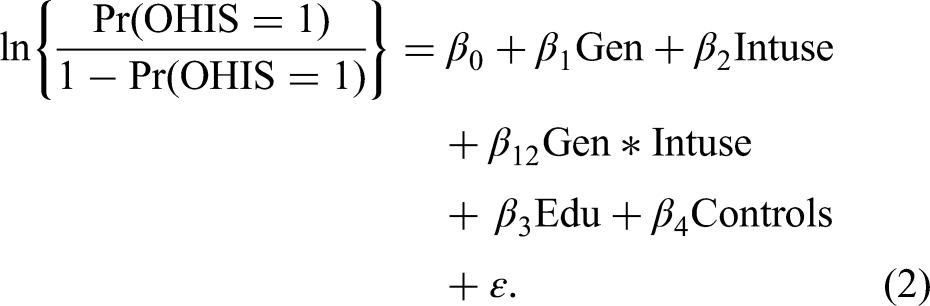

Next, we conducted a Probit model and Ordinal logistic regression model to test the robustness of the benchmark regression. Notably, many scholars emphasize that the interaction effect in nonlinear models cannot be simply evaluated by examining the sign, magnitude, or significance of interaction term coefficients; instead, the relevance and significance of the interaction variables must be assessed by examining their marginal effects.63,64 Therefore, following Ai and Norton's recommended technique, we examined the specific circumstances of the interaction effects—sign, magnitude, or significance—involved in this study and presented them in Supplemental Material and the section titled “Estimated marginal effects of interaction.”
Results
Descriptive statistics result
To offer a preliminary account for the wide rift in OHIS, Table 1 presents a bird's eye view of OHIS (OHIS = 1) versus non-OHIS (OHIS = 0). We find that compared to non-OHIS, the OHIS group are characterized by younger, higher education, more frequent using Internet, living in urban, higher income, and owning personal phone.
Sample statistics by OHIS.

a The variable is categorical.
Multivariable analysis
Before the formal analysis, we conducted a multicollinearity analysis. The results show that the VIF is 2.3 (for the sake of space, please refer to Supplemental Material Table A.2), meeting the criterion of being less than 10, which means there's no multicollinearity among the variables. Table 2 shows the results of binary logistic regression analysis examining the predictors of OHIS . Model 1 presents the analysis results without control variables. Model 2 reports the baseline results for equation (1) simply including generations and education levels main effects. As expected, the middle-aged (OR = 0.285, p < 0.001) and elder (OR = 0.070, p < 0.001) people are less likely to engage in OHIS than the youth. That’s to say, middle-aged and elderly people are 71.5% and 93% less likely to participate in OHIS than the youth. This might be because, compared to the young, the middle-aged and elderly may lack knowledge about how to use computers and smartphones to access online health information resources. 65 Moreover, in terms of personal habits and preferences, prior studies have established that older adults tend to favor conventional ways of accessing health information, like seeing doctors in person or getting recommendations from others. 9 Education levels is positively and significantly associated to OHIS (OR > 1, p < 0.001), with higher educational individuals having greater probability of OHIS. These results demonstrate the generational gaps and educational gaps in OHIS, which is termed as digital health divide.30,60
Binary logistic regressions predicting OHIS (N = 2409).

Notes: +p < 0.1, *p < 0.05, **p < 0.01, ***p < 0.001; Standard errors in parentheses.
OR: odds ratios; Intuse: the frequency of Internet-use; Gen: generation; Edu: education. For the sake of space, only odds ratios are presented in the main table, and the coefficients can be found in the Supplemental Material Table A.3.
Covariates also confirmed certain relationships with OHIS. Being married (OR = 1.371, p < 0.001), urban residence (OR = 1.467, p < 0.001), high income (OR = 1.499, p < 0.01), and ownership of a personal mobile phone ownership (OR = 9.000, p < 0.001) are positively correlated with the predicted probability of OHIS, while agricultural registration (OR = 0.746, p < 0.01) is negatively correlated. Notably, the high OR of mobile phone ownership may be explained form two perspectives: on the one hand, mobile phone ownership is a binary variable, and the proportion of individuals who own a mobile phone in this dataset is as high as 95%. This unbalanced data distribution is the main reason for the high odds ratio. On the other hand, the high proportion of mobile phone ownership not only highlights the importance of mobile phones but also confirms that physical access is not a direct cause of the OHIS gap. Instead, there are other influencing factors (e.g., age and education level). In addition, individual-level variables such as gender, employment status, and self-rated health show no significant relationship with the predicted probability of OHIS (all p > 0.05). Similarly, provincial-level variables such as region, number of medical institutions per capita (pmi), provincial mobile internet penetration rate (pmipr), and provincial per capita GDP (pgdp) do not significantly affect the predicted probability of OHIS (all p > 0.05). Notably, the insignificance of gender and self-rated health in this study contrasts with public perception and previous research, 30 which suggests that females and individuals with poorer health conditions are more likely to engage in OHIS.
Of interest is whether the impacts of generations and education levels on OHIS vary as frequency of Internet-use. Models 3 and 4 additionally introduce one interaction between (1) generations and Internet-use, (2) education levels and Internet-use, respectively, to explore potential moderation (complementarity or substitution) of Internet-use. We find that while the role of Internet use on the association between generations and OHIS is positive, a significant negative moderating effect of Internet use exists in the nexus between education level and OHIS. Moreover, we could find that except for gender, marital status, employment status, residence, personal phone ownership, and self-rated health, the signs and statistical significance of others have changed in Models 3 and/or 4. Interestingly, the disappearing significance of individual level covariates and emergence of significance at the provincial level indicate that impact of Internet-use on OHIS surpasses sociodemographic characteristics, also highlighting the regional disparities in China's digital construction.
Robustness checks
According to “Statistic Analysis” section, we conducted a probit model and an ordinal logistic regression model to examine the robustness of the baseline regression results. The results remained robust and are detailed in Table 3 (for sake of space limitations, see Supplemental Material Table A.4).
Probit model predicting OHIS (N = 2409).

Notes: +p < 0.1, *p < 0.05, **p < 0.01, ***p < 0.001; Standard errors in parentheses.
b: coefficient; Intuse: the frequency of Internet-use; Gen: generation; Edu: education; N: uncontrolled; Y: controlled.
The further analysis of interaction effects analysis
Next, we focus on analyzing the interaction effects based on binary logistic regression analysis. When including the interaction (Gen * Intuse), the OR on the interaction term is above 1 (p < 0.001) and the OR on generation main effect is below 1 (p < 0.001). According to the traditional interpretation of interaction effects, if the signs are the same, the moderator (Internet-use) strengthens the impact of main predictor (generation); if the signs are opposite, the moderator weakens the impact. So, the different signs imply that Internet-use weakens the negative effect of increasing generation on OHIS, indicating Internet-use to some extent compensates for the damage of aging to OHIS. Likewise, the differing signs on education relative to the interaction term (Education * Intuse) suggest that Internet-use weakens the positive effect of increasing education on OHIS, indicating Internet-use to some extent compensates for the damage of education lack to OHIS. In conclusion, Internet-use narrows the generational and educational gaps of OHIS, and intuitive displays can be obtained from the following Figure 1.

Predicted probabilities of OHIS by generation (a), education (b) and internet-use.
As mentioned above, in nonlinear models such as logit/probit, inference based on the magnitude and significance of multiplicative interaction terms is inappropriate a , as the sign of the interaction term does not necessarily indicate the sign of the effect. 63 It is helpful calculating Marginal Effects for starting with the Internet-use side of the interaction. Figure 1 visually illustrates the effects of Internet-use on (a) generational and (b) educational gaps of OHIS, highlighting the narrowing of generational and educational gaps in OHIS as Internet use frequency increases. Specially, Figure 1(a) shows that generation gaps in OHIS are most pronounced among those with low Internet use (the left side of X-axis). As Internet use frequency rises, these gaps reduce, suggesting that higher Internet use frequency are related to the narrowing generational disparities between youth, middle-aged, and elders. Similarly, Figure 1(b) demonstrates that the impact of Internet use on OHIS is more uniform across educational groups when Internet use is low (the left side of X-axis). However, as Internet use frequency increases, the less educated group experiences a more significant improvement in OHIS compared to their more educated counterparts. This indicates that higher Internet use can play a more substantial role in enhancing OHIS for individuals with lower educational attainment. It can be intuitively observed from Figure 1(a) and (b) that the generational and educational gaps in the predicted probabilities of OHIS gradually narrow with increased Internet-use frequency. This highlights the importance of promoting digital inclusion and Internet access as a means to improve health information seeking across diverse populations.
Estimated marginal effects of interaction effects
As Mize emphasizes that a more appropriate technique is to calculate the marginal effects of the main predictor at different levels of moderator, as well as the second difference between different levels of main predictor. 64 Table 4 presents the tests of the generational gaps and educational gaps, as well as tests of whether the size of these gaps differs across frequency of Internet use (second differences, namely the test of interaction). As for generational gaps, we could find a significant difference between higher (M + 1SD) and lower (M-1SD) frequency of Internet-use, with the former being more likely to report OHIS than the later (p < 0.001). To determine if the impact of generation varies by Internet-use frequency, a test for second difference is necessary, as shown in the last column labeled “2nd Difference.” For example in Table 4 Panel A, the youth with higher frequency of Internet-use have a insignificantly higher probability of OHIS (0.815) than do lower frequency (0.681; △ = 0.133; p > 0.05). In contrast, the middle-aged and elders with higher frequency of Internet-use have higher probability of OHIS than do lower frequency (△ = 0.423 and 0.391, respectively, p < 0.001). The effect of Internet-use—with frequent users being more likely OHIS—is larger for middle-aged generation (2nd Difference = 0.290, p < 0.01) and elder generations (2nd Difference = 0.258, p < 0.01). Yet, the effect of Internet-use was slightly lower for elders than for middle-aged, but not significantly so (2nd Difference = −0.031, p > 0.05). This result once again confirms the notion in Figure 1, where with the increase in Internet-use frequency, the impact of Internet-use on OHIS among middle-aged and elderly is stronger (see Figure 1(a), slope of red and green lines increase), thereby narrowing the generational gaps. Similarly, Panel B indicates the same information.
Estimated marginal effects of interaction variables and their differences at the mean ± 1SD level of internet-use.

Note: +p < 0.1, *p < 0.05, **p < 0.01, ***p < 0.001; Standard errors in parentheses.
Discussion
There are numerous benefits for individuals who seek online health information, including strengthening health beliefs, promoting healthy behaviors, and improving physical conditions.66–68 Therefore, this study utilizes CGSS 2021 data from a large cross-sectional survey and binary logistic regression analysis to investigate generational and educational disparities in OHIS in China, and further examines the association between internet use and bridging these disparities.
Principal findings
The findings reveal a significant generational divide in OHIS, with middle-aged and older adults being considerably less likely to engage in this behavior than their younger counterparts. This result aligns with previous research suggesting that the use of digital platforms for health purposes is unequally distributed across the population. 30 This gap can be attributed to two primary factors: the digital divide and divergent information-seeking habits. First, many older adults, often described as “digital immigrants,” possess lower digital literacy, which leads to apprehension when navigating the internet. 69 This anxiety is frequently rooted in fears of security risks, such as fraudulent content and privacy breaches. Framed within the TAM, this lack of confidence and the perceived difficulty of use act as significant barriers, reducing their motivation for OHIS. 65 Complex user interfaces and advanced search techniques can reinforce this reluctance, often resulting in confusion and frustration. In contrast, younger “digital natives,” having grown up immersed in the internet age, encounter significantly fewer of these technical barriers. Second, a clear divergence emerges in channel preferences. The literature indicates that older adults gravitate toward traditional sources, primarily relying on the authority of physicians and trusted word-of-mouth communication. 9 Younger individuals, conversely, tend to act as autonomous researchers, demonstrating a higher degree of trust in information acquired online.
Many older adults, often described as “digital immigrants,” possess lower digital literacy, leading to apprehension when navigating the internet. 69 This anxiety is frequently rooted in fears of security risks, such as fraudulent content and privacy breaches. According to the TAM, this lack of confidence and the perceived difficulty of use act as significant barriers, reducing their motivation to engage in OHIS. 65 Consequently, complex user interfaces and advanced search techniques can reinforce their reluctance, often resulting in confusion and frustration. In contrast, younger generations, often termed “digital natives,” have grown up immersed in the internet age and thus encounter significantly fewer technical barriers when seeking health information online. Furthermore, a significant generational divide also emerges in health information-seeking habits and channel preferences. The literature indicates that older adults gravitate toward traditional sources, primarily relying on the authority of physicians and trusted word-of-mouth communication. 9 In contrast, younger individuals tend to act as autonomous researchers, demonstrating a higher degree of trust in information acquired online.
The study also identifies significant educational disparities in OHIS, wherein individuals with lower educational attainment are less likely to engage in this behavior compared to their counterparts with higher educational attainment. This finding is consistent with existing literature, which indicates that individuals with higher education, socioeconomic status, and internet skills are better equipped to utilize online health resources effectively.6,45 Specifically, higher educational attainment often correlates with greater digital and health literacy, equipping individuals with the skills to proficiently retrieve and critically appraise the credibility of online information. Conversely, those with lower educational attainment often struggle to comprehend complex health information and to differentiate between trustworthy and misleading sources. 44 This challenge is further compounded by language barriers. The predominance of online health resources in non-native languages, such as English, can hinder access for individuals with limited multilingual proficiency. For instance, a native Chinese speaker may struggle to understand intricate medical terminology within the English language, cancer-related content, a difficulty often exacerbated by lower educational attainment.
This study reveals that Internet use is associated with a reduction in the generational and educational gaps in OHIS behavior. Our findings are consistent with previous propositions that internet use is a key factor in mitigating the digital health divide.70–72 The OHIS affecting older adults, which stems from gaps in digital skills and information habits, is being mitigated by two key trends: the simplification of technology and an increase in its perceived usefulness. Technological advancements are consistently reducing barriers to entry; mobile device interfaces have become more intuitive, while features such as voice commands reduce the need for sophisticated motor or typing skills, making OHIS more accessible. Simultaneously, the internet's deep integration into daily life, facilitating social connections, online shopping, and information access, has significantly boosted its perceived utility for older adults. This enhanced perception of usefulness, a core tenet of the TAM, acts as a powerful motivator for them to overcome initial reluctance and seek online health information. For individuals with lower educational attainment, disparities in OHIS are largely attributable to gaps in health literacy and information appraisal skills. From a resource accessibility standpoint, the internet has helped to dismantle traditional knowledge monopolies. It provides widespread access to vast amounts of health information, significantly lowering the threshold for its acquisition. 73 Furthermore, the internet has diversified information formats in ways that can bridge literacy gaps. Many medical professionals now utilize social media to disseminate health knowledge in plain language, often using relatable, real-life examples. This practice effectively “translates” complex medical concepts into understandable terms, thereby enhancing the accessibility of OHIS for this demographic.
Theoretical and practical implications
This study has noteworthy theoretical implications. First, we use the CGSS 2021 data from a large cross-sectional survey in China to reveal generational and educational differences in OHIS. More specifically, there exists a digital health divide characterized by reduced participation in seeking health information online among older people and those with limited levels of education. Prior research has focused on the inequality of OHIS within affluent democracies, particularly in the United States7,45 and France. 73 Limited research has shed light on unequal access to online health information in developing countries.3,74,75 Despite China's status as a leading digital power with over 1.123 billion internet users, the benefits of its rapid digitalization are not equitably distributed. A persistent digital divide remains, wherein older adults and those with lower educational attainment are disproportionately likely to experience digital exclusion. 76 This study, therefore, conceptualizes this phenomenon as a new facet of social stratification. We extend classical social stratification theory to the digital area to examine the mechanisms of exclusion within the context of a major developing country.
While the extant literature has thoroughly documented the digital divide in health, a knowledge gap that disproportionately affects older and less educated individuals, far less attention has been paid to actionable strategies for mitigating it. This study addresses this critical gap by investigating internet use as a key moderating factor. Our findings reveal that consistent internet engagement is correlated with bridging the generational and educational disparities in OHIS. Therefore, by shifting the focus from simply identifying the problem to analyzing a key mechanism for its resolution, our research contributes to a more nuanced understanding of how digital tools can be strategically employed to foster health equity.77,78
The finding that consistent internet use is associated with mitigating generational and educational disparities in OHIS provides significant implications for policymakers, community workers, and the tech industry. Policy efforts should focus on a dual strategy. First, lowering barriers to ensure equitable internet access for older adults and individuals with lower educational attainment. 79 Second, fostering collaborative initiatives between community stakeholders and families to enhance the digital literacy and self-efficacy of these populations. 80 A practical approach involves leveraging established public infrastructure, such as community and senior activity centers, to provide targeted digital literacy programs. Such initiatives can offer a supportive, peer-to-peer learning environment where older adults receive direct instruction in mastering essential internet skills.81,82 The proficiency gained through these programs is crucial, as it directly enhances an individual's ability to locate relevant health information and, critically, to evaluate its credibility and trustworthiness.
Moreover, existing research has established that support from offspring within the family positively influences Internet usage among older adults in vulnerable groups. 83 For instance, children of older adults can provide emotional encouragement and practical assistance to help seniors overcome fears and resistance toward new technologies. Such support can strengthen their willingness and self-confidence to adopt and regularly use the Internet.84,85 Furthermore, we call on digital technology designers to refine their technologies to minimize the divide created at the technology or platform level, thereby allowing individuals from different socioeconomic statuses to access online health information.
Limitations and future work
This study has several limitations. First, the cross-sectional design of the data prohibits the drawing of causal conclusions. Although our analysis identifies a significant association, it cannot untangle the complex, potentially bidirectional relationships between internet use, age, and education. Future research employing longitudinal or experimental methods is therefore essential to provide more robust explanations for how internet use impacts the digital health divide over time. Second, while the dichotomization of the dependent variable OHIS simplifies the analysis and aligns with our research question, it may result in the loss of some informative variation. Future research should consider alternative dataset and approaches, such as treating OHIS as a continuous variable, to capture a broader range of health information seeking behaviors. Three, Internet use was operationalized based on frequency of access, which was limited by the available data and did not fully capture the nuances of digital literacy, information-seeking skills, or the specific purposes for which individuals use the internet. This limitation may affect the depth of our understanding of how different aspects of internet use influence health information seeking behavior. Subsequent research should therefore utilize more detailed measures to explore the association between internet use and mitigating educational and intergenerational disparities in OHIS.
Conclusions
This study analyzes 2021 CGSS data to examine educational and intergenerational disparities in OHIS and explore the association between Internet use and the mitigation of these disparities . Our findings reveal significant generational and educational disparities in OHIS, reflecting a persistent digital divide in this domain. Specifically, younger and more highly educated individuals are more likely to engage in OHIS. Although core demographic characteristics such as age and education are immutable, our findings establish that sustained internet use acts as a powerful mediating factor. Therefore, building on this evidence, the study offers practical strategies designed to reduce these inequalities.
Supplemental Material
sj-docx-1-dhj-10.1177_20552076251393378 - Supplemental material for Exploring generational and educational disparities in online health information seeking in China: The moderating role of internet use
Supplemental material, sj-docx-1-dhj-10.1177_20552076251393378 for Exploring generational and educational disparities in online health information seeking in China: The moderating role of internet use by Lijuan Zhao and Tianyuan Liu in DIGITAL HEALTH
Footnotes
Acknowledgments
The authors are deeply grateful to all the individuals who took part in the CGSS 2021 survey.
Ethical approval
Ethical approval is waived. Because this study used secondary data. The CGSS data collection meets established ethical standards and has obtained ethics approval. Its institutional review board review was waived because there was no interaction with any individual, and no identifiable private information was used.
Informed consent
Informed consent is waived. Because CGSS is a large-scale, continuous, nationwide sampling survey project initiated by Chinese Renmin University, which makes the survey data freely available to the public. Anyone can register and access the data on the official website ( ). The project has been reviewed and approved by the Ethics Committee of the Chinese Renmin University at its inception, and informed consent was obtained from the respondents during the survey.
Contributorship
LJZ contributed to the study conception, methodology, data analysis, manuscript draft, and manuscript review. TYL contributed to the study conception, manuscript draft, manuscript review, and editing. All authors read and approved the final manuscript.
Funding
This work was supported by the Hunan Office for Philosophy and Social Sciences under Grant (No. 23YBQ007) and the National Social Science Fund of China (No. 22CSH035).
Declaration of conflicting interests
The authors declared no potential conflicts of interest with respect to the research, authorship, and/or publication of this article.
Data availability
Supplemental material
Supplemental material for this article is available online.
Notes
References
Supplementary Material
Please find the following supplemental material available below.
For Open Access articles published under a Creative Commons License, all supplemental material carries the same license as the article it is associated with.
For non-Open Access articles published, all supplemental material carries a non-exclusive license, and permission requests for re-use of supplemental material or any part of supplemental material shall be sent directly to the copyright owner as specified in the copyright notice associated with the article.
