




Abstract
Purpose
Older adults are struggling in the digital age due to lower digital literacy and other reasons. The purpose of this study was to explore the relationship between digital social capital, digital divide, learning ability, and health of older adults.
Methods
This study used data from the China General Social Survey (CGSS) to systematically analyze effects of digital social capital on the health of older adults using the moderated mediated effect test.
Results
Digital social capital has a significant positive effect on the health of older adults and significant household and regional heterogeneity. Internet usage has a mediating impact between social capital and the health of older adults. Learning ability positively moderates the effect of internet usage on the health of older adults, but negatively moderates the impact of digital social capital on internet usage. Learning ability moderates the mediating effect of internet usage between social capital and the health of older adults. The stronger the learning ability, the stronger the mediating effect of internet usage between social capital and health of older adults.
Conclusion
Digital social capital can promote the health of older adults, and internet usage and learning ability can play mediating and moderating roles in the process of digital social capital affecting the health of older adults, revealing that we should cultivate the digital social capital of older adults and improve the digital ability of older adults to improve their health.
Background
Health is a prerequisite for people to extend their life cycle and a basis for participation in social activities. 1 Population aging is a major problem faced by all countries, and the health of older adults has become the primary concern of each country. According to data from the National Bureau of Statistics, by the end of 2022, the number of people aged 60 and over in China will reach 280 million, and the proportion of older adults aged 65 and over will exceed 14%, with the number of older adults growing at an accelerated rate and the degree of aging faced by China further deepening. 2 China has been a relational society emphasizing kinship and geography since ancient times, and the accumulation of social capital is essential for individuals to participate in social activities. 3 However, with the increase of age, the indicators of the physical function of older adults decline, and the incidence of disease increases, which not only affects the enthusiasm of older adults to participate in social activities, but also hinders their quality of life in terms of enjoying their twilight years peacefully. Therefore, solving the health of older adults is the key to actively responding to the crisis of population aging and improving the well-being of older adults.
Finding the factors affecting the health of older adults is the key to solving the health problems of older adults, and different scholars have studied these factors from different angles. Some scholars have looked at the issue from the perspective of community services and found that the medical and publicity services carried out by the community can have a favorable effect on the health improvement of older adults.4,5 Some scholars have also looked at demographic characteristics and found that gender, household, economic income, and marital status all have a significant impact on the physical and mental health of older adults. 6 Moreover, some scholars have taken a capital perspective and found that the levels of social capital and cultural capital possessed by an individual are conducive to the health of older adults.7,8 As an informal social security system, social capital is considered a relatively stable and sustainable network of social relationships. 9 It includes both the resources acquired by individuals when participating in activities and the reputation and benefits gained by individuals in activities and plays the role of “glue” at the national, organizational, and individual levels. 10
However, with the arrival of the digital era, social capital has also been given a new connotation of meaning, and digital social capital has gradually become a hotspot for research in the field of social capital. Digital capitalism, the front end of digital social capital, was first proposed in 1999 by Schiller in his book titled “Digital Capitalism,” in which he argues that the internet is affecting all aspects of economic, cultural, and social society in a completely new way, and that it is an indispensable and important enabler of the social development process. 11 Since then, scholars like Ragnedda have proposed a new form of capital, called digital capital, with reference to Bourdieu's theory of capital, in which he argues that the level of digital capital possessed by an individual depends both on the individual's intrinsic willingness to use the internet usage and externally on the network resources that the individual has access to. 12 As a result, digital social capital has been proposed to accurately reflect the social resources owned by individuals in the digital era. Currently, there is no consensus among academics on the concept and connotation of digital social capital, but the assertion that it is the extension of the economic activities of individuals in the traditional society to the digital society is more accepted. Combined with the research background of this study, digital social capital mentioned in this paper refers to a series of network resources, such as network relationships established, network evaluations harvested, and network credibility accumulated by individuals interacting with other network members through the network in various activities in the network world. These network resources can be used to achieve the individual's goals and can have an important positive impact on both the network society and the real society. Some scholars have found that digital social capital has an impact on the establishment of online credit systems, internet word of mouth, and consumer purchasing behavior.13,14 However, only some have paid attention to the impact of digital social capital on the health of older adults. Older adults have greater difficulty in using digital technology due to decline in their physical function, lower acceptance of new things, and weaker digital literacy, resulting in older adults lagging behind the pace of development in the digital age, and the health of older adults caused by digitalization deserves our attention.
In the digital age, digital technology can bring a variety of convenient services to older adults, such as access to health of older adults, purchase of goods, zero-distance communication with others, and employment through digital technology. However, due to the problem of the digital divide among older adults, they are not as successful in mastering and utilizing digital technology compared to younger and middle-aged people. The inability of older adults to use digital technology to access health-related information and resources has a negative impact on the health of older adults. The digital divide is a growing conflict among older adults. It is related to an individual's internet access methods, internet usage methods, awareness of internet usage, etc. Scholars have also classified the digital divide into access gap, usage gap, and knowledge gap based on the different characteristics of each stage of the digital divide. 15 Liu and Su showed that the access gap, usage age, knowledge gap, and digital divide have a certain degree of negative impact on the physical and mental health of older adults. 16 Only by bridging the digital divide faced by older adults can the health of older adults be better maintained. However, it must be considered that to bridge the digital divide among older adults, their learning ability is the key to unlocking their ability to master digital technology. Activity theory emphasizes the participation of older adults in social activities as the most basic form of life, in which older adults are able to take on new roles and make more social connections, and their level of social adjustment is enhanced to a greater extent. 17 More active and vibrant online participation by older adults can strengthen their connection with the digital society, and in the process of using the internet, older adults continue to improve their levels of digital social capital and learning ability in order to adapt to the changes in the development of the digital society and provide strong support for the improvement of their health. As a result, the present study considers the following questions: What is the effect of digital social capital on the health of older adults in the dual context of population aging and the digital age? How heterogeneous is it? What are the roles of internet usage and learning ability in digital social capital influencing the health of older adults?
Based on the abovementioned questions, this study empirically examines the effect of digital social capital on the health of older adults using hierarchical regression with the moderated mediation effect test using data from the 2018 and 2021 China General Social Survey (CGSS) and further analyzes the mediating role of internet usage and the moderating role of learning ability to provide a proactive response to population aging and improve the health of older adults. The possible marginal contributions of this paper are as follows: (a) to conduct research from the perspective of digital social capital, analyze the feasible path to improve the health of older adults, and lay a theoretical foundation for subsequent research; (b) to use hierarchical regression with the moderated mediated effect test to empirically test the effects and mechanisms of digital social capital, internet usage, and learning ability on the health of older adults and analyze the roles that internet usage and learning ability play in them to provide an empirical basis for the existing literature; and (c) to use a variety of methods to alleviate the endogeneity problem in the model, such as the propensity score matching method, method of replacing the core variables, and instrumental variable method, in order to make the research conclusions more reasonable and effective.The theoretical mechanism of this study is shown in Figure 1.

Diagram of the theoretical mechanism of this study.
Methods
Data sources
This study adopted the 2018 and 2021 CGSS data collected from 31 provinces, autonomous regions, and municipalities directly under the central government, covering information at the individual, family, and community levels, used in the fields of sociology, management, economics, etc., and can better reflect the historical changes of the Chinese society. Ethical review and approval were not required for the study on the human participants in accordance with the local legislation and institutional requirements. The participants provided their written informed consent to participate in this study. Referring to the processing method of previous literature, 18 based on the needs of the research objectives, this study excluded the data of older adults under the age of 60, deleted the missing values and outliers, and finally obtained 8099 valid samples. Among them, male older adults accounted for 47.9%; female older adults accounted for 52.1%; older adults with an agricultural household accounted for 54.1%; and older adults with a non-agricultural household accounted for 45.9%; hence, the sample structure was reasonable.
Variable description
Dependent variable
Combining the basic connotation of health and referring to related literature, 17 the health of older adults was measured in terms of two dimensions: physical and mental health. Physical health is the good condition of older adults’ bodies. Mental health refers to the good condition of older adults’ hearts. Physical and mental health were measured through the following questions: How often in the past 4 weeks have your work or other daily activities been affected by health problems? How often in the past 4 weeks have you felt depressed or frustrated? A reverse assignment method was used to assign values to the five scales summed to obtain a final total score, with higher scores indicating better physical and mental health.
Independent variable
The independent variable of this study was digital social capital. Social capital has a multidimensional concept, and the dimensions it encompasses vary in different situational characteristics. Early scholars divided social capital into two levels, that is, individual and collective, with the individual social capital being the social resources possessed by individuals and the collective social capital being the norms, trust, and relationships formed within groups. 19 Scholars studied individual social capital more, with Stephen et al. dividing individual social capital into four parts: social trust, social norms, social network, and social participation. 20 Later, Chinese scholar Du drew on Stephen's empirical research on the division of social capital. 21 Combining the research background and the basic connotation of digital social capital, this study divided digital social capital into the four dimensions as follows: network relationship, network trust, network participation, and network norms. Network relationship referred to the friendliness of older adults’ relationships with other members of the network. It was measured by the item “frequency of access to the internet” and assigned a value on a five-point scale. The higher the score, the more frequent the internet usage, and the more friendly the older adults are with the other members of the network. Network trust referred to the degree to which older adults trust information on the internet. It was measured by the item “the use of customized messages for cellphones” assigned with a value on a five-point scale. The higher the score, the more frequently the older adults use customized messages on mobile phones, reflecting a higher level of trust in the internet. Network participation referred to the process by which older adults participate in social activities via the internet. It was measured herein using the item “whether you regularly access the internet in your free time,” which was assigned a value on a five-point scale. The higher the score, the more often the older adults go online in their free time and the more often they participate online. Network norms refer to older adults’ willingness to use the internet. Measured by the item “has anyone else in the family been on the internet,” “Yes” was assigned a value of 1, while the opposite was 0. Having others in the family access the internet increases the willingness of older adults to master and make use of digital technology, and the level of older adults’ norms on the internet will increase. The digital social capital score was obtained by summing the scores of these four dimensions. The higher the score, the higher the level of digital social capital among older adults.
Mediating variable
The mediating variable in this study was internet usage. It can be found from the literature that the difference in internet usage is one of the specific manifestations of the digital divide. 22 Internet usage and the digital divide are both related and different. Internet usage is the key to addressing the digital divide, while internet access is a prerequisite for internet usage. Ran and Hu used the “whether or not to access the internet” factor as an indicator of internet usage; 23 thus, this study measured internet usage with the following questions: “Do you have a cellphone that you use alone?” and “Have you accessed the internet in the last six months?” Having a cellphone for personal use and having accessed the internet were assigned a value of 1; otherwise, it was a value of 0. The higher the score, the better the ability of older adults to use the internet and the better the digital divide was bridged.
Moderating variable
The moderating variable in this study was learning ability. Due to the digital divide, it is difficult for older adults to utilize the internet for diagnosis, treatment, and prevention of their health, and older adults with higher learning abilities are more likely to absorb and accept external information to make decisions in favor of their health. Educational attainment was used as an indicator of learning ability. 24 The education level was re-assigned according to the number of years of education, 25 with “no education, private school, literacy class” assigned with a value of 0, “elementary school” assigned with a value of 6, “junior high school” assigned with a value of 9, “high school, junior college, technical school” assigned with a value of 12, “specialized school” assigned with a value of 15, “undergraduate school” assigned with a value of 16, and “Graduate and above” assigned with a valu of 19. Higher scores indicated that older adults were better educated, and their learning ability was greater.
Control variable
With reference to the relevant literature, 26 gender, age, household, marital, socioeconomic status, social class, and regional distribution were the control variables for this study. Theoretically, male older adults are more receptive to digital technology and will use it more frequently than female older adults. The younger the older adults are, the more likely they are to learn and use internet technology to know about the health of older adults. Older adults with spouses will be more likely to use digital technology to impart health-related knowledge to family members. The higher the socioeconomic status and the social class of older adults, the greater the propensity to purchase digital technology and the greater the chance of using it to inquire about the health of older adults on health-related issues. Older adults in the eastern region have more access to digital technology than those in the western region and will be more likely to use digital technology to learn about the health of older adults. The specific variable assignment table is shown in Table 1.
Variable assignment table.
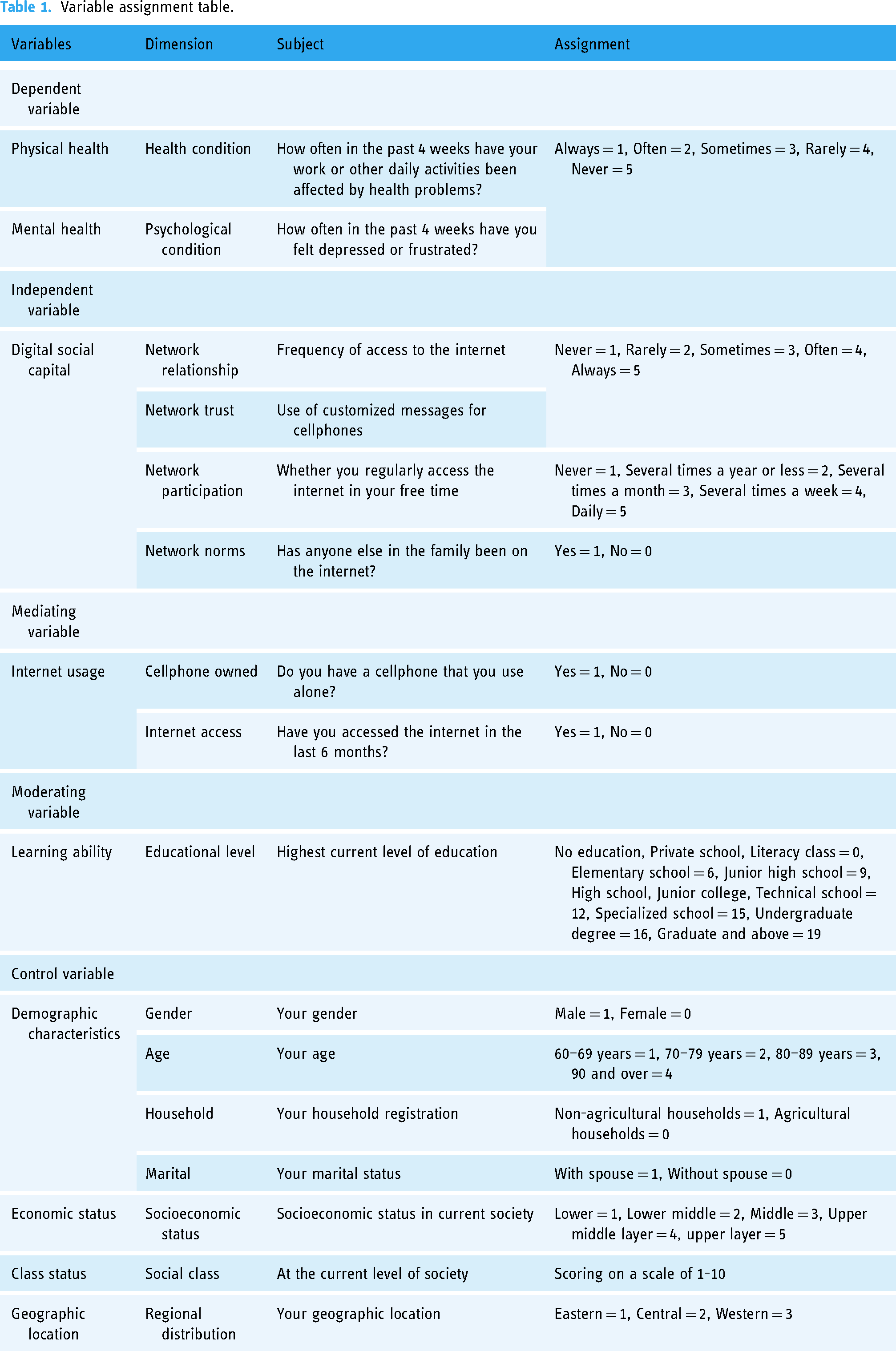
For ease of analysis, the dependent and independent variable scores were operationalized in this study as the arithmetic mean of the scores for each question item. The descriptive statistics for the core variables are shown in Table 2.
Descriptive statistics of core variables.

Model setting
Drawing on the process proposed by Hayes to test the mediating role of moderation, this study sequentially verifies the direct effect of digital social capital on the health of older adults, mechanism of internet usage, and learning ability and constructs the following model:


Results
Analysis of empirical results
Multicollinearity diagnosis of the regression models showed that the variance inflation factor (VIF) of each model was less than 2.0, and the tolerance values were greater than 0.5, indicating that the data selected for this study did not suffer from the problem of multicollinearity and could be continued.
The direct impact of digital social capital on the health of older adults
From equations (1) and (2) in Table 3, it can be seen that digital social capital has a significant positive effect on the health of older adults (Coef. = 0.222, p < 0.01) (i.e. the higher the level of digital social capital of older adults, the better their health). In addition, by observing the amount of change in R2 for equations (1) and (2), it can be found that equation (2) has an increase of 0.013 in R2 compared to equation (1), which indicates that digital social capital has a strong explanatory power for the health of older adults. Meanwhile, by observing equations (1) to (5), it can be found that R2 is increasing, which indicates that the model has a better goodness of fit.
Hierarchical regression results.

Note: ***, **, and * denote 1%, 5%, and 10% significance levels, respectively; heteroscedasticity robust standard errors in parentheses; OH denotes health of older adults; DC denotes digital social capital; IS denotes internet usage; and LA denotes learning ability.
A test of the mediating role of internet usage
Equations (4) and (6) in Table 3 show the test results of the mediating role of internet usage. From equation (6), it can be seen that social capital has a significant positive effect on internet usage (Coef. = 0.230, p < 0.01), indicating that the higher the level of social capital of older adults, the better their ability to master and utilize the internet, and the better the digital divide is bridged. From equation 4, it can be seen that the internet usage of older adults plays a positive role in the health of older adults (Coef. = 0.212, p < 0.01). The stronger the internet usage ability of older adults, the smaller the problem of the digital divide they face and the better their health.
In addition, this study further tested the mediating role of internet usage using the bootstrap method. As can be seen from Table 4, the confidence interval of the indirect effect of internet usage at the 95% level is [0.035, 0.078], which does not contain 0, indicating that a partial mediating effect of internet usage exists.
Bootstrap test results.

Note: ***, **, and * indicate 1%, 5%, and 10% significance levels, respectively; bootstrap intervals are estimated as repeated self-sampling 1000 times 95% confidence intervals.
A test of the moderating role of learning ability
Equations (5) and (8) in Table 3 show the results of the test of the moderating effect of learning ability. As shown in equation (5), learning ability positively moderates the effect of internet usage on the health of older adults (Coef. = 0.016, p < 0.05), and the stronger the learning ability, the stronger the effect of internet usage on the health of older adults. As shown in equation (8), learning ability negatively moderates the effect of digital social capital on internet usage (Coef. = −0.007, P < 0.01), and the weaker the learning ability, the stronger the effect of digital social capital on internet usage.
Moderated mediation test
According to the model testing steps, any of the coefficients
Index of moderated mediation.
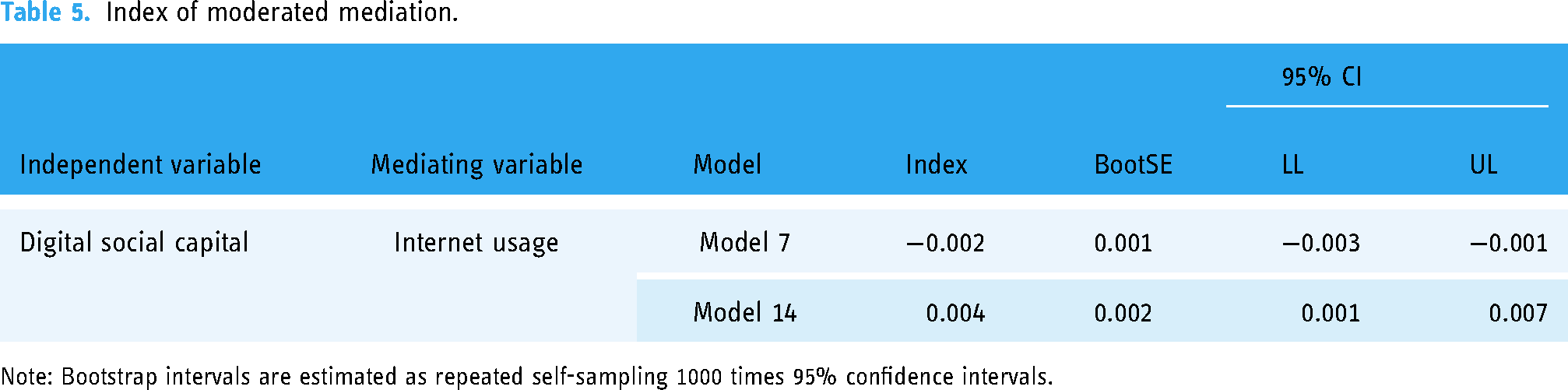
Note: Bootstrap intervals are estimated as repeated self-sampling 1000 times 95% confidence intervals.
Results of the mediation effect test for internet usage at different levels of learning ability.

Note: Bootstrap intervals are estimated as repeated self-sampling 1000 times 95% confidence intervals.
Endogeneity test
There may be a reverse causality between digital social capital and the health of older adults, whereby the health of older adults may consequently affect the level of digital social capital (e.g. older adults who have good health will be more involved in social activities and, thus, may have a higher level of digital social capital). In order to overcome the endogeneity problem, instrumental variables need to be found for Heckman two-stage model regression.
In this study, the Mandarin-speaking ability of the respondents was chosen as the instrumental variable. Their Mandarin-speaking ability reflects the educational background of older adults, and older adults with a stronger Mandarin-speaking ability have more digital social capital than those with a weaker ability. At the same time, the ability of older adults to speak Mandarin will not be necessarily related to their health status; hence, the ability to speak Mandarin can be considered as an exogenous variable. Two-stage model regression results are shown in Table 7. The results of the first-stage regression show that the ability to speak Mandarin can positively affect the level of digital social capital of older adults. The strong correlation between instrumental and dependent variables and the F value of 688.912 > 10 in the first stage indicates that the ability to speak Mandarin has a strong explanatory power on the level of digital social capital of older adults, and there is no problem of weak instrumental variables. A p value of 0.000 indicates that the effect of the ability to speak Mandarin on the digital social capital of older adults is significant at a statistical level of 1%. The results of the second-stage regression show that digital social capital still has a significant positive effect on the health of older adults. The results of the two-stage model regression are basically consistent with the hierarchical regression results, proving the reliability and validity of the research results.
Two-stage model regression results.

Note: ***, **, and * indicate 1%, 5%, and 10% significance levels, respectively.
Robustness test
Propensity score matching test
To avoid the problem of bias caused by the self-selection of variables, this study applied STATA 16 and employed propensity score matching (PSM) to examine the data further using three matching methods, namely, K-nearest neighbor matching, radius matching, and kernel matching. First, digital social capital was processed as a dichotomous variable divided into “low social capital group” and “high social capital group” to construct the processing variables of PSM. 28 As seen in Table 8, the standard bias of all variables after matching was less than 4%, and the p value of the control group and the treatment group after matching was greater than 0.1, indicating that the selected data passed the balance test.
Balance test results.

Note: This table shows the test results of the K-nearest neighbor matching; other matching methods also pass the balance test.
As can be seen from Table 9, the ATT effects of all matching methods were significant at the 5% level. The probability of health of older adults with high levels of digital social capital was 0.215–0.480 percentage points higher compared to those with low levels of digital social capital, and there is a significant positive effect of digital social capital on the health of older adults, suggesting that the selected data were well protected against endogenous risks and further confirming the robustness of the abovementioned results.
ATT effects of digital social capital on the health of older adults.

Note: ***, **, * indicate 1%, 5%, and 10% significance levels, respectively.
Replacement of core variables
In this study, “physical health” was used as a proxy variable to measure the health of older adults. For the convenience of control and observation, the regression results will be presented in the same way as in the previous section. The test results are shown in Table 10, illustrating that the test results are basically in line with the abovementioned conclusions and proving that the regression results of this study are quite robust.
Hierarchical regression results with replacement of core variables.

Note: ***, **, and * denote 1%, 5%, and 10% significance levels, respectively; heteroscedasticity robust standard errors in parentheses; DC denotes digital social capital; IS denotes internet usage; and LA denotes learning ability.
Heterogeneity analysis
Table 11 shows the results of the heterogeneity analysis. From the results of the regional heterogeneity analysis, it can be seen that digital social capital can play a positive role in the health of older adults in the eastern, central, and western regions (Coef. = 0.130, p < 0.01), (Coef. = 0.154, p < 0.01), and (Coef. = 0.123, p < 0.01). From the results of the household heterogeneity analysis, it can be seen that digital social capital can have the same positive effect on the health of older adults in agricultural and non-agricultural households (Coef. = 0.154, p < 0.01) and (Coef. = 0.132, p < 0.01).
Results of the heterogeneity test of digital social capital on the health of older adults.
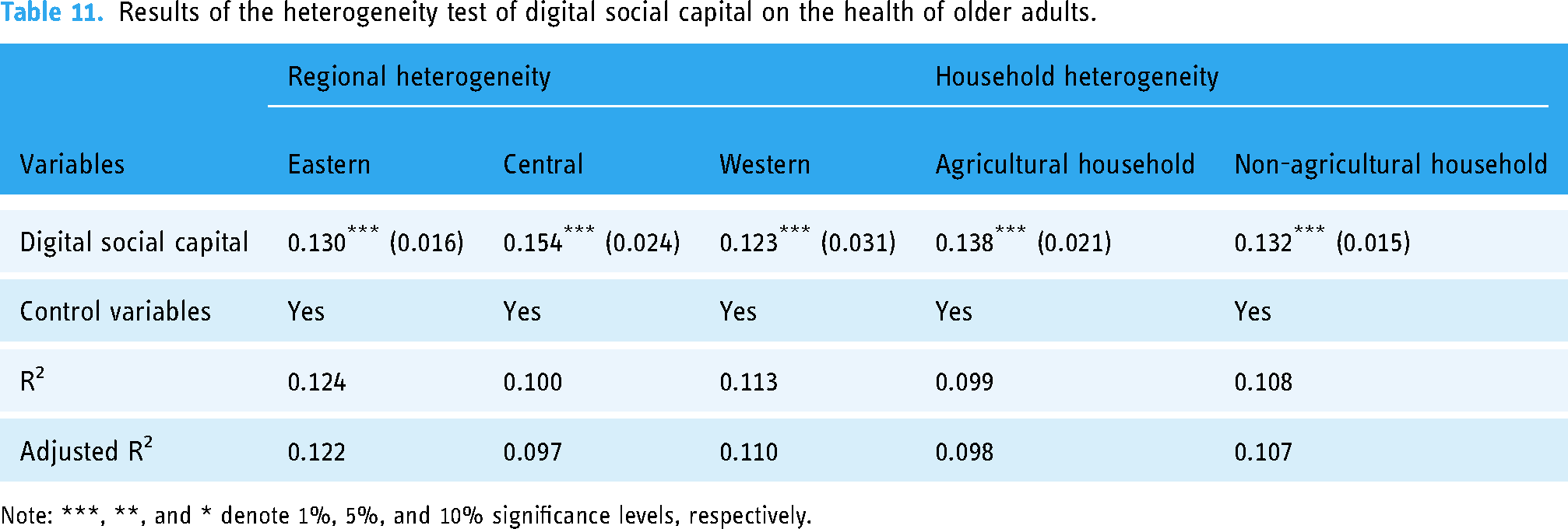
Note: ***, **, and * denote 1%, 5%, and 10% significance levels, respectively.
Discussion
It was found that digital social capital has a significant positive effect on the health of older adults, and the higher the level of digital social capital of older adults, the better their health, which is consistent with the findings of most scholars.29,30 Unlike the traditional type of social capital, digital social capital is a new type of relationship established in cyberspace, which can occur between two or more people who know each other or between two or more strangers. However, digital social capital does not remain virtual forever and can be transformed into traditional social capital under certain conditions. 31 In the digital era, older adults find it difficult to distinguish the various false and fraudulent information flooding the internet and are very vulnerable to being lured by unscrupulous merchants, which can have serious adverse effects on their economy and health. 32 The acquisition of health-related knowledge and information by older adults through the internet plays a vital role in developing good living habits and improving their health.
Internet usage was found to mediate between digital social capital and the health of older adults. The digital divide is the difference between individuals who use the internet and those who do not. It exists between different regions and populations. 33 The emergence of the digital divide is related to the strength of individual access to and mastery of network information, and individuals with weak access to and mastery of network information are collectively referred to as “digitally disadvantaged groups.” At the same time, older adults are typical representatives of “digitally disadvantaged groups.” Because of their weak digital knowledge, older adults are less likely to use the internet to obtain health-related information and enjoy its convenience. The existence of the digital divide not only negatively affects the improvement of family income, but also triggers the emergence of health inequality in older people.34,35 Digital social capital can help older adults bridge the digital divide and improve their internet usage.
At the same time, from the perspective of digital social capital, digital social capital is a basic condition for older adults to participate in social activities, and it is also an important tool for older adults to bridge the digital divide and improve their internet usage. By comparing the social capital owned by internet users and non-internet users, some scholars have found that internet users have more interpersonal relationships than non-internet users and transform these relationships from online to offline, further expanding the social capital advantage of internet users. 36 By participating in various social activities, including online and offline activities, older adults improve their ability to acquire and master online information and knowledge, which ultimately positively impacts the health of older adults.
Unlike previous studies, this study used the learning ability of older adults as a moderating variable rather than a predictor variable and found that learning ability moderated the mediating role of internet usage between digital social capital and the health of older adults, and the stronger the learning ability, the stronger the mediating role of internet usage. In the digital age, learning ability is the key to determining whether or not older adults can acquire and master digital technological capabilities. On the one hand, new types of social relationships have quietly emerged with the development of the internet. Digital social capital is breaking down the original barriers. Based on the digital platform, the information circulation is more frequent; the channels for people to obtain information and knowledge are more diversified: and older adults have a strong learning ability to master better and utilize information resources. 37 On the other hand, digital social capital often contains some specialized and difficult-to-understand information and knowledge. The acquisition of such resources requires older adults to have professional learning abilities to filter, extract, and apply these information resources. Some studies have shown that education is the main reason for the bias in learning ability, and older adults with higher education have stronger learning ability. 38 In addition, learning ability positively moderates the relationship between internet usage and the health of older adults, and the stronger the learning ability, the stronger the positive effect of internet usage on the health of older adults. Learning ability moderates the relationship between internet usage and the health of older adults. The poorer the learning ability of older adults, the poorer their ability to grasp and utilize digital technology. They are unable to select and identify information on the internet and cannot enjoy the convenient services brought by the internet, which is ultimately detrimental to improving their health. However, we found an interesting result in our study that learning ability negatively moderates the relationship between digital social capital and internet usage, and the stronger the learning ability, the weaker the positive effect of digital social capital on internet usage. This may be because older adults with strong learning ability have a greater degree of knowledge and ability to use the internet themselves, thus weakening the effect of digital social capital on internet usage.
From the results of the regional heterogeneity analysis, digital social capital plays a positive role in the health of older adults living in the east, center, and west, and the effect on the health of older adults in the center and west is greater than the effect on the health of older adults in the east. This is because the eastern region has always been an economic leader in China; the internet is developing extremely rapidly; and the marginal benefits of the internet for older adults living in the eastern region show a decreasing trend. 21 With the economic development of the central region, the development of the internet in the central region is in a strong stage; thus, the impact on older adults in the central region is greater than the impact on older adults in the east and west. From the results of the analysis of household heterogeneity, digital social capital has a significant positive effect on the health of older adults in agricultural households and a significant positive effect on the health of older adults in non-agricultural households; the effect on the health of older adults in agricultural households is greater than that on the health of older adults in non-agricultural households. With the implementation of the “rural revitalization” strategy and the “digital countryside” strategy, digital technology is developing rapidly in rural areas and can help older adults in agricultural households to strengthen their ties with their relatives and improve their economic income. 39 Therefore, digital social capital has a greater impact on the health of older adults in agricultural households.
The findings of this study have important policy implications. First, the guiding role of the government should be given full play. On the one hand, heterogeneity analyses show that digital social capital affects the health of older adults from agricultural households to a greater extent in the central and western regions, which have a lower level of economic development compared with the eastern regions. Older adults in agricultural households may be less likely to be exposed to digital technology than older adults in non-agricultural households. This suggests that the government should encourage and guide the sinking of advantageous resources to the grassroots level and continuously improve the digital infrastructure in backward areas. On the other hand, the government should also actively create a good digital environment for older adults, be able to regulate false and fraudulent information in a timely manner, and play the function of network regulation to purify the network environment. Second, communities should help older adults build good digital platforms. Research has found that digital social capital can play a positive role in the health of older adults through a combination of online and offline. Online, community staff can set up work groups and interest groups with residents in their own communities online, which can be used to disseminate news to residents in their own communities and facilitate communication between community staff and community residents. Offline, the community can hold regular lectures on digital technology and set up special lectures for older adults to continuously improve their ability to use digital technology. Finally, the educational role of the family should be fully utilized. Research has shown that learning ability positively moderates the impact of internet usage on the health of older adults, and family members are key to motivating older adults to learn about digital technologies. Family guidance and education can help older adults learn and use digital technologies more quickly. In order to achieve zero distance communication with family members, older adults will be more willing to learn and use digital technology, which will also increase the probability that older adults will use digital technology to obtain health knowledge, thus continuously improving their health of older adults.
This study has several strengths. First, the study sample focuses on older adults confined to lower digital literacy, cultural literacy, and knowledge literacy and struggle in the digital age; therefore, it is essential to study the impact of digital social capital on the health of older adults. Second, internet usage and learning ability are included in the analytical framework, and a moderated mediation model is constructed to empirically explore the mediating role of internet usage and the moderating role of learning ability and deepen the understanding of the relationship between digital social capital and the health of older adults. Finally, the study is based on the 2018 and 2021 CGSS data for empirical analysis, which can overcome the data endogeneity problem to a greater extent, thus avoiding the data bias problem to a certain extent. However, this study also has some limitations. For example, limited by the availability of data, this study can only use the currently available 2018 and 2021 (CGSS) data, and there is a time lag in the data, which may not be able to reflect the current situation accurately. The study's conclusions should be supplemented and improved after the release of new data. 40 In addition, this study only examined individual social capital and ignored the impact of public social capital on the health of older adults, which needs to be supplemented in later studies. Finally, this study focuses only on the positive impact of digital social capital on the health of older adults, but ignores the possibility that digital social capital may also have a negative impact on the health of older adults. If older adults are addicted to the internet, it may weaken their ability to interact offline, and staring at the screens of digital products for a long time may cause fatigue among older adults, which may adversely affect their physical and mental health, which is worth noting in subsequent research. 41
Conclusion
Using data from the CGSS and based on activity theory, this study explored the impact of social capital on the health of older adults. Through an empirical analysis, this study drew the following conclusions: digital social capital significantly promotes the health of older adults (i.e. the higher the level of digital social capital they possess, the better their health). Internet usage has a mediating role between social capital and the health of older adults, and digital social capital can increase the absorption of resources and information by older adults, promote older adults to enhance their enthusiasm for learning, and improve their learning ability, which consequently promotes the improvement of their health. Learning ability moderates the mediating role of internet usage between digital social capital and the health of older adults. Digital social capital positively affects the health status of older adults in central urban and agricultural households. This is importantly linked to implementing policies that tilt advantageous resources toward rural areas and the west and central regions to promote social equity, reduce social gaps, and achieve balanced development. This study may provide a reference for China to actively respond to population aging and improve the health of older adults in developing countries.
Footnotes
Acknowledgments
We are grateful to everyone who participated in this study and to the China General Social Survey (CGSS) database for providing the data.
Contributorship
Y.C. handled conceptualization, formal analysis, literature review, and writing of the original draft. Y.H. handled methodology, supervision, and funding. X.X., L.Z., and J.N. handled writing, review, and editing. All authors have read and agreed to the published version of the manuscript.
Declaration of conflicting interests
The authors declared no potential conflicts of interest with respect to the research, authorship, and/or publication of this article.
Ethical approval
Ethical review and approval were not required for the study on human participants in accordance with the local legislation and institutional requirements. The participants provided their written informed consent to participate in this study.
Funding
The author(s) disclosed receipt of the following financial support for the research, authorship, and/or publication of this article: This study was supported by the National Natural Science Foundation of China (72274081) and the Jiangsu Province Graduate Student Research and Practice Innovation Program (KYCX23_3795).
Guarantor
Y.S.
