




Abstract
Introduction
Information and communication technologies (ICT) now play a vital role in addressing a wide range of personal and societal needs across various domains. This cross-sectional study investigates the association between cognitive abilities and ICT use among older adults in the Czech Republic and Republic of Slovenia.
Methods
We used data from the Survey of Health, Ageing and Retirement in Europe wave 8 (2019) for the Czechia and Slovenia. Cognitive abilities were measured through 10-word list learning tasks and numeracy tests, while digital engagement was assessed by the frequency of internet use in the past 7 days.
Results
Descriptive analyses and regression modeling revealed that higher cognitive abilities were significantly associated with greater ICT use in both Czechia and Slovenia, even after excluding individuals with probable cognitive impairments. This association remained robust after controlling for age, education, gender, and living arrangements. In addition to advancing age, lower cognitive functioning emerged as a key predictor of digital exclusion. Notably, by age 85, only 30% of cognitively healthy individuals in Czechia and 20% in Slovenia reported using internet.
Discussion
Cognitive functioning is a significant and independent predictor of ICT use among older adults in both Czechia and Slovenia. Even after accounting for demographic and social factors, individuals with higher cognitive abilities were more likely to engage with digital technologies. These findings highlight the importance of integrating cognitive health into digital inclusion strategies targeting older populations, particularly in aging societies where technological access is essential for social participation and well-being.
Introduction
Two concurrent global trends are fundamentally reshaping societies: population aging and the rapid advancement of digital technology. The proportion of older individuals is increasing worldwide as birth rates fall, and life expectancies rise. In the European Union (EU), over one-fifth of the population is already aged 65 or above, and this share is projected to approach one-third by 2070. 1 Such demographic shifts, together with improvements in public health and medicine that enable more people to reach old age,2,3 have led to an unprecedented expansion of the older population. At the same time, digital technologies have become increasingly integrated into daily life across all age groups. Information and communication technologies (ICT) now play a vital role in meeting everyday needs in domains such as health care, finance, and social connection. Embracing digital technology is therefore seen as critical for mitigating the challenges associated with aging—such as declining physical and cognitive function, the rise in chronic health conditions, and shrinking social networks. 4
Over the past decade, internet use among older adults has grown markedly. 5 For example, about 49% of Europeans over age 50 were internet users in 2015, according to the Survey of Health, Ageing and Retirement in Europe (SHARE). 6 By 2022 this figure had increased dramatically: approximately 81% of EU residents aged 55–74 were online, compared to almost 98% of those aged 16–24. 7 National data echo this generation gap: in 2023, roughly 76–80% of older adults (55–75 years old) in Slovenia and Czechia had used the internet in the past year, versus over 98% of younger adults. 8 These statistics underscore a persistent digital divide between generations and highlight the need for targeted interventions to improve digital literacy among older adults.
Importantly, older adults are not a homogeneous group in their technology use; they exhibit wide variability in digital access and skills.9–11 In general, internet use tends to decline with increasing age as many older adults face barriers to technology adoption. Physical limitations (such as impaired vision or arthritic hands), lack of prior exposure to digital tools, and limited support can all impede an older person's engagement with new technologies. Even those who do go online often use the internet less frequently and for fewer tasks than younger users. 12 These challenges reinforce negative stereotypes of older adults as technophobic or digitally inept and contribute to outcomes like social isolation, reduced access to services, and loss of autonomy. 13
Although more older adults are embracing ICT, training programs designed for older learners frequently yield only modest results. Age-related impairments—such as reduced vision or manual dexterity—can make it difficult to use computers and smartphones. Cognitive decline with age (e.g. in memory and processing speed) further complicates digital learning by making it harder for older adults to learn and retain new technology skills. In addition, rapidly evolving interfaces and software can easily overwhelm those who did not grow up with digital technology. These factors help explain why many older adults struggle to keep pace with ICT and why the benefits of training interventions are often limited.14–16 Motivational and contextual factors also shape digital engagement in later life. For instance, older adults with more education or prior computer experience—or those who perceive clear personal value in using the internet—tend to be more active online. This underscores that a one-size-fits-all approach to improving digital literacy may be ineffective. 6
Cognitive ability is a critical determinant of technology adoption in aging populations. In particular, fluid cognitive functions—such as working memory, processing speed, and multitasking capacity—are important for mastering new digital tools and interfaces.17,18 However, these fluid abilities tend to decline steadily after about age 65,19–21 making it increasingly challenging for many older adults to acquire new technology skills. Diminished memory and executive function can cause older adults to perceive modern devices as complex or intimidating.22–24 While cognitive aging is well documented,19,21,25 relatively little research has examined how an older adult's cognitive capacity affects their uptake of digital technologies in everyday life.
A growing body of studies supports a positive link between cognitive functioning and ICT use in adulthood. Cross-sectional surveys across broad age ranges consistently find that individuals with stronger cognitive performance are more likely to use computers and the internet,26–30 even after controlling for age, education, and other demographics. Moreover, cognitive-related traits like high-technology self-efficacy and low computer anxiety correlate with greater technology adoption among older adults.26,31,32 In short, people who maintain better cognitive abilities as they age also tend to stay more engaged with digital technologies.
Relatively fewer studies have focused specifically on older adult samples, but their findings reinforce this cognitive–digital relationship. For example, an analysis of adults over 50 in the U.S. Health and Retirement Study found that older adults with better cognitive test scores—as well as higher education, income, and living with a partner—were significantly more likely to adopt internet use over time. 33 Similarly, Calhoun and Lee 34 reported that among Americans in late midlife and older, more frequent computer use was associated with better cognitive function, even after accounting for age, sex, and education. Longitudinal research in Europe suggests the link may be bidirectional: in the SHARE study, greater internet use predicted subsequent cognitive maintenance more strongly than vice versa. Likewise, a study in China found that middle-aged and older adults with higher baseline cognition had higher odds of being regular internet users later on. 35 These convergent findings underscore the intricate interplay between cognitive health and digital engagement in later life, highlighting cognitive ability as a key factor in older adults’ digital inclusion.
Given this background, the present study examines the association between internet use and cognitive abilities among older adults in the Czech Republic and Slovenia. We analyze data from SHARE wave 8 (2019–2020) to compare these two countries and test whether the cognitive–ICT link holds consistently across different contexts. Czechia and Slovenia share many characteristics—they are rapidly aging, post-socialist EU member states that are adapting to digitalization and faced similar challenges during the coronavirus disease 2019 (COVID-19) pandemic. At the same time, they differ in certain cultural and policy factors that might affect technology adoption. This comparison therefore provides an opportunity to see if the predictors of digital engagement in later life are robust across varying societal settings.
In designing our analysis, we also considered that a subset of older adults has cognitive impairments severe enough to effectively preclude them from using digital technologies—the so-called “silent group” of older adults with accelerated cognitive decline. Worldwide, over 55 million people were living with dementia in 2020, 36 a number expected to grow dramatically in coming decades. To focus on older adults aging without significant pathology, we restricted our sample to those with cognitively normal profiles. In practice, we identified individuals with probable cognitive impairment based on very low cognitive scores (for instance, recalling three or fewer words out of ten on a memory test), and we excluded these cases from our analysis. By removing participants with likely dementia or severe cognitive deficits, we aimed to isolate the relationship between internet use and cognitive performance within the normal range of age-related cognition (see Figure 1).

Relationship between performance on word list immediate recall test and internet use.
Recognizing this “cognitive digital divide” is important. A portion of the oldest-old population simply cannot acquire basic digital skills due to neurocognitive disorders, and no amount of conventional training will bridge that gap. With limited resources, interventions should prioritize those who have the capacity to benefit, while also exploring assistive technologies and accessible design to include older adults with mild impairments. Notably, large-scale aging surveys often do not consistently account for cognitive impairment rates.4,37,38 By focusing on older adults without major cognitive deficits, our study helps fill a gap in understanding how cognitive variation in normal aging relates to digital engagement. Overall, prior evidence suggests a strong positive association between internet use and cognitive functioning in later life.
6
We therefore expect to observe such a relationship in both Slovenia and Czechia and further hypothesize that its strength will be comparable between the two countries. Our specific hypotheses are as follows:
H1 (Within-country cognitive effect): Among adults over 50 with normal cognition, greater engagement in ICT (more frequent internet use) will be associated with better cognitive performance. H2 (Cross-national comparison): The positive association between internet use and cognitive performance will be similar in Slovenia and Czechia (i.e. no significant difference between the countries), after excluding individuals with probable cognitive impairment.
By identifying key cognitive and contextual predictors of internet engagement in these populations, this study aims to inform strategies to promote digital inclusion. Such efforts can help ensure that more older adults reap the benefits of participation in an increasingly digital world.
Methods
For this study, we utilized data from wave 8 of the SHARE, a longitudinal, cross-national population based panel survey that collects harmonized microdata on health, socioeconomic status, and social and family networks among individuals aged 50 and older across 28 European countries and Israel. 39 SHARE's modular design enables flexible integration of data tailored to specific research objectives. 40 Wave 8, the most recent pre-pandemic release, began in late 2019 and was suspended in March 2020 due to the COVID-19 pandemic. Data collection was resumed in the same year and continued into 2020 providing both cross-sectional and longitudinal data. 41 This study is based on anonymized secondary analyses of SHARE 2019/2020 data and adheres to the strengthening the reporting of observational studies in epidemiology (STROBE) guidelines, following the checklist for cross-sectional studies. 42
Sample
The study population consisted of individuals aged 50 years or older residing in private households or institutions in the participating countries at the time of sampling. Spouses or partners of eligible individuals were also included regardless of age, to capture household-level data. Individuals were excluded if they were incarcerated, hospitalized or out of the country for the entire survey period, unable to speak the national language(s), or could not be reached due to invalid addresses or relocation. Informed consent was required; therefore, individuals unable to consent were not interviewed.
The SHARE data collection is subject to ongoing ethical review, both centrally and, where required, by national ethics committees or institutional review boards. These reviews ensure compliance with legal norms and international ethical standards, including the Respect Code of Practice for Socio-Economic Research and the Declaration of Helsinki.
Participation in SHARE was voluntary and based on informed consent, ensured at three levels:
Potential respondents receive an invitation letter with a data protection statement, updated for General Data Protection Regulation and available in all national languages. Before the interview, trained interviewers explain the study, provide data protection information again, and document respondent's consent. During the interview, respondents may skip any question they prefer not to answer.
To examine the relationship between cognitive ability and digital engagement, we utilized data from three modules: the Information Technology (IT) module (internet use), the Cognitive Function (CF) module (word recall and numeracy tests), and the Imputations module (for handling missing data).
Following the integration of these modules, we restricted the dataset to respondents from the Czech Republic and Slovenia, yielding a total sample of 26,005 participants—13,530 from Czechia and 12,475 from Slovenia. (At this point, it is appropriate to point out the issue of imputation of missing values. After combining the IT and Health modules, we obtained 5201 respondents (2706 for the Czech Republic and 2495 for Slovenia). However, the dataset suffered from a large number of missing values; even less cases would be suitable for analysis when applying the listwise deletion method. For this reason, we added the Imputations module, but merged it in “1 to many” mode, which leads to an increase in sample size while preserving all its characteristics (cf. SHARE-ERIC 2022).)
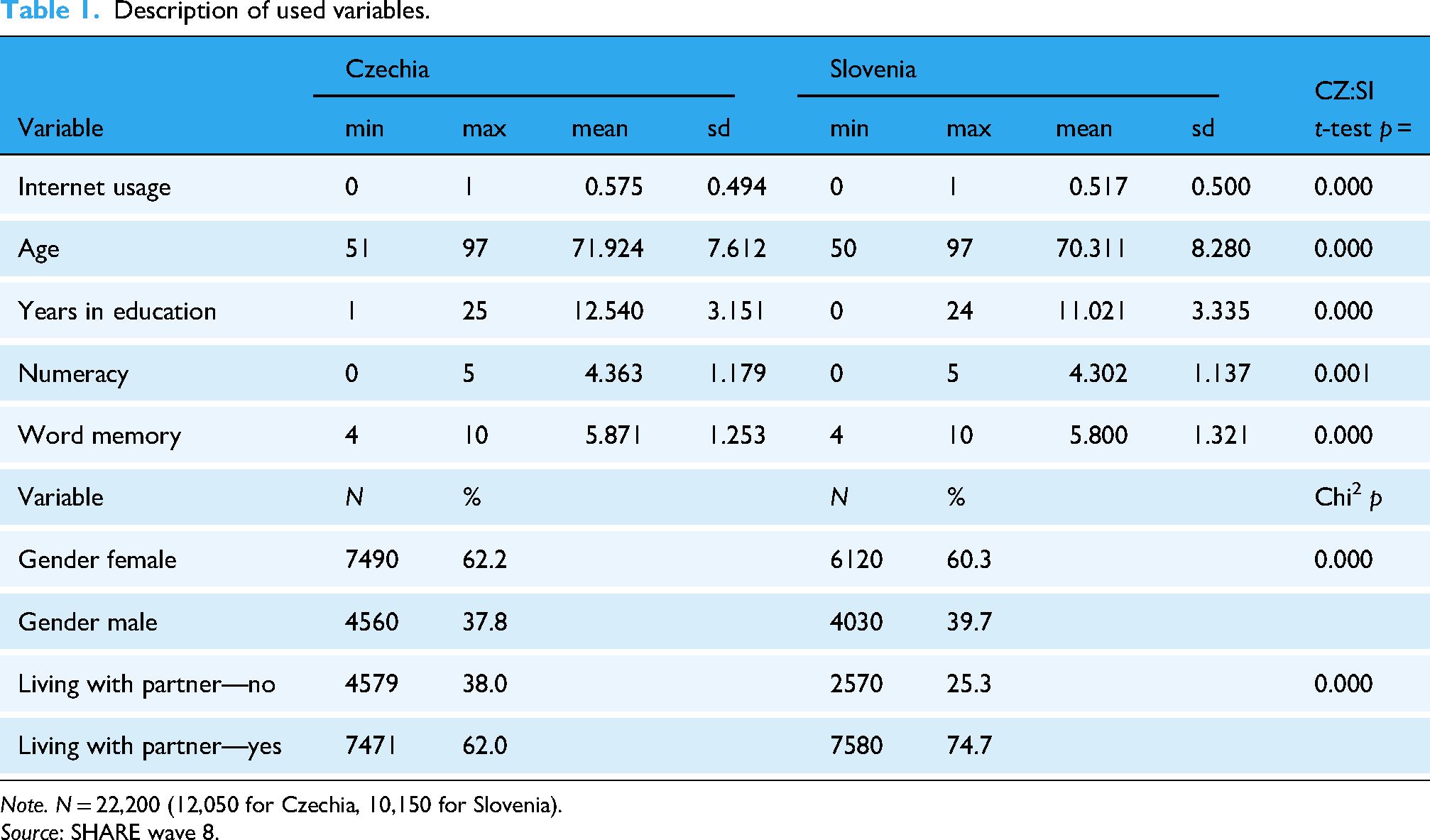
Descriptive statistics (means, standard deviations, and ranges) for all analytic variables, along with t-tests for cross-national comparisons, are presented in Table 1. All variables showed statistically significant differences between the two countries.
Description of used variables.
Note. N = 22,200 (12,050 for Czechia, 10,150 for Slovenia).
Source: SHARE wave 8.
Measures
Dependent variable
The primary objective of this study was to identify factors associated with digital service use among older adults. As SHARE does not include detailed measures on the quantity or type of services used, we employed a proxy indicator of digital engagement. Although we initially considered the item “How would you rate your computer skills?,” it was omitted for long-term panel members in wave 8 and was deemed outdated due to the rapid evolution of ICT.
To capture a more current indicator of digital engagement, we used a proxy question on internet use (During the past 7 days, have you used the Internet, for e-mailing, searching for information, making purchases, or for any other purpose at least once?): “During the past 7 days, have you used the Internet, for e-mailing, searching for information, making purchases, or for any other purpose at least once?” Respondents who answered affirmatively were assumed to have access to digital devices, possess basic ICT skills, and demonstrate motivation to engage with online services. Consistent with Van Dijk Jan's typology, 43 this reflects the necessary conditions for digital participation—skills, access, and motivation. Responses were coded dichotomously (yes = 1, no = 0), making the variable suitable for binary logistic regression.
Independent variables
Cognitive ability in SHARE is assessed through a series of standardized tests administered across all survey waves. For the present study, we focused on two core measures:
Word recall test
44
: Participants are presented with a list of 10 words and asked to recall them immediately and after a delay. Scores range from 0 to 10, with higher values indicating superior episodic memory performance. Numeracy test: This test evaluates basic arithmetic skills using five items, including serial subtraction tasks (e.g. repeatedly subtracting 7 from 100). Scores range from 0 to 5, with higher scores reflecting greater numerical proficiency.
Descriptive statistics for the cognitive measures and key demographic variables are summarized in Table 1.
Truncation. To identify individuals with probable cognitive impairment, we applied the standard Petersen criteria for mild cognitive impairment. 45 Eligible cases exhibited objective cognitive deficits on memory tests and subjective cognitive complaints but retained functional independence and did not meet diagnostic criteria for dementia. Objective impairment was operationalized as scoring more than 1.5 standard deviations below the national mean on the 10-word recall test. Based on this threshold, 2325 respondents (18.6%) were excluded from the Slovenian sample and 1480 (10.9%) from the Czech sample, yielding final analytic samples of 10,150 and 12,050, respectively.
Control variables
We hypothesized that additional individual-level characteristics may be associated with changes in the relationship between cognitive ability and internet use. Some of these factors may correlate with cognitive performance (see Table 2 for correlation matrix), while others may exert a direct effect on digital engagement. To account for these potential confounders, we included age, gender, years of education, and partnership status as control variables in the analyses.
Correlation matrix (independent and control variables with internet usage) with Pearson's correlation coefficient r.

Note. N = 22,200 (12,050 for Czechia, 10,150 for Slovenia).
Source: SHARE wave 8.
Age ranged from 50 to 97 years, with mean values of 71.9 years for Czechia and 70.3 for Slovenia. Gender was coded as a binary variable (1 = male, 2 = female). Educational attainment was measured as years of formal schooling (range: 0–25), with an average of 12.5 years in Czechia, and 11.0 in Slovenia. Partnership status was coded as 1 for individuals living with a partner (married or cohabiting) and 0 for those not living with a partner (single, divorced, or widowed). Overall, 61% of Czech respondents reported living with a partner, compared to 45% in Slovenia. Summary statistics for these control variables are presented in Table 1.
Analytical strategy
To facilitate comparability across variables with differing scales (see Table 1), all continuous variables—years of education, partnership status, numeracy, and word recall—were standardized into z-scores. (When calculating the z-score, the variable is standardized so that its mean is equal to 0 and its standard deviation is equal to 1.) The final analytical procedure consisted of three steps. First, group comparisons were conducted using independent samples t-tests for continuous variables and Pearson's chi-square tests for categorical variables. Second, bivariate relationships between independent and control variables and internet use were examined using Pearson correlation coefficients, calculated separately for Czechia and Slovenia (see Table 2). Third, binary logistic regression models were estimated to assess the impact of cognitive variables on the likelihood of internet use, controlling for age, gender, education, and partnership status.
Results
Sample description
Descriptive statistics for demographic and cognitive variables from the truncated SHARE wave 8 sample are presented in Table 1, including means, standard deviations, and ranges for all variables, separately for Czechia and Slovenia.
Significant differences emerged between the two national samples across all measured variables. Internet use was significantly higher in Czechia than in Slovenia (58% vs. 52%). The Czech sample also included a slightly higher proportion of female participants (62% vs. 60%). Participants in Czechia were, on average, older (mean age = 71.92 years) than those in Slovenia (mean age = 70.31 years), and had completed more years of formal education (14.52 vs. 11.02 years, respectively).
Interestingly, the proportion of respondents living with a partner was greater in Slovenia than in Czechia (74% vs. 62%). In terms of cognitive performance, Czech participants scored slightly higher on both the numeracy test (5.87 vs. 5.80) and the word memory recall test (4.36 vs. 4.30) compared to their Slovenian counterparts.
Bivariate correlations between variables and internet use
The results of the bivariate correlation analysis are presented in Table 2. Overall, the pattern of associations was consistent across the Czech and Slovenian samples, with correlation coefficients demonstrating comparable magnitudes and directions. As expected, internet use was negatively correlated with age, showing the strongest inverse association among all variables (r = −.34 for Czechia; r = −.39 for Slovenia).
Consistent with prior research, internet use was positively associated with higher educational attainment (r = .31 for Czechia; r = .34 for Slovenia), cohabitation with a partner (r = .11 and r = .16, respectively), numeracy scores (r = .14 and r = .22), and word recall performance (r = .29 and r = .26). All reported correlations were statistically significant and aligned with theoretical expectations, supporting the premise that cognitive and sociodemographic factors are key predictors of digital engagement among older adults.
Regression models for predicting internet use
The results of the binary logistic regression analyses for the truncated sample are summarized in Table 3. Models were constructed sequentially using a block-wise approach. Model M1 included only cognitive ability measures (word recall and numeracy). Model M2 added respondent age to assess its incremental effect. Model M3 further introduced additional demographic covariates—gender, years of formal education, and partnership status. Finally, model M4 incorporated a country dummy variable (Slovenia = 0, Czechia = 1) along with interaction terms between country and all previously entered predictors to test for cross-national differences in predictor effects.
Determinants of internet usage in last 7 days (binary logistic regression, odds ratios).

*: interaction; p: probability; z: z-score.
Source: SHARE wave 8.
All models were estimated on the same respondent pool, enabling direct model comparisons. The progressive inclusion of variables led to improved model fit, as indicated by increases in Nagelkerke's pseudo-R2, from 0.126 in model M1 to 0.346 in model M4. However, the inclusion of interaction terms in the final model limited interpretability due to the added complexity of cross-level interactions.
To facilitate interpretation, results are presented using marginal effects, which represent the predicted probability of internet use (on a 0–1 scale) associated with each independent variable, holding all other variables constant. 46 This approach provides clearer insights into the isolated association of each predictor on ICT engagement.
As illustrated in Figures 2 and 3, cognitive ability is strongly associated with the likelihood of internet use in both countries. Figure 2 presents marginal effects estimates depicting the relationship between numeracy test scores and the predicted probability of internet use. A clear positive gradient is observed: as numeracy scores increase, so does the probability of internet engagement. This association is statistically significant in both samples; however, the effect is more pronounced in Czechia than in Slovenia, with the difference between countries reaching statistical significance.

Relationship between performance on Numeracy 2 test and probability of internet use (95% CI). CI: confidence interval.
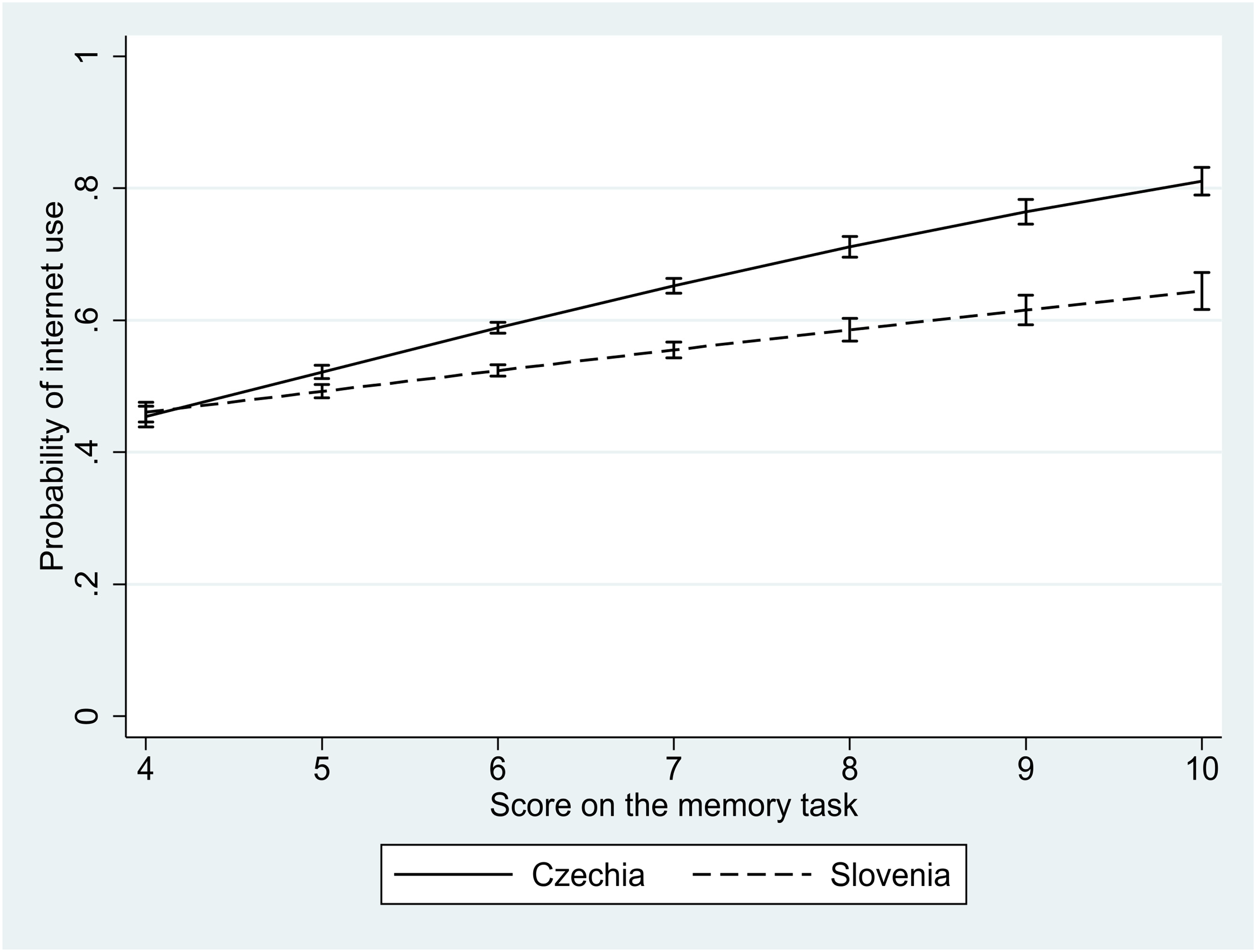
Relationship between performance on word list immediate recall test and probability of internet use (95% CI). CI: confidence interval.
Figure 3 displays the association between performance on the word list immediate recall test and the predicted probability of internet use, based on marginal effects estimation. Consistent with expectations, higher memory scores are associated with increased likelihood of internet use in both countries, independent of other respondent characteristics. While the effect is stronger in Czechia than in Slovenia, this difference reaches statistical significance only at higher memory score levels. At lower scores (e.g. a score of 4), the cross-national difference is not statistically significant, as indicated by overlapping 95% confidence intervals.
Discussion
Analyses of the SHARE dataset demonstrate that cognitive abilities are significant predictors of internet use across the full range of cognitive performance, even after excluding individuals with probable cognitive impairment and controlling for age, gender, educational attainment, and partnership status. These findings support our first hypothesis, indicating that older adults with higher cognitive abilities are more likely to engage with digital technologies. Drawing on pre-pandemic data collected in 2019, the results suggest a robust association between cognitive functioning and digital engagement among cognitively healthy older adults. The findings related to our second hypothesis—that the relationship between cognitive ability and internet use would be consistent across Slovenia and Czechia—were inconclusive. Although the two countries share historical and cultural similarities, we observed substantial differences across nearly all independent and control variables, suggesting notable national variation in the cognitive and demographic predictors of internet use. However, when incorporating interaction terms with country as a moderating variable, the results indicated no significant differences between Slovenia and Czechia in the associations involving gender and education. Furthermore, the relationship between living arrangements and internet use appeared to be comparable across both countries.
Cognitive functioning is widely recognized as a key determinant of internet use and digital literacy, particularly in aging populations. 47 As noted in the Introduction, numerous studies have identified cognitive abilities—such as working memory and processing speed—as significant predictors of digital performance across the adult lifespan. These cognitive domains are crucial for managing common online tasks, including social networking, information retrieval, appointment scheduling, online banking, and e-commerce activities.27,28,48–50 Despite this, relatively few studies have focused specifically on older adults. Existing research—such as that by Calhoun and Lee, 34 Czaja et al., 48 and Freese et al. 51 —has nevertheless found a consistent positive association between cognitive functioning and internet use in later life. Our study advances this literature by demonstrating that cognitive functioning remains a significant predictor of digital engagement among older adults, even after excluding individuals with probable cognitive impairment from the analysis. This finding underscores the relevance of preserved cognitive capacity in enabling older adults to participate meaningfully in the digital world.
Using a comprehensive sample of Slovenian and Czech participants from the SHARE wave 8 dataset, our analyses demonstrate that cognitive abilities remain significant predictors of internet use, even after adjusting for gender, age, education, and partnership status. Specifically, individuals with higher performance on cognitive assessments of short-term and working memory were more likely to report regular internet use. This relationship was observed consistently across both countries. Importantly, the association remained robust even after excluding participants with probable cognitive impairment, as defined by Petersen et al.'s criteria. 45 This methodological refinement was guided by prior findings from Barbosa et al., 52 who reported high prevalence rates of cognitive impairment in older adults across key domains: 24.8% for numeracy, 27.6% for verbal fluency, and 50.5% for memory.
To our knowledge, this is the first study to establish a significant association between internet use and cognitive functioning among older adults with preserved cognitive abilities. These findings have direct implications for the design of digital interventions: web-based interfaces and training programs targeting cognitively healthy older adults should be tailored to decrease cognitive load and enhance usability. For a more comprehensive overview of design recommendations, readers are referred to reviews by Berkowsky and Czaja 53 and Rogers et al. 54
Control variables
While digital literacy has been widely studied among younger populations, considerably less attention has been directed toward the participation of older adults in the design and development of digital technologies (see review of Oh et al. 55 ) Consistent with previous research, our findings reaffirm a strong negative association between age and internet use, even after controlling for other relevant factors. As illustrated in Figure 4, internet engagement declines markedly with age: by 85 years of age, only approximately 30% of individuals in Czechia and 20% in Slovenia report using the internet. This trend is in line with findings from Jørgensen et al., 56 who similarly documented age-related declines in ICT use. Such reductions are plausibly linked to age-associated declines in cognitive and physical functioning,57,58 as well as the increasing prevalence of chronic conditions and multimorbidity in later life. 59
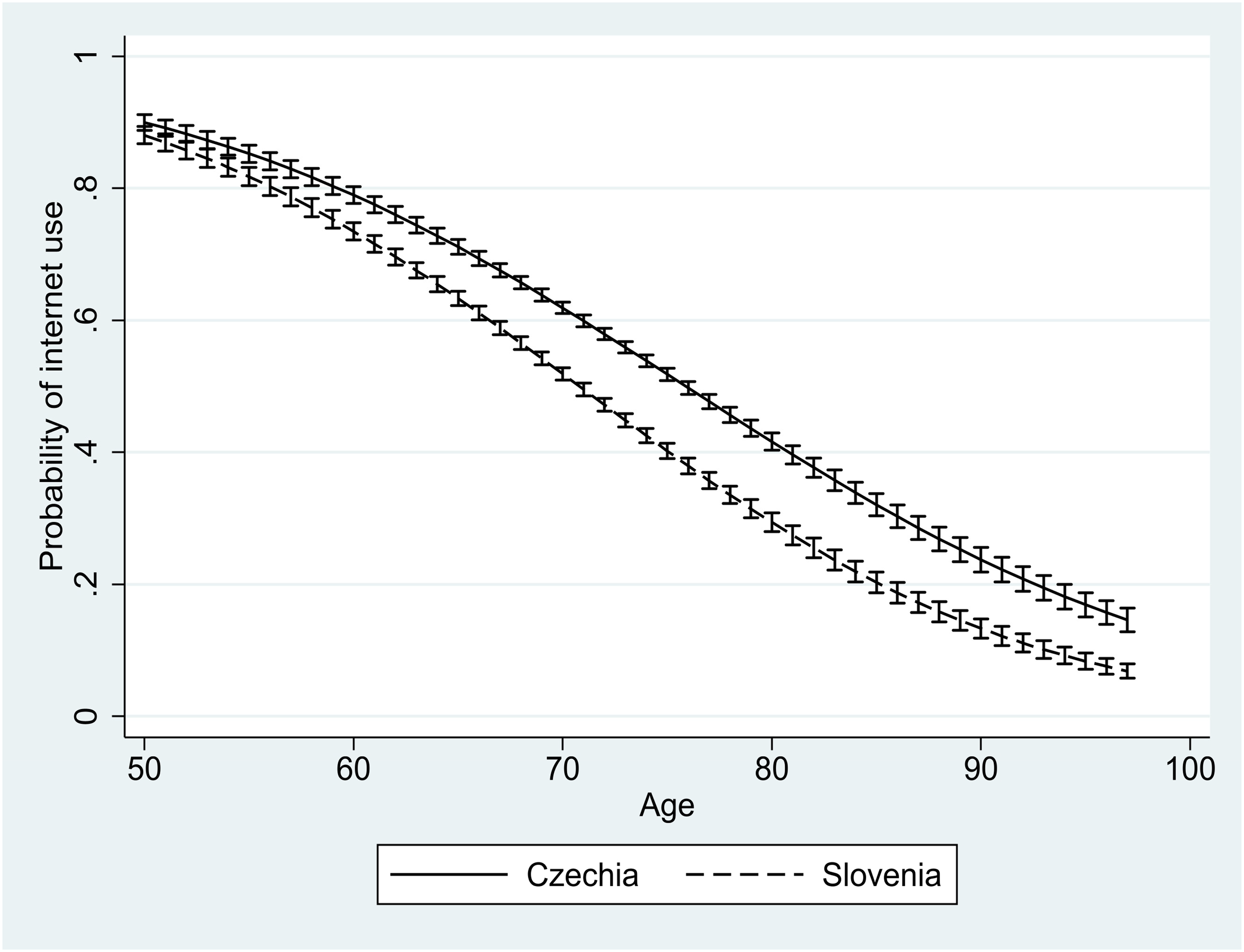
Relationship between age and probability of internet use (95% CI). CI: confidence interval.
Our findings are consistent with prior research demonstrating a strong positive association between internet use and educational attainment (see Figure 5). Data from SHARE wave 8 indicate that older adults with higher levels of formal education are significantly more likely to use the internet. Specifically, the odds of internet use were more than twice as high among those with higher educational attainment compared to their less-educated peers, with odds ratios of 2.255 in Slovenia and 2.037 in Czechia.

Relationship between education and probability of internet use (95% CI). CI: confidence interval.
These results align with international evidence. According to the Organization for Economic Co-operation and Development's (OECD) 2022 report, 7 educational attainment is a major determinant of digital engagement. Across OECD countries participating in the European Union Survey on Information and Communication Technologies, nearly all tertiary-educated adults aged 25–54 used the internet at least once per week in 2021, compared to only 85% of those with less than upper secondary education. The educational gradient is even more pronounced among older adults: among those aged 55–74, weekly internet use ranged from 57% among individuals with less than upper secondary education to 80% for those with upper secondary or post-secondary non-tertiary education, and 95% for those with tertiary education.
These trends are supported by additional empirical studies. For example, Hülür and Macdonald, 60 using Health and Retirement Study data, found that higher educational attainment significantly increased the likelihood of internet adoption among older adults. Similarly, Van Deursen et al., 10 analyzing data from a nationally representative Dutch sample (2010–2013), reported that individuals with higher education levels were more frequent internet users. Tirado-Morueta et al. 61 further noted that higher educational attainment is also associated with greater physical access to digital technologies, reinforcing the role of education in both access and usage.
Among the control variables, hierarchical logistic regression analysis revealed a gender gap in internet use, with women reporting lower rates of digital engagement than men. Based on marginal effects estimation, the predicted probability of internet use among women was 0.557 in Czechia and 0.492 in Slovenia, compared to 0.605 and 0.555, respectively, for men. These findings are consistent with those reported by Kim et al., 62 who observed that older women consistently lag behind their male counterparts in the adoption of ICT. Moreover, Kim et al. 62 also noted gender differences in ICT usage patterns, with men and women often engaging in different types of online activities.
Our study did not include a detailed examination of the mechanisms underlying these gender differences. Questions remain as to whether older women find digital platforms less engaging than men or are less involved in specific internet-based activities such as online banking, healthcare scheduling, information seeking, or digital communication with family and institutions. It is also possible that women engage less frequently in communication with significant others via digital channels. Broader life course factors—such as differences in educational attainment, employment history, income, and caregiving responsibilities—may also contribute to these disparities. Further research is needed to examine these potential mediators and better understand the structural and psychosocial drivers of gendered patterns in digital engagement among older adults.
Our findings also indicate that living arrangements—specifically, whether an individual lives with a partner—are significantly associated with internet use in both Slovenia and Czechia, despite notable differences in the proportion of individuals living alone. In Czechia, 38% of SHARE participants lived alone compared to 25% in Slovenia. In both countries, living with a partner was associated with a significantly higher likelihood of internet use. In Czechia, the predicted probability of internet use was 0.508 for individuals living alone and 0.616 for those living with a partner, with non-overlapping confidence intervals indicating a statistically significant difference. A similar pattern was observed in Slovenia, where individuals living alone had a predicted probability of 0.383, compared to 0.563 for those living with a partner, again with non-overlapping confidence intervals confirming the robustness of the association.
These findings challenge the common assumption that individuals living alone are more likely to use the internet to compensate for limited face-to-face social interaction. One possible explanation is that older adults living alone in both countries may encounter greater barriers to digital access and support, such as limited social capital or limited exposure to technology within their immediate environment. Conversely, those living with a partner may benefit from shared resources, mutual encouragement, or collaborative learning opportunities that facilitate digital engagement. This cross-national pattern warrants further investigation to examine the cultural, infrastructural, and policy-related factors that may shape how living arrangements relate to internet use among older adults.
ICT have been widely recognized as valuable tools for mitigating social isolation and loneliness among older adults. For instance, Chopik et al. 32 found that ICT use was associated with diminished feelings of loneliness, which in turn correlated with fewer depressive symptoms, better self-rated health, and enhanced subjective well-being. Similarly, Soundararajan et al. 63 reported that greater proficiency in social digital literacy was linked to stronger social connectedness, lower levels of loneliness, and overall improvements in well-being and quality of life. These findings highlight the potential of digital engagement to serve as a protective factor against the negative psychosocial outcomes commonly experienced in later life.
Given its capacity to facilitate social connection, ICT may serve as a critical tool in mitigating the emotional and social consequences of loneliness, particularly during periods of enforced isolation such as the COVID-19 pandemic. 64 Among older adults, the use of ICT has been shown to support mental health and contribute positively to overall quality of life by addressing social and emotional needs.65,66 However, further research is needed to assess the effectiveness of targeted interventions aimed at enhancing digital literacy. Such efforts may be essential in reducing social isolation and loneliness and, in turn, improving the well-being and quality of life of older populations.
Ultimately, while demographic factors such as age, gender, education, and living arrangements are significantly associated with ICT use among older adults, they were not the sole determinants. Rather than acting in isolation, these demographic factors likely interact with a broader range of mediating variables—including cognitive abilities, perceived usefulness of technology, and workplace-related stressors—which together shape the nature and extent of digital engagement in later life. 67
Comparisons between Czechia and Slovenia
While our findings show that the same key predictors—such as cognitive functioning, education, and age—are significantly associated with internet use in both Slovenia and Czechia, a more detailed analysis reveals substantial differences in the magnitude of these associations across the two countries. These differences are evident across nearly all independent and control variables. To place our findings in a broader context and better understand national disparities, we extended our analysis by comparing Slovenia and Czechia with other European countries included in the SHARE dataset. Specifically, we examined cross-national patterns in cognitive functioning and digital engagement among older adults to determine whether the trends observed in Slovenia and Czechia are consistent with, or deviate from, broader European patterns.
Regarding internet use, König et al., 6 using SHARE wave 6 data, demonstrated substantial cross-national differences in digital engagement among older adults across Europe. On average, 49% of respondents reported using the internet, but usage rates varied markedly by country. Slovenia exhibited higher internet use compared to Poland, Croatia, and Greece, yet lagged behind Italy, Spain, and Portugal. In contrast, the Czech Republic was among the countries with internet usage rates exceeding 50%, placing it closer to the more digitally engaged nations in the SHARE sample.
Findings on cognitive performance across European countries using SHARE wave 6 data have shown considerable variability. Kamin and Lang 68 analyzing SHARE data from waves 5 and 6 across 14 countries—including Slovenia and Czechia—reported that internet use had a stronger effect on cognitive functioning than the reverse. However, their analysis did not disaggregate results by country, limiting country-specific interpretation. In a related study, Barbosa et al. 52 used data from 17 European countries in SHARE wave 6 and reported that both Slovenia and Czechia fell within the range of 10–12% prevalence of temporal orientation impairment among adults aged 55 and older. Country-level differences in cognitive test performance were more explicitly examined by Lavrač and Srakar (in 68 ) who analyzed SHARE wave 4 data. Their findings indicated that older adults in Slovenia scored below the SHARE average on tests of memory, numeracy, and delayed recall, while scoring slightly above average in verbal fluency. Conversely, Czech participants outperformed the SHARE average in memory, numeracy, and verbal fluency, though they scored slightly below average in delayed recall.
Overall, this brief comparative review supports the credibility of our findings by aligning with existing evidence on differences between Czechia and Slovenia. While our results reveal notable distinctions between the two countries in predictors of internet use, it is important to underscore that both nations are consistently positioned around the European average with respect to cognitive functioning and digital engagement, according to SHARE data. This classification reinforces the relevance of our comparative analysis within the broader European context. Moreover, existing evidence from SHARE highlights substantial cross-national variability in internet use and cognitive abilities, underscoring the importance of contextual factors. However, the current evidence base remains insufficient to draw definitive conclusions about the mechanisms underlying these disparities. Notably, neither our study nor prior SHARE-based analyses were specifically designed to probe national differences in depth. Future research should employ more targeted designs and incorporate additional explanatory variables—such as access to digital technologies, ICT-related attitudes, and emotional well-being—that may mediate the relationship between cognitive functioning and digital engagement. Such efforts are essential to inform nuanced, context-sensitive strategies aimed at promoting digital inclusion among older adults across diverse European settings.
Limitations
While this study benefits from the use of nationally representative samples, several limitations should be acknowledged. First, internet use was assessed using a single-item binary measure, which does not capture the frequency, duration, or diversity of online activities and may be subject to limited reliability. Although König et al. 6 have demonstrated that this measure is a reasonable proxy for general internet engagement, more comprehensive assessments—such as those that examine frequency and breadth of use—would provide a richer understanding of digital behavior, as recommended in prior research.28,48
Second, the scope of cognitive assessment in our study was limited. A more extensive neuropsychological battery may have yielded a more nuanced picture of how specific cognitive domains relate to distinct types of internet activities (e.g. passive browsing vs. active communication). As prior research suggests, the strength and nature of the association between internet use and cognitive function may vary depending on the type of online activity and the cognitive domain assessed. 69
Finally, the inclusion of additional control variables—such as internet access, attitudes toward ICT, problematic internet use, 70 emotional well-being, and digital self-efficacy—could further elucidate the complex relationship between cognitive functioning and digital engagement.67,71,72 Future research should address these limitations by investigating how specific aspects of internet use interact with cognitive abilities and by incorporating a broader range of individual, contextual, and technological factors.
This study makes a meaningful contribution to the growing body of literature on digital engagement in later life by demonstrating a robust positive association between internet use and cognitive functioning—particularly after excluding individuals with probable cognitive impairment. These findings underscore the role of cognitive ability as a key determinant in the use and adoption of digital technologies among older adults, consistent with prior research.28,48,68 To the best of our knowledge, this is among the first studies to provide evidence that higher cognitive functioning is significantly associated with increased likelihood of internet use over time. We propose that cognitive ability becomes an increasingly salient factor in digital adoption during later life, as individuals face heightened functional limitations and cognitive decline—factors that may amplify disparities in digital engagement.
Conclusion
This study advances the understanding of computer literacy and the digital divide by analyzing nationally representative data from 10,150 respondents in Slovenia and 12,050 in the Czech Republic, derived from the SHARE wave 8 dataset. The findings reveal a significant association between increased ICT use and higher cognitive functioning, even after controlling for age, gender, and educational attainment. As expected, internet use declined with advancing age but increased among individuals with higher cognitive abilities—an effect that remained robust even after excluding participants with mild or more severe cognitive impairment. These results highlight the critical role of cognitive functioning in shaping digital engagement among older adults and underscore the need to integrate cognitive considerations into digital inclusion strategies.
Given the limited resources available for promoting digital literacy in aging populations, it is essential to adopt a multifactorial approach when designing interventions. Beyond commonly cited barriers such as technology-related anxiety and lack of self-efficacy, efforts should also account for individual differences in age, gender, education, socioeconomic status, and cognitive capacity. Expanding opportunities for older adults to integrate technology into their daily lives not only fosters digital inclusion but also provides meaningful avenues for social connection, self-expression, and participation in an increasingly digital society.
Footnotes
Acknowledgments
We thank the SHARE research team and all survey participants for their invaluable contributions to this international research infrastructure.
Ethics approval and consent
The SHARE data collection is subject to ongoing ethical review, both centrally and, where required, by national ethics committees or institutional review boards. These reviews ensure compliance with legal norms and international ethical standards, including the Respect Code of Practice for Socio-Economic Research and the Declaration of Helsinki.
Participation in SHARE was voluntary and based on informed consent, ensured at three levels:
Potential respondents receive an invitation letter with a data protection statement, updated for GDPR and available in all national languages. Before the interview, trained interviewers explain the study, provide data protection information again, and document the respondent's consent. During the interview, respondents may skip any question they prefer not to answer.
Consent for publication
Not applicable.
Author contributions
Conceptualization: VK, PS, TD, and BG; data curation: PS, TD, and BG; formal analysis: VK and TD; funding acquisition: VK; investigation: VK, PS, TD, and ZMK; methodology: VK, PS, TD, and JG; project administration: PS, ZMK, and BG; resources: VK, PS, TD, ZMK, and BG; supervision: VK and PS; validation: VK, PS, and TD; visualization: TD; writing—original draft: VK, PS, and TD; writing—review and editing: ZMK, JG, and BG.
Funding
The authors disclosed receipt of the following financial support for the research, authorship, and/or publication of this article: The work on this paper is part of the project “Effect of digitalisation in (post)COVID-19 era on quality of life, and social inclusion of older adults” (DIGOLD), which is funded by the Czech Science Foundation (GAČR), project No. 22-05059L and by the Slovenian Research and Innovation Agency (ARIS), project No. J5-4580.
This paper uses data from SHARE wave 8 (DOIs: 10.6103/SHARE.w8.800, 10.6103/SHARE.w8ca.800) for methodological details. (1) The SHARE data collection has been funded by the European Commission, DG RTD through FP5 (QLK6-CT-2001-00360), FP6 (SHARE-I3: RII-CT-2006-062193, COMPARE: CIT5-CT-2005-028857, SHARELIFE: CIT4-CT-2006-028812), FP7 (SHARE-PREP: GA No. 211909, SHARE-LEAP: GA No. 227822, SHARE M4: GA No. 261982, DASISH: GA No. 283646) and Horizon 2020 (SHARE-DEV3: GA No. 676536, SHARE-COHESION: GA No. 870628, SERISS: GA No. 654221, SSHOC: GA No. 823782, SHARE-COVID19: GA No. 101015924) and by DG Employment, Social Affairs & Inclusion through VS 2015/0195, VS 2016/0135, VS 2018/0285, VS 2019/0332, and VS 2020/0313. Additional funding from the German Ministry of Education and Research, the Max Planck Society for the Advancement of Science, the U.S. National Institute on Aging (U01_AG09740-13S2, P01_AG005842, P01_AG08291, P30_AG12815, R21_AG025169, Y1-AG-4553-01, IAG_BSR06-11, OGHA_04-064, HHSN271201300071C, RAG052527A) and from various national funding sources is gratefully acknowledged (see  ).
).
Declaration of conflicting interests
The authors declared no potential conflicts of interest with respect to the research, authorship, and/or publication of this article.
Availability of data and materials
SHARE data are available free of charge for scientific use worldwide. Use is subject to EU and national data protection laws, and the SHARE Conditions of Use. Researchers must register individually, prove affiliation with a recognized scientific institution or provide details about the scientific project and sign the Statement concerning the use of SHARE data. After approval, users get a personal login to the secure data portal to download anonymized data. The data are distributed as scientific-use files (protected by factual anonymity) and may only be used for non-commercial scientific research.
Guarantor
VK serves as the guarantor and accepts full responsibility for the integrity of the work.