




Abstract
Objective
This study aims to investigate how eHealth use and information-seeking behavior affect older adults’ acceptance of genetic testing, focusing on their participation in genetic tests and their willingness to adopt lifestyle changes based on test results. The research highlights the mediating roles of the perceived importance of genetic information (PIGI) and cancer worry.
Methods
This cross-sectional study used secondary data from the Health Information National Trends Survey (HINTS 5, Cycle 4), conducted in 2020. The analysis included 1852 adults aged 60 and above. Two mediation models were tested using SPSS 25. Model 1 examined the relationship between eHealth use, perceived importance of genetic information (PIGI), and genetic test behavior. Model 2 analyzed how cancer information-seeking influences willingness to change lifestyle behavior (WCLB) based on genetic test results, with cancer worry as a mediator.
Results
Both models showed statistically significant mediation effects (p < 0.05). Model 1 found that eHealth use positively influences genetic test behavior through PIGI. Model 2 revealed that cancer information-seeking indirectly impacts willingness to change lifestyle behavior (WCLB) based on the genetic test results via cancer worry, confirming a full mediation effect. Additionally, among demographic variables, educational level was the strongest predictor of genetic test behavior, while gender significantly predicted WCLB, with older female adults showing higher intentions to change their lifestyle based on genetic test results than males.
Conclusion
The study highlights the pivotal roles of PIGI and cancer worry in shaping older adults’ acceptance of genetic testing, encompassing both performing genetic test behaviors and adopting lifestyle changes based on test results. These findings offer actionable insights for designing targeted health communication strategies and interventions to enhance genetic testing uptake and foster proactive health management among older populations.
Introduction
eHealth refers to the use of information and communication technologies (ICT) like computers, smartphones, and other digital tools to access, manage, and exchange health-related information and services. 1 It encompasses activities such as online health information-seeking, electronic communication with healthcare providers, accessing medical records, and telemedicine services. 2 With the advent of digital health technologies, eHealth has become a significant tool in healthcare delivery, particularly for older adults who are increasingly engaging with eHealth resources despite barriers like digital literacy and access.3,4 eHealth use has a potential relationship with genetic testing behaviors. By utilizing eHealth platforms to seek health information, older adults can gain a deeper understanding of the diagnostic role of genetic tests for diseases such as cancer, heart disease, and Alzheimer's disease5–8 and even encourage them to seek additional details,9,10 further increasing the acceptance of genetic testing.
In light of this relationship, genetic testing offers significant benefits for older adults, serving as an effective method for detecting diseases such as cancer, heart disease, and Alzheimer's disease.5–8 Conversely, those who do not undergo genetic testing risk missing opportunities for early detection, preventive measures, and necessary lifestyle modifications to mitigate potential risks.11–13 eHealth tools play a pivotal role in promoting genetic testing by providing older adults with access to medical test results and enabling communication with healthcare providers. 14 These interactions may lead to recommendations for genetic testing or prompt individuals to seek additional genetic test information online.9,10 The accessibility and convenience of eHealth tools further reduce barriers to obtaining genetic testing-related information, fostering a positive association between eHealth use and the decision to accept genetic tests. 15 Previous studies have highlighted the relationship between eHealth use and genetic testing behaviors.15–18 For instance, research has shown that higher contact with eHealth information is linked to increased participation in preventive health behaviors. 16
Information-seeking behavior also may enhance older adults’ confidence in managing genetic test results, which could motivate their willingness to modify their lifestyle behaviors based on these results.19–21 When individuals actively seek cancer-related information, they gain a sense of empowerment, enabling them to take control of their health. 22 This sense of empowerment can enhance their willingness to take action based on the results, such as making changes to their diet, exercise habits, or preventive care.20–22 For example, research has shown that information-seeking, when accompanied by a critical approach to selecting information sources and minimal barriers to information behavior, is strongly associated with high health self-efficacy beliefs. These factors, in turn, contribute to a greater willingness to engage in healthy behaviors. 23 Besides, cancer information seekers were more inclined to follow through with lifestyle recommendations after receiving genetic test results, 24 reflecting a potential positive correlation between information-seeking and the willingness to change behavior based on genetic test results. This is particularly relevant for individuals considering genetic testing, as those with higher self-efficacy and an understanding of the necessity of lifestyle changes to mitigate disease risks are more likely to undergo genetic testing. 25
The acceptance of genetic testing among older adults can be comprehensively assessed by two distinct but interrelated aspects: genetic test behavior and the willingness to change lifestyle based on genetic test results. 26 First, genetic test behavior refers to the decision to undergo genetic tests, which may be influenced by factors such as perceived benefits, risks, accessibility, and understanding of the test. 27 Second, the willingness to change lifestyle, which is based on genetic test results represents the proactive measures individuals are willing to adopt after receiving their genetic information, such as dietary changes, 28 physical activity change, 29 and regular health screenings.19,24 This aspect reflects the practical application of genetic information in daily life. 30 Integrating these two aspects allows for targeted interventions that can maximize the benefits of the test and results. 26
In summary, genetic testing offers significant potential benefits for older adults, with potential correlations between communication factors and the acceptance of genetic testing. However, the acceptance of genetic testing remains limited within this population.31–33 A significant gap persists in understanding how these communication factors influence genetic test acceptance, particularly through the mediating roles of the perceived importance of genetic information and cancer worry. Previous studies have primarily focused on the direct effects of eHealth use and information-seeking on genetic test behaviors34,35 while giving limited attention to indirect effects and the underlying psychological mechanisms. Furthermore, discussions regarding the willingness to change health behaviors based on subsequent genetic test results remain limited. To address these gaps, this research focuses on the acceptance of genetic testing from two perspectives: genetic test behaviors and the willingness to change lifestyle behaviors based on genetic test results. Specifically, we present the following research questions and the first two hypotheses:
How does eHealth use and perceived importance of genetic information influence the acceptance of genetic test behavior among older adults? How do cancer information-seeking and cancer worry influence the willingness to change lifestyle behaviors based on genetic test results among older adults?
The psychological-related mechanisms of cancer worry and the perceived importance of genetic information can be explained by the stimulus-organism-response (SOR) theory. The SOR theory, originally developed by Mehrabian et al., 36 posits that external stimuli (S) elicit internal cognitive and emotional responses (O), which subsequently lead to observable behaviors (R). This theory has been widely applied in various fields, including health communication.37–39 In the context of health communication, the SOR framework has been utilized to explore how information factors impact health-related behaviors.40–42 For instance, research has shown that exposure to health information can evoke psychological responses such as fear or anxiety, which in turn influence preventive health behaviors. 43 Additionally, research has shown that fear and risk perception could mediate the relationship between social media exposure and vaccination behaviors. 41 Therefore, this theoretical framework is valuable for examining the pathways through which health communication affects behavior, providing insights into the underlying cognitive and emotional processes. In this study, the SOR theory is relevant for understanding how eHealth use and cancer information-seeking influence older adults’ acceptance of genetic testing. In particular, eHealth use (S) affects the decision to take genetic test behavior (R) through the perceived importance of genetic information (O). Similarly, cancer information-seeking (S) influences the willingness to change lifestyle behaviors based on genetic test results (R) through cancer worry (O).
One key factor that may influence the relationship between eHealth use and genetic test behavior is individuals’ perceptions of genetic testing. 33 Specifically, prior studies suggest that eHealth use has the potential to shape the perceived importance of genetic information for cancer prevention and detection.44–46 First, the increasing prevalence of eHealth tools among older adults has provided unprecedented access to health-related information,2,47,48 including genetic data 49 and details about genetic testing, its benefits, and implications.17,50–52 This expanded access may enhance older adults’ understanding of the importance of genetic information.31,35 For example, one study found that older adults who frequently used eHealth tools reported greater awareness and understanding of genetic testing, attributing this to the comprehensive and easily accessible information provided by such tools. 53 Second, eHealth tools deliver personalized health information,54,55 which is often perceived as more relevant and meaningful.56–58 This personalization is more likely to increase the perceived importance of genetic information for cancer prevention and detection. 59 Third, eHealth tools facilitate communication with healthcare providers, who are trusted sources of medical advice. 2 Their recommendations can significantly influence patients’ perceptions. 60 Older adults who use eHealth tools to interact with healthcare providers are more likely to receive professional guidance emphasizing the importance of genetic testing for cancer prevention and detection.61,62 Such interactions may reinforce their perception of the significance of genetic information.
Based on the SOR framework, eHealth use acts as the stimulus that provides access to genetic information, which can influence older adults’ perceived importance of genetic information, resulting in a response (genetic test behavior).
36
This means that older adults perceive the importance of genetic information for cancer prevention and serve the role of a mediator between eHealth use and genetic test behavior. Furthermore, the potential mediating role of the perceived importance of genetic information is supported by empirical evidence.63,64 For instance, research has shown that individuals who used eHealth tools to access genetic information were more likely to perceive genetic testing as important for disease prevention, and were more likely to undergo genetic tests.
65
Based on these reasons, we propose the following hypotheses:
Older adults can seek cancer information to understand the risks and the preventive measures they can take. 35 This information-seeking behavior also amplifies their fear and worry about cancer, 66 which in turn may impact their willingness to change lifestyle behavior. 67 Based on the SOR framework, the external stimuli (cancer information-seeking) influence an individual's internal states (cancer worry), ultimately affecting their behavioral responses (WCLB), 36 which means that cancer worry serves as a mediator between cancer information-seeking and willingness to change lifestyle based on the genetic results.
First, evidence suggests that seeking cancer-related information can influence worry about cancer.66,68,69 Cancer information-seeking involves actively looking for information about cancer risks, prevention, and treatment options.70–72 This behavior can increase awareness and understanding of personal health risks. 73 However, it can also lead to increased cancer worry, which is defined as concern or anxiety about developing cancer. 68 Cancer worry can be both a motivator and a barrier to health-promoting behaviors. On one hand, heightened cancer worry may drive individuals to adopt preventive measures and make lifestyle changes. On the other hand, excessive worry can lead to avoidance behaviors and denial. 74 Second, research indicates that cancer worry can significantly influence health behaviors.75,76 For instance, a study found that higher levels of cancer worry were associated with greater intentions to engage in preventive behaviors, 77 such as screening and lifestyle changes. 78 Furthermore, in addition to the SOR framework, the risk perception attitude (RPA) framework also can explain the role of cancer worry in mediating the relationship between cancer information-seeking and behavior change. 79 This framework suggests that individuals who perceive themselves as being at high risk and experience significant worry are more likely to engage in health-promoting behaviors. 79 Similarly, tailored health communication that also acknowledges and addresses cancer worry can more effectively promote behavior change. 59 Moreover, empirical evidence also underscores the mediating role of cancer worry.2,74 For instance, research has shown that individuals with higher cancer worry were more likely to report intentions to undergo genetic tests and adopt lifestyle changes if they received positive test results. 74 In summary, based on the reasons discussed above, we formulated the following hypotheses, and the whole model is shown in Figure 1:

The theoretical model of acceptance of genetic testing.
Materials and methods
Study design and sample population
This cross-sectional study utilized secondary data from the Health Information National Trends Survey (HINTS 5, Cycle 4), conducted between February 2020 and June 2020. Administered by the National Cancer Institute in the United States, HINTS aims to collect nationally representative data on American adults’ access to health-related information, health behaviors, and health outcomes. The survey design and sampling procedures for HINTS have been comprehensively detailed in prior research. 80 The final sample consisted of 3865 respondents, yielding a response rate of 36.7% from the initial 10,531 participants. For this study, only older adults aged 60 or above (Age ≥ 60) were included, yielding a final analytic sample of 1852 participants. Respondents younger than 60 were excluded from the analysis.
Variables and measurements
eHealth
eHealth use was measured with four items, drawn from previous research. 81 Respondents were asked whether, in the past 12 months, they had used a computer, smartphone, or other electronic means to (1) look for health or medical information; (2) communicate with a doctor or a doctor's office; (3) lookup medical test results; and (4) make appointments with a health care provider. The answers (0 = no, 1 = yes) of the items were summed to create the index of eHealth use. Larger numbers meant greater use of eHealth technology (Cronbach's alpha = 0.91, M = 1.80, SD =1.70).
Cancer information-seeking
A single-item measure was used to assess cancer information-seeking behavior drawn from previous research. 82 Participants were asked: “Have you ever looked for information about cancer from any source?”, and responses were recorded using a binary classification where 1 represents “yes” and 0 represents “no” (M = 0.48, SD =0.50).
Acceptance of genetic testing
The first dependent variable is “genetic test behaviors.” Our study focuses on the cancer prevention and detection of older adults, so we integrate interrelated health behaviors, which are critical for cancer prevention and detection, into a composite variable for a specified population. This is supported by a previous study, which leveraged the same data source to identify two cancer screening behaviors and assess their prevalence among women. 42 Our focus extends to clinical cancer genetic testing among older adults, incorporating not only “high-risk cancer testing” but also “ancestry testing” and “genetic health risk testing,” collectively termed “genetic test behaviors.” This is adapted from a previous study that used the same dataset. 83 “Ancestry testing” is pivotal in assessing cancer risk as it provides insights into an individual's genetic and ethnic backgrounds, thereby facilitating more personalized cancer screening and prevention strategies. 84 Similarly, “genetic health risk testing” is crucial for cancer detection and prevention, as it supports early cancer screening for older adults. The effectiveness of these genetic tests in identifying risks for specific cancers, such as breast, ovarian, and prostate cancers, is thoroughly documented in the 23andMe research publications. 85 Based on these reasons, we employ three items to measure genetic test behaviors. The participants were asked about their experience with the following types of genetic tests: (1) ancestry testing, to determine the background or geographic/ethnic origin of an individual's ancestors (e.g. Ancestry.com and 23andMe); (2) high-risk cancer testing (e.g. testing for BRCA1/2 or Lynch syndrome); and (3) genetic health risk testing, to assess health risk for a variety of health conditions (e.g. 23andMe). Each response was coded as a binary classification (1 = yes, 0 = no), and the responses were summed to create a scale ranging from 0 to 3, where 3 indicates participation in all types of genetic testing and 0 indicates none (Cronbach's alpha = 0.74, M = 1.15, SD = 0.38).
The second dependent variable is “willingness to change lifestyle behavior based on the genetic test result.” It was operationalized with one single item, similar to prior research. 83 Respondents were asked to rate the following statement: “If I found out from a genetic test that I was at high risk of cancer, I would change my behaviors such as diet, exercise, and getting routine medical tests.” A four-point scale was used (1 = “strongly disagree” to 4 = “strongly agree”), with higher scores representing a greater willingness to change lifestyle behavior based on the genetic test results (M = 0.78, SD = 0.27).
Perceived importance of genetic information
The importance of genetic information was assessed using two items adapted from national surveys using the same data source.44,83 Participants were asked how important they believe knowing a person’s genetic information is for (1) preventing cancer and (2) detecting cancer early. Responses were collected using a four-point scale ranging from 1 (not at all important) to 4 (very important), where higher scores indicate greater perceived importance of genetic information (Cronbach's alpha = 0.92, M = 1.43, SD =0.60).
Cancer worry
Cancer worry was operationalized with one single item, similar to prior research. 86 Respondents were asked to rate their cancer worry with the question “How worried are you about getting cancer?” A five-point scale was used (1 = “not at all” to 5 = “extremely”), where higher scores represented higher levels of cancer worry (M = 0.44, SD =0.31).
Statistical methods
All analyses were conducted using SPSS 25. The two mediation models were analyzed separately. First, the MEAN () function computed the mean of multi-item variables with at least one valid value or single-item variables with valid values; otherwise, the cases were considered missing in the analysis. Second, descriptive statistics were analyzed. Third, multiple linear regression analyses were performed separately for demographic variables, SOR-related theoretical factors, and the two dependent variables. Fourth, to interpret the mediation effect, all variables were rescaled to a 0–1 range using min-max normalization. 87 Regression coefficients calculated on this 0–1 scale were referred to as percentage coefficients (bp), with larger bp indicating greater efficiency. 88 The percentage scores were calculated using the formula in Equation (1). The legitimacy of this scale transformation has been supported by Cohen et al. and used in health studies,89–91 where s p is the percentage score after transformation, s os is the original score, s cx is the conceptual maximum on the original scale, and s cn is the conceptual minimum on the original scale.
Following the previous mediation analysis framework,
92
the percentage contribution (c
p
), also known as the ratio of indirect effect, was calculated to indicate the effect size of the perceived importance of genetic testing for cancer prevention on the relationship between eHealth use and genetic test behaviors and cancer worry on the relationship between cancer information-seeking and willingness to change lifestyle behavior. All effects were assessed using 10,000 bootstrap samples to estimate 95% bias-corrected confidence intervals (CIs).

Results
The mean age of the older adults in this study was 70.98 (SD 8.10; range 60–104) years. There were more female respondents (1028/1852, 55.5%) than male respondents (816/1852, 44.1%). A substantial proportion of participants had received some college education (778/1852, 42.0%) and reported an annual household income between US $20,000 and US $74,999 (797/1852, 43.0%). Regarding marital status, 44.3% (821/1852) of participants were married. The detailed demographic information is summarized in Table 1.
Sample population characteristics (N = 1852).

The results presented in Table 2 indicate that three demographic factors are positively associated with genetic test behaviors among older adult populations. Gender, educational attainment, and income range were all found to be significant predictors. Of these, educational level exhibited the most robust association, with a percentage coefficients of 0.45 (95% CI 0.38–0.52, p < 0.001). In contrast, when examining older adults’ willingness to change lifestyle behaviors based on genetic test results, only gender emerged as a statistically significant factor (bp = .05, 95% CI 0.03–0.08,
Effects of multiple linear regression.

Note: Base model means demographics and covariates were included. Full model means theoretical variables of S-O-R were also included besides the base model.
S-O-R: Stimulus-organism-response framework; PIGI: perceived importance of genetic information; 95% confidence intervals are in parentheses. Significance levels: ***0.001.
p < 0.001). The percentage coefficient suggests that older female adults, on average, have a 0.05 unit higher behavioral change intention compared to older male adults.
Hypothesis 1 proposed that eHealth use is positively associated with genetic test behaviors. Tables 2 and 3 both show that the direct effect of eHealth use on the genetic test behaviors was found to be statistically significant (bp = 0.17; β = 0.13, 95% CI .013–0.21; p < 0.001). Therefore, Hypothesis 1 is supported.
Mediation models.

Note: Path indicators are percentage coefficient (bp); PIGI: perceived importance of genetic information; WCLB: willingness to change lifestyle behavior; 95% confidence intervals are in parentheses. Significance levels: **0.01, *** 0.001.
Hypothesis 2 proposed that cancer information-seeking is positively associated with the willingness to change lifestyle behavior based on genetic test results. Table 2 shows that the direct effect of cancer information-seeking on the willingness to change lifestyle behavior based on genetic test results is statistically insignificant. Therefore, hypothesis 2 is rejected. However, the table shows that the indirect analysis revealed a significant mediating effect on cancer worry. The full mediation model indicates that while cancer information-seeking does not directly influence the willingness to change lifestyle behaviors, it significantly affects this willingness through the mediation of the cancer worry.
Hypothesis 3 and hypothesis 4 predicted that the perceived importance of genetic information positively mediates the relationship between eHealth use and genetic test behavior. The mediation effects (bp = 0.004; β = 0.003, 95% CI 0.001–0.01) shown in Table 3 were statistically significant. Thus, hypothesis 3 and hypothesis 4 were supported.
Hypothesis 5 and hypothesis 6 predicted that cancer worry positively mediates the relationship between cancer information-seeking and the willingness to change lifestyle behavior based on genetic test results. As shown in Table 3, the indirect relationship between information-seeking and cancer willingness to change lifestyle behavior based on genetic test results (bp = 0.02; β = 0.02, 95% CI 0.01–0.02) via the mediators of cancer worry was statistically significant, and the direct effect is statistically insignificant, so this is a full mediation model, thereby supporting hypothesis 5 and hypothesis 6. The whole effect of the model is shown in Figure 2.
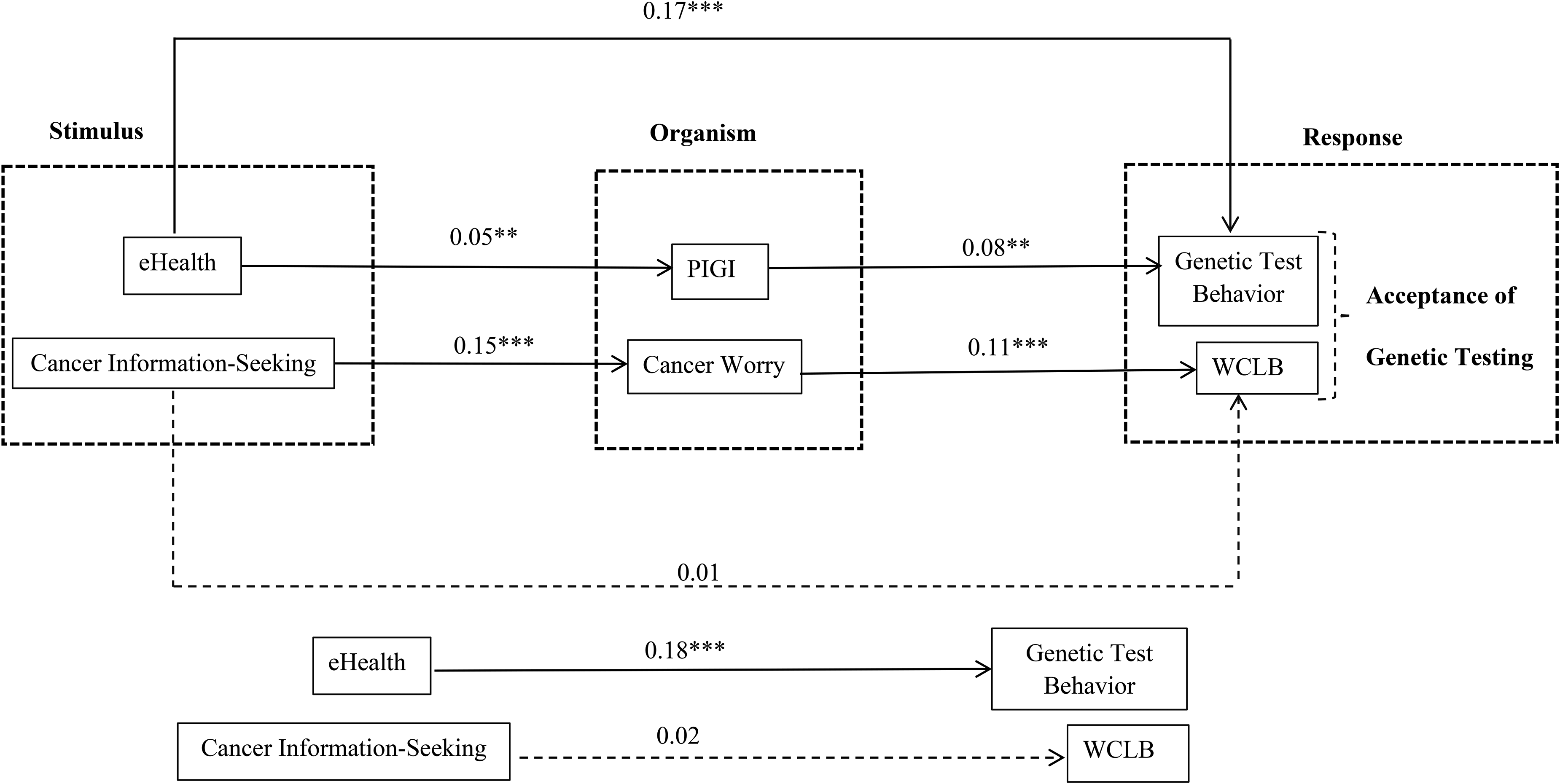
Effects of the mediation models.
Discussion
This study provides new insights into how eHealth use and cancer information-seeking influence older adults’ acceptance of genetic testing, highlighting the mediating roles of the perceived importance of genetic information and cancer worry. The findings contribute to the literature on health communication and genetic testing behaviors among older adults.
The results demonstrate a significant positive association between eHealth use and genetic test behaviors. This finding aligns with previous research suggesting that increased access to digital health information can enhance individuals’ understanding and acceptance of health-related interventions. 34 eHealth platforms provide comprehensive and easily accessible information,50–52 seeking health on eHealth may demystify genetic testing and reduce perceived barriers, thereby fostering a positive attitude toward genetic testing among older adults. 27 The mediating role of the perceived importance of genetic information further elucidates this relationship. The data indicates that eHealth use enhances the perceived importance of genetic information, which in turn promotes genetic test behavior. This mediation effect aligns with the SOR framework, where eHealth use (stimulus) influences the internal cognitive response (perceived importance), leading to a behavioral response (genetic test behavior). 36 This finding is further corroborated by a study highlighting that users who frequently use eHealth tools have higher awareness and understanding of genetic testing. 93 Furthermore, the direct effect of cancer information-seeking on lifestyle change willingness was not significant. However, the mediation analysis revealed that cancer worry plays a crucial role in this relationship. This finding suggests that while seeking cancer information does not directly influence lifestyle change willingness, it significantly impacts this willingness through increased cancer worry. This mediation effect aligns with the SOR framework, where cancer information-seeking (stimulus) influences the internal cognitive response (cancer worry), leading to a behavioral-related response (willingness to change lifestyle behaviors). 36 This means cancer worry, as a mediator, underscores the emotional response elicited by cancer information-seeking, which can motivate individuals to adopt preventive health behaviors. 94 The risk perception attitude (RPA) framework also supports this finding, positing that individuals who perceive a high personal risk and experience high worry are more likely to engage in health-promoting behaviors. 79
The findings of this study offer several practical implications for healthcare providers and policymakers. First, enhancing older adults’ access to eHealth resources can significantly improve their acceptance of genetic tests. Healthcare providers should encourage the use of eHealth platforms and guide individuals in navigating these resources to enhance their perceived importance of genetic information. Furthermore, personalized health messages delivered through eHealth platforms can further reinforce the significance of genetic testing for cancer prevention. Second, cancer information dissemination must consider its emotional impact. Grounded in the SOR framework, this study suggests that cancer information-seeking (stimulus) increases cancer worry (organism), which drives positive behavioral changes, such as adopting healthier lifestyles based on genetic test results (response). Research supports the effectiveness of tailored communication in optimizing the impact of cancer worry by addressing specific concerns like excessive worry, while preserving its role as a motivational driver for health-related behavior changes.95,96 For example, tailored messaging has been shown to improve preventive health behaviors by aligning content with individual needs and emotional states.95,96 The study highlights the need for interventions tailored to the characteristics and needs of older adults. Medical education programs should address cognitive gaps among older adults with lower education levels, improving their understanding of genetic testing and its benefits. Gender-specific strategies can further promote lifestyle changes, particularly among older women, by addressing their unique health concerns and motivations. These targeted approaches can enhance the effectiveness of genetic testing interventions and encourage healthier lifestyle choices in aging populations.
Limitations and future research
Despite its contributions, this study has several limitations. The cross-sectional design of the HINTS data limits the ability to establish causal relationships. Longitudinal studies are needed to confirm the causal pathways proposed in this study. Additionally, the self-reported nature of the data may introduce response biases. Future research should consider using objective measures of eHealth use, cancer information-seeking, and genetic test behaviors. Furthermore, this study focused on older adults in the United States, and the findings may not be generalizable to other populations or cultural contexts. Comparative studies across different countries and cultures can provide a more comprehensive understanding of the factors influencing genetic testing acceptance.
Conclusion
This study highlights the importance of eHealth use and cancer information-seeking in influencing older adults’ acceptance of genetic testing, mediated by the perceived importance of genetic information and cancer worry. By understanding these mediating pathways, healthcare providers and policymakers can develop targeted interventions to enhance the acceptance of genetic testing and promote preventive health behaviors among older adults. Future research should continue to explore these relationships and consider additional psychosocial factors that may influence genetic testing behaviors.
Supplemental Material
sj-docx-1-dhj-10.1177_20552076251317658 - Supplemental material for How eHealth use and cancer information-seeking influence older adults’ acceptance of genetic testing: Mediating roles of PIGI and cancer worry
Supplemental material, sj-docx-1-dhj-10.1177_20552076251317658 for How eHealth use and cancer information-seeking influence older adults’ acceptance of genetic testing: Mediating roles of PIGI and cancer worry by Yingxia Zhu, Qian Erica Xiao, Man Chon Ao and Xinshu Zhao in DIGITAL HEALTH
Footnotes
Contributorship
YZ developed the concept of this study and conducted the material preparation, data collection, and analysis. QEX, MCA, and XZ contributed to the methodology and interpretation and provided critical revisions to the work.
Data availability
The data that support the findings of this study are available from the National Cancer Institute's Health Information National Trends Survey (HINTS) website: https://hints.cancer.gov/.
Declaration of conflicting interests
The authors declared no potential conflicts of interest with respect to the research, authorship, and/or publication of this article.
Ethical approval
HINTS received approval from the Westat Institutional Review Board and was designated as exempt by the US National Institutes of Health Office of Human Subjects Research Protections due to the de-identification of the data. Analyses using the HINTS database met the criteria for research involving non-human subjects, as determined by the Johns Hopkins University School of Medicine Institutional Review Board. Consequently, this analysis did not require additional review. Expedited approval for HINTS was obtained under project number 6048.14 (FWA 00005551).
Funding
The authors disclosed receipt of the following financial support for the research, authorship, and/or publication of this article: This research was supported in part by grants from the University of Macau, including CRG2021-00002-ICI, ICI-RTO-0010-2021, CPG2022-00004- FSS, and SRG2018-00143-FSS; Macau Higher Education Fund, HSS-UMAC-2020-02.
Informed consent
This study used secondary data. The HINTS data make sure that participants provided informed consent for participation in the study.

Supplemental material
Supplemental material for this article is available online.
Notes
References
Supplementary Material
Please find the following supplemental material available below.
For Open Access articles published under a Creative Commons License, all supplemental material carries the same license as the article it is associated with.
For non-Open Access articles published, all supplemental material carries a non-exclusive license, and permission requests for re-use of supplemental material or any part of supplemental material shall be sent directly to the copyright owner as specified in the copyright notice associated with the article.
