



Abstract
Objective
This study aimed to explore the acceptance of exergames in a work environment and investigate influencing factors through examining a conceptual model.
Methods
After viewing a short video on playing exergames, sixty recruited working adults scored items associated with perceived usefulness, perceived ease of use, attitude toward use, and intention to use. Confirmatory factor analysis was carried out to test the measurement model, followed by structural equation modeling to estimate the path coefficients.
Results
The conceptual model was generally supported, with most of the path coefficients being statistically significant. Employees who perceived a higher level of ease of use toward exergames are more likely to have higher perceived usefulness and attitude toward use; higher perceived usefulness and attitude toward use further increases employees’ intention of use for the exergames.
Conclusion
Findings emphasized the importance of usability in affecting employees’ acceptance of exergames, thereby implying that designers should balance hedonic and utilitarian considerations in game design.
Introduction
The importance of maintaining and enhancing employees’ physical health in the workplace has always been emphasized by corporations and governments. Good physical condition among employees leads to high individual performance and company productivity. 1 However, the nature of the corporate lifestyle has prevented people from participating in regular and sufficient physical exercise, which is vital for good physical well-being. Many employees perceive exercise as inconvenient and find keeping to frequent exercise routines at workplaces difficult. In recognition of this problem, many corporate organizations have begun to implement corporate wellness programs in recent decades. Corporate wellness programs typically refer to exercise and fitness programs conducted in the workplace. The benefits of implementing these corporate wellness programs have been studied in detail. Researchers have found that employees with a high participation rate in wellness programs had much fewer absences compared with their counterparts who did not participate as often.2,3 Aside from leading to reduced illness-related absenteeism rates, corporate wellness programs also help to promote job satisfaction. Companies that provide wellness programs are viewed as more concerned for employees’ welfare; as a result, employees’ attitudes toward the company are enhanced. Many studies have shown that employees feel more positively toward employers who offer corporate wellness programs.4,5
With advances in digital game technology, the digitally mediated exercise game, or “exergame,” has emerged as a popular exercise and fitness program for modern people. These digital games use physical interaction, which may often be intense, as the primary mode of play. 6 Studies in human-computer interaction have indicated that users can achieve effective physical exercise through such games in their daily lives. 7 Unlike traditional exercise settings, exergames have various types of motivational features, such as visual and audio performance feedback, and use virtual reality and animated graphics. These features make exercise activities in exergames interactive, meaningful, and enjoyable.8,9 Recently empirical studies have also indicated that exergames lead to improvements both in physical and psychosocial well-being.10,11 As a result, integrating exergames in corporate wellness programs may increase participation of employees and improve their overall well-being.
A recent report by Wootton 12 demonstrated that approximately 9% of surveyed employers planned to use games in their wellness programs in 2012. At least 60% of the surveyed employers indicated that their company health initiatives planned to include games by the end of 2013. This positive trend indicates a growing need for corporate wellness programs to borrow techniques from digital games to encourage regular exercise and foster proper healthy eating habits. Although potential benefits are observed in using exergames in corporate wellness programs, the effects are not well-documented, and research on the acceptance of exergames in the workplace is limited. Given the rising popularity of such programs, studying employees’ acceptance of exergames as part of a corporate wellness program and, more important, the factors that affect their acceptance, is imperative. Singapore is a developed country with a large corporate workforce and a high employment rate. Investigating and promoting exergames as part of corporate wellness programs may contribute to the improvement of productivity and workplace morale among Singaporean employees. With those motivations, this study had two objectives: (a) to investigate the technological acceptance of exergames as a corporate wellness program from the perspective of corporate workers and (b) to examine the factors that affect their acceptance of exergames in the work context.
Theoretical model and hypotheses
As one of the most important theories in understanding human behavior, the theory of reasoned action (TRA) 13 has been widely used to predict a range of human behaviors. TRA asserts that the most important determinant of behavior is behavioral intention. The two cores that determine an individual’s behavioral intention are the attitudes toward performing the behavior and the subjective norms associated with the behavior. 14 Behavior is a measure of an individual’s intention to perform a specified behavior. Attitude refers to an individual’s positive or negative feelings about performing the targeted behavior, and subjective norm is defined as his or her perception of people who are important to affect his or her decision whether to perform the targeted behavior. 15
Adapted from TRA, the technology acceptance model (TAM) 16 was developed specifically for predicting and explaining user behaviors toward information technology (IT). The goal of TAM is to explain user acceptance over a wide range of IT and user populations. TAM posits that two key determinants, perceived usefulness and perceived ease of use, are of primary relevance to technology acceptance. Perceived usefulness refers to a user’s subjective probability of using a specific IT application. Perceived ease of use is the degree to which the user expects the ease of using a targeted IT system. Similar to TRA, TAM states that technology usage is determined by behavior intention. However, TAM further indicated that behavior intention is determined by both attitude toward the system and perceived usefulness. 15 To further show the importance of perceived ease of use and usefulness in the prediction of behavior, Bandura 17 suggested that in any situation, behavior would be best predicted by four factors, namely, perceived ease of use, perceived usefulness, self-efficacy, and outcome judgments. In the research area of gesture-based technologies, several studies have used TAM to evaluate the acceptance of exergames among general and specific populations.18,19 For example, a study of a Kinect (www.xbox.com/en-US/kinect) based health and physical fitness platform showed that the perceived usefulness and ease of use positively affected behavioral intention to use the Kinect platform in an elderly community. 18
On the basis of the above literature on TRA and TAM, we proposed our research model to evaluate the technology acceptance of exergames as a corporate wellness program for employees. The model consisted of four variables: perceived usefulness (PU), perceived ease of use (PEOU), attitude toward use (AU), and intention to use (IU). Figure 1 illustrates the conceptual model in detail.
Conceptual research model.
PU
PU, one of the key determinants in TAM, explains the value of using the perceived technology. Davis
20
defines PU as the degree to which an individual believes that using a particular technology would enhance his or her certain performance. Davis elaborates that PU also has a positive effect on a user’s attitude and his or her intention to use a perceived technology. Thus, hypotheses H1 and H2 are presented as follows:
H1: PU of exergames will positively influence attitude toward use.
H2: PU of exergames will positively influence intention of use.
PEOU
As another crucial determinant in the TAM model, PEOU explains how one perceives how easy a technology is to use. The more one perceives a technology to be easier to use, the more likely it is to be accepted by the person.
15
Further research by Davis also reveals the positive correlation between PEOU and PU. Hence, hypotheses H3 and H4 are formulated.
H3: PEOU of exergames will positively influence perceived usefulness.
H4: PEOU of exergames will positively influence attitude toward use.
AU
In the TAM model, Davis
16
specifically suggested that technology usage is determined by the behavioral intention to use the technology. The behavioral intention is in turn affected by the attitude toward using the technology (AU). The attitude is inspired by the TRA model, in which one’s beliefs and evaluations will determine his or her attitudes toward a specific behavior. Therefore, we present the following hypothesis:
H5: User attitude toward exergames will positively influence his or her intention of use.
Method
Participants and procedure
To test the hypotheses and conceptual model, a structured paper survey was conducted within a period of two weeks in March 2014 among Singaporean employees. The study was approved by the School’s Institutional Review Board (CAY201314S2-005).
A wide range of businesses are part of Singapore’s current economy, with particular focus on main sectors, including manufacturing and engineering, financial and accounting, information and communication technology, management advisory and consultancy. 21 In our study, participants were recruited from five companies that cover these main business sectors: (a) a research and development center for electronic consumer products, with most employees being technical engineers; (b) a consulting firm, the majority of whose employees are consultants and executives; (c) a local engineering firm with engineering employees; (d) an auditor general firm in the government service sector, in which most employees are auditors and executives; and (e) a medium-sized multinational science and technology company. These companies reflect the typical corporate working environments in Singapore.
A total number of sixty employees from five Singaporean companies were recruited in the study. Participation in the study was fully voluntary, and informed consent was obtained from all participants before the study. Each participant was first asked to watch a five-minute YouTube video about a Kinect training demo developed from a third party (not from the commercial company or research team), after which the participant filled out the main questionnaire. The video explained and demonstrated in detail how to play the game on Kinect. To ensure that this video did not affect users’ point of view, the video did not contain any comments or subjective opinions and was purely a demonstration of how a user plays the Kinect training game.
Construct measures
Descriptive statistics of construct measures and results from structural equation modeling (N = 60).

All the estimates are standardized factor loadings, with a significance level p < 0.001.
Scores of the two items were reversed. Items PU3 and PEOU2 were removed from SEM analysis. SD: standard deviation; SE: standard error.
Statistical analysis
The raw data were first checked and cleared, and then entered into IBM SPSS 19
22
and Mplus 6
23
for analysis. The following statistical techniques were applied during data analysis:
Confirmatory factor analysis (CFA). This first step was performed to test whether the measurement items of the four constructs were consistent with the conceptual model. The conceptual model might be revised based on the results of CFA. Structural equation modeling (SEM). In the next step, we assessed the revised model through SEM. Model fit was evaluated; the conceptual model might be further revised if a poor model fit is obtained. After confirming the final model, we estimated its parameters and tested all the hypotheses.
No strict and clear criteria exist in the sample size of SEM studies. The decision of sample size depends on model complexity and many other factors (e.g. normality of the data, missing patterns). Several recent simulation studies reported that rather small sample sizes would be sufficient. For instance, Wolf et al. 24 argued that the sample size can be as low as 30 for simple CFA. Sideridis et al. 25 found that a sample size of 50–70 would be sufficient for a model that involves four latent variables. The current study involves only four latent variables. Therefore, a sample size of 60 may be sufficient for SEM analysis.
Results
Among the sixty included participants, the majority were females (60%) aged between 18–45 years old (93.3%), Chinese Singaporean (91.7%), and with a bachelor degree or above (91.7%). Thirty out of sixty employees reported that they perform common exercise (aerobic exercises and anaerobic exercises, but we made the assumption that these exercises did not include exergaming) for more than 30 minutes per day or more than three hours per week. Table 1 describes the descriptive statistics of the measurement items. The skewness of all the items ranged below ± 1.96, and values for kurtosis ranged from well below the threshold of ± 3.0, thereby demonstrating a normal distribution in the measurement items. The self-reported results showed that the means of three items in intention of use were all above the neutral value of 3, thereby indicating a general acceptance of exergames as a corporate wellness program. More than 40% of the employees in the study suggested that they “agree” or “strongly agree” with the use of exergames in the future, and one-third of them would even encourage others to use exergames for exercise purposes.
CFA
Goodness-of-fit indices and model fits.

CFA: confirmatory factor analysis; CFI: comparative fit index; df: degree of freedom; RMSEA: root mean square error of approximation; SRMR: standardized root mean square residual; SEM: structural equation modeling.
Items PU3 and PEOU2 were removed in the second CFA and SEM.
Although a general acceptable model fit was achieved for the measurement model (χ2(84) =123.977, p = 0.0030; χ2/df = 1.476; CFI = 0.939; RMSEA = 0.089; SRMR = 0.070; see Table 2), an inspection of standardized factor loadings showed that only PU3 and PEOU2 have a loading below 0.6 (we used this critical value because of the small sample size). This finding suggested that these two items may not be appropriate to reflect corresponding constructs in the study. As a result, a second CFA was run on the revised measurement model with these two items removed. The revised measurement model showed a slightly better fit with the data with the following goodness of fit indexes (Table 2): χ2(59) = 83.857, p = 0.0184; χ2/df = 1.421; CFI = 0.960; RMSEA = 0.084; SRMR =0.064. All factor loadings in this revised model are statistically significant (p < 0.001) and substantial. Overall, the measurement model was proven to be valid. The findings provided support for the model and allowed it to proceed with an evaluation of the structural model and hypotheses testing.
SEM
On the basis of the revised measurement model examined by CFA, SEM was carried out to test the hypothesized relationships in the conceptual model. The overall structural model fit appeared to be fairly good (χ2(60) = 84.702, p = 0.0196; χ2/df = 1.412; CFI =0.960; RMSEA = 0.083; SRMR = 0.064; see Table 2). In the next stage, the standardized parameters were estimated in the model by using the significance of individual path coefficients to evaluate the hypotheses. Similar to those in the revised CFA model, all standardized factor loadings were reported to be at least 0.6 and statistically significant. In addition, we applied the coefficient omega suggested by McDonald
29
to assess the internal consistency of each construct. Results showed that all the four constructs have a high reliability of more than 0.9. Figure 2 describes the standardized estimates in the SEM.
SEM results. Items PU3 and PEOU2 were removed from SEM analysis. The solid line indicates a significant path at p < 0.001 level, while the dotted line indicates a non-significant path with p > 0.05.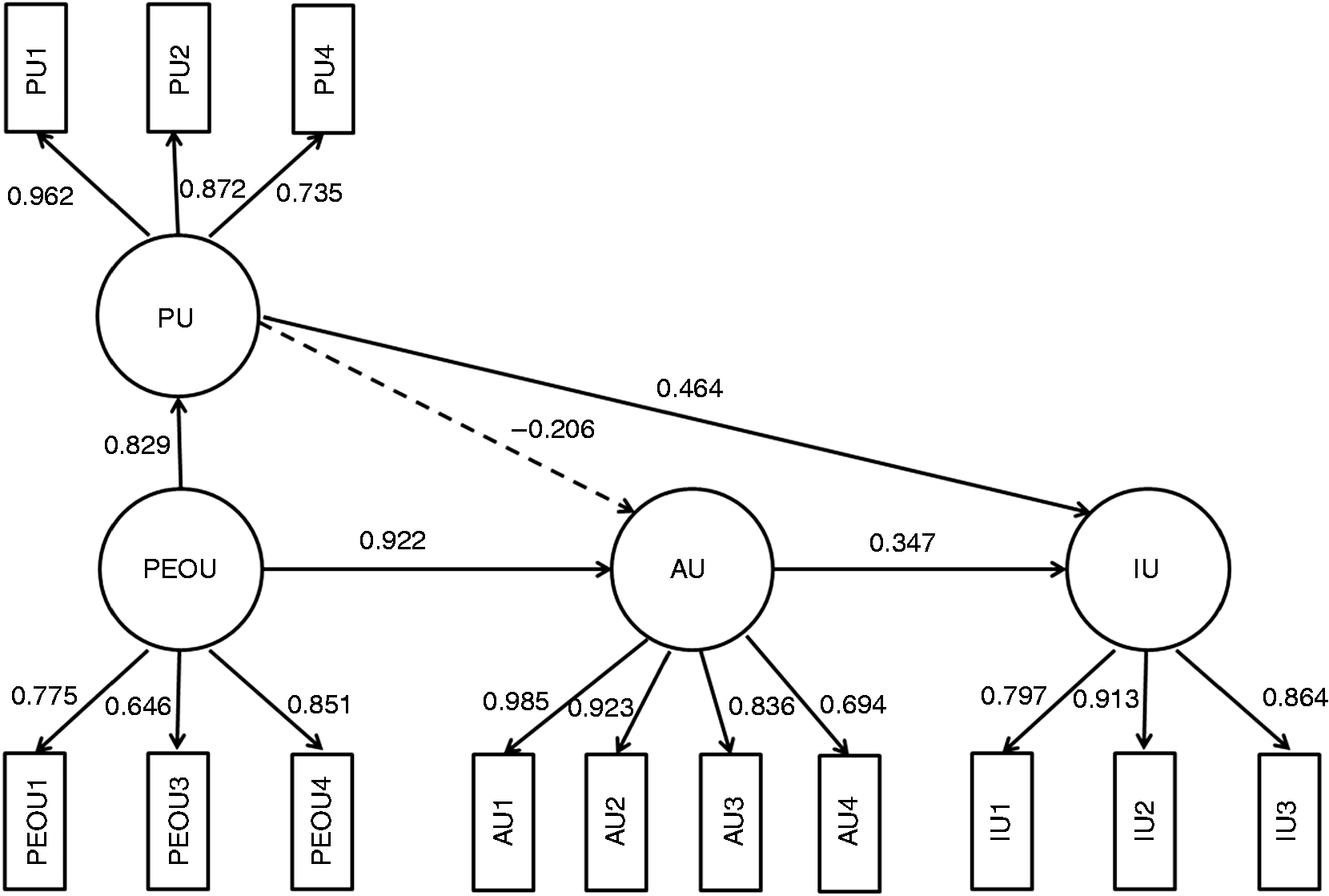
In the hypotheses testing, no significant effect of PU was found on AU, thus rejecting H1 (β = –0.206, SE =0.269, p = 0.443). Except for H1, other hypotheses (H2 to H5) were all supported in the SEM. Results indicated that PU has a positive impact on IU, with a significant coefficient of β = 0.464 (SE = 0.124, p < 0.001). Strong and significant predictive effects from PEOU were found on both PU (β = 0.829, SE = 0.064, p < 0.001) and AU (β = 0.922, SE = 0.258, p < 0.001). The results also suggested that a higher level of AU leads to a higher level of IU toward exergames, with a significant coefficient of β = 0.347 (SE = 0.127, p < 0.01). The above results generally supported the conceptual model, in which four out of the five estimates of path coefficients are statistically significant. More specifically, employees who perceived a higher level of ease of use toward exergames are more likely to have a higher level of perceived usefulness and attitude toward use; higher levels of perceived usefulness and attitude toward use further increase intention of use of the exergames.
Discussion and implications
This study is one of the few attempts to investigate the acceptance and influencing factors of exergames as a corporate wellness program through a sample of employees working in Singapore. Most of the previous exergame studies were conducted in households or nursing homes.30,31 The current study extended this research domain by investigating the potential use of exergames in the workplace to promote exercise. Results support a general acceptance of exergames among the employees via watching a video of exergame play.
More important, this study contributes to the user-centric stream of research on exergames by investigating the influencing factors that explain the intentions to use exergames as a corporate wellness program. We proposed a new conceptual model for explaining the usage intentions of exergames and then empirically tested it through statistical techniques of CFA and SEM. The significant path coefficients in the model support the hypotheses that a higher perceived ease of use of exergames leads to a higher perceived usefulness and more favorable attitude toward the use of exergames, which further positively affects the intention of exergame use.
One of the most interesting findings in the study is that the attitude towards using exergames was driven significantly by the perceived ease of use, but not the perceived usefulness of the game. In other words, employees will enjoy playing the exergames if they feel that the game is easy to play rather than if they think this game can benefit their physical well-being. A similar conclusion was found in previous studies,32,33 which suggested that promoting one’s physical fitness is not the main motivation for people to play exergames. From a practical point of view, an important implication is given for the designer of exergames: They need to create digital games that are easy to use. Sometimes, the difficulty level of games that promote physical fitness effectively may increase, thereby eliminating the fun in playing them. Therefore, developers of exergames have to pay more attention to the usability aspect to increase the enjoyment of game playing. In addition, perceived ease of use was also supported to have a strong and significantly positive effect on perceived usefulness. This finding leads to an interesting conclusion: that high usability of game playing increases the perceived physical benefits of the exergames. This finding further emphasized the importance of PEOU in the entire acceptance model. The nature of the lifestyle of the target population may be the possible explanation. Inconvenience is often the greatest barrier that prevents employees from engaging in regular exercise. Thus, the ease of exercise performance may become the key factor for the exergames. Only easy and convenient games can be implemented in the workplace and further become useful in improving their physical wellness. Consequently, the usefulness of the game tools and devices in digital games should also be designed with usability in mind. This approach does not mean that the physical benefit is no longer important in promoting exergames. Perceived usefulness was found to be a significant predictor for intention of use. Therefore, designers also have to balance between hedonic and utilitarian considerations in game design.
Limitations
This study has several limitations that are worth mentioning. First, the relatively small sample size of 60 participants from five local companies may create a bias for drawing convincing conclusions. Furthermore, the SEM results may also need to be interpreted with caution because of the small sample size. Future studies need to reach a larger sample with more diverse industrial backgrounds to achieve findings with higher generalizability. Second, we concentrated only on the behavioral beliefs produced by “watching the exergames” rather than actually “playing the exergames.” Watching a game is not the same experience as playing it. Therefore, future research may also benefit from testing the theoretical model in an actual experiment setting.
Footnotes
Acknowledgements
We would like to thank all the participants for their time and effort in this study.
Contributorship
Jinhui Li researched the literature, finished the data analysis, and wrote the first draft of the manuscript. Yin-Leng Theng was involved in study design, protocol development, gaining ethical approval. Wei Lun Cheong, Yi Fei Hoo and My Dung Ngo conducted data collection. All authors reviewed and edited the manuscript and approved the final version of the manuscript.
Declaration of Conflicting Interests
The author(s) declared no potential conflicts of interest with respect to the research, authorship, and/or publication of this article.
Ethical approval
The ethics committee of Nanyang Technological University approved this study.
Funding
The author(s) received no financial support for the research, authorship, and/or publication of this article.
Guarantor
Jinhui Li is the guarantor of this work.
Peer review
This manuscript was reviewed by two individuals who have chosen to remain anonymous.