




Abstract
Introduction
Evaluating users’ attitudes and acceptance of telemedicine in the early phases of implementation is critical in predicting a successful adoption and utilization of the service. Telepathology does not require a patient's presence for intercommunication; therefore, it is essential to focus on the acceptance of the main occupational groups that are involved. This study aimed to assess the attitude and acceptance of telepathology in the pathology departments of the Ministry of National Guard Health Affairs (MNGHA) hospitals in Saudi Arabia.
Method
A cross-sectional survey was distributed among pathologists and laboratory technologists in the pathology departments of MNGHA hospitals (N = 78). The data collection instrument was built upon the technology acceptance model’s (TAM's) constructs of perceived usefulness (PU), perceived ease of use (PEU), attitude (ATT), and intention to use (ITU).
Results
In total, 64 questionnaires were completed (response rate of 82%). The acceptance levels represented by the median responses to the TAM constructs, varied from 5.5 (slightly agree) to 6 (agree). The availability of digital pathology services in the workplace was significantly correlated with the participants’ acceptance of telepathology. There was a strong correlation between ITU and PU and a moderate correlation between PEU and PU.
Conclusion
Results suggest that telepathology is more likely to be adopted if it is considered helpful, therefore, it is recommended to focus on its usefulness and direct benefits during the training period. The participants who were familiar with the concept of digital pathology were more receptive to using telepathology, which might emphasize the importance of introducing and familiarizing the resident with digital health during their training period.
Introduction
Information technology plays a crucial role in healthcare by enhancing and maintaining service quality. 1 This was especially apparent during the COVID-19 pandemic, when organizations were motivated to employ technological solutions to mitigate the impacts of COVID-19, which accelerate the shift toward digital healthcare. 2 One of the main technologies contributing to this digital transformation is telemedicine, which sustained access to healthcare services throughout the COVID-19 crisis and continues to provide access to centralized services, such as pathology. 3
Pathology, the study of the nature and causes of disease, is a crucial aspect of healthcare. The new field of digital pathology involves the digitization of glass slides for viewing on a computer instead of through a microscope, that is integral to telepathology. Which enhance pathologists’ diagnostic capabilities by enabling the use and sharing of digital.4,5 Telepathology allows medical professionals in different locations to communicate, and exchange clinical data and digital images of cells and tissues for clinical or educational applications.6,8 This results in better quality care and has potential uses in primary diagnoses, secondary expert opinions, archiving, and education.7,9,12
Most of the research on digital pathology has focused on its technical feasibility and its accuracy and reliability compared to traditional light microscopy.8,13,19 A recent study by the Pathology and Laboratory Medicine Department of King Abdulaziz Medical City concluded that digital images of slides were not inferior to light microscopy and that this method was appropriate for making primary diagnoses in surgical neuropathology. 20 However, alongside ensuring the feasibility of the technology, it is also important to assess the users’ acceptance of digital pathology and telepathology.
While research on telemedicine from an end-user perspective is extensive, research on the attitudes of telepathology users is scarce.12,13 A study in the United Kingdom analyzed pathologists’ utilization of a telepathology system revealed a low utilization of the system. Primarily due to the pathologists’ low levels of acceptance of the technology. 21
In Saudi Arabia, limited research has been conducted on digital pathology and telepathology, particularly regarding pathologists’ attitudes. A 2012 study from the Eastern Province of Saudi Arabia aimed to assess health professionals’ perceptions of telemedicine, including telepathology, and their willingness to adopt it. The study revealed that the adoption rate of existing technologies was low, and the greatest barrier was the lack of knowledge about the meaning of telemedicine. 22 Another study in 2019 from Northern Border University also indicated insufficient knowledge regarding telepathology. 23 Since telepathology, unlike other forms of telemedicine, does not require a patient's presence, it is important to focus research on laboratory technologists and pathologists, and evaluate their attitudes toward technology in the early phases. 24
This study explores the acceptance and attitudes of pathologists and laboratory technologists working in Saudi Arabia Ministry of National Guard Health Affairs (MNGHA) hospitals toward telepathology. It describes their perspectives and concerns regarding telepathology and their intention to use it as it may pertain to any future decisions regarding implementation or training.
Methods
Study design
This was a descriptive, cross-sectional study.
Study site
Pathology and Laboratory Medicine departments in five hospitals of the MNGHA were studied. The NGHA hospitals are a government-funded, multi-specialty health organization that provides primary, secondary, and tertiary care services. The NGHA facilities are located in multiple cities and regions throughout Saudi Arabia, and their pathology departments are accredited by the Commission on Laboratory Accreditation of the College of American Pathologists (CAP), the American Association of Blood Banks (AABB), the International Organization for Standardization (ISO), and the Saudi Central Board for Accreditation of Healthcare Institutions (CBAHI), and they supports and provides selected laboratory services to other regional hospitals.25,26
Sample size calculation
Following the implementation of inclusion and exclusion criteria, 78 pathology personnel were included in the study. Based on the formula provided by Steven K. Thompson, a sample size of 65 participants was determined, with a 95% confidence interval and a P-value of 0.05. 27
Sampling technique
Non-probability convenience sampling was used. Participants were invited to participate from August to October 2021.
Study population and eligibility criteria
The participants included pathology consultants, assistant consultants, residents, and laboratory technologists, regardless of age, gender, and nationality. The exclusion criteria included students, interns, new and untrained technologists, and technicians.
Instrument of data collection
The technology acceptance model (TAM) is a validated data collection instrument designed to evaluate users’ attitudes and acceptance of technology. The TAM is rooted in Fishbein and Ajzen's theory of reasoned action, 28 which asserts that users’ beliefs about the perceived usefulness and ease of use of technology are critical determinants of their attitudes, intentions, and subsequent behaviors. Previous research in the field has reported the TAM's ability to explain and/or predict end users’ acceptance of given technologies, which can be helpful in the early and pre-implementation stages of telepathology.28,30
The Cronbach's alpha coefficient was utilized to assess the reliability of the TAM questionnaire. The findings indicate a high level of internal consistency, with values of 0.925 for perceived usefulness (6 items), 0.892 for perceived ease of use (6 items), 0.854 for attitude (3 items), and 0.854 for intention to use (6 items). The overall reliability coefficient was calculated to be 0.955, which is considered to be above the acceptable threshold of 0.700 as recommended in the relevant literature.29,31
Questionnaire construction
The present study's questionnaire consisted of four sections. The first section collected the demographic characteristics of the participants. The second section included Q7 and Q8 to identify the presence of digital pathology and telepathology in the workplace, and Q9 was to assess if the participants use telepathology, while Q10 mentioned the purpose behind using telepathology (multiple answers).
The third section included a simple, modified version of the TAM that measured four constructs: perceived usefulness (PU; Q11 to Q16), perceived ease of use (PEU; Q17 to Q22), attitude (ATT; Q23 to Q25), and intention to use (ITU; Q26 to Q31), with responses given on a 7-point Likert scale, ranging from 1 (“strongly disagree”) to 7 (“strongly agree”). The adoption of a 7-point Likert scale was supported by the findings of Diefenbach et al. (1993), who concluded that the 7-point scale was superior in terms of perceived accuracy, ease of use, and objective accuracy. 32 Additionally, it is more appropriate for electronically distributed and unsupervised questionnaires, and more likely to accurately reflect an individual's subjective evaluation.33,34 The fourth and last section was an open-ended question for any comments regarding telepathology.
The questionnaire header contained a brief summary of the study’s objectives and scope, as well as an explicit statement indicating that participation in the study was entirely voluntary and that completing the questionnaire would serve as informed consent. A copy of the questionnaire is included in Supplementary Material.
The questionnaire was piloted among seven pathologists (who were not included in the study population) to ensure the appropriateness and clarity of the questionnaire. Based on their feedback, the definition of telepathology was added to question eight (Q8) to improve clarity and minor typographical errors were altered. The participants were given the option to complete the questionnaire manually (on paper) or online (via a Google Form that was sent to their work e-mails).
Primary outcome
This study explores the acceptance and attitudes of pathologists and laboratory technologists working in MNGHA hospitals toward telepathology, and their intention to use telepathology. Which was assessed by 12 items (6 usefulness and 6 ease of use) to measure the telepathology acceptance, 3 items to measure attitude toward telepathology, and 6 items to measure intention to use telepathology.
Data analysis
Analyses were conducted using IBM SPSS Statistics, version 28.0. Descriptive statistics were used to describe the demographic characteristics of the participants. Medians and ranges were used to describe continuous variables in the domains of the TAM. The Mann–Whitney U test and Kruskal–Wallis one-way analysis of variance were used to compare the means of two groups and those of more than two groups, respectively. Finally, the correlations between the different domains of the TAM were assessed using Spearman correlation coefficients. For all analyses, the level of significance was set at P < 0.05.
Results
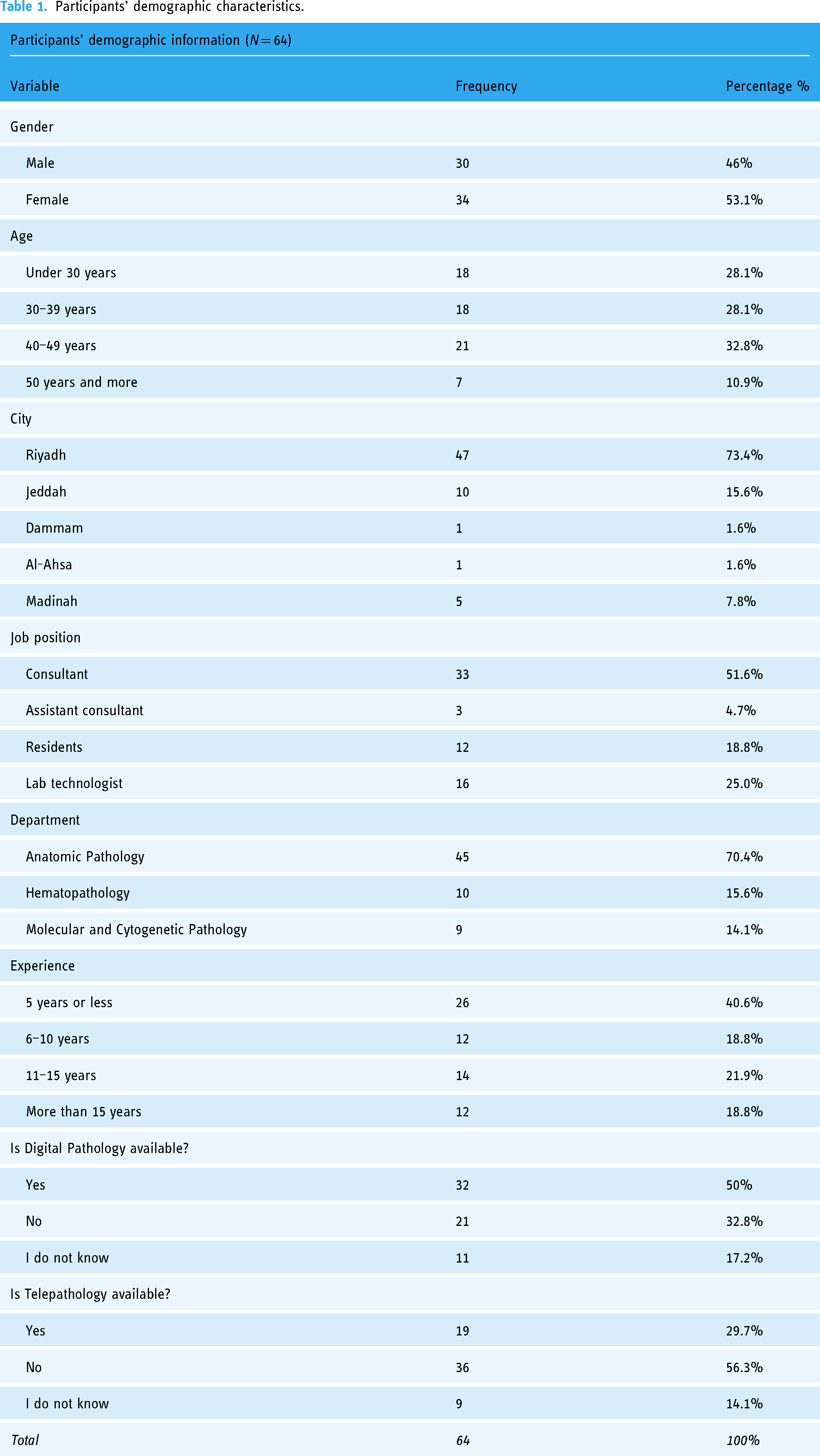
A total of 64 questionnaires were completed (a response rate of 82%). The demographic characteristics of the participants and the availability of digital pathology/telepathology are shown in Table 1. The results of question 9 revealed that 34% (n = 22) of the participants indicated that they use telepathology. Among those who reported using telepathology (n = 22), a majority (n = 19, 86%) stated that they use it for educational purposes, with (n = 13, 59%) using it for second opinions, (n = 9, 41%) using it for archiving, (n = 3, 14%) using it as a primary diagnosis during staffing shortages, and (n = 2, 9%) using it for quality control.
Participants’ demographic characteristics.
The medians and ranges of the responses to the TAM variables (PU, PEU, ATT, and ITU) are summarized in Table 2. The participants reported relatively positive attitudes toward telepathology, with a median (range) score of 6.00 (2.00–7.00). Regarding PU, respondents scored a median (range) of 5.91 (1.50–7.00). The median (range) scores for PEU and ITU were 5.50 (2.00–7.00) and 5.83 (1.76–7.00), respectively.
The median and range scores of the TAM questionnaire domains.

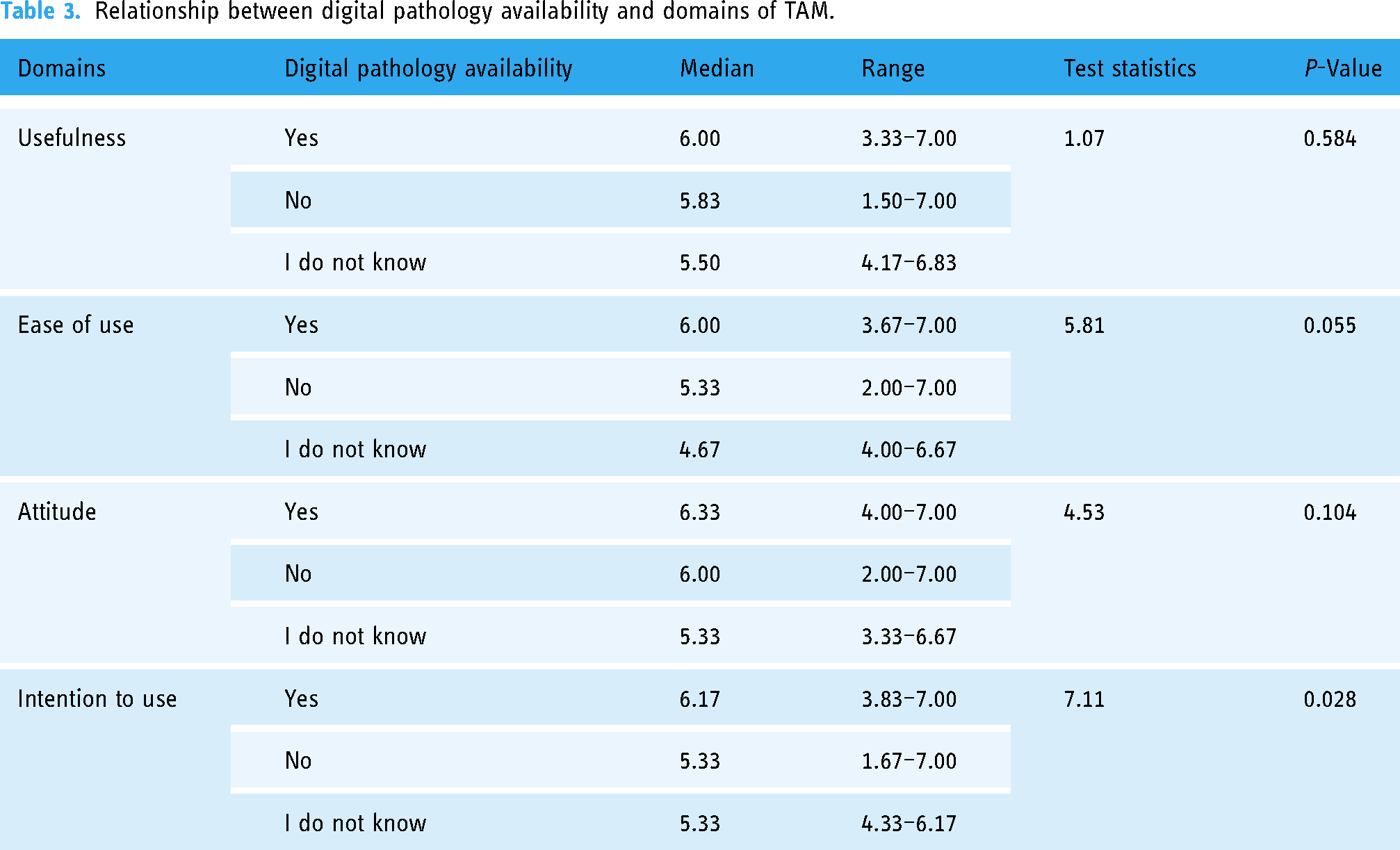
No demographic factors had significant effects on participants’ acceptance. However, the availability and presence of digital pathology were significantly associated with ITU (P = 0.028) and PEU (P = 0.055; Table 3).
Relationship between digital pathology availability and domains of TAM.
Spearman correlation coefficients were used to describe the relationships between the TAM domains; according to Dancey and Reidy's 35 categorization, r values between 0.7 and 0.9 can be interpreted as strong correlations, those between 0.4 and 0.6 as moderate correlations, and those between 0.1 and 0.3 as weak correlations. The analysis of the TAM domains showed that ITU was strongly correlated with both ATT (rs = 0.771, P < 0.05) and PU (rs = 0.742, P < 0.05), whereas it was moderately correlated with PEU (rs = 0.65, P < 0.05). In addition, ATT was correlated strongly with PU (rs = 0.823, P < 0.05; Table 4).
Spearman rank correlation between domains of TAM.

*Correlation is significant at the 0.01 level (two-tailed).
The participants’ answers regarding the ITU domain on the 7-point Likert scale showed that 35.9% and 34.4% of the participants had high and moderate intentions to use telepathology, respectively (Table 5). Only 1.6% reported no intention to use telepathology.
Participant's agreement level to the intention to use.

Discussion
The primary aims of this study were to describe the intent to use telepathology within the MNGHA by assessing the levels of acceptance of and attitudes toward telepathology and determine whether there were factors associated with acceptance.
The median responses for the variables varied somewhat (5.9 for PU, 5.5 for PEU, 6 for ATT, and 5.8 for ITU; Table 2). These median values fell between “slightly agree” and “agree,” indicating a relatively moderate acceptance of telepathology. These results are similar to others in the literature—studies have shown that pathologists generally accept telepathology10,13,35,37—and are consistent with the findings of the Eastern Province and Northern Border University studies, in which the majority of health professionals showed interest in learning about and implementing telemedicine and positive attitudes toward adopting telepathology.22,23 There was no significant association between the participants’ acceptance of telepathology and their genders, ages, job positions, or years of experience. This, however, contradicts the results of other studies, which have suggested that profession and years of experience can influence levels of acceptance and willingness to use technology.13,22 The present study's results may indicate that (1) individuals are more likely to use telepathology if sufficient training and support are available and (2) the older generation is not opposed to new technology; older individuals are as likely as younger individuals to use telepathology once it is available.
The availability of digital pathology had a significant effect on the ITU (P = 0.028) and PEU (P = 0.055) of telepathology (Table 3). This might indicate that the participants who were familiar with the concept of digital pathology were more receptive to the idea of using telepathology. This resembles the assumptions of a national survey by Denni et al., 10 which stated that fears affecting the use of telepathology could be overcome by assistance and clear guidelines. Another result of the acceptance of telemedicine in the laboratory stated that engaging users in the early development stages of a system so that they are familiar with the process improves the users’ attitudes. 38
Davis 39 suggested that an individual's attitude determines whether a technology will be used, and PU and PEU further influence that attitude. With respect to the relationships between the TAM variables of PU, PEU, and ATT and the dependent variable of ITU in the current study, the strongest correlation was between ITU and ATT (rs = 0.771), followed by that between ITU and PU (rs = 0.742), and, lastly, a moderate correlation between ITU and PEU (rs = 0.651; Table 4).
In this study, the correlation between ATT and PU (rs = 0.823) was significantly higher than that between ATT and PEU (rs = 0.728). This indicates that the perceived usefulness had a more considerable influence than the ease of use on the participants’ intent to use telepathology.
This finding is similar to that of the study in the Eastern Province, which found that the participants who perceived the benefits and usefulness of telemedicine were more eager to adopt the technology. 22
Two previous studies have extended the TAM in a similar manner—first, to assess laboratory assistants’ acceptance of telemedicine in the microbiology laboratory, and second, to investigate the acceptance of a laboratory information system among laboratory technologists. These two studies yielded results similar to those of the present study; they suggested that PU had a significant influence on the behavioral ITU, while PEU was not proven to be an effective predictor of ITU for laboratory information systems. The studies concluded that laboratory personnel, like physicians, intended to adopt a system if they were convinced that it was helpful and valuable.38,40 This resembles the findings of the Eastern Province study, in which health professionals’ main barrier to utilizing telemedicine was their lack of knowledge regarding its real benefits and applications to patient care. 22 Other studies that have used the TAM to address the acceptance of telemedicine—specifically, those that have predicted ITU—have also found that PU has a direct, significant, positive effect on individuals’ acceptance of, attitudes toward, and intent to use telemedicine.29,41,42
These results may indicate that healthcare providers tend to focus on the usefulness of a technology itself; therefore, a system is more likely to be adopted if it is considered helpful and offers direct benefits, and the ease of use may be considered a secondary factor.29,38
Strength and limitations
The data for this study were obtained through self-administered questionnaires, which may introduce a potential for bias in the responses. To mitigate this, a 7-point Likert scale was employed, providing participants with a wider range of options to reflect their accurate evaluations. Despite the high response rate among pathologists within the NGHA pathology departments, this study’s findings may not be generalizable to the broader population of pathologists in Saudi Arabia and their acceptance and intention to use telepathology.
Future research should focus on increasing the sample size to better generalize the results to the wider population, using alternative methods of data collection and analysis to confirm the findings, and including the perspectives of decision-makers and stakeholders to consider additional factors relevant to technology acceptance. Additionally, a standardized definition of telepathology across various organizations is necessary, and a comprehensive status report of the implementation of telepathology system would aid in developing appropriate guidelines.
Conclusion
Prior research on telepathology in Saudi Arabia has focused primarily on its technical feasibility and diagnostic accuracy. With sufficient evidence of its applicability, it is time to focus on the intended users and investigate their acceptance and their willingness to utilize telepathology.
Our findings represent a preliminary assessment of the acceptance of telepathology systems among end users, providing the first step toward understanding end users’ perspectives during this national growth in telemedicine utilization and investment. It serves as a valuable source of information in the early stages of telepathology system development and expansion, not only in the MNGHA, but also to other hospitals of the same size implementing telepathology. Our research also has the potential to shape the guidelines and practices of teaching hospitals, particularly with regards to incorporating technical aspects of digital health into clinical education during the residency and training period, and to emphasize the usefulness and direct benefits of telepathology to the patients and healthcare services.
Supplemental Material
sj-docx-1-dhj-10.1177_20552076231163672 - Supplemental material for Pathologists’ acceptance of telepathology in the Ministry of National Guard Health Affairs Hospitals in Saudi Arabia: A survey study
Supplemental material, sj-docx-1-dhj-10.1177_20552076231163672 for Pathologists’ acceptance of telepathology in the Ministry of National Guard Health Affairs Hospitals in Saudi Arabia: A survey study by Raneem Alawashiz and Sharifah Abdullah AlDossary in Digital Health
Footnotes
Acknowledgments
The authors appreciate the support provided by the Research Office in KSAU-HS, and the cooperation of all the heads of Anatomic Pathology, Hematopathology, and Molecular Pathology departments in the MNGHA hospitals. The authors gratefully acknowledge King Abdullah International Medical Research Center for funding the publication of this paper.
Contributorship
This study was conducted by two authors (R.A. and S.D.). R.A. contributed to the study conception, design, analysis, and discussion. S.D. contributed to the study conception, design, critical revising, and giving the final approval.
Declaration of conflicting interests
The author(s) declared no potential conflicts of interest with respect to the research, authorship, and/or publication of this article.
Ethical approval
The ethical clearance was obtained from the institutional review board of King Abdullah International Medical Research Center (SP21R/330/06-8 July 2021).
Funding
The author(s) disclosed receipt of the following financial support for the research, authorship, and/or publication of this article: This work was supported by the King Abdullah International Medical Research Center.
Guarantor
R.A.
Informed consent
Informed consent was obtained from all participants.

Supplemental material
Supplemental material for this article is available online.
References
Supplementary Material
Please find the following supplemental material available below.
For Open Access articles published under a Creative Commons License, all supplemental material carries the same license as the article it is associated with.
For non-Open Access articles published, all supplemental material carries a non-exclusive license, and permission requests for re-use of supplemental material or any part of supplemental material shall be sent directly to the copyright owner as specified in the copyright notice associated with the article.
