




Abstract
Communicating the “97%’’ scientific consensus has been the centerpiece of the effort to persuade climate skeptics. Still, this strategy may not work well for those who mistrust climate scientists, to begin with. We examine how the American public—Republicans in particular—respond when provided with a relatively detailed causal explanation summarizing why scientists have concluded that human activities are responsible for climate change. Based on a preregistered survey experiment (N = 3007), we assessed the effectiveness of detailed causal evidence versus traditional consensus messaging. We found that both treatments had noticeable effects on belief in human-caused climate change, with the causal evidence being slightly more effective, though we did not observe equivalent patterns for changes in attitudes toward climate policies. We conclude that conveying scientific information serves more as a remedy than a cure, reducing but not eliminating misperceptions about climate change and opposition to climate policies.
Keywords
While the science behind climate change calls for urgent policy actions, the partisan divide in the United States represents a significant barrier. For example, a poll finds that 69% of Democrats believed in anthropogenic global warming, in contrast to a mere 23% of Republicans (Funk and Kennedy, 2020). Given the gravity of the climate crisis, scholars and practitioners have sought to design persuasive messages that address the public’s skepticism and guide their opinions on climate change. The most popular strategy has been to inform people about the overwhelming consensus among climate scientists—that human activities are leading to global warming. However, this approach might not be effective for Republicans, who often distrust scientists (Cook and Lewandowsky, 2016), due to the efforts from conservative think tanks and Republican leaders to undermine their credibility (McCright and Dunlap, 2003).
In this article, we propose and test an alternative persuasion strategy: explaining in detail how scientists arrived at the conclusion that human activities are the primary cause of climate change. Given the general lack of public knowledge on the topic (see Nisbet and Myers, 2007), we posit that many Americans might be unfamiliar with the scientific logic and the body of evidence that supports this conclusion. For example, scientists have observed an increase in the stable isotope of carbon (carbon-12) but not in the radioactive isotope (carbon-14), which decays over time. This distinction points to fossil fuels as the main source of rising CO2 levels, rather than natural patterns, because ancient plant and animal remains do not contain carbon-14. Coupled with several other natural causes that scientists have ruled out, this information presents a compelling case that could help climate skeptics better understand and accept the causes of climate change. Our goal is to assess the effectiveness of conveying these scientific facts.
This article presents a preregistered survey experiment (N = 3007) comparing the effects of two types of persuasive messages. The first message, the standard consensus narrative, presents the current scientific consensus (“97% of scientists agree that”) and refutes popular myths around the consensus. The second message, hereafter referred to as the “causal treatment,” provides detailed explanations on why and how climate scientists have reached the consensus, without explicitly referring to a consensus per se.
Our study found that both consensus and causal treatments reduced misbeliefs on climate change. Though the causal treatment was statistically more effective, the substantive difference was small. We found no evidence of a pronounced difference in the effect of either treatment among the most skeptical population; instead, we found that both treatments had stronger effects on Republicans than Democrats. Additionally, the treatments showed minimal to no impact on support for climate policies, with neither the causal nor the consensus information demonstrating a clear advantage in effectiveness. Overall, these results suggest that conveying either type of scientific information—causal or consensus—can be beneficial in increasing the acceptance of human-caused climate change among the American public. However, these interventions appear to have their limits; they do not fully eliminate misperceptions, nor do they directly lead to increased support for climate policies.
Theoretical expectations
Although scholars have examined various persuasive strategies, consensus messaging has garnered the most interest. The empirical support for this approach remains unclear. While some studies suggest that it can increase belief in climate change across the ideological spectrum (e.g., Van der Linden et al., 2015), others found that it may not work or could even backfire among conservatives (e.g., Bolsen and Druckman, 2018; Cook and Lewandowsky, 2016).
Why does consensus messaging sometimes fail? More broadly, why do partisan divides in climate beliefs persist despite continued communication efforts emphasizing that the majority of scientists have reached the same conclusion? A prominent explanation is that Republicans engage in partisan motivated reasoning (Kahan, 2016; Lodge and Taber, 2013). According to this explanation, partisans are motivated to uphold their party’s dominant position. This motivation can lead Republicans to reject or ignore scientific consensus, while causing Democrats to accept the same message, thereby creating and exacerbating political polarization on climate change.
However, some scholars argue that most of the data showing polarization are also consistent with an alternative explanation where citizens vary in the information source they find trustworthy, not in their desire to reach a particular conclusion (Cook and Lewandowsky, 2016; Druckman and McGrath, 2019). For instance, Republicans might dismiss information about scientific consensus, not because they aim to uphold their partisan beliefs, but because they mistrust scientists and, by extension, the consensus they have formed (Cook and Lewandowsky, 2016). From this perspective, the partisan gap in climate beliefs is largely driven by a lack of trust in scientists among Republican voters.
The partisan motivated reasoning theory and the trust-based explanation generate the same empirical expectations—emergence and persistence of polarization on climate beliefs—yet they have different implications for the ongoing debate on how polarization on climate change should be addressed (e.g., Druckman and McGrath, 2019; Kahan, 2016). Specifically, if partisan motivated reasoning is what drives climate skepticism, any corrective information might be dismissed or even backfire. In this case, scholars and practitioners would better allocate scarce resources for interventions designed to minimize Republicans’ directional goals (Kahan, 2016). In contrast, if the root cause of unsuccessful climate persuasion is Republicans’ low trust in scientists (and their consensus), then scholars should focus more on developing interventions that directly communicate the quality and credibility of scientific evidence. In this research, we take the latter approach and evaluate the effectiveness of a message that details the specific logic and evidence supporting the conclusion that human activities are responsible for climate change, in lieu of plainly stating the consensus.
We anticipate that the provision of causal evidence may be more effective than consensus messaging, particularly among climate skeptics. First, as previously noted, consensus messaging likely requires a baseline trust in scientists to be effective—a trust that varies substantially with political predisposition (Cook and Lewandowsky, 2016). Consequently, the consensus treatment might be easily dismissed by Republicans/skeptics. In contrast, the causal treatment, which focuses on the underlying scientific mechanisms and factual evidence rather than perceived credibility, may be less dependent on political predisposition, thereby making it potentially more effective for climate skeptics.
Previous studies outside the climate change context indicate that causal explanations are in fact more effective in inducing belief changes than non-causal evidence (Nyhan and Reifler, 2015; Slusher and Anderson, 1996). Furthermore, causal evidence has been found to be less susceptible to bias from pre-existing attitudes compared to non-causal evidence (Slusher and Anderson, 1996). These findings suggest that causal messages could effectively shift beliefs, regardless of partisanship or pre-established positions on climate change or climate scientists.
In addition, the public may not be as aware of the causal evidence supporting scientists’ consensus as they are of the consensus itself, given that the latter is a common narrative in science communication. Considering that many people may have already been exposed to consensus messaging, additional interventions using the same approach may not generate further belief changes (Druckman and Leeper, 2012). Causal information, however, offers facts and evidence—such as how scientists have ruled out natural causes—that may be novel to most people (especially skeptics). In short, we propose the following hypotheses: H1: Causal information will increase belief in anthropogenic climate change even more relative to consensus information. H2: The difference between causal and consensus information will be greater among (a) Republicans; (b) those who do not believe in human-caused climate change; and (c) those who have low trust in climate scientists.
Importantly, these hypotheses were formulated under the trust-based account (Druckman and McGrath, 2019), with a theoretical premise that people are open to updating opinions, rather than insistently preserving prior viewpoints. We would find evidence against this model, in favor of the motivated reasoning theory, if both of the treatments prove ineffective (or even backfire) for Republicans while effective for Democrats. By testing these competing possibilities, we aim to clarify whether and how partisan resistance to information drives climate skepticism.
Research design
The experiment was administered between August 25 and September 2, 2021. A total of 3007 U.S. adults took part in our study, sourced from Cloud Research (Mturk Toolkit). Given the tendency for CloudResearch (MTurk) samples to skew Democratic, and considering our focus on persuading Republicans about climate change, we purposefully oversampled Republicans during the recruitment process. In the end, our sample consisted of 1520 Republicans, 320 pure Independents, and 1164 Democrats. Participants were, on average, 41 years old. Women constituted 52% of the sample, and 56% held a 4-year college degree or higher.
After informed consent, participants answered standard public opinion questions measuring their partisanship and political attitudes. They then expressed their prior beliefs on climate change and their trust in scientists, followed by demographic questionnaires and a pre-treatment attention check. They were then randomly assigned to one of the three experimental conditions (described below). Subsequently, they were asked about their post-treatment beliefs.
Experimental conditions
The experiment had three conditions: placebo, scientific consensus, and causal explanation. Participants were randomly assigned to one of these three groups. Those in the placebo group received a message unrelated to climate change, specifically about cryptocurrency. Those in the scientific consensus condition were given a message stating that 97% of scientists agree that climate change is human-caused. Participants in the causal explanation group received a message explaining why scientists have come to that conclusion. The treatment messages were adapted from a New York Times article titled “The Science of Climate Change Explained: Facts, Evidence and Proof” (Rosen, 2021). The word counts for the placebo, consensus, and causal messages were 420, 422, and 414 words, respectively. See Appendix A for the full text of the messages.
Measurement of the outcome variable
Belief in anthropogenic climate change is our primary outcome variable. It refers to the belief that climate change is caused by human activities as opposed to natural changes. This variable was measured before and after the treatment, but pre-treatment values were measured using one item, whereas post-treatment values were measured using a five-item battery. The post-treatment measure was created by rescaling each item to 0–1 and calculating the average (Cronbach’s alpha = 0.86). Appendix B provides information on the measurement of other variables. All of the measurement approaches were determined and registered before the experiment was conducted.
Results
We first examine whether the treatments increased participants’ belief in human-caused climate change. Panel (A) of Figure 1 illustrates the mean differences in our anthropogenic belief index across the three experimental conditions. Those in the treatment conditions expressed stronger belief in anthropogenic climate change than those in the control condition, indicating that the treatments successfully shifted people’s beliefs by 5 to 7 percentage points (both p < .005), noticeable effects amounting to about one-fifth to one-fourth of the baseline difference between Democrats and Republicans in the control group (difference = 27 points). The third point, in accordance with H1, shows that the causal information was more effective in changing beliefs (p < .005), although the difference (a two percentage point margin) was substantively small.
1
Average effects of the consensus versus causal treatments on belief in anthropogenic climate change. Each panel plots OLS point estimates with 95% confidence intervals. Table D1 in Appendix D presents these estimates in tabular format.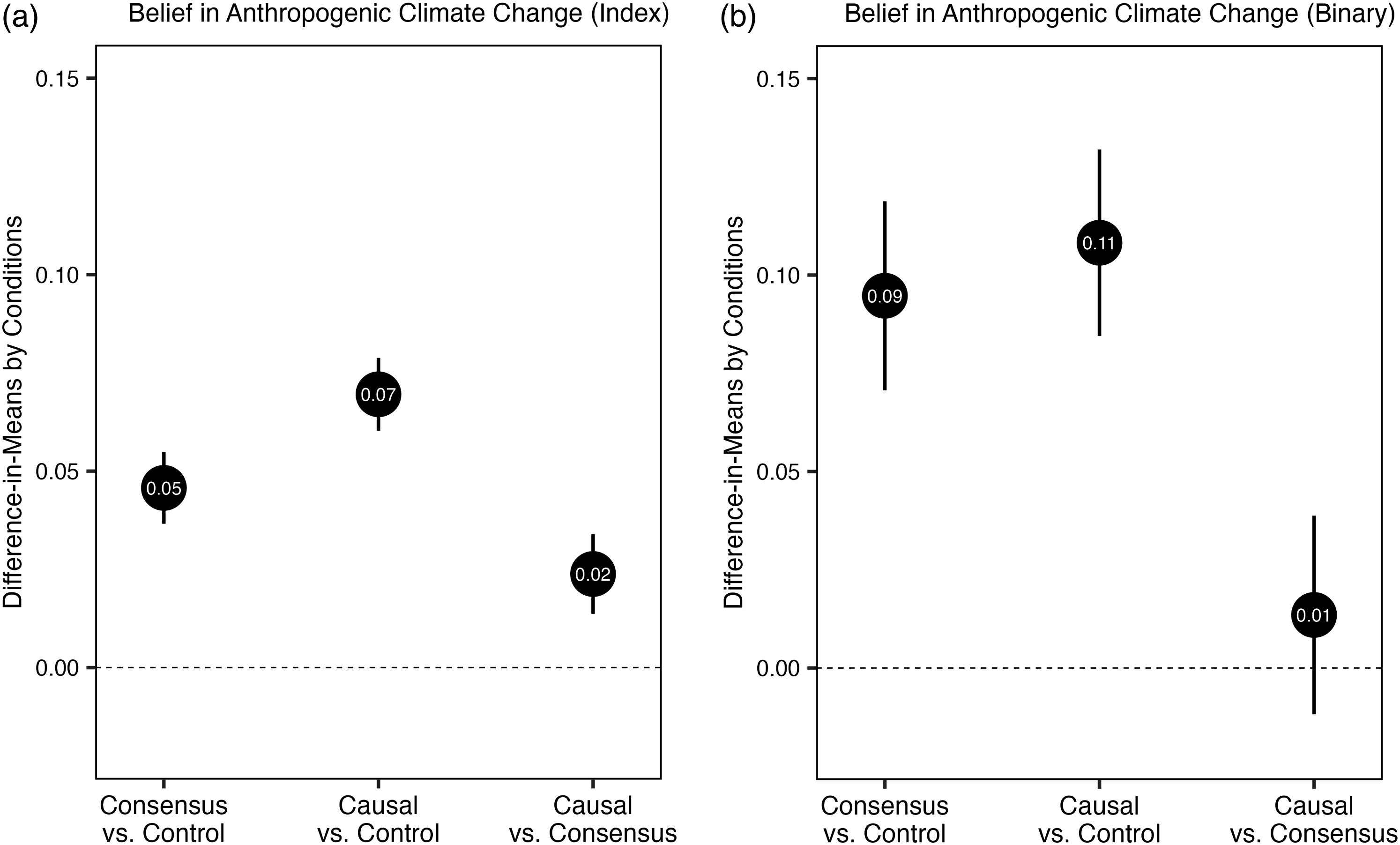
We conducted similar analyses using a binary measure of belief in climate change. This measure indicates whether a participant believed climate change is caused by human activities (1) or not (0) after treatment. Panel (B) of Figure 1 illustrates that the consensus and causal treatments increased the proportions of participants affirming anthropogenic climate change by 9 to 11 percentage points (both p < .005). However, the difference between these two effects was not statistically significant. This null result suggests that the slight advantage of the causal treatment observed in the left panel stemmed from a difference in the confidence with which participants held their beliefs, rather than from a difference in belief conversion. 2 Taken as a whole, while H1 was supported, the relative strength of the causal treatment was not as substantial or robust as we had anticipated. 3
We now turn to heterogeneous effects by priors, as per H2. First, we categorized the participants into seven groups based on partisanship—from strong Republicans to strong Democrats—and separately estimated the treatment effects on the anthropogenic belief index. Panel (A) of Figure 2 presents these marginal effects. As can be seen, the treatment effects were statistically significant across partisanship. While there were some partisan differences in the treatment effects, they were opposite to those predicted by the partisan motivated reasoning hypothesis. In fact, strong Republicans revised their opinions the most, increasing their belief in anthropogenic climate change by 11 percentage points when exposed to the causal treatment and by eight points when exposed to the consensus treatment (both p < .005).
4
Heterogeneous effects on belief in anthropogenic climate change (index) by priors. Each panel plots OLS point estimates with 95% confidence intervals. Tables D2, D3, and D4 in Appendix D present these estimates in tabular format.
Of course, not all Republicans deny human-caused climate change, and not all Republicans lack trust in climate scientists. Panels (B) and (C) of Figure 2 present the marginal effects by pre-treatment belief in anthropogenic climate change (a 7-point scale) and pre-treatment trust in climate scientists (a 4-point scale). Once again, the treatments significantly changed participants’ beliefs in the expected direction across the spectrum of prior opinions, providing little evidence that corrective information was dismissed altogether by climate skeptics or even backfired.
However, contrary to H2, the causal treatment did not demonstrate particular effectiveness among those who identified as Republicans, doubted human-caused climate change, or mistrusted climate scientists. If H2 were correct, the difference between the two treatments—as represented by the distance between the dotted yellow line and solid black line—should be greater on the conservative end of the x-axis. However, none of the three panels support this prediction. Interestingly, the rejection of H2 did not stem from the causal treatment being ineffective among skeptics—but quite the contrary—from the consensus treatment proving more effective than anticipated. Most surprisingly, Panel (C) shows that even those expressing no trust in climate scientists were still convinced by the consensus message by 7 percentage points (p < .005), which was statistically equivalent to the effect of the causal treatment (6 percentage points, p < .005). This result contradicts our initial theoretical assumption that those mistrusting climate scientists would easily dismiss their consensus. 5 More direct tests of H2 are provided in Panels (D) to (F), where the estimated differences between the effects of the two treatments across partisanship and prior beliefs are plotted. These panels show no evidence of more pronounced differences among Republicans or skeptics.
In Appendix C, we list all the preregistered hypotheses, including some that are not featured in the main text. The results pertaining to these hypotheses are detailed in Appendix D.3. Most notably, we report that the treatments had small—and often insignificant—effects on policy preferences, with the causal messaging being slightly less efficacious, if anything. We discuss the implications of these findings in the following section (see also Appendix D.4).
Conclusion
We sought to identify a persuasive strategy particularly effective for Republicans/climate skeptics who tend to have low trust in climate scientists. To this end, we studied the effects of two types of persuasive messages, causal and consensus, on belief in human-caused climate change, expecting the causal message to have a greater impact on belief change. We found that causal messaging was indeed significantly more effective in increasing belief in human influence on climate change than consensus messaging, although the difference was not as substantial or consistent as we initially expected. And we found no support for the hypothesis that causal evidence would be particularly compelling for Republicans. In fact, regarding the downstream effects on policy attitudes, consensus messaging appeared slightly more effective, although this difference was statistically ambiguous, and neither treatment exerted strong effects (see Appendix D.3). Overall, our findings do not provide sufficient evidence to suggest that one treatment is categorically superior to the other.
These results broaden our understanding of how the public, particularly skeptics, responds to scientific information. Our study focused on two theoretical mechanisms that scholars suggested might underlie skeptics’ resistance to scientific information: partisan motivated reasoning (Kahan, 2016) and mistrust of climate scientists (Cook and Lewandowsky, 2016; Druckman and McGrath, 2019). However, neither found strong empirical support. On one hand, Republicans and skeptics do not appear to have engaged in partisan motivated reasoning, at least not in the sense of being unresponsive or having a negative reaction to scientific information. On the other hand, we found only modest support for the trust-based explanation (Druckman and McGrath, 2019), in that the causal message—a persuasive approach presumably less reliant on baseline trust—was only slightly more effective. Ultimately, our results align most with recent studies suggesting people generally update their opinions towards new information (Nyhan et al., 2022), irrespective of prior beliefs or message types (Coppock et al., 2020).
At the same time, our findings raise an important question: if people tend to adopt new information, why has the partisan divide over climate change persisted? First, it is important to note that even the relatively detailed information used in our study did not completely eliminate misbeliefs about climate change among Republicans or skeptics, although it did reduce them. Moreover, prior research suggests that such effects will likely fade over time (Nyhan et al., 2022). Thus, while conveying scientific information is beneficial, it seems to serve more as a remedy than a cure.
In addition, a survey experiment can only establish how public opinion might change if everyone receives—and pays close attention to—scientific information. Such deep engagement with scientific facts, however, is likely to be rare in people’s everyday life (Delli Carpini and Keeter, 1996; Nisbet and Myers, 2007). Without comprehensive scientific information, people are likely to default to partisan cues when forming their viewpoints on these issues. According to this explanation, the polarization of climate change belief could be better explained by a combination of inadequate knowledge of science and polarizing elite cues (see Tesler, 2018), rather than Republicans’ inability or unwillingness to accept scientific information. Thus, finding an effective way to deliver scientific information to the public (e.g., see Yeo et al., 2020) could be as crucial as finding the most effective information itself.
We conclude by discussing the implications of the finding that the treatments, despite having relatively noticeable effects on belief in human-caused climate change, had very small or even null effects on policy attitudes. Should practitioners and scholars care about belief in anthropogenic climate change per se, even if changing it does not directly and uniformly translate into policy support? We argue there are at least two reasons for this. First, the frequent polling and reporting on Americans’ belief in human contributions to climate change (e.g., De Visé, 2023) could influence public officials’ perceptions of the public stance on climate issues, potentially affecting their willingness to enact policy reforms (Bromley-Trujillo and Poe, 2020). Additionally, it is difficult to see how those who deny human involvement in climate change could seriously consider, much less support, policies requiring significant lifestyle or economic changes. Thus, while causal or consensus information might not automatically generate policy support, it may increase Republicans’ openness to new arguments for specific policies or actions. Future research should examine these possibilities to sharpen our knowledge of evidence-based persuasion’s role in mitigating climate change misbeliefs and promoting stronger policy actions.
Supplemental Material
Supplemental Material - Persuading climate skeptics with facts: Effects of causal evidence vs. consensus messaging
Supplemental Material for Persuading climate skeptics with facts: Effects of causal evidence vs. consensus messaging by Jin Woo Kim and Ruijun Liu in Research & Politics
Footnotes
Author’s note
This study was preregistered with the Center for Open Science. We confirm that the analysis plan was registered prior to conducting the research and that the preregistration adheres to the disclosure requirement of the Center for Open Science. The registration can be found at  . We confirm that the experimental design is consistent with APSA’s Principles and Guidance for Human Subjects Research.
Acknowledgements
We thank Brendan Nyhan, Joseph Cappella, and James Druckman for their helpful comments.
Declaration of conflicting interests
The author(s) declared no potential conflicts of interest with respect to the research, authorship, and/or publication of this article.
Funding
The author(s) received no financial support for the research, authorship, and/or publication of this article.
Data Availability Statement
Supplemental Material
Supplemental material for this article is available online.
Notes
References
Supplementary Material
Please find the following supplemental material available below.
For Open Access articles published under a Creative Commons License, all supplemental material carries the same license as the article it is associated with.
For non-Open Access articles published, all supplemental material carries a non-exclusive license, and permission requests for re-use of supplemental material or any part of supplemental material shall be sent directly to the copyright owner as specified in the copyright notice associated with the article.
