



Abstract
Activist groups debate the complex connection between climate change and migration but generally agree on the normative value of describing those migrants as “environmental refugees.” They argue that using such a term, even though unrecognized under international law, might increase the urgency of this issue in the eyes of the public. Does the term do the normative work that has been assumed? To our knowledge, the idea has not been subject to empirical confirmation. In this research note, we present data from two experimental surveys conducted in the UK and the Netherlands (N = 2261) directly addressing that question. The findings significantly undermine the assumption that “environmental refugee” is normatively persuasive outside activists and academic circles. We demonstrate that using “environmental refugees” frames compared to “environmental migrants” does not increase the urgency of the climate migration problem in the eyes of the public, and as our results show, such frames may slightly lower perceptions of urgency. Yet, this result is rather negligible.
Introduction
Climate change is directly and indirectly causing climate migration (Intergovernmental Panel on Climate Change, 2022: 64–65). It is estimated that there could be between 31 million and 143 million people displaced due to climate and environmental reasons from Central and South America, Sub-Saharan Africa, and South Asia alone by 2050 (Intergovernmental Panel on Climate Change, 2022: 65). The World Bank reports that more than 200 million people may need to leave their homes due to climate change (Clement et al., 2021). As the climate crisis grows and the threat of resulting mass migration becomes more acute, calls for action in this sector will only increase.
Against this background of growing climate-induced migration, activists and scholars often use, or call for the use of, the term “environmental refugee” or “climate refugee” as opposed to “climate migrant” or simply “migrant” on the assumption that the former terms more accurately conveys the facts while also driving home the normative point that action must be taken (Apap and Harju, 2023; Williams, 2008). 1 For instance, Marshall (2015), Nishimura (2015), and Williams (2008) all make normative arguments about the recognition of climate migrants or migrants in general as refugees. Recent empirical studies lend some credence to this move, showing that “people make a genuine distinction between immigrants and refugees, as attitudes towards refugees are generally more positive than attitudes towards immigrants” (De Coninck, 2020). Others criticize the use of the term for a range of reasons such as legal accuracy (Apap and Harju, 2023), apocalyptic alarmism (Bettini, 2013), or analytical utility (Hiraide, 2023). The term has roots in late twentieth-century policy discussions (El-Hinnawi, 1985), after which its use waned (perhaps because of legal accuracy concerns), but it is again being used in prominent policy fora (e.g. Juncker, 2015). In the NGO sector, there are other voices making this argument, such as auspiciously named group Climate Refugees, a non-profit organization whose goal is to “provoke conversation” about the “political responsibility” and to “highlight need” (“The Problem” n.d.). The assumptions are rarely clarified, but the presumption seems to be that despite being legally tenuous, the term “climate” or “environmental refugee” drives home for the audience a clear and persuasive normative imperative to act.
To our knowledge, no quantitative evidence has ever been presented to support the case that the term “environmental refugee” conveys to its audience the message its advocates presume it does. This research note focuses only on that normative issue and presents what we believe are the first empirical findings on this topic.
Using data from experimental surveys conducted in the UK and the Netherlands in 2020 and 2021, respectively, we show that the term “environmental refugee” does not increase, relatively, the urgency of this issue in the eyes of the public. If anything, we show that the use of “refugee” decreases the agreement with the call for urgent action. These findings are limited but significant enough to warrant pause by both advocates and academics alike—notably, the findings contrast with De Coninck’s (2020) empirical findings—and imply that more research in this area is needed. Our findings broadly relate to the growing literature on favorability toward environmental migrants (Arias and Blair, 2022; Hedegaard, 2022; Helbling, 2020; Spilker et al., 2020; Stanley et al., 2022, 2023). The literature in this canon shows that climate migrants are typically more favored than economic migrants, yet they do not achieve the same favorability as humanitarian refugees.
Data and Empirical Design
The data (2261 observations) acquired for this study were collected through a population-based survey experiment from a quota-representative sample of participants from the United Kingdom (UK) (N = 727) and the Netherlands (N = 1534). The survey questions regarding potential differences between “environmental migrants” and “environmental refugees” were part of two larger studies conducted in December 2020 (UK) and May/June of 2021 (Netherlands). The participants all gave their informed consent to be part of this survey experiment, with the study having received approval from an ethics committee.
The survey module related to this study consisted of a vignette providing the definition of environmental migrants/refugees. The terms “migrants” and “refugees” were randomly assigned to respondents. The exact wording of the vignette was as follows: Environmental [random assignment: migrants/refugees] are people who have been forced to leave their traditional habitat, temporarily or permanently, because of a marked environmental disruption (natural and/or triggered by people) that jeopardized their existence and/or seriously affected the quality of their life. [only in the Dutch vignette] According to some official estimates, the number of environmental [random assignment: migrants/refugees] may reach 250 million by 2050.
After reading the vignette, the respondents were asked to determine to what extent they agreed with the statement “the problem of environmental migrants/refugees calls for urgent action from the international community,” after which the respondents were given a choice of score between “1,” very much disagree with this statement, and “7,” very much agree. If the “refugee” term induces a greater urgency for action, we should observe, on average, a higher mean score when respondents were assigned with this term rather than with the “migrant” term. All estimations are performed using t-tests and ordinary least squares (OLS) regression models.
There are several reasons why the UK and the Netherlands were chosen as case studies for this survey. First, in both countries, the public is generally concerned with climate change. According to the central statistical body of the Netherlands, three-quarters of the population are informed and worried about the potential impact of climate change on future generations (Statistics Netherlands, 2021). In the UK, the figure is almost identical, as close to 74% of the adult population is worried about the threat posed by climate change (Kendon et al., 2022). Second, both countries have a historically large population of migrants originally from their former colonial possessions. Thus, both have experience encountering and integrating migrant communities in modern times. For instance, 14.4% of the UK’s population in recent estimates from 2022 comprised of migrants (Vargas-Silva and Rienzo, 2023: 3). In the Netherlands, the percentage population of migrants is similar at 15% (Statistics Netherlands, 2023). Therefore, both countries have had experience in policymaking, integration, and accommodation of migrants from other countries.
On the other hand, the two countries offer some notable differences. Migration was one of the main issues on which the Brexit campaign was fought (Goodwin, 2017). This reflected a certain anxiety over people who cross borders, which polarized voters and ultimately played a dominant factor in the vote toward Britain’s exit from the European Union (EU) (Goodwin, 2017). By contrast, the Netherlands, being a part of the EU, has had a comparatively open migration policy (Goodwin, 2017). These similarities and differences contribute to establishing a sound basis for selecting the two sample countries for the analysis.
Results
Figure 1 displays predicted means of outcome variable along with 95% confidence intervals per experimental condition and sample. Starting with the UK sample, one can observe that respondents receiving the “environmental refugees” treatment report slightly lower agreement with the urgent call for action to tackle climate-induced migration. Nonetheless, this difference does not reach a conventional level of statistical significance (|t|= .548, p = .584). Likewise, the Dutch respondents declare less support for urgent action when treated with the “refugees” vignettes. Different from that in the UK case, this result is statistically significant at the 1% level (|t|= 2.841, p = 0.005). Although detectable from the statistical point of view, this negative effect of approximately .25 point of the “refugees” treatment is rather negligible (Cohen’s d = .145).
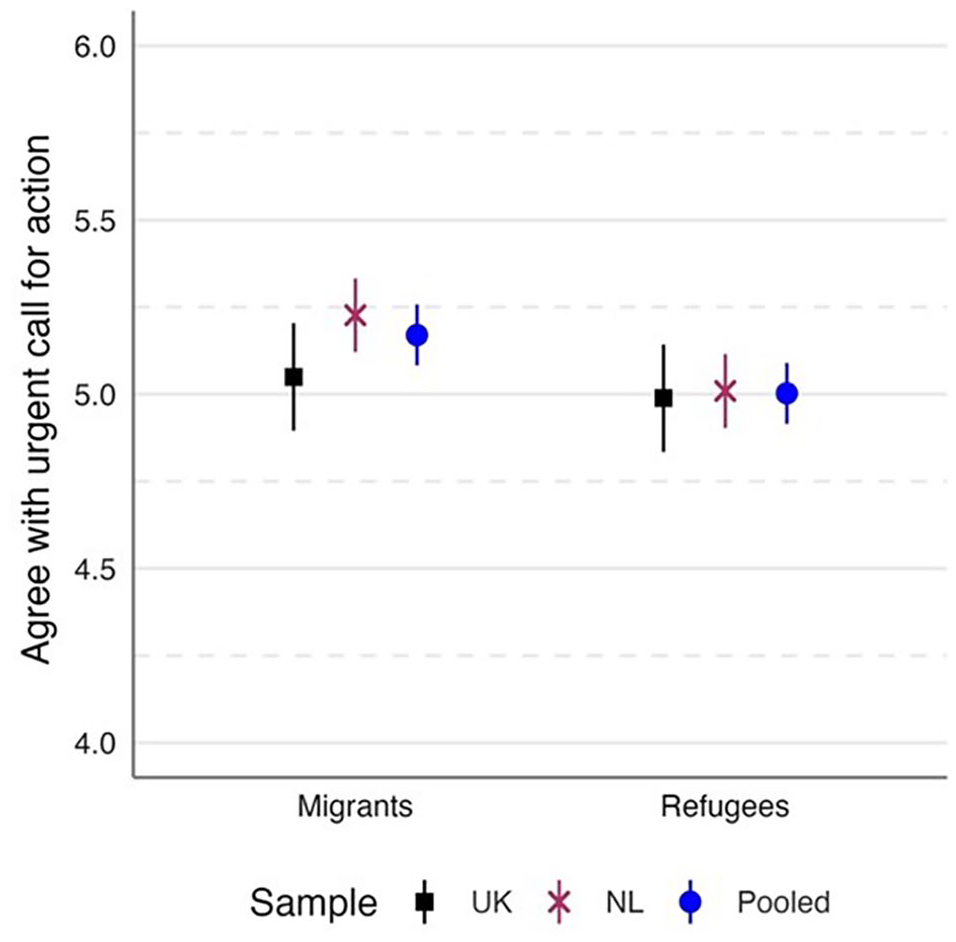
Results From the Survey Experiment Across Various Samples.
When looking at the pooled sample of 2261 respondents (UK and Dutch respondents jointly), we see that the “refugees” treatment leads to, on average, .26 points lower agreement with the call for urgent actions of the international community toward remedying climate-induced migration (|t|= 2.658, p = 0.008). It is evident that this result is mostly driven by the Dutch participants and, generally, is of negligible size (Cohen’s d = .112)
Overall, we cannot provide evidence in favor of the “refugees” frame containing a persuasive normative imperative to act. Quite contrary to this, our findings suggest that the “environmental refugees” frame may slightly backfire and work counter to what was previously assumed, leading people to relatively lower levels of support for the global community’s action on this issue.
Conclusions
This article aimed to contrast assumptions regarding the normative utility of the term “environmental refugee” and compare those assumptions to our empirical findings regarding the comparative valence of that term in contrast to “environmental migrant.” The findings speak for themselves. There is no discernible and presumed difference in public opinion between the terms “environmental migrant” and “environmental refugees.” The implication is that the public in the UK and the Netherlands generally do not consider the nuanced differences between the terms “environmental refugees” and “environmental migrants,” as argued by activists and proponents of the “refugees” labels. This highlights two puzzles, both of which deserve further research. First, there is a seeming disconnect between the societal understanding of the two terms and the academic understanding of the same. Some scholars may believe that the term “environmental refugee” is inherently more persuasive than “environmental migrant,” but that may be a category error of sorts that conflates the academic part with the public whole. Our findings indicate that such assumptions may be wrong. The assumption of “environmental refugees” having more support than “environmental migrants” remains unfounded. Second, our findings contrast with De Conick’s study regarding the social perception of “refugee” and “immigrant” in general, without the environmental specification. That may help explain the reason for the first puzzle, but it raises further questions. Crucially, we have only presented a single piece of evidence, and hence, we encourage further work on the topic.
Footnotes

Declaration of conflicting interests
The author(s) declared no potential conflicts of interest with respect to the research, authorship, and/or publication of this article.
Funding
The author(s) disclosed receipt of the following financial support for the research, authorship, and/or publication of this article: This work was supported by the ERC Starting Grant JUSTREMIT (949648). Financial support by the Leiden University Fund and Erasmus University Rotterdam is gratefully acknowledged as well.