




Abstract
We investigated the link between party identification and several cognitive styles that are associated with open-minded thinking. We used a web-based survey which involved participants rating the strength of an argument they initially disagreed with. Results showed that Democrats tend to score higher and Republicans tend to score lower on open-minded cognitive style variables. However, mediation analyses showed that these partisan differences in cognitive style generally have negligible relationships with how individuals assess the strength of arguments they disagree with. In other words, partisan differences in cognitive style may often make little meaningful difference to information processing.
Keywords
Introduction
Scholars disagree about whether there are substantial differences in how people with different political orientations process information. Some argue for an asymmetry thesis: that left and right differ in psychological traits such as higher levels of dogmatism in conservatives (Jost, 2017; Jost et al., 2003). Others argue that the problem is symmetrical across the political spectrum (Ditto et al., 2019).
In addition, questions remain regarding the extent to which cognitive styles translate to substantively important differences in information processing. If Republicans are more dogmatic or Democrats are more open to change, for example, how much does that affect their information processing? In this study, we examine correlations between party identification and a variety of cognitive styles thought to affect information processing. We also look at what effect these cognitive styles might have on information processing – specifically, participants’ ratings of the strength of an argument with which they initially disagreed. Results show correlations between party identification and open-minded cognitive styles, but none are associated with large differences in argument strength ratings.
Partisan differences in open-mindedness
The motivated social cognition model explains the connection between psychological needs and ideological affinities and assumes that individuals gravitate toward locations on the political spectrum where their needs are best met (Jost et al., 2003). As such, some have argued that cognitive styles that are the least conducive to democratic governance are concentrated on the right, in that conservatism has been positively associated with authoritarian attitudes and dogmatism, and negatively associated with open-mindedness (Jost et al., 2003).
However, what political orientation means in terms of information processing is an empirical question. A meta-analysis by Ditto et al. (2019) examined studies in which information was experimentally manipulated to favor one political party or another. For example, participants might be presented with identical quantitative evidence, but the implication of the evidence was framed to either support liberal or conservative beliefs. If liberal participants rated the information as being of higher quality when it supported the views of liberals as opposed to supporting the views of conservatives, this would be evidence of motivated reasoning in that assessment. Results suggested bias on both sides in favor of information that supports their own views, and that the magnitude of this bias is roughly equal across liberals and conservatives.
These results could be seen as contradicting the findings of scholars who argue that there is a higher level of bias on the right. Ditto (2019) and colleagues argue that psychological affinities for one party or another do not seem to manifest in behavior and thus cast doubt on the idea of partisan asymmetry. Baron and Jost (2019) have argued that Ditto et al. (2019) do not raise questions about partisan asymmetry, as liberals and conservatives would start with different sets of knowledge and evaluations of various contentious issues. In sum, one side says that conservatism is associated with traits that may be undesirable from a democratic standpoint (Jost, 2017), and the other side proposes that, when it comes to behavior, no side is more virtuous than the other.
Cognitive styles and open-mindedness
Researchers have used multiple approaches to measure how individuals are likely to engage with information in an open-minded manner. For example, some individuals have a high need for closure (Webster and Kruglanski, 1994). Individuals with a higher need for closure may settle on decisions that offer quick relief from uncertainty but may not be optimal in the long run.
However, cognitive styles that “should” lead to open-minded information processing, based on their theorized conceptual nature, will not always do so in practice. For example, individuals with higher levels of actively open-minded thinking (AOT) are assumed to make efforts toward engaging with contradictory evidence (Baron, 1993). Although some empirical tests have shown AOT may reduce motivated reasoning (e.g. Stenhouse et al., 2018), AOT has also been associated with higher levels of motivated reasoning (Kahan and Corbin, 2016).
Party identification versus ideology
Some researchers (e.g. Jost et al., 2003) have used ideology and party identification as relatively interchangeable measures of political orientation. However, research casts doubt on the idea that most Americans have consistent ideologies. By one estimate, about 20% to 30% of Americans have a coherent ideology (Kinder and Kalmoe, 2017). Thus, as we are concerned with practical outcomes, we use party identification as the focus of this analysis.
Research questions
Ditto et al. (2019) ask if both they and Baron and Jost (2019) might be right: conservatives have more rigid thinking styles, and liberals more open ones, but it is possible that cognitive styles are ultimately superfluous in the end. We test this more directly by measuring the relationships between party identification, cognitive styles, and information processing behavior.
Figure 1 shows the analytical frameworks of Jost et al. (2003) and Ditto et al. (2019), as well as the framework used in this study. Jost et al. (2003) analyzed correlations between several cognitive styles and conservatism. Ditto et al. (2019) examined whether the difference between those in congenial information situations compared to those in uncongenial information situations is different for individuals with varying political orientations – in other words, a moderated relationship.

Study framework comparisons. Jost et al. (2003) analyzed correlations between several cognitive styles and conservatism.
As outlined above, we are interested in the strength of association between cognitive styles and party identification. We ask:
Research question 1 (RQ1): Which cognitive styles are related to identification with the Democratic or Republican party (party identification)?
Our study differs from Ditto et al. (2019) in several ways. Ditto et al. (2019) looked at an interaction: how political orientation moderates the effect of congeniality manipulations on judgment outcomes. They were interested in the differences in information quality ratings for congenial versus uncongenial information. In our study, we do not manipulate congeniality. Instead, all participants were given uncongenial messages. We measured biased information processing by looking at whether people were more or less willing to rate uncongenial information as being high in quality, rather than by looking at how this rating compared to a rating for congenial information.
We also focus on a different form of congeniality. In the studies analyzed by Ditto et al. (2019), congeniality was defined in terms of whether a message supported the views of participants’ political party or ideological orientation. In our study, we made messages uncongenial by ensuring that they argued against the participants’ own previously stated views on the topic of fracking. Despite these differences, our study is similar to Ditto et al. (2019) in that we examine how party identification is related to variation in judgments of information quality – specifically, evaluations of argument strength. We ask:
Research question 2 (RQ2): What is the magnitude of the differences in argument strength associated with the differences in cognitive styles across parties?
Data collection
Data were collected through an online survey with an embedded experiment in March of 2018. A quota sample of 1571 US adults was obtained from Survey Sampling International (SSI), although as noted below, not all of these individuals were included in the analyses. Institutional Review Board approval was granted; consent was obtained from each respondent prior to the start of the survey. The survey took approximately 20 minutes to complete.
Choice of message topic
In choosing the topic for the messages, our primary goal was to create good, realistic arguments, of similar detail to messages about science that people might actually encounter, which we would reasonably expect to change participants’ factual beliefs if they were open minded. We wanted a topic that was at least somewhat controversial. Motivated reasoning is not a big problem for topics where people do not care much about whether their beliefs are correct or not. However, we did not want an issue like whether climate change is real, where attitudes are more crystallized and unlikely to change. Finally, we also wanted an issue where there was good evidence on both sides of the issue. That would enable our design whereby everyone who was not neutral on the topic could be assigned a counter attitudinal message containing references to real scientific evidence that would stand a chance of being seen as convincing. The topic of whether fracking is better for the climate than coal was the best scientific topic we could find that met all these criteria (see supplementary material for more details of message creation).
This topic did have the downside of combining the two controversial issues of fracking and climate change, making the discussion more complex. Participants who supported fracking but were skeptical about human influence on climate change, for example, might have a difficult time deciding whether to say whether they thought fracking could help stop climate change. However, while simpler topics would have been more desirable from this perspective, other topics would have failed to meet one of the other criteria mentioned above, which we saw as more important for this particular study.
Procedure
The first question measured individuals’ views on whether fracking can help stop climate change. Following this question, respondents answered a battery of questions measuring cognitive styles and other variables, and then either read the message (if they were in the experimental conditions that read messages) or read no message (if they were in the control condition). Those who read messages subsequently rated the strength of the arguments presented in the messages.
There were four experimental conditions in total, which we refer to as two ‘antifracking’ groups (message and control) and two ‘profracking’ groups (message and control). Whether a participant was antifracking or profracking was not randomly assigned but based on their response to the first question about whether fracking can help stop climate change. The people who indicated that fracking could not help stop climate change formed the antifracking groups, and those who indicated that fracking could help stop climate change formed the profracking groups. Those who were neutral were excluded from analysis. Within both the antifracking and profracking groups, one third of participants were randomly assigned to the control condition, and two thirds were randomly assigned to read a counter attitudinal message. The experiment was set up so that participants reading a message would automatically read the message that disagreed with their previously indicated views on whether fracking could help stop climate change. In total there were 431 individuals in the antifracking groups (282 in the treatment group, 149 in the control group) and 252 individuals in the profracking groups (168 in the treatment group, 84 in the control group).
Antifracking participants read a message suggesting that fracking is better for the climate than coal because it results in lower overall greenhouse gas emissions; profracking participants read a message suggesting that fracking is worse for the climate than coal because it is likely to result in higher overall greenhouse gas emissions. One message was 404 words long and one was 405 words long. The full counter-attitudinal messages can be found in the supplementary materials.
This study does not compare the experimental groups to the control groups (treatment-control comparisons were conducted in another study by the authors). Analyses in the current study test associations, not effects of the messages, as there is no control group analysis. Rather, this study analyzes the full antifracking and profracking groups for the correlations between party identification and cognitive style, and the subset of study participants who were placed into the treatment groups for the mediation analyses to measure the predictive ability of cognitive styles on the assessment of argument strength.
The demographics for the 431 individuals in the antifracking groups are as follows: mean age 45 years, 46% female, 79% White, 12% Black, median income category $50,000 to $75,000, and median education category ‘Some college, no degree’. Of the participants in the antifracking groups, 48% were Democrats or Democratic-leaning Independents, 24% were Independents close to neither party, and 28% were Republicans or Republican-leaning Independents. For the 252 individuals in the profracking groups, mean age was 39 years, 52% female, 71% White, 16% Black, median income category $50,000 to $75,000, and median education category ‘Some college, no degree’. Of the participants in the profracking groups, 50% were Democrats or Democratic-leaning Independents, 17% were Independents close to neither party, and 33% were Republicans or Republican-leaning Independents.
Party identification
Participants’ party ID was measured with a single item: ‘Generally speaking, when it comes to political parties in the United States, how would you best describe yourself?’ Answer options were 1 (A strong Democrat); 2 (A not strong Democrat); 3 (Independent, lean toward Democrat); 4 (Independent (Close to neither party)); 5 (Independent, lean toward Republican); 6 (A not strong Republican); and 7 (A strong Republican).
Initial views on fracking
This variable was used to sort individuals into antifracking and profracking groups, and was also included in mediation analyses as a control. Participants were presented with the statement: First, we would like to get your opinion on one method of energy production. Hydraulic fracturing or ‘fracking’ is a way to extract natural gas from shale rock deep underground. Please indicate your confidence that the following statement about fracking is true or false.
Below this, participants were presented with the statement ‘Hydraulic fracturing or “fracking” may help to stop climate change.’ Answer options ranged from 1 (Extremely confident this is false) to 9 (Extremely confident this is true), with 5 (Unsure) as the neutral midpoint.
Cognitive styles
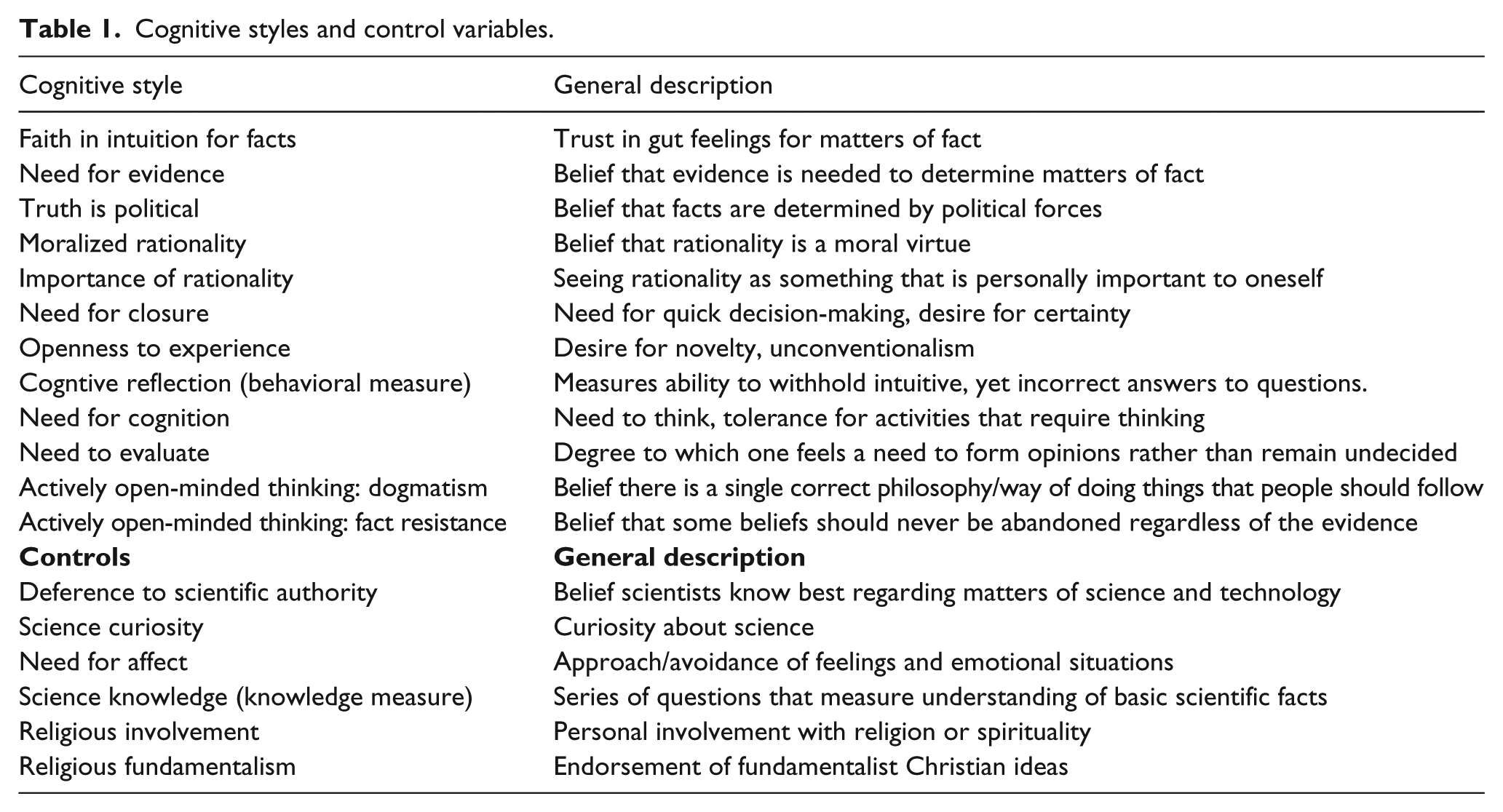
We measured a variety of cognitive styles that have theoretical and/or empirical associations with ‘open-minded’ information processing, and we also included variables that have no theoretical relationship to open-mindedness but were included as controls. For example, we measured scientific knowledge as knowledge levels may be associated with understanding fracking. Understanding fracking could in turn be associated with information processing, and we wanted to compare them to the open-mindedness variables. Descriptions of all the cognitive styles and controls are found in the supplementary materials. Table 1 features brief, general descriptions of the cognitive styles and controls that we tested (references are found in the supplementary materials).
Cognitive styles and control variables.
Argument strength rating
Argument strength rating was measured with the question, ‘Regardless of whether you personally agree or disagree with the article, how would you rate the strength of the argument presented in the article above?’ where 1 was ‘very weak’ and 7 was ‘very strong.’
Missing data and analysis procedure
Some cases were excluded, in the following order, for being previews (n=1); for having duplicate IP addresses (n=23); for not answering a second question about their views about fracking, (n=318); as well as those who completed the survey too quickly (n=86); who did not answer the income question (n=12); or were under the age of 18 (n=2), leaving 1129 cases for analysis. Although these broad reasons for excluding data were decided upon before data collection, the precise way this would be implemented was not decided upon in advance of collection, nor was any part of the study preregistered. Therefore, this data analysis should not be considered to be confirmatory. Missing data were imputed using hot deck imputation (Myers, 2011), a procedure that completes missing data by matching cases on similar traits based on variables that are not important for the specific theoretical questions being tested but are related to the variables being imputed. Often demographic variables are used. We used income: missing values were replaced with values from randomly selected participants who were similar in terms of income.
All analyses were conducted in SPSS Version 25. The mediation analyses were conducted using SPSS PROCESS macro 3.3 (Hayes, 2017). Our regression-based mediation analysis, implemented via Hayes’ (2017) PROCESS macro, uses the same assumptions of sequential ignorability made under the potential outcomes approach used by other researchers (e.g. Imai et al., 2011).
Results
To answer RQ1, we looked at separate sets of bivariate correlations between party identification and cognitive styles. We report correlations separated by antifracking and profracking groups, rather than for the entire sample. This was done to make it possible to compare these results to the mediation results below, which must be separated by group since the two groups rated the argument strength for different messages. Figure 2 shows the results. Overall, the correlations were weak, ranging from −.003 to .31 in the antifracking groups and .008 to −.15 for the profracking groups. Recall that Democrat is coded low, thus a negative correlation indicates association with a Democratic party affiliation, and vice versa for Republicans. In general, particularly for the antifracking group, open-minded and rational cognitive styles were associated with Democrats while dogmatic cognitive styles were associated with Republicans.

Correlations between party identification and cognitive styles for the antifracking and profracking groups. Positive correlations signify that higher identification with Republicans (or lower identification with Democrats) was associated with higher levels of that variable. Negative correlations signify the opposite.
RQ2 regarded the magnitude of the differences in argument strength associated with the differences in cognitive styles across parties. To answer this question, we conducted mediation analyses where argument strength rating was the dependent variable, party identification was the independent variable, and cognitive styles were the mediators. In using mediation analyses in this way, we are not attempting to obtain evidence that this is the correct causal sequence by which these variables influence each other. In other words, we are not claiming that party ID causes differences in cognitive style, nor are we attempting to provide causal evidence for the relationship between cognitive styles and argument strength. Instead, mediation analysis merely provides a convenient way to quantify the magnitude of differences in argument strength ratings associated with the differences in cognitive style between Democrats and Republicans. It is possible that party ID causes differences in cognitive style, that cognitive styles cause people to affiliate with different parties, or that the relationship is reciprocal. In this paper, we do not attempt to distinguish between these scenarios. Instead, we ask: If it were true that the parties differ in cognitive style (for whatever reason), and if it were true that cognitive styles cause people to evaluate counter attitudinal evidence differently, then roughly how large an effect might these cognitive style differences have on argument strength ratings? Estimates of the indirect effects taken from mediation analyses provide one way to quantify the answer to this question. Figure 3 displays the structure of the mediation models used.
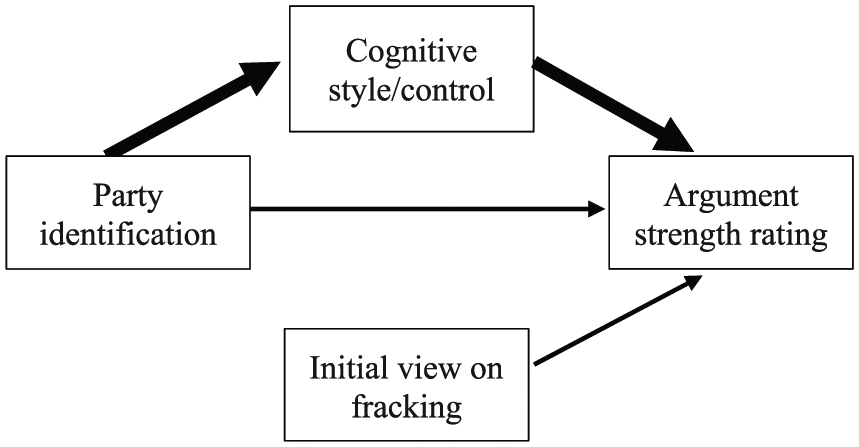
Mediation model.
We conducted 18 separate mediation analyses for each group, one for each of the cognitive style or control variables. The indirect effect was tested using a percentile bootstrap estimation approach with 5000 samples. Figures 4 and 5 graphically display the indirect effects from these analyses (i.e. the arrows bolded above in Figure 3, only the coefficient representing the indirect path from party identification to cognitive style/control variable, and then to argument strength rating). All other coefficients from the mediation analyses are not displayed, since our focus is not on understanding the true nature of the relationships between all variables, but on quantifying the amount of variation in argument strength associated with differences in cognitive styles across parties. Full results for these analyses are available in the supplementary material.

Indirect effects of party identification for the antifracking group that received the treatment. This figure shows the indirect effect of party identification on argument strength ratings, mediated through specific cognitive styles. The chart shows percentile bootstrap confidence intervals for these indirect effects. The units of the x-axis represent the unstandardized coefficients multiplied by six, in order to show the difference in argument strength associated with the difference between Strong Democrats and Strong Republicans, as opposed to the difference associated with one scale point of party identification.

Indirect effects of party identification for the profracking group that received the treatment. This figure shows the indirect effect of party identification on argument strength ratings, mediated through specific cognitive styles. The chart shows percentile bootstrap confidence intervals for these indirect effects. The units of the x-axis represent the unstandardized coefficients multiplied by six, in order to show the difference in argument strength associated with the difference between Strong Democrats and Strong Republicans, as opposed to the difference associated with one scale point of party identification.
Here, a positive indirect effect represents Republicans rating the argument as stronger than Democrats, and a negative indirect effect represents Republicans rating the argument as weaker than Democrats. Nearly all the indirect effects were nonsignificant, but we are concerned with the maximum possible relationships, not whether the relationships are significant or not. All the point estimates were small: none exceeded .2 scale points in either direction.
Examining the confidence interval endpoints reveals the maximum potential relationship between party ID, cognitive styles, and argument strength assessment. The cognitive style with the most extreme endpoint is AOT dogmatism for profracking participants. If this relationship was causal, and the lower end of the confidence interval represented the true effect, this would mean that the differences in AOT dogmatism for strong Republicans compared to strong Democrats would result in strong Republicans rating the argument .35 scale points weaker, on average, than strong Democrats did. Religious fundamentalism, which is not a cognitive style, had an even more extreme upper limit of its confidence interval. If this represented the true effect, and the effect were causal, this would mean that the differences in religious fundamentalism for strong Republicans compared to strong Democrats in the antifracking group would result in strong Republicans rating the argument .48 scale points stronger, on average, than strong Democrats did.
These results show that the differences in cognitive style across Democrats and Republicans do not make much difference to argument strength ratings. To put the scale points in context, one point is the difference between rating the argument strength “very weak” and rating it “moderately weak,” or the difference between “neither weak nor strong” and “slightly strong.” People whose ratings only differ by about one third of a scale point are in close agreement on the strength of the argument. Our estimates suggest that the absolute maximum effect of differences in cognitive style results in roughly this difference for people at the extreme ends of partisan identification. Most likely, the true differences are much lower.
Discussion
Our results show psychological asymmetry between Democrats and Republicans. In most instances, Democrats scored higher and Republicans scored lower on measures of open-minded cognitive styles. These results are broadly consistent with what Jost et al. (2003) report in their meta-analysis.
There were some notable exceptions to the trend of Democrats scoring higher on open-minded cognitive styles. For example, openness to experience and need for closure had almost zero relationship to party ID, and Republicans scored higher on need for cognition, although this correlation was non-significant. The results for openness to experience and need for closure are different to the relationships found by Jost et al. (2003), perhaps due to most of the studies they analyzed not correlating cognitive styles with party ID, but with other variables such as self-reported conservatism or authoritarianism.
Regarding RQ2, our results show that these differences for Republicans and Democrats do not make much difference to individuals’ ratings of argument strength for counter-attitudinal messages. Again, these results are consistent with other scholars. Ditto et al. (2019) found that the different levels of bias between left and right were so small as to be virtually indistinguishable from one another.
Some readers of the literature on partisan differences in cognitive style might conclude that the existence of statistically significant correlations or moderately sized correlations necessarily entails meaningful differences in behavior. Our study shows that this assumption is unwise.
Of course, our results leave open the possibility that cognitive asymmetry may have larger effects on other forms of behavior or in other contexts. The results of Johnston et al. (2017) suggest that cognitive asymmetries are greater among individuals with higher political sophistication. Furthermore, asymmetry in existential motivations, as opposed to cognitive styles, may play a larger role in processing of messages about topics such as fracking (Jost et al. 2003). Also, argument strength ratings are not the only meaningful way to measure information processing behavior or cognitive bias. It is possible that cognitive styles may have larger effects on other important behaviors – and these should be investigated. Finally, future research should also address the extent to which items used to measure cognitive styles inadvertently measure sociopolitical attitudes (Stanovich and Toplak, 2019).
Overall, our analysis highlights the need to precisely measure effects of cognitive style on behavior and interpret those effect sizes with reference to what constitutes a substantially large effect in context. In the end, the question of whether Democrats and Republicans are cognitively symmetrical is likely to be less consequential than the question of whether any asymmetries make much of a difference to meaningful real-world outcomes. Future studies should attempt to answer this second question in a more definitive manner.
Supplemental Material
rp_supplementary – Supplemental material for Differences that don’t make much difference: Party asymmetry in open-minded cognitive styles has little relationship to information processing behavior
Supplemental material, rp_supplementary for Differences that don’t make much difference: Party asymmetry in open-minded cognitive styles has little relationship to information processing behavior by April Eichmeier and Neil Stenhouse in Research & Politics
Footnotes
Declaration of conflicting interests
The author(s) declared no potential conflicts of interest with respect to the research, authorship, and/or publication of this article.
Funding
The author(s) disclosed receipt of the following financial support for the research, authorship, and/or publication of this article: The authors received work support by the National Institute of Food and Agriculture, United States Department of Agriculture, Hatch project 1014149.

Supplementary materials
Carnegie Corporation of New York Grant
The open access article processing charge (APC) for this article was waived due to a grant awarded to Research & Politics from Carnegie Corporation of New York under its ‘Bridging the Gap’ initiative.
References
Supplementary Material
Please find the following supplemental material available below.
For Open Access articles published under a Creative Commons License, all supplemental material carries the same license as the article it is associated with.
For non-Open Access articles published, all supplemental material carries a non-exclusive license, and permission requests for re-use of supplemental material or any part of supplemental material shall be sent directly to the copyright owner as specified in the copyright notice associated with the article.
