




Abstract
Autocratic elections occur on uneven playing fields, yet their regular contestation compels ruling parties to pay attention to citizens’ demands. This claim is at the heart of research linking multiparty elections in autocracies to improvements in human development. Recent work, however, casts doubt on the theoretical and empirical basis of such claims. This paper addresses this debate by focusing specifically on the adoption of social assistance programs, an often theorized but seldom examined link in the chain connecting electoral autocracy with improvements in human development. I demonstrate that electoral autocracies are more likely to adopt these programs than closed autocracies and that the impact largely works through within-country changes in the presence of electoral authoritarianism. The results are consistent with the argument that such regimes are more responsive to citizens’ demands. However, they also remind researchers that the goal of such regimes is to win elections; there is little preventing them from crafting targeted social policies that secure the loyalty of the voting public but without the attendant improvements in broad measures of human development. I conclude with suggestions for how future research can better understand how authoritarian governance shapes development outcomes.
Introduction
Multiparty elections in autocracies are tools of authoritarian survival. Nevertheless, their contestation is credited with improvements in human development. For instance, Miller (2015b) shows that electoral autocracies outperform closed autocracies across a variety of health, education, and gender equality metrics. Blaydes and Kayser (2011) demonstrate that hybrid regimes are more successful at translating economic growth into development that benefits the poor. Teo (2019) argues that electoral autocracies engage in more redistribution and thus have lower levels of income inequality.
A number of theoretical mechanisms could explain this pattern. Electoral autocracies have large and diverse support coalitions, and may rely more heavily on providing development-promoting public goods (Hanson, 2013). Elections in autocracies also retain some uncertainty, and the threat of downward shifts in public support compels even dominant regimes to attend to citizens’ needs (Miller, 2015a). Differences aside, these studies have perpetuated the notion that the recent trend toward electoral authoritarianism (Levitsky and Way, 2010) has unintended but positive consequences for citizens’ well-being.
This argument faces three related challenges. First, several recent papers question the robustness of these empirical findings. For instance, Kim and Kroeger (2018) find that electoral authoritarianism is associated with increasing rates of infant mortality, which they attribute to such regimes’ greater potential of political violence and reduced state capacity. Similarly, Kudamatsu (2012) finds that sub-Saharan African countries that democratized experienced subsequent declines in infant mortality, but there was no effect when autocrats stayed in power by winning multiparty elections.
Second, there are theoretical reasons to doubt that electoral autocracies provide the kinds of public goods that lead to broad improvements in human development. Leaders’ promises regarding public goods frequently lack credibility (Keefer and Khemani, 2005). When such goods are delivered, their outcomes may be invisible to prospective voters and therefore inefficient means of generating electoral support (Harding and Stasavage, 2014). Instead, leaders may prefer to reward supporters with a mixture of clientelistic and programmatic policies whose economic benefits are more identifiable and thus offer more certain electoral rewards (Magaloni, 2006).
Prior scholarship tends to bundle these alternatives together. Miller’s (2015b) summary of his argument is illustrative; electoral authoritarian regimes “strategically emphasize social assistance and basic development outcomes” (1535). However, adopting social assistance policies and prioritizing the infrastructure and institutional development that enhances basic measures of development over time are distinct goals that require different behaviors. Electoral autocracies may not pursue both goals simultaneously, or they may be substitutes to one another, rather than complements.
Third, most existing research designs do not evaluate the specific mechanisms believed to underpin the superior development record of electoral autocracies. Put simply, elections in autocracies do not reduce child mortality or income inequality. Elections in autocracies may compel autocratic leaders to invest in broad public goods, implement social welfare policies, or otherwise engage in redistribution that improves citizens’ wellbeing, but if this is true, scholars should be able to find evidence of these intervening steps. Most cross-national studies only examine the endpoints of this causal chain, or focus on relatively simple proxies that introduce considerable measurement error into the process. For instance, Teo (2019) shows that electoral autocracies are associated with more social spending, yet spending data suffer from accuracy and reporting biases and may not always capture the extent to which mass publics actually experience benefits from public services (Mazaheri,2017: 187; Banerjee and Duflo, 2011). 1
One partial exception to this pattern is Blaydes and Kayser (2011), who find that hybrid regimes outperform autocracies when it comes to translating economic growth into pro-poor outcomes, which they measure in terms of calories consumed. However, their focus on caloric intake is mostly a response to the measurement challenges imposed by traditional measures of pro-poor development, such as national-level income inequality estimates.
Collectively, a number of critical questions regarding electoral autocracy’s developmental consequences remain untested. The remainder of this article explores one specific question in detail, namely whether such regimes are more likely to implement social assistance programs that enhance individual well-being of the neediest citizens.
Empirical approach
The key innovation of this paper is directly measuring whether a regime adopted a new social assistance program in a given year. Social assistance programs, including pensions, family support, conditional and unconditional cash transfers, to name a few, have been at the heart of a considerable body of prior research on the behaviors of electoral authoritarian regimes, though as noted above, never examined directly.
The specific data I use are from Dodlova et al.’s (2017) Non-Contributory Social Transfer Programs, which reports all non-contributory social transfer policies adopted by low- and middle-income countries globally. The data cover all programs in existence up to the year 2015. The earliest program recorded in the data is Hungary’s Családi pótlék, a cash family allowance to aid in the raising of children, which started in 1912. This is an extreme outlier, however, as these policies were relatively scarce until the 1990s, at which point they rapidly proliferated. 2
Figure 1 uses the Non-Contributory Social Transfer Programs data to plot the across-time trends in new program adoption throughout the developing world. The data report a variety of traits for these social transfer programs, including whether they are conditional or unconditional, and various sub-categorical designations, such as programs designed for family support, pensions, conditional cash transfers, and public works to name a few. As these categories are not mutually exclusive, Figure 1 adopts a simpler approach and counts the initiation of any new social transfer program. As is clear, social transfer policies began in earnest after 1990, and all subsequent regression analyses limit the temporal span to 1990 to 2015, to avoid undue influence from a few outlier programs adopted earlier in the 20th century. The graph represents 176 distinct social programs in 97 low and middle income countries, though not all of these appear in the regression analysis that follows due to missing data.
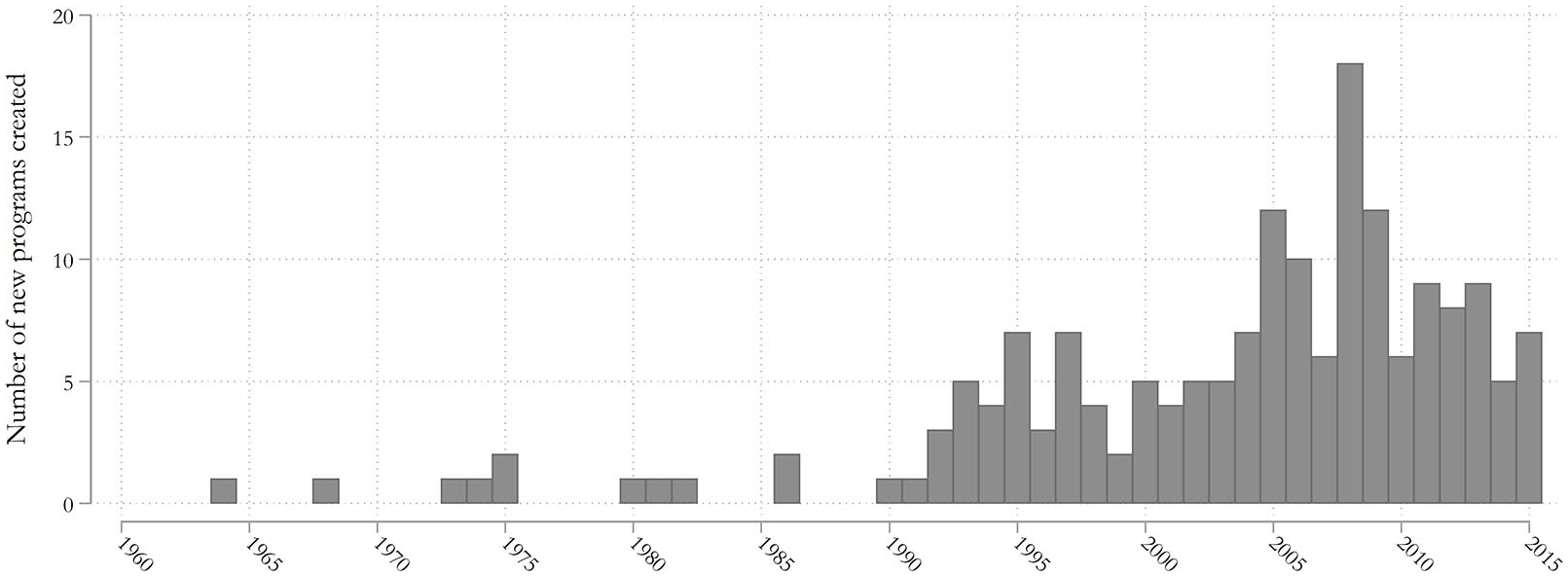
Number of new social transfer programs in developing countries, 1960–2015.
I use these data to construct the dependent variable and analysis sample. Specifically, I create a binary measure that takes the value of 1 if a country adopts any new social transfer program in a given year, and the value of 0 otherwise. 3 However, the Non-Contributory Social Transfer Programs dataset only reports active social transfer programs in countries that meet World Bank low and middle income categories. That is, it does not identify countries that were eligible for inclusion in the dataset given their income levels but were excluded because they did not create a program. I use the same income classifications to determine the remainder of the sample; that is, countries that were eligible for inclusion in the Non-Contributory Social Transfer Programs dataset given their income levels, but were excluded because they did not create a program. The end result is a sample (based on data coverage for the model covariates, described below) that contains 117 developing world countries, observed annually from 1990 to 2015. Eighty seven countries created at least one social program over this period, with 130 programs created in total.
I use these data to evaluate whether electoral autocracies are more likely to adopt these kinds of programs than closed autocracies. This hypothesis flows directly from existing research but, to the best of my knowledge, has not been subject to direct cross-national quantitative analysis. The closest prior work is Knutsen and Rasmussen (2018) and Mares and Carnes (2009). In the former, the authors show that autocracies are just as likely to adopt old-age pensions as are democracies, though they do not focus on the impact of electoral authoritarianism specifically. By contrast, Mares and Carnes (2009) develop a theoretical argument linking the interactions between autocratic leaders and their launching organizations to the kinds of social policies that emerge. However, they do not test this argument in a systematic fashion, nor does their theory address electoral competition and accountability between leaders and citizens in autocracies.
The key independent variables come from the Varieties of Democracy project. Specifically, I use Lührmann et al.’s (2017) Regimes in the World (RIW) measure that separates closed from electoral autocracies, and electoral from liberal democracies. I create a binary indicator for electoral autocracy, which is distinguished from its closed autocratic counterparts by holding de facto multiparty elections for the chief executive, even though irregularities, restrictions on party competition, or other deviations from the institutional requirements for democracy exist (Lührmann et al., 1-2). I also create a binary indicator for democracy, combining the electoral and liberal variants. Closed autocracy is the excluded category. I expect that each regime type indicator is associated with an increased likelihood of adopting a new social transfer program relative to closed autocracies. I present results in two samples: the first includes all regime types, and the second includes only authoritarian regimes. Using all regime types facilitates a comparison between the substantive impact of electoral authoritarian regimes and democratic regimes, while the reduced sample ensures that the results persist when only comparing electoral autocracy to closed autocracy.
Models control for other factors plausibly linked with the adoption of these programs. These include (log) income per capita (Graham and Tucker 2016), population size, the presence of an executive from a left political party (Cruz et al., 2018), the rate of economic growth, level of oil income per capita (Ross and Mahdavi, 2015), and a measure of ethno-linguistic fractionalization. I also include a measure of party institutionalization that draws on various aspects of party strength, such as the number of permanent party organizations, the presence of local party branches, and the existence of publicized policy platforms, from Bizzarro et al. (2017). Teo (2019) argues that this measure approximates parties’ time horizons, which may have a positive impact on the likelihood of adopting a social transfer program. 4
All models also include a count of the total number of social transfer programs in place in a given year, which helps control for changes to the marginal cost of adopting additional transfer programs. I lag all independent variables by one period and include year fixed effects to capture the across-time proliferation of social transfer policies.
Research in this area is subject to Pepinsky’s (2014) critique that autocratic institutions are endogenous to the outcomes they are trying to predict. For instance, autocratic leaders may allow multiparty competition if they believe that economic conditions are threatening their hold on power. Some scholars try to mitigate these critiques through creative approaches to measurement and research design, most notably through instrumental variables (e.g. Miller 2015b; Teo 2019). My approach differs. Rather than attempt to identify instrumental variables that account for the creation of autocratic institutions without simultaneously influencing outcomes of interest, I argue that the construction of the dependent variable goes some way towards addressing these concerns. Unlike some prior work where institutions and outcomes like inequality or child mortality are jointly determined, it is harder to imagine the adoption of a specific policy as driving the emergence of electoral authoritarianism. Adoption of such programs may be associated with other structural variables related to economic performance, though the regression models control for the most obvious of these.
I use two different regression approaches. The first is a standard logistic regression with clustered standard errors, though I limit the presentation of results below to the substantive effect of independent variables on the probability of starting a new social transfer program. The second focuses on controlling for unmeasured unit heterogeneity. The traditional approach – country fixed effects – is inappropriate in this setting as it would drop any countries that did not adopt a social transfer program during this timeframe. Instead, I adopt the “between-within” approach, described by Bell and Jones (2015). This approach is becoming a common method of approximating the unit fixed effects model in the context of binary dependent variables (e.g. Wright et al., 2015; Smith, 2017). Specifically, this method decomposes explanatory variables into panel-specific means and annual deviations from those means (Bell and Jones, 2015). The former measures the differences between countries, while the latter measures the within-country impact. In some models, I include a panel-specific mean of the dependent variable to further account for individual unit heterogeneity. 5
Results
Figure 2 presents results from the standard logistic regression. Specifically, the figure presents substantive effects, expressed as the change in probability of initiating a new social transfer program associated with a unit increase in binary explanatory variables, and an increase from the 25th to 75th percentile observed values for interval-level explanatory variables. 6 These substantive effects are reported for models employing the full sample and the autocracies only sample, respectively.

Substantive effects from logistic regression expressed as changes in probability of adopting a new program.
The estimate for electoral autocracy captures the change in the likelihood of initiating a new program when transitioning from a closed autocracy (the baseline category) to an electoral authoritarian regime. This estimate is positive and statistically significant in both samples; transitioning to electoral autocracy increases the likelihood of program adoption by nearly 4%, and nearly 2% in the autocracies only sample. Though relatively modest when viewed in isolation, the baseline probability of program adoption in a given year is only 3% in the full regime sample and 2% in the autocracies only sample. Thus such a transition doubles the likelihood of adopting a new social transfer program. As expected, a transition from a closed authoritarian regime to a democracy also significantly increases the likelihood of adopting a new social transfer program, though limiting the sample to autocracies does not change the fundamental result concerning electoral authoritarianism.
Party environments that are more institutionalized are also associated with significantly higher probabilities of social transfer program adoption, as are larger populations. The estimate for the variable measuring total programs in place is negative and statistically significant, at least in the full sample; given the coding, this reflects the impact on the predicted probability of new program adoption when moving from zero current programs to one current program. In other words, rather than easing the burden for future program adoption, creating an initial social transfer program significantly reduces the likelihood that additional programs are adopted in the subsequent year. Other model covariates are not significantly associated with adopting new social transfer programs.
The between-within regression approach helps assess whether these results reflect differences in the level of electoral authoritarianism across countries, or conversely, within-country changes in the level of electoral authoritarianism. Figure 3 presents coefficient plots of the key variables, across four different models that vary in terms of sample composition and how unit effects are approximated given the binary dependent variable. The first two models include all regime types, while the second two limit the sample to authoritarian regimes. The second and fourth models approximate unit effects by replacing the count variable of total programs in place with panel-specific means of the dependent variable.

Between-within logistic regression coefficients and 95% and 90% confidence intervals.
In the all regime sample, the main impact of electoral autocracy appears to reflect the large differences between countries; only the between effect measure is significant, though only in the first model. Though not the focus here, democracy appears to matter both in terms of cross-country differences in the average level of democracy and in terms of within-country changes.
However, when limiting the analysis to authoritarian regimes only, the results are different. Here the only significant impact comes from the within-country changes in the degree of electoral autocracy, and the effect is positive and statistically significant. A yearly transition from closed autocracy to electoral autocracy – something that occurs 38 times in the sample – raises the probability of adopting a new social assistance program. These results persist across multiple approaches to capturing unit effects and inclusion of the full set of control variables, including year fixed effects.
The Online Appendix reports a number of other robustness analyses. For instance, the results are consistent when excluding party institutionalization, substituting in a measure of the (log) age of largest government party as a measure of party time horizons, and controlling for the occurrence of an executive or legislative election. I also test whether the effect of electoral autocracy is conditional on the level of party institutionalization or whether there is an ideologically left executive. These hypotheses are drawn from Teo’s (2019) paper on electoral authoritarianism and income inequality, though my results suggest that such conditional effects are absent when focusing on the adoption of social assistance programs specifically.
Conclusion
Electoral authoritarian regimes depend on victory at the polls, so they must “pay attention to citizen concerns” (Teo, 2019: 19). This is accomplished, at least in part, by the adoption of social assistance programs that provide important economic benefits to their population. As such, the evidence reported above strongly supports a previously un-tested claim that animates much of the growing literature on the political economy of authoritarianism. Electoral autocracies behave in ways that imply they care about the material well-being of their populations, and are much more likely to adopt beneficial social assistance policies than their closed authoritarian counterparts.
The results also have implications for the literature on distributive politics. Recent work suggests that programmatic policies – such as the broad welfare programs examined here – do not reward incumbents in democracies (Imai et al., 2020). If programs rely on objective rules regarding implementation, so the argument goes, then incumbents are unable to claim credit. Voters expect to receive the same benefits regardless of the party in power, and thus have little incentive to reward incumbents at the ballot box.
However, this logic may not hold in electoral authoritarian settings. Given the tilted playing field in such regimes, citizens may recognize that continuation of benefits depends on the electoral fortunes of the ruling party, even if these programs have seemingly objective criteria and implementation strategies. Do programmatic policies benefit incumbents in these regimes? Future research could employ this same data to more formally assess this specific question, and others that constitute important parts of the causal chain. This also includes whether the adoption of these programs is associated with improvements in health, education, and poverty metrics.
Future work should also examine whether these social assistance programs are a complement to public goods investments, or a substitute. Do social assistance programs crowd out these broader development programs? Most scholars believe that electoral authoritarians provide benefits because they want to win elections, not out of benevolence. If programmatic policies secure the loyalty of the voting public, electoral authoritarians may even decide to purposely underprovide these public goods, since the benefits take longer to emerge and electoral credit may never materialize. If scholars are to continue emphasizing electoral autocracy’s unexpected but positive developmental impact, these questions require answers.
Supplemental Material
Supplemental_Materials_final_publication_version – Supplemental material for Are electoral autocracies better for the poor? Evidence from social assistance programs
Supplemental material, Supplemental_Materials_final_publication_version for Are electoral autocracies better for the poor? Evidence from social assistance programs by Matthew D. Fails in Research & Politics
Footnotes
Acknowledgements
Special thanks to Elizabeth Wilhelmi, Cody Eldredge, Sarah Hemenway, and Allan VanRyckeghem for their valuable assistance on this project.
Declaration of conflicting interest
The author declared no potential conflicts of interest with respect to the research, authorship, and/or publication of this article.
Funding
The author received no financial support for the research, authorship, and/or publication of this article.

Notes
Supplementary materials
Carnegie Corporation of New York Grant
This publication was made possible (in part) by a grant from theCarnegie Corporation of New York. The statements made andviews expressed are solely the responsibility of the author.
References
Supplementary Material
Please find the following supplemental material available below.
For Open Access articles published under a Creative Commons License, all supplemental material carries the same license as the article it is associated with.
For non-Open Access articles published, all supplemental material carries a non-exclusive license, and permission requests for re-use of supplemental material or any part of supplemental material shall be sent directly to the copyright owner as specified in the copyright notice associated with the article.
