




Abstract
Opposition coordination varies widely in electoral autocracies. Sometimes, opposition parties are highly coordinated and create alliances, present joint candidates or common policy platforms. Yet, at other times, oppositions choose to challenge incumbents individually. This article seeks to explain what drives opposition parties to coordinate in non-democratic regimes. It finds that opponents’ decision-making and strategy formation is influenced by the amount of repression they face from the incumbent regime. It argues that repression has a curvilinear relationship with opposition coordination. When repression is low and high, opposition coordination will be informal or clandestine. However, when repression is at intermediate levels, opposition parties will formally coordinate to dislodge authoritarian incumbents. This article illustrates this argument through an analysis of the Venezuelan opposition under Chavismo (1999–2018), combining 129 interviews with party elites, journalists, academics, and regime defectors, along with archival research at key historical moments.
Autocrats are not invincible, and they know it. One of their biggest fears is an organized and united opposition. 1 They often use ‘divide and conquer’ strategies, such as distributing fiscal resources and political offices among opposition groups (Arriola, 2013; Gandhi and Przeworski, 2006; Lust-Okar, 2007; Schedler, 2002a), or deploying tactics of repression, be they legal or coercive, to guarantee their continued hold onto power (Davenport et al., 2004; Levitsky and Way, 2010). As a result, oppositions often fragment and do not pose a threat to incumbents. For instance, in 1988 South Korea and 1992 Kenya, incumbents won because multiple opposition candidates could not agree on creating a joint platform thereby splitting the opposition votes. Yet, at other times, some countries’ oppositions coordinate to successfully challenge incumbent power. For example, opponents created an electoral alliance to oppose Ferdinand Marcos in the mid-1980s in the Philippines and in Turkey, a coordinated opposition successfully challenged the ruling Justice and Development Party’s (AKP) in the 2019 local elections in Istanbul and Ankara. In Venezuela, opposition parties created the alliance Mesa de la Unidad Democrática (MUD) to collectively challenge Hugo Chávez, and then Nicolás Maduro. These examples show that when oppositions coordinate, they are more likely to increase their competitiveness and/or secure partial victories under authoritarian rule. What explains variation in opposition coordination (OC)?
This article focusses on repression as an explanatory variable for coordination. The argument is twofold: (1) repression shapes the incentives for coordination and (2) oppositions can coordinate either in informal or formal ways, depending on the levels of threat they face at a particular point in time. Moreover, while we should expect opponents to formally coordinate at intermediate levels of repression -where survival is at stake, but pooling resources may still pay off – we might not do so when repression is either low or high. This is so because low repression does not threaten parties’ survival or competitiveness in any serious way, therefore, there is no need for formal coordination. At high repression, formal coordination is too costly because of the high risks it bears. In the latter two scenarios, coordination can in fact happen, but if it does, it would be informal.
This article analyses the causal relationship between repression and OC in the setting of contemporary Venezuela, a country that has transitioned from low to intermediate to high repression (1999–2018). Contrary to the plausible expectation that regime opponents will always ally to oust incumbents, we observe a puzzling variation in coordination efforts: opposition parties have only at specific times chosen to present a unified front. Studying the within-case variation of repression and coordination in Venezuela provides lessons for a wide range of authoritarian regimes, including those engaged in low, mid or high levels of repression. This article uses process-tracing and within-case analysis to reconstruct when and how opponents have decided to coordinate. These methods are particularly useful for theory generating purposes as they allow to establish how certain steps may lead to an expected outcome over time. To analyse outcomes or changes over time, however, it is important to identify and examine key singular moments in time that contribute to understanding variation one is seeking to explain (Collier, 2011; George and Bennett, 2005). Here, I use an in-depth within-case study to explain the causal pathway between repression and coordination between 1999 and 2018.
To assess this argument, this article builds on original data from 6 years of iterative field research between 2014 and 2020. I use 129 semi-structured interviews with key elites from all major opposition parties, including Primero Justicia (PJ), Voluntad Popular (VP), Acción Democrática (AD), Comité de Organización Política e Independiente (COPEI), Causa R, Avanzada Progresista (AP), Alianza Bravo Pueblo (ABP), Un Nuevo Tiempo (UNT) and Vente Venezuela (VV). I also use interviews conducted with members of the MUD’s Executive Secretary, journalists, academics, political advisors, former judges members of civil society organizations and former regime members to analyse OC under Chavismo. 2 I also conducted archival research in newspapers 3 and consulted secondary literature as well as domestic and international reports on repression in Venezuela to examine the causal relationship proposed in this work.
I begin by briefly reviewing the literature on OC in authoritarian regimes, identifying existing explanations, gaps and this article’s contribution. Thereafter, I offer a definition of repression and a conceptualization of OC before introducing my theoretical framework. I then present empirical evidence on Venezuela to illustrate the causal relationship between repression and OC and finally conclude by addressing the implications of my argument and outlining areas of future research.
Repression and OC – Gap and Contribution
Recently, scholars have focussed on studying the internal dynamics of oppositions in authoritarian regimes more systematically (Albrecht, 2010; Arriola, 2013; Bunce and Wolchik, 2011; Greene, 2007; Lust-Okar, 2007). Some work has found that when opposition parties ally, they are often successful in dislodging authoritarian incumbents (Donno, 2013; Howard and Roessler, 2006). This is so because coordination helps overcome existing asymmetries of power between incumbents and opponents (Bunce and Wolchik, 2011; Edgell et al., 2018; Gandhi, 2008). Why, then, do not all oppositions coordinate at all times?
Institutional accounts find that government type, electoral systems, the presence of single-member districts can either promote or hinder coordination (Gandhi and Reuter, 2013; Wahman, 2016). Beyond these variables, scholars argue that ideological distance or proximity (Greene, 2007), personal rivalries among oppositions (Magaloni, 2006), the democratic-authoritarianism cleavage (Selçuk and Hekimci, 2020), or the increased probabilities of defeating an autocratic incumbent (van de Walle, 2006) affect the probabilities of OC. Other factors, including historical legacies, the nature of party systems (Grzymala-Busse, 2002; Weyland, 1996), economic development and/or commodity prices (Corrales, 2002; Dunning, 2008; Geddes, 1999) can further be expected to (dis)incentivize OC. Repression is also often mentioned as a variable that affects opposition behaviour in authoritarian regimes (Gandhi and Przeworski, 2006; Gandhi and Reuter, 2013; Gerschewski, 2013), however, we still lack a deeper understanding of when and how it does. Although there is a vast body of literature that has examined the effects of adverse conditions and/or repression on contention and party building (Loxton, 2015; Tarrow, 2011; Tilly, 1978; Van Dyck, 2017), we know little about how repression influences opposition elites’ incentives to coordinate in contemporary (electoral) autocracies. Addressing this gap is important because coordination is essential to liberalization and/or democratization, and also because autocratization has increased up to the point where, in 2020, authoritarian regimes have surpassed democratic ones (V-Dem, 2020). If we want to understand under what circumstances oppositions can initiate regime change, we need to first better understand when and why they choose to coordinate.
This article adds to the existing literature on authoritarian politics in three ways. First, it introduces repression as an additional independent variable to explain OC. Of course, the relation between repression and OC does not operate in isolation and might be affected or magnified by other variables, such as domestic political, socio-economic factors or even interests of international actors, including states or intergovernmental organizations (IGOs). Through the Venezuelan case I show, however, how varying levels of repression can help or hinder to overcome other potential obstacles, to coordinate in way or the other. Second, by focussing on opposition parties, a still understudied but relevant actor in authoritarian politics, I provide micro-level insights into their decision-making and strategy-formation. I also make an important conceptual contribution to the existing theories of electoral autocracies by distinguishing between different types of coordination (formal/informal) and explaining when and why oppositions will coordinate in one way or the other. Finally, this article makes an important empirical contribution to the literatures on Latin American party systems and the Venezuelan case. Even though some research has analysed contemporary Venezuelan politics, little has been published on opposition parties under Chavismo. 4 Given the unparalleled access to closely guarded opposition elites – many of whom have shaped opposition politics throughout Chavismo – this article also provides empirical depth that remains absent from existing studies.
Defining Repression and Conceptualizing OC
This study’s explanatory variable is repression. Repression can manifest itself and be perceived in a range of ways. This article understands repression as being both (1) violent or physical (i.e. violations of personal integrity rights) and (2) non-violent or legal (i.e. restriction of individuals’ civil and political liberties; Davenport et al., 2004; Escribà-Folch, 2013; Josua and Edel, 2015; Levitsky and Way, 2010; Schedler, 2002b). It also differentiates between levels of repression: low, medium and high. Low repression implies an unlevel playing field and only a partial abuse of state institutions, resources and/or media. Intermediate repression entails widespread and systematic violations of civil liberties, prevalent abuse of state institutions and resources and high repression denotes the government’s absolute control over state institutions and resources as well as the media, the outright banning of opposition parties, prevalent human rights violations and/or the systematic persecution, harassment and even assassination of opposition leaders. These distinctions are particularly important when studying electoral authoritarian regimes as their hybridity (i.e. rulers’ ability to use institutions in different ways; increasing or lowering repression when useful) represents a challenge to both academics and people on the ground.
This study’s outcome variable is OC, which is understood as a process in which opposition parties decide to work together towards the shared goal of dislodging incumbents. 5 Oppositions can coordinate with ideologically close and/or distant partners, and they can also coordinate in different ways. Existing scholarship tends to consider all kinds of joint actions, including non-compete agreements, electoral coalitions, joint protests and policy platforms, as coordination. All of these actions certainly demand coordination, yet they are also associated with different ‘costs’ (i.e. time, planning, resources, mutual concessions) and ‘benefits’ (i.e. competitiveness, effectiveness, credibility). For instance, calling for a nation-wide protest is less ‘costly’ than creating an electoral coalition and/or joint policy platform. And whereas a protest – in the best scenario – can help the opposition mobilize its supporters and pressure incumbents, an electoral coalition with a distinct programme and joint candidates can probably convince and mobilize more supporters, make credible commitments to regime insiders, communicate unity and cohesion thereby representing a real alternative. While in the latter example, coalition members have to intensively engage with one another, negotiate and concede, in the former, it would suffice to announce the protest for a joint cause. This is why I propose that we distinguish between two types of OC: informal and formal. The main difference between the two types is the institutionalization of their coordination process, that is, the formalization of their commitment to working together. Informal OC stands for less costly collective actions and is best understood as flexible and private agreements around certain political or socio-economic issues (e.g. loose platforms, cross-party endorsements, protests). Formal OC stands for institutionalized and more costly efforts (e.g. electoral coalitions, common policy platforms, joint candidates). In these cases, oppositions establish certain mechanisms to structure and facilitate their interaction, such as decision-making rules and conflict resolution mechanisms. Thinking of coordination is this way is helpful because it denotes the different costs and efforts associated with collaborating one way or the other, while allowing for a more nuanced understanding of opposition choices.
To Coordinate or Not to Coordinate – The Opposition’s Dilemma
Opponents in authoritarian regimes constantly face dilemmas about how to strategize. One recurrent puzzle is whether to act alone or collectively. To illustrate opposition decision-making, let us imagine a hypothetical country D, in which there are several opposition parties (X, Y and Z) and one incumbent ruling coalition T. 6 Each of these actors have their own interests and preferences. Generally speaking, we can think of these actors as largely interacting in two main arenas: one, in which opposition parties challenge the incumbent – either individually or collectively – and another, in which opposition parties face and challenge one another. When do they decide to coordinate? What this theory suggests is that (1) parties’ incentives to coordinate in authoritarian regimes will change as repression levels shift and (2) varying levels of repression will provoke different types of OC (informal/formal) because of its changing costs and benefits. This article’s argument should apply to presidential hybrid authoritarian regimes, in which multiple opposition parties exist and the use of repression and types of OC varies over time. The theory focusses on parties and presumes that their goal is to achieve regime change and the main factor separating them is ideology. While there are several obstacles oppositions have to overcome to being able to coordinate, including party system antecedents, party size/strength, competition over national or regional territory, personal rivalries or programmatic platforms, this article holds that repression is a useful variable to explain when, why and how, even ideologically distant opposition parties overcome their differences to coordinate their actions (Figure 1).
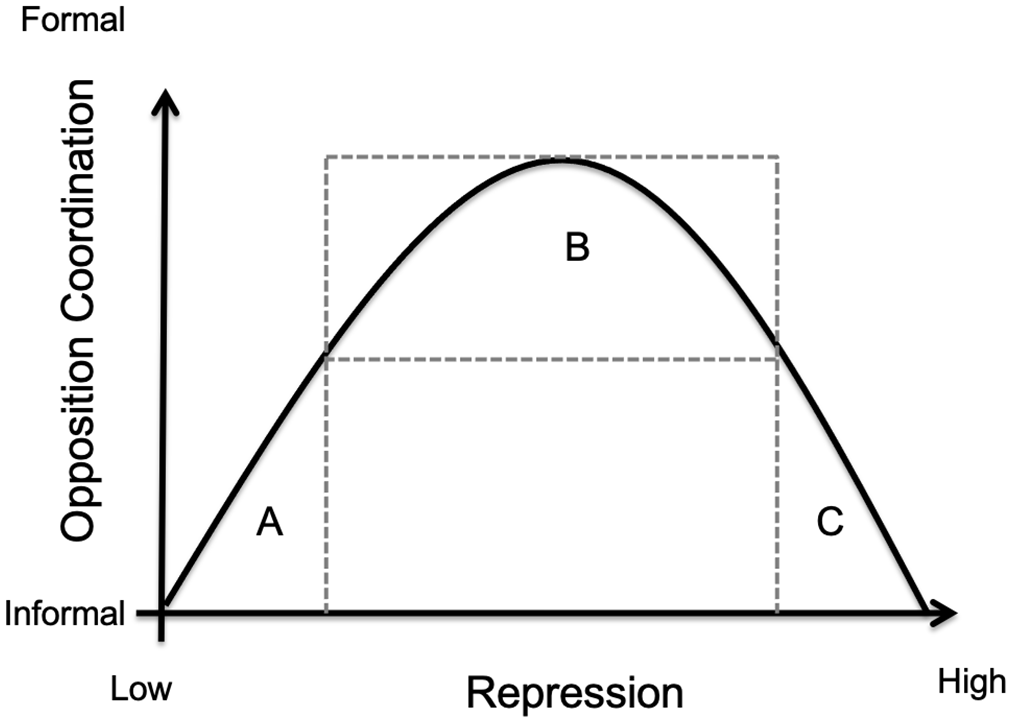
Relationship Between Repression and OC.
Low Repression
Parties compete for power and usually make choices that help them increase their power over their contenders. When repression is low, ideologically distant partners will have little or no strategic reasons to formally coordinate. Parties’ ability to engage in political competition is not affected to any major degree. Therefore, there is no serious threat to either parties’ possibilities of victory or survival and consequently no real need to assume the costs of formal OC (i.e. time, planning, mutual concessions). Existing strategic, ideological, programmatic or leadership differences are expected to prevail because there is no ‘intervening factor’ (repression) that induces the need to formally coordinate. We can also expect parties to prioritize their individual interests (e.g. increasing support base, strengthening programmatic platforms or boosting competitiveness) and compete for power vis-á-vis each other and incumbents. This does not imply that parties will never work together. If a country experiences (even small) changes in violent or non-violent repression, these can create incentives for parties to informally coordinate. For example, if they begin to feel endangered, they could engage with one another around loose platform or discussion tables to coordinate state reforms or one-off actions (e.g. protests). Yet, because there is no imminent threat to their survival, parties will prioritize a flexible and informal way of coordinating and will not be willing to assume the costs of compromising their ideologies, agendas and goals. Creating a joint strategy that would imply power-sharing agreements is not worth pursuing.
Intermediate Repression
When repression reaches intermediate levels, however, the costs for individual participation increase, while the costs of formally coordinating decrease. Now that parties feel threatened and the probabilities of individual victory are lower (fewer resources available to organize, mobilize or field effective campaigns), the benefits of formal OC increase too. Intermediate repression has now a direct impact and works as an intervening factor in elites’ decision-making. The shared perception of threat makes horizontal power relations among parties to become less important than their vertical power relation with the incumbent. While X, Y and Z still care about individual successes and differences in terms of party size, resources or ideology do not completely vanish, they will choose to formally coordinate because it enables self-preservation and a more efficient contestation. Formal OC helps parties (1) signal their commitment to working together, which helps aggregate vote share, (2) present a viable and coherent alternative to voters, (3) increase the costs of repression and co-optation and (4) boost their competitiveness. OC is pursued as a strategy to improve the aggregate comparative advantage towards T. To facilitate OC – and to avoid members to break away – parties will create decision-making rules and conflict resolution mechanisms. Even if parties have to share rewards among each other, they believe to be better off joining forces and potentially winning something together, than losing out completely. Because formal coordination can make oppositions more effective, incumbents can respond with an increased use of repression to break them apart, which, in turn might affect the type of OC parties can pursue. That is, in B and C (Figure 1), the relationship between type of OC and repression might reinforce each other.
High Repression
When repression is high, the costs of participation and formal OC increase. While the utility of formal OC is still high because it could boost the opposition’s competitiveness, the incentives for doing so will vary across parties. As the autocrat now systematically uses repression to further weaken and divide its opponents, as well as reducing the possibilities of regime transition, X, Y and Z might strategize differently. This is so because in C, formal OC brings high personal risks, such as being jailed, killed or sent into exile. Consequently, while some politicians may decide to stay in the race, others may choose to exit or to cooperate with the autocrat to guarantee their personal safety. For example, while X might prioritize personal safety and decide to tone down its activism, Y could give in to regime co-optation strategies by accepting bribes or an office, thereby assuming the role of a loyal or systemic opposition. However, Z could still assume the risks of challenging a highly repressive incumbent and pursue OC with other allies (i.e. other parties, independent leaders or civil society groups). Yet as stakes for visible and formal coordination are high, parties will be forced to coordinate their actions in a rather informal and/or clandestine way or beyond state borders (i.e. from exile).
Explaining Variation in OC in Venezuela (1999–2018)
The use of violent and non-violent repression has widely varied during Hugo Chávez (1999–2013) and Nicolas Maduro’s (2013–present) governments (Figure 2). These changes, however, did not occur over night. During Chávez’s first administration when democracy began to erode, repression was low. Then, Chavismo increased repressive tactics to intermediate levels (2006–2015) by engaging in ‘autocratic legalism’ (Corrales, 2015), attacking the press and opponents and controlling most state institutions (Kornblith, 2013a). Finally, under Maduro’s rule, repression has reached high levels (2016–present). 7 During these periods, parties have coordinated differently: while OC was predominantly informal between 1999 and 2006, it changed to formal (2006–2015) and finally turned largely informal/clandestine (2016–present). In the following section, I will show how changes in repression helped trigger variation in OC.
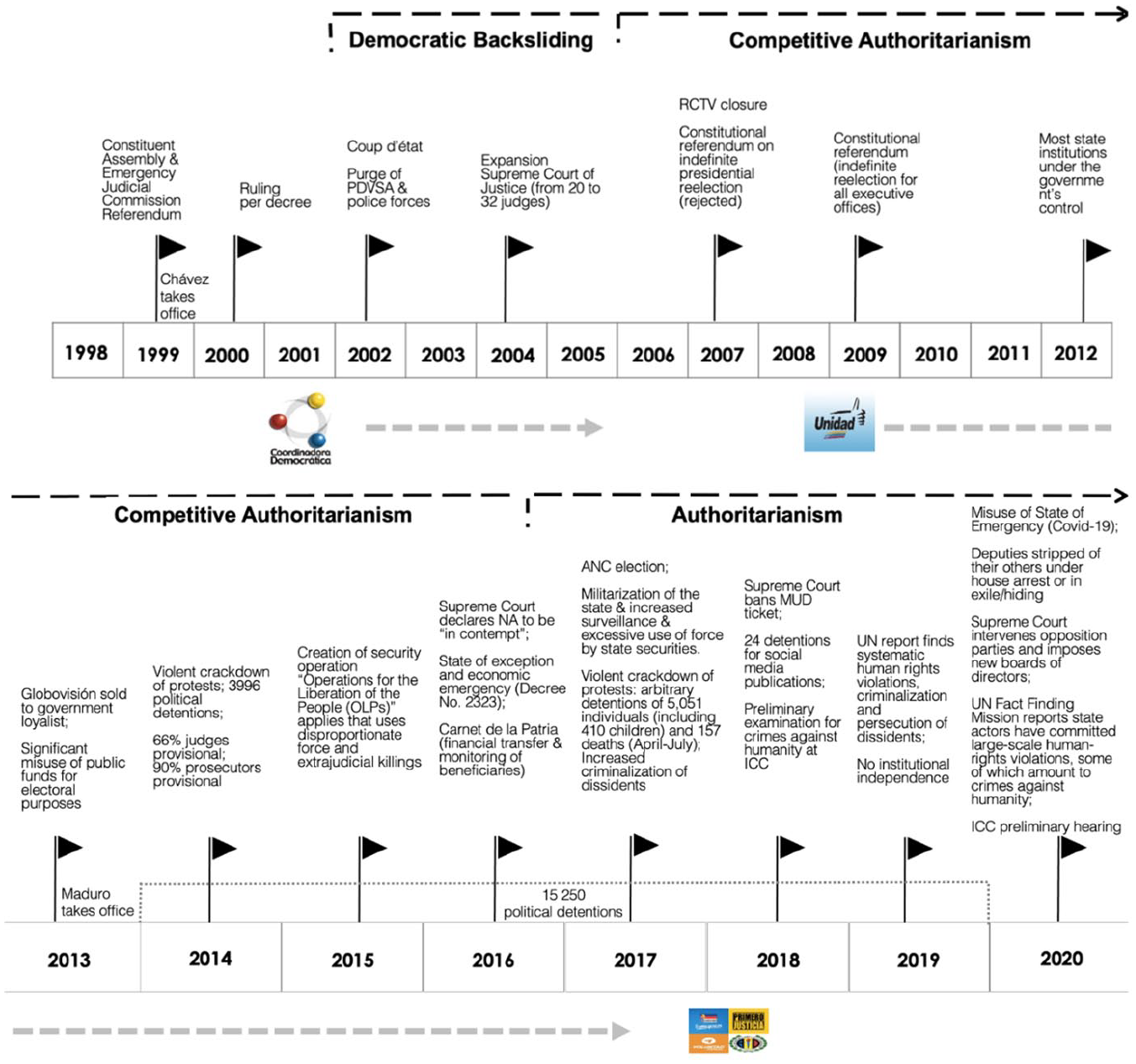
Key Events and OC in Venezuela (1998–2020). 8
1999–2005: Low Repression, Informal Coordination
By 1999, Venezuela’s party system had broken down. Traditional parties were weakened and largely discredited. In fact, Chávez’s victory materialized because of said deterioration and the populations’ active demands for a different type of leadership (Álvarez, 2003). Given their internal weakness and missing legitimacy parties were incapable of shaping political outcomes. They lacked both the capacity to formally coordinate with one another and the authority to convene economic and social actors who opposed Chávez since the very beginning. 9 Drawing on parties’ failings, non-partisan actors, including media owners, labour unions and business groups, largely designed and executed opposition politics during Chávez’s first government. 10
Beyond these factors, low repression only created incentives for informal OC. Although Chávez pursued several ‘power grabs’ during his first administration 11 and engaged in some political persecution, 12 opposition players still had significant means to participate in political affairs during this period. For example, parties (a) controlled more than one third of the legislative seats (Petkoff, 2011), (b) had access to media outlets (e.g. Globovision, Venevision and RCTV) and newspapers (El Nacional, El Universal) and the oil company Petróleos de Venezuela (PDVSA) up until 2003 and (c) both the military and judiciary were largely independent before undergoing important purges between 2002 and 2004. Because there was still room for manoeuvre and these actors had means to shape political outcomes, there was no real need to create a formal coordination agreement.
Low repression made actors believe they were still competitive on their own and could dislodge Chávez without a formal ‘grand strategy’. 13 A chief strategist within UNT, for example, affirmed that not all political actors perceived Chávez as an immediate threat: ‘Many colleagues thought that Chávez could never turn Venezuela into Cuba [. . .] not everyone believed we needed to act fast [. . .] and with a firm strategy’.” 14 Similarly, secretaries and board members from AD, Causa R, PJ, VP and UNT, explained that this ‘uncertain context’ favoured inter-opposition competition. 15 Furthermore, party leaders and analysts sustained that the unsuccessful and reactionary strategies pursued during the early 2000s, including the failed coup (2002), general strike (2002), loss in the recall referendum and regional elections (2004) and the abstention from parliamentary elections (2005), in fact reflect the lack of a collective vision and joint strategy about how challenge Chávez. Though most actors shared the goal of ousting him, they did not see the need to formally coordinate their actions. 16 This is why partisan and non-partisan actors pursued their own – often competing – ideas about how to challenge Chavismo and were not forced to strategize collectively. 17 In fact, PDVSA, Fedecámeras, the confederation of workers (CTV) and political parties, just to name a few, proposed different routes to dislodge Chávez and oftentimes strategized without each other’s approval. 18
Chávez’s opponents, including private sector, social movements and political parties, did, however, informally coordinate during this period around the Coordinadora Democrática (CD), created in 2002 (López Maya, 2004). 19 Though the CD integrated Chávez’s most important adversaries, it did not represent an ‘institutionalised’ or ‘formal’ space for collective opposition strategy-formation or decision-making. 20 In fact, its members did not elaborate any formal coordination mechanisms (i.e. decision-making rules/conflict resolution mechanisms). Instead, the factions with the largest material resources within the CD, predominantly the media and business sector (Globovision, Venevision and Fedecámeras), the so-called ‘de facto powers’, largely imposed their views and strategies onto the weaker ones (parties and social movements). 21 Even though internal disagreements within the CD about how to confront Chávez existed (i.e. electoral vs insurrectional routes), the latter ‘quietly’ supported the extra-institutional actions put forward by ‘de factor powers’ to not weaken the platform (García-Guadilla and Mallen, 2013). Non-partisan actors strategized on behalf of the whole opposition and recurred to ‘extra-institutional strategies with radical goals’ (Gamboa, 2017) to oust Chávez.
Low repression did not create existential threats to opposition members at that time. Therefore, there was no need or benefits to be gained from a formal coordination arrangement, which would have, for example, implied time-intensive deliberations, making concessions and sharing potential victories. Up until 2005, where the judiciary, military, electoral body (Consejo Nacional Electoral, CNE) and National Assembly (NA) were largely but not yet completely under the government’s control (Hawkins, 2015), different actors within the opposition perceived that they still had enough resources to succeed on their own. The private sector, in particular, sought increase its future share of power to shape posterior political outcomes upon Chávez’s removal. 22 Had any of the non-partisan player’s strategies, such as the strikes or boycott, succeeded, their individual rewards after a victory would have been much greater. By contrast, had the whole, very diverse, opposition acted collectively, they would have had to share the rewards among each other after a victory. The expected outcome of collective rewards did not trump individual prospects for success during these years.
2006–2015: Intermediate Repression, Formal Coordination
After a series of accumulated failures during previous years, parties largely replaced non-partisan players in terms of strategy-formation. 23 This allowed parties to not only regain and assert their leadership, but also helped them to promote a different way of conducting politics. Party leaders decided to return to the electoral arena to challenge Chavismo and to coordinate some of their actions to increase their competitiveness. 24 They saw the need to coordinate, particularly after the Chavista-controlled NA began to issue authoritarian laws (Corrales and Penfold, 2011; OEA, 2018), when they realized that the stakes for effectively contesting elections were increasing. In other words, as the chances of individual party success started to drop, the need for a new joint political strategy began to emerge. 25
In this changing context, parties made some important collective choices, such as presenting a joint candidate for the 2006 presidential election, yet, overall their coordination was still informal. 26 When asked why the opposition decided to run together, a key UNT leader explained that ‘there was no rule of law, no checks and balances, no equal participation [making the opposition understand] that [if they were divided they] would never had a chance to win’. 27 At this point, there was a clear need to challenge Chávez together but parties were not yet ready to commit to formal coordination. For example, the selection and cross-party endorsement of the 2006 presidential candidate Manuel Rosales, UNT party leader, was the result of informal gatherings between leaders, who selected him based on his approval rating. 28 Opposition parties also debated ideas about policy and state reforms and presented a joint programmatic alternative to Chavismo. Yet Rosales’s campaign program, while it was supported by most major parties, it was still predominantly designed by UNT. 29 These examples show a clear cut from previous radical and fragmented attempts of dislodging Chávez. Parties realized that working together was necessary to challenge a less democratic, but still popular Chávez, who was using the ongoing oil boom to distribute benefits among his constituents. However, the perceived levels of threat at that time were not sufficient to induce them to engage in formal OC by creating a coalition or common policy platform. 30
Their perception of threat and consequently the need for a different, now formal, type of coordination, changed, however, with three additional ‘warning signs’ 31 between 2007 and 2009. Upon the shutdown of RCTV, Venezuela’s oldest TV outlet (2007), Chávez’s first attempt to seek indefinite re-election through the constitutional referendum (2007), and his success in bringing about indefinite re-election through a second constitutional referendum (2009), parties internalized Chávez’s ambition to reduce the space for effective contestation, inducing the need for a formal coordination agreement. 32 According to cross-party leaders, the key factor driving the decision to create the MUD was the perceived increase of government repression. 33 Once parties noticed that their possibilities of individual success were declining considerably, they decided to create a coalition that would facilitate their survival and improve their competitiveness vis-á-vis their ‘common enemy’. 34 Interviewees explained that the opposition’s decision to act collectively derived from the joint understanding that no party could continue to grow individually, let alone win election on its own under Chavismo. 35 For example, a Causa R member argued that ‘if [they] had not united, it would have been impossible for [them] to ever be successful again. What Chávez really wanted was for [them] to fight among [themselves], so he could govern all by himself’. 36 Intermediate repression thus directly intervened in opposition decision-making and pushed parties’ towards a ‘more committed’ coordination agreement. 37
In contrast to previous informal coordination efforts, this time, parties created a cross-party coalition, elaborated its by-laws, established clear decision-making rules – according to which decisions could only be approved either by consensus or majority (achieved when 3/5 of its members or members representing 70% of the popular vote in a given electoral context reached an agreement) – worked out a policy platform and selected joint candidates through either consensus or primaries for electoral processes.
38
An Executive Secretary’s office led by Ramón Guillermo Aveledo was also installed to guide and structure the coordination process.
39
A former member of the Executive Secretary’s office explained that: unlike other coordination attempts [CD and interim-government], the MUD had its mechanisms and formal procedures [. . .] there were weekly meetings, where different advisor teams met to elaborate strategy [. . .] Then these suggestions were taken to the parties. Decisions were then taken according to the rules, they were not pre-fabricated.
40
All of these mechanisms helped parties mitigate their short-term individual interests and favoured the politics of concessions in terms of strategy-formation, ideology and programs. It was only after repression had increased to intermediate levels, that nearly 30 ideologically diverse parties formally coordinated and agreed on a basic centrist agenda around socio-economic and political issues to confront Chavismo. 41 Other potential explanations, such as inherited weaknesses, Chávez’s popular support and incumbency advantage or the country’s economic development were not singled out as key variables. Rather, high-profile elites, such as former MUD secretaries, underlined that member parties, ranging from socialists to conservatives, were only incentivized to design a joint strategy as an ‘explicit response to the increasingly authoritarian circumstances’. 42 Another MUD coordinator, similarly argued that ‘opposition parties only assumed the burden of coordinating their candidates, programs and resources because it was strictly necessary to fight Chávez’. 43 Others explained that parties had to loosen up their ideological guidelines and individual interests to work together, something they would not have done under democratic circumstances. 44 After the establishment of the MUD and up until 2015, its members decided to contest all types of elections, including local, regional, presidential and legislative together. Parties also noticed that coordination paid off as voters began to reward coordination efforts from the 2010 legislative election – when the opposition won the majority of the popular vote (Monaldi et al., 2011) – onwards. 45
The 2012 and 2013 presidential campaigns are further examples of the causal relationship between repression and coordination. Even though parties were still affected by internal weaknesses inherited from party system collapse, previous mistakes and the increasing constraints imposed by Chavismo, they learned that formal OC was essential to boost their competitiveness and guarantee survival. To defy intermediate repression, MUD members improved their formal coordination mechanisms. According to UNT, PJ members and MUD advisors, organizational structure and campaign management during the 2012 and 2013 electoral processes largely improved compared with previous ones.
46
For example, the opposition did not select its presidential candidate through an informal agreement as in 2006, but rather organized public debates between different leaders and an open primary, where Venezuelans could choose their preferred option (López Maya and Lander, 2012).
47
Furthermore, the increased authoritarian context in 2012 induced parties to improve their programmatic offer. Several commissions and working groups were created within the MUD to work out a distinct political programme that could attract a wide array of voters.
48
Comparing the 2006 and 2012 coordination processes, a UNT member, for example, recalled that: Rosales was largely free to organize his campaign according [their] views but this was no longer possible in 2012 [. . .] Capriles was tied to the MUD guidelines in 2012 and 2013, he had less liberties of creating his own program.
49
After Chávez’s death in March 2013, voters were asked to the polls again 1 month later. Maduro engaged in additional violent and non-violent repressive tactics (Kornblith, 2013b), inducing the need to not only stick to formal OC, but also to improve some coordination mechanisms to challenge Maduro more effectively. While Henrique Capriles, opposition leader and two-time presidential candidate (2012 and 2013), remained the MUD’s runner, the MUD significantly improved its campaigning strategies and program, for example, by presenting a new ‘one hundred days of government’ that offered an increase in wages and pensions. The opposition was forced to ‘present a simple program, something the people could remember because [they] did not have the same access resources and the media, where the regime was defaming [them] 24/7’.
50
Furthermore, parties decided to abandon their individual party tickets to collectively support the MUD’s joint ticket (El Universal, 2013) to help aggregate the opposition’s overall vote share: You have to be creative when you are competing against Goliath [. . .we] knew it was the right time to use one ticket only [. . .] it was now or never, it was our chance to show our unity and commitment to the people.
51
Even though parties knew that leaving aside their individual party tickets could have long-lasting effects on linkages and cleavages, they took these risks because they were more concerned about collective survival and a joint victory than individual gains. Learning from past cycles of error-and-trial and Maduro’s repressive behaviour helped leaders assume the costs of formally coordinating.
After losing the elections by only 1.5% of vote share, divisions on how to challenge Maduro re-emerged. 52 Consequently, different parties pushed for their preferred mechanisms to pursue change. Some parties considered the idea of accepting the government’s invitation to a dialogue by the end of 2013; others proposed calling a Constituent Assembly (CA); others demanded Maduro’s resignation. 53 One faction within the MUD represented by Leopoldo López, María Corina Machado and Antonio Lezdema, decided to call for mass protests dubbed La Salida in 2014. According to various academics, this group sought to capitalize on the opposition’s accumulated frustration from previous electoral losses and rising discontent with economic decline. 54 This go-alone action signals that intra-opposition competition over strategy-formation does not stop to exist under intermediate repression altogether. Surely, La Salida exposed tensions within the MUD and weakened the opposition’s carefully crafted coordination process and consensus that incumbents could only be effectively challenged collectively. Yet, this individual decision did not result in the end of the MUD. Having increased their competitiveness as a result of formal OC provided parties with evidence that they were better off coordinating than acting alone. 55
La Salida protests were violently broken down leaving many wounded and deaths (Human Rights Watch, 2015). López and Ledezma were imprisoned and charged with instigation; Machado was disqualified from her duties as an acting MP and over 40 people died during the clashes with state forces (IACHR, 2014). Most importantly, 2014 represented a turning point in the government’s willingness to repress as it had never done before, thereby pushing Venezuela further up on the authoritarianism scale. 56
2016–2018: High Repression, (In)formal and Clandestine Coordination
From 2014 onwards, it became clear that, unlike Chávez, Maduro was willing to use extensive violence as a means to prevent any uprisings and crash its dissidents (Romero, 2020). In response, they resumed their formal coordination process within the coalition and collectively prepared the upcoming 2015 legislative campaign. 57 Under the leadership of the MUD’s new Executive Secretary, Jesús Torrealba, the opposition ran a highly coordinated campaign in multiple ways. First, the opposition presented jointly selected candidates for most seats. Second, it offered a consensual program and followed collective guidelines elaborated within different MUD committees. Finally, the opposition coordinated with local leaders, increasing the grass-roots support for this election. 58 Reinforcing their formal coordination mechanisms helped the opposition win a 2/3 ‘supermajority’ (112 out of the 167 seats) marking its most decisive blow to incumbents since 1999 (BBC News, 2015).
These electoral results exposed Maduro’s loss of popular support and signaled the opposition’s capacity to win when it coordinates its actions. To hold onto power, the government was forced to further limit the opposition’s capacity to participate and shape political outcomes. Maduro effectively shut down the parliament (Bermúdez, 2016), installed a National Constituent Assembly (NCA) to draft a new constitution, increased political persecution and annulled all institutional mechanisms pursued by the opposition to facilitate a transition, including the possibilities of a recall referendum in 2016 (Brewer, 2018; Romero, 2020). 59 In addition, during these years, his government has systematically used national security forces and paramilitary groups to persecute, imprison, stigmatized or tortured, political dissidents (OHCHR 2019, 2020; Romero, 2020). In response to government abuses but also to the continuous economic and social decline – four-digit inflation in 2017 and increase in poverty increased from 48% in 2014 to 82% in 2017 – the opposition initiated several waves of mass protests, which the regime violently repressed leaving many dead and arrested (Efecto Cocuyo 2018, El Nacional 2018, OHCHR, 2017). In 2016 alone, over 2730 politically motivated arrests were registered (Foro Penal Venezolano, 2016) and the 2017 protests left hundreds of prisoners and over 130 people killed (OEA, 2018). These dynamics show that repression and OC can reinforce each other and that an authoritarian government can respond with increased repression when it is seriously threatened by a coordinated opposition.
Tensions between the government and the opposition further intensified in the years to come and as repression increased, coordination turned informal and/or clandestine over time. From the establishment of the NCA in 2017 onwards, opposition parties coordinated around a few more events, however, as the environment the costs for participating increased, coordination took informal shapes again. For example, to visualize people’s discontent and urge the government to roll back on the NCA, the opposition organized an important one-off action on 16 July 2017, namely a non-binding referendum, in which over 7.6 million people participated within and outside Venezuela (El Nacional, 2017a). In spite of the plebiscite’s lack of success in changing the government’s course of action, this event proved the opposition’s capacity to coordinate on a domestic and international level.
A few months later, the government took advantage of a now weaker opposition and called for regional elections in October 2017 via the NCA, win which the MUD chose to participate. However, due to increased repression prior and after the election as well as and exacerbating internal disagreements, the MUD was in a weaker position and did no longer have the capacity, resources and time to organize and coordinate this event as it had done in previous electoral events. In an highly unfair and unfree process, the opposition only managed to win five out of 23 governorships (Financial Times, 2017). 60 After the election, the NCA required all elected governors to take an oath before its members as a condition to take office, something that none of the Venezuelan electoral laws or constitution requires. This was a small but significant move to further implode an already weakened opposition. Even though, the MUD had stressed during and after the election that none of its candidates would take this oath, four opposition governors from AD were sworn in before the CA. The only candidate who rejected to take the oath was PJ’s candidate for the state of Zulia (BBC News, 2017). Existing divisions within the MUD were additionally exposed when Rosales (UNT), announced his candidacy to replace his colleague, Juan Pablo Guanipa from PJ in the same state (El Nacional, 2017b). In the midst of this internal crisis, important leaders from VP and PJ distanced themselves from AD and UNT and called for the establishment of a new alliance (El Nacional, 2017c). This signals how the government used various repressive tactics to effectively divide the opposition and erode their incentives to formally coordinate.
Internal schisms and the decline of cross-party formal OC became more evident in December 2017, when the NCA called for municipal elections: while a large part of the opposition chose to collectively boycott, other parties and former MUD members, such as COPEI or AP, still participated. According to one opposition advisor, ‘the regime has been successful in dividing the opposition into loyalists and real adversaries’. 61 One politician similarly argued that ‘leaders [who participated in this election] were hijacked by the regime’ 62 and were forced ‘to play the game’ to avoid going back to jail or being forced into exile. 63 Furthermore, opposition advisors and leaders supported the claim that politicians who visibly broke away from the opposition during this election did so to guarantee their personal safety and political survival. 64
Due to increased national and international pressure during 2017 and 2018, including sanctions and advocacy work, Maduro and the opposition attended a dialogue hosted in the Dominican Republic to find an agreement that could guarantee holding free and fair elections in 2018. This process failed, as, according to the opposition, the government rejected their demands of freeing all political prisoners and renewing the CNE’s board. In the aftermath of the dialogue, Maduro called for a snap election in May 2018 (The New York Times, 2018), which all major opposition parties decided to boycott. However, Henri Falcón, leader of AP and former governor of Lara state, launched his candidacy distancing himself from the remaining opposition. On May 20, Maduro won with 67.8% of the votes (The Guardian, 2018). The opposition, including Falcón, and large part of the international community did not recognize these results (CNN, 2018).
In sum, between 2015 and 2018, the opposition moved from being coordinated and competitive to being seriously divided and incapable of challenging Maduro’s rule. Alternative explanations, such as learning, electoral cycles, economic development or party system structures do not fully explain the variation in OC. Cross-ideological parties created the MUD and formally coordinated around this coalition during and after high oil prices and economic booms (2008–2017); 65 they also formally coordinated after electoral failures and successes, particularly between 2010 and 2015; likewise, parties managed inherited weaknesses, personal ambitions and differences by establishing clear decision-making rules and conflict resolution mechanisms (MUD) and they also learned from prior cycles or trial and errors that individual strategies only weakened their overall capacity to challenge Chavismo, while coordination, in contrast, helped to increase their competitiveness.
Discussion
Given the discussion above, this raises the question about why then, parties stopped formally coordinating from 2017 onwards? This article argues that repression is a useful variable to help us understand divergent patterns of OC. Since 2015, Maduro’s government has invested many resources in spying on, exiling, jailing and co-opting opposition politicians to implode their ability and incentives to formally coordinate with one another. As of August 2020, there were over 386 politicians and activists jailed, dozens of leaders exiled, the MUD ticket banned from running, all attractive opposition candidates disqualified; since 2014 over 15000 arbitrary detentions were documented (Figure 2) (Romero, 2020). Reports from the UN High Commissioner of Human Rights (OHCHR, 2019, 2020) and the UN’s Independent Fact Finding Mission (FFM, 2020) show how Maduro’s government has increasingly used physical and legal means against its opponents, committing serious human rights violations and alleged crimes against humanity. IGOs and local NGOs have also demonstrated that particularly after the snap election in 2018, any visible form of resistance has been shut down by security forces (Amnesty International, 2019; Foro Penal Venezolano, 2019; Human Rights Watch, 2019).
Thus, the costs of participation have risen, and the utility of formal OC has declined. Parties tried to shape political outcomes by formally coordinating their actions and participating in the 2015 and 2017 elections, however, the government responded with the establishment of a ‘parallel legislative structure’ (NCA) and has further increased repression since. Interview data shows that Maduro’s use of repression has reduced the incentives for formal coordination, inducing opponents to make different and often competing strategic choices. According to analysts and academics, Maduro has increased repression since 2015 to deliberately revive pre-existing divisions and to create a new ‘systemic opposition’ that can grant some domestic and international legitimacy (Ocando, 2020; PolitikaUcab, 2020). 66 Similarly, the understanding of opposition leaders within VP, PJ, AD and UNT is that Maduro has divided the opposition into ‘real’ and ‘fake’ opponents (Reyes, 2020). On the other hand, parties, such as AP, Cambiemos or MAS, who joined the Mesa de Diálogo Nacional (National Dialogue Table) with the government in 2019 sustain that the political crisis should be resolved through dialogue and negotiations (BBC News, 2019).
The MUD does no longer exist and formal OC across parties has become particularly difficult since 2019, when the ‘interim government’ under the leadership of Juan Guaidó, president of the NA for 2019–2020, was established. The utility and need for OC has not vanished. Guaidó has continuously reiterated that unity is key to defeat Maduro.
67
However, the coordination happening around the so-called ‘G4’ – AD, UNT, VP and PJ – differs from the MUD. Much of the coordination is now informal or happens clandestinely
68
and/or in exile
69
(El País, 2019) given the high levels of repression. Leaders and advisors close to Guaidó and other members of the G4 have been harassed or imprisoned; AD, VP and PJ have been banned from participating. A political advisor shared that: since his parliamentary immunity was taken away, [Guaidó] has to sleep in different places [. . .] we have to delete all of our messages every day to try to bypass surveillance, but it is not easy, nobody is safe at this point.
70
Thus, as the costs of participating have increased, formal OC has been difficult to sustain for G4 members, both logistically and personally. Precisely because resisting has become riskier and costly, many leaders have fled the country, have toned down their criticism or have reoriented their strategic choices. It appears that some minor opposition groups have chosen to accept Maduro’s authoritarian government in return for spoils and guarantees to their personal safety. 71 High repression has thus reduced the incentives for formal OC across formerly aligned parties, while it has also promoted a more individual decision-making approach to guarantee survival.
Conclusion
The literature has argued that OC is important for opposition success in authoritarian regimes. We know that coordinating is difficult and costly, as it requires negotiations and concessions that could bring negative long-term side effects, including brand dilution or voter dissatisfaction. This leads to the question of why and when OC occurs in authoritarian settings. I provide an answer to this question by looking at repression, a hitherto overlooked variable, as a driving force of decision-making processes and choices of opposition party elites. This article provides micro-foundations for the hypothesized curvilinear relationship between repression and coordination, whereby I argue that different levels of repression lead to different types of OC. While low repression leads to informal, intermediate to formal, high repression incentivizes to in(formal) and/or clandestine OC.
Given similar scope conditions, this theoretical argument applies beyond Venezuela. While autocracies worldwide have their specific features and differ as to how to guarantee their survival, they might still be comparable on how potential shifts in repression evoke different types of OC. For example, Honduras (2008–present) and Mexico under the PRI (1976–2000) provide interesting cases to examine the wider applicability of this theory. In Honduras, incumbent Juan Orlando Hernández intensified democratic backsliding, and thus, the use of repression that began with the 2009 coup d’état. Like Chávez and Maduro in Venezuela, he has also been exerting tighter control on the country’s judiciary, congress and the opposition. Hernández tweaked the playing field so he could successfully run for re-election in 2018, even though Honduras’ own constitution expressly barred him from doing so. As a response to the declining freedoms, institutional independence, the rule of law, particularly the unconstitutional re-election, several parties, including the Partido Libertad y Refundación (LIBRE) and the Partido Innovación y Unidad Socialdemócrata (PINU-SD), created the “Alliance against Dictatorship” to challenge Hernández in the 2017 presidential election. The main purpose of the alliance was to prevent Hernández from furthering his grip onto power.
In Mexico, the PRI installed an electoral autocracy whose violent and non-violent repressive tactics immensely varied throughout its 71-year rule. Existing explanations highlight that personal rivalries, ideological distance and institutional arrangements impeded OC. This theory adds some nuance to the understanding of opposition politics under the PRI. When repression was high (1940s–1970s), the opposition had no possibilities to formally coordinate because it was either co-opted (e.g. Partido Auténtico de la Revolución Mexicana (PARM)) or not able to form or contest elections (e.g. left leaning and communist parties). The PAN had no partners to coordinate with. Thereafter, the PRI initiated an almost 30-year long liberalization process that, by progressively reducing repression, slowly increased the space for participation and contestation. Parties were no longer “sufficiently threatened” to formally coordinate; however, PAN and PRD did informally coordinate around electoral reforms throughout the 1980s–1990s that helped to gradually open the system. 72
Future research could apply this argument to other settings to test the theoretical implications outlined in this article. It could also consider further variables to explain the existing variation in OC across countries and regions. We still have to answer, for example, how opposition party size, the existence of viable leadership, availability of funding, regime co-optation, opposition radicalization, corruption or the involvement of international actors in domestic strategy-formation, including diplomatic pressure and/or economic coercion, may affect opponent’s incentives to coordinate in way or the other, or not at all. Exploring these variables will contribute to lightening up the otherwise shadowy world of authoritarian politics.
Footnotes
Acknowledgements
The author would like to thank David Doyle, Nancy Bermeo and Timothy Power for their constructive feedback and support. She would also like to thank Ezequiel Gónzalez-Ocantos, Aníbal Pérez-Liñan, Gabriel Negretto, Gustavo Macía-Flores, Andrés Malamud, Laura Gamboa, Julia Zulver, Isabel Castillo, Stefania Vitale, Francesca Lessa and Jonas von Hoffmann for their valuable comments. She is grateful to all her interviewees for sharing their stories with her.
Declaration of Conflicting Interests
The author(s) declared no potential conflicts of interest with respect to the research, authorship and/or publication of this article.
Funding
The author(s) received no financial support for the research, authorship and/or publication of this article. The author’s doctoral research was supported by Cusanuswerk Foundation.
