




Abstract
The study identifies the typical political socialization trajectories leading to political parties in Hungary through an analysis of life history interviews with 40 young party members. These trajectories develop within a context where the decline and aging of party membership are not accompanied by a resurgence of civil society but rather by its exclusion from political decision-making processes and ongoing democratic backsliding. The findings underscore the significant influence of historical, social, and political contexts on the socialization routes leading to party-political participation, resulting in a more varied, fragmented, complex, and conflictual process compared to Western Europe. Distinct socialization pathways entail specific conflicts, with the persuasive power of party communities playing a crucial role in overcoming these challenges. This persuasive influence functions as an essential compensatory mechanism, particularly in Hungary and, arguably, in other contexts where the broader socialization environment does not actively promote political participation.
Introduction
Representative democracies in contemporary Western Europe are undergoing a profound crisis, one of the key indicators of which is the gradual erosion of political parties’ monopoly on representation (Guasti and Geissel, 2019; Kligler-Vilenchik, and Literat, 2024; Weßels, 2015). Party membership is steadily declining and aging (Bale et al., 2020; Kölln, 2016; van Haute and Gauja, 2015; van Biezen and Poguntke, 2014), with a notable trend of disengagement across all age groups, but particularly among younger generations (Breniaux, 2021; Bruter and Harrison, 2009; Cross and Young, 2008; Weber, 2017).
The prevailing explanation for this negative trend is that young people are increasingly articulating their political demands and participating in politics outside of traditional organizational frameworks. They tend to prefer individualized, direct, informal, and expressive forms of political participation, such as demonstrating, joining issue-oriented movements, and expressing political opinions through clothing or boycotting products for political or environmental reasons, rather than joining political parties (Andersen et al., 2020; Pickard, 2019; Rinolo and Ortensi, 2021; Weiss, 2020). While this shift challenges the sustainability of parties and party-based representative democracy, it also strengthens the representative role of civil society organizations within the political ecosystem.
To date, empirical scholarship has primarily focused on the motivations behind young people’s decisions to join political parties, seeking to identify the factors that still attract them to party membership in contrast to the wider youth population (Breniaux, 2021; Bruter and Harrison, 2009; Fjellman and Sundström, 2021; Weber, 2017), with only a few studies analyzing the political socialization pathways that lead them to these traditional political organizations. Yet such pathway-focused approaches offer at least as valuable insights, suggesting that there is a relatively consistent process of political socialization that guides young individuals toward parties. This process highlights the transmission of political values within families, particularly the family tradition of party membership. These inherited patterns continue to underpin the recruitment functions of parties, even if temporarily and under changing conditions (Bruter and Harrison, 2009; Cross and Young, 2008; Paschou and Durán Mogollón, 2022).
This exploratory study seeks to advance this latter line of inquiry by identifying ideal-typical political socialization trajectories leading to party membership, based on a comparative qualitative analysis of the life histories of 40 party-member university students. In doing so, it aims to pursue three main objectives:
To examine the issue within an atypical political landscape beyond the scope of previous research: This study focuses on a post-communist and currently autocratizing political context, Hungary, which presents a unique yet paradoxical setting for exploring the socialization pathways leading to party membership. While Hungary is witnessing a decline in party membership and a growing reluctance among young people to join political parties, this trend has not been counterbalanced by a strengthening of civil society’s representative role (Čakar and Čular, 2023; Kovacic and Dolenec, 2018; Smith, 2020). Consequently, political parties remain pivotal in political representation, perpetuating conditions that may still attract individuals to party-political participation. However, historical factors have contributed to the absence of a family tradition of party membership, and the role of individual socialization agents in promoting political engagement remains limited (Oross and Szabó, 2019). In addition, the current functioning of the political system, characterized by the dominance of a single political party that has consolidated an unprecedented level of control over civil society and political formations, as well as by weak opposition parties that pose relatively high barriers to entry for potential participants despite their low level of embeddedness (Kovarek and Soós, 2016), presents unique challenges to political engagement.
To assess the role of political parties in party membership: Given the above dynamics, this study takes a closer look at the role of parties in the process of becoming a party member as part of broader political socialization, alongside the usual socialization agents. This research is based on the premise that all forms of political participation emerge from the interaction between individuals and the structures that mobilize them (Hooghe and Stolle, 2005), and that in the relationship between young individuals in formative years and the mobilization structures, the latter play a dominant role. Therefore, it would be misleading to approach the issue solely from the perspective of young people, since party participation is shaped not only by individual decisions, but also—perhaps even more so—by the availability and effectiveness of political parties.
To bridge research strands on political socialization and motivations for party membership: The study simultaneously examines the process of political socialization leading to party membership and the motivations for joining parties, thus attempting to bridge the gap between strands of research that have traditionally examined these aspects separately, and to highlight their interrelationships.
In addressing these objectives, the study contributes not only to the refinement of political socialization theory but also to the broader generalizability of its findings. It enhances our understanding of political engagement in autocratizing democracies and sheds light on how political agency can develop under conditions of democratic erosion, constrained civil society, and hegemonic party dominance—issues of growing importance in comparative politics and international relations.
In terms of key results, the political socialization pathways presented in this study point to the significant influence of historical, social, and political contexts on the process leading to party-political participation—factors that remain largely underexplored in the existing literature. In the case of Hungary, these contextual dynamics shape youth engagement in party politics in ways that are markedly different from those in Western Europe, resulting in a more varied, fragmented, complex, and conflictual process. In contrast to the relatively coherent pathways to party membership observed in Western Europe, socialization agents in Hungary contribute to the development of political agency and motivations in ways that are often contradictory or fraught with tension.
The findings also reveal that these distinct socialization pathways involve specific conflicts, and that the persuasive power of party communities plays a crucial role in resolving them. This persuasive influence acts as an essential compensatory mechanism, particularly in Hungary and, arguably, in other contexts where the broader socialization environment does not actively promote political participation. The ability of party communities to address and mitigate socialization conflicts underscores their critical role in fostering political engagement, especially in settings where traditional socialization mechanisms prove inadequate.
Finally, challenging the assumption in previous studies that party membership follows from fully formed political identities, this study finds that many Hungarian youth join political parties with relatively underdeveloped ideological commitments. This finding suggests that sophisticated political profiles are not necessarily a prerequisite for party membership and that clearer ideological differences between opposition and ruling party members may emerge over time through the process of party socialization.
The article is divided into four sections. The first section outlines the background and conceptual framework that underpins the empirical research. The second section describes the research design, including sample selection, data collection, and analysis methods. The third section presents the research findings, while the final section provides a summary and a comprehensive evaluation of the results.
Background and Conceptual Framework
There is a broad consensus that political socialization is a lifelong process involving continuous interactions between socialization agents and individuals. Through these interactions, individuals acquire politically relevant knowledge, predispositions, behaviors, emotions, and attitudes—collectively forming political culture—within the framework of a nation’s historical, political, and social experiences (Grasso et al., 2018; Muxel, 2022; Saltman, 2014; Schlozman and Brady, 2022; Weiss, 2020).
Since its inception, research on political socialization has been structured around two primary analytical perspectives: the micro-level and the macro-level approach. The former seeks to understand the process of political identity formation from the standpoint of individual development. It conceptualizes individuals as recipients of content transmitted by various socializing agents and examines how they receive, interpret, and act upon these influences. This approach is concerned with the patterns that shape an individual’s political maturation, addressing the questions of what an individual becomes politically and how this transformation occurs. In contrast, the macro-level approach views individuals primarily as objects of political socialization, with a main focus on the stability and continuity of the political system. This perspective examines how political systems establish and promote specific norms, attitudes, and behaviors among citizens in order to ensure their legitimacy and persistence (Owen, 2008; Sapiro, 2004).
Empirical research on political socialization background of young people’s party membership has tended to focus on the micro-level, examining the socialization influences that lead young party members to join a political party. These studies suggest that the deliberate education and transmission of political values within the family—often complemented by the multi-generational family tradition of party membership—plays a crucial role in fostering a propensity to engage in party politics (Breniaux, 2021; Bruter and Harrison, 2009; Cross and Young, 2008; Fjellman and Sundström, 2021; Rainsford, 2014, 2018; Weber, 2017). In addition, some research (e.g. Bruter and Harrison, 2009; Paschou and Durán Mogollón, 2022) has also shown that young party members experience a relatively conflict-free, coherent, and consistent political socialization process, in which different socialization agents reinforce each other’s influence and thereby foster openness to participation in party-political organizations.
These studies have only superficially addressed the impact of macro-level phenomena. This may be because, despite their diverse party systems, the Western European countries share a common framework of crisis in party-based representative democracy, the proliferation of actors, forms and arenas of representation, and the transformation of the power hierarchy to the detriment of political parties (Guasti and Geissel, 2019; Kligler-Vilenchik, and Literat, 2024; Rainsford, 2014; Weßels, 2015).
However, the situation is quite different in the post-socialist countries of Central and Eastern Europe (CEE), especially in Hungary—the target country of this study. While certain symptoms of the crisis of party-based representative democracy are evident here, such as the decline in party membership (e.g. Horváth and Soós, 2015; Kirbiš, 2013; Smith, 2020; van Biezen, 2003) and the growing reluctance of young people to join political parties (Bíró-Nagy and Szabó, 2021; Kovacic and Dolenec, 2018), 1 the underlying mechanisms differ from those observed in Western democracies, as do the consequences of these processes.
During the democratic transition in the CEE region, party membership did not acquire the meaning and significance traditionally associated with it in Western democracies, according to which party membership is a marker of political representation, social embeddedness, and the democratic legitimacy of a political party (Poguntke, 1996). Most parties emerged through elite-driven, top-down processes and adopted Western professionalized models that were already distant from civil society. Consequently, these parties were not rooted in traditional social divisions, but rather shaped by evolving political ones. From the outset, these parties prioritized electoral mobilization over grassroots organization, aided by access to state subsidies and mass media. This reduced their reliance on mass membership (Čakar and Čular, 2023; Lewis, 2000; van Biezen, 2003). 2
A major turning point that broke with the aging trend of the party system occurred in the 2000s with the emergence of youth-based grassroots political parties—Jobbik (Movement for a Better Hungary), which sought to challenge the political elite on the basis of national radicalism, and LMP (Politics Can Be Different), which drew on the principles of the anti-globalization, environmental and human rights movements. Both wanted to reshape the relationship between civil society and politics (Saltman, 2014). However, their parliamentary success coincided with a democratic backslide. Following its landslide victory in 2010, Fidesz—now in its fourth term of government—exploited its supermajority to establish the “System of National Cooperation,” thereby curbing the influence of representative institutions. This included capturing independent bodies, gerrymandering, monopolizing the media, stigmatizing NGOs, silencing civil society, and centralizing education and culture. Human rights organizations, universities, research institutes, and critical journalists frequently became targets of government harassment (Bozóki and Benedek, 2024; Horváth and Soós, 2015; Jenne et al., 2022).
Fidesz’s takeover, prolonged rule, and transformation of liberal democracy into an electoral autocracy (Schedler, 2002) 3 was not without precedent. Following its electoral defeat in 2002, the party adopted a hybrid organizational model in a strategic effort to capture civil society and marginalize left-liberal parties. Drawing on mass party traditions, it built a cohesive and loyal right-wing membership base with a well-organized adult and youth organizational structure. At the same time, it adopted movement party tactics, promoting grassroots mobilization and creating civic networks such as the Civic Circles Movement. Through their own rituals, symbols, and events, these networks became important places for political socialization and identity formation. Alongside their militant mobilization, they also cooperated with patriotic, cultural, and local organizations to expand their influence (Greskovits, 2020; Metz and Várnagy, 2021).
The political socialization processes among Hungarian youth played a crucial role in facilitating the advance of Fidesz. Due to the politically intimidating experience of state socialism and the forced mobilization of the state party, Hungarian society developed a strong anti-political sentiment. This issue was inadequately addressed, if at all, following the democratic transition, resulting in the transmission of these attitudes to younger generations (Ágh, 1995; Lewis, 2000; Mishler and Rose, 1997). Research indicates that young people have largely remained conformist, with little evidence of generational rebellion against their parents’ political behavior. Like the broader society, the youth exhibit skeptical and distrustful attitude toward politics and political organizations (Bíró-Nagy and Szabó, 2021; Oross and Szabó, 2019).
The lack of adequate institutional support for families further hindered their ability to fulfill their role of democratic political socialization. Similarly, the education system received insufficient guidance following the regime change. While education system became ideologically neutral after the transition, it failed to equip students with essential political and civic knowledge, with few exceptions. Unlike in Western Europe, politically affiliated youth organizations were banned from educational institutions. This significantly limited their ability to reach young people and foster political interest and participation (Oross and Szabó, 2019). At the same time, however, the weak socialization capacity of the family and school created a vacuum in political socialization, allowing Fidesz to establish a dominant presence with minimal resistance and significantly influence the formation of political identities (Szabó, 2009). Consequently, a larger segment of youth has remained politically passive, but with a tendency toward rather right-wing values, while the politically active youth cohort, although smaller in size, has also became predominantly right-wing (Mráz, 2018; Saltman, 2014).
Since 2010, this social and political environment has provided the backdrop for the emergence of new challenger parties that seek to counter the processes set in motion by Fidesz and to mobilize and offer a viable political alternative to youth society. These include the aforementioned LMP and Jobbik, followed by the green-left Dialogue for Hungary, Hungary’s first satirical party, the Hungarian Two-Tailed Dog Party, and the Momentum Movement, which emerged in the late 2010s and is composed mainly of young liberal intellectuals and students. Concurrently, the established leftist and liberal parties that survived after 2010, such as the Hungarian Socialist Party and the Democratic Coalition, which split from it, also sought to renew themselves and project a more youthful image.
The responsibility of political parties for young people’s low engagement in party politics has been highlighted in the Western European literature (e.g. Cross and Young, 2008; Hooghe and Stolle, 2005), and some parties have indeed responded by lowering financial and procedural barriers to membership. Measures have included removing probationary periods and the requirement for recommendations from existing members, introducing more affordable and flexible participation options specifically designed for young people, and introducing online party membership systems (Scarrow, 2015). However, Hungarian opposition parties have been forced to adopt a defensive stance in this regard due to the above political circumstances, leading them to raise entry barriers to ensure that only genuinely committed young people can join. In addition, their limited financial resources have prevented them from achieving adequate national organizational embeddedness, and their limited access to traditional media largely confines their activities to the online sphere, where they also have to contend with government propaganda designed to discredit them (Kovarek, 2020). 4
These conditions likely to produce a political context in Hungary that differs markedly from that of Western countries and are likely to shape the political socialization pathways and related incentives leading to party membership, either directly or indirectly through socialization agents. It cannot be assumed, however, that successful navigation of these factors alone leads to party-political participation, nor that there are no other influences at play. Therefore, this study adopts an open and flexible approach to political socialization, guided by the principle that “politics” within the socialization context should be neither too narrow nor too broad. A narrow conceptualization risks limiting the scope of the study, potentially reducing it to an analysis of political influences and motivations alone. Conversely, an overly broad interpretation, while avoiding this limitation, may lack specificity, leading to a normative application of political systems and the inclusion of phenomena not directly related to political socialization (Percheron, 1999). Moreover, the process of political socialization of citizens can be shaped by a wide range of influences, events, and experiences—both explicitly political and those that seem at first glance to be independent of politics.
To take account of this complexity, this study draws on the concept developed by French sociologist Annick Percheron, who defines political socialization as “encompassing any socialization process that explains the formation of certain attitudes, certain behaviors, and the predisposition to assume certain political roles” (Percheron, 1999: 14). This definition provides the necessary flexibility to determine the scope of the study while allowing for individual variation in the perception of politically formative experiences.
The Percheronian approach emphasizes the individual and its micro-environment and lived experience as a lens through which to analyze the impact and scope of macro-level (systemic), meso-level (agent-related), and micro-level (individual specificities) influences on the individual’s political socialization. In doing so, it avoids imposing rigid constraints on the scope of inquiry and instead encourages researchers to remain open-minded about the factors that shape political socialization. This approach recognizes that elements not initially considered significant may in fact play a crucial role in the process.
In the following, we will analyze the ideal-typical political socialization scenarios and motivations that lead young people to political parties in Hungary, applying this open and flexible approach. Before proceeding with this analysis, however, we will first outline the research design of the study.
Methodology, Research Design and Analysis
Sample Selection and Its Key Characteristics
This study focuses on a specific but politically influential sub-group of Hungarian youth: university students—for several key reasons. First, university students represent the intellectual vanguard of the next generation and are likely to form the future elite. As such, they constitute a model group whose political behavior profoundly influences older and younger cohorts. This group is among the first to set the direction of economic, social, and political change, making it a crucial population for analyzing evolving political dynamics (Muxel, 1992; Persson, 2014).
Second, students are uniquely positioned at the intersection of domestic and transnational political and social influences. Exposure to higher education and international academic discourse facilitates the adoption of Western European political and cultural orientations. On the other hand, however, their political development remains shaped by Hungary’s specific historical and political conditions—in particular, students examined in this study have undergone their primary political socialization entirely during the tenure of the Orbán government (since 2010). This dual position makes this cohort somewhat amenable to a comparison with Western European research findings.
In addition, the existing literature suggests that university students tend to have a higher interest in public affairs, stronger party preferences, and higher propensity to participate in party politics than other youth groups (Oross and Szabó, 2019). Historically, university students in Hungary have played an important role in party formation and have been the main target of emerging parties (Szabó, 2009). Moreover, research from Western Europe (Lamb, 2002; Rainsford, 2018; Weber, 2017) as well as studies in Hungary (Sebestyén, 2020) show that students are over-represented among young party members, making them a key group for understanding the typical socialization experiences that lead to parties.
The sample in this study consists of 40 party member university students representing 8 institutionally represented parties, including the ruling party and 7 opposition parties. One-third of the participants were recruited with the help of political parties, while the remaining two-thirds were identified through snowball sampling method (see Appendix 1 online for sample composition).
The sample is over-represented by students from the capital and major cities, males, those from privileged backgrounds, and those studying law and social sciences. This distribution is a consequence of both the broader Hungarian context and the sampling process. Women are underrepresented in Hungarian party politics, and most parties, except the ruling party, have a weak presence in smaller settlements (Ilonszki and Várnagy, 2014). In addition, parties mainly nominated respondents from urban areas, who in turn recommended peers from similar backgrounds. Respondents from smaller settlements and female party members were generally more reluctant to participate in the study.
The over-representation of privileged students reflects the strong selection of higher education in Hungary, where access for lower socio-economic groups remains limited (Róbert, 2025). The educational backgrounds of respondents broadly reflect those of the political elite.
About half of the respondents joined their party during an election campaign, while the rest half joined between elections. The youngest joined at the age of 14 and the oldest at 24, with the average age of entry being 19. The length of membership ranged from 6 months to 9 years, with an average of 3 years at the time of the interview.
More than half held positions within their party, its youth wing or institutional politics, indicating an early political career. Even those without formal roles were more politically engaged than the average young party member, suggesting a potential sample bias. However, the focus of this study is not on political activity, but on how university students become receptive to party membership. It aims to identify key pathways of political socialization and motivations for party membership in Hungary, while acknowledging the limitations of the sample composition.
Data and Methods
Semi-structured in-depth interviews (70–120 minutes) were conducted with participants between February and April 2021, with one-third face-to-face and two-thirds online due to COVID-19. Participants were free to choose their preferred format.
The interviews aimed to reconstruct life histories leading to party membership by simultaneously exploring key socialization contexts (e.g. individuals, groups, relationships, institutions) and, as part of this, how they came in contact with their party. Respondents had full autonomy in assessing the importance of these influences and in identifying the factors that shaped their involvement. The questions served as a guide rather than a constraint, allowing participants to rationalize their socialization trajectories. This approach allowed for a dynamic analysis of the evolving role, influence, hierarchy, and interrelationships of socialization agents on the path to party membership (Saltman, 2014).
The interviews were analyzed using a three-stage coding process based on Grounded Theory (Glaser and Strauss, 1967). The first stage involved open coding in which experiences related to each socialization agent were identified and categorized into key categories. The second, axial coding, explored the relationships between categories and identified emerging patterns. Finally, selective coding was used to identify recurring patterns across the interviews. These patterns were then compared to distinguish and construct dimensions and, based on these, ideal-typical political socialization pathways leading to party membership.
The ideal types are conceptual models that distill the core characteristics of socialization processes. As heuristic tools, they simplify complex social realities without fully capturing the diversity of individual experiences or encompassing all possible trajectories. Nevertheless, they provide valuable insights into the development of openness to party membership in Hungary.
The ideal types were constructed using both deductive and inductive logic, drawing on existing literature and interview findings. They are based on six political socialization and four outcome dimensions. The former dimensions encompass the effects of the different socialization agents and their relationship to each other, while the latter comprise four aspects: the time and way of joining, the motivations, and the process of commitment to the party. Although some dimensions allow for hierarchical ordering, the primary aim was to highlight qualitative differences between scenarios. For clarity, each scenario is named after the most influential socialization agent in the decision to join a party.
The first political socialization dimension, family political socialization, reflects family political thinking, participation patterns, as well as the process of transmitting them (Muxel, 2022; Schlozman and Brady, 2022). It includes four sub-dimensions: the coherence of family political views and values, available patterns of political action, the consciousness of the transmission, and family attitudes toward party membership.
The second and third political socialization dimensions relate to the other two main agents of political socialization, namely peers and school (Cross and Young, 2008; Muxel, 2022), assessing whether they reinforce or challenge family influences.
The fourth dimension is civil society organizations and the fifth is the mobilization of party-political organizations. The former are considered in the existing literature to be particularly important in predisposing people to political participation, as a kind of proto-political training ground that can prepare them for party political activity (Bruter and Harrison, 2009; Owen, 2008). The latter help to validate the dual approach that participation is not only the result of individual intentions but also of the availability of mobilization channels, that is, it depends on the parties (Hooghe and Stolle, 2005). In this study, the first one shows whether or not the effects of these agents are relevant for the development of the intention to participate in party politics, while the second provides insights into how party organizations interact with young people in a given scenario.
The final socialization dimension is the political experiences that may play a particular role in catalyzing party membership (Bruter and Harrison, 2009), which for each ideal-typical scenario sheds light on the events that encouraged the decision to join.
In terms of the output dimensions, the first—time of joining—indicates at what stage in life formal enrollment occurs, while the second indicates whether formal enrollment is preceded by some form of extensive reflection process, including initial involvement without formal commitment. The third dimension highlights the most important reasons for joining for each type of ideal, while the fourth one relates to the timing of commitment to the party, more specifically whether identification with the party and its principles is already established and consolidated prior to formal membership or whether these steps are taken only within the party.
The main findings on these dimensions are summarized in Table 1. It should be noted that while respondents’ experiences of political socialization often combine multiple pathways, each is generally dominated by a single trajectory. The fewest respondents (5) follow the family-motivated trajectory and the most (14 respondents) follow the peer-driven joining scenario. Nine interviewees follow the high school socialization-motivated scenario, while almost one in six respondents joined through NGOs or party mobilization (6-6 people).
Political Socialization Scenarios Leading to Party Membership.
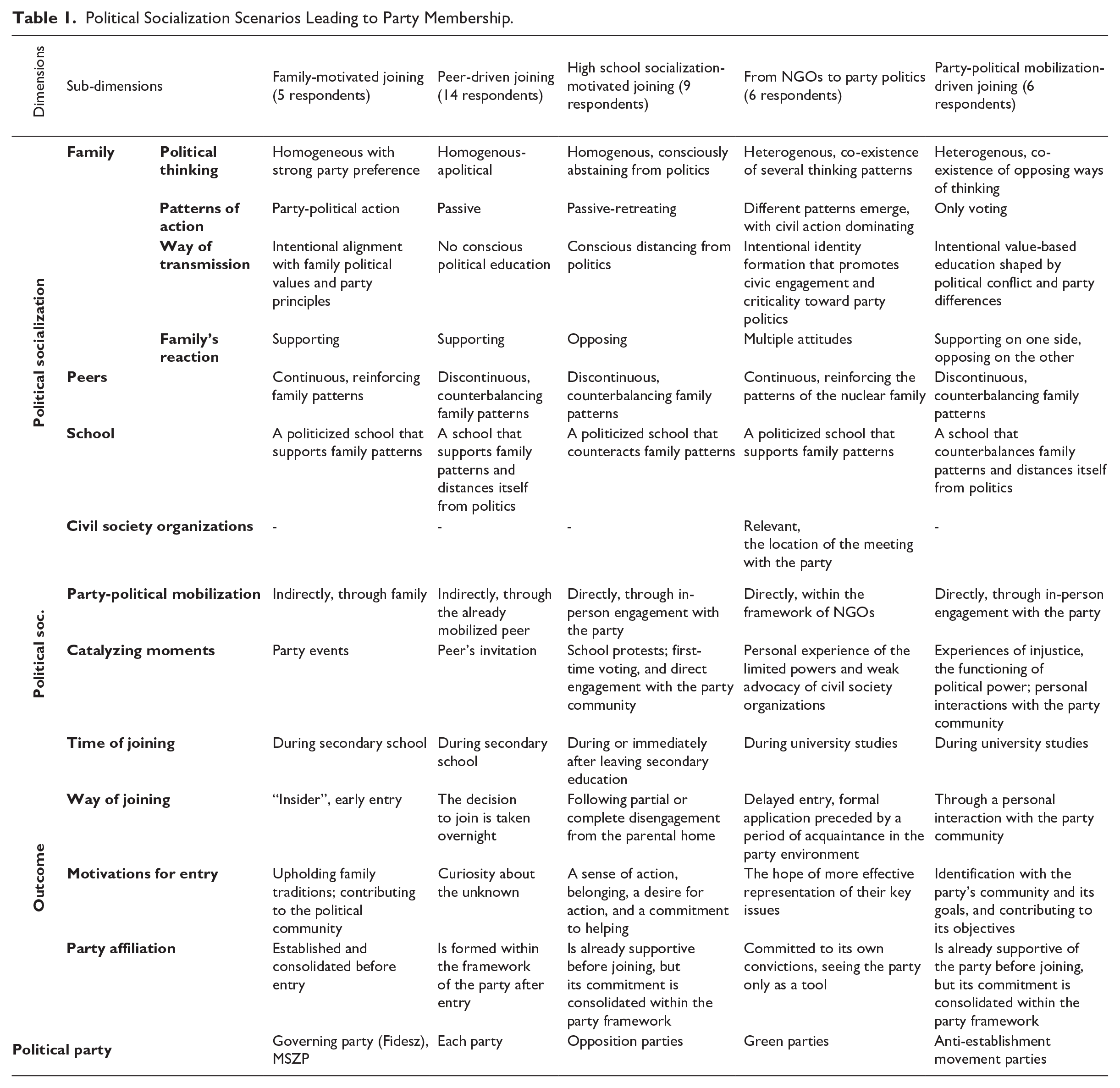
The following chapter provides a detailed analysis of each scenario, supplemented by relevant quotations.
Political Socialization Scenarios Leading to Party Membership Among Hungarian Students
Family-Motivated Joining
At first glance, the family-motivated joining scenario seems most similar to the consistent socialization trajectory observed among young Western party members. However, a closer analysis reveals two important differences. First, this socialization pattern is found mainly among students affiliated with the ruling party and the Hungarian Socialist Party (MSZP), parties that have existed since the regime change. Even within these groups, family-motivated party membership is less common and involves a transfer between only two generations—either from parents to children or, bypassing the parental generation, from grandparents to grandchildren. Second, this scenario represents a closed process of political socialization that contributes to the consolidation and unquestioned acceptance of a particular political identity but also tends to isolate participants from alternative perspectives and foster negative attitudes toward opposing opinions.
The starting point and the basis for this scenario is a family in which one or both grandparents or parents hold important political or party positions. These individuals, through direct involvement—such as involving their children or grandchildren in various party events—or indirectly, through their work, foster the development of their children’s or grandchildren’s inclination toward party politics, while shaping their political orientation in line with their own affiliation.
With regard to the outcome dimension of the way of joining, participants in this scenario are characterized by a sense of “insider” status, having been involved in the political community from an early age. They are personally acquainted with key party figures and have firsthand experience of their successes and failures. Here, the party serves as a primary socialization medium, like family, nursery, or school. Consequently, they see joining the party as a natural choice, representing the culmination of a socialization process that began in childhood.
This socialization process primarily leads to early entry. Young individuals following this trajectory often join their party’s local or youth organization when they reach the minimum age for party membership. Often, they are already active in party activities, making formal enrollment a symbolic act—an affirmation of commitment to their family, party, political traditions, and community.
As Ádám [MSZP] puts it: It was expected that I would come up with the idea. A lot of people say that I’m following in my father’s footsteps, which is partly true, but I didn’t join because of him, I joined because feel I belong here.
Tamás [MSZP] has a similar experience: I was exposed to the MSZP from birth—my grandfather, a founding member, was a local councilor, and my grandmother worked in local government. So MSZP has always been a part of my life. I can truly say that I inherited the social democratic ideology with my mother’s milk, and I couldn’t imagine myself in any other party.
The relationship of these young people to politics is shaped within this framework. They are socialized to identify with the party’s principles, and the patterns of action offered by the party are automatically incorporated into their notion of political participation. They see party politics as the primary vehicle for expressing social aspirations, interests, and values. While civil society organizations contribute to societal functions, their impact is limited—real social change, in their view, can only be achieved through parties.
With regard to the interplay between the various agents of political socialization, it should be noted that in this scenario, the political socialization occurs with minimal conflict, as the family’s moral and political values and approach to various events are seamlessly adopted. A stable value system, unified opinions, and supportive family relationships, reinforced by conscious parenting, ensure this smooth integration. From infancy, these individuals are immersed in like-minded social circles. Their parents enroll them in educational institutions that uphold family values. Within these schools, they are surrounded by peers who share similar views, and it is rare for teachers or classmates to present alternative perspectives to those established by the family.
As Martin [Fidesz] explains it: I spent 13 years in the same church-affiliated school, where the environment was predominantly conservative. Most of the teachers shared the values I had learnt at home, and in key subjects they strongly encouraged us towards the “right” values.
Similarly, Adam [MSZP] describes: It’s a mix of little things, like who you hang out with as a kid, who your parents hang out with, what school you go to, what camps you go to. For example, I went to a youth camp organized by the MSZP, and when it was over there was a little thank you ceremony and I was given a certificate for my participation, and then the party leader signed it and gave it to me. It’s one of those classic things where your parents consciously steer you in the right direction and you just think you’re going to a camp.
In addition, the fact that they are integrated into the party community at a crucial time in their personal development, where they are usually in contact with members older than themselves, reinforces the pattern tracing. The interaction with these individuals and the fact that they spend a significant part of their leisure time in this environment further limits the possibility of encountering very different beliefs and opinions. In this respect, the university brings a major change in their lives, where they are confronted with a much more diverse atmosphere. However, by then they have developed a strong resistance to diversity, gravitating toward like-minded peers and forming deeper connections only with those who share their views.
Among the various ideal-typical scenarios, those who join parties through family influence are the most stable in their political identity and have one of the strongest emotional attachments to their political community. They feel committed to the party as soon as they join. The main motivation for joining is, on the one hand, the desire to follow and continue family traditions and, on the other, to help the political community to which they belong together with their family.
Peer-Driven Joining
In terms of the dimensions of political socialization and their interplay, the peer-driven joining scenario differs markedly from the previous pathway. It usually occurs in families that are apolitical, characterized by political apathy, limited knowledge, and a lack of interest in historical or civic matters. Parents tend not to follow politics or express strong views, and political discussions within the household are rare and often characterized by resignation. Schools, which generally avoid addressing political topics, offer little counterbalance to this apolitical background.
The most critical phase of this scenario, however, occurs during the school years, particularly in adolescence, when a peer appears who is either already a member of a political party or has been strongly oriented toward party-political action through family socialization. This peer, through the friendship—or in some cases the romantic relationship—becomes the catalyst for the young people in this scenario to engage in party politics and choose a party. The relationship with this peer goes beyond an average social relationship. Over time, this peer becomes the main reference point and socializing factor that shapes the opinions and political outlook of the subjects in this scenario. Through this relationship they disengage from their family’s apolitical traditions, develop an interest in politics, and eventually join a political organization.
Several factors may contribute to the increased importance of this relationship. In some cases, a traumatic event in the family, such as a crisis or breakdown, reinforces the role of this peer more than would normally be the case. In other cases, the peer simply stands out due to his or her personality, making him or her particularly attractive to the young person. In some situations, this peer may be a flat mate, and the shared living arrangement deepens their bond and further solidifies their influence.
In terms of how they join, their motivations, and their party affiliation, peer-driven joiners enter the political party as complete outsiders, in contrast to family-motivated participants who have insider status. Their involvement is driven by a desire to follow a role model and by curiosity about the unfamiliar, without any pre-existing expectations, deep reflection, or strong political convictions before joining. Their loyalty to the party and their political beliefs take shape only after they have become part of the organization, which means that these factors are not prerequisites for membership.
As Ákos [MKKP] tells us: My roommate invited me to a party meeting, and since I was free, I went out of curiosity. That was my first encounter with the party. I hadn’t been interested in politics before and didn’t know much about them, but I liked what I saw and felt attracted to them. After that, I started to read up on political issues because I thought it was appropriate given my involvement (laughs).
Bence [Fidesz] expresses a similar perspective: Interestingly, when I joined, I had little political awareness and limited engagement with current events. My knowledge was minimal and I wasn’t strongly committed to any worldview. It was only after I became a member that I really immersed myself in politics.
Due to the weak political identity-forming influence of both family and school, individuals in this scenario approach party politics with a relatively “clean slate.” Their political knowledge, beliefs, and opinions are largely shaped by the peers who introduced them and by the party itself. In such cases, the party cannot rely on values acquired through family or school socialization but must take on a substitute socialization role. The quality of this socialization process within the party will be crucial in determining whether the individual develops a lasting commitment to the political community.
For participants in this political socialization scenario, there are no significant barriers to joining or participating in a political party within their home environment. Although their parents may initially be hesitant due to a lack of relevant experience, generally come to accept this involvement over time. Furthermore, in the long run, the child’s involvement in politics may encourage the development of the family’s own party affiliation and political participation.
As László [Jobbik] explains it: My family didn’t have such a well-established political identity. They basically started to get involved in politics after I joined the party to follow my activities, and that’s how they became quasi-voters of the party.
The peer-driven socialization scenario was observed among young members of both the ruling party and the various opposition parties included in the study. It emerged as the most common form of political socialization among the respondents.
High School Socialization-Motivated Joining
The starting point of the third trajectory is also an apolitical family environment. In these families, however, there is often a conscious effort to distance children from politics and to cultivate a non-political atmosphere within the household. This approach is typically rooted in the parents’ experiences of the communist past, though these experiences are conveyed in a fragmented and unclear manner. As a result, students exposed to this scenario tend to have limited identification with their parents’ fears. In fact, political socialization within the family proves counterproductive, as it inadvertently fosters rather than suppresses young people’s interest in politics.
As Zoltán [LMP] explains: There were no party members in our family because we were strong victims of socialism and resisted any form of party affiliation. We were a prominent capitalist, factory—owning family and lost everything after the war—half the family fled abroad. This history shaped my family’s closed and distant attitude to politics. So, I am the first truly “first generation” party member.
Similarly, Amanda [MKKP] describes: My mother is completely apolitical and indifferent to politics. My father, who spent most of his life under the previous regime, is deeply frightened. He always warned me to stay away from politics—he didn’t care what I did as long as it wasn’t politics. Even now, when I go out campaigning or protesting, he tells me to be careful, to keep a low profile, because those in power can destroy your life.
The shift away from family tradition takes place within the second political socialization dimension, in the context of secondary school, where both the teaching staff and the student community create an environment conducive to political engagement. Here, students are encouraged to go beyond the passive and withdrawn attitude instilled at home. The schools in this scenario are often highly politicized and oppositional. Teachers play a crucial role in fostering political awareness by encouraging students to discuss current events, form independent opinions, and critically evaluate the status quo. This process extends beyond theoretical discussion, as political advocacy on issues relevant to the school itself becomes an integral part of educational experience. Thus, secondary school provides a platform for practical political participation, paving the way for further engagement in political activities outside the school setting.
As András [Momentum] explains: I attended (name of high school), a school with strong liberal values where discussing politics was openly encouraged. Many of my teachers were activist-minded, and we were supported in standing up for various causes. At times, the entire student body participated in solidarity demonstrations. When the amendment to the Higher Education Act was introduced, it became a constant topic of discussion among students and teachers. It was a politically engaged school and community, without restrictions on political discourse. I know of schools where the administration strictly prohibits such discussions, but ours was not one of them.
Norbert [DK] shared similar experiences: Secondary school was very oppositional. They tried to teach us to think critically, and I think they succeeded. And as time went on, the teachers became more and more agitated against the whole system. And the whole school environment was like that.
In this scenario, the politically active secondary school environment encourages young people to take a political stance and seek an appropriate political identity. As they approach voting age, their awareness of political parties increases and identity formation becomes intertwined with party choice. Initially, they approach this as an exploratory process, engaging with different political communities—often online—where they can observe and interact with different perspectives from an outsider’s position.
Although this process often leads to a growing affinity for a particular political party, the decision to formally join is typically made during a face-to-face encounter with party members. It is through this direct interaction that young people become convinced that their political engagement should be channeled through the organization. However, unlike the previous socialization scenario, for those whose political awakening is rooted in secondary school experiences, the intention to join a party frequently generates conflict within the family. Enrollment in the party tends to occur only when parental consent is no longer required, or when the individual has gained sufficient independence, often by moving out of the family home or starting higher education.
In addition to their attraction to the party and its community, the political participation of individuals motivated by secondary school socialization is driven by a variety of internal desires and intentions. These manifest themselves as unfulfilled needs that have yet to find a specific direction, as inner motivations linked to ideas that remain undefined, and sometimes as a sense of underlying tension or anxiety. Key among these motivations is a strong desire to act, to belong, and to contribute—fueling a need to engage in meaningful political and social activities.
From NGOs to Party Politics
The fourth way of developing a willingness to engage in party politics is through NGOs. However, it is important to note that in this scenario, young people are not directly encouraged by NGOs to participate in party politics. Instead, the opportunity arises through political parties that collaborate with these organizations in various capacities.
A further distinguishing feature of this political socialization pathway lies in the dimensions of the way and motivations of joining. It is characterized by a prolonged period of reflection that precedes the decision to join a party, often lasting several years. This prolonged deliberation results from the strong countervailing influences of previous socialization experiences. Moreover, the decision to join a party is not driven by a natural affinity with a particular political community, but rather by personal experiences that reveal the limited influence and weak political advocacy capacity of domestic civil society organizations and movements.
As Klára [LMP] explains: I worked for a long time in civil associations, and it was only later, and with good reason, that I began to shift towards party politics. I realize that a political party, holds far more influence and potential to make a difference. If you are a civil activist, your voice is often unheard. But when you represent a party, the situation changes dramatically. I saw this as the best opportunity to make a difference and the most powerful tool to help others.
Krisztián [PM] says something similar: For a long time, I thought that party politicians and the party itself were such a bad thing, a bad formation, and that if you wanted to make a change, you shouldn’t do it in a party, but in NGOs and movements. But when you spend years in NGOs and movements, you realize how small you feel, how powerless you are, and how many tools a party has.
Students who follow the pathway from NGOs to political parties typically come from politically active families, where political awareness is a core value and political discussions are part of daily life. In contrast to the family-driven route, however, these individuals encounter a more heterogeneous political environment, characterized by different political traditions, values, and modes of action. However, the influence of the immediate family, especially the parents, plays a crucial role, not in promoting direct identification with party politics, but in shaping their civic identity and propensity to engage. This upbringing also cultivates a critical attitude toward party politics and encourages a more nuanced perspective on political participation.
In this scenario, participants are introduced to civic movements at an early age, mainly through the involvement of their parents. They experience the excitement of demonstrations and learn about critical issues that require public action. The involvement with family members continues throughout their school years. These young people attend schools with a highly politicized atmosphere, where both teachers and peers reinforce the values and actions cultivated at home, offering further opportunities for their political and civic engagement to flourish.
There is strong continuity between the high school and university peer communities. These students often apply to the same universities, pursue similar courses, and remain closely connected throughout their university years. Together, they participate in various student communities, professional groups, and civic organizations. Over time, political parties begin to appear within these circles, marking the beginning of a new phase in their lives.
The involvement of political parties within the framework of these civil organizations facilitates personal connections with party members, leading to a gradual reshaping of beliefs and opinions. This interaction often softens the originally civil students’ resistance to party politics. Cooperation between civil organizations and political parties thus becomes a crucial moment, as it challenges the students’ previous convictions, opening the door to a deeper engagement with the political landscape.
However, this re-evaluation process is often prolonged by the impact of prior socialization experiences, delaying the decision to join a party. Even after formal membership, the reappraisal remains incomplete. A further complicating factor is the opposition—perceived or real—from their usual peer group. This resistance creates tension, leading to a period of prolonged uncertainty and internal conflict during the transition to party membership. As a result, joining a party is not a seamless integration, but rather a period marked by persistent self-doubt and inner struggle.
As Zsófia [PM] clearly explains: This obviously goes back to what I said about the attitudes I acquired in my socialization, which make me constantly question whether this world of parties is for me.
Referring to the attitudes of her peers, Olivia [PM] said: Basically, joining a party in the left-wing environment in which I find myself is a kind of blasphemy, so it’s very unacceptable, and that’s why it wasn’t that I joined overnight, but that this process was prolonged.
Among the various ideal-typical scenarios, the party commitment of those coming from civil organizations is the weakest. For them, ideological conviction, not party-political organization, is of primary importance. Their official entry is typically preceded by a period of getting to know each other in the circle of the party, and their motivation to enter is given by the hope of more effective representation of the social issues they consider important.
In this scenario, family members are ambivalent about the decision to join the party. However, this is not due to a contradictory relationship between the parents and politics, but rather due to the different political and action preferences of the various family members. For this reason, the involvement of the participants in this scenario is met with supportive, neutral, and opposing attitudes within the family.
Party-Political Mobilization-Driven Joining
The main mobilizing factor in the last political socialization scenario is the invitation by political parties. While it is the parties’ mobilization activities that encourage young people to engage in party politics, their interest in politics and desire to act are already established during adolescence. However, due to a lack of peer support and opportunities in their family, school, or university environment, their political activity remains limited to intense political-public interest until a political party reaches out to them through an online or offline channel and invites them to join.
As Zsombor [Momentum] describes: I’ve always been interested in politics, but there were no political organizations around me to join. Then Momentum came along and built up its grassroots organizations across the country. I couldn’t go in person, but I read interviews with their leaders online and their values and beliefs resonated with me. When they set up a local organization in our community and started organizing beer parties every Thursday, I received an invitation on Facebook. I went and liked the atmosphere so much that I decided to stay.
Péter [MKKP] describes it similarly: These political events sparked my growing concern and curiosity about how I could become more actively involved. Then a friend and I noticed that an information session for MKKP was being organized in [name of town]. We went and listened to what was going on and had a chat with [name of politician] who organizes local activities. I liked it, and later there was a carnival community building event, which I attended on my own. In the end, I was the one who got involved.
As in the previous trajectory, the starting point of this scenario is a family environment with a heterogeneous political profile. In this case, however, the family members are typically divided into two opposing camps, which are subject to confrontations due to radically different political beliefs and party preferences. As a way of resolving these differences, young people adopt a strongly centrist political mindset during their political socialization and it is this quality that becomes one of the pillars of their positive response to the party’s invitation. The political parties that successfully appeal to these individuals tend to emphasize a commitment to distancing themselves from political extremism and ideological rigidity.
As Rebeka [LMP] explains: In my family, political affiliations are sharply divided: my father’s side supports Fidesz, while my mother was a strong supporter of MSZP and later DK. This division often led to conflicts at home. I don’t remember exactly when, but I once shouted: ‘Mum and dad, stop fighting! I’m going to found—as I said as a child—the Golden Mean Party. I think my concept was already influenced by the LMP, which opposed both Gyurcsány, the former left-wing prime minister, and Fidesz. I think this early experience played a fundamental role in shaping my centrist political orientation.
Evelin [Momentum] shared similar experiences: It’s quite strange because my family is very politically divided. Maybe that’s why I tend to gravitate towards the center, because I feel uncomfortable with extremes. One half of my family has strong left-wing views, while the other half isn’t strictly right-wing, but is characterized by strong support for Fidesz.
The other pillar of their engagement is rooted in dissatisfaction with the status quo and a desire for change, driven by personal experiences of injustice and recognition of the shortcomings of the political system. These anti-establishment sentiments, shaped by both personal dissatisfaction and disillusionment with political authority, are closely aligned with the messages of political parties advocating regime change. In addition, the personal connection formed within the party community plays a key role in the decision to join, as it allows young people to assess the credibility of the party and their own potential role. In this sense, the energizing effect of empathy, human gestures, and understanding within the party is crucial.
The main motivation for these young people to join the party is to identify with the party community and its goals, and to contribute to achieving those goals. This means that they feel a certain commitment to the organization from the moment they join, but that this commitment is developed and consolidated within the party later on.
As in the previous scenario, the family’s reception of their involvement is controversial. One half of the family, typically with left-wing values, is supportive, while the other half is opposed. However, this is not based on the ambivalence of the family members toward political participation, but rather on their opposition to the political party of their choice.
Conclusion
The aim of this exploratory study was to contribute to the existing body of literature on the political socialization process that leads young people to join political parties today. At the same time, however, the study sought to go beyond the perspective of previous, predominantly Western European research by examining the issue in a political context in which parties, as key institutions of representative democracy, are confronted with general crisis tendencies, such as the aging of party membership and the growing disengagement of young people from political parties and party politics, but also with other challenges that threaten representative democracy from another angle, such as the autocratic tendencies of the political system and the dominance of political and social spheres by a single party. Second, the study has also broadened the approach to the topic by including the role of political parties in the dynamic investigation of political socialization pathways leading to party membership, as opposed to the previous research that has only looked at young people and traditional socialization agents. Finally, it has simultaneously examined political socialization pathways and initial motivations for party membership, providing a conceptual link between political socialization research and studies on motivations. The results not only offer instructive insights in all three aspects but also highlight the need for further comparative research to fully understand the implications across different political contexts.
While the existing literature has demonstrated that in Western Europe a relatively conflict-free, coherent, and consistent political socialization process facilitates young people’s entry into political parties—where family traditions and the intergenerational transmission of party membership play a central role (e.g. Bruter and Harrison, 2009; Cross and Young, 2008; Paschou and Durán Mogollón, 2022)—this study reveals a markedly different pattern in Hungary. In a context where such traditions are largely absent due to the country’s historical past, and where democratic political socialization through primary agents remains deficient, young people follow different political socialization pathways to party membership. These trajectories are significantly more diverse, fragmented, and conflictual than those observed in Western Europe.
This finding underlines two critical points. First, it highlights the limited generalizability of political socialization research, as the process is deeply rooted in the historical, political, and social context of a given society—aspects that have received little attention in relevant research. Second, it challenges the common assumption that political engagement necessarily results from an exceptional social background and political socialization. In fact, the majority of young people in the sample came from politically under-socialized or deliberately distanced family environments. This result certainly merits further investigation to determine whether this pattern is unique to Hungary and other post-communist states, or whether it reflects a broader phenomenon that has been insufficiently explored in political socialization research to date.
Although the family route to party membership also exists in Hungary, it is neither widespread nor functionally equivalent to its Western European counterpart. Instead, it often involves a more closed socialization process, in which upbringing is structured to control external influences and isolate individuals from dissenting communities. This controlled socialization process presents potential risks to democratic functioning by limiting exposure to diverse viewpoints and fostering a more insular political culture. In other socialization scenarios, families may adopt a neutral or even oppositional stance toward political engagement, adding complexity to young people’s journeys toward party membership—already a challenging endeavor in the Hungarian context. Notably, young people tend to perceive the social costs associated with negative family and community reactions as more burdensome than the procedural challenges of political participation, such as bureaucratic barriers or the difficulties associated with opposition activities. This finding suggests that social and familial pressures play a pivotal role in shaping their political decisions, often outweighing more tangible barriers to engagement. This finding also highlights the complexity of and potential conflicts inherent in the political socialization process leading to party membership and underscores the importance of analyzing these dynamics to better understand their impact on young people’s engagement with political parties.
While political parties have not been at the center of studies of political socialization leading to party membership, the Western academic community has nevertheless acknowledged their potential responsibility in this process. As Cross and Young (2008: 365) argue: If political parties are unable to reinvigorate their membership base and portray an image of a more open and inclusive organizations, they risk being perceived increasingly as public utilities propped up by the state but with little connection to society. Put simply, the “pull” of family socialization will be inadequate to outweigh the more general societal “push” away from party membership.
The general lesson of the ideal-typical political socialization scenarios outlined in the study is also that parties remain of paramount importance. The conscious community-building and continuous mobilization strategy of the ruling party in the 2000s suggests that robust organizational networks and direct, face-to-face contact with a wide range of citizens are still critical strengths in politics, but the experiences of young people who come into contact with opposition parties also show that direct personal relationships with party communities can be extremely persuasive. This provides the impulse that confirms the intention to participate or triggers joining, but, for example, in the case of the scenario leading from civil organizations to parties, for example, it dissolves the objections related to party-political participation arising from previous socialization. This finding may be broadly generalizable and have cross-national implications, suggesting that political parties still have the potential to reverse their representation crisis and re-engage young people if they perceive movement-like structures not as a stage of development to be left behind over time, but as an integral part of party operation. On the other hand, face-to-face communication seems to be particularly important, presumably because this is where young people can really pay attention and, at best, be listened to, so that it is a two-way relationship, an interaction in which they feel part of something important and experience their personal importance.
In a political setting like Hungary, where basic democratic values and demands are weak, opposition parties face overwhelming obstacles in a system that remains nominally democratic, and civil society organizations are systematically excluded from political life, grassroots engagement strategies appear to be among the most viable solutions. It is a potential way to embed a democratic alternative in the deeper layers of society and, in the long run, to reverse the autocratic tendency.
Finally, with regard to the relationship between political socialization and motivations for joining parties, the analysis did not reveal clear pathways leading to specific parties. Rather, the scenarios identified tend to orient young people toward broader clusters of parties. This suggests that different forms of political socialization may orient young people toward both the ruling party and the opposition. Similarly, the study found no clear or consistent patterns of motivation that would distinguish those who join the ruling party from those who join opposition parties. Therefore, future research should focus on refining the typology of political socialization pathways and exploring how contextual factors, such as local political environments, party strategies, and generational value shifts, interact with motivations to shape affiliation with specific parties.
Importantly, in contrast to previous studies (e.g. Bruter and Harrison, 2009; Paschou and Durán Mogollón, 2022), which typically conclude that young people join political parties with fully formed political values and motivations, our findings suggest a different pattern in the Hungarian context. Except in cases where party membership is driven by family influence or transitions from civil society organizations, young people often join parties without fully developed political identities. This suggests that well-defined political orientations are not necessarily a prerequisite for party engagement, and that clearer ideological distinctions between members of opposition and governing parties may develop only over time. A longitudinal study tracking the evolution of these individuals’ motivations and political identities would provide valuable insights—an investigation beyond the scope of the present study, but a promising avenue for future research.
Supplemental Material
sj-docx-1-psx-10.1177_00323217251351529 – Supplemental material for Political Socialization Scenarios Leading to Party Membership in an Autocratizing Democracy: Insights From an Interview-Based Study
Supplemental material, sj-docx-1-psx-10.1177_00323217251351529 for Political Socialization Scenarios Leading to Party Membership in an Autocratizing Democracy: Insights From an Interview-Based Study by Annamária Sebestyén in Political Studies
Footnotes
Acknowledgements
I would like to express my sincere gratitude to the Momentum PRiSMa Research Group for their valuable support throughout the research and writing process.
Declaration of Conflicting Interests
The author(s) declared no potential conflicts of interest with respect to the research, authorship, and/or publication of this article.
Funding
The author(s) disclosed receipt of the following financial support for the research, authorship, and/or publication of this article: The research was supported by the Momentum program of the Hungarian Academy of Sciences (MTA–HUN-REN TK Lendület “Momentum” PRiSMa research project (LP2024-2/2024)).
Ethical Approval and Informed Consent Statements
The research was conducted and the study was written in full accordance with the principles of scientific ethics.

Supplementary Information
Additional Supplementary Information may be found with the online version of this article.
Contents
Appendix 1
Participant characteristics
Interview guidelines
Notes
Author biography
References
Supplementary Material
Please find the following supplemental material available below.
For Open Access articles published under a Creative Commons License, all supplemental material carries the same license as the article it is associated with.
For non-Open Access articles published, all supplemental material carries a non-exclusive license, and permission requests for re-use of supplemental material or any part of supplemental material shall be sent directly to the copyright owner as specified in the copyright notice associated with the article.
