



Abstract
Background:
Work-related injuries are a significant public health and socioeconomic concern, with the International Labour Organization reporting 2.3 million deaths and 340 million injuries annually worldwide. This study examined work-related injuries and occupational safety practices among sugar factory workers in Tanzania.
Methods:
This descriptive cross-sectional study, conducted from January to February 2024, involved 338 workers from two Tanzanian sugar industries. Participants were recruited using systematic sampling. Data were collected via structured questionnaires and environmental observation checklists. SPSS version 27 was used for descriptive univariate and bivariate analyses, with significance set at p < 0.05.
Results:
Among 338 workers, 14.8% reported injuries during the previous production session, with 89.3% occurring while performing tasks outside their assigned duties. The main causes were hand tools (35.7%) and fire or hot substances (21.4%), with abrasions (42.9%) being the most common injury type, primarily affecting the arms or hands (32%). Work-related injuries were significantly associated with occupational factors. Higher injury prevalence was observed among workers with <5 years of experience (48.1%, p = 0.02), factory employees (68.9%, p = 0.001), those without Ocupation Safety and Health (OSH) supervision (26.0% vs 11.1%, p = 0.004), and workers not using personal protective equipment (58.0% vs 42.0%, p = 0.02).
Conclusion:
Work-related injuries was relatively low but mostly occurred during unassigned tasks. Strengthening workplace safety culture, ensuring consistent supervision, and promoting proper protective equipment use are essential to reducing work-related injuries.
Introduction
Work-related injuries (WRI) pose significant challenges to public health and socioeconomic development, especially in developing countries where occupational safety and health receive limited attention. 1 According to the International Labour Organization (ILO) 2023 data, nearly three million people die from WRI and diseases annually, with over 7500 deaths daily. 2 Additionally, around 374 million occupational accidents occur each year, 3 underscoring the urgent need for better workplace safety and health management. Around 884 million people, or 50% of the global workforce, are engaged in agriculture, with the Asia-Pacific region accounting for 74%, Africa 16%, and Latin America 3%. 4 The sugar industry is vital to development, but workers face injuries and illnesses from harsh conditions, leading to chronic pain, stress, and reduced quality of life. 5 Strengthening safety and health programs is crucial for enhancing worker well-being and productivity.
Agriculture and agro-processing are among the most hazardous occupations globally, with fatal accidents in agriculture occurring at twice the rate of other industries. Of the 335,000 workplace fatalities reported worldwide, about 170,000 occur in agriculture, 6 with machinery and pesticide use significantly increasing the risks. Agriculture is the main source of employment in sub-Saharan Africa (SSA), where WRI are common. 7 A 2018 study reported WRI prevalence ranging from 1.6% to 20.4% across region. 8 In Tanzania, workers in the agriculture, food, and beverage sectors are at higher risk of WRI, highlighting the need for improved safety measures and training. 8
Tanzania aims to achieve upper-middle-income status by 2050 through industrialization. 9 However, this transition faces challenges, particularly in addressing occupational safety, health services, and WRI and diseases. 8 Tackling these issues is crucial for realizing Tanzania’s industrialization vision. From 2016 to 2019, a total of 4578 WRI, including 236 fatalities, were reported to the Tanzanian Workers Compensation Fund, though likely underreported due to inadequate documentation and the absence of a unified reporting system. 8 Limited data collection hinders understanding of occupational injuries across sectors like agriculture and manufacturing. 10
Occupational injuries are unacceptable as they raise equity concerns and cause significant financial losses to health systems, social security, employers, and society. 11 Fortunately, many effective and affordable preventive measures exist. The sugar industry involves both agricultural and factory work, each with distinct hazards: agricultural workers face heavy lifting and repetitive tasks, while factory workers are exposed to machinery, sharp tools, and heat. 12
Regular occupational safety supervision and proper use of personal protective equipment (PPE) are critical in reducing injuries. Effective supervision enforces safety protocols and fosters a culture of safety, while consistent PPE use, supported by training and accessible, comfortable equipment, significantly lowers injury risk.13,14 Work is essential to people’s lives, making occupational safety vital for community well-being. In Tanzania, WRI are common but not well documented. This study examined WRI and safety practices among workers in two sugar factories in Morogoro and Kilimanjaro regions to inform strategies for improving workplace safety, preventing injuries, and promoting worker health and productivity.
Materials and methods
Study design and area
A descriptive cross-sectional study assessed WRI and safety practices among workers in two Tanzanian sugar factories. Factory A, located in Morogoro (eastern Tanzania), was established in the 1960s, employs over 4500 workers, and is known for its safety protocols. Factory B, in Kilimanjaro (northern Tanzania), has operated since the 1930s, employs over 2900 workers, and focusses on sustainable practices.
Study population and sample size estimation
The study included employees aged 18 years or older from Factory A (Morogoro) and Factory B (Kilimanjaro), with a total workforce of 6771 employees. The required sample size was calculated using the finite population formula 15 :

where N = 6771, P = 20.4% (based on WRI prevalence in SSA), Z = 1.96 (95% confidence level), and E = 0.05 (margin of error). The initial sample size was 241, which was adjusted for a design effect of 1.5, resulting in a final sample size of 362 workers.
Sample selection
Participants were selected using systematic sampling. The factories were purposively chosen based on accessibility, willingness to participate, and operational stability during the study period. The total sample of 338 workers was allocated proportionally according to each factory’s workforce: 65% from Factory A and 35% from Factory B. Within each factory, workers were stratified into two groups: Agriculture (crop production, engineering, and optimization units) and Manufacturing (operational sections and shifts). The sampling interval was calculated by dividing the number of eligible workers by the required sample size for each factory. The first participant was selected randomly, and subsequent participants were chosen at regular intervals until the target sample was reached.
Inclusion criteria
Participants were required to be at least 18 years old and provide written informed consent. Eligible operational/field workers were those directly involved in production in the agriculture and manufacturing departments, with experience from the previous production season.
Exclusion criteria
Non-operational/field workers were excluded because their work environments and risk exposures differ from production areas. Workers who were physically or mentally unfit to participate, such as those on medical leave or with impairments preventing reliable data collection, were also excluded. In total, 24 workers were excluded.
Outcome variable
The dependent variable, WRI, was classified into three categories based on injury severity: mild injuries requiring only first aid, moderate injuries necessitating hospital care or up to 3 days of sick leave, and severe injuries involving hospital admission or sick leave exceeding 3 days. The injury recall period covered the previous 6 months to capture recent and relevant injury events.
Independent variables
This study evaluated three key variables: worker-related (sex, age, marital status, education, employment type, experience, job title, and department), work-related environmental (weekly hours, supervision, health training, and medical exams), and behavioural factors (smoking, alcohol use, sleep disorders, job satisfaction, and PPE usage).
Hours worked per week: Categorized as ⩽45 or >45 h/week to reflect participants’ weekly workload relative to the company’s standard full-time schedule.
Presence of OHS training: Whether the participant has received Occupational Safety and Health training (yes/no).
Presence of workplace OHS supervision: Indicates whether participants work under qualified occupational safety supervision (yes/no).
Utilization of PPE: Whether participants consistently use PPE (yes/no).
Alcohol consumption: Categorized based on drinking patterns over the past 12 months: 0 = nondrinker: does not consume alcohol; 1 = occasional drinker: consumes alcohol less than once per week or one to two drinks per occasion; 2 = heavy drinker: for men, ⩾15 drinks/week; for women, ⩾8 drinks/week; or binge drinking (⩾5 drinks for men, ⩾4 drinks for women) on multiple occasions.
Cigarette smoking: Categorized based on smoking behavior: 0 = nonsmoker: does not smoke; 1 = occasional smoker: smokes <1–5 cigarettes/day, not daily; 2 = regular smoker: smokes daily, usually >5 cigarettes/day.
Sleeping disorders: In this study, sleeping disorders are defined as conditions that disrupt normal sleep patterns, including difficulty falling or staying asleep (insomnia) and interruptions in breathing during sleep (sleep apnoea). These were assessed through participants’ self-reports of sleep problems affecting alertness and work performance, along with potential contributing factors such as night shifts, lack of shift rotation, or holding multiple jobs simultaneously.
Sources of injury refer to the agents or situations causing WRI among participants. Categorizes as hand tools (e.g. hammers, knives, and screwdrivers), fire or hot objects (e.g. flames, hot surfaces, or liquids), machinery (injuries from moving equipment), collisions with objects (being struck by falling or moving items), and electricity and falls, combined because both often result from similar workplace hazards, such as wet surfaces or poor lighting.
Employment type was categorized as permanent, seasonal, or temporary. Permanent employees had ongoing contracts with full benefits. Seasonal workers were employed during high-demand periods, such as the harvest, typically recurring annually. Temporary workers were hired for short, task-specific projects without recurring contracts, representing a more ad hoc arrangement than seasonal employment.
Data collection tools
Data were collected using a tool adapted from the ILO occupational health surveillance methods and tailored to the local context. 16 This tool combined elements such as hospitalization days, work absences, alcohol and cigarette consumption, and safety training attendance to assess risk factors and safety protocol understanding. Originally developed in English, it was translated into Kiswahili for cultural appropriateness and piloted for accuracy. The pretest was conducted with 20 sugar industry workers from a different factory not included in the study sample to evaluate clarity, cultural relevance, and ease of administration. Feedback from the pretest led to minor revisions in wording and question order to improve comprehension and flow. Five experts reviewed the tool, yielding a Content Validity Index 17 of 0.91/item and 0.92 overall, and reliability analysis showed a Cronbach’s alpha of 0.88. Two clinical medicine diploma holders were trained for 2 days on research ethics, data collection, and tool use. Workers were approached during their shifts by factory supervisors. Participation was voluntary with no monetary incentives; participants were informed about the study’s purpose, assured confidentiality, and the importance of their input. Data collection, from January to February 2024, involved obtaining informed consent, administering the Kiswahili questionnaire, and using an observational checklist. The questionnaire was programmed into Kobo Toolbox to facilitate efficient digital data entry. To ensure quality, the principal investigator randomly selected 5% of the completed questionnaires for double data entry by a second data clerk, comparing them with the original entries to detect inconsistencies (Supplemental Material).
Data analysis
Data entry and cleaning were conducted using Microsoft Excel, with missing values verified and corrected before analysis. Statistical analyses were performed using IBM SPSS Statistics, Version 27.0 (IBM Corporation, Armonk, NY, USA). Descriptive statistics were used to summarize sociodemographic characteristics: categorical variables were presented using frequencies and percentages, while continuous variables were summarized using means and standard deviations. Results were presented using tables and charts for clarity. Bivariate analysis was conducted to assess associations between selected independent variables, and the occurrence of WRI. Chi-square (χ2) tests were used for categorical variables. A p < 0.05 was considered statistically significant. No regression modelling or calculation of incidence rates was performed, in line with the descriptive nature of the study.
Results
Social demographic characteristics of the respondents
A total of 362 workers were approached, with 338 participating, resulting in a response rate of ~93.4%. Participants included 54.7% males and 45.3% females, with an average age of 26.9 years (±3.58). Marital status showed that 61.2% were married, and 42% had a primary school education or lower. Employment types included 49.1% seasonal workers, with 39.3% having 1–3 years of experience and 8.3% more than 10 years. Many temporary and seasonal workers also undertook other physically demanding agricultural tasks, such as planting, harvesting, or transporting produce, which may have increased fatigue and heightened their risk of injury.
Most participants (57.4%) were on manufacturing, factory workers. Regarding substance use, most participants were nondrinkers (79.3%) and nonsmokers (96.2%; Table 1).
Sociodemographic characteristics of participants (n = 338).

Work environment and worker behavior characteristics
Table 2 shows that the majority of participants (96.2%) worked ⩽45 h/week, and 87.3% received Occupational Health and Safety (OSH) training, with 73.9% trained within the past year. Qualified supervision was reported by 86.2%, and 98.3% underwent regular medical check-ups. Sleep disorders affected 13.9% of individuals, largely due to holding multiple jobs (63.8%). Job satisfaction was high (94.7%), and 62.1% used PPE.
Environmental and behavioral factors of participants (n = 338).

PPE: personal protective equipment.
Causes and sources of WRI
Table 3 shows that 50 (14.8%) of the 338 workers reported injuries during the previous production session, with an overwhelming 89.3% of these injuries occurring while performing tasks outside their assigned duties. Hand tools (35.7%) and fire or hot substances (21.4%) emerged as the leading causes. Most injured workers (75.9%) sought hospital treatment, 4.3% required hospitalization, and over half (57.1%) were absent from work for more than 3 days.
Distribution of injury sources and tasks during injuries among participants (n = 50).

Figure 1 shows that the most prevalent type of injury was abrasion, 21 (42.9%).
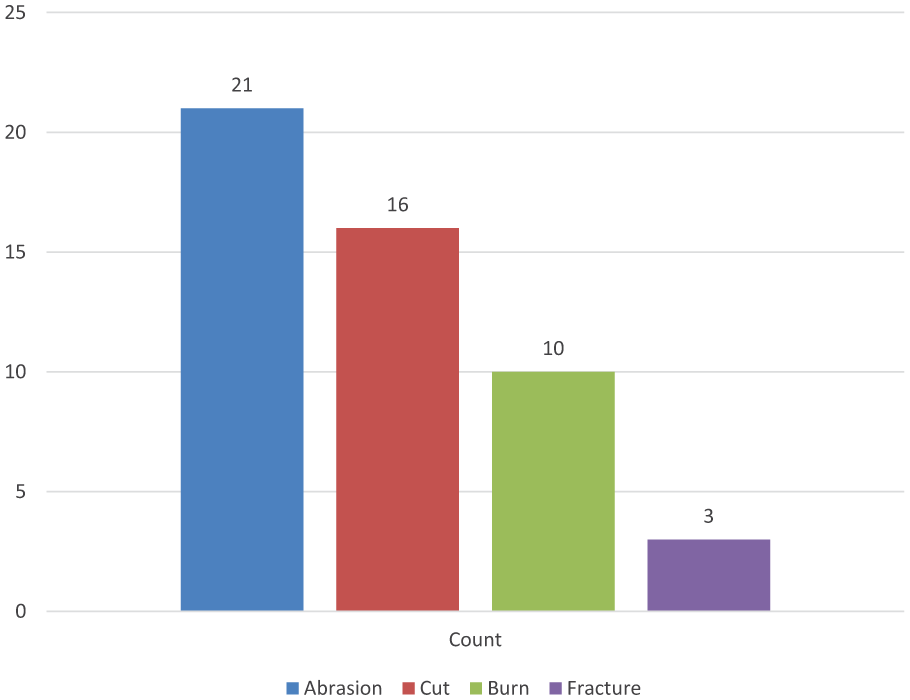
Distribution of work-related injuries by type of injury among participants (n = 50).
Figure 2 shows that the most affected body part in WRI was the upper or lower arm/hands, with 16 cases (32%), followed by the leg with 13 cases (26%), multiple sites with nine cases (18%), head with seven cases (14%), and trunk with five cases (10%).
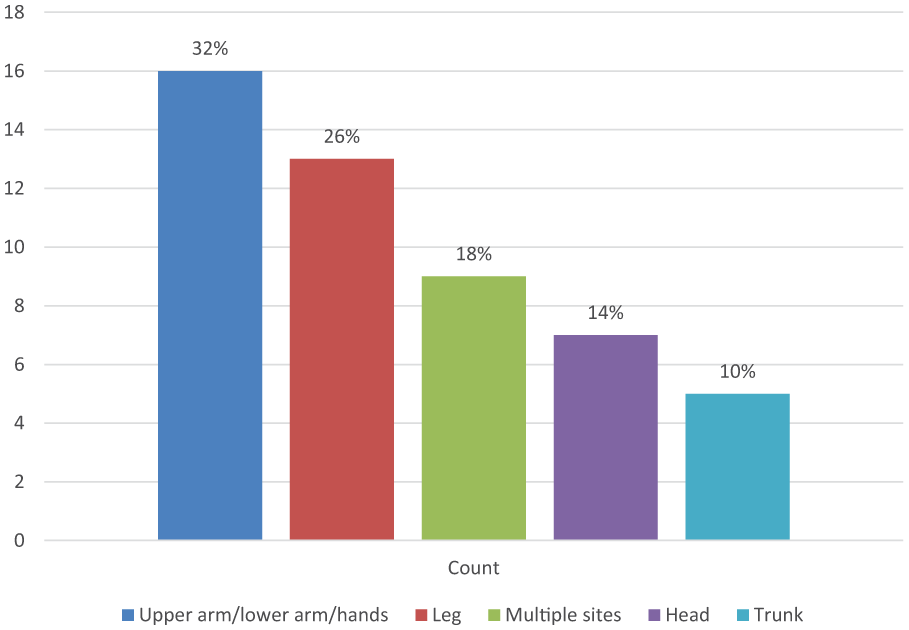
Distribution of work-related injuries by body part among sugar industry workers in Tanzania (n = 50).
Bivariate analysis of factors associated with WRI among sugar factory workers
Table 4 shows associations between WRI and four factors. Workers with <5 years of experience reported more injuries (48.1%) than those with 6–10 years (18.6%) or over 10 years (33.3%; p = 0.02). Injuries were higher among factory workers (68.9%) than among agriculture workers (31.1%; p = 0.001). Lack of OSH supervision was linked to more injuries (26.0%) compared to supervised workers (11.1%; p = 0.004). Similarly, nonuse of PPE was associated with more injuries (58.0%) than PPE use (42.0%; p = 0.02).
Bivariate analysis of factors associated with WRI among sugar factory workers (n = 338).

PPE: personal protective equipment.
Discussion
This study found that 14.8% of workers in two sugar factories in Tanzania sustained WRI. Notably, 89.3% of injuries occurred during tasks outside assigned duties, highlighting the increased risk associated with unfamiliar or untrained activities. Similar studies indicate that deviations from assigned tasks elevate injury risk due to inadequate training, poor supervision, or improper use of tools.18,19 There is a need to prioritize mechanization, ergonomics, and clear job roles, along with cross-training and supervision, to reduce injuries during nonroutine tasks.
The leading causes of WRI in this study, hand tools and fire/hot substances, mirror global patterns in the sugarcane industry. Similar to reports from Brazil, where machetes cause nearly half of workplace accidents, manual tool handling remains a major hazard. 20 Heat and burn injuries are also common, often linked to field burning and processing activities.21,22 Other studies show sugarcane workers face various risks, including accidents, repetitive strain injuries, and exposure to thermal, chemical, and mechanical hazards.23,24 To reduce injuries among sugarcane workers, targeted interventions should focus on safe tool handling, PPE use, and heat/fire protection, supported by training, supervision, shaded rest areas, and regular medical check-ups.
In this study, a high incidence of abrasions among sugarcane workers, primarily affecting the arms and hands, aligns with findings from other regions.20,23 These injuries are typically caused by slippage of tools or impact with hard surfaces, leading to abrasions and more severe injuries to the upper extremities.21,24 In Brazil, for instance, machetes are involved in nearly 49% of work-related accidents, often causing injuries to the hands and legs. 20 Similarly, a study from India shows that injuries from hand tools, such as sickles and axes, are common among sugarcane workers. 25 The prevalence of abrasions indicates the need for targeted safety interventions, including training on safe tool use, provision of protective gloves and arm guards, supervision, first-aid access, and promotion of hazard reporting, rest breaks, and community safety awareness.
Workers with less than five years of experience had more injuries than those with 6–10 or over 10 years, likely due to limited familiarity with tasks, safety protocols, and the work environment. They face higher risks from inexperience, less-developed skills, and assignment to hazardous tasks.26,27 Consistent with previous research, injury rates decrease as job tenure increases.26,28,29 Newly hired or mobile workers are particularly at risk because they perform unfamiliar tasks and may lack full understanding of safety rules, often taking at least 1 year to reach the risk level of longer-tenured employees. 27 While some studies report no clear association in specific populations, most evidence supports that less experience correlates with higher injury rates.26,28
In our study, workers with less than five years of experience were more represented not only in the WRI group but also made up the majority of the No WRI group (65%), suggesting a more complex relationship between work experience and injury risk. Other factors, such as task assignment, safety culture, and adherence to protocols, may have influenced injury patterns. Local factories could address this through targeted safety induction, mentorship by experienced workers, and close supervision during the initial months of employment. Future research is recommended to further explore these dynamics in similar occupational settings.
This study found that workplaces without OSH supervision had higher injury rates, and workers not using PPE experienced more injuries. Consistent supervision, practical training, and access to appropriate PPE play a critical role in reducing WRI. 30 Effective supervision reinforces safety protocols and fosters a safety culture,30,31 while PPE compliance improves when workers are trained and provided with comfortable, suitable equipment. 32 However, barriers such as discomfort, lack of awareness, or assignment to higher-risk tasks can limit consistent PPE use.32,33 Implementing regular OSH supervision, practical safety training in Kiswahili, provision of comfortable PPE, and peer-led hazard reporting can collectively support a sustainable safety culture and safer work environment.
Study limitations and policy implications
This study provides valuable insights into WRI prevalence and risk factors among Tanzanian sugarcane workers, but it has limitations. Its cross-sectional design prevents establishing causality, and reliance on self-reported data may introduce recall and social desirability biases, including telescoping, where events occurring outside the 6-month recall period may have been reported. Minor injuries and sensitive behaviors like alcohol use and PPE compliance may be under- or over-reported. The study did not consider organizational factors such as departmental roles or management practices that may influence safety. Some temporary and seasonal workers had other jobs outside the factories, which could affect injury risk but were not assessed. Findings may not generalize beyond the study setting. Despite these limitations, the results have important policy implications. The study highlights the need for targeted interventions to improve sugarcane worker safety in Tanzania, including proper supervision, ongoing Kiswahili safety training, provision of comfortable PPE, clear job roles, task rotation, and cross-training. Promoting a strong safety culture through peer champions, hazard reporting, and regular briefings can further reduce injuries and guide factory management and policymakers in designing effective, context-specific occupational safety programs.
Conclusion
Strengthening workplace safety in Tanzanian sugarcane factories requires practical training, effective supervision, and appropriate PPE. Culturally and linguistically tailored interventions, worker participation, and continuous monitoring are essential for sustaining a strong safety culture. While this study offers valuable descriptive insights, future research using longitudinal or regression-based designs is needed to clarify causal relationships and quantify the impact of risk factors. Such evidence can inform policies and practices to reduce injuries, improve worker well-being, and enhance productivity in the sugar industry.
Supplemental Material
sj-docx-1-smo-10.1177_20503121251385675 – Supplemental material for Work-related injuries and occupational safety practices among sugar factory workers in Tanzania: A cross-sectional study
Supplemental material, sj-docx-1-smo-10.1177_20503121251385675 for Work-related injuries and occupational safety practices among sugar factory workers in Tanzania: A cross-sectional study by Isaya Charles Mwera, Magnus Michael Sichalwe, Simon H. Mamuya and Luco Patson Mwelange in SAGE Open Medicine
Footnotes
Acknowledgements
The authors would like to express their sincere gratitude to the Muhimbili University of Health and Allied Sciences (MUHAS) Research and Ethics Committee for promptly granting ethical approval for this study. We also extend our appreciation to the management of the selected sugar industries for their permission and support in facilitating the research process. Special thanks go to all the workers who participated in the study for their time, cooperation, and valuable insights. Their contributions were essential to the success of this research.

Ethical considerations
This study received ethical approval under reference number MUHAS-REC-12-2023-198. Permission to conduct the research and publish findings was also obtained from the management of the selected sugar industries.
Consent to participate
Written informed consent was obtained from all participants after explaining the study’s purpose, procedures, and their right to withdraw at any time. Confidentiality and anonymity were ensured throughout the study.
Author contributions
Isaya Charles Mwera: conceptualization, methodology, data collection and curation, formal analysis, funding acquisition, investigation, resources, project administration, writing – original draft, writing – review and editing. Magnus Michael Sichalwe: methodology, data curation, formal analysis, investigation, resources, project administration, writing – original draft, writing – review and editing. Simon H. Mamuya: conceptualization, project administration, supervision, methodology, writing – review and editing. Luco Patson Mwelange: conceptualization, project administration, supervision, methodology, writing – review and editing.
Funding
The authors received no financial support for the research, authorship, and/or publication of this article.
Declaration of conflicting interests
The authors declared no potential conflicts of interest with respect to the research, authorship, and/or publication of this article.
Data availability statement
The data supporting the findings of this study are available from the corresponding author upon reasonable request.
Supplemental material
Supplemental material for this article is available online.
References
Supplementary Material
Please find the following supplemental material available below.
For Open Access articles published under a Creative Commons License, all supplemental material carries the same license as the article it is associated with.
For non-Open Access articles published, all supplemental material carries a non-exclusive license, and permission requests for re-use of supplemental material or any part of supplemental material shall be sent directly to the copyright owner as specified in the copyright notice associated with the article.
